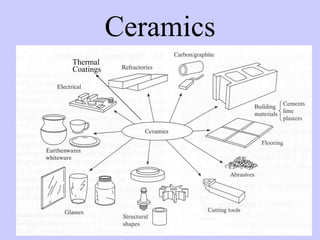
Ceramics
Thermal
Coatings
History and Background
• Applications date into antiquity - earthenware,
pottery, clay product, bricks, etc
• More modern uses: Transparent glass,
structural glass, refractories
• Advanced uses: Thermal barrier coatings,
structural ceramics, composite armor,
electronics, glass-ceramics
• Ceramics can be Amorphous or Crystalline
• Atomic structure contains strong Ionic Bonds
What are they?
• A compound of metallic and nonmetallic
elements, for which the inter atomic
bonding is predominantly ionic.
• They tend to be oxides, carbides, etc of
metallic elements.
• The mechanical properties are usually good:
high strength, especially at elevated
temperature.
• However, they exhibit low to nil-ductility,
and have low fracture toughness.
Crystalline Ceramics
• As with plastics, the amorphous ceramics
tend to be transparent
• The structural ceramics tend to be
crystalline and show greater strength, as
well as stability at high temperature
Structure Anion Packing Examples
AX FCC NaCl, MgO, FeO
AX Simple Cubic CsCl
AX FCC ZnS, SiC
AX2 Simple Cubic CaF2, UO2, ThO2
ABX3 FCC BaTiO3, SrZrO3
AB2X4 FCC MgAl2O4, FeAl2O4
AX Structure - CsCl
Simple Cubic Crystal
Cs+
• Cl-
Note: This is not
a BCC structure.
AX Structure - NaCl
2- FCC
interpenetrating
lattices.
Try it!
a
a
Cl-
Na+
For this NaCl structure, the
crystal lattice parameter is
a= 2 ( r Na+ + r Cl -),
where r is ionic radius.
Compute the theoretical density of Rock Salt based on its crystal structure.
)
2.16g/cm
(actual
g/cm
14
2
)ions/mol
(6.023x10
)]cm
0.181x10
0
2[(0.102x1
g/mol
35.45)
(22.99
ions
4
N
a
)
A
A
(
4
V
M
3
3
23
3
7
7
A
3
Cl
Na










.

AX structure - Si C
Summary of most common
ceramic crystal structures
Silicate Ceramics
• Silica, SiO2
• Many
polymorphs:
Quartz
Crystobalite
Tridymite
• Low density:
Quartz:
2.65g/cm3
Crystalline Crystabolite
Carbon
• Pure carbon has many polymorphs with
vastly varying properties. It also exists in
the amorphous state.
• Diamond: Is similar to ZnS in structure
• Graphite is considered to be a crystalline
ceramic
• Fullerenes, C60, are a newly discovered
polymorph - with interesting properties.
Diamond
• AX type crystal structure similar
to that of ZnS.
• Each carbon atom is covalently bonded to four
other C atoms in a diamond-cubic crystal
structure.
• The material is optically transparent and
extremely hard (hardest natural material known)
and durable.
• In engineering applications, cruder or industrial
forms of diamond, that are much less expensive
than the gemstone forms, are used as abrasives,
indentors, and coatings (especially thin films) for
Graphite
• Layers of hexagonally arranged and
covalently bonded C atoms.
• Between layers, weaker Van der Walls
bonds are active, giving easy slip
on the {0001} crystallographic planes.
• Excellent as a dry lubricant, relatively high strength at
elevated temperatures, high thermal and electrical
conductivity, low thermal expansion, resistance to
thermal shock, and good machinability.
• Usage: electrodes, heating elements, crucibles,
casting molds, rocket nozzles, and other applications.
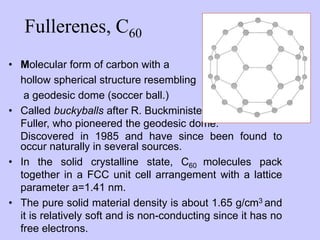
Fullerenes, C60
• Molecular form of carbon with a
hollow spherical structure resembling
a geodesic dome (soccer ball.)
• Called buckyballs after R. Buckminister
Fuller, who pioneered the geodesic dome.
Discovered in 1985 and have since been found to
occur naturally in several sources.
• In the solid crystalline state, C60 molecules pack
together in a FCC unit cell arrangement with a lattice
parameter a=1.41 nm.
• The pure solid material density is about 1.65 g/cm3 and
it is relatively soft and is non-conducting since it has no
free electrons.
Properties of Buckyballs
• When alkali metal anions, most notably K+, are in the
structure (usually 3 per C60 molecule), the resulting
molecular material (K3C60) displays the characteristics of
a metal. In fact, K3C60 is considered to be the first
molecular metal ever encountered.
• K3C60 buckyballs and similar molecular materials
become super conducting (practically no electrical
resistance) at about 18K (relatively high temperature for
this phenomenon)
• Applications in low-power consumption, low-pollution,
magnetic-levitation and propulsion devices for mass
transit systems.
• Other synthetic ceramic materials have been developed
that display superconductivity at even higher
temperatures (up to 100K) above the temperature of
Try It!
• Calcualte the theoretical density of
pure C60 based on a FCC unit cell
as shown:
a=1.41 nm
)
1.65g/cm
(actual
1.71g/cm
N
)
(1.41x10
11)
4(60)(12.0
V
M
3
3
A
3
7



 

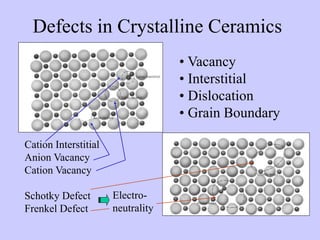
Defects in Crystalline Ceramics
• Vacancy
• Interstitial
• Dislocation
• Grain Boundary
Cation Interstitial
Anion Vacancy
Cation Vacancy
Schotky Defect
Frenkel Defect
Electro-
neutrality
Mechanical Properties
• Brittle Materials, hard to perform a Tension Test.
• Flexural Test (Bend) is often substituted.
• Obtain Flexural Strength (Modulus of Rupture),
Stiffness (Modulus of Elasticity), and Ductility.
• Strength is often good, Stiffness my be high, but
Ductility and affected properties are poor.
• In crystalline ceramics, dislocation motion is
difficult because of the need to maintain electro-
neutrality. Consequently plastic deformation is
restricted.
Flexural Test Configuration
a
L
a
P P
b
d
Four point bend fixture
D
X-Section
3
D
Pa
32
mr
2
d
b
a
P
6
mr


 

Rectangular: Circular:
Stress-Strain Behaviour
0.0010
0.0008
0.0006
0.0004
0.0002
0.0000
0
100
200
300
Bending Strain
Bending
Stress,
MPa
Aluminum Oxide
Soda-Lime Glass
Mechanical Properties of Various Ceramics
a Sintered with about 5% porosity
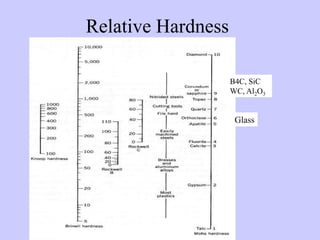
Hardness of Ceramics
Relative Hardness
B4C, SiC
WC, Al2O3
Glass
Effect of Porosity on Stiffness
)
0.9P
1.9P
(1
E
E 2
o 


Where Eo is the theoretical modulus of elasticity with no
porosity, and P is the volume fraction of porosity.
Effect of Porosity on Strength
Where o is the theoretical modulus of rupture with no
porosity, P is the volume fraction of porosity, and n is an
empirical material constant
nP
e
o
mr

 

Fracture Toughness
Fracture Toughness (MPam)
Amorphous Ceramics - Glasses
(Na20, Ca0, K2O, etc)
• The viscosity of the material at ambient temperature is
relatively high, but as the temperature increases there is a
continuous decrease in viscosity.
• When the viscosity has decreased to the point that the
ceramic is a fluid, it is considered to have melted.
• At ambient temperature while it is still solid, it is said to be
in the “glassy” condition.
• There is no distinct melting temperature (Tm) for these
materials as there is with the crystalline materials.
• The glass transition temperature, Tg, is used to define the
temperature below which the material is a “solid” and
defines a practical upper limit on service temperature.
Specific volume of
amorphous and crystalline
ceramics.
Viscous Behaviour in
Amorphous Ceramics
• Plastic deformation does not occur by dislocation motion in
amorphous or non-crystalline ceramics, such as glass.
•Deformation is by viscous flow: rate of deformation proportional
to applied stress.
dy
dv
A
F
/
;


 

 = shear stress
 = viscosity of
material
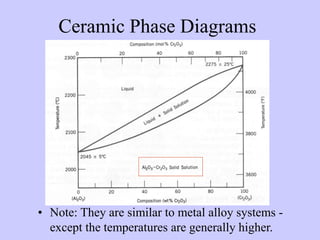
Ceramic Phase Diagrams
• Note: They are similar to metal alloy systems -
except the temperatures are generally higher.
Binary Eutectic Ceramic Alloy
Spinel

ceramics1.ppt

  • 1.
  • 2.
    History and Background •Applications date into antiquity - earthenware, pottery, clay product, bricks, etc • More modern uses: Transparent glass, structural glass, refractories • Advanced uses: Thermal barrier coatings, structural ceramics, composite armor, electronics, glass-ceramics • Ceramics can be Amorphous or Crystalline • Atomic structure contains strong Ionic Bonds
  • 3.
    What are they? •A compound of metallic and nonmetallic elements, for which the inter atomic bonding is predominantly ionic. • They tend to be oxides, carbides, etc of metallic elements. • The mechanical properties are usually good: high strength, especially at elevated temperature. • However, they exhibit low to nil-ductility, and have low fracture toughness.
  • 4.
    Crystalline Ceramics • Aswith plastics, the amorphous ceramics tend to be transparent • The structural ceramics tend to be crystalline and show greater strength, as well as stability at high temperature Structure Anion Packing Examples AX FCC NaCl, MgO, FeO AX Simple Cubic CsCl AX FCC ZnS, SiC AX2 Simple Cubic CaF2, UO2, ThO2 ABX3 FCC BaTiO3, SrZrO3 AB2X4 FCC MgAl2O4, FeAl2O4
  • 5.
    AX Structure -CsCl Simple Cubic Crystal Cs+ • Cl- Note: This is not a BCC structure.
  • 6.
    AX Structure -NaCl 2- FCC interpenetrating lattices.
  • 7.
    Try it! a a Cl- Na+ For thisNaCl structure, the crystal lattice parameter is a= 2 ( r Na+ + r Cl -), where r is ionic radius. Compute the theoretical density of Rock Salt based on its crystal structure. ) 2.16g/cm (actual g/cm 14 2 )ions/mol (6.023x10 )]cm 0.181x10 0 2[(0.102x1 g/mol 35.45) (22.99 ions 4 N a ) A A ( 4 V M 3 3 23 3 7 7 A 3 Cl Na           . 
  • 8.
  • 9.
    Summary of mostcommon ceramic crystal structures
  • 10.
    Silicate Ceramics • Silica,SiO2 • Many polymorphs: Quartz Crystobalite Tridymite • Low density: Quartz: 2.65g/cm3
  • 11.
  • 12.
    Carbon • Pure carbonhas many polymorphs with vastly varying properties. It also exists in the amorphous state. • Diamond: Is similar to ZnS in structure • Graphite is considered to be a crystalline ceramic • Fullerenes, C60, are a newly discovered polymorph - with interesting properties.
  • 13.
    Diamond • AX typecrystal structure similar to that of ZnS. • Each carbon atom is covalently bonded to four other C atoms in a diamond-cubic crystal structure. • The material is optically transparent and extremely hard (hardest natural material known) and durable. • In engineering applications, cruder or industrial forms of diamond, that are much less expensive than the gemstone forms, are used as abrasives, indentors, and coatings (especially thin films) for
  • 14.
    Graphite • Layers ofhexagonally arranged and covalently bonded C atoms. • Between layers, weaker Van der Walls bonds are active, giving easy slip on the {0001} crystallographic planes. • Excellent as a dry lubricant, relatively high strength at elevated temperatures, high thermal and electrical conductivity, low thermal expansion, resistance to thermal shock, and good machinability. • Usage: electrodes, heating elements, crucibles, casting molds, rocket nozzles, and other applications.
  • 15.
    Fullerenes, C60 • Molecularform of carbon with a hollow spherical structure resembling a geodesic dome (soccer ball.) • Called buckyballs after R. Buckminister Fuller, who pioneered the geodesic dome. Discovered in 1985 and have since been found to occur naturally in several sources. • In the solid crystalline state, C60 molecules pack together in a FCC unit cell arrangement with a lattice parameter a=1.41 nm. • The pure solid material density is about 1.65 g/cm3 and it is relatively soft and is non-conducting since it has no free electrons.
  • 16.
    Properties of Buckyballs •When alkali metal anions, most notably K+, are in the structure (usually 3 per C60 molecule), the resulting molecular material (K3C60) displays the characteristics of a metal. In fact, K3C60 is considered to be the first molecular metal ever encountered. • K3C60 buckyballs and similar molecular materials become super conducting (practically no electrical resistance) at about 18K (relatively high temperature for this phenomenon) • Applications in low-power consumption, low-pollution, magnetic-levitation and propulsion devices for mass transit systems. • Other synthetic ceramic materials have been developed that display superconductivity at even higher temperatures (up to 100K) above the temperature of
  • 17.
    Try It! • Calcualtethe theoretical density of pure C60 based on a FCC unit cell as shown: a=1.41 nm ) 1.65g/cm (actual 1.71g/cm N ) (1.41x10 11) 4(60)(12.0 V M 3 3 A 3 7      
  • 18.
    Defects in CrystallineCeramics • Vacancy • Interstitial • Dislocation • Grain Boundary Cation Interstitial Anion Vacancy Cation Vacancy Schotky Defect Frenkel Defect Electro- neutrality
  • 19.
    Mechanical Properties • BrittleMaterials, hard to perform a Tension Test. • Flexural Test (Bend) is often substituted. • Obtain Flexural Strength (Modulus of Rupture), Stiffness (Modulus of Elasticity), and Ductility. • Strength is often good, Stiffness my be high, but Ductility and affected properties are poor. • In crystalline ceramics, dislocation motion is difficult because of the need to maintain electro- neutrality. Consequently plastic deformation is restricted.
  • 20.
    Flexural Test Configuration a L a PP b d Four point bend fixture D X-Section 3 D Pa 32 mr 2 d b a P 6 mr      Rectangular: Circular:
  • 21.
  • 22.
    Mechanical Properties ofVarious Ceramics a Sintered with about 5% porosity
  • 23.
  • 24.
  • 25.
    Effect of Porosityon Stiffness ) 0.9P 1.9P (1 E E 2 o    Where Eo is the theoretical modulus of elasticity with no porosity, and P is the volume fraction of porosity.
  • 26.
    Effect of Porosityon Strength Where o is the theoretical modulus of rupture with no porosity, P is the volume fraction of porosity, and n is an empirical material constant nP e o mr    
  • 27.
  • 28.
    Amorphous Ceramics -Glasses (Na20, Ca0, K2O, etc) • The viscosity of the material at ambient temperature is relatively high, but as the temperature increases there is a continuous decrease in viscosity. • When the viscosity has decreased to the point that the ceramic is a fluid, it is considered to have melted. • At ambient temperature while it is still solid, it is said to be in the “glassy” condition. • There is no distinct melting temperature (Tm) for these materials as there is with the crystalline materials. • The glass transition temperature, Tg, is used to define the temperature below which the material is a “solid” and defines a practical upper limit on service temperature.
  • 29.
    Specific volume of amorphousand crystalline ceramics.
  • 30.
    Viscous Behaviour in AmorphousCeramics • Plastic deformation does not occur by dislocation motion in amorphous or non-crystalline ceramics, such as glass. •Deformation is by viscous flow: rate of deformation proportional to applied stress. dy dv A F / ;       = shear stress  = viscosity of material
  • 31.
    Ceramic Phase Diagrams •Note: They are similar to metal alloy systems - except the temperatures are generally higher.
  • 32.