THE CONQUEST TO THE
CENTRAL DOGMA OF
MOLECULAR BIOLOGY
By:
AAAAAA
Subject Teacher, Biotechnology
THE CONQUEST TO THE
CENTRAL DOGMA OF
MOLECULAR BIOLOGY
By:
AAAAAA
Subject Teacher, Biotechnology
THE CONQUEST TO THE
CENTRAL DOGMA OF
MOLECULAR BIOLOGY
By:
AAAAAA
Subject Teacher, Biotechnology
THE CONQUEST TO THE
CENTRAL DOGMA OF
MOLECULAR BIOLOGY
By:
AAAAAA
Subject Teacher, Biotechnology
THE CONQUEST TO THE
CENTRAL DOGMA OF
MOLECULAR BIOLOGY
By:
AAAAAA
Subject Teacher, Biotechnology
THE CONQUEST TO THE
CENTRAL DOGMA OF
MOLECULAR BIOLOGY
By:
AAAAAA
Subject Teacher, Biotechnology
THE CONQUEST TO THE
CENTRAL DOGMA OF
MOLECULAR BIOLOGY
By:
AAAAAA
Subject Teacher, Biotechnology
THE CONQUEST TO THE
CENTRAL DOGMA OF
MOLECULAR BIOLOGY
By:
AAAAAA
Subject Teacher, Biotechnology
THE CONQUEST TO THE
CENTRAL DOGMA OF
MOLECULAR BIOLOGY
By:
AAAAAA
Subject Teacher, Biotechnology
THE CONQUEST TO THE
CENTRAL DOGMA OF
MOLECULAR BIOLOGY
By:
AAAAAA
Subject Teacher, Biotechnology
Terminal Objectives
Identify the key structural features of DNA and
RNA
Differentiate DNA and RNA by revisiting their
structures and functions
Determine how DNA is transcribed into RNA
Translate genetic information from RNA to amino
acid
Create amino acid sequence based on
information present in mRNA
The Central Dogma of Molecular Biology
DNA ---------→ RNA---------→Protein.
TRANSCRIPTION TRANSLATION
But first let us take into consideration the key structural features of the
Nucleic acids, the DNA and the RNA
Understanding the
Deoxyribonucleic Acid
Watch Offline
Watch Online
https://www.youtub
e.com/watch?v=o_-
6JXLYS-k
Key Structural features of DNA
Deoxyribonucleic acid
or DNA
a double helix
formed by base pairs
attached to a sugar-
phosphate
backbone.
The blueprint of life
Key Structural features of DNA
Nucleotide
consists of a sugar
molecule (either ribose
in RNA or deoxyribose
in DNA) attached to a
phosphate group and a
nitrogen-containing
base.
Key Structural features of DNA
Nucleotide in a
DNA sequence
Nucleotide is the
building block of
nucleic acids
Key Structural features of DNA
Deoxyribose is
the five-carbon
sugar molecule t
hat helps form
the phosphate
backbone of
DNA molecules.
Key Structural features of DNA
Nitrogenous Bases or nitrogen-
containing base, is an organic
molecule with a nitrogen atom that
has the chemical properties of a
base.
The main biological function of a
nitrogenous base is to bond nucleic
acids together.
Key Structural features of DNA
 Nitrogenous Bases are divided into 2
groups the Pyrimidines and the
Purines
Pyrimidines are composed of Cytosine
(C) and Thymine (T) (Uricil is present
only in RNA replacing Thymine)
Purines are composed of Adenine (A)
and Guanine (G)
The Nitrogenous Base Pairing is
governed by the Chargaff’s Rule
Key Structural features of DNA
Nitrogenous Base Pairing
Chargaff’s rule: The rule that
in DNA there is always equality in
quantity between the bases A
and T and between the bases G
and C. (A is adenine, T is thymine,
G is guanine, and C is cytosine.)
Adenine (A) can only be
paired with Thymine (T)
while Guanine (G) can only
be paired with Cytosine (C)
and vice versa
How does Chagaff’s Rule work in DNA?
Remember that DNA is a double helix (2 stranded
molecule) wherein A is paired with T, and G is paired
with C and vice versa. Try to determine the
complementary base pair of the given 1st strand of
DNA
ATC GCA ACC TGC
___ ___ ___ ___
ACG
TGG
CGT
TAG
1ST STRAND
2ND STRAND
Significance of complementary base
pairing
The importance of such complementary base pairing is
that each strand of DNA can act as template to direct
the synthesis of other strand similar to its
complementary one.
Thus nucleic acids are uniquely capable of directing
their own self replication.
The information carried by DNA and RNA direct the
synthesis of specific proteins which control most
cellular activities.
Key Structural features of RNA
Ribonucleic acid or RNA
It is formed of linear
polynucleotide
It is generally single stranded
molecule
The pentose sugar is Ribose
Uracile (U) replaces Thymine
(T) in the pyrimidine bases.
Types of RNA
Messenger RNA (mRNA):
Transfer RNA (tRNA):
Ribosomal RNA (rRNA):
Types of RNA
Messenger RNA (mRNA):
Carries genetic information copied from DNA in the form of a
series of 3-base code, each of which specifies a particular
amino acid.
Messenger RNA Carries Information from DNA in a Three-
Letter Genetic Code (CODON)
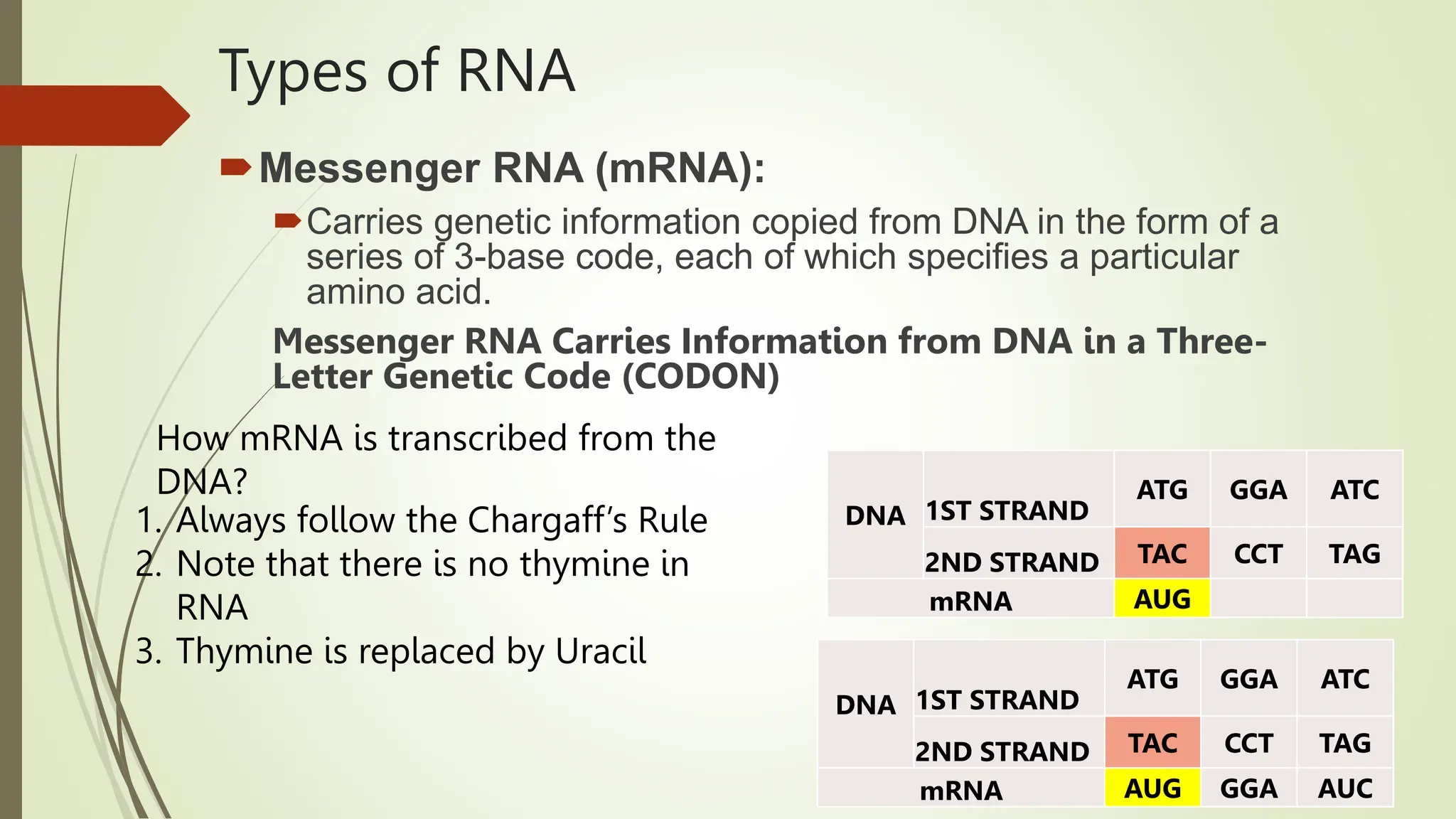
How mRNA is transcribed from the
DNA?
1. Always follow the Chargaff’s Rule
2. Note that there is no thymine in
RNA
3. Thymine is replaced by Uracil
DNA 1ST STRAND
ATG GGA ATC
2ND STRAND TAC CCT TAG
mRNA AUG
DNA 1ST STRAND
ATG GGA ATC
2ND STRAND TAC CCT TAG
mRNA AUG GGA AUC
Types of RNA
Transfer RNA (tRNA):
It is the key that read the code on the mRNA.
Each amino acid has its own tRNA, which binds to it and carries
it to the growing end of a polypeptide chain.
Ribosomal RNA (rRNA):
Associated with a set of proteins to form the ribosomes.
These complex structures, which physically move along the
mRNA molecule, catalyze the assembly of amino acids into
protein chain.
They also bind tRNAs that have the specific amino acids
according to the code.
DIFFERENCES OF DNA AND RNA
DEOXYRIBONUCLEIC ACID
(DNA)
 DOUBLE HELIX
 SUGAR=DEOXYRIBOSE (NO
HYDROXYL (OH) GROUP ON
THE SECOND CARBON OF
PENTOSE RING
 NITROGENOUS BASE PAIR
ADENINE-THYMINE; CYTOSINE-
GUANINE
RIBONUCLEIC ACID (RNA)
 SINGLE HELIX/SINGLE
STRAND
 SUGAR=RIBOSE (WITH
HYDROXYL (OH) GROUP
ON THE SECOND
CAROBON OF PENTOSE
RING
 NITROGENOUS BASE PAIR
ADENINE-URACIL; CYTOSINE-
GUANINE
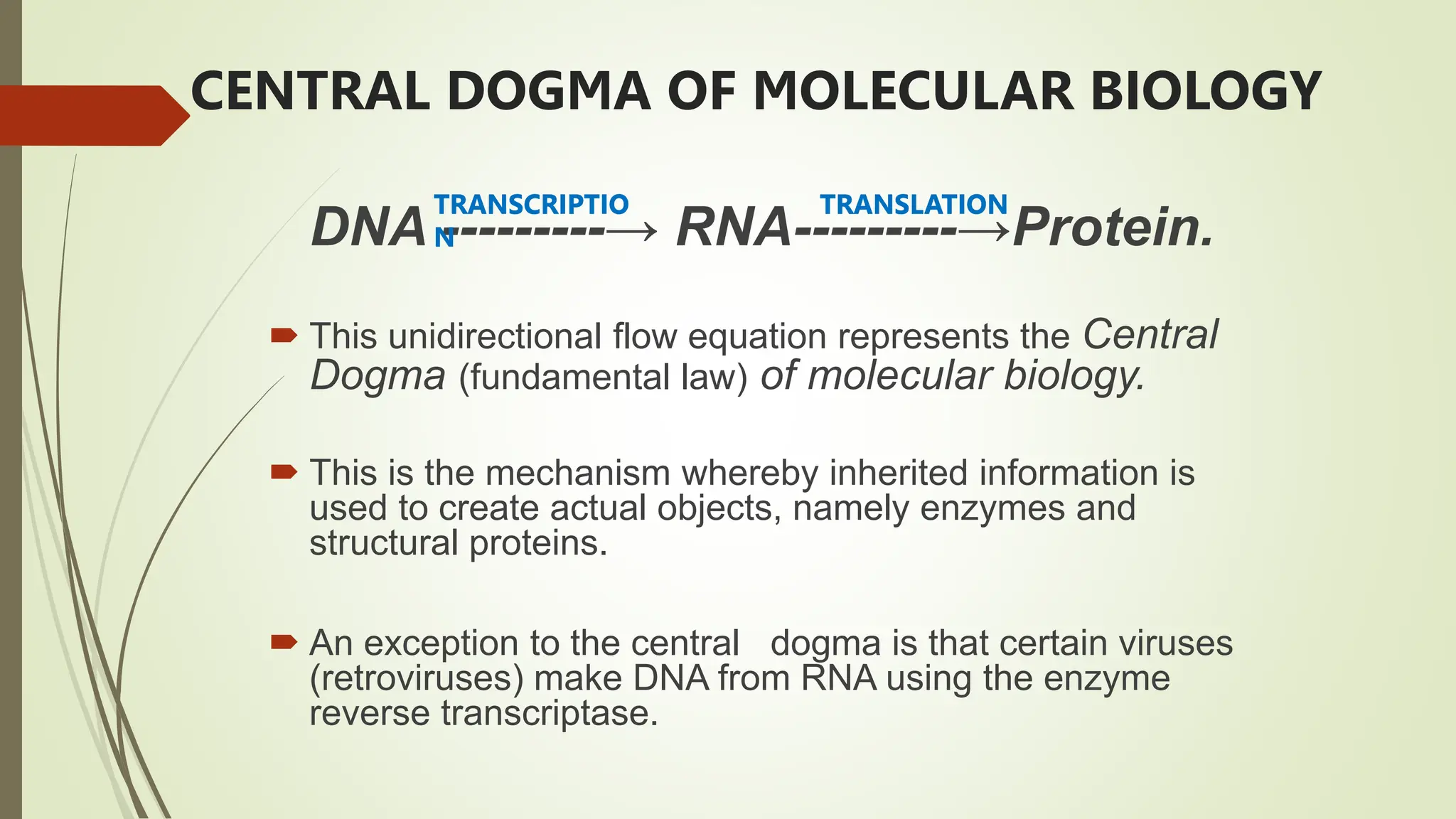
CENTRAL DOGMA OF MOLECULAR BIOLOGY
DNA ---------→ RNA---------→Protein.
 This unidirectional flow equation represents the Central
Dogma (fundamental law) of molecular biology.
 This is the mechanism whereby inherited information is
used to create actual objects, namely enzymes and
structural proteins.
 An exception to the central dogma is that certain viruses
(retroviruses) make DNA from RNA using the enzyme
reverse transcriptase.
TRANSCRIPTIO
N
TRANSLATION
TRANSCRIPTIO
N
TRANSLATION
STEPS IN TRANSLATING GENITIC CODE TO
AMINO ACID
 In the first step, the information in DNA is transferred to a
messenger RNA (mRNA) molecule by way of a process
called transcription.
DNA
1ST
STRAND
ATA ATG GGA ATC TAA
2ND
STRAND
TAT TAC CCA TAG ATT
mRNA ATA AUG CCA AUC UAA
Within all cells,
the translation
machinery
resides within a
specialized
organelle called
the ribosome.
mRNA (CODON) serves as the template in
creating amino acid
TRANSLATION
 During translation, which
is the second major step
in gene expression, the
mRNA is "read"
according to the genetic
code, which relates the
DNA sequence to
the amino acid sequence
in proteins
DNA
1ST
STRAN
D
ATA ATG GGA ATC TAA
2ND
STRAN
D
TAT TAC CCA TAG ATT
mRNA ATA AUG CCA AUC UAA
AMINO ACID MET LEU ILU STOP
TRANSLATION
DNA
1ST
STRAND
ATA ATG GGA ATC TAA
2ND
STRAND
TAT TAC CCA TAG ATT
mRNA ATA AUG CCA AUC UAA
AMINO ACID MET LEU ILU STOP
USE THE AMINO ACID TABLE TO DETERMINE THE
AMINO ACID OF A GIVEN CODON.
IN TRANSLATING mRNA into amino
acid always begin with the start
codon (AUG) that will yield
Methionine and translation will end
at stop codon. ATA is not a start
codon, so it is not translated.
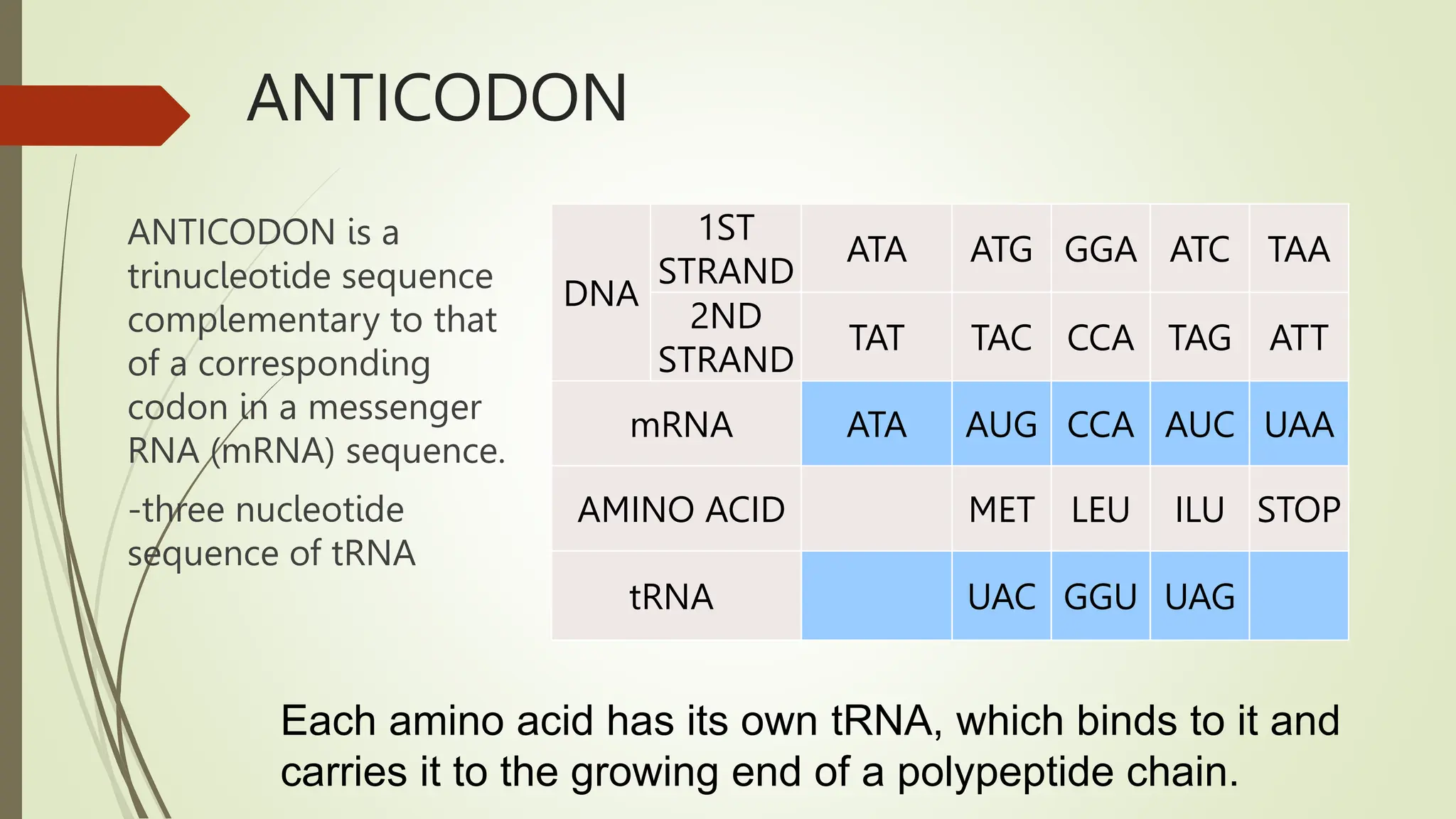
ANTICODON
ANTICODON is a
trinucleotide sequence
complementary to that
of a corresponding
codon in a messenger
RNA (mRNA) sequence.
-three nucleotide
sequence of tRNA
DNA
1ST
STRAND
ATA ATG GGA ATC TAA
2ND
STRAND
TAT TAC CCA TAG ATT
mRNA ATA AUG CCA AUC UAA
AMINO ACID MET LEU ILU STOP
tRNA UAC GGU UAG
Each amino acid has its own tRNA, which binds to it and
carries it to the growing end of a polypeptide chain.
TERMINATION OF TRANSLATION
There are three termination codons that are employed
at the end of a protein-coding sequence in mRNA:
UAA, UAG, and UGA. No tRNAs recognize these
codons. Thus, in the place of these tRNAs, one of
several proteins, called release factors, binds and
facilitates release of the mRNA from the ribosome and
subsequent dissociation of the ribosome.
SUMMARY
Practice
 Complete the table by supplying the DNA complementary base pairs, mRNA,
amino acids, and tRNA
DNA
1ST
STRAND
ATG AAG CAA TAG TAA
2ND
STRAND
mRNA
AMINO ACID
tRNA
ANSWER
 Complete the table by supplying the DNA complementary base pairs, mRNA,
amino acids, and tRNA
DNA
1ST
STRAND
ATG AAG CAA TAC TAA
2ND
STRAND
TAC TTC GTT ATG ATT
mRNA AUG AAG CAA UAC UAA
AMINO ACID Met Lys Gln Tyr STOP
tRNA UAC UUC GUU AUC
 https://ghr.nlm.nih.gov/primer/basics/dna
 https://www.genome.gov/genetics-glossary/Nucleotide
 https://www.genome.gov/sites/default/files/tg/en/illustration/nucleotide.jpg
 https://biologydictionary.net/deoxyribose/
 https://socratic.org/questions/561a8dec11ef6b598845f269
 https://www.nature.com/scitable/topicpage/translation-dna-to-mrna-to-protein-
393/

CENTRAL DOGMA OF MOLECULAR.pptx

  • 1.
    THE CONQUEST TOTHE CENTRAL DOGMA OF MOLECULAR BIOLOGY By: AAAAAA Subject Teacher, Biotechnology
  • 2.
    THE CONQUEST TOTHE CENTRAL DOGMA OF MOLECULAR BIOLOGY By: AAAAAA Subject Teacher, Biotechnology
  • 3.
    THE CONQUEST TOTHE CENTRAL DOGMA OF MOLECULAR BIOLOGY By: AAAAAA Subject Teacher, Biotechnology
  • 4.
    THE CONQUEST TOTHE CENTRAL DOGMA OF MOLECULAR BIOLOGY By: AAAAAA Subject Teacher, Biotechnology
  • 5.
    THE CONQUEST TOTHE CENTRAL DOGMA OF MOLECULAR BIOLOGY By: AAAAAA Subject Teacher, Biotechnology
  • 6.
    THE CONQUEST TOTHE CENTRAL DOGMA OF MOLECULAR BIOLOGY By: AAAAAA Subject Teacher, Biotechnology
  • 7.
    THE CONQUEST TOTHE CENTRAL DOGMA OF MOLECULAR BIOLOGY By: AAAAAA Subject Teacher, Biotechnology
  • 8.
    THE CONQUEST TOTHE CENTRAL DOGMA OF MOLECULAR BIOLOGY By: AAAAAA Subject Teacher, Biotechnology
  • 9.
    THE CONQUEST TOTHE CENTRAL DOGMA OF MOLECULAR BIOLOGY By: AAAAAA Subject Teacher, Biotechnology
  • 10.
    THE CONQUEST TOTHE CENTRAL DOGMA OF MOLECULAR BIOLOGY By: AAAAAA Subject Teacher, Biotechnology
  • 11.
    Terminal Objectives Identify thekey structural features of DNA and RNA Differentiate DNA and RNA by revisiting their structures and functions Determine how DNA is transcribed into RNA Translate genetic information from RNA to amino acid Create amino acid sequence based on information present in mRNA
  • 12.
    The Central Dogmaof Molecular Biology DNA ---------→ RNA---------→Protein. TRANSCRIPTION TRANSLATION But first let us take into consideration the key structural features of the Nucleic acids, the DNA and the RNA
  • 13.
    Understanding the Deoxyribonucleic Acid WatchOffline Watch Online https://www.youtub e.com/watch?v=o_- 6JXLYS-k
  • 15.
    Key Structural featuresof DNA Deoxyribonucleic acid or DNA a double helix formed by base pairs attached to a sugar- phosphate backbone. The blueprint of life
  • 16.
    Key Structural featuresof DNA Nucleotide consists of a sugar molecule (either ribose in RNA or deoxyribose in DNA) attached to a phosphate group and a nitrogen-containing base.
  • 17.
    Key Structural featuresof DNA Nucleotide in a DNA sequence Nucleotide is the building block of nucleic acids
  • 18.
    Key Structural featuresof DNA Deoxyribose is the five-carbon sugar molecule t hat helps form the phosphate backbone of DNA molecules.
  • 19.
    Key Structural featuresof DNA Nitrogenous Bases or nitrogen- containing base, is an organic molecule with a nitrogen atom that has the chemical properties of a base. The main biological function of a nitrogenous base is to bond nucleic acids together.
  • 20.
    Key Structural featuresof DNA  Nitrogenous Bases are divided into 2 groups the Pyrimidines and the Purines Pyrimidines are composed of Cytosine (C) and Thymine (T) (Uricil is present only in RNA replacing Thymine) Purines are composed of Adenine (A) and Guanine (G) The Nitrogenous Base Pairing is governed by the Chargaff’s Rule
  • 21.
    Key Structural featuresof DNA Nitrogenous Base Pairing Chargaff’s rule: The rule that in DNA there is always equality in quantity between the bases A and T and between the bases G and C. (A is adenine, T is thymine, G is guanine, and C is cytosine.) Adenine (A) can only be paired with Thymine (T) while Guanine (G) can only be paired with Cytosine (C) and vice versa
  • 22.
    How does Chagaff’sRule work in DNA? Remember that DNA is a double helix (2 stranded molecule) wherein A is paired with T, and G is paired with C and vice versa. Try to determine the complementary base pair of the given 1st strand of DNA ATC GCA ACC TGC ___ ___ ___ ___ ACG TGG CGT TAG 1ST STRAND 2ND STRAND
  • 23.
    Significance of complementarybase pairing The importance of such complementary base pairing is that each strand of DNA can act as template to direct the synthesis of other strand similar to its complementary one. Thus nucleic acids are uniquely capable of directing their own self replication. The information carried by DNA and RNA direct the synthesis of specific proteins which control most cellular activities.
  • 24.
    Key Structural featuresof RNA Ribonucleic acid or RNA It is formed of linear polynucleotide It is generally single stranded molecule The pentose sugar is Ribose Uracile (U) replaces Thymine (T) in the pyrimidine bases.
  • 25.
    Types of RNA MessengerRNA (mRNA): Transfer RNA (tRNA): Ribosomal RNA (rRNA):
  • 26.
    Types of RNA MessengerRNA (mRNA): Carries genetic information copied from DNA in the form of a series of 3-base code, each of which specifies a particular amino acid. Messenger RNA Carries Information from DNA in a Three- Letter Genetic Code (CODON) How mRNA is transcribed from the DNA? 1. Always follow the Chargaff’s Rule 2. Note that there is no thymine in RNA 3. Thymine is replaced by Uracil DNA 1ST STRAND ATG GGA ATC 2ND STRAND TAC CCT TAG mRNA AUG DNA 1ST STRAND ATG GGA ATC 2ND STRAND TAC CCT TAG mRNA AUG GGA AUC
  • 27.
    Types of RNA TransferRNA (tRNA): It is the key that read the code on the mRNA. Each amino acid has its own tRNA, which binds to it and carries it to the growing end of a polypeptide chain. Ribosomal RNA (rRNA): Associated with a set of proteins to form the ribosomes. These complex structures, which physically move along the mRNA molecule, catalyze the assembly of amino acids into protein chain. They also bind tRNAs that have the specific amino acids according to the code.
  • 28.
    DIFFERENCES OF DNAAND RNA DEOXYRIBONUCLEIC ACID (DNA)  DOUBLE HELIX  SUGAR=DEOXYRIBOSE (NO HYDROXYL (OH) GROUP ON THE SECOND CARBON OF PENTOSE RING  NITROGENOUS BASE PAIR ADENINE-THYMINE; CYTOSINE- GUANINE RIBONUCLEIC ACID (RNA)  SINGLE HELIX/SINGLE STRAND  SUGAR=RIBOSE (WITH HYDROXYL (OH) GROUP ON THE SECOND CAROBON OF PENTOSE RING  NITROGENOUS BASE PAIR ADENINE-URACIL; CYTOSINE- GUANINE
  • 30.
    CENTRAL DOGMA OFMOLECULAR BIOLOGY DNA ---------→ RNA---------→Protein.  This unidirectional flow equation represents the Central Dogma (fundamental law) of molecular biology.  This is the mechanism whereby inherited information is used to create actual objects, namely enzymes and structural proteins.  An exception to the central dogma is that certain viruses (retroviruses) make DNA from RNA using the enzyme reverse transcriptase. TRANSCRIPTIO N TRANSLATION TRANSCRIPTIO N TRANSLATION
  • 31.
    STEPS IN TRANSLATINGGENITIC CODE TO AMINO ACID  In the first step, the information in DNA is transferred to a messenger RNA (mRNA) molecule by way of a process called transcription.
  • 32.
    DNA 1ST STRAND ATA ATG GGAATC TAA 2ND STRAND TAT TAC CCA TAG ATT mRNA ATA AUG CCA AUC UAA Within all cells, the translation machinery resides within a specialized organelle called the ribosome. mRNA (CODON) serves as the template in creating amino acid
  • 33.
    TRANSLATION  During translation,which is the second major step in gene expression, the mRNA is "read" according to the genetic code, which relates the DNA sequence to the amino acid sequence in proteins DNA 1ST STRAN D ATA ATG GGA ATC TAA 2ND STRAN D TAT TAC CCA TAG ATT mRNA ATA AUG CCA AUC UAA AMINO ACID MET LEU ILU STOP
  • 34.
    TRANSLATION DNA 1ST STRAND ATA ATG GGAATC TAA 2ND STRAND TAT TAC CCA TAG ATT mRNA ATA AUG CCA AUC UAA AMINO ACID MET LEU ILU STOP USE THE AMINO ACID TABLE TO DETERMINE THE AMINO ACID OF A GIVEN CODON. IN TRANSLATING mRNA into amino acid always begin with the start codon (AUG) that will yield Methionine and translation will end at stop codon. ATA is not a start codon, so it is not translated.
  • 36.
    ANTICODON ANTICODON is a trinucleotidesequence complementary to that of a corresponding codon in a messenger RNA (mRNA) sequence. -three nucleotide sequence of tRNA DNA 1ST STRAND ATA ATG GGA ATC TAA 2ND STRAND TAT TAC CCA TAG ATT mRNA ATA AUG CCA AUC UAA AMINO ACID MET LEU ILU STOP tRNA UAC GGU UAG Each amino acid has its own tRNA, which binds to it and carries it to the growing end of a polypeptide chain.
  • 37.
    TERMINATION OF TRANSLATION Thereare three termination codons that are employed at the end of a protein-coding sequence in mRNA: UAA, UAG, and UGA. No tRNAs recognize these codons. Thus, in the place of these tRNAs, one of several proteins, called release factors, binds and facilitates release of the mRNA from the ribosome and subsequent dissociation of the ribosome.
  • 38.
  • 39.
    Practice  Complete thetable by supplying the DNA complementary base pairs, mRNA, amino acids, and tRNA DNA 1ST STRAND ATG AAG CAA TAG TAA 2ND STRAND mRNA AMINO ACID tRNA
  • 40.
    ANSWER  Complete thetable by supplying the DNA complementary base pairs, mRNA, amino acids, and tRNA DNA 1ST STRAND ATG AAG CAA TAC TAA 2ND STRAND TAC TTC GTT ATG ATT mRNA AUG AAG CAA UAC UAA AMINO ACID Met Lys Gln Tyr STOP tRNA UAC UUC GUU AUC
  • 41.
     https://ghr.nlm.nih.gov/primer/basics/dna  https://www.genome.gov/genetics-glossary/Nucleotide https://www.genome.gov/sites/default/files/tg/en/illustration/nucleotide.jpg  https://biologydictionary.net/deoxyribose/  https://socratic.org/questions/561a8dec11ef6b598845f269  https://www.nature.com/scitable/topicpage/translation-dna-to-mrna-to-protein- 393/

Editor's Notes

  • #32 During transcription, the DNA of a gene serves as a template for complementary base-pairing, and an enzyme called RNA polymerase II catalyzes the formation of a pre-mRNA molecule, which is then processed to form mature mRNA. The resulting mRNA is a single-stranded copy of the gene, which next must be translated into a protein molecule.