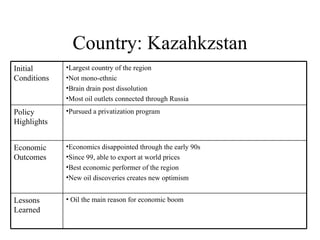
Country: Kazahkzstan Initial Conditions Largest country of the region Not mono-ethnic Brain drain post dissolution Most oil outlets connected through Russia Policy Highlights Pursued a privatization program Economic Outcomes Economics disappointed through the early 90s Since 99, able to export at world prices  Best economic performer of the region New oil discoveries creates new optimism Lessons Learned Oil the main reason for economic boom
Country: Krygyzstan Initial Conditions Most impoverished of all CA states No resources Policy Highlights Became the most reformist CA state – 1 st  to be admitted entrance to WTO Large scale reforms and land reforms instituted Implementation not viewed as successful Economic Outcomes Limited success in attracting foreign investment High expenditures resulted in large debts incurred Stalled reforms after balance of payment crisis in 1998 Still one of the poorer CA states Lessons Learned Transplanting western institutions into a Central Asian setting not successful -  too many other conditions for a successful market economy were lacking Although resource poor, better management leads to less suffering than Tajikistan
Country: Tajikistan Initial Conditions Also a poor CA state No resources Embroiled in civil war for most of the 90s Gov’t not in control over its territory during the war Policy Highlights During the 90s, country preoccupied with civil war Post war, liberal policies instituted to follow int’l institution recommendations Implementation poor Economic Outcomes Foreign investment came in the form of military aids from Russia Overall economic performance disastrous  Lessons Learned No resources + political instability = poverty
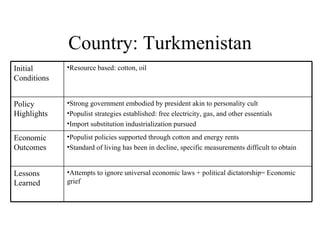
Country: Turkmenistan Initial Conditions Resource based: cotton, oil Policy Highlights Strong government embodied by president akin to personality cult Populist strategies established: free electricity, gas, and other essentials Import substitution industrialization pursued Economic Outcomes Populist policies supported through cotton and energy rents Standard of living has been in decline, specific measurements difficult to obtain Lessons Learned Attempts to ignore universal economic laws + political dictatorship= Economic grief
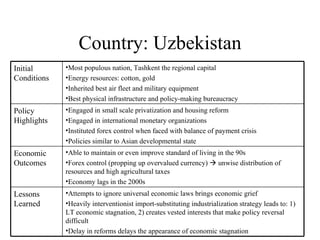
Country: Uzbekistan Initial Conditions Most populous nation, Tashkent the regional capital Energy resources: cotton, gold Inherited best air fleet and military equipment Best physical infrastructure and policy-making bureaucracy Policy Highlights Engaged in small scale privatization and housing reform Engaged in international monetary organizations Instituted forex control when faced with balance of payment crisis Policies similar to Asian developmental state Economic Outcomes Able to maintain or even improve standard of living in the 90s Forex control (propping up overvalued currency)    unwise distribution of resources and high agricultural taxes Economy lags in the 2000s Lessons Learned Attempts to ignore universal economic laws brings economic grief Heavily interventionist import-substituting industrialization strategy  leads to:  1) LT economic stagnation, 2) creates vested interests that make policy reversal difficult  Delay in reforms delays the appearance of economic stagnation

Central Asian countries

  • 1.
    Country: Kazahkzstan InitialConditions Largest country of the region Not mono-ethnic Brain drain post dissolution Most oil outlets connected through Russia Policy Highlights Pursued a privatization program Economic Outcomes Economics disappointed through the early 90s Since 99, able to export at world prices Best economic performer of the region New oil discoveries creates new optimism Lessons Learned Oil the main reason for economic boom
  • 2.
    Country: Krygyzstan InitialConditions Most impoverished of all CA states No resources Policy Highlights Became the most reformist CA state – 1 st to be admitted entrance to WTO Large scale reforms and land reforms instituted Implementation not viewed as successful Economic Outcomes Limited success in attracting foreign investment High expenditures resulted in large debts incurred Stalled reforms after balance of payment crisis in 1998 Still one of the poorer CA states Lessons Learned Transplanting western institutions into a Central Asian setting not successful - too many other conditions for a successful market economy were lacking Although resource poor, better management leads to less suffering than Tajikistan
  • 3.
    Country: Tajikistan InitialConditions Also a poor CA state No resources Embroiled in civil war for most of the 90s Gov’t not in control over its territory during the war Policy Highlights During the 90s, country preoccupied with civil war Post war, liberal policies instituted to follow int’l institution recommendations Implementation poor Economic Outcomes Foreign investment came in the form of military aids from Russia Overall economic performance disastrous Lessons Learned No resources + political instability = poverty
  • 4.
    Country: Turkmenistan InitialConditions Resource based: cotton, oil Policy Highlights Strong government embodied by president akin to personality cult Populist strategies established: free electricity, gas, and other essentials Import substitution industrialization pursued Economic Outcomes Populist policies supported through cotton and energy rents Standard of living has been in decline, specific measurements difficult to obtain Lessons Learned Attempts to ignore universal economic laws + political dictatorship= Economic grief
  • 5.
    Country: Uzbekistan InitialConditions Most populous nation, Tashkent the regional capital Energy resources: cotton, gold Inherited best air fleet and military equipment Best physical infrastructure and policy-making bureaucracy Policy Highlights Engaged in small scale privatization and housing reform Engaged in international monetary organizations Instituted forex control when faced with balance of payment crisis Policies similar to Asian developmental state Economic Outcomes Able to maintain or even improve standard of living in the 90s Forex control (propping up overvalued currency)  unwise distribution of resources and high agricultural taxes Economy lags in the 2000s Lessons Learned Attempts to ignore universal economic laws brings economic grief Heavily interventionist import-substituting industrialization strategy leads to: 1) LT economic stagnation, 2) creates vested interests that make policy reversal difficult Delay in reforms delays the appearance of economic stagnation