NADO
Census Solutions Workshop
Ideation Workshop
Facilitator:
Haley Ashcom
Intergovernmental Affairs Specialist and
Intergovernmental Partnership Account Manager
U.S. Census Bureau
Purpose:
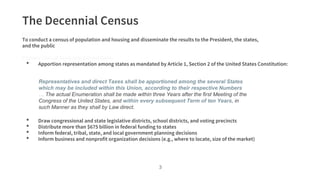
To conduct a census of population and housing and disseminate the results to the President, the states,
and the public
Primary Uses of Decennial Census Data:
• Apportion representation among states as mandated by Article 1, Section 2 of the United States Constitution:
• Draw congressional and state legislative districts, school districts, and voting precincts
• Distribute more than $675 billion in federal funding to states
• Inform federal, tribal, state, and local government planning decisions
• Inform business and nonprofit organization decisions (e.g., where to locate, size of the market)
Representatives and direct Taxes shall be apportioned among the several States
which may be included within this Union, according to their respective Numbers
… The actual Enumeration shall be made within three Years after the first Meeting of the
Congress of the United States, and within every subsequent Term of ten Years, in
such Manner as they shall by Law direct.
The Decennial Census
3
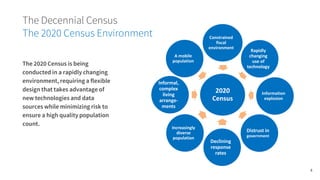
The 2020 Census is being
conducted in a rapidly changing
environment, requiring a flexible
design that takes advantage of
new technologies and data
sources while minimizing risk to
ensure a high quality population
count.
2020
Census
Constrained
fiscal
environment
Rapidly
changing
use of
technology
Information
explosion
Distrust in
government
Declining
response
rates
Increasingly
diverse
population
Informal,
complex
living
arrange-
ments
A mobile
population
The Decennial Census
The 2020 Census Environment
4
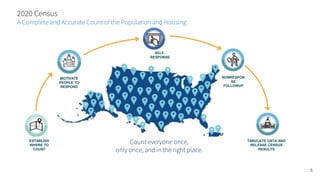
2020 Census
A Complete and Accurate Count of the Population and Housing
Count everyone once,
only once, and in the right place.
ESTABLISH
WHERE TO
COUNT
SELF-
RESPONSE
TABULATE DATA AND
RELEASE CENSUS
RESULTS
MOTIVATE
PEOPLE TO
RESPOND
NONRESPON
SE
FOLLOWUP
5
Build connections and seed collaborations between organizations and
individuals committed to a successful 2020 Census
Develop actionable concepts that can lead to a stronger awareness &
outreach campaigns to reach the communities you serve
Build momentum towards making ideas come to life by generating
commitments and developing them through 2020
Showcase a model that other cities and towns can use to generate
collaborative relationships with stakeholders and ideas to reach their own
hard to count populations
Workshop Objectives
Think about your role as you
plan for 2020 ...
Collaborate, Coordinate, and Convene
Advocate for Resources
Educate, Motivate and Mobilize
Design
Thinking
101
Source: Nielsen Norman Group
Sprint Principles
GUIDING PRINCIPLES
Avoiding groupthink
Parallel is better than serial
The magic of time constraint
THINGS TO KEEP IN MIND
Leverage existing resources + “blue sky”- it
Diverge then converge
Have fun & trust the process!
What are the top 3 challenges
you are facing in advance of the
2020 Census?
What is your vision of success?
As we go through
the upcoming
activities, think
about...
Your Challenge Statement
Each table has a challenge statement in the
middle of the table. Read it and start
considering it’s implications.
What is a persona...
Pg. Activities- 9/ Resources Sec (last 5-6 pages)
A persona represents characteristics,
demographics, attitudes, behaviors,
challenges and motivators
of a group(s) or community
“I have trouble
completing
census forms.”
Your audience
may not be native
English speakers
and find Census
forms confusing.
“I don’t have time
to fill out the
census forms.”
Your audience is
very busy and
assumes the
Census will be
time-consuming
and cumbersome.
“I don’t trust the
government with
my information.”
Your audience is
concerned about data
privacy or having their
information used by
other federal
agencies.
“I don’t think the
census has any
impact on my life.”
Your audience isn’t
sure what Census
does, how its data
affects them, and why
their participation
matters.
Solo Ideation
Write as many concrete ideas or concepts as possible
that addresses the challenge statement selected.
One (1) statement per sticky note
Post Up!
One person at a time, read your own sticky notes
out to the group as you post them on the wall.
Take your markers with you!
Pg. Activities- 10
Clustering could look like...
Group ideas (cluster) together based on
common topics, themes or affinity.
Now, lets Cluster!
Group ideas (cluster) together based on
common topics, themes or affinity.
Dot Voting + Selection
3 votes (dots) per person,
then select the idea with the most votes or group of
ideas (no more than 2-3 stickys).
You will work with this concept moving forward.
Fleshing Out Your Idea...
● Who is our idea designed for?
One of the scenarios, or
someone else? (i.e.
policymaker, grasstops, etc.)
● What is a tool, campaign,
program, initiative or other
concept that we can create?
Guiding questions:
● How are people going to find out
about it?
● How does it make people feel?
● Who can we partner with?
● What are the existing resources
around this table to pull this off?
● What are references for this kind
of idea?
● What is the call to action?
● What are some ways you can
promote or socialize this concept
or idea?
Develop a Storyboard!
A storyboard could look like...
The Pitch:
Teams Share Outs
Select one person in the group to present
your idea/concept
+
One person to hold up the flip chart
Contribution Sheets
Fill out commitments sheets (one per person) and
leave them facedown in the middle of the table.
CENSUS
SOLUTIONS
WORKSHOP
TOOLKIT
PRE-DECISIONAL DOCUMENT
33
THANK YOU
PRE-DECISIONAL DOCUMENT
OFFICE OF CONGRESSIONAL AND
INTERGOVERNMENTAL AFFAIRS
Haley Ashcom
haley.m.ashcom@census.gov
census.partners@census.gov
census.gov/partners

Census Solutions Workshop: Ashcom

  • 1.
  • 2.
    Ideation Workshop Facilitator: Haley Ashcom IntergovernmentalAffairs Specialist and Intergovernmental Partnership Account Manager U.S. Census Bureau
  • 3.
    Purpose: To conduct acensus of population and housing and disseminate the results to the President, the states, and the public Primary Uses of Decennial Census Data: • Apportion representation among states as mandated by Article 1, Section 2 of the United States Constitution: • Draw congressional and state legislative districts, school districts, and voting precincts • Distribute more than $675 billion in federal funding to states • Inform federal, tribal, state, and local government planning decisions • Inform business and nonprofit organization decisions (e.g., where to locate, size of the market) Representatives and direct Taxes shall be apportioned among the several States which may be included within this Union, according to their respective Numbers … The actual Enumeration shall be made within three Years after the first Meeting of the Congress of the United States, and within every subsequent Term of ten Years, in such Manner as they shall by Law direct. The Decennial Census 3
  • 4.
    The 2020 Censusis being conducted in a rapidly changing environment, requiring a flexible design that takes advantage of new technologies and data sources while minimizing risk to ensure a high quality population count. 2020 Census Constrained fiscal environment Rapidly changing use of technology Information explosion Distrust in government Declining response rates Increasingly diverse population Informal, complex living arrange- ments A mobile population The Decennial Census The 2020 Census Environment 4
  • 5.
    2020 Census A Completeand Accurate Count of the Population and Housing Count everyone once, only once, and in the right place. ESTABLISH WHERE TO COUNT SELF- RESPONSE TABULATE DATA AND RELEASE CENSUS RESULTS MOTIVATE PEOPLE TO RESPOND NONRESPON SE FOLLOWUP 5
  • 6.
    Build connections andseed collaborations between organizations and individuals committed to a successful 2020 Census Develop actionable concepts that can lead to a stronger awareness & outreach campaigns to reach the communities you serve Build momentum towards making ideas come to life by generating commitments and developing them through 2020 Showcase a model that other cities and towns can use to generate collaborative relationships with stakeholders and ideas to reach their own hard to count populations Workshop Objectives
  • 7.
    Think about yourrole as you plan for 2020 ... Collaborate, Coordinate, and Convene Advocate for Resources Educate, Motivate and Mobilize
  • 8.
  • 9.
    Sprint Principles GUIDING PRINCIPLES Avoidinggroupthink Parallel is better than serial The magic of time constraint THINGS TO KEEP IN MIND Leverage existing resources + “blue sky”- it Diverge then converge Have fun & trust the process!
  • 10.
    What are thetop 3 challenges you are facing in advance of the 2020 Census? What is your vision of success? As we go through the upcoming activities, think about...
  • 11.
    Your Challenge Statement Eachtable has a challenge statement in the middle of the table. Read it and start considering it’s implications.
  • 12.
    What is apersona... Pg. Activities- 9/ Resources Sec (last 5-6 pages) A persona represents characteristics, demographics, attitudes, behaviors, challenges and motivators of a group(s) or community
  • 13.
    “I have trouble completing censusforms.” Your audience may not be native English speakers and find Census forms confusing. “I don’t have time to fill out the census forms.” Your audience is very busy and assumes the Census will be time-consuming and cumbersome. “I don’t trust the government with my information.” Your audience is concerned about data privacy or having their information used by other federal agencies. “I don’t think the census has any impact on my life.” Your audience isn’t sure what Census does, how its data affects them, and why their participation matters.
  • 14.
    Solo Ideation Write asmany concrete ideas or concepts as possible that addresses the challenge statement selected. One (1) statement per sticky note
  • 15.
    Post Up! One personat a time, read your own sticky notes out to the group as you post them on the wall. Take your markers with you! Pg. Activities- 10
  • 16.
    Clustering could looklike... Group ideas (cluster) together based on common topics, themes or affinity.
  • 19.
    Now, lets Cluster! Groupideas (cluster) together based on common topics, themes or affinity.
  • 20.
    Dot Voting +Selection 3 votes (dots) per person, then select the idea with the most votes or group of ideas (no more than 2-3 stickys). You will work with this concept moving forward.
  • 21.
  • 23.
    ● Who isour idea designed for? One of the scenarios, or someone else? (i.e. policymaker, grasstops, etc.) ● What is a tool, campaign, program, initiative or other concept that we can create? Guiding questions: ● How are people going to find out about it? ● How does it make people feel? ● Who can we partner with? ● What are the existing resources around this table to pull this off? ● What are references for this kind of idea? ● What is the call to action? ● What are some ways you can promote or socialize this concept or idea?
  • 24.
    Develop a Storyboard! Astoryboard could look like...
  • 29.
    The Pitch: Teams ShareOuts Select one person in the group to present your idea/concept + One person to hold up the flip chart
  • 30.
    Contribution Sheets Fill outcommitments sheets (one per person) and leave them facedown in the middle of the table.
  • 32.
  • 33.
  • 34.
  • 35.
    PRE-DECISIONAL DOCUMENT OFFICE OFCONGRESSIONAL AND INTERGOVERNMENTAL AFFAIRS Haley Ashcom haley.m.ashcom@census.gov census.partners@census.gov census.gov/partners

Editor's Notes

  • #4 Every 10 years, the U.S. Census Bureau conducts a census to determine the number of people living in the United States. The census is conducted in years ending in zero. The primary purpose of the census is to apportion representation (the number of seats) in the U.S. House of Representatives among states as mandated by Article 1, Section 2 of the Constitution.   *****************ANIMATED SLIDE: PLEASE CLICK BEFORE EACH BULLET*****************   There are many other important uses of census data including:   Drawing congressional and state legislative districts, school districts and voting precincts; Distributing federal dollars to states—more than $675 billion dollars each year; Informing the decisions that governments make every day; and, Helping businesses and nonprofits make good decisions about their work.
  • #5 As we think about planning a program as large and complex as the 2020 Census, we have to think about it in a number of ways. We’ve been planning the 2020 Census since the 2010 Census concluded. As we try to count everyone living in the country, we need to consider today’s landscape.    Declining response rates Response rates for surveys and censuses in general have declined as people are overloaded with requests for information and have become increasingly concerned about sharing information. Although the census is important, many people view it as just one more request for information – another intrusion into their lives. For the decennial census - where we have to count people once, only once, and in the right place - we need to combat that attitude and motivate people to respond. We have to plan for the increasingly complex living arrangements and population Households are becoming more diverse and dynamic, making it a challenge to associate an identified person to a single location. For example, blended families may include children who have two primary residences. Additionally, some households include multiple relationships and generations. We took all of this into account as we thought about how to conduct the 2020 Census and ensure we count everyone.   A very mobile population About 15 percent of this country’s population moves in a given year making us a highly mobile population. Our goal for the 2020 Census is not only to count the people, but to count the people where they are. And with a population as mobile as ours, this is a challenge. It is with this geographical attachment that the population data become so valuable to communities, governments and businesses.   And finally, the last challenge I want to highlight today is technology. To keep pace with the growing use of, and reliance on, technology, we are infusing technology throughout the 2020 Census. This brings innovation, new ideas, efficiency, and increased quality, but it also brings a challenge. We are designing a census based on today’s technology but technology will evolve rapidly by 2020.
  • #6 Regardless of modern day societal challenges, our goal does not change: To count everyone once, only once, and in the right place. At its simplest, this is what the decennial census is all about. The decennial census is the largest peacetime mobilization this country undertakes. It is an incredible amount of work and our census experts divide the entire process into 35 separate operations each with its own process and team. I like to think of it in five high-level steps. **************ANIMATED SLIDE: PLEASE CLICK BEFORE EACH BOLD HEADING*************   ESTABLISH WHERE TO COUNT First, we identify all addresses where people could live by conducting a 100-percent review and update of the Nation’s addresses. Legislative, school and voting districts can only be established if we know WHERE each piece of the overall population count resides. Having a complete address list that covers the entire country allows us to contact every household so that they can respond to the census. It’s also how we know who hasn’t responded so that we can reach them by other means, like knocking on their door.   MOTIVATE PEOPLE TO RESPOND We will conduct a nationwide communications and partnership campaign by working with the trusted voices in local communities to increase participation and ultimately increase self-response. We will maximize outreach using TV, radio, newspapers, billboards, email and social media. We will make sure our advertising reaches everyone by tailoring messages to different audiences and using the right platform – TV, radio, social media – to reach each audience.   COUNT THE POPULATION PRIMARILY THROUGH SELF-RESPONSE The 2020 Census will offer multiple ways to respond. Previous censuses asked the public to respond by mail. We’re making it quick, safe and easy for people to respond from anywhere, at any time, by using the internet, phone, or by mailing in a questionnaire. To make it easy to respond through any of those options, we will accept responses without the unique Census ID that comes on your letter or postcard that we mail to you. As always, we’ll collect data from all households, including group and unique living arrangements.   CONDUCT IN-PERSON FOLLOW-UP FOR THOSE WHO DO NOT INITIALLY RESPOND We recognize that in spite of making it easy for people to respond there will always be a portion of the population that does not respond. But, our goal is to count everyone. So, if a household doesn’t respond on its own, we send census takers to knock on their doors and collect their information. We call this nonresponse followup. We will use data the government already has as well as third‑party data to avoid collecting information about things we already know—like which housing units are vacant. This will reduce the number of in-person visits to vacant housing units. (In 2010, almost 30 percent of the 48 million nonresponse followup case visits were to vacant or non-existing units.)   When we do have to go knock on doors, we’re efficiently managing and routing census takers by determining the best travel routes through automation. Our census takers will use secure smartphones when they visit a household to capture people’s responses – this makes the data collection and processing much faster than if we kept using paper and pencils as we did in prior censuses.   TABULATE DATA AND RELEASE CENSUS RESULTS We do all of this in order to provide complete and accurate census data. Consistent with prior censuses, we will deliver apportionment counts to the President (by December 31, 2020) and redistricting counts to the states (by March 31, 2021).   We are also building on recent efforts to give the public greater access to the data by releasing census results on a new, user‑friendly web platform featuring easier search functionality, visualizations, and navigation to enhance dissemination and increase access to data tables and data sets through data.census.gov.
  • #15 Pg. Activities- 10 of toolkit
  • #16 Pick up all your stickys and go to the assigned wall area. Read your stickys outloud to the group as you post them up, one person at a time
  • #21 You can put all your 3 vote on one sticky or separate stickys, as long as you use your 3 votes! Draw a circle (dot) on the top 3 ideas. (individual exercise, no groupthink!) Select which solution to work with
  • #30 Describe your persona/user, what you are trying to communicate to that persona and your concept or idea...