Project Final Outcomes
www.celluwood.com
Laminated Strong Eco-Material for Building Construction made of Cellulose-Strengthened Wood
1. Project objectives
2. Project results/products
Lignin-based gluing system
Nanocellulose epoxy and casein resins for eco-beams
Inorganic core material for eco-columns
Eco-beams and eco-columns
Content
3. Project consortium
Project objectives (1)
The CELLUWOOD project aimed at developing a new range
of structural elements for construction made of wood by
introducing innovative technologies. The project developed
the fit for purposes nanocellulose and lignin bio-resins and
their novel applications in the laminated wood production
(glulam products) instead of synthetic resins made from
petrochemicals.
The ultimate outcomes are new glulam construction re-
engineering elements, namely eco-beam and eco-
columns.
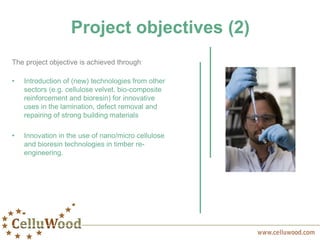
The project objective is achieved through:
• Introduction of (new) technologies from other
sectors (e.g. cellulose velvet, bio-composite
reinforcement and bioresin) for innovative
uses in the lamination, defect removal and
repairing of strong building materials
• Innovation in the use of nano/micro cellulose
and bioresin technologies in timber re-
engineering.
Project objectives (2)
Project results/products
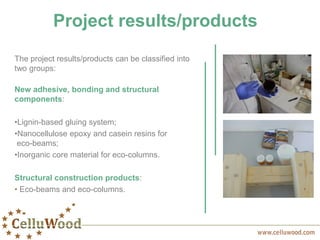
The project results/products can be classified into
two groups:
New adhesive, bonding and structural
components:
•Lignin-based gluing system;
•Nanocellulose epoxy and casein resins for
eco-beams;
•Inorganic core material for eco-columns.
Structural construction products:
• Eco-beams and eco-columns.
Lignin-based gluing system
CELLUWOOD developed lignin base adhesive with a “greener” character, in which the use of the
phenol component was partially replaced by modified lignin.
The produced adhesive is capable of setting in cold pressing in order to be used as binder for glulam
building materials in small and medium sized companies.
Characteristics:
• Lower phenol-formaldehyde emission
• Easy to apply
• Relatively cheap to be produced (becaues of the low lignin prices)
• Performances equivalent to commercial glue (e.g. eco-beams fabricated with the modified PF
resin showed better mechanical properties than commercially available beams)
Restriction of use:
• Darker colour
The application can be suitable for outdoor constructions and
situations where colour effect does not jeopardize the design idea.
Lignin based gluing system
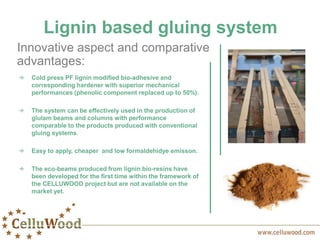
Cold press PF lignin modified bio-adhesive and
corresponding hardener with superior mechanical
performances (phenolic component replaced up to 50%).
The system can be effectively used in the production of
glulam beams and columns with performance
comparable to the products produced with conventional
gluing systems.
Easy to apply, cheaper and low formaldehidye emisson.
The eco-beams produced from lignin bio-resins have
been developed for the first time within the framework of
the CELLUWOOD project but are not available on the
market yet.
Innovative aspect and comparative
advantages:
Conclusion
The developed lignin-based PF resin gluing system
showed a clear environmental improvement
compared to commercial available glues: 74% vs.
MUF and 86% vs. PU resins. Besides the
environmental advantages, the lower cost and better
technical performance make the lignin-based gluing
system as real eco-innovation and a great success
for the CELLUWOOD project.
Nanocellulose epoxy resin for eco-
beams
Nanocellulose based materials are characterised by high strength and low weight.
Two types of nanocellulose based wood adhesives have been produced:
• nanocellulose reinforced epoxy,
• nanocellulose reinforced casein.
Both adhesives can be used and cured at the room temperature
under a low pressure, and display high performance.
The shear strength of the epoxy resin increased by more than 50%, (dosage of
nanocellulose in a range of 1-5%).
Nanocellulose has the potential to replace current used MUF and epoxy resins,
and provide much efficient and high strength resin systems for laminated
timber industries.
Nanocellulose epoxy resin for eco-
beams
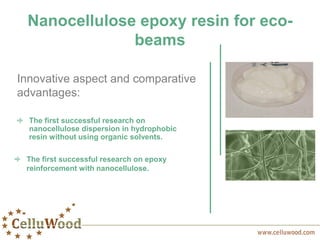
The first successful research on
nanocellulose dispersion in hydrophobic
resin without using organic solvents.
The first successful research on epoxy
reinforcement with nanocellulose.
Innovative aspect and comparative
advantages:
Nanocellulose has the potential to replace current used MUF and epoxy
resins, and provide more efficient and high strength resin systems for
laminated timber industries.
Nanocellulose reinforeced gluing systems have a higher environmental
impact compared to the commercial glues. The main reason is high
environmental impact of the adhesion system used as a base component for
reinforced adhesives and the nature of the data used for the LCA (only
laboratory testing data were available). It is expected that in optimised
industrial production the impact will be much lower. Further research about
this aspect is recommended, and reinforcement of other gluing systems with
lower environmental impact in order to make the nanocellulose adhesives
environmentally competitive with commercial glues.
Conclusion
Inorganic core material for eco-
column (ICM)
Another novelty concept developed in CELLUWOOD project has been the
Inorganic Core Material (ICM) for eco columns. The idea was to use
wood residues from timber beam and column production as core material
for the eco columns.
Key component: Modified formulation of a sawdust and gypsum
mixture which increases stiffness and gives better compressive
strength to the components.
Characteristics:
• Use of abundant raw material easy process and the good performance,
• ICM composite columns can potentially be commercialised to use wood residues and reduce raw
material costs for the column production
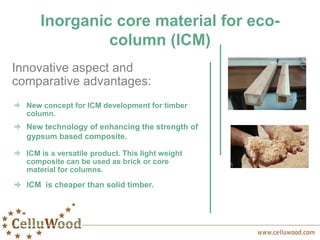
Inorganic core material for eco-
column (ICM)
New concept for ICM development for timber
column.
Innovative aspect and
comparative advantages:
New technology of enhancing the strength of
gypsum based composite.
ICM is a versatile product. This light weight
composite can be used as brick or core
material for columns.
ICM is cheaper than solid timber.
Conclusion
It is envisaged that once the interface between the ICM and
enclose lumber is improved, the ICM composite columns can
potentially be commercialised to use wood residues and reduce
raw material costs for the column production.
The novel ICM concept using a gypsum and sawdust mixture as
core material for columns can find its place in the wood
construction market, in particular in the wall building and
column manufacturing sector.
Structural construction products:
eco-beams and eco-columns
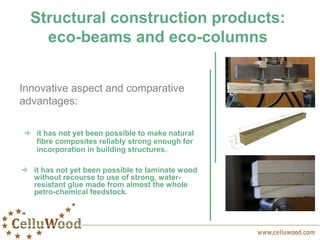
The developed eco-beams and eco-columns are strong re-engineered
timber products bonded by a natural bio-resin system.
The developed natural binding systems have been applied to both eco-
beams and eco-columns.
The processing technologies have been tailored with the
application of the natural bioresin systems. This could be done
with the conventional production facilities and gluing lines in
the companies.
No extra investment where required to apply the developed
resins and gluing systems.
Structural construction products:
eco-beams and eco-columns
it has not yet been possible to make natural
fibre composites reliably strong enough for
incorporation in building structures.
Innovative aspect and comparative
advantages:
it has not yet been possible to laminate wood
without recourse to use of strong, water-
resistant glue made from almost the whole
petro-chemical feedstock.
Conclusion
Eco-beams fabricated with the lignin modified PF resin
showed better mechanical properties than commercially
available Melamine Urea Formaldehyde (MUF) resin beams.
Excellent dimensional stability.
CELLUWOOD beams are appropriate for outdoor use.
Their production is convenient for small and medium
companies. Does not demand any extra investment.
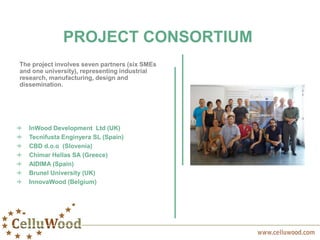
PROJECT CONSORTIUM
The project involves seven partners (six SMEs
and one university), representing industrial
research, manufacturing, design and
dissemination.
InWood Development Ltd (UK)
Tecnifusta Enginyera SL (Spain)
CBD d.o.o (Slovenia)
Chimar Hellas SA (Greece)
AIDIMA (Spain)
Brunel University (UK)
InnovaWood (Belgium)
Thank you
Contact:
Mr. Edward Stenhouse
Project Coordinator
edwardstenhouse@btconnect.com
Prof. Dr. Mizi Fan
Project Management
Mizi.Fan@brunel.ac.uk
InnovaWood
Project Web and Dissemination
office@innovawood.com
MSc. Miguel Ángel Abián
Project Coordinator and Manager at AIDIMA
comercial@aidima.es

CELLUWOOD Project Presentation Outcomes

  • 1.
    Project Final Outcomes www.celluwood.com LaminatedStrong Eco-Material for Building Construction made of Cellulose-Strengthened Wood
  • 2.
    1. Project objectives 2.Project results/products Lignin-based gluing system Nanocellulose epoxy and casein resins for eco-beams Inorganic core material for eco-columns Eco-beams and eco-columns Content 3. Project consortium
  • 3.
    Project objectives (1) TheCELLUWOOD project aimed at developing a new range of structural elements for construction made of wood by introducing innovative technologies. The project developed the fit for purposes nanocellulose and lignin bio-resins and their novel applications in the laminated wood production (glulam products) instead of synthetic resins made from petrochemicals. The ultimate outcomes are new glulam construction re- engineering elements, namely eco-beam and eco- columns.
  • 4.
    The project objectiveis achieved through: • Introduction of (new) technologies from other sectors (e.g. cellulose velvet, bio-composite reinforcement and bioresin) for innovative uses in the lamination, defect removal and repairing of strong building materials • Innovation in the use of nano/micro cellulose and bioresin technologies in timber re- engineering. Project objectives (2)
  • 5.
    Project results/products The projectresults/products can be classified into two groups: New adhesive, bonding and structural components: •Lignin-based gluing system; •Nanocellulose epoxy and casein resins for eco-beams; •Inorganic core material for eco-columns. Structural construction products: • Eco-beams and eco-columns.
  • 6.
    Lignin-based gluing system CELLUWOODdeveloped lignin base adhesive with a “greener” character, in which the use of the phenol component was partially replaced by modified lignin. The produced adhesive is capable of setting in cold pressing in order to be used as binder for glulam building materials in small and medium sized companies. Characteristics: • Lower phenol-formaldehyde emission • Easy to apply • Relatively cheap to be produced (becaues of the low lignin prices) • Performances equivalent to commercial glue (e.g. eco-beams fabricated with the modified PF resin showed better mechanical properties than commercially available beams) Restriction of use: • Darker colour The application can be suitable for outdoor constructions and situations where colour effect does not jeopardize the design idea.
  • 7.
    Lignin based gluingsystem Cold press PF lignin modified bio-adhesive and corresponding hardener with superior mechanical performances (phenolic component replaced up to 50%). The system can be effectively used in the production of glulam beams and columns with performance comparable to the products produced with conventional gluing systems. Easy to apply, cheaper and low formaldehidye emisson. The eco-beams produced from lignin bio-resins have been developed for the first time within the framework of the CELLUWOOD project but are not available on the market yet. Innovative aspect and comparative advantages:
  • 8.
    Conclusion The developed lignin-basedPF resin gluing system showed a clear environmental improvement compared to commercial available glues: 74% vs. MUF and 86% vs. PU resins. Besides the environmental advantages, the lower cost and better technical performance make the lignin-based gluing system as real eco-innovation and a great success for the CELLUWOOD project.
  • 9.
    Nanocellulose epoxy resinfor eco- beams Nanocellulose based materials are characterised by high strength and low weight. Two types of nanocellulose based wood adhesives have been produced: • nanocellulose reinforced epoxy, • nanocellulose reinforced casein. Both adhesives can be used and cured at the room temperature under a low pressure, and display high performance. The shear strength of the epoxy resin increased by more than 50%, (dosage of nanocellulose in a range of 1-5%). Nanocellulose has the potential to replace current used MUF and epoxy resins, and provide much efficient and high strength resin systems for laminated timber industries.
  • 10.
    Nanocellulose epoxy resinfor eco- beams The first successful research on nanocellulose dispersion in hydrophobic resin without using organic solvents. The first successful research on epoxy reinforcement with nanocellulose. Innovative aspect and comparative advantages:
  • 11.
    Nanocellulose has thepotential to replace current used MUF and epoxy resins, and provide more efficient and high strength resin systems for laminated timber industries. Nanocellulose reinforeced gluing systems have a higher environmental impact compared to the commercial glues. The main reason is high environmental impact of the adhesion system used as a base component for reinforced adhesives and the nature of the data used for the LCA (only laboratory testing data were available). It is expected that in optimised industrial production the impact will be much lower. Further research about this aspect is recommended, and reinforcement of other gluing systems with lower environmental impact in order to make the nanocellulose adhesives environmentally competitive with commercial glues. Conclusion
  • 12.
    Inorganic core materialfor eco- column (ICM) Another novelty concept developed in CELLUWOOD project has been the Inorganic Core Material (ICM) for eco columns. The idea was to use wood residues from timber beam and column production as core material for the eco columns. Key component: Modified formulation of a sawdust and gypsum mixture which increases stiffness and gives better compressive strength to the components. Characteristics: • Use of abundant raw material easy process and the good performance, • ICM composite columns can potentially be commercialised to use wood residues and reduce raw material costs for the column production
  • 13.
    Inorganic core materialfor eco- column (ICM) New concept for ICM development for timber column. Innovative aspect and comparative advantages: New technology of enhancing the strength of gypsum based composite. ICM is a versatile product. This light weight composite can be used as brick or core material for columns. ICM is cheaper than solid timber.
  • 14.
    Conclusion It is envisagedthat once the interface between the ICM and enclose lumber is improved, the ICM composite columns can potentially be commercialised to use wood residues and reduce raw material costs for the column production. The novel ICM concept using a gypsum and sawdust mixture as core material for columns can find its place in the wood construction market, in particular in the wall building and column manufacturing sector.
  • 15.
    Structural construction products: eco-beamsand eco-columns The developed eco-beams and eco-columns are strong re-engineered timber products bonded by a natural bio-resin system. The developed natural binding systems have been applied to both eco- beams and eco-columns. The processing technologies have been tailored with the application of the natural bioresin systems. This could be done with the conventional production facilities and gluing lines in the companies. No extra investment where required to apply the developed resins and gluing systems.
  • 16.
    Structural construction products: eco-beamsand eco-columns it has not yet been possible to make natural fibre composites reliably strong enough for incorporation in building structures. Innovative aspect and comparative advantages: it has not yet been possible to laminate wood without recourse to use of strong, water- resistant glue made from almost the whole petro-chemical feedstock.
  • 17.
    Conclusion Eco-beams fabricated withthe lignin modified PF resin showed better mechanical properties than commercially available Melamine Urea Formaldehyde (MUF) resin beams. Excellent dimensional stability. CELLUWOOD beams are appropriate for outdoor use. Their production is convenient for small and medium companies. Does not demand any extra investment.
  • 18.
    PROJECT CONSORTIUM The projectinvolves seven partners (six SMEs and one university), representing industrial research, manufacturing, design and dissemination. InWood Development Ltd (UK) Tecnifusta Enginyera SL (Spain) CBD d.o.o (Slovenia) Chimar Hellas SA (Greece) AIDIMA (Spain) Brunel University (UK) InnovaWood (Belgium)
  • 19.
    Thank you Contact: Mr. EdwardStenhouse Project Coordinator edwardstenhouse@btconnect.com Prof. Dr. Mizi Fan Project Management Mizi.Fan@brunel.ac.uk InnovaWood Project Web and Dissemination office@innovawood.com MSc. Miguel Ángel Abián Project Coordinator and Manager at AIDIMA comercial@aidima.es