‘Not far away day when pipette will be replaced by your iPhone’
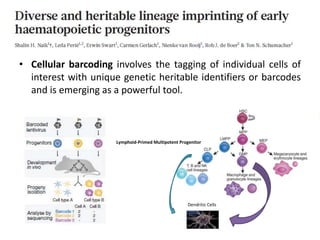
• Cellular barcoding involves the tagging of individual cells of
interest with unique genetic heritable identifiers or barcodes
and is emerging as a powerful tool.
Lymphoid-Primed Multipotent Progenitor
Dendritic Cells
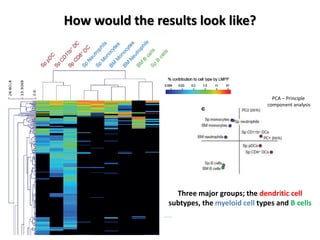
How would the results look like?
Three major groups; the dendritic cell
subtypes, the myeloid cell types and B cells
PCA – Principle
component analysis
LMPP’s and HSC’s contribution to the cell types
Almost one-half of the LMPPs were classified as dendritic-cell biased, 10% of the
progenitors contributed primarily to B cells, 10% primarily to myeloid cells, and just 3%
of the LMPPs were multi-outcome progenitors.
Many LMPPs produced dendritic cells without generating detectable lymphoid and
myeloid output, leading the authors to propose that dendritic cells should be
considered a separate lineage of hematopoiesis.
Snapshot of the output (Limitations)
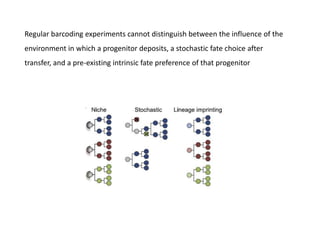
Regular barcoding experiments cannot distinguish between the influence of the
environment in which a progenitor deposits, a stochastic fate choice after
transfer, and a pre-existing intrinsic fate preference of that progenitor
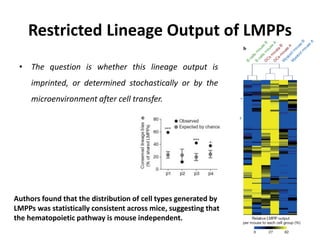
Restricted Lineage Output of LMPPs
• The question is whether this lineage output is
imprinted, or determined stochastically or by the
microenvironment after cell transfer.
Authors found that the distribution of cell types generated by
LMPPs was statistically consistent across mice, suggesting that
the hematopoietic pathway is mouse independent.
Summary
• A large number of LMPPs gave rise to dendritic cells!
• Authors have proposed the existence of additional branches to the
hematopoietic tree, such as a direct branch from LMPPs to dendritic cells
only!
• Although some HSCs were found to contribute to all the cell types
analyzed, some HSCs were biased toward output in the myeloid or
lymphoid lineage.
• Heritable lineage imprinting is initiated as early as at the HSC level and
progressively increases throughout haematopoiesis.
Pros-and-cons
• Looking at specific branch with known or
suspected outcome.
• Snapshot
• Irradiation
• Transplantation
• In-vitro manipulations
• Sorting bias

Cellular barcoding’ in hematopoiesis

  • 1.
    ‘Not far awayday when pipette will be replaced by your iPhone’
  • 2.
    • Cellular barcodinginvolves the tagging of individual cells of interest with unique genetic heritable identifiers or barcodes and is emerging as a powerful tool. Lymphoid-Primed Multipotent Progenitor Dendritic Cells
  • 3.
    How would theresults look like? Three major groups; the dendritic cell subtypes, the myeloid cell types and B cells PCA – Principle component analysis
  • 4.
    LMPP’s and HSC’scontribution to the cell types Almost one-half of the LMPPs were classified as dendritic-cell biased, 10% of the progenitors contributed primarily to B cells, 10% primarily to myeloid cells, and just 3% of the LMPPs were multi-outcome progenitors. Many LMPPs produced dendritic cells without generating detectable lymphoid and myeloid output, leading the authors to propose that dendritic cells should be considered a separate lineage of hematopoiesis.
  • 5.
    Snapshot of theoutput (Limitations)
  • 6.
    Regular barcoding experimentscannot distinguish between the influence of the environment in which a progenitor deposits, a stochastic fate choice after transfer, and a pre-existing intrinsic fate preference of that progenitor
  • 7.
    Restricted Lineage Outputof LMPPs • The question is whether this lineage output is imprinted, or determined stochastically or by the microenvironment after cell transfer. Authors found that the distribution of cell types generated by LMPPs was statistically consistent across mice, suggesting that the hematopoietic pathway is mouse independent.
  • 8.
    Summary • A largenumber of LMPPs gave rise to dendritic cells! • Authors have proposed the existence of additional branches to the hematopoietic tree, such as a direct branch from LMPPs to dendritic cells only! • Although some HSCs were found to contribute to all the cell types analyzed, some HSCs were biased toward output in the myeloid or lymphoid lineage. • Heritable lineage imprinting is initiated as early as at the HSC level and progressively increases throughout haematopoiesis.
  • 9.
    Pros-and-cons • Looking atspecific branch with known or suspected outcome. • Snapshot • Irradiation • Transplantation • In-vitro manipulations • Sorting bias

Editor's Notes

  • #6 Figure 5. Composition of a developmental tree. Barcoding provides only a snapshot of the output of a single progenitor at a given time, but no information on the intermediate steps (A), with a hypothetical example of how a single cell generates 8 x red, and 8 x green cells. It cannot differentiate between cases of (B) late-stage commitment, (C) early-stage commitment, or (D) instances of de- or trans-differentiation vs. a linear branching event.
  • #7 It is important to note that the niche in which an LMPP lands may still also exert some influence on cellular output (e.g., for the 50% of sibling barcodes that showed a disparate fate) and by the same token, the data do not exclude a contribution of stochastic effects. Nevertheless, these sibling analyses provide direct evidence that at least a portion of the LMPPs were imprinted to a cell fate either before isolation or before major clonal expansion in vitro.