SCME
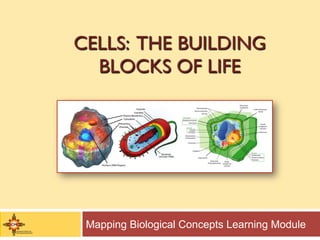
CELLS: THE BUILDING
BLOCKS OF LIFE
Mapping Biological Concepts Learning Module
This unit provides information on cells, the
building blocks of life –
•  the different types of cells,
•  aspects of their growth, and
•  the types of organelles found within cells.
This information is necessary to better
understand how bioMEMS use cells to create
new diagnostic and therapeutic devices.
Unit Overview
v  Define and interpret The Cell Theory.
v  Describe similarities and differences of
prokaryotic and eukaryotic cells.
v  Identify and describe the functions of cellular
structures (cell membrane, cell wall, nucleus,
cytoplasm, chloroplast, mitochondria) within a
cell.
Objectives
Introduction
The field of bioMEMS is rapidly growing. One
area of major interest is in the development of
miniature and portable instrumentation for cell-
based microassays and sensor applications in
areas such as
v  health diagnostics,
v  environmental risk management, and
v  food safety.
All areas rely on a basic knowledge of a cell.
The Phenotype MicroArray™ (PM)
This image is from the Phenotype MicroArray™ (PM), a new tool which offers a
panoramic view of cellular events. Just like a battery of tests on a person’s blood can
scan the health of vital organs, the PM can scan the physiology of cells, yielding data
on hundreds of traits at once. Typical cell-based assays measure only one trait at a
time (for example, cell death or DNA synthesis), but the PM can measure up to 2,000
traits--or phenotypes--under hundreds of growth conditions.
Environmental Health Perspectives Volume 114, Number 3, March 2006
Challenges
Challenges in using cells in bioMEMS:
v  Incorporating living cells into sensors and diagnostic
devices
v  Creating environmental conditions conducive to cell
organization into tissue-like structures
v  Sorting and concentrating bacterial cells on a micro-
fluidic biochip
What is a cell?
A cell is the smallest unit exhibiting
the property of life.
v  Cells acquire and use energy.
v  They acquire and organize
materials.
v  They grow and reproduce.
The graphic shows an animal cell,
its organelles, nucleus and plasma
membrane.
Note: Organelles are to a cell, like
organs are to a human.
Animal Cell
Hooke’s Microscope
Cells are approximately 10X
smaller than the visual limits of
the human eye. Thus, the
discovery of cells was dependent
on the development of the
microscope.
In 1662, Robert Hooke built a
primitive microscope and used it
to observe and describe
individual cells of cork.
Robert Hooke's microscope and drawing of a thin
layer of cork
Leeuwenhoek’s Observations
In 1675, Anton van Leeuwenhoek used a microscope to examine
droplets of water. He described a multitude of "animalcules", thus
becoming the first person to observe living, single-celled
microorganisms.
It was another 100 years before scientists would describe cells in
greater detail.
Anton van Leeuwenhoek and his
drawings of microorganisms
The Cell Theory
In the 1830's, Matthias Schleiden
and Theodor Schwann proposed
a set of hypotheses that came to
be called the cell theory. The cell
theory states
(1) all organisms are composed
of one or more cells
(2) the cell is the structural unit of
life
(3) cells can arise only by division
from a preexisting cell Plant Cell
[Image courtesy of Mariana RuizVillarreal]
Prokaryotic and Eukaryotic Cells
Cells vary in the types and complexity of structures found both
internally and externally. However, they can be categorized into two
broad types: prokaryotic and eukaryotic. The structurally simpler
prokaryotic cells include bacteria (Fig 1). The more complex
eukaryotic cells include protists, fungi, animals (Fig 2) and plants (Fig
3). [Bacteria and plant cell graphics courtesy of Mariana Ruiz Villarreal]
Bacteria Animal Cell Plant Cell
Eukaryotic and Prokaryotic Cell
The figure compares eukaryotic and prokaryotic cells.
It points out common features found in both cell types.
Common features of Eukaryotic and Prokaryotic cells
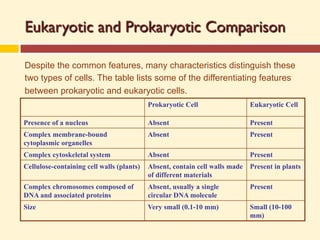
Eukaryotic and Prokaryotic Comparison
Despite the common features, many characteristics distinguish these
two types of cells. The table lists some of the differentiating features
between prokaryotic and eukaryotic cells.
Prokaryotic Cell Eukaryotic Cell
Presence of a nucleus Absent Present
Complex membrane-bound
cytoplasmic organelles
Absent Present
Complex cytoskeletal system Absent Present
Cellulose-containing cell walls (plants) Absent, contain cell walls made
of different materials
Present in plants
Complex chromosomes composed of
DNA and associated proteins
Absent, usually a single
circular DNA molecule
Present
Size Very small (0.1-10 mm) Small (10-100
mm)
The Eukaryotic Cell
Compartmentalization is the key to
eukaryotic cell function.
Eukaryotic cells are larger and
more structurally complex than
prokaryotic cells.
This complexity is largely due to
the membrane-bound organelles
that compartmentalize cellular
functions.
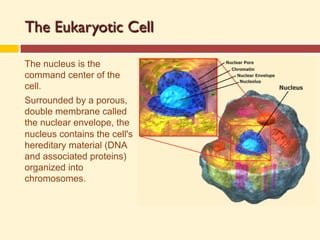
The Eukaryotic Cell
The nucleus is the
command center of the
cell.
Surrounded by a porous,
double membrane called
the nuclear envelope, the
nucleus contains the cell's
hereditary material (DNA
and associated proteins)
organized into
chromosomes.
The Eukaryotic Cell
Eukaryotic cells contain an extensive endomembrane
system consisting of
v  the endoplasmic reticulum (both smooth and rough
forms),
v  the Golgi apparatus, and
v  lysosomes.
These are the organelles of the cell.
Eukaryotic Organelles
These organelles form an
interconnected set of
membrane systems that
function in compartmentalizing,
transporting, and modifying
proteins.
The lysosomes contain
digestive enzymes that break
down proteins, carbohydrates,
and lipids. Lysosomes process
cellular debris as well as food
particles.
Organelles
Two organelles,
mitochondria and
chloroplasts, function
specifically to supply
energy to cells.
Nearly all eukaryotic cells
contain mitochondria.
Chloroplasts are found only
in photosynthetic cells such
as plants and algae.
Plant Cell showing organelles, Cytoplasm,
Plasma Membrane and Cell Wall
[Image courtesy of Mariana Ruiz Villarreal]
Organelles
Organelles are found
within the cytoplasm of
the cell.
For animal cells, the
boundary of the cell is
defined by the plasma
membrane.
For plant cells, the
boundary is defined by
the plasma membrane
plus a cell wall composed
of cellulose (see graphic).
Plant Cell showing organelles, Cytoplasm,
Plasma Membrane and Cell Wall
[Image courtesy of Mariana Ruiz Villarreal]
Growing Cells
Whole cells can be removed from a plant or animal and cultured in a
laboratory (in vitro).
Applications for animal cell cultures include the following:
v Investigate the physiology or biochemistry of cells (e.g. cell
metabolism).
v Test the effect of various chemical compounds or drugs on specific
cell types (normal or cancerous cells, for example).
v Assist in the generation of artificial tissues (e.g. artificial skin or organ
tissue). Generating artificial tissues is an emerging area of
biotechnology known as “tissue engineering”.
v Synthesize valuable biologicals from large scale cell cultures.
Biologicals encompass a broad range of cell products (e.g. specific
proteins or viruses, therapeutic proteins)
Using MEMS for Cell Cultivation
MEMS are being develop and testing for use in cell cultivation.
BioPOETS at the University of California, Berkeley has
developed a MEMS cell culture array (left image). The array uses
microfluidics to create an optimal micro-environment for cell
cultivation (inset). The right images are cells that have been
cultivated in this array. [Images courtesy of BioPOETS Lab, UC-Berkeley]
Review of The Cell
A cell is the basic unit of life. Cells are highly
complex and organized. They possess
hereditary information and the means to use it.
Cells
v  reproduce
v  acquire and utilize energy
v  carry out a variety of chemical reactions
v  engage in mechanical activities
v  respond to stimuli
v  self-regulate
Let’s see what you remember
v  What are the major tenets of the cell theory?
v  How are prokaryotic and eukaryotic cells similar?
v  How are prokaryotic and eukaryotic cells different?
v  What is the primary tool of the cell biologist studying cells in
the laboratory?
v  How are MEMS being used in cell cultivation?
Cells are divided into two main categories: prokaryotic and
eukaryotic. Prokaryotic cells and eukaryotic cells share
similarities, but eukaryotic cells are more complex structurally.
The organelles found in the larger eukaryotic cell
compartmentalize cellular functions.
MEMS applications will aid in the cultivation of cells for the
purpose of creating new diagnostic and therapeutic
bioMEMS.
Summary
The information contained herein is considered
to be true and accurate; however the
Southwest Center for Microsystems Education
(SCME) makes no guarantees concerning the
authenticity of any statement. SCME accepts
no liability for the content of this unit, or for the
consequences of any actions taken on the
basis of the information provided.
Disclaimer
Made possible through grants from the National Science Foundation
Department of Undergraduate Education #0830384, 0902411, and 1205138.
Any opinions, findings and conclusions or recommendations expressed in
this material are those of the authors and creators, and do not necessarily
reflect the views of the National Science Foundation.
Southwest Center for Microsystems Education (SCME) NSF ATE Center
© 2010 Regents of the University of New Mexico
Content is protected by the CC Attribution Non-Commercial Share Alike
license.
Website: www.scme-nm.org
Acknowledgements
Revised August 2017

Cells_Building_Blocks_Presentation.pdf

  • 1.
    SCME CELLS: THE BUILDING BLOCKSOF LIFE Mapping Biological Concepts Learning Module
  • 2.
    This unit providesinformation on cells, the building blocks of life – •  the different types of cells, •  aspects of their growth, and •  the types of organelles found within cells. This information is necessary to better understand how bioMEMS use cells to create new diagnostic and therapeutic devices. Unit Overview
  • 3.
    v  Define andinterpret The Cell Theory. v  Describe similarities and differences of prokaryotic and eukaryotic cells. v  Identify and describe the functions of cellular structures (cell membrane, cell wall, nucleus, cytoplasm, chloroplast, mitochondria) within a cell. Objectives
  • 4.
    Introduction The field ofbioMEMS is rapidly growing. One area of major interest is in the development of miniature and portable instrumentation for cell- based microassays and sensor applications in areas such as v  health diagnostics, v  environmental risk management, and v  food safety. All areas rely on a basic knowledge of a cell. The Phenotype MicroArray™ (PM) This image is from the Phenotype MicroArray™ (PM), a new tool which offers a panoramic view of cellular events. Just like a battery of tests on a person’s blood can scan the health of vital organs, the PM can scan the physiology of cells, yielding data on hundreds of traits at once. Typical cell-based assays measure only one trait at a time (for example, cell death or DNA synthesis), but the PM can measure up to 2,000 traits--or phenotypes--under hundreds of growth conditions. Environmental Health Perspectives Volume 114, Number 3, March 2006
  • 5.
    Challenges Challenges in usingcells in bioMEMS: v  Incorporating living cells into sensors and diagnostic devices v  Creating environmental conditions conducive to cell organization into tissue-like structures v  Sorting and concentrating bacterial cells on a micro- fluidic biochip
  • 6.
    What is acell? A cell is the smallest unit exhibiting the property of life. v  Cells acquire and use energy. v  They acquire and organize materials. v  They grow and reproduce. The graphic shows an animal cell, its organelles, nucleus and plasma membrane. Note: Organelles are to a cell, like organs are to a human. Animal Cell
  • 7.
    Hooke’s Microscope Cells areapproximately 10X smaller than the visual limits of the human eye. Thus, the discovery of cells was dependent on the development of the microscope. In 1662, Robert Hooke built a primitive microscope and used it to observe and describe individual cells of cork. Robert Hooke's microscope and drawing of a thin layer of cork
  • 8.
    Leeuwenhoek’s Observations In 1675,Anton van Leeuwenhoek used a microscope to examine droplets of water. He described a multitude of "animalcules", thus becoming the first person to observe living, single-celled microorganisms. It was another 100 years before scientists would describe cells in greater detail. Anton van Leeuwenhoek and his drawings of microorganisms
  • 9.
    The Cell Theory Inthe 1830's, Matthias Schleiden and Theodor Schwann proposed a set of hypotheses that came to be called the cell theory. The cell theory states (1) all organisms are composed of one or more cells (2) the cell is the structural unit of life (3) cells can arise only by division from a preexisting cell Plant Cell [Image courtesy of Mariana RuizVillarreal]
  • 10.
    Prokaryotic and EukaryoticCells Cells vary in the types and complexity of structures found both internally and externally. However, they can be categorized into two broad types: prokaryotic and eukaryotic. The structurally simpler prokaryotic cells include bacteria (Fig 1). The more complex eukaryotic cells include protists, fungi, animals (Fig 2) and plants (Fig 3). [Bacteria and plant cell graphics courtesy of Mariana Ruiz Villarreal] Bacteria Animal Cell Plant Cell
  • 11.
    Eukaryotic and ProkaryoticCell The figure compares eukaryotic and prokaryotic cells. It points out common features found in both cell types. Common features of Eukaryotic and Prokaryotic cells
  • 12.
    Eukaryotic and ProkaryoticComparison Despite the common features, many characteristics distinguish these two types of cells. The table lists some of the differentiating features between prokaryotic and eukaryotic cells. Prokaryotic Cell Eukaryotic Cell Presence of a nucleus Absent Present Complex membrane-bound cytoplasmic organelles Absent Present Complex cytoskeletal system Absent Present Cellulose-containing cell walls (plants) Absent, contain cell walls made of different materials Present in plants Complex chromosomes composed of DNA and associated proteins Absent, usually a single circular DNA molecule Present Size Very small (0.1-10 mm) Small (10-100 mm)
  • 13.
    The Eukaryotic Cell Compartmentalizationis the key to eukaryotic cell function. Eukaryotic cells are larger and more structurally complex than prokaryotic cells. This complexity is largely due to the membrane-bound organelles that compartmentalize cellular functions.
  • 14.
    The Eukaryotic Cell Thenucleus is the command center of the cell. Surrounded by a porous, double membrane called the nuclear envelope, the nucleus contains the cell's hereditary material (DNA and associated proteins) organized into chromosomes.
  • 15.
    The Eukaryotic Cell Eukaryoticcells contain an extensive endomembrane system consisting of v  the endoplasmic reticulum (both smooth and rough forms), v  the Golgi apparatus, and v  lysosomes. These are the organelles of the cell.
  • 16.
    Eukaryotic Organelles These organellesform an interconnected set of membrane systems that function in compartmentalizing, transporting, and modifying proteins. The lysosomes contain digestive enzymes that break down proteins, carbohydrates, and lipids. Lysosomes process cellular debris as well as food particles.
  • 17.
    Organelles Two organelles, mitochondria and chloroplasts,function specifically to supply energy to cells. Nearly all eukaryotic cells contain mitochondria. Chloroplasts are found only in photosynthetic cells such as plants and algae. Plant Cell showing organelles, Cytoplasm, Plasma Membrane and Cell Wall [Image courtesy of Mariana Ruiz Villarreal]
  • 18.
    Organelles Organelles are found withinthe cytoplasm of the cell. For animal cells, the boundary of the cell is defined by the plasma membrane. For plant cells, the boundary is defined by the plasma membrane plus a cell wall composed of cellulose (see graphic). Plant Cell showing organelles, Cytoplasm, Plasma Membrane and Cell Wall [Image courtesy of Mariana Ruiz Villarreal]
  • 19.
    Growing Cells Whole cellscan be removed from a plant or animal and cultured in a laboratory (in vitro). Applications for animal cell cultures include the following: v Investigate the physiology or biochemistry of cells (e.g. cell metabolism). v Test the effect of various chemical compounds or drugs on specific cell types (normal or cancerous cells, for example). v Assist in the generation of artificial tissues (e.g. artificial skin or organ tissue). Generating artificial tissues is an emerging area of biotechnology known as “tissue engineering”. v Synthesize valuable biologicals from large scale cell cultures. Biologicals encompass a broad range of cell products (e.g. specific proteins or viruses, therapeutic proteins)
  • 20.
    Using MEMS forCell Cultivation MEMS are being develop and testing for use in cell cultivation. BioPOETS at the University of California, Berkeley has developed a MEMS cell culture array (left image). The array uses microfluidics to create an optimal micro-environment for cell cultivation (inset). The right images are cells that have been cultivated in this array. [Images courtesy of BioPOETS Lab, UC-Berkeley]
  • 21.
    Review of TheCell A cell is the basic unit of life. Cells are highly complex and organized. They possess hereditary information and the means to use it. Cells v  reproduce v  acquire and utilize energy v  carry out a variety of chemical reactions v  engage in mechanical activities v  respond to stimuli v  self-regulate
  • 22.
    Let’s see whatyou remember v  What are the major tenets of the cell theory? v  How are prokaryotic and eukaryotic cells similar? v  How are prokaryotic and eukaryotic cells different? v  What is the primary tool of the cell biologist studying cells in the laboratory? v  How are MEMS being used in cell cultivation?
  • 23.
    Cells are dividedinto two main categories: prokaryotic and eukaryotic. Prokaryotic cells and eukaryotic cells share similarities, but eukaryotic cells are more complex structurally. The organelles found in the larger eukaryotic cell compartmentalize cellular functions. MEMS applications will aid in the cultivation of cells for the purpose of creating new diagnostic and therapeutic bioMEMS. Summary
  • 24.
    The information containedherein is considered to be true and accurate; however the Southwest Center for Microsystems Education (SCME) makes no guarantees concerning the authenticity of any statement. SCME accepts no liability for the content of this unit, or for the consequences of any actions taken on the basis of the information provided. Disclaimer
  • 25.
    Made possible throughgrants from the National Science Foundation Department of Undergraduate Education #0830384, 0902411, and 1205138. Any opinions, findings and conclusions or recommendations expressed in this material are those of the authors and creators, and do not necessarily reflect the views of the National Science Foundation. Southwest Center for Microsystems Education (SCME) NSF ATE Center © 2010 Regents of the University of New Mexico Content is protected by the CC Attribution Non-Commercial Share Alike license. Website: www.scme-nm.org Acknowledgements Revised August 2017