Active transport
DQ -How do substances move when the
concentration of substances is low?
Starter:
Recap what we mean by diffusion
Monday 19 May 2025
2.
Grading criteria
• 7-8:explain why active transport is important
by using these examples
• 6: give and describe some examples of where
active transport happens
• 5: define ‘active transport’
3.
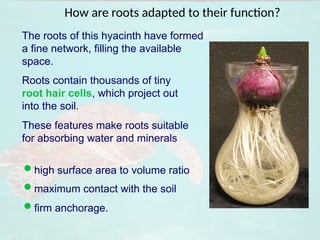
How are rootsadapted to their function?
Roots contain thousands of tiny
root hair cells, which project out
into the soil.
The roots of this hyacinth have formed
a fine network, filling the available
space.
These features make roots suitable
for absorbing water and minerals
high surface area to volume ratio
maximum contact with the soil
firm anchorage.
4.
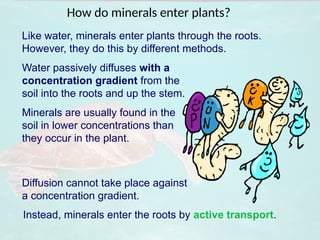
How do mineralsenter plants?
Like water, minerals enter plants through the roots.
However, they do this by different methods.
Water passively diffuses with a
concentration gradient from the
soil into the roots and up the stem.
Diffusion cannot take place against
a concentration gradient.
Minerals are usually found in the
soil in lower concentrations than
they occur in the plant.
Instead, minerals enter the roots by active transport.
5.
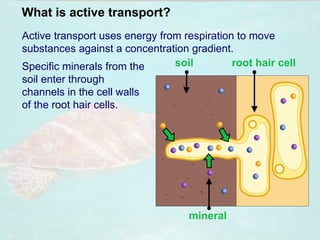
Active transport usesenergy from respiration to move
substances against a concentration gradient.
What is active transport?
Specific minerals from the
soil enter through
channels in the cell walls
of the root hair cells.
soil
mineral
root hair cell
6.
19/05/2025
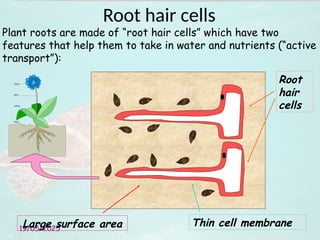
Plant roots aremade of “root hair cells” which have two
features that help them to take in water and nutrients (“active
transport”):
Root hair cells
Root
hair
cells
Thin cell membrane
Large surface area
19/05/2025
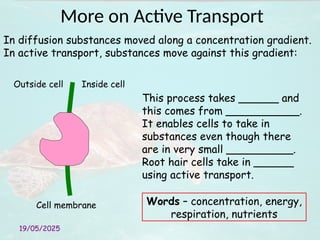
More on ActiveTransport
In diffusion substances moved along a concentration gradient.
In active transport, substances move against this gradient:
Outside cell Inside cell
This process takes ______ and
this comes from ___________.
It enables cells to take in
substances even though there
are in very small __________.
Root hair cells take in ______
using active transport.
Cell membrane Words – concentration, energy,
respiration, nutrients
9.
19/05/2025
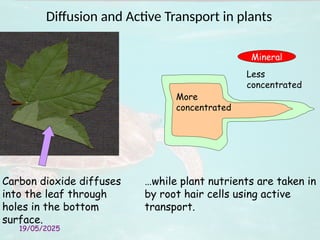
Carbon dioxide diffuses
intothe leaf through
holes in the bottom
surface.
Diffusion and Active Transport in plants
More
concentrated
Less
concentrated
Mineral
…while plant nutrients are taken in
by root hair cells using active
transport.
Editor's Notes
#5 Teacher notes
See the ‘Movement In and Out of Cells’ presentation for more information about active transport.
#7 Teacher notes
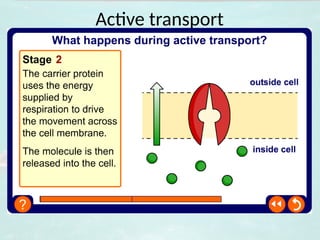
This two-stage interactive animation illustrates how molecules enter the cell through active transport.
See the ‘Movement In and Out of Cells’ presentation for more information about active transport.



![Polymer [ बहुलक ] Chemistry Notes PDF - Irfanullah Mehar - JJ Sir Chemistry.pdf](https://cdn.slidesharecdn.com/ss_thumbnails/polymerchemistrynotespdf-irfanullahmehar-jjsirchemistry-260210172118-3f9b37f7-thumbnail.jpg?width=640&height=640&fit=bounds)