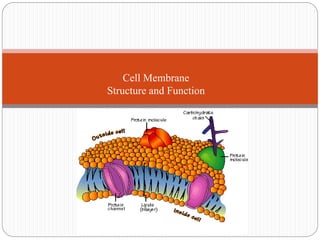
Cell Membrane
Structure and Function
Copyright © The McGraw-Hill Companies, Inc. Permission required for reproduction or display.
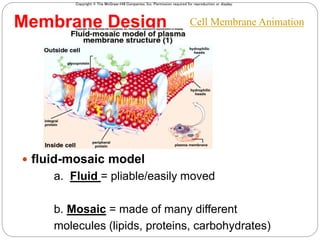
Membrane Design
2
 fluid-mosaic model
a. Fluid = pliable/easily moved
b. Mosaic = made of many different
molecules (lipids, proteins, carbohydrates)
Cell Membrane Animation
Copyright © The McGraw-Hill Companies, Inc. Permission required for reproduction or display.
3
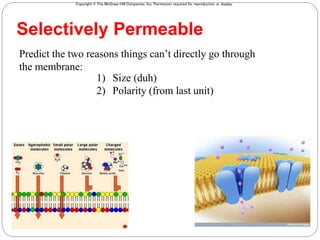
Predict the two reasons things can’t directly go through
the membrane:
Selectively Permeable
1) Size (duh)
2) Polarity (from last unit)
Copyright © The McGraw-Hill Companies, Inc. Permission required for reproduction or display.
4
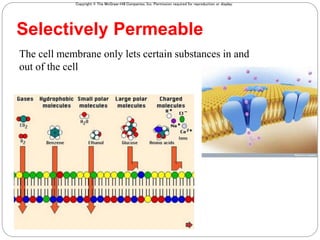
The cell membrane only lets certain substances in and
out of the cell
Selectively Permeable
Copyright © The McGraw-Hill Companies, Inc. Permission required for reproduction or display.
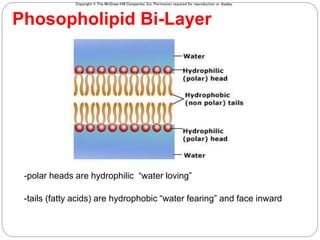
Phosopholipid Bi-Layer
5
-polar heads are hydrophilic “water loving”
-tails (fatty acids) are hydrophobic “water fearing” and face inward
Copyright © The McGraw-Hill Companies, Inc. Permission required for reproduction or display.
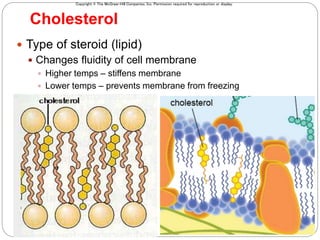
Cholesterol
 Type of steroid (lipid)
 Changes fluidity of cell membrane
 Higher temps – stiffens membrane
 Lower temps – prevents membrane from freezing
Copyright © The McGraw-Hill Companies, Inc. Permission required for reproduction or display.
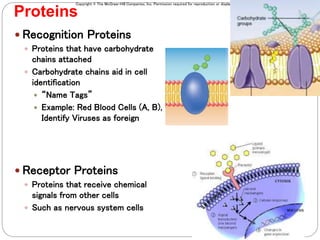
Proteins
7
 Recognition Proteins
 Proteins that have carbohydrate
chains attached
 Carbohydrate chains aid in cell
identification
 “Name Tags”
 Example: Red Blood Cells (A, B),
Identify Viruses as foreign
 Receptor Proteins
 Proteins that receive chemical
signals from other cells
 Such as nervous system cells
Copyright © The McGraw-Hill Companies, Inc. Permission required for reproduction or display.
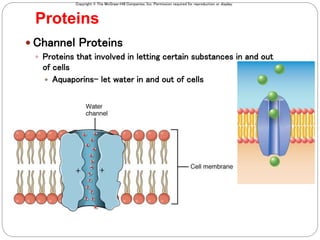
 Channel Proteins
 Proteins that involved in letting certain substances in and out
of cells
 Aquaporins- let water in and out of cells
Proteins
Copyright © The McGraw-Hill Companies, Inc. Permission required for reproduction or display.
9
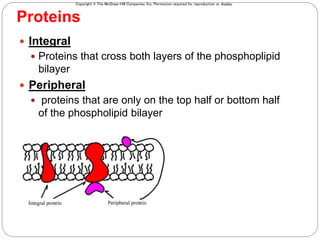
 Integral
 Proteins that cross both layers of the phosphoplipid
bilayer
 Peripheral
 proteins that are only on the top half or bottom half
of the phospholipid bilayer
Proteins

cell membrane structure.ppt

  • 1.
  • 2.
    Copyright © TheMcGraw-Hill Companies, Inc. Permission required for reproduction or display. Membrane Design 2  fluid-mosaic model a. Fluid = pliable/easily moved b. Mosaic = made of many different molecules (lipids, proteins, carbohydrates) Cell Membrane Animation
  • 3.
    Copyright © TheMcGraw-Hill Companies, Inc. Permission required for reproduction or display. 3 Predict the two reasons things can’t directly go through the membrane: Selectively Permeable 1) Size (duh) 2) Polarity (from last unit)
  • 4.
    Copyright © TheMcGraw-Hill Companies, Inc. Permission required for reproduction or display. 4 The cell membrane only lets certain substances in and out of the cell Selectively Permeable
  • 5.
    Copyright © TheMcGraw-Hill Companies, Inc. Permission required for reproduction or display. Phosopholipid Bi-Layer 5 -polar heads are hydrophilic “water loving” -tails (fatty acids) are hydrophobic “water fearing” and face inward
  • 6.
    Copyright © TheMcGraw-Hill Companies, Inc. Permission required for reproduction or display. Cholesterol  Type of steroid (lipid)  Changes fluidity of cell membrane  Higher temps – stiffens membrane  Lower temps – prevents membrane from freezing
  • 7.
    Copyright © TheMcGraw-Hill Companies, Inc. Permission required for reproduction or display. Proteins 7  Recognition Proteins  Proteins that have carbohydrate chains attached  Carbohydrate chains aid in cell identification  “Name Tags”  Example: Red Blood Cells (A, B), Identify Viruses as foreign  Receptor Proteins  Proteins that receive chemical signals from other cells  Such as nervous system cells
  • 8.
    Copyright © TheMcGraw-Hill Companies, Inc. Permission required for reproduction or display.  Channel Proteins  Proteins that involved in letting certain substances in and out of cells  Aquaporins- let water in and out of cells Proteins
  • 9.
    Copyright © TheMcGraw-Hill Companies, Inc. Permission required for reproduction or display. 9  Integral  Proteins that cross both layers of the phosphoplipid bilayer  Peripheral  proteins that are only on the top half or bottom half of the phospholipid bilayer Proteins