Chapter 11  Event schemas: Sentence patterns 02/09/11 Cognitive English Grammar
Worlds of experience: event schemas The material world: Occurrence schemas: states, processes Spatial schemas: location, motion Possession schema Psychological world: Emotion schema Perception/cognition schema Force-dynamic world: Action schema Self-motion schema Caused-motion schema Transfer schema: physical & abstract, beneficial, metaphorical 02/09/11 Cognitive English Grammar
Occurrence schema: Processes: CHANGE OF STATE IS MOTION Deictic motion: PURPOSEFUL CHANGE IS MOTION TO A LOCATION John  went  into computing. The country  went  to war. ACHIEVING A PURPOSEFUL CHANGE IS REACHING A LOCATION We have  come  to a conclusion/  reached  a conclusion. *We have come to a disagreement. Non-deictic motion: CHANGE TO AN EXPECTED STATE IS ARRIVAL AT A LOCATION All good things  come  to an end. The water is  coming  to a boil. CHANGE TO AN UNEXPECTED STATE IS MOTION AWAY.  The car  went  dead in the middle of the road. He  went  crazy. 02/09/11 Cognitive English Grammar
Action schema:  Degrees of force of the energy source Agent-like causes: Natural forces:  Kathrina devastated New Orleans. Reified causes:  The strike closed down the railway system. Means:  Your article pointed out that ... Instrument:  Guns don’t kill people, people kill people. Enabling conditions:  This item won’t scan. 02/09/11 Cognitive English Grammar
Action schema:  Affectedness of the theme  (Bolinger 1977) George turned the pages. The pages were turned by George. George turned the corner. *The corner was turned by George. The stranger approached me. I was approached by the stranger. The train approached me. *I was approached by the train. The generals deserted the army.  The army was deserted by the generals. Private Smith deserted the army. *The army was deserted by the Private Smith. Generations of lovers have The bridge has been walked under walked under the bridge.   by generations of lovers. The dog walked under the bridge. *The bridge was walked under by the dog. 02/09/11 Cognitive English Grammar
Transfer schema:  Beneficial transfer Uncle Jim bought some chocolates for Margaret . Uncle Jim bought Margaret some chocolates. Uncle Jim cooked a meal for Margaret. Uncle Jim cooked Margaret a meal. Uncle Jim washed some socks for Margaret. ?Uncle Jim washed Margaret some socks. Uncle Jim answered some letters for Margaret.  *Uncle Jim answered Margaret some letters. 02/09/11 Cognitive English Grammar
Chapter 12  Space and extensions of space:  Complements and adjuncts 02/09/11 Cognitive English Grammar
Space and time Theory of relativity, space-time (Einstein) Space and time are necessary concepts: any object is located in space and time (Kant).  Space and time  are irreducible domains of experience.  Space is more basic than time. Time is metaphorically understood in terms of space:  time frame, space in time ; linearity of time: passage of time. In many languages, time is obligatorily coded as tense in finite sentence, while space is often left implicit:  It’s raining,  default sense: ‘It is raining here’. 02/09/11 Cognitive English Grammar
Space and things Space is empty but significant: it makes the appearance of physical entities possible.  Things that exist exist in space, and to be is to be located.  “ Rules” for objects in space: two objects cannot occupy the same space at same time; an object cannot be in two places at same time.  Things are defined by space: their shape, form and boundaries separate things from the space surrounding them. Space is also within things (atoms, molecules). The three axes of the Euclidean coordinate system apply to space and objects (spatial dimensions).  02/09/11 Cognitive English Grammar
Spatial dimensions a)  Vertical  dimension: natural reference line with the ground-level of the earth surface as zero point; defined by force of gravity and human up-right position, psychologically and linguistically the most salient spatial dimension. b)  Horizontal  dimension: front-back; defined by asymmetry of man: principal organs of perception, direction of motion. c)  Lateral  dimension: left-right, dependent upon prior establishment of front-back; symmetrical. Polarity  of verticality and horizontality:  Things above the ground and in front of us are visible and available = positive polarity;  Things beneath the ground and behind us are invisible and unavailable = negative polarity.  02/09/11 Cognitive English Grammar
Space and humans Experience  of space: Bodily basis of some spatial notions:  heart  ‘center’,  belly  ‘in’,  back ,  zurück  < zum Rücken,  Stadt  ‘place where one is standing’. Perception  of space: The earth is experienced as a flat horizontal plane extending into infinity . Some objects have a canonical position: e.g. intrinsic tops and bottoms of bottles, chairs, tables, people. Anthropocentrism : Biological make-up, asymmetrical body, up-right position, habitat, experience of gravity, encounter, locomotion. Egocentrism : We are part of space and make considerable use of ego as the reference point in speech situations: deixis, perspective. Significance  of space: e.g. borders, territory, spatial property. 02/09/11 Cognitive English Grammar
Space and language Space is coded in language a)  by specifying the direction and distance from any point in space. Distances are measured in terms of time taken for someone or something to move from X to Y (e.g. an hour’s journey) or by a ruler: feet, hands, arms, stride, miles, inches, yards.  b)  by specifying the dimension of a reference object.  Spatial expressions:  Case (Ablative, Locative):  Roma  ‘from Rome’,  Romam  ‘to Rom’ Prepositions (+ case):  in/into the pool ,  auf dem/das Dach Verbs:  contain ,  surround ,   posture verbs ( stand ), motion verbs ( go ) Spatial adjectives:  tall  (vertical length),  long  (horizontal length) 02/09/11 Cognitive English Grammar
English vs Tzeltal spatial strategies English:   The cat  is   on   the mat   Subject-NP  Predicate  Prep   NP   TR   vacuous  support   LM Tzeltal:   Pachal   ta  mexa  boch   Predicate   Prep   NP  Subject-NP    sitting-bowl-like   at  table  gourd   upright location   vacuous  LM  TR English strategy: Where to look – region projected from landmark. Tzeltal strategy:  What to look for – something that has exactly this    shape and disposition; this is the trajector. 02/09/11 Cognitive English Grammar
Spatial specifications by means of  body-part terms in Tzeltal  AT the  face  of the house  = in front of the house AT the  mouth  of the house  = door AT the  head  of the table  = end standing AT table its-head the bottle  = the bottle is standing on the end of the table hanging the shelf AT its-side the house = the shelf is hanging on the side of the house standing coffee AT its-mouth/lips the fire = the coffee is standing at the edge of the fire  leaning-almost-vertically firewood AT the back-house = the firewood is stacked vertically against the back of the house.  02/09/11 Cognitive English Grammar
Different conceptions of  the same spatial situation English:   The sun rises  in  the East and sets  in  the West. German:   Die Sonne geht  im   Osten  auf  und  im  Westen  unter.   ‘ t he sun  goes  in  the East up  and  in   the West down‘  Hungarian:  Anap  kelet en  kel  és  nyvgat on   nyvgszik.   ‘ the sun East- on  rises and West- on   sets ’ Spanish:   El sol  sale  por   el este  y  se pone  por   el oeste.   ‘ the sun goes-out  about  the East and puts itself  about  the West’ Finnnish:  Aurinko  nousee idä stä   ja  laskee  länt een .   ‘ the sun  rises  East- out-of  and sets  West- into ’ Japanese:  Taiyō-ha  higashi- kara   nobori,  nishi -ni  shizumu.   ‘ sun-TOP East- from  rise-and  West- to  sink ’  02/09/11 Cognitive English Grammar
Classifying three static spatial situations   (Melissa Bowerman) 02/09/11 Cognitive English Grammar La taza está en la mesa. La manzana está en la fuenta. La manilla está en la puerta. Die Tasse ist auf dem Tisch. Der Apfel ist in der Schüssel. Der Griff ist an der Tür.
Classifying three static spatial situations (Melissa Bowerman) 02/09/11 Cognitive English Grammar Kuppi on pödällä.  Adessive The cup is on the table The handle is on the door. The apple is in the bowl. Omena on kulhossa.  Inessive Ovessa on kahva.  Inessive
Classifying three actions in English  and Korean 02/09/11 Cognitive English Grammar
Two ways of specifying a spatial region:  Two types of spatial prepositions Dimensional  prepositions specify the spatial region where a thing (trajector =  TR ) is to be found relative to the dimensional property of a landmark (=  LM ), as in:  Look, there is a squirrel  on  the roof. Orientational  prepositions specify the spatial region where a thing (trajector) is to be found relative to two or more andmarks, as in:  Now the squirrel is  behind  the tree .  02/09/11 Cognitive English Grammar
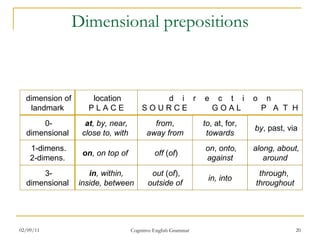
Dimensional prepositions dimension of landmark 0-dimensional 1-dimens. 2-dimens. 3-dimensional location P L A C E at , by, near, close to, with  on , on top of  in , within, inside, between  from ,  away from off  ( of ) out  ( of ), outside of to , at, for,  towards by , past, via on ,  onto, against along, about, around in, into through ,  throughout d  i  r  e  c  t  i  o  n S O U R C E  G O A L  P  A  T  H 02/09/11 Cognitive English Grammar
Core sense and extensions of  at point in space wait at the bus stop point in time at six o’clock target aim at a target functional activity at a place be at school 02/09/11 Cognitive English Grammar
at the intersection 02/09/11 Cognitive English Grammar
at the gate 02/09/11 Cognitive English Grammar Lynn is at the gate to  St. Michael's and  All Angels Church.  Thankfully, the tourist center  offered to call Robert  (bell ringer) to open  the church and  show us around.
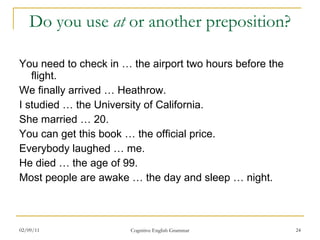
Do you use  at  or another preposition? You need to check in … the airport two hours before the flight. We finally arrived … Heathrow. I studied … the University of California. She married … 20. You can get this book … the official price. Everybody laughed … me. He died … the age of 99. Most people are awake … the day and sleep … night. 02/09/11 Cognitive English Grammar
Core sense and extensions of  on The book is on the table Contact with surface Contact with line Stratford on Avon The book is on the table Indirect   contact   I can rely on my friends Support The army stood on guard days Passive state My class is on Thursday  02/09/11 Cognitive English Grammar
wrinkles on my forehead 02/09/11 Cognitive English Grammar
Do you use  on  or another preposition? There is a spider … the wall. There is no money left … my bank account.  The dog is … a leash. My dad lives … a small pension. I hope I can always count … you. I have so many things … my mind. The police are … duty tonight. All the books are … sale today. There is no school … Wednesday. Let’s go swimming … the morning. But our final test is … Thursday morning. 02/09/11 Cognitive English Grammar
Core sense and extensions of  in The toys are in the box The flower is in the vase a comment in the margin There is a man in the water The chair is in the corner Containment Bounded surface Unbounded container Partial containment Mental boundaries of container Bounded  passive states I am in love with Rose Bounded units of time other than days I’ll see you in the morning 02/09/11 Cognitive English Grammar
Do you use  in  or another preposition? We are … Oxford street now.  Our bus is … the road to Cambridge.  The drug dealer is locked up … prison. Some prisoners are kept … chains. I was … a shock when I saw this. The state police are … charge of the investigation. The plane landed … time.  Will you be back … time for dinner? 02/09/11 Cognitive English Grammar
Uses of the source prepositions  from, off/of,  and  out of The apple fell ... the tree. He produced the letter ... his pocket. Rebecca has no secrets ... Danny. Some muggers will turn violent ... sheer frustration. It is hard to learn Japanese … books.  Microchips are fabricated ... silicon slices.  The rug is made ... cotton. Bread is made ... wheat and several other things. Books are made ... paper. 02/09/11 Cognitive English Grammar
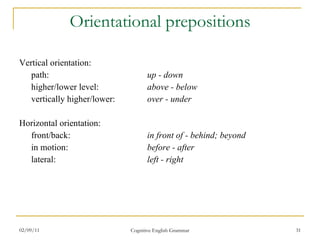
Orientational prepositions Vertical orientation: path: up - down higher/lower level: above - below   vertically higher/lower:  over - under Horizontal orientation: front/back: in front of - behind; beyond in motion: before - after lateral: left - right 02/09/11 Cognitive English Grammar
Vertical path prepositions:  up  and  down vertical ascent endpoint/ completion gradual ascent reflexive The rocket shot up climb up the hill The elevator is up/  The steak is eaten up He stood up up down vertical descent gradual descent endpoint reflexive The rocket fell down climb down the hill The elevator is down He sat down LM LM LM LM LM LM TR TR TR TR TR TR LM = TR LM = TR 02/09/11 Cognitive English Grammar
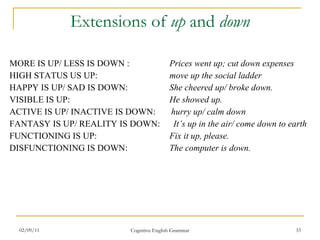
Extensions of  up  and  down MORE IS UP/ LESS IS DOWN :   Prices went up; cut down expenses HIGH STATUS US UP:    move up the social ladder HAPPY IS UP/ SAD IS DOWN:   She cheered up/ broke down. VISIBLE IS UP:    He showed up.  ACTIVE IS UP/ INACTIVE IS DOWN:  hurry up/ calm down FANTASY IS UP/ REALITY IS DOWN:  It’s up in the air/ come down to earth FUNCTIONING IS UP:   Fix it up, please.   DISFUNCTIONING IS DOWN:    The computer is down. 02/09/11 Cognitive English Grammar
Verticality prepositions:  over  and  under (beneath, underneath)   over LM separation contact fly over the Alps hike over the Alps under separation contact the cat under  the table the key under  the door mat rotation rotation TR She had a veil over her face. He carried a gun  under his coat. reflexive The wall  fell over. LM LM LM LM LM TR TR TR TR TR LM = TR 02/09/11 Cognitive English Grammar
Extensions of  above, below  and  over, under MORE IS UP:   above the average;  over 50% of the population LESS IS DOWN:    below freezing point; under age HIGH STATUS US UP:  be above the law; criticism LOW STATUS IS DOWN: serve under the emperor HIDDEN IS DOWN:  under cover AFFECTING IS TOUCHING:  work under pressure; be under arrest 02/09/11 Cognitive English Grammar
Horizontality prepositions:  before  and  after before The dog ran after the cat. after LM preceding LM in motion TR He reached the goal before me.  following LM in motion TR LM preceding LM in fictive motion LM LM TR I come before you.  following LM in fictive motion TR You come after me.  02/09/11 Cognitive English Grammar
Extensions of  behind  and  beyond;  before/for  and  after  TIME IS A MOVING OBJECT:   We are behind schedule.    Spring comes before summer and  after  winter. CAUSING IS PUSHING FORWARD:  He is the man behind the revolt. INACCESSIBILITY IS DISTANCE:  That car is beyond our means.    This is beyond all doubt. AIMS ARE GOALS:   She is hunting for/after money.    *She is hunting for an ideal partner.   She is hunting after an ideal partner 02/09/11 Cognitive English Grammar
Intense emotions are containers She pursed her lips in vexation.  She kicked the door in frustration. He pushed away his plate in disgust. He swings around in terror. to be   in fear, in anger, in fright, in anxiety, in distress, in despair *to be in worry, *in sadness, *in shame  or  *in disappointment .  *to be in pride, *to be in delight, *to be in pleasure,  *to be in enthusiasm, *to be in surprise But: to be in love. Emotions conceptualized as containers  and expressed by  in -phrases are intense and predominantly negative. The physiological reactions triggered by them are processes or actions which are beyond the experiencer's control or responsibility. 02/09/11 Cognitive English Grammar
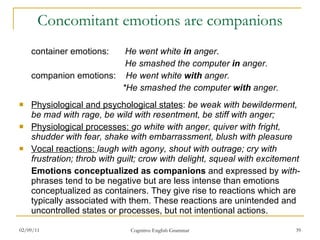
Concomitant emotions are companions container emotions:   He went white  in  anger .   He smashed the computer  in  anger. companion emotions:  He went white  with  anger.   *He smashed the computer  with  anger. Physiological and psychological states :  be weak with bewilderment, be mad with rage, be wild with resentment, be stiff with anger;  Physiological processes:  go white with anger, quiver with fright, shudder with fear, shake with embarrassment, blush with pleasure Vocal reactions:  laugh with agony, shout with outrage; cry with frustration; throb with guilt; crow with delight, squeal with excitement Emotions conceptualized as companions  and expressed by  with -phrases tend to be negative but are less intense than emotions conceptualized as containers. They give rise to reactions which are typically associated with them. These reactions are unintended and uncontrolled states or processes, but not intentional actions.  02/09/11 Cognitive English Grammar
Reasoned emotions are back-regions  factual situation: She cried for joy. non-factual situation: She can't speak for excitement. hypothetical situation: She could have died for shame. She couldn't sleep for fear that someone would break in . He cried  in  pain. *He didn't cry  in  pain. He cried  with  pain. *He didn't cry  with  pain. *He cried  for  pain. He didn't cry  for  pain. Emotions conceptualized as back-regions  and expressed by  for  involve reasoning. Emotions reasoned about do not prompt any specifically determined reactions. This is the case with the unspecific range of responses following positive emotions and with situations involving negated or hypothetical responses. 02/09/11 Cognitive English Grammar
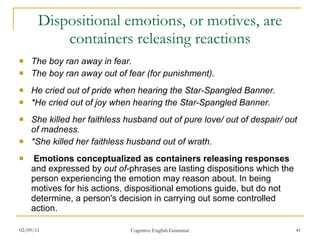
Dispositional emotions, or motives, are containers releasing reactions The boy ran away in fear. The boy ran away out of fear (for punishment). He cried out of pride when hearing the Star-Spangled Banner. *He cried out of joy when hearing the Star-Spangled Banner. She killed her faithless husband out of pure love/ out of despair/ out of madness. *She killed her faithless husband out of wrath.   Emotions conceptualized as containers releasing responses  and expressed by  out of- phrases are lasting dispositions which the person experiencing the emotion may reason about. In being motives for his actions, dispositional emotions guide, but do not determine, a person's decision in carrying out some controlled action. 02/09/11 Cognitive English Grammar

Ceg chapters 11,12

  • 1.
    Chapter 11 Event schemas: Sentence patterns 02/09/11 Cognitive English Grammar
  • 2.
    Worlds of experience:event schemas The material world: Occurrence schemas: states, processes Spatial schemas: location, motion Possession schema Psychological world: Emotion schema Perception/cognition schema Force-dynamic world: Action schema Self-motion schema Caused-motion schema Transfer schema: physical & abstract, beneficial, metaphorical 02/09/11 Cognitive English Grammar
  • 3.
    Occurrence schema: Processes:CHANGE OF STATE IS MOTION Deictic motion: PURPOSEFUL CHANGE IS MOTION TO A LOCATION John went into computing. The country went to war. ACHIEVING A PURPOSEFUL CHANGE IS REACHING A LOCATION We have come to a conclusion/ reached a conclusion. *We have come to a disagreement. Non-deictic motion: CHANGE TO AN EXPECTED STATE IS ARRIVAL AT A LOCATION All good things come to an end. The water is coming to a boil. CHANGE TO AN UNEXPECTED STATE IS MOTION AWAY. The car went dead in the middle of the road. He went crazy. 02/09/11 Cognitive English Grammar
  • 4.
    Action schema: Degrees of force of the energy source Agent-like causes: Natural forces: Kathrina devastated New Orleans. Reified causes: The strike closed down the railway system. Means: Your article pointed out that ... Instrument: Guns don’t kill people, people kill people. Enabling conditions: This item won’t scan. 02/09/11 Cognitive English Grammar
  • 5.
    Action schema: Affectedness of the theme (Bolinger 1977) George turned the pages. The pages were turned by George. George turned the corner. *The corner was turned by George. The stranger approached me. I was approached by the stranger. The train approached me. *I was approached by the train. The generals deserted the army. The army was deserted by the generals. Private Smith deserted the army. *The army was deserted by the Private Smith. Generations of lovers have The bridge has been walked under walked under the bridge. by generations of lovers. The dog walked under the bridge. *The bridge was walked under by the dog. 02/09/11 Cognitive English Grammar
  • 6.
    Transfer schema: Beneficial transfer Uncle Jim bought some chocolates for Margaret . Uncle Jim bought Margaret some chocolates. Uncle Jim cooked a meal for Margaret. Uncle Jim cooked Margaret a meal. Uncle Jim washed some socks for Margaret. ?Uncle Jim washed Margaret some socks. Uncle Jim answered some letters for Margaret. *Uncle Jim answered Margaret some letters. 02/09/11 Cognitive English Grammar
  • 7.
    Chapter 12 Space and extensions of space: Complements and adjuncts 02/09/11 Cognitive English Grammar
  • 8.
    Space and timeTheory of relativity, space-time (Einstein) Space and time are necessary concepts: any object is located in space and time (Kant). Space and time are irreducible domains of experience. Space is more basic than time. Time is metaphorically understood in terms of space: time frame, space in time ; linearity of time: passage of time. In many languages, time is obligatorily coded as tense in finite sentence, while space is often left implicit: It’s raining, default sense: ‘It is raining here’. 02/09/11 Cognitive English Grammar
  • 9.
    Space and thingsSpace is empty but significant: it makes the appearance of physical entities possible. Things that exist exist in space, and to be is to be located. “ Rules” for objects in space: two objects cannot occupy the same space at same time; an object cannot be in two places at same time. Things are defined by space: their shape, form and boundaries separate things from the space surrounding them. Space is also within things (atoms, molecules). The three axes of the Euclidean coordinate system apply to space and objects (spatial dimensions). 02/09/11 Cognitive English Grammar
  • 10.
    Spatial dimensions a) Vertical dimension: natural reference line with the ground-level of the earth surface as zero point; defined by force of gravity and human up-right position, psychologically and linguistically the most salient spatial dimension. b) Horizontal dimension: front-back; defined by asymmetry of man: principal organs of perception, direction of motion. c) Lateral dimension: left-right, dependent upon prior establishment of front-back; symmetrical. Polarity of verticality and horizontality: Things above the ground and in front of us are visible and available = positive polarity; Things beneath the ground and behind us are invisible and unavailable = negative polarity. 02/09/11 Cognitive English Grammar
  • 11.
    Space and humansExperience of space: Bodily basis of some spatial notions: heart ‘center’, belly ‘in’, back , zurück < zum Rücken, Stadt ‘place where one is standing’. Perception of space: The earth is experienced as a flat horizontal plane extending into infinity . Some objects have a canonical position: e.g. intrinsic tops and bottoms of bottles, chairs, tables, people. Anthropocentrism : Biological make-up, asymmetrical body, up-right position, habitat, experience of gravity, encounter, locomotion. Egocentrism : We are part of space and make considerable use of ego as the reference point in speech situations: deixis, perspective. Significance of space: e.g. borders, territory, spatial property. 02/09/11 Cognitive English Grammar
  • 12.
    Space and languageSpace is coded in language a) by specifying the direction and distance from any point in space. Distances are measured in terms of time taken for someone or something to move from X to Y (e.g. an hour’s journey) or by a ruler: feet, hands, arms, stride, miles, inches, yards. b) by specifying the dimension of a reference object. Spatial expressions: Case (Ablative, Locative): Roma ‘from Rome’, Romam ‘to Rom’ Prepositions (+ case): in/into the pool , auf dem/das Dach Verbs: contain , surround , posture verbs ( stand ), motion verbs ( go ) Spatial adjectives: tall (vertical length), long (horizontal length) 02/09/11 Cognitive English Grammar
  • 13.
    English vs Tzeltalspatial strategies English: The cat is on the mat Subject-NP Predicate Prep NP TR vacuous support LM Tzeltal: Pachal ta mexa boch Predicate Prep NP Subject-NP sitting-bowl-like at table gourd upright location vacuous LM TR English strategy: Where to look – region projected from landmark. Tzeltal strategy: What to look for – something that has exactly this shape and disposition; this is the trajector. 02/09/11 Cognitive English Grammar
  • 14.
    Spatial specifications bymeans of body-part terms in Tzeltal AT the face of the house = in front of the house AT the mouth of the house = door AT the head of the table = end standing AT table its-head the bottle = the bottle is standing on the end of the table hanging the shelf AT its-side the house = the shelf is hanging on the side of the house standing coffee AT its-mouth/lips the fire = the coffee is standing at the edge of the fire leaning-almost-vertically firewood AT the back-house = the firewood is stacked vertically against the back of the house. 02/09/11 Cognitive English Grammar
  • 15.
    Different conceptions of the same spatial situation English: The sun rises in the East and sets in the West. German: Die Sonne geht im Osten auf und im Westen unter. ‘ t he sun goes in the East up and in the West down‘ Hungarian: Anap kelet en kel és nyvgat on nyvgszik. ‘ the sun East- on rises and West- on sets ’ Spanish: El sol sale por el este y se pone por el oeste. ‘ the sun goes-out about the East and puts itself about the West’ Finnnish: Aurinko nousee idä stä ja laskee länt een . ‘ the sun rises East- out-of and sets West- into ’ Japanese: Taiyō-ha higashi- kara nobori, nishi -ni shizumu. ‘ sun-TOP East- from rise-and West- to sink ’ 02/09/11 Cognitive English Grammar
  • 16.
    Classifying three staticspatial situations (Melissa Bowerman) 02/09/11 Cognitive English Grammar La taza está en la mesa. La manzana está en la fuenta. La manilla está en la puerta. Die Tasse ist auf dem Tisch. Der Apfel ist in der Schüssel. Der Griff ist an der Tür.
  • 17.
    Classifying three staticspatial situations (Melissa Bowerman) 02/09/11 Cognitive English Grammar Kuppi on pödällä. Adessive The cup is on the table The handle is on the door. The apple is in the bowl. Omena on kulhossa. Inessive Ovessa on kahva. Inessive
  • 18.
    Classifying three actionsin English and Korean 02/09/11 Cognitive English Grammar
  • 19.
    Two ways ofspecifying a spatial region: Two types of spatial prepositions Dimensional prepositions specify the spatial region where a thing (trajector = TR ) is to be found relative to the dimensional property of a landmark (= LM ), as in: Look, there is a squirrel on the roof. Orientational prepositions specify the spatial region where a thing (trajector) is to be found relative to two or more andmarks, as in: Now the squirrel is behind the tree . 02/09/11 Cognitive English Grammar
  • 20.
    Dimensional prepositions dimensionof landmark 0-dimensional 1-dimens. 2-dimens. 3-dimensional location P L A C E at , by, near, close to, with on , on top of in , within, inside, between from , away from off ( of ) out ( of ), outside of to , at, for, towards by , past, via on , onto, against along, about, around in, into through , throughout d i r e c t i o n S O U R C E G O A L P A T H 02/09/11 Cognitive English Grammar
  • 21.
    Core sense andextensions of at point in space wait at the bus stop point in time at six o’clock target aim at a target functional activity at a place be at school 02/09/11 Cognitive English Grammar
  • 22.
    at the intersection02/09/11 Cognitive English Grammar
  • 23.
    at the gate02/09/11 Cognitive English Grammar Lynn is at the gate to St. Michael's and All Angels Church. Thankfully, the tourist center offered to call Robert (bell ringer) to open the church and show us around.
  • 24.
    Do you use at or another preposition? You need to check in … the airport two hours before the flight. We finally arrived … Heathrow. I studied … the University of California. She married … 20. You can get this book … the official price. Everybody laughed … me. He died … the age of 99. Most people are awake … the day and sleep … night. 02/09/11 Cognitive English Grammar
  • 25.
    Core sense andextensions of on The book is on the table Contact with surface Contact with line Stratford on Avon The book is on the table Indirect contact I can rely on my friends Support The army stood on guard days Passive state My class is on Thursday 02/09/11 Cognitive English Grammar
  • 26.
    wrinkles on myforehead 02/09/11 Cognitive English Grammar
  • 27.
    Do you use on or another preposition? There is a spider … the wall. There is no money left … my bank account. The dog is … a leash. My dad lives … a small pension. I hope I can always count … you. I have so many things … my mind. The police are … duty tonight. All the books are … sale today. There is no school … Wednesday. Let’s go swimming … the morning. But our final test is … Thursday morning. 02/09/11 Cognitive English Grammar
  • 28.
    Core sense andextensions of in The toys are in the box The flower is in the vase a comment in the margin There is a man in the water The chair is in the corner Containment Bounded surface Unbounded container Partial containment Mental boundaries of container Bounded passive states I am in love with Rose Bounded units of time other than days I’ll see you in the morning 02/09/11 Cognitive English Grammar
  • 29.
    Do you use in or another preposition? We are … Oxford street now. Our bus is … the road to Cambridge. The drug dealer is locked up … prison. Some prisoners are kept … chains. I was … a shock when I saw this. The state police are … charge of the investigation. The plane landed … time. Will you be back … time for dinner? 02/09/11 Cognitive English Grammar
  • 30.
    Uses of thesource prepositions from, off/of, and out of The apple fell ... the tree. He produced the letter ... his pocket. Rebecca has no secrets ... Danny. Some muggers will turn violent ... sheer frustration. It is hard to learn Japanese … books. Microchips are fabricated ... silicon slices. The rug is made ... cotton. Bread is made ... wheat and several other things. Books are made ... paper. 02/09/11 Cognitive English Grammar
  • 31.
    Orientational prepositions Verticalorientation: path: up - down higher/lower level: above - below vertically higher/lower: over - under Horizontal orientation: front/back: in front of - behind; beyond in motion: before - after lateral: left - right 02/09/11 Cognitive English Grammar
  • 32.
    Vertical path prepositions: up and down vertical ascent endpoint/ completion gradual ascent reflexive The rocket shot up climb up the hill The elevator is up/ The steak is eaten up He stood up up down vertical descent gradual descent endpoint reflexive The rocket fell down climb down the hill The elevator is down He sat down LM LM LM LM LM LM TR TR TR TR TR TR LM = TR LM = TR 02/09/11 Cognitive English Grammar
  • 33.
    Extensions of up and down MORE IS UP/ LESS IS DOWN : Prices went up; cut down expenses HIGH STATUS US UP: move up the social ladder HAPPY IS UP/ SAD IS DOWN: She cheered up/ broke down. VISIBLE IS UP: He showed up. ACTIVE IS UP/ INACTIVE IS DOWN: hurry up/ calm down FANTASY IS UP/ REALITY IS DOWN: It’s up in the air/ come down to earth FUNCTIONING IS UP: Fix it up, please. DISFUNCTIONING IS DOWN: The computer is down. 02/09/11 Cognitive English Grammar
  • 34.
    Verticality prepositions: over and under (beneath, underneath) over LM separation contact fly over the Alps hike over the Alps under separation contact the cat under the table the key under the door mat rotation rotation TR She had a veil over her face. He carried a gun under his coat. reflexive The wall fell over. LM LM LM LM LM TR TR TR TR TR LM = TR 02/09/11 Cognitive English Grammar
  • 35.
    Extensions of above, below and over, under MORE IS UP: above the average; over 50% of the population LESS IS DOWN: below freezing point; under age HIGH STATUS US UP: be above the law; criticism LOW STATUS IS DOWN: serve under the emperor HIDDEN IS DOWN: under cover AFFECTING IS TOUCHING: work under pressure; be under arrest 02/09/11 Cognitive English Grammar
  • 36.
    Horizontality prepositions: before and after before The dog ran after the cat. after LM preceding LM in motion TR He reached the goal before me. following LM in motion TR LM preceding LM in fictive motion LM LM TR I come before you. following LM in fictive motion TR You come after me. 02/09/11 Cognitive English Grammar
  • 37.
    Extensions of behind and beyond; before/for and after TIME IS A MOVING OBJECT: We are behind schedule. Spring comes before summer and after winter. CAUSING IS PUSHING FORWARD: He is the man behind the revolt. INACCESSIBILITY IS DISTANCE: That car is beyond our means. This is beyond all doubt. AIMS ARE GOALS: She is hunting for/after money. *She is hunting for an ideal partner. She is hunting after an ideal partner 02/09/11 Cognitive English Grammar
  • 38.
    Intense emotions arecontainers She pursed her lips in vexation. She kicked the door in frustration. He pushed away his plate in disgust. He swings around in terror. to be in fear, in anger, in fright, in anxiety, in distress, in despair *to be in worry, *in sadness, *in shame or *in disappointment . *to be in pride, *to be in delight, *to be in pleasure, *to be in enthusiasm, *to be in surprise But: to be in love. Emotions conceptualized as containers and expressed by in -phrases are intense and predominantly negative. The physiological reactions triggered by them are processes or actions which are beyond the experiencer's control or responsibility. 02/09/11 Cognitive English Grammar
  • 39.
    Concomitant emotions arecompanions container emotions: He went white in anger . He smashed the computer in anger. companion emotions: He went white with anger. *He smashed the computer with anger. Physiological and psychological states : be weak with bewilderment, be mad with rage, be wild with resentment, be stiff with anger; Physiological processes: go white with anger, quiver with fright, shudder with fear, shake with embarrassment, blush with pleasure Vocal reactions: laugh with agony, shout with outrage; cry with frustration; throb with guilt; crow with delight, squeal with excitement Emotions conceptualized as companions and expressed by with -phrases tend to be negative but are less intense than emotions conceptualized as containers. They give rise to reactions which are typically associated with them. These reactions are unintended and uncontrolled states or processes, but not intentional actions. 02/09/11 Cognitive English Grammar
  • 40.
    Reasoned emotions areback-regions factual situation: She cried for joy. non-factual situation: She can't speak for excitement. hypothetical situation: She could have died for shame. She couldn't sleep for fear that someone would break in . He cried in pain. *He didn't cry in pain. He cried with pain. *He didn't cry with pain. *He cried for pain. He didn't cry for pain. Emotions conceptualized as back-regions and expressed by for involve reasoning. Emotions reasoned about do not prompt any specifically determined reactions. This is the case with the unspecific range of responses following positive emotions and with situations involving negated or hypothetical responses. 02/09/11 Cognitive English Grammar
  • 41.
    Dispositional emotions, ormotives, are containers releasing reactions The boy ran away in fear. The boy ran away out of fear (for punishment). He cried out of pride when hearing the Star-Spangled Banner. *He cried out of joy when hearing the Star-Spangled Banner. She killed her faithless husband out of pure love/ out of despair/ out of madness. *She killed her faithless husband out of wrath.   Emotions conceptualized as containers releasing responses and expressed by out of- phrases are lasting dispositions which the person experiencing the emotion may reason about. In being motives for his actions, dispositional emotions guide, but do not determine, a person's decision in carrying out some controlled action. 02/09/11 Cognitive English Grammar