3/29/2010


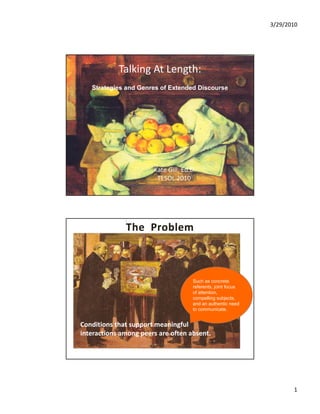
            Talking At Length:
   Strategies and Genres of Extended Discourse


                       Kate Gill, Ed.D.
                        TESOL 2010


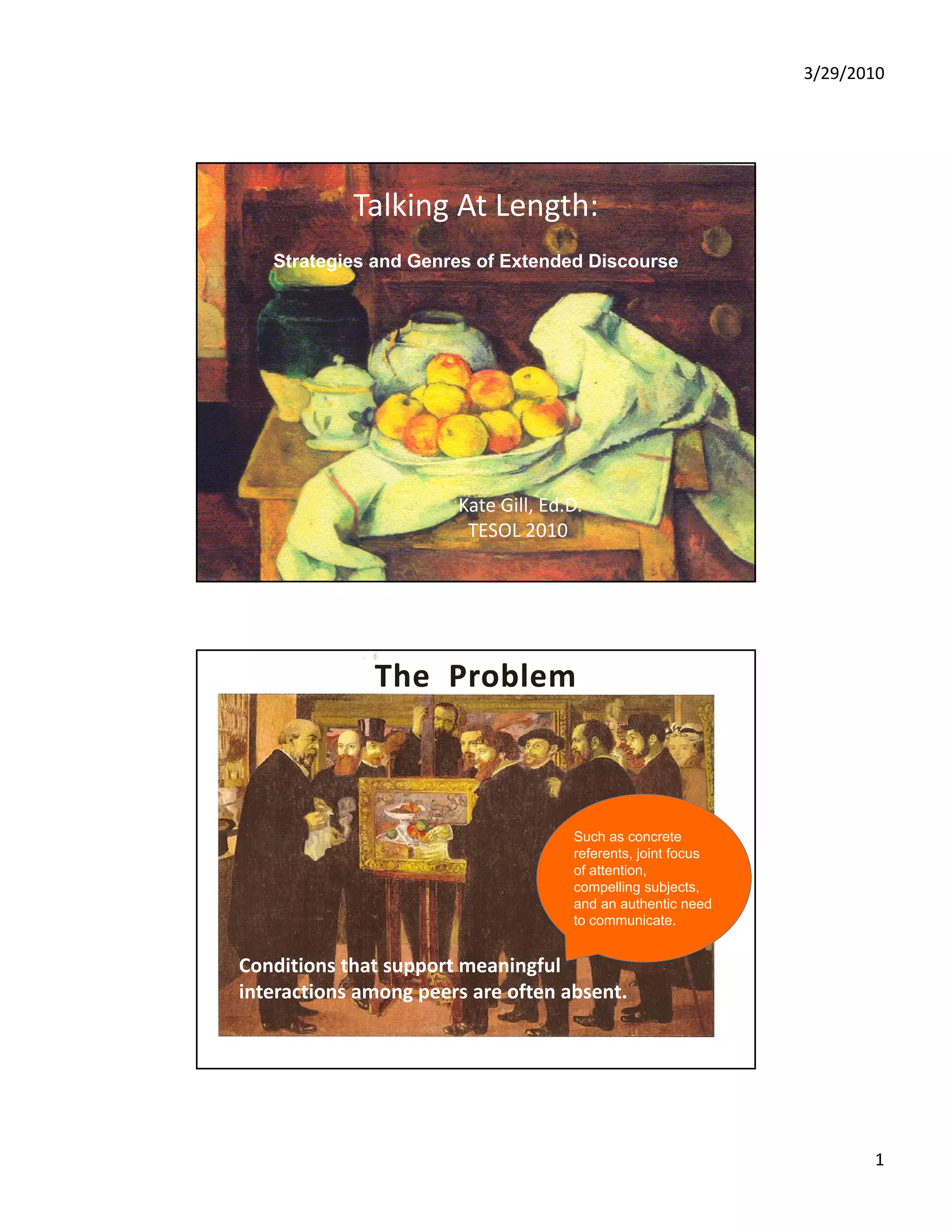
              The  Problem


                                     Such as concrete
                                     referents, joint focus
                                     of attention,
                                     compelling subjects,
                                     and an authentic need
                                     to communicate.


Conditions that support meaningful 
interactions among peers are often absent. 


                                                                     1
3/29/2010


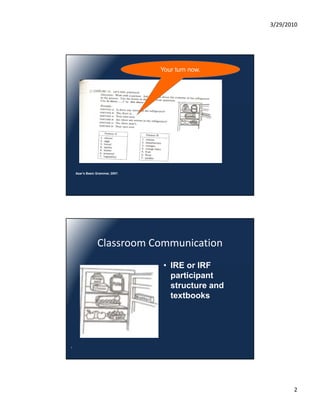
                                  Your turn now.


    Azar’s Basic Grammar, 2007.


                 Classroom Communication
                                   • IRE or IRF
                                     participant
                                     structure and
                                     textbooks


.


                                                            2
3/29/2010


     Authentic Communication

  Widely discussed as effective in L2 acquisition
• Wid l di       d     ff ti i L2         i iti

• Participants negotiate turns and topics

• Unpredictability of response

• Co‐construct meaning


                        Participants

                        SESSIONS

•Juan from Chile:             1, 2, 3, 4,  5
•Lola from Brazil:               1, 2, 3,       5 
•Gary from Haiti:                1, 2,           5 
•Mary from Ethiopia:             1,3
•Qin from Taiwan:
•Qin from Taiwan:                 1
•Kim from Korea:              1
•Liz from the U.S:              1, 4, 5
•Kate from the U.S:                 1, 2, 3, 4,  5


                                                             3
3/29/2010


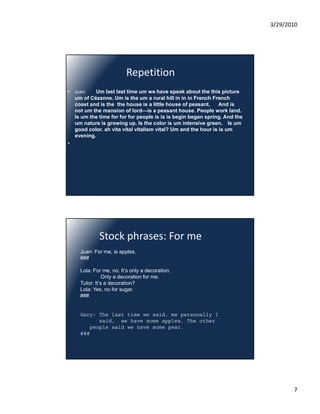
        Two Paintings by Cézanne
Small Houses Near Pontoise   Still Life with Commode


          1883-1884                    1887‐1888


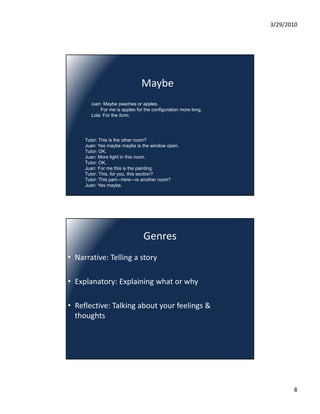
   Features of Authentic Communication


                                                              4
3/29/2010


Why look at extended discourse?
 •compared to topic exchange and repair, understudied

 •a diagnostic indicator of L2 proficiency

 •evidence of individual adult speaker’s L2 acquisition

 • functions and structures that support genres of talk


                Strategies

•Using fillers like um and uh
•Using fillers like um and uh

•Repeating a word in a turn

•Using a stock word or phrase
 Ui       t k     d     h


                                                                 5
3/29/2010


                           Fillers

Kate: So tell me, what did you notice in this painting? What did
  you—
Gary: I uh see some apples. Uh some sugar         thing.
Kate: Did you agree?
Juan: Uh apples.
Kate: Apples?
Qin: Is not apples!
Kate: Wait, sorry.
Qin: Peaches.


                                                                          6
3/29/2010


                         Repetition
• Juan:   Um last last time um we have speak about the this picture
  um of Cézanne. Um is the um a rural hill in in in French French
  coast and is the the house is a little house of peasant.     And is
  not um the mansion of lord—is a peasant house. People work land.
  Is um the time for for for people is is is begin began spring. And the
  um nature is growing up. Is the color is um intensive green. Is um
  good color. ah vita vital vitalism vital? Um and the hour is is um
  evening.
•


             Stock phrases: For me
     Juan: For me, is apples.
     ###

     Lola: For me, no. It’s only a decoration.
                Only a decoration for me.
     Tutor: It’s a decoration?
     Lola: Yes, no for sugar.
     ###


     Gary: The last time we said, me personally I
           said, we have some apples. The other
        people said we have some pear.
     ###


                                                                                  7
3/29/2010


                               Maybe
       Juan: Maybe peaches or apples.
           For me is apples for the configuration more long.
       Lola: For the form.


     Tutor: This is the other room?
     Juan: Yes maybe maybe is the window open.
     Tutor: OK.
     Juan: More light in this room.
     Tutor: OK.
     Juan: For me this is the painting.
     Tutor: This, for you, this section?
     Tutor: This part—here—is another room?
     Juan: Yes maybe.


                               Genres
• Narrative: Telling a story

• Explanatory: Explaining what or why

• Reflective: Talking about your feelings & 
  thoughts 


                                                                      8
3/29/2010


                  Narrative
 Gary: When I was in my country, my mother have one. When
 she served somebody coffee à Haiti, she used this thing.


Gary: When you arrive in my country in a peasant home, you
know, p-e-a-s-a-n-t ? Uh, you can find a table like this, uh, full
the same thing. Because this peasant no have a big home, he
has small home. He has a small table. He make all things with
the table.


                                                                            9
3/29/2010


                         Explanation
Juan: Mary said this is is no is very very very days ago is uh this
   um no fresh but but um the other sense is ah this picture is um
   sense um um peasant environment peasant farmer's house.
   Is countryside environment for relaxed. um the picture
   picture?
Liz: The painter?
Juan:    The painter. Uh create the different movement situations
   with technique. Uh uh different forms uh different colors and
   uh different um shape this picture um for is no this form.


                             Explanatory
      Juan: The farmer is small farmer, big
         farmer. The f
         f            farm is rich, the farmer
                                        f
         is rich. And the peasant level is
         subsistence.

      Gary: Subsistence level, yeah.

      Juan: The peasant normally is subsistence.
                                    subsistence

      Kate: That’s a good point, yeah.


                                                                            10
3/29/2010


                          Explanatory
Gary: But it’s better to say
   peasant no farmers.

Kate: I think you’re right.

Gary: When I talk about my
  country, a poor country,
  I can say peasant. When I
  talk about the United States,
  French, I can say farmers.

Kate: Yeah, I guess that’s a
  word we don’t use much.

Gary: Okay.


                        Reflective
   Mary: Me, I confused because everybody say different things. But the
   artist have different something inside you know. He think for
   something. When I see the first time I didn’t think about it. This is fruit
   and one sugar plate. This some plate, some other. But now when I
   see, it really it looks another thing. I said fruit, he said not this one
   fruit. I said fresh, not fresh, he said not fresh. So I will think about this
   one.


                                                                                         11
3/29/2010


                            Reflective
Lola: I changed my –I changed my mind. When I saw it the first time, I
   didn’t like this. Yeah, I didn’t like this picture. Because I didn’t like the
   still life. But I understand I have not too much for this picture, for this
   kind of picture. Then I can see more, one more dimension.For me is
   art. I see the movements and then I can imagine. Across the hall and
   another room and another peoples, and peoples go aut and pick up
   the apples and take to the tables and share with somebody. And then
   is more sympathic to me, too. The first time I couldn’t see. It very
   freeze. Now it’s turned to a warm. And I see life in there. Oh I see
   movement.
   movement I see dimension and imagine people too in the room and
                        dimension,                                   room,
   another room.


      Tutor: What interested you today?
      Juan: Um for me uh the interesting for today is about the, uh,
      technique. The uh the painter uh created the um.
      Tutor: Technique?
      Juan: Or imagination for recreate the situation. How how to different
      J      O i     i ti f           t th it ti       H    h     t diff   t
      form is what is the imagination for recreate these things, these things?
      Maybe to put the other elements all in painting different color uh mixed
      uh everything.


                                                                                         12
3/29/2010


                           Summary

• Strategies such as fillers, repeating words, phrases—support 
  learners participation in authentic communication.
  learners’ participation in authentic communication.

• Learners dysfluencies support fluency—key elements in 
  constructing discourse.

• L2 speakers can achieve discourse: tell stories, explain things, 
  construct knowledge about topics of mutual interest, and 
  reflect on their feelings/thoughts in the process.


                          Implications
       •Students at all levels of L2 proficiency 
       can successfully participate in 
       can successfully participate in
       discourse—they need opportunities.

       •Teachers can set up conditions to 
       support peer to peer response and 
       support peer‐to‐peer response and
       participation in discourse, facilitating L2 
       acquisition.


                                                                            13
3/29/2010


  Um


Thank You.


                   14

Gill TESOL 2010 Talkng At Length: Strategies and Genres of Extended Discourse

  • 1.
    3/29/2010 Talking At Length: Strategies and Genres of Extended Discourse Kate Gill, Ed.D. TESOL 2010 The  Problem Such as concrete referents, joint focus of attention, compelling subjects, and an authentic need to communicate. Conditions that support meaningful  interactions among peers are often absent.  1
  • 2.
    3/29/2010 Your turn now. Azar’s Basic Grammar, 2007. Classroom Communication • IRE or IRF participant structure and textbooks . 2
  • 3.
    3/29/2010 Authentic Communication Widely discussed as effective in L2 acquisition • Wid l di d ff ti i L2 i iti • Participants negotiate turns and topics • Unpredictability of response • Co‐construct meaning Participants SESSIONS •Juan from Chile:  1, 2, 3, 4,  5 •Lola from Brazil:  1, 2, 3,       5  •Gary from Haiti:  1, 2,           5  •Mary from Ethiopia:  1,3 •Qin from Taiwan: •Qin from Taiwan: 1 •Kim from Korea:   1 •Liz from the U.S: 1, 4, 5 •Kate from the U.S: 1, 2, 3, 4,  5 3
  • 4.
    3/29/2010 Two Paintings by Cézanne Small Houses Near Pontoise Still Life with Commode 1883-1884 1887‐1888 Features of Authentic Communication 4
  • 5.
    3/29/2010 Why look at extended discourse? •compared to topic exchange and repair, understudied •a diagnostic indicator of L2 proficiency •evidence of individual adult speaker’s L2 acquisition • functions and structures that support genres of talk Strategies •Using fillers like um and uh •Using fillers like um and uh •Repeating a word in a turn •Using a stock word or phrase Ui t k d h 5
  • 6.
    3/29/2010 Fillers Kate: So tell me, what did you notice in this painting? What did you— Gary: I uh see some apples. Uh some sugar thing. Kate: Did you agree? Juan: Uh apples. Kate: Apples? Qin: Is not apples! Kate: Wait, sorry. Qin: Peaches. 6
  • 7.
    3/29/2010 Repetition • Juan:   Um last last time um we have speak about the this picture um of Cézanne. Um is the um a rural hill in in in French French coast and is the the house is a little house of peasant. And is not um the mansion of lord—is a peasant house. People work land. Is um the time for for for people is is is begin began spring. And the um nature is growing up. Is the color is um intensive green. Is um good color. ah vita vital vitalism vital? Um and the hour is is um evening. • Stock phrases: For me Juan: For me, is apples. ### Lola: For me, no. It’s only a decoration. Only a decoration for me. Tutor: It’s a decoration? Lola: Yes, no for sugar. ### Gary: The last time we said, me personally I said, we have some apples. The other people said we have some pear. ### 7
  • 8.
    3/29/2010 Maybe Juan: Maybe peaches or apples. For me is apples for the configuration more long. Lola: For the form. Tutor: This is the other room? Juan: Yes maybe maybe is the window open. Tutor: OK. Juan: More light in this room. Tutor: OK. Juan: For me this is the painting. Tutor: This, for you, this section? Tutor: This part—here—is another room? Juan: Yes maybe. Genres • Narrative: Telling a story • Explanatory: Explaining what or why • Reflective: Talking about your feelings &  thoughts  8
  • 9.
    3/29/2010 Narrative Gary: When I was in my country, my mother have one. When she served somebody coffee à Haiti, she used this thing. Gary: When you arrive in my country in a peasant home, you know, p-e-a-s-a-n-t ? Uh, you can find a table like this, uh, full the same thing. Because this peasant no have a big home, he has small home. He has a small table. He make all things with the table. 9
  • 10.
    3/29/2010 Explanation Juan: Mary said this is is no is very very very days ago is uh this um no fresh but but um the other sense is ah this picture is um sense um um peasant environment peasant farmer's house. Is countryside environment for relaxed. um the picture picture? Liz: The painter? Juan: The painter. Uh create the different movement situations with technique. Uh uh different forms uh different colors and uh different um shape this picture um for is no this form. Explanatory Juan: The farmer is small farmer, big farmer. The f f farm is rich, the farmer f is rich. And the peasant level is subsistence. Gary: Subsistence level, yeah. Juan: The peasant normally is subsistence. subsistence Kate: That’s a good point, yeah. 10
  • 11.
    3/29/2010 Explanatory Gary: But it’s better to say peasant no farmers. Kate: I think you’re right. Gary: When I talk about my country, a poor country, I can say peasant. When I talk about the United States, French, I can say farmers. Kate: Yeah, I guess that’s a word we don’t use much. Gary: Okay. Reflective Mary: Me, I confused because everybody say different things. But the artist have different something inside you know. He think for something. When I see the first time I didn’t think about it. This is fruit and one sugar plate. This some plate, some other. But now when I see, it really it looks another thing. I said fruit, he said not this one fruit. I said fresh, not fresh, he said not fresh. So I will think about this one. 11
  • 12.
    3/29/2010 Reflective Lola: I changed my –I changed my mind. When I saw it the first time, I didn’t like this. Yeah, I didn’t like this picture. Because I didn’t like the still life. But I understand I have not too much for this picture, for this kind of picture. Then I can see more, one more dimension.For me is art. I see the movements and then I can imagine. Across the hall and another room and another peoples, and peoples go aut and pick up the apples and take to the tables and share with somebody. And then is more sympathic to me, too. The first time I couldn’t see. It very freeze. Now it’s turned to a warm. And I see life in there. Oh I see movement. movement I see dimension and imagine people too in the room and dimension, room, another room. Tutor: What interested you today? Juan: Um for me uh the interesting for today is about the, uh, technique. The uh the painter uh created the um. Tutor: Technique? Juan: Or imagination for recreate the situation. How how to different J O i i ti f t th it ti H h t diff t form is what is the imagination for recreate these things, these things? Maybe to put the other elements all in painting different color uh mixed uh everything. 12
  • 13.
    3/29/2010 Summary • Strategies such as fillers, repeating words, phrases—support  learners participation in authentic communication. learners’ participation in authentic communication. • Learners dysfluencies support fluency—key elements in  constructing discourse. • L2 speakers can achieve discourse: tell stories, explain things,  construct knowledge about topics of mutual interest, and  reflect on their feelings/thoughts in the process. Implications •Students at all levels of L2 proficiency  can successfully participate in  can successfully participate in discourse—they need opportunities. •Teachers can set up conditions to  support peer to peer response and  support peer‐to‐peer response and participation in discourse, facilitating L2  acquisition. 13
  • 14.