Downloaded 24 times
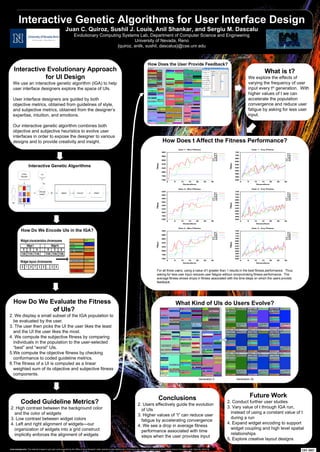

The document discusses the use of interactive genetic algorithms (IGAs) in user interface (UI) design, enabling designers to explore UI options through a combination of objective and subjective metrics. It highlights findings that higher values of 't' can reduce user fatigue while maintaining fitness performance, and users effectively guide UI evolution through their feedback. Future research directions include varying user input frequency and expanding widget encoding for creative layout designs.


