What is CE marking?
CE marking is a key indicator of a product’s compliance
with EU legislation and enables the free movement of
products within the European market. By affixing the CE
marking on a product, a manufacturer is declaring, on his
sole responsibility, conformity with all of the legal requirements to achieve CE marking and therefore ensuring
validity for that product to be sold throughout the European Economic Area (EEA, the 27 Member States of the
EU and EFTA countries Iceland, Norway, Liechtenstein), as
well as Turkey. This also applies to products made in third
countries which are sold in the EEA and Turkey.
However, not all products must bear the CE marking. Only
those product categories subject to specific directives that
provide for the CE marking are required to be CE marked.

Further information
For further information on the regulatory policy and
CE marking, please visit:
www.ec.europa.eu/enterprise/policies/single-market-goods/
regulatory-policies-common-rules-for-products/index_en.htm
www.ec.europa.eu/CEmarking
NANDO database of notified conformity assessment bodies:
www.ec.europa.eu/enterprise/newapproach/nando

CE marking does not indicate that a product was made in
the EEA, but merely states that the product is assessed
before being placed on the market and thus satisfies the
legislative requirements (e.g. a harmonised level of safety)
to be sold there. It means that the manufacturer has verified that the product complies with all relevant essential
requirements (e.g. health and safety requirements) of the
applicable directive(s) – or, if stipulated in the directive(s), had
it examined by a notified conformity assessment body.
It is the manufacturer’s responsibility to carry out the conformity assessment, to set up the technical file, to issue the
EC declaration of conformity and to affix CE marking on a
product. Distributors must verify the presence of both the
CE marking and the necessary supporting documentation.
If the product is being imported from a third country,
the importer has to verify that the manufacturer outside
the EU has undertaken the necessary steps and that the
documentation is available upon request.
This leaflet sets out the six necessary steps. Follow them to
comply with the legal requirements and make Europe’s
market yours!

CE marking makes
Europe’s market
yours!

European Commission
Directorate-General for Enterprise and Industry
B-1049 Brussels, Belgium
Fax: +32 2 299 08 31
E-mail: entr-reg-approach-for-free-circ@ec.europa.eu

European Commission
Enterprise and Industry
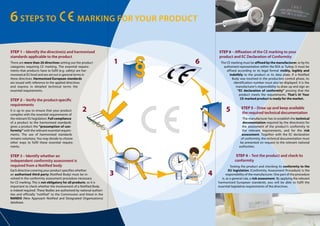
6 steps to

marking for your product

STEP 1 – Identify the directive(s) and harmonised
standards applicable to the product
There are more than 20 directives setting out the product
categories requiring CE marking. The essential requirements that products have to fulfil (e.g. safety) are harmonised at EU level and are set out in general terms in
these directives. Harmonised European standards
are issued with reference to the applied directives
and express in detailed technical terms the
essential requirements.

STEP 2 – Verify the product-specific
requirements
It is up to you to ensure that your product
complies with the essential requirements of
the relevant EU legislation. Full compliance
of a product to the harmonised standards
gives a product the “presumption of conformity” with the relevant essential requirements. The use of harmonised standards
remains voluntary. You may decide to choose
other ways to fulfil these essential requirements.

1

STEP 6 – Affixation of the CE marking to your
product and EC Declaration of Conformity

6

The CE marking must be affixed by the manufacturer, or by his
authorised representative within the EEA or Turkey. It must be
affixed according to its legal format visibly, legibly and
indelibly to the product or its data plate. If a Notified
Body was involved in the production control phase, its
identification number must also be displayed. It is the
manufacturer’s responsibility to draw up and sign an
“EC declaration of conformity” proving that the
product meets the requirements. That’s it! Your
CE-marked product is ready for the market.

2

5

The manufacturer has to establish the technical
documentation required by the directive(s) for
the assessment of the product’s conformity to
the relevant requirements, and for the risk
assessment. Together with the EC declaration
of conformity, the technical documentation must
be presented on request to the relevant national
authorities.

STEP 4 – Test the product and check its
conformity

STEP 3 – Identify whether an
independent conformity assessment is
required from a Notified body
Each directive covering your product specifies whether
an authorised third party (Notified Body) must be involved in the conformity assessment procedure necessary
for CE marking. This is not obligatory for all products, so it is
important to check whether the involvement of a Notified Body
is indeed required. These Bodies are authorised by national authorities and officially “notified” to the Commission and listed in the
NANDO (New Approach Notified and Designated Organisations)
database.

STEP 5 – Draw up and keep available
the required technical documentation

3

4

Testing the product and checking its conformity to the
EU legislation (Conformity Assessment Procedure) is the
responsibility of the manufacturer. One part of the procedure
is, as a general rule, a risk assessment. By applying the relevant
harmonised European standards, you will be able to fulfil the
essential legislative requirements of the directives.

C E MARK leaflet economic_operators_en

  • 1.
    What is CEmarking? CE marking is a key indicator of a product’s compliance with EU legislation and enables the free movement of products within the European market. By affixing the CE marking on a product, a manufacturer is declaring, on his sole responsibility, conformity with all of the legal requirements to achieve CE marking and therefore ensuring validity for that product to be sold throughout the European Economic Area (EEA, the 27 Member States of the EU and EFTA countries Iceland, Norway, Liechtenstein), as well as Turkey. This also applies to products made in third countries which are sold in the EEA and Turkey. However, not all products must bear the CE marking. Only those product categories subject to specific directives that provide for the CE marking are required to be CE marked. Further information For further information on the regulatory policy and CE marking, please visit: www.ec.europa.eu/enterprise/policies/single-market-goods/ regulatory-policies-common-rules-for-products/index_en.htm www.ec.europa.eu/CEmarking NANDO database of notified conformity assessment bodies: www.ec.europa.eu/enterprise/newapproach/nando CE marking does not indicate that a product was made in the EEA, but merely states that the product is assessed before being placed on the market and thus satisfies the legislative requirements (e.g. a harmonised level of safety) to be sold there. It means that the manufacturer has verified that the product complies with all relevant essential requirements (e.g. health and safety requirements) of the applicable directive(s) – or, if stipulated in the directive(s), had it examined by a notified conformity assessment body. It is the manufacturer’s responsibility to carry out the conformity assessment, to set up the technical file, to issue the EC declaration of conformity and to affix CE marking on a product. Distributors must verify the presence of both the CE marking and the necessary supporting documentation. If the product is being imported from a third country, the importer has to verify that the manufacturer outside the EU has undertaken the necessary steps and that the documentation is available upon request. This leaflet sets out the six necessary steps. Follow them to comply with the legal requirements and make Europe’s market yours! CE marking makes Europe’s market yours! European Commission Directorate-General for Enterprise and Industry B-1049 Brussels, Belgium Fax: +32 2 299 08 31 E-mail: entr-reg-approach-for-free-circ@ec.europa.eu European Commission Enterprise and Industry
  • 2.
    6 steps to markingfor your product STEP 1 – Identify the directive(s) and harmonised standards applicable to the product There are more than 20 directives setting out the product categories requiring CE marking. The essential requirements that products have to fulfil (e.g. safety) are harmonised at EU level and are set out in general terms in these directives. Harmonised European standards are issued with reference to the applied directives and express in detailed technical terms the essential requirements. STEP 2 – Verify the product-specific requirements It is up to you to ensure that your product complies with the essential requirements of the relevant EU legislation. Full compliance of a product to the harmonised standards gives a product the “presumption of conformity” with the relevant essential requirements. The use of harmonised standards remains voluntary. You may decide to choose other ways to fulfil these essential requirements. 1 STEP 6 – Affixation of the CE marking to your product and EC Declaration of Conformity 6 The CE marking must be affixed by the manufacturer, or by his authorised representative within the EEA or Turkey. It must be affixed according to its legal format visibly, legibly and indelibly to the product or its data plate. If a Notified Body was involved in the production control phase, its identification number must also be displayed. It is the manufacturer’s responsibility to draw up and sign an “EC declaration of conformity” proving that the product meets the requirements. That’s it! Your CE-marked product is ready for the market. 2 5 The manufacturer has to establish the technical documentation required by the directive(s) for the assessment of the product’s conformity to the relevant requirements, and for the risk assessment. Together with the EC declaration of conformity, the technical documentation must be presented on request to the relevant national authorities. STEP 4 – Test the product and check its conformity STEP 3 – Identify whether an independent conformity assessment is required from a Notified body Each directive covering your product specifies whether an authorised third party (Notified Body) must be involved in the conformity assessment procedure necessary for CE marking. This is not obligatory for all products, so it is important to check whether the involvement of a Notified Body is indeed required. These Bodies are authorised by national authorities and officially “notified” to the Commission and listed in the NANDO (New Approach Notified and Designated Organisations) database. STEP 5 – Draw up and keep available the required technical documentation 3 4 Testing the product and checking its conformity to the EU legislation (Conformity Assessment Procedure) is the responsibility of the manufacturer. One part of the procedure is, as a general rule, a risk assessment. By applying the relevant harmonised European standards, you will be able to fulfil the essential legislative requirements of the directives.