CLINICAL AUDIT
Citizens Hospital
2022-2023
HEALTH CARE PRACTICES AND
CLOSTRIDIUM DIFFICILE INCIDENCE IN A
TERTIARY CARE UNIT
Persons Responsible : Dr B. GANGA BHAVANI (CCM Resident)
Dr CH. BALA SUBRAHMANYAM (CCM Consultant)
Department : Critical Care Medicine
Aims and objectives
● Clostridium difficile is a serious and highly infectious colitis. In recent
decades, the incidence and mortality rates from C difficile have increased,
due to both virulence factors and widespread use of broad-spectrum
antibiotics.
● There is strong evidence that good clinical care of these patients reduces
morbidity, mortality and helps to limit cross-infection.
● The goal is to initiate early isolation of C difficile-positive patients, educate
the staff to follow cross-contamination prevention precautions , sanitizing the
rooms, initiate infection control and strict adherence to PPE.
Reference for Standards
Guidelines for the prevention of cross contamination of clostridium difficle has
been taken from IDSA 2017 clinical practice guidelines for clostridium difficile
infection in adults and children.
Methodology
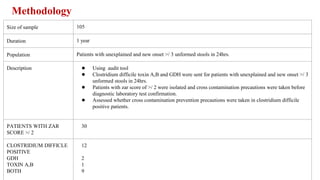
Size of sample 105
Duration 1 year
Population Patients with unexplained and new onset >/ 3 unformed stools in 24hrs.
Description ● Using audit tool
● Clostridium difficile toxin A,B and GDH were sent for patients with unexplained and new onset >/ 3
unformed stools in 24hrs.
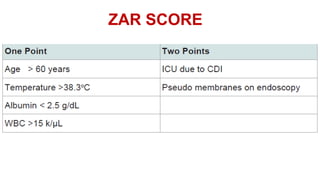
● Patients with zar score of >/ 2 were isolated and cross contamination precautions were taken before
diagnostic laboratory test confirmation.
● Assessed whether cross contamination prevention precautions were taken in clostridium difficile
positive patients.
PATIENTS WITH ZAR
SCORE >/ 2
30
CLOSTRIDIUM DIFFICLE
POSITIVE
GDH
TOXIN A,B
BOTH
12
2
1
9
ZAR SCORE
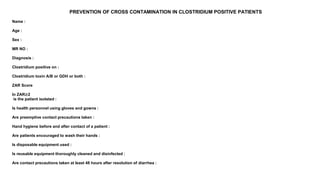
PREVENTION OF CROSS CONTAMINATION IN CLOSTRIDIUM POSITIVE PATIENTS
Name :
Age :
Sex :
MR NO :
Diagnosis :
Clostridium positive on :
Clostridium toxin A/B or GDH or both :
ZAR Score
In ZAR≳2
is the patient isolated :
Is health personnel using gloves and gowns :
Are preemptive contact precautions taken :
Hand hygiene before and after contact of a patient :
Are patients encouraged to wash their hands :
Is disposable equipment used :
Is reusable equipment thoroughly cleaned and disinfected :
Are contact precautions taken at least 48 hours after resolution of diarrhea :
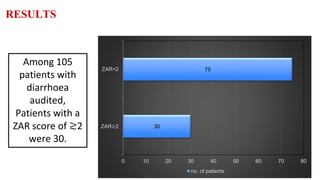
30
75
ZAR≳2
ZAR<2
0 10 20 30 40 50 60 70 80
no. of patients
Among 105
patients with
diarrhoea
audited,
Patients with a
ZAR score of ≳2
were 30.
RESULTS
C.Difficle --ve
60%
Toxin+ 3%
GDH+ 7%
Both + 30%
C. difficile +ve
=
40%
Among 30
patients with a
ZAR score of ≳2
C.difficle was
positive in 12
patients (40%)
RESULTS
RESULTS
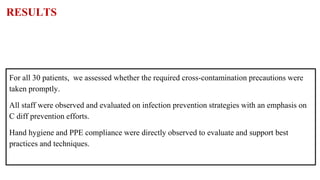
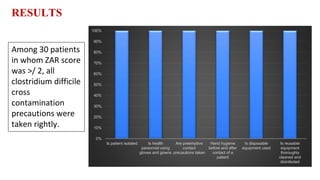
For all 30 patients, we assessed whether the required cross-contamination precautions were
taken promptly.
All staff were observed and evaluated on infection prevention strategies with an emphasis on
C diff prevention efforts.
Hand hygiene and PPE compliance were directly observed to evaluate and support best
practices and techniques.
0%
10%
20%
30%
40%
50%
60%
70%
80%
90%
100%
Is patient isolated Is health
personnel using
gloves and gowns
Are preemptive
contact
precautions taken
Hand hygiene
before and after
contact of a
patient
Is disposable
equipment used
Is reusable
equipment
thoroughly
cleaned and
disinfected
Among 30 patients
in whom ZAR score
was >/ 2, all
clostridium difficile
cross
contamination
precautions were
taken rightly.
RESULTS
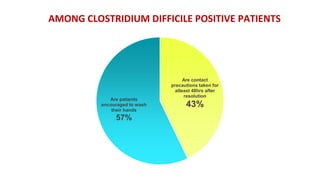
Are contact
precautions taken for
atleast 48hrs after
resolution
43%
Are patients
encouraged to wash
their hands
57%
AMONG CLOSTRIDIUM DIFFICILE POSITIVE PATIENTS
QUALITY IMPROVEMENT INTERVENTIONS
Teamwork among the staff and a clear understanding of their responsibilities
towards cleaning, disinfecting, stocking supplies, efficient communication,
and complying with the policies and procedures of hand hygiene and PPE
compliance led to the prevention of clostridium difficle cross-contamination.
THANK YOU

cdiff audit (1).pptx

  • 1.
  • 2.
    HEALTH CARE PRACTICESAND CLOSTRIDIUM DIFFICILE INCIDENCE IN A TERTIARY CARE UNIT Persons Responsible : Dr B. GANGA BHAVANI (CCM Resident) Dr CH. BALA SUBRAHMANYAM (CCM Consultant) Department : Critical Care Medicine
  • 3.
    Aims and objectives ●Clostridium difficile is a serious and highly infectious colitis. In recent decades, the incidence and mortality rates from C difficile have increased, due to both virulence factors and widespread use of broad-spectrum antibiotics. ● There is strong evidence that good clinical care of these patients reduces morbidity, mortality and helps to limit cross-infection. ● The goal is to initiate early isolation of C difficile-positive patients, educate the staff to follow cross-contamination prevention precautions , sanitizing the rooms, initiate infection control and strict adherence to PPE.
  • 4.
    Reference for Standards Guidelinesfor the prevention of cross contamination of clostridium difficle has been taken from IDSA 2017 clinical practice guidelines for clostridium difficile infection in adults and children.
  • 5.
    Methodology Size of sample105 Duration 1 year Population Patients with unexplained and new onset >/ 3 unformed stools in 24hrs. Description ● Using audit tool ● Clostridium difficile toxin A,B and GDH were sent for patients with unexplained and new onset >/ 3 unformed stools in 24hrs. ● Patients with zar score of >/ 2 were isolated and cross contamination precautions were taken before diagnostic laboratory test confirmation. ● Assessed whether cross contamination prevention precautions were taken in clostridium difficile positive patients. PATIENTS WITH ZAR SCORE >/ 2 30 CLOSTRIDIUM DIFFICLE POSITIVE GDH TOXIN A,B BOTH 12 2 1 9
  • 6.
  • 7.
    PREVENTION OF CROSSCONTAMINATION IN CLOSTRIDIUM POSITIVE PATIENTS Name : Age : Sex : MR NO : Diagnosis : Clostridium positive on : Clostridium toxin A/B or GDH or both : ZAR Score In ZAR≳2 is the patient isolated : Is health personnel using gloves and gowns : Are preemptive contact precautions taken : Hand hygiene before and after contact of a patient : Are patients encouraged to wash their hands : Is disposable equipment used : Is reusable equipment thoroughly cleaned and disinfected : Are contact precautions taken at least 48 hours after resolution of diarrhea :
  • 8.
    30 75 ZAR≳2 ZAR<2 0 10 2030 40 50 60 70 80 no. of patients Among 105 patients with diarrhoea audited, Patients with a ZAR score of ≳2 were 30. RESULTS
  • 9.
    C.Difficle --ve 60% Toxin+ 3% GDH+7% Both + 30% C. difficile +ve = 40% Among 30 patients with a ZAR score of ≳2 C.difficle was positive in 12 patients (40%) RESULTS
  • 10.
    RESULTS For all 30patients, we assessed whether the required cross-contamination precautions were taken promptly. All staff were observed and evaluated on infection prevention strategies with an emphasis on C diff prevention efforts. Hand hygiene and PPE compliance were directly observed to evaluate and support best practices and techniques.
  • 11.
    0% 10% 20% 30% 40% 50% 60% 70% 80% 90% 100% Is patient isolatedIs health personnel using gloves and gowns Are preemptive contact precautions taken Hand hygiene before and after contact of a patient Is disposable equipment used Is reusable equipment thoroughly cleaned and disinfected Among 30 patients in whom ZAR score was >/ 2, all clostridium difficile cross contamination precautions were taken rightly. RESULTS
  • 12.
    Are contact precautions takenfor atleast 48hrs after resolution 43% Are patients encouraged to wash their hands 57% AMONG CLOSTRIDIUM DIFFICILE POSITIVE PATIENTS
  • 13.
    QUALITY IMPROVEMENT INTERVENTIONS Teamworkamong the staff and a clear understanding of their responsibilities towards cleaning, disinfecting, stocking supplies, efficient communication, and complying with the policies and procedures of hand hygiene and PPE compliance led to the prevention of clostridium difficle cross-contamination.
  • 14.