Targeted Therapy for BRAF V600–
Mutant Melanoma
This program is supported by educational grants from
in association with
clinicaloptions.com/oncology
A Unique Physician, Nurse, and Patient Seminar Series
About These Slides
 Users are encouraged to use these slides in their own
noncommercial presentations, but we ask that content
and attribution not be changed. Users are asked to honor
this intent
 These slides may not be published or posted online
without permission from Clinical Care Options
(email permissions@clinicaloptions.com)
Disclaimer
The materials published on the Clinical Care Options Web site reflect the views of the authors of the
CCO material, not those of Clinical Care Options, LLC, the CME providers, or the companies providing
educational grants. The materials may discuss uses and dosages for therapeutic products that have not
been approved by the United States Food and Drug Administration. A qualified healthcare professional
should be consulted before using any therapeutic product discussed. Readers should verify all information
and data before treating patients or using any therapies described in these materials.
clinicaloptions.com/oncology
A Unique Physician, Nurse, and Patient Seminar Series
Faculty
Keith T. Flaherty, MD
Director of Temeer Center for Targeted Therapy
Massachusetts General Hospital Cancer Center
Boston, Massachusetts
Keith T. Flaherty, MD has disclosed that he has received
consulting fees from GlaxoSmithKline, Novartis, and
Roche/Genentech.
clinicaloptions.com/oncology
A Unique Physician, Nurse, and Patient Seminar Series
Incidence of Key Driver Oncogenes in
Melanoma
 BRAF ~ 50%
 NRAS ~ 20%
 CKIT ~ 1%
– Primarily mucosal and acral lentiginous
 GNAQ/GNA11 ~ 1%
– Almost exclusively uveal
Nikolaou VA, et al. J Invest Dermatol. 2012;132:854-863.
Smalley KS, et al. Semin Oncol. 2012;39:204-214.
clinicaloptions.com/oncology
A Unique Physician, Nurse, and Patient Seminar Series
BRAF Mutations: Biology and Practice
BRAF mutations
 Stable across primary to metastatic
melanoma
 Detectable in formalin-fixed,
paraffin-embedded tumor samples
BRAF Mutation, % N = 677
All BRAF mutations 47
V600E 72
V600K 23
V600R/L 4
Non-V600 2
Jakob J, et al. ASCO 2011. Abstract 8500.
NRAS
CRAFBRAF
MEK
ERK
clinicaloptions.com/oncology
A Unique Physician, Nurse, and Patient Seminar Series
BRAF Mutation Testing
 BRAF mutations are present throughout melanoma
disease progression
– If metastasis biopsy not available, most recent melanoma
surgery sample adequate (eg, lymph node)
 BRAF mutation testing is commercially available
– FDA-approved tests
– Cobas 4800 BRAF V600 Mutation Test (vemurafenib)
– THxID BRAF Kit (dabrafenib with or without trametinib)
NCCN. Clinical practice guidelines in oncology: melanoma. v.1.2014.
clinicaloptions.com/oncology
A Unique Physician, Nurse, and Patient Seminar Series
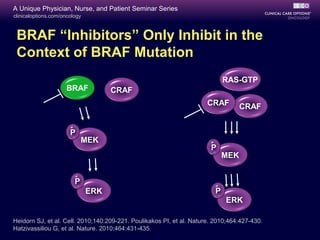
BRAF “Inhibitors” Only Inhibit in the
Context of BRAF Mutation
CRAFBRAF
MEK
ERK
P
P
CRAF
MEK
ERK
P
P
CRAF
Heidorn SJ, et al. Cell. 2010;140:209-221. Poulikakos PI, et al. Nature. 2010; 464:427-430.
Hatzivassiliou G, et al. Nature. 2010;464:431-435.
RAS-GTP
clinicaloptions.com/oncology
A Unique Physician, Nurse, and Patient Seminar Series
BRAF-Mutant Melanoma
Initial Therapy
clinicaloptions.com/oncology
A Unique Physician, Nurse, and Patient Seminar Series
Key Target Selectivity of Raf Inhibitors
Target Kinase IC50 (nM)
Vemurafenib Dabrafenib
BRAF-V600E 31 0.6
CRAF 48 5
BRAF 100 12
Bollag G, et al. Nature. 2010;467:596-599. Kefford R, et al. ASCO 2010. Abstract 8503.
clinicaloptions.com/oncology
A Unique Physician, Nurse, and Patient Seminar Series
Sosman J, et al. N Engl J Med. 2012;366:707-714.
Tumor regression: ~ 90% of patients
8 confirmed CRs
BRIM-2 Phase II Study of Vemurafenib in
Metastatic Melanoma: Tumor Regression
60
40
20
0
-20
-40
-60
-80
-100
PercentChangeFromBaselinein
LongestDiameterofTargetLesion
Patients Treated With Vemurafenib
Disease Stage
M1a
M1b
M1c
clinicaloptions.com/oncology
A Unique Physician, Nurse, and Patient Seminar Series
1. Chapman PB, et al. N Engl J Med. 2011;364:2507-2516. 2. McArthur G, et al. ECCO-ESMO 2011.
Abstract LBA28. 3. Hauschild A, et al. Lancet. 2012;380:358-365. 4. Robert C, et al. ASCO 2012.
Abstract LBA8509. 5. Flaherty KT, et al. N Engl J Med. 2012;367:107-114.
Phase III Trials in BRAF V600E–Mutant
Melanoma
Trial Name NCT Identifier N Treatment Arms
BRIM-3[1,2]
NCT01006980 675 Vemurafenib 960 mg PO BID (n = 337)
Dacarbazine 1000 mg/m2
IV q3w
(n = 338)
BRF113683[3]
NCT01227889 250 Dabrafenib 150 mg PO BID (n = 187)
Dacarbazine 1000 mg/m2
IV q3w (n = 63)
METRIC[4,5]
NCT01245062 322 Trametinib 2 mg PO QD (n = 214)
Dacarbazine1000 mg/m2
IV q3w or
paclitaxel 175 mg/m2
q3w (n = 108)
clinicaloptions.com/oncology
A Unique Physician, Nurse, and Patient Seminar Series
Chapman PB, et al. N Engl J Med. 2011;364:2507-2516.
250
200
150
100
50
0
-50
-100
%ChangeFromBaselinein
DiametersofTargetLesions
Patients Treated With Vemurafenib
Unresectable
stage IIIc
M1a M1b M1c
Disease Stage 100
80
60
40
20
0
0 2 4 6 8 10 12
Mos
PFS(%)
HR: 0.26 (95% Cl: 0.20-0.33;
P < .001)
Vemurafenib (n = 275)
Dacarbazine (n = 274)
BRIM-3 Phase III Study of Vemurafenib vs
DTIC in Melanoma: Response and PFS
clinicaloptions.com/oncology
A Unique Physician, Nurse, and Patient Seminar Series
Mos
Vemurafenib (n = 337)
Est 6-mo survival: 83%
Median follow-up: 6.2 mos
Dacarbazine (n = 338)
Est 6-mo survival: 63%
Median follow-up: 4.5 mos
OS(%)
HR: 0.44
(95% CI: 0.33-0.59)
Dacarbazine
median OS:
7.9 mos
McArthur G, et al. ECCO-ESMO 2011. Abstract LBA28.
BRIM-3 Phase III Study of Vemurafenib vs
Dacarbazine in Melanoma: OS
100
90
80
70
60
50
40
30
20
10
0
0 1 2 3 4 5 6 7 8 9 10 11 12 13 14
clinicaloptions.com/oncology
A Unique Physician, Nurse, and Patient Seminar Series
Phase III Study of Dabrafenib vs DTIC in
Melanoma: Response and PFS
Hauschild A, et al. Lancet Oncol. 2012;380:358-365.
Unresectable IIC
M1A
M1B
M1C
100
80
60
40
20
0
-20
-40
-60
-80
-100
ChangeatMaximumReductionFrom
BaselineMeasurement(%)
100
90
80
70
60
50
40
30
20
10
0PFS(%)
0 1 2 3 4 5 6 7 8 9
Dabrafenib
Dacarbazine
Mos
clinicaloptions.com/oncology
A Unique Physician, Nurse, and Patient Seminar Series
Trametinib (n = 214)
Single-Agent MEKi (Trametinib) in BRAF-
Mutant/BRAFi-Naive Metastatic Melanoma
Robert C, et al. ASCO 2012. Abstract LBA8509.
Disease Stage
39%
M1c
M1b
M1a
IIIC
Unknown
100
80
60
40
20
0
-20
-40
-60
-80
-100
%ChangeFromBaselinein
DiametersofTargetLesions
clinicaloptions.com/oncology
A Unique Physician, Nurse, and Patient Seminar Series
Phase III METRIC: Trametinib (MEKi) vs
Dacarbazine or Paclitaxel
Flaherty KT, et al. N Engl J Med. 2012;367:107-
114.
1.0
0.8
0.6
0.4
0.2
0
0 2 4 6
8
Mos Since Randomization
ProbabilityofPFS
HR: 0.45
(95% Cl: 0.33-0.63;
P < .001)
Trametinib
(n = 214)
Chemotherapy
(n = 108)
ProbabilityofOS
1.0
0.8
0.6
0.4
0.2
0
0 2 4 6 8 10
Trametinib
(n = 214)
Chemotherapy
(n = 108)
HR: 0.54 (95% Cl: 0.32-0.92; P = .01)
Mos Since Randomization
clinicaloptions.com/oncology
A Unique Physician, Nurse, and Patient Seminar Series
Most Common AEs With Approved
Targeted Agents in Advanced Melanoma
AE (≥ Grade 2), % Vemurafenib[1]
Dabrafenib[2]
Trametinib[3]
Arthralgia 21 5 NR
Rash 18 NR 27
Fatigue 13 6 9
Cutaneous SCC/
keratoacanthoma
12/8 6 (combined) NR
Hyperkeratosis 6 13 NR
Pyrexia NR 11 NR
Headache 5 5 NR
Photosensitivity (any grade) 12 3 NR
Hypertension NR NR 12
1. Chapman PB, et al. N Engl J Med. 2011;364:2507-2516. 2. Hauschild A, et al. Lancet. 2012;380:358-
365. 3. Flaherty KT, et al N Engl J Med. 2012;367:107-114.
clinicaloptions.com/oncology
A Unique Physician, Nurse, and Patient Seminar Series
Vemurafenib + Ipilimumab: Hepatotoxicity
 Phase I study in patients with BRAF V600–mutant
melanoma
– Dose-limiting grade 3 aminotransferase elevation in 4 pts
– Lowering dose of vemurafenib still produced elevated
aminotransferase levels
– Hepatic adverse events asymptomatic and reversible
– Other adverse events of the combination: grade 2 temporal
arteritis, grade 3 rash
– Study has been closed to further accrual
Ribas A, et al. N Engl J Med. 2013;368:1365-1366.
clinicaloptions.com/oncology
A Unique Physician, Nurse, and Patient Seminar Series
Resistance to BRAF Inhibitors
clinicaloptions.com/oncology
A Unique Physician, Nurse, and Patient Seminar Series
Sosman J, et al. N Engl J Med. 2012;366:707-714.
BRIM-2 Phase II Study of Vemurafenib in
Metastatic Melanoma: PFSIndividualPatientsTreated
WithVemurafenib
TTP
Time to response
Died
Alive with response
Mos
0 202 4 6 8 10 12 14 16 18
clinicaloptions.com/oncology
A Unique Physician, Nurse, and Patient Seminar Series
Molecular Characteristics of Disease
Progression
 Variable restoration of signaling through ERK
 No new activating mutations in BRAF
– BRAFV600E persists at progression
300
250
200
150
100
50
0
H-Score
BL Day 15 DP
pERK
Time
N = 23 n = 12
clinicaloptions.com/oncology
A Unique Physician, Nurse, and Patient Seminar Series
Bypassing BRAF Inhibitor Blockade
Nazarian R, et al. Nature. 2010;468:973-977. Johannessen CM, et al. Nature. 2010;468:968-972. Villanueva J, et al. Cancer
Cell. 2010;18:683-695. Wagle N, et al. J Clin Oncol. 2011;29:3085-3096. Shi H, et al. Nat Commun. 2012;3:724. Poulikakos
PI,
et al. Nature. 2011;480:387-390. Straussman R, et al. Nature. 2012;487:500-504. Whittaker SR, et al. Cancer Discov. 2013;3:
350-362. Maertens O, et al. Cancer Discov. 2013;3:338-349.
CRAFBRAF
MEK
ERK
P
P
BRAF BRAF
BRAF
BRAF
NRAS
COT
MEK
Alternative splicing
Amplification
PI3K
NF1
clinicaloptions.com/oncology
A Unique Physician, Nurse, and Patient Seminar Series
Single-Agent MEKi (Trametinib) in BRAF-
Mutant/BRAFi-Naive Metastatic Melanoma
Robert C, et al. ASCO 2012. Abstract LBA8509.
Disease Stage
39%
Trametinib (n = 214)
M1c
M1b
M1a
IIIC
Unknown
100
80
60
40
20
0
-20
-40
-60
-80
-100
%ChangeFromBaselinein
DiametersofTargetLesions
clinicaloptions.com/oncology
A Unique Physician, Nurse, and Patient Seminar Series
Single-Agent MEK Inhibitor Has Minimal
Activity in BRAFi-Refractory Patients
Unconfirmed RR: 5% (95% CI: 0.6-16.9)
1 CR, 1 PR, 11 SD
*Discontinued prior BRAFi due to toxicity
K = V600K
M1cM1a M1bM Stage at Screening
K
K
K
K
*
MaximumReductioninTargetLesions
FromBaseline(%)
*
*
Kim KB, et al. J Clin Oncol. 2013;31:482-489.
100
80
60
40
20
0
-20
-40
-60
-80
-100
clinicaloptions.com/oncology
A Unique Physician, Nurse, and Patient Seminar Series
Tumor Regression With BRAF/MEK
Combination in BRAFi-Refractory Patients
MaximumPercentReduction
FromBaseline
Mos Since
Prior BRAFi
PR
SD
PD
Best Response
on Prior BRAFiRR: 19%
M = Prior MEKi
Flaherty KT, et al. SMR 2011. Abstract LBA1-4.
--80
--60
--40
--20
0
20
40
1.0 0.4 0 0.6 4.2 -- 0.3 2.1 4.3 2.6 7.7 0.5 0.2 1.0 -- 6.2 0.5 1.0 0.2 7.4 9.21.1 1.1
M
M
M M
M
clinicaloptions.com/oncology
A Unique Physician, Nurse, and Patient Seminar Series
Dabrafenib + Trametinib Combination in
BRAF Inhibitor–Naive Patients
MaximumPercentReductionFromBaselineMeasurement
Best Confirmed Response
CR
PRPD
SD
Dabrafenib 150 mg BID/Trametinib 2 mg QD
Long G et al. ESMO 2012. Abstract LBA27_PR.
100
80
60
40
20
0
-20
-40
-60
-80
-100
100
80
60
40
20
0
-20
-40
-60
-80
-100
Dabrafenib Monotherapy
clinicaloptions.com/oncology
A Unique Physician, Nurse, and Patient Seminar Series
Delayed Resistance With BRAF/MEK
Combo vs Single-Agent BRAF Inhibition
Flaherty KT, et al. N Engl J Med. 2012;367:1694-1703.
Full-dose BRAF/MEK
Full-dose BRAF/half-dose MEK
Full-dose BRAF
Full-Dose BRAF/MEK Full-Dose BRAF
Median PFS, mos 9.4 5.8
HR 0.39 (P < .001)1.0
0.8
0.6
0.4
0.2
0
0 3 6 9 12 15 18
Mos Since Randomization
ProbabilityofPFS
clinicaloptions.com/oncology
A Unique Physician, Nurse, and Patient Seminar Series
Grade 3†
All Grades Grade 3†
All Grades Grade 3†
All Grades
Cutaneous SCCa‡
9 (17) 10 (19) 1 (2) 1 (2) 3 (5) 4 (7)
Skin papilloma 0 8 (15) 0 4 (7) 0 2 (4)
Hyperkeratosis 0 16 (30) 0 3 (6) 0 5 (9)
Decreased EF 0 0 1 (2) 2 (4) 0 5 (9)
Cardiac failure 0 0 1 (2) 1 (2) 0 0
Hypertension 0 2 (4) 0 2 (4) 1 (2) 5 (9)
Chorioretinopathy 0 0 0 0 1 (2) 1 (2)
BRAF/MEK vs BRAF Inhibition: AEs
Flaherty KT, et al. N Engl J Med. 2012;367:1694-1703.
Adverse Event, n
(%)
Dabrafenib Monotherapy
(n = 53)*
Grade 3/4 All Grades
Combination 150/1
(n = 54)
Grade 3/4 All Grades
Combination 150/2
(n = 55)*
Grade 3/4 All Grades
Any event 23 (43) 53 (100) 26 (48) 53 (98) 32 (58) 55 (100)
Pyrexia 0 14 (26) 5 (9) 37 (69) 3 (5) 39 (71)
Chills 0 9 (17) 1 (2) 27 (50) 1 (2) 32 (58)
Fatigue 3 (6) 21 (40) 1 (2) 31 (57) 2 (4) 29 (53)
Nausea 0 11 (21) 2 (6) 25 (46) 1 (2) 24 (44)
Vomiting 0 8 (15) 2 (4) 23 (43) 1 (2) 22 (40)
Diarrhea 0 15 (28) 0 14 (26) 1 (2) 20 (36)
*1 patient assigned to monotherapy received combination 150/2 and was included in the combination 150/2 safety analyses.
†
No grade 4 adverse events reported for these categories.
‡
Includes keratoacanthoma .
clinicaloptions.com/oncology
A Unique Physician, Nurse, and Patient Seminar Series
BRAF “Inhibitors” Only Inhibit in the
Context of BRAF Mutation
CRAFBRAF
MEK
ERK
P
P
CRAF
MEK
ERK
P
P
CRAF
RAS-GTP
Heidorn SJ, et al. Cell. 2010;140:209-221. Poulikakos PI, et al. Nature. 2010;464:427-430.
Hatzivassiliou G, et al. Nature. 2010;464:431-435.
clinicaloptions.com/oncology
A Unique Physician, Nurse, and Patient Seminar Series
CRAFBRAF
MEK
ERK
P
P
CRAF
MEK
ERK
P
P
CRAF
RAS-GTP
BRAF
inhibitor BRAF
inhibitor
MEK
inhibitor MEK
inhibitor
Heidorn SJ, et al. Cell. 2010;140:209-221. Poulikakos PI, et al. Nature. 2010;464:427-430.
Hatzivassiliou G, et al. Nature. 2010;464:431-435.
BRAF “Inhibitors” Only Inhibit in the
Context of BRAF Mutation
clinicaloptions.com/oncology
A Unique Physician, Nurse, and Patient Seminar Series
Conclusions
 For 50% of patients with melanoma, BRAF and MEK
inhibition have been validated as new therapies
 Building on BRAF or BRAF/MEK inhibition will proceed in
2 directions:
– Further optimizing MAPK-targeted therapy
– Combination targeted therapy antagonizing pathways
essential for melanomagenesis
Go Online for More CCO
Coverage of Melanoma!
Interactive Case Challenges to compare your management decisions to
those of the expert faculty
Downloadable slides for your own noncommercial presentations or use
as a self-study resource
clinicaloptions.com/oncology

Cco melanoma

  • 1.
    Targeted Therapy forBRAF V600– Mutant Melanoma This program is supported by educational grants from in association with
  • 2.
    clinicaloptions.com/oncology A Unique Physician,Nurse, and Patient Seminar Series About These Slides  Users are encouraged to use these slides in their own noncommercial presentations, but we ask that content and attribution not be changed. Users are asked to honor this intent  These slides may not be published or posted online without permission from Clinical Care Options (email permissions@clinicaloptions.com) Disclaimer The materials published on the Clinical Care Options Web site reflect the views of the authors of the CCO material, not those of Clinical Care Options, LLC, the CME providers, or the companies providing educational grants. The materials may discuss uses and dosages for therapeutic products that have not been approved by the United States Food and Drug Administration. A qualified healthcare professional should be consulted before using any therapeutic product discussed. Readers should verify all information and data before treating patients or using any therapies described in these materials.
  • 3.
    clinicaloptions.com/oncology A Unique Physician,Nurse, and Patient Seminar Series Faculty Keith T. Flaherty, MD Director of Temeer Center for Targeted Therapy Massachusetts General Hospital Cancer Center Boston, Massachusetts Keith T. Flaherty, MD has disclosed that he has received consulting fees from GlaxoSmithKline, Novartis, and Roche/Genentech.
  • 4.
    clinicaloptions.com/oncology A Unique Physician,Nurse, and Patient Seminar Series Incidence of Key Driver Oncogenes in Melanoma  BRAF ~ 50%  NRAS ~ 20%  CKIT ~ 1% – Primarily mucosal and acral lentiginous  GNAQ/GNA11 ~ 1% – Almost exclusively uveal Nikolaou VA, et al. J Invest Dermatol. 2012;132:854-863. Smalley KS, et al. Semin Oncol. 2012;39:204-214.
  • 5.
    clinicaloptions.com/oncology A Unique Physician,Nurse, and Patient Seminar Series BRAF Mutations: Biology and Practice BRAF mutations  Stable across primary to metastatic melanoma  Detectable in formalin-fixed, paraffin-embedded tumor samples BRAF Mutation, % N = 677 All BRAF mutations 47 V600E 72 V600K 23 V600R/L 4 Non-V600 2 Jakob J, et al. ASCO 2011. Abstract 8500. NRAS CRAFBRAF MEK ERK
  • 6.
    clinicaloptions.com/oncology A Unique Physician,Nurse, and Patient Seminar Series BRAF Mutation Testing  BRAF mutations are present throughout melanoma disease progression – If metastasis biopsy not available, most recent melanoma surgery sample adequate (eg, lymph node)  BRAF mutation testing is commercially available – FDA-approved tests – Cobas 4800 BRAF V600 Mutation Test (vemurafenib) – THxID BRAF Kit (dabrafenib with or without trametinib) NCCN. Clinical practice guidelines in oncology: melanoma. v.1.2014.
  • 7.
    clinicaloptions.com/oncology A Unique Physician,Nurse, and Patient Seminar Series BRAF “Inhibitors” Only Inhibit in the Context of BRAF Mutation CRAFBRAF MEK ERK P P CRAF MEK ERK P P CRAF Heidorn SJ, et al. Cell. 2010;140:209-221. Poulikakos PI, et al. Nature. 2010; 464:427-430. Hatzivassiliou G, et al. Nature. 2010;464:431-435. RAS-GTP
  • 8.
    clinicaloptions.com/oncology A Unique Physician,Nurse, and Patient Seminar Series BRAF-Mutant Melanoma Initial Therapy
  • 9.
    clinicaloptions.com/oncology A Unique Physician,Nurse, and Patient Seminar Series Key Target Selectivity of Raf Inhibitors Target Kinase IC50 (nM) Vemurafenib Dabrafenib BRAF-V600E 31 0.6 CRAF 48 5 BRAF 100 12 Bollag G, et al. Nature. 2010;467:596-599. Kefford R, et al. ASCO 2010. Abstract 8503.
  • 10.
    clinicaloptions.com/oncology A Unique Physician,Nurse, and Patient Seminar Series Sosman J, et al. N Engl J Med. 2012;366:707-714. Tumor regression: ~ 90% of patients 8 confirmed CRs BRIM-2 Phase II Study of Vemurafenib in Metastatic Melanoma: Tumor Regression 60 40 20 0 -20 -40 -60 -80 -100 PercentChangeFromBaselinein LongestDiameterofTargetLesion Patients Treated With Vemurafenib Disease Stage M1a M1b M1c
  • 11.
    clinicaloptions.com/oncology A Unique Physician,Nurse, and Patient Seminar Series 1. Chapman PB, et al. N Engl J Med. 2011;364:2507-2516. 2. McArthur G, et al. ECCO-ESMO 2011. Abstract LBA28. 3. Hauschild A, et al. Lancet. 2012;380:358-365. 4. Robert C, et al. ASCO 2012. Abstract LBA8509. 5. Flaherty KT, et al. N Engl J Med. 2012;367:107-114. Phase III Trials in BRAF V600E–Mutant Melanoma Trial Name NCT Identifier N Treatment Arms BRIM-3[1,2] NCT01006980 675 Vemurafenib 960 mg PO BID (n = 337) Dacarbazine 1000 mg/m2 IV q3w (n = 338) BRF113683[3] NCT01227889 250 Dabrafenib 150 mg PO BID (n = 187) Dacarbazine 1000 mg/m2 IV q3w (n = 63) METRIC[4,5] NCT01245062 322 Trametinib 2 mg PO QD (n = 214) Dacarbazine1000 mg/m2 IV q3w or paclitaxel 175 mg/m2 q3w (n = 108)
  • 12.
    clinicaloptions.com/oncology A Unique Physician,Nurse, and Patient Seminar Series Chapman PB, et al. N Engl J Med. 2011;364:2507-2516. 250 200 150 100 50 0 -50 -100 %ChangeFromBaselinein DiametersofTargetLesions Patients Treated With Vemurafenib Unresectable stage IIIc M1a M1b M1c Disease Stage 100 80 60 40 20 0 0 2 4 6 8 10 12 Mos PFS(%) HR: 0.26 (95% Cl: 0.20-0.33; P < .001) Vemurafenib (n = 275) Dacarbazine (n = 274) BRIM-3 Phase III Study of Vemurafenib vs DTIC in Melanoma: Response and PFS
  • 13.
    clinicaloptions.com/oncology A Unique Physician,Nurse, and Patient Seminar Series Mos Vemurafenib (n = 337) Est 6-mo survival: 83% Median follow-up: 6.2 mos Dacarbazine (n = 338) Est 6-mo survival: 63% Median follow-up: 4.5 mos OS(%) HR: 0.44 (95% CI: 0.33-0.59) Dacarbazine median OS: 7.9 mos McArthur G, et al. ECCO-ESMO 2011. Abstract LBA28. BRIM-3 Phase III Study of Vemurafenib vs Dacarbazine in Melanoma: OS 100 90 80 70 60 50 40 30 20 10 0 0 1 2 3 4 5 6 7 8 9 10 11 12 13 14
  • 14.
    clinicaloptions.com/oncology A Unique Physician,Nurse, and Patient Seminar Series Phase III Study of Dabrafenib vs DTIC in Melanoma: Response and PFS Hauschild A, et al. Lancet Oncol. 2012;380:358-365. Unresectable IIC M1A M1B M1C 100 80 60 40 20 0 -20 -40 -60 -80 -100 ChangeatMaximumReductionFrom BaselineMeasurement(%) 100 90 80 70 60 50 40 30 20 10 0PFS(%) 0 1 2 3 4 5 6 7 8 9 Dabrafenib Dacarbazine Mos
  • 15.
    clinicaloptions.com/oncology A Unique Physician,Nurse, and Patient Seminar Series Trametinib (n = 214) Single-Agent MEKi (Trametinib) in BRAF- Mutant/BRAFi-Naive Metastatic Melanoma Robert C, et al. ASCO 2012. Abstract LBA8509. Disease Stage 39% M1c M1b M1a IIIC Unknown 100 80 60 40 20 0 -20 -40 -60 -80 -100 %ChangeFromBaselinein DiametersofTargetLesions
  • 16.
    clinicaloptions.com/oncology A Unique Physician,Nurse, and Patient Seminar Series Phase III METRIC: Trametinib (MEKi) vs Dacarbazine or Paclitaxel Flaherty KT, et al. N Engl J Med. 2012;367:107- 114. 1.0 0.8 0.6 0.4 0.2 0 0 2 4 6 8 Mos Since Randomization ProbabilityofPFS HR: 0.45 (95% Cl: 0.33-0.63; P < .001) Trametinib (n = 214) Chemotherapy (n = 108) ProbabilityofOS 1.0 0.8 0.6 0.4 0.2 0 0 2 4 6 8 10 Trametinib (n = 214) Chemotherapy (n = 108) HR: 0.54 (95% Cl: 0.32-0.92; P = .01) Mos Since Randomization
  • 17.
    clinicaloptions.com/oncology A Unique Physician,Nurse, and Patient Seminar Series Most Common AEs With Approved Targeted Agents in Advanced Melanoma AE (≥ Grade 2), % Vemurafenib[1] Dabrafenib[2] Trametinib[3] Arthralgia 21 5 NR Rash 18 NR 27 Fatigue 13 6 9 Cutaneous SCC/ keratoacanthoma 12/8 6 (combined) NR Hyperkeratosis 6 13 NR Pyrexia NR 11 NR Headache 5 5 NR Photosensitivity (any grade) 12 3 NR Hypertension NR NR 12 1. Chapman PB, et al. N Engl J Med. 2011;364:2507-2516. 2. Hauschild A, et al. Lancet. 2012;380:358- 365. 3. Flaherty KT, et al N Engl J Med. 2012;367:107-114.
  • 18.
    clinicaloptions.com/oncology A Unique Physician,Nurse, and Patient Seminar Series Vemurafenib + Ipilimumab: Hepatotoxicity  Phase I study in patients with BRAF V600–mutant melanoma – Dose-limiting grade 3 aminotransferase elevation in 4 pts – Lowering dose of vemurafenib still produced elevated aminotransferase levels – Hepatic adverse events asymptomatic and reversible – Other adverse events of the combination: grade 2 temporal arteritis, grade 3 rash – Study has been closed to further accrual Ribas A, et al. N Engl J Med. 2013;368:1365-1366.
  • 19.
    clinicaloptions.com/oncology A Unique Physician,Nurse, and Patient Seminar Series Resistance to BRAF Inhibitors
  • 20.
    clinicaloptions.com/oncology A Unique Physician,Nurse, and Patient Seminar Series Sosman J, et al. N Engl J Med. 2012;366:707-714. BRIM-2 Phase II Study of Vemurafenib in Metastatic Melanoma: PFSIndividualPatientsTreated WithVemurafenib TTP Time to response Died Alive with response Mos 0 202 4 6 8 10 12 14 16 18
  • 21.
    clinicaloptions.com/oncology A Unique Physician,Nurse, and Patient Seminar Series Molecular Characteristics of Disease Progression  Variable restoration of signaling through ERK  No new activating mutations in BRAF – BRAFV600E persists at progression 300 250 200 150 100 50 0 H-Score BL Day 15 DP pERK Time N = 23 n = 12
  • 22.
    clinicaloptions.com/oncology A Unique Physician,Nurse, and Patient Seminar Series Bypassing BRAF Inhibitor Blockade Nazarian R, et al. Nature. 2010;468:973-977. Johannessen CM, et al. Nature. 2010;468:968-972. Villanueva J, et al. Cancer Cell. 2010;18:683-695. Wagle N, et al. J Clin Oncol. 2011;29:3085-3096. Shi H, et al. Nat Commun. 2012;3:724. Poulikakos PI, et al. Nature. 2011;480:387-390. Straussman R, et al. Nature. 2012;487:500-504. Whittaker SR, et al. Cancer Discov. 2013;3: 350-362. Maertens O, et al. Cancer Discov. 2013;3:338-349. CRAFBRAF MEK ERK P P BRAF BRAF BRAF BRAF NRAS COT MEK Alternative splicing Amplification PI3K NF1
  • 23.
    clinicaloptions.com/oncology A Unique Physician,Nurse, and Patient Seminar Series Single-Agent MEKi (Trametinib) in BRAF- Mutant/BRAFi-Naive Metastatic Melanoma Robert C, et al. ASCO 2012. Abstract LBA8509. Disease Stage 39% Trametinib (n = 214) M1c M1b M1a IIIC Unknown 100 80 60 40 20 0 -20 -40 -60 -80 -100 %ChangeFromBaselinein DiametersofTargetLesions
  • 24.
    clinicaloptions.com/oncology A Unique Physician,Nurse, and Patient Seminar Series Single-Agent MEK Inhibitor Has Minimal Activity in BRAFi-Refractory Patients Unconfirmed RR: 5% (95% CI: 0.6-16.9) 1 CR, 1 PR, 11 SD *Discontinued prior BRAFi due to toxicity K = V600K M1cM1a M1bM Stage at Screening K K K K * MaximumReductioninTargetLesions FromBaseline(%) * * Kim KB, et al. J Clin Oncol. 2013;31:482-489. 100 80 60 40 20 0 -20 -40 -60 -80 -100
  • 25.
    clinicaloptions.com/oncology A Unique Physician,Nurse, and Patient Seminar Series Tumor Regression With BRAF/MEK Combination in BRAFi-Refractory Patients MaximumPercentReduction FromBaseline Mos Since Prior BRAFi PR SD PD Best Response on Prior BRAFiRR: 19% M = Prior MEKi Flaherty KT, et al. SMR 2011. Abstract LBA1-4. --80 --60 --40 --20 0 20 40 1.0 0.4 0 0.6 4.2 -- 0.3 2.1 4.3 2.6 7.7 0.5 0.2 1.0 -- 6.2 0.5 1.0 0.2 7.4 9.21.1 1.1 M M M M M
  • 26.
    clinicaloptions.com/oncology A Unique Physician,Nurse, and Patient Seminar Series Dabrafenib + Trametinib Combination in BRAF Inhibitor–Naive Patients MaximumPercentReductionFromBaselineMeasurement Best Confirmed Response CR PRPD SD Dabrafenib 150 mg BID/Trametinib 2 mg QD Long G et al. ESMO 2012. Abstract LBA27_PR. 100 80 60 40 20 0 -20 -40 -60 -80 -100 100 80 60 40 20 0 -20 -40 -60 -80 -100 Dabrafenib Monotherapy
  • 27.
    clinicaloptions.com/oncology A Unique Physician,Nurse, and Patient Seminar Series Delayed Resistance With BRAF/MEK Combo vs Single-Agent BRAF Inhibition Flaherty KT, et al. N Engl J Med. 2012;367:1694-1703. Full-dose BRAF/MEK Full-dose BRAF/half-dose MEK Full-dose BRAF Full-Dose BRAF/MEK Full-Dose BRAF Median PFS, mos 9.4 5.8 HR 0.39 (P < .001)1.0 0.8 0.6 0.4 0.2 0 0 3 6 9 12 15 18 Mos Since Randomization ProbabilityofPFS
  • 28.
    clinicaloptions.com/oncology A Unique Physician,Nurse, and Patient Seminar Series Grade 3† All Grades Grade 3† All Grades Grade 3† All Grades Cutaneous SCCa‡ 9 (17) 10 (19) 1 (2) 1 (2) 3 (5) 4 (7) Skin papilloma 0 8 (15) 0 4 (7) 0 2 (4) Hyperkeratosis 0 16 (30) 0 3 (6) 0 5 (9) Decreased EF 0 0 1 (2) 2 (4) 0 5 (9) Cardiac failure 0 0 1 (2) 1 (2) 0 0 Hypertension 0 2 (4) 0 2 (4) 1 (2) 5 (9) Chorioretinopathy 0 0 0 0 1 (2) 1 (2) BRAF/MEK vs BRAF Inhibition: AEs Flaherty KT, et al. N Engl J Med. 2012;367:1694-1703. Adverse Event, n (%) Dabrafenib Monotherapy (n = 53)* Grade 3/4 All Grades Combination 150/1 (n = 54) Grade 3/4 All Grades Combination 150/2 (n = 55)* Grade 3/4 All Grades Any event 23 (43) 53 (100) 26 (48) 53 (98) 32 (58) 55 (100) Pyrexia 0 14 (26) 5 (9) 37 (69) 3 (5) 39 (71) Chills 0 9 (17) 1 (2) 27 (50) 1 (2) 32 (58) Fatigue 3 (6) 21 (40) 1 (2) 31 (57) 2 (4) 29 (53) Nausea 0 11 (21) 2 (6) 25 (46) 1 (2) 24 (44) Vomiting 0 8 (15) 2 (4) 23 (43) 1 (2) 22 (40) Diarrhea 0 15 (28) 0 14 (26) 1 (2) 20 (36) *1 patient assigned to monotherapy received combination 150/2 and was included in the combination 150/2 safety analyses. † No grade 4 adverse events reported for these categories. ‡ Includes keratoacanthoma .
  • 29.
    clinicaloptions.com/oncology A Unique Physician,Nurse, and Patient Seminar Series BRAF “Inhibitors” Only Inhibit in the Context of BRAF Mutation CRAFBRAF MEK ERK P P CRAF MEK ERK P P CRAF RAS-GTP Heidorn SJ, et al. Cell. 2010;140:209-221. Poulikakos PI, et al. Nature. 2010;464:427-430. Hatzivassiliou G, et al. Nature. 2010;464:431-435.
  • 30.
    clinicaloptions.com/oncology A Unique Physician,Nurse, and Patient Seminar Series CRAFBRAF MEK ERK P P CRAF MEK ERK P P CRAF RAS-GTP BRAF inhibitor BRAF inhibitor MEK inhibitor MEK inhibitor Heidorn SJ, et al. Cell. 2010;140:209-221. Poulikakos PI, et al. Nature. 2010;464:427-430. Hatzivassiliou G, et al. Nature. 2010;464:431-435. BRAF “Inhibitors” Only Inhibit in the Context of BRAF Mutation
  • 31.
    clinicaloptions.com/oncology A Unique Physician,Nurse, and Patient Seminar Series Conclusions  For 50% of patients with melanoma, BRAF and MEK inhibition have been validated as new therapies  Building on BRAF or BRAF/MEK inhibition will proceed in 2 directions: – Further optimizing MAPK-targeted therapy – Combination targeted therapy antagonizing pathways essential for melanomagenesis
  • 32.
    Go Online forMore CCO Coverage of Melanoma! Interactive Case Challenges to compare your management decisions to those of the expert faculty Downloadable slides for your own noncommercial presentations or use as a self-study resource clinicaloptions.com/oncology

Editor's Notes

  • #10 IC, inhibitory concentration.
  • #11 CR, complete response.
  • #12 BID, twice daily; IV, intravenously; PO, by mouth; q3 weeks, every 3 weeks; qd, daily.
  • #13 CI, confidence interval; HR, hazard ratio; PFS, progression-free survival.
  • #14 CI, confidence interval; HR, hazard ratio; OS, overall survival.
  • #15 DTIC, dacarbazine; PFS, progression-free survival.
  • #16 CI, confidence interval; RR, response rate.
  • #17 CI, confidence interval; HR, hazard ratio; MEKi, MEK inhibitor; OS, overall survival; PFS, progression-free survival.
  • #18 AE, adverse event; NR, not reported; SCC, squamous cell carcinoma.
  • #21 PFS, progression-free survival; TTP, time to progression.
  • #24 CI, confidence interval; RR, response rate.
  • #25 CI, confidence interval; CR, complete response; PR, partial response; RR, response rate; SD, stable disease.
  • #26 BRAFi, BRAF inhibitor; MEKi, MEK inhibitor; PD, progressive disease; PR, partial response; RR, response rate, SD, stable disease. Five patients had prior brain metastases (1 PR, 3 SD and 1 PD) Three patients were V600K (1 PD, 2 SD) Comments from Dr Falchook: 1. For each of the 3 patients who are not on the waterfall plot (mentioned at the bottom of the slide): Did they come off study for clinical progression or toxicity? Or another reason? What was their best response on a prior BRAFi? What was the time since prior BRAFi? 2. How many of the PRs are confirmed? 3. There may not be room on the slide, but I would be interested to know the duration of treatment on the prior BRAFi for each patient, with an extra row at the bottom of the slide. 4. Again, there may not be room on the slide, but it would be nice to include which BRAFi each patient had received, as in slide 17.
  • #27 CR, complete response; PD, progressive disease; PR, partial response; QD, daily; SD, stable disease.
  • #28 HR, hazard ratio; PFS, progression-free survival.
  • #29 AE, adverse event; EF, ejection fraction; SCCa, squamous cell carcinoma.