DETERMINING PUBLIC PERCEPTIONS AND UNDERSTANDING OF THE
ROLE OF NUCLEAR TECHNOLOGY IN SOUTH AFRICA
RESEARCH REPORT
Presented to the
Graduate School of Business Leadership
University of South Africa
In partial fulfilment of the
Requirements for the
MASTERS DEGREE IN BUSINESS ADMINSTRATION
UNIVERSITY OF SOUTH AFRICA
By
CHANTAL CHARLENE JANNEKER
14 May 2012


DECLARATION OF CANDIDATE
I, Chantal Charlene Janneker being a registered student at UNISA and bearing the student
number 71649484, declare that this research report is my own work. All information
obtained directly or indirectly from other sources have been fully acknowledged and
referenced in the text.
14 May 2012
Signed: ____________________________ Date: _______________________


ACKNOWLEDGEMENTS
I would like to acknowledge with much gratitude, the very thorough research conducted by
Jaré Struwig and Ben Roberts of the HSRC, both of who displayed great sensitivity and
clear and constructive thinking in their interaction with me regarding the questions asked
in the survey, the areas surveyed and the overall benchmarking of the results.
In particular, I would like to acknowledge and most sincerely thank my colleagues at
Necsa, so many of whom not only took interest in this project, but readily and willingly
provided me with constructive comment and voluntary assistance in generally editing this
document.


TABLE OF CONTENTS
LIST OF FIGURES.................................................................................................... 10
LIST OF TABLES...................................................................................................... 12
1. CHAPTER 1: BACKGROUND TO THE PROBLEM .......................................... 32
1.1 Introduction................................................................................................ 32
1.2 The problem review ................................................................................... 35
1.3 The research objectives ............................................................................. 36
1.4 Methodology ............................................................................................... 38
1.5 The significance of the study..................................................................... 39
1.8 Conclusion .................................................................................................. 40
2. CHAPTER 2: PROBLEM ANALYSIS.................................................................... 42
2.1 An overview of the global nuclear industry............................................. 42
2.1.1 Three Mile Island Nuclear Reactor (TMI-2).......................................... 45
2.1.2 Chernobyl Nuclear Power Reactor-4..................................................... 45
2.1.3 Fukushima Daiichi Nuclear Power Plant (NPP).................................... 46
2.2 Analysing the global nuclear challenges .................................................. 47
2.3 An overview of the South African nuclear industry............................... 50
2.4 The South African nuclear challenges ..................................................... 53
2.5 The South African nuclear legislative and policy framework ............... 56
2.5.1 The White Paper on Energy Policy (1998)............................................ 56
2.5.2 The Nuclear Energy Act, 1999 (Act No. 46 of 1999)............................ 56
2.5.3 The National Nuclear Regulatory Act, 1999 (Act No. 47 of 1999)....... 57
2.5.4 The Radioactive Waste Management Policy and Strategy (2005) ........ 57
2.5.5 The Nuclear Energy Policy (2008) ........................................................ 57
2.5.6 The National Radioactive Waste Disposal Institute Act, 2008 (Act No. 53
of 2008)................................................................................................... 57
2.5.7 The Integrated Resource Plan (IRP2010), 2010-2030 (2011) ............... 58
2.5.8 The Industrial Policy Action Plan (IPAP, 2010) ................................... 58
2.5.9 The Nuclear Energy Resource Development and Innovation Strategy
(NERDIS) ............................................................................................... 58
2.6 The Nuclear Industry Players................................................................... 59
2.6.1 The South African Nuclear Energy Corporation (Necsa)...................... 59
2.6.2 The National Nuclear Regulator (NNR)................................................ 59
2.6.3 Eskom .................................................................................................... 60


2.6.4 The Nuclear Industry Association of South Africa (NIASA, 2012)...... 60
2.6.5 The National Nuclear Energy Executive Co-ordination Committee
(NNEECC, 2011).................................................................................... 60
2.7 The business case for an integrated public awareness programme ...... 61
2.8 Conclusion .................................................................................................. 62
3. CHAPTER 3: LITERATURE REVIEW ................................................................. 63
3.1 Introduction................................................................................................ 63
3.2 RESEARCH OBJECTIVE 1: To determine the South African public’s
knowledge of nuclear energy and technology.......................................... 63
3.2.1 Introduction............................................................................................. 63
3.2.2 The construction of the Koeberg NPP .................................................... 64
3.2.3 The selection of future nuclear sites ....................................................... 64
3.2.4 The Pebble Bed Modular Reactor (PBMR)............................................ 64
3.2.5 Global events influencing public perception .......................................... 65
3.2.6 South African events influencing public perceptions ............................. 65
3.2.7 Conclusion .............................................................................................. 66
3.3 RESEARCH OBJECTIVE 2: To establish the South African public’s
support for different applications of nuclear technology....................... 66
3.3.1 The nuclear debate in South Africa ........................................................ 66
3.3.2 The early history of strategic decision-making....................................... 67
3.3.3 The later history of nuclear strategic decision-making........................... 68
3.3.4 The era of commercial decision-making, transparency and open dialogue70
3.3.5 Challenges deterring public support for nuclear technology applications72
3.3.6 Solutions that may promote public support for nuclear technology
applications ............................................................................................. 73
3.3.6 Conclusion .............................................................................................. 74
3.4 RESEARCH OBJECTIVE 3: To establish the South African public’s
perceived benefits and concerns associated with nuclear energy and
technology ................................................................................................... 75
3.4.1 Introduction............................................................................................. 75
3.4.2 Nuclear secured a position in South Africa’s energy mix ...................... 75
3.4.3 The nuclear debate concerning the benefits and concerns...................... 76
3.4.4 Benefits and concerns of nuclear as perceived by proponent and opponent
77
3.4.4 Conclusion .............................................................................................. 79


3.5 RESEARCH OBJECTIVE 4: To ascertain the South African public’s
perceptions of nuclear energy................................................................... 80
3.5.1 Introduction............................................................................................. 80
3.5.2 Nuclear likened to anti-abortion campaigns. .......................................... 81
3.5.2 The role of the media in forming public perceptions of nuclear............. 81
3.5.3 Media sensationalism of the Fukushima accident .................................. 82
3.5.3 Conclusion .............................................................................................. 84
3.6 RESEARCH OBJECTIVE 5: To clarify the South African public’s
perceptions of nuclear safety..................................................................... 85
3.6.1 Introduction............................................................................................. 85
3.6.2 Nuclear technology: A viable solution to the Kyoto commitments........ 86
3.6.3 South Africa’s commitment to the Kyoto Protocol ................................ 86
3.6.4 Events that influence public perceptions of nuclear safety..................... 87
3.6.5 Psychological developments that influence public perceptions of nuclear
safety....................................................................................................... 87
3.6.6 Increased transparency in reporting nuclear safety incidents ................. 88
3.6.7 Conclusion .............................................................................................. 88
3.7. RESEARCH OBJECTIVE 6: To comprehend the South African
public’s views on nuclear energy in a global context.............................. 89
3.7.1 Introduction............................................................................................. 89
3.7.2 Globally the NPT continues to be nuclear weapons deterrent................ 89
3.7.3 NPT significantly boosts multilateralism................................................ 89
3.7.4 Conclusion .............................................................................................. 90
3.8 RESEARCH OBJECTIVE 7: To establish who the South African
public trust for information on nuclear energy ...................................... 90
3.8.1 Introduction............................................................................................. 90
3.8.2 South Africa’s legacy of social disparities still breeds distrust .............. 91
3.8.3 South Africa’s apartheid-era nuclear weapons history ........................... 91
3.8.4 Why public acceptance is synonymous with trust? ................................ 92
3.8.5 Conclusion .............................................................................................. 93
3.9 RESEARCH OBJECTIVE 08: To evaluate the South African public’s
final assessment of nuclear energy and technology ................................ 93
3.9.1 Introduction............................................................................................. 93
3.9.2 In 1944 the South African nuclear programme was borne ..................... 94


3.9.3 In 1948 the South African Atomic Energy Board was established ........ 94
3.9.4 In 1970 the “Building 5000” complex was constructed ......................... 94
3.9.5 During the 1970s and 1980 South Africa resisted IAEA inspections..... 95
3.9.6 In 1987 under severe pressure South Africa indicates it will sign the NPT95
3.9.7 In 1989 President F.W. de Klerk redefines South Africa’s nuclear
aspirations ............................................................................................... 96
3.10 GANTT Chart Time-line........................................................................... 96
3.11 Conclusion .................................................................................................. 96
4. CHAPTER 4: RESEARCH DESIGN AND METHODOLOGY........................... 98
4.1 Introduction................................................................................................ 98
4.2 Research inception meeting ...................................................................... 98
4.3 Research design.......................................................................................... 99
4.3.1 Research philosophy:.............................................................................. 99
4.3.2 Research approach: ............................................................................... 100
4.3.3 Research strategy / methodology.......................................................... 101
4.3.4 Time horizons: (cross sectional) .......................................................... 102
4.3.5 Data collection methods: Reliability and validity................................. 103
5. CHAPTER 5: RESULTS AND DISCUSSION...................................................... 113
5.1 Introduction.............................................................................................. 113
5.2 RESEARCH OBJECTIVE 1: To determine the South African public’s
knowledge of nuclear energy and technology........................................ 114
5.2.1 Introduction........................................................................................... 114
5.2.2 Self rated knowledge in terms of determining the public’s knowledge of
Nuclear Energy and Technology .......................................................... 114
5.2.3 Nuclear knowledge quiz for determining the public’s knowledge of Nuclear
Energy and Technology ........................................................................ 117
5.2.4 Conclusion ............................................................................................ 119
5.3 RESEARCH OBJECTIVE 2: To establish the South African public’s
support for different applications of nuclear technology..................... 120
5.3.1 Introduction........................................................................................... 120
5.3.2 Support for different applications of Nuclear Technology................... 121
5.3.3 Conclusion ............................................................................................ 125
5.4 RESEARCH OBJECTIVE 3: To establish the South African public’s
perceived benefits and concerns associated with nuclear technology. 125
5.4.1 Introduction........................................................................................... 125


5.4.2 What survey respondents were asked in terms of perceived benefits and
concerns of Nuclear Technology .......................................................... 125
5.4.3 Conclusion ............................................................................................ 130
5.5 RESEARCH OBJECTIVE 4: To clarify the South African public’s
perceptions of nuclear energy................................................................. 131
5.5.1 Introduction........................................................................................... 131
5.5.2 General view of Nuclear Energy........................................................... 131
5.5.3 Benefits and disadvantages of nuclear energy...................................... 134
5.5.4 Future energy preferences..................................................................... 138
5.6. RESEARCH OBJECTIVE 5: To clarify the South African public’s
perceptions of nuclear safety................................................................... 146
5.6.1 Introduction........................................................................................... 146
5.6.2 Portrayal of nuclear risks in media and the public................................ 147
5.6.3 Assessment of level of nuclear risk ...................................................... 151
5.6.4 Perceived likelihood of a nuclear accident ........................................... 156
5.6.5 Attitudes towards the storage of nuclear waste..................................... 159
5.6.6 Evaluation of government’s and nuclear authority’s efforts in ensuring
nuclear safety ........................................................................................ 161
5.7. RESEARCH OBJECTIVE 6: To understand the South African
public’s views on nuclear energy in a global context............................ 164
5.7.1 Introduction........................................................................................... 164
5.8. RESEARCH OBJECTIVE 7: To establish who the South African
public trust for information on nuclear................................................. 167
5.8.1 Introduction........................................................................................... 167
5.9. RESEARCH OBJECTIVE 8: To evaluate the South African public’s
final assessment of nuclear energy and technology .............................. 173
5.9.1 Introduction........................................................................................... 173
5.9.2 A composite profile of support and opposition to nuclear energy and
technology............................................................................................. 176
5.9.3 Multivariate Analysis (MVA)............................................................... 178
5.9.4 Self-Reported Knowledge of Nuclear Technology and Energy Issues. 179
5.9.5 Overall Evaluation of Nuclear Energy.................................................. 181
5.9.6 Recent exposure to nuclear energy or technology advertising ............. 187
5.9.7 Conclusion ............................................................................................ 190
6. CHAPTER 6: CONCLUSION AND RECOMMENDATIONS.......................... 191


6.1 Summary of findings................................................................................ 191
6.2. RESEARCH OBJECTIVE 1: To determine the South African public’s
knowledge of nuclear energy and technology........................................ 191
6.3 RESEARCH OBJECTIVE 2: To establish the South African public’s
support for different applications of nuclear technology..................... 192
6.4 RESEARCH OBJECTIVE 3: To establish the South African public’s
perceived benefits and concerns associated with nuclear technology. 192
6.5 RESEARCH OBJECTIVE 4: To ascertain the South African public’s
perceptions of nuclear energy................................................................. 193
6.6 RESEARCH OBJECTIVE 5: To clarify the South African public’s
perceptions of nuclear safety................................................................... 194
6.7 RESEARCH OBJECTIVE 6: To comprehend the South African
public’s views on nuclear energy in a global context............................ 195
6.8 RESEARCH OBJECTIVE 7: To establish who the South African
public trust for information on nuclear................................................. 196
6.9 RESEARCH OBJECTIVE 8: To evaluate the South African public’s
final assessment of nuclear energy and technology .............................. 196
7. REFERENCES ......................................................................................................... 198


LIST OF FIGURES
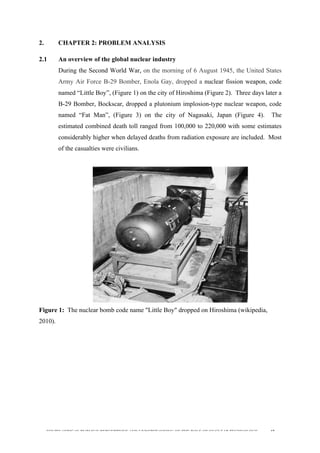
Figure 1: The nuclear bomb code name "Little Boy" dropped on Hiroshima (wikipedia,
2010)....................................................................................................................................42
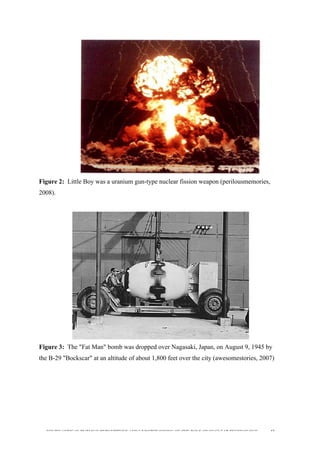
Figure 2: Little Boy was a uranium gun-type nuclear fission weapon (perilousmemories,
2008)....................................................................................................................................43
Figure 3: The "Fat Man" bomb was dropped over Nagasaki, Japan, on August 9, 1945 by
the B-29 "Bockscar" at an altitude of about 1,800 feet over the city (awesomestories, 2007)
.............................................................................................................................................43
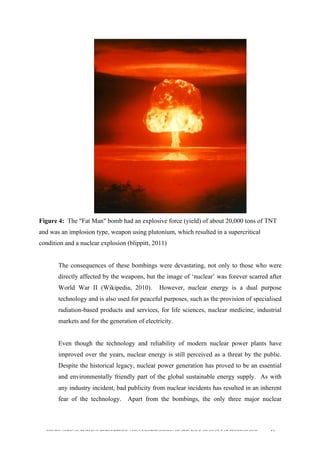
Figure 4: The "Fat Man" bomb had an explosive force (yield) of about 20,000 tons of TNT
and was an implosion type, weapon using plutonium, which resulted in a supercritical
condition and a nuclear explosion (blippitt, 2011)..............................................................44
Figure 5: The centre of gravity of civil nuclear power is shifting towards East. China has
laid out plans to increase nuclear power capability 11 fold, up to 95,620 MWe (Insight,
2008)....................................................................................................................................48
Figure 6: The Fukushima Daiichi Nuclear Power Plant before the devastating natural
disaster struck (dailymail, 2012). ........................................................................................49
Figure 7: The crippled Fukushima Daiichi Nuclear Power Plant in Okuma, northern Japan
and nine days after the March disaster struck (dailymail, 2012).........................................50
Figure 8: Location of Necsa at Pelindaba (maplandia, 2012) .............................................51
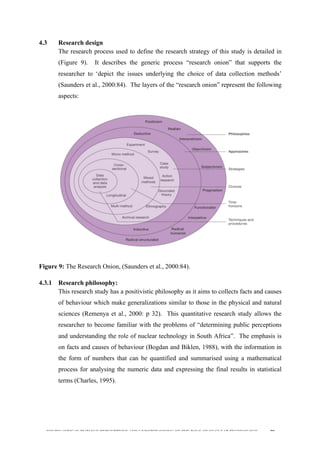
Figure 9: The Research Onion, (Saunders et al., 2000:84)..................................................99
Figure 10: Self reported knowledge and actual knowledge of nuclear scores by socio-
demographic attributes ......................................................................................................119
Figure 11: South African attitude of the various applications of nuclear energy and
technology) ........................................................................................................................121
Figure 12: Views on the different applications on nuclear technology by socio-
demographic and other attributes ......................................................................................122
Figure 13: Concerns and Benefits of nuclear technology mentioned by socio-demographic
attributes ............................................................................................................................129
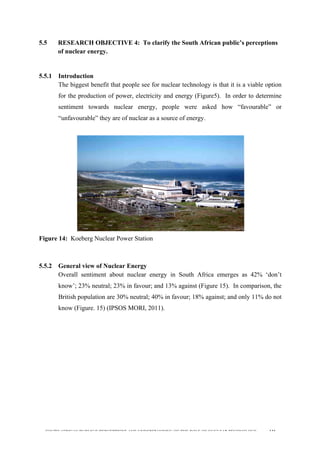
Figure 14: Koeberg Nuclear Power Station......................................................................131
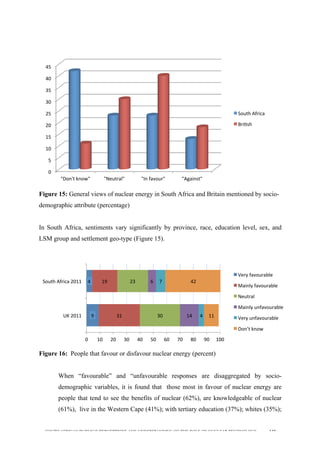
Figure 15: General views of nuclear energy in South Africa and Britain mentioned by
socio-demographic attribute (percentage) .........................................................................132
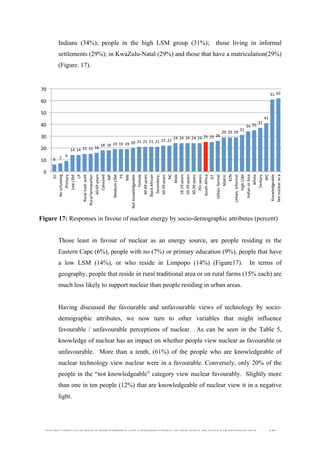
Figure 16: People that favour or disfavour nuclear energy (percent)...............................132
Figure 17: Responses in favour of nuclear energy by socio-demographic attributes
(percent).............................................................................................................................133
Figure 18: Disadvantages and benefits of nuclear energy by socio demographic and other
characteristics ....................................................................................................................137
Figure 19: South Africans least in favour of the building of new nuclear reactors...........139
Figure 20: Perceptions of the levels of energy by select socio-demographic characteristics
...........................................................................................................................................144
Figure 21: Perceived nuclear incidents sometimes raise major concerns in the media and
the public. In your opinion, compared to other safety risks, would you say that nuclear
risks are?............................................................................................................................147


Figure 22: Ratio of the share of citizens reporting exaggerated nuclear risk to the share
perceiving underestimated risk in South Africa and Europe (ratio)..................................151
Figure 23: Perceived level of risk of nuclear power plants to you and your family in South
Africa and Europe..............................................................................................................152
Figure 24: Perceived level of risk of nuclear power plants to you and your family, by
levels of self-reported knowledge and support for nuclear technology and energy..........155
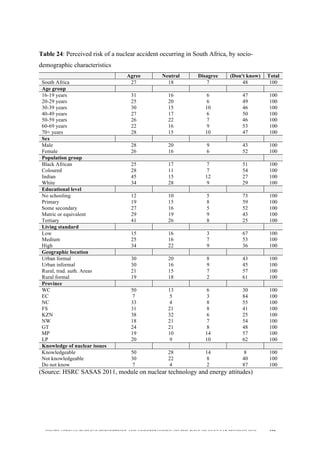
Figure 25: Belief in the possibility of a nuclear accident in South Africa .......................156
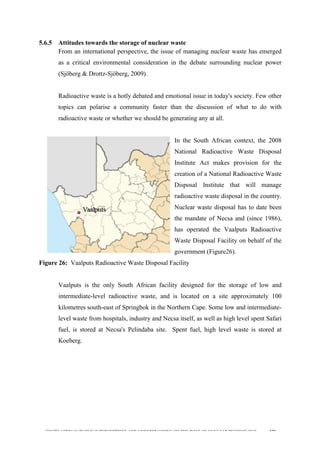
Figure 26: Vaalputs Radioactive Waste Disposal Facility ...............................................159
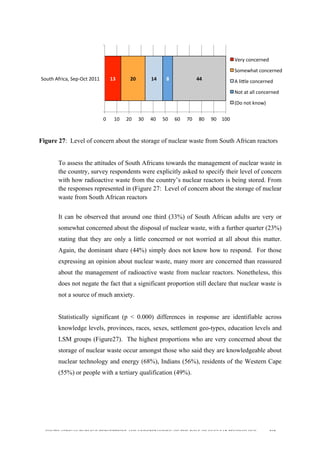
Figure 27: Level of concern about the storage of nuclear waste from South African
reactors...............................................................................................................................160
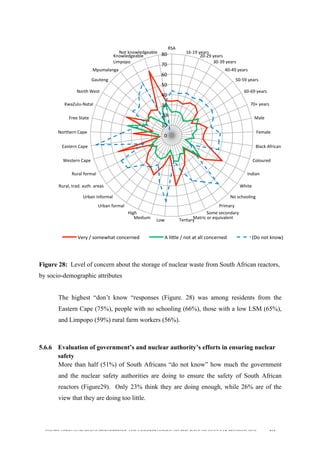
Figure 28: Level of concern about the storage of nuclear waste from South African
reactors, by socio-demographic attributes.........................................................................161
Figure 29: Assessment of efforts by government and nuclear authority in ensuring nuclear
safety in South Africa........................................................................................................162
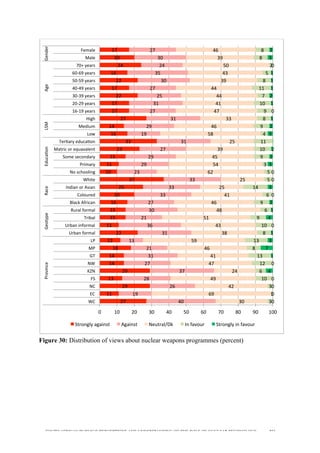
Figure 30: Distribution of views about nuclear weapons programmes (percent)..............166
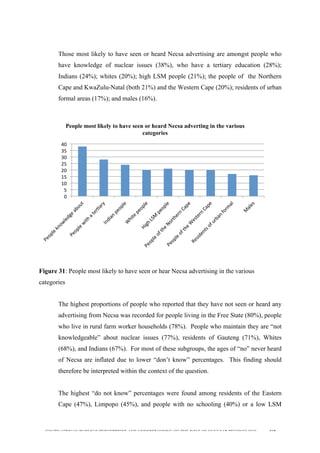
Figure 31: People most likely to have seen or hear Necsa advertising in the various
categories...........................................................................................................................168
Figure 32: Nuclear industry in SA should do more to promote the benefits of nuclear
technology, by socio-demographic attributes....................................................................171
Figure 33: Nuclear industry in SA should do more to promote the benefits of nuclear
technology, by levels of self-reported knowledge and support for nuclear technology and
energy ................................................................................................................................172
Figure 34: Overall assessment of benefits versus risks of nuclear technology and energy in
South Africa and Europe ...................................................................................................173
Figure 35: Overall assessment of benefits versus risks of nuclear technology and energy,
by levels of self-reported knowledge and evaluation of nuclear energy. ..........................175
Figure 36: Profiling supporters and opponents of nuclear energy and technology..........177
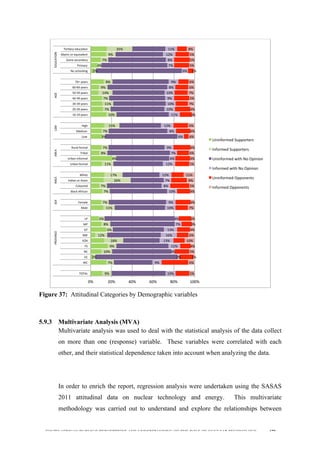
Figure 37: Attitudinal Categories by Demographic variables..........................................178


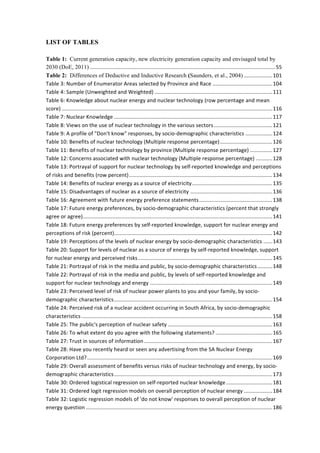
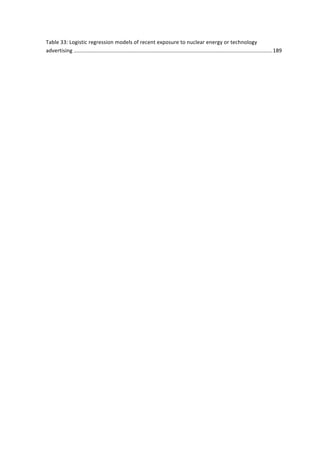
LIST OF TABLES
Table 1: Current generation capacity, new electricity generation capacity and envisaged total by
2030 (DoE, 2011)	
  ............................................................................................................................	
  55	
  
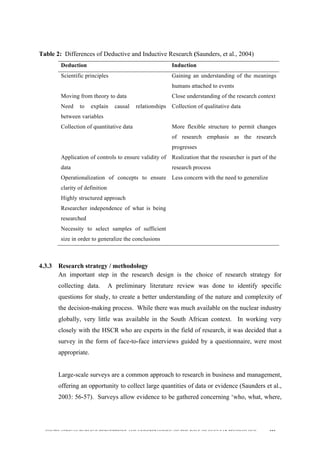
Table 2: Differences of Deductive and Inductive Research (Saunders, et al., 2004)	
  ...................	
  101	
  
Table	
  3:	
  Number	
  of	
  Enumerator	
  Areas	
  selected	
  by	
  Province	
  and	
  Race	
  ........................................	
  104	
  
Table	
  4:	
  Sample	
  (Unweighted	
  and	
  Weighted)	
  ...............................................................................	
  111	
  
Table	
  6:	
  Knowledge	
  about	
  nuclear	
  energy	
  and	
  nuclear	
  technology	
  (row	
  percentage	
  and	
  mean	
  
score)	
  .............................................................................................................................................	
  116	
  
Table	
  7:	
  Nuclear	
  Knowledge	
  ..........................................................................................................	
  117	
  
Table	
  8:	
  Views	
  on	
  the	
  use	
  of	
  nuclear	
  technology	
  in	
  the	
  various	
  sectors	
  .......................................	
  121	
  
Table	
  9:	
  A	
  profile	
  of	
  "Don't	
  know"	
  responses,	
  by	
  socio-­‐demographic	
  characteristics	
  ..................	
  124	
  
Table	
  10:	
  Benefits	
  of	
  nuclear	
  technology	
  (Multiple	
  response	
  percentage)	
  ...................................	
  126	
  
Table	
  11:	
  Benefits	
  of	
  nuclear	
  technology	
  by	
  province	
  (Multiple	
  response	
  percentage)	
  ...............	
  127	
  
Table	
  12:	
  Concerns	
  associated	
  with	
  nuclear	
  technology	
  (Multiple	
  response	
  percentage)	
  ...........	
  128	
  
Table	
  13:	
  Portrayal	
  of	
  support	
  for	
  nuclear	
  technology	
  by	
  self-­‐reported	
  knowledge	
  and	
  perceptions	
  
of	
  risks	
  and	
  benefits	
  (row	
  percent)	
  ................................................................................................	
  134	
  
Table	
  14:	
  Benefits	
  of	
  nuclear	
  energy	
  as	
  a	
  source	
  of	
  electricity	
  ......................................................	
  135	
  
Table	
  15:	
  Disadvantages	
  of	
  nuclear	
  as	
  a	
  source	
  of	
  electricity	
  .......................................................	
  136	
  
Table	
  16:	
  Agreement	
  with	
  future	
  energy	
  preference	
  statements	
  .................................................	
  138	
  
Table	
  17:	
  Future	
  energy	
  preferences,	
  by	
  socio-­‐demographic	
  characteristics	
  (percent	
  that	
  strongly	
  
agree	
  or	
  agree)	
  ...............................................................................................................................	
  141	
  
Table	
  18:	
  Future	
  energy	
  preferences	
  by	
  self-­‐reported	
  knowledge,	
  support	
  for	
  nuclear	
  energy	
  and	
  
perceptions	
  of	
  risk	
  (percent)	
  ..........................................................................................................	
  142	
  
Table	
  19:	
  Perceptions	
  of	
  the	
  levels	
  of	
  nuclear	
  energy	
  by	
  socio-­‐demographic	
  characteristics	
  ......	
  143	
  
Table	
  20:	
  Support	
  for	
  levels	
  of	
  nuclear	
  as	
  a	
  source	
  of	
  energy	
  by	
  self-­‐reported	
  knowledge,	
  support	
  
for	
  nuclear	
  energy	
  and	
  perceived	
  risks	
  ..........................................................................................	
  145	
  
Table	
  21:	
  Portrayal	
  of	
  risk	
  in	
  the	
  media	
  and	
  public,	
  by	
  socio-­‐demographic	
  characteristics	
  ..........	
  148	
  
Table	
  22:	
  Portrayal	
  of	
  risk	
  in	
  the	
  media	
  and	
  public,	
  by	
  levels	
  of	
  self-­‐reported	
  knowledge	
  and	
  
support	
  for	
  nuclear	
  technology	
  and	
  energy	
  ..................................................................................	
  149	
  
Table	
  23:	
  Perceived	
  level	
  of	
  risk	
  of	
  nuclear	
  power	
  plants	
  to	
  you	
  and	
  your	
  family,	
  by	
  socio-­‐
demographic	
  characteristics	
  ..........................................................................................................	
  154	
  
Table	
  24:	
  Perceived	
  risk	
  of	
  a	
  nuclear	
  accident	
  occurring	
  in	
  South	
  Africa,	
  by	
  socio-­‐demographic	
  
characteristics	
  ................................................................................................................................	
  158	
  
Table	
  25:	
  The	
  public's	
  perception	
  of	
  nuclear	
  safety	
  ......................................................................	
  163	
  
Table	
  26:	
  To	
  what	
  extent	
  do	
  you	
  agree	
  with	
  the	
  following	
  statements?	
  ......................................	
  165	
  
Table	
  27:	
  Trust	
  in	
  sources	
  of	
  information	
  ......................................................................................	
  167	
  
Table	
  28:	
  Have	
  you	
  recently	
  heard	
  or	
  seen	
  any	
  advertising	
  from	
  the	
  SA	
  Nuclear	
  Energy	
  
Corporation	
  Ltd?	
  ............................................................................................................................	
  169	
  
Table	
  29:	
  Overall	
  assessment	
  of	
  benefits	
  versus	
  risks	
  of	
  nuclear	
  technology	
  and	
  energy,	
  by	
  socio-­‐
demographic	
  characteristics	
  ..........................................................................................................	
  173	
  
Table	
  30:	
  Ordered	
  logistical	
  regression	
  on	
  self-­‐reported	
  nuclear	
  knowledge	
  ...............................	
  181	
  
Table	
  31:	
  Ordered	
  logit	
  regression	
  models	
  on	
  overall	
  perception	
  of	
  nuclear	
  energy	
  ...................	
  184	
  
Table	
  32:	
  Logistic	
  regression	
  models	
  of	
  'do	
  not	
  know'	
  responses	
  to	
  overall	
  perception	
  of	
  nuclear	
  
energy	
  question	
  .............................................................................................................................	
  186	


Table	
  33:	
  Logistic	
  regression	
  models	
  of	
  recent	
  exposure	
  to	
  nuclear	
  energy	
  or	
  technology	
  
advertising	
  .....................................................................................................................................	
  189	


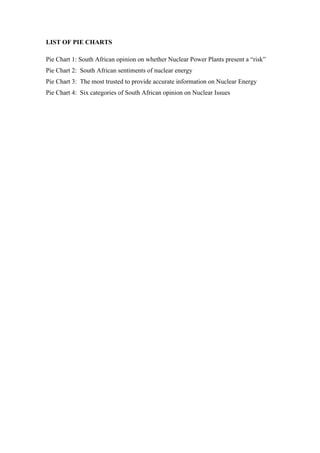
LIST OF PIE CHARTS
Pie Chart 1: South African opinion on whether Nuclear Power Plants present a “risk”
Pie Chart 2: South African sentiments of nuclear energy
Pie Chart 3: The most trusted to provide accurate information on Nuclear Energy
Pie Chart 4: Six categories of South African opinion on Nuclear Issues


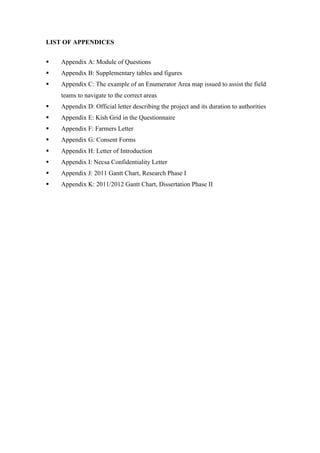
LIST OF APPENDICES
§ Appendix A: Module of Questions
§ Appendix B: Supplementary tables and figures
§ Appendix C: The example of an Enumerator Area map issued to assist the field
teams to navigate to the correct areas
§ Appendix D: Official letter describing the project and its duration to authorities
§ Appendix E: Kish Grid in the Questionnaire
§ Appendix F: Farmers Letter
§ Appendix G: Consent Forms
§ Appendix H: Letter of Introduction
§ Appendix I: Necsa Confidentiality Letter
§ Appendix J: 2011 Gantt Chart, Research Phase I
§ Appendix K: 2011/2012 Gantt Chart, Dissertation Phase II


ACRONYMS
AEB Atomic Energy Board
AEC Atomic Energy Corporation
AgriSA Agri South Africa
ANC African National Congress
ARMSCOR Armaments Corporation of South Africa
ARV Antiretroviral
CAN Canadian Nuclear Association
CSIR Council for Scientific and Industrial Research
CNA Canadian Nuclear Association
CO2 Carbon Dioxide
DEA Department of Environmental Affairs
DFA Department of Foreign Affairs
DEAT Department of Environmental Affairs and Tourism
DME Department of Minerals and Energy
DST Department of Science and Technology
DoE Department of Energy
EA Enumerator Area
EC Eastern Cape
EIA Environmental Impact Assessments
EPR European Pressurized Reactor
EU European Union
FS Free State
GDP Growth Domestic Product
GHG Green House Gas (CO2, CH4, O3, N2O, etc)
GP Gauteng Province
GW Gigawatts
HSRC Human Sciences Research Council
IAEA International Atomic Energy Agency
IDC Industrial Development Corporation
IPAP Industrial Policy Action Plan
IPCS International Programme on Chemical Safety
IRP Integrated Resource Plan


JV Joint Venture
KZN KwaZulu-Natal
LP Limpopo
LSM Living Standard Measurement
MBq Megabecquerels
MP Mpumalanga
mSv Millisieverts
MVA Multivariate Analysis
NAC New Agenda Coalition
Necsa South African Nuclear Energy Corporation
NC Northern Cape
NEI Nuclear Energy Institute
NEP Nuclear Energy Policy
NERDIS Nuclear Energy Resource Development and Innovation Strategy
NETC Nuclear Energy Technical Committee
NIASA Nuclear Industry Association of South Africa
NNEECC National Nuclear Energy Executive Coordination Committee
NNR National Nuclear Regulator
NPP Nuclear Power Plant
NPT Treaty on the non-proliferation of nuclear weapons
NUM National Union of Mineworkers
NVC Necsa Visitor Centre
NW North West
OECD Organisation for Economic Co-operation and Development
OCGT Open Cycle Gas Turbine
CCGT Closed Cycle Gas Turbine
PAIA Public Access to Information Act
PBMR Pebble Bed Modular Reactor
PSU Primary Sampling Unit
PWR Pressurized Water Reactor
SASAS South African Social Attitudes Survey
SOE State Owned Enterprise
TWh Terawatt hours
UCOR Uranium Enrichment Corporation of South Africa


USA United States of America
USSR Union of Soviet Socialist Republics
WB World Bank
WC Western Cape
WHO World Health Organisation
WNA World Nuclear Association
WWF World Wide Fund
UK United Kingdom
UN United Nations
USA United States of America
USSR Former Soviet Union


  GLOSSARY
Atom: An atom is a basic component of the chemical elements that form matter. It
consists of a nucleus composed of positively charged protons and neutral particles
(neutrons), orbited by negatively charged particles (electrons).
Becquerel (Bq): A Becquerel is a unit to measure nuclear activity (1 Bq = 1 atomic
nucleus disintegration per second). The Becquerel is a very small unit. Nuclear activity
was previously measured in curies (1 curie – 37 billion Bq)
Containment Area: During the construction of a facility designed to house radioactive
materials, a series of containment barriers is put up between the material inside and the
environment outside the facility during construction. This creates separate areas called
“containment areas”.
Contamination: Contamination is the presence of an undesirable level of radioactive
substances (dust or liquid) at the surface of or inside any medium. Contamination in
humans can be external (on the skin) or internal (via the respiratory or digestive tracts).
Criticality: Criticality is reached when a medium containing a fissile nuclear material
becomes critical when neutrons are produced (by fission of this material) at the same rate
as they disappear (through absorption and leakage to the outside).
Decommissioning: Decommissioning is a term covering all the steps following the
shutdown of a nuclear or mining facility at the end of its operating life, from closure to the
removal of radioactivity of the site and including physical dismantling and clean-up of all
non-reusable facilities and equipment.
Decontamination: Decontamination is a physical, chemical or mechanical operation
designed to eliminate or reduce the presence of radioactive or chemical materials deposited
on or in a facility, open space, equipment, or personnel.
Dose: Dose is a measurement characterizing the exposure of individuals subjected to
radiation. The term dose is often mistakenly used instead of dose equivalent.


• Absorbed dose: This is a quantity of energy absorbed by matter (living or inert)
exposed to radiation. It is expressed in grays (Gy).
• Dose equivalent: In living organisms, an absorbed dose has different effects
depending on the type of radiation (X-ray, alpha, beta and gamma). To take these
differences into account, a dose-multiplying factor is used (known as the “quality
factor”) to compute a “dose equivalent”.
• Effective dose: This is the sum of weighted dose equivalents deposited on the
various tissues and organs by internal and external irradiation. The unit of
measurement for effective dose is the sievert (Sv).
• Lethal dose: This is a fatal dose of nuclear or chemical origin.
• Maximum permissible dose: This is a dose that must not be exceeded for a given
period of time.
• Gray (Gy): This is a unit of measurement for the absorbed dose. The absorbed
dose was formerly measured in rads (1 gray = 100 rads).
• Sievert (Sv): This is a unit of measurement for the dose equivalent, i.e. the fraction
of energy contributed by ionizing radiation and received per kilogram of living
matter. On the basis of the measured energy dose received (measured in grays), the
dose equivalent is calculated by applying various factors according to the type of
radiation received and the organ concerned.
• Commonly used sub-multiples are:
o The millisieverts, or mSv, equal to 0.001 Sv (a thousandth of a Sv),
o The microsievert, or µSv, equal to 0.000 001 Sv (a millionth of a Sv).
For example, the mean annual dose from exposure to natural background
radiation (soil, cosmos, etc.) of the population in France is 2.4 mSv/person,
with the same being applicable to South Africa.


Enriched uranium and depleted uranium: Before uranium is used to manufacture “fuel
elements”, natural uranium is enriched with 235
U (the proportion of 235
U is then 3% to 5%).
Uranium enriched in 235
U is obtained from natural uranium using an isotope separation
process. The physical or chemical processes used to produce enriched uranium also
produce at the same time uranium that has a lower proportion of 235
U than natural uranium:
this is known as depleted uranium.
Enrichment: This is a process used to increase the abundance of fissile isotopes in an
element. Naturally-occurring uranium is composed of 0.7% 235
U (fissile) and 99.3% 238
U
(non-fissile). To make it suitable for use in a pressurised water reactor, the proportion of
235
U is increased to about 3% to 4%.
Enumerator Areas: The smallest geographical area that formed the blocks of the
geographical frame for South African 2001 Census
Exposure: Exposure of an organism to a source of radiation characterized by the dose
received.
• External exposure: This is exposure from a radiation source located outside the
organism.
• Internal exposure: This is exposure from a radiation source located inside the
organism.
Fission: Splitting of a heavy nucleus, generally upon impact with a neutron, into two
smaller nuclei (fission products), accompanied by the emission of neutrons and radiation,
and the release of a considerable amount of heat. The energy thus released as heat is the
underlying principle of nuclear energy.
Fuel Cycle: All the industrial operations undergone by nuclear fuel. These operations
include: extraction, processing uranium ore, conversion, uranium enrichment, fuel
manufacturing, reprocessing spent fuels and waste management. The fuel cycle is “closed”
if it includes the reprocessing of spent fuel and recycling of fissile materials resulting from
reprocessing. The term “once through” cycle means that the fuel is disposed of in a
permanent storage site after its use in the reactor.


Fuel Element: A fuel element or assembly of rods is joined together and filled with
uranium or MOX27
pellets. Depending on the type of nuclear plant, the reactor core
contains from 100 to 200 fuel assemblies.
Fuel Rod: Metal tube (about 4 m in length and 1 cm in diameter) filled with pellets (about
300) of nuclear fuel.
Generation IV: Code name of nuclear reactors to put in operation beyond 2030.
Irradiation: This is the exposure to radiation and, by extension, its effects.
Isotopes: Elements whose atoms have the same number of electrons and protons but a
different number of neutrons. For example: Uranium has three isotopes.
• 234
U (92 protons, 92 electrons, 142 neutrons);
• 235
U (92 protons, 92 electrons, 143 neutrons);
• 238
U (92 protons, 92 electrons, 146 neutrons);
A given chemical element can therefore have several isotopes with a differing number of
neutrons. All the isotopes of a given element have the same chemical properties, but
different physical properties (mass in particular).
Living Standard Measurement (LSM): A wealth indicator using assets or basic services
to determine a living standard measurement is classified from LSM 1 to LSM 10.
Measurement of Size (MOS): The Measurement of Size used for sampling households in
this survey was a function of the number of households in the enumerator areas.
MOX: ‘Mixed Oxides” is a mixture of uranium and plutonium oxides used to make
certain nuclear fuels.
Natural Uranium: This is a naturally occurring radioactive element in the form of a hard,
gray metal, found in several ores, pitchblende in particular. Natural uranium comes as a
mixture composed of 99.27% non-fissile 238
U, 0.72% fissile 235
U and 0.01% 234
U.


Nuclear Fuel: This is a nuclide that releases energy when it is consumed by fission inside
a reactor. By extension, any product containing fissile materials that yield energy in a
reactor core by sustaining the chain reaction. A 1,300 MW PWR contains about 100 tons
of fuel, periodically renewed in sections.
Nuclear Safety: In the nuclear industry, nuclear safety covers all the measures taken at
every stage of the design, construction, operation and final shutdown of a facility to ensure
operational safety and the prevention of incidents to limit their impact.
Plutonium: This is a chemical element with the atomic number 94 and conventional
symbol Pu. Plutonium-239, a fissile isotope is produced in nuclear reactors from uranium-
238.
Primary Sampling Unit: In sample surveys, primary sampling unit (commonly
abbreviated as PSU) arises in samples in which population elements are grouped into
aggregates and the aggregates become units in sample selection. The aggregates are, due to
their intended usage, called "sampling units". Primary sampling unit refers to sampling
units that are selected in the first (primary) stage of a multi-stage sample ultimately aimed
at selecting individual elements.
Radioactive Half-Life: This refers to the time required for half the atoms contained in a
sample of radioactive substance to decay naturally. The radioactivity of the substance has
therefore been halved. The half-life varies with the characteristics of each radionuclide:
• 110 minutes for argon-41;
• 8 days for iodine-131;
• 4.5 billion years for uranium-238. No external physical action is capable of
modifying the half-life of a radionuclide.
Radioactive Waste: This refers to non-reusable by-products of the nuclear industry.
Divided into four categories according to the intensity of their radioactivity:
• Very low-level waste (VLLW);
• Low-level waste (LLW); such as gloves, overboots and production masks all
coming from industrial production and maintenance operations (90% of waste
stored in specialized centres);


• Intermediate-level waste (ILW), such as certain parts coming from dismantled
production equipment, measuring instruments, etc., (8%);
• High-level waste (HLW), mainly fission products separated during reprocessing /
recycling operations (2%).
Radioactivity: This refers an emission by a chemical element of electromagnetic waves
and/or particles caused by a change in its nucleus. Emission can be spontaneous (natural
radioactivity) and has several forms. (See Dose and Becquerel).
Nuclear Reactor: This is a device in which controlled nuclear reactions are carried out.
The heat released by these reactions is harnessed to form water vapour to operate a turbine
driving an electric generator. Models vary according to the type of fuel, the moderator
used to control the reaction and the coolant used to remove the heat to be recovered. The
model currently used by Eskom in South Africa is two Pressurised Water Reactors
(PWR’s). Therefore the Koeberg nuclear reactor is moderated and cooled by light water
maintained in a liquid state in the core through appropriate pressurization under normal
operating conditions.
Uranium: This is a chemical element with the atomic number 92 and conventional
symbol U, with three natural isotopes: 234
U, 235
U and 238
U. 235
U is the only naturally
occurring fissile nuclide, which is why it is used as a source of energy.


EXECUTIVE SUMMARY
The main objective of this research problem explores, “Determining public perceptions and
understanding of the role of nuclear technology in South Africa,” in the context of public
acceptance. Understanding public perception is an important element in gaining the
support of stakeholders (the international community, national political and governmental
policy-makers, private-sector investors, the media, local communities, media opinion and
trend setters and our future leaders in universities and educational institutions such as
schools). The results of this study are envisaged to demystify public understanding of as
well as enable research and development of nuclear energy and technology to support the
planned South African nuclear new build programme.
The findings of a representative sample survey of 3004 adults distributed across South
Africa reveal that few claim to be “very knowledgeable” (3%) or “somewhat
knowledgeable” (15%) about nuclear energy and nuclear technology issues; most are “not
very knowledgeable” (18%); or “not at all knowledgeable” (34%) or they “don’t know”
(30%).
Not surprisingly, the highest perceived levels of knowledge occur amongst people with a
tertiary education (39%); and amongst residents of the Western Cape (37%); where about
4% of South Africa’s electric energy is generated at Koeberg Nuclear Power Station. Also,
there are generally higher than average levels of knowledge amongst Indian (33%) and
White South Africans (31%); people in the high living standard measurement (LSM)
category (29%); residents of urban formal areas (26%) and males (22%).
Differences between age groups are not statistically significant. The lowest perceived
levels of knowledge about nuclear energy and nuclear technology occur amongst people
without schooling (2%); the low LSM group (5%); residents of the Eastern Cape (5%); or
of rural formal areas (7%); females (15%) and Black South Africans (16%).
Responses to three factual questions (research Objective 1: Knowledge of Nuclear Energy
and Technology, Self-rated knowledge and the Knowledge quiz) about nuclear energy in
South Africa yielded the highest mean scores amongst people with tertiary education;
Indians and Whites; those living in formal urban environments and those in the high LSM


grouping. The two provinces with the highest mean scores were KwaZulu-Natal and the
Free State.
Half of the adult population “don’t know” of any benefits of nuclear technology on the
multiple-choice list presented to them. Otherwise, the benefit most frequently identified
was that nuclear technology provides power/electricity/energy (20%). Others said it
creates jobs, helps the economy (16%); contributes to medical diagnostics and research
(14%); contributes to energy production efficiency (14%); or is less harmful to the
environment than are other energy sources (12%).
Regarding the benefits of nuclear energy as a source of electricity, 50% “don’t know”;
23% said that ‘it ensures a reliable supply of electricity’; and 16% said that ‘it helps to
combat climate change’.
The most frequently mentioned concerns regarding nuclear energy most frequently were
the safety of nuclear power plants (21%); the disposal of nuclear waste (17%); the effects
of radiation exposure or of a nuclear accident on workers and the community (16%); a lack
of knowledge of the implications (15%); the cost of nuclear-generated electricity (13%);
terrorist access to nuclear weapons (11%) and the environmental effects of producing
nuclear electricity (11%).
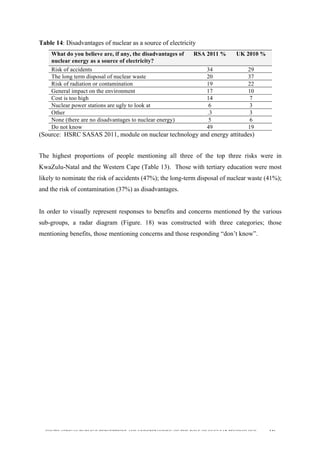
The main specific disadvantages of nuclear energy as a source of electricity were perceived
to be the risk of accidents (34%); the long-term disposal of nuclear waste (20%); the risk of
radiation or contamination (19%) and the general impact on the environment (17%);
although 49% “don’t know” of any disadvantages.
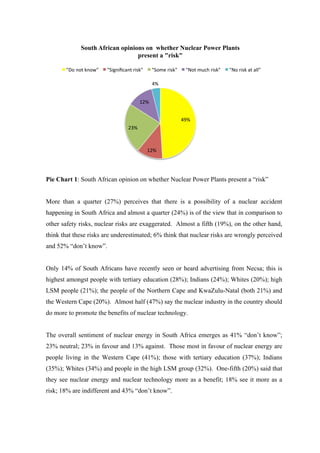
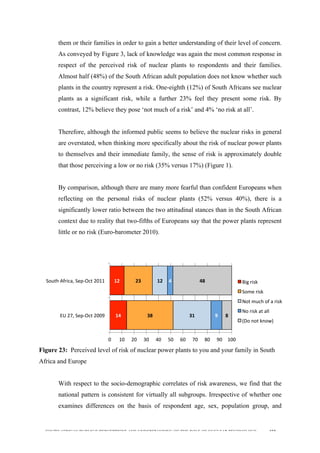
Almost half (48%) of those surveyed, “don’t know” whether nuclear plants represent a
risk? This proportion is much higher than the mere 5% across Europe that “doesn’t know”.
One-eighth (12%) of South Africans see nuclear plants as “a significant risk”; 23% as
“some risk”; 12% as “not much of a risk” and 4% as “no risk at all”.


Pie Chart 1: South African opinion on whether Nuclear Power Plants present a “risk”
More than a quarter (27%) perceives that there is a possibility of a nuclear accident
happening in South Africa and almost a quarter (24%) is of the view that in comparison to
other safety risks, nuclear risks are exaggerated. Almost a fifth (19%), on the other hand,
think that these risks are underestimated; 6% think that nuclear risks are wrongly perceived
and 52% “don’t know”.
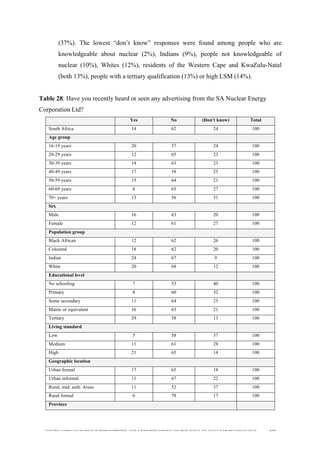
Only 14% of South Africans have recently seen or heard advertising from Necsa; this is
highest amongst people with tertiary education (28%); Indians (24%); Whites (20%); high
LSM people (21%); the people of the Northern Cape and KwaZulu-Natal (both 21%) and
the Western Cape (20%). Almost half (47%) say the nuclear industry in the country should
do more to promote the benefits of nuclear technology.
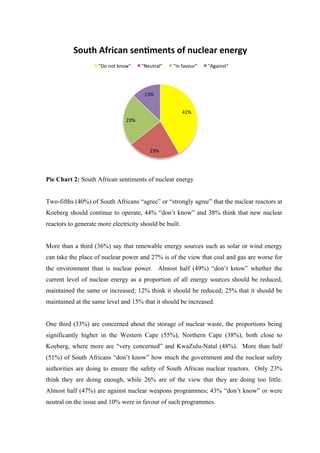
The overall sentiment of nuclear energy in South Africa emerges as 41% “don’t know”;
23% neutral; 23% in favour and 13% against. Those most in favour of nuclear energy are
people living in the Western Cape (41%); those with tertiary education (37%); Indians
(35%); Whites (34%) and people in the high LSM group (32%). One-fifth (20%) said that
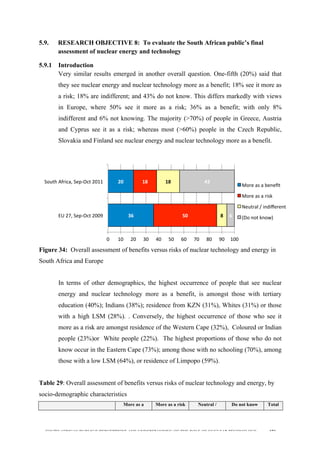
they see nuclear energy and nuclear technology more as a benefit; 18% see it more as a
risk; 18% are indifferent and 43% “don’t know”.
49%	
  
12%	
  
23%	
  
12%	
  
4%	
  
South African opinions on whether Nuclear Power Plants
present a "risk"
"Do	
  not	
  know"	
   "Significant	
  risk"	
   "Some	
  risk"	
   "Not	
  much	
  risk"	
   "No	
  risk	
  at	
  all"	


Pie Chart 2: South African sentiments of nuclear energy
Two-fifths (40%) of South Africans “agree” or “strongly agree” that the nuclear reactors at
Koeberg should continue to operate, 44% “don’t know” and 38% think that new nuclear
reactors to generate more electricity should be built.
More than a third (36%) say that renewable energy sources such as solar or wind energy
can take the place of nuclear power and 27% is of the view that coal and gas are worse for
the environment than is nuclear power. Almost half (49%) “don’t know” whether the
current level of nuclear energy as a proportion of all energy sources should be reduced,
maintained the same or increased; 12% think it should be reduced; 25% that it should be
maintained at the same level and 15% that it should be increased.
One third (33%) are concerned about the storage of nuclear waste, the proportions being
significantly higher in the Western Cape (55%), Northern Cape (38%), both close to
Koeberg, where more are “very concerned” and KwaZulu-Natal (48%). More than half
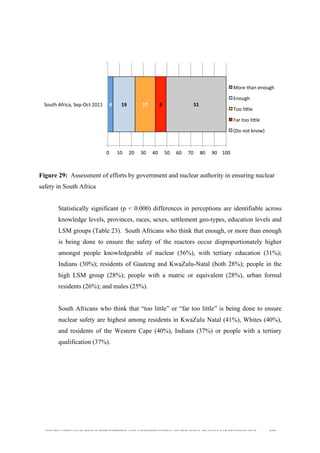
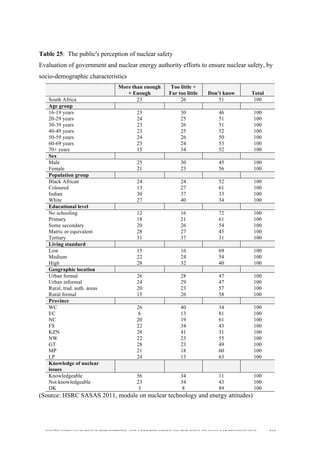
(51%) of South Africans “don’t know” how much the government and the nuclear safety
authorities are doing to ensure the safety of South African nuclear reactors. Only 23%
think they are doing enough, while 26% are of the view that they are doing too little.
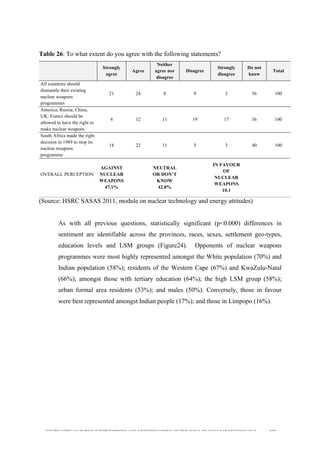
Almost half (47%) are against nuclear weapons programmes; 43% “don’t know” or were
neutral on the issue and 10% were in favour of such programmes.
41%	
  
23%	
  
23%	
  
13%	
  
South	
  African	
  sen0ments	
  of	
  nuclear	
  energy	
  
"Do	
  not	
  know"	
   "Neutral"	
   "In	
  favour"	
   "Against"	


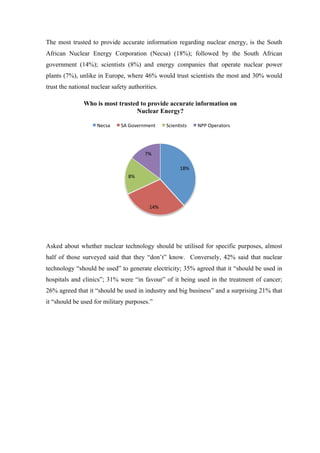
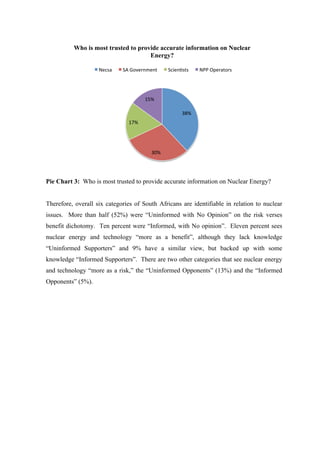
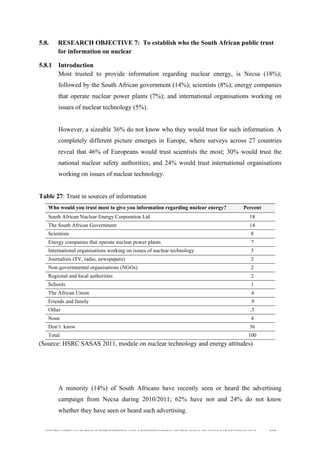
The most trusted to provide accurate information regarding nuclear energy, is the South
African Nuclear Energy Corporation (Necsa) (18%); followed by the South African
government (14%); scientists (8%) and energy companies that operate nuclear power
plants (7%), unlike in Europe, where 46% would trust scientists the most and 30% would
trust the national nuclear safety authorities.
Asked about whether nuclear technology should be utilised for specific purposes, almost
half of those surveyed said that they “don’t” know. Conversely, 42% said that nuclear
technology “should be used” to generate electricity; 35% agreed that it “should be used in
hospitals and clinics”; 31% were “in favour” of it being used in the treatment of cancer;
26% agreed that it “should be used in industry and big business” and a surprising 21% that
it “should be used for military purposes.”
18%	
  
14%	
  
8%	
  
7%	
  
Who is most trusted to provide accurate information on
Nuclear Energy?
Necsa	
   SA	
  Government	
   Sciendsts	
   NPP	
  Operators	


Pie Chart 3: Who is most trusted to provide accurate information on Nuclear Energy?
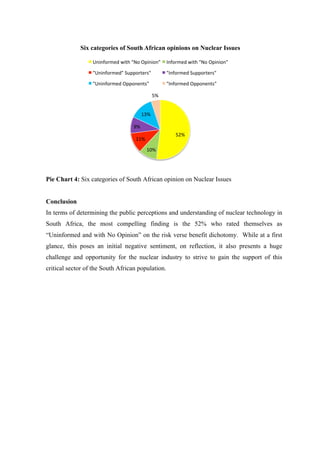
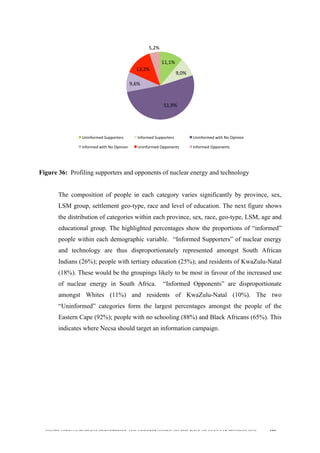
Therefore, overall six categories of South Africans are identifiable in relation to nuclear
issues. More than half (52%) were “Uninformed with No Opinion” on the risk verses
benefit dichotomy. Ten percent were “Informed, with No opinion”. Eleven percent sees
nuclear energy and technology “more as a benefit”, although they lack knowledge
“Uninformed Supporters” and 9% have a similar view, but backed up with some
knowledge “Informed Supporters”. There are two other categories that see nuclear energy
and technology “more as a risk,” the “Uninformed Opponents” (13%) and the “Informed
Opponents” (5%).
38%	
  
30%	
  
17%	
  
15%	
  
Who is most trusted to provide accurate information on Nuclear
Energy?
Necsa	
   SA	
  Government	
   Sciendsts	
   NPP	
  Operators	


Pie Chart 4: Six categories of South African opinion on Nuclear Issues
Conclusion
In terms of determining the public perceptions and understanding of nuclear technology in
South Africa, the most compelling finding is the 52% who rated themselves as
“Uninformed and with No Opinion” on the risk verse benefit dichotomy. While at a first
glance, this poses an initial negative sentiment, on reflection, it also presents a huge
challenge and opportunity for the nuclear industry to strive to gain the support of this
critical sector of the South African population.
52%	
  
10%	
  
11%	
  
9%	
  
13%	
  
5%	
  
Six categories of South African opinions on Nuclear Issues
Uninformed	
  with	
  "No	
  Opinion"	
   Informed	
  with	
  "No	
  Opinion"	
  
"Uninformed"	
  Supporters"	
   "Informed	
  Supporters"	
  
"Uninformed	
  Opponents"	
   "Informed	
  Opponents"	


SOUTH AFRICAN PUBLIC’S PERCEPTIONS AND UNDERSTANDING OF THE ROLE OF NUCLEAR TECHNOLOGY 32
1. CHAPTER 1: BACKGROUND TO THE PROBLEM
1.1 Introduction
According to a Solidarity Institute Report by (Calldo, 2008), “Warnings of a dark
future were clear and accurate. A White Paper of 1998 (DME, 1998) said that the
country would run out of electricity by 2007. The report was signed by the then
Minister Penual Maduna. Despite this dire prediction, it was never acted upon.
Eskom’s requests for budget to build new power stations were also denied in 1998
when the government instructed Eskom to stop building new power stations due to its
attempted privatisation of Eskom in the late 1990s.”
Calldo reported that, “Even President Thabo Mbeki said, “When Eskom said to the
government, ‘we think we must invest more in terms of electricity generation,’ we
said not now, later we were wrong. Eskom was right. We were wrong.” Even in
2003, former Energy Minister Phumizile Nlambo-Ngcuka said there is no looming
power crisis. She said the then Eskom CEO, Thulani Gcabashe assured her South
Africa will never run out of power. This entire situation is very controversial given
the fact that Eskom warned the government in 1998 of a looming power crisis.
All South Africans share similar experiences of living in the dark and newspaper
headlines revealing doom and gloom of widespread rolling blackouts in the latter
months of 2007. This marked the onset of South Africa’s electricity supply demand
exceeding Eskom’s electricity capacity, where the reserve margin was eroded,
threatening to destabilise the national grid. During this crisis, demand side
management was introduced, which focussed on encouraging consumers to conserve
power during peak periods to reduce the incidence of load shedding.
Reports said government claimed that the shortage caught them by surprise since the
South African economy grew faster than expected. However, their target growth rate
of 6% per annum was not achieved from 1996 to 2004, with the average gross
domestic product (GDP) growth rate during this period being 3.1%.


SOUTH AFRICAN PUBLIC’S PERCEPTIONS AND UNDERSTANDING OF THE ROLE OF NUCLEAR TECHNOLOGY 33
The entire situation was shrouded by controversy. Decision-makers and leaders both
in Eskom and government claim the solution was the construction of additional power
stations. However, investigative television programme, Carte Blanche, (wikipedia,
2010) reported that part of the problem related to the supply of coal to coal-fired
power plants. Several others suggested causes such as skills shortages and the
increasing demand for electricity around the country.
In spite of every effort being made, a possible energy crisis still looms in 2012. South
Africa urgently needs a viable solution to meet the need for an increase in electricity
supply to meet the growing demand. Government adopted the White Paper on Energy
Policy (DME, 1998), which calls for the achievement of energy security through the
diversification of primary energy sources. Subsequently, the Integrated Resource
Plan for Electricity Generation (IRP2010) was also adopted on 16 March 2011. The
IRP2010 provides a blueprint for the electricity generation mix for the next 20 years,
and requires that 42% renewables, 23% nuclear, 15% gas, 15% coal and 6%
hydroelectric generation capacity is added to the grid.
According to Thomas, et al. (1980), in their research report titled, “A comparative
study of public beliefs about five energy systems,” public acceptance is becoming an
increasingly important constraint to be taken into account by those responsible for
technological policies. Acceptance by the public will depend on their relevant
attitudes towards a given technology, and these attitudes will be a function of beliefs
about the attributes and probable consequences of the technology in question.”
Thomas’s study explores belief systems with respect to five energy sources: nuclear,
coal, oil, hydro and solar.
Across the world, debate rages about the risks and the benefits of harnessing nuclear
power to meet the energy demands of the twenty-first century. A recent Organisation
for Economic Co-operation and Development (OECD) report, (Kovacs, 2010) reveals
that in countries that have nuclear power sources, the proportion of the population that
see the benefits thereof outweighing the risks are far higher than is the case in
countries that don’t have nuclear power.


SOUTH AFRICAN PUBLIC’S PERCEPTIONS AND UNDERSTANDING OF THE ROLE OF NUCLEAR TECHNOLOGY 34
Furthermore, the study indicates that about two-thirds of Europeans are of the view
that nuclear power contributes to making their countries less dependent on the
importation of energy and half agree that it ensures more stability in the price of
energy. Similarly, residents of countries with nuclear power are much more likely to
think that these can be operated safely and that the disposal of nuclear waste can be
done safely, than are people living in countries that do not have nuclear power.
Nevertheless, more than half of the Europeans surveyed think that the risks of nuclear
power outweigh the benefits, especially if their country does not have nuclear energy
and therefore their experience of nuclear energy is minimal.
In a review of several earlier attitudinal studies, Eiser et al. (1988a) opined that
although a sizeable proportion of the population studies were opposed in principle to
the use of nuclear power, either for military or civil purposes, both opposition and
support tends to be stronger in the case of potential local nuclear energy developments
Woo & Castore (1980); Hughey et al., (1985) and Eiser et al. (1988a) found males,
employed people and those in social classes I and II were more favourably disposed
towards the potential establishment of a nuclear power station near their villages in
the south-west of England. The study also found that residents felt far more positive
about a potential oil well development in the same area than about the prospect of a
nuclear power station.
Major nuclear incidents occurred at Three Mile Island in the United States on 28
March 1979; Chernobyl (now in Ukraine, then in the former Soviet Union) on 26
April 1986 and Fukushima, Japan on 11 March 2011. De Boer and Catsburg (1988)
reported on the dramatic increase in opposition to nuclear power plants that emerged
in surveys conducted after the explosion of the nuclear power station at Chernobyl.
After the Chernobyl incident, the proportion of people in the United Kingdom (UK)
who thought that nuclear power stations were not very safe increased from 25% in
January 1986 to 41% in May 1986. Similarly, in Greece in May 1981, 56% were of
the view that nuclear power plants are dangerous and should not be built; however,
this climbed dramatically to 73% in May 1986 after Chernobyl. Comparable margins
of growth in opposition were recorded in surveys in Canada and the United States
(US) before and after the Chernobyl accident.


SOUTH AFRICAN PUBLIC’S PERCEPTIONS AND UNDERSTANDING OF THE ROLE OF NUCLEAR TECHNOLOGY 35
By contrast, South Africa makes minimal use of nuclear power (4% of the country’s
electricity is nuclear-generated) and has been spared any exposure to nuclear fallout
as has occurred in the northern hemisphere.
This research study provides an analysis, “Public perceptions and understanding of
the role of nuclear technology in South Africa,” collected in a national survey during
2011. The significance of this research lies in the fact that a comprehensive gap of
knowledge is addressed, given that a national project of this extent has not been
attempted in South Africa before.
Notably, countries with large nuclear programmes, such as France and the US have
established national benchmarks through research studies undertaken over a number
of years. Therefore, to begin to address the South African publics’ perceptions and
understanding of the role nuclear technology, we first needed to acquire a benchmark
from which to work. This entailed demystifying the nuclear myths and elaborating on
the facts to address the publics’ concerns.
1.2 The problem review
The main research problem of this study explores, “Determining publics’ perceptions
and understanding of the role of nuclear technology in South Africa,” in the context of
public acceptance being an important element in gaining the various stakeholders
support to ensure the advancement of nuclear research and development. A number
of emerging themes are identified in the problem review that follows.
a. Internationally nuclear energy has been utilized as a dual use technology, which has a
legacy of destruction and devastation due to global events such as Three Mile Island
(28 March 1979), Chernobyl (26 April 1986) and Fukushima (11 March 2011). There
are however also hugely beneficial nuclear technology applications such as nuclear
power, nuclear medicine, nuclear industrial and commercial applications.
b. Closer to home, the South African nuclear industry has a history going back to the
mid 1940s. Despite this, the South African public is still largely unaware of the basic
myths and facts associated with nuclear energy.


SOUTH AFRICAN PUBLIC’S PERCEPTIONS AND UNDERSTANDING OF THE ROLE OF NUCLEAR TECHNOLOGY 36
c. As mentioned, public consultation and public perceptions of nuclear energy and
technology, in the context of public acceptance is important in gaining stakeholders
support to proceed with the South African nuclear new build.
d. Nuclear power generated at Koeberg in Cape Town, is a type of nuclear technology
involving the controlled use of nuclear fission to release energy for work including
heat propulsion and the generation of electricity. Nuclear energy is produced by a
controlled nuclear chain reaction which creates heat that is used to boil water and
produce steam to drive a steam turbine. The turbine is connected to a generator which
is then used to generate electricity.
e. In comparison to ‘renewable’ power sources, nuclear power plants have a small
footprint (m2
/kW produced) and release very small quantities of greenhouse gases
making them environmentally acceptable.
f. As South Africa is on the brink of launching its largest long-term infrastructure
development plan, determining the level of public perceptions and understanding the
role of nuclear technology is critical. This is especially vital in light of 23% (added
nuclear) of the countries foreseeable electricity generation capacity being attributed to
nuclear power.
g. The proposed nuclear new build is aimed at ensuring a sustainable electricity sector
that meets the country’s projected growth in demand at a minimal cost and
environmental impact.
1.3 The research objectives
As established, the problem statement seeks to, “Determine the South African
publics’ perceptions and understanding of the role of nuclear technology,” to gain
support for research and development of nuclear technology essential to support and
advance the nuclear new build.


SOUTH AFRICAN PUBLIC’S PERCEPTIONS AND UNDERSTANDING OF THE ROLE OF NUCLEAR TECHNOLOGY 37
While this research project highlights past controversial decision-making issues of a
national magnitude, it remains relevant to the prosperity and quality of life of every
South African. Given this will be the largest long-term infrastructure development
plan ever undertaken in South Africa, it will have far-reaching political, economical,
social/cultural, technological, legal and environmental (PESTLE) consequences.
The public therefore has a vested interest in supporting a sustainable nuclear energy
solution which is efficient, economical and environmentally negligible in terms of
carbon dioxide emissions. Therefore, public acceptance of nuclear technology is a
serious challenge which requires a smart solution. In light of the research problem
and objectives this research study was designed to determine the following:
Main research objective:
The main objective of this research is to, “Determine the South African publics’
perceptions and understanding of the role of nuclear technology.”
Research sub-objectives
1. To determine the South African public’s knowledge of nuclear energy and
technology;
2. To establish the South African public’s support for different applications of
nuclear technology;
3. To establish the South African public’s perceived benefits and concerns associated
with nuclear technology;
4. To ascertain the South African public’s perceptions of nuclear energy;
5. To clarify the South African publics’ perceptions of nuclear safety;
6. To comprehend the South African public’s views on nuclear energy in a global
context;
7. To establish who the South African public trust for information on nuclear energy;
and
8. To evaluate the South African public’s final assessment of nuclear energy and
technology.


SOUTH AFRICAN PUBLIC’S PERCEPTIONS AND UNDERSTANDING OF THE ROLE OF NUCLEAR TECHNOLOGY 38
1.4 Methodology
Empiricism is a theory (wikipedia, 2010) of gaining knowledge by means of direct or
indirect observation or experience. It asserts that knowledge comes primarily from
tangible sensory experience in a world of people, objects and events which are
factually based. The descriptive approach of this study is aimed at gathering
knowledge and opinions about the desirability of the present state of nuclear
perceptions in South Africa.
One of the views of epistemology is the study of human knowledge, along with
rationalism, idealism and historicism. Epistemology (roebuckclasses, 2012) is a
branch of philosophy concerned with the nature and scope of knowledge. Empiricism
however, emphasizes the role of experience and evidence of especially sensory
perception, in the formation of ideas, over the notion of innate ideas or traditions. It is
a fundamental part of the scientific method that all theories must be tested against
observations of the natural world, rather than resting solely on reasoning, intuition or
revelation.
This research used data generated in the 2011 Human Sciences Research Council
(HSRC) South African Social Attitudes Survey (SASAS) for a tabulation entitled
“Public Perceptions of Nuclear Science in South Africa.” The questionnaire used in
the HSRC Household Survey which was drafted following thorough consultations
with Necsa and by drawing upon similar surveys conducted abroad and made
available by the World Nuclear Association (WNA). The HSRC is world renowned
for their scientific survey methodology, and have been able to apply a rigorous
standard of statistical validity through correct sample sizing and demographic
diversity to the current work.
The sampling frame was developed using 2011 census mid-year population estimates
and consists of 1000 census enumerating areas (EA’s). The EA’s chosen from the
census sample frame were stratified by the socio-demographic domains of province,
geographic sub-type and the four main population groups (Blacks, Coloureds, Indians
and Whites). The master sample was developed in order to allow the HSRC to
conduct longitudinal social surveys. More specifically, it was designed with the


SOUTH AFRICAN PUBLIC’S PERCEPTIONS AND UNDERSTANDING OF THE ROLE OF NUCLEAR TECHNOLOGY 39
sampling demands of large, periodically repeated social surveys in mind to provide
critical information for policy and decision-making purposes.
The scope of the study focused on a representative sample of the South African
population, which covers the countries nine provinces, urban, rural, informal
settlements, traditional geographical areas, formal urban, farmlands and socio-
economic population groups. These variables were used as explicit stratification
variables.
The prime target population consisted of individuals aged 16+ who reside in South
Africa. The target population consisted of those people living in household structures,
and hostels with the exclusion of those living in special institutions, hospitals and
prisons. These geo-demographic categories reflect the diversity of the South African
population based on their rural/urban, income, education, ethnicity and geographic
characteristics. Such stratification has also ensured that the metropolitan, semi-urban
and rural population of South Africa have been thoroughly covered in the sample.
Three re-visits to the selected household were allowed if a randomly selected
individual was not at home at the time of the first contact.
This quantitative research results draws conclusions through statistical inferences.
This data is generally accepted as strong and objective data because it tells you both,
what and how much, as compared to qualitative data which only identifies the what.
1.5 The significance of the study
The results of this research and the analysis of outcomes, will be extremely useful
both to government and to the nuclear industry, given that the infrastructure build
mandated by the IRP2010 is the largest and most expensive in South Africa’s history.
This programme can be slowed down and even derailed unless difficulties in the area
of public acceptance of nuclear energy are identified early and addressed. Research
on this project began in December 2010 with the implementation of the first
comprehensive public awareness advertising campaign on nuclear energy.


SOUTH AFRICAN PUBLIC’S PERCEPTIONS AND UNDERSTANDING OF THE ROLE OF NUCLEAR TECHNOLOGY 40
First and foremost, the intent of this research study is to assist Necsa to fulfil one of
its mandates outlined in the Nuclear Energy Policy, namely Principle 14, Section 7,
which recognises the “need to stimulate public awareness and to inform the public
about nuclear energy”. Too successfully deliver on this mandate entailed undertaking
this research study to analytically, “Determine the South African publics’ perceptions
and understanding of the role of nuclear technology.” This is the first comprehensive
national study of this nature, both in terms of scope and depth, ever undertaken on
public perceptions of nuclear energy in South Africa.
In addition to Necsa, this research study will also benefit key decision-makers such as
the National Nuclear Energy Executive Co-ordinating Council (NNEECC) as well as
the broader South African nuclear industry. The results of this research is intended to
guide the nuclear industry to develop targeted messaging to address the varying public
concerns and ultimately assist in the advancement of nuclear research and
development, along with the nuclear new build programme.
The formulation of this research commenced with various benchmarks and market
segmentation having been undertaken. For example, how do we differentiate our
approach to national environmental groups with links to foreign organizations as
compared with local residents associations? Comparisons were made with similar
surveys conducted in other countries, specifically France and the United States. The
purpose of these benchmarks being to search for common principles and also
differences that will enable South Africa to adopt successful strategies that are
relevant, and to avoid those ones that don’t apply in our country’s context.
1.8 Conclusion
In addition to South Africa’s uranium rich resources, it has exciting nuclear energy
ambitions which entail ensuring a sustainable, efficient security of electricity supply
for its ever growing population needs. Apart from this, nuclear technology dominates
another exciting global niche in South Africa, producing high quality specialised
radiation-based products and services, for life sciences, healthcare and industrial
markets. Through NTP Radioisotopes, a subsidiary of Necsa, South Africa exports
life-saving medical isotopes to nearly 60 countries on five continents.


SOUTH AFRICAN PUBLIC’S PERCEPTIONS AND UNDERSTANDING OF THE ROLE OF NUCLEAR TECHNOLOGY 41
NTP is a world leader in the production and supply of radio-chemicals, in particular
iridium -131 (131
Ir) and molybdenum-99 (99
Mo), the latter being the most important
radioisotope used in the practice of diagnostic nuclear medicine. This product is used
amongst others, for the treatment of more than ten million cancer patients globally,
and earns the country foreign income which equates to a turnover of approximately
R800 m/annum.


SOUTH AFRICAN PUBLIC’S PERCEPTIONS AND UNDERSTANDING OF THE ROLE OF NUCLEAR TECHNOLOGY 42
2. CHAPTER 2: PROBLEM ANALYSIS
2.1 An overview of the global nuclear industry
During the Second World War, on the morning of 6 August 1945, the United States
Army Air Force B-29 Bomber, Enola Gay, dropped a nuclear fission weapon, code
named “Little Boy”, (Figure 1) on the city of Hiroshima (Figure 2). Three days later a
B-29 Bomber, Bockscar, dropped a plutonium implosion-type nuclear weapon, code
named “Fat Man”, (Figure 3) on the city of Nagasaki, Japan (Figure 4). The
estimated combined death toll ranged from 100,000 to 220,000 with some estimates
considerably higher when delayed deaths from radiation exposure are included. Most
of the casualties were civilians.
Figure 1: The nuclear bomb code name "Little Boy" dropped on Hiroshima (wikipedia,
2010).


SOUTH AFRICAN PUBLIC’S PERCEPTIONS AND UNDERSTANDING OF THE ROLE OF NUCLEAR TECHNOLOGY 43
Figure 2: Little Boy was a uranium gun-type nuclear fission weapon (perilousmemories,
2008).
	
  
Figure 3: The "Fat Man" bomb was dropped over Nagasaki, Japan, on August 9, 1945 by
the B-29 "Bockscar" at an altitude of about 1,800 feet over the city (awesomestories, 2007)


SOUTH AFRICAN PUBLIC’S PERCEPTIONS AND UNDERSTANDING OF THE ROLE OF NUCLEAR TECHNOLOGY 44
Figure 4: The "Fat Man" bomb had an explosive force (yield) of about 20,000 tons of TNT
and was an implosion type, weapon using plutonium, which resulted in a supercritical
condition and a nuclear explosion (blippitt, 2011)
The consequences of these bombings were devastating, not only to those who were
directly affected by the weapons, but the image of ‘nuclear’ was forever scarred after
World War II (Wikipedia, 2010). However, nuclear energy is a dual purpose
technology and is also used for peaceful purposes, such as the provision of specialised
radiation-based products and services, for life sciences, nuclear medicine, industrial
markets and for the generation of electricity.
Even though the technology and reliability of modern nuclear power plants have
improved over the years, nuclear energy is still perceived as a threat by the public.
Despite the historical legacy, nuclear power generation has proved to be an essential
and environmentally friendly part of the global sustainable energy supply. As with
any industry incident, bad publicity from nuclear incidents has resulted in an inherent
fear of the technology. Apart from the bombings, the only three major nuclear


SOUTH AFRICAN PUBLIC’S PERCEPTIONS AND UNDERSTANDING OF THE ROLE OF NUCLEAR TECHNOLOGY 45
incidents that have occurred since World War II has left an even deeper scar, fear and
doubt about the safety of nuclear energy. These incidents are:
2.1.1 Three Mile Island Nuclear Reactor (TMI-2)
Cause: On 28 March 1979, near Harrisburg in the United States of America
(USA), failure involving the water pumps in the TMI-2 reactor allowed
pressure to build up in the reactor causing a partial core melt-down. A relief
valve automatically opened in response but failed to close again, allowing
cooling water to escape from the reactor. Operators at the plant didn’t get the
signal that the valve was still open and radiation was released.
Effect: The nuclear fuel rods inside the reactor experienced a partial
meltdown, i.e. some fuel rods overheated and melted. Fortunately, the
radioactive material at no stage escaped from the containment vessel.
Exposure to radiation and radioactive matter: Experts say the resulting
radiation exposure was never enough to cause a detectable health effect in the
general population.
2.1.2 Chernobyl Nuclear Power Reactor-4
Cause: On 26 April 1986, about 80 miles north of Kiev, Ukraine the Reactor
Operators were performing a test to see how the reactor would respond in the
event of an electrical failure, essentially thereby bypassing, ignoring and
overriding built in safety controls and inadvertently causing a dramatic power
surge and total core melt-down.
Effect: The core had not been shut down prior to the test and the power surge
triggered a series of events that sent the nuclear reaction out of control,
causing two explosions. The reactor was not surrounded by a containment
structure, so the explosions and the subsequent fire sent a giant plume of
radioactive material into the atmosphere which was dispersed by the winds.
Exposure to radiation and radioactive matter: At least 5% of the
radioactive reactor core was released mostly westward towards Poland and


SOUTH AFRICAN PUBLIC’S PERCEPTIONS AND UNDERSTANDING OF THE ROLE OF NUCLEAR TECHNOLOGY 46
other neighbouring countries in the atmosphere. Two Chernobyl plant
workers died on the night of the accident and 28 more people died within a
few weeks from radiation poisoning. In the long-term, several thousand more
people were at risk of developing cancer.
2.1.3 Fukushima Daiichi Nuclear Power Plant (NPP)
The 11 March 2012 marks the devastating natural disaster which severely
impacted the Fukushima Daiichi NPP (Figure. 5) in Japan. This event had the
potential to result in the worst nuclear disaster in history after a number of
reactors were damaged by a magnitude nine earthquake, followed by a
tsunami (Figure. 6).
Cause: The Emergency Cooling Systems at the plant started to fail after
being flooded by the tsunami that followed the massive earthquake which also
knocked out the conventional electricity supply to the facility. Workers at the
Fukushima Daiichi NPP experienced numerous problems in maintaining water
levels in the three reactors that were in operation when the earthquake struck.
These were boiling water type reactors where water is essential to keep the
nuclear fuel rods inside the core from overheating. Officials suspected that the
fuel rods had melted in the reactors due to the cooling systems having failed
and the fuel rods not being submerged in water as normally required.
Effect: After the tsunami four of the six nuclear reactors in the Fukushima
Daiichi NPP were in trouble. Explosions occurred in Unit 1 and 3 from a
build-up of hydrogen gas and were thus not attributable to any nuclear
reaction. Experts suspected that the nuclear rods inside these two reactors had
started to melt but had not breached the containment vessel, which was
designed to keep radioactive material from escaping. At the time, Unit 2
posed a bigger threat with the explosion possibly having caused a breach in
the containment vessel, which could have allowed radioactive steam or water
to escape.


SOUTH AFRICAN PUBLIC’S PERCEPTIONS AND UNDERSTANDING OF THE ROLE OF NUCLEAR TECHNOLOGY 47
Exposure to radiation and radioactive matter: It should be noted that the
earthquake and tsunami killed tens of thousands, whereas the release of
radioactive material has to the date of this report killed nobody.
2.1.4 Conclusion
The major contributing factors in all three major nuclear incidents experienced
globally since World War II were mainly due to human factors, such as poor
management, poor design of the facilities, poor training of Nuclear Reactor
Operators, poor operating instructions and most importantly, the lack of a
nuclear safety culture. All three incidents could easily have been avoided had
the prescribed safety design and management measures been adhered to (pub-
iaea, 2011).
2.2 Analysing the global nuclear challenges
Despite the military applications and nuclear accidents, developing countries have an
insatiable appetite for electricity and are proceeding with the construction of new
nuclear power reactors barely a year after the Fukushima Daiichi disaster disrupted
the growth of nuclear power around the world.
According to the U.S. editions of The Wall Street Journal, headlined: Nuclear Pushes
on despite Fukushima, “Sixty nuclear reactors are currently (2012) under construction
globally, with 163 more on order or planned, according to the WNA. Little has
changed from the results posted by the trade group who conducted a February 2011
survey, a month before Fukushima, 62 reactors were under construction and 156 on
order or planned.”
The Wall Street Journal reported that these numbers contradict the perception that the
nuclear power industry was stopped in its tracks after the meltdown at the Fukushima
NPP following the earthquake and tsunami. This incident has been rated by some as
the worst nuclear disaster since Chernobyl in 1986. While Japan and some European
nations prepare to shut down or mothball their nuclear plants, the march to build
reactors in developing countries continues.


SOUTH AFRICAN PUBLIC’S PERCEPTIONS AND UNDERSTANDING OF THE ROLE OF NUCLEAR TECHNOLOGY 48
“We didn’t lose a single order after the Japanese Fukushima incident,” said Sergei
Novikov, a spokesman for Rosatom, a state owned company created to promote
Russian nuclear exports (The Wall Street Journal, 2012). The company said its
backlog of international orders rose to 21 plants at the end of 2011, up from 11 a year
earlier. The orders for new reactors are largely based on crash industrialization
programs in such emerging markets as China and Vietnam, built around electricity
intensive industries like aluminium and glass. Such new capacity also is raising
living standards in more advanced, but still accelerating economies, like South Korea,
where electricity increasingly powers everything from automated bathroom faucets to
tablet computers (WSJ, 2012).
The centre of gravity for electricity consumption is clearly shifting eastward. The
IAEA forecasts global electricity demand to grow by 2.4% a year over the next two
decades, rising by more than 80% by 2035. Power demand during that period is
forecast to grow at an annual rate of 5.4% in China, compared with just 0.9% in the
European Union (EU) and 1% in the USA (Insight, 2008).
Figure 5: The centre of gravity of civil nuclear power is shifting towards East. China has
laid out plans to increase nuclear power capability 11 fold, up to 95,620 MWe (Insight, 2008).


SOUTH AFRICAN PUBLIC’S PERCEPTIONS AND UNDERSTANDING OF THE ROLE OF NUCLEAR TECHNOLOGY 49
Some 53% of power plants of all types, not just nuclear, to be built through 2020 are
in the Asian-Pacific region, according to IHS Cera, (HIS, 2012) an energy consulting
firm. China alone accounts for 38% of that total. “Each year, China adds new
capacity equivalent to the total generation in the U.K.”, said Ivan Lee, an Asia energy
research analyst for Nomura Securities (WSJ, 2012).
Many governments have concluded that nuclear energy must remain part of their
overall energy mix. Nuclear energy is less subject to the price spikes of fossil fuels
and the weather issues that can complicate alternative energy production like wind
power. It has allowed Beijing to grow its overall power generating capacity, while
cutting reliance on fossil fuels that have polluted its air and waterways and have
increasingly become a point of social tension for local governments. “People are
doing the calculations and realizing that you cannot reduce the impact on the
environment without nuclear,” said Li Ning, an expert on China’s nuclear industry at
Xiamen University (WSJ, 2012).
	
  
Figure 6: The Fukushima Daiichi Nuclear Power Plant before the devastating natural
disaster struck (dailymail, 2012).


SOUTH AFRICAN PUBLIC’S PERCEPTIONS AND UNDERSTANDING OF THE ROLE OF NUCLEAR TECHNOLOGY 50
Figure 7: The crippled Fukushima Daiichi Nuclear Power Plant in Okuma, northern Japan
and nine days after the March disaster struck (dailymail, 2012).
2.3 An overview of the South African nuclear industry
The South African nuclear industry has its origins in the mid-1940s, with the
establishment of the Atomic Energy Board (AEB) in 1948 through an Act of
Parliament. The AEB was tasked foremost with regulating the uranium industry in
the country, with a supporting role in research on radioactivity that was being
conducted by the Council for Scientific and Industrial Research (CSIR) at the time.
The research included monitoring of radioactivity and radon gas in gold mines, the
importation of radioisotopes and the application of radioisotopes in research and
medical practice (Necsa Annual Report, 2010/11).
During the 1950s, the potential for the peaceful application of nuclear energy was
becoming apparent and in 1959, the state authorised the development of a domestic
nuclear research and development programme, which would be undertaken by the
AEB and planning began on the building of a research rector. The Pelindaba site,
which is located 30km to the west of Pretoria near Hartbeespoort Dam (Figure 8), was
established in 1961 and continues to be the base for South Africa’s nuclear research
and development programmes.


SOUTH AFRICAN PUBLIC’S PERCEPTIONS AND UNDERSTANDING OF THE ROLE OF NUCLEAR TECHNOLOGY 51
Figure 8: Location of Necsa at Pelindaba (maplandia, 2012)
The South African Fundamental Atomic Research Installation (SAFARI-1) reactor
went into operation in 1965, while in 1970 the Uranium Enrichment Corporation
(UCOR) was established to develop an enrichment programme. By the late 1970s,
the country ranked among the few nations possessing the capacity to enrich uranium
and plans were finalised for the construction of the first nuclear power plant.
Construction of a nuclear energy power station commenced at Koeberg, 30 km north
of Cape Town near Melkbosstrand in 1976, after a contract with Framatome
(currently Areva) of France was signed. The plant was constructed to be the sole
provider of power in the Western Cape since fossil fuelled power stations were
deemed too small and too expensive to be viable. Coal would have been too
expensive to transport by rail from the then Transvaal province (some 1500+
kilometres).
Koeberg has two uranium fuelled PWR’s, with Unit 1 being synchronised to the grid
in April 1984. Unit 2 followed in July 1985. Operated by South Africa’s only
national electricity supplier, Eskom, the Koeberg nuclear power station continues to
be the only nuclear power station in the country and the entire African continent.


SOUTH AFRICAN PUBLIC’S PERCEPTIONS AND UNDERSTANDING OF THE ROLE OF NUCLEAR TECHNOLOGY 52
In 1986, the AEB and UCOR were merged to form the Atomic Energy Corporation
(AEC), while during the same year the Vaalputs Waste Disposal Site for low and
intermediate-level waste, situated in Namaqualand in the Northern Cape, became
operational. Following the transition to democracy in South Africa in 1994, the AEC
became the South African Nuclear Energy Corporation (Necsa) in 1999 following the
passing of the Nuclear Energy Act, No. 46 of 1999.
In terms of waste management requirements, low and intermediate-level nuclear
waste is stored at Vaalputs. With respect to the disposal of high-level waste,
Koeberg’s high level waste, which is largely in the form of spent reactor fuel, is
currently in storage ponds on location. High level waste from SAFARI-1 is placed in
dry storage within the Pelindaba facility.
Owing to perceived and real threats to the apartheid government, a clandestine
programme to manufacture nuclear weapons was implemented during the 1970s. Six
and a half nuclear weapons were built with the intention that they serve as a deterrent.
However, in response to dramatic changes in the international geopolitical landscape
and the resultant CODESA negotiations to replace the vestiges of the apartheid
system with a fully representative government, the government at that time decided to
end the production of nuclear weapons and to dismantle the nuclear weapons
programme.
South Africa was the first country to voluntarily accede to the Treaty on the Non-
Proliferation (NPT) of Nuclear Weapons in 1991, which seeks to prevent the spread
of Nuclear Weapons to other than the five Nuclear Weapon States that existed at that
time (USA, UK, France, China, and Russia) and to facilitate peaceful nuclear co-
operation between Treaty members and provide a foundation for universal nuclear
disarmament (NPT, 1991).
South Africa also entered into a safeguards agreement, including the Additional
Protocol with the IAEA in 2002 (IAEA, 2002). In 1993, then President F W de Klerk
publicly revealed the previous existence of the programme, its dismantlement and the
country’s accession to the NPT. Since 1998, South Africa has actively participated in


SOUTH AFRICAN PUBLIC’S PERCEPTIONS AND UNDERSTANDING OF THE ROLE OF NUCLEAR TECHNOLOGY 53
NPT meetings, and advocated nuclear disarmament, as a member of the New Agenda
Coalition (NAC) (Nuclearfiles, 2000).
2.4 The South African nuclear challenges
Despite its historical legacy, nuclear power is experiencing a renaissance the world
over. Drivers of this nuclear renaissance include an increasing energy demand,
concerns over security of supply, concerns over climate change, economics, insurance
against future price volatility and the dependence on high emission fossil fuels, all of
which are combining to make the case for the increased use of nuclear power (IPCS,
2010).
“South Africa promotes the right of all states to develop nuclear technology for
peaceful purposes. It promotes nuclear energy as part of combating GHG emissions
and to ensure security of energy supply. The pursuance of energy security is not only
a right of all states but also a global responsibility. The energy crisis facing
developing countries is likely to worsen as states reach capacity constraints in the
power sector, so it is crucial to South Africa’s interests to expand its nuclear-power
capacity. Through the IRP, the government has given its support and commitment to
nuclear as a viable option for low-carbon base-load electricity generation,” Dipuo
Peters, Minister of Energy (Mail & Guardian, 2011).
Much like many countries throughout the world, South Africa is presently grappling
with the twin policy challenges of addressing climate change and ensuring that the
future energy needs of the country are adequately met. It is increasingly apparent that
the mounting concern with respect to climate change and energy security has
influenced the direction and nature of energy policy in South Africa in recent years,
with nuclear power also being reclassified as a low-carbon technology. From an
international perspective, South Africa has unacceptably high levels of GHG
emissions, a situation that is informed by the country’s energy-intensive economy,
which is overwhelmingly dependent on the country’s extensive low quality coal
reserves (Winkler & Marquand, 2009).


SOUTH AFRICAN PUBLIC’S PERCEPTIONS AND UNDERSTANDING OF THE ROLE OF NUCLEAR TECHNOLOGY 54
Fossil fuels therefore dominate the energy sector, with coal providing 75% of the
fossil fuel demand and accounting for more than 90% of SA’s electricity generation
capacity (DEAT, 2009: 3). In response, the government has committed to reducing its
GHG emissions by 34% by 2020 and 43% by 2025, a decision that has significant
implications for the energy sector.
The IAEA has defined energy security as ‘the uninterrupted physical availability of
energy at a price which is affordable, while respecting environmental concerns’
(IAEA, 2001). Bearing this in mind, the over-reliance on low quality coal, coupled
with environmental considerations and a need for a developmental approach in
securing the energy requirements for all South Africans, has resulted in a strong
energy policy emphasis on diversifying the country’s primary energy sources in
coming decades.
In response, the 1998 White Paper on Energy Policy (DME, 1998) listed the securing
of energy supply through diversity as one of five core policy objectives. A decade
later, this priority is again reflected in the 2008 National Energy Act, which also aims,
inter alia, to ‘ensure uninterrupted supply of energy’ and ‘promote diversity of supply
of energy and its sources’ (DoE, 2008). This approach is echoed in the Department of
Energy’s Integrated Electricity Resource Plan (IRP) for 2010-2030 (DoE, 2011),
which was promulgated by Cabinet in March 2011 and which outlines a preferred
scenario in relation to medium to long-term options for increasing the electricity
supply and managing demand over a 20-year period between 2010 and 2030.
Premised on estimates, it is expected that electricity consumption over this period will
increase by three-quarters from 260 terawatt hours (TWh) in 2010 to 454 TWh by
2030. Similarly, peak electricity demand is predicted to increase from 39 gigawatts
(GW) to 68GW over the two decades. The Policy-Adjusted IRP 2010 scenario
proposes a reduction in the overall share of coal in the country’s electricity generation
and a corresponding increase in the overall share represented by low-carbon
technologies.
At present, nuclear energy accounts for an estimated 3% of primary energy sources in
general and 4% of sources used for electricity generation. Through the IRP, the


SOUTH AFRICAN PUBLIC’S PERCEPTIONS AND UNDERSTANDING OF THE ROLE OF NUCLEAR TECHNOLOGY 55
government makes a strong commitment to the future of nuclear energy alongside
various forms of renewable energy. The envisaged energy generation mix by 2030 is
expected to consist of 46% coal, 13% nuclear, 5% hydro (9% if pumped storage is
added), 11% gas-fired power, 10% wind, and 11% solar (9% PV power and 1% CSP)
(Table 1). More specifically, the IRP scenario indicates that an additional 9600MW
of new capacity will be installed from nuclear energy by 2030, which represents 23%
of all new capacity that is to be produced.
Table 1: Current generation capacity, new electricity generation capacity and envisaged total
by 2030 (DoE, 2011)
Total generating
capacity in 2010
New (uncommitted)
capacity options
from 2010-30
Total generating
capacity in 2030
MW % MW % MW %
Coal 34 821 74 6 250 15 41 071 46
Open Cycle Gas Turbine (OCGT) 3 420 7 3 910 9 7 330 8
Closed Cycle Gas Turbine
(CCGT) 0 0 2 370 6 2 370 3
Pumped storage hydroelectricity 2 912 6 0 0 2 912 3
Nuclear 1 800 4 9 600 23 11 400 13
Hydro 2 150 5 2 609 6 4 759 5
Wind 800 2 8 400 20 9 200 10
Concentrated Solar Power (CSP) 200 0 1 000 2 1 200 1
Photo-voltaic (PV) 0 0 8 400 20 8 400 9
Other 890 2 0 0 890 1
Total 46 993 100 42 539 100 89 532 100
This study is of particular importance to ensure popular support for the planned
additional 23% for nuclear. The first part of this new nuclear capacity will be added
to the electricity grid from about 2023, with the remainder operational by 2030.
Depending on the nuclear reactor design chosen, between six and nine nuclear units
are expected to be constructed, located at several sites in South Africa (Peters, 2011).
A single site or power station usually accommodates more than one reactor. The
three sites that Eskom have earmarked for power stations are the Koeberg site at
Dynefontein, 30km north of Cape Town, Bantamsklip on the southern Cape coast
near Pearly Beach, and Thyspunt near Oyster Bay in the Eastern Cape. The 2012/13
Budget Review provides an indicative cost of R300-billion for the new nuclear build
over the next 17 years (National Treasury, 2012:105).


SOUTH AFRICAN PUBLIC’S PERCEPTIONS AND UNDERSTANDING OF THE ROLE OF NUCLEAR TECHNOLOGY 56
2.5 The South African nuclear legislative and policy framework
Post-apartheid nuclear energy legislation and policy has been characterised by a
strong commitment to the non-proliferation of nuclear weapons, also in accordance
with the 1996 Treaty of Pelindaba, coupled with a mounting government emphasis on
the expansion of nuclear power as part of a more diversified energy mix (IRP, 2010).
The following legislation and policy documents, while not exhaustive, provide the
essence of the nature and trajectory of the South African government’s position on
nuclear energy:
2.5.1 The White Paper on Energy Policy (1998)
This policy document expressly calls for the attainment of energy security in
the country through a diversification of primary energy sources in coming
decades in the context of climate change mitigation efforts. In terms of the
future role of nuclear energy, the White Paper indicates that the “Government
will ensure that decisions to construct new nuclear power stations are taken
within the context of an integrated energy policy planning process, with due
consideration given to all relevant legislation, and the process subject to
structured participation and consultation with all stakeholders.” The document
further stresses that options around new nuclear capacity from the late 2000s
onwards will ultimately “depend largely on the environmental and economic
merits of other energy sources relative to nuclear and its political and public
acceptability, construction lead-times and load characteristics.”
2.5.2 The Nuclear Energy Act, 1999 (Act No. 46 of 1999)
The NEA delegates responsibility for nuclear power generation, management
of radioactive wastes and the country's international commitments under the
Nuclear Non-Proliferation Treaty to the Minister of Minerals and Energy.
Necsa is also formally established from the AEC under this Act, and is
assigned responsibility for most nuclear energy matters including wastes and
safeguards.


SOUTH AFRICAN PUBLIC’S PERCEPTIONS AND UNDERSTANDING OF THE ROLE OF NUCLEAR TECHNOLOGY 57
2.5.3 The National Nuclear Regulatory Act, 1999 (Act No. 47 of 1999)
This Act established the NNR, which was formerly the Council for Nuclear
Safety, to govern and ensure the safety of the public and environment covering
the full fuel cycle from mining to waste disposal.
2.5.4 The Radioactive Waste Management Policy and Strategy (2005)
This strategy document articulates a national radioactive waste policy
framework that identifies principles to govern nuclear waste management. It
further provides for the necessary management structures for radioactive waste
management.
2.5.5 The Nuclear Energy Policy (2008)
The NEP is a significant document as it represents the first occasion in which
a South African government has formulated and comprehensively detailed its
position on nuclear energy. As the ministerial foreword notes, the document
“clarifies the main objectives and lays down the principles that will guide
Government’s vision for an extended nuclear energy programme.” The
document provides a vision that embraces investment in additional nuclear
reactors to meet the country’s rising electricity demand. The policy also
outlines an intention to acquire other steps in the nuclear fuel chain, including
the reintroduction of an enrichment capability, the acquisition of reprocessing
technology and plans to beneficiate uranium into nuclear fuel.
2.5.6 The National Radioactive Waste Disposal Institute Act, 2008 (Act No. 53
of 2008)
Building on recommended governance structures in the 2005 Radioactive
Waste Management Policy and Strategy and 2008 Nuclear Energy Policy, this
Act provides for the establishment of a National Radioactive Waste Disposal
Institute. The function of the institute would be to manage radioactive waste
disposal on a national basis. The responsibility for Vaalputs will eventually be
placed with such an Institute.


SOUTH AFRICAN PUBLIC’S PERCEPTIONS AND UNDERSTANDING OF THE ROLE OF NUCLEAR TECHNOLOGY 58
2.5.7 The Integrated Resource Plan (IRP2010), 2010-2030 (2011)
Drawing on the 1998 Energy Policy and 2008 Nuclear Energy Policy in
particular the plan outlines the preferred scenario for diversify the energy mix
between 2010 and 2030 to ensure a greater reliance on renewable and nuclear
energy and a reduced dependence on fossil fuels. Considerations relating to
energy security and climate change feature prominently in deciding on the
choices associated with the IRP Policy Adjusted scenario.
2.5.8 The Industrial Policy Action Plan (IPAP, 2010)
In January 2007 Cabinet adopted the National Industrial Policy Framework
(NIPF) which sets out Government’s broad approach to industrialisation with
the following core objectives:
a. To facilitate diversification beyond our current reliance on traditional
commodities and non-tradable services;
b. The long-term intensification of South Africa’s industrialisation process
and movement towards a knowledge economy;
c. The promotion of a more labour-absorbing industrialisation path with a
particular emphasis on tradable labour-absorbing goods and services and
economic linkages that catalyse employment creation;
d. The promotion of a broader-based industrialisation path characterised by
the increased participation of historically disadvantaged people and
marginalised regions in the mainstream of the industrial economy; and
e. Contributing to industrial development on the African continent, with a
strong emphasis on building its productive capacity.
2.5.9 The Nuclear Energy Resource Development and Innovation Strategy
(NERDIS)
Necsa developed the South African NERDIS, (Necsa, 2011) together with the
Department of Science and Technology (DST). The strategy includes an
extensive analysis of the entire national nuclear programme and identifies
matters to be addressed during the expansion of the nuclear fleet. The
NERDIS is expected to make a significant contribution to the roll-out of a
viable expanded South African nuclear programme.


SOUTH AFRICAN PUBLIC’S PERCEPTIONS AND UNDERSTANDING OF THE ROLE OF NUCLEAR TECHNOLOGY 59
2.6 The Nuclear Industry Players
The Department of Energy (DoE), through the Minister of Energy, assumes
overarching responsibility for the governance of the nuclear industry in the country.
The Department administers the Nuclear Energy Act, the National Nuclear
Regulatory Act and the National Radioactive Waste Disposal Institute Act.
2.6.1 The South African Nuclear Energy Corporation (Necsa)
Necsa is a state-owned enterprise (SOE) based at Pelindaba. It’s core mandate
is to undertake and promote nuclear research and development. Necsa
operates the SAFARI-1 research reactor, and is also involved in commercial
nuclear applications, such as the commercial production and international
sales of nuclear medical isotopes. Necsa’s subsidiary, Pelchem, announced in
2012 that it would be involved in manufacturing ingredients for anti-retroviral
(ARV) medicine as part of a joint venture (JV) with an international
pharmaceutical company. Necsa has also been responsible for managing
Vaalputs in the Northern Cape, the designated storage facility for low and
intermediate level nuclear waste. The 2008 National Radioactive Waste
Disposal Institute Act provides for the establishment of a National Radioactive
Waste Disposal Institute that will manage radioactive waste disposal in South
Africa. Once established and fully operational, the responsibility for Vaalputs
will be transferred to this dedicated nuclear waste management agency.
2.6.2 The National Nuclear Regulator (NNR)
The NNR was established in terms of the National Nuclear Regulatory Act,
1999 (Act No. 47 of 1999) and is responsible for exercising regulatory control
over the safety of nuclear installations, certain types of radioactive waste,
irradiated nuclear fuel and the mining and processing of radioactive material.
More specifically, the NNR is mandated to undertake the following activities:
a. Provide safety standards and regulatory practices for protection of persons,
property and the environment from nuclear damage;
b. Exercise regulatory control related to safety over the siting, design,
construction, operation, manufacture of component parts, decontamination,
decommissioning and closure of nuclear installations;


SOUTH AFRICAN PUBLIC’S PERCEPTIONS AND UNDERSTANDING OF THE ROLE OF NUCLEAR TECHNOLOGY 60
c. Exercise regulatory control over vessels propelled by nuclear power or
having radioactive material on board which is capable of causing nuclear
damage;
d. Provide assurance of compliance and to ensure that provisions for nuclear
emergency planning are in place, and
e. Serve as the national competent authority in connection with the IAEA’s
Regulations for the Safe transport of Radioactive Material.
2.6.3 Eskom
This state-owned enterprise (Eskom, 2012) is the national electricity utility
that generates approximately 95% of the electricity used in South Africa and
approximately 45% of the electricity used in Africa. Eskom is the owner and
operator of the Koeberg Nuclear Power Plant.
2.6.4 The Nuclear Industry Association of South Africa (NIASA, 2012)
NIASA is a body composed of organisations, groups, and individuals drawn
from organisations concerned with nuclear power generation and with other
industrial and non-industrial applications of nuclear technology in South
Africa. The aim of the Association is to represent the Nuclear Industry in
South Africa and to support, promote and champion the collective interests of
its members.
2.6.5 The National Nuclear Energy Executive Co-ordination Committee
(NNEECC, 2011)
The NNEECC is an executive level (Cabinet) government structure that was
proposed in the 2008 Nuclear Energy Policy and that was established in
November 2011. It is tasked with coordinating and implementing a phased
decision making approach to the nuclear programme. Cabinet further
approved the establishment of the Nuclear Energy Technical Committee
(NETC) to support the NNEECC.


SOUTH AFRICAN PUBLIC’S PERCEPTIONS AND UNDERSTANDING OF THE ROLE OF NUCLEAR TECHNOLOGY 61
2.7 The business case for an integrated public awareness programme
Although significant public consultation has already taken place as part of the
IRP2010 development process, the critical period for public engagement still lies
ahead, when the EIA’s are carried out, and when the new NNEECC, chaired by the
Deputy President, consults with social partners in the labour and business sectors.
While it might appear that the issue of public perceptions is a soft issue that may be
perceived by some as not being on the same level as engineering design or financial
modelling, this is not the case in reality. Recent events have clearly demonstrated that
small vociferous sectors of the public have the power to delay nuclear construction
programmes, e.g. through clever use of statutory mechanisms such as EIAs, thereby
adding significantly to the overall cost. In some countries, nuclear programmes have
even been aborted owing to anti-nuclear public pressure groups.
The South African Government’s vision for nuclear energy is guided by the principles
of Cabinet’s Nuclear Energy Policy, 2008. Principle 14, Section 7 of the Policy states
that “Government shall create programmes to stimulate public awareness and
information about nuclear energy” (NEP, 2008).
As the only SOE, mandated to execute nuclear research and development and also in
terms of other nuclear related initiatives both nationally and internationally, the Necsa
launched a state-of-the-art Visitor Centre (NVC) on 03 February 2011. This facility
was officially opened by the Minister of Energy, Ms Dipuo Peters, to fulfil
government’s directive to demystify nuclear myths, contextualise South Africa’s
nuclear heritage, inform the public about nuclear science and technology and inspire
learners to pursue careers in nuclear technology. The launch of this facility was
accompanied by a 12-month focussed public awareness programme that was driven
by an internationally renowned global advertising company and utilised a variety of
media to demystify nuclear energy and promote the NVC amongst a broad target
group that specifically included disadvantaged communities.


SOUTH AFRICAN PUBLIC’S PERCEPTIONS AND UNDERSTANDING OF THE ROLE OF NUCLEAR TECHNOLOGY 62
2.8 Conclusion
The history and political sensitivity of nuclear energy is sufficiently contentious that
negative opinion is easily generated and maintained amongst the general population,
both nationally and internationally. This chapter seeks to provide the historical and
political background to substantiate the view that addressing public perceptions
adequately is a critical element of the successful implementation of the nuclear
component of South Africa’s Integrated Resource Plan (IRP2010). The major
contributing factors to the three nuclear incidents experienced globally were mainly
due to human error, as is the case with most unfortunate incidents.
An embedded safety culture is essential in the nuclear industry, just as compliance
with the prescribed safety culture is in the aviation, mining and other industries. Just
as the escalating road death fatalities are avoidable, especially over the holiday
season, so to were all the nuclear incidents, had the prescribed safety design and
management measures been adhered to. The South African Government, through the
DoE, Minister of Energy, assumes over-arching responsibility for the governance of
the nuclear industry in the country and is guided by the principles of a range of robust
internationally benchmarked legislative frames which include:
The White Paper on Energy Policy (1998);
The Nuclear Energy Act, 1999 (Act No. 46 of 1999);
The National Nuclear Regulatory Act, 1999 (Act No. 47 of 1999);
The Radioactive Waste Management Policy and Strategy (2005);
The Nuclear Energy Policy (2008);
The National Radioactive Waste Disposal Institute Act, 2008 (Act No. 53 of 2008);
The Integrated Resource Plan (IRP2010), 2010-2030 (2011);
The Industrial Policy Action Plan IPAP) and;
The Nuclear Energy Resource Development and Innovation Strategy (NERDIS)
	
  
This legislative framework together with the nuclear industry professional
associations and SOE’s act as implementing agents in realising South Africa’s nuclear
ambitions of energy security through the diversification of primary energy sources.


SOUTH AFRICAN PUBLIC’S PERCEPTIONS AND UNDERSTANDING OF THE ROLE OF NUCLEAR TECHNOLOGY 63
3. CHAPTER 3: LITERATURE REVIEW
3.1 Introduction
The following literature review will address highlights and defining moments in the
nuclear history that have impacted on South African public perceptions and their
understanding of the role of nuclear energy. This includes past nuclear incidents,
(Stumpf, W. op.cit) nuclear history in South Africa, (Albright, D. “South Africa and
the Affordable Bomb,” Bulletin of the Atomic Scientists, Vol. 50, No. 4, July/August
1994,) the role of the Media, the role of Environmental Activists and the role of the
South African Government.
3.2 RESEARCH OBJECTIVE 1: To determine the South African public’s
knowledge of nuclear energy and technology
	
  
3.2.1 Introduction
The apartheid-era South African nuclear weapons programme, which built and then
dismantled six and a half Hiroshima type bombs, is unique in international history.
However, more than two decades after the programme’s exposure, the historical
record of this case remains remarkably thin. Batteries of secrecy laws were utilized
during the programme’s lifetime to conceal the existence of South Africa’s nuclear
arsenal.
According to Harris et al., (2004), although the need for concealment has evaporated
with De Klerk’s decision to dismantle the programme, secrecy laws obstructing the
fuller public disclosure have seemingly persisted into the democratic era. While there
has been no formal, high-level articulation of official nuclear secrecy policy or
justification, officials of two successive African National Congress (ANC) led
governments have apparently expressed strong objection to further disclosures beyond
those made in 1993 – 1994.
The then South African government decided to incorporate nuclear power into the
energy mix early in 1970. The Koeberg NPP, consisting of two operating 960 MWe
PWR’s, is owned by Eskom, the national electricity utility. The decision to utilise
nuclear power was justified on economic grounds, since uranium is an abundant


SOUTH AFRICAN PUBLIC’S PERCEPTIONS AND UNDERSTANDING OF THE ROLE OF NUCLEAR TECHNOLOGY 64
mineral in South Africa, as well as the problematic geographic spread of coal, cooling
water and load centres.
Traditionally, gold mining has been a major sector in the South African economy that
produces uranium as a by-product. At the time, the 1972 oil crisis was still fresh in
everyone’s mind and the spectre of diminishing fossil reserves was frequently raised.
Spreading the base of fuels used to generate electricity was seen as a sensible strategy
for utilities. Whilst Eskom’s decision to construct a Nuclear Power Station was never
secret, it was not applied with high public participation. The same practice was
followed as with fossil stations at the time.
3.2.2 The construction of the Koeberg NPP
During the construction of Koeberg NPP, South Africa was increasingly subjected to
political and economic pressure as well as isolation, owing to apartheid. Prior to fuel
loading the plant was sabotaged, resulting in a year’s delay. Current thinking is that
at the time this was sooner an action against the policy of apartheid than against
nuclear power.
3.2.3 The selection of future nuclear sites
The entire South African coastline has been assessed and certain sites have been
identified as being suitable for possible future nuclear power stations. The process
used included full public participation and was in accordance with good EIA
practices. The aim was to integrate these sites into a long-term national planning
strategy, even though no firm plans existed to build a given technology on any of the
sites.
3.2.4 The Pebble Bed Modular Reactor (PBMR)
On 18 July 2010, Business Times headlined that “Government pulls plug on PBMR”.
“The government has pulled the plug on its ambitious nuclear energy programme after
investing more than R9 billion into it over about 11 years. The PBMR, which was
established in 1999 to build small nuclear power reactors, faces imminent closure.”


SOUTH AFRICAN PUBLIC’S PERCEPTIONS AND UNDERSTANDING OF THE ROLE OF NUCLEAR TECHNOLOGY 65
In a letter dated 5 July 2010, (Times Live, 2010) the then Public Enterprises Minister
Barbara Hogan informed the National Union of Mineworkers (NUM) of the
following. "The Minister of Finance has clearly stated that there will be no further
funding for the company, and I would like to reiterate that this position has not
changed. It is clear that the remainder of the cash on hand is to be utilized solely for
the winding down of the company as well as the preservation of the intellectual
property."
The objective was to design, license and build a prototype nuclear reactor plant,
which, if successful, would have paved the way for building small power plants to
help meet SA's needs. The company operated as an independent entity, governed by
an agreement between founding investors Eskom, the Industrial Development
Corporation (IDC) and USA nuclear conglomerate, Westinghouse.
3.2.5 Global events influencing public perception
As explored earlier, the bombs dropped at Nagasaki and Hiroshima greatly influenced
public acceptance of nuclear power. Opponents of nuclear energy use shocking
graphic visuals from these unfortunate incidents to instil horror and fear in the public.
Despite ongoing industry public awareness education, the public globally find it
difficult to separate the horror images from the peaceful use of nuclear energy. The
accidents at Three Mile Island and Chernobyl are well known to the general public
and most opponents of nuclear power will cite these examples together with,
Fukushima when arguing against nuclear power
3.2.6 South African events influencing public perceptions
The existence of South Africa’s former nuclear weapons programme was made public
on 24 March 1993, by the former State President, Mr F W de Klerk. He informed the
South African Parliament that the country had embarked on the development of a
limited nuclear deterrent during the period covering the 1970s and 1980s.
He confirmed that the nuclear weapons had been fully dismantled before South
Africa's accession to the NPT on 10 July 1991 and signature of a Comprehensive
Safeguards Agreement with the IAEA, a mere 7 weeks later, on 16 September 1991.


SOUTH AFRICAN PUBLIC’S PERCEPTIONS AND UNDERSTANDING OF THE ROLE OF NUCLEAR TECHNOLOGY 66
He also granted permission for full access by the IAEA to facilities and records of
facilities, which in the past had been used for the secret development of the nuclear
deterrent capability.
With this admission, South Africa has put to rest speculation over many years of the
true status of its’ suspected nuclear deterrent programme. The public invitation to the
IAEA for full access to details of the past programme and the facilities that had
already been converted to non-nuclear commercial activities before accession to the
NPT was also given in accordance with South Africa's stated policy of full
transparency after accession (Stump, W. 1999).
3.2.7 Conclusion
South Africa occupies a unique position relative to the NPT in that it is the only
country to have had voluntarily decommissioned a nuclear weapons capability and
acceded to the Treaty. A balance sheet of the history of South Africa’s nuclear
programme outline above, should give some insight into the political forces that might
drive countries into acquiring a nuclear deterrent capability and also those forces that
may reverse that decision.
3.3 RESEARCH OBJECTIVE 2: To establish the South African public’s support
for different applications of nuclear technology
3.3.1 The nuclear debate in South Africa
The history of the nuclear debate in South Africa can be divided into two distinct
contexts. The first context is that of "strategic" decision-making about nuclear issues
as it has been defined by the Nationalist Government in the era from the early 1950s
to the early 1990s, and the second context is that of "commercial" decision-making
since the 1990s (Venter and Fouché 1994: 79; Williams1994: 73).
Taking a closer look at the context of strategic decision-making, a further division can
be made between an earlier phase spanning the 1950s and early 1960s, and a later
phase spanning the 1970s and 1980s that was characterized by a siege economy


SOUTH AFRICAN PUBLIC’S PERCEPTIONS AND UNDERSTANDING OF THE ROLE OF NUCLEAR TECHNOLOGY 67
following the international boycott of minerals and embargoes on technology transfers
to South Africa.
Similarly, the context of commercial decision-making of the 1990s is embedded
within a wider context of political transformation within which the emphasis shifted
to that of reconstruction and development with a view to satisfy the basic needs of the
majority of South Africa's citizens. As it will be shown in the analysis below, the
nuclear debate in the 1990s highlighted many of the tensions between commercial
decision-making about nuclear technology and development oriented decision-
making.
3.3.2 The early history of strategic decision-making
The early history of strategic decision-making about nuclear technology in South
Africa begins with the formation of the Atomic Energy Board in 1948. It was set-up
under the leadership of Prime Minister Smuts to exercise control over and trade in
uranium in South Africa, following interest that was expressed by the USA and
Britain to procure uranium for their nuclear weapons programmes. Uranium mining
in South Africa commenced in 1952 when a uranium production plant was opened at
West Rand Consolidated Mine to supply uranium to the Combined Development
Agencies, the official procurement organizations of the British and United States
governments. By 1959 twenty six mines in South Africa were feeding material to 17
production plants which supplied almost 6 000 mt of uranium per annum for delivery
to the Combined Development Agencies. However, from 1960, the demand for
material for military purposes declined, and with it so too did the production of
uranium in South Africa (Williams, 1994 & Eberhard, 1994).
During this time, uranium production in South Africa was considered to be a strategic,
military associated business (Williams, 1973), and accordingly it was operated under
a blanket of official secrecy. The freedom to publish and discuss information about
the production and sales of uranium simply does exist, so an uninformed public was
created that could not engage in a meaningful public debate about nuclear issues by
raising concerns, objections and opposition to it, or holding government officials and
politicians accountable for their policies.


SOUTH AFRICAN PUBLIC’S PERCEPTIONS AND UNDERSTANDING OF THE ROLE OF NUCLEAR TECHNOLOGY 68
3.3.3 The later history of nuclear strategic decision-making
The later history of strategic decision-making about nuclear fuel and/or energy in
South Africa coincided with the 1970s and 1980s, although earlier indications of the
trends of this era can be traced to the early 1960s. The oil crisis in the early 1970s
brought about a swing in favour of nuclear power in industrialized countries, and this
in turn led to a dramatic surge in the demand for uranium in the industrialized
countries of the world. South Africa's uranium production was at about 1 865 million
tons (mt) in the mid 1960s. Production soared to a record level of 6 156 mt of
uranium in 1980. At this stage, South African uranium accounted for 14% of
production in the western world (Williams, 1994: 73).
Along with the oil crisis, international pressures against the apartheid regime in South
Africa from the early 1970s started to create a siege economy. This led to a number
of strategic choices that for the first time resulted in heated public debates in South
Africa about the military and civilian use of nuclear power. In 1976, construction
started on South Africa's first civilian NPP at the Koeberg site. Following the same
pattern of secrecy about nuclear technology that was established in the earlier phases
of the installation of nuclear power plants in the rest of the world, the consultative
process with the people of Cape Town on the building of Koeberg, and with the
people of Namaqualand on the siting of Vaalputs, was done in what many described
as a high-handed and derisory manner.
During the phases of its construction and in the first years of its operation, public
resistance mounted against Koeberg from a widely based alliance known as Koeberg
Alert, but this made little impact on the decision to go ahead with the power station.
Eventually, public debate subsided, although none of the issues driving it (for instance
safety, radiation risks, disaster management, and waste storage) were really resolved.
In fact, these issues have remained latent, hidden just below the surface of public
debate, and have surfaced again, the moment new proposals about nuclear power
generation were formulated.


SOUTH AFRICAN PUBLIC’S PERCEPTIONS AND UNDERSTANDING OF THE ROLE OF NUCLEAR TECHNOLOGY 69
Where the commissioning and installation of Koeberg (construction was completed in
March1984) led to a public debate of some sort about the safety and other substantive
issues related to such an installation, another strategic choice was made by the
apartheid government in 1971 (Albright 1994: 153), namely to secretly develop a
nuclear weapons capability by making use of sufficiently enriched uranium.
It is still unclear exactly how this weapons capability was developed and funded
(Christie, 1994), but it clearly coincided with the decision of the Atomic Energy
Board of South Africa in the late 1970s to become self sufficient as far as nuclear fuel
supplies were concerned. Since sanctions prevented South Africa from buying
enriched uranium on the world market, it led to the erection of a number of small
plants, including the Z-plant at Pelindaba, in which uranium could be taken through
all of the stages of conversion, enrichment and fuel fabrication (Venter and Fouché
1994: 79, 83, 84).
Of these latter developments, the public initially knew very little, but slowly it was
eventually realized locally as well as internationally, that South Africa had indeed
developed nuclear weapons, so that issues regarding nuclear proliferation also entered
the public debate. The Kalahari Incident in 1977 was detected by USSA and USA
surveillance satellites when the construction of deep shafts for underground nuclear
weapons testing were discovered; arising from an unaccounted for nuclear explosion
in the Southern Ocean, off-shore of the Prince Edward Islands, in South African
possession. Speculations that international pressure was placed on South Africa to
dismantle its nuclear weapons before the political transition of April 1994, all
contributed to the image of a very close association between civilian use of nuclear
energy and nuclear weapons.
A further characteristic of the development of strategic nuclear capabilities during this
time was that the state guaranteed loans through which South Africa's nuclear
facilities were financed. It was clear from the outset that uranium conversion and
enrichment facilities would never recover the capital costs by sales revenue. In fact,
until the early 1990s the full responsibility for servicing loans was carried by the
South African government. During 1994, the servicing costs of these loans (interest


SOUTH AFRICAN PUBLIC’S PERCEPTIONS AND UNDERSTANDING OF THE ROLE OF NUCLEAR TECHNOLOGY 70
plus capital) were estimated at between R150 million and R200 million annually
(Venter and Fouché 1994: 83).
Others indicate that the nuclear sector received generous state subsidies from the
Department of Mineral and Energy Affairs' budget that peaked at R705 million (or
92% of the Department's budget) in 1987/88 (Auf der Heyde, 1994: 97). During
1994, it was estimated that South Africa's nuclear fuel production capability was
subsidized by the state at almost R300 million per year, with income generated from it
only amounting to R10 million from export contracts and about R80 million from
contracts with Eskom at prices much higher than spot prices in the international
nuclear fuel market (Auf der Heyde, 1994:98).
While these figures only become known during the 1990s, the general ethical concern
raised about such subsidies in the face of commercial losses was that it constituted a
substantive drain on the country's resources (Auf der Heyde, 1994: 98). From an
ethical point of view, this was public money that was utilized to serve the agenda of
the then regime. While this regime justified this expenditure on the basis of strategic
reasons, this justification clearly fell away in an era of a democratically elected
government, accountable to the whole of the population.
3.3.4 The era of commercial decision-making, transparency and open dialogue
Although indicators to this effect were present at earlier stages, for example in the
founding of Nufcor by a consortium of mines in 1967 to produce uranium, it was
during the early 1990s, that it explicitly shifted from strategic to commercial decision-
making in the nuclear energy field in South Africa. During this time it was realized
that South Africa could not afford to continue its decision-making on nuclear issues
on an ideological basis; and that the basis for decision-making should shift to "rational
analysis derived through integrated energy planning within a policy framework which
seeks to advance social equity, economic competitiveness and environmental
sustainability" (Eberhard 1994: 48). This entailed a major paradigm shift in which an
optimal energy balance was sought to meet social needs (The Nuclear Debate 1994:
199; DME 1998: 6).


SOUTH AFRICAN PUBLIC’S PERCEPTIONS AND UNDERSTANDING OF THE ROLE OF NUCLEAR TECHNOLOGY 71
The Management of the Atomic Energy Corporation (AEC), which replaced the
earlier Atomic Energy Board), for instance, determined that its uranium enrichment
capability was not commercially viable, due to the small size of the enrichment plants,
but also because of the depressed and oversupplied nuclear fuel market. The AEC
Management subsequently made the decision to close some of its enrichment plants,
or to convert to a wide spectrum of other market-driven production capabilities with
civilian applications (as opposed to technology driven products with military
applications) (Venter and Fouché 1994:79, 84, 85, 87-88; Albright 1994: 152; cf. also
Stumpf 1994).
In addition, it should be noted that this shift took place within a political context
within which the emphasis strongly moved to that of ensuring social equity,
environmental sustainability (Eberhard 1994: 40), and greater openness, transparency
and flexibility indecision-making. Within such a context it became evident that the
nuclear industry would only survive if it could clearly demonstrate that it was
economically competitive and not an unnecessary drain on the country’s financial
resources when there was pressing social priorities. It also had to demonstrate that it
contributed to the economic development of the country, or at least was not
incompatible with the national policy goal of environmental sustainability (cf.
Eberhard 1994:40).
Evidence of this shift towards social goals, openness and dialogue were evident in the
early 1990s, when South Africa become a signatory to the Nuclear NPT (on July 8,
1991) and subsequently opened its uranium enrichment facilities for inspection by the
IAEA. During this time, South Africa also became a significant supporter of the
OAU's declaration of Africa as a nuclear weapons-free zone. This ideal was
formalized as the Treaty of Pelindaba was signed in Cairo in April 1996. South
Africa played a brokering role in the Review and Extension Conference of the NPT in
New York in April-May 1995, and slowly started to resume its activities in the IAEA.
Further impetus to this trend of openness and dialogue was given on March 24, 1993
when president F.W. de Klerk confirmed in a speech in Parliament the world's
suspicion (cf. Moore1987) that South Africa had engaged in a nuclear weapons
programme. The full extent of his announcement was that in 1990 South Africa gave


SOUTH AFRICAN PUBLIC’S PERCEPTIONS AND UNDERSTANDING OF THE ROLE OF NUCLEAR TECHNOLOGY 72
final effect to decisions made in1989 after the fall of the Berlin wall, that all nuclear
devices had been dismantled and destroyed. At that stage, South Africa had six
nuclear explosive devices, and was working on a seventh when the decision was made
to stop the programme (Barrie 1994: 164-165; Amuah 1994: 177).
First, the R210 million pilot enrichment plant, otherwise known as the Y-Plant was
closed in February 1990, followed by a systematic dismantling of the nuclear
weapons themselves at Armscor’s Advena warehouse. The process included
decontamination of the buildings, safe storage of the remaining of highly enriched
uranium at Pelindaba and a number of inspections by the IAEA to verify the process
of dismantling was complete. The documentation relating to the process of weapon-
making was also destroyed. According to Barrie (1994: 171), this dismantling
demonstrated South Africa's willingness to co-operate with international bodies on the
matter of nuclear weapons proliferation, and "speaks volumes for this country's good
faith".
3.3.5 Challenges deterring public support for nuclear technology applications
The disclosure by F.W. de Klerk underlines the very close link that existed until very
recently within South Africa between commercial and military applications of nuclear
technology. It underlines the fact that if the political will to pursue such technologies
exists, that overt commercial applications of nuclear technology can very well be used
very effectively as a smokescreen to conceal such military applications.
As pointed out by Barrie (1994: 171), any commercial nuclear capacity will have to
live permanently under the cloud of latent nuclear weapons proliferation. Given
South African’s history in this regard, as well as the secrecy within which it was
shrouded, the fear of proliferation is deeply ingrained in the political consciousness of
many South Africans. As such, this fear constitutes a major political reality that will
have to be taken seriously in any decision, or attempted decision, to proceed with and
new developments in nuclear technology within the commercial sector.
During an unprecedented conference on the nuclear debate in South Africa that was
held in Cape Town from 11-13 February 1994, it was mentioned that one possible


SOUTH AFRICAN PUBLIC’S PERCEPTIONS AND UNDERSTANDING OF THE ROLE OF NUCLEAR TECHNOLOGY 73
response to this fear of proliferation would be to renounce civilian nuclear technology
altogether, but it was pointed out that this would be a very difficult decision to justify,
since there are many other applications of nuclear technology besides that of
electricity generation (for example that of radioisotopes used in research, industry and
the medical fraternity to treatment cancer). It was also argued that South Africa
would be losing highly skilled personnel and substantive technological capacity if the
indigenous nuclear industry were unravelled (Eberhard 1994: 50; cf.). Another
response was to only approve of nuclear technology that was diversion proof, and to
put in place an elaborate machinery of surveillance and verification (Barrie 1994:171;
Albright 1994: 143).
3.3.6 Solutions that may promote public support for nuclear technology applications
Given the emerging picture, it seems that public trust and support for civilian
applications of nuclear technology will require a level of transparency to enable a
process of surveillance and verification. However, this may prove very difficult,
given the fact that surveillance and verification imply levels of access to and openness
about nuclear technology that may be in conflict with current standards and practices
regarding the safety of that technology. Barrie (1994: 171) makes a very important
point when he draws attention to the link between commercial and military nuclear
power: "The link is such a close one and an inconvenient reality for those who would
deny it."
Furthermore it is important to note within this era of commercial decision-making and
open dialogue about nuclear technology that market forces alone may prove not to be
adequate to address all of the issues that may emerge. The nature of the nuclear fuel
cycle presupposes, due to its organizational and technological complexity, a degree of
centralized co-ordination that only the state is able to offer (Barrie 1994: 174). The
possible motives for a state to become involved with nuclear technology could be:
a) Either for its perceived contribution to external security (through nuclear
weapons); or
b) For the contribution it can make to economic growth that relies on scientific and
technological innovation, and a centralized energy system (Barrie 1994: 174).


SOUTH AFRICAN PUBLIC’S PERCEPTIONS AND UNDERSTANDING OF THE ROLE OF NUCLEAR TECHNOLOGY 74
Expansion will depend on factors such as economic growth, public attitudes and
approaches by decision-makers in assessing the macro-economic, health and
environmental aspects of the different options available for electricity generation
(DME 1998: 60).
3.3.6 Conclusion
In conclusion, it can be said that a whole new set of challenges emerged during the
1990s in the South African nuclear debate. Besides the central issues characteristic of
all debates about nuclear technology (safety and health issues, radiation risks, disaster
management, proliferation, nuclear waste storage and cost efficiency) a number of
serious framework issues emerged during the 1990s that have to do either with
a) The mechanisms of policy and decision-making on nuclear issues, or
b) With public trust in the structures and institutions responsible to control the
nuclear industry.
In these two areas, a number of unresolved issues still exist which can be captured in
the following questions, starting with issues of mechanisms and procedures:
a) What exactly should the role of public participation be in the process of
developing nuclear policy, albeit that decision-making on nuclear issues entail
technical detail that is inaccessible to the lay public (Amuah 1994)?
b) How should the tension between demands for open dialogue and transparency
about nuclear issues for the sake of public control (on the one hand) and the
demand for secrecy about nuclear issues for security reasons (on the other hand)
be addressed?
c) What should the appropriate mix of energy options for South Africa be in terms of
an integrated energy plan, and what should the place in this mix be, if any, for
nuclear power generation? What exactly do we mean when we say that we should
choose "the best option in terms of suitability and the lowest price for our
immediate and future needs" (Stott 1994: 53)?
d) Can the nuclear industry make a positive contribution to the processes of
economic, social and political reconstruction and development in South Africa?


SOUTH AFRICAN PUBLIC’S PERCEPTIONS AND UNDERSTANDING OF THE ROLE OF NUCLEAR TECHNOLOGY 75
3.4 RESEARCH OBJECTIVE 3: To establish the South African public’s perceived
benefits and concerns associated with nuclear energy and technology
	
  
3.4.1 Introduction
A positive public perception towards nuclear energy is critical to the South African
economy. It is only through public acceptance that Government can advance their
plans for the much need South African nuclear new build. Another important value
proposition that has emerged in the era of commercial decision-making and open
dialogue about nuclear power is the fact that taxpayers’ money will need to be used to
develop a nuclear capability in South Africa.
Apart from financing challenges, there are serious value propositions for localisation,
skills development, economic growth and development, innovation and
industrialisation, the efficient utilization of our rich uranium resources, job creation,
social empowerment, as well as an environmentally sustainable, security of supply to
meet the growth needs of South Africa.
There is also a view that argues that South Africa should not waste the millions
invested in the apartheid-era nuclear programme which provided “exciting
development opportunities” that resulted in an “immense technological achievements”
(Barrie 1994: 172), while others characterized it as "a costly mistake" and "excessive
investment in a highly protective industry" (Stumpf 1994: 27).
3.4.2 Nuclear secured a position in South Africa’s energy mix
Creamer Media Reporter, Jean McKenzie published a lead article entitled, “Nuclear
could ease energy shortage, creates jobs – Adam.” (01 June 2011). “NIASA
President, Dr Rob Adam said, “Investment in nuclear power would not only ease
South Africa’s energy shortage, but would also allow for significant job creation.
Adam, who was the then Necsa CEO, delivered a keynote speech on behalf of Energy
Minister, Dipuo Peters at the Nuclear Industry Localization Conference (NILC) in
Cape Town at the International Convention Centre (ICC) from 1 to 3 June 2011. He
said that nuclear would remain a large part of the IRP, which sets out South Africa’s
energy mix over 20 years.”


SOUTH AFRICAN PUBLIC’S PERCEPTIONS AND UNDERSTANDING OF THE ROLE OF NUCLEAR TECHNOLOGY 76
“The country’s intention to invest in nuclear power is extremely positive for the nuclear
industry,” according to WNA, Director of Trade and Transport Serge Gorlin,
(McKenzie, 2011). He also highlighted the current state of nuclear programmes and
nuclear new build plants around the world, following the crisis at the earthquake and
tsunami that hit the Fukushima Daiichi NPP in Japan.
3.4.3 The nuclear debate concerning the benefits and concerns
In 1953, the British Government approved the construction of the world’s first
commercial nuclear power station, Magnox, at Calder Hall, which had a capacity of
120 MW. In 1956, the Queen Elizabeth reactor was put on stream and operated
safely, reliably and successful for 47 years, until it was decommissioned in 2003.
Today we have much more advanced nuclear expertise, a much better understanding
of nuclear reactor physics, better materials, longer experience, a longer computer
design and a exceptional safety record (better than most other industries). According
to (Kenny, A., s.a.), While we are far more capable, in almost every way in building
nuclear power stations, it now takes eight years or more to build a nuclear power
station today. The reasons for the lengthy construction period include:
a. The very onerous, expensive and time consuming regulation that is generally
imposed on such construction, greatly increasing capital costs;
b. Political obstruction and delays in granting required permissions;
c. Long delays in granting licenses, with often crippling financing interest rates
during the construction phase when no income is being generated;
d. Protracted Environmental Impact Assessments (EIA’s) and the dual regulatory
regimes of the NNR and Department of Environmental Affairs (DEA); and
e. Protests and demonstrations interfering with, or delaying, decisions to build, or
grant approval to transport nuclear fuel/waste, etc.
Most, if not all, negative scenarios and agenda’s can be directly attributed to current
public perceptions. In addition, public fear of nuclear power is relentlessly stoked by
well-funded international activist groups, such as Greenpeace, Friends of the Earth,
World Wide Fund (WWF) and politicians who seldom have any scientific or


SOUTH AFRICAN PUBLIC’S PERCEPTIONS AND UNDERSTANDING OF THE ROLE OF NUCLEAR TECHNOLOGY 77
engineering qualifications, yet demand more and more regulation of nuclear power and
cause more and more delays and refusals. These are the views and of Andrew Kenny,
acclaimed South African climate expert, in a presentation on nuclear perceptions.
3.4.4 Benefits and concerns of nuclear as perceived by proponent and opponent
The issue of nuclear power is not a clear cut. Nuclear proponents promote it as
the solution for the world's current energy problems. However, opponents claim
that, not only nuclear power is not a solution, but it may turn out to be the source
of new problems. The debate on the benefits and concerns by nuclear
proponents say:
a) Nuclear is a much cleaner alternative than oil, natural gas or coal, emitting much
less carbon dioxide (CO2) than the latter options;
b) Nuclear power is the best means to acquire independence from oil and gas
producing nations that now command world energy supply. It uses a uranium
type fuel that is relatively abundant and cheap compared to oil or gas;
c) Nuclear reactor efficiency is high, having increased from the past 70% to the
current 80% grade;
d) As the so-called "carbon tax" (calculated on the basis of equivalent CO2
emissions) will become common practice, nuclear kWh, currently significantly
more expensive to produce than coal, oil or gas-powered electricity, will regain
competitiveness;
e) New technologies of nuclear fuel reprocessing may significantly reduce the
amount of nuclear waste produced by the prevailing technologies. Nuclear fuel
reprocessing, also known as uranium enrichment, consists of extracting plutonium
from spent fuel and turns it into fuel for use in another plant; and
f) New approaches of nuclear waste management, namely the geological repository,
of which the first project should become operational in Finland by 2020, will
solve the problem of disposal without short and long term hazards to public health
and safety.
These arguments posed by supporters of nuclear are rather unconvincing to non-
believing opponents who say:


SOUTH AFRICAN PUBLIC’S PERCEPTIONS AND UNDERSTANDING OF THE ROLE OF NUCLEAR TECHNOLOGY 78
a) Nuclear power may not be the answer to a carbon-free environment. In order to
make a dent in the projected GHG emissions by 2050, the world would require 1
TW (terawatt) of nuclear power by that date (MIT study, 2003). This means
tripling global nuclear power production. Taking into account the current 372,000
MW capacity, the 40-50 year life cycle of the reactors, and the resulting need to
replace the operating units now with a median age of 24 years, a simple
calculation shows that the world should add roughly 2,000 MW capabilities each
month in the course of the forthcoming 42 years, starting today. As a yardstick,
the modern European pressurized reactor, a generation III+ reactor (EPR) under
construction in Finland, has a 1,600 MW capability, is budgeted at 3 billion euro,
and should take 57 months to build from pouring the first concrete to plant
commissioning. The technical, financial and managerial burdens may prove an
insurmountable obstacle in the way of the terawatt objective.
b) The cost of nuclear power is currently 15% to 60% higher over life time than
conventional coal or gas power (MIT study, 2003). Speculation about the possible
impact of a "carbon tax" to bring the cost of nuclear power to par with alternative
sources should be tempered by other developments. For instance, new
technologies may revamp coal powered plants, and the burying of CO2 (being
tested in Germany) may defuse the threat of the carbon tax. On the other hand,
there are no reliable estimates as yet of the real cost of disposing of spent fuel and
other nuclear waste, for which there is actually no solution currently. Facts say
that nuclear power may be cheaper to run due to inexpensive fuels, but very
expensive to build, requiring heavy capital investments, huge front-end pre-
construction and on-site engineering costs, and very long waiting periods until the
plant can bill the first kWh. This is why the World Bank (WB) has a long-
standing policy not to lend money to nuclear projects (WB 1991).
c) Nuclear power technologies are promising, but remain to be proven.
Reprocessing spent fuel has been adopted by France. However, not only it entails
sizable risks from complex and dangerous reprocessing, but it is also very costly.
France only reprocesses 28% of yearly spent fuel. Lots of R&D, funding and time
are still needed to master the process technically and economically. The so-called


SOUTH AFRICAN PUBLIC’S PERCEPTIONS AND UNDERSTANDING OF THE ROLE OF NUCLEAR TECHNOLOGY 79
generation IV reactors presenting advanced features are decades away from
commercial deployment.
d) Nuclear power technologies, particularly the more advanced ones based on fuel
reprocessing, fly in the face of political leaders concerned with nuclear
proliferation in military weaponry. It is difficult to reconcile militancy for the
spread of new and advanced nuclear plants, with the effective prevention of the
use of enriched uranium for bellicose purposes.
e) Safety and health of present and future generations should command the greatest
caution. Nuclear power is inherently hazardous. Needless to mention grave
incidents like Three Mile Island (1979) or Chernobyl (1986). Maybe more
worrisome are the hundreds of "smaller" incidents, leakages, releases of waste,
short-circuits, small fires, earthquake damage, overheating, human errors, and
misplaced fuel, inventory that supposedly plague the installed park of nuclear
plants worldwide. Such hazards are a good reminder of the inability of all
involved, maintenance technicians, security officials, process managers, plant
engineers, etc. to maintain installations under tight and safe control.
According to Insight, (2008) the facts are as follows:
a) A large plant produces 25 to 30 tons of spent fuel per year, not to mention
other forms of waste, such a contaminated items, materials and equipment.;
b) Nuclear waste is highly radioactive, presenting both short-term radioactivity
(fission products) and long-term radioactivity (mostly plutonium and
curium). Radioactive decay is very slow; and
c) The process of nuclear waste disposal is vulnerable to accidents or malicious
tampering. The only guarantee is that future generations will inherit a hidden
wealth of dangerous radioactive materials;
3.4.4 Conclusion
A major policy milestone was achieved on 16 March 2011, just days after the
Japanese earthquake and tsunami disaster struck. South Africa’s Cabinet approved
the Integrated Resource Plan (IRP 2010) which will form the basis of planning to


SOUTH AFRICAN PUBLIC’S PERCEPTIONS AND UNDERSTANDING OF THE ROLE OF NUCLEAR TECHNOLOGY 80
meet our countries electricity power generation needs until 2030. The plan envisages
that nuclear will contribute an additional 9,600 MW of the total generation mix by
2030. However, while South Africa stood firm to its commitment to nuclear after
Fukushima, Germany announced drastic steps to completely close its nuclear
programme, with the decommissioning of all its NPP’s complete by 2022.
Switzerland will not close its nuclear energy programme, but has been cautious and
announced that it will not be replacing three units that have come to the end of their
life cycle, said Serge Gorlin (McKenzie, 2011).
Gorlin added that other countries with established nuclear programmes, such as the
UK and the USA, were reviewing their existing nuclear plans, but have not
fundamentally altered their stance towards nuclear energy generation. Developing
countries, such as India and South Korea, were still pursuing growing nuclear energy
programmes. Reports by Creamer Media (2011) during the question and answer
session after Gorlin’s presentation, concern was expressed by participants at the NILC
conference in Cape Town, over the public perception of nuclear power, which
threatened to undermine nuclear growth. Gorlin admitted that at any time “the threat
that hangs over nuclear is that governments will change colour and decide not to
pursue a nuclear programme.”
3.5 RESEARCH OBJECTIVE 4: To ascertain the South African public’s
perceptions of nuclear energy
	
  
3.5.1 Introduction
Health & Sitkin (2001) believe that a change in behaviour can more easily be
expected when there is both a positive personal attitude and a positive personal
environment. The extent to which behaviour can be changed by interventions in the
personal domain, such as education or information, depends on the strength of the
contextual environment (Stern, 1999). Issues in the contextual environment include
public policy and economic variables. Crises have been shown to be an effective
driver of change. The Cape Town electricity crisis is not unique and other countries
have dealt with the consequences of their electricity crises by changing the behaviour


SOUTH AFRICAN PUBLIC’S PERCEPTIONS AND UNDERSTANDING OF THE ROLE OF NUCLEAR TECHNOLOGY 81
of consumers to manage electricity demand (Journal of Energy in Southern Africa,
February 2008)
3.5.2 Nuclear likened to anti-abortion campaigns.
Despite all the negative publicity, the South African government indicated its support
for nuclear power, only days after Fukushima in March 2011. The DoE indicated that
nuclear power generation would play a significant role in the country’s future energy
mix. The DoE Director-General, Ms Nelisiswe Magubane said, “The inclusion of
nuclear power would assist South Africa in its efforts to reduce GHG emissions.”
Magubane noted that it would be challenging to rebuild an industry that has been
dormant for almost 30 years. She said the biggest concerns around nuclear power
were the lack of information and communication to the general public. “Nuclear has
always been linked with big price tags and environmental and historical disasters. In
fact, it is right up there with anti-abortion campaigns,” said Magubane. She urged the
industry to increase its communication efforts and to assist government in forming a
greater understanding of nuclear power generation to the general public (Prinsloo,
2010).
3.5.2 The role of the media in forming public perceptions of nuclear
Several recent media articles have highlighted the importance of including nuclear
power in the energy mix in South Africa. However, the main hindrance to the
acceptance and growth of nuclear energy is believed to be public perception, which
has largely been negatively influenced by the media.
	
  
The story, “What’s really wrong with Harties?” featured in the 07 May 2010 issue of
Farmer’s Weekly (farmersweekly, 2010). This publication reported that one of the
residents at the Hartbeespoort Dam claimed that Necsa was polluting the Crocodile
River, which had resulted in the death of fish in the river and in some people
contracting cancer from eating fish with high radioactivity levels. Despite Necsa’s
response that this report had no scientific or factual basis, the publication continued to
highlight similar stories.


SOUTH AFRICAN PUBLIC’S PERCEPTIONS AND UNDERSTANDING OF THE ROLE OF NUCLEAR TECHNOLOGY 82
On 09 March 2011, the world watched as a tragic natural disaster unfolded in Japan.
An earthquake and then a tsunami wreaked havoc along a huge stretch of the north
east coast, as it swept far inland devastating a number of towns and villages. Yet the
images published and aired globally were primarily of headlines that “A powerful
explosion has hit a nuclear power station in north eastern Japan, which was badly
damaged in Friday’s devastating earthquake and tsunami.”
Damian Grammaticas reported on the destruction wrought by the tsunami in Sendai
(BBC News, 2011) with the headline “Japan Earthquake: Explosion at Fukushima
nuclear plant.” The fact of the matter is that at the time of writing this report, twenty
seven thousand had people died as a result of the earthquake and tsunami, yet no one
died as a result of the impact of these disasters on the Fukushima NPP.
3.5.3 Media sensationalism of the Fukushima accident
“I’m ashamed for my profession. The media’s reporting of the nuclear accident at
Fukushima goes well beyond mere sensationalism. It sacrifices the calm assessment
of fact and reason to populist hysteria and a radical green agenda,” said Journalist, Ivo
Vegter (dailymaverick, 2012). “Radiation and you,” runs the headline. “The
radiation levels at Fukushima are now equivalent to having 4 000 chest X-rays in an
hour. This crisis has prompted the questions: is nuclear energy really worth it, and on
a more personal note, what exactly do I need to know about radiation?”
Health24, a division of Naspers’ Media24, is probably not to blame for this
misleading introduction to what might have been a useful guide to radiation levels,
mirroring this post and graphics by Randall Munroe of XKCD fame (Birgit
Ottermann, Health24, 2011). The story’s author admits to not being a nuclear expert,
although even a non-expert might be expected to tell the difference between waste
water contained inside the reactor and radiation exposure to the wider population. In
essence, however, this story just repeats the nuclear hyperboles that even the most
reputable of news organizations dish up daily (Health24, 2011)


SOUTH AFRICAN PUBLIC’S PERCEPTIONS AND UNDERSTANDING OF THE ROLE OF NUCLEAR TECHNOLOGY 83
“Alarm over plutonium,” reads the headline over a Reuters story carried by
TimesLIVE (Reuters, 2011). In the article you read about “low-risk levels”. Despite
scary descriptions of plutonium as “highly carcinogenic and one of the most
dangerous substances on the planet,” there’s not a hint that the soil in question was
about 50 times less radioactive than, say, a typical human body, nor that they may
well have stumbled upon harmless residues from Pacific weapons tests staged decades
ago.
“Japan Nuke Plant Water ‘Leaking into Sea,” screams Sky News (Sky News, 2011). It
quotes a “Sky News correspondent” as saying “radiation in the sea near the plant was
currently more than 4,000 times the legal limit”. This might alarm readers, especially
because it quotes such a reputable source, but there is no mention in the story that the
normal limit is extraordinarily low, that the Pacific Ocean is extraordinarily big, and
that the radioactive substance in question (iodine-131) decays extraordinarily rapidly.
A few weeks from now, all that will be left behind is some of the burny stuff your
mother used to put on scrapes, albeit in concentrations so low that only a committed
homeopath would benefit from bathing in Japanese coastal waters.
The Guardian warned, “Japan fears food contamination as battle to cool nuclear plant
continues: Abnormal radiation levels reported in tap water, vegetables and milk with
concerns that fish may also be affected” (Guardian, 2011). Most of the contamination
involves the aforementioned iodine-131, which was the main culprit for elevated
thyroid cancer risk after Chernobyl. Its half-life is eight days. At the time of writing,
a fortnight after the article, the IAEA reported (IAEA, 2011) that that most drinking
water restrictions have been lifted.
“Dangerous Levels of Radioactive Isotope Found 25 Miles from Nuclear Plant,” yells
the New York Times headline (New York Times, 2011). Sure, it’s higher than
normal, but it would have to remain that way for a few decades, while you lived there,
before there’d be a small chance that you would notice.


SOUTH AFRICAN PUBLIC’S PERCEPTIONS AND UNDERSTANDING OF THE ROLE OF NUCLEAR TECHNOLOGY 84
“Japan may have lost race to save nuclear reactor,” trumpets a Guardian headline,
evoking fears of a meltdown and containment breach, before promptly contradicting
itself: “no danger of Chernobyl-style catastrophe” (Guardian, 2011).
But who to believe, when Agency France-Presse, as reported by News24 “Fukushima
much bigger than Chernobyl – expert”? The “expert” in question, Natalia Mironova,
is an anti-nuclear campaigner, speculating about an entirely fictional worst-case
scenario in Fukushima. As the story unfolds you learn that the UN has long
dismissed claims that tens or even hundreds of thousands of people died as a result of
Chernobyl, and even the reliable alarmists at Greenpeace limit themselves to a
number of 60,000. However, Mironova said, “Chernobyl would likely impact the
health of 600 million people around the world over the long-term, or nearly nine times
more than were killed in World Wars I and II.”
Needless to say, many of these stories follow a typical pattern. First, scream
something scary about the radiation risk. Exploit the fact that “normal” or “legal”
limits are extremely low. For example, the legal radiation exposure limit for US
nuclear workers is eight times lower than the level known to cause a detectable
statistical cancer risk. However, it is 50 times higher than the limit for ordinary
members of the public. Given such remarkably low limits, it is easy to create
headlines that involve scary numbers. When the norm is virtually zero, it’s pretty
easy to get to a thousand times worse.
3.5.3 Conclusion
In conclusion, one can safely assume that most of the various media readership is not
well versed in nuclear physics. Therefore throw in some stuff naming scary-sounding
radioactive isotopes and add a few ominous measurements in millisieverts (mSv) and
megabecquerels (MBq), and you’ve scared the vast majority senseless. Of course,
then they bury a few caveats down the middle somewhere to protect their backsides if
anyone accuses them of lying. Those paragraphs might hint that despite the
unimaginable terror, “experts” say it’s not likely to be very serious and official
measures are mostly precautionary in nature.


SOUTH AFRICAN PUBLIC’S PERCEPTIONS AND UNDERSTANDING OF THE ROLE OF NUCLEAR TECHNOLOGY 85
As if the sensationalist tabloid media isn’t enough of a blot on the noble profession of
journalism, the respected mainstream has gone well beyond mere sensationalism in its
reporting on Fukushima. If ordinary environmental reporting, which goes under
banner headlines such as “Addicted to Oil”, “Frankenfoods” and “World in Peril!”,
isn’t enough, surely the demonstrably hysterical headlines about Fukushima are
convincing evidence of a radical green bias in the mainstream news media?
This bias is an abdication of responsibility. Worse, it is dangerous. Besides the
immediate financial harm that results from such irresponsible, untruthful reporting, it
gives anti-progressive environmentalists slogans for protests in the streets and is
likely to prompt a nuclear ice age at government policy level. “One ought to be proud
to be a journalist, but the coverage of Fukushima is a disgrace to the profession,” said
Ivo Vegter (dailymaverick, 2012). Sadly, this is how public perceptions of nuclear
energy are largely formed the world over.
3.6 RESEARCH OBJECTIVE 5: To clarify the South African public’s perceptions
of nuclear safety
3.6.1 Introduction
The “Survey of Different Approaches utilised to Aid Public Acceptance of Nuclear
Energy” produced in April 1999 by the Unipede: Nuclear Task force set out to
contribute to the improvement of public acceptance of nuclear energy by analysing
public perceptions of nuclear in different participating countries. The objective of the
survey was to identify rational and non-rational root causes for the main fears of the
public as well as identifying a number of guidelines that when used, may efficiently
achieve an improvement of public acceptance. The members of UNIPEDE’s Task
force for Nuclear Affairs were drawn from Belgium, the Czech Republic, Finland,
Germany, Hungary, Italy, Netherlands, South Africa, Spain, Sweden, Switzerland and
the United Kingdom, Wald, F. &Peresso, E.M. 1999.


SOUTH AFRICAN PUBLIC’S PERCEPTIONS AND UNDERSTANDING OF THE ROLE OF NUCLEAR TECHNOLOGY 86
3.6.2 Nuclear technology: A viable solution to the Kyoto commitments
According to Wald, F. & Peresso, E.M. 1999, Participating governments at the Kyoto
Summit in December 1997 agreed to CO2 and other GHG reduction targets. Many
different methods may be used to reach these targets, such as energy savings,
optimised use of energy, renewable energy, clean fossil fuel technologies and of
course, nuclear power. Each has its peculiar advantages and disadvantages.
A major advantage of nuclear power is that it allows for the long-term and consistent
generation of large amounts of cost-effective base load electricity with very low
releases of CO2 gas and a very low overall carbon footprint. Nuclear energy can be
part of the solution to lowering the level of greenhouse gas emissions. Without
nuclear energy, it would not be possible for a significant number of countries to meet
both their targets for energy demand and their Kyoto commitments.
3.6.3 South Africa’s commitment to the Kyoto Protocol
Global climate change is possibly the greatest environmental challenge facing the
world in this century, (unfccc.int, 2012). South Africa ratified the Kyoto Protocol on
July 31, 2002, with the Protocol entering into force just over two and half years later,
on February 16, 2005. As of this date, South Africa needed to reduce its GHG
emissions through actively reducing the use of fossil fuels, or by utilizing more
renewable resources.
Although South Africa is the African continent's greatest air polluter, with its
emissions per capita considerably higher than many of the other developing countries,
it is not classified as an Annex 1 party. Annex 1 Parties refers to developed countries
and other parties included in Annex 1 to the United Nations Framework Convention
on Climate Change (UNFCCC, 1992) that committed themselves to limiting
anthropogenic emissions and enhancing their GHG sinks and reservoirs.
The Kyoto Protocol set binding targets for Annex 1 Parties to limit or reduce their
GHG emissions. It has established innovative mechanisms to assist these Parties in
meeting their emissions commitments. Non-Annex 1 countries are not subjected to
caps on emissions. Emission quotas (known as “assigned amounts”) were agreed by
each participating Annex 1 country, with the intention of reducing the overall


SOUTH AFRICAN PUBLIC’S PERCEPTIONS AND UNDERSTANDING OF THE ROLE OF NUCLEAR TECHNOLOGY 87
emissions by 5.2% from their 1990 levels by the end of 2012. South Africa falls into
the "Non-Annex 1" Parties’ category, where mostly developing nations that do not
have any legal bindings to the Protocol are categorized. However, Non-Annex 1
countries such as South Africa, have agreed in principle to reduce their GHG
emissions
Non-Annex 1 parties agreed to achieve emission reduction targets by the
Commitment Period (2008 – 2012). Upon ratifying the Protocol, these agreements
would then become legally binding and the participating nations would be responsible
for their actions in terms of global warming. In order to achieve this, nations ratifying
the protocol will have to adhere to several regulations, of which some would include:
a. Climate change prevention policies have to be implemented;
b. Energy efficiency must be improved upon;
c. The waste and transport sectors need to reduce emissions in their sectors; and
d. Instruments that work against the Kyoto Protocol must be phased out.
3.6.4 Events that influence public perceptions of nuclear safety
In identifying developments and events that have influenced public acceptance of
nuclear power, it is believed that all direct and contributory causes should be
considered. While developments and events in this document are discussed in light of
the South African public context, a number of these events are of international
relevance, since nuclear cannot be confined to particular countries. As is often said, a
nuclear incident in one country is a nuclear incident in every country, since the
consequences are global.
3.6.5 Psychological developments that influence public perceptions of nuclear safety
Awareness of atmospheric pollution, health and environmental effects has increased
in both professional bodies and in the public arena. This together with governmental
commitments to reduce pollution and production of GHG will influence the power
industry. Nuclear power is a better option in this regard, than for instance coal-fired
power stations. However, the issue of emissions of radioactive material and nuclear
waste remains contentious.


SOUTH AFRICAN PUBLIC’S PERCEPTIONS AND UNDERSTANDING OF THE ROLE OF NUCLEAR TECHNOLOGY 88
3.6.6 Increased transparency in reporting nuclear safety incidents
As indicated by the UNIPEDE Task Force survey, the increased transparency in
reporting of nuclear incidents and investigations has had a negative influence on
public acceptance in South Africa, owing to a lack of understanding when interpreting
these reports. The public tends to assume that any event at a nuclear power station is
cause for great alarm. The safe economic operation of many nuclear plants does
however build trusting perceptions with the public.
3.6.7 Conclusion
South African legislation mandates that public participation and consultation are an
integral step in the construction of any nuclear facility. This consultation begins at
the onset with an EIA which according to the study influences the acceptance for
nuclear power.
An open and transparent approach to public consultation and reporting, together with
information and education of nuclear issues has proven successful in influencing
public perceptions toward the support of nuclear safety. This was evident during the
12-month focussed public awareness programme driven by an internationally
renowned global advertising company (Saatchi and Saatchi, SA). A variety of media
tools were applied to targeted different audiences with different messages.
This entailed taking a phased messaging approach with measurement criteria through
a newspaper print campaign, a regionalised radio campaign, activations otherwise
known as industrial theatre, secondary school debates, community debate and digital
media to mention but a few. For example, prior to one of the debates 65.25% of the
church members were against nuclear energy, with only 34,75% in support of nuclear.
However after the debate, that percentage dropped by 30% with 60.84% in support of
nuclear and only 39.16% against. A sum total of 19 295 church member were
reached during this campaign, with similar results evident in the other campaigns.


SOUTH AFRICAN PUBLIC’S PERCEPTIONS AND UNDERSTANDING OF THE ROLE OF NUCLEAR TECHNOLOGY 89
3.7. RESEARCH OBJECTIVE 6: To comprehend the South African public’s views
on nuclear energy in a global context
3.7.1 Introduction
The Nuclear Non-Proliferation Treaty (NPT) has been at the heart of the global
nuclear debates, as reported on April 30, 2012 by Alistair Burt of Business Day. This
included recent international talks about Iran’s nuclear programme and concern that it
is developing a nuclear weapon. We have also seen the DPRK rocket launch
ostensibly, a failed satellite launch, but widely suspected to be part of a nuclear
weapons programme. Yet at the same time we’ve seen unprecedented agreement by
world leaders at the Nuclear Security Summit in Seoul, 2012 to work together to
tackle the threat of nuclear terrorism.
Given the expectation that world-wide energy demand is set to double by 2050 and
the stark reality that we must reduce global GHG emissions if we are to avoid
catastrophic climate change, then it is clear that the debate about the peaceful uses of
nuclear power and the risks of the spread of nuclear weapons is set to continue. The
NPT is at the heart of the approach to this debate.
3.7.2 Globally the NPT continues to be nuclear weapons deterrent
The NPT was borne out of fear that the Cold War era would lead to a nuclear arms
race. In many ways it has surpassed expectations in terms of longevity, participation
and meeting its counter-proliferation objectives. Today, with 189 states parties to the
Treaty, it has more signatories than any other treaty of its kind. The three non-
signatories; India, Israel, and Pakistan are the only additional states believed to have
gained possession of nuclear weapons since the Treaty’s inception in 1968. While we
have left the Cold War era long behind us, the Treaty continues to be a considerable
deterrent to the spread of nuclear weapons.
3.7.3 NPT significantly boosts multilateralism
The UK Foreign Office Minister, William Hague said, “We took a big step towards
achieving this in 2010. As my first overseas duty as a UK Foreign Office Minister, I
attended the NPT Review Conference at the UN in New York. The outcome was a
significant boost to multilateralism. All states parties agreed to support the Treaty to


SOUTH AFRICAN PUBLIC’S PERCEPTIONS AND UNDERSTANDING OF THE ROLE OF NUCLEAR TECHNOLOGY 90
meet new and existing threats. A five-year action plan was agreed by consensus,
spanning the three so-called “pillars” of the NPT progress toward disarmament by
existing nuclear weapon states, measures to prevent the proliferation of nuclear
weapons to others and, a crucial part of the bargain struck in 1968, supporting the
peaceful use of nuclear energy for those that want it. Agreement to the action plan
represented the start of a process. The real test will be through delivery of the action
plan to meet our commitments by the next Review Conference in 2015.
3.7.4 Conclusion
“Since 2010 the UK has set out our plans for the reduction of our nuclear warheads,
missiles and overall nuclear weapons stockpile. Amongst the nuclear weapons states
(China, France, Russia, the UK and the US), all members of the NPT, stockpiles
already stand at their lowest since the Cold War and we meet regularly to discuss how
we will work together to make further progress towards our long-term goal of a world
without nuclear weapons,” said Hague.
South Africa shares the international community’s concern regarding the spread of
nuclear weapons and strongly advocates the concept of a nuclear weapon-free world
and became a State Party to the NPT in July 1991 (dfa, 2004). It still occupies a
unique position in that it is the only country to have voluntarily decommissioned a
nuclear weapons capability and acceded to the NPT (StumpF, W., 1994)
3.8 RESEARCH OBJECTIVE 7: To establish who the South African public trust
for information on nuclear energy
3.8.1 Introduction
When the public assess risks, they seldom have sufficient statistical evidence at hand.
Instead they rely on inferences and intuition based upon their own limited past
experience and confidence. Therefore the fear and distrust which shrouds the nuclear
industry globally, is a perceived and subjective risk (Slovic et al., 1980) and
(Holgrave and Webber, 1993).


SOUTH AFRICAN PUBLIC’S PERCEPTIONS AND UNDERSTANDING OF THE ROLE OF NUCLEAR TECHNOLOGY 91
3.8.2 South Africa’s legacy of social disparities still breeds distrust
South Africa has a vivid nuclear legacy synonymous with sentiments of apartheid,
secrecy and covert nuclear weapons operations. Despite the demise of apartheid in
South Africa, came an increased awareness and visibility of the social disparities
between the different race groups, and a strong emphasis in policy initiatives on
levelling the playing field, as well as bringing previously marginalised individuals,
particularly Black South Africans and women, into the economic mainstream.
Yet, despite some progress towards racial reconciliation, large socio-economic
inequalities between race groups remain, and race continues to be a pervasive theme
in everyday life. The relics of the past are so embedded, that the expectations and
social meaning created by apartheid persist, with the racial identity of South Africans
still affecting trust relationships, particularly those involving Black South Africans,
who were most severely marginalised by apartheid institutions.
In one of the first studies of its kind in South Africa, Ashraf et al., (2003) found that
Black people make significantly lower offers in a trust game, supporting previous
work which suggests people of previously disadvantaged groups in society may be
less trusting (Alesina et al., 2000).
The work reported here comes from trust games run with high schools students in
which photographs of participants were used to transmit information about the race of
individuals in the games and extends this earlier work by examining the impact of the
racial identity of both advantaged and disadvantaged individual behaviour in this
strategic setting. This work closely resembles that of Fershtman and Gneezy (2001,
2002), Glaeser et al., (2000), and Eckel and Wilson (2003) as described in
http://wwwcssr.uctza/sites/cssr.uct.ac.za/files/pubs/wp78/pdf.	
  
3.8.3 South Africa’s apartheid-era nuclear weapons history
Research into South African apartheid-era nuclear weapons history has been severely
hampered by longstanding secrecy laws, not to mention the destruction of most policy
records. The recent declassification and release of a 1975 Defence Force
memorandum recommending the acquisition of nuclear weapons, however, indicates
that important documents have survived. This document sheds light on military


SOUTH AFRICAN PUBLIC’S PERCEPTIONS AND UNDERSTANDING OF THE ROLE OF NUCLEAR TECHNOLOGY 92
attitudes about nuclear acquisition, and about the extent of the South African Israeli
alliance. It confirms that Israel had offered South Africa missiles, and may have
offered nuclear warheads as well.
While the release of the 1975 document is promising, the Promotion of Access to
Information Act, (PAIA) 2000 and the convening of an interdepartmental
Classification and Declassification Review Committee in 2002 do not thus far
represent a decisive shift towards greater openness on apartheid-era history. The
state’s incentives for disclosure, controlled to avoid nuclear technology leakage,
(Harris et al., 2004) include the benefits of the lessons of the past to the global non-
proliferation regime, contributing to South Africa’s prestige and foreign policy
agenda, and enhancing the country’s democratic transparency.
3.8.4 Why public acceptance is synonymous with trust?
In recent years, public acceptance has often been considered as the single most
important issue that has to be resolved in most nuclear related decision-making
processes. Many nuclear decisions based upon robust technology and economic
incentives alone, have failed to be implemented. The limitations common to most
decision-making processes is that of public opinions having been ignored or only
partly considered. For example, decisions are normally made by a group of selected
experts using cost benefit analysis, in which all the values aggregated are in terms of
cost versus benefit. However, cost-benefit analysis is not designed for multi-
stakeholder decisions. In particular, public participation is treated separately from the
primary decision-making process. The position is taken that the public have to be
persuaded or convinced after the decision has been made by the decision-makers.
Therefore, efforts are usually directed towards advertisements and education as a
means of attempting to change public attitudes and beliefs. Generally, this process
creates a situation of confrontation between the public and the decision-makers that
there is danger of each side insisting on its own adversarial stance resulting in public
distrust of the decision-maker.


SOUTH AFRICAN PUBLIC’S PERCEPTIONS AND UNDERSTANDING OF THE ROLE OF NUCLEAR TECHNOLOGY 93
3.8.5 Conclusion
Judging from the research at hand thus far, it seems the public perceptions of trust are
more easily influence by media propaganda, as a result of the very covert nuclear
legacy and trend of perceived secrecy both the past and present South African
governments have been accused of. On the one hand, this is understandable given the
sensitivity of the information should it land in the wrong hands. However, the South
African public have right to know how public money was used and to what end.
While the South African nuclear programme was largely kept secret, there were
innovative technological development and globally comparable capabilities that
resulted from this programme, which all South African can be proud of.
These are just some of the questions related to public trust in the structures and
institutions responsible for controlling the nuclear technology:
a) How can we ensure public scrutiny of the powers that allocate resources for
research and development of science and technology in South Africa?
b) How can we ensure that “South Africa never again allows its resources, scientists
and engineers to produce weapons of mass destruction" (Nelson Mandela, quoted
in the Washington Times, 4 Dec. 1993)?
c) Was everything revealed about the South African nuclear weapons programme?
(Albright 1994: 142).
d) Why was South Africa's nuclear weapons programme not subjected to a TRC
hearing?
e) Did South Africa contribute to the development of Israel and China's nuclear
capacity and if so, to what extent (Albright 1994: 142, 147-148)?
f) As the industry had concealed and denied so much in the past, could people
believe them now (The Nuclear Debate 1994: 140)?
3.9 RESEARCH OBJECTIVE 08: To evaluate the South African public’s final
assessment of nuclear energy and technology
	
  
3.9.1 Introduction
The recent history of South Africa’s nuclear programme presents an import and
unprecedented case of a state that developed and then voluntarily relinquished its
nuclear weapons. In a final assessment of nuclear energy in technology in South
Africa, we look at the chronology of events, based on a survey of from the Emerging


SOUTH AFRICAN PUBLIC’S PERCEPTIONS AND UNDERSTANDING OF THE ROLE OF NUCLEAR TECHNOLOGY 94
Nuclear Suppliers Project (ENSP) database. This does not purport to be the final
word on the South African nuclear programme. It does however, provide an over-
arching view of the driving forces behind the “attainment and renunciation” of nuclear
energy and technology in South Africa, which is a direct reflection of the publics’
perceptions today.
	
  
3.9.2 In 1944 the South African nuclear programme was borne
Interestingly, the South African nuclear programme began in 1944 when the British
Government, through Winston Churchill asked the then-Prime Minister Jan C. smuts
to survey South Africa’s uranium deposits. The study revealed the existence of large
deposits of low-grade ore.
	
  
3.9.3 In 1948 the South African Atomic Energy Board was established
In the 1950s, South Africa sent its scientists to study nuclear physics in the US under
the aegis of the “Atoms for Peace” program. Then in 1952 the first South African
uranium plant was opened at West Rand Consolidated Mine, near Johannesburg.
Under the aegis of the “Atoms for Peace” programme, South Africa and the US
signed a bilateral 50 year agreement for nuclear collaboration. Under this agreement
in 1957, South Africa acquired the 20 MW Safari-1 reactor and highly enriched fuel.
Soon after in 1959, the research and development programme for processing natural
uranium was launched.
	
  
3.9.4 In 1970 the “Building 5000” complex was constructed
This facility was equipped with high explosives, criticality and the nuclear weapons
manufacturing capability. In the same year, the enrichment project was made public
and the Uranium Enrichment Corporation (AEC) was also established. When South
Africa’s program began in earnest in the early 1970s, the scientists sent to the US in
the 1950s were instrumental in its development. Nuclear weapons research was
carried out by the South African Atomic Energy Corporation (AEC) under the guise
of developing peaceful nuclear explosives for the mining industry. The sense of
urgency was sharpened by the southward march of the African liberation movement,
which the South African government viewed as inspired by the Soviet Union. South


SOUTH AFRICAN PUBLIC’S PERCEPTIONS AND UNDERSTANDING OF THE ROLE OF NUCLEAR TECHNOLOGY 95
Africa conducted its nuclear program in absolute secrecy, with very few government
officials and even top Cabinet members knowing of its existence.
	
  
3.9.5 During the 1970s and 1980 South Africa resisted IAEA inspections
Throughout the 1970s and 1980s, the Group of 77 pressured the IAEA to carry out
inspections on South Africa’s nuclear facilities, such as the pilot uranium enrichment
plant. In an uncorroborated report, James Adams claims that South Africa and Israel
had signed a technical cooperation agreement during the visit of South African Prime
Minister John Vorster to Israel. On October 15, 1976, the South African Government
and France formalize the Koeberg negotiations by signing a bilateral agreement.
Allegations that South Africa had made preparations to conduct a nuclear test in the
Kalahari in 1977 increased concern about the country’s intentions. But South Africa
continued to resist IAEA efforts to conduct an inspection.
Also in 1977, South barters 50 metric tons of yellowcake for 30 grams of Israeli
tritium. The material is code named “Teeblare (Afrikaans for tea leaves) and is
shipped secretly to South Africa in small “capsules each containing 2.5 grams.” The
shipment timing suggested the “Teeblare” were meant for the weapons programme,
but South African Arms Corporation (Armscor) decided not to use them in the
manufacture of nuclear devices. In 1979, South Africa and Israel reportedly conduct
a joint nuclear test in the South Atlantic. This secret operation was exposed by the
US Vela reconnaissance satellite, which detected a “double flash” of light in the South
Atlantic. The bomb was reported to be 2 – 3 kilotons (kt).
	
  
3.9.6 In 1987 under severe pressure South Africa indicates it will sign the NPT
As a result, the Group of 77 removed South Africa from the African seat at the IAEA
in 1979. Further resistance led to a move in 1987 to expel South Africa from the
IAEA. At this point South Africa responded to western pressure by indicating that it
would sign the NPT. The decision to expel it from the IAEA was then deferred. In
1982 South Africa passed the Nuclear energy Act which made it illegal to divulge
information concerning uranium reserves, as well as actual or potential output without
government permission. Also in 1982, the ANC bombs the Koeberg-1 reactor in
retaliation for the South African defence force raid on Maseru, Lesotho, in which 42


SOUTH AFRICAN PUBLIC’S PERCEPTIONS AND UNDERSTANDING OF THE ROLE OF NUCLEAR TECHNOLOGY 96
ANC members and Lesotho citizens were killed. Although no exact figure was given,
the damage caused by a series of four explosions to the R1.8 billion complex was
reported to be extensive. Despite sanctions imposed by France against South Africa
in 1986, Framatome still supplied Koeberg with nuclear fuel. In 1986 the US
Congress also passed the “Anti-Apartheid Act” barring uranium imports from South
Africa.
3.9.7 In 1989 President F.W. de Klerk redefines South Africa’s nuclear aspirations
After President F.W. de Klerk’s election in September 1989, AEC officials were
informed of his intentions to discontinue the nuclear weapons program. This was a
calculated move to thwart attempts by the Group 77 to deprive South Africa of its
rights and privileges as a member of the IAEA. In July 1991, South Africa finally
acceded to the NPT and subsequently signed a safeguards agreement with the IAEA
on September 16, 1991. An AEC official later stated that the possibility of a black
majority rule contributed to the decision. Less than two years after these acts of
sincerity, the international community were shocked by a starling government
revelation. In 1990 the ban on the ANC is lifted and Nelson Mandela is released from
prison. On March 24, 1993, President de Klerk disclosed publicly that South Africa
had built and, destroyed six nuclear bombs and still maintains a stockpile of highly
enriched uranium.
3.10 GANTT Chart Time-line
Refer to Appendix J: 2011/2012 Gantt Chart, Research Phase I
Refer to Appendix K: 2011/2012 Gantt Chart, Dissertation Phase II
3.11 Conclusion
In conclusion, it is clear from a brief overview of the chronological account of South
African nuclear programme at its inception in 1944 and it s renunciation in 1993, that
it was marred in controversy. From the alienation of the majority of its people
through a system of apartheid, to the threat of hostile attacks from both international
in internal sources, to international sanctions, a comprehensive covertly strategized
nuclear weapons capability to nuclear weapons testing.


SOUTH AFRICAN PUBLIC’S PERCEPTIONS AND UNDERSTANDING OF THE ROLE OF NUCLEAR TECHNOLOGY 97
De Klerk’s action improved South Africa’s reputation among African states and
paved the way for participation in the creation of an African Nuclear Weapon-Free
Zone. Doubts however remain, about whether or not de Klerk disclosed the full
extent of South Africa’s nuclear weapons programme. Apparently, valuable
information pertaining to the program has been destroyed by the then government,
except for the material accounting and material transfer records. IAEA authorities,
however, seem satisfied with official statements.
On reflection of the facts, there is certainly no doubt why the South African public’s
final assessment of nuclear energy and technology is one of fear, doubt, distrust and
racial division. The delays experienced in the pending nuclear new build are much
clearer, given the many secret and antagonistic relations that inform the public’s
perceptions of nuclear today.


SOUTH AFRICAN PUBLIC’S PERCEPTIONS AND UNDERSTANDING OF THE ROLE OF NUCLEAR TECHNOLOGY 98
4. CHAPTER 4: RESEARCH DESIGN AND METHODOLOGY
4.1 Introduction
The research philosophy depends on the way you think about the development of
knowledge (Saunders et al., 2000:84). The aim of this study is to determine public
perceptions and understanding of the role of nuclear technology in South Africa.
From the literature review it has been deducted that the perception of nuclear energy
in South Africa has been severely damaged by the impact of devastating nuclear
bombings and accident abroad, clandestine weapons operations locally from 1994 to
1993 which also happened to coincide with a political struggle and transition period,
According to Easterby-Smith et al. (2008), “The right choice of approach helps you to
make a more informed decision about the research design; to think about which
strategies will work for your research topic and to adapt your design to cater for any
constraints.” The HSRC has been conducting the South African Social Attitudes
Survey (SASAS) on an annual basis since 2003, with the ninth survey completed late
in 2011. SASAS is a nationally representative sample survey of approximately 3,500
adults aged 16+ that investigated public’s attitudes, beliefs, behaviours patterns and
values in the country.
Due to various requests from government departments and other organisations, the
HSRC has decided to make a similar capacity available to external organisations in
the form of a client survey. The client survey runs parallel with the HSRC’s SASAS
survey and follows the same methodological principles. A module on ‘nuclear
energy’ was included for the South African Nuclear Energy Corporation (Necsa) in
the 2011 SASAS round. After the project was awarded, the contract between the
HSRC and Necsa was signed and marked the official start of the project.
4.2 Research inception meeting
An inception meeting was held between Ms Chantal Janneker (Necsa) and Ms Jare
Struwig (HSRC) to discuss the project. The main aim of the meetings was to clarify
the issues relating to the terms of reference including sampling, project definition,
questionnaire content and design, deliverables, communication channels, progress
reports and other logistical issues.


SOUTH AFRICAN PUBLIC’S PERCEPTIONS AND UNDERSTANDING OF THE ROLE OF NUCLEAR TECHNOLOGY 99
4.3 Research design
The research process used to define the research strategy of this study is detailed in
(Figure 9). It describes the generic process “research onion” that supports the
researcher to ‘depict the issues underlying the choice of data collection methods’
(Saunders et al., 2000:84). The layers of the “research onion” represent the following
aspects:
Figure 9: The Research Onion, (Saunders et al., 2000:84).
4.3.1 Research philosophy:
This research study has a positivistic philosophy as it aims to collects facts and causes
of behaviour which make generalizations similar to those in the physical and natural
sciences (Remenya et al., 2000: p 32). This quantitative research study allows the
researcher to become familiar with the problems of “determining public perceptions
and understanding the role of nuclear technology in South Africa”. The emphasis is
on facts and causes of behaviour (Bogdan and Biklen, 1988), with the information in
the form of numbers that can be quantified and summarised using a mathematical
process for analysing the numeric data and expressing the final results in statistical
terms (Charles, 1995).


SOUTH AFRICAN PUBLIC’S PERCEPTIONS AND UNDERSTANDING OF THE ROLE OF NUCLEAR TECHNOLOGY 100
4.3.2 Research approach:
As mentioned earlier, this research study has made use of deductive reasoning where
one started thinking about generalizations (Saunders et al., 2003: 86-87), mostly
applicable in disciplines where agreed facts and established theories are available
(Remenya et al., 2000: p.75).
Research sample design
The long-term aim of this survey programme is to construct an empirical evidence
base that enables one to track and explain the attitudes, beliefs and behaviour patterns
of the country’s diverse population. Empirical research is a way of gaining
knowledge by means of direct and indirect observation or experience.
Different types of frameworks exist for designing research methodologies through
quantitative, qualitative and mixed method approaches. Empirical evidence can be
analysed quantitatively and has been chosen for the purpose of this study. Through
quantifying the evidence or making sense of it in a qualitative form, the researcher
can answer empirical questions with the evidence (data) collected. Different
approaches can be taken such as deductive or inductive. Deductive research starts
with existing theories and concepts and formulates hypotheses that are subsequently
tested; its vantage point is received theory (Gummesson, 2000). The researcher
begins with an abstract, logical relationship among concepts and then move toward
concrete empirical evidence (Neuman, 2003).
An inductive research starts with real-world data, and categories, concepts, patterns,
models, and eventually, theories emerge from this input (Gummesson, 2000). The
researcher begins with detailed observations of a subject and moves toward more
abstract generalizations and identifies preliminary relationships (Neuman, 2003).
After the initial stages, all types of research become iteration between the deductive
and the inductive. This is sometimes referred to as adductive research (Gummesson,
2000). This research is deductive. From (Table 2), outlining the main differences
between deductive and inductive research approaches, the deductive research
approach is most appropriate for a positivistic research philosophy.


SOUTH AFRICAN PUBLIC’S PERCEPTIONS AND UNDERSTANDING OF THE ROLE OF NUCLEAR TECHNOLOGY 101
Table 2: Differences of Deductive and Inductive Research (Saunders, et al., 2004)
Deduction Induction
Scientific principles Gaining an understanding of the meanings
humans attached to events
Moving from theory to data Close understanding of the research context
Need to explain causal relationships
between variables
Collection of qualitative data
Collection of quantitative data More flexible structure to permit changes
of research emphasis as the research
progresses
Application of controls to ensure validity of
data
Realization that the researcher is part of the
research process
Operationalization of concepts to ensure
clarity of definition
Less concern with the need to generalize
Highly structured approach
Researcher independence of what is being
researched
Necessity to select samples of sufficient
size in order to generalize the conclusions
4.3.3 Research strategy / methodology
An important step in the research design is the choice of research strategy for
collecting data. A preliminary literature review was done to identify specific
questions for study, to create a better understanding of the nature and complexity of
the decision-making process. While there was much available on the nuclear industry
globally, very little was available in the South African context. In working very
closely with the HSCR who are experts in the field of research, it was decided that a
survey in the form of face-to-face interviews guided by a questionnaire, were most
appropriate.
Large-scale surveys are a common approach to research in business and management,
offering an opportunity to collect large quantities of data or evidence (Saunders et al.,
2003: 56-57). Surveys allow evidence to be gathered concerning ‘who, what, where,


SOUTH AFRICAN PUBLIC’S PERCEPTIONS AND UNDERSTANDING OF THE ROLE OF NUCLEAR TECHNOLOGY 102
when, why and how many’ or ‘how much’ but are of less value when the researcher is
asking ‘how’ or ‘why’ questions with an open-ended character.
4.3.4 Time horizons: (cross sectional)
To understand, explain, and predict marketplace behaviour researchers ask questions.
Although these questions take many forms, they often appear as items in surveys of
managers or consumers. In recent years, the validity of survey research has become
increasingly concerning. Two issues dominate these concerns:
a. Common Method Variance (CMV): This is identified as a systematic error due to
the use of a single rater or single source.
b. Causal Inference (CI): This is otherwise known as the ability to infer causation
from observed empirical relationship.
Combined these issues present a serious threat to the validity of findings from survey-
based marketing studies. Although the subject of these concerns is generally survey
research, these issues are especially critical for cross-sectional research. Cross-
sectional research surveys may be defined as research being completed by a single
respondent at a single point in time. This rising concern about the validity of cross-
sectional surveys is an important issue because this method represents the most
common form of field research in many areas, and thus provides a critical foundation
for much of the knowledge of these topics.
To reduce the threat of CMV bias and enhance CI, survey researchers typically
recommend three different data collection strategies.
a. Employing multiple respondents;
b. Obtaining multiple types of data, or
c. Gathering data over multiple periods.
All three strategies are capable of creating separation between the collection of
independent and dependent variables, which in theory should reduce the hazard of
CMV and increase CI. Unfortunately, this view is seldom tested because few survey
studies employ any of these data collection strategies.


SOUTH AFRICAN PUBLIC’S PERCEPTIONS AND UNDERSTANDING OF THE ROLE OF NUCLEAR TECHNOLOGY 103
4.3.5 Data collection methods: Reliability and validity
In this study, Seal’s view (1999: 226) is adopted, by focusing on the trustworthiness
of a study: ‘The trustworthiness of a research report lies at the heart of the issues
conventionally discussed as validity and reliability’. To claim the trustworthiness of
this study, the approach suggested by Yin (1994: 32-38) was followed in using the
conventional criteria definitions and defining research tactics to eliminate, or at least
reduce, possible criticism.
4.3.5.1 Study reliability
	
  
Target population: complex sample design
The target population for the survey needs to achieve a national representative
sample as scoped by the Necsa. Therefore, the sample design had to ensure that all
people in South Africa, including individuals aged 16+ years, regardless of race,
class, residential status are included. As a result a complex sample design was used
that included stratification and multi-stage sampling procedures.
The explicit stratification variables that were used in the sample were provinces,
urban/rural population and people living in different types of areas (e.g. informal
settlements, traditional areas, formal urban and farmlands). In addition, to ensure
the sample was representative in terms of the ethnic and cultural diversity of South
Africa, the HSRC’s geo-demographic categories, which have been developed from
the 2001 census data, were used as the implicit stratification variable. These geo-
demographic categories reflect the diversity of the South African population based
on their rural/urban, income, education, “ethnicity” and geographic characteristics.
The 2001 census data, updated with Statistics South Africa 2007 Community Survey
were used as the basis of the sample.
Research instrument: questionnaire
A draft pilot questionnaire was developed by Necsa. The HSRC commented on the
draft pilot questionnaire and gave feedback to Necsa. The questions were formatted
to fit the South African Social Attitude Survey (SASAS) format and piloted in a
rural and urban set-up. Subsequent to the pilot, feedback was given to Necsa and a
final questionnaire was designed.


SOUTH AFRICAN PUBLIC’S PERCEPTIONS AND UNDERSTANDING OF THE ROLE OF NUCLEAR TECHNOLOGY 104
Refer to Appendix A: The Questionnaire.	
  2011 SASAS module on nuclear energy]
Research sample:
The 2011 sample was updated and drawn by Prof. David Stoker, a statistician who
has also been responsible for many of Statistics South Africa’s national surveys
based on international best practice. The sample had to be updated since the
previous SASAS samples were based on the HSRC’s second master sample EA’s
which was compiled many years before (2003). The new sampling frame was
developed using the 2011 census midyear population estimates. A summary
disaggregated by race and province is illustrated in Table 3.
Table 3: Number of Enumerator Areas selected by Province and Race
Province African Coloured Indians White Total 2011
WC 15 32 3 21 71
EC 32 13 3 12 60
FC 9 14 0 6 29
FS 22 4 0 10 36
KZN 39 6 25 15 85
NW 24 3 2 9 38
GT 43 12 15 33 103
MP 25 2 2 9 38
LP 30 2 1 7 40
Total 2011 239 88 51 122 500
(Source: HSRC SASAS 2011, module on number of Enumerator Areas selected by Province & Race)
Navigation to the selected areas
Once the sample was selected, a navigational toolkit was developed to assist the
field teams in finding the correct areas. These kits assisted the Supervisors and
Fieldworkers to locate the exact EA where the interviews were to take place. The
navigational kits included:
a. Route descriptions, to assist the teams to navigate their way into the selected
EA’s;
b. Maps using aerial photographs as a base, identified the exact geographic location
of the EA’s to be sampled throughout the country;


SOUTH AFRICAN PUBLIC’S PERCEPTIONS AND UNDERSTANDING OF THE ROLE OF NUCLEAR TECHNOLOGY 105
c. More detailed maps that identified the exact area, pinpointing street names and
places of interest such as schools, clinics, hospitals, etc. selected by the office-
based sampling team, within the EAs where respondents would be interviewed;
and
d. Refer to Appendix C: An example of an Enumerator Area map issued to assist
the field teams to navigate to the correct areas
Introduction of the project to the communities
Prior to starting the actual interviewing process, Supervisors were instructed to visit
the local Police Stations, Indunas’, Chiefs or other leading role players in the various
areas to ensure that the local Authorities were aware of the project and to inform the
communities of their intent. Official letters (Appendix D) described the project and
its duration and relevant ethical issues were distributed to the authorities. This was
done not only as a form of research and ethical protocol, but also to ensure the safety
of the field teams.
Selecting a household and individual
After driving through the EA and introducing the project to the Local Authorities,
Supervisors had to select seven households in each EA. This had to be done in a
random way in order to ensure equal selection probability. The first visiting point
(household) was selected randomly anywhere in the EA by the Supervisor. Once the
random starting point had been selected, the field team needed to select the next
household by counting an interval number of households and using a serpentine way
of systematically moving though the EA. The interval was calculated by dividing
the total number of households in the EA by seven (the number of households
required in each EA).
Once a household had been selected, a household member needed to be selected
randomly as a respondent. This household member (respondent) needed to be
16+years... For the purpose of this survey, the KISH grid was used to randomly
select the respondent in the household. Refer to Appendix E: Kish Grid in the
Questionnaire.


SOUTH AFRICAN PUBLIC’S PERCEPTIONS AND UNDERSTANDING OF THE ROLE OF NUCLEAR TECHNOLOGY 106
Data collection protocol
The following data-collection gathering protocol guidelines were implemented for:
a. Fieldworkers and Supervisors were required to notify the relevant local authorities
that they would be working in the specific area. The purpose was to assist their
own safety and to reassure respondents, especially the elderly or suspicious, that
the survey was official.
b. They were advised to inform the Inkosi or Induna in a rural traditional authority
area, whilst in urban formal or urban informal areas a visit to the local Police and,
if possible, the local Councillor was to be made prior to commencing work in the
area.
c. They were further advised that farms should be entered with caution and that they
should report to the local AgriSA offices before doing so. Field Supervisors were
issued with ‘Farm letters’ (Appendix F: Farmers Letter) which contained
information on the purpose of the study and contact details in case they had
queries.
d. Consent forms (Appendix G: Consent Forms) were completed upon successfully
conclusion of each interview. While verbal consent was secured from the
respondent before the interview, a written consent form (Appendix G: Consent
Form) had to be signed afterwards.
e. Fieldworkers were issued with name tags and letters of introduction (Appendix H:
Letter of Introduction) to be used in the field. The letters were translated into
different languages.
f. They had to present their identity cards when introducing themselves.
Inter-rater or inter-observer reliability
This is used to assess the degree to which different Fieldworkers agree when
measuring the same phenomenon simultaneously.
a. The questionnaire design for this study was approved by the SASAS Principal
Researchers. These Researchers ensured that the question was clearly phrased by
having internal discussions about the context and meaning of questions. Once
designed, the questions were piloted to make sure that people had a similar
understanding of the meaning of the questions.


SOUTH AFRICAN PUBLIC’S PERCEPTIONS AND UNDERSTANDING OF THE ROLE OF NUCLEAR TECHNOLOGY 107
b. Research validity and methodology were evaluated by measuring the effectiveness
of the carefully designed questionnaire. Reliability was achieved by ensuring the
dependability and consistency of the data.
c. The research validity of the questionnaire relies on reliability. If the questionnaire
is proven to be reliable, then there is no discussion of validity. For this study,
both the content and construct validity of the questionnaire were established,
thereby confirming the instruments validity to measure what it is intended to
measure.
d. According to Johns (1996) validity is an index of the event to which a measure
truly reflects what it is supposed to measure.
e. The fieldworkers were then trained for a full day to ensure they understood the
concepts been measured. Each question was explained, followed by roll playing
to ensure that each fieldworker interpreted the questions similarly. Notes on each
question were made and captured in a training manual. This ensured inter
fieldworker reliability since the fieldworkers all had the same concept of what is
being measured.
Test-retest reliability
This test compares results from an initial test with repeated measures. The
assumption is that the instrument is reliable if there is close agreement over repeated
tests when the variables being measured remain unchanged. During SASAS a pilot is
undertaken where the questions are fielded and repeated in different circumstances
and different settings. The questionnaires are piloted in rural and urban settings,
among low and high income people and among various language groups. The pilot
results are then analyzed to make sure that there is consistency among findings from
the various sub-groups. Results are correlated to determine if they are consistent.
Parallel-forms or alternate-forms reliability:
This test is used to assess the consistency of the results of two similar types of tests,
which measure the same variable at the same time. Since SASAS is not an
experimental design, two similar parallel instruments were not designed. However,
during the SASAS piloting, various questions measuring the same construct were
tested. These questions are then analyzed and correlated to understand if the meaning
and understanding are clear. An example of such questions in the nuclear study is the


SOUTH AFRICAN PUBLIC’S PERCEPTIONS AND UNDERSTANDING OF THE ROLE OF NUCLEAR TECHNOLOGY 108
subjective self rated knowledge and actual knowledge questions. These were
correlated and a high correlation was found. This implied that the questions were
reliable, as they measured what they were intended to measure.
Enumerator Areas (EA’s)
Enumerator Areas from the 2001 Census formed the Primary Sampling Unit (PSU).
a. 500 PSU”s or EA’s were selected throughout South Africa;
b. Within each PSU or EA a total of 7 visiting points or households were selected for
interviewing using random sampling.
c. A total of 3500 visiting points or households were sampled for this study.
The following pre-field research logistics were undertaken:
I. Draft questionnaire was developed;
II. Draft questionnaire was piloted;
III. Final questionnaire was designed;
IV. Questionnaire was translated into 6 languages; (From English intoisiZulu,
isiXhosa, Tshivenda, Xitsonga, Setswana, and Afrikaans.)
V. Show cards was developed;
VI. Each questionnaire was individually bar coded;
VII. Final questionnaires was printed; and
VIII. Research, using the questionnaires, was completed.
4.3.5.2 Construct validity:
In this research study, many sources of evidence were looked for, otherwise known
as triangulation, to obtain a synergistic view of evidence. As mentioned earlier, the
chosen data collect method is the questionnaire and interviews as primary sources
and documentation as secondary sources of data.
Tests for homogeneity or internal consistency
This test ensures that the individual items in an instrument measuring a single
construct give a highly correlated result, which reflects the homogeneity of the
items.


SOUTH AFRICAN PUBLIC’S PERCEPTIONS AND UNDERSTANDING OF THE ROLE OF NUCLEAR TECHNOLOGY 109
a. The questionnaires were tested for internal consistency, that is, South
Africa should continue to operate its existing nuclear reactors at Koeberg
in the Western Cape; and South Africa should build new nuclear reactors.
Answers to these questions correlated since the same construct, namely
attitudes towards nuclear reactors were being measured. These questions
were tested for internal validity using Cronbach Alfa.
b. Cronbach's α	
  (alpha) is a coefficient of reliability. It is commonly used as a
measure of the internal consistency or reliability of a psychometric test
score for a sample of examinees. Cronbach's alpha statistic is widely used
in the social sciences, business, nursing, and other disciplines. Items that
are manipulated are commonly referred to as variables.
4.3.5.3 Internal validity
This may be defined as being of concern in causal and explanatory studies, as the
relationship between different events, can be demonstrated by sound argument even
if all the evidence is not present (Remenyi et al., 2000). Internal validity is the
approximate truth about inferences regarding cause-effect or causal relationships.
a. The SASAS is not a highly controlled, true experimental design (with control or
experimental groups) and internal validity is rather based on correlations or
associations between variables other than on a direct manipulation of the
independent variable. Tests of internal validity were undertaken to understand
the interrelationships between independent variables and its impact on the
dependent variables (perceptions of nuclear).
Research quality control
The Researchers conducted random quality control visits to selected areas and
worked with the Fieldworkers for a period of time, to ensure they adhered to
ethical research practices and understood the intent of the questions and
followed the training received. They also ensured Fieldworkers correctly
selected the identified households and respondents in the household. The
Researchers checked on procedures followed in administering the research


SOUTH AFRICAN PUBLIC’S PERCEPTIONS AND UNDERSTANDING OF THE ROLE OF NUCLEAR TECHNOLOGY 110
instrument. Follow-up checks were conducted in eight of the nine provinces.
Telephonic follow-up checks were done on 10% of the total sample.
Researcher training
A one-day training session was held in various provinces. The main training
session took place in Pretoria and covered the northern provinces, namely
Gauteng, Limpopo, Mpumalanga and North West. All relevant remarks and
instructions discussed during the training session were included in the training
manual. Other training sessions were held in Port Elizabeth, Durban, Kimberley
and Western Cape. The training session included sessions on selection and
sampling of households; fieldwork operating procedures; research protocol; and
ethical considerations. The questionnaire was discussed in detail. The training
was designed to be participatory, practical and interactive, and gave
Fieldworkers the opportunity to seek clarification on questions. A training
manual was developed as part of the training toolkit.
The training manual:
A training manual was also developed that explained difficult concepts in the
questionnaire. The English questionnaire was translated into six languages -
namely, isiZulu, isiXhosa, Tshivenda, Xitsonga, Setswana, and Afrikaans.
Fieldworkers were issued with hard copies of the translated templates to ensure
consistency of translations for the various languages.
Data capturing and cleaning
The data-capturing function was outsourced to an external company. The
process was carefully monitored by the HSRC’s Data Management Centre and
the HSRC required 100% verification of the data from the data-capturing
company. This meant that all variables were captured twice to ensure 100%
verification. After receiving the data, the Data Management Centre embarked
on a data-cleaning exercise. Data was checked and edited for logical
consistency, permitted ranges, reliability on derived variables and filter
instructions. After the data-cleaning exercise, the analytical team received the
survey realisation rates. A realisation rate of 89% was achieved. This very high


SOUTH AFRICAN PUBLIC’S PERCEPTIONS AND UNDERSTANDING OF THE ROLE OF NUCLEAR TECHNOLOGY 111
realisation rate was achieved due to the communities being well informed about
the survey as well as the face-to-face interview data collection methodology.
Research data weighting
The final data set was given to the statistician for benchmarking and weighting
purposes. As indicated in Table 1, a total of 3004 people were interviewed
during this study. When weighted, this total represents 33 739 400 South
Africans +16 years.
Table 4: Sample (Unweighted and Weighted)
Unweighted N Percent Weighted N Percent
Total 3004 100 33,739,400 100
Age group
16-19 years 209 7 3,264,868 10
20-29 years 737 25 10,712,072 32
30-39 years 632 21 6,929,579 21
40-49 years 544 18 5,363,608 16
50-59 years 415 14 3,560,464 11
60-69 years 297 10 2,578,909 8
70+ years 166 6 1,308,714 4
Sex
Male 1240 41 16,015,316 47
Female 1763 59 17,721,084 53
Population group
Black African 1883 63 25,878,197 77
Coloured 473 16 3,203,881 9
Indian or Asian 259 9 967,055 3
White 387 13 3,685,596 11
Living standard
Low 258 9 3,124,353 10
Medium 1339 49 16,695,651 54
High 1163 42 11,288,378 36
Geographic location
Urban, formal 1888 63 18,606,702 55
Urban, informal 243 8 3,224,311 10
Rural, trad. auth.areas 627 21 9,598,195 28
Rural, formal 246 8 2,310,192 7
Province
WC 393 13 3,666,989 11
EC 337 11 4,433,710 13
NC 157 5 743,397 2
FS 225 7 1,894,486 6
KZN 579 19 6,933,814 21
NW 220 7 2,162,040 6
GT 591 20 8,009,701 24
MP 232 8 2,399,548 7
LP 270 9 3,495,714 10


SOUTH AFRICAN PUBLIC’S PERCEPTIONS AND UNDERSTANDING OF THE ROLE OF NUCLEAR TECHNOLOGY 112
The marginal totals for the benchmark variables were obtained from the mid-
year estimates published by Statistics South Africa and the data was weighted
to the 2010 mid-year population estimates. As a result, the estimated South
African population for the applicable year was used as target population. The
final data set (un-weighted and weighted) is disaggregated by key
demographic variables in Table 1: Sample (un-weighted and weighted).
4.3.5.4 External validity
External validity is concerned with the degree to which research findings can be
applied to the real world, beyond the controlled setting of the research. The SASAS
survey is externally valid since it is representative of the 16+ population of South
Africa. Just over 3000 adults were interviewed and responses were weighted to the
adult population of South Africa. This defined concern with knowing whether the
findings can be generalized to a wider context beyond the immediate research
environment (Remenyi et al, 2000). For external validity, it may be difficult to
predict from the results in one context what the results will be beyond that context.


SOUTH AFRICAN PUBLIC’S PERCEPTIONS AND UNDERSTANDING OF THE ROLE OF NUCLEAR TECHNOLOGY 113
5. CHAPTER 5: RESULTS AND DISCUSSION
5.1 Introduction
	
  
As discussed earlier, the HSRC has conducted the SASAS on an annual basis since
2003, with the ninth survey completed late in 2011. SASAS is a nationally
representative sample survey of approximately 3,500 adults aged 16+ that
investigated public’s attitudes, beliefs, behaviours patterns and values in the country.
Due to on-going requests from government departments and other organisations, the
HSRC decided to make a similar capacity available to external organisations in the
form of a client survey. The client survey runs parallel with the HSRC’s SASAS
survey and follows the same methodological principles. A module on ‘nuclear
energy’ was included for Necsa in the 2011 SASAS. After the project was awarded,
the contract between the HSRC and Necsa was signed and marked the official start of
the project
The first question people were asked in the questionnaire was whether they regarded
themselves as “very knowledgeable”, ”somewhat knowledgeable”, “not very
knowledgeable” or “ not at all knowledgeable” about nuclear energy and nuclear
technology. Respondents were also given the option to respond “don’t know”. This
question was included in order to get a measurement of knowledge based on self
assessment.
This measurement is subjective, but generally serves as a good proxy for actual
knowledge and is often used in studies on attitudinal issues. However, in order to
determine if self rated knowledge correlated with actual knowledge, some factual
knowledge questions (quiz questions) were asked. This section describes the results
of the self rated knowledge question as well as the quiz questions. The empirical
results contained in this report were structured around the following thematic issues:
a. Knowledge of nuclear technology and energy issues;
b. General perception of nuclear technology, including its relative benefits and risks,
and support for its application in different sectors;


SOUTH AFRICAN PUBLIC’S PERCEPTIONS AND UNDERSTANDING OF THE ROLE OF NUCLEAR TECHNOLOGY 114
c. Nuclear energy perceptions, focusing on people’s general attitude, recognition of
advantages and risks, and future energy preferences;
d. Nuclear safety, entailing risk perceptions of nuclear energy and power plants, the
storage of nuclear waste, and an evaluation of government and nuclear safety
authority efforts;
e. Public views on nuclear proliferation , including support for non-proliferation,
views on ‘Nuclear Weapons States’, and level of agreement with South Africa’s
decision to voluntarily dismantle its nuclear weapons programme;
f. Information on nuclear energy and technology;
g. A final overall assessment of nuclear energy and technology.
5.2 RESEARCH OBJECTIVE 1: To determine the South African public’s
knowledge of nuclear energy and technology
	
  
5.2.1 Introduction
This section aims to gain an appreciation of the different perceived benefits and
possible.	
  	
  In order to establish a comparative scale for perceived knowledge about
nuclear energy and technology, mean scores were calculated. Scores were recorded to
“very knowledgeable” =4; “somewhat knowledgeable”= 3; “not very
knowledgeable”= 2 and “not at all knowledgeable” =1. “Don’t know” options were
coded as missing data. The scores were then converted to a 0-100 scale. A high score
indicated high levels of perceived or self rated knowledge. 	
  
5.2.2 Self rated knowledge in terms of determining the public’s knowledge of Nuclear
Energy and Technology
Given the limited use and historically restricted dissemination of information about
nuclear issues, it is not surprising that only a small proportion of South Africans
indicate that they are very knowledgeable (3%) or somewhat knowledgeable (15%)
about nuclear energy and nuclear technology issues. Conversely, most say that they
are not very knowledgeable (18%); not at all knowledgeable (34%) or they do not
know (30%). This pattern contrasts sharply with the levels of knowledge about
nuclear issues that Canadians claim; a survey in 2004 found that 8% are very
knowledgeable and 52%, somewhat knowledgeable on these subjects (Ipsos-Reid,


SOUTH AFRICAN PUBLIC’S PERCEPTIONS AND UNDERSTANDING OF THE ROLE OF NUCLEAR TECHNOLOGY 115
2004). The significance of this study lies in the fact that it fill a gap in nuclear
knowledge globally and especially within South Africa, hence there being a very
limited literature base for comparison.
The differences in perceived levels of knowledge about nuclear energy and nuclear
technology issues vary significantly (p < 0.000) between people of different sexes;
living standard measures (LSMs); levels of education; races; residential locations and
provinces of South Africa. Thus, the highest perceived levels of knowledge occur
amongst people with a tertiary education (39%); and amongst residents of the Western
Cape (37%), where about 40% of energy utilised in the Western Cape is generated at
Koeberg Nuclear Power Station.
There are generally higher than average levels of knowledge amongst Indians (33%);
Whites (31%); people in the high LSM category (29%); residents of urban formal
areas (25%); and males (22%). Differences between age groups are not statistically
significant. Conversely, the lowest perceived levels of knowledge about nuclear
energy and nuclear technology occur amongst people without schooling (2%); low
LSM (4%); residents of the Eastern Cape (5%); or of rural formal and rural,
traditional authority areas (7%); females (15%) and Back Africans (15%).


SOUTH AFRICAN PUBLIC’S PERCEPTIONS AND UNDERSTANDING OF THE ROLE OF NUCLEAR TECHNOLOGY 116
Table 5: Knowledge about nuclear energy and technology (row percentage & mean score)
Very
knowledge
-able
Somewhat
knowledge
-able
Not very
knowledge-
able
Not at all
knowledge
-able
Don’t
know
Mean score
(excl. “don’t
knows”)
South Africa 3 15 18 34 30 27.3
Age group
16-19 years 1 16 20 34 29 26.3
20-29 years 3 15 19 34 29 27.1
30-39 years 3 16 19 31 31 29.1
40-49 years 3 17 15 36 29 27.3
50-59 years 5 15 16 40 25 26.0
60-69 years 2 11 17 34 36 23.6
70+ years 2 19 19 24 35 33.0
Sex
Male 4 18 20 30 28 31.4
Female 2 13 16 38 31 23.4
Population
group
Black African 2 13 18 34 32 25.1
Coloured 5 17 13 39 27 27.8
Indian 4 29 22 27 18 37.1
White 6 25 22 29 17 36.6
Educational
attainment
No schooling 1 1 8 45 46 7.3
Primary 2 4 14 40 40 15.9
Secondary, 2 11 16 38 33 21.5
Matric 3 22 20 31 24 32.3
Tertiary 10 29 27 18 15 45.1
Living
standard
(LMS)
Low 0 4 12 30 53 15.0
Medium 2 12 16 38 33 22.4
High 5 24 22 30 19 35.3
Geographic
location
Urban, formal 4 21 19 33 22 31.8
Urban,
informal
4 14 13 41 29 24.5
Rural,
traditional.
authority
Areas
0 7 18 31 43 19.8
Rural, formal 3 4 15 44 34 15.9
Province
WC 5 32 16 28 19 39.6
EC 0 5 9 31 55 14.0
NC 7 16 17 33 27 31.7
FS 3 19 22 42 14 26.8
KZN 2 18 31 27 22 31.4
NW 2 10 19 39 29 22.1
GT 4 19 15 39 23 27.8
MP 3 8 15 44 29 19.8
LP 3 4 12 33 48 18.5
(Source: HSRC SASAS 2011, module on nuclear technology and energy attitudes)


SOUTH AFRICAN PUBLIC’S PERCEPTIONS AND UNDERSTANDING OF THE ROLE OF NUCLEAR TECHNOLOGY 117
5.2.3 Nuclear knowledge quiz for determining the public’s knowledge of Nuclear
Energy and Technology
In order to determine actual knowledge, the facts relating to nuclear technology in
South Africa were tested in the survey (Table 4). Thus, 39% correctly said that
there is a nuclear power station in the Western Cape; 27% correctly disagreed that
South Africa has never built nuclear weapons; and 17% correctly said that there is
not a nuclear research centre in Gauteng. (27% said this is true, possibly being
unaware that the centre is close to but outside of the border of Gauteng, and situated
in North West province). Most striking is that 50% or more said that they did not
know the answer in each case.
Table 6: Nuclear Knowledge
True False (Do not know)
know)
Total
S A has a nuclear power station in the
WCWCwesternWestern
Cape
39 12 50 100
S A has never built nuclear weapons 20 27 53 100
S A has a nuclear research centre in Gauteng 27 17 57 100
(Source: HSRC SASAS 2011, module on nuclear technology and energy attitudes)
As is the case with perceived levels of knowledge about nuclear energy and nuclear
technology, actual knowledge varies significantly (p<0.000) between people of
different genders; races; levels of education; residential locations; LSM’s; and
provinces of South Africa (Table 5).
The highest occurrence of correct answers about the nuclear power station were
amongst white people (75%); people with a tertiary education (68%); and amongst
residents of the Western Cape (67%); people in the high LSM category (58%);
residents of urban formal areas (47%); and males (42%). Conversely, the lowest
proportions of correct answers occurred amongst females (35%); Black Africans
(32%); residents of urban informal areas (26%); those in the low LSM group (21%);
residents of the Eastern Cape; and people without schooling (14%).
Regarding the nuclear weapons programme, the proportions that correctly said that it
was “false” that ‘South Africa has never built nuclear weapons’ was highest amongst
those with tertiary education (47%); Indians (42%); residents of the Free State (39%);
those in the high LSM group (35%); residents of urban formal areas (32%); and males
(29%). Those that responded incorrectly were most prevalent amongst females (25%);


SOUTH AFRICAN PUBLIC’S PERCEPTIONS AND UNDERSTANDING OF THE ROLE OF NUCLEAR TECHNOLOGY 118
Coloured people (24%); people with a primary school level of education (19%); living
in rural formal areas (19%); in the low LSM group (17%); and residents of the
Eastern Cape (6%).
Computation of a combined score out of3.1 for each correct response, reveals that62%
scored zero; 14% scored 1; 19% scored 2; and only 5% achieved the maximum
possible ‘knowledge’ score of 3 out of 3. In order to comparatively access knowledge
a means score was calculated and converted to a 0-100 score, portrayed in the radar
diagram (Figure. 10). Together with this actual knowledge score, the self reported
knowledge score as described in Section 4.1 is also portrayed on the same radar
diagram.


SOUTH AFRICAN PUBLIC’S PERCEPTIONS AND UNDERSTANDING OF THE ROLE OF NUCLEAR TECHNOLOGY 119
	
  
Figure 10: Self reported knowledge and actual knowledge of nuclear scores by socio-
demographic attributes
Firstly the results from the radar diagram confirm that the self rated knowledge
(asking people how they rate their level of knowledge) and actual factual knowledge
is generally well correlated. With the exception of KwaZulu-Natal, Free State and
North West, where the actual knowledge scores are much higher than the self reported
knowledge scores, the patterns and scores are fairly similar. In general, no huge
discrepancy between self rated knowledge and actual knowledge is found in this
study.
5.2.4 Conclusion
When analysing the mean knowledge scores on nuclear, it becomes apparent that men
are more knowledgeable than women. Socio-economic status variables also matters
with notable statistically significant gradients of difference evident when examining
scores by race, education and LSM. People with a low LSM were far less
0	
  
5	
  
10	
  
15	
  
20	
  
25	
  
30	
  
35	
  
40	
  
45	
  
50	
  
Male	
  
Female	
  
16-­‐19	
  years	
  
20-­‐29	
  years	
  
30-­‐39	
  years	
  
40-­‐49	
  years	
  
50-­‐59	
  years	
  
60-­‐69	
  years	
  
70+	
  years	
  
Black	
  African	
  
Coloured	
  
Indian	
  or	
  Asia	
  
White	
  
No	
  schooling	
  
Primary	
  
Secondary,	
  
Matric	
  
Terdary	
  
Low	
  LSM	
  
Medium	
  LSM	
  
High	
  LSM	
  
WC	
  
EC	
  
NC	
  
FS	
  
KZN	
  
NW	
  
GT	
  
MP	
  
LP	
  
Urban,	
  formal	
  
Urban,	
  informal	
  
Rural	
  trad.	
  auth.	
  
Rural	
  farmworker	
  HH	
  
Self	
  reported	
  knowledge	
   Knowledge	
  score	


SOUTH AFRICAN PUBLIC’S PERCEPTIONS AND UNDERSTANDING OF THE ROLE OF NUCLEAR TECHNOLOGY 120
knowledgeable than people with a medium or high LSM. A similar pattern was found
for education where the incremental gradient showed that a higher education ensured
a better knowledge of nuclear issues. Whites and Indians were also more
knowledgeable than Coloured and Blacks. People residing in urban formal areas were
also more knowledgeable than people in urban informal, rural traditional authority
areas and rural formal areas. Knowledge was lowest in the Eastern Cape and
Limpopo and highest in KwaZulu-Natal and Western Cape.
	
  
5.3 RESEARCH OBJECTIVE 2: To establish the South African public’s support
for different applications of nuclear technology
	
  
5.3.1 Introduction
Asked about whether nuclear technology should be utilised for specific purposes,
almost half said that they do not know (Table 6). Conversely, 42% said that nuclear
technology should be used to generate electricity; 35% agreed that it should be used in
hospitals and clinics; 31% were in favour of it being used for the treatment of cancer;
26% that it should be used in industry and big business; and 21% that it should be
used for military purposes.


SOUTH AFRICAN PUBLIC’S PERCEPTIONS AND UNDERSTANDING OF THE ROLE OF NUCLEAR TECHNOLOGY 121
Table 7: Views on the use of nuclear technology in the various sectors
Nuclear technology should
be used…
Strongly
agree Agree Neutral Disagree
Strongly
disagree
Don’t
know
Mean
Score
(excl.
don’t
knows)
…to generate electricity 16 26 8 4 2 44 72.5
…in hospitals and
clinics 11 24 9 8 3 45 64.7
…for cancer treatment 14 17 12 7 4 47 64.4
…in industry and big
business i.e. to fix leaks in
gas pipelines 9 17 13 10 4 48 58.6
…for military applications
nuclear weapons 8 13 9 13 13 45 46.1
(Source: HSRC SASAS 2011, module on nuclear technology and energy attitudes)
Figure 11: South African attitude of the various applications of nuclear energy and
technology)
5.3.2 Support for different applications of Nuclear Technology
In order to visually represent responses of the various sub-groups, a radar diagram
(Figure 12) was constructed representing the percentages that strongly agreed and
agreed that nuclear technology should be used to generate electricity, in hospitals in
clinics, for cancer treatment, in industry and for military applications.
0	
   10	
   20	
   30	
   40	
   50	
   60	
  
Generate	
  Electricity	
  
Used	
  in	
  Hospitals	
  
Cancer	
  Treatment	
  
Used	
  in	
  Industry	
  
Military	
  Applicadons	
  
A5tudes	
  as	
  a	
  percentage	
  on	
  nuclear	
  enegry	
  and	
  technology	
  
Applica0ons	
  of	
  nuclear	
  energy	
  and	
  technolgy	
  
Don't	
  know	
  
Disagree	
  
Neutral	
  
Agree	
  
Strongly	
  agree	


SOUTH AFRICAN PUBLIC’S PERCEPTIONS AND UNDERSTANDING OF THE ROLE OF NUCLEAR TECHNOLOGY 122
	
  
Figure 12: Views on the different applications on nuclear technology by socio-demographic
and other attributes
Results from the radar diagram show that, of the five options, the most preferred
application of nuclear technology is the generation of electricity. Those that were
most likely to agree that nuclear technology should be applied to generate electricity
were those categorised as knowledgeable about nuclear technology. Almost two thirds
(77%) of this group indicated that they agreed that nuclear technology should be
utilised to generate electricity. In addition, large shares of Indian or Asians (65%),
people with a tertiary education (63%) people in KwaZulu-Natal (61%), Whites
(58%), people with a high LSM (55%) and people residing in the Western Cape
(44%) were also in agreement that nuclear should be applied to generate electricity.
The utilization of nuclear technology in hospitals and for the treatment of cancer was
also well supported. Support for the application of nuclear in hospitals and clinics
and for cancer treatment were quite similar for the various subtypes. The highest
0	
  
10	
  
20	
  
30	
  
40	
  
50	
  
60	
  
70	
  
80	
  
Male	
  
Female	
  
16-­‐19	
  years	
  
20-­‐29	
  years	
  
30-­‐39	
  years	
  
40-­‐49	
  years	
  
50-­‐59	
  years	
  
60-­‐69	
  years	
  
70+	
  years	
  
Black	
  African	
  
Coloured	
  
Indian	
  or	
  Asian	
  
White	
  
No	
  schooling	
  
Primary	
  
Some	
  secondary,	
  
Matric	
  or	
  equivalent	
  
Terdary	
  educadon	
  
Low	
  LSM	
  
Medium	
  LSM	
  
High	
  LSM	
  
WC	
  
EC	
  
NC	
  
FS	
  
KZN	
  
NW	
  
GT	
  
MP	
  
LP	
  
Urban,formal	
  
Urban,informal	
  
Rural	
  trad.	
  Auth	
  
Rural	
  formal	
  HH	
  
Knowledgeable	
  
Not	
  knowledgeable	
  
Hospitals	
  and	
  Clinics	
   Generate	
  electricity	
   In	
  Industry	
  
Military	
  applicadons	
   Cancer	
  treatment	


SOUTH AFRICAN PUBLIC’S PERCEPTIONS AND UNDERSTANDING OF THE ROLE OF NUCLEAR TECHNOLOGY 123
support for the application of nuclear in hospitals and clinics were found among those
that are knowledgeable about nuclear technology (65%), Indian or Asians (58%),
people in KwaZulu-Natal (51%), people with a tertiary education (49%) and whites
(48%). Those that were least in agreement that nuclear should be applied in hospitals
were people residing in the Eastern Cape (10%) and those with no schooling (18%).
Similar patterns were found with regards to the application of nuclear for cancer
treatment where those most in favour were those knowledgeable about nuclear
technology (59%), Indian or Asians (53%), Whites (52%), people in Western Cape
(50%) and people with a tertiary education (49%).
The use of nuclear technology for industry was supported mostly by those
knowledgeable about nuclear technology (50%), Asians (39%), people residing in
urban informal areas (39%), in Gauteng (33%) in KwaZulu-Natal (31%) and with a
high LSM (31%).
The use of nuclear technology for military applications was supported by the smallest
proportions of people and mostly by those knowledgeable about nuclear (40%),
Asians (35%), people residing in urban informal areas (33%) and people in the Free
State (30%). This section clearly illustrates that knowledge plays a vital role in
supporting the applications of nuclear technologies in various industries. Once people
are knowledgeable about nuclear, they tend to support the various applications of
technology.
Since a large proportion of the answers consisted of “don’t know” responses, it was
important to understand who the people were that were unaware of the various
applications of nuclear technology. The percentage of people who stated they did not
know of any of the various possible benefits of nuclear technology (i.e. for usage in
hospitals, to generate electricity, for industry, for military applications and for cancer
treatment) was disaggregated by subgroups and is portrayed in Table 7: The
percentages of the subgroups that are above average are shaded


SOUTH AFRICAN PUBLIC’S PERCEPTIONS AND UNDERSTANDING OF THE ROLE OF NUCLEAR TECHNOLOGY 124
Table 8: A profile of "Don't know" responses, by socio-demographic characteristics
Hospital Electricity Industry Military
Cancer
treatment
South Africa 45 44 47 45 47
Age group
16-19 years 44 44 48 42 42
20-29 years 44 42 49 45 45
30-39 years 45 44 46 45 45
40-49 years 47 45 46 46 46
50-59 years 42 42 50 42 42
60-69 years 53 51 47 50 50
70+ years 46 45 53 46 46
Sex
Male 41 40 43 41 41
Female 49 47 51 48 48
Population group
Black 48 47 50 48 48
Coloured 50 48 50 48 48
Indian 22 21 25 22 22
White 28 24 34 24 24
Educational
attainment
No schooling 68 67 48 72 72
Primary 57 57 70 57 57
Some secondary 49 48 59 49 49
Matric or equivalent 39 37 50 38 38
Tertiary education 26 23 41 25 25
Living standard
Low LSM 63 62 65 65 65
Medium LSM 49 49 51 49 49
High LSM 34 31 37 33 33
Geographic location
Urban, formal 41 38 43 40 40
Urban, informal 39 39 44 40 40
Rural, trad. auth.areas 53 53 54 54 54
Rural, formal 57 56 59 57 57
Province
WC 28 27 33 28 28
EC 78 73 78 75 75
NC 50 45 52 44 44
FS 35 35 39 33 33
KZN 25 26 28 28 28
NW 48 46 49 47 47
GT 45 42 48 46 46
MP 60 59 62 57 57
LP 55 55 56 55 55
(Source: HSRC SASAS 2011, module on nuclear technology and energy attitudes)
Note: Shaded cells represent higher than average level of “don’t know” responses.


SOUTH AFRICAN PUBLIC’S PERCEPTIONS AND UNDERSTANDING OF THE ROLE OF NUCLEAR TECHNOLOGY 125
5.3.3 Conclusion
Except for nuclear applications in industries, the trends in “don’t know” responses are
almost identical. Consistent with earlier findings, females are less likely to have an
opinion regarding the applications of the various technologies. A socio-economic
gradient and educational gradient is also again notable, with high low LSM groups
having a much higher proportion of don’t know responses than medium and high
LSM groups. Similarly, people with no educational attainment have much higher
proportions of “don’t know” which diminishes as educational levels increases.
Coloured and African Black respondents have the most don’t know responses as well
as people residing in rural formal areas. Eastern Cape has the highest don’t know
responses for nuclear application in generating electricity, for usage in hospitals and
clinics, for cancer treatment and for military application. In terms of the application
of nuclear technology in industry, people in the Northern Cape had exceptional high
levels of “do not know” responses.
	
  
5.4 RESEARCH OBJECTIVE 3: To establish the South African public’s perceived
benefits and concerns associated with nuclear technology
	
  
5.4.1 Introduction
This section aims to gain an appreciation of the different perceived benefits and
possible concerns that South Africans tend to associate with nuclear technology. It
draws on similar questions that have been asked of Canadian citizens in regular
surveys designed to monitor nuclear attitudes over the last decade.
5.4.2 What survey respondents were asked in terms of perceived benefits and concerns
of Nuclear Technology
Respondents to the survey were asked “What benefits, if any, do you associate with
nuclear technology?” A set of ten coded options listing different benefits was
provided, together with an additional “other benefit” category, and an option to
capture the responses of those stipulating that there are no benefits to nuclear
technology.


SOUTH AFRICAN PUBLIC’S PERCEPTIONS AND UNDERSTANDING OF THE ROLE OF NUCLEAR TECHNOLOGY 126
Overall we find that 50% of South Africans indicated that they “don’t know” whether
or not there are benefits to be derived from nuclear technology. The share of ‘don’t
know’ responses was highest for residents in the Eastern Cape (77%), those with no
schooling (76%), those with low living standards (67%) and residents of rural formal
areas (63%).
In fact, of the “don’t know” responses to the questions on benefits to nuclear
technology, 54% answered “don’t know” to the self-reported knowledge question,
with a further 39% indicating that they are not at all knowledgeable and 5% not very
knowledgeable.
In terms of the level of support and rank order of the listed benefits, we find that 44%
of South Africans cite at least one benefit, with the potential of nuclear technology in
relation to electricity generation emerging as the most commonly mentioned (20%)
(Table 5) This is followed by job creation and gains for the economy (16%), the use
in medical diagnostics and research (14%), energy production efficiency (14%) and a
sense that nuclear energy is relatively less harmful to the environment than other
energy sources (12%). Lesser mentioned benefits included nuclear technology as a
cost-efficient alternative (9%), (an option that is more cost-effective than other energy
sources) a safe technology or energy source (9%), a non-fossil fuel (7%) and a
plentiful/ renewable resource (6%). Finally, slightly less than a tenth (7%) of
respondents indicated that nuclear technology provides no benefits.
Table 9: Benefits of nuclear technology (Multiple response percentage)
Benefits of nuclear technology (ranked in descending order) Percent
Produces power/electricity/energy 20
Creates jobs/helps economy 16
Medical diagnostics/research 14
Energy production efficiency 14
Less harmful to the environment than other energy sources 12
Cost-efficient alternative to other energy sources 9
It is a safe technology/energy source 9
It is a non-fossil fuel 7
Advanced technology/research 6
Plentiful/renewable 6
Other 0
None/no benefits 7
Do not know / No answer 50
(Source: HSRC SASAS 2011, module on nuclear technology and energy attitudes)


SOUTH AFRICAN PUBLIC’S PERCEPTIONS AND UNDERSTANDING OF THE ROLE OF NUCLEAR TECHNOLOGY 127
Note: Multiple responses allowed, so total may sum to more than 100%.
The benefits of nuclear technology as an energy or electricity source was mentioned
most frequently by residents of KwaZulu-Natal (28%), the Western Cape (26%) and
Northern Cape (25%), as well as people in formal urban areas (24%)
Table 10: Benefits of nuclear technology by province (Multiple response percentage)
WC EC NC FS KZN NW GP MP LP All
Produces power/electricity/energy 26 12 25 24 28 11 19 17 17 20
Creates jobs/helps economy 18 6 12 16 22 15 18 13 16 16
Medical diagnostics/research 10 1 10 24 21 16 22 5 5 14
Energy production efficiency 24 3 17 18 17 14 16 9 9 14
Less harmful to the environment than
other energy sources
9 5 8 9 30 13 8 6 4 12
Cost-efficient alternative 21 3 10 8 15 7 8 4 1 9
It is a safe technology/energy source 9 2 10 16 16 8 7 6 7 9
It is a non-fossil fuel 17 1 2 10 12 6 4 5 4 7
Advanced technology/research 11 3 7 7 5 7 6 7 6 6
Plentiful/renewable 13 1 2 6 8 4 5 2 4 6
Other (specify) 1 0 0 0 0 0 0 0 1 0
None/no benefits 7 3 8 9 7 7 6 7 10 6
(Do not know / no answer) 38 78 53 41 28 57 50 62 63 50
Source: HSRC SASAS 2011, module on nuclear technology and energy attitudes.
Note: Multiple responses allowed, so total may sum to more than 100%.
It is also more frequently cited as a benefit among white and Indian respondents (32%
and 29% respectively), those with either a tertiary or matric level education (34% and
26% respectively), and those in households with a high LMS (30%). Also of interest
is the emphasis that 16-19 year-olds place on the use of nuclear technology in the
energy sector (27%), which is higher than for any other age group. Similar
educational, living standard, race and geographic patterns are observed in relation to
those referring to job creation / economic gain and medical diagnostic and research
benefits.
Almost half (47%) could not articulate their concerns with nuclear technology (Table
9). The concern most frequently mentioned – in response to the list of concerns read
out by the survey Fieldworker - was the safety of nuclear power plants (21%). This
was highest amongst residents of KwaZulu-Natal (33%) and the Western Cape (27%).


SOUTH AFRICAN PUBLIC’S PERCEPTIONS AND UNDERSTANDING OF THE ROLE OF NUCLEAR TECHNOLOGY 128
The safety was far more likely to be a concern amongst Indian (37%) and White
people (32%) than amongst coloured (25%) or Black African (18%) people; and
amongst those with tertiary education (34%).
Table 11: Concerns associated with nuclear technology (Multiple response percentage)
What concerns, if any, do you associate with nuclear technology? Percent
The safety of nuclear power plants 21
The disposal of nuclear waste 17
The effects of radiation exposure or effects of nuclear accidents 16
Weapons or warfare 15
Dangerous or frightening 13
Lack of knowledge of implications 11
The environmental effects of producing nuclear electricity 11
The cost of nuclear generated electricity 9
Misuse or abuse of nuclear technology 9
Lack of controls or regulations 6
Incompetence or improperly managed 5
Overall negative or against it 3
Other 0
None or no concerns 7
Do not know or no answer 47
(Source: HSRC SASAS 2011, module on nuclear technology and energy attitudes)
Other concerns were, in descending order of mention: the disposal of nuclear waste
(17%); the effects of radiation exposure or of a nuclear accident on workers and the
community (16%); a lack of knowledge of the implications (15%); the cost of
nuclear-generated electricity (13%); terrorist access to nuclear weapons (11%); and
the environmental effects of producing nuclear electricity (11%). Less mentioned
were the misuse or abuse of nuclear technology (9%); weapons or warfare (9%); that
it is dangerous or frightening (6%); lack of controls or regulations (5%); and
incompetence or improper management (3%). Seven percent mentioned other
concerns that could be summarised as potentially destructive effects.
In order to visually represent responses to benefits and concerns mentioned by the
various sub-groups, a radar diagram (Figure. 10) was constructed with three
categories - those mentioning benefits, those mentioning concerns and those
responding “don’t know”.


SOUTH AFRICAN PUBLIC’S PERCEPTIONS AND UNDERSTANDING OF THE ROLE OF NUCLEAR TECHNOLOGY 129
	
  
Figure 13: Concerns and Benefits of nuclear technology mentioned by socio-demographic
attributes
Those people who are generally knowledgeable about nuclear issues 89%, who are
favourable towards nuclear energy (87%) or who generally regard nuclear technology
as a benefit (88%) were much more likely to mention the benefits of nuclear
technology than the other socio demographic sub groups (89%; 87%; and 88%
respectively). Within the socio-demographic sub-groups the benefits of nuclear
technology were mostly acknowledged by people with a tertiary qualification (70%),
residence of KwaZulu-Natal (69%), Indians (67%), Whites (60%), the high LSM
group (57%) and residence of the Western Cape (55%).
Interestingly, the same groups that mentioned benefits were also most likely to
mention concerns. The highest proportions mentioning concerns were those
0	
  
10	
  
20	
  
30	
  
40	
  
50	
  
60	
  
70	
  
80	
  
90	
  
100	
  
South	
  Africa	
  
16-­‐19	
  years	
  
20-­‐29	
  years	
  
30-­‐39	
  years	
  
40-­‐49	
  years	
  
50-­‐59	
  years	
  
60-­‐69	
  years	
  
70+	
  years	
  
Male	
  
Female	
  
African	
  
Coloured	
  
Indian	
  
White	
  
No	
  schooling	
  
Primary	
  
Some	
  secondary	
  	
  
Matric	
  
Terdary	
  
Low	
  LSM	
  Medium	
  LSM	
  High	
  LSM	
  Urban	
  formal	
  
Urban	
  informal	
  
Rural	
  trad.	
  auth.	
  areas	
  
Rural	
  formal	
  
WC	
  
EC	
  
NC	
  
FS	
  
KZN	
  
NW	
  
GP	
  
MP	
  
LP	
  
Knowledgeable	
  
Not	
  knowledgeable	
  
Favourable	
  
Unfavourable	
  
More	
  as	
  benefit	
  
More	
  as	
  risk	
  
Concern	
  mendoned	
   Benefit	
  mendoned	
   (Don't	
  know	
  to	
  benefits	
  &	
  concerns)	


SOUTH AFRICAN PUBLIC’S PERCEPTIONS AND UNDERSTANDING OF THE ROLE OF NUCLEAR TECHNOLOGY 130
knowledgeable about nuclear technology or energy (90%), those favourable towards
nuclear energy (88%) or who see nuclear technology as a benefit (86%). Within the
socio-demographic sub-groups, benefits of nuclear technology were mostly
acknowledged by people with a tertiary qualification (70%), residence of KwaZulu-
Natal (69%), Indians (67%), Whites (60%), the high LSM group (57%) and residence
of the Western Cape (55%).
Half of the respondents did not mention any benefit associated with nuclear
technology. This “don’t know” response was most prevalent among residents of the
Eastern Cape (73%), people with no schooling (68%), people with a low LSM (64%),
rural farm workers (55%), and people residing in Limpopo (57%).
5.4.3 Conclusion
While the share that expresses no opinion in reporting benefits may seem
exceptionally high, it is important to emphasise from a comparative perspective that,
even in the Canadian context, a notable share provides ‘do not know’ values. In
surveys conducted on behalf of the Canadian Nuclear Association (CNA) in 2002 and
2003, between a quarter and a half of respondents offered no opinion on the benefits
question (Ipsos-Reid, 2003).
This declined to slightly less than a fifth (18%) of Canadian respondents by 2008
(Hrobsky & Wright, 2008), though the point remains that even in developed
countries, on technical subjects such as nuclear technology, there tends to be a higher-
than-average level of item non-response. As such, it remains somewhat unsurprising
that approximately half of South Africans aged 16 years and older should report no
opinion on the advantages of nuclear technology and that this assumes a strong
gradient on the basis of socio-economic status variables.


SOUTH AFRICAN PUBLIC’S PERCEPTIONS AND UNDERSTANDING OF THE ROLE OF NUCLEAR TECHNOLOGY 131
5.5 RESEARCH OBJECTIVE 4: To clarify the South African public’s perceptions
of nuclear energy.
	
  
5.5.1 Introduction
The biggest benefit that people see for nuclear technology is that it is a viable option
for the production of power, electricity and energy (Figure5). In order to determine
sentiment towards nuclear energy, people were asked how “favourable” or
“unfavourable” they are of nuclear as a source of energy.
Figure 14: Koeberg Nuclear Power Station
5.5.2 General view of Nuclear Energy
Overall sentiment about nuclear energy in South Africa emerges as 42% ‘don’t
know’; 23% neutral; 23% in favour; and 13% against (Figure 15). In comparison, the
British population are 30% neutral; 40% in favour; 18% against; and only 11% do not
know (Figure. 15) (IPSOS MORI, 2011).


SOUTH AFRICAN PUBLIC’S PERCEPTIONS AND UNDERSTANDING OF THE ROLE OF NUCLEAR TECHNOLOGY 132


Figure 15: General views of nuclear energy in South Africa and Britain mentioned by socio-
demographic attribute (percentage)
In South Africa, sentiments vary significantly by province, race, education level, sex, and
LSM group and settlement geo-type (Figure 15).
	
  
Figure 16: People that favour or disfavour nuclear energy (percent)
When “favourable” and “unfavourable responses are disaggregated by socio-
demographic variables, it is found that those most in favour of nuclear energy are
people that tend to see the benefits of nuclear (62%), are knowledgeable of nuclear
(61%), live in the Western Cape (41%); with tertiary education (37%); whites (35%);
0	
  
5	
  
10	
  
15	
  
20	
  
25	
  
30	
  
35	
  
40	
  
45	
  
"Don't	
  know"	
   "Neutral"	
   "In	
  favour"	
   "Against"	
  
South	
  Africa	
  
Bridsh	
  
9	
  
4	
  
31	
  
19	
  
30	
  
23	
  
14	
  
6	
  
4	
  
7	
  
11	
  
42	
  
0	
   10	
   20	
   30	
   40	
   50	
   60	
   70	
   80	
   90	
   100	
  
UK	
  2011	
  
South	
  Africa	
  2011	
  
Very	
  favourable	
  
Mainly	
  favourable	
  
Neutral	
  
Mainly	
  unfavourable	
  
Very	
  unfavourable	
  
Don’t	
  know	


SOUTH AFRICAN PUBLIC’S PERCEPTIONS AND UNDERSTANDING OF THE ROLE OF NUCLEAR TECHNOLOGY 133
Indians (34%); people in the high LSM group (31%); those living in informal
settlements (29%); in KwaZulu-Natal (29%) and those that have a matriculation(29%)
(Figure. 17).
	
  
Figure 17: Responses in favour of nuclear energy by socio-demographic attributes (percent)
	
  
Those least in favour of nuclear as an energy source, are people residing in the
Eastern Cape (6%), people with no (7%) or primary education (9%), people that have
a low LSM (14%), or who reside in Limpopo (14%) (Figure17). In terms of
geography, people that reside in rural traditional area or on rural farms (15% each) are
much less likely to support nuclear than people residing in urban areas.
Having discussed the favourable and unfavourable views of technology by socio-
demographic attributes, we now turn to other variables that might influence
favourable / unfavourable perceptions of nuclear. As can be seen in the Table 5,
knowledge of nuclear has an impact on whether people view nuclear as favourable or
unfavourable. More than a tenth, (61%) of the people who are knowledgeable of
nuclear technology view nuclear were in a favourable. Conversely, only 20% of the
people in the “not knowledgeable” category view nuclear favourably. Slightly more
than one in ten people (12%) that are knowledgeable of nuclear view it in a negative
light.
6	
   7	
  
9	
  
14	
   14	
   15	
   15	
   16	
  
18	
   18	
   19	
   19	
   19	
   20	
   21	
   21	
   21	
   21	
   22	
   22	
  
24	
   24	
   24	
   24	
   24	
   25	
   25	
   26	
  
29	
   29	
   29	
  
31	
  
34	
   35	
  
37	
  
41	
  
61	
   62	
  
0	
  
10	
  
20	
  
30	
  
40	
  
50	
  
60	
  
70	
  
EC	
  
No	
  schooling	
  
Primary	
  
Low	
  LSM	
  
LP	
  
Rural	
  trad.	
  auth	
  
Rural	
  farmworker	
  
60-­‐69	
  years	
  
Coloured	
  
MP	
  
Medium	
  LSM	
  
FS	
  
NW	
  
Not	
  knowledgeable	
  
Female	
  
40-­‐49	
  years	
  
Black	
  African	
  
Secondary,	
  
50-­‐59	
  years	
  
NC	
  
Male	
  
16-­‐19	
  years	
  
20-­‐29	
  years	
  
30-­‐39	
  years	
  
70+	
  years	
  
South	
  Africa	
  
GT	
  
Urban,	
  formal	
  
Matric	
  
KZN	
  
Urban,	
  informal	
  
High	
  LSM	
  
Indian	
  or	
  Asia	
  
White	
  
Terdary	
  
WC	
  
Knowledgeable	
  
See	
  nuclear	
  as	
  a	


SOUTH AFRICAN PUBLIC’S PERCEPTIONS AND UNDERSTANDING OF THE ROLE OF NUCLEAR TECHNOLOGY 134
Table 12: Portrayal of support for nuclear technology by self-reported knowledge and
perceptions of risks and benefits (row percent)
Favourable
Neither
favourable nor
unfavourable Unfavourable
Don’t
know Total
Knowledge of nuclear issues
Knowledgeable 61 25 12 2 100
Not knowledgeable 20 32 18 30 100
No opinion / don’t know 3 4 6 87 100
Overall view of benefits versus risks of nuclear technology
More as benefit 62 26 8 5 100
More as risk 20 33 37 10 100
Indifferent 26 45 13 16 100
No opinion / don’t know 4 8 5 82 100
(Source: HSRC SASAS 2011, module on nuclear technology and energy attitudes)
Similarly, people view nuclear favourably if they believe that it is more of a benefit
(63% of people who viewed nuclear more as a benefit viewed it favourably).
Conversely, those that viewed nuclear more as a risk rated it less favourably (37% of
those that felt it was a risk viewed it unfavourably). Favourable and unfavourable
assessments of nuclear are therefore definitely influenced by knowledge of nuclear as
well as perceived benefits and risks of nuclear.
5.5.3 Benefits and disadvantages of nuclear energy
In relation to the benefits of nuclear energy as a source of electricity, 50% indicated
that they do not know (Table 12); in comparison with only 25% saying they do not
know in a similar survey in the United Kingdom, (2010). Just under one-quarter
(23%) said that it ensures a reliable supply of electricity (highest in KwaZulu-Natal:
(36%), and the Western Cape: (29%), (Table 12), while a similar proportion to the
19% with this view in the UK, (2010).
One-sixth (16%) said that it helps to combat climate change (19% in UK, 2010); 14%
that it offers an unlimited supply of power; 14% that nuclear energy is not more
expensive than other fuels (20% in UK, 2010); 13% that it is a proven technology that
already exists; and 11% that it is a cleaner source of energy with less impact on the
environment (18% in UK, 2010). Nine percent were of the view that only a small
amount of waste is produced and 8% said that it uses less fossil fuels or natural


SOUTH AFRICAN PUBLIC’S PERCEPTIONS AND UNDERSTANDING OF THE ROLE OF NUCLEAR TECHNOLOGY 135
resources. Five percent indicated that there are no benefits of the use of nuclear
energy as a source of electricity (7% in UK, 2010).
Table 13: Benefits of nuclear energy as a source of electricity
What do you believe are, if any, the benefits of nuclear as a source of
electricity?
Percent
It ensures a reliable supply of electricity 23
Helps to combat climate change 16
Nuclear energy is not more expensive than other fuels (costs are competitive) 14
It offers an unlimited supply of power 14
It is a proven technology that already exists 13
It is a cleaner source of energy with less impact on the environment 11
Only a small amount of waste is produced 9
It uses less fossil fuels or natural resources 8
None (there are no benefits to nuclear energy) 5
Other 0.3
Do not know 50
(Source: HSRC SASAS 2011, module on nuclear technology and energy attitudes)
The main specific disadvantages of nuclear energy as a source of electricity were
perceived to be (Table 13) the risk of accidents (34%); the long term disposal of
nuclear waste (20%); the risk of radiation or contamination (19%); the general impact
on the environment (17%); or the ugliness of nuclear power stations (6%). Five
percent said there are no disadvantages. A massive 49% said that they do not know of
disadvantages to the use of nuclear energy as a source of electricity.


SOUTH AFRICAN PUBLIC’S PERCEPTIONS AND UNDERSTANDING OF THE ROLE OF NUCLEAR TECHNOLOGY 136
Table 14: Disadvantages of nuclear as a source of electricity
What do you believe are, if any, the disadvantages of
nuclear energy as a source of electricity?


RSA 2011 % UK 2010 %
Risk of accidents 34 29
The long term disposal of nuclear waste 20 37
Risk of radiation or contamination 19 22
General impact on the environment 17 10
Cost is too high 14 7
Nuclear power stations are ugly to look at 6 3
Other .3 3
None (there are no disadvantages to nuclear energy) 5 6
Do not know 49 19
(Source: HSRC SASAS 2011, module on nuclear technology and energy attitudes)
The highest proportions of people mentioning all three of the top three risks were in
KwaZulu-Natal and the Western Cape (Table 13). Those with tertiary education were most
likely to nominate the risk of accidents (47%); the long-term disposal of nuclear waste (41%);
and the risk of contamination (37%) as disadvantages.
In order to visually represent responses to benefits and concerns mentioned by the various
sub-groups, a radar diagram (Figure. 18) was constructed with three categories; those
mentioning benefits, those mentioning concerns and those responding “don’t know”.


SOUTH AFRICAN PUBLIC’S PERCEPTIONS AND UNDERSTANDING OF THE ROLE OF NUCLEAR TECHNOLOGY 137
	
  
Figure 18: Disadvantages and benefits of nuclear energy by socio demographic and other
characteristics
The groups most likely to mention benefits associated with nuclear energy were highest
among those favourable to nuclear energy (92%), who perceived it more of a benefit than a
risk (91%) and who were knowledgeable about nuclear (90%). In terms of socio-
demographic characteristics people with a tertiary qualification (70%), residence of
KwaZulu-Natal (69%), Indians (67%), Whites (60%), people with a high LSM (57%), or
residence from the Western Cape (55%) were most likely to mention benefits associated with
nuclear energy. Interestingly, similar response patterns were found when asked about the
disadvantages associated with nuclear energy. People who mentioned a benefit were also
able to mention a disadvantage. Figure 18 illustrates that people who venture opinions about
nuclear are cognitively able to cite the benefits and disadvantages of nuclear energy.
0	
  
10	
  
20	
  
30	
  
40	
  
50	
  
60	
  
70	
  
80	
  
90	
  
100	
  
RSA	
  
16-­‐19	
  years	
  
20-­‐29	
  years	
  
30-­‐39	
  years	
  
40-­‐49	
  years	
  
50-­‐59	
  years	
  
60-­‐69	
  years	
  
70+	
  years	
  
Male	
  
Female	
  
Black	
  African	
  
Coloured	
  
Indian	
  
White	
  
No	
  schooling	
  
Primary	
  
Some	
  secondary	
  
Matric	
  or	
  equivalent	
  
Terdary	
  
Low	
  Medium	
  High	
  Urban	
  formal	
  
Urban	
  informal	
  
Rural,	
  trad.	
  auth.	
  
Rural	
  formal	
  
Western	
  Cape	
  
Eastern	
  Cape	
  
Northern	
  Cape	
  
Free	
  State	
  
KwaZulu-­‐Natal	
  
North	
  West	
  
Gauteng	
  
Mpumalanga	
  
Limpopo	
  
Knowledgeable	
  
Not	
  knowledgeable	
  
Favourable	
  
Unfavourable	
  
More	
  as	
  benefit	
  
More	
  as	
  risk	
  
Disadvantage	
  mendoned	
   Benefit	
  mendoned	


SOUTH AFRICAN PUBLIC’S PERCEPTIONS AND UNDERSTANDING OF THE ROLE OF NUCLEAR TECHNOLOGY 138
5.5.4 Future energy preferences
Two-fifths (40%) of South Africans “agree” or “strongly agree” (Table 14) that the
nuclear reactors at Koeberg should continue to operate (44% “don’t know”). Thirty-
eight percent think that South Africa should construct new nuclear reactors to
generate more electricity in the country (42% “don’t know”). More than a third
(36%) thinks that renewable energy sources such as solar or wind energy can take the
place of nuclear power in South Africa (42% “don’t know”). Just over a quarter
(27%) is of the view that coal and gas is worse for the environment than is nuclear
power (45% “don’t know”).
Table 15: Agreement with future energy preference statements
Strongly
agree
Agree
Neither
agree nor
disagree
Disagree
Strongly
disagree
Don’t
know
Total
SA should continue to operate
its existing nuclear reactors at
Koeberg, Western Cape
14 26 9 6 2 44 100
SA should build new nuclear
reactors to generate more
electricity in SA
15 23 11 6 3 42 100
Renewable energy sources
(solar or wind) can take the
place of nuclear power in SA
16 20 15 5 2 42 100
Coal and gas are worse for the
environment than nuclear
power
11 16 14 10 4 45 100
(Source: HSRC SASAS 2011, module on nuclear technology and energy attitudes)
Two fifths of people want South Africa to continue operating the nuclear reactors in
Koeberg. Those that are most supportive of Koeberg continuing its operations are that
proportion (Table 14) of people with a tertiary qualification (62%), people residing in
KwaZulu-Natal (61%), Indians (59%), Whites (58%), or people resident in Western
Cape (57%). People least in favour are those residing in the Eastern Cape (11%),
Limpopo (23%), who have a low LSM (23%) or who have no schooling (24%). In
terms of South Africa building new nuclear reactors, people residing in KwaZulu-
Natal (61%), or educated with a tertiary qualification (55%), Indians (50%), Whites
(47%), or with a high LSM (45%) were most in favour of this statement.


SOUTH AFRICAN PUBLIC’S PERCEPTIONS AND UNDERSTANDING OF THE ROLE OF NUCLEAR TECHNOLOGY 139
Those who were least in favour of the building of new nuclear reactors were Eastern
Cape residents (12%), people with no schooling (23%), residents of Limpopo (24%),
those with a low LSM (27%)or with a primary schooling (27%).
Figure 19: South Africans least in favour of the building of new nuclear reactors
	
  
“New findings on wind farms,” reported on in NEWS 24 on 29 April 2012 in London
(Reuters, April 2012). “Large wind farms may have a warming effect on the local
climate, research in the United States shows, casting a shadow over the long-term
sustainability of wind power. Carbon dioxide and other greenhouse gases from
burning fossil fuels contribute to global warming, which could lead to the melting of
glaciers, a rise in the sea level, ocean acidification, crop failure and other devastating
effects,” said scientists.
To reduce emissions, nations are moving towards cleaner energy sources such as wind
power. The world's wind farms last year had the capacity to produce 238 gigawatts
electricity at any one time; a 21% rise on 2010. According to the Global Wind
Energy Council, capacity is expected to reach 500 about gigawatts by the end of 2016,
as more, and bigger farms spring up. Researchers at the State University of New
York at Albany analysed the satellite data of areas around large wind farms in Texas,
where four of the world's largest farms are located, over the period 2003 to 2011.
Eastern	
  Cape	
  Residents	
  
People	
  with	
  no	
  Schooling	
  
Residents	
  of	
  Limpopo	
  
Low	
  LSM	
  	
  
Primary	
  Schooling	
  
0	
   5	
  
10	
   15	
  
20	
  
25	
  
30	
  
South	
  Africans	
  least	
  in	
  favour	
  of	
  the	
  building	
  of	
  new	
  nuclear	
  reactors	


SOUTH AFRICAN PUBLIC’S PERCEPTIONS AND UNDERSTANDING OF THE ROLE OF NUCLEAR TECHNOLOGY 140
Results published in the journal Nature Climate Change, showed a warming trend of
up to 0.72ºC per decade in areas over the farms, compared with nearby regions
without the farms. "We attribute this warming primarily to wind farms," the study
said. The temperature change could be due to the effects of the energy expelled by
farms and the movement and turbulence generated by turbine rotors, it said. "These
changes, if spatially large enough, may have noticeable impacts on local to regional
weather and climate," the authors said. Efforts to reduce carbon dioxide and other
GHG emissions are not sufficient to stop the planet heating up beyond 2ºC this
century, a threshold scientists say risks an unstable climate in which weather extremes
are common.


SOUTH AFRICAN PUBLIC’S PERCEPTIONS AND UNDERSTANDING OF THE ROLE OF NUCLEAR TECHNOLOGY 141
Table 16: Future energy preferences, by socio-demographic characteristics (percent that
strongly agree or agree)
To what extent do you
strongly agree or agree
that ...
SA should
continue to
operate its
existing nuclear
reactors at
Koeberg
SA should
build new
nuclear
reactors
Renewable
energy sources
can take the
place of nuclear
power in SA
Coal or gas are
worse for the
environment
than nuclear
power
South Africa 40 38 36 27
Age
16-19 years 44 39 39 25
20-29 years 38 40 38 29
30-39 years 40 36 36 27
40-49 years 38 36 33 23
50-59 years 40 40 37 30
60-69 years 41 36 37 26
70+ years 38 37 33 30
Sex
Male 44 41 40 30
Female 35 35 33 25
Population group
Black African 37 37 34 24
Coloured 34 31 36 33
Indian 59 50 53 43
White 58 47 48 40
Living standard
Low 23 27 23 14
Medium 35 35 34 24
High 51 45 43 36
Educational level
No schooling 24 23 14 17
Primary 30 27 31 19
Some secondary 33 33 35 25
Matric 46 44 41 31
Tertiary 62 55 45 40
Geographic location
Urban, formal 44 40 39 32
Urban, informal 44 41 45 37
Rural, trad. auth.areas 31 33 30 17
Rural, formal 31 29 30 23
Province
WC 57 39 53 47
EC 11 12 18 9
NC 35 33 41 36
FS 35 38 35 28
KZN 61 61 52 41
NW 37 33 23 21
GT 42 40 34 24
MP 27 32 30 20
LP 23 24 28 14
(Source: HSRC SASAS 2011, module on nuclear technology and energy attitudes)
Those who stated renewable energy can take the place of nuclear power in South
Africa were (Table 15) Indians (53%), residents of the Western Cape (53%) or


SOUTH AFRICAN PUBLIC’S PERCEPTIONS AND UNDERSTANDING OF THE ROLE OF NUCLEAR TECHNOLOGY 142
KwaZulu-Natal (52%) or White (48%). Those that thought renewable energy would
not take the place of nuclear energy in South Africa are mostly among those who have
no schooling (14%), from the Eastern Cape (18%), with a low LSM (23%), or
resident in North West (23%).
Residents of the Western Cape (47%), Asians (43%), residents of KwaZulu-Natal
(41%), Whites (40%) who have a tertiary qualification (40%) (Table 15) were most
likely to think that coal or gas are worse for the environment than nuclear. Opposite
sentiments came from people residing in the Eastern Cape (9%), low LSM (14%)
from Limpopo (14%), from rural traditional author areas (17%) or who have no
schooling (17%).
Table 17: Future energy preferences by self-reported knowledge, support for nuclear energy
and perceptions of risk (percent)
To what extent do you
strongly agree or agree
that ...
SA should
continue to
operate its
existing
nuclear
reactors at
Koeberg
SA should
build new
nuclear
reactors
Renewable
energy sources
can take the
place of nuclear
power in SA
Coal or gas are
worse for the
environment
than nuclear
power
Knowledge of nuclear
issues
Knowledgeable 78 69 68 54
Not knowledgeable 43 44 41 29
Support for nuclear energy
Favourable 85 82 66 57
Unfavourable 37 32 53 29
Overall view of benefits versus risks of nuclear technology
More as benefit 81 81 60 56
More as a risk 46 41 65 37
(Source: HSRC SASAS 2011, module on nuclear technology and energy attitudes)
Almost half (49%) of (Table 16) “don’t know” whether the current level of nuclear
energy as a proportion of all energy sources should be reduced, maintained at the
same level or increased. About one in eight (12%) think that it should be reduced;
25% that it should be maintained at the same level; and 15% that it should be
increased. The comparative figures for Europe in 2010 were to reduce by 34%;
maintain at the same level 39%; increase by 17%; and ‘don’t know’ was 10%. The
strongest sentiment in favour of increasing the proportion of energy from nuclear


SOUTH AFRICAN PUBLIC’S PERCEPTIONS AND UNDERSTANDING OF THE ROLE OF NUCLEAR TECHNOLOGY 143
sources in was Poland (30%); Estonia (29%); Hungary and the United Kingdom (both
27%).
Table 18: Perceptions of the levels of nuclear energy by socio-demographic characteristics
Reduced Maintained
the same
Increased Don’t know Total
South Africa 12 25 15 49 100
Age groups
16-19 years 12 25 19 45 100
20-29 years 11 26 15 48 100
30-39 years 11 26 15 48 100
40-49 years 11 24 13 52 100
50-59 years 15 24 15 46 100
60-69 years 11 23 13 53 100
70+ years 14 17 16 53 100
Sex
Male 12 26 17 44 100
Female 11 23 13 53 100
Population group
Black African 11 25 14 51 100
Coloured 12 18 13 57 100
Indian 23 24 25 27 100
White 16 32 22 31 100
Educational level
No schooling 5 14 8 72 100
Primary 13 17 8 61 100
Some secondary 11 24 12 54 100
Matric or equivalent 12 28 18 42 100
Tertiary education 14 33 26 27 100
Living standard
Low 6 16 10 68 100
Medium 10 22 13 55 100
High 13 32 20 35 100
Geographic location
Urban, formal 12 28 17 43 100
Urban, informal 8 26 20 46 100
Rural, trad. auth.areas 12 20 11 57 100
Rural, formal 8 19 9 64 100
Province
WC 13 38 16 33 100
EC 11 8 3 77 100
NC 13 18 12 58 100
FS 14 32 9 45 100
KZN 16 39 17 29 100
NW 12 19 13 56 100
GT 8 24 21 47 100
MP 11 13 19 57 100
LP 9 13 14 64 100
(Source: HSRC SASAS 2011, module on nuclear technology and energy attitudes)
The highest proportions of people who wanted nuclear energy reduced were found
amongst Indians (23%), people from KwaZulu-Natal (16%), Whites (16%) and
people with a tertiary qualification (14%). Similarly, and somewhat unexpected, the


SOUTH AFRICAN PUBLIC’S PERCEPTIONS AND UNDERSTANDING OF THE ROLE OF NUCLEAR TECHNOLOGY 144
same subgroups that wanted nuclear reduced also stated that it should be increased.
Those most in favour of increasing nuclear energy as a proportion of other energy
sources were found among people with a tertiary education (26%), Indians (25%),
Whites (22%), people residing in Gauteng (21%) or people with a high LSM (20%).
This somewhat contradictory finding can be ascribed to a sense of ambivalence, also
found in other surveys, where people exhibit conditional acceptance of nuclear
energy. They do acknowledge the need for nuclear energy but at the same time are
weary of the possible risks associated with nuclear technologies and energy.
	
  
Figure 20: Perceptions of the levels of energy by select socio-demographic characteristics
	
  
Having discussed whether nuclear energy should be reduced or increased by socio-
demographic attributes, we now turn to other variables that might influence decisions
regarding the increase or reduction of nuclear energy (Table 17). Knowledge seems
0	
  
5	
  
10	
  
15	
  
20	
  
25	
  
Male	
  
Female	
  
16-­‐19	
  years	
  
20-­‐29	
  years	
  
30-­‐39	
  years	
  
40-­‐49	
  years	
  
50-­‐59	
  years	
  
60-­‐69	
  years	
  
70+	
  years	
  
Black	
  African	
  
Coloured	
  
Indian	
  or	
  Asian	
  
White	
  
No	
  schooling	
  
Primary	
  
Some	
  secondary,	
  excluding	
  
Matric	
  or	
  equivalent	
  
Terdary	
  educadon	
  
Low	
  LSM	
  
Medium	
  LSM	
  
High	
  LSM	
  
WC	
  
EC	
  
NC	
  
FS	
  
KZN	
  
NW	
  
GT	
  
MP	
  
LP	
  
Urban,formal	
  
Urban,informal	
  
Rural	
  trad.	
  auth.	
  
Rural	
  farmworker	
  HH	
  
Knoweldgeable	
  
Not	
  knowledgeable	
  
Reduced	
   Increased	


SOUTH AFRICAN PUBLIC’S PERCEPTIONS AND UNDERSTANDING OF THE ROLE OF NUCLEAR TECHNOLOGY 145
to play an important role in deciding whether a person would nominate for nuclear
energy to be reduced or increased. People who are knowledgeable on nuclear issues,
wants the levels of nuclear at the very least to remain the same (48%) or to be
increased (26%). Less than a fifth (17%) of this group wants the levels of nuclear
energy supply to be reduced. Those who are not knowledgeable about nuclear issues
mostly do not want to venture an opinion (41%) or alternatively wants the status quo
to be maintained (27%).
As would be expected, those favourable towards nuclear energy want the levels to be
maintained (45%) or increased (36%). A sizeable proportion (35%) of those ‘not in
favour of nuclear energy’ wants the levels of nuclear energy to be reduced. Perceived
risks of nuclear energy also plays a role in whether people would nominate the levels
of nuclear energy to be increased. If a person perceived nuclear issues generally as a
risk, they would not want it to be increased (35%). The opposite also holds true-if
people perceive nuclear as a benefit, they would want current levels to be increased
(40%) or maintained (40%).
Table 19: Support for levels of nuclear as a source of energy by self-reported knowledge,
support for nuclear energy and perceived risks
Reduced
Maintained
the same Increased
Don’t
know Total
Knowledge of nuclear issues
Knowledgeable 17 48 26 8 100
Not knowledgeable 14 27 20 41 100
No opinion / don’t know 4 6 3 87 100
Support for nuclear energy
Favourable 13 45 36 6 100
Neutral 15 47 18 20 100
Unfavourable 35 24 12 28 100
No opinion / don’t know 1 2 2 94 100
Overall view of benefits versus risks of nuclear technology
More as benefit 13 40 40 6 100
More as risk 35 37 12 14 100
Indifferent 10 45 18 27 100
No opinion / don’t know 1 4 3 92 100
(Source: HSRC SASAS 2011, module on nuclear technology and energy attitudes)


SOUTH AFRICAN PUBLIC’S PERCEPTIONS AND UNDERSTANDING OF THE ROLE OF NUCLEAR TECHNOLOGY 146
5.6. RESEARCH OBJECTIVE 5: To clarify the South African public’s perceptions
of nuclear safety
5.6.1 Introduction
The nuclear incident at the Japanese Fukushima I Nuclear PPT in March 2011, which
involved equipment failure, nuclear meltdowns and the associated release of
radioactive materials in the aftermath of an earthquake and tsunami, represents the
most notable nuclear accident since those in Chernobyl, Ukraine in 1986 and Three
Mile Island in the United States in 1979.
Analysis of opinion poll trend data in developed countries has suggested that these
accidents resulted in increased levels of opposition to nuclear energy (de Boer
&Catsburg, 1988; Eiser et al., 1990; Nelkin & Pollak, 1981; van der Plight, 1992;
Corner et al., 2011). The Fukushima incident also had demonstrable effects from an
energy policy perspective. For instance, the German government has permanently
closed a number of its reactors and has pledged to close the remainder by 2022
(ScienceInsider, May 2011) Japan and Taiwan (Tsuyoshi Inajima & Yuji Okada,
Bloomberg, October, 2011) (Yu-Huay Sun, Bloomberg, April 2011) have expressed
an intention to scale back their reliance on nuclear energy, while the Swiss (nytimes,
2011) and Spanish (thedailybeast, 2011) governments have banned new nuclear
reactor construction.
Therefore, this South African assessment of attitudes to nuclear technology and
energy, which was conducted six months after the Fukushima accident, occurred in a
context of intensifying global nuclear safety debates. There was more negative public
sentiment towards the future of nuclear energy options coupled with relatively strong
state policy responses. In the absence of trend data on attitudes towards nuclear
issues in South Africa, it is not clear what effect the Fukushima disaster may have had
on public opinion. Nevertheless, it would be fair to assume that it would have
provoked some concern about domestic nuclear safety considerations, especially for
those that are generally more knowledgeable of nuclear issues. This section will
examine views on several aspects of nuclear safety.


SOUTH AFRICAN PUBLIC’S PERCEPTIONS AND UNDERSTANDING OF THE ROLE OF NUCLEAR TECHNOLOGY 147
5.6.2 Portrayal of nuclear risks in media and the public
In order to understand people’s perception about media reporting on the issue of
nuclear incidents, people were asked if they thought the messages about the safety
issues of nuclear are exaggerated and not realistic by the media. The results (Figure
21) demonstrate that nearly a quarter of South Africans (24%) expressed the view that
nuclear risks are either somewhat or strongly exaggerated at the time of interviewing,
in comparison with approximately a fifth (19%) that tends to consider nuclear risk as
underestimated. 6% percent say that nuclear risks are wrongly perceived. However, a
majority (52%) say that they do not know whether or not nuclear risks are
exaggerated or underestimated.
Figure 21: Perceived nuclear incidents sometimes raise major concerns in the media and the
public. In your opinion, compared to other safety risks, would you say that nuclear risks are?
	
  
In terms of socio-demographic differences in the relation to whether nuclear risks are
exaggerated or not, it was found that for most sub-groups the portions declaring that
the risks are strongly exaggerated and underestimated are broadly comparable, with a
modest inclination towards the former (Table 1). There is not much difference on the
basis of age or sex, though there does again appear to be a relationship in the basis of
class, partly due to the now familiar pattern associated with the distribution of “no
opinion” / “don’t know” responses. Therefore, it was found that notably higher levels
of reported exaggeration and underestimation of risk among Whites and Indians as
well as better-educated respondents, together with those with higher living standards
and residents in urban areas. Those most likely to report that the representation of
nuclear risks is over exaggerated are citizens in the Western Cape (38%) and those
with a tertiary education (38%). The latter finding concerning the Western Cape is
7	
   17	
   14	
   5	
   5	
   52	
  
0	
   10	
   20	
   30	
   40	
   50	
   60	
   70	
   80	
   90	
   100	
  
South	
  Africa,	
  Sep-­‐Oct	
  2011	
  
Strongly	
  exaggerated	
  
Somewhat	
  exaggerated	
  
Somewhat	
  underesdmated	
  
Strongly	
  underesdmated	
  
Nuclear	
  risks	
  are	
  perceived	
  
correctly	
  
(Do	
  not	
  know)	


SOUTH AFRICAN PUBLIC’S PERCEPTIONS AND UNDERSTANDING OF THE ROLE OF NUCLEAR TECHNOLOGY 148
noteworthy given that the Koeberg Nuclear Power Station is located in that province,
which raises questions about the role of proximity and experience of nuclear power
and power plants in assessments of risk.
Table 20: Portrayal of risk in the media and public, by socio-demographic characteristics
Strongly /
somewhat
exaggerated
Strongly /
somewhat
underestimated
Nuclear risks
are perceived
correctly
Don't
know Total
South Africa 24 19 5 52 100
Age group
16-19 years 25 21 6 48 100
20-29 years 24 18 7 52 100
30-39 years 24 19 6 51 100
40-49 years 25 16 5 54 100
50-59 years 23 22 4 51 100
60-69 years 23 21 4 53 100
70+ years 24 19 5 52 100
Sex
Male 27 19 6 48 100
Female 21 19 5 55 100
Population group
Black African 23 18 5 54 100
Coloured 17 15 7 61 100
Indian 38 27 7 28 100
White 30 29 6 35 100
Educational level
No schooling 12 14 2 72 100
Primary 17 14 5 64 100
Some secondary 21 16 6 57 100
Matric or equivalent 27 22 6 45 100
Tertiary 38 26 6 30 100
Living standard
Low 17 11 3 69 100
Medium 21 18 5 56 100
High 32 22 6 40 100
Geographic location
Urban formal 28 21 5 46 100
Urban informal 28 20 5 47 100
Rural, trad. auth. Areas 17 16 6 61 100
Rural formal 17 11 6 66 100
Province
WC 38 18 5 39 100
EC 7 5 3 86 100
NC 16 17 5 63 100
FS 23 26 7 44 100
KZN 38 31 4 27 100
NW 22 19 4 55 100
GT 25 20 4 51 100
MP 12 14 11 63 100
LP 10 12 13 66 100
(Source: HSRC SASAS 2011, module on nuclear technology and energy attitudes)


SOUTH AFRICAN PUBLIC’S PERCEPTIONS AND UNDERSTANDING OF THE ROLE OF NUCLEAR TECHNOLOGY 149
Compared with the aforementioned differences in risk perception based on a range of
socio-demographic attributes, from (Table 20), it would appear that psychological
variables have more explanatory power in determining one’s position in relation to
nuclear risk. For instance, those who report that they are informed or knowledgeable
of nuclear issues are substantially more likely to report that the representation of
nuclear risks are strongly exaggerated than those professing that they are not
knowledgeable on this subject matter (60% versus 22% respectively) (Table 19).
This finding is interesting as it suggests that for those with a reasonable familiarity on
matters concerning nuclear technology or energy, there is a fairly broad-based sense
that the portrayal of risk associated with nuclear incidents is somewhat inflated,
especially relative to other technologies. The same pattern is evident for those with a
favourable disposition towards nuclear energy, and for those that perceive nuclear
technology more as a benefit than a personal risk.
Table 21: Portrayal of risk in the media and public, by levels of self-reported knowledge and
support for nuclear technology and energy
Strongly /
somewhat
exaggerated
Strongly /
somewhat
underestimated
Nuclear risks
are perceived
correctly
Don’t
know Total
Knowledge of nuclear issues
Knowledgeable 60 25 5 10 100
Not knowledgeable 22 25 7 45 100
No opinion / don’t know 4 4 2 89 100
Support for nuclear energy
Favourable 55 28 5 12 100
Neutral 36 33 8 23 100
Unfavourable 20 33 15 32 100
No opinion / don’t know 2 2 1 96 100
Overall view of benefits versus
risks of nuclear technology
More as benefit 56 26 6 12 100
More as risk 34 34 13 19 100
Indifferent 29 33 7 31 100
No opinion / Do not know 3 4 1 92 100
(Source: HSRC SASAS 2011, module on nuclear technology and energy attitudes)
Having established a reasonable level of insight into how South Africans feel about
nuclear risk in general and how this varies when examining a range of different


SOUTH AFRICAN PUBLIC’S PERCEPTIONS AND UNDERSTANDING OF THE ROLE OF NUCLEAR TECHNOLOGY 150
characteristics it is important to consider the extent to which, as a society, South
Africa’s sense or risk approximates or diverges from that in other countries.
In (Figure 21) the South African results are compared to findings from a Special
Euro-barometer survey on nuclear safety conducted in late 2009. The South African
position in relation to nuclear risk differs markedly on aggregate from that derived
from 27 European Union member countries. On average 47% of Europeans believe
that nuclear risks are underestimated, 38% feel that they are exaggerated, with less
than a tenth (7%) reporting that the risks are being correctly portrayed and a
comparatively low 8% indicating that they do not know. The share of EU citizens
stating that risk is exaggerated is 0.8 times the share reporting exaggerated risk. This
prevailing sense of underestimated risk is evident in a majority of countries in the
study, including countries that rank among the top producers and consumers of
nuclear energy, such as France and Germany.
Table 22: Future energy preferences by self-reported knowledge, support for nuclear energy
and perceptions of risk (percent)
To what extent do you
strongly agree or agree
that ...
SA should
continue to
operate its
existing
nuclear
reactors at
Koeberg
SA should
build new
nuclear
reactors
Renewable
energy sources
can take the
place of nuclear
power in SA
Coal or gas are
worse for the
environment
than nuclear
power
Knowledge of nuclear
issues
Knowledgeable 78 69 68 54
Not knowledgeable 43 44 41 29
Support for nuclear energy
Favourable 85 82 66 57
Unfavourable 37 32 53 29
Overall view of benefits versus risks of nuclear technology
More as benefit 81 81 60 56
More as a risk 46 41 65 37
(Source: HSRC SASAS 2011, module on nuclear technology and energy attitudes)
In South Africa, the share reporting exaggerated nuclear risk is 1.3 times higher than
the share declaring that the risks are underestimated. This places the views of South
Africans alongside a small subset of European nations that feel similarly. The latter


SOUTH AFRICAN PUBLIC’S PERCEPTIONS AND UNDERSTANDING OF THE ROLE OF NUCLEAR TECHNOLOGY 151
include Sweden, Bulgaria, Denmark, the United Kingdom, Hungary, Finland, the
Netherlands, Czech Republic and Poland. If we were to focus exclusively on South
Africans that are knowledgeable about nuclear issues and residents of the Western
Cape, the ratio between those claiming exaggerated and underestimated risk (2.4 and
2.1 respectively) would place our country alongside Sweden and Bulgaria.
Figure 22: Ratio of the share of citizens reporting exaggerated nuclear risk to the share
perceiving underestimated risk in South Africa and Europe (ratio)
Note: The actual percentages reporting exaggerated, correct and underestimated risk in the
EU and South Africa are presented in Appendix B.
In South Africa, a high proportion (52%) of respondents report “no opinion” or “do
not know” in several European countries, specifically Malta (33%), Portugal (31%)
and Ireland (21%). However, in contrast with the South African situation, for those
expressing an opinion in these three states, those perceiving an underestimation of
risk outnumber those suggesting exaggerated risk.
5.6.3 Assessment of level of nuclear risk
Having examined general risk perceptions of nuclear energy, all respondents were
asked to what extent they feel that the nuclear plants in South Africa present a risk to
2,3	
  
2,1	
  
1,7	
  
1,6	
  
1,5	
  
1,3	
   1,3	
   1,2	
   1,2	
   1,2	
  
0,9	
   0,9	
   0,9	
   0,8	
   0,8	
   0,8	
   0,8	
   0,8	
   0,7	
   0,7	
   0,7	
   0,7	
   0,7	
   0,6	
   0,6	
   0,6	
   0,6	
   0,5	
   0,5	
   0,5	
  
0,3	
  
0,0	
  
0,5	
  
1,0	
  
1,5	
  
2,0	
  
2,5	


SOUTH AFRICAN PUBLIC’S PERCEPTIONS AND UNDERSTANDING OF THE ROLE OF NUCLEAR TECHNOLOGY 152
them or their families in order to gain a better understanding of their level of concern.
As conveyed by Figure 3, lack of knowledge was again the most common response in
respect of the perceived risk of nuclear plants to respondents and their families.
Almost half (48%) of the South African adult population does not know whether such
plants in the country represent a risk. One-eighth (12%) of South Africans see nuclear
plants as a significant risk, while a further 23% feel they present some risk. By
contrast, 12% believe they pose ‘not much of a risk’ and 4% ‘no risk at all’.
Therefore, although the informed public seems to believe the nuclear risks in general
are overstated, when thinking more specifically about the risk of nuclear power plants
to themselves and their immediate family, the sense of risk is approximately double
that those perceiving a low or no risk (35% versus 17%) (Figure 1).
By comparison, although there are many more fearful than confident Europeans when
reflecting on the personal risks of nuclear plants (52% versus 40%), there is a
significantly lower ratio between the two attitudinal stances than in the South African
context due to reality that two-fifths of Europeans say that the power plants represent
little or no risk (Euro-barometer 2010).
Figure 23: Perceived level of risk of nuclear power plants to you and your family in South
Africa and Europe
With respect to the socio-demographic correlates of risk awareness, we find that the
national pattern is consistent for virtually all subgroups. Irrespective of whether one
examines differences on the basis of respondent age, sex, population group, and
14	
  
12	
  
38	
  
23	
  
31	
  
12	
  
9	
  
4	
  
8	
  
48	
  
0	
   10	
   20	
   30	
   40	
   50	
   60	
   70	
   80	
   90	
   100	
  
EU	
  27,	
  Sep-­‐Oct	
  2009	
  
South	
  Africa,	
  Sep-­‐Oct	
  2011	
   Big	
  risk	
  
Some	
  risk	
  
Not	
  much	
  of	
  a	
  risk	
  
No	
  risk	
  at	
  all	
  
(Do	
  not	
  know)	


SOUTH AFRICAN PUBLIC’S PERCEPTIONS AND UNDERSTANDING OF THE ROLE OF NUCLEAR TECHNOLOGY 153
education level (Table 21), there is a greater expression of fear than confidence. The
same applies when examining geographic differences in perceptions. In terms of the
extent to which the personal and family risk exceeds a sense of safety, there is a
negligible age effect and only marginal differences by sex and rural/urban location. A
more notable gradient of difference can be discerned when examining the results by
educational attainment.
The level of those perceiving a low or no risk at all is above average for those with a
matriculation 20% or tertiary education 36% respectively to those with lower
education levels (all around 10%), though even for these South Africans there is a
sizable contingent that acknowledge the presence of risk associated with nuclear
power plants. The same association is found between views on risks to oneself and
one’s family and LSM.


SOUTH AFRICAN PUBLIC’S PERCEPTIONS AND UNDERSTANDING OF THE ROLE OF NUCLEAR TECHNOLOGY 154
Table 23: Perceived level of risk of nuclear power plants to you and your family, by socio-
demographic characteristics
A big risk +
Some risk
Not much risk +
No risk at all Don't know Total
South Africa 35 17 48 100
Age group
16-19 years 36 17 47 100
20-29 years 33 18 49 100
30-39 years 38 15 47 100
40-49 years 36 15 49 100
50-59 years 35 20 45 100
60-69 years 34 15 51 100
70+ years 31 20 48 100
Sex
Male 37 19 44 100
Female 33 15 52 100
Population group
Black African 33 15 52 100
Coloured 35 13 52 100
Indian 54 20 27 100
White 40 33 27 100
Educational level
No schooling 19 12 69 100
Primary 30 10 60 100
Some secondary 36 11 53 100
Matric or equivalent 38 20 42 100
Tertiary 39 36 25 100
Living standard
Low 22 10 68 100
Medium 34 13 53 100
High 41 25 35 100
Geographic location
Urban formal 37 20 43 100
Urban informal 35 17 47 100
Rural, trad. auth. Areas 32 12 56 100
Rural formal 28 14 58 100
Province
WC 58 13 28 100
EC 17 3 80 100
NC 29 19 52 100
FS 26 27 47 100
KZN 56 19 25 100
NW 26 21 53 100
GT 29 20 50 100
MP 23 19 58 100
LP 23 16 61 100
(Source: HSRC SASAS 2011, module on nuclear technology and energy attitudes)
There are important nuances pertaining to population group differences in perspective
(Table 21). For both black and coloured respondents there is a near identical result,
with approximately a third declaring a risk, less than a fifth reporting low/no risk and
around half unable to provide an opinion. Indian and white respondents have


SOUTH AFRICAN PUBLIC’S PERCEPTIONS AND UNDERSTANDING OF THE ROLE OF NUCLEAR TECHNOLOGY 155
markedly lower proportion of “don’t know” responses, which translates into greater
apprehension in the case of the former, but an enhanced sense of confidence among
white South Africans. Another observation of note is the fact that residents of the
Western Cape reported the highest level of fear of all the provinces (58%) while only
13% are confident about the operations of nuclear power plants. This is in spite of the
fact that people residing in this province were most inclined to mention that nuclear
risks were inflated in the previous section. It would thus seem that recognising a
tendency of the media and society to generally amplify nuclear risk does not preclude
cautiousness about the possibility of personal risk.
Figure 24: Perceived level of risk of nuclear power plants to you and your family, by levels
of self-reported knowledge and support for nuclear technology and energy
This relationship is again observable when examining variation in risk perceptions by
levels of self-reported knowledge of nuclear issues, general attitude to nuclear energy
and technology (Figure 20). As one would intuitively anticipate, those with more
knowledge, a more positive general outlook on nuclear energy, and those that
perceive nuclear technology more as a benefit than risk provide more favourable than
average evaluations of nuclear power plants. Yet, again it must be stated that even
57	
  
41	
  
49	
  
58	
  
67	
  
48	
   43	
  
81	
  
35	
  
18	
  
43	
   21	
  
14	
  
41	
  
29	
  
11	
  
8	
  
41	
  
8	
  
21	
   19	
  
11	
  
28	
  
8	
  
0	
  
10	
  
20	
  
30	
  
40	
  
50	
  
60	
  
70	
  
80	
  
90	
  
100	
  
Knowledgeable	
  
Not	
  knowledgeable	
  
Favourable	
  
Neutral	
  
Unfavourable	
  
More	
  as	
  benefit	
  
Indifferent	
  
More	
  as	
  risk	
  
Nuclear	
  knowledge	
   Evaluadon	
  of	
  nuclear	
  energy	
   Nuclear	
  as	
  benefit	
  or	
  risk	
  
Big	
  /	
  some	
  risk	
   Not	
  much	
  /	
  no	
  risk	
  at	
  all	
   (Don't	
  Know)	


SOUTH AFRICAN PUBLIC’S PERCEPTIONS AND UNDERSTANDING OF THE ROLE OF NUCLEAR TECHNOLOGY 156
among South Africans exhibiting such traits, deep-set concerns remain about the risk
for them and their families.
5.6.4 Perceived likelihood of a nuclear accident
In further understanding public perceptions on nuclear safety, people were asked a
third nuclear safety measure that focused on the extent to which they agree or disagree
that the possibility exists of a nuclear accident happening in South Africa. The
national results in (Figure21) indicated that concern outweighs a sense of security on
this matter. Slightly over a quarter (27%) “strongly agrees” or “somewhat agrees”
that there is a prospect of a nuclear incident occurring in the country, with nearly a
fifth (18%) neutral, and a mere 7% indicating that this is an unlikely scenario.
As is evident throughout the attitudinal module on nuclear technology and energy, we
find that around half the population (48%) were unable to offer an opinion on the risk
of a nuclear accident. While we are unable to determine the scale of the effect that the
2011 Fukushima incident has had on such perceptions, it is worth re-emphasising that
this serious nuclear accident is likely to have resulted on aggregate in a strengthening
rather than a reversal of people’s positions.
Figure 25: Belief in the possibility of a nuclear accident in South Africa
Socio-demographic analysis of the results again reveals modest variation by age and
sex of respondents, with LSM differences more pronounced (Table 24:	
  Perceived	
  risk	
  
of	
   a	
   nuclear	
   accident	
   occurring	
   in	
   South	
   Africa,	
   by	
   socio-­‐demographic	
  
characteristics	
  
8	
   19	
   18	
   6	
  1	
   48	
  
0	
   10	
   20	
   30	
   40	
   50	
   60	
   70	
   80	
   90	
   100	
  
South	
  Africa,	
  Sep-­‐Oct	
  2011	
  
Strongly	
  agree	
  
Agree	
  
Neither	
  agree	
  nor	
  disagree	
  
Disagree	
  
Strongly	
  disagree	
  
(Do	
  not	
  know)	


SOUTH AFRICAN PUBLIC’S PERCEPTIONS AND UNDERSTANDING OF THE ROLE OF NUCLEAR TECHNOLOGY 157
Those with higher education levels report lower item non-response and a more
developed appreciation of the risk of a nuclear accident in the country. Among those
with a tertiary education, the share agreeing with the statement on the chance of a
nuclear accident is 5.1 times higher than the share that disagree (41% versus 8%).
Acknowledgement of the likelihood of a nuclear accident in South Africa are also
conspicuously higher than average among those with a high LMS (34%), residents of
the Western Cape, KwaZulu-Natal, Northern Cape and Free State (50%, 38%, 33%
and 31% in turn), Indian and White respondents (45% and 34%), as well as those
living in formal urban areas (30%).
There is again evidence of substantial differences in perspective on the possibility of
nuclear accidents in the country based on levels of knowledge of nuclear issues. Half
of those professing knowledge of nuclear issues are of the view that a nuclear accident
could happen, compared to only 30% of those of South Africans admitting that they
have limited or no knowledge.
The level of non-response to the question on the possibility of a nuclear accident
happening in South Africa is most prevalent amongst those living in the Eastern Cape
(84%), those with no schooling (73%), people with low living standards (67%), those
in rural formal areas (62%), and among coloured and female respondents (54% and
53% respectively).


SOUTH AFRICAN PUBLIC’S PERCEPTIONS AND UNDERSTANDING OF THE ROLE OF NUCLEAR TECHNOLOGY 158
Table 24: Perceived risk of a nuclear accident occurring in South Africa, by socio-
demographic characteristics
Agree Neutral Disagree (Don't know) Total
South Africa 27 18 7 48 100
Age group
16-19 years 31 16 6 47 100
20-29 years 25 20 6 49 100
30-39 years 30 15 10 46 100
40-49 years 27 17 6 50 100
50-59 years 26 22 7 46 100
60-69 years 22 16 9 53 100
70+ years 28 15 10 47 100
Sex
Male 28 20 9 43 100
Female 26 16 6 52 100
Population group
Black African 25 17 7 51 100
Coloured 28 11 7 54 100
Indian 45 15 12 27 100
White 34 28 9 29 100
Educational level
No schooling 12 10 5 73 100
Primary 19 15 8 59 100
Some secondary 27 16 5 52 100
Matric or equivalent 29 19 9 43 100
Tertiary 41 26 8 25 100
Living standard
Low 15 16 3 67 100
Medium 25 16 7 53 100
High 34 22 9 36 100
Geographic location
Urban formal 30 20 8 43 100
Urban informal 30 16 9 45 100
Rural, trad. auth. Areas 21 15 7 57 100
Rural formal 19 18 2 61 100
Province
WC 50 13 6 30 100
EC 7 5 3 84 100
NC 33 4 8 55 100
FS 31 21 8 41 100
KZN 38 32 6 25 100
NW 18 21 7 54 100
GT 24 21 8 48 100
MP 19 10 14 57 100
LP 20 9 10 62 100
Knowledge of nuclear issues
Knowledgeable 50 28 14 8 100
Not knowledgeable 30 22 8 40 100
Do not know 7 4 2 87 100
(Source: HSRC SASAS 2011, module on nuclear technology and energy attitudes)


SOUTH AFRICAN PUBLIC’S PERCEPTIONS AND UNDERSTANDING OF THE ROLE OF NUCLEAR TECHNOLOGY 159
5.6.5 Attitudes towards the storage of nuclear waste
From an international perspective, the issue of managing nuclear waste has emerged
as a critical environmental consideration in the debate surrounding nuclear power
(Sjöberg & Drottz-Sjöberg, 2009).
Radioactive waste is a hotly debated and emotional issue in today's society. Few other
topics can polarise a community faster than the discussion of what to do with
radioactive waste or whether we should be generating any at all.
In the South African context, the 2008
National Radioactive Waste Disposal
Institute Act makes provision for the
creation of a National Radioactive Waste
Disposal Institute that will manage
radioactive waste disposal in the country.
Nuclear waste disposal has to date been
the mandate of Necsa and (since 1986),
has operated the Vaalputs Radioactive
Waste Disposal Facility on behalf of the
government (Figure26).
Figure 26: Vaalputs Radioactive Waste Disposal Facility
Vaalputs is the only South African facility designed for the storage of low and
intermediate-level radioactive waste, and is located on a site approximately 100
kilometres south-east of Springbok in the Northern Cape. Some low and intermediate-
level waste from hospitals, industry and Necsa itself, as well as high level spent Safari
fuel, is stored at Necsa's Pelindaba site. Spent fuel, high level waste is stored at
Koeberg.


SOUTH AFRICAN PUBLIC’S PERCEPTIONS AND UNDERSTANDING OF THE ROLE OF NUCLEAR TECHNOLOGY 160
Figure 27: Level of concern about the storage of nuclear waste from South African reactors
To assess the attitudes of South Africans towards the management of nuclear waste in
the country, survey respondents were explicitly asked to specify their level of concern
with how radioactive waste from the country’s nuclear reactors is being stored. From
the responses represented in (Figure 27: Level of concern about the storage of nuclear
waste from South African reactors
It can be observed that around one third (33%) of South African adults are very or
somewhat concerned about the disposal of nuclear waste, with a further quarter (23%)
stating that they are only a little concerned or not worried at all about this matter.
Again, the dominant share (44%) simply does not know how to respond. For those
expressing an opinion about nuclear waste, many more are concerned than reassured
about the management of radioactive waste from nuclear reactors. Nonetheless, this
does not negate the fact that a significant proportion still declare that nuclear waste is
not a source of much anxiety.
Statistically significant (p < 0.000) differences in response are identifiable across
knowledge levels, provinces, races, sexes, settlement geo-types, education levels and
LSM groups (Figure27). The highest proportions who are very concerned about the
storage of nuclear waste occur amongst those who said they are knowledgeable about
nuclear technology and energy (68%), Indians (56%), residents of the Western Cape
(55%) or people with a tertiary qualification (49%).
13	
   20	
   14	
   8	
   44	
  
0	
   10	
   20	
   30	
   40	
   50	
   60	
   70	
   80	
   90	
   100	
  
South	
  Africa,	
  Sep-­‐Oct	
  2011	
  
Very	
  concerned	
  
Somewhat	
  concerned	
  
A	
  lille	
  concerned	
  
Not	
  at	
  all	
  concerned	
  
(Do	
  not	
  know)	


SOUTH AFRICAN PUBLIC’S PERCEPTIONS AND UNDERSTANDING OF THE ROLE OF NUCLEAR TECHNOLOGY 161
Figure 28: Level of concern about the storage of nuclear waste from South African reactors,
by socio-demographic attributes
	
  
The highest “don’t know “responses (Figure. 28) was among residents from the
Eastern Cape (75%), people with no schooling (66%), those with a low LSM (65%),
and Limpopo (59%) rural farm workers (56%).
5.6.6 Evaluation of government’s and nuclear authority’s efforts in ensuring nuclear
safety
More than half (51%) of South Africans “do not know” how much the government
and the nuclear safety authorities are doing to ensure the safety of South African
reactors (Figure29). Only 23% think they are doing enough, while 26% are of the
view that they are doing too little.
	
  
0	
  
10	
  
20	
  
30	
  
40	
  
50	
  
60	
  
70	
  
80	
  
RSA	
  
16-­‐19	
  years	
  
20-­‐29	
  years	
  
30-­‐39	
  years	
  
40-­‐49	
  years	
  
50-­‐59	
  years	
  
60-­‐69	
  years	
  
70+	
  years	
  
Male	
  
Female	
  
Black	
  African	
  
Coloured	
  
Indian	
  
White	
  
No	
  schooling	
  
Primary	
  
Some	
  secondary	
  
Matric	
  or	
  equivalent	
  
Terdary	
  Low	
  
Medium	
  
High	
  
Urban	
  formal	
  
Urban	
  informal	
  
Rural,	
  trad.	
  auth.	
  areas	
  
Rural	
  formal	
  
Western	
  Cape	
  
Eastern	
  Cape	
  
Northern	
  Cape	
  
Free	
  State	
  
KwaZulu-­‐Natal	
  
North	
  West	
  
Gauteng	
  
Mpumalanga	
  
Limpopo	
  
Knowledgeable	
  
Not	
  knowledgeable	
  
Very	
  /	
  somewhat	
  concerned	
   A	
  lille	
  /	
  not	
  at	
  all	
  concerned	
   (Do	
  not	
  know)	


SOUTH AFRICAN PUBLIC’S PERCEPTIONS AND UNDERSTANDING OF THE ROLE OF NUCLEAR TECHNOLOGY 162
	
  
Figure 29: Assessment of efforts by government and nuclear authority in ensuring nuclear
safety in South Africa
	
  
Statistically significant (p < 0.000) differences in perceptions are identifiable across
knowledge levels, provinces, races, sexes, settlement geo-types, education levels and
LSM groups (Table 23). South Africans who think that enough, or more than enough
is being done to ensure the safety of the reactors occur disproportionately higher
amongst people knowledgeable of nuclear (56%), with tertiary education (31%);
Indians (30%); residents of Gauteng and KwaZulu-Natal (both 28%); people in the
high LSM group (28%); people with a matric or equivalent (28%), urban formal
residents (26%); and males (25%).
South Africans who think that “too little” or “far too little” is being done to ensure
nuclear safety are highest among residents in KwaZulu Natal (41%), Whites (40%),
and residents of the Western Cape (40%), Indians (37%) or people with a tertiary
qualification (37%).
4	
   19	
   17	
   9	
   51	
  
0	
   10	
   20	
   30	
   40	
   50	
   60	
   70	
   80	
   90	
   100	
  
South	
  Africa,	
  Sep-­‐Oct	
  2011	
  
More	
  than	
  enough	
  
Enough	
  
Too	
  lille	
  
Far	
  too	
  lille	
  
(Do	
  not	
  know)	


SOUTH AFRICAN PUBLIC’S PERCEPTIONS AND UNDERSTANDING OF THE ROLE OF NUCLEAR TECHNOLOGY 163
Table 25: The public's perception of nuclear safety
Evaluation of government and nuclear energy authority efforts to ensure nuclear safety, by
socio-demographic characteristics
More than enough
+ Enough
Too little +
Far too little Don’t know Total
South Africa 23 26 51 100
Age group
16-19 years 23 30 46 100
20-29 years 24 25 51 100
30-39 years 23 26 51 100
40-49 years 23 25 52 100
50-59 years 24 26 50 100
60-69 years 23 24 53 100
70+ years 15 34 52 100
Sex
Male 25 30 45 100
Female 21 23 56 100
Population group
Black African 24 24 52 100
Coloured 13 27 61 100
Indian 30 37 33 100
White 27 40 34 100
Educational level
No schooling 12 16 72 100
Primary 18 21 61 100
Some secondary 20 26 54 100
Matric or equivalent 28 27 45 100
Tertiary 31 37 31 100
Living standard
Low 15 16 69 100
Medium 22 24 54 100
High 28 32 40 100
Geographic location
Urban formal 26 28 47 100
Urban informal 24 29 47 100
Rural, trad. auth. areas 20 23 57 100
Rural formal 15 26 58 100
Province
WC 26 40 34 100
EC 6 13 81 100
NC 20 19 61 100
FS 22 34 43 100
KZN 28 41 31 100
NW 22 23 55 100
GT 28 23 49 100
MP 21 18 60 100
LP 24 13 63 100
Knowledge of nuclear
issues
Knowledgeable 56 34 11 100
Not knowledgeable 23 34 43 100
DK 3 8 89 100
(Source: HSRC SASAS 2011, module on nuclear technology and energy attitudes)


SOUTH AFRICAN PUBLIC’S PERCEPTIONS AND UNDERSTANDING OF THE ROLE OF NUCLEAR TECHNOLOGY 164
5.7. RESEARCH OBJECTIVE 6: To understand the South African public’s views
on nuclear energy in a global context
5.7.1 Introduction
Respondents’ views about whether nuclear weapons programmes should be pursued
or not were tested in a set of three questions. Sentiments were either against nuclear
weapons or neutral in the sense of not knowing; relatively few expressed support for
nuclear weapons programmes (Table 24).
Thus, almost half (45%) think that all countries should dismantle their existing
nuclear weapons programmes; 36% think that America, Russia, China, the UK and
France should not be allowed to have the right to make nuclear weapons; and 41%
think South Africa made the right decision in 1989 to stop its nuclear weapons
programme.
A Weapons Index was computed by quantifying sentiment either in favour, neutral or
against (Table 24). The combined outcome was that 47% gave a set of responses that
could be construed as being against nuclear weapons programmes; 43% did not know
or were neutral on the issue; and 10% were in favour of such programmes.


SOUTH AFRICAN PUBLIC’S PERCEPTIONS AND UNDERSTANDING OF THE ROLE OF NUCLEAR TECHNOLOGY 165
Table 26: To what extent do you agree with the following statements?
Strongly
agree
Agree
Neither
agree nor
disagree
Disagree
Strongly
disagree
Do not
know
Total
All countries should
dismantle their existing
nuclear weapons
programmes
21 24 8 9 3 36 100
America, Russia, China,
UK, France should be
allowed to have the right to
make nuclear weapons
4 12 11 19 17 36 100
South Africa made the right
decision in 1989 to stop its
nuclear weapons
programme
18 22 11 5 3 40 100
OVERALL PERCEPTION
AGAINST
NUCLEAR
WEAPONS
47.1%
NEUTRAL
OR DON’T
KNOW
42.8%
IN FAVOUR
OF
NUCLEAR
WEAPONS
10.1
(Source: HSRC SASAS 2011, module on nuclear technology and energy attitudes)
As with all previous questions, statistically significant (p<0.000) differences in
sentiment are identifiable across the provinces, races, sexes, settlement geo-types,
education levels and LSM groups (Figure24). Opponents of nuclear weapons
programmes were most highly represented amongst the White population (70%) and
Indian population (58%); residents of the Western Cape (67%) and KwaZulu-Natal
(66%); amongst those with tertiary education (64%); the high LSM group (58%);
urban formal area residents (53%); and males (50%). Conversely, those in favour
were best represented amongst Indian people (17%); and those in Limpopo (16%).


SOUTH AFRICAN PUBLIC’S PERCEPTIONS AND UNDERSTANDING OF THE ROLE OF NUCLEAR TECHNOLOGY 166
Figure 30: Distribution of views about nuclear weapons programmes (percent)	


27	
  
11	
  
29	
  
13	
  
29	
  
14	
  
14	
  
18	
  
12	
  
22	
  
11	
  
15	
  
15	
  
16	
  
20	
  
25	
  
37	
  
10	
  
11	
  
15	
  
23	
  
33	
  
16	
  
14	
  
27	
  
17	
  
17	
  
22	
  
17	
  
22	
  
16	
  
24	
  
20	
  
17	
  
40	
  
19	
  
26	
  
28	
  
37	
  
27	
  
31	
  
21	
  
13	
  
31	
  
36	
  
21	
  
30	
  
27	
  
33	
  
33	
  
33	
  
23	
  
29	
  
29	
  
27	
  
31	
  
19	
  
29	
  
31	
  
27	
  
31	
  
25	
  
27	
  
30	
  
35	
  
24	
  
30	
  
27	
  
30	
  
69	
  
42	
  
49	
  
24	
  
47	
  
41	
  
46	
  
59	
  
38	
  
43	
  
51	
  
48	
  
46	
  
41	
  
25	
  
25	
  
62	
  
54	
  
45	
  
39	
  
25	
  
58	
  
46	
  
33	
  
47	
  
41	
  
44	
  
44	
  
39	
  
43	
  
50	
  
39	
  
46	
  
3	
  
1	
  
3	
  
10	
  
6	
  
12	
  
13	
  
8	
  
13	
  
8	
  
10	
  
9	
  
6	
  
9	
  
6	
  
14	
  
5	
  
5	
  
3	
  
9	
  
10	
  
11	
  
4	
  
9	
  
8	
  
9	
  
10	
  
7	
  
11	
  
8	
  
5	
  
2	
  
8	
  
8	
  
0	
  
0	
  
0	
  
0	
  
4	
  
0	
  
1	
  
7	
  
3	
  
1	
  
0	
  
4	
  
1	
  
2	
  
0	
  
3	
  
0	
  
0	
  
3	
  
2	
  
2	
  
3	
  
2	
  
1	
  
0	
  
1	
  
2	
  
1	
  
1	
  
1	
  
0	
  
3	
  
2	
  
0	
   10	
   20	
   30	
   40	
   50	
   60	
   70	
   80	
   90	
   100	
  
WC	
  
EC	
  
NC	
  
FS	
  
KZN	
  
NW	
  
GT	
  
MP	
  
LP	
  
Urban	
  formal	
  
Urban	
  informal	
  
Tribal	
  
Rural	
  formal	
  
Black	
  African	
  
Coloured	
  
Indian	
  or	
  Asian	
  
White	
  
No	
  schooling	
  
Primary	
  
Some	
  secondary	
  
Matric	
  or	
  equavalent	
  
Terdary	
  educadon	
  
Low	
  
Medium	
  
High	
  
16-­‐19	
  years	
  
20-­‐29	
  years	
  
30-­‐39	
  years	
  
40-­‐49	
  years	
  
50-­‐59	
  years	
  
60-­‐69	
  years	
  
70+	
  years	
  
Male	
  
Female	
  
Province	
  Geotype	
  Race	
  Educadon	
  LSM	
  Age	
  Gender	
  
Strongly	
  against	
   Against	
   Neutral/Dk	
   In	
  favour	
   Strongly	
  in	
  favour	


SOUTH AFRICAN PUBLIC’S PERCEPTIONS AND UNDERSTANDING OF THE ROLE OF NUCLEAR TECHNOLOGY 167
5.8. RESEARCH OBJECTIVE 7: To establish who the South African public trust
for information on nuclear
5.8.1 Introduction
Most trusted to provide information regarding nuclear energy, is Necsa (18%);
followed by the South African government (14%); scientists (8%); energy companies
that operate nuclear power plants (7%); and international organisations working on
issues of nuclear technology (5%).
However, a sizeable 36% do not know who they would trust for such information. A
completely different picture emerges in Europe, where surveys across 27 countries
reveal that 46% of Europeans would trust scientists the most; 30% would trust the
national nuclear safety authorities; and 24% would trust international organisations
working on issues of nuclear technology.
Table 27: Trust in sources of information
Who would you trust most to give you information regarding nuclear energy? Percent
South African Nuclear Energy Corporation Ltd 18
The South African Government 14
Scientists 8
Energy companies that operate nuclear power plants 7
International organisations working on issues of nuclear technology 5
Journalists (TV, radio, newspapers) 2
Non-governmental organisations (NGOs) 2
Regional and local authorities 2
Schools 1
The African Union .6
Friends and family .9
Other .5
None 4
Don’t know 36
Total 100
(Source: HSRC SASAS 2011, module on nuclear technology and energy attitudes)
A minority (14%) of South Africans have recently seen or heard the advertising
campaign from Necsa during 2010/2011; 62% have not and 24% do not know
whether they have seen or heard such advertising.


SOUTH AFRICAN PUBLIC’S PERCEPTIONS AND UNDERSTANDING OF THE ROLE OF NUCLEAR TECHNOLOGY 168
Those most likely to have seen or heard Necsa advertising are amongst people who
have knowledge of nuclear issues (38%), who have a tertiary education (28%);
Indians (24%); whites (20%); high LSM people (21%); the people of the Northern
Cape and KwaZulu-Natal (both 21%) and the Western Cape (20%); residents of urban
formal areas (17%); and males (16%).
Figure 31: People most likely to have seen or hear Necsa advertising in the various
categories
	
  
The highest proportions of people who reported that they have not seen or heard any
advertising from Necsa was recorded for people living in the Free State (80%), people
who live in rural farm worker households (78%). People who maintain they are “not
knowledgeable” about nuclear issues (77%), residents of Gauteng (71%), Whites
(68%), and Indians (67%). For most of these subgroups, the ages of “no” never heard
of Necsa are inflated due to lower “don’t know” percentages. This finding should
therefore be interpreted within the context of the question.
The highest “do not know” percentages were found among residents of the Eastern
Cape (47%), Limpopo (45%), and people with no schooling (40%) or a low LSM
0	
  
5	
  
10	
  
15	
  
20	
  
25	
  
30	
  
35	
  
40	
  
People most likely to have seen or heard Necsa adverting in the various
categories


SOUTH AFRICAN PUBLIC’S PERCEPTIONS AND UNDERSTANDING OF THE ROLE OF NUCLEAR TECHNOLOGY 169
(37%). The lowest “don’t know” responses were found among people who are
knowledgeable about nuclear (2%), Indians (9%), people not knowledgeable of
nuclear (10%), Whites (12%), residents of the Western Cape and KwaZulu-Natal
(both 13%), people with a tertiary qualification (13%) or high LSM (14%).
Table 28: Have you recently heard or seen any advertising from the SA Nuclear Energy
Corporation Ltd?
Yes No (Don't know) Total
South Africa 14 62 24 100
Age group
16-19 years 20 57 24 100
20-29 years 12 65 23 100
30-39 years 14 63 23 100
40-49 years 17 58 25 100
50-59 years 15 64 21 100
60-69 years 8 65 27 100
70+ years 13 56 31 100
Sex
Male 16 63 20 100
Female 12 61 27 100
Population group
Black African 12 62 26 100
Coloured 18 62 20 100
Indian 24 67 9 100
White 20 68 12 100
Educational level
No schooling 7 53 40 100
Primary 8 60 32 100
Some secondary 11 64 25 100
Matric or equivalent 16 63 21 100
Tertiary 29 58 13 100
Living standard
Low 5 58 37 100
Medium 11 61 28 100
High 21 65 14 100
Geographic location
Urban formal 17 65 18 100
Urban informal 11 67 22 100
Rural, trad. auth. Areas 11 52 37 100
Rural formal 6 78 17 100
Province


SOUTH AFRICAN PUBLIC’S PERCEPTIONS AND UNDERSTANDING OF THE ROLE OF NUCLEAR TECHNOLOGY 170
WC 20 67 13 100
EC 5 48 47 100
NC 21 49 30 100
FS 6 80 14 100
KZN 21 67 13 100
NW 16 61 23 100
GT 13 71 17 100
MP 14 56 29 100
LP 8 47 45 100
Knowledge of nuclear issues
Knowledgeable 38 60 2 100
Not knowledgeable 12 77 11 100
DK 3 37 60 100
(Source: HSRC SASAS 2011, module on nuclear technology and energy attitudes)
Almost half (47%) of all South African adults hold the view that the nuclear industry
in the country should do more to promote the benefits of nuclear technology. This
view is most prevalent, and statistically significantly so, amongst Indians (71%);
people with tertiary education (69%); the people of KwaZulu-Natal (64%); high LSM
people (58%); Whites (57%); residents of the Western Cape (56%); and those living
in urban formal areas (53%).
Just under two fifths (39%) responded “don’t know” to the question. The people,
who opted for this option, were mostly among residents of the Eastern Cape or people
with no schooling (both 69%), low LSM people (61%), people from rural traditional
authority areas (52%) or with a primary education. Although these groups generally
have low levels of knowledge of nuclear, they also do not have a desire to want any
information on the subject- at least not information promoting the benefits of nuclear
technology. This trend where people with lower education levels shy away from
more information on technical or scientific issues, are not uncommon.


SOUTH AFRICAN PUBLIC’S PERCEPTIONS AND UNDERSTANDING OF THE ROLE OF NUCLEAR TECHNOLOGY 171
Figure 32: Nuclear industry in SA should do more to promote the benefits of nuclear
technology, by socio-demographic attributes.
Having discussed the views on promoting the benefits of nuclear technology by socio-
demographic attributes, we now turn to socio-psychological variables. As can be seen
in Error!	
  Reference	
  source	
  not	
  found., these variables have sizeable explanatory power
in determining whether people feel the benefits of nuclear technology should be
promoted. More than three quarters (78%) of people knowledgeable of nuclear issues
were of the opinion that the nuclear industry should do more to promote the benefits
of nuclear technology. A sizeable proportion, that is (54%) of those people who are,
by their own admission, not knowledgeable about nuclear, also wanted to see more
promotional material on the benefits of nuclear technology.
0	
  
10	
  
20	
  
30	
  
40	
  
50	
  
60	
  
70	
  
80	
  
RSA	
  
16-­‐19	
  years	
  
20-­‐29	
  years	
  
30-­‐39	
  years	
  
40-­‐49	
  years	
  
50-­‐59	
  years	
  
60-­‐69	
  years	
  
70+	
  years	
  
Male	
  
Female	
  
Black	
  African	
  
Coloured	
  
Indian	
  
White	
  
No	
  schooling	
  
Primary	
  
Some	
  secondary	
  
Matric	
  or	
  equivalent	
  Terdary	
  
Low	
  
Medium	
  
High	
  
Urban	
  formal	
  
Urban	
  informal	
  
Rural,	
  trad.	
  auth.	
  areas	
  
Rural	
  formal	
  
Western	
  Cape	
  
Eastern	
  Cape	
  
Northern	
  Cape	
  
Free	
  State	
  
KwaZulu-­‐Natal	
  
North	
  West	
  
Gauteng	
  
Mpumalanga	
  
Limpopo	
  
Yes	
   No	
   (Do	
  not	
  know)	


SOUTH AFRICAN PUBLIC’S PERCEPTIONS AND UNDERSTANDING OF THE ROLE OF NUCLEAR TECHNOLOGY 172
Figure 33: Nuclear industry in SA should do more to promote the benefits of nuclear
technology, by levels of self-reported knowledge and support for nuclear technology and
energy
Those in favour of nuclear technology are substantially more likely to want Necsa to
promote the benefits of nuclear technology (83%) whilst the opposite is true of those
that are unfavourable towards nuclear technology where a sizeable 43% don’t want
the industry to promote the benefits of nuclear. Those who had a neutral stance, and
were neither favourable nor unfavourable, generally erred towards the positive,
wanting the industry to promote the benefits of nuclear technology. Almost all (93%)
of the people who regarded nuclear more as a benefit than a risk were in favour of
Necsa promoting the benefits of nuclear technology. Interestingly thought, was the
finding that more than half of South Africans that perceived nuclear as a risk still felt
that Necsa needed to promote the benefits of nuclear technology. Although this group
felt nuclear posed more of a risk than a benefit, they seem to potentially see the value
of nuclear technology. The majority of those that were indifferent (62%) still felt they
would want Necsa to promote the benefits of nuclear technology.
78	
  
54	
  
83	
  
68	
  
41	
  
93	
  
62	
  
52	
  
15	
  
19	
  
12	
  
15	
  
43	
  
6	
  
21	
   38	
  
7	
  
27	
  
5	
  
16	
   16	
   17	
   10	
  
0	
  
10	
  
20	
  
30	
  
40	
  
50	
  
60	
  
70	
  
80	
  
90	
  
100	
  
Knowledgeable	
  
Not	
  knowledgeable	
  
Favourable	
  
Neutral	
  
Unfavourable	
  
More	
  as	
  benfit	
  
Indifferent	
  
More	
  as	
  risk	
  
Nuclear	
  knowledge	
   Evaluadon	
  of	
  nuclear	
  energy	
   Nuclear	
  as	
  benefit	
  or	
  risk	
  
Yes	
   No	
   (Do	
  not	
  know)	


SOUTH AFRICAN PUBLIC’S PERCEPTIONS AND UNDERSTANDING OF THE ROLE OF NUCLEAR TECHNOLOGY 173
5.9. RESEARCH OBJECTIVE 8: To evaluate the South African public’s final
assessment of nuclear energy and technology
5.9.1 Introduction
Very similar results emerged in another overall question. One-fifth (20%) said that
they see nuclear energy and nuclear technology more as a benefit; 18% see it more as
a risk; 18% are indifferent; and 43% do not know. This differs markedly with views
in Europe, where 50% see it more as a risk; 36% as a benefit; with only 8%
indifferent and 6% not knowing. The majority (>70%) of people in Greece, Austria
and Cyprus see it as a risk; whereas most (>60%) people in the Czech Republic,
Slovakia and Finland see nuclear energy and nuclear technology more as a benefit.
Figure 34: Overall assessment of benefits versus risks of nuclear technology and energy in
South Africa and Europe
	
  
In terms of other demographics, the highest occurrence of people that see nuclear
energy and nuclear technology more as a benefit, is amongst those with tertiary
education (40%); Indians (38%); residence from KZN (31%), Whites (31%) or those
with a high LSM (28%). . Conversely, the highest occurrence of those who see it
more as a risk are amongst residence of the Western Cape (32%), Coloured or Indian
people (23%)or White people (22%). The highest proportions of those who do not
know occur in the Eastern Cape (73%); among those with no schooling (70%), among
those with a low LSM (64%), or residence of Limpopo (59%).
Table 29: Overall assessment of benefits versus risks of nuclear technology and energy, by
socio-demographic characteristics
More as a More as a risk Neutral / Do not know Total
36	
  
20	
  
50	
  
18	
  
8	
  
18	
  
6	
  
43	
  
0	
   10	
   20	
   30	
   40	
   50	
   60	
   70	
   80	
   90	
   100	
  
EU	
  27,	
  Sep-­‐Oct	
  2009	
  
South	
  Africa,	
  Sep-­‐Oct	
  2011	
  
More	
  as	
  a	
  benefit	
  
More	
  as	
  a	
  risk	
  
Neutral	
  /	
  indifferent	
  
(Do	
  not	
  know)	


SOUTH AFRICAN PUBLIC’S PERCEPTIONS AND UNDERSTANDING OF THE ROLE OF NUCLEAR TECHNOLOGY 174
benefit indifferent
South Africa 20 18 18 43 100
Age group
16-19 years 25 14 18 43 100
20-29 years 19 19 17 45 100
30-39 years 22 18 19 40 100
40-49 years 18 20 18 45 100
50-59 years 21 19 22 38 100
60-69 years 16 19 18 47 100
70+ years 21 16 15 48 100
Sex
Male 23 18 19 40 100
Female 17 18 18 47 100
Population group
Black African 18 17 18 46 100
Coloured 16 23 14 47 100
Indian 38 23 14 26 100
White 31 22 23 24 100
Educational level
No schooling 5 6 18 70 100
Primary 10 20 18 52 100
Some secondary 17 20 16 47 100
Matric or equivalent 24 18 19 39 100
Tertiary 40 17 21 22 100
Living standard
Low 14 10 11 64 100
Medium 17 18 17 48 100
High 28 20 21 31 100
Geographic location
Urban formal 22 19 22 38 100
Urban informal 25 19 14 43 100
Rural, trad. auth. Areas 16 17 14 53 100
Rural formal 17 20 12 51 100
Province
WC 22 32 16 30 100
EC 5 15 8 73 100
NC 21 19 11 50 100
FS 25 14 22 40 100
KZN 31 20 21 27 100
NW 16 17 23 44 100
GT 21 17 23 39 100
MP 19 13 19 50 100
LP 13 15 13 59 100


SOUTH AFRICAN PUBLIC’S PERCEPTIONS AND UNDERSTANDING OF THE ROLE OF NUCLEAR TECHNOLOGY 175
(Source: HSRC SASAS 2011, module on nuclear technology and energy attitudes)
Having discussed the views on promoting the benefits of nuclear technology by socio-
demographic attributes, we now turn to other variables that might influence
perceptions of risks versus benefits. As can be seen in the figure below, knowledge of
nuclear has an impact on whether people see nuclear as a benefit or a risk. Almost
half (45%) of the people who are knowledgeable of nuclear technology see nuclear
technology and energy as a benefit.
Conversely, only 21% of the people in the “not knowledgeable” category of see it as a
benefit. Similar proportions of the “knowledgeable” and “not knowledgeable”
categories (23% and 24% respectively) perceive nuclear more as a risk. Almost a
quarter (23%) among both the “knowledgeable” and “not knowledgeable” were
indifferent. Almost a third (32%) of the “not knowledgeable” group did not know if
they regarded nuclear as a benefit or a risk. If this group are targeted and become
knowledgeable about nuclear, they are most likely to convert to perceiving nuclear as
a benefit.
Figure 35: Overall assessment of benefits versus risks of nuclear technology and energy, by
levels of self-reported knowledge and evaluation of nuclear energy.
45	
  
21	
  
55	
  
23	
  
12	
  
23	
  
24	
  
16	
  
27	
   52	
  
23	
  
23	
  
21	
  
36	
  
18	
  
8	
  
32	
  
8	
   15	
   18	
  
0	
  
10	
  
20	
  
30	
  
40	
  
50	
  
60	
  
70	
  
80	
  
90	
  
100	
  
Knowledgeable	
  
Not	
  knowledgeable	
  
Favourable	
  
Neutral	
  
Unfavourable	
  
Nuclear	
  knowledge	
   Evaluadon	
  of	
  nuclear	
  energy	
  
More	
  as	
  a	
  benefit	
   More	
  as	
  a	
  risk	
   Neutral	
  /	
  indifferent	
   (Do	
  not	
  know)	


SOUTH AFRICAN PUBLIC’S PERCEPTIONS AND UNDERSTANDING OF THE ROLE OF NUCLEAR TECHNOLOGY 176
The majority of people (55%) that are favourable of nuclear technology and energy
also see it as a benefit. Conversely, the majority (52%) of those who are not
supportive of nuclear see it as a risk. The logical deduction to make is therefore that
the drivers of unfavourable sentiments about nuclear is based on perceptions of risk,
which again is driven by knowledge of nuclear. The perceptions of risks, and safety
regulations undertaken to address the risks needs to be communicated clearly to the
public.
Unfavourable sentiment can be turned into favourable sentiment if associated risks are
addressed in the minds of the people. Safety measures and safety standards that the
nuclear industry adheres to needs to be communicated to the public at large in order to
realistically portray risks associated with nuclear.
5.9.2 A composite profile of support and opposition to nuclear energy and technology
For the purposes of characterising variations in perspective of nuclear energy and
technology issues, the adult population of South Africa can thus be sub-divided into
six categories. By far the largest (52%) are in the category ‘Uniformed with No
Opinion’. They scored less than 2 out of 3 for the nuclear knowledge questions and
they “do not know” whether nuclear energy and technology is more of a risk or a
benefit.
A further 10% scored well in the knowledge questions (2 or 3 out of 3) but likewise,
have “no opinion” on the risk-benefit dichotomy. There are two categories that see
nuclear energy and technology more as a benefit: the uninformed supporters (11%)
and the informed supporters (9%). Similarly, there are two categories that see nuclear
energy and technology more as a risk: the uninformed opponents (13%) and the
informed opponents (5%).


SOUTH AFRICAN PUBLIC’S PERCEPTIONS AND UNDERSTANDING OF THE ROLE OF NUCLEAR TECHNOLOGY 177
Figure 36: Profiling supporters and opponents of nuclear energy and technology
The composition of people in each category varies significantly by province, sex,
LSM group, settlement geo-type, race and level of education. The next figure shows
the distribution of categories within each province, sex, race, geo-type, LSM, age and
educational group. The highlighted percentages show the proportions of “informed”
people within each demographic variable. “Informed Supporters” of nuclear energy
and technology are thus disproportionately represented amongst South African
Indians (26%); people with tertiary education (25%); and residents of KwaZulu-Natal
(18%). These would be the groupings likely to be most in favour of the increased use
of nuclear energy in South Africa. “Informed Opponents” are disproportionate
amongst Whites (11%) and residents of KwaZulu-Natal (10%). The two
“Uninformed” categories form the largest percentages amongst the people of the
Eastern Cape (92%); people with no schooling (88%) and Black Africans (65%). This
indicates where Necsa should target an information campaign.
11,1%	
  
9,0%	
  
51,9%	
  
9,6%	
  
13,2%	
  
5,2%	
  
Uninformed	
  Supporters	
   Informed	
  Supporters	
   Uninformed	
  with	
  No	
  Opinion	
  
Informed	
  with	
  No	
  Opinion	
   Uninformed	
  Opponents	
   Informed	
  Opponents	


SOUTH AFRICAN PUBLIC’S PERCEPTIONS AND UNDERSTANDING OF THE ROLE OF NUCLEAR TECHNOLOGY 178
Figure 37: Attitudinal Categories by Demographic variables
5.9.3 Multivariate Analysis (MVA)
Multivariate analysis was used to deal with the statistical analysis of the data collect
on more than one (response) variable. These variables were correlated with each
other, and their statistical dependence taken into account when analyzing the data.
In order to enrich the report, regression analysis were undertaken using the SASAS
2011 attitudinal data on nuclear technology and energy. This multivariate
methodology was carried out to understand and explore the relationships between
9%	
  
7%	
  
2%	
  
10%	
  
9%	
  
18%	
  
12%	
  
6%	
  
8%	
  
6%	
  
11%	
  
7%	
  
7%	
  
7%	
  
26%	
  
17%	
  
11%	
  
4%	
  
8%	
  
7%	
  
3%	
  
7%	
  
15%	
  
10%	
  
7%	
  
11%	
  
7%	
  
14%	
  
9%	
  
8%	
  
2%	
  
4%	
  
7%	
  
9%	
  
25%	
  
10%	
  
9%	
  
2%	
  
4%	
  
11%	
  
13%	
  
16%	
  
13%	
  
7%	
  
4%	
  
10%	
  
9%	
  
10%	
  
8%	
  
7%	
  
12%	
  
12%	
  
6%	
  
7%	
  
9%	
  
6%	
  
8%	
  
12%	
  
11%	
  
10%	
  
10%	
  
9%	
  
10%	
  
8%	
  
9%	
  
6%	
  
7%	
  
8%	
  
12%	
  
11%	
  
5%	
  
6%	
  
1%	
  
5%	
  
4%	
  
10%	
  
6%	
  
4%	
  
3%	
  
3%	
  
7%	
  
4%	
  
4%	
  
5%	
  
8%	
  
11%	
  
5%	
  
4%	
  
6%	
  
4%	
  
6%	
  
4%	
  
6%	
  
3%	
  
4%	
  
7%	
  
5%	
  
7%	
  
6%	
  
6%	
  
1%	
  
5%	
  
5%	
  
5%	
  
8%	
  
0%	
   20%	
   40%	
   60%	
   80%	
   100%	
  
TOTAL	
  
WC	
  
EC	
  
NC	
  
FS	
  
KZN	
  
NW	
  
GT	
  
MP	
  
LP	
  
Male	
  
Female	
  
Black	
  African	
  
Coloured	
  
Indian	
  or	
  Asian	
  
White	
  
Urban	
  formal	
  
Urban	
  informal	
  
Tribal	
  
Rural	
  formal	
  
Low	
  
Medium	
  
High	
  
16-­‐19	
  years	
  
20-­‐29	
  years	
  
30-­‐39	
  years	
  
40-­‐49	
  years	
  
50-­‐59	
  years	
  
60-­‐69	
  years	
  
70+	
  years	
  
No	
  schooling	
  
Primary	
  
Some	
  secondary	
  
Matric	
  or	
  equivalent	
  
Terdary	
  educadon	
  
PROVINCE	
  SEX	
  RACE	
  AREA	
  LSM	
  AGE	
  EDUCATION	
  
Uninformed	
  Supporters	
  
Informed	
  Supporters	
  
Uninformed	
  with	
  No	
  Opinion	
  
Informed	
  with	
  No	
  Opinion	
  
Uninformed	
  Opponents	
  
Informed	
  Opponents	


SOUTH AFRICAN PUBLIC’S PERCEPTIONS AND UNDERSTANDING OF THE ROLE OF NUCLEAR TECHNOLOGY 179
certain dependant variables and basic characteristics (independent variables) of the
survey respondents. More specifically, the following four regressions were
undertaken.
a. The first regression (ordered logistic regression) explores the relationship between
knowledge of nuclear technology/energy and socio demographic variables.
b. A second ordered logistic regression explores the relationship between support for
nuclear energy and socio demographic variables.
c. A third regression (logistic) explores the “don’t know” responses to the overall
perception of nuclear energy.
d. A fourth logistic regression explores the relationship between exposure to nuclear
advertising and socio-demographic variables.
5.9.4 Self-Reported Knowledge of Nuclear Technology and Energy Issues
The first regression, explaining the relationship between self-reported knowledge and
socio-demographic characteristics revealed that knowledge is significantly lower for:
a. Those aged 40-49 years relative to those 70 years and older;
b. Women relative to men;
c. Those with a matriculation education or lower compared with those with a tertiary
level education;
d. Those with a low living standard relative to those with a high living standard;
e. Those in the Eastern Cape, Limpopo, Mpumalanga, North West and Gauteng
relative to the Western Cape; and
f. Those that have not recently seen or heard advertising relating to nuclear issues.
No significant difference is found in knowledge levels based on population group or
geographic location (geo-type). Knowledge is critical when participating in any form
of debate pertaining to nuclear energy or nuclear technology. As was illustrated in this
report, people that rated themselves as knowledgeable were much more able to
articulate the benefits as well as the risks of nuclear energy and technology. They
were thus able to express an informed opinion. Education plays a critical role in
determining whether people are knowledgeable about nuclear issues.


SOUTH AFRICAN PUBLIC’S PERCEPTIONS AND UNDERSTANDING OF THE ROLE OF NUCLEAR TECHNOLOGY 180
An exponential increase is found when observing knowledge of nuclear issues and
educational attainment. As levels of education incrementally increase, so does
knowledge of nuclear issues. Education is thus critical when developing a strategy of
promoting nuclear technology and nuclear energy. An opportunity exists to influence
young cohorts through formal school curricula. Other forms of more informal
educational methods should also be pursued since an information void also exists
among people with a low living standard. The challenge would be to package
information in a way that people with a low living standard (and low education level)
are able to absorb and understand.
Women are also significantly less knowledgeable of nuclear issues. Women generally
tend to be wary of any science or technological subjects and educational material that
are presented to women should be presented in less technical terms. The focus could
for instance be on the benefits of nuclear technology such as the treatment of cancer
patients, children and other vulnerable groups. If provincial road shows are envisaged
as a method of promoting knowledge of nuclear technology and energy, Eastern Cape,
Mpumalanga and Limpopo should be targeted first. These are the provinces where the
lowest levels of nuclear knowledge were found.


SOUTH AFRICAN PUBLIC’S PERCEPTIONS AND UNDERSTANDING OF THE ROLE OF NUCLEAR TECHNOLOGY 181
Table 30: Ordered logistical regression on self-reported nuclear knowledge
Coefficient Standard
Error
Z P>z [95% Confidence
Interval]
16-19 years -0.063 0.240 -0.260 0.793 -0.533 0.407
20-29 years 0.040 0.173 0.230 0.818 -0.299 0.379
30-39 years -0.007 0.176 -0.040 0.967 -0.352 0.338
50-59 years 0.054 0.206 0.260 0.793 -0.350 0.458
60-69 years 0.192 0.225 0.850 0.394 -0.250 0.634
70+ years 0.549 0.236 2.330 0.020 0.087 1.011
Female -0.358 0.114 -3.140 0.002 -0.581 -0.135
Black 0.216 0.205 1.050 0.292 -0.186 0.619
Coloured -0.269 0.236 -1.140 0.254 -0.731 0.193
Indian 0.171 0.212 0.810 0.420 -0.245 0.587
No schooling -2.400 0.365 -6.580 0.000 -3.115 -1.686
Primary education -1.445 0.268 -5.400 0.000 -1.970 -0.920
Some secondary -1.035 0.194 -5.340 0.000 -1.415 -0.655
Matric or equivalent -0.510 0.189 -2.700 0.007 -0.879 -0.140
Low living standard -0.628 0.312 -2.010 0.044 -1.240 -0.017
Medium living standard -0.303 0.165 -1.840 0.066 -0.627 0.020
Urban informal -0.147 0.232 -0.630 0.526 -0.602 0.308
Rural trad. auth. Areas -0.192 0.181 -1.060 0.290 -0.547 0.163
Rural formal -0.557 0.298 -1.870 0.062 -1.142 0.028
Eastern Cape -1.846 0.335 -5.510 0.000 -2.502 -1.189
Northern Cape -0.472 0.305 -1.550 0.121 -1.069 0.125
Free State -0.314 0.272 -1.150 0.249 -0.847 0.220
KwaZulu-Natal -0.339 0.210 -1.610 0.107 -0.752 0.073
North West -0.956 0.262 -3.650 0.000 -1.470 -0.443
Gauteng -0.861 0.215 -4.000 0.000 -1.284 -0.439
Mpumalanga -1.333 0.286 -4.670 0.000 -1.893 -0.773
Limpopo -1.364 0.287 -4.760 0.000 -1.925 -0.802
Recent exposure to
nuclear advertising 1.776 0.146 12.120 0.000 1.489 2.063
/cut1 -1.05489 0.27777 -1.5993 -0.51047
/cut2 0.145396 0.276215 -0.39597 0.686767
/cut3 2.425028 0.296204 1.844479 3.005576
Ordered logit estimates log likelihood = --25814387; number of obs = 2728; LRχ2
(28) = 489.4; Prob> χ2
=
0.0000; Pseudo R2
= 0.1508
(Note: The dependent variable is based on a reversed scale where 1=not at all knowledgeable, 2=not very
knowledgeable, 3=somewhat knowledgeable and 4=very knowledgeable. For analytical purposes ‘do not know’
responses were combined with the ‘not at all knowledgeable’ category. The base categories are: 40-49 year-olds,
male, white, tertiary education, high LSM, formal urban areas, and the Western Cape.
5.9.5 Overall Evaluation of Nuclear Energy
The regression in this section, explains the relationship between support for nuclear
energy and socio-demographic characteristics Model I and also. Model II explains the
relationship between support for nuclear energy and socio demographic


SOUTH AFRICAN PUBLIC’S PERCEPTIONS AND UNDERSTANDING OF THE ROLE OF NUCLEAR TECHNOLOGY 182
characteristics, but also includes variables measuring knowledge, believes about
environmental benefits; proliferation of nuclear weapons and perceptions of risk.
The base Model I show that among those that expressed an opinion on nuclear energy,
the following are significantly more likely to express a favourable view of nuclear
energy, controlling for other socio-demographic factors:
a. Black South Africans relative to coloured and white South Africans;
b. Those with a tertiary, matric or incomplete secondary education relative to those
with no schooling;
c. Those in formal urban areas and informal urban settlements compared to those
living in rural, traditional authority areas; and
d. Those in the Western Cape, Northern Cape, KwaZulu-Natal, Gauteng, Free State,
North West, Limpopo and Mpumalanga relative to those in the Eastern Cape.
Differences on the basis of age, sex and living standard were not statistically
significant after controlling for other factors.
In Model II, four additional attitudinal variables were introduced, namely self-
reported knowledge of nuclear technology and energy issues, belief in environmental
gains to nuclear energy, opposition to the proliferation of nuclear weaponry, and
belief in the personal/family risk of operating nuclear plants in South Africa. The
following conclusions can be made:
a) Those professing knowledge of nuclear issues are considerably more likely to
offer a positive evaluation of nuclear energy than those lacking such knowledge;
b) Those identifying that there are environmental gains to using nuclear energy for
electricity purposes are also more likely to have an overall favourable view of
nuclear energy;
c) Those who are opposed to the proliferation of nuclear weapons are less supportive
of nuclear energy;
d) A recognition of the inherent risks of nuclear power plants to oneself and one’s
family does not result in a significant dampening effect in support of nuclear
energy;


SOUTH AFRICAN PUBLIC’S PERCEPTIONS AND UNDERSTANDING OF THE ROLE OF NUCLEAR TECHNOLOGY 183
e) Black South Africans continue to express more favourable views of nuclear
energy than coloured citizens, though the black-white difference falls away;
f) The educational gradient underlying attitudes towards nuclear energy is no longer
evident;
g) Again, there is a negligible age effect, with the only significant difference being
that 40-49 year-olds possess a less favourable outlook with regard to nuclear
energy than 16-19 year-olds;
h) Similarly, there continues to be no significant difference in perception based on
LSM; and
i) Most of the provincial differences observed in the base model are retained.
The regression results illustrate that knowledge of nuclear technology and energy is
critical in assessing nuclear in a positive way. Support for nuclear technology and
initiatives ultimately depend on knowledge. Results also show that people are
opposed to nuclear if they perceive it as a part of a weapons programme or perceive it
as being a risk. Turning to the socio-economic characteristics it is evident that Black
South Africans remain more favourable towards nuclear than Coloureds. People
residing in the Free State, Limpopo and Eastern Cape are least favourable towards
nuclear energy.


SOUTH AFRICAN PUBLIC’S PERCEPTIONS AND UNDERSTANDING OF THE ROLE OF NUCLEAR TECHNOLOGY 184
Table 31: Ordered logit regression models on overall perception of nuclear energy
Model I Model II
Coef. Coef.
20-29 years -0.052 -0.144
30-39 years -0.057 -0.116
40-49 years -0.239 -0.464 *
50-59 years 0.029 -0.147
60-69 years -0.058 -0.394
70+ years 0.290 -0.061
Male 0.019 -0.132
Coloured -0.704 *** -0.738 ***
Indian -0.274 -0.334
White -0.499 ** -0.278
Primary education 0.135 -0.006
Some secondary 0.757 * 0.411
Matric or equivalent 0.913 ** 0.469
Tertiary 0.959 ** 0.384
Medium living standard -0.322 -0.433
High living standard -0.095 -0.125
Formal urban areas 0.375 * 0.270
Informal urban settlements 0.596 ** 0.802 ***
Formal rural areas 0.158 0.223
Western Cape 1.425 *** 1.360 ***
Northern Cape 1.448 *** 1.494 ***
Free State 0.716 * 0.596
KwaZulu-Natal 1.067 *** 0.878 ***
North West 0.705 * 0.741 *
Gauteng 0.851 *** 0.695 **
Mpumalanga 0.571 * 0.763 *
Limpopo 0.599 * 0.390
Knowledgeable of nuclear technology/energy issues 1.172 ***
Believes in environmental benefits to nuclear energy 0.880 ***
Opposed to proliferation of nuclear weapons -0.008 ***
Believes nuclear plants pose a risk to oneself and family -0.129
/cut1 -0.515 -1.526
/cut2 0.239 -0.604
/cut3 2.051 1.401
/cut4 4.263 3.871
Ordered logit estimates log likelihood -2136.318 -1804.2856
Number of observations 1564 1402
LRχ2
121.44 320.06
Prob> χ2
0.0000 0.0000
Pseudo R2
0.0276 0.0815
Note: The dependent variable is based on a reversed scale where 1=very unfavourable, 2=mainly unfavourable,
3=neutral, 4=mainly favourable, and 5=very favourable. For analytical purposes ‘do not know’ responses were
Since almost half of South Africans do not know if they are favourable or
unfavourable toward nuclear, a regression was undertaken to determine the
relationship between don’t know answers and overall perceptions of nuclear energy.


SOUTH AFRICAN PUBLIC’S PERCEPTIONS AND UNDERSTANDING OF THE ROLE OF NUCLEAR TECHNOLOGY 185
With regard to those that provided ‘do not know’ responses to the evaluative question
on nuclear energy, the base logistic regression model (Model I) shows that,
controlling for other socio-demographic attributes:
a. Coloured and Black South Africans are respectively 2.7 and 1.6 times more likely
than White South Africans to express no opinion;
b. Those with a matric or lower level of education are significantly more likely to
provide ‘do not know’ responses than those with a tertiary education;
c. Those with low and medium living standards are more likely to report no opinion
than those with high LMS; and
d. Those in the Eastern Cape, Limpopo, Northern Cape, Mpumalanga, Gauteng and
North West are all more likely to offer no opinion on nuclear energy than
residents of the Western Cape.
No significant differences are discernible on the basis of age, sex or geographic
location (geo-type) when controlling for other factors.
In Model II we add one attitudinal variable to the base model, namely self-reported
knowledge on nuclear technology and energy issues.
a) Those with knowledge of nuclear issues are less likely to report item non response
to the evaluation of nuclear energy question;
b) The population group differences remain unchanged;
c) The education differences weaken somewhat, with only those with no schooling
or primary education more likely than those with a tertiary education to report no
opinion;
d) The difference between those with low and high LSM remains, but those with
medium LSM are no longer different from those with high LSM; and
e) Those in the Eastern Cape, Northern Cape, and Limpopo, continue to be more
inclined to offer no opinion on nuclear energy than residents of the Western Cape,
while residents in KwaZulu-Natal become less likely than their Western Cape
counterparts to voice no opinion.
The regression results illustrate that the lack of knowledge is one of the most
significant drivers of “don’t know" answers. Coloured and Black South Africans are
more likely than the other two race groups to state “don’t knows” This is also true for


SOUTH AFRICAN PUBLIC’S PERCEPTIONS AND UNDERSTANDING OF THE ROLE OF NUCLEAR TECHNOLOGY 186
people with lesser education, with a low living standard and people residing in the
Eastern Cape, Northern Cape, and Limpopo.
Table 32: Logistic regression models of 'do not know' responses to overall perception of
nuclear energy question
Model I Model II
Odds Ratio Odds Ratio
16-29 years 0.723 0.651
20-29 years 0.914 0.854
30-39 years 0.968 0.916
50-59 years 0.913 0.947
60-69 years 1.032 0.972
70+ years 1.118 1.193
Female 1.220 1.095
Black African 1.648 * 1.999 **
Coloured 2.693 *** 3.353 ***
Indian 1.382 1.880 *
No schooling 3.252 *** 2.184 *
Primary education 2.728 *** 1.996 *
Some secondary 2.036 *** 1.566
Matric or equivalent 1.547 * 1.480
Low living standard 2.668 *** 2.633 ***
Medium living standard 1.464 * 1.362
Informal urban settlements 0.883 0.869
Rural, traditional authority areas 0.945 0.826
Formal rural areas 1.541 1.166
E C 6.340 *** 4.454 ***
NC 2.589 *** 2.290 **
FS 1.074 0.876
KZN 0.753 0.510 **
NW 1.830 * 1.235
GT 1.908 *** 1.378
MP 2.524 *** 1.670
LP 3.207 *** 2.099 **
Knowledgeable of nuclear technology/energy issues 0.028 ***
Logistic estimates log likelihood -18282219 -16209399
Number of observations 2746 2735
LRχ2
251.61 289.68
Prob> χ2
0.0000 0.0000
Pseudo R2
0.1278 0.2241
Note: The dependent variable is based on a dummy variable where 0= opinion provided and 1= ‘do not know’
response. For analytical purposes ‘do not know’ responses were excluded from consideration. The base
categories are: 40-49 year-olds, male, White, tertiary education, high LSM, formal urban areas, and the Western
Cape. *, **, and *** indicate statistical significance at the 0.05, 0.01 and 0.001 levels respectively.


SOUTH AFRICAN PUBLIC’S PERCEPTIONS AND UNDERSTANDING OF THE ROLE OF NUCLEAR TECHNOLOGY 187
5.9.6 Recent exposure to nuclear energy or technology advertising
From a science communication perspective, it is crucial that the South African public
has at least a basic level of information about nuclear technology and energy issues.
This assumes more importance given the plans for nuclear energy in the country’s
electricity generation mix in the future. To better understand the areas of greatest need
in providing basic information to the public, we modelled exposure to recent media
advertising on nuclear technology and energy. The base logistic regression Model I
shows that:
a. 16-19 year-olds are more likely to report having seen such advertising than those
in their 20s, 30s and 60s;
b. Those with tertiary education are more inclined to have been exposed to such
advertising than those with lower educational level;
c. Those with low living standards are less likely to have been exposed to such
advertising than those with high LSM;
d. Those in the Eastern Cape, Free State, Gauteng and Mpumalanga are less likely to
have seen or heard nuclear advertising that residents in the Western Cape; and
e. There are no significant differences on the basis of sex, population group, or
geographic location.
In Model II, four additional attitudinal variables were introduced, namely self-
reported knowledge of nuclear technology and energy issues, belief in environmental
gains to nuclear energy, opposition to the proliferation of nuclear weaponry, and
belief in the personal/family risk of operating nuclear plants in South Africa. The
following can be observed:
a) Those reporting that they are knowledgeable of nuclear issues are 4.1 times more
likely to have seen nuclear advertising than those without such knowledge;
b) Those who believe that there are environmental benefits to using nuclear energy
for electricity generation are 2.7 times more likely to report exposure than those
who do not perceive such environmental gains;
c) Views on nuclear proliferation and on the risk of nuclear power plants to oneself
or one’s family do not exert a significant influence on reported exposure to
nuclear advertising controlling for other factors;


SOUTH AFRICAN PUBLIC’S PERCEPTIONS AND UNDERSTANDING OF THE ROLE OF NUCLEAR TECHNOLOGY 188
d) The age effects noted in the base model remain, though the significant difference
between 16-19 year-olds and those in the 30s has fallen away. The LSM findings
also remain intact;
e) The educational variation in reported exposure loses significance once the
attitudinal variables are introduced into the modelling;
f) Those in the Eastern Cape and Free State continue to be less likely to have seen or
heard nuclear advertising than residents in the Western Cape. The differences
between Mpumalanga, Gauteng and the Western Cape fall away.
Again, as with the previous regressions, the importance of knowledge is emphasised.
People who are knowledgeable are much more likely to be perceptive to messages
promoting the benefits of nuclear technology. People that believe nuclear is
beneficial to the environment are also more likely to have seen advertisements
promoting the benefits of nuclear technology.
Interestingly the youngest cohort (16-19 year olds) is more likely than other age
groups to have heard or seen advertising promoting the benefits of nuclear. Residents
from Eastern Cape and Free State were the least likely to have heard any advertising
on the benefits of nuclear.


SOUTH AFRICAN PUBLIC’S PERCEPTIONS AND UNDERSTANDING OF THE ROLE OF NUCLEAR TECHNOLOGY 189
Table 33: Logistic regression models of recent exposure to nuclear energy or technology
advertising
Model I Model II
Odds Ratio Odds Ratio
20-29 years 0.429 ** 0.429 **
30-39 years 0.525 * 0.547
40-49 years 0.671 0.636
50-59 years 0.579 0.528
60-69 years 0.317 *** 0.278 ***
70+ years 0.594 0.502
Female 0.757 0.859
Black African 1.040 1.004
Coloured 1.187 1.319
Indian 1.210 1.160
No schooling 0.359 * 0.780
Primary education 0.342 ** 0.633
Some secondary 0.406 *** 0.634
Matric or equivalent 0.585 * 0.724
Low living standard 0.352 * 0.376 *
Medium living standard 0.679 0.706
Informal urban settlements 0.846 0.892
Rural, traditional authority areas 1.132 1.233
Formal rural areas 0.542 0.687
EC 0.209 *** 0.413 *
NC 1.093 1.380
FS 0.302 ** 0.315 **
KZN 1.158 1.175
NW 0.821 1.237
GT 0.526 * 0.678
MP 0.791 1.322
LP 0.446 * 0.692
Knowledgeable of nuclear technology/energy issues 4.149 ***
Believes in environmental benefits to nuclear energy 2.712 ***
Opposed to proliferation of nuclear weapons 1.001
Believes nuclear plants pose a risk to oneself and family 1.091
Logistic estimates log likelihood -11362831 -10176513
Number of observations 2730 2721
LRχ2
120.29 265.59
Prob> χ2
0.0000 0.0000
Pseudo R2
0.0903 0.1844
Note: The dependent variable is based on a dummy variable where 0= no recent exposure to nuclear advertising
and 1=exposure to nuclear advertising. For analytical purposes ‘do not know’ responses were excluded from
consideration. The base categories are: 16-19 year-olds, male, white, tertiary education, high living standard,
formal urban areas, and the Western Cape. *, **, and *** indicate statistical significance at the 0.05, 0.01 and
0.001 levels respectively.


SOUTH AFRICAN PUBLIC’S PERCEPTIONS AND UNDERSTANDING OF THE ROLE OF NUCLEAR TECHNOLOGY 190
5.9.7 Conclusion
The results generated in this study, in particular by the base logistic regression Model
I demonstrate clearly that positive public opinion regarding nuclear energy is
significantly influenced by younger age groups in combination with higher standards
of education and LSM. This is borne out by the abject lack of knowledge that was
measured in South Africa’s poorer provinces.
Model II also highlighted that nuclear advertising has a significant positive impact on
public awareness, as doe’s environmental education. When read together, these
results underscore the imperative stated in the Nuclear Energy Policy, that Necsa
should actively pursue public awareness programmes to demystify nuclear energy
amongst the general public.
In terms of the IRP2010, the same imperative would seek to underpin the nuclear new
build with general public support. Positive public perceptions could be of critical
value, given a relatively high negative perception that was registered with regards
South Africa’s nuclear history and the legacy of our nuclear weapons programme.
The need for a heightened public participation programme is further underscored by
the fact that a high the “no knowledge” and “don’t know” categories, by far exceeded
the “knowledgeable” proportion, meaning that a positive result is the most likely
consequence of a focused public awareness programme.


SOUTH AFRICAN PUBLIC’S PERCEPTIONS AND UNDERSTANDING OF THE ROLE OF NUCLEAR TECHNOLOGY 191
6. CHAPTER 6: CONCLUSION AND RECOMMENDATIONS
6.1 Summary of findings
One of the major requirements for sustaining human progress is an adequate source of
energy. The current largest sources of energy in South Africa are coal, oil and natural
gas. Due to the environmental effects of these fossil fuels, the finite nature of the
sources and concern about climate change, the use of nuclear power is currently being
re-evaluated. Globally, nuclear energy continues to be a controversial issue and a
challenge from the point of view of public opinion, especially because nuclear power
often raises concerns about the associated risks.
Against the background of this current debate, it is extremely important to develop a
better understanding of the views of civil society on nuclear technologies, how their
risks are perceived and how to establish effective communication between all the
stakeholders prior to decision-making.The following discussions of results from the
SASAS survey offer some insight into the views of South Africans on nuclear energy
and nuclear technology:
6.2. RESEARCH OBJECTIVE 1: To determine the South African public’s
knowledge of nuclear energy and technology
	
  
South Africans exhibit particularly low levels of knowledge about nuclear energy and
technology issues. Only a select few claim to be very knowledgeable (3%) or
somewhat knowledgeable (15%), with greater proportions reporting that they are ‘not
very’ (18%) or ‘not at all’ knowledgeable (34%). Almost a third (30%) were unable to
express an opinion, instead opting to provide a ‘do not know’ response. From a
comparative perspective, the knowledge levels of South Africans are much lower than
those observed in Canada and Europe.
When analysing the mean knowledge scores on nuclear, it becomes apparent that men
are more knowledgeable than women. Socio-economic status variables also matter
with notable statistically significant gradients of difference evident when examining
scores by race, education and LSM. People with a low LSM are far less
knowledgeable than people with a medium or high LSM. A similar pattern is found
for education where the incremental gradient shows that a higher education ensured a


SOUTH AFRICAN PUBLIC’S PERCEPTIONS AND UNDERSTANDING OF THE ROLE OF NUCLEAR TECHNOLOGY 192
better knowledge of nuclear issues. Whites and Indians are also more knowledgeable
about nuclear than Coloureds and Blacks. People residing in urban formal areas are
also more knowledgeable than people in urban informal, rural traditional authority
areas and rural formal areas. Knowledge is lowest in the Eastern Cape and Limpopo
and highest in KwaZulu-Natal and Western Cape.
6.3 RESEARCH OBJECTIVE 2: To establish the South African public’s support
for different applications of nuclear technology
	
  
South Africans were asked about their level of support for energy and certain non-
energy related applications of nuclear technology. For those able to express an
opinion, the highest level of acceptance vested in different uses of nuclear technology
is reported in relation to electricity generation (42%).
The medical application of nuclear technology, both in hospitals and clinics as well as
for cancer treatment, is favourably evaluated by approximately a third of respondents
(35% and 31% respectively). Industrial usage is supported by an estimated fifth of
South Africans, while the level of rejection exceeds acceptance in respect of military
applications on nuclear technology.
6.4 RESEARCH OBJECTIVE 3: To establish the South African public’s perceived
benefits and concerns associated with nuclear technology
	
  
Approximately half (44%) of South Africans are able to cite at least one benefit of
nuclear technology, with slightly less than a tenth (7%) indicating that it offers no
benefits. Again, a large share of South Africans (50%) provided ‘no-opinion’
responses due to a lack of knowledge. The production of energy or electricity is the
most commonly cited benefit of nuclear technology, mentioned by a fifth of South
Africans.
A similar pattern of responses is evident in relation to perceived disadvantages of
nuclear technology: 47% mention at least one concern, 7% report no concerns and
47% provide no opinion. The issue of safety features as a significant consideration,
with the safety of nuclear power plants, the disposal of nuclear waste, and risk of


SOUTH AFRICAN PUBLIC’S PERCEPTIONS AND UNDERSTANDING OF THE ROLE OF NUCLEAR TECHNOLOGY 193
radiation exposure in the event of a nuclear accident ranking as the top three
disadvantages of nuclear technology mentioned by South Africans.
6.5 RESEARCH OBJECTIVE 4: To ascertain the South African public’s
perceptions of nuclear energy
	
  
Turning specifically to nuclear energy, nearly a quarter are in favour, an equivalent
share are ambivalent, while barely more than a tenth hold negative views. A
substantial proportion (two-fifths) is again unable to offer an opinion. While we
approximate European attitudes in the relatively high shares, offering positive than
negative evaluations, the level of non-response is nearly four times higher in South
Africa. This finding reinforces the importance of science communication and
awareness raising initiatives to address the lack of information that persists around
nuclear energy issues.
As with nuclear technology, the survey asked respondents to identify what they
believe to be the disadvantages and benefits of nuclear energy as a source of
electricity in the country. South Africans are most inclined to perceive nuclear energy
primarily as a means of ensuring a reliable supply of electricity and as an energy
source that will assist in combating climate change (cited by 23% and 16%
respectively). Safety risks and nuclear waste disposal are the predominant concerns
among the public: the risk of accidents is referred to as a disadvantage of nuclear
energy by a third (34%), while the long-term disposal of nuclear waste and the risk of
radiation or contamination are issues cited by a fifth of respondents.
The Department of Energy’s Nuclear Energy Policy (2008) and Integrated Resource
Plan for Electricity (IRP, 2011) provide the government’s vision of a future energy
mix that is more diversified and less fossil-fuel dependent, with nuclear and
renewable energy alike playing a more instrumental role. Several questions were
posed to survey respondents pertaining to the future role of nuclear energy. Two-
fifths of South Africans agree that the nuclear reactors at Koeberg should continue
operating in future, with around one tenth ambivalent, a similar share voicing
opposition, and the remainder providing “don’t know” responses.


SOUTH AFRICAN PUBLIC’S PERCEPTIONS AND UNDERSTANDING OF THE ROLE OF NUCLEAR TECHNOLOGY 194
Even greater support is evident among Western Cape residents, where nearly every
one in six argues for the continued existence of Koeberg. A consistent pattern is
observed with regard to levels of support for the construction of new nuclear reactors
in the country. The IRP proposes a new nuclear fleet of at least six units that will
provide an additional 9600MW of capacity by 2030 alongside that currently provided
by the Koeberg reactors. Again close to two-fifths of South Africans approve of such
a proposal for new nuclear build, with a considerably smaller share against the idea.
As with preceding sections, a lack of information prevents a sizable share from being
able to declare a position on the matter.
In spite of these fairly positive assertions about the future of nuclear energy, South
Africans were generally more moderate in their final opinion on the level of nuclear
energy in the future energy mix. Less than one-fifth believes that the share of nuclear
energy in the energy mix should be increased, whilst marginally more than one-tenth
wants it reduced. The largest segment among those able to offer an opinion prefers to
maintain the current level of nuclear energy as a proportion of all energy sources,
while an estimated half of South Africans lack the knowledge to be able to respond.
The highest proportions of citizens saying that the share of nuclear energy should be
increased are found among those with self-reported nuclear knowledge and
demonstrating a generally partial outlook on nuclear energy and technology, in
addition to the tertiary educated, those with high LMS, residents of Gauteng, and
Indian and White respondents.
6.6 RESEARCH OBJECTIVE 5: To clarify the South African public’s perceptions
of nuclear safety
	
  
Conducted six months after the nuclear incident at the Fukushima I Power Plant in
Japan, the survey unequivocally demonstrates the importance that the South African
public attaches to issues of safety when referring to nuclear technology and energy.
More than two-fifths of South Africans believe that nuclear safety risks are not being
correctly perceived in the media or the public. A quarter (24%) feel the portrayal of
risk is exaggerated, while slightly under a fifth (19%) considers it to be
underestimated. Less than one in ten South Africans believes that nuclear risk is
accurately perceived nowadays.


SOUTH AFRICAN PUBLIC’S PERCEPTIONS AND UNDERSTANDING OF THE ROLE OF NUCLEAR TECHNOLOGY 195
Risk features prominently in the minds of South Africans when they think about the
issue from a personal point of view. More than a third (35%) believes nuclear power
plants’ pose either “some risk” or “a big risk” to them or their families, with less than
a fifth seeing them as “no risk.” Half of South Africans could not answer the question
about personal risk. Therefore, although the informed public feels that nuclear risks
are generally overstated, when explicitly thinking about themselves and their families,
the share of South Africans expressing concern about the risk of nuclear power plants
is double that of those perceiving either a limited or no risk.
Consistent with this finding, South Africans are almost four times more likely to agree
with than refute the claim that there is a possibility of a nuclear accident occurring in
the country (27% versus 7%), with approximately a fifth ambivalent and half
providing ‘don’t know’ responses. Furthermore, among those able to express an
opinion, there is a greater tendency for respondents to exhibit concern than
reassurance about the management of radioactive waste from nuclear reactors.
South African opinion is quite divided in evaluating government and nuclear
regulatory authority efforts in ensuring nuclear safety in the country: while 23% feel
that such efforts are adequate, 26% assert that more needs to be done in addressing the
challenge posed by nuclear waste. Proximity to or experience of nuclear power plants
in the country does appear to exert some influence on perceptions, as illustrated by the
strong views that are consistently voiced by South Africans based in the Western
Cape.
6.7 RESEARCH OBJECTIVE 6: To comprehend the South African public’s views
on nuclear energy in a global context
	
  
Views on Nuclear Non-Proliferation: Half of South Africans are against a nuclear
weapons programme, just under half do not know or feel neutral about the issue and a
minority 10% is in favour of such a programme.


SOUTH AFRICAN PUBLIC’S PERCEPTIONS AND UNDERSTANDING OF THE ROLE OF NUCLEAR TECHNOLOGY 196
6.8 RESEARCH OBJECTIVE 7: To establish who the South African public trust
for information on nuclear
	
  
In terms of the sources that South Africans ‘would trust the most’ in providing
information on nuclear energy, South Africans placed greatest confidence in the South
African Nuclear Energy Corporation (Necsa), followed by the South African
government, and scientists. Less than 5% mentioned different media sources, non-
governmental organisations and informal sources such as friends and family.
At the time of the survey, only a nominal share of South Africans (14%) reported
having recently heard any advertising from Necsa. There is a resolute belief that the
nuclear industry should do more to promote the benefits of nuclear technology (cited
by 47%), with 14% disagreeing and 39% unable to provide an opinion.
6.9 RESEARCH OBJECTIVE 8: To evaluate the South African public’s final
assessment of nuclear energy and technology
	
  
An overall assessment of whether South Africans see nuclear technology more as a
benefit or as a risk revealed a split vote of roughly a fifth between “a risk”, “a benefit”
or “neither a risk nor a benefit” The rest, just under half, did not venture an opinion
due to a lack of knowledge.
The high share of the adult population that offers no opinion (‘don’t know’ responses)
to the questions on knowledge of nuclear technology and nuclear energy is perhaps
unsurprising given the technical and scientific nature of the subject matter and the
relatively poor mathematics and scientific literacy levels in the country in general.
In light of these facts, there emerges a very strong motivation for the South African
governments to provide funding for the Necsa Visitor Centre (NVC), to provide the
much needed information and education services to the South African public on
behalf of the nuclear industry.
However, given the emphasis that is being placed on nuclear energy in the IRP 2010
and the importance this decision will have on the lives of ordinary citizens, it is
imperative the government, the nuclear industry and non-governmental stakeholders


SOUTH AFRICAN PUBLIC’S PERCEPTIONS AND UNDERSTANDING OF THE ROLE OF NUCLEAR TECHNOLOGY 197
alike invest in conveying to the general public sufficient basic information about the
nuclear options for the country. This is critical for deliberative democracy and to
ensure that the energy decisions that are made are discussed and debated by the
public.
In line with the emphasis in the 2008 Nuclear Energy Policy on raising public
awareness about the country’s nuclear energy programme, including the associated
risks and benefits, the survey results suggest a sustained, differentiated and targeted
science communication is required.


SOUTH AFRICAN PUBLIC’S PERCEPTIONS AND UNDERSTANDING OF THE ROLE OF NUCLEAR TECHNOLOGY 198
7. REFERENCES
Albright, D. 1994. ‘The Legacy of the South African Nuclear Weapons Program’. Paper
presented at the Conference on a Nuclear Policy for a Democratic South Africa, Cape Town,
11-13 Feb. 1994.
Alesina, Alberto., and La Ferrara, Eliana. [2000]: “Who Trusts Others” Journal of Public
Economics, 85, 207-34.
Amuah, I. 1994 Nuclear Policy in South Africa: Past, Present and Future. In The Nuclear
Debate. Proceedings of the Conference on Nuclear Policy for a Democratic South Africa.
Environmental Monitoring Group: Western Cape.
Anon. 2008. Times put Eskom under the griller. Available from http://
http://www.timeslive.co.za/thetimes/2008/01/29/times-puts-eskom-under-the-griller
[Accessed 18 January 2012]
Anon. 2008. 80 000 miners may lose jobs. Available from
http://www.fin24.com/Economy/80-000-miners-may-lose-jobs-20080214.
[Accessed 19 February 2012]
Ashraf, Nava, Bohnet, Iris and Piankov, Nikita. [2004]: “Is Trust a Bad Investment,” KSG
Faculty Research Working Paper Series, RWP03-047, Harvard University.
Auf der Heyde, T. 1994 The South African Nuclear Fuel Industry: History and Prospects. In
The Nuclear Debate. Proceedings of the Conference on Nuclear Policy for a Democratic
South Africa. Environmental Monitoring Group: Western Cape.
Barrie, G. 1994 Nuclear Law and Policy in South Africa after 1994. In The Nuclear Debate.
Proceedings of the Conference on Nuclear Policy for a Democratic South Africa.
Environmental Monitoring Group: Western Cape.
Calldo, F. 2008. Eskom’s power crisis: Reasons, impact & possible solutions. Available
from http://www.solidarityinstitute.co.za/docs/eskom_crisis.pdf [Accessed 16 March 2012]


SOUTH AFRICAN PUBLIC’S PERCEPTIONS AND UNDERSTANDING OF THE ROLE OF NUCLEAR TECHNOLOGY 199
Christie, R. 1994 The Military Dimensions of Nuclear Development in South Africa. In The
Nuclear Debate. Proceedings of the Conference on Nuclear Policy for a Democratic South
Africa. Environmental Monitoring Group: Western Cape.
Coldwell, D. & Herbst, F. Business Research, Cape Town: Juta
Cooper, D.R. and Schindler, P.S. 2003. Business Research Methods 9th
ed. London:
McGraw-Hill
Dalquist, S. 2004. Timeline: A Chronology of Public Opinion on Nuclear Power in the
United States and the United Kingdom. MIT.
Dawson, C., Spegele, B. & Williams, S. 2012. ‘Nuclear Pushes On Despite Fukushima’. The
Wall Street Journal. Available from
http://online.wsj.com/article/SB10001424052970204276304577265240284295880.html
[Accessed 20 April 2012]
DEAT.2009. Greenhouse Gas inventory South Africa 1990 to 2000: National Inventory
Report”, Pretoria: Department of Environment Affairs and Tourism.
Department of Environmental Affairs and Tourism. 2004. A national climate change
response strategy for South Africa. Available from
http://unfccc.int/files/meetings/seminar/application/pdf/sem_sup3_south_africa.pdf
[Accessed 29 November 2011]
De Boer, C. &Catsburg, I. 1988.The Impact of Nuclear Accidents on Attitudes toward
Nuclear Energy.Public Opinion Quarterly 2 (2), 254-261.
DIRC (2004) Treaty on the Non-Proliferation of Nuclear Weapons (NPT). Available from
www.dfa.gov.za/foreign/Multilateral/inter/npt.htm [Accessed 17 January 2012]
DME (1998) White Paper on the Energy Policy of the Republic of South Africa. Pretoria:
Department of Minerals and Energy.


SOUTH AFRICAN PUBLIC’S PERCEPTIONS AND UNDERSTANDING OF THE ROLE OF NUCLEAR TECHNOLOGY 200
DME (2005) Radioactive Waste Management Policy and Strategy. Pretoria: Department of
Minerals and Energy.
DME (2008) Nuclear Energy Policy and Strategy for the Republic of South Africa. Pretoria:
Department of Minerals and Energy.
DoE (2008) National Energy Act No. 34 of 2008. Government Gazette No. 31638, 24
November 2008.
DoE (2011) Integrated Resource Plan for Electricity 2010-2030. Government Gazette
No.34263, 6 May 2011. Available from http://www.doe-
irp.co.za/content/IRP2010_2030_Final_Report_20110325.pdf [Accessed 8 March 2012]
Earthlife Africa 2000. Renewable Energy the Obvious Choice for Energy Development in
South Africa. Earthlife Africa: Johannesburg.
Eberhard, A. 1994 Options for energy Policy and Planning in South Africa: Where does
Nuclear Power fit in? In The Nuclear Debate. Proceedings of the Conference on Nuclear
Policy for a Democratic South Africa. Environmental Monitoring Group: Western Cape.
Eiser, J.R., Spears, R., Webley, P. & van der Pligt, J. 1988a. Local residents’ attitudes to oil
and nuclear developments. Social Behaviour 3, 237-253.
Eiser, J.R., van der Pligt, J. & Spears, R. 1988b. Local opposition to the construction of a
nuclear power station: differential salience of impacts. Journal of Applied Social Psychology
18, 654-663.
Eiser, J.R., Hannover, B., Mann, L., Morin, M., van der Pligt, J., Webly, P. 1990. Nuclear
attitudes after Chernobyl: a cross national study. Journal of Environmental Psychology 10,
101–110.


SOUTH AFRICAN PUBLIC’S PERCEPTIONS AND UNDERSTANDING OF THE ROLE OF NUCLEAR TECHNOLOGY 201
Fig, D. (2008) A price too high: nuclear energy in South Africa. In McDonald, David A. (ed.)
Electric Capitalism: Recolonising Africa on the power grid, chapter 6, pp. 180-201. HSRC
Press.
Gayle, D. 2012. Stricken Fukushima nuclear plant at dire risk of massive new earthquake,
scientists warn. Available from http://www.dailymail.co.uk/sciencetech/article-
2100901/Stricken-Fukushima-Daiichi-nuclear-plant-dire-risk-massive-new-earthquake-
scientists-warn.html [19 February 2012]
Glaeser, E., D. Laibson, J. Scheinkman, and C. Soutter [2000]: “Measuring
Trust,” Quarterly Journal of Economics, 115[3], 811–846
Govender, P. 2010. Government pulls plug on PBMR. Available from
http://www.timeslive.co.za/business/2010/07/18/government-pulls-plug-on-pbmr
[22 November 2011]
Grammaticas, D. 2011. Japanearthquake:ExplosionatFukushimanuclearplant.Availablefrom
http://www.bbc.co.uk/news/world-asia-pacific-12720219. [Accessed14January2012]
Guardian. 2011 Japan may have lost race to save nuclear reactor. Available from
http://www.guardian.co.uk/world/2011/mar/29/japan-lost-race-save-nuclear-reactor/print
[Accessed 18 March 2012]
Guardian. 2011 Japan fears food contamination as battle to cool nuclear plant continues.
Available from http://www.guardian.co.uk/world/2011/mar/22/japan-food-contamination-
nuclear-plant/print [Accessed 18 March 2012]
Harris. 2004. Unveiling South Africa’s nuclear past. Journal of Southern African Studies.
30(3), 457-475
Health 24. 2011. Radiation and you. Available from
http://admin.health.co.za/medical/condition_centres/777-792-1461-2097,61774.asp
[Accessed 14 January 2012]


SOUTH AFRICAN PUBLIC’S PERCEPTIONS AND UNDERSTANDING OF THE ROLE OF NUCLEAR TECHNOLOGY 202
Health & Sitkin (2001, 81) believe that a change in behaviour can more easily be expected
when there is both a positive personal attitude and a positive personal
Hill, M. 2008. Experts warn power crisis threatens growth but govt says ‘no need to panic’.
Available from http://www.engineeringnews.co.za/article.php?a_id=124684
[Accessed 15 December 2011]
Hofstee, E. 2006.Constructing a Good Dissertation, Sandton, South Africa: EPE
Hrobsky, M. & J. Wright. 2008. Canadian Attitudes towards Nuclear Energy: Tracking
Survey Results, September 2008. Slide Presentation Submitted to: Canadian Nuclear
Association.
IAEA, 2001. Fukushima Nuclear Accident Update Log. Available from
http://www.iaea.org/newscenter/news/tsunamiupdate01.html [Accessed 7 February 2012]
IAEA. 2012. Powers urge Iran to open site to nuclear inspectors. Available from
http://www.themalaysianinsider.com/world/article/powers-urge-iran-to-site-to-nuclear-
inspectors [Accessed 19 March 2012]
IAEA. 2002. Seminar for African States on the Non-proliferation of Nuclear Weapons:
The Role of Safeguards Agreements and Additional Protocols. Available from
http://www.iaea.org/worldatom/Meetings/2002/infsemsa.pdf [Accessed 3 March 2012]
IHS CERA. Delivering critical knowledge and independent analysis on energy markets,
geopolitics, industry trends and strategy. Available from
http://www.ihs.com/products/cera/index.aspx [Accessed 6 February 2012]
Insight. 2008. Nuclear power: solution or problem? Available from
http://stats.areppim.com/archives/insight_nuclear.htm [Accessed 19 January 2012]


SOUTH AFRICAN PUBLIC’S PERCEPTIONS AND UNDERSTANDING OF THE ROLE OF NUCLEAR TECHNOLOGY 203
Integrated Resource Plan for Electricity 2010-2030. Available from
http://www.doe-irp.co.za/content/IRP2010_2030_Final_Report_20110325.pdf
[Accessed 16 October 2011]
IPSOS MORI-UK, 2010. Attitudes to nuclear energy, 2010
IPSOS MORI. Nuclear Update - December 2011.
Ipsos-Reid. 2003. Canadian Attitudes towards Nuclear Energy: Tracking Survey Results,
Nov 2003. Final Report Submitted to: Canadian Nuclear Association.
Ipsos-Reid. 2004. Canadian Views of Nuclear Energy: Focus on Ontario. Final Report
Submitted to: Canadian Nuclear Association.
Kenny, A. 2011.Eskom.Public perceptions and Nuclear [lecture]
Koeberg Alert Research Group 1987. The Power of the State and the State of Power in SA's
Nuclear Industry. University of Cape Town: Rondebosch.
Komaggas Community Namaqualand 1994 Presentation. In The Nuclear
Debate. Proceedings of the Conference on Nuclear Policy for a Democratic South Africa.
Environmental Monitoring Group: Western Cape.
Koopmans, R. and Duyvendak, W 1994, The Political Construction of the Nuclear Energy
Issue and Its Impact on the Mobilization of Anti-Nuclear Movements in Western Europe.
Berlin: Wissenschaftszentrum fur Sozialforschung.
Kovacs, P., Eng, T. &Gordelier, S. 2010.Public attitudes to nuclear power. Nuclear Energy
Agency. Organisation for Economic Cooperation and Development (OECD), Paris.
Lawton, A and McKenitt, D. 1995.Strategic change in Local government Management:
comparative case studies. Local Government Studies. (1) 46-64
Leedy, P.D. and Ormrod, J.E. 2005.Practical Research. New Jersey: Pearson Education Inc.
Levitt, S.D. and Dubner, S.J. Freakonomics, London: Penguin books.


SOUTH AFRICAN PUBLIC’S PERCEPTIONS AND UNDERSTANDING OF THE ROLE OF NUCLEAR TECHNOLOGY 204
Masiza, Z. 1993. A Chronology of South Africa's Nuclear Program. The Non-proliferation
Review/Fall 1993
Mayle, D.T., Francis, G.A.J., Hinton, C.M. & Holloway, J.A. What really goes on in the
name of Benchmarking? Open University Business School, U.K.
McKenzie, J. 2011. Nuclear could ease energy shortage, create jobs – Adam. Available from
http://www.engineeringnews.co.za/article/nuclear-programme-could-ease-energy-shortage-
create-jobs-adams-2011-06-01 [Accessed 2 February 2012]
Moore, J.D.L. 1987 South Africa and Nuclear Proliferation. South Africa's Nuclear
Capabilities and Intentions in the Context of International Non-proliferation Policies.
London: Macmillan Press.
MyFundi.Youronlineencyclopedia. 2010. Sv. ‘Global warming IV: South Africa and the
Kyoto Protocol
http://myfundi.co.za/e/Global_warming_IV:_South_Africa_and_the_Kyoto_Protocol
[Accessed 17 November 2011]
National Nuclear Regulatory Act, 1999 (Act 47 of 1999), Pretoria: Government Gazette.
Available from http://discover.sabinet.co.za/document/GGD88126
[Accessed 15 October 2011]
National Radioactive Waste Disposal Institute Act, 2008 (Act 53 of 2008), Pretoria:
Government Gazette. Available from
http://www.energy.gov.za/files/policies/act_nuclear_53_2008_NatRadioActWaste.pdf
[Accessed 18 November 2011]
National Treasury (2012) Budget Review 2012. Pretoria: National Treasury.
Necsa. 2012. Annual report 2011.


SOUTH AFRICAN PUBLIC’S PERCEPTIONS AND UNDERSTANDING OF THE ROLE OF NUCLEAR TECHNOLOGY 205
Nelkin, D. & Pollack, M., 1981. A pregnant pause: the European response to the Three Mile
Island accident. The Three Mile Island nuclear accident: lessons and implications. Annals of
the New York Academy of Sciences 365 (1), 186–195.
Nuclear Debate. Proceedings of the Conference on Nuclear Policy for a Democratic South
Africa. Environmental Monitoring Group: Western Cape.
Nuclear Energy, undated. Department of Energy, Republic of South Africa.
Nuclear Energy Act, 1999 (Act 46 of 1999), Pretoria: Government Gazette. Available from
http://discover.sabinet.co.za/document/NTL13299 [Accessed 12 November 2011]
Pallant, J. 2007. SPSS Survival manual. A Step-by-Step Guide to DATA Analysis using SPSS
version 15.U.K> Open University Press.
Peters, D. (2011) ‘Nuclear power is a key part of SA’s future’, Mail & Guardian, 9-14
December 2011, p.23. Available from http://mg.co.za/article/2011-12-09-nuclear-power-is-a-
key-part-of-sas-future [Accessed 1 February 2012]
Production Issues Working Group. 1999. Survey of Different Approaches Utilised to Aid
Public Acceptance of Nuclear Energy. Available from
http://www.eurelectric.org/Download/Download.aspx?DocumentID=4049
[Accessed 16 March 2012]
Ravi, C. 2009. The Nuclear Safety Culture in India: Past, Present and Future. Available from
http://www.ipcs.org/pdf_file/issue/SR90-Chaitanya.pdf [Accessed 26 October 2011]
Reuters. 2011. ‘Alarm over plutonium’ Available from
http://www.timeslive.co.za/world/article994217.ece/Alarm-over-plutonium?service=print
[Accessed 15 January 2012]
Reuters. 2012. “New findings on wind farms,” reported on in NEWS 24 on 29 April 2012 in
London(Reuter – News 24, April 2012. Available from
http://www.info.gov.za/view/DownloadFileAction?id=117330 [Accessed 25 April 2012]


SOUTH AFRICAN PUBLIC’S PERCEPTIONS AND UNDERSTANDING OF THE ROLE OF NUCLEAR TECHNOLOGY 206
Rindfleisch, A., Malter, A.J. &Moorman, C. 2008. Cross-Sectional Versus Longitudinal
Survey Research. Journal of Marketing Research, XLV (3).
Roebuckclasses. 2012. P.30
Sample, I. 2011. Japan may have lost race to save nuclear reactor. Available from
http://www.guardian.co.uk/world/2011/mar/29/japan-lost-race-save-nuclear-reactor/print
[Accessed 26 November 2011]
Saunders 2003 p 101, (Saunders et al., 2003: 86-87)
Sjöberg, L. & Drottz-Sjöberg, B-M. 2009. ‘Public risk perception of nuclear waste’,
International Journal of Risk Assessment and Management, 11(3/4), pp.264-296.
Sky Channel. 2011 Japan Nuke Plant Water ‘Leaking into Seas’ Available from
http://news.sky.com/home/world-news/article/15964569 [Accessed 18 February 2012]
Sohn, KY. 2000. Assimilation of public opinions in nuclear decision-making using risk
perception. Annals of nuclear energy, 28, pp. 553-563
Special Euro-barometer EB324, Europeans and Nuclear Safety, March 2010.
Stott, T. 1994 The Role of Nuclear Power in Meeting South Africa's Future Electricity
Demand. In The Nuclear Debate. Proceedings of the Conference on Nuclear Policy for a
Democratic South Africa. Environmental Monitoring Group: Western Cape.
Susan Segal-Horn 2004, the Strategy Reader. 2nd
ed. Oxford: Blackwell Publishing
Stumpf, W. 1994 the Creation of National Wealth through Technology: The AEC's 2000 Plus
Plan. In The Nuclear Debate. Proceedings of the Conference on Nuclear Policy for a
Democratic South Africa. Environmental Monitoring Group: Western Cape.


SOUTH AFRICAN PUBLIC’S PERCEPTIONS AND UNDERSTANDING OF THE ROLE OF NUCLEAR TECHNOLOGY 207
Stumpf, W. E. 1995. Birth and death of the South African nuclear weapons programme.
Available from http://www.fas.org/nuke/guide/rsa/nuke/stumpf.htm
[Accessed 12 January 2012]
Thomas, K., et.al. 1980. A comparative study of public beliefs about five energy systems.
Luxemburg, Austria: International Institute for Applied Systems Analysis. Available from
http://www.iiasa.ac.at/Admin/PUB/Documents/RR-80-015.pdf
[Accessed 15 November 2011]
van der Pligt, J., 1992. Nuclear Energy and the Public. Blackwell, Oxford.
United Nations. Framework convention on climate change. Available from
http://unfccc.int/2860.php [18 March 2012]
Venter, P. and Fouché, K. 1994 the Uranium Conversion, Enrichment and Fuel Fabrication
Industry in South Africa. In The Nuclear Debate. Proceedings of the Conference on
Nuclear Policy for a Democratic South Africa. Environmental Monitoring Group: Western
Cape.
Von Ketelhodt, A. 2008. ‘The impact of electricity crises on the consumption
Behaviour of small and medium enterprises’, Journal of Energy in Southern Africa, 19(1), pp.
4-12. Available from http://www.eri.uct.ac.za/jesa/volume19/19-1jesa-vonketelhodt.pdf
[Accessed 14 March 2012]
Wald, F. & Peresso, E.M. 1999. Survey of different approaches utilized to Aid Public
Acceptance of Nuclear Energy. Unipede.
Wald, ML. 2011. Dangerous Levels of Radioactive Isotope Found 25 Miles From Nuclear
Plant. Available from
http://www.nytimes.com/2011/03/31/world/asia/31japan.html?_r=1&pagewanted=print
[Accessed 30 January 2012]
Wikipedia. The free encyclopaedia. 2010. Sv. ‘Anti-nuclear movement’ Available from
http://en.wikipedia.org/wiki/Anti_nuclear_movement#Public_opinion_survey_on_nuclear_is
sues


SOUTH AFRICAN PUBLIC’S PERCEPTIONS AND UNDERSTANDING OF THE ROLE OF NUCLEAR TECHNOLOGY 208
[Accessed 23 January 2012]
Wikipedia. The free encyclopaedia. 2010. Sv. ‘Three Mile Island accident’ Available from
http://en.wikipedia.org/wiki/Anti_nuclear_movement#Public_opinion_survey_on_nuclear_is
sues [Accessed 4 February 2012]
Wikipedia. The free encyclopaedia. 2010. Sv. ‘Eskom’ Available from
http://en.wikipedia.org/wiki/Eskom [Accessed 16 November 2011]
Wikipedia. The free encyclopaedia. 2010. Sv. ‘Empiricism’ Available from
http://en.wikipedia.org/wiki/Empiricism [Accessed 3 January 2012]
Wikipedia. The free encyclopaedia. 2010. Sv. ‘Little Boy’ Available from
http://en.wikipedia.org/wiki/Little_Boy [Accessed 15 January 2012]
Wikipedia. The free encyclopaedia. 2010. Sv. ‘Treaty on the Non-Proliferation of Nuclear
Weapons’ Available from http://en.wikipedia.org/wiki/Treaty_on_the_Non-
Proliferation_of_Nuclear_Weapons [Accessed 14 February 2012]
Wikipedia. The free encyclopaedia. 2010. Sv. ‘Fat Man’ Available from
http://en.wikipedia.org/wiki/Fat_Man [Accessed 24 December 2011]
Wikipedia. The free encyclopedia. 2010. Sv. ‘Anti-nuclear movement’ Available from
http://en.wikipedia.org/wiki/Anti_nuclear_movement#Public_opinion_survey_on_nuclear_is
sues [Accessed 1 February 2012]
Williams, K. 1994 The Uranium Mining and Processing Industry in South Africa. In The
Nuclear Debate. Proceedings of the Conference on Nuclear Policy for a Democratic South
Africa. Environmental Monitoring Group: Western Cape.
Woo, T.O. &Castore, C.H. 1980. Expectancy value and selective exposure as determinants
of attitudes towards a nuclear power plant.Journal of Applied Social Psychology 10, 224-234.


SOUTH AFRICAN PUBLIC’S PERCEPTIONS AND UNDERSTANDING OF THE ROLE OF NUCLEAR TECHNOLOGY 209
ScienceInsider, May, 2011.
http://news.sciencemag.org/scienceinsider/2011/05/nuclear-phaseout-will-pay-
offfo.html?ref=hp
28, 2011)."Nuclear Promotion Dropped in Japan Energy Policy After Fukushima".
Bloomberg.
http://www.bloomberg.com/news/2011-10-28/nuclear-promotion-dropped-in-japanenergy-
policy-after-fukushima.html;
Yu-Huay Sun, “Quake-Prone Taiwan Halts Nuclear Expansion as Japan Struggles at
Fukushima”, Bloomberg, 13 April 2011.
http://www.bloomberg.com/news/2011-04-12/taiwan-halts-plans-to-build-atomicreactors-
after-japan-crisis.html
New York Times, 2011.05.25,
http://www.nytimes.com/2011/05/26/business/global/26nuclear.html?_r=1
ScienceInsider May 2011.
http://news.sciencemag.org/scienceinsider/2011/05/switzerland-to-phase-
outnuclear.html?ref=hp
Henry Sokolski (November 28, 2011). "Nuclear Power Goes Rogue". Newsweek.
http://www.thedailybeast.com/newsweek/2011/11/27/post-fukushima-nuclear-powerchanges-
latitudes.html
  210	


Determining Public Perceptions and understanding of the role of Nuclear Technology in South Africa by CC Janneker - Thesis - 14 May 2012 FINAL

  • 1.
        DETERMINING PUBLICPERCEPTIONS AND UNDERSTANDING OF THE ROLE OF NUCLEAR TECHNOLOGY IN SOUTH AFRICA RESEARCH REPORT Presented to the Graduate School of Business Leadership University of South Africa In partial fulfilment of the Requirements for the MASTERS DEGREE IN BUSINESS ADMINSTRATION UNIVERSITY OF SOUTH AFRICA By CHANTAL CHARLENE JANNEKER 14 May 2012
  • 2.
        DECLARATION OFCANDIDATE I, Chantal Charlene Janneker being a registered student at UNISA and bearing the student number 71649484, declare that this research report is my own work. All information obtained directly or indirectly from other sources have been fully acknowledged and referenced in the text. 14 May 2012 Signed: ____________________________ Date: _______________________
  • 3.
        ACKNOWLEDGEMENTS I wouldlike to acknowledge with much gratitude, the very thorough research conducted by Jaré Struwig and Ben Roberts of the HSRC, both of who displayed great sensitivity and clear and constructive thinking in their interaction with me regarding the questions asked in the survey, the areas surveyed and the overall benchmarking of the results. In particular, I would like to acknowledge and most sincerely thank my colleagues at Necsa, so many of whom not only took interest in this project, but readily and willingly provided me with constructive comment and voluntary assistance in generally editing this document.
  • 4.
        TABLE OFCONTENTS LIST OF FIGURES.................................................................................................... 10 LIST OF TABLES...................................................................................................... 12 1. CHAPTER 1: BACKGROUND TO THE PROBLEM .......................................... 32 1.1 Introduction................................................................................................ 32 1.2 The problem review ................................................................................... 35 1.3 The research objectives ............................................................................. 36 1.4 Methodology ............................................................................................... 38 1.5 The significance of the study..................................................................... 39 1.8 Conclusion .................................................................................................. 40 2. CHAPTER 2: PROBLEM ANALYSIS.................................................................... 42 2.1 An overview of the global nuclear industry............................................. 42 2.1.1 Three Mile Island Nuclear Reactor (TMI-2).......................................... 45 2.1.2 Chernobyl Nuclear Power Reactor-4..................................................... 45 2.1.3 Fukushima Daiichi Nuclear Power Plant (NPP).................................... 46 2.2 Analysing the global nuclear challenges .................................................. 47 2.3 An overview of the South African nuclear industry............................... 50 2.4 The South African nuclear challenges ..................................................... 53 2.5 The South African nuclear legislative and policy framework ............... 56 2.5.1 The White Paper on Energy Policy (1998)............................................ 56 2.5.2 The Nuclear Energy Act, 1999 (Act No. 46 of 1999)............................ 56 2.5.3 The National Nuclear Regulatory Act, 1999 (Act No. 47 of 1999)....... 57 2.5.4 The Radioactive Waste Management Policy and Strategy (2005) ........ 57 2.5.5 The Nuclear Energy Policy (2008) ........................................................ 57 2.5.6 The National Radioactive Waste Disposal Institute Act, 2008 (Act No. 53 of 2008)................................................................................................... 57 2.5.7 The Integrated Resource Plan (IRP2010), 2010-2030 (2011) ............... 58 2.5.8 The Industrial Policy Action Plan (IPAP, 2010) ................................... 58 2.5.9 The Nuclear Energy Resource Development and Innovation Strategy (NERDIS) ............................................................................................... 58 2.6 The Nuclear Industry Players................................................................... 59 2.6.1 The South African Nuclear Energy Corporation (Necsa)...................... 59 2.6.2 The National Nuclear Regulator (NNR)................................................ 59 2.6.3 Eskom .................................................................................................... 60
  • 5.
        2.6.4 TheNuclear Industry Association of South Africa (NIASA, 2012)...... 60 2.6.5 The National Nuclear Energy Executive Co-ordination Committee (NNEECC, 2011).................................................................................... 60 2.7 The business case for an integrated public awareness programme ...... 61 2.8 Conclusion .................................................................................................. 62 3. CHAPTER 3: LITERATURE REVIEW ................................................................. 63 3.1 Introduction................................................................................................ 63 3.2 RESEARCH OBJECTIVE 1: To determine the South African public’s knowledge of nuclear energy and technology.......................................... 63 3.2.1 Introduction............................................................................................. 63 3.2.2 The construction of the Koeberg NPP .................................................... 64 3.2.3 The selection of future nuclear sites ....................................................... 64 3.2.4 The Pebble Bed Modular Reactor (PBMR)............................................ 64 3.2.5 Global events influencing public perception .......................................... 65 3.2.6 South African events influencing public perceptions ............................. 65 3.2.7 Conclusion .............................................................................................. 66 3.3 RESEARCH OBJECTIVE 2: To establish the South African public’s support for different applications of nuclear technology....................... 66 3.3.1 The nuclear debate in South Africa ........................................................ 66 3.3.2 The early history of strategic decision-making....................................... 67 3.3.3 The later history of nuclear strategic decision-making........................... 68 3.3.4 The era of commercial decision-making, transparency and open dialogue70 3.3.5 Challenges deterring public support for nuclear technology applications72 3.3.6 Solutions that may promote public support for nuclear technology applications ............................................................................................. 73 3.3.6 Conclusion .............................................................................................. 74 3.4 RESEARCH OBJECTIVE 3: To establish the South African public’s perceived benefits and concerns associated with nuclear energy and technology ................................................................................................... 75 3.4.1 Introduction............................................................................................. 75 3.4.2 Nuclear secured a position in South Africa’s energy mix ...................... 75 3.4.3 The nuclear debate concerning the benefits and concerns...................... 76 3.4.4 Benefits and concerns of nuclear as perceived by proponent and opponent 77 3.4.4 Conclusion .............................................................................................. 79
  • 6.
        3.5 RESEARCHOBJECTIVE 4: To ascertain the South African public’s perceptions of nuclear energy................................................................... 80 3.5.1 Introduction............................................................................................. 80 3.5.2 Nuclear likened to anti-abortion campaigns. .......................................... 81 3.5.2 The role of the media in forming public perceptions of nuclear............. 81 3.5.3 Media sensationalism of the Fukushima accident .................................. 82 3.5.3 Conclusion .............................................................................................. 84 3.6 RESEARCH OBJECTIVE 5: To clarify the South African public’s perceptions of nuclear safety..................................................................... 85 3.6.1 Introduction............................................................................................. 85 3.6.2 Nuclear technology: A viable solution to the Kyoto commitments........ 86 3.6.3 South Africa’s commitment to the Kyoto Protocol ................................ 86 3.6.4 Events that influence public perceptions of nuclear safety..................... 87 3.6.5 Psychological developments that influence public perceptions of nuclear safety....................................................................................................... 87 3.6.6 Increased transparency in reporting nuclear safety incidents ................. 88 3.6.7 Conclusion .............................................................................................. 88 3.7. RESEARCH OBJECTIVE 6: To comprehend the South African public’s views on nuclear energy in a global context.............................. 89 3.7.1 Introduction............................................................................................. 89 3.7.2 Globally the NPT continues to be nuclear weapons deterrent................ 89 3.7.3 NPT significantly boosts multilateralism................................................ 89 3.7.4 Conclusion .............................................................................................. 90 3.8 RESEARCH OBJECTIVE 7: To establish who the South African public trust for information on nuclear energy ...................................... 90 3.8.1 Introduction............................................................................................. 90 3.8.2 South Africa’s legacy of social disparities still breeds distrust .............. 91 3.8.3 South Africa’s apartheid-era nuclear weapons history ........................... 91 3.8.4 Why public acceptance is synonymous with trust? ................................ 92 3.8.5 Conclusion .............................................................................................. 93 3.9 RESEARCH OBJECTIVE 08: To evaluate the South African public’s final assessment of nuclear energy and technology ................................ 93 3.9.1 Introduction............................................................................................. 93 3.9.2 In 1944 the South African nuclear programme was borne ..................... 94
  • 7.
        3.9.3 In1948 the South African Atomic Energy Board was established ........ 94 3.9.4 In 1970 the “Building 5000” complex was constructed ......................... 94 3.9.5 During the 1970s and 1980 South Africa resisted IAEA inspections..... 95 3.9.6 In 1987 under severe pressure South Africa indicates it will sign the NPT95 3.9.7 In 1989 President F.W. de Klerk redefines South Africa’s nuclear aspirations ............................................................................................... 96 3.10 GANTT Chart Time-line........................................................................... 96 3.11 Conclusion .................................................................................................. 96 4. CHAPTER 4: RESEARCH DESIGN AND METHODOLOGY........................... 98 4.1 Introduction................................................................................................ 98 4.2 Research inception meeting ...................................................................... 98 4.3 Research design.......................................................................................... 99 4.3.1 Research philosophy:.............................................................................. 99 4.3.2 Research approach: ............................................................................... 100 4.3.3 Research strategy / methodology.......................................................... 101 4.3.4 Time horizons: (cross sectional) .......................................................... 102 4.3.5 Data collection methods: Reliability and validity................................. 103 5. CHAPTER 5: RESULTS AND DISCUSSION...................................................... 113 5.1 Introduction.............................................................................................. 113 5.2 RESEARCH OBJECTIVE 1: To determine the South African public’s knowledge of nuclear energy and technology........................................ 114 5.2.1 Introduction........................................................................................... 114 5.2.2 Self rated knowledge in terms of determining the public’s knowledge of Nuclear Energy and Technology .......................................................... 114 5.2.3 Nuclear knowledge quiz for determining the public’s knowledge of Nuclear Energy and Technology ........................................................................ 117 5.2.4 Conclusion ............................................................................................ 119 5.3 RESEARCH OBJECTIVE 2: To establish the South African public’s support for different applications of nuclear technology..................... 120 5.3.1 Introduction........................................................................................... 120 5.3.2 Support for different applications of Nuclear Technology................... 121 5.3.3 Conclusion ............................................................................................ 125 5.4 RESEARCH OBJECTIVE 3: To establish the South African public’s perceived benefits and concerns associated with nuclear technology. 125 5.4.1 Introduction........................................................................................... 125
  • 8.
        5.4.2 Whatsurvey respondents were asked in terms of perceived benefits and concerns of Nuclear Technology .......................................................... 125 5.4.3 Conclusion ............................................................................................ 130 5.5 RESEARCH OBJECTIVE 4: To clarify the South African public’s perceptions of nuclear energy................................................................. 131 5.5.1 Introduction........................................................................................... 131 5.5.2 General view of Nuclear Energy........................................................... 131 5.5.3 Benefits and disadvantages of nuclear energy...................................... 134 5.5.4 Future energy preferences..................................................................... 138 5.6. RESEARCH OBJECTIVE 5: To clarify the South African public’s perceptions of nuclear safety................................................................... 146 5.6.1 Introduction........................................................................................... 146 5.6.2 Portrayal of nuclear risks in media and the public................................ 147 5.6.3 Assessment of level of nuclear risk ...................................................... 151 5.6.4 Perceived likelihood of a nuclear accident ........................................... 156 5.6.5 Attitudes towards the storage of nuclear waste..................................... 159 5.6.6 Evaluation of government’s and nuclear authority’s efforts in ensuring nuclear safety ........................................................................................ 161 5.7. RESEARCH OBJECTIVE 6: To understand the South African public’s views on nuclear energy in a global context............................ 164 5.7.1 Introduction........................................................................................... 164 5.8. RESEARCH OBJECTIVE 7: To establish who the South African public trust for information on nuclear................................................. 167 5.8.1 Introduction........................................................................................... 167 5.9. RESEARCH OBJECTIVE 8: To evaluate the South African public’s final assessment of nuclear energy and technology .............................. 173 5.9.1 Introduction........................................................................................... 173 5.9.2 A composite profile of support and opposition to nuclear energy and technology............................................................................................. 176 5.9.3 Multivariate Analysis (MVA)............................................................... 178 5.9.4 Self-Reported Knowledge of Nuclear Technology and Energy Issues. 179 5.9.5 Overall Evaluation of Nuclear Energy.................................................. 181 5.9.6 Recent exposure to nuclear energy or technology advertising ............. 187 5.9.7 Conclusion ............................................................................................ 190 6. CHAPTER 6: CONCLUSION AND RECOMMENDATIONS.......................... 191
  • 9.
        6.1 Summaryof findings................................................................................ 191 6.2. RESEARCH OBJECTIVE 1: To determine the South African public’s knowledge of nuclear energy and technology........................................ 191 6.3 RESEARCH OBJECTIVE 2: To establish the South African public’s support for different applications of nuclear technology..................... 192 6.4 RESEARCH OBJECTIVE 3: To establish the South African public’s perceived benefits and concerns associated with nuclear technology. 192 6.5 RESEARCH OBJECTIVE 4: To ascertain the South African public’s perceptions of nuclear energy................................................................. 193 6.6 RESEARCH OBJECTIVE 5: To clarify the South African public’s perceptions of nuclear safety................................................................... 194 6.7 RESEARCH OBJECTIVE 6: To comprehend the South African public’s views on nuclear energy in a global context............................ 195 6.8 RESEARCH OBJECTIVE 7: To establish who the South African public trust for information on nuclear................................................. 196 6.9 RESEARCH OBJECTIVE 8: To evaluate the South African public’s final assessment of nuclear energy and technology .............................. 196 7. REFERENCES ......................................................................................................... 198
  • 10.
        LIST OFFIGURES Figure 1: The nuclear bomb code name "Little Boy" dropped on Hiroshima (wikipedia, 2010)....................................................................................................................................42 Figure 2: Little Boy was a uranium gun-type nuclear fission weapon (perilousmemories, 2008)....................................................................................................................................43 Figure 3: The "Fat Man" bomb was dropped over Nagasaki, Japan, on August 9, 1945 by the B-29 "Bockscar" at an altitude of about 1,800 feet over the city (awesomestories, 2007) .............................................................................................................................................43 Figure 4: The "Fat Man" bomb had an explosive force (yield) of about 20,000 tons of TNT and was an implosion type, weapon using plutonium, which resulted in a supercritical condition and a nuclear explosion (blippitt, 2011)..............................................................44 Figure 5: The centre of gravity of civil nuclear power is shifting towards East. China has laid out plans to increase nuclear power capability 11 fold, up to 95,620 MWe (Insight, 2008)....................................................................................................................................48 Figure 6: The Fukushima Daiichi Nuclear Power Plant before the devastating natural disaster struck (dailymail, 2012). ........................................................................................49 Figure 7: The crippled Fukushima Daiichi Nuclear Power Plant in Okuma, northern Japan and nine days after the March disaster struck (dailymail, 2012).........................................50 Figure 8: Location of Necsa at Pelindaba (maplandia, 2012) .............................................51 Figure 9: The Research Onion, (Saunders et al., 2000:84)..................................................99 Figure 10: Self reported knowledge and actual knowledge of nuclear scores by socio- demographic attributes ......................................................................................................119 Figure 11: South African attitude of the various applications of nuclear energy and technology) ........................................................................................................................121 Figure 12: Views on the different applications on nuclear technology by socio- demographic and other attributes ......................................................................................122 Figure 13: Concerns and Benefits of nuclear technology mentioned by socio-demographic attributes ............................................................................................................................129 Figure 14: Koeberg Nuclear Power Station......................................................................131 Figure 15: General views of nuclear energy in South Africa and Britain mentioned by socio-demographic attribute (percentage) .........................................................................132 Figure 16: People that favour or disfavour nuclear energy (percent)...............................132 Figure 17: Responses in favour of nuclear energy by socio-demographic attributes (percent).............................................................................................................................133 Figure 18: Disadvantages and benefits of nuclear energy by socio demographic and other characteristics ....................................................................................................................137 Figure 19: South Africans least in favour of the building of new nuclear reactors...........139 Figure 20: Perceptions of the levels of energy by select socio-demographic characteristics ...........................................................................................................................................144 Figure 21: Perceived nuclear incidents sometimes raise major concerns in the media and the public. In your opinion, compared to other safety risks, would you say that nuclear risks are?............................................................................................................................147
  • 11.
        Figure 22:Ratio of the share of citizens reporting exaggerated nuclear risk to the share perceiving underestimated risk in South Africa and Europe (ratio)..................................151 Figure 23: Perceived level of risk of nuclear power plants to you and your family in South Africa and Europe..............................................................................................................152 Figure 24: Perceived level of risk of nuclear power plants to you and your family, by levels of self-reported knowledge and support for nuclear technology and energy..........155 Figure 25: Belief in the possibility of a nuclear accident in South Africa .......................156 Figure 26: Vaalputs Radioactive Waste Disposal Facility ...............................................159 Figure 27: Level of concern about the storage of nuclear waste from South African reactors...............................................................................................................................160 Figure 28: Level of concern about the storage of nuclear waste from South African reactors, by socio-demographic attributes.........................................................................161 Figure 29: Assessment of efforts by government and nuclear authority in ensuring nuclear safety in South Africa........................................................................................................162 Figure 30: Distribution of views about nuclear weapons programmes (percent)..............166 Figure 31: People most likely to have seen or hear Necsa advertising in the various categories...........................................................................................................................168 Figure 32: Nuclear industry in SA should do more to promote the benefits of nuclear technology, by socio-demographic attributes....................................................................171 Figure 33: Nuclear industry in SA should do more to promote the benefits of nuclear technology, by levels of self-reported knowledge and support for nuclear technology and energy ................................................................................................................................172 Figure 34: Overall assessment of benefits versus risks of nuclear technology and energy in South Africa and Europe ...................................................................................................173 Figure 35: Overall assessment of benefits versus risks of nuclear technology and energy, by levels of self-reported knowledge and evaluation of nuclear energy. ..........................175 Figure 36: Profiling supporters and opponents of nuclear energy and technology..........177 Figure 37: Attitudinal Categories by Demographic variables..........................................178
  • 12.
        LIST OFTABLES Table 1: Current generation capacity, new electricity generation capacity and envisaged total by 2030 (DoE, 2011)  ............................................................................................................................  55   Table 2: Differences of Deductive and Inductive Research (Saunders, et al., 2004)  ...................  101   Table  3:  Number  of  Enumerator  Areas  selected  by  Province  and  Race  ........................................  104   Table  4:  Sample  (Unweighted  and  Weighted)  ...............................................................................  111   Table  6:  Knowledge  about  nuclear  energy  and  nuclear  technology  (row  percentage  and  mean   score)  .............................................................................................................................................  116   Table  7:  Nuclear  Knowledge  ..........................................................................................................  117   Table  8:  Views  on  the  use  of  nuclear  technology  in  the  various  sectors  .......................................  121   Table  9:  A  profile  of  "Don't  know"  responses,  by  socio-­‐demographic  characteristics  ..................  124   Table  10:  Benefits  of  nuclear  technology  (Multiple  response  percentage)  ...................................  126   Table  11:  Benefits  of  nuclear  technology  by  province  (Multiple  response  percentage)  ...............  127   Table  12:  Concerns  associated  with  nuclear  technology  (Multiple  response  percentage)  ...........  128   Table  13:  Portrayal  of  support  for  nuclear  technology  by  self-­‐reported  knowledge  and  perceptions   of  risks  and  benefits  (row  percent)  ................................................................................................  134   Table  14:  Benefits  of  nuclear  energy  as  a  source  of  electricity  ......................................................  135   Table  15:  Disadvantages  of  nuclear  as  a  source  of  electricity  .......................................................  136   Table  16:  Agreement  with  future  energy  preference  statements  .................................................  138   Table  17:  Future  energy  preferences,  by  socio-­‐demographic  characteristics  (percent  that  strongly   agree  or  agree)  ...............................................................................................................................  141   Table  18:  Future  energy  preferences  by  self-­‐reported  knowledge,  support  for  nuclear  energy  and   perceptions  of  risk  (percent)  ..........................................................................................................  142   Table  19:  Perceptions  of  the  levels  of  nuclear  energy  by  socio-­‐demographic  characteristics  ......  143   Table  20:  Support  for  levels  of  nuclear  as  a  source  of  energy  by  self-­‐reported  knowledge,  support   for  nuclear  energy  and  perceived  risks  ..........................................................................................  145   Table  21:  Portrayal  of  risk  in  the  media  and  public,  by  socio-­‐demographic  characteristics  ..........  148   Table  22:  Portrayal  of  risk  in  the  media  and  public,  by  levels  of  self-­‐reported  knowledge  and   support  for  nuclear  technology  and  energy  ..................................................................................  149   Table  23:  Perceived  level  of  risk  of  nuclear  power  plants  to  you  and  your  family,  by  socio-­‐ demographic  characteristics  ..........................................................................................................  154   Table  24:  Perceived  risk  of  a  nuclear  accident  occurring  in  South  Africa,  by  socio-­‐demographic   characteristics  ................................................................................................................................  158   Table  25:  The  public's  perception  of  nuclear  safety  ......................................................................  163   Table  26:  To  what  extent  do  you  agree  with  the  following  statements?  ......................................  165   Table  27:  Trust  in  sources  of  information  ......................................................................................  167   Table  28:  Have  you  recently  heard  or  seen  any  advertising  from  the  SA  Nuclear  Energy   Corporation  Ltd?  ............................................................................................................................  169   Table  29:  Overall  assessment  of  benefits  versus  risks  of  nuclear  technology  and  energy,  by  socio-­‐ demographic  characteristics  ..........................................................................................................  173   Table  30:  Ordered  logistical  regression  on  self-­‐reported  nuclear  knowledge  ...............................  181   Table  31:  Ordered  logit  regression  models  on  overall  perception  of  nuclear  energy  ...................  184   Table  32:  Logistic  regression  models  of  'do  not  know'  responses  to  overall  perception  of  nuclear   energy  question  .............................................................................................................................  186  
  • 13.
        Table  33:  Logistic  regression  models  of  recent  exposure  to  nuclear  energy  or  technology   advertising  .....................................................................................................................................  189  
  • 14.
        LIST OFPIE CHARTS Pie Chart 1: South African opinion on whether Nuclear Power Plants present a “risk” Pie Chart 2: South African sentiments of nuclear energy Pie Chart 3: The most trusted to provide accurate information on Nuclear Energy Pie Chart 4: Six categories of South African opinion on Nuclear Issues
  • 15.
        LIST OFAPPENDICES § Appendix A: Module of Questions § Appendix B: Supplementary tables and figures § Appendix C: The example of an Enumerator Area map issued to assist the field teams to navigate to the correct areas § Appendix D: Official letter describing the project and its duration to authorities § Appendix E: Kish Grid in the Questionnaire § Appendix F: Farmers Letter § Appendix G: Consent Forms § Appendix H: Letter of Introduction § Appendix I: Necsa Confidentiality Letter § Appendix J: 2011 Gantt Chart, Research Phase I § Appendix K: 2011/2012 Gantt Chart, Dissertation Phase II
  • 16.
        ACRONYMS AEB AtomicEnergy Board AEC Atomic Energy Corporation AgriSA Agri South Africa ANC African National Congress ARMSCOR Armaments Corporation of South Africa ARV Antiretroviral CAN Canadian Nuclear Association CSIR Council for Scientific and Industrial Research CNA Canadian Nuclear Association CO2 Carbon Dioxide DEA Department of Environmental Affairs DFA Department of Foreign Affairs DEAT Department of Environmental Affairs and Tourism DME Department of Minerals and Energy DST Department of Science and Technology DoE Department of Energy EA Enumerator Area EC Eastern Cape EIA Environmental Impact Assessments EPR European Pressurized Reactor EU European Union FS Free State GDP Growth Domestic Product GHG Green House Gas (CO2, CH4, O3, N2O, etc) GP Gauteng Province GW Gigawatts HSRC Human Sciences Research Council IAEA International Atomic Energy Agency IDC Industrial Development Corporation IPAP Industrial Policy Action Plan IPCS International Programme on Chemical Safety IRP Integrated Resource Plan
  • 17.
        JV JointVenture KZN KwaZulu-Natal LP Limpopo LSM Living Standard Measurement MBq Megabecquerels MP Mpumalanga mSv Millisieverts MVA Multivariate Analysis NAC New Agenda Coalition Necsa South African Nuclear Energy Corporation NC Northern Cape NEI Nuclear Energy Institute NEP Nuclear Energy Policy NERDIS Nuclear Energy Resource Development and Innovation Strategy NETC Nuclear Energy Technical Committee NIASA Nuclear Industry Association of South Africa NNEECC National Nuclear Energy Executive Coordination Committee NNR National Nuclear Regulator NPP Nuclear Power Plant NPT Treaty on the non-proliferation of nuclear weapons NUM National Union of Mineworkers NVC Necsa Visitor Centre NW North West OECD Organisation for Economic Co-operation and Development OCGT Open Cycle Gas Turbine CCGT Closed Cycle Gas Turbine PAIA Public Access to Information Act PBMR Pebble Bed Modular Reactor PSU Primary Sampling Unit PWR Pressurized Water Reactor SASAS South African Social Attitudes Survey SOE State Owned Enterprise TWh Terawatt hours UCOR Uranium Enrichment Corporation of South Africa
  • 18.
        USA UnitedStates of America USSR Union of Soviet Socialist Republics WB World Bank WC Western Cape WHO World Health Organisation WNA World Nuclear Association WWF World Wide Fund UK United Kingdom UN United Nations USA United States of America USSR Former Soviet Union
  • 19.
         GLOSSARY Atom:An atom is a basic component of the chemical elements that form matter. It consists of a nucleus composed of positively charged protons and neutral particles (neutrons), orbited by negatively charged particles (electrons). Becquerel (Bq): A Becquerel is a unit to measure nuclear activity (1 Bq = 1 atomic nucleus disintegration per second). The Becquerel is a very small unit. Nuclear activity was previously measured in curies (1 curie – 37 billion Bq) Containment Area: During the construction of a facility designed to house radioactive materials, a series of containment barriers is put up between the material inside and the environment outside the facility during construction. This creates separate areas called “containment areas”. Contamination: Contamination is the presence of an undesirable level of radioactive substances (dust or liquid) at the surface of or inside any medium. Contamination in humans can be external (on the skin) or internal (via the respiratory or digestive tracts). Criticality: Criticality is reached when a medium containing a fissile nuclear material becomes critical when neutrons are produced (by fission of this material) at the same rate as they disappear (through absorption and leakage to the outside). Decommissioning: Decommissioning is a term covering all the steps following the shutdown of a nuclear or mining facility at the end of its operating life, from closure to the removal of radioactivity of the site and including physical dismantling and clean-up of all non-reusable facilities and equipment. Decontamination: Decontamination is a physical, chemical or mechanical operation designed to eliminate or reduce the presence of radioactive or chemical materials deposited on or in a facility, open space, equipment, or personnel. Dose: Dose is a measurement characterizing the exposure of individuals subjected to radiation. The term dose is often mistakenly used instead of dose equivalent.
  • 20.
        • Absorbeddose: This is a quantity of energy absorbed by matter (living or inert) exposed to radiation. It is expressed in grays (Gy). • Dose equivalent: In living organisms, an absorbed dose has different effects depending on the type of radiation (X-ray, alpha, beta and gamma). To take these differences into account, a dose-multiplying factor is used (known as the “quality factor”) to compute a “dose equivalent”. • Effective dose: This is the sum of weighted dose equivalents deposited on the various tissues and organs by internal and external irradiation. The unit of measurement for effective dose is the sievert (Sv). • Lethal dose: This is a fatal dose of nuclear or chemical origin. • Maximum permissible dose: This is a dose that must not be exceeded for a given period of time. • Gray (Gy): This is a unit of measurement for the absorbed dose. The absorbed dose was formerly measured in rads (1 gray = 100 rads). • Sievert (Sv): This is a unit of measurement for the dose equivalent, i.e. the fraction of energy contributed by ionizing radiation and received per kilogram of living matter. On the basis of the measured energy dose received (measured in grays), the dose equivalent is calculated by applying various factors according to the type of radiation received and the organ concerned. • Commonly used sub-multiples are: o The millisieverts, or mSv, equal to 0.001 Sv (a thousandth of a Sv), o The microsievert, or µSv, equal to 0.000 001 Sv (a millionth of a Sv). For example, the mean annual dose from exposure to natural background radiation (soil, cosmos, etc.) of the population in France is 2.4 mSv/person, with the same being applicable to South Africa.
  • 21.
        Enriched uraniumand depleted uranium: Before uranium is used to manufacture “fuel elements”, natural uranium is enriched with 235 U (the proportion of 235 U is then 3% to 5%). Uranium enriched in 235 U is obtained from natural uranium using an isotope separation process. The physical or chemical processes used to produce enriched uranium also produce at the same time uranium that has a lower proportion of 235 U than natural uranium: this is known as depleted uranium. Enrichment: This is a process used to increase the abundance of fissile isotopes in an element. Naturally-occurring uranium is composed of 0.7% 235 U (fissile) and 99.3% 238 U (non-fissile). To make it suitable for use in a pressurised water reactor, the proportion of 235 U is increased to about 3% to 4%. Enumerator Areas: The smallest geographical area that formed the blocks of the geographical frame for South African 2001 Census Exposure: Exposure of an organism to a source of radiation characterized by the dose received. • External exposure: This is exposure from a radiation source located outside the organism. • Internal exposure: This is exposure from a radiation source located inside the organism. Fission: Splitting of a heavy nucleus, generally upon impact with a neutron, into two smaller nuclei (fission products), accompanied by the emission of neutrons and radiation, and the release of a considerable amount of heat. The energy thus released as heat is the underlying principle of nuclear energy. Fuel Cycle: All the industrial operations undergone by nuclear fuel. These operations include: extraction, processing uranium ore, conversion, uranium enrichment, fuel manufacturing, reprocessing spent fuels and waste management. The fuel cycle is “closed” if it includes the reprocessing of spent fuel and recycling of fissile materials resulting from reprocessing. The term “once through” cycle means that the fuel is disposed of in a permanent storage site after its use in the reactor.
  • 22.
        Fuel Element:A fuel element or assembly of rods is joined together and filled with uranium or MOX27 pellets. Depending on the type of nuclear plant, the reactor core contains from 100 to 200 fuel assemblies. Fuel Rod: Metal tube (about 4 m in length and 1 cm in diameter) filled with pellets (about 300) of nuclear fuel. Generation IV: Code name of nuclear reactors to put in operation beyond 2030. Irradiation: This is the exposure to radiation and, by extension, its effects. Isotopes: Elements whose atoms have the same number of electrons and protons but a different number of neutrons. For example: Uranium has three isotopes. • 234 U (92 protons, 92 electrons, 142 neutrons); • 235 U (92 protons, 92 electrons, 143 neutrons); • 238 U (92 protons, 92 electrons, 146 neutrons); A given chemical element can therefore have several isotopes with a differing number of neutrons. All the isotopes of a given element have the same chemical properties, but different physical properties (mass in particular). Living Standard Measurement (LSM): A wealth indicator using assets or basic services to determine a living standard measurement is classified from LSM 1 to LSM 10. Measurement of Size (MOS): The Measurement of Size used for sampling households in this survey was a function of the number of households in the enumerator areas. MOX: ‘Mixed Oxides” is a mixture of uranium and plutonium oxides used to make certain nuclear fuels. Natural Uranium: This is a naturally occurring radioactive element in the form of a hard, gray metal, found in several ores, pitchblende in particular. Natural uranium comes as a mixture composed of 99.27% non-fissile 238 U, 0.72% fissile 235 U and 0.01% 234 U.
  • 23.
        Nuclear Fuel:This is a nuclide that releases energy when it is consumed by fission inside a reactor. By extension, any product containing fissile materials that yield energy in a reactor core by sustaining the chain reaction. A 1,300 MW PWR contains about 100 tons of fuel, periodically renewed in sections. Nuclear Safety: In the nuclear industry, nuclear safety covers all the measures taken at every stage of the design, construction, operation and final shutdown of a facility to ensure operational safety and the prevention of incidents to limit their impact. Plutonium: This is a chemical element with the atomic number 94 and conventional symbol Pu. Plutonium-239, a fissile isotope is produced in nuclear reactors from uranium- 238. Primary Sampling Unit: In sample surveys, primary sampling unit (commonly abbreviated as PSU) arises in samples in which population elements are grouped into aggregates and the aggregates become units in sample selection. The aggregates are, due to their intended usage, called "sampling units". Primary sampling unit refers to sampling units that are selected in the first (primary) stage of a multi-stage sample ultimately aimed at selecting individual elements. Radioactive Half-Life: This refers to the time required for half the atoms contained in a sample of radioactive substance to decay naturally. The radioactivity of the substance has therefore been halved. The half-life varies with the characteristics of each radionuclide: • 110 minutes for argon-41; • 8 days for iodine-131; • 4.5 billion years for uranium-238. No external physical action is capable of modifying the half-life of a radionuclide. Radioactive Waste: This refers to non-reusable by-products of the nuclear industry. Divided into four categories according to the intensity of their radioactivity: • Very low-level waste (VLLW); • Low-level waste (LLW); such as gloves, overboots and production masks all coming from industrial production and maintenance operations (90% of waste stored in specialized centres);
  • 24.
        • Intermediate-levelwaste (ILW), such as certain parts coming from dismantled production equipment, measuring instruments, etc., (8%); • High-level waste (HLW), mainly fission products separated during reprocessing / recycling operations (2%). Radioactivity: This refers an emission by a chemical element of electromagnetic waves and/or particles caused by a change in its nucleus. Emission can be spontaneous (natural radioactivity) and has several forms. (See Dose and Becquerel). Nuclear Reactor: This is a device in which controlled nuclear reactions are carried out. The heat released by these reactions is harnessed to form water vapour to operate a turbine driving an electric generator. Models vary according to the type of fuel, the moderator used to control the reaction and the coolant used to remove the heat to be recovered. The model currently used by Eskom in South Africa is two Pressurised Water Reactors (PWR’s). Therefore the Koeberg nuclear reactor is moderated and cooled by light water maintained in a liquid state in the core through appropriate pressurization under normal operating conditions. Uranium: This is a chemical element with the atomic number 92 and conventional symbol U, with three natural isotopes: 234 U, 235 U and 238 U. 235 U is the only naturally occurring fissile nuclide, which is why it is used as a source of energy.
  • 25.
        EXECUTIVE SUMMARY Themain objective of this research problem explores, “Determining public perceptions and understanding of the role of nuclear technology in South Africa,” in the context of public acceptance. Understanding public perception is an important element in gaining the support of stakeholders (the international community, national political and governmental policy-makers, private-sector investors, the media, local communities, media opinion and trend setters and our future leaders in universities and educational institutions such as schools). The results of this study are envisaged to demystify public understanding of as well as enable research and development of nuclear energy and technology to support the planned South African nuclear new build programme. The findings of a representative sample survey of 3004 adults distributed across South Africa reveal that few claim to be “very knowledgeable” (3%) or “somewhat knowledgeable” (15%) about nuclear energy and nuclear technology issues; most are “not very knowledgeable” (18%); or “not at all knowledgeable” (34%) or they “don’t know” (30%). Not surprisingly, the highest perceived levels of knowledge occur amongst people with a tertiary education (39%); and amongst residents of the Western Cape (37%); where about 4% of South Africa’s electric energy is generated at Koeberg Nuclear Power Station. Also, there are generally higher than average levels of knowledge amongst Indian (33%) and White South Africans (31%); people in the high living standard measurement (LSM) category (29%); residents of urban formal areas (26%) and males (22%). Differences between age groups are not statistically significant. The lowest perceived levels of knowledge about nuclear energy and nuclear technology occur amongst people without schooling (2%); the low LSM group (5%); residents of the Eastern Cape (5%); or of rural formal areas (7%); females (15%) and Black South Africans (16%). Responses to three factual questions (research Objective 1: Knowledge of Nuclear Energy and Technology, Self-rated knowledge and the Knowledge quiz) about nuclear energy in South Africa yielded the highest mean scores amongst people with tertiary education; Indians and Whites; those living in formal urban environments and those in the high LSM
  • 26.
        grouping. Thetwo provinces with the highest mean scores were KwaZulu-Natal and the Free State. Half of the adult population “don’t know” of any benefits of nuclear technology on the multiple-choice list presented to them. Otherwise, the benefit most frequently identified was that nuclear technology provides power/electricity/energy (20%). Others said it creates jobs, helps the economy (16%); contributes to medical diagnostics and research (14%); contributes to energy production efficiency (14%); or is less harmful to the environment than are other energy sources (12%). Regarding the benefits of nuclear energy as a source of electricity, 50% “don’t know”; 23% said that ‘it ensures a reliable supply of electricity’; and 16% said that ‘it helps to combat climate change’. The most frequently mentioned concerns regarding nuclear energy most frequently were the safety of nuclear power plants (21%); the disposal of nuclear waste (17%); the effects of radiation exposure or of a nuclear accident on workers and the community (16%); a lack of knowledge of the implications (15%); the cost of nuclear-generated electricity (13%); terrorist access to nuclear weapons (11%) and the environmental effects of producing nuclear electricity (11%). The main specific disadvantages of nuclear energy as a source of electricity were perceived to be the risk of accidents (34%); the long-term disposal of nuclear waste (20%); the risk of radiation or contamination (19%) and the general impact on the environment (17%); although 49% “don’t know” of any disadvantages. Almost half (48%) of those surveyed, “don’t know” whether nuclear plants represent a risk? This proportion is much higher than the mere 5% across Europe that “doesn’t know”. One-eighth (12%) of South Africans see nuclear plants as “a significant risk”; 23% as “some risk”; 12% as “not much of a risk” and 4% as “no risk at all”.
  • 27.
        Pie Chart1: South African opinion on whether Nuclear Power Plants present a “risk” More than a quarter (27%) perceives that there is a possibility of a nuclear accident happening in South Africa and almost a quarter (24%) is of the view that in comparison to other safety risks, nuclear risks are exaggerated. Almost a fifth (19%), on the other hand, think that these risks are underestimated; 6% think that nuclear risks are wrongly perceived and 52% “don’t know”. Only 14% of South Africans have recently seen or heard advertising from Necsa; this is highest amongst people with tertiary education (28%); Indians (24%); Whites (20%); high LSM people (21%); the people of the Northern Cape and KwaZulu-Natal (both 21%) and the Western Cape (20%). Almost half (47%) say the nuclear industry in the country should do more to promote the benefits of nuclear technology. The overall sentiment of nuclear energy in South Africa emerges as 41% “don’t know”; 23% neutral; 23% in favour and 13% against. Those most in favour of nuclear energy are people living in the Western Cape (41%); those with tertiary education (37%); Indians (35%); Whites (34%) and people in the high LSM group (32%). One-fifth (20%) said that they see nuclear energy and nuclear technology more as a benefit; 18% see it more as a risk; 18% are indifferent and 43% “don’t know”. 49%   12%   23%   12%   4%   South African opinions on whether Nuclear Power Plants present a "risk" "Do  not  know"   "Significant  risk"   "Some  risk"   "Not  much  risk"   "No  risk  at  all"  
  • 28.
        Pie Chart2: South African sentiments of nuclear energy Two-fifths (40%) of South Africans “agree” or “strongly agree” that the nuclear reactors at Koeberg should continue to operate, 44% “don’t know” and 38% think that new nuclear reactors to generate more electricity should be built. More than a third (36%) say that renewable energy sources such as solar or wind energy can take the place of nuclear power and 27% is of the view that coal and gas are worse for the environment than is nuclear power. Almost half (49%) “don’t know” whether the current level of nuclear energy as a proportion of all energy sources should be reduced, maintained the same or increased; 12% think it should be reduced; 25% that it should be maintained at the same level and 15% that it should be increased. One third (33%) are concerned about the storage of nuclear waste, the proportions being significantly higher in the Western Cape (55%), Northern Cape (38%), both close to Koeberg, where more are “very concerned” and KwaZulu-Natal (48%). More than half (51%) of South Africans “don’t know” how much the government and the nuclear safety authorities are doing to ensure the safety of South African nuclear reactors. Only 23% think they are doing enough, while 26% are of the view that they are doing too little. Almost half (47%) are against nuclear weapons programmes; 43% “don’t know” or were neutral on the issue and 10% were in favour of such programmes. 41%   23%   23%   13%   South  African  sen0ments  of  nuclear  energy   "Do  not  know"   "Neutral"   "In  favour"   "Against"  
  • 29.
        The mosttrusted to provide accurate information regarding nuclear energy, is the South African Nuclear Energy Corporation (Necsa) (18%); followed by the South African government (14%); scientists (8%) and energy companies that operate nuclear power plants (7%), unlike in Europe, where 46% would trust scientists the most and 30% would trust the national nuclear safety authorities. Asked about whether nuclear technology should be utilised for specific purposes, almost half of those surveyed said that they “don’t” know. Conversely, 42% said that nuclear technology “should be used” to generate electricity; 35% agreed that it “should be used in hospitals and clinics”; 31% were “in favour” of it being used in the treatment of cancer; 26% agreed that it “should be used in industry and big business” and a surprising 21% that it “should be used for military purposes.” 18%   14%   8%   7%   Who is most trusted to provide accurate information on Nuclear Energy? Necsa   SA  Government   Sciendsts   NPP  Operators  
  • 30.
        Pie Chart3: Who is most trusted to provide accurate information on Nuclear Energy? Therefore, overall six categories of South Africans are identifiable in relation to nuclear issues. More than half (52%) were “Uninformed with No Opinion” on the risk verses benefit dichotomy. Ten percent were “Informed, with No opinion”. Eleven percent sees nuclear energy and technology “more as a benefit”, although they lack knowledge “Uninformed Supporters” and 9% have a similar view, but backed up with some knowledge “Informed Supporters”. There are two other categories that see nuclear energy and technology “more as a risk,” the “Uninformed Opponents” (13%) and the “Informed Opponents” (5%). 38%   30%   17%   15%   Who is most trusted to provide accurate information on Nuclear Energy? Necsa   SA  Government   Sciendsts   NPP  Operators  
  • 31.
        Pie Chart4: Six categories of South African opinion on Nuclear Issues Conclusion In terms of determining the public perceptions and understanding of nuclear technology in South Africa, the most compelling finding is the 52% who rated themselves as “Uninformed and with No Opinion” on the risk verse benefit dichotomy. While at a first glance, this poses an initial negative sentiment, on reflection, it also presents a huge challenge and opportunity for the nuclear industry to strive to gain the support of this critical sector of the South African population. 52%   10%   11%   9%   13%   5%   Six categories of South African opinions on Nuclear Issues Uninformed  with  "No  Opinion"   Informed  with  "No  Opinion"   "Uninformed"  Supporters"   "Informed  Supporters"   "Uninformed  Opponents"   "Informed  Opponents"  
  • 32.
        SOUTH AFRICANPUBLIC’S PERCEPTIONS AND UNDERSTANDING OF THE ROLE OF NUCLEAR TECHNOLOGY 32 1. CHAPTER 1: BACKGROUND TO THE PROBLEM 1.1 Introduction According to a Solidarity Institute Report by (Calldo, 2008), “Warnings of a dark future were clear and accurate. A White Paper of 1998 (DME, 1998) said that the country would run out of electricity by 2007. The report was signed by the then Minister Penual Maduna. Despite this dire prediction, it was never acted upon. Eskom’s requests for budget to build new power stations were also denied in 1998 when the government instructed Eskom to stop building new power stations due to its attempted privatisation of Eskom in the late 1990s.” Calldo reported that, “Even President Thabo Mbeki said, “When Eskom said to the government, ‘we think we must invest more in terms of electricity generation,’ we said not now, later we were wrong. Eskom was right. We were wrong.” Even in 2003, former Energy Minister Phumizile Nlambo-Ngcuka said there is no looming power crisis. She said the then Eskom CEO, Thulani Gcabashe assured her South Africa will never run out of power. This entire situation is very controversial given the fact that Eskom warned the government in 1998 of a looming power crisis. All South Africans share similar experiences of living in the dark and newspaper headlines revealing doom and gloom of widespread rolling blackouts in the latter months of 2007. This marked the onset of South Africa’s electricity supply demand exceeding Eskom’s electricity capacity, where the reserve margin was eroded, threatening to destabilise the national grid. During this crisis, demand side management was introduced, which focussed on encouraging consumers to conserve power during peak periods to reduce the incidence of load shedding. Reports said government claimed that the shortage caught them by surprise since the South African economy grew faster than expected. However, their target growth rate of 6% per annum was not achieved from 1996 to 2004, with the average gross domestic product (GDP) growth rate during this period being 3.1%.
  • 33.
        SOUTH AFRICANPUBLIC’S PERCEPTIONS AND UNDERSTANDING OF THE ROLE OF NUCLEAR TECHNOLOGY 33 The entire situation was shrouded by controversy. Decision-makers and leaders both in Eskom and government claim the solution was the construction of additional power stations. However, investigative television programme, Carte Blanche, (wikipedia, 2010) reported that part of the problem related to the supply of coal to coal-fired power plants. Several others suggested causes such as skills shortages and the increasing demand for electricity around the country. In spite of every effort being made, a possible energy crisis still looms in 2012. South Africa urgently needs a viable solution to meet the need for an increase in electricity supply to meet the growing demand. Government adopted the White Paper on Energy Policy (DME, 1998), which calls for the achievement of energy security through the diversification of primary energy sources. Subsequently, the Integrated Resource Plan for Electricity Generation (IRP2010) was also adopted on 16 March 2011. The IRP2010 provides a blueprint for the electricity generation mix for the next 20 years, and requires that 42% renewables, 23% nuclear, 15% gas, 15% coal and 6% hydroelectric generation capacity is added to the grid. According to Thomas, et al. (1980), in their research report titled, “A comparative study of public beliefs about five energy systems,” public acceptance is becoming an increasingly important constraint to be taken into account by those responsible for technological policies. Acceptance by the public will depend on their relevant attitudes towards a given technology, and these attitudes will be a function of beliefs about the attributes and probable consequences of the technology in question.” Thomas’s study explores belief systems with respect to five energy sources: nuclear, coal, oil, hydro and solar. Across the world, debate rages about the risks and the benefits of harnessing nuclear power to meet the energy demands of the twenty-first century. A recent Organisation for Economic Co-operation and Development (OECD) report, (Kovacs, 2010) reveals that in countries that have nuclear power sources, the proportion of the population that see the benefits thereof outweighing the risks are far higher than is the case in countries that don’t have nuclear power.
  • 34.
        SOUTH AFRICANPUBLIC’S PERCEPTIONS AND UNDERSTANDING OF THE ROLE OF NUCLEAR TECHNOLOGY 34 Furthermore, the study indicates that about two-thirds of Europeans are of the view that nuclear power contributes to making their countries less dependent on the importation of energy and half agree that it ensures more stability in the price of energy. Similarly, residents of countries with nuclear power are much more likely to think that these can be operated safely and that the disposal of nuclear waste can be done safely, than are people living in countries that do not have nuclear power. Nevertheless, more than half of the Europeans surveyed think that the risks of nuclear power outweigh the benefits, especially if their country does not have nuclear energy and therefore their experience of nuclear energy is minimal. In a review of several earlier attitudinal studies, Eiser et al. (1988a) opined that although a sizeable proportion of the population studies were opposed in principle to the use of nuclear power, either for military or civil purposes, both opposition and support tends to be stronger in the case of potential local nuclear energy developments Woo & Castore (1980); Hughey et al., (1985) and Eiser et al. (1988a) found males, employed people and those in social classes I and II were more favourably disposed towards the potential establishment of a nuclear power station near their villages in the south-west of England. The study also found that residents felt far more positive about a potential oil well development in the same area than about the prospect of a nuclear power station. Major nuclear incidents occurred at Three Mile Island in the United States on 28 March 1979; Chernobyl (now in Ukraine, then in the former Soviet Union) on 26 April 1986 and Fukushima, Japan on 11 March 2011. De Boer and Catsburg (1988) reported on the dramatic increase in opposition to nuclear power plants that emerged in surveys conducted after the explosion of the nuclear power station at Chernobyl. After the Chernobyl incident, the proportion of people in the United Kingdom (UK) who thought that nuclear power stations were not very safe increased from 25% in January 1986 to 41% in May 1986. Similarly, in Greece in May 1981, 56% were of the view that nuclear power plants are dangerous and should not be built; however, this climbed dramatically to 73% in May 1986 after Chernobyl. Comparable margins of growth in opposition were recorded in surveys in Canada and the United States (US) before and after the Chernobyl accident.
  • 35.
        SOUTH AFRICANPUBLIC’S PERCEPTIONS AND UNDERSTANDING OF THE ROLE OF NUCLEAR TECHNOLOGY 35 By contrast, South Africa makes minimal use of nuclear power (4% of the country’s electricity is nuclear-generated) and has been spared any exposure to nuclear fallout as has occurred in the northern hemisphere. This research study provides an analysis, “Public perceptions and understanding of the role of nuclear technology in South Africa,” collected in a national survey during 2011. The significance of this research lies in the fact that a comprehensive gap of knowledge is addressed, given that a national project of this extent has not been attempted in South Africa before. Notably, countries with large nuclear programmes, such as France and the US have established national benchmarks through research studies undertaken over a number of years. Therefore, to begin to address the South African publics’ perceptions and understanding of the role nuclear technology, we first needed to acquire a benchmark from which to work. This entailed demystifying the nuclear myths and elaborating on the facts to address the publics’ concerns. 1.2 The problem review The main research problem of this study explores, “Determining publics’ perceptions and understanding of the role of nuclear technology in South Africa,” in the context of public acceptance being an important element in gaining the various stakeholders support to ensure the advancement of nuclear research and development. A number of emerging themes are identified in the problem review that follows. a. Internationally nuclear energy has been utilized as a dual use technology, which has a legacy of destruction and devastation due to global events such as Three Mile Island (28 March 1979), Chernobyl (26 April 1986) and Fukushima (11 March 2011). There are however also hugely beneficial nuclear technology applications such as nuclear power, nuclear medicine, nuclear industrial and commercial applications. b. Closer to home, the South African nuclear industry has a history going back to the mid 1940s. Despite this, the South African public is still largely unaware of the basic myths and facts associated with nuclear energy.
  • 36.
        SOUTH AFRICANPUBLIC’S PERCEPTIONS AND UNDERSTANDING OF THE ROLE OF NUCLEAR TECHNOLOGY 36 c. As mentioned, public consultation and public perceptions of nuclear energy and technology, in the context of public acceptance is important in gaining stakeholders support to proceed with the South African nuclear new build. d. Nuclear power generated at Koeberg in Cape Town, is a type of nuclear technology involving the controlled use of nuclear fission to release energy for work including heat propulsion and the generation of electricity. Nuclear energy is produced by a controlled nuclear chain reaction which creates heat that is used to boil water and produce steam to drive a steam turbine. The turbine is connected to a generator which is then used to generate electricity. e. In comparison to ‘renewable’ power sources, nuclear power plants have a small footprint (m2 /kW produced) and release very small quantities of greenhouse gases making them environmentally acceptable. f. As South Africa is on the brink of launching its largest long-term infrastructure development plan, determining the level of public perceptions and understanding the role of nuclear technology is critical. This is especially vital in light of 23% (added nuclear) of the countries foreseeable electricity generation capacity being attributed to nuclear power. g. The proposed nuclear new build is aimed at ensuring a sustainable electricity sector that meets the country’s projected growth in demand at a minimal cost and environmental impact. 1.3 The research objectives As established, the problem statement seeks to, “Determine the South African publics’ perceptions and understanding of the role of nuclear technology,” to gain support for research and development of nuclear technology essential to support and advance the nuclear new build.
  • 37.
        SOUTH AFRICANPUBLIC’S PERCEPTIONS AND UNDERSTANDING OF THE ROLE OF NUCLEAR TECHNOLOGY 37 While this research project highlights past controversial decision-making issues of a national magnitude, it remains relevant to the prosperity and quality of life of every South African. Given this will be the largest long-term infrastructure development plan ever undertaken in South Africa, it will have far-reaching political, economical, social/cultural, technological, legal and environmental (PESTLE) consequences. The public therefore has a vested interest in supporting a sustainable nuclear energy solution which is efficient, economical and environmentally negligible in terms of carbon dioxide emissions. Therefore, public acceptance of nuclear technology is a serious challenge which requires a smart solution. In light of the research problem and objectives this research study was designed to determine the following: Main research objective: The main objective of this research is to, “Determine the South African publics’ perceptions and understanding of the role of nuclear technology.” Research sub-objectives 1. To determine the South African public’s knowledge of nuclear energy and technology; 2. To establish the South African public’s support for different applications of nuclear technology; 3. To establish the South African public’s perceived benefits and concerns associated with nuclear technology; 4. To ascertain the South African public’s perceptions of nuclear energy; 5. To clarify the South African publics’ perceptions of nuclear safety; 6. To comprehend the South African public’s views on nuclear energy in a global context; 7. To establish who the South African public trust for information on nuclear energy; and 8. To evaluate the South African public’s final assessment of nuclear energy and technology.
  • 38.
        SOUTH AFRICANPUBLIC’S PERCEPTIONS AND UNDERSTANDING OF THE ROLE OF NUCLEAR TECHNOLOGY 38 1.4 Methodology Empiricism is a theory (wikipedia, 2010) of gaining knowledge by means of direct or indirect observation or experience. It asserts that knowledge comes primarily from tangible sensory experience in a world of people, objects and events which are factually based. The descriptive approach of this study is aimed at gathering knowledge and opinions about the desirability of the present state of nuclear perceptions in South Africa. One of the views of epistemology is the study of human knowledge, along with rationalism, idealism and historicism. Epistemology (roebuckclasses, 2012) is a branch of philosophy concerned with the nature and scope of knowledge. Empiricism however, emphasizes the role of experience and evidence of especially sensory perception, in the formation of ideas, over the notion of innate ideas or traditions. It is a fundamental part of the scientific method that all theories must be tested against observations of the natural world, rather than resting solely on reasoning, intuition or revelation. This research used data generated in the 2011 Human Sciences Research Council (HSRC) South African Social Attitudes Survey (SASAS) for a tabulation entitled “Public Perceptions of Nuclear Science in South Africa.” The questionnaire used in the HSRC Household Survey which was drafted following thorough consultations with Necsa and by drawing upon similar surveys conducted abroad and made available by the World Nuclear Association (WNA). The HSRC is world renowned for their scientific survey methodology, and have been able to apply a rigorous standard of statistical validity through correct sample sizing and demographic diversity to the current work. The sampling frame was developed using 2011 census mid-year population estimates and consists of 1000 census enumerating areas (EA’s). The EA’s chosen from the census sample frame were stratified by the socio-demographic domains of province, geographic sub-type and the four main population groups (Blacks, Coloureds, Indians and Whites). The master sample was developed in order to allow the HSRC to conduct longitudinal social surveys. More specifically, it was designed with the
  • 39.
        SOUTH AFRICANPUBLIC’S PERCEPTIONS AND UNDERSTANDING OF THE ROLE OF NUCLEAR TECHNOLOGY 39 sampling demands of large, periodically repeated social surveys in mind to provide critical information for policy and decision-making purposes. The scope of the study focused on a representative sample of the South African population, which covers the countries nine provinces, urban, rural, informal settlements, traditional geographical areas, formal urban, farmlands and socio- economic population groups. These variables were used as explicit stratification variables. The prime target population consisted of individuals aged 16+ who reside in South Africa. The target population consisted of those people living in household structures, and hostels with the exclusion of those living in special institutions, hospitals and prisons. These geo-demographic categories reflect the diversity of the South African population based on their rural/urban, income, education, ethnicity and geographic characteristics. Such stratification has also ensured that the metropolitan, semi-urban and rural population of South Africa have been thoroughly covered in the sample. Three re-visits to the selected household were allowed if a randomly selected individual was not at home at the time of the first contact. This quantitative research results draws conclusions through statistical inferences. This data is generally accepted as strong and objective data because it tells you both, what and how much, as compared to qualitative data which only identifies the what. 1.5 The significance of the study The results of this research and the analysis of outcomes, will be extremely useful both to government and to the nuclear industry, given that the infrastructure build mandated by the IRP2010 is the largest and most expensive in South Africa’s history. This programme can be slowed down and even derailed unless difficulties in the area of public acceptance of nuclear energy are identified early and addressed. Research on this project began in December 2010 with the implementation of the first comprehensive public awareness advertising campaign on nuclear energy.
  • 40.
        SOUTH AFRICANPUBLIC’S PERCEPTIONS AND UNDERSTANDING OF THE ROLE OF NUCLEAR TECHNOLOGY 40 First and foremost, the intent of this research study is to assist Necsa to fulfil one of its mandates outlined in the Nuclear Energy Policy, namely Principle 14, Section 7, which recognises the “need to stimulate public awareness and to inform the public about nuclear energy”. Too successfully deliver on this mandate entailed undertaking this research study to analytically, “Determine the South African publics’ perceptions and understanding of the role of nuclear technology.” This is the first comprehensive national study of this nature, both in terms of scope and depth, ever undertaken on public perceptions of nuclear energy in South Africa. In addition to Necsa, this research study will also benefit key decision-makers such as the National Nuclear Energy Executive Co-ordinating Council (NNEECC) as well as the broader South African nuclear industry. The results of this research is intended to guide the nuclear industry to develop targeted messaging to address the varying public concerns and ultimately assist in the advancement of nuclear research and development, along with the nuclear new build programme. The formulation of this research commenced with various benchmarks and market segmentation having been undertaken. For example, how do we differentiate our approach to national environmental groups with links to foreign organizations as compared with local residents associations? Comparisons were made with similar surveys conducted in other countries, specifically France and the United States. The purpose of these benchmarks being to search for common principles and also differences that will enable South Africa to adopt successful strategies that are relevant, and to avoid those ones that don’t apply in our country’s context. 1.8 Conclusion In addition to South Africa’s uranium rich resources, it has exciting nuclear energy ambitions which entail ensuring a sustainable, efficient security of electricity supply for its ever growing population needs. Apart from this, nuclear technology dominates another exciting global niche in South Africa, producing high quality specialised radiation-based products and services, for life sciences, healthcare and industrial markets. Through NTP Radioisotopes, a subsidiary of Necsa, South Africa exports life-saving medical isotopes to nearly 60 countries on five continents.
  • 41.
        SOUTH AFRICANPUBLIC’S PERCEPTIONS AND UNDERSTANDING OF THE ROLE OF NUCLEAR TECHNOLOGY 41 NTP is a world leader in the production and supply of radio-chemicals, in particular iridium -131 (131 Ir) and molybdenum-99 (99 Mo), the latter being the most important radioisotope used in the practice of diagnostic nuclear medicine. This product is used amongst others, for the treatment of more than ten million cancer patients globally, and earns the country foreign income which equates to a turnover of approximately R800 m/annum.
  • 42.
        SOUTH AFRICANPUBLIC’S PERCEPTIONS AND UNDERSTANDING OF THE ROLE OF NUCLEAR TECHNOLOGY 42 2. CHAPTER 2: PROBLEM ANALYSIS 2.1 An overview of the global nuclear industry During the Second World War, on the morning of 6 August 1945, the United States Army Air Force B-29 Bomber, Enola Gay, dropped a nuclear fission weapon, code named “Little Boy”, (Figure 1) on the city of Hiroshima (Figure 2). Three days later a B-29 Bomber, Bockscar, dropped a plutonium implosion-type nuclear weapon, code named “Fat Man”, (Figure 3) on the city of Nagasaki, Japan (Figure 4). The estimated combined death toll ranged from 100,000 to 220,000 with some estimates considerably higher when delayed deaths from radiation exposure are included. Most of the casualties were civilians. Figure 1: The nuclear bomb code name "Little Boy" dropped on Hiroshima (wikipedia, 2010).
  • 43.
        SOUTH AFRICANPUBLIC’S PERCEPTIONS AND UNDERSTANDING OF THE ROLE OF NUCLEAR TECHNOLOGY 43 Figure 2: Little Boy was a uranium gun-type nuclear fission weapon (perilousmemories, 2008).   Figure 3: The "Fat Man" bomb was dropped over Nagasaki, Japan, on August 9, 1945 by the B-29 "Bockscar" at an altitude of about 1,800 feet over the city (awesomestories, 2007)  
  • 44.
        SOUTH AFRICANPUBLIC’S PERCEPTIONS AND UNDERSTANDING OF THE ROLE OF NUCLEAR TECHNOLOGY 44 Figure 4: The "Fat Man" bomb had an explosive force (yield) of about 20,000 tons of TNT and was an implosion type, weapon using plutonium, which resulted in a supercritical condition and a nuclear explosion (blippitt, 2011) The consequences of these bombings were devastating, not only to those who were directly affected by the weapons, but the image of ‘nuclear’ was forever scarred after World War II (Wikipedia, 2010). However, nuclear energy is a dual purpose technology and is also used for peaceful purposes, such as the provision of specialised radiation-based products and services, for life sciences, nuclear medicine, industrial markets and for the generation of electricity. Even though the technology and reliability of modern nuclear power plants have improved over the years, nuclear energy is still perceived as a threat by the public. Despite the historical legacy, nuclear power generation has proved to be an essential and environmentally friendly part of the global sustainable energy supply. As with any industry incident, bad publicity from nuclear incidents has resulted in an inherent fear of the technology. Apart from the bombings, the only three major nuclear
  • 45.
        SOUTH AFRICANPUBLIC’S PERCEPTIONS AND UNDERSTANDING OF THE ROLE OF NUCLEAR TECHNOLOGY 45 incidents that have occurred since World War II has left an even deeper scar, fear and doubt about the safety of nuclear energy. These incidents are: 2.1.1 Three Mile Island Nuclear Reactor (TMI-2) Cause: On 28 March 1979, near Harrisburg in the United States of America (USA), failure involving the water pumps in the TMI-2 reactor allowed pressure to build up in the reactor causing a partial core melt-down. A relief valve automatically opened in response but failed to close again, allowing cooling water to escape from the reactor. Operators at the plant didn’t get the signal that the valve was still open and radiation was released. Effect: The nuclear fuel rods inside the reactor experienced a partial meltdown, i.e. some fuel rods overheated and melted. Fortunately, the radioactive material at no stage escaped from the containment vessel. Exposure to radiation and radioactive matter: Experts say the resulting radiation exposure was never enough to cause a detectable health effect in the general population. 2.1.2 Chernobyl Nuclear Power Reactor-4 Cause: On 26 April 1986, about 80 miles north of Kiev, Ukraine the Reactor Operators were performing a test to see how the reactor would respond in the event of an electrical failure, essentially thereby bypassing, ignoring and overriding built in safety controls and inadvertently causing a dramatic power surge and total core melt-down. Effect: The core had not been shut down prior to the test and the power surge triggered a series of events that sent the nuclear reaction out of control, causing two explosions. The reactor was not surrounded by a containment structure, so the explosions and the subsequent fire sent a giant plume of radioactive material into the atmosphere which was dispersed by the winds. Exposure to radiation and radioactive matter: At least 5% of the radioactive reactor core was released mostly westward towards Poland and
  • 46.
        SOUTH AFRICANPUBLIC’S PERCEPTIONS AND UNDERSTANDING OF THE ROLE OF NUCLEAR TECHNOLOGY 46 other neighbouring countries in the atmosphere. Two Chernobyl plant workers died on the night of the accident and 28 more people died within a few weeks from radiation poisoning. In the long-term, several thousand more people were at risk of developing cancer. 2.1.3 Fukushima Daiichi Nuclear Power Plant (NPP) The 11 March 2012 marks the devastating natural disaster which severely impacted the Fukushima Daiichi NPP (Figure. 5) in Japan. This event had the potential to result in the worst nuclear disaster in history after a number of reactors were damaged by a magnitude nine earthquake, followed by a tsunami (Figure. 6). Cause: The Emergency Cooling Systems at the plant started to fail after being flooded by the tsunami that followed the massive earthquake which also knocked out the conventional electricity supply to the facility. Workers at the Fukushima Daiichi NPP experienced numerous problems in maintaining water levels in the three reactors that were in operation when the earthquake struck. These were boiling water type reactors where water is essential to keep the nuclear fuel rods inside the core from overheating. Officials suspected that the fuel rods had melted in the reactors due to the cooling systems having failed and the fuel rods not being submerged in water as normally required. Effect: After the tsunami four of the six nuclear reactors in the Fukushima Daiichi NPP were in trouble. Explosions occurred in Unit 1 and 3 from a build-up of hydrogen gas and were thus not attributable to any nuclear reaction. Experts suspected that the nuclear rods inside these two reactors had started to melt but had not breached the containment vessel, which was designed to keep radioactive material from escaping. At the time, Unit 2 posed a bigger threat with the explosion possibly having caused a breach in the containment vessel, which could have allowed radioactive steam or water to escape.
  • 47.
        SOUTH AFRICANPUBLIC’S PERCEPTIONS AND UNDERSTANDING OF THE ROLE OF NUCLEAR TECHNOLOGY 47 Exposure to radiation and radioactive matter: It should be noted that the earthquake and tsunami killed tens of thousands, whereas the release of radioactive material has to the date of this report killed nobody. 2.1.4 Conclusion The major contributing factors in all three major nuclear incidents experienced globally since World War II were mainly due to human factors, such as poor management, poor design of the facilities, poor training of Nuclear Reactor Operators, poor operating instructions and most importantly, the lack of a nuclear safety culture. All three incidents could easily have been avoided had the prescribed safety design and management measures been adhered to (pub- iaea, 2011). 2.2 Analysing the global nuclear challenges Despite the military applications and nuclear accidents, developing countries have an insatiable appetite for electricity and are proceeding with the construction of new nuclear power reactors barely a year after the Fukushima Daiichi disaster disrupted the growth of nuclear power around the world. According to the U.S. editions of The Wall Street Journal, headlined: Nuclear Pushes on despite Fukushima, “Sixty nuclear reactors are currently (2012) under construction globally, with 163 more on order or planned, according to the WNA. Little has changed from the results posted by the trade group who conducted a February 2011 survey, a month before Fukushima, 62 reactors were under construction and 156 on order or planned.” The Wall Street Journal reported that these numbers contradict the perception that the nuclear power industry was stopped in its tracks after the meltdown at the Fukushima NPP following the earthquake and tsunami. This incident has been rated by some as the worst nuclear disaster since Chernobyl in 1986. While Japan and some European nations prepare to shut down or mothball their nuclear plants, the march to build reactors in developing countries continues.
  • 48.
        SOUTH AFRICANPUBLIC’S PERCEPTIONS AND UNDERSTANDING OF THE ROLE OF NUCLEAR TECHNOLOGY 48 “We didn’t lose a single order after the Japanese Fukushima incident,” said Sergei Novikov, a spokesman for Rosatom, a state owned company created to promote Russian nuclear exports (The Wall Street Journal, 2012). The company said its backlog of international orders rose to 21 plants at the end of 2011, up from 11 a year earlier. The orders for new reactors are largely based on crash industrialization programs in such emerging markets as China and Vietnam, built around electricity intensive industries like aluminium and glass. Such new capacity also is raising living standards in more advanced, but still accelerating economies, like South Korea, where electricity increasingly powers everything from automated bathroom faucets to tablet computers (WSJ, 2012). The centre of gravity for electricity consumption is clearly shifting eastward. The IAEA forecasts global electricity demand to grow by 2.4% a year over the next two decades, rising by more than 80% by 2035. Power demand during that period is forecast to grow at an annual rate of 5.4% in China, compared with just 0.9% in the European Union (EU) and 1% in the USA (Insight, 2008). Figure 5: The centre of gravity of civil nuclear power is shifting towards East. China has laid out plans to increase nuclear power capability 11 fold, up to 95,620 MWe (Insight, 2008).
  • 49.
        SOUTH AFRICANPUBLIC’S PERCEPTIONS AND UNDERSTANDING OF THE ROLE OF NUCLEAR TECHNOLOGY 49 Some 53% of power plants of all types, not just nuclear, to be built through 2020 are in the Asian-Pacific region, according to IHS Cera, (HIS, 2012) an energy consulting firm. China alone accounts for 38% of that total. “Each year, China adds new capacity equivalent to the total generation in the U.K.”, said Ivan Lee, an Asia energy research analyst for Nomura Securities (WSJ, 2012). Many governments have concluded that nuclear energy must remain part of their overall energy mix. Nuclear energy is less subject to the price spikes of fossil fuels and the weather issues that can complicate alternative energy production like wind power. It has allowed Beijing to grow its overall power generating capacity, while cutting reliance on fossil fuels that have polluted its air and waterways and have increasingly become a point of social tension for local governments. “People are doing the calculations and realizing that you cannot reduce the impact on the environment without nuclear,” said Li Ning, an expert on China’s nuclear industry at Xiamen University (WSJ, 2012).   Figure 6: The Fukushima Daiichi Nuclear Power Plant before the devastating natural disaster struck (dailymail, 2012).  
  • 50.
        SOUTH AFRICANPUBLIC’S PERCEPTIONS AND UNDERSTANDING OF THE ROLE OF NUCLEAR TECHNOLOGY 50 Figure 7: The crippled Fukushima Daiichi Nuclear Power Plant in Okuma, northern Japan and nine days after the March disaster struck (dailymail, 2012). 2.3 An overview of the South African nuclear industry The South African nuclear industry has its origins in the mid-1940s, with the establishment of the Atomic Energy Board (AEB) in 1948 through an Act of Parliament. The AEB was tasked foremost with regulating the uranium industry in the country, with a supporting role in research on radioactivity that was being conducted by the Council for Scientific and Industrial Research (CSIR) at the time. The research included monitoring of radioactivity and radon gas in gold mines, the importation of radioisotopes and the application of radioisotopes in research and medical practice (Necsa Annual Report, 2010/11). During the 1950s, the potential for the peaceful application of nuclear energy was becoming apparent and in 1959, the state authorised the development of a domestic nuclear research and development programme, which would be undertaken by the AEB and planning began on the building of a research rector. The Pelindaba site, which is located 30km to the west of Pretoria near Hartbeespoort Dam (Figure 8), was established in 1961 and continues to be the base for South Africa’s nuclear research and development programmes.
  • 51.
        SOUTH AFRICANPUBLIC’S PERCEPTIONS AND UNDERSTANDING OF THE ROLE OF NUCLEAR TECHNOLOGY 51 Figure 8: Location of Necsa at Pelindaba (maplandia, 2012) The South African Fundamental Atomic Research Installation (SAFARI-1) reactor went into operation in 1965, while in 1970 the Uranium Enrichment Corporation (UCOR) was established to develop an enrichment programme. By the late 1970s, the country ranked among the few nations possessing the capacity to enrich uranium and plans were finalised for the construction of the first nuclear power plant. Construction of a nuclear energy power station commenced at Koeberg, 30 km north of Cape Town near Melkbosstrand in 1976, after a contract with Framatome (currently Areva) of France was signed. The plant was constructed to be the sole provider of power in the Western Cape since fossil fuelled power stations were deemed too small and too expensive to be viable. Coal would have been too expensive to transport by rail from the then Transvaal province (some 1500+ kilometres). Koeberg has two uranium fuelled PWR’s, with Unit 1 being synchronised to the grid in April 1984. Unit 2 followed in July 1985. Operated by South Africa’s only national electricity supplier, Eskom, the Koeberg nuclear power station continues to be the only nuclear power station in the country and the entire African continent.
  • 52.
        SOUTH AFRICANPUBLIC’S PERCEPTIONS AND UNDERSTANDING OF THE ROLE OF NUCLEAR TECHNOLOGY 52 In 1986, the AEB and UCOR were merged to form the Atomic Energy Corporation (AEC), while during the same year the Vaalputs Waste Disposal Site for low and intermediate-level waste, situated in Namaqualand in the Northern Cape, became operational. Following the transition to democracy in South Africa in 1994, the AEC became the South African Nuclear Energy Corporation (Necsa) in 1999 following the passing of the Nuclear Energy Act, No. 46 of 1999. In terms of waste management requirements, low and intermediate-level nuclear waste is stored at Vaalputs. With respect to the disposal of high-level waste, Koeberg’s high level waste, which is largely in the form of spent reactor fuel, is currently in storage ponds on location. High level waste from SAFARI-1 is placed in dry storage within the Pelindaba facility. Owing to perceived and real threats to the apartheid government, a clandestine programme to manufacture nuclear weapons was implemented during the 1970s. Six and a half nuclear weapons were built with the intention that they serve as a deterrent. However, in response to dramatic changes in the international geopolitical landscape and the resultant CODESA negotiations to replace the vestiges of the apartheid system with a fully representative government, the government at that time decided to end the production of nuclear weapons and to dismantle the nuclear weapons programme. South Africa was the first country to voluntarily accede to the Treaty on the Non- Proliferation (NPT) of Nuclear Weapons in 1991, which seeks to prevent the spread of Nuclear Weapons to other than the five Nuclear Weapon States that existed at that time (USA, UK, France, China, and Russia) and to facilitate peaceful nuclear co- operation between Treaty members and provide a foundation for universal nuclear disarmament (NPT, 1991). South Africa also entered into a safeguards agreement, including the Additional Protocol with the IAEA in 2002 (IAEA, 2002). In 1993, then President F W de Klerk publicly revealed the previous existence of the programme, its dismantlement and the country’s accession to the NPT. Since 1998, South Africa has actively participated in
  • 53.
        SOUTH AFRICANPUBLIC’S PERCEPTIONS AND UNDERSTANDING OF THE ROLE OF NUCLEAR TECHNOLOGY 53 NPT meetings, and advocated nuclear disarmament, as a member of the New Agenda Coalition (NAC) (Nuclearfiles, 2000). 2.4 The South African nuclear challenges Despite its historical legacy, nuclear power is experiencing a renaissance the world over. Drivers of this nuclear renaissance include an increasing energy demand, concerns over security of supply, concerns over climate change, economics, insurance against future price volatility and the dependence on high emission fossil fuels, all of which are combining to make the case for the increased use of nuclear power (IPCS, 2010). “South Africa promotes the right of all states to develop nuclear technology for peaceful purposes. It promotes nuclear energy as part of combating GHG emissions and to ensure security of energy supply. The pursuance of energy security is not only a right of all states but also a global responsibility. The energy crisis facing developing countries is likely to worsen as states reach capacity constraints in the power sector, so it is crucial to South Africa’s interests to expand its nuclear-power capacity. Through the IRP, the government has given its support and commitment to nuclear as a viable option for low-carbon base-load electricity generation,” Dipuo Peters, Minister of Energy (Mail & Guardian, 2011). Much like many countries throughout the world, South Africa is presently grappling with the twin policy challenges of addressing climate change and ensuring that the future energy needs of the country are adequately met. It is increasingly apparent that the mounting concern with respect to climate change and energy security has influenced the direction and nature of energy policy in South Africa in recent years, with nuclear power also being reclassified as a low-carbon technology. From an international perspective, South Africa has unacceptably high levels of GHG emissions, a situation that is informed by the country’s energy-intensive economy, which is overwhelmingly dependent on the country’s extensive low quality coal reserves (Winkler & Marquand, 2009).
  • 54.
        SOUTH AFRICANPUBLIC’S PERCEPTIONS AND UNDERSTANDING OF THE ROLE OF NUCLEAR TECHNOLOGY 54 Fossil fuels therefore dominate the energy sector, with coal providing 75% of the fossil fuel demand and accounting for more than 90% of SA’s electricity generation capacity (DEAT, 2009: 3). In response, the government has committed to reducing its GHG emissions by 34% by 2020 and 43% by 2025, a decision that has significant implications for the energy sector. The IAEA has defined energy security as ‘the uninterrupted physical availability of energy at a price which is affordable, while respecting environmental concerns’ (IAEA, 2001). Bearing this in mind, the over-reliance on low quality coal, coupled with environmental considerations and a need for a developmental approach in securing the energy requirements for all South Africans, has resulted in a strong energy policy emphasis on diversifying the country’s primary energy sources in coming decades. In response, the 1998 White Paper on Energy Policy (DME, 1998) listed the securing of energy supply through diversity as one of five core policy objectives. A decade later, this priority is again reflected in the 2008 National Energy Act, which also aims, inter alia, to ‘ensure uninterrupted supply of energy’ and ‘promote diversity of supply of energy and its sources’ (DoE, 2008). This approach is echoed in the Department of Energy’s Integrated Electricity Resource Plan (IRP) for 2010-2030 (DoE, 2011), which was promulgated by Cabinet in March 2011 and which outlines a preferred scenario in relation to medium to long-term options for increasing the electricity supply and managing demand over a 20-year period between 2010 and 2030. Premised on estimates, it is expected that electricity consumption over this period will increase by three-quarters from 260 terawatt hours (TWh) in 2010 to 454 TWh by 2030. Similarly, peak electricity demand is predicted to increase from 39 gigawatts (GW) to 68GW over the two decades. The Policy-Adjusted IRP 2010 scenario proposes a reduction in the overall share of coal in the country’s electricity generation and a corresponding increase in the overall share represented by low-carbon technologies. At present, nuclear energy accounts for an estimated 3% of primary energy sources in general and 4% of sources used for electricity generation. Through the IRP, the
  • 55.
        SOUTH AFRICANPUBLIC’S PERCEPTIONS AND UNDERSTANDING OF THE ROLE OF NUCLEAR TECHNOLOGY 55 government makes a strong commitment to the future of nuclear energy alongside various forms of renewable energy. The envisaged energy generation mix by 2030 is expected to consist of 46% coal, 13% nuclear, 5% hydro (9% if pumped storage is added), 11% gas-fired power, 10% wind, and 11% solar (9% PV power and 1% CSP) (Table 1). More specifically, the IRP scenario indicates that an additional 9600MW of new capacity will be installed from nuclear energy by 2030, which represents 23% of all new capacity that is to be produced. Table 1: Current generation capacity, new electricity generation capacity and envisaged total by 2030 (DoE, 2011) Total generating capacity in 2010 New (uncommitted) capacity options from 2010-30 Total generating capacity in 2030 MW % MW % MW % Coal 34 821 74 6 250 15 41 071 46 Open Cycle Gas Turbine (OCGT) 3 420 7 3 910 9 7 330 8 Closed Cycle Gas Turbine (CCGT) 0 0 2 370 6 2 370 3 Pumped storage hydroelectricity 2 912 6 0 0 2 912 3 Nuclear 1 800 4 9 600 23 11 400 13 Hydro 2 150 5 2 609 6 4 759 5 Wind 800 2 8 400 20 9 200 10 Concentrated Solar Power (CSP) 200 0 1 000 2 1 200 1 Photo-voltaic (PV) 0 0 8 400 20 8 400 9 Other 890 2 0 0 890 1 Total 46 993 100 42 539 100 89 532 100 This study is of particular importance to ensure popular support for the planned additional 23% for nuclear. The first part of this new nuclear capacity will be added to the electricity grid from about 2023, with the remainder operational by 2030. Depending on the nuclear reactor design chosen, between six and nine nuclear units are expected to be constructed, located at several sites in South Africa (Peters, 2011). A single site or power station usually accommodates more than one reactor. The three sites that Eskom have earmarked for power stations are the Koeberg site at Dynefontein, 30km north of Cape Town, Bantamsklip on the southern Cape coast near Pearly Beach, and Thyspunt near Oyster Bay in the Eastern Cape. The 2012/13 Budget Review provides an indicative cost of R300-billion for the new nuclear build over the next 17 years (National Treasury, 2012:105).
  • 56.
        SOUTH AFRICANPUBLIC’S PERCEPTIONS AND UNDERSTANDING OF THE ROLE OF NUCLEAR TECHNOLOGY 56 2.5 The South African nuclear legislative and policy framework Post-apartheid nuclear energy legislation and policy has been characterised by a strong commitment to the non-proliferation of nuclear weapons, also in accordance with the 1996 Treaty of Pelindaba, coupled with a mounting government emphasis on the expansion of nuclear power as part of a more diversified energy mix (IRP, 2010). The following legislation and policy documents, while not exhaustive, provide the essence of the nature and trajectory of the South African government’s position on nuclear energy: 2.5.1 The White Paper on Energy Policy (1998) This policy document expressly calls for the attainment of energy security in the country through a diversification of primary energy sources in coming decades in the context of climate change mitigation efforts. In terms of the future role of nuclear energy, the White Paper indicates that the “Government will ensure that decisions to construct new nuclear power stations are taken within the context of an integrated energy policy planning process, with due consideration given to all relevant legislation, and the process subject to structured participation and consultation with all stakeholders.” The document further stresses that options around new nuclear capacity from the late 2000s onwards will ultimately “depend largely on the environmental and economic merits of other energy sources relative to nuclear and its political and public acceptability, construction lead-times and load characteristics.” 2.5.2 The Nuclear Energy Act, 1999 (Act No. 46 of 1999) The NEA delegates responsibility for nuclear power generation, management of radioactive wastes and the country's international commitments under the Nuclear Non-Proliferation Treaty to the Minister of Minerals and Energy. Necsa is also formally established from the AEC under this Act, and is assigned responsibility for most nuclear energy matters including wastes and safeguards.
  • 57.
        SOUTH AFRICANPUBLIC’S PERCEPTIONS AND UNDERSTANDING OF THE ROLE OF NUCLEAR TECHNOLOGY 57 2.5.3 The National Nuclear Regulatory Act, 1999 (Act No. 47 of 1999) This Act established the NNR, which was formerly the Council for Nuclear Safety, to govern and ensure the safety of the public and environment covering the full fuel cycle from mining to waste disposal. 2.5.4 The Radioactive Waste Management Policy and Strategy (2005) This strategy document articulates a national radioactive waste policy framework that identifies principles to govern nuclear waste management. It further provides for the necessary management structures for radioactive waste management. 2.5.5 The Nuclear Energy Policy (2008) The NEP is a significant document as it represents the first occasion in which a South African government has formulated and comprehensively detailed its position on nuclear energy. As the ministerial foreword notes, the document “clarifies the main objectives and lays down the principles that will guide Government’s vision for an extended nuclear energy programme.” The document provides a vision that embraces investment in additional nuclear reactors to meet the country’s rising electricity demand. The policy also outlines an intention to acquire other steps in the nuclear fuel chain, including the reintroduction of an enrichment capability, the acquisition of reprocessing technology and plans to beneficiate uranium into nuclear fuel. 2.5.6 The National Radioactive Waste Disposal Institute Act, 2008 (Act No. 53 of 2008) Building on recommended governance structures in the 2005 Radioactive Waste Management Policy and Strategy and 2008 Nuclear Energy Policy, this Act provides for the establishment of a National Radioactive Waste Disposal Institute. The function of the institute would be to manage radioactive waste disposal on a national basis. The responsibility for Vaalputs will eventually be placed with such an Institute.
  • 58.
        SOUTH AFRICANPUBLIC’S PERCEPTIONS AND UNDERSTANDING OF THE ROLE OF NUCLEAR TECHNOLOGY 58 2.5.7 The Integrated Resource Plan (IRP2010), 2010-2030 (2011) Drawing on the 1998 Energy Policy and 2008 Nuclear Energy Policy in particular the plan outlines the preferred scenario for diversify the energy mix between 2010 and 2030 to ensure a greater reliance on renewable and nuclear energy and a reduced dependence on fossil fuels. Considerations relating to energy security and climate change feature prominently in deciding on the choices associated with the IRP Policy Adjusted scenario. 2.5.8 The Industrial Policy Action Plan (IPAP, 2010) In January 2007 Cabinet adopted the National Industrial Policy Framework (NIPF) which sets out Government’s broad approach to industrialisation with the following core objectives: a. To facilitate diversification beyond our current reliance on traditional commodities and non-tradable services; b. The long-term intensification of South Africa’s industrialisation process and movement towards a knowledge economy; c. The promotion of a more labour-absorbing industrialisation path with a particular emphasis on tradable labour-absorbing goods and services and economic linkages that catalyse employment creation; d. The promotion of a broader-based industrialisation path characterised by the increased participation of historically disadvantaged people and marginalised regions in the mainstream of the industrial economy; and e. Contributing to industrial development on the African continent, with a strong emphasis on building its productive capacity. 2.5.9 The Nuclear Energy Resource Development and Innovation Strategy (NERDIS) Necsa developed the South African NERDIS, (Necsa, 2011) together with the Department of Science and Technology (DST). The strategy includes an extensive analysis of the entire national nuclear programme and identifies matters to be addressed during the expansion of the nuclear fleet. The NERDIS is expected to make a significant contribution to the roll-out of a viable expanded South African nuclear programme.
  • 59.
        SOUTH AFRICANPUBLIC’S PERCEPTIONS AND UNDERSTANDING OF THE ROLE OF NUCLEAR TECHNOLOGY 59 2.6 The Nuclear Industry Players The Department of Energy (DoE), through the Minister of Energy, assumes overarching responsibility for the governance of the nuclear industry in the country. The Department administers the Nuclear Energy Act, the National Nuclear Regulatory Act and the National Radioactive Waste Disposal Institute Act. 2.6.1 The South African Nuclear Energy Corporation (Necsa) Necsa is a state-owned enterprise (SOE) based at Pelindaba. It’s core mandate is to undertake and promote nuclear research and development. Necsa operates the SAFARI-1 research reactor, and is also involved in commercial nuclear applications, such as the commercial production and international sales of nuclear medical isotopes. Necsa’s subsidiary, Pelchem, announced in 2012 that it would be involved in manufacturing ingredients for anti-retroviral (ARV) medicine as part of a joint venture (JV) with an international pharmaceutical company. Necsa has also been responsible for managing Vaalputs in the Northern Cape, the designated storage facility for low and intermediate level nuclear waste. The 2008 National Radioactive Waste Disposal Institute Act provides for the establishment of a National Radioactive Waste Disposal Institute that will manage radioactive waste disposal in South Africa. Once established and fully operational, the responsibility for Vaalputs will be transferred to this dedicated nuclear waste management agency. 2.6.2 The National Nuclear Regulator (NNR) The NNR was established in terms of the National Nuclear Regulatory Act, 1999 (Act No. 47 of 1999) and is responsible for exercising regulatory control over the safety of nuclear installations, certain types of radioactive waste, irradiated nuclear fuel and the mining and processing of radioactive material. More specifically, the NNR is mandated to undertake the following activities: a. Provide safety standards and regulatory practices for protection of persons, property and the environment from nuclear damage; b. Exercise regulatory control related to safety over the siting, design, construction, operation, manufacture of component parts, decontamination, decommissioning and closure of nuclear installations;
  • 60.
        SOUTH AFRICANPUBLIC’S PERCEPTIONS AND UNDERSTANDING OF THE ROLE OF NUCLEAR TECHNOLOGY 60 c. Exercise regulatory control over vessels propelled by nuclear power or having radioactive material on board which is capable of causing nuclear damage; d. Provide assurance of compliance and to ensure that provisions for nuclear emergency planning are in place, and e. Serve as the national competent authority in connection with the IAEA’s Regulations for the Safe transport of Radioactive Material. 2.6.3 Eskom This state-owned enterprise (Eskom, 2012) is the national electricity utility that generates approximately 95% of the electricity used in South Africa and approximately 45% of the electricity used in Africa. Eskom is the owner and operator of the Koeberg Nuclear Power Plant. 2.6.4 The Nuclear Industry Association of South Africa (NIASA, 2012) NIASA is a body composed of organisations, groups, and individuals drawn from organisations concerned with nuclear power generation and with other industrial and non-industrial applications of nuclear technology in South Africa. The aim of the Association is to represent the Nuclear Industry in South Africa and to support, promote and champion the collective interests of its members. 2.6.5 The National Nuclear Energy Executive Co-ordination Committee (NNEECC, 2011) The NNEECC is an executive level (Cabinet) government structure that was proposed in the 2008 Nuclear Energy Policy and that was established in November 2011. It is tasked with coordinating and implementing a phased decision making approach to the nuclear programme. Cabinet further approved the establishment of the Nuclear Energy Technical Committee (NETC) to support the NNEECC.
  • 61.
        SOUTH AFRICANPUBLIC’S PERCEPTIONS AND UNDERSTANDING OF THE ROLE OF NUCLEAR TECHNOLOGY 61 2.7 The business case for an integrated public awareness programme Although significant public consultation has already taken place as part of the IRP2010 development process, the critical period for public engagement still lies ahead, when the EIA’s are carried out, and when the new NNEECC, chaired by the Deputy President, consults with social partners in the labour and business sectors. While it might appear that the issue of public perceptions is a soft issue that may be perceived by some as not being on the same level as engineering design or financial modelling, this is not the case in reality. Recent events have clearly demonstrated that small vociferous sectors of the public have the power to delay nuclear construction programmes, e.g. through clever use of statutory mechanisms such as EIAs, thereby adding significantly to the overall cost. In some countries, nuclear programmes have even been aborted owing to anti-nuclear public pressure groups. The South African Government’s vision for nuclear energy is guided by the principles of Cabinet’s Nuclear Energy Policy, 2008. Principle 14, Section 7 of the Policy states that “Government shall create programmes to stimulate public awareness and information about nuclear energy” (NEP, 2008). As the only SOE, mandated to execute nuclear research and development and also in terms of other nuclear related initiatives both nationally and internationally, the Necsa launched a state-of-the-art Visitor Centre (NVC) on 03 February 2011. This facility was officially opened by the Minister of Energy, Ms Dipuo Peters, to fulfil government’s directive to demystify nuclear myths, contextualise South Africa’s nuclear heritage, inform the public about nuclear science and technology and inspire learners to pursue careers in nuclear technology. The launch of this facility was accompanied by a 12-month focussed public awareness programme that was driven by an internationally renowned global advertising company and utilised a variety of media to demystify nuclear energy and promote the NVC amongst a broad target group that specifically included disadvantaged communities.
  • 62.
        SOUTH AFRICANPUBLIC’S PERCEPTIONS AND UNDERSTANDING OF THE ROLE OF NUCLEAR TECHNOLOGY 62 2.8 Conclusion The history and political sensitivity of nuclear energy is sufficiently contentious that negative opinion is easily generated and maintained amongst the general population, both nationally and internationally. This chapter seeks to provide the historical and political background to substantiate the view that addressing public perceptions adequately is a critical element of the successful implementation of the nuclear component of South Africa’s Integrated Resource Plan (IRP2010). The major contributing factors to the three nuclear incidents experienced globally were mainly due to human error, as is the case with most unfortunate incidents. An embedded safety culture is essential in the nuclear industry, just as compliance with the prescribed safety culture is in the aviation, mining and other industries. Just as the escalating road death fatalities are avoidable, especially over the holiday season, so to were all the nuclear incidents, had the prescribed safety design and management measures been adhered to. The South African Government, through the DoE, Minister of Energy, assumes over-arching responsibility for the governance of the nuclear industry in the country and is guided by the principles of a range of robust internationally benchmarked legislative frames which include: The White Paper on Energy Policy (1998); The Nuclear Energy Act, 1999 (Act No. 46 of 1999); The National Nuclear Regulatory Act, 1999 (Act No. 47 of 1999); The Radioactive Waste Management Policy and Strategy (2005); The Nuclear Energy Policy (2008); The National Radioactive Waste Disposal Institute Act, 2008 (Act No. 53 of 2008); The Integrated Resource Plan (IRP2010), 2010-2030 (2011); The Industrial Policy Action Plan IPAP) and; The Nuclear Energy Resource Development and Innovation Strategy (NERDIS)   This legislative framework together with the nuclear industry professional associations and SOE’s act as implementing agents in realising South Africa’s nuclear ambitions of energy security through the diversification of primary energy sources.
  • 63.
        SOUTH AFRICANPUBLIC’S PERCEPTIONS AND UNDERSTANDING OF THE ROLE OF NUCLEAR TECHNOLOGY 63 3. CHAPTER 3: LITERATURE REVIEW 3.1 Introduction The following literature review will address highlights and defining moments in the nuclear history that have impacted on South African public perceptions and their understanding of the role of nuclear energy. This includes past nuclear incidents, (Stumpf, W. op.cit) nuclear history in South Africa, (Albright, D. “South Africa and the Affordable Bomb,” Bulletin of the Atomic Scientists, Vol. 50, No. 4, July/August 1994,) the role of the Media, the role of Environmental Activists and the role of the South African Government. 3.2 RESEARCH OBJECTIVE 1: To determine the South African public’s knowledge of nuclear energy and technology   3.2.1 Introduction The apartheid-era South African nuclear weapons programme, which built and then dismantled six and a half Hiroshima type bombs, is unique in international history. However, more than two decades after the programme’s exposure, the historical record of this case remains remarkably thin. Batteries of secrecy laws were utilized during the programme’s lifetime to conceal the existence of South Africa’s nuclear arsenal. According to Harris et al., (2004), although the need for concealment has evaporated with De Klerk’s decision to dismantle the programme, secrecy laws obstructing the fuller public disclosure have seemingly persisted into the democratic era. While there has been no formal, high-level articulation of official nuclear secrecy policy or justification, officials of two successive African National Congress (ANC) led governments have apparently expressed strong objection to further disclosures beyond those made in 1993 – 1994. The then South African government decided to incorporate nuclear power into the energy mix early in 1970. The Koeberg NPP, consisting of two operating 960 MWe PWR’s, is owned by Eskom, the national electricity utility. The decision to utilise nuclear power was justified on economic grounds, since uranium is an abundant
  • 64.
        SOUTH AFRICANPUBLIC’S PERCEPTIONS AND UNDERSTANDING OF THE ROLE OF NUCLEAR TECHNOLOGY 64 mineral in South Africa, as well as the problematic geographic spread of coal, cooling water and load centres. Traditionally, gold mining has been a major sector in the South African economy that produces uranium as a by-product. At the time, the 1972 oil crisis was still fresh in everyone’s mind and the spectre of diminishing fossil reserves was frequently raised. Spreading the base of fuels used to generate electricity was seen as a sensible strategy for utilities. Whilst Eskom’s decision to construct a Nuclear Power Station was never secret, it was not applied with high public participation. The same practice was followed as with fossil stations at the time. 3.2.2 The construction of the Koeberg NPP During the construction of Koeberg NPP, South Africa was increasingly subjected to political and economic pressure as well as isolation, owing to apartheid. Prior to fuel loading the plant was sabotaged, resulting in a year’s delay. Current thinking is that at the time this was sooner an action against the policy of apartheid than against nuclear power. 3.2.3 The selection of future nuclear sites The entire South African coastline has been assessed and certain sites have been identified as being suitable for possible future nuclear power stations. The process used included full public participation and was in accordance with good EIA practices. The aim was to integrate these sites into a long-term national planning strategy, even though no firm plans existed to build a given technology on any of the sites. 3.2.4 The Pebble Bed Modular Reactor (PBMR) On 18 July 2010, Business Times headlined that “Government pulls plug on PBMR”. “The government has pulled the plug on its ambitious nuclear energy programme after investing more than R9 billion into it over about 11 years. The PBMR, which was established in 1999 to build small nuclear power reactors, faces imminent closure.”
  • 65.
        SOUTH AFRICANPUBLIC’S PERCEPTIONS AND UNDERSTANDING OF THE ROLE OF NUCLEAR TECHNOLOGY 65 In a letter dated 5 July 2010, (Times Live, 2010) the then Public Enterprises Minister Barbara Hogan informed the National Union of Mineworkers (NUM) of the following. "The Minister of Finance has clearly stated that there will be no further funding for the company, and I would like to reiterate that this position has not changed. It is clear that the remainder of the cash on hand is to be utilized solely for the winding down of the company as well as the preservation of the intellectual property." The objective was to design, license and build a prototype nuclear reactor plant, which, if successful, would have paved the way for building small power plants to help meet SA's needs. The company operated as an independent entity, governed by an agreement between founding investors Eskom, the Industrial Development Corporation (IDC) and USA nuclear conglomerate, Westinghouse. 3.2.5 Global events influencing public perception As explored earlier, the bombs dropped at Nagasaki and Hiroshima greatly influenced public acceptance of nuclear power. Opponents of nuclear energy use shocking graphic visuals from these unfortunate incidents to instil horror and fear in the public. Despite ongoing industry public awareness education, the public globally find it difficult to separate the horror images from the peaceful use of nuclear energy. The accidents at Three Mile Island and Chernobyl are well known to the general public and most opponents of nuclear power will cite these examples together with, Fukushima when arguing against nuclear power 3.2.6 South African events influencing public perceptions The existence of South Africa’s former nuclear weapons programme was made public on 24 March 1993, by the former State President, Mr F W de Klerk. He informed the South African Parliament that the country had embarked on the development of a limited nuclear deterrent during the period covering the 1970s and 1980s. He confirmed that the nuclear weapons had been fully dismantled before South Africa's accession to the NPT on 10 July 1991 and signature of a Comprehensive Safeguards Agreement with the IAEA, a mere 7 weeks later, on 16 September 1991.
  • 66.
        SOUTH AFRICANPUBLIC’S PERCEPTIONS AND UNDERSTANDING OF THE ROLE OF NUCLEAR TECHNOLOGY 66 He also granted permission for full access by the IAEA to facilities and records of facilities, which in the past had been used for the secret development of the nuclear deterrent capability. With this admission, South Africa has put to rest speculation over many years of the true status of its’ suspected nuclear deterrent programme. The public invitation to the IAEA for full access to details of the past programme and the facilities that had already been converted to non-nuclear commercial activities before accession to the NPT was also given in accordance with South Africa's stated policy of full transparency after accession (Stump, W. 1999). 3.2.7 Conclusion South Africa occupies a unique position relative to the NPT in that it is the only country to have had voluntarily decommissioned a nuclear weapons capability and acceded to the Treaty. A balance sheet of the history of South Africa’s nuclear programme outline above, should give some insight into the political forces that might drive countries into acquiring a nuclear deterrent capability and also those forces that may reverse that decision. 3.3 RESEARCH OBJECTIVE 2: To establish the South African public’s support for different applications of nuclear technology 3.3.1 The nuclear debate in South Africa The history of the nuclear debate in South Africa can be divided into two distinct contexts. The first context is that of "strategic" decision-making about nuclear issues as it has been defined by the Nationalist Government in the era from the early 1950s to the early 1990s, and the second context is that of "commercial" decision-making since the 1990s (Venter and Fouché 1994: 79; Williams1994: 73). Taking a closer look at the context of strategic decision-making, a further division can be made between an earlier phase spanning the 1950s and early 1960s, and a later phase spanning the 1970s and 1980s that was characterized by a siege economy
  • 67.
        SOUTH AFRICANPUBLIC’S PERCEPTIONS AND UNDERSTANDING OF THE ROLE OF NUCLEAR TECHNOLOGY 67 following the international boycott of minerals and embargoes on technology transfers to South Africa. Similarly, the context of commercial decision-making of the 1990s is embedded within a wider context of political transformation within which the emphasis shifted to that of reconstruction and development with a view to satisfy the basic needs of the majority of South Africa's citizens. As it will be shown in the analysis below, the nuclear debate in the 1990s highlighted many of the tensions between commercial decision-making about nuclear technology and development oriented decision- making. 3.3.2 The early history of strategic decision-making The early history of strategic decision-making about nuclear technology in South Africa begins with the formation of the Atomic Energy Board in 1948. It was set-up under the leadership of Prime Minister Smuts to exercise control over and trade in uranium in South Africa, following interest that was expressed by the USA and Britain to procure uranium for their nuclear weapons programmes. Uranium mining in South Africa commenced in 1952 when a uranium production plant was opened at West Rand Consolidated Mine to supply uranium to the Combined Development Agencies, the official procurement organizations of the British and United States governments. By 1959 twenty six mines in South Africa were feeding material to 17 production plants which supplied almost 6 000 mt of uranium per annum for delivery to the Combined Development Agencies. However, from 1960, the demand for material for military purposes declined, and with it so too did the production of uranium in South Africa (Williams, 1994 & Eberhard, 1994). During this time, uranium production in South Africa was considered to be a strategic, military associated business (Williams, 1973), and accordingly it was operated under a blanket of official secrecy. The freedom to publish and discuss information about the production and sales of uranium simply does exist, so an uninformed public was created that could not engage in a meaningful public debate about nuclear issues by raising concerns, objections and opposition to it, or holding government officials and politicians accountable for their policies.
  • 68.
        SOUTH AFRICANPUBLIC’S PERCEPTIONS AND UNDERSTANDING OF THE ROLE OF NUCLEAR TECHNOLOGY 68 3.3.3 The later history of nuclear strategic decision-making The later history of strategic decision-making about nuclear fuel and/or energy in South Africa coincided with the 1970s and 1980s, although earlier indications of the trends of this era can be traced to the early 1960s. The oil crisis in the early 1970s brought about a swing in favour of nuclear power in industrialized countries, and this in turn led to a dramatic surge in the demand for uranium in the industrialized countries of the world. South Africa's uranium production was at about 1 865 million tons (mt) in the mid 1960s. Production soared to a record level of 6 156 mt of uranium in 1980. At this stage, South African uranium accounted for 14% of production in the western world (Williams, 1994: 73). Along with the oil crisis, international pressures against the apartheid regime in South Africa from the early 1970s started to create a siege economy. This led to a number of strategic choices that for the first time resulted in heated public debates in South Africa about the military and civilian use of nuclear power. In 1976, construction started on South Africa's first civilian NPP at the Koeberg site. Following the same pattern of secrecy about nuclear technology that was established in the earlier phases of the installation of nuclear power plants in the rest of the world, the consultative process with the people of Cape Town on the building of Koeberg, and with the people of Namaqualand on the siting of Vaalputs, was done in what many described as a high-handed and derisory manner. During the phases of its construction and in the first years of its operation, public resistance mounted against Koeberg from a widely based alliance known as Koeberg Alert, but this made little impact on the decision to go ahead with the power station. Eventually, public debate subsided, although none of the issues driving it (for instance safety, radiation risks, disaster management, and waste storage) were really resolved. In fact, these issues have remained latent, hidden just below the surface of public debate, and have surfaced again, the moment new proposals about nuclear power generation were formulated.
  • 69.
        SOUTH AFRICANPUBLIC’S PERCEPTIONS AND UNDERSTANDING OF THE ROLE OF NUCLEAR TECHNOLOGY 69 Where the commissioning and installation of Koeberg (construction was completed in March1984) led to a public debate of some sort about the safety and other substantive issues related to such an installation, another strategic choice was made by the apartheid government in 1971 (Albright 1994: 153), namely to secretly develop a nuclear weapons capability by making use of sufficiently enriched uranium. It is still unclear exactly how this weapons capability was developed and funded (Christie, 1994), but it clearly coincided with the decision of the Atomic Energy Board of South Africa in the late 1970s to become self sufficient as far as nuclear fuel supplies were concerned. Since sanctions prevented South Africa from buying enriched uranium on the world market, it led to the erection of a number of small plants, including the Z-plant at Pelindaba, in which uranium could be taken through all of the stages of conversion, enrichment and fuel fabrication (Venter and Fouché 1994: 79, 83, 84). Of these latter developments, the public initially knew very little, but slowly it was eventually realized locally as well as internationally, that South Africa had indeed developed nuclear weapons, so that issues regarding nuclear proliferation also entered the public debate. The Kalahari Incident in 1977 was detected by USSA and USA surveillance satellites when the construction of deep shafts for underground nuclear weapons testing were discovered; arising from an unaccounted for nuclear explosion in the Southern Ocean, off-shore of the Prince Edward Islands, in South African possession. Speculations that international pressure was placed on South Africa to dismantle its nuclear weapons before the political transition of April 1994, all contributed to the image of a very close association between civilian use of nuclear energy and nuclear weapons. A further characteristic of the development of strategic nuclear capabilities during this time was that the state guaranteed loans through which South Africa's nuclear facilities were financed. It was clear from the outset that uranium conversion and enrichment facilities would never recover the capital costs by sales revenue. In fact, until the early 1990s the full responsibility for servicing loans was carried by the South African government. During 1994, the servicing costs of these loans (interest
  • 70.
        SOUTH AFRICANPUBLIC’S PERCEPTIONS AND UNDERSTANDING OF THE ROLE OF NUCLEAR TECHNOLOGY 70 plus capital) were estimated at between R150 million and R200 million annually (Venter and Fouché 1994: 83). Others indicate that the nuclear sector received generous state subsidies from the Department of Mineral and Energy Affairs' budget that peaked at R705 million (or 92% of the Department's budget) in 1987/88 (Auf der Heyde, 1994: 97). During 1994, it was estimated that South Africa's nuclear fuel production capability was subsidized by the state at almost R300 million per year, with income generated from it only amounting to R10 million from export contracts and about R80 million from contracts with Eskom at prices much higher than spot prices in the international nuclear fuel market (Auf der Heyde, 1994:98). While these figures only become known during the 1990s, the general ethical concern raised about such subsidies in the face of commercial losses was that it constituted a substantive drain on the country's resources (Auf der Heyde, 1994: 98). From an ethical point of view, this was public money that was utilized to serve the agenda of the then regime. While this regime justified this expenditure on the basis of strategic reasons, this justification clearly fell away in an era of a democratically elected government, accountable to the whole of the population. 3.3.4 The era of commercial decision-making, transparency and open dialogue Although indicators to this effect were present at earlier stages, for example in the founding of Nufcor by a consortium of mines in 1967 to produce uranium, it was during the early 1990s, that it explicitly shifted from strategic to commercial decision- making in the nuclear energy field in South Africa. During this time it was realized that South Africa could not afford to continue its decision-making on nuclear issues on an ideological basis; and that the basis for decision-making should shift to "rational analysis derived through integrated energy planning within a policy framework which seeks to advance social equity, economic competitiveness and environmental sustainability" (Eberhard 1994: 48). This entailed a major paradigm shift in which an optimal energy balance was sought to meet social needs (The Nuclear Debate 1994: 199; DME 1998: 6).
  • 71.
        SOUTH AFRICANPUBLIC’S PERCEPTIONS AND UNDERSTANDING OF THE ROLE OF NUCLEAR TECHNOLOGY 71 The Management of the Atomic Energy Corporation (AEC), which replaced the earlier Atomic Energy Board), for instance, determined that its uranium enrichment capability was not commercially viable, due to the small size of the enrichment plants, but also because of the depressed and oversupplied nuclear fuel market. The AEC Management subsequently made the decision to close some of its enrichment plants, or to convert to a wide spectrum of other market-driven production capabilities with civilian applications (as opposed to technology driven products with military applications) (Venter and Fouché 1994:79, 84, 85, 87-88; Albright 1994: 152; cf. also Stumpf 1994). In addition, it should be noted that this shift took place within a political context within which the emphasis strongly moved to that of ensuring social equity, environmental sustainability (Eberhard 1994: 40), and greater openness, transparency and flexibility indecision-making. Within such a context it became evident that the nuclear industry would only survive if it could clearly demonstrate that it was economically competitive and not an unnecessary drain on the country’s financial resources when there was pressing social priorities. It also had to demonstrate that it contributed to the economic development of the country, or at least was not incompatible with the national policy goal of environmental sustainability (cf. Eberhard 1994:40). Evidence of this shift towards social goals, openness and dialogue were evident in the early 1990s, when South Africa become a signatory to the Nuclear NPT (on July 8, 1991) and subsequently opened its uranium enrichment facilities for inspection by the IAEA. During this time, South Africa also became a significant supporter of the OAU's declaration of Africa as a nuclear weapons-free zone. This ideal was formalized as the Treaty of Pelindaba was signed in Cairo in April 1996. South Africa played a brokering role in the Review and Extension Conference of the NPT in New York in April-May 1995, and slowly started to resume its activities in the IAEA. Further impetus to this trend of openness and dialogue was given on March 24, 1993 when president F.W. de Klerk confirmed in a speech in Parliament the world's suspicion (cf. Moore1987) that South Africa had engaged in a nuclear weapons programme. The full extent of his announcement was that in 1990 South Africa gave
  • 72.
        SOUTH AFRICANPUBLIC’S PERCEPTIONS AND UNDERSTANDING OF THE ROLE OF NUCLEAR TECHNOLOGY 72 final effect to decisions made in1989 after the fall of the Berlin wall, that all nuclear devices had been dismantled and destroyed. At that stage, South Africa had six nuclear explosive devices, and was working on a seventh when the decision was made to stop the programme (Barrie 1994: 164-165; Amuah 1994: 177). First, the R210 million pilot enrichment plant, otherwise known as the Y-Plant was closed in February 1990, followed by a systematic dismantling of the nuclear weapons themselves at Armscor’s Advena warehouse. The process included decontamination of the buildings, safe storage of the remaining of highly enriched uranium at Pelindaba and a number of inspections by the IAEA to verify the process of dismantling was complete. The documentation relating to the process of weapon- making was also destroyed. According to Barrie (1994: 171), this dismantling demonstrated South Africa's willingness to co-operate with international bodies on the matter of nuclear weapons proliferation, and "speaks volumes for this country's good faith". 3.3.5 Challenges deterring public support for nuclear technology applications The disclosure by F.W. de Klerk underlines the very close link that existed until very recently within South Africa between commercial and military applications of nuclear technology. It underlines the fact that if the political will to pursue such technologies exists, that overt commercial applications of nuclear technology can very well be used very effectively as a smokescreen to conceal such military applications. As pointed out by Barrie (1994: 171), any commercial nuclear capacity will have to live permanently under the cloud of latent nuclear weapons proliferation. Given South African’s history in this regard, as well as the secrecy within which it was shrouded, the fear of proliferation is deeply ingrained in the political consciousness of many South Africans. As such, this fear constitutes a major political reality that will have to be taken seriously in any decision, or attempted decision, to proceed with and new developments in nuclear technology within the commercial sector. During an unprecedented conference on the nuclear debate in South Africa that was held in Cape Town from 11-13 February 1994, it was mentioned that one possible
  • 73.
        SOUTH AFRICANPUBLIC’S PERCEPTIONS AND UNDERSTANDING OF THE ROLE OF NUCLEAR TECHNOLOGY 73 response to this fear of proliferation would be to renounce civilian nuclear technology altogether, but it was pointed out that this would be a very difficult decision to justify, since there are many other applications of nuclear technology besides that of electricity generation (for example that of radioisotopes used in research, industry and the medical fraternity to treatment cancer). It was also argued that South Africa would be losing highly skilled personnel and substantive technological capacity if the indigenous nuclear industry were unravelled (Eberhard 1994: 50; cf.). Another response was to only approve of nuclear technology that was diversion proof, and to put in place an elaborate machinery of surveillance and verification (Barrie 1994:171; Albright 1994: 143). 3.3.6 Solutions that may promote public support for nuclear technology applications Given the emerging picture, it seems that public trust and support for civilian applications of nuclear technology will require a level of transparency to enable a process of surveillance and verification. However, this may prove very difficult, given the fact that surveillance and verification imply levels of access to and openness about nuclear technology that may be in conflict with current standards and practices regarding the safety of that technology. Barrie (1994: 171) makes a very important point when he draws attention to the link between commercial and military nuclear power: "The link is such a close one and an inconvenient reality for those who would deny it." Furthermore it is important to note within this era of commercial decision-making and open dialogue about nuclear technology that market forces alone may prove not to be adequate to address all of the issues that may emerge. The nature of the nuclear fuel cycle presupposes, due to its organizational and technological complexity, a degree of centralized co-ordination that only the state is able to offer (Barrie 1994: 174). The possible motives for a state to become involved with nuclear technology could be: a) Either for its perceived contribution to external security (through nuclear weapons); or b) For the contribution it can make to economic growth that relies on scientific and technological innovation, and a centralized energy system (Barrie 1994: 174).
  • 74.
        SOUTH AFRICANPUBLIC’S PERCEPTIONS AND UNDERSTANDING OF THE ROLE OF NUCLEAR TECHNOLOGY 74 Expansion will depend on factors such as economic growth, public attitudes and approaches by decision-makers in assessing the macro-economic, health and environmental aspects of the different options available for electricity generation (DME 1998: 60). 3.3.6 Conclusion In conclusion, it can be said that a whole new set of challenges emerged during the 1990s in the South African nuclear debate. Besides the central issues characteristic of all debates about nuclear technology (safety and health issues, radiation risks, disaster management, proliferation, nuclear waste storage and cost efficiency) a number of serious framework issues emerged during the 1990s that have to do either with a) The mechanisms of policy and decision-making on nuclear issues, or b) With public trust in the structures and institutions responsible to control the nuclear industry. In these two areas, a number of unresolved issues still exist which can be captured in the following questions, starting with issues of mechanisms and procedures: a) What exactly should the role of public participation be in the process of developing nuclear policy, albeit that decision-making on nuclear issues entail technical detail that is inaccessible to the lay public (Amuah 1994)? b) How should the tension between demands for open dialogue and transparency about nuclear issues for the sake of public control (on the one hand) and the demand for secrecy about nuclear issues for security reasons (on the other hand) be addressed? c) What should the appropriate mix of energy options for South Africa be in terms of an integrated energy plan, and what should the place in this mix be, if any, for nuclear power generation? What exactly do we mean when we say that we should choose "the best option in terms of suitability and the lowest price for our immediate and future needs" (Stott 1994: 53)? d) Can the nuclear industry make a positive contribution to the processes of economic, social and political reconstruction and development in South Africa?
  • 75.
        SOUTH AFRICANPUBLIC’S PERCEPTIONS AND UNDERSTANDING OF THE ROLE OF NUCLEAR TECHNOLOGY 75 3.4 RESEARCH OBJECTIVE 3: To establish the South African public’s perceived benefits and concerns associated with nuclear energy and technology   3.4.1 Introduction A positive public perception towards nuclear energy is critical to the South African economy. It is only through public acceptance that Government can advance their plans for the much need South African nuclear new build. Another important value proposition that has emerged in the era of commercial decision-making and open dialogue about nuclear power is the fact that taxpayers’ money will need to be used to develop a nuclear capability in South Africa. Apart from financing challenges, there are serious value propositions for localisation, skills development, economic growth and development, innovation and industrialisation, the efficient utilization of our rich uranium resources, job creation, social empowerment, as well as an environmentally sustainable, security of supply to meet the growth needs of South Africa. There is also a view that argues that South Africa should not waste the millions invested in the apartheid-era nuclear programme which provided “exciting development opportunities” that resulted in an “immense technological achievements” (Barrie 1994: 172), while others characterized it as "a costly mistake" and "excessive investment in a highly protective industry" (Stumpf 1994: 27). 3.4.2 Nuclear secured a position in South Africa’s energy mix Creamer Media Reporter, Jean McKenzie published a lead article entitled, “Nuclear could ease energy shortage, creates jobs – Adam.” (01 June 2011). “NIASA President, Dr Rob Adam said, “Investment in nuclear power would not only ease South Africa’s energy shortage, but would also allow for significant job creation. Adam, who was the then Necsa CEO, delivered a keynote speech on behalf of Energy Minister, Dipuo Peters at the Nuclear Industry Localization Conference (NILC) in Cape Town at the International Convention Centre (ICC) from 1 to 3 June 2011. He said that nuclear would remain a large part of the IRP, which sets out South Africa’s energy mix over 20 years.”
  • 76.
        SOUTH AFRICANPUBLIC’S PERCEPTIONS AND UNDERSTANDING OF THE ROLE OF NUCLEAR TECHNOLOGY 76 “The country’s intention to invest in nuclear power is extremely positive for the nuclear industry,” according to WNA, Director of Trade and Transport Serge Gorlin, (McKenzie, 2011). He also highlighted the current state of nuclear programmes and nuclear new build plants around the world, following the crisis at the earthquake and tsunami that hit the Fukushima Daiichi NPP in Japan. 3.4.3 The nuclear debate concerning the benefits and concerns In 1953, the British Government approved the construction of the world’s first commercial nuclear power station, Magnox, at Calder Hall, which had a capacity of 120 MW. In 1956, the Queen Elizabeth reactor was put on stream and operated safely, reliably and successful for 47 years, until it was decommissioned in 2003. Today we have much more advanced nuclear expertise, a much better understanding of nuclear reactor physics, better materials, longer experience, a longer computer design and a exceptional safety record (better than most other industries). According to (Kenny, A., s.a.), While we are far more capable, in almost every way in building nuclear power stations, it now takes eight years or more to build a nuclear power station today. The reasons for the lengthy construction period include: a. The very onerous, expensive and time consuming regulation that is generally imposed on such construction, greatly increasing capital costs; b. Political obstruction and delays in granting required permissions; c. Long delays in granting licenses, with often crippling financing interest rates during the construction phase when no income is being generated; d. Protracted Environmental Impact Assessments (EIA’s) and the dual regulatory regimes of the NNR and Department of Environmental Affairs (DEA); and e. Protests and demonstrations interfering with, or delaying, decisions to build, or grant approval to transport nuclear fuel/waste, etc. Most, if not all, negative scenarios and agenda’s can be directly attributed to current public perceptions. In addition, public fear of nuclear power is relentlessly stoked by well-funded international activist groups, such as Greenpeace, Friends of the Earth, World Wide Fund (WWF) and politicians who seldom have any scientific or
  • 77.
        SOUTH AFRICANPUBLIC’S PERCEPTIONS AND UNDERSTANDING OF THE ROLE OF NUCLEAR TECHNOLOGY 77 engineering qualifications, yet demand more and more regulation of nuclear power and cause more and more delays and refusals. These are the views and of Andrew Kenny, acclaimed South African climate expert, in a presentation on nuclear perceptions. 3.4.4 Benefits and concerns of nuclear as perceived by proponent and opponent The issue of nuclear power is not a clear cut. Nuclear proponents promote it as the solution for the world's current energy problems. However, opponents claim that, not only nuclear power is not a solution, but it may turn out to be the source of new problems. The debate on the benefits and concerns by nuclear proponents say: a) Nuclear is a much cleaner alternative than oil, natural gas or coal, emitting much less carbon dioxide (CO2) than the latter options; b) Nuclear power is the best means to acquire independence from oil and gas producing nations that now command world energy supply. It uses a uranium type fuel that is relatively abundant and cheap compared to oil or gas; c) Nuclear reactor efficiency is high, having increased from the past 70% to the current 80% grade; d) As the so-called "carbon tax" (calculated on the basis of equivalent CO2 emissions) will become common practice, nuclear kWh, currently significantly more expensive to produce than coal, oil or gas-powered electricity, will regain competitiveness; e) New technologies of nuclear fuel reprocessing may significantly reduce the amount of nuclear waste produced by the prevailing technologies. Nuclear fuel reprocessing, also known as uranium enrichment, consists of extracting plutonium from spent fuel and turns it into fuel for use in another plant; and f) New approaches of nuclear waste management, namely the geological repository, of which the first project should become operational in Finland by 2020, will solve the problem of disposal without short and long term hazards to public health and safety. These arguments posed by supporters of nuclear are rather unconvincing to non- believing opponents who say:
  • 78.
        SOUTH AFRICANPUBLIC’S PERCEPTIONS AND UNDERSTANDING OF THE ROLE OF NUCLEAR TECHNOLOGY 78 a) Nuclear power may not be the answer to a carbon-free environment. In order to make a dent in the projected GHG emissions by 2050, the world would require 1 TW (terawatt) of nuclear power by that date (MIT study, 2003). This means tripling global nuclear power production. Taking into account the current 372,000 MW capacity, the 40-50 year life cycle of the reactors, and the resulting need to replace the operating units now with a median age of 24 years, a simple calculation shows that the world should add roughly 2,000 MW capabilities each month in the course of the forthcoming 42 years, starting today. As a yardstick, the modern European pressurized reactor, a generation III+ reactor (EPR) under construction in Finland, has a 1,600 MW capability, is budgeted at 3 billion euro, and should take 57 months to build from pouring the first concrete to plant commissioning. The technical, financial and managerial burdens may prove an insurmountable obstacle in the way of the terawatt objective. b) The cost of nuclear power is currently 15% to 60% higher over life time than conventional coal or gas power (MIT study, 2003). Speculation about the possible impact of a "carbon tax" to bring the cost of nuclear power to par with alternative sources should be tempered by other developments. For instance, new technologies may revamp coal powered plants, and the burying of CO2 (being tested in Germany) may defuse the threat of the carbon tax. On the other hand, there are no reliable estimates as yet of the real cost of disposing of spent fuel and other nuclear waste, for which there is actually no solution currently. Facts say that nuclear power may be cheaper to run due to inexpensive fuels, but very expensive to build, requiring heavy capital investments, huge front-end pre- construction and on-site engineering costs, and very long waiting periods until the plant can bill the first kWh. This is why the World Bank (WB) has a long- standing policy not to lend money to nuclear projects (WB 1991). c) Nuclear power technologies are promising, but remain to be proven. Reprocessing spent fuel has been adopted by France. However, not only it entails sizable risks from complex and dangerous reprocessing, but it is also very costly. France only reprocesses 28% of yearly spent fuel. Lots of R&D, funding and time are still needed to master the process technically and economically. The so-called
  • 79.
        SOUTH AFRICANPUBLIC’S PERCEPTIONS AND UNDERSTANDING OF THE ROLE OF NUCLEAR TECHNOLOGY 79 generation IV reactors presenting advanced features are decades away from commercial deployment. d) Nuclear power technologies, particularly the more advanced ones based on fuel reprocessing, fly in the face of political leaders concerned with nuclear proliferation in military weaponry. It is difficult to reconcile militancy for the spread of new and advanced nuclear plants, with the effective prevention of the use of enriched uranium for bellicose purposes. e) Safety and health of present and future generations should command the greatest caution. Nuclear power is inherently hazardous. Needless to mention grave incidents like Three Mile Island (1979) or Chernobyl (1986). Maybe more worrisome are the hundreds of "smaller" incidents, leakages, releases of waste, short-circuits, small fires, earthquake damage, overheating, human errors, and misplaced fuel, inventory that supposedly plague the installed park of nuclear plants worldwide. Such hazards are a good reminder of the inability of all involved, maintenance technicians, security officials, process managers, plant engineers, etc. to maintain installations under tight and safe control. According to Insight, (2008) the facts are as follows: a) A large plant produces 25 to 30 tons of spent fuel per year, not to mention other forms of waste, such a contaminated items, materials and equipment.; b) Nuclear waste is highly radioactive, presenting both short-term radioactivity (fission products) and long-term radioactivity (mostly plutonium and curium). Radioactive decay is very slow; and c) The process of nuclear waste disposal is vulnerable to accidents or malicious tampering. The only guarantee is that future generations will inherit a hidden wealth of dangerous radioactive materials; 3.4.4 Conclusion A major policy milestone was achieved on 16 March 2011, just days after the Japanese earthquake and tsunami disaster struck. South Africa’s Cabinet approved the Integrated Resource Plan (IRP 2010) which will form the basis of planning to
  • 80.
        SOUTH AFRICANPUBLIC’S PERCEPTIONS AND UNDERSTANDING OF THE ROLE OF NUCLEAR TECHNOLOGY 80 meet our countries electricity power generation needs until 2030. The plan envisages that nuclear will contribute an additional 9,600 MW of the total generation mix by 2030. However, while South Africa stood firm to its commitment to nuclear after Fukushima, Germany announced drastic steps to completely close its nuclear programme, with the decommissioning of all its NPP’s complete by 2022. Switzerland will not close its nuclear energy programme, but has been cautious and announced that it will not be replacing three units that have come to the end of their life cycle, said Serge Gorlin (McKenzie, 2011). Gorlin added that other countries with established nuclear programmes, such as the UK and the USA, were reviewing their existing nuclear plans, but have not fundamentally altered their stance towards nuclear energy generation. Developing countries, such as India and South Korea, were still pursuing growing nuclear energy programmes. Reports by Creamer Media (2011) during the question and answer session after Gorlin’s presentation, concern was expressed by participants at the NILC conference in Cape Town, over the public perception of nuclear power, which threatened to undermine nuclear growth. Gorlin admitted that at any time “the threat that hangs over nuclear is that governments will change colour and decide not to pursue a nuclear programme.” 3.5 RESEARCH OBJECTIVE 4: To ascertain the South African public’s perceptions of nuclear energy   3.5.1 Introduction Health & Sitkin (2001) believe that a change in behaviour can more easily be expected when there is both a positive personal attitude and a positive personal environment. The extent to which behaviour can be changed by interventions in the personal domain, such as education or information, depends on the strength of the contextual environment (Stern, 1999). Issues in the contextual environment include public policy and economic variables. Crises have been shown to be an effective driver of change. The Cape Town electricity crisis is not unique and other countries have dealt with the consequences of their electricity crises by changing the behaviour
  • 81.
        SOUTH AFRICANPUBLIC’S PERCEPTIONS AND UNDERSTANDING OF THE ROLE OF NUCLEAR TECHNOLOGY 81 of consumers to manage electricity demand (Journal of Energy in Southern Africa, February 2008) 3.5.2 Nuclear likened to anti-abortion campaigns. Despite all the negative publicity, the South African government indicated its support for nuclear power, only days after Fukushima in March 2011. The DoE indicated that nuclear power generation would play a significant role in the country’s future energy mix. The DoE Director-General, Ms Nelisiswe Magubane said, “The inclusion of nuclear power would assist South Africa in its efforts to reduce GHG emissions.” Magubane noted that it would be challenging to rebuild an industry that has been dormant for almost 30 years. She said the biggest concerns around nuclear power were the lack of information and communication to the general public. “Nuclear has always been linked with big price tags and environmental and historical disasters. In fact, it is right up there with anti-abortion campaigns,” said Magubane. She urged the industry to increase its communication efforts and to assist government in forming a greater understanding of nuclear power generation to the general public (Prinsloo, 2010). 3.5.2 The role of the media in forming public perceptions of nuclear Several recent media articles have highlighted the importance of including nuclear power in the energy mix in South Africa. However, the main hindrance to the acceptance and growth of nuclear energy is believed to be public perception, which has largely been negatively influenced by the media.   The story, “What’s really wrong with Harties?” featured in the 07 May 2010 issue of Farmer’s Weekly (farmersweekly, 2010). This publication reported that one of the residents at the Hartbeespoort Dam claimed that Necsa was polluting the Crocodile River, which had resulted in the death of fish in the river and in some people contracting cancer from eating fish with high radioactivity levels. Despite Necsa’s response that this report had no scientific or factual basis, the publication continued to highlight similar stories.
  • 82.
        SOUTH AFRICANPUBLIC’S PERCEPTIONS AND UNDERSTANDING OF THE ROLE OF NUCLEAR TECHNOLOGY 82 On 09 March 2011, the world watched as a tragic natural disaster unfolded in Japan. An earthquake and then a tsunami wreaked havoc along a huge stretch of the north east coast, as it swept far inland devastating a number of towns and villages. Yet the images published and aired globally were primarily of headlines that “A powerful explosion has hit a nuclear power station in north eastern Japan, which was badly damaged in Friday’s devastating earthquake and tsunami.” Damian Grammaticas reported on the destruction wrought by the tsunami in Sendai (BBC News, 2011) with the headline “Japan Earthquake: Explosion at Fukushima nuclear plant.” The fact of the matter is that at the time of writing this report, twenty seven thousand had people died as a result of the earthquake and tsunami, yet no one died as a result of the impact of these disasters on the Fukushima NPP. 3.5.3 Media sensationalism of the Fukushima accident “I’m ashamed for my profession. The media’s reporting of the nuclear accident at Fukushima goes well beyond mere sensationalism. It sacrifices the calm assessment of fact and reason to populist hysteria and a radical green agenda,” said Journalist, Ivo Vegter (dailymaverick, 2012). “Radiation and you,” runs the headline. “The radiation levels at Fukushima are now equivalent to having 4 000 chest X-rays in an hour. This crisis has prompted the questions: is nuclear energy really worth it, and on a more personal note, what exactly do I need to know about radiation?” Health24, a division of Naspers’ Media24, is probably not to blame for this misleading introduction to what might have been a useful guide to radiation levels, mirroring this post and graphics by Randall Munroe of XKCD fame (Birgit Ottermann, Health24, 2011). The story’s author admits to not being a nuclear expert, although even a non-expert might be expected to tell the difference between waste water contained inside the reactor and radiation exposure to the wider population. In essence, however, this story just repeats the nuclear hyperboles that even the most reputable of news organizations dish up daily (Health24, 2011)
  • 83.
        SOUTH AFRICANPUBLIC’S PERCEPTIONS AND UNDERSTANDING OF THE ROLE OF NUCLEAR TECHNOLOGY 83 “Alarm over plutonium,” reads the headline over a Reuters story carried by TimesLIVE (Reuters, 2011). In the article you read about “low-risk levels”. Despite scary descriptions of plutonium as “highly carcinogenic and one of the most dangerous substances on the planet,” there’s not a hint that the soil in question was about 50 times less radioactive than, say, a typical human body, nor that they may well have stumbled upon harmless residues from Pacific weapons tests staged decades ago. “Japan Nuke Plant Water ‘Leaking into Sea,” screams Sky News (Sky News, 2011). It quotes a “Sky News correspondent” as saying “radiation in the sea near the plant was currently more than 4,000 times the legal limit”. This might alarm readers, especially because it quotes such a reputable source, but there is no mention in the story that the normal limit is extraordinarily low, that the Pacific Ocean is extraordinarily big, and that the radioactive substance in question (iodine-131) decays extraordinarily rapidly. A few weeks from now, all that will be left behind is some of the burny stuff your mother used to put on scrapes, albeit in concentrations so low that only a committed homeopath would benefit from bathing in Japanese coastal waters. The Guardian warned, “Japan fears food contamination as battle to cool nuclear plant continues: Abnormal radiation levels reported in tap water, vegetables and milk with concerns that fish may also be affected” (Guardian, 2011). Most of the contamination involves the aforementioned iodine-131, which was the main culprit for elevated thyroid cancer risk after Chernobyl. Its half-life is eight days. At the time of writing, a fortnight after the article, the IAEA reported (IAEA, 2011) that that most drinking water restrictions have been lifted. “Dangerous Levels of Radioactive Isotope Found 25 Miles from Nuclear Plant,” yells the New York Times headline (New York Times, 2011). Sure, it’s higher than normal, but it would have to remain that way for a few decades, while you lived there, before there’d be a small chance that you would notice.
  • 84.
        SOUTH AFRICANPUBLIC’S PERCEPTIONS AND UNDERSTANDING OF THE ROLE OF NUCLEAR TECHNOLOGY 84 “Japan may have lost race to save nuclear reactor,” trumpets a Guardian headline, evoking fears of a meltdown and containment breach, before promptly contradicting itself: “no danger of Chernobyl-style catastrophe” (Guardian, 2011). But who to believe, when Agency France-Presse, as reported by News24 “Fukushima much bigger than Chernobyl – expert”? The “expert” in question, Natalia Mironova, is an anti-nuclear campaigner, speculating about an entirely fictional worst-case scenario in Fukushima. As the story unfolds you learn that the UN has long dismissed claims that tens or even hundreds of thousands of people died as a result of Chernobyl, and even the reliable alarmists at Greenpeace limit themselves to a number of 60,000. However, Mironova said, “Chernobyl would likely impact the health of 600 million people around the world over the long-term, or nearly nine times more than were killed in World Wars I and II.” Needless to say, many of these stories follow a typical pattern. First, scream something scary about the radiation risk. Exploit the fact that “normal” or “legal” limits are extremely low. For example, the legal radiation exposure limit for US nuclear workers is eight times lower than the level known to cause a detectable statistical cancer risk. However, it is 50 times higher than the limit for ordinary members of the public. Given such remarkably low limits, it is easy to create headlines that involve scary numbers. When the norm is virtually zero, it’s pretty easy to get to a thousand times worse. 3.5.3 Conclusion In conclusion, one can safely assume that most of the various media readership is not well versed in nuclear physics. Therefore throw in some stuff naming scary-sounding radioactive isotopes and add a few ominous measurements in millisieverts (mSv) and megabecquerels (MBq), and you’ve scared the vast majority senseless. Of course, then they bury a few caveats down the middle somewhere to protect their backsides if anyone accuses them of lying. Those paragraphs might hint that despite the unimaginable terror, “experts” say it’s not likely to be very serious and official measures are mostly precautionary in nature.
  • 85.
        SOUTH AFRICANPUBLIC’S PERCEPTIONS AND UNDERSTANDING OF THE ROLE OF NUCLEAR TECHNOLOGY 85 As if the sensationalist tabloid media isn’t enough of a blot on the noble profession of journalism, the respected mainstream has gone well beyond mere sensationalism in its reporting on Fukushima. If ordinary environmental reporting, which goes under banner headlines such as “Addicted to Oil”, “Frankenfoods” and “World in Peril!”, isn’t enough, surely the demonstrably hysterical headlines about Fukushima are convincing evidence of a radical green bias in the mainstream news media? This bias is an abdication of responsibility. Worse, it is dangerous. Besides the immediate financial harm that results from such irresponsible, untruthful reporting, it gives anti-progressive environmentalists slogans for protests in the streets and is likely to prompt a nuclear ice age at government policy level. “One ought to be proud to be a journalist, but the coverage of Fukushima is a disgrace to the profession,” said Ivo Vegter (dailymaverick, 2012). Sadly, this is how public perceptions of nuclear energy are largely formed the world over. 3.6 RESEARCH OBJECTIVE 5: To clarify the South African public’s perceptions of nuclear safety 3.6.1 Introduction The “Survey of Different Approaches utilised to Aid Public Acceptance of Nuclear Energy” produced in April 1999 by the Unipede: Nuclear Task force set out to contribute to the improvement of public acceptance of nuclear energy by analysing public perceptions of nuclear in different participating countries. The objective of the survey was to identify rational and non-rational root causes for the main fears of the public as well as identifying a number of guidelines that when used, may efficiently achieve an improvement of public acceptance. The members of UNIPEDE’s Task force for Nuclear Affairs were drawn from Belgium, the Czech Republic, Finland, Germany, Hungary, Italy, Netherlands, South Africa, Spain, Sweden, Switzerland and the United Kingdom, Wald, F. &Peresso, E.M. 1999.  
  • 86.
        SOUTH AFRICANPUBLIC’S PERCEPTIONS AND UNDERSTANDING OF THE ROLE OF NUCLEAR TECHNOLOGY 86 3.6.2 Nuclear technology: A viable solution to the Kyoto commitments According to Wald, F. & Peresso, E.M. 1999, Participating governments at the Kyoto Summit in December 1997 agreed to CO2 and other GHG reduction targets. Many different methods may be used to reach these targets, such as energy savings, optimised use of energy, renewable energy, clean fossil fuel technologies and of course, nuclear power. Each has its peculiar advantages and disadvantages. A major advantage of nuclear power is that it allows for the long-term and consistent generation of large amounts of cost-effective base load electricity with very low releases of CO2 gas and a very low overall carbon footprint. Nuclear energy can be part of the solution to lowering the level of greenhouse gas emissions. Without nuclear energy, it would not be possible for a significant number of countries to meet both their targets for energy demand and their Kyoto commitments. 3.6.3 South Africa’s commitment to the Kyoto Protocol Global climate change is possibly the greatest environmental challenge facing the world in this century, (unfccc.int, 2012). South Africa ratified the Kyoto Protocol on July 31, 2002, with the Protocol entering into force just over two and half years later, on February 16, 2005. As of this date, South Africa needed to reduce its GHG emissions through actively reducing the use of fossil fuels, or by utilizing more renewable resources. Although South Africa is the African continent's greatest air polluter, with its emissions per capita considerably higher than many of the other developing countries, it is not classified as an Annex 1 party. Annex 1 Parties refers to developed countries and other parties included in Annex 1 to the United Nations Framework Convention on Climate Change (UNFCCC, 1992) that committed themselves to limiting anthropogenic emissions and enhancing their GHG sinks and reservoirs. The Kyoto Protocol set binding targets for Annex 1 Parties to limit or reduce their GHG emissions. It has established innovative mechanisms to assist these Parties in meeting their emissions commitments. Non-Annex 1 countries are not subjected to caps on emissions. Emission quotas (known as “assigned amounts”) were agreed by each participating Annex 1 country, with the intention of reducing the overall
  • 87.
        SOUTH AFRICANPUBLIC’S PERCEPTIONS AND UNDERSTANDING OF THE ROLE OF NUCLEAR TECHNOLOGY 87 emissions by 5.2% from their 1990 levels by the end of 2012. South Africa falls into the "Non-Annex 1" Parties’ category, where mostly developing nations that do not have any legal bindings to the Protocol are categorized. However, Non-Annex 1 countries such as South Africa, have agreed in principle to reduce their GHG emissions Non-Annex 1 parties agreed to achieve emission reduction targets by the Commitment Period (2008 – 2012). Upon ratifying the Protocol, these agreements would then become legally binding and the participating nations would be responsible for their actions in terms of global warming. In order to achieve this, nations ratifying the protocol will have to adhere to several regulations, of which some would include: a. Climate change prevention policies have to be implemented; b. Energy efficiency must be improved upon; c. The waste and transport sectors need to reduce emissions in their sectors; and d. Instruments that work against the Kyoto Protocol must be phased out. 3.6.4 Events that influence public perceptions of nuclear safety In identifying developments and events that have influenced public acceptance of nuclear power, it is believed that all direct and contributory causes should be considered. While developments and events in this document are discussed in light of the South African public context, a number of these events are of international relevance, since nuclear cannot be confined to particular countries. As is often said, a nuclear incident in one country is a nuclear incident in every country, since the consequences are global. 3.6.5 Psychological developments that influence public perceptions of nuclear safety Awareness of atmospheric pollution, health and environmental effects has increased in both professional bodies and in the public arena. This together with governmental commitments to reduce pollution and production of GHG will influence the power industry. Nuclear power is a better option in this regard, than for instance coal-fired power stations. However, the issue of emissions of radioactive material and nuclear waste remains contentious.
  • 88.
        SOUTH AFRICANPUBLIC’S PERCEPTIONS AND UNDERSTANDING OF THE ROLE OF NUCLEAR TECHNOLOGY 88 3.6.6 Increased transparency in reporting nuclear safety incidents As indicated by the UNIPEDE Task Force survey, the increased transparency in reporting of nuclear incidents and investigations has had a negative influence on public acceptance in South Africa, owing to a lack of understanding when interpreting these reports. The public tends to assume that any event at a nuclear power station is cause for great alarm. The safe economic operation of many nuclear plants does however build trusting perceptions with the public. 3.6.7 Conclusion South African legislation mandates that public participation and consultation are an integral step in the construction of any nuclear facility. This consultation begins at the onset with an EIA which according to the study influences the acceptance for nuclear power. An open and transparent approach to public consultation and reporting, together with information and education of nuclear issues has proven successful in influencing public perceptions toward the support of nuclear safety. This was evident during the 12-month focussed public awareness programme driven by an internationally renowned global advertising company (Saatchi and Saatchi, SA). A variety of media tools were applied to targeted different audiences with different messages. This entailed taking a phased messaging approach with measurement criteria through a newspaper print campaign, a regionalised radio campaign, activations otherwise known as industrial theatre, secondary school debates, community debate and digital media to mention but a few. For example, prior to one of the debates 65.25% of the church members were against nuclear energy, with only 34,75% in support of nuclear. However after the debate, that percentage dropped by 30% with 60.84% in support of nuclear and only 39.16% against. A sum total of 19 295 church member were reached during this campaign, with similar results evident in the other campaigns.
  • 89.
        SOUTH AFRICANPUBLIC’S PERCEPTIONS AND UNDERSTANDING OF THE ROLE OF NUCLEAR TECHNOLOGY 89 3.7. RESEARCH OBJECTIVE 6: To comprehend the South African public’s views on nuclear energy in a global context 3.7.1 Introduction The Nuclear Non-Proliferation Treaty (NPT) has been at the heart of the global nuclear debates, as reported on April 30, 2012 by Alistair Burt of Business Day. This included recent international talks about Iran’s nuclear programme and concern that it is developing a nuclear weapon. We have also seen the DPRK rocket launch ostensibly, a failed satellite launch, but widely suspected to be part of a nuclear weapons programme. Yet at the same time we’ve seen unprecedented agreement by world leaders at the Nuclear Security Summit in Seoul, 2012 to work together to tackle the threat of nuclear terrorism. Given the expectation that world-wide energy demand is set to double by 2050 and the stark reality that we must reduce global GHG emissions if we are to avoid catastrophic climate change, then it is clear that the debate about the peaceful uses of nuclear power and the risks of the spread of nuclear weapons is set to continue. The NPT is at the heart of the approach to this debate. 3.7.2 Globally the NPT continues to be nuclear weapons deterrent The NPT was borne out of fear that the Cold War era would lead to a nuclear arms race. In many ways it has surpassed expectations in terms of longevity, participation and meeting its counter-proliferation objectives. Today, with 189 states parties to the Treaty, it has more signatories than any other treaty of its kind. The three non- signatories; India, Israel, and Pakistan are the only additional states believed to have gained possession of nuclear weapons since the Treaty’s inception in 1968. While we have left the Cold War era long behind us, the Treaty continues to be a considerable deterrent to the spread of nuclear weapons. 3.7.3 NPT significantly boosts multilateralism The UK Foreign Office Minister, William Hague said, “We took a big step towards achieving this in 2010. As my first overseas duty as a UK Foreign Office Minister, I attended the NPT Review Conference at the UN in New York. The outcome was a significant boost to multilateralism. All states parties agreed to support the Treaty to
  • 90.
        SOUTH AFRICANPUBLIC’S PERCEPTIONS AND UNDERSTANDING OF THE ROLE OF NUCLEAR TECHNOLOGY 90 meet new and existing threats. A five-year action plan was agreed by consensus, spanning the three so-called “pillars” of the NPT progress toward disarmament by existing nuclear weapon states, measures to prevent the proliferation of nuclear weapons to others and, a crucial part of the bargain struck in 1968, supporting the peaceful use of nuclear energy for those that want it. Agreement to the action plan represented the start of a process. The real test will be through delivery of the action plan to meet our commitments by the next Review Conference in 2015. 3.7.4 Conclusion “Since 2010 the UK has set out our plans for the reduction of our nuclear warheads, missiles and overall nuclear weapons stockpile. Amongst the nuclear weapons states (China, France, Russia, the UK and the US), all members of the NPT, stockpiles already stand at their lowest since the Cold War and we meet regularly to discuss how we will work together to make further progress towards our long-term goal of a world without nuclear weapons,” said Hague. South Africa shares the international community’s concern regarding the spread of nuclear weapons and strongly advocates the concept of a nuclear weapon-free world and became a State Party to the NPT in July 1991 (dfa, 2004). It still occupies a unique position in that it is the only country to have voluntarily decommissioned a nuclear weapons capability and acceded to the NPT (StumpF, W., 1994) 3.8 RESEARCH OBJECTIVE 7: To establish who the South African public trust for information on nuclear energy 3.8.1 Introduction When the public assess risks, they seldom have sufficient statistical evidence at hand. Instead they rely on inferences and intuition based upon their own limited past experience and confidence. Therefore the fear and distrust which shrouds the nuclear industry globally, is a perceived and subjective risk (Slovic et al., 1980) and (Holgrave and Webber, 1993).
  • 91.
        SOUTH AFRICANPUBLIC’S PERCEPTIONS AND UNDERSTANDING OF THE ROLE OF NUCLEAR TECHNOLOGY 91 3.8.2 South Africa’s legacy of social disparities still breeds distrust South Africa has a vivid nuclear legacy synonymous with sentiments of apartheid, secrecy and covert nuclear weapons operations. Despite the demise of apartheid in South Africa, came an increased awareness and visibility of the social disparities between the different race groups, and a strong emphasis in policy initiatives on levelling the playing field, as well as bringing previously marginalised individuals, particularly Black South Africans and women, into the economic mainstream. Yet, despite some progress towards racial reconciliation, large socio-economic inequalities between race groups remain, and race continues to be a pervasive theme in everyday life. The relics of the past are so embedded, that the expectations and social meaning created by apartheid persist, with the racial identity of South Africans still affecting trust relationships, particularly those involving Black South Africans, who were most severely marginalised by apartheid institutions. In one of the first studies of its kind in South Africa, Ashraf et al., (2003) found that Black people make significantly lower offers in a trust game, supporting previous work which suggests people of previously disadvantaged groups in society may be less trusting (Alesina et al., 2000). The work reported here comes from trust games run with high schools students in which photographs of participants were used to transmit information about the race of individuals in the games and extends this earlier work by examining the impact of the racial identity of both advantaged and disadvantaged individual behaviour in this strategic setting. This work closely resembles that of Fershtman and Gneezy (2001, 2002), Glaeser et al., (2000), and Eckel and Wilson (2003) as described in http://wwwcssr.uctza/sites/cssr.uct.ac.za/files/pubs/wp78/pdf.   3.8.3 South Africa’s apartheid-era nuclear weapons history Research into South African apartheid-era nuclear weapons history has been severely hampered by longstanding secrecy laws, not to mention the destruction of most policy records. The recent declassification and release of a 1975 Defence Force memorandum recommending the acquisition of nuclear weapons, however, indicates that important documents have survived. This document sheds light on military
  • 92.
        SOUTH AFRICANPUBLIC’S PERCEPTIONS AND UNDERSTANDING OF THE ROLE OF NUCLEAR TECHNOLOGY 92 attitudes about nuclear acquisition, and about the extent of the South African Israeli alliance. It confirms that Israel had offered South Africa missiles, and may have offered nuclear warheads as well. While the release of the 1975 document is promising, the Promotion of Access to Information Act, (PAIA) 2000 and the convening of an interdepartmental Classification and Declassification Review Committee in 2002 do not thus far represent a decisive shift towards greater openness on apartheid-era history. The state’s incentives for disclosure, controlled to avoid nuclear technology leakage, (Harris et al., 2004) include the benefits of the lessons of the past to the global non- proliferation regime, contributing to South Africa’s prestige and foreign policy agenda, and enhancing the country’s democratic transparency. 3.8.4 Why public acceptance is synonymous with trust? In recent years, public acceptance has often been considered as the single most important issue that has to be resolved in most nuclear related decision-making processes. Many nuclear decisions based upon robust technology and economic incentives alone, have failed to be implemented. The limitations common to most decision-making processes is that of public opinions having been ignored or only partly considered. For example, decisions are normally made by a group of selected experts using cost benefit analysis, in which all the values aggregated are in terms of cost versus benefit. However, cost-benefit analysis is not designed for multi- stakeholder decisions. In particular, public participation is treated separately from the primary decision-making process. The position is taken that the public have to be persuaded or convinced after the decision has been made by the decision-makers. Therefore, efforts are usually directed towards advertisements and education as a means of attempting to change public attitudes and beliefs. Generally, this process creates a situation of confrontation between the public and the decision-makers that there is danger of each side insisting on its own adversarial stance resulting in public distrust of the decision-maker.
  • 93.
        SOUTH AFRICANPUBLIC’S PERCEPTIONS AND UNDERSTANDING OF THE ROLE OF NUCLEAR TECHNOLOGY 93 3.8.5 Conclusion Judging from the research at hand thus far, it seems the public perceptions of trust are more easily influence by media propaganda, as a result of the very covert nuclear legacy and trend of perceived secrecy both the past and present South African governments have been accused of. On the one hand, this is understandable given the sensitivity of the information should it land in the wrong hands. However, the South African public have right to know how public money was used and to what end. While the South African nuclear programme was largely kept secret, there were innovative technological development and globally comparable capabilities that resulted from this programme, which all South African can be proud of. These are just some of the questions related to public trust in the structures and institutions responsible for controlling the nuclear technology: a) How can we ensure public scrutiny of the powers that allocate resources for research and development of science and technology in South Africa? b) How can we ensure that “South Africa never again allows its resources, scientists and engineers to produce weapons of mass destruction" (Nelson Mandela, quoted in the Washington Times, 4 Dec. 1993)? c) Was everything revealed about the South African nuclear weapons programme? (Albright 1994: 142). d) Why was South Africa's nuclear weapons programme not subjected to a TRC hearing? e) Did South Africa contribute to the development of Israel and China's nuclear capacity and if so, to what extent (Albright 1994: 142, 147-148)? f) As the industry had concealed and denied so much in the past, could people believe them now (The Nuclear Debate 1994: 140)? 3.9 RESEARCH OBJECTIVE 08: To evaluate the South African public’s final assessment of nuclear energy and technology   3.9.1 Introduction The recent history of South Africa’s nuclear programme presents an import and unprecedented case of a state that developed and then voluntarily relinquished its nuclear weapons. In a final assessment of nuclear energy in technology in South Africa, we look at the chronology of events, based on a survey of from the Emerging
  • 94.
        SOUTH AFRICANPUBLIC’S PERCEPTIONS AND UNDERSTANDING OF THE ROLE OF NUCLEAR TECHNOLOGY 94 Nuclear Suppliers Project (ENSP) database. This does not purport to be the final word on the South African nuclear programme. It does however, provide an over- arching view of the driving forces behind the “attainment and renunciation” of nuclear energy and technology in South Africa, which is a direct reflection of the publics’ perceptions today.   3.9.2 In 1944 the South African nuclear programme was borne Interestingly, the South African nuclear programme began in 1944 when the British Government, through Winston Churchill asked the then-Prime Minister Jan C. smuts to survey South Africa’s uranium deposits. The study revealed the existence of large deposits of low-grade ore.   3.9.3 In 1948 the South African Atomic Energy Board was established In the 1950s, South Africa sent its scientists to study nuclear physics in the US under the aegis of the “Atoms for Peace” program. Then in 1952 the first South African uranium plant was opened at West Rand Consolidated Mine, near Johannesburg. Under the aegis of the “Atoms for Peace” programme, South Africa and the US signed a bilateral 50 year agreement for nuclear collaboration. Under this agreement in 1957, South Africa acquired the 20 MW Safari-1 reactor and highly enriched fuel. Soon after in 1959, the research and development programme for processing natural uranium was launched.   3.9.4 In 1970 the “Building 5000” complex was constructed This facility was equipped with high explosives, criticality and the nuclear weapons manufacturing capability. In the same year, the enrichment project was made public and the Uranium Enrichment Corporation (AEC) was also established. When South Africa’s program began in earnest in the early 1970s, the scientists sent to the US in the 1950s were instrumental in its development. Nuclear weapons research was carried out by the South African Atomic Energy Corporation (AEC) under the guise of developing peaceful nuclear explosives for the mining industry. The sense of urgency was sharpened by the southward march of the African liberation movement, which the South African government viewed as inspired by the Soviet Union. South
  • 95.
        SOUTH AFRICANPUBLIC’S PERCEPTIONS AND UNDERSTANDING OF THE ROLE OF NUCLEAR TECHNOLOGY 95 Africa conducted its nuclear program in absolute secrecy, with very few government officials and even top Cabinet members knowing of its existence.   3.9.5 During the 1970s and 1980 South Africa resisted IAEA inspections Throughout the 1970s and 1980s, the Group of 77 pressured the IAEA to carry out inspections on South Africa’s nuclear facilities, such as the pilot uranium enrichment plant. In an uncorroborated report, James Adams claims that South Africa and Israel had signed a technical cooperation agreement during the visit of South African Prime Minister John Vorster to Israel. On October 15, 1976, the South African Government and France formalize the Koeberg negotiations by signing a bilateral agreement. Allegations that South Africa had made preparations to conduct a nuclear test in the Kalahari in 1977 increased concern about the country’s intentions. But South Africa continued to resist IAEA efforts to conduct an inspection. Also in 1977, South barters 50 metric tons of yellowcake for 30 grams of Israeli tritium. The material is code named “Teeblare (Afrikaans for tea leaves) and is shipped secretly to South Africa in small “capsules each containing 2.5 grams.” The shipment timing suggested the “Teeblare” were meant for the weapons programme, but South African Arms Corporation (Armscor) decided not to use them in the manufacture of nuclear devices. In 1979, South Africa and Israel reportedly conduct a joint nuclear test in the South Atlantic. This secret operation was exposed by the US Vela reconnaissance satellite, which detected a “double flash” of light in the South Atlantic. The bomb was reported to be 2 – 3 kilotons (kt).   3.9.6 In 1987 under severe pressure South Africa indicates it will sign the NPT As a result, the Group of 77 removed South Africa from the African seat at the IAEA in 1979. Further resistance led to a move in 1987 to expel South Africa from the IAEA. At this point South Africa responded to western pressure by indicating that it would sign the NPT. The decision to expel it from the IAEA was then deferred. In 1982 South Africa passed the Nuclear energy Act which made it illegal to divulge information concerning uranium reserves, as well as actual or potential output without government permission. Also in 1982, the ANC bombs the Koeberg-1 reactor in retaliation for the South African defence force raid on Maseru, Lesotho, in which 42
  • 96.
        SOUTH AFRICANPUBLIC’S PERCEPTIONS AND UNDERSTANDING OF THE ROLE OF NUCLEAR TECHNOLOGY 96 ANC members and Lesotho citizens were killed. Although no exact figure was given, the damage caused by a series of four explosions to the R1.8 billion complex was reported to be extensive. Despite sanctions imposed by France against South Africa in 1986, Framatome still supplied Koeberg with nuclear fuel. In 1986 the US Congress also passed the “Anti-Apartheid Act” barring uranium imports from South Africa. 3.9.7 In 1989 President F.W. de Klerk redefines South Africa’s nuclear aspirations After President F.W. de Klerk’s election in September 1989, AEC officials were informed of his intentions to discontinue the nuclear weapons program. This was a calculated move to thwart attempts by the Group 77 to deprive South Africa of its rights and privileges as a member of the IAEA. In July 1991, South Africa finally acceded to the NPT and subsequently signed a safeguards agreement with the IAEA on September 16, 1991. An AEC official later stated that the possibility of a black majority rule contributed to the decision. Less than two years after these acts of sincerity, the international community were shocked by a starling government revelation. In 1990 the ban on the ANC is lifted and Nelson Mandela is released from prison. On March 24, 1993, President de Klerk disclosed publicly that South Africa had built and, destroyed six nuclear bombs and still maintains a stockpile of highly enriched uranium. 3.10 GANTT Chart Time-line Refer to Appendix J: 2011/2012 Gantt Chart, Research Phase I Refer to Appendix K: 2011/2012 Gantt Chart, Dissertation Phase II 3.11 Conclusion In conclusion, it is clear from a brief overview of the chronological account of South African nuclear programme at its inception in 1944 and it s renunciation in 1993, that it was marred in controversy. From the alienation of the majority of its people through a system of apartheid, to the threat of hostile attacks from both international in internal sources, to international sanctions, a comprehensive covertly strategized nuclear weapons capability to nuclear weapons testing.
  • 97.
        SOUTH AFRICANPUBLIC’S PERCEPTIONS AND UNDERSTANDING OF THE ROLE OF NUCLEAR TECHNOLOGY 97 De Klerk’s action improved South Africa’s reputation among African states and paved the way for participation in the creation of an African Nuclear Weapon-Free Zone. Doubts however remain, about whether or not de Klerk disclosed the full extent of South Africa’s nuclear weapons programme. Apparently, valuable information pertaining to the program has been destroyed by the then government, except for the material accounting and material transfer records. IAEA authorities, however, seem satisfied with official statements. On reflection of the facts, there is certainly no doubt why the South African public’s final assessment of nuclear energy and technology is one of fear, doubt, distrust and racial division. The delays experienced in the pending nuclear new build are much clearer, given the many secret and antagonistic relations that inform the public’s perceptions of nuclear today.
  • 98.
        SOUTH AFRICANPUBLIC’S PERCEPTIONS AND UNDERSTANDING OF THE ROLE OF NUCLEAR TECHNOLOGY 98 4. CHAPTER 4: RESEARCH DESIGN AND METHODOLOGY 4.1 Introduction The research philosophy depends on the way you think about the development of knowledge (Saunders et al., 2000:84). The aim of this study is to determine public perceptions and understanding of the role of nuclear technology in South Africa. From the literature review it has been deducted that the perception of nuclear energy in South Africa has been severely damaged by the impact of devastating nuclear bombings and accident abroad, clandestine weapons operations locally from 1994 to 1993 which also happened to coincide with a political struggle and transition period, According to Easterby-Smith et al. (2008), “The right choice of approach helps you to make a more informed decision about the research design; to think about which strategies will work for your research topic and to adapt your design to cater for any constraints.” The HSRC has been conducting the South African Social Attitudes Survey (SASAS) on an annual basis since 2003, with the ninth survey completed late in 2011. SASAS is a nationally representative sample survey of approximately 3,500 adults aged 16+ that investigated public’s attitudes, beliefs, behaviours patterns and values in the country. Due to various requests from government departments and other organisations, the HSRC has decided to make a similar capacity available to external organisations in the form of a client survey. The client survey runs parallel with the HSRC’s SASAS survey and follows the same methodological principles. A module on ‘nuclear energy’ was included for the South African Nuclear Energy Corporation (Necsa) in the 2011 SASAS round. After the project was awarded, the contract between the HSRC and Necsa was signed and marked the official start of the project. 4.2 Research inception meeting An inception meeting was held between Ms Chantal Janneker (Necsa) and Ms Jare Struwig (HSRC) to discuss the project. The main aim of the meetings was to clarify the issues relating to the terms of reference including sampling, project definition, questionnaire content and design, deliverables, communication channels, progress reports and other logistical issues.
  • 99.
        SOUTH AFRICANPUBLIC’S PERCEPTIONS AND UNDERSTANDING OF THE ROLE OF NUCLEAR TECHNOLOGY 99 4.3 Research design The research process used to define the research strategy of this study is detailed in (Figure 9). It describes the generic process “research onion” that supports the researcher to ‘depict the issues underlying the choice of data collection methods’ (Saunders et al., 2000:84). The layers of the “research onion” represent the following aspects: Figure 9: The Research Onion, (Saunders et al., 2000:84). 4.3.1 Research philosophy: This research study has a positivistic philosophy as it aims to collects facts and causes of behaviour which make generalizations similar to those in the physical and natural sciences (Remenya et al., 2000: p 32). This quantitative research study allows the researcher to become familiar with the problems of “determining public perceptions and understanding the role of nuclear technology in South Africa”. The emphasis is on facts and causes of behaviour (Bogdan and Biklen, 1988), with the information in the form of numbers that can be quantified and summarised using a mathematical process for analysing the numeric data and expressing the final results in statistical terms (Charles, 1995).
  • 100.
        SOUTH AFRICANPUBLIC’S PERCEPTIONS AND UNDERSTANDING OF THE ROLE OF NUCLEAR TECHNOLOGY 100 4.3.2 Research approach: As mentioned earlier, this research study has made use of deductive reasoning where one started thinking about generalizations (Saunders et al., 2003: 86-87), mostly applicable in disciplines where agreed facts and established theories are available (Remenya et al., 2000: p.75). Research sample design The long-term aim of this survey programme is to construct an empirical evidence base that enables one to track and explain the attitudes, beliefs and behaviour patterns of the country’s diverse population. Empirical research is a way of gaining knowledge by means of direct and indirect observation or experience. Different types of frameworks exist for designing research methodologies through quantitative, qualitative and mixed method approaches. Empirical evidence can be analysed quantitatively and has been chosen for the purpose of this study. Through quantifying the evidence or making sense of it in a qualitative form, the researcher can answer empirical questions with the evidence (data) collected. Different approaches can be taken such as deductive or inductive. Deductive research starts with existing theories and concepts and formulates hypotheses that are subsequently tested; its vantage point is received theory (Gummesson, 2000). The researcher begins with an abstract, logical relationship among concepts and then move toward concrete empirical evidence (Neuman, 2003). An inductive research starts with real-world data, and categories, concepts, patterns, models, and eventually, theories emerge from this input (Gummesson, 2000). The researcher begins with detailed observations of a subject and moves toward more abstract generalizations and identifies preliminary relationships (Neuman, 2003). After the initial stages, all types of research become iteration between the deductive and the inductive. This is sometimes referred to as adductive research (Gummesson, 2000). This research is deductive. From (Table 2), outlining the main differences between deductive and inductive research approaches, the deductive research approach is most appropriate for a positivistic research philosophy.    
  • 101.
        SOUTH AFRICANPUBLIC’S PERCEPTIONS AND UNDERSTANDING OF THE ROLE OF NUCLEAR TECHNOLOGY 101 Table 2: Differences of Deductive and Inductive Research (Saunders, et al., 2004) Deduction Induction Scientific principles Gaining an understanding of the meanings humans attached to events Moving from theory to data Close understanding of the research context Need to explain causal relationships between variables Collection of qualitative data Collection of quantitative data More flexible structure to permit changes of research emphasis as the research progresses Application of controls to ensure validity of data Realization that the researcher is part of the research process Operationalization of concepts to ensure clarity of definition Less concern with the need to generalize Highly structured approach Researcher independence of what is being researched Necessity to select samples of sufficient size in order to generalize the conclusions 4.3.3 Research strategy / methodology An important step in the research design is the choice of research strategy for collecting data. A preliminary literature review was done to identify specific questions for study, to create a better understanding of the nature and complexity of the decision-making process. While there was much available on the nuclear industry globally, very little was available in the South African context. In working very closely with the HSCR who are experts in the field of research, it was decided that a survey in the form of face-to-face interviews guided by a questionnaire, were most appropriate. Large-scale surveys are a common approach to research in business and management, offering an opportunity to collect large quantities of data or evidence (Saunders et al., 2003: 56-57). Surveys allow evidence to be gathered concerning ‘who, what, where,
  • 102.
        SOUTH AFRICANPUBLIC’S PERCEPTIONS AND UNDERSTANDING OF THE ROLE OF NUCLEAR TECHNOLOGY 102 when, why and how many’ or ‘how much’ but are of less value when the researcher is asking ‘how’ or ‘why’ questions with an open-ended character. 4.3.4 Time horizons: (cross sectional) To understand, explain, and predict marketplace behaviour researchers ask questions. Although these questions take many forms, they often appear as items in surveys of managers or consumers. In recent years, the validity of survey research has become increasingly concerning. Two issues dominate these concerns: a. Common Method Variance (CMV): This is identified as a systematic error due to the use of a single rater or single source. b. Causal Inference (CI): This is otherwise known as the ability to infer causation from observed empirical relationship. Combined these issues present a serious threat to the validity of findings from survey- based marketing studies. Although the subject of these concerns is generally survey research, these issues are especially critical for cross-sectional research. Cross- sectional research surveys may be defined as research being completed by a single respondent at a single point in time. This rising concern about the validity of cross- sectional surveys is an important issue because this method represents the most common form of field research in many areas, and thus provides a critical foundation for much of the knowledge of these topics. To reduce the threat of CMV bias and enhance CI, survey researchers typically recommend three different data collection strategies. a. Employing multiple respondents; b. Obtaining multiple types of data, or c. Gathering data over multiple periods. All three strategies are capable of creating separation between the collection of independent and dependent variables, which in theory should reduce the hazard of CMV and increase CI. Unfortunately, this view is seldom tested because few survey studies employ any of these data collection strategies.
  • 103.
        SOUTH AFRICANPUBLIC’S PERCEPTIONS AND UNDERSTANDING OF THE ROLE OF NUCLEAR TECHNOLOGY 103 4.3.5 Data collection methods: Reliability and validity In this study, Seal’s view (1999: 226) is adopted, by focusing on the trustworthiness of a study: ‘The trustworthiness of a research report lies at the heart of the issues conventionally discussed as validity and reliability’. To claim the trustworthiness of this study, the approach suggested by Yin (1994: 32-38) was followed in using the conventional criteria definitions and defining research tactics to eliminate, or at least reduce, possible criticism. 4.3.5.1 Study reliability   Target population: complex sample design The target population for the survey needs to achieve a national representative sample as scoped by the Necsa. Therefore, the sample design had to ensure that all people in South Africa, including individuals aged 16+ years, regardless of race, class, residential status are included. As a result a complex sample design was used that included stratification and multi-stage sampling procedures. The explicit stratification variables that were used in the sample were provinces, urban/rural population and people living in different types of areas (e.g. informal settlements, traditional areas, formal urban and farmlands). In addition, to ensure the sample was representative in terms of the ethnic and cultural diversity of South Africa, the HSRC’s geo-demographic categories, which have been developed from the 2001 census data, were used as the implicit stratification variable. These geo- demographic categories reflect the diversity of the South African population based on their rural/urban, income, education, “ethnicity” and geographic characteristics. The 2001 census data, updated with Statistics South Africa 2007 Community Survey were used as the basis of the sample. Research instrument: questionnaire A draft pilot questionnaire was developed by Necsa. The HSRC commented on the draft pilot questionnaire and gave feedback to Necsa. The questions were formatted to fit the South African Social Attitude Survey (SASAS) format and piloted in a rural and urban set-up. Subsequent to the pilot, feedback was given to Necsa and a final questionnaire was designed.
  • 104.
        SOUTH AFRICANPUBLIC’S PERCEPTIONS AND UNDERSTANDING OF THE ROLE OF NUCLEAR TECHNOLOGY 104 Refer to Appendix A: The Questionnaire.  2011 SASAS module on nuclear energy] Research sample: The 2011 sample was updated and drawn by Prof. David Stoker, a statistician who has also been responsible for many of Statistics South Africa’s national surveys based on international best practice. The sample had to be updated since the previous SASAS samples were based on the HSRC’s second master sample EA’s which was compiled many years before (2003). The new sampling frame was developed using the 2011 census midyear population estimates. A summary disaggregated by race and province is illustrated in Table 3. Table 3: Number of Enumerator Areas selected by Province and Race Province African Coloured Indians White Total 2011 WC 15 32 3 21 71 EC 32 13 3 12 60 FC 9 14 0 6 29 FS 22 4 0 10 36 KZN 39 6 25 15 85 NW 24 3 2 9 38 GT 43 12 15 33 103 MP 25 2 2 9 38 LP 30 2 1 7 40 Total 2011 239 88 51 122 500 (Source: HSRC SASAS 2011, module on number of Enumerator Areas selected by Province & Race) Navigation to the selected areas Once the sample was selected, a navigational toolkit was developed to assist the field teams in finding the correct areas. These kits assisted the Supervisors and Fieldworkers to locate the exact EA where the interviews were to take place. The navigational kits included: a. Route descriptions, to assist the teams to navigate their way into the selected EA’s; b. Maps using aerial photographs as a base, identified the exact geographic location of the EA’s to be sampled throughout the country;
  • 105.
        SOUTH AFRICANPUBLIC’S PERCEPTIONS AND UNDERSTANDING OF THE ROLE OF NUCLEAR TECHNOLOGY 105 c. More detailed maps that identified the exact area, pinpointing street names and places of interest such as schools, clinics, hospitals, etc. selected by the office- based sampling team, within the EAs where respondents would be interviewed; and d. Refer to Appendix C: An example of an Enumerator Area map issued to assist the field teams to navigate to the correct areas Introduction of the project to the communities Prior to starting the actual interviewing process, Supervisors were instructed to visit the local Police Stations, Indunas’, Chiefs or other leading role players in the various areas to ensure that the local Authorities were aware of the project and to inform the communities of their intent. Official letters (Appendix D) described the project and its duration and relevant ethical issues were distributed to the authorities. This was done not only as a form of research and ethical protocol, but also to ensure the safety of the field teams. Selecting a household and individual After driving through the EA and introducing the project to the Local Authorities, Supervisors had to select seven households in each EA. This had to be done in a random way in order to ensure equal selection probability. The first visiting point (household) was selected randomly anywhere in the EA by the Supervisor. Once the random starting point had been selected, the field team needed to select the next household by counting an interval number of households and using a serpentine way of systematically moving though the EA. The interval was calculated by dividing the total number of households in the EA by seven (the number of households required in each EA). Once a household had been selected, a household member needed to be selected randomly as a respondent. This household member (respondent) needed to be 16+years... For the purpose of this survey, the KISH grid was used to randomly select the respondent in the household. Refer to Appendix E: Kish Grid in the Questionnaire.
  • 106.
        SOUTH AFRICANPUBLIC’S PERCEPTIONS AND UNDERSTANDING OF THE ROLE OF NUCLEAR TECHNOLOGY 106 Data collection protocol The following data-collection gathering protocol guidelines were implemented for: a. Fieldworkers and Supervisors were required to notify the relevant local authorities that they would be working in the specific area. The purpose was to assist their own safety and to reassure respondents, especially the elderly or suspicious, that the survey was official. b. They were advised to inform the Inkosi or Induna in a rural traditional authority area, whilst in urban formal or urban informal areas a visit to the local Police and, if possible, the local Councillor was to be made prior to commencing work in the area. c. They were further advised that farms should be entered with caution and that they should report to the local AgriSA offices before doing so. Field Supervisors were issued with ‘Farm letters’ (Appendix F: Farmers Letter) which contained information on the purpose of the study and contact details in case they had queries. d. Consent forms (Appendix G: Consent Forms) were completed upon successfully conclusion of each interview. While verbal consent was secured from the respondent before the interview, a written consent form (Appendix G: Consent Form) had to be signed afterwards. e. Fieldworkers were issued with name tags and letters of introduction (Appendix H: Letter of Introduction) to be used in the field. The letters were translated into different languages. f. They had to present their identity cards when introducing themselves. Inter-rater or inter-observer reliability This is used to assess the degree to which different Fieldworkers agree when measuring the same phenomenon simultaneously. a. The questionnaire design for this study was approved by the SASAS Principal Researchers. These Researchers ensured that the question was clearly phrased by having internal discussions about the context and meaning of questions. Once designed, the questions were piloted to make sure that people had a similar understanding of the meaning of the questions.
  • 107.
        SOUTH AFRICANPUBLIC’S PERCEPTIONS AND UNDERSTANDING OF THE ROLE OF NUCLEAR TECHNOLOGY 107 b. Research validity and methodology were evaluated by measuring the effectiveness of the carefully designed questionnaire. Reliability was achieved by ensuring the dependability and consistency of the data. c. The research validity of the questionnaire relies on reliability. If the questionnaire is proven to be reliable, then there is no discussion of validity. For this study, both the content and construct validity of the questionnaire were established, thereby confirming the instruments validity to measure what it is intended to measure. d. According to Johns (1996) validity is an index of the event to which a measure truly reflects what it is supposed to measure. e. The fieldworkers were then trained for a full day to ensure they understood the concepts been measured. Each question was explained, followed by roll playing to ensure that each fieldworker interpreted the questions similarly. Notes on each question were made and captured in a training manual. This ensured inter fieldworker reliability since the fieldworkers all had the same concept of what is being measured. Test-retest reliability This test compares results from an initial test with repeated measures. The assumption is that the instrument is reliable if there is close agreement over repeated tests when the variables being measured remain unchanged. During SASAS a pilot is undertaken where the questions are fielded and repeated in different circumstances and different settings. The questionnaires are piloted in rural and urban settings, among low and high income people and among various language groups. The pilot results are then analyzed to make sure that there is consistency among findings from the various sub-groups. Results are correlated to determine if they are consistent. Parallel-forms or alternate-forms reliability: This test is used to assess the consistency of the results of two similar types of tests, which measure the same variable at the same time. Since SASAS is not an experimental design, two similar parallel instruments were not designed. However, during the SASAS piloting, various questions measuring the same construct were tested. These questions are then analyzed and correlated to understand if the meaning and understanding are clear. An example of such questions in the nuclear study is the
  • 108.
        SOUTH AFRICANPUBLIC’S PERCEPTIONS AND UNDERSTANDING OF THE ROLE OF NUCLEAR TECHNOLOGY 108 subjective self rated knowledge and actual knowledge questions. These were correlated and a high correlation was found. This implied that the questions were reliable, as they measured what they were intended to measure. Enumerator Areas (EA’s) Enumerator Areas from the 2001 Census formed the Primary Sampling Unit (PSU). a. 500 PSU”s or EA’s were selected throughout South Africa; b. Within each PSU or EA a total of 7 visiting points or households were selected for interviewing using random sampling. c. A total of 3500 visiting points or households were sampled for this study. The following pre-field research logistics were undertaken: I. Draft questionnaire was developed; II. Draft questionnaire was piloted; III. Final questionnaire was designed; IV. Questionnaire was translated into 6 languages; (From English intoisiZulu, isiXhosa, Tshivenda, Xitsonga, Setswana, and Afrikaans.) V. Show cards was developed; VI. Each questionnaire was individually bar coded; VII. Final questionnaires was printed; and VIII. Research, using the questionnaires, was completed. 4.3.5.2 Construct validity: In this research study, many sources of evidence were looked for, otherwise known as triangulation, to obtain a synergistic view of evidence. As mentioned earlier, the chosen data collect method is the questionnaire and interviews as primary sources and documentation as secondary sources of data. Tests for homogeneity or internal consistency This test ensures that the individual items in an instrument measuring a single construct give a highly correlated result, which reflects the homogeneity of the items.
  • 109.
        SOUTH AFRICANPUBLIC’S PERCEPTIONS AND UNDERSTANDING OF THE ROLE OF NUCLEAR TECHNOLOGY 109 a. The questionnaires were tested for internal consistency, that is, South Africa should continue to operate its existing nuclear reactors at Koeberg in the Western Cape; and South Africa should build new nuclear reactors. Answers to these questions correlated since the same construct, namely attitudes towards nuclear reactors were being measured. These questions were tested for internal validity using Cronbach Alfa. b. Cronbach's α  (alpha) is a coefficient of reliability. It is commonly used as a measure of the internal consistency or reliability of a psychometric test score for a sample of examinees. Cronbach's alpha statistic is widely used in the social sciences, business, nursing, and other disciplines. Items that are manipulated are commonly referred to as variables. 4.3.5.3 Internal validity This may be defined as being of concern in causal and explanatory studies, as the relationship between different events, can be demonstrated by sound argument even if all the evidence is not present (Remenyi et al., 2000). Internal validity is the approximate truth about inferences regarding cause-effect or causal relationships. a. The SASAS is not a highly controlled, true experimental design (with control or experimental groups) and internal validity is rather based on correlations or associations between variables other than on a direct manipulation of the independent variable. Tests of internal validity were undertaken to understand the interrelationships between independent variables and its impact on the dependent variables (perceptions of nuclear). Research quality control The Researchers conducted random quality control visits to selected areas and worked with the Fieldworkers for a period of time, to ensure they adhered to ethical research practices and understood the intent of the questions and followed the training received. They also ensured Fieldworkers correctly selected the identified households and respondents in the household. The Researchers checked on procedures followed in administering the research
  • 110.
        SOUTH AFRICANPUBLIC’S PERCEPTIONS AND UNDERSTANDING OF THE ROLE OF NUCLEAR TECHNOLOGY 110 instrument. Follow-up checks were conducted in eight of the nine provinces. Telephonic follow-up checks were done on 10% of the total sample. Researcher training A one-day training session was held in various provinces. The main training session took place in Pretoria and covered the northern provinces, namely Gauteng, Limpopo, Mpumalanga and North West. All relevant remarks and instructions discussed during the training session were included in the training manual. Other training sessions were held in Port Elizabeth, Durban, Kimberley and Western Cape. The training session included sessions on selection and sampling of households; fieldwork operating procedures; research protocol; and ethical considerations. The questionnaire was discussed in detail. The training was designed to be participatory, practical and interactive, and gave Fieldworkers the opportunity to seek clarification on questions. A training manual was developed as part of the training toolkit. The training manual: A training manual was also developed that explained difficult concepts in the questionnaire. The English questionnaire was translated into six languages - namely, isiZulu, isiXhosa, Tshivenda, Xitsonga, Setswana, and Afrikaans. Fieldworkers were issued with hard copies of the translated templates to ensure consistency of translations for the various languages. Data capturing and cleaning The data-capturing function was outsourced to an external company. The process was carefully monitored by the HSRC’s Data Management Centre and the HSRC required 100% verification of the data from the data-capturing company. This meant that all variables were captured twice to ensure 100% verification. After receiving the data, the Data Management Centre embarked on a data-cleaning exercise. Data was checked and edited for logical consistency, permitted ranges, reliability on derived variables and filter instructions. After the data-cleaning exercise, the analytical team received the survey realisation rates. A realisation rate of 89% was achieved. This very high
  • 111.
        SOUTH AFRICANPUBLIC’S PERCEPTIONS AND UNDERSTANDING OF THE ROLE OF NUCLEAR TECHNOLOGY 111 realisation rate was achieved due to the communities being well informed about the survey as well as the face-to-face interview data collection methodology. Research data weighting The final data set was given to the statistician for benchmarking and weighting purposes. As indicated in Table 1, a total of 3004 people were interviewed during this study. When weighted, this total represents 33 739 400 South Africans +16 years. Table 4: Sample (Unweighted and Weighted) Unweighted N Percent Weighted N Percent Total 3004 100 33,739,400 100 Age group 16-19 years 209 7 3,264,868 10 20-29 years 737 25 10,712,072 32 30-39 years 632 21 6,929,579 21 40-49 years 544 18 5,363,608 16 50-59 years 415 14 3,560,464 11 60-69 years 297 10 2,578,909 8 70+ years 166 6 1,308,714 4 Sex Male 1240 41 16,015,316 47 Female 1763 59 17,721,084 53 Population group Black African 1883 63 25,878,197 77 Coloured 473 16 3,203,881 9 Indian or Asian 259 9 967,055 3 White 387 13 3,685,596 11 Living standard Low 258 9 3,124,353 10 Medium 1339 49 16,695,651 54 High 1163 42 11,288,378 36 Geographic location Urban, formal 1888 63 18,606,702 55 Urban, informal 243 8 3,224,311 10 Rural, trad. auth.areas 627 21 9,598,195 28 Rural, formal 246 8 2,310,192 7 Province WC 393 13 3,666,989 11 EC 337 11 4,433,710 13 NC 157 5 743,397 2 FS 225 7 1,894,486 6 KZN 579 19 6,933,814 21 NW 220 7 2,162,040 6 GT 591 20 8,009,701 24 MP 232 8 2,399,548 7 LP 270 9 3,495,714 10
  • 112.
        SOUTH AFRICANPUBLIC’S PERCEPTIONS AND UNDERSTANDING OF THE ROLE OF NUCLEAR TECHNOLOGY 112 The marginal totals for the benchmark variables were obtained from the mid- year estimates published by Statistics South Africa and the data was weighted to the 2010 mid-year population estimates. As a result, the estimated South African population for the applicable year was used as target population. The final data set (un-weighted and weighted) is disaggregated by key demographic variables in Table 1: Sample (un-weighted and weighted). 4.3.5.4 External validity External validity is concerned with the degree to which research findings can be applied to the real world, beyond the controlled setting of the research. The SASAS survey is externally valid since it is representative of the 16+ population of South Africa. Just over 3000 adults were interviewed and responses were weighted to the adult population of South Africa. This defined concern with knowing whether the findings can be generalized to a wider context beyond the immediate research environment (Remenyi et al, 2000). For external validity, it may be difficult to predict from the results in one context what the results will be beyond that context.  
  • 113.
        SOUTH AFRICANPUBLIC’S PERCEPTIONS AND UNDERSTANDING OF THE ROLE OF NUCLEAR TECHNOLOGY 113 5. CHAPTER 5: RESULTS AND DISCUSSION 5.1 Introduction   As discussed earlier, the HSRC has conducted the SASAS on an annual basis since 2003, with the ninth survey completed late in 2011. SASAS is a nationally representative sample survey of approximately 3,500 adults aged 16+ that investigated public’s attitudes, beliefs, behaviours patterns and values in the country. Due to on-going requests from government departments and other organisations, the HSRC decided to make a similar capacity available to external organisations in the form of a client survey. The client survey runs parallel with the HSRC’s SASAS survey and follows the same methodological principles. A module on ‘nuclear energy’ was included for Necsa in the 2011 SASAS. After the project was awarded, the contract between the HSRC and Necsa was signed and marked the official start of the project The first question people were asked in the questionnaire was whether they regarded themselves as “very knowledgeable”, ”somewhat knowledgeable”, “not very knowledgeable” or “ not at all knowledgeable” about nuclear energy and nuclear technology. Respondents were also given the option to respond “don’t know”. This question was included in order to get a measurement of knowledge based on self assessment. This measurement is subjective, but generally serves as a good proxy for actual knowledge and is often used in studies on attitudinal issues. However, in order to determine if self rated knowledge correlated with actual knowledge, some factual knowledge questions (quiz questions) were asked. This section describes the results of the self rated knowledge question as well as the quiz questions. The empirical results contained in this report were structured around the following thematic issues: a. Knowledge of nuclear technology and energy issues; b. General perception of nuclear technology, including its relative benefits and risks, and support for its application in different sectors;
  • 114.
        SOUTH AFRICANPUBLIC’S PERCEPTIONS AND UNDERSTANDING OF THE ROLE OF NUCLEAR TECHNOLOGY 114 c. Nuclear energy perceptions, focusing on people’s general attitude, recognition of advantages and risks, and future energy preferences; d. Nuclear safety, entailing risk perceptions of nuclear energy and power plants, the storage of nuclear waste, and an evaluation of government and nuclear safety authority efforts; e. Public views on nuclear proliferation , including support for non-proliferation, views on ‘Nuclear Weapons States’, and level of agreement with South Africa’s decision to voluntarily dismantle its nuclear weapons programme; f. Information on nuclear energy and technology; g. A final overall assessment of nuclear energy and technology. 5.2 RESEARCH OBJECTIVE 1: To determine the South African public’s knowledge of nuclear energy and technology   5.2.1 Introduction This section aims to gain an appreciation of the different perceived benefits and possible.    In order to establish a comparative scale for perceived knowledge about nuclear energy and technology, mean scores were calculated. Scores were recorded to “very knowledgeable” =4; “somewhat knowledgeable”= 3; “not very knowledgeable”= 2 and “not at all knowledgeable” =1. “Don’t know” options were coded as missing data. The scores were then converted to a 0-100 scale. A high score indicated high levels of perceived or self rated knowledge.   5.2.2 Self rated knowledge in terms of determining the public’s knowledge of Nuclear Energy and Technology Given the limited use and historically restricted dissemination of information about nuclear issues, it is not surprising that only a small proportion of South Africans indicate that they are very knowledgeable (3%) or somewhat knowledgeable (15%) about nuclear energy and nuclear technology issues. Conversely, most say that they are not very knowledgeable (18%); not at all knowledgeable (34%) or they do not know (30%). This pattern contrasts sharply with the levels of knowledge about nuclear issues that Canadians claim; a survey in 2004 found that 8% are very knowledgeable and 52%, somewhat knowledgeable on these subjects (Ipsos-Reid,
  • 115.
        SOUTH AFRICANPUBLIC’S PERCEPTIONS AND UNDERSTANDING OF THE ROLE OF NUCLEAR TECHNOLOGY 115 2004). The significance of this study lies in the fact that it fill a gap in nuclear knowledge globally and especially within South Africa, hence there being a very limited literature base for comparison. The differences in perceived levels of knowledge about nuclear energy and nuclear technology issues vary significantly (p < 0.000) between people of different sexes; living standard measures (LSMs); levels of education; races; residential locations and provinces of South Africa. Thus, the highest perceived levels of knowledge occur amongst people with a tertiary education (39%); and amongst residents of the Western Cape (37%), where about 40% of energy utilised in the Western Cape is generated at Koeberg Nuclear Power Station. There are generally higher than average levels of knowledge amongst Indians (33%); Whites (31%); people in the high LSM category (29%); residents of urban formal areas (25%); and males (22%). Differences between age groups are not statistically significant. Conversely, the lowest perceived levels of knowledge about nuclear energy and nuclear technology occur amongst people without schooling (2%); low LSM (4%); residents of the Eastern Cape (5%); or of rural formal and rural, traditional authority areas (7%); females (15%) and Back Africans (15%).
  • 116.
        SOUTH AFRICANPUBLIC’S PERCEPTIONS AND UNDERSTANDING OF THE ROLE OF NUCLEAR TECHNOLOGY 116 Table 5: Knowledge about nuclear energy and technology (row percentage & mean score) Very knowledge -able Somewhat knowledge -able Not very knowledge- able Not at all knowledge -able Don’t know Mean score (excl. “don’t knows”) South Africa 3 15 18 34 30 27.3 Age group 16-19 years 1 16 20 34 29 26.3 20-29 years 3 15 19 34 29 27.1 30-39 years 3 16 19 31 31 29.1 40-49 years 3 17 15 36 29 27.3 50-59 years 5 15 16 40 25 26.0 60-69 years 2 11 17 34 36 23.6 70+ years 2 19 19 24 35 33.0 Sex Male 4 18 20 30 28 31.4 Female 2 13 16 38 31 23.4 Population group Black African 2 13 18 34 32 25.1 Coloured 5 17 13 39 27 27.8 Indian 4 29 22 27 18 37.1 White 6 25 22 29 17 36.6 Educational attainment No schooling 1 1 8 45 46 7.3 Primary 2 4 14 40 40 15.9 Secondary, 2 11 16 38 33 21.5 Matric 3 22 20 31 24 32.3 Tertiary 10 29 27 18 15 45.1 Living standard (LMS) Low 0 4 12 30 53 15.0 Medium 2 12 16 38 33 22.4 High 5 24 22 30 19 35.3 Geographic location Urban, formal 4 21 19 33 22 31.8 Urban, informal 4 14 13 41 29 24.5 Rural, traditional. authority Areas 0 7 18 31 43 19.8 Rural, formal 3 4 15 44 34 15.9 Province WC 5 32 16 28 19 39.6 EC 0 5 9 31 55 14.0 NC 7 16 17 33 27 31.7 FS 3 19 22 42 14 26.8 KZN 2 18 31 27 22 31.4 NW 2 10 19 39 29 22.1 GT 4 19 15 39 23 27.8 MP 3 8 15 44 29 19.8 LP 3 4 12 33 48 18.5 (Source: HSRC SASAS 2011, module on nuclear technology and energy attitudes)
  • 117.
        SOUTH AFRICANPUBLIC’S PERCEPTIONS AND UNDERSTANDING OF THE ROLE OF NUCLEAR TECHNOLOGY 117 5.2.3 Nuclear knowledge quiz for determining the public’s knowledge of Nuclear Energy and Technology In order to determine actual knowledge, the facts relating to nuclear technology in South Africa were tested in the survey (Table 4). Thus, 39% correctly said that there is a nuclear power station in the Western Cape; 27% correctly disagreed that South Africa has never built nuclear weapons; and 17% correctly said that there is not a nuclear research centre in Gauteng. (27% said this is true, possibly being unaware that the centre is close to but outside of the border of Gauteng, and situated in North West province). Most striking is that 50% or more said that they did not know the answer in each case. Table 6: Nuclear Knowledge True False (Do not know) know) Total S A has a nuclear power station in the WCWCwesternWestern Cape 39 12 50 100 S A has never built nuclear weapons 20 27 53 100 S A has a nuclear research centre in Gauteng 27 17 57 100 (Source: HSRC SASAS 2011, module on nuclear technology and energy attitudes) As is the case with perceived levels of knowledge about nuclear energy and nuclear technology, actual knowledge varies significantly (p<0.000) between people of different genders; races; levels of education; residential locations; LSM’s; and provinces of South Africa (Table 5). The highest occurrence of correct answers about the nuclear power station were amongst white people (75%); people with a tertiary education (68%); and amongst residents of the Western Cape (67%); people in the high LSM category (58%); residents of urban formal areas (47%); and males (42%). Conversely, the lowest proportions of correct answers occurred amongst females (35%); Black Africans (32%); residents of urban informal areas (26%); those in the low LSM group (21%); residents of the Eastern Cape; and people without schooling (14%). Regarding the nuclear weapons programme, the proportions that correctly said that it was “false” that ‘South Africa has never built nuclear weapons’ was highest amongst those with tertiary education (47%); Indians (42%); residents of the Free State (39%); those in the high LSM group (35%); residents of urban formal areas (32%); and males (29%). Those that responded incorrectly were most prevalent amongst females (25%);
  • 118.
        SOUTH AFRICANPUBLIC’S PERCEPTIONS AND UNDERSTANDING OF THE ROLE OF NUCLEAR TECHNOLOGY 118 Coloured people (24%); people with a primary school level of education (19%); living in rural formal areas (19%); in the low LSM group (17%); and residents of the Eastern Cape (6%). Computation of a combined score out of3.1 for each correct response, reveals that62% scored zero; 14% scored 1; 19% scored 2; and only 5% achieved the maximum possible ‘knowledge’ score of 3 out of 3. In order to comparatively access knowledge a means score was calculated and converted to a 0-100 score, portrayed in the radar diagram (Figure. 10). Together with this actual knowledge score, the self reported knowledge score as described in Section 4.1 is also portrayed on the same radar diagram.
  • 119.
        SOUTH AFRICANPUBLIC’S PERCEPTIONS AND UNDERSTANDING OF THE ROLE OF NUCLEAR TECHNOLOGY 119   Figure 10: Self reported knowledge and actual knowledge of nuclear scores by socio- demographic attributes Firstly the results from the radar diagram confirm that the self rated knowledge (asking people how they rate their level of knowledge) and actual factual knowledge is generally well correlated. With the exception of KwaZulu-Natal, Free State and North West, where the actual knowledge scores are much higher than the self reported knowledge scores, the patterns and scores are fairly similar. In general, no huge discrepancy between self rated knowledge and actual knowledge is found in this study. 5.2.4 Conclusion When analysing the mean knowledge scores on nuclear, it becomes apparent that men are more knowledgeable than women. Socio-economic status variables also matters with notable statistically significant gradients of difference evident when examining scores by race, education and LSM. People with a low LSM were far less 0   5   10   15   20   25   30   35   40   45   50   Male   Female   16-­‐19  years   20-­‐29  years   30-­‐39  years   40-­‐49  years   50-­‐59  years   60-­‐69  years   70+  years   Black  African   Coloured   Indian  or  Asia   White   No  schooling   Primary   Secondary,   Matric   Terdary   Low  LSM   Medium  LSM   High  LSM   WC   EC   NC   FS   KZN   NW   GT   MP   LP   Urban,  formal   Urban,  informal   Rural  trad.  auth.   Rural  farmworker  HH   Self  reported  knowledge   Knowledge  score  
  • 120.
        SOUTH AFRICANPUBLIC’S PERCEPTIONS AND UNDERSTANDING OF THE ROLE OF NUCLEAR TECHNOLOGY 120 knowledgeable than people with a medium or high LSM. A similar pattern was found for education where the incremental gradient showed that a higher education ensured a better knowledge of nuclear issues. Whites and Indians were also more knowledgeable than Coloured and Blacks. People residing in urban formal areas were also more knowledgeable than people in urban informal, rural traditional authority areas and rural formal areas. Knowledge was lowest in the Eastern Cape and Limpopo and highest in KwaZulu-Natal and Western Cape.   5.3 RESEARCH OBJECTIVE 2: To establish the South African public’s support for different applications of nuclear technology   5.3.1 Introduction Asked about whether nuclear technology should be utilised for specific purposes, almost half said that they do not know (Table 6). Conversely, 42% said that nuclear technology should be used to generate electricity; 35% agreed that it should be used in hospitals and clinics; 31% were in favour of it being used for the treatment of cancer; 26% that it should be used in industry and big business; and 21% that it should be used for military purposes.
  • 121.
        SOUTH AFRICANPUBLIC’S PERCEPTIONS AND UNDERSTANDING OF THE ROLE OF NUCLEAR TECHNOLOGY 121 Table 7: Views on the use of nuclear technology in the various sectors Nuclear technology should be used… Strongly agree Agree Neutral Disagree Strongly disagree Don’t know Mean Score (excl. don’t knows) …to generate electricity 16 26 8 4 2 44 72.5 …in hospitals and clinics 11 24 9 8 3 45 64.7 …for cancer treatment 14 17 12 7 4 47 64.4 …in industry and big business i.e. to fix leaks in gas pipelines 9 17 13 10 4 48 58.6 …for military applications nuclear weapons 8 13 9 13 13 45 46.1 (Source: HSRC SASAS 2011, module on nuclear technology and energy attitudes) Figure 11: South African attitude of the various applications of nuclear energy and technology) 5.3.2 Support for different applications of Nuclear Technology In order to visually represent responses of the various sub-groups, a radar diagram (Figure 12) was constructed representing the percentages that strongly agreed and agreed that nuclear technology should be used to generate electricity, in hospitals in clinics, for cancer treatment, in industry and for military applications. 0   10   20   30   40   50   60   Generate  Electricity   Used  in  Hospitals   Cancer  Treatment   Used  in  Industry   Military  Applicadons   A5tudes  as  a  percentage  on  nuclear  enegry  and  technology   Applica0ons  of  nuclear  energy  and  technolgy   Don't  know   Disagree   Neutral   Agree   Strongly  agree  
  • 122.
        SOUTH AFRICANPUBLIC’S PERCEPTIONS AND UNDERSTANDING OF THE ROLE OF NUCLEAR TECHNOLOGY 122   Figure 12: Views on the different applications on nuclear technology by socio-demographic and other attributes Results from the radar diagram show that, of the five options, the most preferred application of nuclear technology is the generation of electricity. Those that were most likely to agree that nuclear technology should be applied to generate electricity were those categorised as knowledgeable about nuclear technology. Almost two thirds (77%) of this group indicated that they agreed that nuclear technology should be utilised to generate electricity. In addition, large shares of Indian or Asians (65%), people with a tertiary education (63%) people in KwaZulu-Natal (61%), Whites (58%), people with a high LSM (55%) and people residing in the Western Cape (44%) were also in agreement that nuclear should be applied to generate electricity. The utilization of nuclear technology in hospitals and for the treatment of cancer was also well supported. Support for the application of nuclear in hospitals and clinics and for cancer treatment were quite similar for the various subtypes. The highest 0   10   20   30   40   50   60   70   80   Male   Female   16-­‐19  years   20-­‐29  years   30-­‐39  years   40-­‐49  years   50-­‐59  years   60-­‐69  years   70+  years   Black  African   Coloured   Indian  or  Asian   White   No  schooling   Primary   Some  secondary,   Matric  or  equivalent   Terdary  educadon   Low  LSM   Medium  LSM   High  LSM   WC   EC   NC   FS   KZN   NW   GT   MP   LP   Urban,formal   Urban,informal   Rural  trad.  Auth   Rural  formal  HH   Knowledgeable   Not  knowledgeable   Hospitals  and  Clinics   Generate  electricity   In  Industry   Military  applicadons   Cancer  treatment  
  • 123.
        SOUTH AFRICANPUBLIC’S PERCEPTIONS AND UNDERSTANDING OF THE ROLE OF NUCLEAR TECHNOLOGY 123 support for the application of nuclear in hospitals and clinics were found among those that are knowledgeable about nuclear technology (65%), Indian or Asians (58%), people in KwaZulu-Natal (51%), people with a tertiary education (49%) and whites (48%). Those that were least in agreement that nuclear should be applied in hospitals were people residing in the Eastern Cape (10%) and those with no schooling (18%). Similar patterns were found with regards to the application of nuclear for cancer treatment where those most in favour were those knowledgeable about nuclear technology (59%), Indian or Asians (53%), Whites (52%), people in Western Cape (50%) and people with a tertiary education (49%). The use of nuclear technology for industry was supported mostly by those knowledgeable about nuclear technology (50%), Asians (39%), people residing in urban informal areas (39%), in Gauteng (33%) in KwaZulu-Natal (31%) and with a high LSM (31%). The use of nuclear technology for military applications was supported by the smallest proportions of people and mostly by those knowledgeable about nuclear (40%), Asians (35%), people residing in urban informal areas (33%) and people in the Free State (30%). This section clearly illustrates that knowledge plays a vital role in supporting the applications of nuclear technologies in various industries. Once people are knowledgeable about nuclear, they tend to support the various applications of technology. Since a large proportion of the answers consisted of “don’t know” responses, it was important to understand who the people were that were unaware of the various applications of nuclear technology. The percentage of people who stated they did not know of any of the various possible benefits of nuclear technology (i.e. for usage in hospitals, to generate electricity, for industry, for military applications and for cancer treatment) was disaggregated by subgroups and is portrayed in Table 7: The percentages of the subgroups that are above average are shaded
  • 124.
        SOUTH AFRICANPUBLIC’S PERCEPTIONS AND UNDERSTANDING OF THE ROLE OF NUCLEAR TECHNOLOGY 124 Table 8: A profile of "Don't know" responses, by socio-demographic characteristics Hospital Electricity Industry Military Cancer treatment South Africa 45 44 47 45 47 Age group 16-19 years 44 44 48 42 42 20-29 years 44 42 49 45 45 30-39 years 45 44 46 45 45 40-49 years 47 45 46 46 46 50-59 years 42 42 50 42 42 60-69 years 53 51 47 50 50 70+ years 46 45 53 46 46 Sex Male 41 40 43 41 41 Female 49 47 51 48 48 Population group Black 48 47 50 48 48 Coloured 50 48 50 48 48 Indian 22 21 25 22 22 White 28 24 34 24 24 Educational attainment No schooling 68 67 48 72 72 Primary 57 57 70 57 57 Some secondary 49 48 59 49 49 Matric or equivalent 39 37 50 38 38 Tertiary education 26 23 41 25 25 Living standard Low LSM 63 62 65 65 65 Medium LSM 49 49 51 49 49 High LSM 34 31 37 33 33 Geographic location Urban, formal 41 38 43 40 40 Urban, informal 39 39 44 40 40 Rural, trad. auth.areas 53 53 54 54 54 Rural, formal 57 56 59 57 57 Province WC 28 27 33 28 28 EC 78 73 78 75 75 NC 50 45 52 44 44 FS 35 35 39 33 33 KZN 25 26 28 28 28 NW 48 46 49 47 47 GT 45 42 48 46 46 MP 60 59 62 57 57 LP 55 55 56 55 55 (Source: HSRC SASAS 2011, module on nuclear technology and energy attitudes) Note: Shaded cells represent higher than average level of “don’t know” responses.
  • 125.
        SOUTH AFRICANPUBLIC’S PERCEPTIONS AND UNDERSTANDING OF THE ROLE OF NUCLEAR TECHNOLOGY 125 5.3.3 Conclusion Except for nuclear applications in industries, the trends in “don’t know” responses are almost identical. Consistent with earlier findings, females are less likely to have an opinion regarding the applications of the various technologies. A socio-economic gradient and educational gradient is also again notable, with high low LSM groups having a much higher proportion of don’t know responses than medium and high LSM groups. Similarly, people with no educational attainment have much higher proportions of “don’t know” which diminishes as educational levels increases. Coloured and African Black respondents have the most don’t know responses as well as people residing in rural formal areas. Eastern Cape has the highest don’t know responses for nuclear application in generating electricity, for usage in hospitals and clinics, for cancer treatment and for military application. In terms of the application of nuclear technology in industry, people in the Northern Cape had exceptional high levels of “do not know” responses.   5.4 RESEARCH OBJECTIVE 3: To establish the South African public’s perceived benefits and concerns associated with nuclear technology   5.4.1 Introduction This section aims to gain an appreciation of the different perceived benefits and possible concerns that South Africans tend to associate with nuclear technology. It draws on similar questions that have been asked of Canadian citizens in regular surveys designed to monitor nuclear attitudes over the last decade. 5.4.2 What survey respondents were asked in terms of perceived benefits and concerns of Nuclear Technology Respondents to the survey were asked “What benefits, if any, do you associate with nuclear technology?” A set of ten coded options listing different benefits was provided, together with an additional “other benefit” category, and an option to capture the responses of those stipulating that there are no benefits to nuclear technology.
  • 126.
        SOUTH AFRICANPUBLIC’S PERCEPTIONS AND UNDERSTANDING OF THE ROLE OF NUCLEAR TECHNOLOGY 126 Overall we find that 50% of South Africans indicated that they “don’t know” whether or not there are benefits to be derived from nuclear technology. The share of ‘don’t know’ responses was highest for residents in the Eastern Cape (77%), those with no schooling (76%), those with low living standards (67%) and residents of rural formal areas (63%). In fact, of the “don’t know” responses to the questions on benefits to nuclear technology, 54% answered “don’t know” to the self-reported knowledge question, with a further 39% indicating that they are not at all knowledgeable and 5% not very knowledgeable. In terms of the level of support and rank order of the listed benefits, we find that 44% of South Africans cite at least one benefit, with the potential of nuclear technology in relation to electricity generation emerging as the most commonly mentioned (20%) (Table 5) This is followed by job creation and gains for the economy (16%), the use in medical diagnostics and research (14%), energy production efficiency (14%) and a sense that nuclear energy is relatively less harmful to the environment than other energy sources (12%). Lesser mentioned benefits included nuclear technology as a cost-efficient alternative (9%), (an option that is more cost-effective than other energy sources) a safe technology or energy source (9%), a non-fossil fuel (7%) and a plentiful/ renewable resource (6%). Finally, slightly less than a tenth (7%) of respondents indicated that nuclear technology provides no benefits. Table 9: Benefits of nuclear technology (Multiple response percentage) Benefits of nuclear technology (ranked in descending order) Percent Produces power/electricity/energy 20 Creates jobs/helps economy 16 Medical diagnostics/research 14 Energy production efficiency 14 Less harmful to the environment than other energy sources 12 Cost-efficient alternative to other energy sources 9 It is a safe technology/energy source 9 It is a non-fossil fuel 7 Advanced technology/research 6 Plentiful/renewable 6 Other 0 None/no benefits 7 Do not know / No answer 50 (Source: HSRC SASAS 2011, module on nuclear technology and energy attitudes)
  • 127.
        SOUTH AFRICANPUBLIC’S PERCEPTIONS AND UNDERSTANDING OF THE ROLE OF NUCLEAR TECHNOLOGY 127 Note: Multiple responses allowed, so total may sum to more than 100%. The benefits of nuclear technology as an energy or electricity source was mentioned most frequently by residents of KwaZulu-Natal (28%), the Western Cape (26%) and Northern Cape (25%), as well as people in formal urban areas (24%) Table 10: Benefits of nuclear technology by province (Multiple response percentage) WC EC NC FS KZN NW GP MP LP All Produces power/electricity/energy 26 12 25 24 28 11 19 17 17 20 Creates jobs/helps economy 18 6 12 16 22 15 18 13 16 16 Medical diagnostics/research 10 1 10 24 21 16 22 5 5 14 Energy production efficiency 24 3 17 18 17 14 16 9 9 14 Less harmful to the environment than other energy sources 9 5 8 9 30 13 8 6 4 12 Cost-efficient alternative 21 3 10 8 15 7 8 4 1 9 It is a safe technology/energy source 9 2 10 16 16 8 7 6 7 9 It is a non-fossil fuel 17 1 2 10 12 6 4 5 4 7 Advanced technology/research 11 3 7 7 5 7 6 7 6 6 Plentiful/renewable 13 1 2 6 8 4 5 2 4 6 Other (specify) 1 0 0 0 0 0 0 0 1 0 None/no benefits 7 3 8 9 7 7 6 7 10 6 (Do not know / no answer) 38 78 53 41 28 57 50 62 63 50 Source: HSRC SASAS 2011, module on nuclear technology and energy attitudes. Note: Multiple responses allowed, so total may sum to more than 100%. It is also more frequently cited as a benefit among white and Indian respondents (32% and 29% respectively), those with either a tertiary or matric level education (34% and 26% respectively), and those in households with a high LMS (30%). Also of interest is the emphasis that 16-19 year-olds place on the use of nuclear technology in the energy sector (27%), which is higher than for any other age group. Similar educational, living standard, race and geographic patterns are observed in relation to those referring to job creation / economic gain and medical diagnostic and research benefits. Almost half (47%) could not articulate their concerns with nuclear technology (Table 9). The concern most frequently mentioned – in response to the list of concerns read out by the survey Fieldworker - was the safety of nuclear power plants (21%). This was highest amongst residents of KwaZulu-Natal (33%) and the Western Cape (27%).
  • 128.
        SOUTH AFRICANPUBLIC’S PERCEPTIONS AND UNDERSTANDING OF THE ROLE OF NUCLEAR TECHNOLOGY 128 The safety was far more likely to be a concern amongst Indian (37%) and White people (32%) than amongst coloured (25%) or Black African (18%) people; and amongst those with tertiary education (34%). Table 11: Concerns associated with nuclear technology (Multiple response percentage) What concerns, if any, do you associate with nuclear technology? Percent The safety of nuclear power plants 21 The disposal of nuclear waste 17 The effects of radiation exposure or effects of nuclear accidents 16 Weapons or warfare 15 Dangerous or frightening 13 Lack of knowledge of implications 11 The environmental effects of producing nuclear electricity 11 The cost of nuclear generated electricity 9 Misuse or abuse of nuclear technology 9 Lack of controls or regulations 6 Incompetence or improperly managed 5 Overall negative or against it 3 Other 0 None or no concerns 7 Do not know or no answer 47 (Source: HSRC SASAS 2011, module on nuclear technology and energy attitudes) Other concerns were, in descending order of mention: the disposal of nuclear waste (17%); the effects of radiation exposure or of a nuclear accident on workers and the community (16%); a lack of knowledge of the implications (15%); the cost of nuclear-generated electricity (13%); terrorist access to nuclear weapons (11%); and the environmental effects of producing nuclear electricity (11%). Less mentioned were the misuse or abuse of nuclear technology (9%); weapons or warfare (9%); that it is dangerous or frightening (6%); lack of controls or regulations (5%); and incompetence or improper management (3%). Seven percent mentioned other concerns that could be summarised as potentially destructive effects. In order to visually represent responses to benefits and concerns mentioned by the various sub-groups, a radar diagram (Figure. 10) was constructed with three categories - those mentioning benefits, those mentioning concerns and those responding “don’t know”.
  • 129.
        SOUTH AFRICANPUBLIC’S PERCEPTIONS AND UNDERSTANDING OF THE ROLE OF NUCLEAR TECHNOLOGY 129   Figure 13: Concerns and Benefits of nuclear technology mentioned by socio-demographic attributes Those people who are generally knowledgeable about nuclear issues 89%, who are favourable towards nuclear energy (87%) or who generally regard nuclear technology as a benefit (88%) were much more likely to mention the benefits of nuclear technology than the other socio demographic sub groups (89%; 87%; and 88% respectively). Within the socio-demographic sub-groups the benefits of nuclear technology were mostly acknowledged by people with a tertiary qualification (70%), residence of KwaZulu-Natal (69%), Indians (67%), Whites (60%), the high LSM group (57%) and residence of the Western Cape (55%). Interestingly, the same groups that mentioned benefits were also most likely to mention concerns. The highest proportions mentioning concerns were those 0   10   20   30   40   50   60   70   80   90   100   South  Africa   16-­‐19  years   20-­‐29  years   30-­‐39  years   40-­‐49  years   50-­‐59  years   60-­‐69  years   70+  years   Male   Female   African   Coloured   Indian   White   No  schooling   Primary   Some  secondary     Matric   Terdary   Low  LSM  Medium  LSM  High  LSM  Urban  formal   Urban  informal   Rural  trad.  auth.  areas   Rural  formal   WC   EC   NC   FS   KZN   NW   GP   MP   LP   Knowledgeable   Not  knowledgeable   Favourable   Unfavourable   More  as  benefit   More  as  risk   Concern  mendoned   Benefit  mendoned   (Don't  know  to  benefits  &  concerns)  
  • 130.
        SOUTH AFRICANPUBLIC’S PERCEPTIONS AND UNDERSTANDING OF THE ROLE OF NUCLEAR TECHNOLOGY 130 knowledgeable about nuclear technology or energy (90%), those favourable towards nuclear energy (88%) or who see nuclear technology as a benefit (86%). Within the socio-demographic sub-groups, benefits of nuclear technology were mostly acknowledged by people with a tertiary qualification (70%), residence of KwaZulu- Natal (69%), Indians (67%), Whites (60%), the high LSM group (57%) and residence of the Western Cape (55%). Half of the respondents did not mention any benefit associated with nuclear technology. This “don’t know” response was most prevalent among residents of the Eastern Cape (73%), people with no schooling (68%), people with a low LSM (64%), rural farm workers (55%), and people residing in Limpopo (57%). 5.4.3 Conclusion While the share that expresses no opinion in reporting benefits may seem exceptionally high, it is important to emphasise from a comparative perspective that, even in the Canadian context, a notable share provides ‘do not know’ values. In surveys conducted on behalf of the Canadian Nuclear Association (CNA) in 2002 and 2003, between a quarter and a half of respondents offered no opinion on the benefits question (Ipsos-Reid, 2003). This declined to slightly less than a fifth (18%) of Canadian respondents by 2008 (Hrobsky & Wright, 2008), though the point remains that even in developed countries, on technical subjects such as nuclear technology, there tends to be a higher- than-average level of item non-response. As such, it remains somewhat unsurprising that approximately half of South Africans aged 16 years and older should report no opinion on the advantages of nuclear technology and that this assumes a strong gradient on the basis of socio-economic status variables.
  • 131.
        SOUTH AFRICANPUBLIC’S PERCEPTIONS AND UNDERSTANDING OF THE ROLE OF NUCLEAR TECHNOLOGY 131 5.5 RESEARCH OBJECTIVE 4: To clarify the South African public’s perceptions of nuclear energy.   5.5.1 Introduction The biggest benefit that people see for nuclear technology is that it is a viable option for the production of power, electricity and energy (Figure5). In order to determine sentiment towards nuclear energy, people were asked how “favourable” or “unfavourable” they are of nuclear as a source of energy. Figure 14: Koeberg Nuclear Power Station 5.5.2 General view of Nuclear Energy Overall sentiment about nuclear energy in South Africa emerges as 42% ‘don’t know’; 23% neutral; 23% in favour; and 13% against (Figure 15). In comparison, the British population are 30% neutral; 40% in favour; 18% against; and only 11% do not know (Figure. 15) (IPSOS MORI, 2011).        
  • 132.
        SOUTH AFRICANPUBLIC’S PERCEPTIONS AND UNDERSTANDING OF THE ROLE OF NUCLEAR TECHNOLOGY 132     Figure 15: General views of nuclear energy in South Africa and Britain mentioned by socio- demographic attribute (percentage) In South Africa, sentiments vary significantly by province, race, education level, sex, and LSM group and settlement geo-type (Figure 15).   Figure 16: People that favour or disfavour nuclear energy (percent) When “favourable” and “unfavourable responses are disaggregated by socio- demographic variables, it is found that those most in favour of nuclear energy are people that tend to see the benefits of nuclear (62%), are knowledgeable of nuclear (61%), live in the Western Cape (41%); with tertiary education (37%); whites (35%); 0   5   10   15   20   25   30   35   40   45   "Don't  know"   "Neutral"   "In  favour"   "Against"   South  Africa   Bridsh   9   4   31   19   30   23   14   6   4   7   11   42   0   10   20   30   40   50   60   70   80   90   100   UK  2011   South  Africa  2011   Very  favourable   Mainly  favourable   Neutral   Mainly  unfavourable   Very  unfavourable   Don’t  know  
  • 133.
        SOUTH AFRICANPUBLIC’S PERCEPTIONS AND UNDERSTANDING OF THE ROLE OF NUCLEAR TECHNOLOGY 133 Indians (34%); people in the high LSM group (31%); those living in informal settlements (29%); in KwaZulu-Natal (29%) and those that have a matriculation(29%) (Figure. 17).   Figure 17: Responses in favour of nuclear energy by socio-demographic attributes (percent)   Those least in favour of nuclear as an energy source, are people residing in the Eastern Cape (6%), people with no (7%) or primary education (9%), people that have a low LSM (14%), or who reside in Limpopo (14%) (Figure17). In terms of geography, people that reside in rural traditional area or on rural farms (15% each) are much less likely to support nuclear than people residing in urban areas. Having discussed the favourable and unfavourable views of technology by socio- demographic attributes, we now turn to other variables that might influence favourable / unfavourable perceptions of nuclear. As can be seen in the Table 5, knowledge of nuclear has an impact on whether people view nuclear as favourable or unfavourable. More than a tenth, (61%) of the people who are knowledgeable of nuclear technology view nuclear were in a favourable. Conversely, only 20% of the people in the “not knowledgeable” category view nuclear favourably. Slightly more than one in ten people (12%) that are knowledgeable of nuclear view it in a negative light. 6   7   9   14   14   15   15   16   18   18   19   19   19   20   21   21   21   21   22   22   24   24   24   24   24   25   25   26   29   29   29   31   34   35   37   41   61   62   0   10   20   30   40   50   60   70   EC   No  schooling   Primary   Low  LSM   LP   Rural  trad.  auth   Rural  farmworker   60-­‐69  years   Coloured   MP   Medium  LSM   FS   NW   Not  knowledgeable   Female   40-­‐49  years   Black  African   Secondary,   50-­‐59  years   NC   Male   16-­‐19  years   20-­‐29  years   30-­‐39  years   70+  years   South  Africa   GT   Urban,  formal   Matric   KZN   Urban,  informal   High  LSM   Indian  or  Asia   White   Terdary   WC   Knowledgeable   See  nuclear  as  a  
  • 134.
        SOUTH AFRICANPUBLIC’S PERCEPTIONS AND UNDERSTANDING OF THE ROLE OF NUCLEAR TECHNOLOGY 134 Table 12: Portrayal of support for nuclear technology by self-reported knowledge and perceptions of risks and benefits (row percent) Favourable Neither favourable nor unfavourable Unfavourable Don’t know Total Knowledge of nuclear issues Knowledgeable 61 25 12 2 100 Not knowledgeable 20 32 18 30 100 No opinion / don’t know 3 4 6 87 100 Overall view of benefits versus risks of nuclear technology More as benefit 62 26 8 5 100 More as risk 20 33 37 10 100 Indifferent 26 45 13 16 100 No opinion / don’t know 4 8 5 82 100 (Source: HSRC SASAS 2011, module on nuclear technology and energy attitudes) Similarly, people view nuclear favourably if they believe that it is more of a benefit (63% of people who viewed nuclear more as a benefit viewed it favourably). Conversely, those that viewed nuclear more as a risk rated it less favourably (37% of those that felt it was a risk viewed it unfavourably). Favourable and unfavourable assessments of nuclear are therefore definitely influenced by knowledge of nuclear as well as perceived benefits and risks of nuclear. 5.5.3 Benefits and disadvantages of nuclear energy In relation to the benefits of nuclear energy as a source of electricity, 50% indicated that they do not know (Table 12); in comparison with only 25% saying they do not know in a similar survey in the United Kingdom, (2010). Just under one-quarter (23%) said that it ensures a reliable supply of electricity (highest in KwaZulu-Natal: (36%), and the Western Cape: (29%), (Table 12), while a similar proportion to the 19% with this view in the UK, (2010). One-sixth (16%) said that it helps to combat climate change (19% in UK, 2010); 14% that it offers an unlimited supply of power; 14% that nuclear energy is not more expensive than other fuels (20% in UK, 2010); 13% that it is a proven technology that already exists; and 11% that it is a cleaner source of energy with less impact on the environment (18% in UK, 2010). Nine percent were of the view that only a small amount of waste is produced and 8% said that it uses less fossil fuels or natural
  • 135.
        SOUTH AFRICANPUBLIC’S PERCEPTIONS AND UNDERSTANDING OF THE ROLE OF NUCLEAR TECHNOLOGY 135 resources. Five percent indicated that there are no benefits of the use of nuclear energy as a source of electricity (7% in UK, 2010). Table 13: Benefits of nuclear energy as a source of electricity What do you believe are, if any, the benefits of nuclear as a source of electricity? Percent It ensures a reliable supply of electricity 23 Helps to combat climate change 16 Nuclear energy is not more expensive than other fuels (costs are competitive) 14 It offers an unlimited supply of power 14 It is a proven technology that already exists 13 It is a cleaner source of energy with less impact on the environment 11 Only a small amount of waste is produced 9 It uses less fossil fuels or natural resources 8 None (there are no benefits to nuclear energy) 5 Other 0.3 Do not know 50 (Source: HSRC SASAS 2011, module on nuclear technology and energy attitudes) The main specific disadvantages of nuclear energy as a source of electricity were perceived to be (Table 13) the risk of accidents (34%); the long term disposal of nuclear waste (20%); the risk of radiation or contamination (19%); the general impact on the environment (17%); or the ugliness of nuclear power stations (6%). Five percent said there are no disadvantages. A massive 49% said that they do not know of disadvantages to the use of nuclear energy as a source of electricity.
  • 136.
        SOUTH AFRICANPUBLIC’S PERCEPTIONS AND UNDERSTANDING OF THE ROLE OF NUCLEAR TECHNOLOGY 136 Table 14: Disadvantages of nuclear as a source of electricity What do you believe are, if any, the disadvantages of nuclear energy as a source of electricity?     RSA 2011 % UK 2010 % Risk of accidents 34 29 The long term disposal of nuclear waste 20 37 Risk of radiation or contamination 19 22 General impact on the environment 17 10 Cost is too high 14 7 Nuclear power stations are ugly to look at 6 3 Other .3 3 None (there are no disadvantages to nuclear energy) 5 6 Do not know 49 19 (Source: HSRC SASAS 2011, module on nuclear technology and energy attitudes) The highest proportions of people mentioning all three of the top three risks were in KwaZulu-Natal and the Western Cape (Table 13). Those with tertiary education were most likely to nominate the risk of accidents (47%); the long-term disposal of nuclear waste (41%); and the risk of contamination (37%) as disadvantages. In order to visually represent responses to benefits and concerns mentioned by the various sub-groups, a radar diagram (Figure. 18) was constructed with three categories; those mentioning benefits, those mentioning concerns and those responding “don’t know”.
  • 137.
        SOUTH AFRICANPUBLIC’S PERCEPTIONS AND UNDERSTANDING OF THE ROLE OF NUCLEAR TECHNOLOGY 137   Figure 18: Disadvantages and benefits of nuclear energy by socio demographic and other characteristics The groups most likely to mention benefits associated with nuclear energy were highest among those favourable to nuclear energy (92%), who perceived it more of a benefit than a risk (91%) and who were knowledgeable about nuclear (90%). In terms of socio- demographic characteristics people with a tertiary qualification (70%), residence of KwaZulu-Natal (69%), Indians (67%), Whites (60%), people with a high LSM (57%), or residence from the Western Cape (55%) were most likely to mention benefits associated with nuclear energy. Interestingly, similar response patterns were found when asked about the disadvantages associated with nuclear energy. People who mentioned a benefit were also able to mention a disadvantage. Figure 18 illustrates that people who venture opinions about nuclear are cognitively able to cite the benefits and disadvantages of nuclear energy. 0   10   20   30   40   50   60   70   80   90   100   RSA   16-­‐19  years   20-­‐29  years   30-­‐39  years   40-­‐49  years   50-­‐59  years   60-­‐69  years   70+  years   Male   Female   Black  African   Coloured   Indian   White   No  schooling   Primary   Some  secondary   Matric  or  equivalent   Terdary   Low  Medium  High  Urban  formal   Urban  informal   Rural,  trad.  auth.   Rural  formal   Western  Cape   Eastern  Cape   Northern  Cape   Free  State   KwaZulu-­‐Natal   North  West   Gauteng   Mpumalanga   Limpopo   Knowledgeable   Not  knowledgeable   Favourable   Unfavourable   More  as  benefit   More  as  risk   Disadvantage  mendoned   Benefit  mendoned  
  • 138.
        SOUTH AFRICANPUBLIC’S PERCEPTIONS AND UNDERSTANDING OF THE ROLE OF NUCLEAR TECHNOLOGY 138 5.5.4 Future energy preferences Two-fifths (40%) of South Africans “agree” or “strongly agree” (Table 14) that the nuclear reactors at Koeberg should continue to operate (44% “don’t know”). Thirty- eight percent think that South Africa should construct new nuclear reactors to generate more electricity in the country (42% “don’t know”). More than a third (36%) thinks that renewable energy sources such as solar or wind energy can take the place of nuclear power in South Africa (42% “don’t know”). Just over a quarter (27%) is of the view that coal and gas is worse for the environment than is nuclear power (45% “don’t know”). Table 15: Agreement with future energy preference statements Strongly agree Agree Neither agree nor disagree Disagree Strongly disagree Don’t know Total SA should continue to operate its existing nuclear reactors at Koeberg, Western Cape 14 26 9 6 2 44 100 SA should build new nuclear reactors to generate more electricity in SA 15 23 11 6 3 42 100 Renewable energy sources (solar or wind) can take the place of nuclear power in SA 16 20 15 5 2 42 100 Coal and gas are worse for the environment than nuclear power 11 16 14 10 4 45 100 (Source: HSRC SASAS 2011, module on nuclear technology and energy attitudes) Two fifths of people want South Africa to continue operating the nuclear reactors in Koeberg. Those that are most supportive of Koeberg continuing its operations are that proportion (Table 14) of people with a tertiary qualification (62%), people residing in KwaZulu-Natal (61%), Indians (59%), Whites (58%), or people resident in Western Cape (57%). People least in favour are those residing in the Eastern Cape (11%), Limpopo (23%), who have a low LSM (23%) or who have no schooling (24%). In terms of South Africa building new nuclear reactors, people residing in KwaZulu- Natal (61%), or educated with a tertiary qualification (55%), Indians (50%), Whites (47%), or with a high LSM (45%) were most in favour of this statement.
  • 139.
        SOUTH AFRICANPUBLIC’S PERCEPTIONS AND UNDERSTANDING OF THE ROLE OF NUCLEAR TECHNOLOGY 139 Those who were least in favour of the building of new nuclear reactors were Eastern Cape residents (12%), people with no schooling (23%), residents of Limpopo (24%), those with a low LSM (27%)or with a primary schooling (27%). Figure 19: South Africans least in favour of the building of new nuclear reactors   “New findings on wind farms,” reported on in NEWS 24 on 29 April 2012 in London (Reuters, April 2012). “Large wind farms may have a warming effect on the local climate, research in the United States shows, casting a shadow over the long-term sustainability of wind power. Carbon dioxide and other greenhouse gases from burning fossil fuels contribute to global warming, which could lead to the melting of glaciers, a rise in the sea level, ocean acidification, crop failure and other devastating effects,” said scientists. To reduce emissions, nations are moving towards cleaner energy sources such as wind power. The world's wind farms last year had the capacity to produce 238 gigawatts electricity at any one time; a 21% rise on 2010. According to the Global Wind Energy Council, capacity is expected to reach 500 about gigawatts by the end of 2016, as more, and bigger farms spring up. Researchers at the State University of New York at Albany analysed the satellite data of areas around large wind farms in Texas, where four of the world's largest farms are located, over the period 2003 to 2011. Eastern  Cape  Residents   People  with  no  Schooling   Residents  of  Limpopo   Low  LSM     Primary  Schooling   0   5   10   15   20   25   30   South  Africans  least  in  favour  of  the  building  of  new  nuclear  reactors  
  • 140.
        SOUTH AFRICANPUBLIC’S PERCEPTIONS AND UNDERSTANDING OF THE ROLE OF NUCLEAR TECHNOLOGY 140 Results published in the journal Nature Climate Change, showed a warming trend of up to 0.72ºC per decade in areas over the farms, compared with nearby regions without the farms. "We attribute this warming primarily to wind farms," the study said. The temperature change could be due to the effects of the energy expelled by farms and the movement and turbulence generated by turbine rotors, it said. "These changes, if spatially large enough, may have noticeable impacts on local to regional weather and climate," the authors said. Efforts to reduce carbon dioxide and other GHG emissions are not sufficient to stop the planet heating up beyond 2ºC this century, a threshold scientists say risks an unstable climate in which weather extremes are common.
  • 141.
        SOUTH AFRICANPUBLIC’S PERCEPTIONS AND UNDERSTANDING OF THE ROLE OF NUCLEAR TECHNOLOGY 141 Table 16: Future energy preferences, by socio-demographic characteristics (percent that strongly agree or agree) To what extent do you strongly agree or agree that ... SA should continue to operate its existing nuclear reactors at Koeberg SA should build new nuclear reactors Renewable energy sources can take the place of nuclear power in SA Coal or gas are worse for the environment than nuclear power South Africa 40 38 36 27 Age 16-19 years 44 39 39 25 20-29 years 38 40 38 29 30-39 years 40 36 36 27 40-49 years 38 36 33 23 50-59 years 40 40 37 30 60-69 years 41 36 37 26 70+ years 38 37 33 30 Sex Male 44 41 40 30 Female 35 35 33 25 Population group Black African 37 37 34 24 Coloured 34 31 36 33 Indian 59 50 53 43 White 58 47 48 40 Living standard Low 23 27 23 14 Medium 35 35 34 24 High 51 45 43 36 Educational level No schooling 24 23 14 17 Primary 30 27 31 19 Some secondary 33 33 35 25 Matric 46 44 41 31 Tertiary 62 55 45 40 Geographic location Urban, formal 44 40 39 32 Urban, informal 44 41 45 37 Rural, trad. auth.areas 31 33 30 17 Rural, formal 31 29 30 23 Province WC 57 39 53 47 EC 11 12 18 9 NC 35 33 41 36 FS 35 38 35 28 KZN 61 61 52 41 NW 37 33 23 21 GT 42 40 34 24 MP 27 32 30 20 LP 23 24 28 14 (Source: HSRC SASAS 2011, module on nuclear technology and energy attitudes) Those who stated renewable energy can take the place of nuclear power in South Africa were (Table 15) Indians (53%), residents of the Western Cape (53%) or
  • 142.
        SOUTH AFRICANPUBLIC’S PERCEPTIONS AND UNDERSTANDING OF THE ROLE OF NUCLEAR TECHNOLOGY 142 KwaZulu-Natal (52%) or White (48%). Those that thought renewable energy would not take the place of nuclear energy in South Africa are mostly among those who have no schooling (14%), from the Eastern Cape (18%), with a low LSM (23%), or resident in North West (23%). Residents of the Western Cape (47%), Asians (43%), residents of KwaZulu-Natal (41%), Whites (40%) who have a tertiary qualification (40%) (Table 15) were most likely to think that coal or gas are worse for the environment than nuclear. Opposite sentiments came from people residing in the Eastern Cape (9%), low LSM (14%) from Limpopo (14%), from rural traditional author areas (17%) or who have no schooling (17%). Table 17: Future energy preferences by self-reported knowledge, support for nuclear energy and perceptions of risk (percent) To what extent do you strongly agree or agree that ... SA should continue to operate its existing nuclear reactors at Koeberg SA should build new nuclear reactors Renewable energy sources can take the place of nuclear power in SA Coal or gas are worse for the environment than nuclear power Knowledge of nuclear issues Knowledgeable 78 69 68 54 Not knowledgeable 43 44 41 29 Support for nuclear energy Favourable 85 82 66 57 Unfavourable 37 32 53 29 Overall view of benefits versus risks of nuclear technology More as benefit 81 81 60 56 More as a risk 46 41 65 37 (Source: HSRC SASAS 2011, module on nuclear technology and energy attitudes) Almost half (49%) of (Table 16) “don’t know” whether the current level of nuclear energy as a proportion of all energy sources should be reduced, maintained at the same level or increased. About one in eight (12%) think that it should be reduced; 25% that it should be maintained at the same level; and 15% that it should be increased. The comparative figures for Europe in 2010 were to reduce by 34%; maintain at the same level 39%; increase by 17%; and ‘don’t know’ was 10%. The strongest sentiment in favour of increasing the proportion of energy from nuclear
  • 143.
        SOUTH AFRICANPUBLIC’S PERCEPTIONS AND UNDERSTANDING OF THE ROLE OF NUCLEAR TECHNOLOGY 143 sources in was Poland (30%); Estonia (29%); Hungary and the United Kingdom (both 27%). Table 18: Perceptions of the levels of nuclear energy by socio-demographic characteristics Reduced Maintained the same Increased Don’t know Total South Africa 12 25 15 49 100 Age groups 16-19 years 12 25 19 45 100 20-29 years 11 26 15 48 100 30-39 years 11 26 15 48 100 40-49 years 11 24 13 52 100 50-59 years 15 24 15 46 100 60-69 years 11 23 13 53 100 70+ years 14 17 16 53 100 Sex Male 12 26 17 44 100 Female 11 23 13 53 100 Population group Black African 11 25 14 51 100 Coloured 12 18 13 57 100 Indian 23 24 25 27 100 White 16 32 22 31 100 Educational level No schooling 5 14 8 72 100 Primary 13 17 8 61 100 Some secondary 11 24 12 54 100 Matric or equivalent 12 28 18 42 100 Tertiary education 14 33 26 27 100 Living standard Low 6 16 10 68 100 Medium 10 22 13 55 100 High 13 32 20 35 100 Geographic location Urban, formal 12 28 17 43 100 Urban, informal 8 26 20 46 100 Rural, trad. auth.areas 12 20 11 57 100 Rural, formal 8 19 9 64 100 Province WC 13 38 16 33 100 EC 11 8 3 77 100 NC 13 18 12 58 100 FS 14 32 9 45 100 KZN 16 39 17 29 100 NW 12 19 13 56 100 GT 8 24 21 47 100 MP 11 13 19 57 100 LP 9 13 14 64 100 (Source: HSRC SASAS 2011, module on nuclear technology and energy attitudes) The highest proportions of people who wanted nuclear energy reduced were found amongst Indians (23%), people from KwaZulu-Natal (16%), Whites (16%) and people with a tertiary qualification (14%). Similarly, and somewhat unexpected, the
  • 144.
        SOUTH AFRICANPUBLIC’S PERCEPTIONS AND UNDERSTANDING OF THE ROLE OF NUCLEAR TECHNOLOGY 144 same subgroups that wanted nuclear reduced also stated that it should be increased. Those most in favour of increasing nuclear energy as a proportion of other energy sources were found among people with a tertiary education (26%), Indians (25%), Whites (22%), people residing in Gauteng (21%) or people with a high LSM (20%). This somewhat contradictory finding can be ascribed to a sense of ambivalence, also found in other surveys, where people exhibit conditional acceptance of nuclear energy. They do acknowledge the need for nuclear energy but at the same time are weary of the possible risks associated with nuclear technologies and energy.   Figure 20: Perceptions of the levels of energy by select socio-demographic characteristics   Having discussed whether nuclear energy should be reduced or increased by socio- demographic attributes, we now turn to other variables that might influence decisions regarding the increase or reduction of nuclear energy (Table 17). Knowledge seems 0   5   10   15   20   25   Male   Female   16-­‐19  years   20-­‐29  years   30-­‐39  years   40-­‐49  years   50-­‐59  years   60-­‐69  years   70+  years   Black  African   Coloured   Indian  or  Asian   White   No  schooling   Primary   Some  secondary,  excluding   Matric  or  equivalent   Terdary  educadon   Low  LSM   Medium  LSM   High  LSM   WC   EC   NC   FS   KZN   NW   GT   MP   LP   Urban,formal   Urban,informal   Rural  trad.  auth.   Rural  farmworker  HH   Knoweldgeable   Not  knowledgeable   Reduced   Increased  
  • 145.
        SOUTH AFRICANPUBLIC’S PERCEPTIONS AND UNDERSTANDING OF THE ROLE OF NUCLEAR TECHNOLOGY 145 to play an important role in deciding whether a person would nominate for nuclear energy to be reduced or increased. People who are knowledgeable on nuclear issues, wants the levels of nuclear at the very least to remain the same (48%) or to be increased (26%). Less than a fifth (17%) of this group wants the levels of nuclear energy supply to be reduced. Those who are not knowledgeable about nuclear issues mostly do not want to venture an opinion (41%) or alternatively wants the status quo to be maintained (27%). As would be expected, those favourable towards nuclear energy want the levels to be maintained (45%) or increased (36%). A sizeable proportion (35%) of those ‘not in favour of nuclear energy’ wants the levels of nuclear energy to be reduced. Perceived risks of nuclear energy also plays a role in whether people would nominate the levels of nuclear energy to be increased. If a person perceived nuclear issues generally as a risk, they would not want it to be increased (35%). The opposite also holds true-if people perceive nuclear as a benefit, they would want current levels to be increased (40%) or maintained (40%). Table 19: Support for levels of nuclear as a source of energy by self-reported knowledge, support for nuclear energy and perceived risks Reduced Maintained the same Increased Don’t know Total Knowledge of nuclear issues Knowledgeable 17 48 26 8 100 Not knowledgeable 14 27 20 41 100 No opinion / don’t know 4 6 3 87 100 Support for nuclear energy Favourable 13 45 36 6 100 Neutral 15 47 18 20 100 Unfavourable 35 24 12 28 100 No opinion / don’t know 1 2 2 94 100 Overall view of benefits versus risks of nuclear technology More as benefit 13 40 40 6 100 More as risk 35 37 12 14 100 Indifferent 10 45 18 27 100 No opinion / don’t know 1 4 3 92 100 (Source: HSRC SASAS 2011, module on nuclear technology and energy attitudes)
  • 146.
        SOUTH AFRICANPUBLIC’S PERCEPTIONS AND UNDERSTANDING OF THE ROLE OF NUCLEAR TECHNOLOGY 146 5.6. RESEARCH OBJECTIVE 5: To clarify the South African public’s perceptions of nuclear safety 5.6.1 Introduction The nuclear incident at the Japanese Fukushima I Nuclear PPT in March 2011, which involved equipment failure, nuclear meltdowns and the associated release of radioactive materials in the aftermath of an earthquake and tsunami, represents the most notable nuclear accident since those in Chernobyl, Ukraine in 1986 and Three Mile Island in the United States in 1979. Analysis of opinion poll trend data in developed countries has suggested that these accidents resulted in increased levels of opposition to nuclear energy (de Boer &Catsburg, 1988; Eiser et al., 1990; Nelkin & Pollak, 1981; van der Plight, 1992; Corner et al., 2011). The Fukushima incident also had demonstrable effects from an energy policy perspective. For instance, the German government has permanently closed a number of its reactors and has pledged to close the remainder by 2022 (ScienceInsider, May 2011) Japan and Taiwan (Tsuyoshi Inajima & Yuji Okada, Bloomberg, October, 2011) (Yu-Huay Sun, Bloomberg, April 2011) have expressed an intention to scale back their reliance on nuclear energy, while the Swiss (nytimes, 2011) and Spanish (thedailybeast, 2011) governments have banned new nuclear reactor construction. Therefore, this South African assessment of attitudes to nuclear technology and energy, which was conducted six months after the Fukushima accident, occurred in a context of intensifying global nuclear safety debates. There was more negative public sentiment towards the future of nuclear energy options coupled with relatively strong state policy responses. In the absence of trend data on attitudes towards nuclear issues in South Africa, it is not clear what effect the Fukushima disaster may have had on public opinion. Nevertheless, it would be fair to assume that it would have provoked some concern about domestic nuclear safety considerations, especially for those that are generally more knowledgeable of nuclear issues. This section will examine views on several aspects of nuclear safety.  
  • 147.
        SOUTH AFRICANPUBLIC’S PERCEPTIONS AND UNDERSTANDING OF THE ROLE OF NUCLEAR TECHNOLOGY 147 5.6.2 Portrayal of nuclear risks in media and the public In order to understand people’s perception about media reporting on the issue of nuclear incidents, people were asked if they thought the messages about the safety issues of nuclear are exaggerated and not realistic by the media. The results (Figure 21) demonstrate that nearly a quarter of South Africans (24%) expressed the view that nuclear risks are either somewhat or strongly exaggerated at the time of interviewing, in comparison with approximately a fifth (19%) that tends to consider nuclear risk as underestimated. 6% percent say that nuclear risks are wrongly perceived. However, a majority (52%) say that they do not know whether or not nuclear risks are exaggerated or underestimated. Figure 21: Perceived nuclear incidents sometimes raise major concerns in the media and the public. In your opinion, compared to other safety risks, would you say that nuclear risks are?   In terms of socio-demographic differences in the relation to whether nuclear risks are exaggerated or not, it was found that for most sub-groups the portions declaring that the risks are strongly exaggerated and underestimated are broadly comparable, with a modest inclination towards the former (Table 1). There is not much difference on the basis of age or sex, though there does again appear to be a relationship in the basis of class, partly due to the now familiar pattern associated with the distribution of “no opinion” / “don’t know” responses. Therefore, it was found that notably higher levels of reported exaggeration and underestimation of risk among Whites and Indians as well as better-educated respondents, together with those with higher living standards and residents in urban areas. Those most likely to report that the representation of nuclear risks is over exaggerated are citizens in the Western Cape (38%) and those with a tertiary education (38%). The latter finding concerning the Western Cape is 7   17   14   5   5   52   0   10   20   30   40   50   60   70   80   90   100   South  Africa,  Sep-­‐Oct  2011   Strongly  exaggerated   Somewhat  exaggerated   Somewhat  underesdmated   Strongly  underesdmated   Nuclear  risks  are  perceived   correctly   (Do  not  know)  
  • 148.
        SOUTH AFRICANPUBLIC’S PERCEPTIONS AND UNDERSTANDING OF THE ROLE OF NUCLEAR TECHNOLOGY 148 noteworthy given that the Koeberg Nuclear Power Station is located in that province, which raises questions about the role of proximity and experience of nuclear power and power plants in assessments of risk. Table 20: Portrayal of risk in the media and public, by socio-demographic characteristics Strongly / somewhat exaggerated Strongly / somewhat underestimated Nuclear risks are perceived correctly Don't know Total South Africa 24 19 5 52 100 Age group 16-19 years 25 21 6 48 100 20-29 years 24 18 7 52 100 30-39 years 24 19 6 51 100 40-49 years 25 16 5 54 100 50-59 years 23 22 4 51 100 60-69 years 23 21 4 53 100 70+ years 24 19 5 52 100 Sex Male 27 19 6 48 100 Female 21 19 5 55 100 Population group Black African 23 18 5 54 100 Coloured 17 15 7 61 100 Indian 38 27 7 28 100 White 30 29 6 35 100 Educational level No schooling 12 14 2 72 100 Primary 17 14 5 64 100 Some secondary 21 16 6 57 100 Matric or equivalent 27 22 6 45 100 Tertiary 38 26 6 30 100 Living standard Low 17 11 3 69 100 Medium 21 18 5 56 100 High 32 22 6 40 100 Geographic location Urban formal 28 21 5 46 100 Urban informal 28 20 5 47 100 Rural, trad. auth. Areas 17 16 6 61 100 Rural formal 17 11 6 66 100 Province WC 38 18 5 39 100 EC 7 5 3 86 100 NC 16 17 5 63 100 FS 23 26 7 44 100 KZN 38 31 4 27 100 NW 22 19 4 55 100 GT 25 20 4 51 100 MP 12 14 11 63 100 LP 10 12 13 66 100 (Source: HSRC SASAS 2011, module on nuclear technology and energy attitudes)
  • 149.
        SOUTH AFRICANPUBLIC’S PERCEPTIONS AND UNDERSTANDING OF THE ROLE OF NUCLEAR TECHNOLOGY 149 Compared with the aforementioned differences in risk perception based on a range of socio-demographic attributes, from (Table 20), it would appear that psychological variables have more explanatory power in determining one’s position in relation to nuclear risk. For instance, those who report that they are informed or knowledgeable of nuclear issues are substantially more likely to report that the representation of nuclear risks are strongly exaggerated than those professing that they are not knowledgeable on this subject matter (60% versus 22% respectively) (Table 19). This finding is interesting as it suggests that for those with a reasonable familiarity on matters concerning nuclear technology or energy, there is a fairly broad-based sense that the portrayal of risk associated with nuclear incidents is somewhat inflated, especially relative to other technologies. The same pattern is evident for those with a favourable disposition towards nuclear energy, and for those that perceive nuclear technology more as a benefit than a personal risk. Table 21: Portrayal of risk in the media and public, by levels of self-reported knowledge and support for nuclear technology and energy Strongly / somewhat exaggerated Strongly / somewhat underestimated Nuclear risks are perceived correctly Don’t know Total Knowledge of nuclear issues Knowledgeable 60 25 5 10 100 Not knowledgeable 22 25 7 45 100 No opinion / don’t know 4 4 2 89 100 Support for nuclear energy Favourable 55 28 5 12 100 Neutral 36 33 8 23 100 Unfavourable 20 33 15 32 100 No opinion / don’t know 2 2 1 96 100 Overall view of benefits versus risks of nuclear technology More as benefit 56 26 6 12 100 More as risk 34 34 13 19 100 Indifferent 29 33 7 31 100 No opinion / Do not know 3 4 1 92 100 (Source: HSRC SASAS 2011, module on nuclear technology and energy attitudes) Having established a reasonable level of insight into how South Africans feel about nuclear risk in general and how this varies when examining a range of different
  • 150.
        SOUTH AFRICANPUBLIC’S PERCEPTIONS AND UNDERSTANDING OF THE ROLE OF NUCLEAR TECHNOLOGY 150 characteristics it is important to consider the extent to which, as a society, South Africa’s sense or risk approximates or diverges from that in other countries. In (Figure 21) the South African results are compared to findings from a Special Euro-barometer survey on nuclear safety conducted in late 2009. The South African position in relation to nuclear risk differs markedly on aggregate from that derived from 27 European Union member countries. On average 47% of Europeans believe that nuclear risks are underestimated, 38% feel that they are exaggerated, with less than a tenth (7%) reporting that the risks are being correctly portrayed and a comparatively low 8% indicating that they do not know. The share of EU citizens stating that risk is exaggerated is 0.8 times the share reporting exaggerated risk. This prevailing sense of underestimated risk is evident in a majority of countries in the study, including countries that rank among the top producers and consumers of nuclear energy, such as France and Germany. Table 22: Future energy preferences by self-reported knowledge, support for nuclear energy and perceptions of risk (percent) To what extent do you strongly agree or agree that ... SA should continue to operate its existing nuclear reactors at Koeberg SA should build new nuclear reactors Renewable energy sources can take the place of nuclear power in SA Coal or gas are worse for the environment than nuclear power Knowledge of nuclear issues Knowledgeable 78 69 68 54 Not knowledgeable 43 44 41 29 Support for nuclear energy Favourable 85 82 66 57 Unfavourable 37 32 53 29 Overall view of benefits versus risks of nuclear technology More as benefit 81 81 60 56 More as a risk 46 41 65 37 (Source: HSRC SASAS 2011, module on nuclear technology and energy attitudes) In South Africa, the share reporting exaggerated nuclear risk is 1.3 times higher than the share declaring that the risks are underestimated. This places the views of South Africans alongside a small subset of European nations that feel similarly. The latter
  • 151.
        SOUTH AFRICANPUBLIC’S PERCEPTIONS AND UNDERSTANDING OF THE ROLE OF NUCLEAR TECHNOLOGY 151 include Sweden, Bulgaria, Denmark, the United Kingdom, Hungary, Finland, the Netherlands, Czech Republic and Poland. If we were to focus exclusively on South Africans that are knowledgeable about nuclear issues and residents of the Western Cape, the ratio between those claiming exaggerated and underestimated risk (2.4 and 2.1 respectively) would place our country alongside Sweden and Bulgaria. Figure 22: Ratio of the share of citizens reporting exaggerated nuclear risk to the share perceiving underestimated risk in South Africa and Europe (ratio) Note: The actual percentages reporting exaggerated, correct and underestimated risk in the EU and South Africa are presented in Appendix B. In South Africa, a high proportion (52%) of respondents report “no opinion” or “do not know” in several European countries, specifically Malta (33%), Portugal (31%) and Ireland (21%). However, in contrast with the South African situation, for those expressing an opinion in these three states, those perceiving an underestimation of risk outnumber those suggesting exaggerated risk. 5.6.3 Assessment of level of nuclear risk Having examined general risk perceptions of nuclear energy, all respondents were asked to what extent they feel that the nuclear plants in South Africa present a risk to 2,3   2,1   1,7   1,6   1,5   1,3   1,3   1,2   1,2   1,2   0,9   0,9   0,9   0,8   0,8   0,8   0,8   0,8   0,7   0,7   0,7   0,7   0,7   0,6   0,6   0,6   0,6   0,5   0,5   0,5   0,3   0,0   0,5   1,0   1,5   2,0   2,5  
  • 152.
        SOUTH AFRICANPUBLIC’S PERCEPTIONS AND UNDERSTANDING OF THE ROLE OF NUCLEAR TECHNOLOGY 152 them or their families in order to gain a better understanding of their level of concern. As conveyed by Figure 3, lack of knowledge was again the most common response in respect of the perceived risk of nuclear plants to respondents and their families. Almost half (48%) of the South African adult population does not know whether such plants in the country represent a risk. One-eighth (12%) of South Africans see nuclear plants as a significant risk, while a further 23% feel they present some risk. By contrast, 12% believe they pose ‘not much of a risk’ and 4% ‘no risk at all’. Therefore, although the informed public seems to believe the nuclear risks in general are overstated, when thinking more specifically about the risk of nuclear power plants to themselves and their immediate family, the sense of risk is approximately double that those perceiving a low or no risk (35% versus 17%) (Figure 1). By comparison, although there are many more fearful than confident Europeans when reflecting on the personal risks of nuclear plants (52% versus 40%), there is a significantly lower ratio between the two attitudinal stances than in the South African context due to reality that two-fifths of Europeans say that the power plants represent little or no risk (Euro-barometer 2010). Figure 23: Perceived level of risk of nuclear power plants to you and your family in South Africa and Europe With respect to the socio-demographic correlates of risk awareness, we find that the national pattern is consistent for virtually all subgroups. Irrespective of whether one examines differences on the basis of respondent age, sex, population group, and 14   12   38   23   31   12   9   4   8   48   0   10   20   30   40   50   60   70   80   90   100   EU  27,  Sep-­‐Oct  2009   South  Africa,  Sep-­‐Oct  2011   Big  risk   Some  risk   Not  much  of  a  risk   No  risk  at  all   (Do  not  know)  
  • 153.
        SOUTH AFRICANPUBLIC’S PERCEPTIONS AND UNDERSTANDING OF THE ROLE OF NUCLEAR TECHNOLOGY 153 education level (Table 21), there is a greater expression of fear than confidence. The same applies when examining geographic differences in perceptions. In terms of the extent to which the personal and family risk exceeds a sense of safety, there is a negligible age effect and only marginal differences by sex and rural/urban location. A more notable gradient of difference can be discerned when examining the results by educational attainment. The level of those perceiving a low or no risk at all is above average for those with a matriculation 20% or tertiary education 36% respectively to those with lower education levels (all around 10%), though even for these South Africans there is a sizable contingent that acknowledge the presence of risk associated with nuclear power plants. The same association is found between views on risks to oneself and one’s family and LSM.
  • 154.
        SOUTH AFRICANPUBLIC’S PERCEPTIONS AND UNDERSTANDING OF THE ROLE OF NUCLEAR TECHNOLOGY 154 Table 23: Perceived level of risk of nuclear power plants to you and your family, by socio- demographic characteristics A big risk + Some risk Not much risk + No risk at all Don't know Total South Africa 35 17 48 100 Age group 16-19 years 36 17 47 100 20-29 years 33 18 49 100 30-39 years 38 15 47 100 40-49 years 36 15 49 100 50-59 years 35 20 45 100 60-69 years 34 15 51 100 70+ years 31 20 48 100 Sex Male 37 19 44 100 Female 33 15 52 100 Population group Black African 33 15 52 100 Coloured 35 13 52 100 Indian 54 20 27 100 White 40 33 27 100 Educational level No schooling 19 12 69 100 Primary 30 10 60 100 Some secondary 36 11 53 100 Matric or equivalent 38 20 42 100 Tertiary 39 36 25 100 Living standard Low 22 10 68 100 Medium 34 13 53 100 High 41 25 35 100 Geographic location Urban formal 37 20 43 100 Urban informal 35 17 47 100 Rural, trad. auth. Areas 32 12 56 100 Rural formal 28 14 58 100 Province WC 58 13 28 100 EC 17 3 80 100 NC 29 19 52 100 FS 26 27 47 100 KZN 56 19 25 100 NW 26 21 53 100 GT 29 20 50 100 MP 23 19 58 100 LP 23 16 61 100 (Source: HSRC SASAS 2011, module on nuclear technology and energy attitudes) There are important nuances pertaining to population group differences in perspective (Table 21). For both black and coloured respondents there is a near identical result, with approximately a third declaring a risk, less than a fifth reporting low/no risk and around half unable to provide an opinion. Indian and white respondents have
  • 155.
        SOUTH AFRICANPUBLIC’S PERCEPTIONS AND UNDERSTANDING OF THE ROLE OF NUCLEAR TECHNOLOGY 155 markedly lower proportion of “don’t know” responses, which translates into greater apprehension in the case of the former, but an enhanced sense of confidence among white South Africans. Another observation of note is the fact that residents of the Western Cape reported the highest level of fear of all the provinces (58%) while only 13% are confident about the operations of nuclear power plants. This is in spite of the fact that people residing in this province were most inclined to mention that nuclear risks were inflated in the previous section. It would thus seem that recognising a tendency of the media and society to generally amplify nuclear risk does not preclude cautiousness about the possibility of personal risk. Figure 24: Perceived level of risk of nuclear power plants to you and your family, by levels of self-reported knowledge and support for nuclear technology and energy This relationship is again observable when examining variation in risk perceptions by levels of self-reported knowledge of nuclear issues, general attitude to nuclear energy and technology (Figure 20). As one would intuitively anticipate, those with more knowledge, a more positive general outlook on nuclear energy, and those that perceive nuclear technology more as a benefit than risk provide more favourable than average evaluations of nuclear power plants. Yet, again it must be stated that even 57   41   49   58   67   48   43   81   35   18   43   21   14   41   29   11   8   41   8   21   19   11   28   8   0   10   20   30   40   50   60   70   80   90   100   Knowledgeable   Not  knowledgeable   Favourable   Neutral   Unfavourable   More  as  benefit   Indifferent   More  as  risk   Nuclear  knowledge   Evaluadon  of  nuclear  energy   Nuclear  as  benefit  or  risk   Big  /  some  risk   Not  much  /  no  risk  at  all   (Don't  Know)  
  • 156.
        SOUTH AFRICANPUBLIC’S PERCEPTIONS AND UNDERSTANDING OF THE ROLE OF NUCLEAR TECHNOLOGY 156 among South Africans exhibiting such traits, deep-set concerns remain about the risk for them and their families. 5.6.4 Perceived likelihood of a nuclear accident In further understanding public perceptions on nuclear safety, people were asked a third nuclear safety measure that focused on the extent to which they agree or disagree that the possibility exists of a nuclear accident happening in South Africa. The national results in (Figure21) indicated that concern outweighs a sense of security on this matter. Slightly over a quarter (27%) “strongly agrees” or “somewhat agrees” that there is a prospect of a nuclear incident occurring in the country, with nearly a fifth (18%) neutral, and a mere 7% indicating that this is an unlikely scenario. As is evident throughout the attitudinal module on nuclear technology and energy, we find that around half the population (48%) were unable to offer an opinion on the risk of a nuclear accident. While we are unable to determine the scale of the effect that the 2011 Fukushima incident has had on such perceptions, it is worth re-emphasising that this serious nuclear accident is likely to have resulted on aggregate in a strengthening rather than a reversal of people’s positions. Figure 25: Belief in the possibility of a nuclear accident in South Africa Socio-demographic analysis of the results again reveals modest variation by age and sex of respondents, with LSM differences more pronounced (Table 24:  Perceived  risk   of   a   nuclear   accident   occurring   in   South   Africa,   by   socio-­‐demographic   characteristics   8   19   18   6  1   48   0   10   20   30   40   50   60   70   80   90   100   South  Africa,  Sep-­‐Oct  2011   Strongly  agree   Agree   Neither  agree  nor  disagree   Disagree   Strongly  disagree   (Do  not  know)  
  • 157.
        SOUTH AFRICANPUBLIC’S PERCEPTIONS AND UNDERSTANDING OF THE ROLE OF NUCLEAR TECHNOLOGY 157 Those with higher education levels report lower item non-response and a more developed appreciation of the risk of a nuclear accident in the country. Among those with a tertiary education, the share agreeing with the statement on the chance of a nuclear accident is 5.1 times higher than the share that disagree (41% versus 8%). Acknowledgement of the likelihood of a nuclear accident in South Africa are also conspicuously higher than average among those with a high LMS (34%), residents of the Western Cape, KwaZulu-Natal, Northern Cape and Free State (50%, 38%, 33% and 31% in turn), Indian and White respondents (45% and 34%), as well as those living in formal urban areas (30%). There is again evidence of substantial differences in perspective on the possibility of nuclear accidents in the country based on levels of knowledge of nuclear issues. Half of those professing knowledge of nuclear issues are of the view that a nuclear accident could happen, compared to only 30% of those of South Africans admitting that they have limited or no knowledge. The level of non-response to the question on the possibility of a nuclear accident happening in South Africa is most prevalent amongst those living in the Eastern Cape (84%), those with no schooling (73%), people with low living standards (67%), those in rural formal areas (62%), and among coloured and female respondents (54% and 53% respectively).
  • 158.
        SOUTH AFRICANPUBLIC’S PERCEPTIONS AND UNDERSTANDING OF THE ROLE OF NUCLEAR TECHNOLOGY 158 Table 24: Perceived risk of a nuclear accident occurring in South Africa, by socio- demographic characteristics Agree Neutral Disagree (Don't know) Total South Africa 27 18 7 48 100 Age group 16-19 years 31 16 6 47 100 20-29 years 25 20 6 49 100 30-39 years 30 15 10 46 100 40-49 years 27 17 6 50 100 50-59 years 26 22 7 46 100 60-69 years 22 16 9 53 100 70+ years 28 15 10 47 100 Sex Male 28 20 9 43 100 Female 26 16 6 52 100 Population group Black African 25 17 7 51 100 Coloured 28 11 7 54 100 Indian 45 15 12 27 100 White 34 28 9 29 100 Educational level No schooling 12 10 5 73 100 Primary 19 15 8 59 100 Some secondary 27 16 5 52 100 Matric or equivalent 29 19 9 43 100 Tertiary 41 26 8 25 100 Living standard Low 15 16 3 67 100 Medium 25 16 7 53 100 High 34 22 9 36 100 Geographic location Urban formal 30 20 8 43 100 Urban informal 30 16 9 45 100 Rural, trad. auth. Areas 21 15 7 57 100 Rural formal 19 18 2 61 100 Province WC 50 13 6 30 100 EC 7 5 3 84 100 NC 33 4 8 55 100 FS 31 21 8 41 100 KZN 38 32 6 25 100 NW 18 21 7 54 100 GT 24 21 8 48 100 MP 19 10 14 57 100 LP 20 9 10 62 100 Knowledge of nuclear issues Knowledgeable 50 28 14 8 100 Not knowledgeable 30 22 8 40 100 Do not know 7 4 2 87 100 (Source: HSRC SASAS 2011, module on nuclear technology and energy attitudes)
  • 159.
        SOUTH AFRICANPUBLIC’S PERCEPTIONS AND UNDERSTANDING OF THE ROLE OF NUCLEAR TECHNOLOGY 159 5.6.5 Attitudes towards the storage of nuclear waste From an international perspective, the issue of managing nuclear waste has emerged as a critical environmental consideration in the debate surrounding nuclear power (Sjöberg & Drottz-Sjöberg, 2009). Radioactive waste is a hotly debated and emotional issue in today's society. Few other topics can polarise a community faster than the discussion of what to do with radioactive waste or whether we should be generating any at all. In the South African context, the 2008 National Radioactive Waste Disposal Institute Act makes provision for the creation of a National Radioactive Waste Disposal Institute that will manage radioactive waste disposal in the country. Nuclear waste disposal has to date been the mandate of Necsa and (since 1986), has operated the Vaalputs Radioactive Waste Disposal Facility on behalf of the government (Figure26). Figure 26: Vaalputs Radioactive Waste Disposal Facility Vaalputs is the only South African facility designed for the storage of low and intermediate-level radioactive waste, and is located on a site approximately 100 kilometres south-east of Springbok in the Northern Cape. Some low and intermediate- level waste from hospitals, industry and Necsa itself, as well as high level spent Safari fuel, is stored at Necsa's Pelindaba site. Spent fuel, high level waste is stored at Koeberg.
  • 160.
        SOUTH AFRICANPUBLIC’S PERCEPTIONS AND UNDERSTANDING OF THE ROLE OF NUCLEAR TECHNOLOGY 160 Figure 27: Level of concern about the storage of nuclear waste from South African reactors To assess the attitudes of South Africans towards the management of nuclear waste in the country, survey respondents were explicitly asked to specify their level of concern with how radioactive waste from the country’s nuclear reactors is being stored. From the responses represented in (Figure 27: Level of concern about the storage of nuclear waste from South African reactors It can be observed that around one third (33%) of South African adults are very or somewhat concerned about the disposal of nuclear waste, with a further quarter (23%) stating that they are only a little concerned or not worried at all about this matter. Again, the dominant share (44%) simply does not know how to respond. For those expressing an opinion about nuclear waste, many more are concerned than reassured about the management of radioactive waste from nuclear reactors. Nonetheless, this does not negate the fact that a significant proportion still declare that nuclear waste is not a source of much anxiety. Statistically significant (p < 0.000) differences in response are identifiable across knowledge levels, provinces, races, sexes, settlement geo-types, education levels and LSM groups (Figure27). The highest proportions who are very concerned about the storage of nuclear waste occur amongst those who said they are knowledgeable about nuclear technology and energy (68%), Indians (56%), residents of the Western Cape (55%) or people with a tertiary qualification (49%). 13   20   14   8   44   0   10   20   30   40   50   60   70   80   90   100   South  Africa,  Sep-­‐Oct  2011   Very  concerned   Somewhat  concerned   A  lille  concerned   Not  at  all  concerned   (Do  not  know)  
  • 161.
        SOUTH AFRICANPUBLIC’S PERCEPTIONS AND UNDERSTANDING OF THE ROLE OF NUCLEAR TECHNOLOGY 161 Figure 28: Level of concern about the storage of nuclear waste from South African reactors, by socio-demographic attributes   The highest “don’t know “responses (Figure. 28) was among residents from the Eastern Cape (75%), people with no schooling (66%), those with a low LSM (65%), and Limpopo (59%) rural farm workers (56%). 5.6.6 Evaluation of government’s and nuclear authority’s efforts in ensuring nuclear safety More than half (51%) of South Africans “do not know” how much the government and the nuclear safety authorities are doing to ensure the safety of South African reactors (Figure29). Only 23% think they are doing enough, while 26% are of the view that they are doing too little.   0   10   20   30   40   50   60   70   80   RSA   16-­‐19  years   20-­‐29  years   30-­‐39  years   40-­‐49  years   50-­‐59  years   60-­‐69  years   70+  years   Male   Female   Black  African   Coloured   Indian   White   No  schooling   Primary   Some  secondary   Matric  or  equivalent   Terdary  Low   Medium   High   Urban  formal   Urban  informal   Rural,  trad.  auth.  areas   Rural  formal   Western  Cape   Eastern  Cape   Northern  Cape   Free  State   KwaZulu-­‐Natal   North  West   Gauteng   Mpumalanga   Limpopo   Knowledgeable   Not  knowledgeable   Very  /  somewhat  concerned   A  lille  /  not  at  all  concerned   (Do  not  know)  
  • 162.
        SOUTH AFRICANPUBLIC’S PERCEPTIONS AND UNDERSTANDING OF THE ROLE OF NUCLEAR TECHNOLOGY 162   Figure 29: Assessment of efforts by government and nuclear authority in ensuring nuclear safety in South Africa   Statistically significant (p < 0.000) differences in perceptions are identifiable across knowledge levels, provinces, races, sexes, settlement geo-types, education levels and LSM groups (Table 23). South Africans who think that enough, or more than enough is being done to ensure the safety of the reactors occur disproportionately higher amongst people knowledgeable of nuclear (56%), with tertiary education (31%); Indians (30%); residents of Gauteng and KwaZulu-Natal (both 28%); people in the high LSM group (28%); people with a matric or equivalent (28%), urban formal residents (26%); and males (25%). South Africans who think that “too little” or “far too little” is being done to ensure nuclear safety are highest among residents in KwaZulu Natal (41%), Whites (40%), and residents of the Western Cape (40%), Indians (37%) or people with a tertiary qualification (37%). 4   19   17   9   51   0   10   20   30   40   50   60   70   80   90   100   South  Africa,  Sep-­‐Oct  2011   More  than  enough   Enough   Too  lille   Far  too  lille   (Do  not  know)  
  • 163.
        SOUTH AFRICANPUBLIC’S PERCEPTIONS AND UNDERSTANDING OF THE ROLE OF NUCLEAR TECHNOLOGY 163 Table 25: The public's perception of nuclear safety Evaluation of government and nuclear energy authority efforts to ensure nuclear safety, by socio-demographic characteristics More than enough + Enough Too little + Far too little Don’t know Total South Africa 23 26 51 100 Age group 16-19 years 23 30 46 100 20-29 years 24 25 51 100 30-39 years 23 26 51 100 40-49 years 23 25 52 100 50-59 years 24 26 50 100 60-69 years 23 24 53 100 70+ years 15 34 52 100 Sex Male 25 30 45 100 Female 21 23 56 100 Population group Black African 24 24 52 100 Coloured 13 27 61 100 Indian 30 37 33 100 White 27 40 34 100 Educational level No schooling 12 16 72 100 Primary 18 21 61 100 Some secondary 20 26 54 100 Matric or equivalent 28 27 45 100 Tertiary 31 37 31 100 Living standard Low 15 16 69 100 Medium 22 24 54 100 High 28 32 40 100 Geographic location Urban formal 26 28 47 100 Urban informal 24 29 47 100 Rural, trad. auth. areas 20 23 57 100 Rural formal 15 26 58 100 Province WC 26 40 34 100 EC 6 13 81 100 NC 20 19 61 100 FS 22 34 43 100 KZN 28 41 31 100 NW 22 23 55 100 GT 28 23 49 100 MP 21 18 60 100 LP 24 13 63 100 Knowledge of nuclear issues Knowledgeable 56 34 11 100 Not knowledgeable 23 34 43 100 DK 3 8 89 100 (Source: HSRC SASAS 2011, module on nuclear technology and energy attitudes)
  • 164.
        SOUTH AFRICANPUBLIC’S PERCEPTIONS AND UNDERSTANDING OF THE ROLE OF NUCLEAR TECHNOLOGY 164 5.7. RESEARCH OBJECTIVE 6: To understand the South African public’s views on nuclear energy in a global context 5.7.1 Introduction Respondents’ views about whether nuclear weapons programmes should be pursued or not were tested in a set of three questions. Sentiments were either against nuclear weapons or neutral in the sense of not knowing; relatively few expressed support for nuclear weapons programmes (Table 24). Thus, almost half (45%) think that all countries should dismantle their existing nuclear weapons programmes; 36% think that America, Russia, China, the UK and France should not be allowed to have the right to make nuclear weapons; and 41% think South Africa made the right decision in 1989 to stop its nuclear weapons programme. A Weapons Index was computed by quantifying sentiment either in favour, neutral or against (Table 24). The combined outcome was that 47% gave a set of responses that could be construed as being against nuclear weapons programmes; 43% did not know or were neutral on the issue; and 10% were in favour of such programmes.
  • 165.
        SOUTH AFRICANPUBLIC’S PERCEPTIONS AND UNDERSTANDING OF THE ROLE OF NUCLEAR TECHNOLOGY 165 Table 26: To what extent do you agree with the following statements? Strongly agree Agree Neither agree nor disagree Disagree Strongly disagree Do not know Total All countries should dismantle their existing nuclear weapons programmes 21 24 8 9 3 36 100 America, Russia, China, UK, France should be allowed to have the right to make nuclear weapons 4 12 11 19 17 36 100 South Africa made the right decision in 1989 to stop its nuclear weapons programme 18 22 11 5 3 40 100 OVERALL PERCEPTION AGAINST NUCLEAR WEAPONS 47.1% NEUTRAL OR DON’T KNOW 42.8% IN FAVOUR OF NUCLEAR WEAPONS 10.1 (Source: HSRC SASAS 2011, module on nuclear technology and energy attitudes) As with all previous questions, statistically significant (p<0.000) differences in sentiment are identifiable across the provinces, races, sexes, settlement geo-types, education levels and LSM groups (Figure24). Opponents of nuclear weapons programmes were most highly represented amongst the White population (70%) and Indian population (58%); residents of the Western Cape (67%) and KwaZulu-Natal (66%); amongst those with tertiary education (64%); the high LSM group (58%); urban formal area residents (53%); and males (50%). Conversely, those in favour were best represented amongst Indian people (17%); and those in Limpopo (16%).
  • 166.
        SOUTH AFRICANPUBLIC’S PERCEPTIONS AND UNDERSTANDING OF THE ROLE OF NUCLEAR TECHNOLOGY 166 Figure 30: Distribution of views about nuclear weapons programmes (percent)         27   11   29   13   29   14   14   18   12   22   11   15   15   16   20   25   37   10   11   15   23   33   16   14   27   17   17   22   17   22   16   24   20   17   40   19   26   28   37   27   31   21   13   31   36   21   30   27   33   33   33   23   29   29   27   31   19   29   31   27   31   25   27   30   35   24   30   27   30   69   42   49   24   47   41   46   59   38   43   51   48   46   41   25   25   62   54   45   39   25   58   46   33   47   41   44   44   39   43   50   39   46   3   1   3   10   6   12   13   8   13   8   10   9   6   9   6   14   5   5   3   9   10   11   4   9   8   9   10   7   11   8   5   2   8   8   0   0   0   0   4   0   1   7   3   1   0   4   1   2   0   3   0   0   3   2   2   3   2   1   0   1   2   1   1   1   0   3   2   0   10   20   30   40   50   60   70   80   90   100   WC   EC   NC   FS   KZN   NW   GT   MP   LP   Urban  formal   Urban  informal   Tribal   Rural  formal   Black  African   Coloured   Indian  or  Asian   White   No  schooling   Primary   Some  secondary   Matric  or  equavalent   Terdary  educadon   Low   Medium   High   16-­‐19  years   20-­‐29  years   30-­‐39  years   40-­‐49  years   50-­‐59  years   60-­‐69  years   70+  years   Male   Female   Province  Geotype  Race  Educadon  LSM  Age  Gender   Strongly  against   Against   Neutral/Dk   In  favour   Strongly  in  favour  
  • 167.
        SOUTH AFRICANPUBLIC’S PERCEPTIONS AND UNDERSTANDING OF THE ROLE OF NUCLEAR TECHNOLOGY 167 5.8. RESEARCH OBJECTIVE 7: To establish who the South African public trust for information on nuclear 5.8.1 Introduction Most trusted to provide information regarding nuclear energy, is Necsa (18%); followed by the South African government (14%); scientists (8%); energy companies that operate nuclear power plants (7%); and international organisations working on issues of nuclear technology (5%). However, a sizeable 36% do not know who they would trust for such information. A completely different picture emerges in Europe, where surveys across 27 countries reveal that 46% of Europeans would trust scientists the most; 30% would trust the national nuclear safety authorities; and 24% would trust international organisations working on issues of nuclear technology. Table 27: Trust in sources of information Who would you trust most to give you information regarding nuclear energy? Percent South African Nuclear Energy Corporation Ltd 18 The South African Government 14 Scientists 8 Energy companies that operate nuclear power plants 7 International organisations working on issues of nuclear technology 5 Journalists (TV, radio, newspapers) 2 Non-governmental organisations (NGOs) 2 Regional and local authorities 2 Schools 1 The African Union .6 Friends and family .9 Other .5 None 4 Don’t know 36 Total 100 (Source: HSRC SASAS 2011, module on nuclear technology and energy attitudes) A minority (14%) of South Africans have recently seen or heard the advertising campaign from Necsa during 2010/2011; 62% have not and 24% do not know whether they have seen or heard such advertising.
  • 168.
        SOUTH AFRICANPUBLIC’S PERCEPTIONS AND UNDERSTANDING OF THE ROLE OF NUCLEAR TECHNOLOGY 168 Those most likely to have seen or heard Necsa advertising are amongst people who have knowledge of nuclear issues (38%), who have a tertiary education (28%); Indians (24%); whites (20%); high LSM people (21%); the people of the Northern Cape and KwaZulu-Natal (both 21%) and the Western Cape (20%); residents of urban formal areas (17%); and males (16%). Figure 31: People most likely to have seen or hear Necsa advertising in the various categories   The highest proportions of people who reported that they have not seen or heard any advertising from Necsa was recorded for people living in the Free State (80%), people who live in rural farm worker households (78%). People who maintain they are “not knowledgeable” about nuclear issues (77%), residents of Gauteng (71%), Whites (68%), and Indians (67%). For most of these subgroups, the ages of “no” never heard of Necsa are inflated due to lower “don’t know” percentages. This finding should therefore be interpreted within the context of the question. The highest “do not know” percentages were found among residents of the Eastern Cape (47%), Limpopo (45%), and people with no schooling (40%) or a low LSM 0   5   10   15   20   25   30   35   40   People most likely to have seen or heard Necsa adverting in the various categories
  • 169.
        SOUTH AFRICANPUBLIC’S PERCEPTIONS AND UNDERSTANDING OF THE ROLE OF NUCLEAR TECHNOLOGY 169 (37%). The lowest “don’t know” responses were found among people who are knowledgeable about nuclear (2%), Indians (9%), people not knowledgeable of nuclear (10%), Whites (12%), residents of the Western Cape and KwaZulu-Natal (both 13%), people with a tertiary qualification (13%) or high LSM (14%). Table 28: Have you recently heard or seen any advertising from the SA Nuclear Energy Corporation Ltd? Yes No (Don't know) Total South Africa 14 62 24 100 Age group 16-19 years 20 57 24 100 20-29 years 12 65 23 100 30-39 years 14 63 23 100 40-49 years 17 58 25 100 50-59 years 15 64 21 100 60-69 years 8 65 27 100 70+ years 13 56 31 100 Sex Male 16 63 20 100 Female 12 61 27 100 Population group Black African 12 62 26 100 Coloured 18 62 20 100 Indian 24 67 9 100 White 20 68 12 100 Educational level No schooling 7 53 40 100 Primary 8 60 32 100 Some secondary 11 64 25 100 Matric or equivalent 16 63 21 100 Tertiary 29 58 13 100 Living standard Low 5 58 37 100 Medium 11 61 28 100 High 21 65 14 100 Geographic location Urban formal 17 65 18 100 Urban informal 11 67 22 100 Rural, trad. auth. Areas 11 52 37 100 Rural formal 6 78 17 100 Province
  • 170.
        SOUTH AFRICANPUBLIC’S PERCEPTIONS AND UNDERSTANDING OF THE ROLE OF NUCLEAR TECHNOLOGY 170 WC 20 67 13 100 EC 5 48 47 100 NC 21 49 30 100 FS 6 80 14 100 KZN 21 67 13 100 NW 16 61 23 100 GT 13 71 17 100 MP 14 56 29 100 LP 8 47 45 100 Knowledge of nuclear issues Knowledgeable 38 60 2 100 Not knowledgeable 12 77 11 100 DK 3 37 60 100 (Source: HSRC SASAS 2011, module on nuclear technology and energy attitudes) Almost half (47%) of all South African adults hold the view that the nuclear industry in the country should do more to promote the benefits of nuclear technology. This view is most prevalent, and statistically significantly so, amongst Indians (71%); people with tertiary education (69%); the people of KwaZulu-Natal (64%); high LSM people (58%); Whites (57%); residents of the Western Cape (56%); and those living in urban formal areas (53%). Just under two fifths (39%) responded “don’t know” to the question. The people, who opted for this option, were mostly among residents of the Eastern Cape or people with no schooling (both 69%), low LSM people (61%), people from rural traditional authority areas (52%) or with a primary education. Although these groups generally have low levels of knowledge of nuclear, they also do not have a desire to want any information on the subject- at least not information promoting the benefits of nuclear technology. This trend where people with lower education levels shy away from more information on technical or scientific issues, are not uncommon.
  • 171.
        SOUTH AFRICANPUBLIC’S PERCEPTIONS AND UNDERSTANDING OF THE ROLE OF NUCLEAR TECHNOLOGY 171 Figure 32: Nuclear industry in SA should do more to promote the benefits of nuclear technology, by socio-demographic attributes. Having discussed the views on promoting the benefits of nuclear technology by socio- demographic attributes, we now turn to socio-psychological variables. As can be seen in Error!  Reference  source  not  found., these variables have sizeable explanatory power in determining whether people feel the benefits of nuclear technology should be promoted. More than three quarters (78%) of people knowledgeable of nuclear issues were of the opinion that the nuclear industry should do more to promote the benefits of nuclear technology. A sizeable proportion, that is (54%) of those people who are, by their own admission, not knowledgeable about nuclear, also wanted to see more promotional material on the benefits of nuclear technology. 0   10   20   30   40   50   60   70   80   RSA   16-­‐19  years   20-­‐29  years   30-­‐39  years   40-­‐49  years   50-­‐59  years   60-­‐69  years   70+  years   Male   Female   Black  African   Coloured   Indian   White   No  schooling   Primary   Some  secondary   Matric  or  equivalent  Terdary   Low   Medium   High   Urban  formal   Urban  informal   Rural,  trad.  auth.  areas   Rural  formal   Western  Cape   Eastern  Cape   Northern  Cape   Free  State   KwaZulu-­‐Natal   North  West   Gauteng   Mpumalanga   Limpopo   Yes   No   (Do  not  know)  
  • 172.
        SOUTH AFRICANPUBLIC’S PERCEPTIONS AND UNDERSTANDING OF THE ROLE OF NUCLEAR TECHNOLOGY 172 Figure 33: Nuclear industry in SA should do more to promote the benefits of nuclear technology, by levels of self-reported knowledge and support for nuclear technology and energy Those in favour of nuclear technology are substantially more likely to want Necsa to promote the benefits of nuclear technology (83%) whilst the opposite is true of those that are unfavourable towards nuclear technology where a sizeable 43% don’t want the industry to promote the benefits of nuclear. Those who had a neutral stance, and were neither favourable nor unfavourable, generally erred towards the positive, wanting the industry to promote the benefits of nuclear technology. Almost all (93%) of the people who regarded nuclear more as a benefit than a risk were in favour of Necsa promoting the benefits of nuclear technology. Interestingly thought, was the finding that more than half of South Africans that perceived nuclear as a risk still felt that Necsa needed to promote the benefits of nuclear technology. Although this group felt nuclear posed more of a risk than a benefit, they seem to potentially see the value of nuclear technology. The majority of those that were indifferent (62%) still felt they would want Necsa to promote the benefits of nuclear technology. 78   54   83   68   41   93   62   52   15   19   12   15   43   6   21   38   7   27   5   16   16   17   10   0   10   20   30   40   50   60   70   80   90   100   Knowledgeable   Not  knowledgeable   Favourable   Neutral   Unfavourable   More  as  benfit   Indifferent   More  as  risk   Nuclear  knowledge   Evaluadon  of  nuclear  energy   Nuclear  as  benefit  or  risk   Yes   No   (Do  not  know)  
  • 173.
        SOUTH AFRICANPUBLIC’S PERCEPTIONS AND UNDERSTANDING OF THE ROLE OF NUCLEAR TECHNOLOGY 173 5.9. RESEARCH OBJECTIVE 8: To evaluate the South African public’s final assessment of nuclear energy and technology 5.9.1 Introduction Very similar results emerged in another overall question. One-fifth (20%) said that they see nuclear energy and nuclear technology more as a benefit; 18% see it more as a risk; 18% are indifferent; and 43% do not know. This differs markedly with views in Europe, where 50% see it more as a risk; 36% as a benefit; with only 8% indifferent and 6% not knowing. The majority (>70%) of people in Greece, Austria and Cyprus see it as a risk; whereas most (>60%) people in the Czech Republic, Slovakia and Finland see nuclear energy and nuclear technology more as a benefit. Figure 34: Overall assessment of benefits versus risks of nuclear technology and energy in South Africa and Europe   In terms of other demographics, the highest occurrence of people that see nuclear energy and nuclear technology more as a benefit, is amongst those with tertiary education (40%); Indians (38%); residence from KZN (31%), Whites (31%) or those with a high LSM (28%). . Conversely, the highest occurrence of those who see it more as a risk are amongst residence of the Western Cape (32%), Coloured or Indian people (23%)or White people (22%). The highest proportions of those who do not know occur in the Eastern Cape (73%); among those with no schooling (70%), among those with a low LSM (64%), or residence of Limpopo (59%). Table 29: Overall assessment of benefits versus risks of nuclear technology and energy, by socio-demographic characteristics More as a More as a risk Neutral / Do not know Total 36   20   50   18   8   18   6   43   0   10   20   30   40   50   60   70   80   90   100   EU  27,  Sep-­‐Oct  2009   South  Africa,  Sep-­‐Oct  2011   More  as  a  benefit   More  as  a  risk   Neutral  /  indifferent   (Do  not  know)  
  • 174.
        SOUTH AFRICANPUBLIC’S PERCEPTIONS AND UNDERSTANDING OF THE ROLE OF NUCLEAR TECHNOLOGY 174 benefit indifferent South Africa 20 18 18 43 100 Age group 16-19 years 25 14 18 43 100 20-29 years 19 19 17 45 100 30-39 years 22 18 19 40 100 40-49 years 18 20 18 45 100 50-59 years 21 19 22 38 100 60-69 years 16 19 18 47 100 70+ years 21 16 15 48 100 Sex Male 23 18 19 40 100 Female 17 18 18 47 100 Population group Black African 18 17 18 46 100 Coloured 16 23 14 47 100 Indian 38 23 14 26 100 White 31 22 23 24 100 Educational level No schooling 5 6 18 70 100 Primary 10 20 18 52 100 Some secondary 17 20 16 47 100 Matric or equivalent 24 18 19 39 100 Tertiary 40 17 21 22 100 Living standard Low 14 10 11 64 100 Medium 17 18 17 48 100 High 28 20 21 31 100 Geographic location Urban formal 22 19 22 38 100 Urban informal 25 19 14 43 100 Rural, trad. auth. Areas 16 17 14 53 100 Rural formal 17 20 12 51 100 Province WC 22 32 16 30 100 EC 5 15 8 73 100 NC 21 19 11 50 100 FS 25 14 22 40 100 KZN 31 20 21 27 100 NW 16 17 23 44 100 GT 21 17 23 39 100 MP 19 13 19 50 100 LP 13 15 13 59 100
  • 175.
        SOUTH AFRICANPUBLIC’S PERCEPTIONS AND UNDERSTANDING OF THE ROLE OF NUCLEAR TECHNOLOGY 175 (Source: HSRC SASAS 2011, module on nuclear technology and energy attitudes) Having discussed the views on promoting the benefits of nuclear technology by socio- demographic attributes, we now turn to other variables that might influence perceptions of risks versus benefits. As can be seen in the figure below, knowledge of nuclear has an impact on whether people see nuclear as a benefit or a risk. Almost half (45%) of the people who are knowledgeable of nuclear technology see nuclear technology and energy as a benefit. Conversely, only 21% of the people in the “not knowledgeable” category of see it as a benefit. Similar proportions of the “knowledgeable” and “not knowledgeable” categories (23% and 24% respectively) perceive nuclear more as a risk. Almost a quarter (23%) among both the “knowledgeable” and “not knowledgeable” were indifferent. Almost a third (32%) of the “not knowledgeable” group did not know if they regarded nuclear as a benefit or a risk. If this group are targeted and become knowledgeable about nuclear, they are most likely to convert to perceiving nuclear as a benefit. Figure 35: Overall assessment of benefits versus risks of nuclear technology and energy, by levels of self-reported knowledge and evaluation of nuclear energy. 45   21   55   23   12   23   24   16   27   52   23   23   21   36   18   8   32   8   15   18   0   10   20   30   40   50   60   70   80   90   100   Knowledgeable   Not  knowledgeable   Favourable   Neutral   Unfavourable   Nuclear  knowledge   Evaluadon  of  nuclear  energy   More  as  a  benefit   More  as  a  risk   Neutral  /  indifferent   (Do  not  know)  
  • 176.
        SOUTH AFRICANPUBLIC’S PERCEPTIONS AND UNDERSTANDING OF THE ROLE OF NUCLEAR TECHNOLOGY 176 The majority of people (55%) that are favourable of nuclear technology and energy also see it as a benefit. Conversely, the majority (52%) of those who are not supportive of nuclear see it as a risk. The logical deduction to make is therefore that the drivers of unfavourable sentiments about nuclear is based on perceptions of risk, which again is driven by knowledge of nuclear. The perceptions of risks, and safety regulations undertaken to address the risks needs to be communicated clearly to the public. Unfavourable sentiment can be turned into favourable sentiment if associated risks are addressed in the minds of the people. Safety measures and safety standards that the nuclear industry adheres to needs to be communicated to the public at large in order to realistically portray risks associated with nuclear. 5.9.2 A composite profile of support and opposition to nuclear energy and technology For the purposes of characterising variations in perspective of nuclear energy and technology issues, the adult population of South Africa can thus be sub-divided into six categories. By far the largest (52%) are in the category ‘Uniformed with No Opinion’. They scored less than 2 out of 3 for the nuclear knowledge questions and they “do not know” whether nuclear energy and technology is more of a risk or a benefit. A further 10% scored well in the knowledge questions (2 or 3 out of 3) but likewise, have “no opinion” on the risk-benefit dichotomy. There are two categories that see nuclear energy and technology more as a benefit: the uninformed supporters (11%) and the informed supporters (9%). Similarly, there are two categories that see nuclear energy and technology more as a risk: the uninformed opponents (13%) and the informed opponents (5%).
  • 177.
        SOUTH AFRICANPUBLIC’S PERCEPTIONS AND UNDERSTANDING OF THE ROLE OF NUCLEAR TECHNOLOGY 177 Figure 36: Profiling supporters and opponents of nuclear energy and technology The composition of people in each category varies significantly by province, sex, LSM group, settlement geo-type, race and level of education. The next figure shows the distribution of categories within each province, sex, race, geo-type, LSM, age and educational group. The highlighted percentages show the proportions of “informed” people within each demographic variable. “Informed Supporters” of nuclear energy and technology are thus disproportionately represented amongst South African Indians (26%); people with tertiary education (25%); and residents of KwaZulu-Natal (18%). These would be the groupings likely to be most in favour of the increased use of nuclear energy in South Africa. “Informed Opponents” are disproportionate amongst Whites (11%) and residents of KwaZulu-Natal (10%). The two “Uninformed” categories form the largest percentages amongst the people of the Eastern Cape (92%); people with no schooling (88%) and Black Africans (65%). This indicates where Necsa should target an information campaign. 11,1%   9,0%   51,9%   9,6%   13,2%   5,2%   Uninformed  Supporters   Informed  Supporters   Uninformed  with  No  Opinion   Informed  with  No  Opinion   Uninformed  Opponents   Informed  Opponents  
  • 178.
        SOUTH AFRICANPUBLIC’S PERCEPTIONS AND UNDERSTANDING OF THE ROLE OF NUCLEAR TECHNOLOGY 178 Figure 37: Attitudinal Categories by Demographic variables 5.9.3 Multivariate Analysis (MVA) Multivariate analysis was used to deal with the statistical analysis of the data collect on more than one (response) variable. These variables were correlated with each other, and their statistical dependence taken into account when analyzing the data. In order to enrich the report, regression analysis were undertaken using the SASAS 2011 attitudinal data on nuclear technology and energy. This multivariate methodology was carried out to understand and explore the relationships between 9%   7%   2%   10%   9%   18%   12%   6%   8%   6%   11%   7%   7%   7%   26%   17%   11%   4%   8%   7%   3%   7%   15%   10%   7%   11%   7%   14%   9%   8%   2%   4%   7%   9%   25%   10%   9%   2%   4%   11%   13%   16%   13%   7%   4%   10%   9%   10%   8%   7%   12%   12%   6%   7%   9%   6%   8%   12%   11%   10%   10%   9%   10%   8%   9%   6%   7%   8%   12%   11%   5%   6%   1%   5%   4%   10%   6%   4%   3%   3%   7%   4%   4%   5%   8%   11%   5%   4%   6%   4%   6%   4%   6%   3%   4%   7%   5%   7%   6%   6%   1%   5%   5%   5%   8%   0%   20%   40%   60%   80%   100%   TOTAL   WC   EC   NC   FS   KZN   NW   GT   MP   LP   Male   Female   Black  African   Coloured   Indian  or  Asian   White   Urban  formal   Urban  informal   Tribal   Rural  formal   Low   Medium   High   16-­‐19  years   20-­‐29  years   30-­‐39  years   40-­‐49  years   50-­‐59  years   60-­‐69  years   70+  years   No  schooling   Primary   Some  secondary   Matric  or  equivalent   Terdary  educadon   PROVINCE  SEX  RACE  AREA  LSM  AGE  EDUCATION   Uninformed  Supporters   Informed  Supporters   Uninformed  with  No  Opinion   Informed  with  No  Opinion   Uninformed  Opponents   Informed  Opponents  
  • 179.
        SOUTH AFRICANPUBLIC’S PERCEPTIONS AND UNDERSTANDING OF THE ROLE OF NUCLEAR TECHNOLOGY 179 certain dependant variables and basic characteristics (independent variables) of the survey respondents. More specifically, the following four regressions were undertaken. a. The first regression (ordered logistic regression) explores the relationship between knowledge of nuclear technology/energy and socio demographic variables. b. A second ordered logistic regression explores the relationship between support for nuclear energy and socio demographic variables. c. A third regression (logistic) explores the “don’t know” responses to the overall perception of nuclear energy. d. A fourth logistic regression explores the relationship between exposure to nuclear advertising and socio-demographic variables. 5.9.4 Self-Reported Knowledge of Nuclear Technology and Energy Issues The first regression, explaining the relationship between self-reported knowledge and socio-demographic characteristics revealed that knowledge is significantly lower for: a. Those aged 40-49 years relative to those 70 years and older; b. Women relative to men; c. Those with a matriculation education or lower compared with those with a tertiary level education; d. Those with a low living standard relative to those with a high living standard; e. Those in the Eastern Cape, Limpopo, Mpumalanga, North West and Gauteng relative to the Western Cape; and f. Those that have not recently seen or heard advertising relating to nuclear issues. No significant difference is found in knowledge levels based on population group or geographic location (geo-type). Knowledge is critical when participating in any form of debate pertaining to nuclear energy or nuclear technology. As was illustrated in this report, people that rated themselves as knowledgeable were much more able to articulate the benefits as well as the risks of nuclear energy and technology. They were thus able to express an informed opinion. Education plays a critical role in determining whether people are knowledgeable about nuclear issues.
  • 180.
        SOUTH AFRICANPUBLIC’S PERCEPTIONS AND UNDERSTANDING OF THE ROLE OF NUCLEAR TECHNOLOGY 180 An exponential increase is found when observing knowledge of nuclear issues and educational attainment. As levels of education incrementally increase, so does knowledge of nuclear issues. Education is thus critical when developing a strategy of promoting nuclear technology and nuclear energy. An opportunity exists to influence young cohorts through formal school curricula. Other forms of more informal educational methods should also be pursued since an information void also exists among people with a low living standard. The challenge would be to package information in a way that people with a low living standard (and low education level) are able to absorb and understand. Women are also significantly less knowledgeable of nuclear issues. Women generally tend to be wary of any science or technological subjects and educational material that are presented to women should be presented in less technical terms. The focus could for instance be on the benefits of nuclear technology such as the treatment of cancer patients, children and other vulnerable groups. If provincial road shows are envisaged as a method of promoting knowledge of nuclear technology and energy, Eastern Cape, Mpumalanga and Limpopo should be targeted first. These are the provinces where the lowest levels of nuclear knowledge were found.
  • 181.
        SOUTH AFRICANPUBLIC’S PERCEPTIONS AND UNDERSTANDING OF THE ROLE OF NUCLEAR TECHNOLOGY 181 Table 30: Ordered logistical regression on self-reported nuclear knowledge Coefficient Standard Error Z P>z [95% Confidence Interval] 16-19 years -0.063 0.240 -0.260 0.793 -0.533 0.407 20-29 years 0.040 0.173 0.230 0.818 -0.299 0.379 30-39 years -0.007 0.176 -0.040 0.967 -0.352 0.338 50-59 years 0.054 0.206 0.260 0.793 -0.350 0.458 60-69 years 0.192 0.225 0.850 0.394 -0.250 0.634 70+ years 0.549 0.236 2.330 0.020 0.087 1.011 Female -0.358 0.114 -3.140 0.002 -0.581 -0.135 Black 0.216 0.205 1.050 0.292 -0.186 0.619 Coloured -0.269 0.236 -1.140 0.254 -0.731 0.193 Indian 0.171 0.212 0.810 0.420 -0.245 0.587 No schooling -2.400 0.365 -6.580 0.000 -3.115 -1.686 Primary education -1.445 0.268 -5.400 0.000 -1.970 -0.920 Some secondary -1.035 0.194 -5.340 0.000 -1.415 -0.655 Matric or equivalent -0.510 0.189 -2.700 0.007 -0.879 -0.140 Low living standard -0.628 0.312 -2.010 0.044 -1.240 -0.017 Medium living standard -0.303 0.165 -1.840 0.066 -0.627 0.020 Urban informal -0.147 0.232 -0.630 0.526 -0.602 0.308 Rural trad. auth. Areas -0.192 0.181 -1.060 0.290 -0.547 0.163 Rural formal -0.557 0.298 -1.870 0.062 -1.142 0.028 Eastern Cape -1.846 0.335 -5.510 0.000 -2.502 -1.189 Northern Cape -0.472 0.305 -1.550 0.121 -1.069 0.125 Free State -0.314 0.272 -1.150 0.249 -0.847 0.220 KwaZulu-Natal -0.339 0.210 -1.610 0.107 -0.752 0.073 North West -0.956 0.262 -3.650 0.000 -1.470 -0.443 Gauteng -0.861 0.215 -4.000 0.000 -1.284 -0.439 Mpumalanga -1.333 0.286 -4.670 0.000 -1.893 -0.773 Limpopo -1.364 0.287 -4.760 0.000 -1.925 -0.802 Recent exposure to nuclear advertising 1.776 0.146 12.120 0.000 1.489 2.063 /cut1 -1.05489 0.27777 -1.5993 -0.51047 /cut2 0.145396 0.276215 -0.39597 0.686767 /cut3 2.425028 0.296204 1.844479 3.005576 Ordered logit estimates log likelihood = --25814387; number of obs = 2728; LRχ2 (28) = 489.4; Prob> χ2 = 0.0000; Pseudo R2 = 0.1508 (Note: The dependent variable is based on a reversed scale where 1=not at all knowledgeable, 2=not very knowledgeable, 3=somewhat knowledgeable and 4=very knowledgeable. For analytical purposes ‘do not know’ responses were combined with the ‘not at all knowledgeable’ category. The base categories are: 40-49 year-olds, male, white, tertiary education, high LSM, formal urban areas, and the Western Cape. 5.9.5 Overall Evaluation of Nuclear Energy The regression in this section, explains the relationship between support for nuclear energy and socio-demographic characteristics Model I and also. Model II explains the relationship between support for nuclear energy and socio demographic
  • 182.
        SOUTH AFRICANPUBLIC’S PERCEPTIONS AND UNDERSTANDING OF THE ROLE OF NUCLEAR TECHNOLOGY 182 characteristics, but also includes variables measuring knowledge, believes about environmental benefits; proliferation of nuclear weapons and perceptions of risk. The base Model I show that among those that expressed an opinion on nuclear energy, the following are significantly more likely to express a favourable view of nuclear energy, controlling for other socio-demographic factors: a. Black South Africans relative to coloured and white South Africans; b. Those with a tertiary, matric or incomplete secondary education relative to those with no schooling; c. Those in formal urban areas and informal urban settlements compared to those living in rural, traditional authority areas; and d. Those in the Western Cape, Northern Cape, KwaZulu-Natal, Gauteng, Free State, North West, Limpopo and Mpumalanga relative to those in the Eastern Cape. Differences on the basis of age, sex and living standard were not statistically significant after controlling for other factors. In Model II, four additional attitudinal variables were introduced, namely self- reported knowledge of nuclear technology and energy issues, belief in environmental gains to nuclear energy, opposition to the proliferation of nuclear weaponry, and belief in the personal/family risk of operating nuclear plants in South Africa. The following conclusions can be made: a) Those professing knowledge of nuclear issues are considerably more likely to offer a positive evaluation of nuclear energy than those lacking such knowledge; b) Those identifying that there are environmental gains to using nuclear energy for electricity purposes are also more likely to have an overall favourable view of nuclear energy; c) Those who are opposed to the proliferation of nuclear weapons are less supportive of nuclear energy; d) A recognition of the inherent risks of nuclear power plants to oneself and one’s family does not result in a significant dampening effect in support of nuclear energy;
  • 183.
        SOUTH AFRICANPUBLIC’S PERCEPTIONS AND UNDERSTANDING OF THE ROLE OF NUCLEAR TECHNOLOGY 183 e) Black South Africans continue to express more favourable views of nuclear energy than coloured citizens, though the black-white difference falls away; f) The educational gradient underlying attitudes towards nuclear energy is no longer evident; g) Again, there is a negligible age effect, with the only significant difference being that 40-49 year-olds possess a less favourable outlook with regard to nuclear energy than 16-19 year-olds; h) Similarly, there continues to be no significant difference in perception based on LSM; and i) Most of the provincial differences observed in the base model are retained. The regression results illustrate that knowledge of nuclear technology and energy is critical in assessing nuclear in a positive way. Support for nuclear technology and initiatives ultimately depend on knowledge. Results also show that people are opposed to nuclear if they perceive it as a part of a weapons programme or perceive it as being a risk. Turning to the socio-economic characteristics it is evident that Black South Africans remain more favourable towards nuclear than Coloureds. People residing in the Free State, Limpopo and Eastern Cape are least favourable towards nuclear energy.
  • 184.
        SOUTH AFRICANPUBLIC’S PERCEPTIONS AND UNDERSTANDING OF THE ROLE OF NUCLEAR TECHNOLOGY 184 Table 31: Ordered logit regression models on overall perception of nuclear energy Model I Model II Coef. Coef. 20-29 years -0.052 -0.144 30-39 years -0.057 -0.116 40-49 years -0.239 -0.464 * 50-59 years 0.029 -0.147 60-69 years -0.058 -0.394 70+ years 0.290 -0.061 Male 0.019 -0.132 Coloured -0.704 *** -0.738 *** Indian -0.274 -0.334 White -0.499 ** -0.278 Primary education 0.135 -0.006 Some secondary 0.757 * 0.411 Matric or equivalent 0.913 ** 0.469 Tertiary 0.959 ** 0.384 Medium living standard -0.322 -0.433 High living standard -0.095 -0.125 Formal urban areas 0.375 * 0.270 Informal urban settlements 0.596 ** 0.802 *** Formal rural areas 0.158 0.223 Western Cape 1.425 *** 1.360 *** Northern Cape 1.448 *** 1.494 *** Free State 0.716 * 0.596 KwaZulu-Natal 1.067 *** 0.878 *** North West 0.705 * 0.741 * Gauteng 0.851 *** 0.695 ** Mpumalanga 0.571 * 0.763 * Limpopo 0.599 * 0.390 Knowledgeable of nuclear technology/energy issues 1.172 *** Believes in environmental benefits to nuclear energy 0.880 *** Opposed to proliferation of nuclear weapons -0.008 *** Believes nuclear plants pose a risk to oneself and family -0.129 /cut1 -0.515 -1.526 /cut2 0.239 -0.604 /cut3 2.051 1.401 /cut4 4.263 3.871 Ordered logit estimates log likelihood -2136.318 -1804.2856 Number of observations 1564 1402 LRχ2 121.44 320.06 Prob> χ2 0.0000 0.0000 Pseudo R2 0.0276 0.0815 Note: The dependent variable is based on a reversed scale where 1=very unfavourable, 2=mainly unfavourable, 3=neutral, 4=mainly favourable, and 5=very favourable. For analytical purposes ‘do not know’ responses were Since almost half of South Africans do not know if they are favourable or unfavourable toward nuclear, a regression was undertaken to determine the relationship between don’t know answers and overall perceptions of nuclear energy.
  • 185.
        SOUTH AFRICANPUBLIC’S PERCEPTIONS AND UNDERSTANDING OF THE ROLE OF NUCLEAR TECHNOLOGY 185 With regard to those that provided ‘do not know’ responses to the evaluative question on nuclear energy, the base logistic regression model (Model I) shows that, controlling for other socio-demographic attributes: a. Coloured and Black South Africans are respectively 2.7 and 1.6 times more likely than White South Africans to express no opinion; b. Those with a matric or lower level of education are significantly more likely to provide ‘do not know’ responses than those with a tertiary education; c. Those with low and medium living standards are more likely to report no opinion than those with high LMS; and d. Those in the Eastern Cape, Limpopo, Northern Cape, Mpumalanga, Gauteng and North West are all more likely to offer no opinion on nuclear energy than residents of the Western Cape. No significant differences are discernible on the basis of age, sex or geographic location (geo-type) when controlling for other factors. In Model II we add one attitudinal variable to the base model, namely self-reported knowledge on nuclear technology and energy issues. a) Those with knowledge of nuclear issues are less likely to report item non response to the evaluation of nuclear energy question; b) The population group differences remain unchanged; c) The education differences weaken somewhat, with only those with no schooling or primary education more likely than those with a tertiary education to report no opinion; d) The difference between those with low and high LSM remains, but those with medium LSM are no longer different from those with high LSM; and e) Those in the Eastern Cape, Northern Cape, and Limpopo, continue to be more inclined to offer no opinion on nuclear energy than residents of the Western Cape, while residents in KwaZulu-Natal become less likely than their Western Cape counterparts to voice no opinion. The regression results illustrate that the lack of knowledge is one of the most significant drivers of “don’t know" answers. Coloured and Black South Africans are more likely than the other two race groups to state “don’t knows” This is also true for
  • 186.
        SOUTH AFRICANPUBLIC’S PERCEPTIONS AND UNDERSTANDING OF THE ROLE OF NUCLEAR TECHNOLOGY 186 people with lesser education, with a low living standard and people residing in the Eastern Cape, Northern Cape, and Limpopo. Table 32: Logistic regression models of 'do not know' responses to overall perception of nuclear energy question Model I Model II Odds Ratio Odds Ratio 16-29 years 0.723 0.651 20-29 years 0.914 0.854 30-39 years 0.968 0.916 50-59 years 0.913 0.947 60-69 years 1.032 0.972 70+ years 1.118 1.193 Female 1.220 1.095 Black African 1.648 * 1.999 ** Coloured 2.693 *** 3.353 *** Indian 1.382 1.880 * No schooling 3.252 *** 2.184 * Primary education 2.728 *** 1.996 * Some secondary 2.036 *** 1.566 Matric or equivalent 1.547 * 1.480 Low living standard 2.668 *** 2.633 *** Medium living standard 1.464 * 1.362 Informal urban settlements 0.883 0.869 Rural, traditional authority areas 0.945 0.826 Formal rural areas 1.541 1.166 E C 6.340 *** 4.454 *** NC 2.589 *** 2.290 ** FS 1.074 0.876 KZN 0.753 0.510 ** NW 1.830 * 1.235 GT 1.908 *** 1.378 MP 2.524 *** 1.670 LP 3.207 *** 2.099 ** Knowledgeable of nuclear technology/energy issues 0.028 *** Logistic estimates log likelihood -18282219 -16209399 Number of observations 2746 2735 LRχ2 251.61 289.68 Prob> χ2 0.0000 0.0000 Pseudo R2 0.1278 0.2241 Note: The dependent variable is based on a dummy variable where 0= opinion provided and 1= ‘do not know’ response. For analytical purposes ‘do not know’ responses were excluded from consideration. The base categories are: 40-49 year-olds, male, White, tertiary education, high LSM, formal urban areas, and the Western Cape. *, **, and *** indicate statistical significance at the 0.05, 0.01 and 0.001 levels respectively.
  • 187.
        SOUTH AFRICANPUBLIC’S PERCEPTIONS AND UNDERSTANDING OF THE ROLE OF NUCLEAR TECHNOLOGY 187 5.9.6 Recent exposure to nuclear energy or technology advertising From a science communication perspective, it is crucial that the South African public has at least a basic level of information about nuclear technology and energy issues. This assumes more importance given the plans for nuclear energy in the country’s electricity generation mix in the future. To better understand the areas of greatest need in providing basic information to the public, we modelled exposure to recent media advertising on nuclear technology and energy. The base logistic regression Model I shows that: a. 16-19 year-olds are more likely to report having seen such advertising than those in their 20s, 30s and 60s; b. Those with tertiary education are more inclined to have been exposed to such advertising than those with lower educational level; c. Those with low living standards are less likely to have been exposed to such advertising than those with high LSM; d. Those in the Eastern Cape, Free State, Gauteng and Mpumalanga are less likely to have seen or heard nuclear advertising that residents in the Western Cape; and e. There are no significant differences on the basis of sex, population group, or geographic location. In Model II, four additional attitudinal variables were introduced, namely self- reported knowledge of nuclear technology and energy issues, belief in environmental gains to nuclear energy, opposition to the proliferation of nuclear weaponry, and belief in the personal/family risk of operating nuclear plants in South Africa. The following can be observed: a) Those reporting that they are knowledgeable of nuclear issues are 4.1 times more likely to have seen nuclear advertising than those without such knowledge; b) Those who believe that there are environmental benefits to using nuclear energy for electricity generation are 2.7 times more likely to report exposure than those who do not perceive such environmental gains; c) Views on nuclear proliferation and on the risk of nuclear power plants to oneself or one’s family do not exert a significant influence on reported exposure to nuclear advertising controlling for other factors;
  • 188.
        SOUTH AFRICANPUBLIC’S PERCEPTIONS AND UNDERSTANDING OF THE ROLE OF NUCLEAR TECHNOLOGY 188 d) The age effects noted in the base model remain, though the significant difference between 16-19 year-olds and those in the 30s has fallen away. The LSM findings also remain intact; e) The educational variation in reported exposure loses significance once the attitudinal variables are introduced into the modelling; f) Those in the Eastern Cape and Free State continue to be less likely to have seen or heard nuclear advertising than residents in the Western Cape. The differences between Mpumalanga, Gauteng and the Western Cape fall away. Again, as with the previous regressions, the importance of knowledge is emphasised. People who are knowledgeable are much more likely to be perceptive to messages promoting the benefits of nuclear technology. People that believe nuclear is beneficial to the environment are also more likely to have seen advertisements promoting the benefits of nuclear technology. Interestingly the youngest cohort (16-19 year olds) is more likely than other age groups to have heard or seen advertising promoting the benefits of nuclear. Residents from Eastern Cape and Free State were the least likely to have heard any advertising on the benefits of nuclear.
  • 189.
        SOUTH AFRICANPUBLIC’S PERCEPTIONS AND UNDERSTANDING OF THE ROLE OF NUCLEAR TECHNOLOGY 189 Table 33: Logistic regression models of recent exposure to nuclear energy or technology advertising Model I Model II Odds Ratio Odds Ratio 20-29 years 0.429 ** 0.429 ** 30-39 years 0.525 * 0.547 40-49 years 0.671 0.636 50-59 years 0.579 0.528 60-69 years 0.317 *** 0.278 *** 70+ years 0.594 0.502 Female 0.757 0.859 Black African 1.040 1.004 Coloured 1.187 1.319 Indian 1.210 1.160 No schooling 0.359 * 0.780 Primary education 0.342 ** 0.633 Some secondary 0.406 *** 0.634 Matric or equivalent 0.585 * 0.724 Low living standard 0.352 * 0.376 * Medium living standard 0.679 0.706 Informal urban settlements 0.846 0.892 Rural, traditional authority areas 1.132 1.233 Formal rural areas 0.542 0.687 EC 0.209 *** 0.413 * NC 1.093 1.380 FS 0.302 ** 0.315 ** KZN 1.158 1.175 NW 0.821 1.237 GT 0.526 * 0.678 MP 0.791 1.322 LP 0.446 * 0.692 Knowledgeable of nuclear technology/energy issues 4.149 *** Believes in environmental benefits to nuclear energy 2.712 *** Opposed to proliferation of nuclear weapons 1.001 Believes nuclear plants pose a risk to oneself and family 1.091 Logistic estimates log likelihood -11362831 -10176513 Number of observations 2730 2721 LRχ2 120.29 265.59 Prob> χ2 0.0000 0.0000 Pseudo R2 0.0903 0.1844 Note: The dependent variable is based on a dummy variable where 0= no recent exposure to nuclear advertising and 1=exposure to nuclear advertising. For analytical purposes ‘do not know’ responses were excluded from consideration. The base categories are: 16-19 year-olds, male, white, tertiary education, high living standard, formal urban areas, and the Western Cape. *, **, and *** indicate statistical significance at the 0.05, 0.01 and 0.001 levels respectively.
  • 190.
        SOUTH AFRICANPUBLIC’S PERCEPTIONS AND UNDERSTANDING OF THE ROLE OF NUCLEAR TECHNOLOGY 190 5.9.7 Conclusion The results generated in this study, in particular by the base logistic regression Model I demonstrate clearly that positive public opinion regarding nuclear energy is significantly influenced by younger age groups in combination with higher standards of education and LSM. This is borne out by the abject lack of knowledge that was measured in South Africa’s poorer provinces. Model II also highlighted that nuclear advertising has a significant positive impact on public awareness, as doe’s environmental education. When read together, these results underscore the imperative stated in the Nuclear Energy Policy, that Necsa should actively pursue public awareness programmes to demystify nuclear energy amongst the general public. In terms of the IRP2010, the same imperative would seek to underpin the nuclear new build with general public support. Positive public perceptions could be of critical value, given a relatively high negative perception that was registered with regards South Africa’s nuclear history and the legacy of our nuclear weapons programme. The need for a heightened public participation programme is further underscored by the fact that a high the “no knowledge” and “don’t know” categories, by far exceeded the “knowledgeable” proportion, meaning that a positive result is the most likely consequence of a focused public awareness programme.
  • 191.
        SOUTH AFRICANPUBLIC’S PERCEPTIONS AND UNDERSTANDING OF THE ROLE OF NUCLEAR TECHNOLOGY 191 6. CHAPTER 6: CONCLUSION AND RECOMMENDATIONS 6.1 Summary of findings One of the major requirements for sustaining human progress is an adequate source of energy. The current largest sources of energy in South Africa are coal, oil and natural gas. Due to the environmental effects of these fossil fuels, the finite nature of the sources and concern about climate change, the use of nuclear power is currently being re-evaluated. Globally, nuclear energy continues to be a controversial issue and a challenge from the point of view of public opinion, especially because nuclear power often raises concerns about the associated risks. Against the background of this current debate, it is extremely important to develop a better understanding of the views of civil society on nuclear technologies, how their risks are perceived and how to establish effective communication between all the stakeholders prior to decision-making.The following discussions of results from the SASAS survey offer some insight into the views of South Africans on nuclear energy and nuclear technology: 6.2. RESEARCH OBJECTIVE 1: To determine the South African public’s knowledge of nuclear energy and technology   South Africans exhibit particularly low levels of knowledge about nuclear energy and technology issues. Only a select few claim to be very knowledgeable (3%) or somewhat knowledgeable (15%), with greater proportions reporting that they are ‘not very’ (18%) or ‘not at all’ knowledgeable (34%). Almost a third (30%) were unable to express an opinion, instead opting to provide a ‘do not know’ response. From a comparative perspective, the knowledge levels of South Africans are much lower than those observed in Canada and Europe. When analysing the mean knowledge scores on nuclear, it becomes apparent that men are more knowledgeable than women. Socio-economic status variables also matter with notable statistically significant gradients of difference evident when examining scores by race, education and LSM. People with a low LSM are far less knowledgeable than people with a medium or high LSM. A similar pattern is found for education where the incremental gradient shows that a higher education ensured a
  • 192.
        SOUTH AFRICANPUBLIC’S PERCEPTIONS AND UNDERSTANDING OF THE ROLE OF NUCLEAR TECHNOLOGY 192 better knowledge of nuclear issues. Whites and Indians are also more knowledgeable about nuclear than Coloureds and Blacks. People residing in urban formal areas are also more knowledgeable than people in urban informal, rural traditional authority areas and rural formal areas. Knowledge is lowest in the Eastern Cape and Limpopo and highest in KwaZulu-Natal and Western Cape. 6.3 RESEARCH OBJECTIVE 2: To establish the South African public’s support for different applications of nuclear technology   South Africans were asked about their level of support for energy and certain non- energy related applications of nuclear technology. For those able to express an opinion, the highest level of acceptance vested in different uses of nuclear technology is reported in relation to electricity generation (42%). The medical application of nuclear technology, both in hospitals and clinics as well as for cancer treatment, is favourably evaluated by approximately a third of respondents (35% and 31% respectively). Industrial usage is supported by an estimated fifth of South Africans, while the level of rejection exceeds acceptance in respect of military applications on nuclear technology. 6.4 RESEARCH OBJECTIVE 3: To establish the South African public’s perceived benefits and concerns associated with nuclear technology   Approximately half (44%) of South Africans are able to cite at least one benefit of nuclear technology, with slightly less than a tenth (7%) indicating that it offers no benefits. Again, a large share of South Africans (50%) provided ‘no-opinion’ responses due to a lack of knowledge. The production of energy or electricity is the most commonly cited benefit of nuclear technology, mentioned by a fifth of South Africans. A similar pattern of responses is evident in relation to perceived disadvantages of nuclear technology: 47% mention at least one concern, 7% report no concerns and 47% provide no opinion. The issue of safety features as a significant consideration, with the safety of nuclear power plants, the disposal of nuclear waste, and risk of
  • 193.
        SOUTH AFRICANPUBLIC’S PERCEPTIONS AND UNDERSTANDING OF THE ROLE OF NUCLEAR TECHNOLOGY 193 radiation exposure in the event of a nuclear accident ranking as the top three disadvantages of nuclear technology mentioned by South Africans. 6.5 RESEARCH OBJECTIVE 4: To ascertain the South African public’s perceptions of nuclear energy   Turning specifically to nuclear energy, nearly a quarter are in favour, an equivalent share are ambivalent, while barely more than a tenth hold negative views. A substantial proportion (two-fifths) is again unable to offer an opinion. While we approximate European attitudes in the relatively high shares, offering positive than negative evaluations, the level of non-response is nearly four times higher in South Africa. This finding reinforces the importance of science communication and awareness raising initiatives to address the lack of information that persists around nuclear energy issues. As with nuclear technology, the survey asked respondents to identify what they believe to be the disadvantages and benefits of nuclear energy as a source of electricity in the country. South Africans are most inclined to perceive nuclear energy primarily as a means of ensuring a reliable supply of electricity and as an energy source that will assist in combating climate change (cited by 23% and 16% respectively). Safety risks and nuclear waste disposal are the predominant concerns among the public: the risk of accidents is referred to as a disadvantage of nuclear energy by a third (34%), while the long-term disposal of nuclear waste and the risk of radiation or contamination are issues cited by a fifth of respondents. The Department of Energy’s Nuclear Energy Policy (2008) and Integrated Resource Plan for Electricity (IRP, 2011) provide the government’s vision of a future energy mix that is more diversified and less fossil-fuel dependent, with nuclear and renewable energy alike playing a more instrumental role. Several questions were posed to survey respondents pertaining to the future role of nuclear energy. Two- fifths of South Africans agree that the nuclear reactors at Koeberg should continue operating in future, with around one tenth ambivalent, a similar share voicing opposition, and the remainder providing “don’t know” responses.
  • 194.
        SOUTH AFRICANPUBLIC’S PERCEPTIONS AND UNDERSTANDING OF THE ROLE OF NUCLEAR TECHNOLOGY 194 Even greater support is evident among Western Cape residents, where nearly every one in six argues for the continued existence of Koeberg. A consistent pattern is observed with regard to levels of support for the construction of new nuclear reactors in the country. The IRP proposes a new nuclear fleet of at least six units that will provide an additional 9600MW of capacity by 2030 alongside that currently provided by the Koeberg reactors. Again close to two-fifths of South Africans approve of such a proposal for new nuclear build, with a considerably smaller share against the idea. As with preceding sections, a lack of information prevents a sizable share from being able to declare a position on the matter. In spite of these fairly positive assertions about the future of nuclear energy, South Africans were generally more moderate in their final opinion on the level of nuclear energy in the future energy mix. Less than one-fifth believes that the share of nuclear energy in the energy mix should be increased, whilst marginally more than one-tenth wants it reduced. The largest segment among those able to offer an opinion prefers to maintain the current level of nuclear energy as a proportion of all energy sources, while an estimated half of South Africans lack the knowledge to be able to respond. The highest proportions of citizens saying that the share of nuclear energy should be increased are found among those with self-reported nuclear knowledge and demonstrating a generally partial outlook on nuclear energy and technology, in addition to the tertiary educated, those with high LMS, residents of Gauteng, and Indian and White respondents. 6.6 RESEARCH OBJECTIVE 5: To clarify the South African public’s perceptions of nuclear safety   Conducted six months after the nuclear incident at the Fukushima I Power Plant in Japan, the survey unequivocally demonstrates the importance that the South African public attaches to issues of safety when referring to nuclear technology and energy. More than two-fifths of South Africans believe that nuclear safety risks are not being correctly perceived in the media or the public. A quarter (24%) feel the portrayal of risk is exaggerated, while slightly under a fifth (19%) considers it to be underestimated. Less than one in ten South Africans believes that nuclear risk is accurately perceived nowadays.
  • 195.
        SOUTH AFRICANPUBLIC’S PERCEPTIONS AND UNDERSTANDING OF THE ROLE OF NUCLEAR TECHNOLOGY 195 Risk features prominently in the minds of South Africans when they think about the issue from a personal point of view. More than a third (35%) believes nuclear power plants’ pose either “some risk” or “a big risk” to them or their families, with less than a fifth seeing them as “no risk.” Half of South Africans could not answer the question about personal risk. Therefore, although the informed public feels that nuclear risks are generally overstated, when explicitly thinking about themselves and their families, the share of South Africans expressing concern about the risk of nuclear power plants is double that of those perceiving either a limited or no risk. Consistent with this finding, South Africans are almost four times more likely to agree with than refute the claim that there is a possibility of a nuclear accident occurring in the country (27% versus 7%), with approximately a fifth ambivalent and half providing ‘don’t know’ responses. Furthermore, among those able to express an opinion, there is a greater tendency for respondents to exhibit concern than reassurance about the management of radioactive waste from nuclear reactors. South African opinion is quite divided in evaluating government and nuclear regulatory authority efforts in ensuring nuclear safety in the country: while 23% feel that such efforts are adequate, 26% assert that more needs to be done in addressing the challenge posed by nuclear waste. Proximity to or experience of nuclear power plants in the country does appear to exert some influence on perceptions, as illustrated by the strong views that are consistently voiced by South Africans based in the Western Cape. 6.7 RESEARCH OBJECTIVE 6: To comprehend the South African public’s views on nuclear energy in a global context   Views on Nuclear Non-Proliferation: Half of South Africans are against a nuclear weapons programme, just under half do not know or feel neutral about the issue and a minority 10% is in favour of such a programme.
  • 196.
        SOUTH AFRICANPUBLIC’S PERCEPTIONS AND UNDERSTANDING OF THE ROLE OF NUCLEAR TECHNOLOGY 196 6.8 RESEARCH OBJECTIVE 7: To establish who the South African public trust for information on nuclear   In terms of the sources that South Africans ‘would trust the most’ in providing information on nuclear energy, South Africans placed greatest confidence in the South African Nuclear Energy Corporation (Necsa), followed by the South African government, and scientists. Less than 5% mentioned different media sources, non- governmental organisations and informal sources such as friends and family. At the time of the survey, only a nominal share of South Africans (14%) reported having recently heard any advertising from Necsa. There is a resolute belief that the nuclear industry should do more to promote the benefits of nuclear technology (cited by 47%), with 14% disagreeing and 39% unable to provide an opinion. 6.9 RESEARCH OBJECTIVE 8: To evaluate the South African public’s final assessment of nuclear energy and technology   An overall assessment of whether South Africans see nuclear technology more as a benefit or as a risk revealed a split vote of roughly a fifth between “a risk”, “a benefit” or “neither a risk nor a benefit” The rest, just under half, did not venture an opinion due to a lack of knowledge. The high share of the adult population that offers no opinion (‘don’t know’ responses) to the questions on knowledge of nuclear technology and nuclear energy is perhaps unsurprising given the technical and scientific nature of the subject matter and the relatively poor mathematics and scientific literacy levels in the country in general. In light of these facts, there emerges a very strong motivation for the South African governments to provide funding for the Necsa Visitor Centre (NVC), to provide the much needed information and education services to the South African public on behalf of the nuclear industry. However, given the emphasis that is being placed on nuclear energy in the IRP 2010 and the importance this decision will have on the lives of ordinary citizens, it is imperative the government, the nuclear industry and non-governmental stakeholders
  • 197.
        SOUTH AFRICANPUBLIC’S PERCEPTIONS AND UNDERSTANDING OF THE ROLE OF NUCLEAR TECHNOLOGY 197 alike invest in conveying to the general public sufficient basic information about the nuclear options for the country. This is critical for deliberative democracy and to ensure that the energy decisions that are made are discussed and debated by the public. In line with the emphasis in the 2008 Nuclear Energy Policy on raising public awareness about the country’s nuclear energy programme, including the associated risks and benefits, the survey results suggest a sustained, differentiated and targeted science communication is required.
  • 198.
        SOUTH AFRICANPUBLIC’S PERCEPTIONS AND UNDERSTANDING OF THE ROLE OF NUCLEAR TECHNOLOGY 198 7. REFERENCES Albright, D. 1994. ‘The Legacy of the South African Nuclear Weapons Program’. Paper presented at the Conference on a Nuclear Policy for a Democratic South Africa, Cape Town, 11-13 Feb. 1994. Alesina, Alberto., and La Ferrara, Eliana. [2000]: “Who Trusts Others” Journal of Public Economics, 85, 207-34. Amuah, I. 1994 Nuclear Policy in South Africa: Past, Present and Future. In The Nuclear Debate. Proceedings of the Conference on Nuclear Policy for a Democratic South Africa. Environmental Monitoring Group: Western Cape. Anon. 2008. Times put Eskom under the griller. Available from http:// http://www.timeslive.co.za/thetimes/2008/01/29/times-puts-eskom-under-the-griller [Accessed 18 January 2012] Anon. 2008. 80 000 miners may lose jobs. Available from http://www.fin24.com/Economy/80-000-miners-may-lose-jobs-20080214. [Accessed 19 February 2012] Ashraf, Nava, Bohnet, Iris and Piankov, Nikita. [2004]: “Is Trust a Bad Investment,” KSG Faculty Research Working Paper Series, RWP03-047, Harvard University. Auf der Heyde, T. 1994 The South African Nuclear Fuel Industry: History and Prospects. In The Nuclear Debate. Proceedings of the Conference on Nuclear Policy for a Democratic South Africa. Environmental Monitoring Group: Western Cape. Barrie, G. 1994 Nuclear Law and Policy in South Africa after 1994. In The Nuclear Debate. Proceedings of the Conference on Nuclear Policy for a Democratic South Africa. Environmental Monitoring Group: Western Cape. Calldo, F. 2008. Eskom’s power crisis: Reasons, impact & possible solutions. Available from http://www.solidarityinstitute.co.za/docs/eskom_crisis.pdf [Accessed 16 March 2012]
  • 199.
        SOUTH AFRICANPUBLIC’S PERCEPTIONS AND UNDERSTANDING OF THE ROLE OF NUCLEAR TECHNOLOGY 199 Christie, R. 1994 The Military Dimensions of Nuclear Development in South Africa. In The Nuclear Debate. Proceedings of the Conference on Nuclear Policy for a Democratic South Africa. Environmental Monitoring Group: Western Cape. Coldwell, D. & Herbst, F. Business Research, Cape Town: Juta Cooper, D.R. and Schindler, P.S. 2003. Business Research Methods 9th ed. London: McGraw-Hill Dalquist, S. 2004. Timeline: A Chronology of Public Opinion on Nuclear Power in the United States and the United Kingdom. MIT. Dawson, C., Spegele, B. & Williams, S. 2012. ‘Nuclear Pushes On Despite Fukushima’. The Wall Street Journal. Available from http://online.wsj.com/article/SB10001424052970204276304577265240284295880.html [Accessed 20 April 2012] DEAT.2009. Greenhouse Gas inventory South Africa 1990 to 2000: National Inventory Report”, Pretoria: Department of Environment Affairs and Tourism. Department of Environmental Affairs and Tourism. 2004. A national climate change response strategy for South Africa. Available from http://unfccc.int/files/meetings/seminar/application/pdf/sem_sup3_south_africa.pdf [Accessed 29 November 2011] De Boer, C. &Catsburg, I. 1988.The Impact of Nuclear Accidents on Attitudes toward Nuclear Energy.Public Opinion Quarterly 2 (2), 254-261. DIRC (2004) Treaty on the Non-Proliferation of Nuclear Weapons (NPT). Available from www.dfa.gov.za/foreign/Multilateral/inter/npt.htm [Accessed 17 January 2012] DME (1998) White Paper on the Energy Policy of the Republic of South Africa. Pretoria: Department of Minerals and Energy.
  • 200.
        SOUTH AFRICANPUBLIC’S PERCEPTIONS AND UNDERSTANDING OF THE ROLE OF NUCLEAR TECHNOLOGY 200 DME (2005) Radioactive Waste Management Policy and Strategy. Pretoria: Department of Minerals and Energy. DME (2008) Nuclear Energy Policy and Strategy for the Republic of South Africa. Pretoria: Department of Minerals and Energy. DoE (2008) National Energy Act No. 34 of 2008. Government Gazette No. 31638, 24 November 2008. DoE (2011) Integrated Resource Plan for Electricity 2010-2030. Government Gazette No.34263, 6 May 2011. Available from http://www.doe- irp.co.za/content/IRP2010_2030_Final_Report_20110325.pdf [Accessed 8 March 2012] Earthlife Africa 2000. Renewable Energy the Obvious Choice for Energy Development in South Africa. Earthlife Africa: Johannesburg. Eberhard, A. 1994 Options for energy Policy and Planning in South Africa: Where does Nuclear Power fit in? In The Nuclear Debate. Proceedings of the Conference on Nuclear Policy for a Democratic South Africa. Environmental Monitoring Group: Western Cape. Eiser, J.R., Spears, R., Webley, P. & van der Pligt, J. 1988a. Local residents’ attitudes to oil and nuclear developments. Social Behaviour 3, 237-253. Eiser, J.R., van der Pligt, J. & Spears, R. 1988b. Local opposition to the construction of a nuclear power station: differential salience of impacts. Journal of Applied Social Psychology 18, 654-663. Eiser, J.R., Hannover, B., Mann, L., Morin, M., van der Pligt, J., Webly, P. 1990. Nuclear attitudes after Chernobyl: a cross national study. Journal of Environmental Psychology 10, 101–110.
  • 201.
        SOUTH AFRICANPUBLIC’S PERCEPTIONS AND UNDERSTANDING OF THE ROLE OF NUCLEAR TECHNOLOGY 201 Fig, D. (2008) A price too high: nuclear energy in South Africa. In McDonald, David A. (ed.) Electric Capitalism: Recolonising Africa on the power grid, chapter 6, pp. 180-201. HSRC Press. Gayle, D. 2012. Stricken Fukushima nuclear plant at dire risk of massive new earthquake, scientists warn. Available from http://www.dailymail.co.uk/sciencetech/article- 2100901/Stricken-Fukushima-Daiichi-nuclear-plant-dire-risk-massive-new-earthquake- scientists-warn.html [19 February 2012] Glaeser, E., D. Laibson, J. Scheinkman, and C. Soutter [2000]: “Measuring Trust,” Quarterly Journal of Economics, 115[3], 811–846 Govender, P. 2010. Government pulls plug on PBMR. Available from http://www.timeslive.co.za/business/2010/07/18/government-pulls-plug-on-pbmr [22 November 2011] Grammaticas, D. 2011. Japanearthquake:ExplosionatFukushimanuclearplant.Availablefrom http://www.bbc.co.uk/news/world-asia-pacific-12720219. [Accessed14January2012] Guardian. 2011 Japan may have lost race to save nuclear reactor. Available from http://www.guardian.co.uk/world/2011/mar/29/japan-lost-race-save-nuclear-reactor/print [Accessed 18 March 2012] Guardian. 2011 Japan fears food contamination as battle to cool nuclear plant continues. Available from http://www.guardian.co.uk/world/2011/mar/22/japan-food-contamination- nuclear-plant/print [Accessed 18 March 2012] Harris. 2004. Unveiling South Africa’s nuclear past. Journal of Southern African Studies. 30(3), 457-475 Health 24. 2011. Radiation and you. Available from http://admin.health.co.za/medical/condition_centres/777-792-1461-2097,61774.asp [Accessed 14 January 2012]
  • 202.
        SOUTH AFRICANPUBLIC’S PERCEPTIONS AND UNDERSTANDING OF THE ROLE OF NUCLEAR TECHNOLOGY 202 Health & Sitkin (2001, 81) believe that a change in behaviour can more easily be expected when there is both a positive personal attitude and a positive personal Hill, M. 2008. Experts warn power crisis threatens growth but govt says ‘no need to panic’. Available from http://www.engineeringnews.co.za/article.php?a_id=124684 [Accessed 15 December 2011] Hofstee, E. 2006.Constructing a Good Dissertation, Sandton, South Africa: EPE Hrobsky, M. & J. Wright. 2008. Canadian Attitudes towards Nuclear Energy: Tracking Survey Results, September 2008. Slide Presentation Submitted to: Canadian Nuclear Association. IAEA, 2001. Fukushima Nuclear Accident Update Log. Available from http://www.iaea.org/newscenter/news/tsunamiupdate01.html [Accessed 7 February 2012] IAEA. 2012. Powers urge Iran to open site to nuclear inspectors. Available from http://www.themalaysianinsider.com/world/article/powers-urge-iran-to-site-to-nuclear- inspectors [Accessed 19 March 2012] IAEA. 2002. Seminar for African States on the Non-proliferation of Nuclear Weapons: The Role of Safeguards Agreements and Additional Protocols. Available from http://www.iaea.org/worldatom/Meetings/2002/infsemsa.pdf [Accessed 3 March 2012] IHS CERA. Delivering critical knowledge and independent analysis on energy markets, geopolitics, industry trends and strategy. Available from http://www.ihs.com/products/cera/index.aspx [Accessed 6 February 2012] Insight. 2008. Nuclear power: solution or problem? Available from http://stats.areppim.com/archives/insight_nuclear.htm [Accessed 19 January 2012]
  • 203.
        SOUTH AFRICANPUBLIC’S PERCEPTIONS AND UNDERSTANDING OF THE ROLE OF NUCLEAR TECHNOLOGY 203 Integrated Resource Plan for Electricity 2010-2030. Available from http://www.doe-irp.co.za/content/IRP2010_2030_Final_Report_20110325.pdf [Accessed 16 October 2011] IPSOS MORI-UK, 2010. Attitudes to nuclear energy, 2010 IPSOS MORI. Nuclear Update - December 2011. Ipsos-Reid. 2003. Canadian Attitudes towards Nuclear Energy: Tracking Survey Results, Nov 2003. Final Report Submitted to: Canadian Nuclear Association. Ipsos-Reid. 2004. Canadian Views of Nuclear Energy: Focus on Ontario. Final Report Submitted to: Canadian Nuclear Association. Kenny, A. 2011.Eskom.Public perceptions and Nuclear [lecture] Koeberg Alert Research Group 1987. The Power of the State and the State of Power in SA's Nuclear Industry. University of Cape Town: Rondebosch. Komaggas Community Namaqualand 1994 Presentation. In The Nuclear Debate. Proceedings of the Conference on Nuclear Policy for a Democratic South Africa. Environmental Monitoring Group: Western Cape. Koopmans, R. and Duyvendak, W 1994, The Political Construction of the Nuclear Energy Issue and Its Impact on the Mobilization of Anti-Nuclear Movements in Western Europe. Berlin: Wissenschaftszentrum fur Sozialforschung. Kovacs, P., Eng, T. &Gordelier, S. 2010.Public attitudes to nuclear power. Nuclear Energy Agency. Organisation for Economic Cooperation and Development (OECD), Paris. Lawton, A and McKenitt, D. 1995.Strategic change in Local government Management: comparative case studies. Local Government Studies. (1) 46-64 Leedy, P.D. and Ormrod, J.E. 2005.Practical Research. New Jersey: Pearson Education Inc. Levitt, S.D. and Dubner, S.J. Freakonomics, London: Penguin books.
  • 204.
        SOUTH AFRICANPUBLIC’S PERCEPTIONS AND UNDERSTANDING OF THE ROLE OF NUCLEAR TECHNOLOGY 204 Masiza, Z. 1993. A Chronology of South Africa's Nuclear Program. The Non-proliferation Review/Fall 1993 Mayle, D.T., Francis, G.A.J., Hinton, C.M. & Holloway, J.A. What really goes on in the name of Benchmarking? Open University Business School, U.K. McKenzie, J. 2011. Nuclear could ease energy shortage, create jobs – Adam. Available from http://www.engineeringnews.co.za/article/nuclear-programme-could-ease-energy-shortage- create-jobs-adams-2011-06-01 [Accessed 2 February 2012] Moore, J.D.L. 1987 South Africa and Nuclear Proliferation. South Africa's Nuclear Capabilities and Intentions in the Context of International Non-proliferation Policies. London: Macmillan Press. MyFundi.Youronlineencyclopedia. 2010. Sv. ‘Global warming IV: South Africa and the Kyoto Protocol http://myfundi.co.za/e/Global_warming_IV:_South_Africa_and_the_Kyoto_Protocol [Accessed 17 November 2011] National Nuclear Regulatory Act, 1999 (Act 47 of 1999), Pretoria: Government Gazette. Available from http://discover.sabinet.co.za/document/GGD88126 [Accessed 15 October 2011] National Radioactive Waste Disposal Institute Act, 2008 (Act 53 of 2008), Pretoria: Government Gazette. Available from http://www.energy.gov.za/files/policies/act_nuclear_53_2008_NatRadioActWaste.pdf [Accessed 18 November 2011] National Treasury (2012) Budget Review 2012. Pretoria: National Treasury. Necsa. 2012. Annual report 2011.
  • 205.
        SOUTH AFRICANPUBLIC’S PERCEPTIONS AND UNDERSTANDING OF THE ROLE OF NUCLEAR TECHNOLOGY 205 Nelkin, D. & Pollack, M., 1981. A pregnant pause: the European response to the Three Mile Island accident. The Three Mile Island nuclear accident: lessons and implications. Annals of the New York Academy of Sciences 365 (1), 186–195. Nuclear Debate. Proceedings of the Conference on Nuclear Policy for a Democratic South Africa. Environmental Monitoring Group: Western Cape. Nuclear Energy, undated. Department of Energy, Republic of South Africa. Nuclear Energy Act, 1999 (Act 46 of 1999), Pretoria: Government Gazette. Available from http://discover.sabinet.co.za/document/NTL13299 [Accessed 12 November 2011] Pallant, J. 2007. SPSS Survival manual. A Step-by-Step Guide to DATA Analysis using SPSS version 15.U.K> Open University Press. Peters, D. (2011) ‘Nuclear power is a key part of SA’s future’, Mail & Guardian, 9-14 December 2011, p.23. Available from http://mg.co.za/article/2011-12-09-nuclear-power-is-a- key-part-of-sas-future [Accessed 1 February 2012] Production Issues Working Group. 1999. Survey of Different Approaches Utilised to Aid Public Acceptance of Nuclear Energy. Available from http://www.eurelectric.org/Download/Download.aspx?DocumentID=4049 [Accessed 16 March 2012] Ravi, C. 2009. The Nuclear Safety Culture in India: Past, Present and Future. Available from http://www.ipcs.org/pdf_file/issue/SR90-Chaitanya.pdf [Accessed 26 October 2011] Reuters. 2011. ‘Alarm over plutonium’ Available from http://www.timeslive.co.za/world/article994217.ece/Alarm-over-plutonium?service=print [Accessed 15 January 2012] Reuters. 2012. “New findings on wind farms,” reported on in NEWS 24 on 29 April 2012 in London(Reuter – News 24, April 2012. Available from http://www.info.gov.za/view/DownloadFileAction?id=117330 [Accessed 25 April 2012]
  • 206.
        SOUTH AFRICANPUBLIC’S PERCEPTIONS AND UNDERSTANDING OF THE ROLE OF NUCLEAR TECHNOLOGY 206 Rindfleisch, A., Malter, A.J. &Moorman, C. 2008. Cross-Sectional Versus Longitudinal Survey Research. Journal of Marketing Research, XLV (3). Roebuckclasses. 2012. P.30 Sample, I. 2011. Japan may have lost race to save nuclear reactor. Available from http://www.guardian.co.uk/world/2011/mar/29/japan-lost-race-save-nuclear-reactor/print [Accessed 26 November 2011] Saunders 2003 p 101, (Saunders et al., 2003: 86-87) Sjöberg, L. & Drottz-Sjöberg, B-M. 2009. ‘Public risk perception of nuclear waste’, International Journal of Risk Assessment and Management, 11(3/4), pp.264-296. Sky Channel. 2011 Japan Nuke Plant Water ‘Leaking into Seas’ Available from http://news.sky.com/home/world-news/article/15964569 [Accessed 18 February 2012] Sohn, KY. 2000. Assimilation of public opinions in nuclear decision-making using risk perception. Annals of nuclear energy, 28, pp. 553-563 Special Euro-barometer EB324, Europeans and Nuclear Safety, March 2010. Stott, T. 1994 The Role of Nuclear Power in Meeting South Africa's Future Electricity Demand. In The Nuclear Debate. Proceedings of the Conference on Nuclear Policy for a Democratic South Africa. Environmental Monitoring Group: Western Cape. Susan Segal-Horn 2004, the Strategy Reader. 2nd ed. Oxford: Blackwell Publishing Stumpf, W. 1994 the Creation of National Wealth through Technology: The AEC's 2000 Plus Plan. In The Nuclear Debate. Proceedings of the Conference on Nuclear Policy for a Democratic South Africa. Environmental Monitoring Group: Western Cape.
  • 207.
        SOUTH AFRICANPUBLIC’S PERCEPTIONS AND UNDERSTANDING OF THE ROLE OF NUCLEAR TECHNOLOGY 207 Stumpf, W. E. 1995. Birth and death of the South African nuclear weapons programme. Available from http://www.fas.org/nuke/guide/rsa/nuke/stumpf.htm [Accessed 12 January 2012] Thomas, K., et.al. 1980. A comparative study of public beliefs about five energy systems. Luxemburg, Austria: International Institute for Applied Systems Analysis. Available from http://www.iiasa.ac.at/Admin/PUB/Documents/RR-80-015.pdf [Accessed 15 November 2011] van der Pligt, J., 1992. Nuclear Energy and the Public. Blackwell, Oxford. United Nations. Framework convention on climate change. Available from http://unfccc.int/2860.php [18 March 2012] Venter, P. and Fouché, K. 1994 the Uranium Conversion, Enrichment and Fuel Fabrication Industry in South Africa. In The Nuclear Debate. Proceedings of the Conference on Nuclear Policy for a Democratic South Africa. Environmental Monitoring Group: Western Cape. Von Ketelhodt, A. 2008. ‘The impact of electricity crises on the consumption Behaviour of small and medium enterprises’, Journal of Energy in Southern Africa, 19(1), pp. 4-12. Available from http://www.eri.uct.ac.za/jesa/volume19/19-1jesa-vonketelhodt.pdf [Accessed 14 March 2012] Wald, F. & Peresso, E.M. 1999. Survey of different approaches utilized to Aid Public Acceptance of Nuclear Energy. Unipede. Wald, ML. 2011. Dangerous Levels of Radioactive Isotope Found 25 Miles From Nuclear Plant. Available from http://www.nytimes.com/2011/03/31/world/asia/31japan.html?_r=1&pagewanted=print [Accessed 30 January 2012] Wikipedia. The free encyclopaedia. 2010. Sv. ‘Anti-nuclear movement’ Available from http://en.wikipedia.org/wiki/Anti_nuclear_movement#Public_opinion_survey_on_nuclear_is sues
  • 208.
        SOUTH AFRICANPUBLIC’S PERCEPTIONS AND UNDERSTANDING OF THE ROLE OF NUCLEAR TECHNOLOGY 208 [Accessed 23 January 2012] Wikipedia. The free encyclopaedia. 2010. Sv. ‘Three Mile Island accident’ Available from http://en.wikipedia.org/wiki/Anti_nuclear_movement#Public_opinion_survey_on_nuclear_is sues [Accessed 4 February 2012] Wikipedia. The free encyclopaedia. 2010. Sv. ‘Eskom’ Available from http://en.wikipedia.org/wiki/Eskom [Accessed 16 November 2011] Wikipedia. The free encyclopaedia. 2010. Sv. ‘Empiricism’ Available from http://en.wikipedia.org/wiki/Empiricism [Accessed 3 January 2012] Wikipedia. The free encyclopaedia. 2010. Sv. ‘Little Boy’ Available from http://en.wikipedia.org/wiki/Little_Boy [Accessed 15 January 2012] Wikipedia. The free encyclopaedia. 2010. Sv. ‘Treaty on the Non-Proliferation of Nuclear Weapons’ Available from http://en.wikipedia.org/wiki/Treaty_on_the_Non- Proliferation_of_Nuclear_Weapons [Accessed 14 February 2012] Wikipedia. The free encyclopaedia. 2010. Sv. ‘Fat Man’ Available from http://en.wikipedia.org/wiki/Fat_Man [Accessed 24 December 2011] Wikipedia. The free encyclopedia. 2010. Sv. ‘Anti-nuclear movement’ Available from http://en.wikipedia.org/wiki/Anti_nuclear_movement#Public_opinion_survey_on_nuclear_is sues [Accessed 1 February 2012] Williams, K. 1994 The Uranium Mining and Processing Industry in South Africa. In The Nuclear Debate. Proceedings of the Conference on Nuclear Policy for a Democratic South Africa. Environmental Monitoring Group: Western Cape. Woo, T.O. &Castore, C.H. 1980. Expectancy value and selective exposure as determinants of attitudes towards a nuclear power plant.Journal of Applied Social Psychology 10, 224-234.
  • 209.
        SOUTH AFRICANPUBLIC’S PERCEPTIONS AND UNDERSTANDING OF THE ROLE OF NUCLEAR TECHNOLOGY 209 ScienceInsider, May, 2011. http://news.sciencemag.org/scienceinsider/2011/05/nuclear-phaseout-will-pay- offfo.html?ref=hp 28, 2011)."Nuclear Promotion Dropped in Japan Energy Policy After Fukushima". Bloomberg. http://www.bloomberg.com/news/2011-10-28/nuclear-promotion-dropped-in-japanenergy- policy-after-fukushima.html; Yu-Huay Sun, “Quake-Prone Taiwan Halts Nuclear Expansion as Japan Struggles at Fukushima”, Bloomberg, 13 April 2011. http://www.bloomberg.com/news/2011-04-12/taiwan-halts-plans-to-build-atomicreactors- after-japan-crisis.html New York Times, 2011.05.25, http://www.nytimes.com/2011/05/26/business/global/26nuclear.html?_r=1 ScienceInsider May 2011. http://news.sciencemag.org/scienceinsider/2011/05/switzerland-to-phase- outnuclear.html?ref=hp Henry Sokolski (November 28, 2011). "Nuclear Power Goes Rogue". Newsweek. http://www.thedailybeast.com/newsweek/2011/11/27/post-fukushima-nuclear-powerchanges- latitudes.html
  • 210.