Congressional Budget Office
2019 Technical Panel on Assumptions and Methods
Washington, D.C.
November 16, 2018
Julie Topoleski
Health, Retirement, and Long-Term Analysis Division
CBO’s Long-Term Social Security Projections
1
CBO
CBO’s long-term Social Security projections are based
on a detailed microsimulation model that starts with
data about individuals from a representative sample of
the population and projects economic and demographic
outcomes for that sample through time.
2
CBO
CBO’s Long-Term Model (CBOLT) has four components:
The demographic model projects the population by age and
sex, using annual projections of the number of births, deaths,
immigrants, and emigrants.
The microsimulation model projects year-to-year changes in
demographic characteristics and economic outcomes for
individuals in a representative sample of the population.
The long-term budget model projects federal outlays,
revenues, deficits, and debt beyond CBO’s standard 10-year
budget window.
The policy growth model simulates how demographics, fiscal
policy, and economic factors affect the U.S. economy and, in
turn, the federal budget.
3
CBO
Projections of economic and demographic variables
are key inputs into that model.
4
CBO
CBO consults a variety of sources—including its own
analysis of historical data, forecasts made by other
government agencies, panels of advisers, and
academic literature—when creating its projections.
CBO regularly reviews its projections, sometimes in
light of revised and recent data and sometimes in light
of recent analyses.
5
CBO
Economic projections are extensions of CBO’s 10-year
economic forecast, which underlies the agency’s budget
projections.
Those projections reflect not just historical averages but
also trends that many economic forecasters expect will
continue.
6
CBO
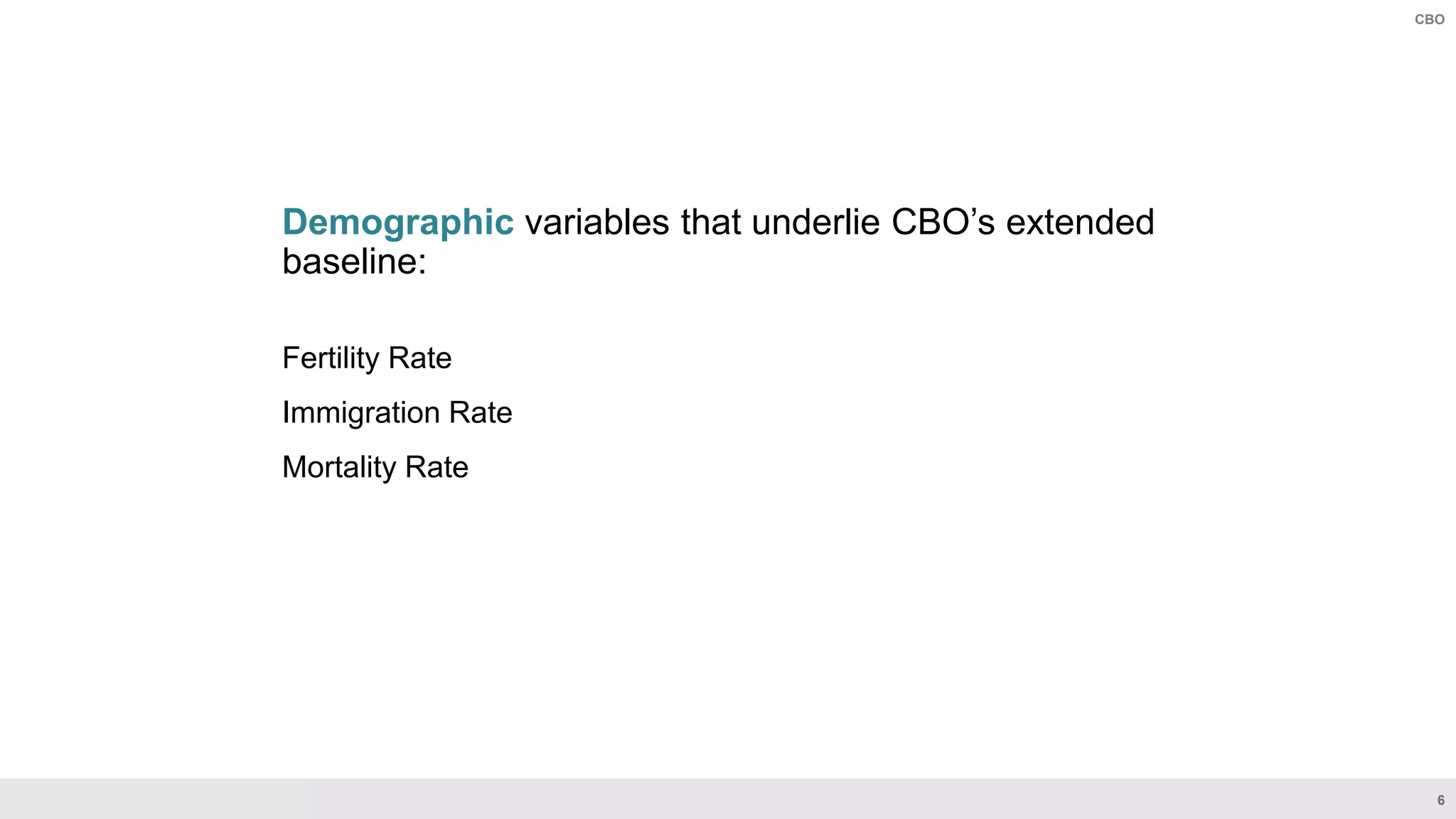
Demographic variables that underlie CBO’s extended
baseline:
Fertility Rate
Immigration Rate
Mortality Rate
7
CBO
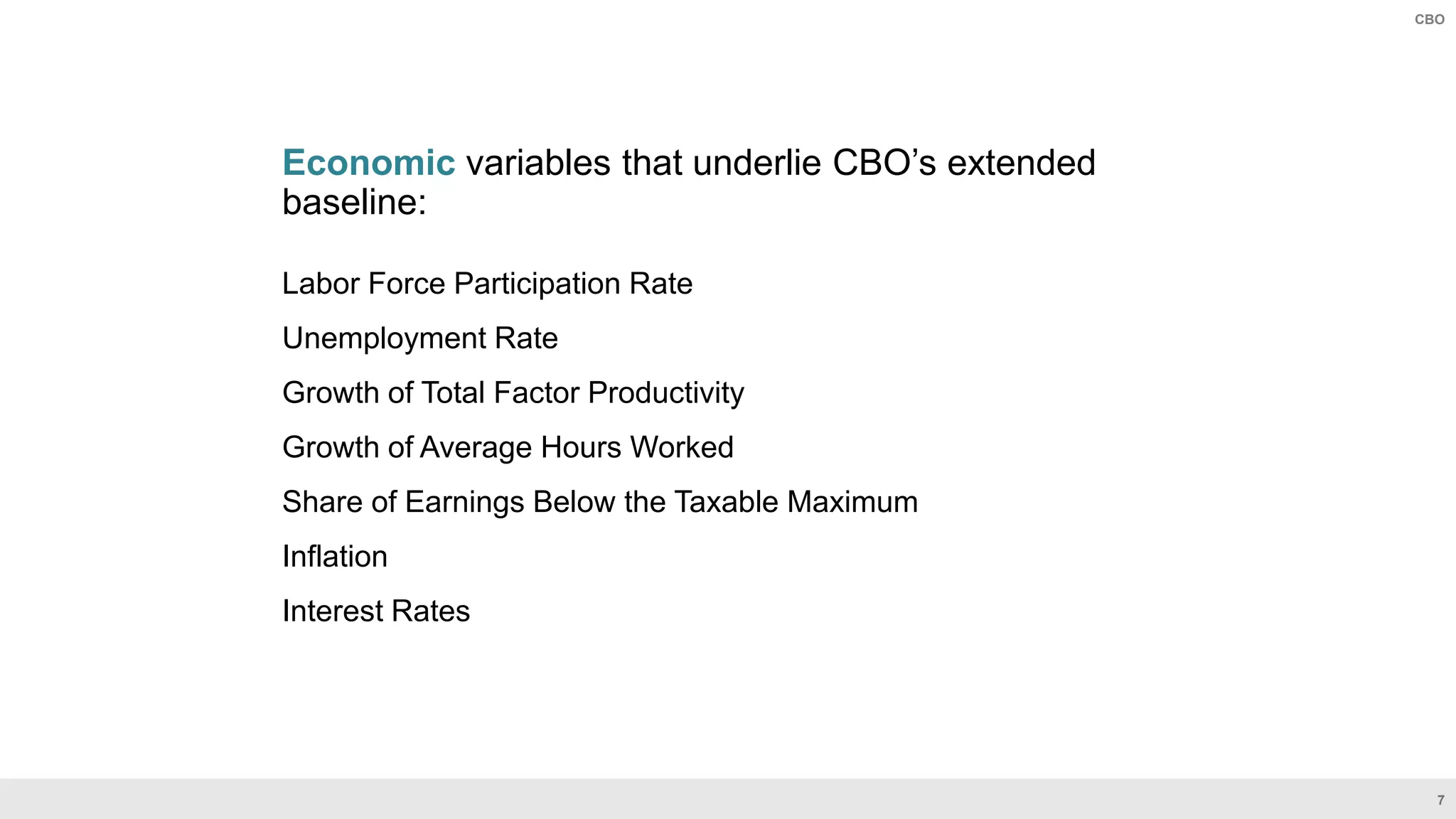
Economic variables that underlie CBO’s extended
baseline:
Labor Force Participation Rate
Unemployment Rate
Growth of Total Factor Productivity
Growth of Average Hours Worked
Share of Earnings Below the Taxable Maximum
Inflation
Interest Rates
8
CBO
Although long-term projections of any variable are
uncertain, projections of Social Security finances
are more sensitive to changes in some inputs than
others.
9
CBO
One way to illustrate the effect that different
projections of underlying factors have on Social
Security projections is to compare CBO’s projections
with the Social Security Trustees’ projections.
10
CBO
Sources: Congressional Budget Office; Social Security Trustees.
CBO’s and the Social Security Trustees’ Projections
of Social Security Tax Revenues and Outlays
Series 2
Series 1
0
25
50
75
100
73-74 75-76 77-78 79-80 81-82 83-84 85-86 87-88
Thousands
11
CBO
Sources: Congressional Budget Office; Social Security Trustees.
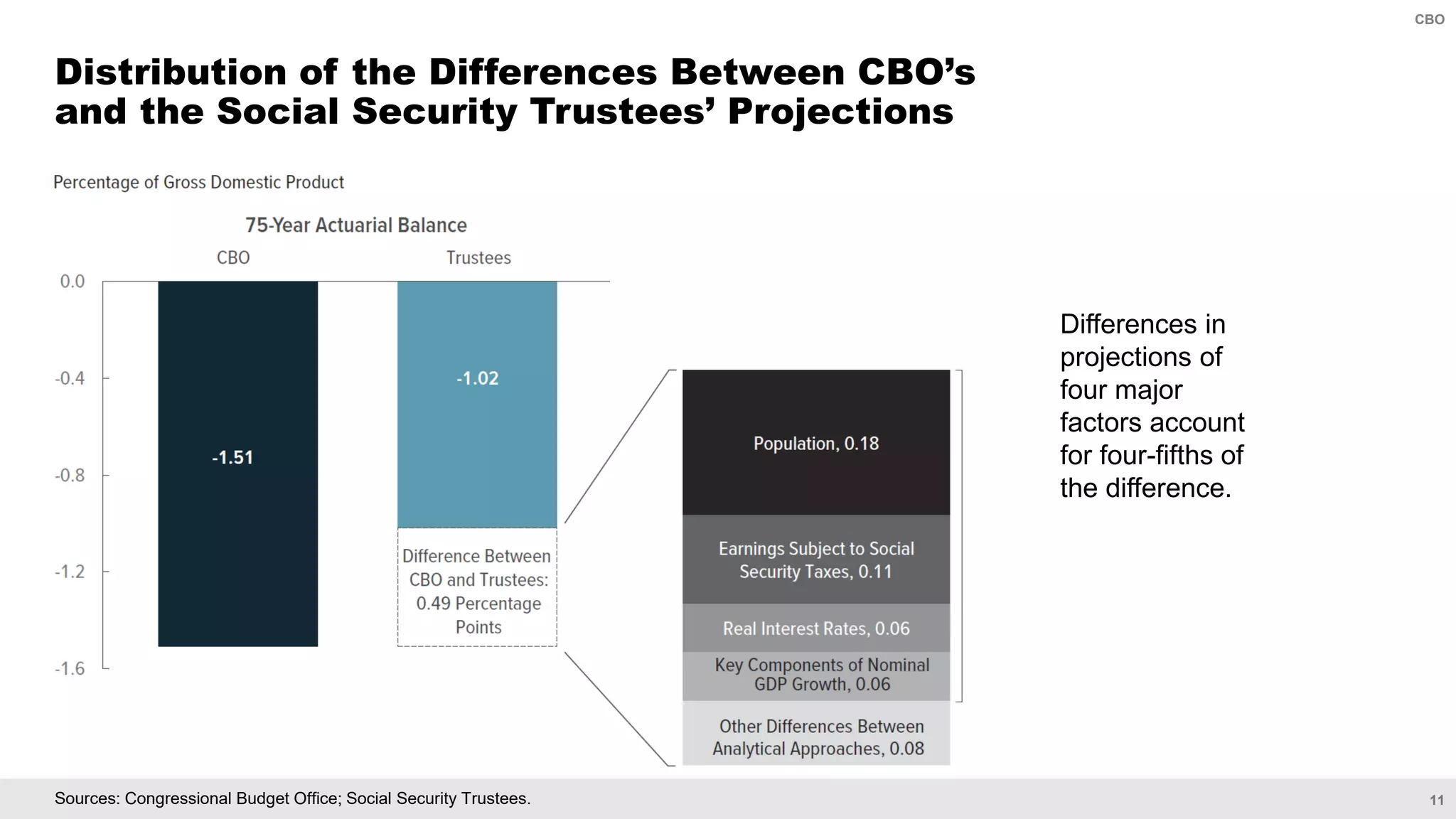
Distribution of the Differences Between CBO’s
and the Social Security Trustees’ Projections
Series 2
Series 1
0
25
50
75
100
73-74 75-76 77-78 79-80 81-82 83-84 85-86 87-88
Thousands
Differences in
projections of
four major
factors account
for four-fifths of
the difference.
12
CBO
The largest effects are from differences in population
and differences in earnings subject to Social Security
taxes.
Underlying population estimates are projections of
fertility, mortality, and immigration.
Earnings subject to Social Security taxes depend on
the share of earnings above and below the taxable
maximum, the share of total compensation paid as
earnings, and total compensation as a share of GDP.

CBO’s Long-Term Social Security Projections

  • 1.
    Congressional Budget Office 2019Technical Panel on Assumptions and Methods Washington, D.C. November 16, 2018 Julie Topoleski Health, Retirement, and Long-Term Analysis Division CBO’s Long-Term Social Security Projections
  • 2.
    1 CBO CBO’s long-term SocialSecurity projections are based on a detailed microsimulation model that starts with data about individuals from a representative sample of the population and projects economic and demographic outcomes for that sample through time.
  • 3.
    2 CBO CBO’s Long-Term Model(CBOLT) has four components: The demographic model projects the population by age and sex, using annual projections of the number of births, deaths, immigrants, and emigrants. The microsimulation model projects year-to-year changes in demographic characteristics and economic outcomes for individuals in a representative sample of the population. The long-term budget model projects federal outlays, revenues, deficits, and debt beyond CBO’s standard 10-year budget window. The policy growth model simulates how demographics, fiscal policy, and economic factors affect the U.S. economy and, in turn, the federal budget.
  • 4.
    3 CBO Projections of economicand demographic variables are key inputs into that model.
  • 5.
    4 CBO CBO consults avariety of sources—including its own analysis of historical data, forecasts made by other government agencies, panels of advisers, and academic literature—when creating its projections. CBO regularly reviews its projections, sometimes in light of revised and recent data and sometimes in light of recent analyses.
  • 6.
    5 CBO Economic projections areextensions of CBO’s 10-year economic forecast, which underlies the agency’s budget projections. Those projections reflect not just historical averages but also trends that many economic forecasters expect will continue.
  • 7.
    6 CBO Demographic variables thatunderlie CBO’s extended baseline: Fertility Rate Immigration Rate Mortality Rate
  • 8.
    7 CBO Economic variables thatunderlie CBO’s extended baseline: Labor Force Participation Rate Unemployment Rate Growth of Total Factor Productivity Growth of Average Hours Worked Share of Earnings Below the Taxable Maximum Inflation Interest Rates
  • 9.
    8 CBO Although long-term projectionsof any variable are uncertain, projections of Social Security finances are more sensitive to changes in some inputs than others.
  • 10.
    9 CBO One way toillustrate the effect that different projections of underlying factors have on Social Security projections is to compare CBO’s projections with the Social Security Trustees’ projections.
  • 11.
    10 CBO Sources: Congressional BudgetOffice; Social Security Trustees. CBO’s and the Social Security Trustees’ Projections of Social Security Tax Revenues and Outlays Series 2 Series 1 0 25 50 75 100 73-74 75-76 77-78 79-80 81-82 83-84 85-86 87-88 Thousands
  • 12.
    11 CBO Sources: Congressional BudgetOffice; Social Security Trustees. Distribution of the Differences Between CBO’s and the Social Security Trustees’ Projections Series 2 Series 1 0 25 50 75 100 73-74 75-76 77-78 79-80 81-82 83-84 85-86 87-88 Thousands Differences in projections of four major factors account for four-fifths of the difference.
  • 13.
    12 CBO The largest effectsare from differences in population and differences in earnings subject to Social Security taxes. Underlying population estimates are projections of fertility, mortality, and immigration. Earnings subject to Social Security taxes depend on the share of earnings above and below the taxable maximum, the share of total compensation paid as earnings, and total compensation as a share of GDP.