Running head: CAVEAT EMPTOR 1
Caveat Emptor vs. Primum NonNocere
Bruce D. Parker
Hodges University
CAVEAT EMPTOR 2
Buyer beware vs. not knowingly to do harm
The primary purpose of this study is to define and determine if cultural, ethical or moral
values abate when small business acquisitions fail to meet the buyer’s expectations. The
secondary purpose of this study it to gain a greater understanding of ethics and morals in western
business and culture today. This paper is an attempt to understand the ethics that managers need
and the ethics of responsibility in the small business acquisition.
In small business acquisitions, a case study will be used regarding the author’s personal
experience. It is one of many similar cases where buyer’s expectations may be misled, regarding
the condition of the acquisition, which then causes the buyer to receive unanticipated financial
and organizational distress.
CAVEAT EMPTOR 3
Caveat Emptor vs. Primum NonNocere: Buyer Beware vs. Not Knowingly To Do Harm
The ethics that managers need and “ethics of responsibility” in small business acquisition
Introduction
Moving further into the 21st Century the need for ethical and moral responsibility is ever-
increasing. How individuals foster personal morals, and ethics has been a topic of much debate
for philosophers, educators, and scholars alike. The focus of this chapter is to define ethics and
morals in a personal view. To illustrate this author’s belief that there should be no difference
between business ethics and business morals, as defined by scholars in the business field.
In his book “The Essential Drucker”, Peter Drucker examined the “ethics of
responsibility” in the world of business (Drucker, 2001, p. 63). In brief, business people should
not lie, cheat, steal, or do any unethical or immoral act that would cause harm to any stakeholder.
This premise of what actions a business should not do should begin with a statement of what
businesses should do. Developing standards in business is a direct reflection on a corporate
CEO’s or president’s personal beliefs and conduct.
CAVEAT EMPTOR 4
Chapter One
Ethics in infancy
Marcus Tullius Cicero stated that it was Socrates who “summoned philosophy down from
the heavens...to inquire into life and morals and things evil and good” (Rosen, 2009, p. 5).
Socrates was a master of rhetoric and used his skills adroitly as he ably defended his positions on
good and evil, right and wrong, morality and immorality, and the very nature of life itself.
Socrates’ positions and abilities led David Knox to title Socrates “The First Professor” (Knox,
1998, p. 115). As Knox points out, he was the founder of the Socratic Method, a method of
intellectual and moral discovery through the depth of dialog between teacher and student.
Socrates was more than just a teacher, as Xenophon points out: “Socrates was interested in
forming the entire person” (p. 118). Socrates’ mission was “to form a virtuous whole that would
be a benefit and ornament to society” (p. 118). His successors like Aristotle used similar methods
to draw the student of humanity into the world around them.
Aristotle states that: “every art and every investigation, and similarly every action and
pursuit is considered to aim at some good” (Thomson, 2004, p. 1). He further states that
“knowledge of the good is of great importance to us for the conduct of our lives” (p. 2). He then
suppositions that the highest of all practical goods is happiness according to Aristotle (p. 7). He
defined happiness as “something perfect and self-sufficient being the end to which our actions
are directed,” a practical good (p. 15). If one is to believe this philosophy, the subsequent
actions then according to Aristotle, should be based on the pursuit of happiness, the practical
good.
As a side note, in developing business ethics, Brague takes the position that “Aristotle
offers a business ethic intent on advancing the attainment of personal happiness…Defining
CAVEAT EMPTOR 5
happiness in universalistic terms, Aristotle insists upon the priority of exercising the virtues, of
habitually acting in ways that fulfill the highest human potentialities” (Brague, 2006, p. 342).
Aristotle states: “moral goodness, on the other hand, is the result of habit, from which it has
actually got its name, being a light modification of the work ethos” (Thomson, 2004, p. 31).
Ethics and morality are intertwined. Stanley Rosen in “The Philosopher’s Handbook” had his
introduction written by Paul Rahe. Rahe states that “Aristotle contends that there is also such a
thing as moral virtue” (Rosen, 2009, p. 13).
Are morality and ethics are the same?
So far as this author can discern, there are numerous differences between the two as
promulgated by various authors. For instance, psychologists have been studying morality for
centuries. “Morals can be defined as concepts, reasoning, and actions related to well-being,
rights, and the fair treatment of other people” (Vélez García & Ostrosky‐Solís, 2006, p. 349).
This definition seems to be a reasonable statement and is in line with the authors above regarding
goodness, human potential, and the conduct of individual lives.
Immanuel Kant, an 18th-century German philosopher, takes a very strong stand on morals
with his statement that:
Morality demands that we act on the sort of policies which, if adopted by
everyone, would generate a community of free and equal members, each of whom would,
in the process of realizing his own purposes, also further the aims of his fellows.
(L'Etang, 1992, p. 742)
This statement by Kant becomes part of the entwining in the moral and ethical dilemma.
Are morals and ethics the same? Morals do become the basis for ethics, and ethical conduct and
ethics are a standard duty or a code of action to the community as implied by almost all the
CAVEAT EMPTOR 6
philosophers. L’Etang takes the position that: “the moral significance of codes of ethics is
contained in their existence, and they have the potential to yield the process of ethical decision-
taking” (p. 743).
Due to the abundance of definitions of morals and ethics by numerous authors, countless
references have been melded together to try and perfect an acceptable definition of ethics and
morals. Individual and group conduct has been analyzed and dissected to the point where many
authors agree, with a reasonable expectation of general acceptance by philosophers, educators,
and psychologists, on a relative test statement. Hosmer wrote:
Ethically justifiable behavior, to repeat the argument for emphasis, consists of morally
correct decisions and actions in which the interests of the society take the degree of
precedence that is "right," that is "just," and that is "fair" over the interests of the
individual. (Hosmer, 1995, p. 399)
Codes of ethics from society to business
SocietThis is an area that seems to present an easy transition, and over the last half
century more and more social ideas have become business practices. “The Department of Labor
(DOL) administers and enforces more than 180 federal laws” (United States Department of
Labor, 2014, para. 1). Some of the laws enacted with social ideas as a base train of thought,
include:
 The Equal Pay (not equated to color, sex, or nationality) Act.
 Various societal employment acts such as:
o Child labor laws
o Equal opportunity laws and acts, where employment exhibits no regard to
race, age, religion or national origin.
CAVEAT EMPTOR 7
The list has become quite large since the mid-1960’s, including the Taft-Hartley Act that handles
regulating employee-employer relations. The Taft-Hartley Act may be the most extensive and
important act regarding business to employee relations! (United States Department of Labor,
2014, para. 3)
Not only has the business community been forced to accept social ideas; businesses bear
scrutiny by the community or governmental bodies in which they operate in the western world.
Ethical codes of conduct had to be implemented by a majority of companies to withstand the
outside pressure of governmental and societal standards and laws. Unfortunately, not all ethical
codes of conduct are the same, but many of them have criteria based on societal needs. Phillip V.
Lewis states there are two points that known for certain about the content of any code of ethics:
(1) One's business ethics cannot be separated from his or her personal ethics (or all other
ethics);
(2) The business will never be any more ethical than the people who are in business. (Lewis,
P., 1995, p. 377)
These are two remarkably candid points, and they are the crux of success or failure in any
ethical business situation. They form a formidable barrier that ensures that the connection
between business and personal ethics cannot have separation without serious consequences.
In a similar, but different light, the comparison between personal and business ethics was
put forth by Stanwick and Stanwick in their textbook “Understanding Business Ethics.” The
authors defined ethics “as the value an individual uses to interpret whether any particular action
is considered acceptable and appropriate” (Stanwick & Stanwick, 2009, p. 2). The authors also
use a similar variant when they defined business ethics. Business ethics consists of “the
collective values of a business organization that can be used to evaluate whether the behavior of
CAVEAT EMPTOR 8
the collective members of the organization is considered acceptable and appropriate” (p. 3). It is
apparent that business ethics needs an avenue of connection to personal ethics.
Ethics of Responsibility
Mr. Drucker is very succinct when he states that “one main topic is plain, everyday
honesty” (Drucker, 2001, p. 63). There have been liars, cheaters, and thieves throughout all
periods of time; these miscreants exists in and resonate within every aspect of society.
Drucker believes that “the problem is one of moral values and moral education, of the
individual, of the family, and of the school” (p.64). Drucker also believes that to fix the problem
is with a penalty, commensurate to the broken moral or ethical act that would cause serious
reflection upon any individual of moral fortitude. The removal of inducement to commit an
immoral or unethical act by a suitable known and stout punishment, Drucker believes, is
substantial enough to slow the onslaught of unethical business activity (p.64).
Management is at the forefront when it comes to responsibility for immoral and unethical
acts committed by employees, management, or business owners. Being at the forefront is often
construed as being the leader or part of the leadership team. However, it is only natural that
many managers are not natural born leaders, according to Drucker. In many cases, being a
manager is simply a position of responsibility and puts a manager in the “membership of the
leadership group” (p.65). Therefore, being a “member of the leadership group, a manager stands
under the demands of professional ethics-the demands of an ethic of responsibility” (p. 65).
The reason Drucker has emerged as the median standard of business ethics is addressed
by Klein. Klein states: “after all, an argument can be made for the opinion that Drucker not only
invented modern business management, but that he embodies, more than any other business
management theorist, Aristotelian practical wisdom” (Klein, 2000, p. 121).
CAVEAT EMPTOR 9
Primum NonNocere
According to Drucker, Primum NonNocere is the first part of the Hippocratic Oath. The
translation that most non-physicians are familiar with is “above all, not knowingly to do harm”
(Drucker, 2001, p. 65). Drucker further explains that Primum NonNocere should be the “basic
rule of professional ethics, the basic rule of an ethics of public responsibility” (p.66). However,
this is not the course of business today; golden parachutes, excess compensation in all forms, and
the need for profit have all disillusioned the general public away from trusting almost any
business. Whether any business is doing what is best for the public is now questioned. All of
these items have stunted the trust that the western world has in the way businesses are operated.
The public requires a greater education as to why certain business methods are needed
prior to the nefarious deed (see examples given) going public for the first time and causing
tremendous business trust repercussions. Does the public understand why it is so important for a
company to make a sizeable profit? In that fact, why should Wal-Mart, Apple, Wells Fargo,
Warren Buffet, or any businessman or enterprise make more than anyone in the world? “How
much money is too much?” is a question this author’s father often posed when he played his
lottery tickets? The dream of being so rich he could not spend all of his money in a lifetime was
more than he wanted.
Why businesses wanted to make so much money was something he did not quite
understand. What he did understand was greed, and that human beings run the businesses of this
world. It is not the fault of the businesses for making more than they needed; it is the people
who ran them that had taken greed to a new level.
CAVEAT EMPTOR 10
A recent perspective published in an epilog in a not well-known magazine, European
Eating Disorders Review is as follows:
Of course, old Hippocrates had a point. Not doing harm is important. It was in his time
when most treatments were ineffective. It still is now that powerfully effective treatments
often are available. But perhaps the ‘primum’ bit needs to be thought about. Now the
balance between risk of harm and chance of benefit is where it is at. (Palmer, 2002, p.
230)
Summary
What constitutes ethics? Are they principles of application or simplistic statements of
being? Do morality and ethics mean the same in western society? What was the basis for morals
and ethics when these concepts upon introduction? How do most human beings perceive morals
and ethics? These were the original questions that this author had in his mind before venturing
into the case study that is to follow.
‘Do no harm’ in business, for this author has been the mainstream of his life. Being
raised on a small farm with small farm morals and ethics, and then moving into the business
world was an eye-opening experience. A fundamental shift, due to several severe lifetime
experiences, caused serious doubts and uncertainty about how the author had led his life. This
was the author’s focus for this chapter’s seminal review about ethics, morals, business, and
practices of today and years gone by. In the author’s mind no case study could move forward
without a more complete understanding of why human beings do the deeds the do. Primal
questions must be answered.
CAVEAT EMPTOR 11
Chapter Two
Business ethics a short history
The point can be made that the history of business ethics is a combination of everyday
ethics and moral convictions applied to business. Although the term business ethics was
virtually unheard of in the post-modern world it was being taught in every book, bible study,
classroom, TV show and religious belief system. The substance for all the ethical and moral
business discussions was justice, honesty, truthfulness, and their counterparts, lying, cheating
and stealing, at home, and in an individual’s personal and business life (De George, 2005, p. 47).
This education played an instrumental role in the development of Judaea-Christian ethics in
western society. This author vividly remembers being taught in grammar school, that George
Washington chopped down the cherry tree, but he did not lie about the deed. This was one of the
many teachings regarding personal ethics that taught the values of western society. Standing in
the corner at school, in the first grade, because this author’s dog ate the homework from the night
before, was a reinforcement of one of those principles called honesty. The counterpart, the
villains, liars and cheats for example in many of the old western movies, were always bad
bankers, cheaters at cards, cattle-rustlers, etc., all associated with bad business and personal
ethics and morals.
The Ox-bow Incident is indicative of novels of western lore that were steeped in moral,
ethical and immoral and unethical behaviors. Clark submitted that:
True law, the code of justice, the essence of our sensations of right and wrong, is the
conscience of society. It has taken thousands of years to develop, and it is the greatest,
the most distinguishing quality which has developed with mankind. (Clark, 2014)
CAVEAT EMPTOR 12
The code of justice, the code of the west, the knight’s oath, a code of ethics, the
Hippocratic Oath, is indicative of reinforced social behavior.
Immoral or unethical act are business is postulated by the individuals behind the act.
Business becomes part of the act by the individuals, not the other way around. Drucker used an
analogy “when this government agency makes this ruling or this decision, we know perfectly
well that it is some people within the agency making the ruling or the decision” (Drucker, 1985,
p. 5). It is the role of management within an organization to make responsible decisions,
according to Drucker. “It is also business management, to which our society increasingly looks
for leadership in respect to the quality of life” (p.10). If managers are there to lead then
“Managing ethical behavior is thus no doubt a critical social problem for business organizations”
(Stead, Worrell & Stead, 1990, p. 233).
Business ethics had to emerge from the social classrooms and into business classes, and
De George believed that “the new ingredient and the catalyst that led to the field of business
ethics…was the entry of a significant number of philosophers, who brought ethical theory and
philosophical analysis to bear on a variety of issues in business” (De George, 2006, p.52).
Business ethics received little to no recognition until the 1970’s when, according to De George,
it gained its roots in the world of academia. The change was a result of business schools and
businesses being pressed by social constraints to improve the relationship between business and
society. The first conference of business ethics was in 1974 at the University of Kansas. At this
conference an anthology of subject matter was used to develop some of the new courses in
business ethics (De George, 2006, p. 52). Today there are 42 different business journals
including the popular Journal of Business Ethics and the Journal of Business Ethics Education. It
CAVEAT EMPTOR 13
appears that the need for business ethics in the classroom, in the boardroom, and in all
institutions of ethical responsibility has never been greater.
A business code of ethics
How can you have a business code of ethics unless you have a base standard? Is the code
based on the type of business that is being operated? Is the code based on where you live? Is the
code based on societal values or normative values?
Businesses are not the same. Everyone does not live in the same place. Location and
situation determine what standards of business are used. Indeed, societal values or normative
values are as interchangeable as authors. In todays business world, academia, business
management, and stakeholders assist in writing a business code of ethics. Varying codes of
ethics definitions imply similar ideas. Stanwick and Stanwick proposed in 2009, that a code of
ethics must represent “the collective values of a business organization that can be used to
evaluate whether the behavior of the collective members of the organization are considered
acceptable and appropriate” (p. 2). Schwartz proposed that “a code of ethics by most definitions
is a written, distinct, formal document that consists of moral standards that help guide employee
or corporate behavior” (Schwartz, 2002, p. 27). Schwartz continues that “codes of ethics by their
very definition, imply that they contain normative guides for behavior” (p. 27).
What types of behavior or standards need to be included in all “codes of ethics”?
Raiborn and Payne (1990) suggest that corporate “codes of ethics should be based at the highest
moral levels” (p. 880). In the same regard, standards of behavior need compliance with societal
laws and business laws. “A corporation, in developing a code of business ethics, should take its
proper place as a member of society through its status of a legal “person” (p. 880). (Drucker
addressed this same issue of the corporation as a ‘legal person’ in 1954, when he stated that
CAVEAT EMPTOR 14
“society has been forced to grant to the enterprise…first a charter of perpetuity, if not of
theoretical immortality to the ‘legal person” (p. 382). Raiborn and Payne (1990) further suggest
that there are four fundamental principles that would build a good foundation for standards of
behavior that would be applicable to any viable ethical question or dilemma. These principles
are:
1. Integrity-of sound moral principle, with characteristics of honesty, sincerity, and
candor.
2. Justice-having impartiality, sound reason, correctness, conscientiousness, and good
faith.
3. Competence-being capable, reliable, and duly qualified.
4. Utility-the quality of being useful and, philosophically, providing the greatest good for
the greatest number (or the least harm to the greatest number) (p. 885).
The principles are suggestions as stated, but can be exemplified with simplistic across-the-board
clarity; in a single statement the McDonnell Douglas Corp. policy “states that employees should
be honest and trustworthy in all relationships” (p. 883). However clear and simplistic this
statement of policy, it did not prevent McDonnell Douglas Corp. owners and managers from
becoming embroiled in major defense scandals:
In 1979, James McDonnell III and three other company officials were indicted on charges
of bribing foreign officials…Clark Clifford, a former secretary of defense, defended the
company in court by arguing that these payments were made with the full knowledge of
the U.S. government in "difficult sales environments” (Funding Universe, 2014, para.
20).
CAVEAT EMPTOR 15
Raiborn and Payne (1990) encapsulated this behavior when they stated “that it is important to
note…an ethics code will fail…in a company whose management does not adhere, in good faith,
to the ideals espoused by the code” (p. 884).
Patrick Murphy in Business Ethics Quarterly (2010) states:
1. Corporate codes should be specific” and that employees need guidance in interpreting
their actions.
2. Codes should be public documents as well as blunt and realistic about violations, i.e.
violators will be terminated.
3. Codes should be revised periodically and become living documents to reflect current
ethical problems (p. 909).
It is apparent that Murphy’s statement shows a one-sided view of corporate codes.
Leadership or management is not mentioned; yet, they are often the cause of corporate ethical
failure. Drucker believes that employees need leadership, not guidance. He states that
leadership’s job is to lift man up, set the proper example, and to give the employee vision in his
performance abilities and assist him to be a better person. “Nothing better prepares the ground
for such leadership than a spirit of management that confirms in the day-to-day practices of the
organizations strict principles of conduct and responsibility, high standards of performance, and
respect for the individual and his work” (Drucker, 1954, p. 159).
Corporate Governance
To ensure that corporations are directing and managing their business affairs, a new
term was formed in the 1990’s called “corporate governance.” One definition by Mayer states
that “corporate governance is concerned with ways of bringing the investors and managers in
line and ensuring that firms are run for the benefit of the investors” (Abor & Adjasi, 2007, p.
CAVEAT EMPTOR 16
113). This definition is suitable for larger enterprises, but what about the small and medium
enterprises (SMEs)? What qualifies as an SME?
Van der Wijst considers small and medium-sized business as privately held firms with 1-
9 and 10-99 people employed, respectively; Jordan et al. define SME’s as firms with less
than 100 employees and less than [euro] 15 million turnover; Michaelas et al. consider
small independent private limited companies with less than 200 employees and López
and Aybar analyze companies with sales below [euro] 15 million (Abor & Adjasi, 2007,
p. 112).
There is no easy way to simplify the three definitions of SME’s given by the different
authors. In the United States many small corporations exist as singular owner-run operations
with corporate officers often being husband and wife. Small corporations vary: by employee
size and business efficiency, the industry in which the corporation is involved, and the value of
the assets. In medium run enterprises, the number of employees increases to often over 50
people, and the corporation may have a diversified officer core. The ownership is more
diversified with investors as owners. Drucker clarifies his opinion on what he believes is one
fairly reliable criteria. “In a small business the man at the top knows who the few people are in
the organization,” the man at the top knows almost everything about his employees and
“regardless of title and position, it can hardly exceed twelve to fifteen” employees. In the
medium sized business the man at the top is normally three or four top notched co-owners or
managers, who when asked collectively, can tell you about the 40-50 employees they have under
their supervision. Drucker also states that “this test is neither infallible nor precise” (Drucker,
1985, p. 647-648).
CAVEAT EMPTOR 17
In the SME’s, corporate governance is critical for short and long term financial growth,
employee supervision, financial accountability, social accountability, and organizational control.
Abor and Adasji (2007) state:
Corporate governance is “about putting checks and balances in place to prevent abuses of
authority and ensure the integrity of financial results…setting rules and procedures as to
how the company is run…that good governance does not guarantee business success.
However, poor governance could be symptomatic of a business failure. More
importantly, lifting the confidence of existing owners and potential new owners is a
valuable goal. (p. 119)
In effect, corporate governance is the truthful corporate diligence due to the stakeholders, who
are involved in a firm’s realm of activity.
A moral corporation
Society needs moral corporations on every level; “no pluralistic society such as
ours…has ever worked unless its key institutions take responsibility for the common good”
(Drucker, 1974, p. 379). Klein states that “the manager must assume the responsibility for the
public good and equate what is genuinely in the public interest with the firm’s self-interest”
(Klein, 2000, p. 123). Note: “Manager” could easily be transposed with “owner” in any of the
previous or following statements. Managers need abide by an ethical code of conduct; self-
interest must share equally in all occasions with what is best for society and stakeholders alike.
Klein states that “Drucker believed that a moral principle grounded in the nature and purposes of
an organization is necessary to give business management legitimate authority” (Klein, 2000, p.
124). Ownership then of any organization does not give an individual legitimate authority; it is
CAVEAT EMPTOR 18
moral principle that is the foundation of respect and the recognition of legitimacy by all
stakeholders.
Ownership should then in “any institution exists for the sake of society and within a
community” (Drucker, 1974, p. 18). Managers should consider the responsibility they have to
societal moral values and need to look beyond the relative scope of their immediate impact
within the confines of their own business establishment. Immoral and unethical managers’ and
owners’ actions, words, and impact, “tend to cause social disruption. They tend to conceal
unhealthy reality and create disease, or at least social hypochondria. They tend to misdirect and
to prevent understanding, and this is grievous social harm” (Drucker, 1974, p. 369).
Corporations rely on professional managers and owners alike to carry the moral torches that
provide a path for others to follow, stakeholders all.
Summary
The term business ethics did not magically appear on the scene in the business world; it
was a culmination of years of methodical business research and educational rhetoric. Ethics and
morals are terms that had to find a place within the andragogy of business students. The need for
business ethics and a unified code of ethics has never been greater than it is today. Business and
business managers should stand on high moral ground. Ethical principles of conduct need to be
in harmony with societal beliefs and norms. In order for this to happen, corporate governance
has to be enforced from SME’s to large corporations. Without the proper checks and balances
provided with ethical and moral corporate governance, dangerous predators in the business world
could cause and have caused tremendous societal harm. Drucker has valid points about the need
for societal responsibilities outweighing the needs of the individual’s self-interest.
CAVEAT EMPTOR 19
Chapter Three
Introduction
This chapter defines mergers and acquisitions (M&A) and the difference between how
the two different types of business may increase their consolidated value and how businesses
realize their potential in M&A’s and generate revenues needed for expansion. It takes a brief
look at which type of business transaction may be more beneficial and when are the best times to
do a merger or acquisition. Caveat Emptor (buyers beware) is a serious threat in any acquisition
or merger. The terms origins and usage are discovered as well as how caveat emptor is
universally adopted as one of the laws of the land in regards to business transaction. The case
study is presented with the original complaints filed by the plaintiff. The case study is reviewed
between plaintiffs and defendants with corresponding history, actions and results of the U.S.
District Court’s decisions on declaratory judgments that solidified the original complaints in the
eyes of justice.
About Mergers and Acquisitions
Although the terms mergers and acquisitions (M&A) are often used together in layman’s
terms they are similar but not the same. There are different ways in which a two or more
companies or businesses may become more valuable together than apart. M&A have a similar
valued key principle and “the key principle behind buying a company is to create shareholder
value over and above that of the sum of the two companies” (Investopedia, 2014, para.1). An
acquisition defined is when one company purchases or acquires another company and the
purchased company ceases to exist. Legally, the target company acquired is enveloped by the
buyer and the assets, stocks, and shares are all legally owned in the name of the purchasing
company. In a merger,
CAVEAT EMPTOR 20
Two firms, often of about the same size, agree to go forward as a single new company
rather than remain separately owned and operated. This kind of action is more precisely
referred to as a "merger of equals." Both companies' stocks are surrendered and new
company stock is issued in its place. (Investopedia, 2014, para. 5)
An example of a merged stock would be ExxonMobil, two former oil giants merged into one.
An example of an acquisition would be Google and YouTube. Both still function as independent
names but Google is the parent company.
Acquisitions
“Prosperity and growth come only to the business that systematically finds and exploits
its potential” (Drucker, 1996, p. 163). How do businesses realize their potential? Peter Drucker
said that “gradual growth from within is not possible, as a rule. Only sale of the company,
acquisition of another company in the same industry, or merger will produce a business of the
size needed” (Drucker, 1986, p. 180). In layman’s terms, other than using finance or excess
profit as a means of financial growth, a business cannot grow to the size it needs to generate
more money.
Acquisition of a business is when one business buys another. Business acquisitions can
be related (when the business being purchased is similar to the acquiring business) or unrelated
(when the business being purchased is not similar to the acquiring business). Drucker called the
related business acquisition a “common core of unity” (Paine & Power, 1984) and used the
“common core of unity” as one of the five rules for managers to be successful in acquiring
another business. The five rules are:
1. Common core of unity--both businesses need a common market, common technology
or a similar production process.
CAVEAT EMPTOR 21
2. Contribution--the acquired firm cannot be just a money contribution by the acquiring
business. The business making the acquisition must provide substantial contributions
in other areas such as potential skills, management techniques, or other significant
contributions.
3. Temperamental fit--the acquired business products, customers, and materials have to
be recognized as a significant part of the investment. The acquired company has to
maintain its perceived value for the buy-in to be successful.
4. Top management--new top management must be provided within one year by the
acquiring business. (Drucker (1986) stated that the “managers of the acquired
company rarely stay around for long”.) (p. 425) Drucker believed that the acquiring
business had to have people that they could trust in upper management positions,
mangers who knew company procedures, guidelines and who understood the motives
of the parent company.
5. Promotions--in the first year the companies should promote managers from each
company to work within the other company’s infrastructure. (Paine & Power, 1984, p.
99-100)
Paine and Power (1984) did not readily agree with the rules as laid out by Drucker for
acquisitions. They pointed out that few authors believed that acquisitions could ever be as
financially successful as the parent company. The authors state that there are some factors that
make acquisitions more inclined to fail such as a falling economy, financial health of the
acquired company, and disconcerting industry factors—for example, a seasonal business. Their
final conclusion is that there are no concrete rules that will make an acquisition successful. (p.
99-108) On the other hand, Vermeulen and Barkema ( 2001) state that “acquisitions allow firms
CAVEAT EMPTOR 22
to achieve greater market power, to overcome barriers to entry, to enter new markets quickly,
and to acquire new knowledge and resources” (p.457). The same authors also indicate that
“acquisitions are often associated with implementation problems and unsatisfactory post-
acquisition performance” (p. 458). The authors support their statement with various studies
including Porter, Ravenscraft and Scherer, and Roll.
Ravenscraft and Scherer found that, on the average, the profitability of target firms
declines after their acquisition. In fact, a large proportion of acquired companies are
again divested or sold off (Porter, 1987; Ravenscraft & Scherer, 1987), with the prime
reason being their unsatisfactory performance (Ravenscraft& Scherer, 1991; Roll, 1986).
An important reason for the disappointing performance is the problems that are
associated with the integration of acquisitions (Haspeslagh & Jemison, 1991).
Acquisitions can be profitable if they are made under the right conditions. “Salter and Weinhold,
and Allen, Oliver and Schwallie advocate locating and purchasing undervalued assets that can be
revitalized with minimum investment: and Salter and Weinhold stress the need to have excess
cash or access to financing on favorable terms” (Paine, & Power, 1984, p. 109). Acquisitions
when firms are at the weakest condition may not be the only caveat for a business purchase.
Michael Porter “suggests that managers should make acquisitions when the economy is bad,
have superior information, and have a unique ability to improve operations” (p. 110). It is
apparent that acquisitions are a risky business, and there is no guarantee of success or rules of
acquisition sufficient to alleviate the risk and burden of an acquisition’s failure. It is also
apparent that there are sufficient guidelines laid out by prominent business analysts, who
advocate business acquisitions as a method of increasing a business’s capacity to excel or
improve financially.
CAVEAT EMPTOR 23
Mergers
As the two terms, M&A, do mean slightly different things, there is a synergy that occurs
during a merger. According to McClure, (2014) “synergy is a magic force that allows for
enhanced cost efficiencies for the new business.” Synergy does take the form of revenue
enhancement and cost savings. By merging the companies hope to benefit from the following:
1. Staff reductions--normally, the first person to lose their job is the CEO (with a nice
severance package) and then the redundant accounting, marketing, operations and
department personnel become additional business casualties.
2. Economies of scale--optimistically, merged business savings occur from purchasing
office supplies to buying equipment in a larger abundance. Purchasing power from a
larger organization does provide a tremendous amount of leverage in negotiating
lower prices.
3. Acquiring new technology--theoretically, merging a smaller company with a greater
technological edge may be all the larger company needs to remain competitive or
gain a competitive edge.
4. Improved market reach and industry visibility--visibly, an increased sales and
revenue opportunity occurs with an increased market size. The perceived business
growth from the investment community and the banks may also lead to an abundantly
ready cash flow. (para. 9)
Even with all the benefits that may occur there is no guarantee for success and the magic
force. McClure says that “synergy opportunities may exist only in the minds of the corporate
leaders and the deal makers” (para. 11). Sean Becketti, (1986) former visiting scholar at the
Federal Reserve Bank of Kansas City states that one of the other important reasons for a merger
CAVEAT EMPTOR 24
and a ‘significant difference’ is that a firm’s output expands more rapidly during a merger. In an
acquisition business investments traditionally would carry investitures with a larger cash output
before the business could expand. (p. 19) “Many analysts believe that mergers allow assets of
acquired firms to be directed toward more profitable activities” (p. 20). There are numerous
types of mergers as stated by Becketti:
1. Consolidation--the combination of many firms into a single new firm. An example of
this type of merger would be U.S. Steel which in 1901, was formed from 785
different firms.
2. Horizontal--where a union is formed of former competing companies. An example of
this type of merger would be Daimler-Benz and Chrysler who merged and formed
DaimlerChrysler.
3. Vertical--a merger of a supplier to its customers. An example of this type of merger
would be Time Warner and the Turner Corporation. Time Warner is a major cable
operator and they merged to use the services of the Turner Corp. which produced
CNN, TBS and other programming.
4. Conglomerate--a merger that would combine businesses that have no relationship or
unrelated common core. An example of this type of merger would be Walt Disney
and ABC. (Becketti, 1986, p. 14)
Beckett also states that the simplest form of a leveraged buyout is with a cash purchase for shares
program. (p. 15) A majority of mergers are financed with debt and are dependent on cash
availability as well as the cost of funds (prevailing interest rates). (p. 18) Changes in bank
interest rates have a direct correlation to the cost of any merger; borrowed funds costs may
increase or decrease the cost of the funds needed for the merger. (p. 23) Mergers also appear to
CAVEAT EMPTOR 25
be cyclical and occur during the expansion period of a business cycle and definitely occur prior
to when the GNP reaches its peak for that particular expansion period. (p.17) Vis-à-vis, during a
downswing in the business cycle or during a recession there are fewer numbers of mergers.
Like a poker hand, a business merger is sometimes a bad deal. As most poker players will
tell you, a bad deal is just that, a bad deal, and corporate managers, investors, and stakeholders
involved in a bad deal will be penalized in numerous ways. These ways may include loss of
stock value, termination, bankruptcy, and dissolution of the merged venture altogether.
Business, like playing poker professionally, is a speculative game and a speculative industry is
always at the mercy of circumstance: the economy, the consumer and investors, and the dealer.
Any failure in any of these areas and the merger may be a bust.
Caveat Emptor
The dealer, the one holding all the cards initially, is in control of the game. Through
sleight of hand, hiding cards, dealing from the bottom of the deck, and counting cards, the dealer
has numerous ways to persuade the player into thinking he has something of value in his hand.
The principle is simple: card player beware, you are at the mercy of a professional. The
principle in business is the same; like card player beware, the term buyer beware or Caveat
Emptor is well established in the business world. The professional business thief knows that one
fact is certain: once the money is gone it is almost impossible to retrieve.
Caveat Emptor is not a new term. In a lawsuit levied in 1930 by the state of Connecticut
against sellers of useful oils who may have been selling oils (motor oil), that did not meet state
standards, Caveat Emptor was employed by the judiciary, and the Connecticut law was
overturned.
CAVEAT EMPTOR 26
The court seemed concerned lest opportunity for sale be denied to "useful oils which
have a wide market and satisfy the public," and seemed disposed to frown upon attempts
to prevent "buyers and sellers from dealing" when "the buyer gets exactly what he
wants." The appearance of such reasons, held in ready reserve, is significant; it indicates
that even in high judicial places the notion survives that the buyer had best be allowed to
take his own chances” (Hamilton, 1931, p. 1134)
A note about Mr. Hamilton: he was the Southmayd Professor of Law at Yale from 1928-
48.Walton Hale Hamilton (1881-1958) was one of the intellectual leaders of the Legal Realist
movement at Yale. An economist but not a lawyer, Hamilton applied the insights of institutional
economics to legal contexts, producing many classic critiques of legal formalism. In works such
as “The Ancient Maxim Caveat Emptor,” 40 Yale L. J. 1133 (1931), “Affectation with a Public
Interest,” 39 Yale L. J. 1089 (1930), and “The Path of Due Process of Law,” 48 Ethics 269
(1938), he showed how legal concepts that had evolved in specific historical and social contexts
could lead to surprising and undesirable outcomes when removed from context and generalized
into universal legal principles.
Mr. Hamilton was brilliant in his research and this author has chosen him to be the key point of
reference in seminal thought on the term “Caveat Emptor”.
In the use of legal authority by the public judiciary and through legislative acts the
prevailing authorities do not, in many cases, protect the purchaser of product or enterprise. He
refers to caveat emptor as the “good old doctrine” as it applies to the “rules of law it has come to
comprehend, and of the public policy it has been made to serve” (p. 1136). The term “caveat
emptor” appears for the first time in print in the 16th century over a horse trade, of all things;
although Latin in origin at no time in history prior had the term been written but had been an
CAVEAT EMPTOR 27
understood maxim. (p. 1164) The first true legal standing for the common law of caveat emptor
in the late 18th century states that “for the common law, that the general rule is caveat emptor and
that the buyer has a legal remedy only because of “express warrant,” deceit “to disguise
defects,” and “provisions unwholesome at the time of delivery”. (p. 1174)
In a case where the purchaser of hops from a seller suffered the loss of all the hops due to
overwatering by the grower, not affiliated with the seller of said hops the following occurred:
The barristers who represented the defense plead a lack of express warranty and an
absence of deceit, and claimed the rule of caveat emptor. The bench insisted that the
buyer had had his opportunity to inspect; and that if he had doubted, he might have
insisted upon a formal warranty or have refused to purchase. (p. 1176)
These two cases served as the benchmark for judicial caveat emptor. According to Mr. Hamilton
“the buyer who at the time of sale has failed to exact positive assurances against future
contingencies deserves to take the consequences of his slothfulness”. (p. 1178) Hamilton states
that Kent in his Commentaries on American Law (1840) is correct when he backs away from the
laws of higher ethics when he stated:
human laws "are not so perfect as the dictates of conscience" and that "the sphere of
morality is more enlarged than the limits of civil jurisdiction," and defends the caveat
emptor which "very reasonably requires the purchaser to attend, when he
makes his contract, to the quality of the article he buys. (p. 1180)
Caveat emptor seemed to so firmly established that Justice Davis, “speaking for the U.S.
Supreme Court declares “caveat emptor· to be of such universal acceptance that, with a single
exception, the courts of all the States in the union, where the common law prevails, sanction it”
(p. 1181). Regardless of the countless laws that have been put in place since this was written in
CAVEAT EMPTOR 28
1931, with the attempt to protect the product, the purchaser, and the seller one truth remains. Mr.
Hamilton expressed this fact succinctly in his closing line when he said “in plain speech and law,
a refined caveat emptor still means that purchase is a game of chance” (p. 1187)
Case Study-Rolsafe International, LLC. V Rolsafe Internationals, Corp. /Joe Kafka
This case is a modern day study in morals, ethics, business ethics, acquisition processes,
caveat emptor and the judicial system.
Rolsafe-History of
Rolsafe hurricane shutters were the brainchild of Bruce Hoovis, who filed and was
granted a license to do business in the state of Florida with the Florida Department of Business
and Professional Regulation in 1989. (FDBPR, 2014, p. 1) Mr. Hoovis changed the name to
Rolsafe International Corp in 1996. (FDBPR, 2014, p. 1) and continued ownership in the
company until 1999 when it was sold to Mr. Joe Kafka. According to the records for DBPR Mr.
Kafka applied for a dba in 2002 as Rolsafe International Corp. and never finalized it. Rolsafe
International LLC purchased Rolsafe International Corp. on 11 Jan. 2005. On July 27, 2005
Rolsafe International LLC was licensed to do business in the State of Florida. (FDBPR, 2014, p.
1)
The primary business of Rolsafe Corp was the “selling, manufacturing and installing” of
hurricane home and business outdoor protective devices, in the advance and onset of a hurricane
of sufficient strength to damage said homes and businesses. (Arnold, 2005, p.2)
Migg Capital and the acquisition
“Mr. Pete A. Klisares has been a Principal Owner and Manager of MIGG Capital
(MIGG), an Ohio-based capital investment company, since October 1999 and also serves as a
Business Consultant” (Bloomberg: Business Week, 2014, para. 2). Mr. Brett Klisares, “is
CAVEAT EMPTOR 29
currently employed at MIGG Capital” located in Columbus, Ohio. (Bloomberg: Business Week,
2014, para. 2)
In the closing months of 2003 Migg found that Rolsafe International Corp. (Rolsafe
Corp.) was for sale. MIGG as a venture capitalist company specialized in purchasing
underachieving companies, managing them for a period of time, and then turning the companies
out for sale. “Beginning in 2004, plaintiff (Rolsafe International LLC-formed by MIGG capital
in 2004) indicated an interest in acquiring Rolsafe Corp.’s assets from Kafka, its sole
shareholder…Kafka agreed to sell the assets of Rolsafe Corp. to plaintiff in exchange for, among
other things, $3,000,000 and a 19.5% membership interest in plaintiff. (Arnold, 2005, p. 2)
In addition to assets of Rolsafe Corp., several other contractual documents were signed as
part of the purchase agreement. They included a consulting agreement, non-compete and non-
solicitation agreement, promissory note, and an operating agreement of Rolsafe International
LLC. (U.S. District Court, (2005). docs. 1-11).
The complaint against defendants
Rolsafe International LLC, (plaintiff) v. Joseph Kafka and Rolsafe International
Corporation (defendant) included the following claims:
First Claim--breach of contract where 13 parts of the asset agreement were cited and
identified as being breached, with an estimated damage which exceeded $8,000,000.
Second Claim--indemnification where the plaintiff exerts that they are entitled to all loses
incurred due to defendant’s actions.
Third Claim--fraud and intentional misrepresentation where the plaintiff exerts that they
were intentionally misled as to the current financial, operating, and liability conditions of Rolsafe
Corp., and asked for an additional $25,000 in attorney’s fees.
CAVEAT EMPTOR 30
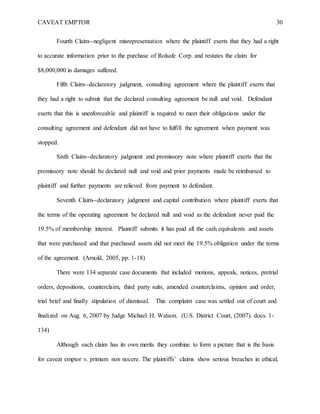
Fourth Claim--negligent misrepresentation where the plaintiff exerts that they had a right
to accurate information prior to the purchase of Rolsafe Corp. and restates the claim for
$8,000,000 in damages suffered.
Fifth Claim--declaratory judgment, consulting agreement where the plaintiff exerts that
they had a right to submit that the declared consulting agreement be null and void. Defendant
exerts that this is unenforceable and plaintiff is required to meet their obligations under the
consulting agreement and defendant did not have to fulfill the agreement when payment was
stopped.
Sixth Claim--declaratory judgment and promissory note where plaintiff exerts that the
promissory note should be declared null and void and prior payments made be reimbursed to
plaintiff and further payments are relieved from payment to defendant.
Seventh Claim--declaratory judgment and capital contribution where plaintiff exerts that
the terms of the operating agreement be declared null and void as the defendant never paid the
19.5% of membership interest. Plaintiff submits it has paid all the cash equivalents and assets
that were purchased and that purchased assets did not meet the 19.5% obligation under the terms
of the agreement. (Arnold, 2005, pp. 1-18)
There were 134 separate case documents that included motions, appeals, notices, pretrial
orders, depositions, counterclaim, third party suits, amended counterclaims, opinion and order,
trial brief and finally stipulation of dismissal. This complaint case was settled out of court and
finalized on Aug. 6, 2007 by Judge Michael H. Watson. (U.S. District Court, (2007). docs. 1-
134)
Although each claim has its own merits they combine to form a picture that is the basis
for caveat emptor v. primum non nocere. The plaintiffs’ claims show serious breaches in ethical,
CAVEAT EMPTOR 31
moral and business behaviors that are in opposition to societal standards and behaviors on the
part of the defendant. The defendant implores caveat emptor as his defense and the decision on
the complaint lies in the hands of the court system, and the ways the laws have been interpreted
in the past.
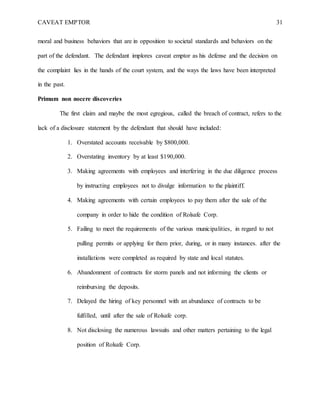
Primum non nocere discoveries
The first claim and maybe the most egregious, called the breach of contract, refers to the
lack of a disclosure statement by the defendant that should have included:
1. Overstated accounts receivable by $800,000.
2. Overstating inventory by at least $190,000.
3. Making agreements with employees and interfering in the due diligence process
by instructing employees not to divulge information to the plaintiff.
4. Making agreements with certain employees to pay them after the sale of the
company in order to hide the condition of Rolsafe Corp.
5. Failing to meet the requirements of the various municipalities, in regard to not
pulling permits or applying for them prior, during, or in many instances. after the
installations were completed as required by state and local statutes.
6. Abandonment of contracts for storm panels and not informing the clients or
reimbursing the deposits.
7. Delayed the hiring of key personnel with an abundance of contracts to be
fulfilled, until after the sale of Rolsafe corp.
8. Not disclosing the numerous lawsuits and other matters pertaining to the legal
position of Rolsafe Corp.
CAVEAT EMPTOR 32
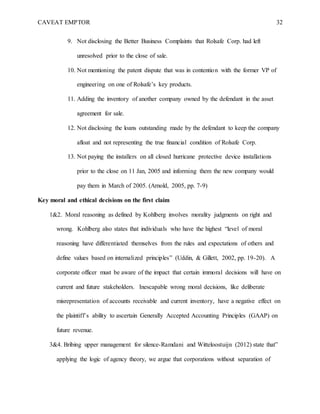
9. Not disclosing the Better Business Complaints that Rolsafe Corp. had left
unresolved prior to the close of sale.
10. Not mentioning the patent dispute that was in contention with the former VP of
engineering on one of Rolsafe’s key products.
11. Adding the inventory of another company owned by the defendant in the asset
agreement for sale.
12. Not disclosing the loans outstanding made by the defendant to keep the company
afloat and not representing the true financial condition of Rolsafe Corp.
13. Not paying the installers on all closed hurricane protective device installations
prior to the close on 11 Jan, 2005 and informing them the new company would
pay them in March of 2005. (Arnold, 2005, pp. 7-9)
Key moral and ethical decisions on the first claim
1&2. Moral reasoning as defined by Kohlberg involves morality judgments on right and
wrong. Kohlberg also states that individuals who have the highest “level of moral
reasoning have differentiated themselves from the rules and expectations of others and
define values based on internalized principles” (Uddin, & Gillett, 2002, pp. 19-20). A
corporate officer must be aware of the impact that certain immoral decisions will have on
current and future stakeholders. Inescapable wrong moral decisions, like deliberate
misrepresentation of accounts receivable and current inventory, have a negative effect on
the plaintiff’s ability to ascertain Generally Accepted Accounting Principles (GAAP) on
future revenue.
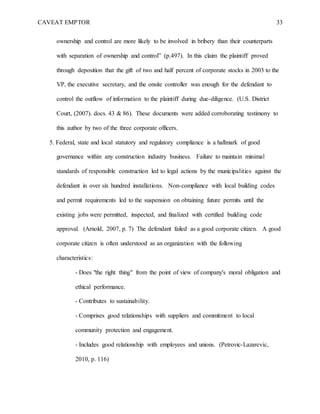
3&4. Bribing upper management for silence-Ramdani and Witteloostuijn (2012) state that”
applying the logic of agency theory, we argue that corporations without separation of
CAVEAT EMPTOR 33
ownership and control are more likely to be involved in bribery than their counterparts
with separation of ownership and control” (p.497). In this claim the plaintiff proved
through deposition that the gift of two and half percent of corporate stocks in 2003 to the
VP, the executive secretary, and the onsite controller was enough for the defendant to
control the outflow of information to the plaintiff during due-diligence. (U.S. District
Court, (2007). docs. 43 & 86). These documents were added corroborating testimony to
this author by two of the three corporate officers.
5. Federal, state and local statutory and regulatory compliance is a hallmark of good
governance within any construction industry business. Failure to maintain minimal
standards of responsible construction led to legal actions by the municipalities against the
defendant in over six hundred installations. Non-compliance with local building codes
and permit requirements led to the suspension on obtaining future permits until the
existing jobs were permitted, inspected, and finalized with certified building code
approval. (Arnold, 2007, p. 7) The defendant failed as a good corporate citizen. A good
corporate citizen is often understood as an organization with the following
characteristics:
- Does "the right thing" from the point of view of company's moral obligation and
ethical performance.
- Contributes to sustainability.
- Comprises good relationships with suppliers and commitment to local
community protection and engagement.
- Includes good relationship with employees and unions. (Petrovic-Lazarevic,
2010, p. 116)
CAVEAT EMPTOR 34
Sonja Petrovic-Lazarevic sets the correct standards for a good corporate citizen
and the defendant did not meet the company’s moral obligation and ethical performance.
The defendant was also remiss in not maintaining good relationships with the local
communities.
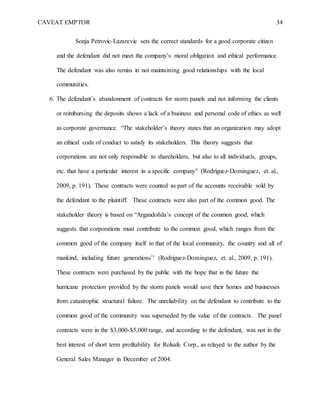
6. The defendant’s abandonment of contracts for storm panels and not informing the clients
or reimbursing the deposits shows a lack of a business and personal code of ethics as well
as corporate governance. “The stakeholder’s theory states that an organization may adopt
an ethical code of conduct to satisfy its stakeholders. This theory suggests that
corporations are not only responsible to shareholders, but also to all individuals, groups,
etc. that have a particular interest in a specific company” (Rodriguez-Dominguez, et. al.,
2009, p. 191). These contracts were counted as part of the accounts receivable sold by
the defendant to the plaintiff. These contracts were also part of the common good. The
stakeholder theory is based on “Argandoñda’s concept of the common good, which
suggests that corporations must contribute to the common good, which ranges from the
common good of the company itself to that of the local community, the country and all of
mankind, including future generations’’ (Rodriguez-Dominguez, et. al., 2009, p. 191).
These contracts were purchased by the public with the hope that in the future the
hurricane protection provided by the storm panels would save their homes and businesses
from catastrophic structural failure. The unreliability on the defendant to contribute to the
common good of the community was superseded by the value of the contracts. The panel
contracts were in the $3,000-$5,000 range, and according to the defendant, was not in the
best interest of short term profitability for Rolsafe Corp., as relayed to the author by the
General Sales Manager in December of 2004.
CAVEAT EMPTOR 35
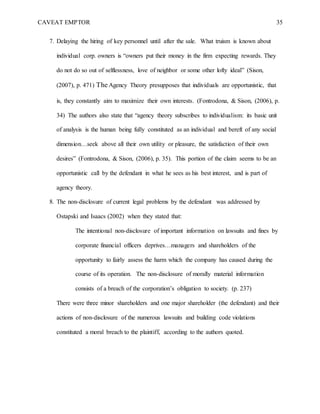
7. Delaying the hiring of key personnel until after the sale. What truism is known about
individual corp. owners is “owners put their money in the firm expecting rewards. They
do not do so out of selflessness, love of neighbor or some other lofty ideal” (Sison,
(2007), p. 471) The Agency Theory presupposes that individuals are opportunistic, that
is, they constantly aim to maximize their own interests. (Fontrodona, & Sison, (2006), p.
34) The authors also state that “agency theory subscribes to individualism: its basic unit
of analysis is the human being fully constituted as an individual and bereft of any social
dimension…seek above all their own utility or pleasure, the satisfaction of their own
desires” (Fontrodona, & Sison, (2006), p. 35). This portion of the claim seems to be an
opportunistic call by the defendant in what he sees as his best interest, and is part of
agency theory.
8. The non-disclosure of current legal problems by the defendant was addressed by
Ostapski and Isaacs (2002) when they stated that:
The intentional non-disclosure of important information on lawsuits and fines by
corporate financial officers deprives…managers and shareholders of the
opportunity to fairly assess the harm which the company has caused during the
course of its operation. The non-disclosure of morally material information
consists of a breach of the corporation’s obligation to society. (p. 237)
There were three minor shareholders and one major shareholder (the defendant) and their
actions of non-disclosure of the numerous lawsuits and building code violations
constituted a moral breach to the plaintiff, according to the authors quoted.
CAVEAT EMPTOR 36
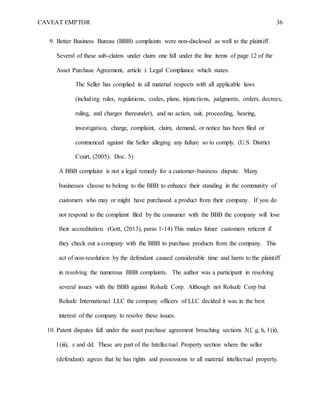
9. Better Business Bureau (BBB) complaints were non-disclosed as well to the plaintiff.
Several of these sub-claims under claim one fall under the line items of page 12 of the
Asset Purchase Agreement, article i: Legal Compliance which states:
The Seller has complied in all material respects with all applicable laws
(including rules, regulations, codes, plans, injunctions, judgments, orders, decrees,
ruling, and charges thereunder), and no action, suit, proceeding, hearing,
investigation, charge, complaint, claim, demand, or notice has been filed or
commenced against the Seller alleging any failure so to comply. (U.S. District
Court, (2005). Doc. 5)
A BBB complaint is not a legal remedy for a customer-business dispute. Many
businesses choose to belong to the BBB to enhance their standing in the community of
customers who may or might have purchased a product from their company. If you do
not respond to the complaint filed by the consumer with the BBB the company will lose
their accreditation. (Gott, (2013), paras 1-14) This makes future customers reticent if
they check out a company with the BBB to purchase products from the company. This
act of non-resolution by the defendant caused considerable time and harm to the plaintiff
in resolving the numerous BBB complaints. The author was a participant in resolving
several issues with the BBB against Rolsafe Corp. Although not Rolsafe Corp but
Rolsafe International LLC the company officers of LLC decided it was in the best
interest of the company to resolve these issues.
10. Patent disputes fall under the asset purchase agreement breaching sections 3(f, g, h, l (ii),
l (iii), s and dd. These are part of the Intellectual Property section where the seller
(defendant) agrees that he has rights and possessions to all material intellectual property.
CAVEAT EMPTOR 37
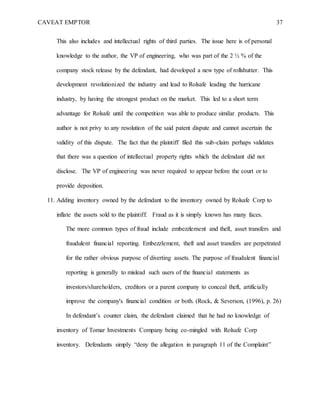
This also includes and intellectual rights of third parties. The issue here is of personal
knowledge to the author, the VP of engineering, who was part of the 2 ½ % of the
company stock release by the defendant, had developed a new type of rollshutter. This
development revolutionized the industry and lead to Rolsafe leading the hurricane
industry, by having the strongest product on the market. This led to a short term
advantage for Rolsafe until the competition was able to produce similar products. This
author is not privy to any resolution of the said patent dispute and cannot ascertain the
validity of this dispute. The fact that the plaintiff filed this sub-claim perhaps validates
that there was a question of intellectual property rights which the defendant did not
disclose. The VP of engineering was never required to appear before the court or to
provide deposition.
11. Adding inventory owned by the defendant to the inventory owned by Rolsafe Corp to
inflate the assets sold to the plaintiff. Fraud as it is simply known has many faces.
The more common types of fraud include embezzlement and theft, asset transfers and
fraudulent financial reporting. Embezzlement, theft and asset transfers are perpetrated
for the rather obvious purpose of diverting assets. The purpose of fraudulent financial
reporting is generally to mislead such users of the financial statements as
investors/shareholders, creditors or a parent company to conceal theft, artificially
improve the company's financial condition or both. (Rock, & Severson, (1996), p. 26)
In defendant’s counter claim, the defendant claimed that he had no knowledge of
inventory of Tomar Investments Company being co-mingled with Rolsafe Corp
inventory. Defendants simply “deny the allegation in paragraph 11 of the Complaint”
CAVEAT EMPTOR 38
(U.S. District Court, (2005), doc. 4). In virtually all of the plaintiff’s claims this is the
response given by the defendant.
12. Hidden loans and fraudulent financial misrepresentation by Rolsafe Corp. “Accounting
failures are failures of individuals to fulfill their responsibility, to behave ethically”
(Staubus, (2005), p. 6). Under the duress of an overzealous CEO or a few corporate
managers in recent years a number of highly publicized scandals of corporate fraud have
been widely spread in the publicized world. Staubus (2005) states that “corporate
personnel have primary responsibility for financial reporting-more direct that
auditors…they are the main perpetrators” (p. 7) of ethical failures. “At the end of the
day, the CEO is the captain of the ship with the authority to determine financial reporting
and with responsibility for it” (Staubus, (2005), p. 7). When there is no one to be
accountable to and no independent control mechanisms, the cost of getting caught in
financial fraud is minimal. Therefore it seems that a risk analysis was performed by the
CEO and the financial reporting was made to appear as it needed to meet the
circumstance (cooking the books).
13. Delaying incentive and final payment to sales and installers until the new company takes
control of the organization, without the knowledge of the plaintiff, caused an unforeseen
burden on the plaintiff. This is the result of an “asymmetric information problem…when
the selling firm’s information is superior to the information of the buying firm” (Datar,
Frankel, & Wolfson, (2001), p. 201). According to the authors this is also an agency
cost, as the acquired company has to bear the burden of previous ownership thus reducing
the perceived value of the acquisition. The financial burden to be paid was also not
CAVEAT EMPTOR 39
allocated in the financial statements provided to the plaintiff. (U.S. District Court,
(2005), doc. 11)
The second claim-indemnification
Included in the second claim was the premise of the first claim, that all the sub-claims in
the first claim are incorporated into the second claim. In Sec. 8 of the Asset Purchase Agreement
the defendants are required to hold the “plaintiff harmless” against any and all claims, liabilities,
obligations, etc. (Arnold, 2005, p. 9) The purpose of indemnification is to protect the plaintiff
against any actions that were performed under the previous owner, in this case the defendants.
Due to the many warranties and representations agreed to by the defendant the plaintiff is
entitled to indemnification. The amount requested under the indemnification claim exceeds
$8,000,000. (Arnold, (2005), p. 10) The reason for the request was that Rolsafe International
LLC covered all the costs associated with the damages in order to maintain the common good of
the corporate name.
It is interesting to note that previous laws or statutes have set the precedent for what the
laws are now. In an article in the Harvard Law Review from 1928 Arthur Corbin declares that
the statute of frauds has been in existence for over 250 years. Indemnify is part of the statute of
frauds as Dr. Corbin declares the “the word indemnify is…used in exactly the sense of
“guarantee” or “be surety for”. (p.694) The “Statute of Frauds was drawn for the protection of
persons in the position of the plaintiff, rather than those in the position of the defendant. (p. 701)
In this instance the seller under the Statute of Frauds, has indemnified Rolsafe Corp as the
guarantor for all losses due to the defendants’ misconduct, including all attorneys’ fees and
expenses.
The third and fourth claim-fraud/intentional and negligent misrepresentation
CAVEAT EMPTOR 40
Fraudulent and intentional, negligent warranties and misrepresentations, material
misrepresentations, negligent misrepresentation, all made knowingly by the defendant were
easily proved by the preponderance of evidence. In order to prove or to succeed on a claim of
fraud, plaintiff must prove the following:
1. A misrepresentation of material fact;
2. Made with knowledge of its falsity;
3. For the purpose of inducing another person to rely on it;
4. That the person relied on the misrepresentation to his detriment; and
5. That this reliance caused damages. (U.S. District Court, doc. 133, (2007). p. 10).
This proof was backed up with a statement by the plaintiff’s lawyer:
The evidence will show that Rolsafe Corp. was failing financially and operationally, and
had already been rejected by another prospective purchaser. Corp. had defaulted on loan
obligations in the past, the company had declining sales for years, and Kafka had to pay
personally to keep the Company afloat. He did not want to go through another
unprofitable year. (U.S. District Court, doc. 133, (2007). p. 10)
(This statement will prove useful later in the chapter)
Finally — and perhaps most importantly — the defendants’ anticipated defense that LLC
should have performed more due diligence to learn the truth is simply irrelevant to
breach of representation and warranty claims. As stated in Spherion, infra, one cannot
escape responsibility for breaching representations and warranties by claiming that the
non-breaching party could have, or should have, discovered the truth. To do so would
render representations and warranties meaningless. (U.S. District Court, doc. 133,
(2007). ps. 15-16)
CAVEAT EMPTOR 41
Claims five, six and seven
These claims are for;
#5 A declaratory judgment for negligent misrepresentation,
#6 A declaratory judgment for the promissory note of $500,000 (which was to be
paid out in 60 installments over a five year period) for the defendant as agreed in the
Asset Purchase Agreement,
#7 A declaratory judgment based on the operating agreement where a 19.5% interest
in Rolsafe International LLC was to be assigned the defendant when all capital and assets
were assured and paid by the defendant. (Arnold, (2005), ps. 15-17)
A declaratory judgment
What is a declaratory judgment? In order for the case study to have merit it was
determined by the author that the case documents must have legal standing and the reader
must have an awareness of part of the Judicial Code that applies to business lawsuits.
The President of the United States, Franklin D. Roosevelt, signed the Federal Declaratory
Judgment act in 1934, amendment #274D to the Judicial Code for the Federal Courts. It
reads as follows:
In case of actual controversy the courts of the United States shall have power
upon petition, declaration, complaint, or other appropriate pleadings to declare
rights and other legal relations of any interested party petitioning for such
declaration, whether or not further relief is or could be prayed, and such
declaration shall have the force and effect of a final judgment or decree and be
reviewable as such. (Borchard, (1934). p. 35)
CAVEAT EMPTOR 42
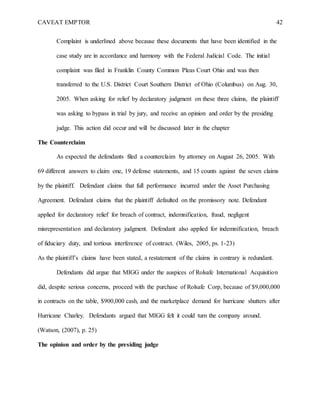
Complaint is underlined above because these documents that have been identified in the
case study are in accordance and harmony with the Federal Judicial Code. The initial
complaint was filed in Franklin County Common Pleas Court Ohio and was then
transferred to the U.S. District Court Southern District of Ohio (Columbus) on Aug. 30,
2005. When asking for relief by declaratory judgment on these three claims, the plaintiff
was asking to bypass in trial by jury, and receive an opinion and order by the presiding
judge. This action did occur and will be discussed later in the chapter
The Counterclaim
As expected the defendants filed a counterclaim by attorney on August 26, 2005. With
69 different answers to claim one, 19 defense statements, and 15 counts against the seven claims
by the plaintiff. Defendant claims that full performance incurred under the Asset Purchasing
Agreement. Defendant claims that the plaintiff defaulted on the promissory note. Defendant
applied for declaratory relief for breach of contract, indemnification, fraud, negligent
misrepresentation and declaratory judgment. Defendant also applied for indemnification, breach
of fiduciary duty, and tortious interference of contract. (Wiles, 2005, ps. 1-23)
As the plaintiff’s claims have been stated, a restatement of the claims in contrary is redundant.
Defendants did argue that MIGG under the auspices of Rolsafe International Acquisition
did, despite serious concerns, proceed with the purchase of Rolsafe Corp, because of $9,000,000
in contracts on the table, $900,000 cash, and the marketplace demand for hurricane shutters after
Hurricane Charley. Defendants argued that MIGG felt it could turn the company around.
(Watson, (2007), p. 25)
The opinion and order by the presiding judge
CAVEAT EMPTOR 43
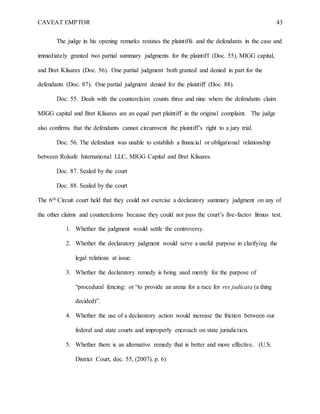
The judge in his opening remarks restates the plaintiffs and the defendants in the case and
immediately granted two partial summary judgments for the plaintiff (Doc. 55), MIGG capital,
and Bret Klisares (Doc. 56). One partial judgment both granted and denied in part for the
defendants (Doc. 87). One partial judgment denied for the plaintiff (Doc. 88).
Doc. 55. Deals with the counterclaim counts three and nine where the defendants claim
MIGG capital and Bret Klisares are an equal part plaintiff in the original complaint. The judge
also confirms that the defendants cannot circumvent the plaintiff’s right to a jury trial.
Doc. 56. The defendant was unable to establish a financial or obligational relationship
between Rolsafe International LLC, MIGG Capital and Bret Klisares.
Doc. 87. Sealed by the court
Doc. 88. Sealed by the court
The 6th Circuit court held that they could not exercise a declaratory summary judgment on any of
the other claims and counterclaims because they could not pass the court’s five-factor litmus test.
1. Whether the judgment would settle the controversy.
2. Whether the declaratory judgment would serve a useful purpose in clarifying the
legal relations at issue.
3. Whether the declaratory remedy is being used merely for the purpose of
“procedural fencing: or “to provide an arena for a race for res judicata (a thing
decided)”.
4. Whether the use of a declaratory action would increase the friction between our
federal and state courts and improperly encroach on state jurisdiction.
5. Whether there is an alternative remedy that is better and more effective. (U.S.
District Court, doc. 55, (2007). p. 6)
CAVEAT EMPTOR 44
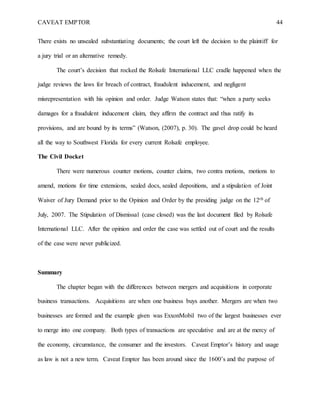
There exists no unsealed substantiating documents; the court left the decision to the plaintiff for
a jury trial or an alternative remedy.
The court’s decision that rocked the Rolsafe International LLC cradle happened when the
judge reviews the laws for breach of contract, fraudulent inducement, and negligent
misrepresentation with his opinion and order. Judge Watson states that: “when a party seeks
damages for a fraudulent inducement claim, they affirm the contract and thus ratify its
provisions, and are bound by its terms” (Watson, (2007), p. 30). The gavel drop could be heard
all the way to Southwest Florida for every current Rolsafe employee.
The Civil Docket
There were numerous counter motions, counter claims, two contra motions, motions to
amend, motions for time extensions, sealed docs, sealed depositions, and a stipulation of Joint
Waiver of Jury Demand prior to the Opinion and Order by the presiding judge on the 12th of
July, 2007. The Stipulation of Dismissal (case closed) was the last document filed by Rolsafe
International LLC. After the opinion and order the case was settled out of court and the results
of the case were never publicized.
Summary
The chapter began with the differences between mergers and acquisitions in corporate
business transactions. Acquisitions are when one business buys another. Mergers are when two
businesses are formed and the example given was ExxonMobil two of the largest businesses ever
to merge into one company. Both types of transactions are speculative and are at the mercy of
the economy, circumstance, the consumer and the investors. Caveat Emptor’s history and usage
as law is not a new term. Caveat Emptor has been around since the 1600’s and the purpose of
CAVEAT EMPTOR 45
the law is to ensure that the purchaser attend to his purchase with contract and ascertains the
quality of goods bought prior to purchase. This is commonly known today as doing your due
diligence and can mean the success or failure in mergers and acquisitions. The case study
between plaintiffs and defendants, the history behind the original complaints and the results
which ended in favor of the defendants bring an end to the chapter.
Conclusion
The primary purpose of this study was to define and determine whether cultural, ethical
or moral values are undermined when small business acquisitions fail to meet the buyer’s
expectations. Caveat Emptor: when unethical behavior, lack of moral goodness and
unprofessional business actions lead to the harm of others, then the answer is unequivocally yes,
business endeavors have been undermined. When this occurs all the stated values of society
become violated and society suffers, as it does not benefit from what philosophers have called
the highest quality conduct of our lives. “Buyer beware” is a mask for the immoral to hide
behind as the laws are not stringent enough to curtail the acts of the unethical. Countless are the
deeds of the unprincipled in just this singular case study. The nefarious conduct of the defendant
has caused irreparable harm to more than just the defendant. The woman who ran the lathe, the
man who drilled the holes, the assembly people who put the products together, the salesman, the
secretaries; more than 130 people lost their jobs, their retirement, their security and their peace of
mind. The damages are beyond this seemingly small scale of affected individuals, they rebound
in the community over and over again as lives, homes and businesses have been permanently
changed.
This paper is also an attempt to understand the ethics that managers need and the ethics of
responsibility in small business acquisition. When morals and ethics are readily defined and
CAVEAT EMPTOR 46
understood by society then managers need to act in accordance with those standards. By their
actions managers set the tone for benefiting themselves and their fellow men. The development
of a business code of ethics becomes imperative in the day to day operations of all business.
This provides a constant guidance for managers which appear lacking in today’s business place.
Truly, like Drucker supposed, the business actions of managers should be a reflection of their
own ethics and morals. In a society high on the pursuit of personal wealth and opulence, is this
possible? Sadly the constraints of self-preservation often outweigh the necessity of “do no harm
to others.” Ethics and morals are pushed off the high road for personal and societal attainment.
Doing the best you can for yourself often overcomes the overwhelming societal requirement of
doing what is best for others.
Socrates stated that he wanted to “inquire into life and morals and things evil and good”
(Rosen, 2009, p. 5). 2400 years later Drucker believed that humanity should continue in this
path of inquiry and educate the populace in moral values, for the betterment of every individual
and every family. (Drucker, 2001, p. 63) The educated pursuit of ethically justifiable behavior
according to Hosmer (1995) “consists of morally correct decisions”. (p.399) If, as a society we
are not teaching ethics and morals in our educational systems, who then will? My inquiry into
ethics, morals, and behavior that is commensurate with what is best for society is self-driven.
My education at Hodges has increased my desire to teach others how to be a professional
business people and more importantly how to be better human beings. It is only at this endeavor
that I can see self-fulfillment for myself and assist others to reach for higher plateaus as well.
Acceptable actions and behaviors that may not serve the best interest of all involved have been
allowed to burrow deep into the foundations of society. It is my conclusion that the only way to
elevate ethical behavior is through education.
CAVEAT EMPTOR 47
In writing this paper my views of ethics and morals in our culture today have been
enhanced and enlightened. There has been a significant change in my life that has occurred due
to my personal attempt to educate myself at the request of my teachers. I have a better
understanding of why we are encouraged to write and rewrite about personal and business topics
and the experience that we have gained from them.
Finally, the reality of responsible business seems to be eschewing business for profit.
There is absolutely nothing wrong with being in business for profit. Defining the reasoning for
choosing profit for profit’s sake is a prevalent topic of discussion over the centuries amongst
experts. Egregiously earned profit is a violation of professional ethics when one deliberately, and
knowingly, does harm in any business endeavor.
CAVEAT EMPTOR 48
References
Abor, J., & Charles K.D. Adjasi. (2007). Corporate governance and the small and medium
enterprises sector: Theory and implications. Corporate Governance, 7(2), 111.
doi:http://dx.doi.org/10.1108/14720700710739769.
Andrade, G., Mitchell, M., & Stafford, E. (2001). New evidence and perspectives on mergers.
The Journal of Economic Perspectives, 15(2), 103-120. Retrieved from
http://search.proquest.com/docview/212106518?accountid=40795
Arnold, James E. (23 July, 2007). Plaintiff’s trial brief, U.S. District Court, (Aug. 6, 2007), doc.
1) Case # 2:05-cv-00802-MHW-MRA Rolsafe International LLC v. Kafka, Retrieved
from https://ecf.ohsd.uscourts.gov/cgi-bin/DktRpt.pl?103654
Arnold, James E. (29 July, 2005). Complaint filed by Rolsafe International LLC., U.S. District
Court, (Aug. 6, 2007), doc. 1) Case # 2:05-cv-00802-MHW-MRA Rolsafe International
LLC v. Kafka, Retrieved from https://ecf.ohsd.uscourts.gov/cgi-bin/DktRpt.pl?103654
Arnold, James E. (29 July, 2005). Complaint in the Franklin County Court of Common Pleas,
Rolsafe International LLC, Plaintiff, v. Joseph A. Kafka and Rolsafe International Corp, ,
pgs. 1-18. Retrieved from https://ecf.ohsd.uscourts.gov/doc1/1431830481
Bloomberg: Business Week. (25 July, 2014). Company overview of MIGG Capital, LLC,
Executive Profile & Biography, Peter A. Klisares, Principal. Retrieved from
http://investing.businessweek.com/research/stocks/private/person.asp?personId=658400
&privcapId=2331534&previousCapId=36353&previousTitle=VistaCare%20Inc.
Bloomberg: Business Week. (25 July, 2014). Company overview of MIGG Capital, LLC,
Company Snapshot, Bret B. Klisares, Key Executives for MIGG Capital, LLC. Retrieved
from
CAVEAT EMPTOR 49
http://investing.businessweek.com/research/stocks/private/snapshot.asp?privcapId=23315
34
Borchard, Edwin. (1 Jan., 1934). Federal Declaratory Judgments Act, Yale Law School. Faculty
Scholarship series. Paper 3443. Retrieved from
http://digitalcommons.law.yale.edu/cgi/viewcontent.cgi?article=4443&context=fss_paper
s&sei-
redir=1&referer=http%3A%2F%2Fscholar.google.com%2Fscholar%3Fstart%3D0%26q
%3DWhat%2Bis%2Ba%2Bdeclaratory%2Bjudgment%253F%26hl%3Den%26as_sdt%3
D0%2C10#search=%22What%20declaratory%20judgment%3F%22
Bragues, G. (2006). Seek the good life, not money: The Aristotelian approach to business ethics.
Journal of Business Ethics, 67(4), 341-357. doi:http://dx.doi.org/10.1007/s10551-006-
9026-4
Clark, W. V. T. (2014, July 2). Walter Van Tilburg Clark Quotes. Goodreads. Retrieved from:
http://www.goodreads.com/quotes/491343-true-law-the-code-of-justice-the-essence-of-
our
Corbin, Arthur. (1 Jan., 1928). Contracts of Indemnity and the Statute of Frauds, Yale Law
School. Yale Law School Legal Scholarship Repository. Vol. XLI, #6, ps. 689-708.
Retrieved from
http://digitalcommons.law.yale.edu/cgi/viewcontent.cgi?article=3863&context=fss_paper
s&sei-
redir=1&referer=http%3A%2F%2Fscholar.google.com%2Fscholar%3Fstart%3D60%26q
%3Dwhat%2Bis%2BIndemnity%253F%26hl%3Den%26as_sdt%3D0%2C10#search=%
22what%20Indemnity%3F%22
CAVEAT EMPTOR 50
Datar, S., Frankel, R., & Wolfson, M. (2001). Earnouts: The effects of adverse selection and
agency costs on acquisition techniques. Journal of Law, Economics, and Organization,
17(1), 201-238.
De George, R. T. (2006). The history of business ethics. In M. J. Epstein and K. O. Hanson
(Eds.) The accountable corporation. London, UK: Praeger Westpoint), pp. 47–58.
Drucker, P. F. (1984). The practice of management. New York, NY: Harper and Row.
Drucker, P. F. (1985). Management; tasks, responsibilities, practices. New York. NY: Harper
Business.
Drucker, P. F. (2001). The essential Drucker: Selections from the management works of Peter F.
Drucker. New York, NY: Harper Business.
Florida Department of Business and Professional Regulation. (30 July, 2014). Licensee search,
search license by name, search results, Rolsafe, Retrieved from
https://www.myfloridalicense.com/LicenseDetail.asp?SID=&id=B76B6381E1EE42BDA
FBDE1A0C95516B5
Florida Department of Business and Professional Regulation. (30 July, 2014). Licensee search,
search license by name, search results, Rolsafe International Corp. Retrieved from
https://www.myfloridalicense.com/LicenseDetail.asp?SID=&id=88E6640D7536B6942C
C8F2B31A6DA85C
Florida Department of Business and Professional Regulation. (30 July, 2014). Licensee search,
search license by name, search results, Rolsafe International LLC. Retrieved from
https://www.myfloridalicense.com/LicenseDetail.asp?SID=&id=CEEC8692F0982F1875
3D8F19C0FC7F31
CAVEAT EMPTOR 51
Fontrodona, J., & Sison, A. G. (2006). The nature of the firm, agency theory and shareholder
theory: a critique from philosophical anthropology. Journal of Business Ethics, 66(1), 33-
42. doi:10.1007/s10551-006-9052-2
Funding Universe. (2014, June 24). McDonnell Douglas Corporation history, Retrieved from
http://www.fundinguniverse.com/company-histories/mcdonnell-douglas-corporation-
history/
Gott, Sharane. (24 April, 2013). BBB offers tips on when and how to file a complaint, consumer
news and opinion blog, BBB. Retrieved from http://www.bbb.org/blog/2013/04/bbb-
offers-tips-on-when-and-how-to-file-a-complaint/
Hamilton, W. (1931). The ancient maxim caveat emptor. The Yale Law Journal. 40(8), pp. 1133-
1187. Retrieved from
http://digitalcommons.law.yale.edu/cgi/viewcontent.cgi?article=5674&context=fss_paper
s&sei-
redir=1&referer=http%3A%2F%2Fscholar.google.com%2Fscholar%3Fhl%3Den%26q%
3DCaveat%2BEmptor%2Bdefined%26btnG%3D%26as_sdt%3D1%252C10%26as_sdtp
%3D#search=%22Caveat%20Emptor%20defined%22
Hosmer, L. (1995). Trust: the connecting link between organizational theory and philosophical
ethics. Academy of Management Review, 20(2), 379-403.
doi:10.5465/AMR.1995.9507312923
Klein, S. S. (2000). Drucker as Business Moralist. Journal of Business Ethics, 28(2), 121-128.
Knox, D.K. (1998). Socrates: The first professor. Innovative Higher Education, 23(2), 115-126.
L'Etang, J. (1992). A Kantian approach to codes of ethics. Journal of Business Ethics, 11(10),
737. Retrieved from http://search.proquest.com/docview/198087937?accountid=40795
CAVEAT EMPTOR 52
McClure, Ben. (2014). Mergers and acquisitions: definition. Investopedia. Retrieved from
http://www.investopedia.com/university/mergers/mergers1.asp
Murphy, P. E. (1988). Implementing business ethics. Journal of Business Ethics, 7(12), 907-915
Retrieved Business Source Complete database.
Ostapski, S., & Isaacs, C. N. (1992). Corporate moral responsibility and the moral audit:
challenges for refuse relief inc. Journal of Business Ethics, 11(3), 231-239. Retrieved
Business Source Complete database.
Paine, F. T., & Power, D. J. (1984). Merger strategy: an examination of Drucker's five rules for
successful acquisitions. Strategic Management Journal, 5(2), 99-110. Retrieved from
https://web.a.ebscohost.com/ehost/detail?vid=3&sid=b813b6a0-14ba-40bd-9dcf-
c5993fc4e172%40sessionmgr4001&hid=4201&bdata=JnNpdGU9ZWhvc3QtbGl2ZQ%3
d%3d#db=bth&AN=12496769
Palmer, B. (2002). Primum non nocere. European Eating Disorders Review, 10(3), 230-231.
doi:10.1002/erv.471
Petrovic-Lazarevic, S. (2010). Good corporate citizenship in the Australian construction
industry. Corporate Governance, 10(2), 115-128.
doi:http://dx.doi.org/10.1108/14720701011035648
Raiborn, C. A., & Payne, D. (1990). Corporate codes of conduct: a collective conscience and
continuum. Journal of Business Ethics, 9(11), 879-889. Retrieved from Business Source
Complete database.
Ramdani, D., & Witteloostuijn, A. (2012). The shareholder-manager relationship and its impact
on the likelihood of firm bribery. Journal of Business Ethics, 108(4), 495-507.
doi:10.1007/s10551-011-1105-5. Retrieved Business Source Complete database.
CAVEAT EMPTOR 53
Retrieved from https://ecf.ohsd.uscourts.gov/cgi-bin/DktRpt.pl?109454040377068-L10-1
Rock, R. J., & Severson, J. V. (1996). Demystifying corporate fraud. Business Credit, 98(7), 26.
Retrieved from http://search.proquest.com/docview/230158263?accountid=40795
Rodriguez-Dominguez, L., Gallego-Alvarez, I., & Garcia-Sanchez, I. (2009). Corporate
governance and codes of ethics. Journal of Business Ethics, 90(2), 187-202.
doi:10.1007/s10551-009-0035-y. Retrieved Business Source Complete database.
Rosen, S. (Ed.). (2009). The philosopher's handbook: Essential readings from Plato to Kant. New
York, NY: Random House LLC.
Schwartz, M. S. (2002). A code of ethics for corporate code of ethics. Journal of Business Ethics,
41(1/2), 27-43. Retrieved from Business Source Complete database.
Schwartz, M. S. (2005). Universal moral values for corporate codes of ethics. Journal of
Business Ethics, 59(1/2), 27-44. doi:10.1007/s10551-005-3403-2 Retrieved from
Business Source Complete database.
Sison, A. G. (2007). Toward a common good theory of the firm: The Tasubinsa Case. Journal of
Business Ethics, 74(4), 471-480. doi:10.1007/s10551-007-9525-y. Retrieved Business
Source Complete database.
Stanwick, P. A., & Stanwick, S. D., (2009), Understanding Business Ethics. Upper Saddle River,
NJ: Pearson Education, Inc.
Staubus, G. J. (2005). Ethics failures in corporate financial reporting. Journal of Business Ethics,
57(1), 5-15. doi:10.1007/s10551-004-3811-8. Retrieved Business Source Complete
database.
CAVEAT EMPTOR 54
Stead, W., Worrell, D. L., & Stead, J., (1990). An integrative model for understanding and
managing ethical behavior in business organizations. Journal of Business Ethics, 9(3),
233-242. Retrieved from Business Source Complete database.
Thomson, J. A. K. (Trans.). (2004). Aristotle: The Nicomachean Ethics. London, England.
Penguin Books Ltd.
U.S. District Court Southern District of Ohio (Columbus). (Aug. 6, 2007). Civil docket for case
#: 2:05-cv-00802-MHW-MRA, Rolsafe International LLC v. Kafka, assigned to: Judge
Michael H. Watson, referred to: Magistrate Judge Mark R. Abel, Case in other court:
Franklin County Common Pleas, 05CVH 07 7807 Cause: 28:1441 Petition for removal--
other contract
U.S. District Court. (Aug. 6, 2007). docs. 1-134) Case # 2:05-cv-00802-MHW-MRA Rolsafe
International LLC v. Kafka, Retrieved from https://ecf.ohsd.uscourts.gov/cgi-
bin/DktRpt.pl?103654
Uddin, N., & Gillett, P. R. (2002). The effects of moral reasoning and self-monitoring on CFO
intentions to report fraudulently on financial statements. Journal of Business Ethics,
40(1), 15-32. Retrieved Business Source Complete database.
United States: U.S. Department of Labor. (2014, June 9). Laws and regulations: Summary of the
major laws of the Department of Labor. U.S. Department of Labor. Retrieved from
http://www.dol.gov/oasam/programs/crc/NoFearResult.htm
Vélez García, A., & Ostrosky‐Solís, F. (2006). From morality to moral emotions. International
Journal of Psychology, 41(5), 348-354. doi:10.1080/00207590500345898
Vermeulen, F., & Barkema, H. (2001). Learning through acquisitions. Academy Of Management
Journal, 44(3), 457-476. doi:10.2307/3069364
CAVEAT EMPTOR 55
Wiles, James M. (26 Aug, 2005). Counterclaim filed by Rolsafe Corp and Mr. Joseph A, Kafka,
U.S. District Court, (Aug. 6, 2007), doc. 4, ps. 1-23 Case # 2:05-cv-00802-MHW-MRA
Rolsafe International LLC v. Kafka, Retrieved from https://ecf.ohsd.uscourts.gov/cgi-
bin/DktRpt.pl?103654

Caveat Emptor Chapters Revision 7-22

  • 1.
    Running head: CAVEATEMPTOR 1 Caveat Emptor vs. Primum NonNocere Bruce D. Parker Hodges University
  • 2.
    CAVEAT EMPTOR 2 Buyerbeware vs. not knowingly to do harm The primary purpose of this study is to define and determine if cultural, ethical or moral values abate when small business acquisitions fail to meet the buyer’s expectations. The secondary purpose of this study it to gain a greater understanding of ethics and morals in western business and culture today. This paper is an attempt to understand the ethics that managers need and the ethics of responsibility in the small business acquisition. In small business acquisitions, a case study will be used regarding the author’s personal experience. It is one of many similar cases where buyer’s expectations may be misled, regarding the condition of the acquisition, which then causes the buyer to receive unanticipated financial and organizational distress.
  • 3.
    CAVEAT EMPTOR 3 CaveatEmptor vs. Primum NonNocere: Buyer Beware vs. Not Knowingly To Do Harm The ethics that managers need and “ethics of responsibility” in small business acquisition Introduction Moving further into the 21st Century the need for ethical and moral responsibility is ever- increasing. How individuals foster personal morals, and ethics has been a topic of much debate for philosophers, educators, and scholars alike. The focus of this chapter is to define ethics and morals in a personal view. To illustrate this author’s belief that there should be no difference between business ethics and business morals, as defined by scholars in the business field. In his book “The Essential Drucker”, Peter Drucker examined the “ethics of responsibility” in the world of business (Drucker, 2001, p. 63). In brief, business people should not lie, cheat, steal, or do any unethical or immoral act that would cause harm to any stakeholder. This premise of what actions a business should not do should begin with a statement of what businesses should do. Developing standards in business is a direct reflection on a corporate CEO’s or president’s personal beliefs and conduct.
  • 4.
    CAVEAT EMPTOR 4 ChapterOne Ethics in infancy Marcus Tullius Cicero stated that it was Socrates who “summoned philosophy down from the heavens...to inquire into life and morals and things evil and good” (Rosen, 2009, p. 5). Socrates was a master of rhetoric and used his skills adroitly as he ably defended his positions on good and evil, right and wrong, morality and immorality, and the very nature of life itself. Socrates’ positions and abilities led David Knox to title Socrates “The First Professor” (Knox, 1998, p. 115). As Knox points out, he was the founder of the Socratic Method, a method of intellectual and moral discovery through the depth of dialog between teacher and student. Socrates was more than just a teacher, as Xenophon points out: “Socrates was interested in forming the entire person” (p. 118). Socrates’ mission was “to form a virtuous whole that would be a benefit and ornament to society” (p. 118). His successors like Aristotle used similar methods to draw the student of humanity into the world around them. Aristotle states that: “every art and every investigation, and similarly every action and pursuit is considered to aim at some good” (Thomson, 2004, p. 1). He further states that “knowledge of the good is of great importance to us for the conduct of our lives” (p. 2). He then suppositions that the highest of all practical goods is happiness according to Aristotle (p. 7). He defined happiness as “something perfect and self-sufficient being the end to which our actions are directed,” a practical good (p. 15). If one is to believe this philosophy, the subsequent actions then according to Aristotle, should be based on the pursuit of happiness, the practical good. As a side note, in developing business ethics, Brague takes the position that “Aristotle offers a business ethic intent on advancing the attainment of personal happiness…Defining
  • 5.
    CAVEAT EMPTOR 5 happinessin universalistic terms, Aristotle insists upon the priority of exercising the virtues, of habitually acting in ways that fulfill the highest human potentialities” (Brague, 2006, p. 342). Aristotle states: “moral goodness, on the other hand, is the result of habit, from which it has actually got its name, being a light modification of the work ethos” (Thomson, 2004, p. 31). Ethics and morality are intertwined. Stanley Rosen in “The Philosopher’s Handbook” had his introduction written by Paul Rahe. Rahe states that “Aristotle contends that there is also such a thing as moral virtue” (Rosen, 2009, p. 13). Are morality and ethics are the same? So far as this author can discern, there are numerous differences between the two as promulgated by various authors. For instance, psychologists have been studying morality for centuries. “Morals can be defined as concepts, reasoning, and actions related to well-being, rights, and the fair treatment of other people” (Vélez García & Ostrosky‐Solís, 2006, p. 349). This definition seems to be a reasonable statement and is in line with the authors above regarding goodness, human potential, and the conduct of individual lives. Immanuel Kant, an 18th-century German philosopher, takes a very strong stand on morals with his statement that: Morality demands that we act on the sort of policies which, if adopted by everyone, would generate a community of free and equal members, each of whom would, in the process of realizing his own purposes, also further the aims of his fellows. (L'Etang, 1992, p. 742) This statement by Kant becomes part of the entwining in the moral and ethical dilemma. Are morals and ethics the same? Morals do become the basis for ethics, and ethical conduct and ethics are a standard duty or a code of action to the community as implied by almost all the
  • 6.
    CAVEAT EMPTOR 6 philosophers.L’Etang takes the position that: “the moral significance of codes of ethics is contained in their existence, and they have the potential to yield the process of ethical decision- taking” (p. 743). Due to the abundance of definitions of morals and ethics by numerous authors, countless references have been melded together to try and perfect an acceptable definition of ethics and morals. Individual and group conduct has been analyzed and dissected to the point where many authors agree, with a reasonable expectation of general acceptance by philosophers, educators, and psychologists, on a relative test statement. Hosmer wrote: Ethically justifiable behavior, to repeat the argument for emphasis, consists of morally correct decisions and actions in which the interests of the society take the degree of precedence that is "right," that is "just," and that is "fair" over the interests of the individual. (Hosmer, 1995, p. 399) Codes of ethics from society to business SocietThis is an area that seems to present an easy transition, and over the last half century more and more social ideas have become business practices. “The Department of Labor (DOL) administers and enforces more than 180 federal laws” (United States Department of Labor, 2014, para. 1). Some of the laws enacted with social ideas as a base train of thought, include:  The Equal Pay (not equated to color, sex, or nationality) Act.  Various societal employment acts such as: o Child labor laws o Equal opportunity laws and acts, where employment exhibits no regard to race, age, religion or national origin.
  • 7.
    CAVEAT EMPTOR 7 Thelist has become quite large since the mid-1960’s, including the Taft-Hartley Act that handles regulating employee-employer relations. The Taft-Hartley Act may be the most extensive and important act regarding business to employee relations! (United States Department of Labor, 2014, para. 3) Not only has the business community been forced to accept social ideas; businesses bear scrutiny by the community or governmental bodies in which they operate in the western world. Ethical codes of conduct had to be implemented by a majority of companies to withstand the outside pressure of governmental and societal standards and laws. Unfortunately, not all ethical codes of conduct are the same, but many of them have criteria based on societal needs. Phillip V. Lewis states there are two points that known for certain about the content of any code of ethics: (1) One's business ethics cannot be separated from his or her personal ethics (or all other ethics); (2) The business will never be any more ethical than the people who are in business. (Lewis, P., 1995, p. 377) These are two remarkably candid points, and they are the crux of success or failure in any ethical business situation. They form a formidable barrier that ensures that the connection between business and personal ethics cannot have separation without serious consequences. In a similar, but different light, the comparison between personal and business ethics was put forth by Stanwick and Stanwick in their textbook “Understanding Business Ethics.” The authors defined ethics “as the value an individual uses to interpret whether any particular action is considered acceptable and appropriate” (Stanwick & Stanwick, 2009, p. 2). The authors also use a similar variant when they defined business ethics. Business ethics consists of “the collective values of a business organization that can be used to evaluate whether the behavior of
  • 8.
    CAVEAT EMPTOR 8 thecollective members of the organization is considered acceptable and appropriate” (p. 3). It is apparent that business ethics needs an avenue of connection to personal ethics. Ethics of Responsibility Mr. Drucker is very succinct when he states that “one main topic is plain, everyday honesty” (Drucker, 2001, p. 63). There have been liars, cheaters, and thieves throughout all periods of time; these miscreants exists in and resonate within every aspect of society. Drucker believes that “the problem is one of moral values and moral education, of the individual, of the family, and of the school” (p.64). Drucker also believes that to fix the problem is with a penalty, commensurate to the broken moral or ethical act that would cause serious reflection upon any individual of moral fortitude. The removal of inducement to commit an immoral or unethical act by a suitable known and stout punishment, Drucker believes, is substantial enough to slow the onslaught of unethical business activity (p.64). Management is at the forefront when it comes to responsibility for immoral and unethical acts committed by employees, management, or business owners. Being at the forefront is often construed as being the leader or part of the leadership team. However, it is only natural that many managers are not natural born leaders, according to Drucker. In many cases, being a manager is simply a position of responsibility and puts a manager in the “membership of the leadership group” (p.65). Therefore, being a “member of the leadership group, a manager stands under the demands of professional ethics-the demands of an ethic of responsibility” (p. 65). The reason Drucker has emerged as the median standard of business ethics is addressed by Klein. Klein states: “after all, an argument can be made for the opinion that Drucker not only invented modern business management, but that he embodies, more than any other business management theorist, Aristotelian practical wisdom” (Klein, 2000, p. 121).
  • 9.
    CAVEAT EMPTOR 9 PrimumNonNocere According to Drucker, Primum NonNocere is the first part of the Hippocratic Oath. The translation that most non-physicians are familiar with is “above all, not knowingly to do harm” (Drucker, 2001, p. 65). Drucker further explains that Primum NonNocere should be the “basic rule of professional ethics, the basic rule of an ethics of public responsibility” (p.66). However, this is not the course of business today; golden parachutes, excess compensation in all forms, and the need for profit have all disillusioned the general public away from trusting almost any business. Whether any business is doing what is best for the public is now questioned. All of these items have stunted the trust that the western world has in the way businesses are operated. The public requires a greater education as to why certain business methods are needed prior to the nefarious deed (see examples given) going public for the first time and causing tremendous business trust repercussions. Does the public understand why it is so important for a company to make a sizeable profit? In that fact, why should Wal-Mart, Apple, Wells Fargo, Warren Buffet, or any businessman or enterprise make more than anyone in the world? “How much money is too much?” is a question this author’s father often posed when he played his lottery tickets? The dream of being so rich he could not spend all of his money in a lifetime was more than he wanted. Why businesses wanted to make so much money was something he did not quite understand. What he did understand was greed, and that human beings run the businesses of this world. It is not the fault of the businesses for making more than they needed; it is the people who ran them that had taken greed to a new level.
  • 10.
    CAVEAT EMPTOR 10 Arecent perspective published in an epilog in a not well-known magazine, European Eating Disorders Review is as follows: Of course, old Hippocrates had a point. Not doing harm is important. It was in his time when most treatments were ineffective. It still is now that powerfully effective treatments often are available. But perhaps the ‘primum’ bit needs to be thought about. Now the balance between risk of harm and chance of benefit is where it is at. (Palmer, 2002, p. 230) Summary What constitutes ethics? Are they principles of application or simplistic statements of being? Do morality and ethics mean the same in western society? What was the basis for morals and ethics when these concepts upon introduction? How do most human beings perceive morals and ethics? These were the original questions that this author had in his mind before venturing into the case study that is to follow. ‘Do no harm’ in business, for this author has been the mainstream of his life. Being raised on a small farm with small farm morals and ethics, and then moving into the business world was an eye-opening experience. A fundamental shift, due to several severe lifetime experiences, caused serious doubts and uncertainty about how the author had led his life. This was the author’s focus for this chapter’s seminal review about ethics, morals, business, and practices of today and years gone by. In the author’s mind no case study could move forward without a more complete understanding of why human beings do the deeds the do. Primal questions must be answered.
  • 11.
    CAVEAT EMPTOR 11 ChapterTwo Business ethics a short history The point can be made that the history of business ethics is a combination of everyday ethics and moral convictions applied to business. Although the term business ethics was virtually unheard of in the post-modern world it was being taught in every book, bible study, classroom, TV show and religious belief system. The substance for all the ethical and moral business discussions was justice, honesty, truthfulness, and their counterparts, lying, cheating and stealing, at home, and in an individual’s personal and business life (De George, 2005, p. 47). This education played an instrumental role in the development of Judaea-Christian ethics in western society. This author vividly remembers being taught in grammar school, that George Washington chopped down the cherry tree, but he did not lie about the deed. This was one of the many teachings regarding personal ethics that taught the values of western society. Standing in the corner at school, in the first grade, because this author’s dog ate the homework from the night before, was a reinforcement of one of those principles called honesty. The counterpart, the villains, liars and cheats for example in many of the old western movies, were always bad bankers, cheaters at cards, cattle-rustlers, etc., all associated with bad business and personal ethics and morals. The Ox-bow Incident is indicative of novels of western lore that were steeped in moral, ethical and immoral and unethical behaviors. Clark submitted that: True law, the code of justice, the essence of our sensations of right and wrong, is the conscience of society. It has taken thousands of years to develop, and it is the greatest, the most distinguishing quality which has developed with mankind. (Clark, 2014)
  • 12.
    CAVEAT EMPTOR 12 Thecode of justice, the code of the west, the knight’s oath, a code of ethics, the Hippocratic Oath, is indicative of reinforced social behavior. Immoral or unethical act are business is postulated by the individuals behind the act. Business becomes part of the act by the individuals, not the other way around. Drucker used an analogy “when this government agency makes this ruling or this decision, we know perfectly well that it is some people within the agency making the ruling or the decision” (Drucker, 1985, p. 5). It is the role of management within an organization to make responsible decisions, according to Drucker. “It is also business management, to which our society increasingly looks for leadership in respect to the quality of life” (p.10). If managers are there to lead then “Managing ethical behavior is thus no doubt a critical social problem for business organizations” (Stead, Worrell & Stead, 1990, p. 233). Business ethics had to emerge from the social classrooms and into business classes, and De George believed that “the new ingredient and the catalyst that led to the field of business ethics…was the entry of a significant number of philosophers, who brought ethical theory and philosophical analysis to bear on a variety of issues in business” (De George, 2006, p.52). Business ethics received little to no recognition until the 1970’s when, according to De George, it gained its roots in the world of academia. The change was a result of business schools and businesses being pressed by social constraints to improve the relationship between business and society. The first conference of business ethics was in 1974 at the University of Kansas. At this conference an anthology of subject matter was used to develop some of the new courses in business ethics (De George, 2006, p. 52). Today there are 42 different business journals including the popular Journal of Business Ethics and the Journal of Business Ethics Education. It
  • 13.
    CAVEAT EMPTOR 13 appearsthat the need for business ethics in the classroom, in the boardroom, and in all institutions of ethical responsibility has never been greater. A business code of ethics How can you have a business code of ethics unless you have a base standard? Is the code based on the type of business that is being operated? Is the code based on where you live? Is the code based on societal values or normative values? Businesses are not the same. Everyone does not live in the same place. Location and situation determine what standards of business are used. Indeed, societal values or normative values are as interchangeable as authors. In todays business world, academia, business management, and stakeholders assist in writing a business code of ethics. Varying codes of ethics definitions imply similar ideas. Stanwick and Stanwick proposed in 2009, that a code of ethics must represent “the collective values of a business organization that can be used to evaluate whether the behavior of the collective members of the organization are considered acceptable and appropriate” (p. 2). Schwartz proposed that “a code of ethics by most definitions is a written, distinct, formal document that consists of moral standards that help guide employee or corporate behavior” (Schwartz, 2002, p. 27). Schwartz continues that “codes of ethics by their very definition, imply that they contain normative guides for behavior” (p. 27). What types of behavior or standards need to be included in all “codes of ethics”? Raiborn and Payne (1990) suggest that corporate “codes of ethics should be based at the highest moral levels” (p. 880). In the same regard, standards of behavior need compliance with societal laws and business laws. “A corporation, in developing a code of business ethics, should take its proper place as a member of society through its status of a legal “person” (p. 880). (Drucker addressed this same issue of the corporation as a ‘legal person’ in 1954, when he stated that
  • 14.
    CAVEAT EMPTOR 14 “societyhas been forced to grant to the enterprise…first a charter of perpetuity, if not of theoretical immortality to the ‘legal person” (p. 382). Raiborn and Payne (1990) further suggest that there are four fundamental principles that would build a good foundation for standards of behavior that would be applicable to any viable ethical question or dilemma. These principles are: 1. Integrity-of sound moral principle, with characteristics of honesty, sincerity, and candor. 2. Justice-having impartiality, sound reason, correctness, conscientiousness, and good faith. 3. Competence-being capable, reliable, and duly qualified. 4. Utility-the quality of being useful and, philosophically, providing the greatest good for the greatest number (or the least harm to the greatest number) (p. 885). The principles are suggestions as stated, but can be exemplified with simplistic across-the-board clarity; in a single statement the McDonnell Douglas Corp. policy “states that employees should be honest and trustworthy in all relationships” (p. 883). However clear and simplistic this statement of policy, it did not prevent McDonnell Douglas Corp. owners and managers from becoming embroiled in major defense scandals: In 1979, James McDonnell III and three other company officials were indicted on charges of bribing foreign officials…Clark Clifford, a former secretary of defense, defended the company in court by arguing that these payments were made with the full knowledge of the U.S. government in "difficult sales environments” (Funding Universe, 2014, para. 20).
  • 15.
    CAVEAT EMPTOR 15 Raibornand Payne (1990) encapsulated this behavior when they stated “that it is important to note…an ethics code will fail…in a company whose management does not adhere, in good faith, to the ideals espoused by the code” (p. 884). Patrick Murphy in Business Ethics Quarterly (2010) states: 1. Corporate codes should be specific” and that employees need guidance in interpreting their actions. 2. Codes should be public documents as well as blunt and realistic about violations, i.e. violators will be terminated. 3. Codes should be revised periodically and become living documents to reflect current ethical problems (p. 909). It is apparent that Murphy’s statement shows a one-sided view of corporate codes. Leadership or management is not mentioned; yet, they are often the cause of corporate ethical failure. Drucker believes that employees need leadership, not guidance. He states that leadership’s job is to lift man up, set the proper example, and to give the employee vision in his performance abilities and assist him to be a better person. “Nothing better prepares the ground for such leadership than a spirit of management that confirms in the day-to-day practices of the organizations strict principles of conduct and responsibility, high standards of performance, and respect for the individual and his work” (Drucker, 1954, p. 159). Corporate Governance To ensure that corporations are directing and managing their business affairs, a new term was formed in the 1990’s called “corporate governance.” One definition by Mayer states that “corporate governance is concerned with ways of bringing the investors and managers in line and ensuring that firms are run for the benefit of the investors” (Abor & Adjasi, 2007, p.
  • 16.
    CAVEAT EMPTOR 16 113).This definition is suitable for larger enterprises, but what about the small and medium enterprises (SMEs)? What qualifies as an SME? Van der Wijst considers small and medium-sized business as privately held firms with 1- 9 and 10-99 people employed, respectively; Jordan et al. define SME’s as firms with less than 100 employees and less than [euro] 15 million turnover; Michaelas et al. consider small independent private limited companies with less than 200 employees and López and Aybar analyze companies with sales below [euro] 15 million (Abor & Adjasi, 2007, p. 112). There is no easy way to simplify the three definitions of SME’s given by the different authors. In the United States many small corporations exist as singular owner-run operations with corporate officers often being husband and wife. Small corporations vary: by employee size and business efficiency, the industry in which the corporation is involved, and the value of the assets. In medium run enterprises, the number of employees increases to often over 50 people, and the corporation may have a diversified officer core. The ownership is more diversified with investors as owners. Drucker clarifies his opinion on what he believes is one fairly reliable criteria. “In a small business the man at the top knows who the few people are in the organization,” the man at the top knows almost everything about his employees and “regardless of title and position, it can hardly exceed twelve to fifteen” employees. In the medium sized business the man at the top is normally three or four top notched co-owners or managers, who when asked collectively, can tell you about the 40-50 employees they have under their supervision. Drucker also states that “this test is neither infallible nor precise” (Drucker, 1985, p. 647-648).
  • 17.
    CAVEAT EMPTOR 17 Inthe SME’s, corporate governance is critical for short and long term financial growth, employee supervision, financial accountability, social accountability, and organizational control. Abor and Adasji (2007) state: Corporate governance is “about putting checks and balances in place to prevent abuses of authority and ensure the integrity of financial results…setting rules and procedures as to how the company is run…that good governance does not guarantee business success. However, poor governance could be symptomatic of a business failure. More importantly, lifting the confidence of existing owners and potential new owners is a valuable goal. (p. 119) In effect, corporate governance is the truthful corporate diligence due to the stakeholders, who are involved in a firm’s realm of activity. A moral corporation Society needs moral corporations on every level; “no pluralistic society such as ours…has ever worked unless its key institutions take responsibility for the common good” (Drucker, 1974, p. 379). Klein states that “the manager must assume the responsibility for the public good and equate what is genuinely in the public interest with the firm’s self-interest” (Klein, 2000, p. 123). Note: “Manager” could easily be transposed with “owner” in any of the previous or following statements. Managers need abide by an ethical code of conduct; self- interest must share equally in all occasions with what is best for society and stakeholders alike. Klein states that “Drucker believed that a moral principle grounded in the nature and purposes of an organization is necessary to give business management legitimate authority” (Klein, 2000, p. 124). Ownership then of any organization does not give an individual legitimate authority; it is
  • 18.
    CAVEAT EMPTOR 18 moralprinciple that is the foundation of respect and the recognition of legitimacy by all stakeholders. Ownership should then in “any institution exists for the sake of society and within a community” (Drucker, 1974, p. 18). Managers should consider the responsibility they have to societal moral values and need to look beyond the relative scope of their immediate impact within the confines of their own business establishment. Immoral and unethical managers’ and owners’ actions, words, and impact, “tend to cause social disruption. They tend to conceal unhealthy reality and create disease, or at least social hypochondria. They tend to misdirect and to prevent understanding, and this is grievous social harm” (Drucker, 1974, p. 369). Corporations rely on professional managers and owners alike to carry the moral torches that provide a path for others to follow, stakeholders all. Summary The term business ethics did not magically appear on the scene in the business world; it was a culmination of years of methodical business research and educational rhetoric. Ethics and morals are terms that had to find a place within the andragogy of business students. The need for business ethics and a unified code of ethics has never been greater than it is today. Business and business managers should stand on high moral ground. Ethical principles of conduct need to be in harmony with societal beliefs and norms. In order for this to happen, corporate governance has to be enforced from SME’s to large corporations. Without the proper checks and balances provided with ethical and moral corporate governance, dangerous predators in the business world could cause and have caused tremendous societal harm. Drucker has valid points about the need for societal responsibilities outweighing the needs of the individual’s self-interest.
  • 19.
    CAVEAT EMPTOR 19 ChapterThree Introduction This chapter defines mergers and acquisitions (M&A) and the difference between how the two different types of business may increase their consolidated value and how businesses realize their potential in M&A’s and generate revenues needed for expansion. It takes a brief look at which type of business transaction may be more beneficial and when are the best times to do a merger or acquisition. Caveat Emptor (buyers beware) is a serious threat in any acquisition or merger. The terms origins and usage are discovered as well as how caveat emptor is universally adopted as one of the laws of the land in regards to business transaction. The case study is presented with the original complaints filed by the plaintiff. The case study is reviewed between plaintiffs and defendants with corresponding history, actions and results of the U.S. District Court’s decisions on declaratory judgments that solidified the original complaints in the eyes of justice. About Mergers and Acquisitions Although the terms mergers and acquisitions (M&A) are often used together in layman’s terms they are similar but not the same. There are different ways in which a two or more companies or businesses may become more valuable together than apart. M&A have a similar valued key principle and “the key principle behind buying a company is to create shareholder value over and above that of the sum of the two companies” (Investopedia, 2014, para.1). An acquisition defined is when one company purchases or acquires another company and the purchased company ceases to exist. Legally, the target company acquired is enveloped by the buyer and the assets, stocks, and shares are all legally owned in the name of the purchasing company. In a merger,
  • 20.
    CAVEAT EMPTOR 20 Twofirms, often of about the same size, agree to go forward as a single new company rather than remain separately owned and operated. This kind of action is more precisely referred to as a "merger of equals." Both companies' stocks are surrendered and new company stock is issued in its place. (Investopedia, 2014, para. 5) An example of a merged stock would be ExxonMobil, two former oil giants merged into one. An example of an acquisition would be Google and YouTube. Both still function as independent names but Google is the parent company. Acquisitions “Prosperity and growth come only to the business that systematically finds and exploits its potential” (Drucker, 1996, p. 163). How do businesses realize their potential? Peter Drucker said that “gradual growth from within is not possible, as a rule. Only sale of the company, acquisition of another company in the same industry, or merger will produce a business of the size needed” (Drucker, 1986, p. 180). In layman’s terms, other than using finance or excess profit as a means of financial growth, a business cannot grow to the size it needs to generate more money. Acquisition of a business is when one business buys another. Business acquisitions can be related (when the business being purchased is similar to the acquiring business) or unrelated (when the business being purchased is not similar to the acquiring business). Drucker called the related business acquisition a “common core of unity” (Paine & Power, 1984) and used the “common core of unity” as one of the five rules for managers to be successful in acquiring another business. The five rules are: 1. Common core of unity--both businesses need a common market, common technology or a similar production process.
  • 21.
    CAVEAT EMPTOR 21 2.Contribution--the acquired firm cannot be just a money contribution by the acquiring business. The business making the acquisition must provide substantial contributions in other areas such as potential skills, management techniques, or other significant contributions. 3. Temperamental fit--the acquired business products, customers, and materials have to be recognized as a significant part of the investment. The acquired company has to maintain its perceived value for the buy-in to be successful. 4. Top management--new top management must be provided within one year by the acquiring business. (Drucker (1986) stated that the “managers of the acquired company rarely stay around for long”.) (p. 425) Drucker believed that the acquiring business had to have people that they could trust in upper management positions, mangers who knew company procedures, guidelines and who understood the motives of the parent company. 5. Promotions--in the first year the companies should promote managers from each company to work within the other company’s infrastructure. (Paine & Power, 1984, p. 99-100) Paine and Power (1984) did not readily agree with the rules as laid out by Drucker for acquisitions. They pointed out that few authors believed that acquisitions could ever be as financially successful as the parent company. The authors state that there are some factors that make acquisitions more inclined to fail such as a falling economy, financial health of the acquired company, and disconcerting industry factors—for example, a seasonal business. Their final conclusion is that there are no concrete rules that will make an acquisition successful. (p. 99-108) On the other hand, Vermeulen and Barkema ( 2001) state that “acquisitions allow firms
  • 22.
    CAVEAT EMPTOR 22 toachieve greater market power, to overcome barriers to entry, to enter new markets quickly, and to acquire new knowledge and resources” (p.457). The same authors also indicate that “acquisitions are often associated with implementation problems and unsatisfactory post- acquisition performance” (p. 458). The authors support their statement with various studies including Porter, Ravenscraft and Scherer, and Roll. Ravenscraft and Scherer found that, on the average, the profitability of target firms declines after their acquisition. In fact, a large proportion of acquired companies are again divested or sold off (Porter, 1987; Ravenscraft & Scherer, 1987), with the prime reason being their unsatisfactory performance (Ravenscraft& Scherer, 1991; Roll, 1986). An important reason for the disappointing performance is the problems that are associated with the integration of acquisitions (Haspeslagh & Jemison, 1991). Acquisitions can be profitable if they are made under the right conditions. “Salter and Weinhold, and Allen, Oliver and Schwallie advocate locating and purchasing undervalued assets that can be revitalized with minimum investment: and Salter and Weinhold stress the need to have excess cash or access to financing on favorable terms” (Paine, & Power, 1984, p. 109). Acquisitions when firms are at the weakest condition may not be the only caveat for a business purchase. Michael Porter “suggests that managers should make acquisitions when the economy is bad, have superior information, and have a unique ability to improve operations” (p. 110). It is apparent that acquisitions are a risky business, and there is no guarantee of success or rules of acquisition sufficient to alleviate the risk and burden of an acquisition’s failure. It is also apparent that there are sufficient guidelines laid out by prominent business analysts, who advocate business acquisitions as a method of increasing a business’s capacity to excel or improve financially.
  • 23.
    CAVEAT EMPTOR 23 Mergers Asthe two terms, M&A, do mean slightly different things, there is a synergy that occurs during a merger. According to McClure, (2014) “synergy is a magic force that allows for enhanced cost efficiencies for the new business.” Synergy does take the form of revenue enhancement and cost savings. By merging the companies hope to benefit from the following: 1. Staff reductions--normally, the first person to lose their job is the CEO (with a nice severance package) and then the redundant accounting, marketing, operations and department personnel become additional business casualties. 2. Economies of scale--optimistically, merged business savings occur from purchasing office supplies to buying equipment in a larger abundance. Purchasing power from a larger organization does provide a tremendous amount of leverage in negotiating lower prices. 3. Acquiring new technology--theoretically, merging a smaller company with a greater technological edge may be all the larger company needs to remain competitive or gain a competitive edge. 4. Improved market reach and industry visibility--visibly, an increased sales and revenue opportunity occurs with an increased market size. The perceived business growth from the investment community and the banks may also lead to an abundantly ready cash flow. (para. 9) Even with all the benefits that may occur there is no guarantee for success and the magic force. McClure says that “synergy opportunities may exist only in the minds of the corporate leaders and the deal makers” (para. 11). Sean Becketti, (1986) former visiting scholar at the Federal Reserve Bank of Kansas City states that one of the other important reasons for a merger
  • 24.
    CAVEAT EMPTOR 24 anda ‘significant difference’ is that a firm’s output expands more rapidly during a merger. In an acquisition business investments traditionally would carry investitures with a larger cash output before the business could expand. (p. 19) “Many analysts believe that mergers allow assets of acquired firms to be directed toward more profitable activities” (p. 20). There are numerous types of mergers as stated by Becketti: 1. Consolidation--the combination of many firms into a single new firm. An example of this type of merger would be U.S. Steel which in 1901, was formed from 785 different firms. 2. Horizontal--where a union is formed of former competing companies. An example of this type of merger would be Daimler-Benz and Chrysler who merged and formed DaimlerChrysler. 3. Vertical--a merger of a supplier to its customers. An example of this type of merger would be Time Warner and the Turner Corporation. Time Warner is a major cable operator and they merged to use the services of the Turner Corp. which produced CNN, TBS and other programming. 4. Conglomerate--a merger that would combine businesses that have no relationship or unrelated common core. An example of this type of merger would be Walt Disney and ABC. (Becketti, 1986, p. 14) Beckett also states that the simplest form of a leveraged buyout is with a cash purchase for shares program. (p. 15) A majority of mergers are financed with debt and are dependent on cash availability as well as the cost of funds (prevailing interest rates). (p. 18) Changes in bank interest rates have a direct correlation to the cost of any merger; borrowed funds costs may increase or decrease the cost of the funds needed for the merger. (p. 23) Mergers also appear to
  • 25.
    CAVEAT EMPTOR 25 becyclical and occur during the expansion period of a business cycle and definitely occur prior to when the GNP reaches its peak for that particular expansion period. (p.17) Vis-à-vis, during a downswing in the business cycle or during a recession there are fewer numbers of mergers. Like a poker hand, a business merger is sometimes a bad deal. As most poker players will tell you, a bad deal is just that, a bad deal, and corporate managers, investors, and stakeholders involved in a bad deal will be penalized in numerous ways. These ways may include loss of stock value, termination, bankruptcy, and dissolution of the merged venture altogether. Business, like playing poker professionally, is a speculative game and a speculative industry is always at the mercy of circumstance: the economy, the consumer and investors, and the dealer. Any failure in any of these areas and the merger may be a bust. Caveat Emptor The dealer, the one holding all the cards initially, is in control of the game. Through sleight of hand, hiding cards, dealing from the bottom of the deck, and counting cards, the dealer has numerous ways to persuade the player into thinking he has something of value in his hand. The principle is simple: card player beware, you are at the mercy of a professional. The principle in business is the same; like card player beware, the term buyer beware or Caveat Emptor is well established in the business world. The professional business thief knows that one fact is certain: once the money is gone it is almost impossible to retrieve. Caveat Emptor is not a new term. In a lawsuit levied in 1930 by the state of Connecticut against sellers of useful oils who may have been selling oils (motor oil), that did not meet state standards, Caveat Emptor was employed by the judiciary, and the Connecticut law was overturned.
  • 26.
    CAVEAT EMPTOR 26 Thecourt seemed concerned lest opportunity for sale be denied to "useful oils which have a wide market and satisfy the public," and seemed disposed to frown upon attempts to prevent "buyers and sellers from dealing" when "the buyer gets exactly what he wants." The appearance of such reasons, held in ready reserve, is significant; it indicates that even in high judicial places the notion survives that the buyer had best be allowed to take his own chances” (Hamilton, 1931, p. 1134) A note about Mr. Hamilton: he was the Southmayd Professor of Law at Yale from 1928- 48.Walton Hale Hamilton (1881-1958) was one of the intellectual leaders of the Legal Realist movement at Yale. An economist but not a lawyer, Hamilton applied the insights of institutional economics to legal contexts, producing many classic critiques of legal formalism. In works such as “The Ancient Maxim Caveat Emptor,” 40 Yale L. J. 1133 (1931), “Affectation with a Public Interest,” 39 Yale L. J. 1089 (1930), and “The Path of Due Process of Law,” 48 Ethics 269 (1938), he showed how legal concepts that had evolved in specific historical and social contexts could lead to surprising and undesirable outcomes when removed from context and generalized into universal legal principles. Mr. Hamilton was brilliant in his research and this author has chosen him to be the key point of reference in seminal thought on the term “Caveat Emptor”. In the use of legal authority by the public judiciary and through legislative acts the prevailing authorities do not, in many cases, protect the purchaser of product or enterprise. He refers to caveat emptor as the “good old doctrine” as it applies to the “rules of law it has come to comprehend, and of the public policy it has been made to serve” (p. 1136). The term “caveat emptor” appears for the first time in print in the 16th century over a horse trade, of all things; although Latin in origin at no time in history prior had the term been written but had been an
  • 27.
    CAVEAT EMPTOR 27 understoodmaxim. (p. 1164) The first true legal standing for the common law of caveat emptor in the late 18th century states that “for the common law, that the general rule is caveat emptor and that the buyer has a legal remedy only because of “express warrant,” deceit “to disguise defects,” and “provisions unwholesome at the time of delivery”. (p. 1174) In a case where the purchaser of hops from a seller suffered the loss of all the hops due to overwatering by the grower, not affiliated with the seller of said hops the following occurred: The barristers who represented the defense plead a lack of express warranty and an absence of deceit, and claimed the rule of caveat emptor. The bench insisted that the buyer had had his opportunity to inspect; and that if he had doubted, he might have insisted upon a formal warranty or have refused to purchase. (p. 1176) These two cases served as the benchmark for judicial caveat emptor. According to Mr. Hamilton “the buyer who at the time of sale has failed to exact positive assurances against future contingencies deserves to take the consequences of his slothfulness”. (p. 1178) Hamilton states that Kent in his Commentaries on American Law (1840) is correct when he backs away from the laws of higher ethics when he stated: human laws "are not so perfect as the dictates of conscience" and that "the sphere of morality is more enlarged than the limits of civil jurisdiction," and defends the caveat emptor which "very reasonably requires the purchaser to attend, when he makes his contract, to the quality of the article he buys. (p. 1180) Caveat emptor seemed to so firmly established that Justice Davis, “speaking for the U.S. Supreme Court declares “caveat emptor· to be of such universal acceptance that, with a single exception, the courts of all the States in the union, where the common law prevails, sanction it” (p. 1181). Regardless of the countless laws that have been put in place since this was written in
  • 28.
    CAVEAT EMPTOR 28 1931,with the attempt to protect the product, the purchaser, and the seller one truth remains. Mr. Hamilton expressed this fact succinctly in his closing line when he said “in plain speech and law, a refined caveat emptor still means that purchase is a game of chance” (p. 1187) Case Study-Rolsafe International, LLC. V Rolsafe Internationals, Corp. /Joe Kafka This case is a modern day study in morals, ethics, business ethics, acquisition processes, caveat emptor and the judicial system. Rolsafe-History of Rolsafe hurricane shutters were the brainchild of Bruce Hoovis, who filed and was granted a license to do business in the state of Florida with the Florida Department of Business and Professional Regulation in 1989. (FDBPR, 2014, p. 1) Mr. Hoovis changed the name to Rolsafe International Corp in 1996. (FDBPR, 2014, p. 1) and continued ownership in the company until 1999 when it was sold to Mr. Joe Kafka. According to the records for DBPR Mr. Kafka applied for a dba in 2002 as Rolsafe International Corp. and never finalized it. Rolsafe International LLC purchased Rolsafe International Corp. on 11 Jan. 2005. On July 27, 2005 Rolsafe International LLC was licensed to do business in the State of Florida. (FDBPR, 2014, p. 1) The primary business of Rolsafe Corp was the “selling, manufacturing and installing” of hurricane home and business outdoor protective devices, in the advance and onset of a hurricane of sufficient strength to damage said homes and businesses. (Arnold, 2005, p.2) Migg Capital and the acquisition “Mr. Pete A. Klisares has been a Principal Owner and Manager of MIGG Capital (MIGG), an Ohio-based capital investment company, since October 1999 and also serves as a Business Consultant” (Bloomberg: Business Week, 2014, para. 2). Mr. Brett Klisares, “is
  • 29.
    CAVEAT EMPTOR 29 currentlyemployed at MIGG Capital” located in Columbus, Ohio. (Bloomberg: Business Week, 2014, para. 2) In the closing months of 2003 Migg found that Rolsafe International Corp. (Rolsafe Corp.) was for sale. MIGG as a venture capitalist company specialized in purchasing underachieving companies, managing them for a period of time, and then turning the companies out for sale. “Beginning in 2004, plaintiff (Rolsafe International LLC-formed by MIGG capital in 2004) indicated an interest in acquiring Rolsafe Corp.’s assets from Kafka, its sole shareholder…Kafka agreed to sell the assets of Rolsafe Corp. to plaintiff in exchange for, among other things, $3,000,000 and a 19.5% membership interest in plaintiff. (Arnold, 2005, p. 2) In addition to assets of Rolsafe Corp., several other contractual documents were signed as part of the purchase agreement. They included a consulting agreement, non-compete and non- solicitation agreement, promissory note, and an operating agreement of Rolsafe International LLC. (U.S. District Court, (2005). docs. 1-11). The complaint against defendants Rolsafe International LLC, (plaintiff) v. Joseph Kafka and Rolsafe International Corporation (defendant) included the following claims: First Claim--breach of contract where 13 parts of the asset agreement were cited and identified as being breached, with an estimated damage which exceeded $8,000,000. Second Claim--indemnification where the plaintiff exerts that they are entitled to all loses incurred due to defendant’s actions. Third Claim--fraud and intentional misrepresentation where the plaintiff exerts that they were intentionally misled as to the current financial, operating, and liability conditions of Rolsafe Corp., and asked for an additional $25,000 in attorney’s fees.
  • 30.
    CAVEAT EMPTOR 30 FourthClaim--negligent misrepresentation where the plaintiff exerts that they had a right to accurate information prior to the purchase of Rolsafe Corp. and restates the claim for $8,000,000 in damages suffered. Fifth Claim--declaratory judgment, consulting agreement where the plaintiff exerts that they had a right to submit that the declared consulting agreement be null and void. Defendant exerts that this is unenforceable and plaintiff is required to meet their obligations under the consulting agreement and defendant did not have to fulfill the agreement when payment was stopped. Sixth Claim--declaratory judgment and promissory note where plaintiff exerts that the promissory note should be declared null and void and prior payments made be reimbursed to plaintiff and further payments are relieved from payment to defendant. Seventh Claim--declaratory judgment and capital contribution where plaintiff exerts that the terms of the operating agreement be declared null and void as the defendant never paid the 19.5% of membership interest. Plaintiff submits it has paid all the cash equivalents and assets that were purchased and that purchased assets did not meet the 19.5% obligation under the terms of the agreement. (Arnold, 2005, pp. 1-18) There were 134 separate case documents that included motions, appeals, notices, pretrial orders, depositions, counterclaim, third party suits, amended counterclaims, opinion and order, trial brief and finally stipulation of dismissal. This complaint case was settled out of court and finalized on Aug. 6, 2007 by Judge Michael H. Watson. (U.S. District Court, (2007). docs. 1- 134) Although each claim has its own merits they combine to form a picture that is the basis for caveat emptor v. primum non nocere. The plaintiffs’ claims show serious breaches in ethical,
  • 31.
    CAVEAT EMPTOR 31 moraland business behaviors that are in opposition to societal standards and behaviors on the part of the defendant. The defendant implores caveat emptor as his defense and the decision on the complaint lies in the hands of the court system, and the ways the laws have been interpreted in the past. Primum non nocere discoveries The first claim and maybe the most egregious, called the breach of contract, refers to the lack of a disclosure statement by the defendant that should have included: 1. Overstated accounts receivable by $800,000. 2. Overstating inventory by at least $190,000. 3. Making agreements with employees and interfering in the due diligence process by instructing employees not to divulge information to the plaintiff. 4. Making agreements with certain employees to pay them after the sale of the company in order to hide the condition of Rolsafe Corp. 5. Failing to meet the requirements of the various municipalities, in regard to not pulling permits or applying for them prior, during, or in many instances. after the installations were completed as required by state and local statutes. 6. Abandonment of contracts for storm panels and not informing the clients or reimbursing the deposits. 7. Delayed the hiring of key personnel with an abundance of contracts to be fulfilled, until after the sale of Rolsafe corp. 8. Not disclosing the numerous lawsuits and other matters pertaining to the legal position of Rolsafe Corp.
  • 32.
    CAVEAT EMPTOR 32 9.Not disclosing the Better Business Complaints that Rolsafe Corp. had left unresolved prior to the close of sale. 10. Not mentioning the patent dispute that was in contention with the former VP of engineering on one of Rolsafe’s key products. 11. Adding the inventory of another company owned by the defendant in the asset agreement for sale. 12. Not disclosing the loans outstanding made by the defendant to keep the company afloat and not representing the true financial condition of Rolsafe Corp. 13. Not paying the installers on all closed hurricane protective device installations prior to the close on 11 Jan, 2005 and informing them the new company would pay them in March of 2005. (Arnold, 2005, pp. 7-9) Key moral and ethical decisions on the first claim 1&2. Moral reasoning as defined by Kohlberg involves morality judgments on right and wrong. Kohlberg also states that individuals who have the highest “level of moral reasoning have differentiated themselves from the rules and expectations of others and define values based on internalized principles” (Uddin, & Gillett, 2002, pp. 19-20). A corporate officer must be aware of the impact that certain immoral decisions will have on current and future stakeholders. Inescapable wrong moral decisions, like deliberate misrepresentation of accounts receivable and current inventory, have a negative effect on the plaintiff’s ability to ascertain Generally Accepted Accounting Principles (GAAP) on future revenue. 3&4. Bribing upper management for silence-Ramdani and Witteloostuijn (2012) state that” applying the logic of agency theory, we argue that corporations without separation of
  • 33.
    CAVEAT EMPTOR 33 ownershipand control are more likely to be involved in bribery than their counterparts with separation of ownership and control” (p.497). In this claim the plaintiff proved through deposition that the gift of two and half percent of corporate stocks in 2003 to the VP, the executive secretary, and the onsite controller was enough for the defendant to control the outflow of information to the plaintiff during due-diligence. (U.S. District Court, (2007). docs. 43 & 86). These documents were added corroborating testimony to this author by two of the three corporate officers. 5. Federal, state and local statutory and regulatory compliance is a hallmark of good governance within any construction industry business. Failure to maintain minimal standards of responsible construction led to legal actions by the municipalities against the defendant in over six hundred installations. Non-compliance with local building codes and permit requirements led to the suspension on obtaining future permits until the existing jobs were permitted, inspected, and finalized with certified building code approval. (Arnold, 2007, p. 7) The defendant failed as a good corporate citizen. A good corporate citizen is often understood as an organization with the following characteristics: - Does "the right thing" from the point of view of company's moral obligation and ethical performance. - Contributes to sustainability. - Comprises good relationships with suppliers and commitment to local community protection and engagement. - Includes good relationship with employees and unions. (Petrovic-Lazarevic, 2010, p. 116)
  • 34.
    CAVEAT EMPTOR 34 SonjaPetrovic-Lazarevic sets the correct standards for a good corporate citizen and the defendant did not meet the company’s moral obligation and ethical performance. The defendant was also remiss in not maintaining good relationships with the local communities. 6. The defendant’s abandonment of contracts for storm panels and not informing the clients or reimbursing the deposits shows a lack of a business and personal code of ethics as well as corporate governance. “The stakeholder’s theory states that an organization may adopt an ethical code of conduct to satisfy its stakeholders. This theory suggests that corporations are not only responsible to shareholders, but also to all individuals, groups, etc. that have a particular interest in a specific company” (Rodriguez-Dominguez, et. al., 2009, p. 191). These contracts were counted as part of the accounts receivable sold by the defendant to the plaintiff. These contracts were also part of the common good. The stakeholder theory is based on “Argandoñda’s concept of the common good, which suggests that corporations must contribute to the common good, which ranges from the common good of the company itself to that of the local community, the country and all of mankind, including future generations’’ (Rodriguez-Dominguez, et. al., 2009, p. 191). These contracts were purchased by the public with the hope that in the future the hurricane protection provided by the storm panels would save their homes and businesses from catastrophic structural failure. The unreliability on the defendant to contribute to the common good of the community was superseded by the value of the contracts. The panel contracts were in the $3,000-$5,000 range, and according to the defendant, was not in the best interest of short term profitability for Rolsafe Corp., as relayed to the author by the General Sales Manager in December of 2004.
  • 35.
    CAVEAT EMPTOR 35 7.Delaying the hiring of key personnel until after the sale. What truism is known about individual corp. owners is “owners put their money in the firm expecting rewards. They do not do so out of selflessness, love of neighbor or some other lofty ideal” (Sison, (2007), p. 471) The Agency Theory presupposes that individuals are opportunistic, that is, they constantly aim to maximize their own interests. (Fontrodona, & Sison, (2006), p. 34) The authors also state that “agency theory subscribes to individualism: its basic unit of analysis is the human being fully constituted as an individual and bereft of any social dimension…seek above all their own utility or pleasure, the satisfaction of their own desires” (Fontrodona, & Sison, (2006), p. 35). This portion of the claim seems to be an opportunistic call by the defendant in what he sees as his best interest, and is part of agency theory. 8. The non-disclosure of current legal problems by the defendant was addressed by Ostapski and Isaacs (2002) when they stated that: The intentional non-disclosure of important information on lawsuits and fines by corporate financial officers deprives…managers and shareholders of the opportunity to fairly assess the harm which the company has caused during the course of its operation. The non-disclosure of morally material information consists of a breach of the corporation’s obligation to society. (p. 237) There were three minor shareholders and one major shareholder (the defendant) and their actions of non-disclosure of the numerous lawsuits and building code violations constituted a moral breach to the plaintiff, according to the authors quoted.
  • 36.
    CAVEAT EMPTOR 36 9.Better Business Bureau (BBB) complaints were non-disclosed as well to the plaintiff. Several of these sub-claims under claim one fall under the line items of page 12 of the Asset Purchase Agreement, article i: Legal Compliance which states: The Seller has complied in all material respects with all applicable laws (including rules, regulations, codes, plans, injunctions, judgments, orders, decrees, ruling, and charges thereunder), and no action, suit, proceeding, hearing, investigation, charge, complaint, claim, demand, or notice has been filed or commenced against the Seller alleging any failure so to comply. (U.S. District Court, (2005). Doc. 5) A BBB complaint is not a legal remedy for a customer-business dispute. Many businesses choose to belong to the BBB to enhance their standing in the community of customers who may or might have purchased a product from their company. If you do not respond to the complaint filed by the consumer with the BBB the company will lose their accreditation. (Gott, (2013), paras 1-14) This makes future customers reticent if they check out a company with the BBB to purchase products from the company. This act of non-resolution by the defendant caused considerable time and harm to the plaintiff in resolving the numerous BBB complaints. The author was a participant in resolving several issues with the BBB against Rolsafe Corp. Although not Rolsafe Corp but Rolsafe International LLC the company officers of LLC decided it was in the best interest of the company to resolve these issues. 10. Patent disputes fall under the asset purchase agreement breaching sections 3(f, g, h, l (ii), l (iii), s and dd. These are part of the Intellectual Property section where the seller (defendant) agrees that he has rights and possessions to all material intellectual property.
  • 37.
    CAVEAT EMPTOR 37 Thisalso includes and intellectual rights of third parties. The issue here is of personal knowledge to the author, the VP of engineering, who was part of the 2 ½ % of the company stock release by the defendant, had developed a new type of rollshutter. This development revolutionized the industry and lead to Rolsafe leading the hurricane industry, by having the strongest product on the market. This led to a short term advantage for Rolsafe until the competition was able to produce similar products. This author is not privy to any resolution of the said patent dispute and cannot ascertain the validity of this dispute. The fact that the plaintiff filed this sub-claim perhaps validates that there was a question of intellectual property rights which the defendant did not disclose. The VP of engineering was never required to appear before the court or to provide deposition. 11. Adding inventory owned by the defendant to the inventory owned by Rolsafe Corp to inflate the assets sold to the plaintiff. Fraud as it is simply known has many faces. The more common types of fraud include embezzlement and theft, asset transfers and fraudulent financial reporting. Embezzlement, theft and asset transfers are perpetrated for the rather obvious purpose of diverting assets. The purpose of fraudulent financial reporting is generally to mislead such users of the financial statements as investors/shareholders, creditors or a parent company to conceal theft, artificially improve the company's financial condition or both. (Rock, & Severson, (1996), p. 26) In defendant’s counter claim, the defendant claimed that he had no knowledge of inventory of Tomar Investments Company being co-mingled with Rolsafe Corp inventory. Defendants simply “deny the allegation in paragraph 11 of the Complaint”
  • 38.
    CAVEAT EMPTOR 38 (U.S.District Court, (2005), doc. 4). In virtually all of the plaintiff’s claims this is the response given by the defendant. 12. Hidden loans and fraudulent financial misrepresentation by Rolsafe Corp. “Accounting failures are failures of individuals to fulfill their responsibility, to behave ethically” (Staubus, (2005), p. 6). Under the duress of an overzealous CEO or a few corporate managers in recent years a number of highly publicized scandals of corporate fraud have been widely spread in the publicized world. Staubus (2005) states that “corporate personnel have primary responsibility for financial reporting-more direct that auditors…they are the main perpetrators” (p. 7) of ethical failures. “At the end of the day, the CEO is the captain of the ship with the authority to determine financial reporting and with responsibility for it” (Staubus, (2005), p. 7). When there is no one to be accountable to and no independent control mechanisms, the cost of getting caught in financial fraud is minimal. Therefore it seems that a risk analysis was performed by the CEO and the financial reporting was made to appear as it needed to meet the circumstance (cooking the books). 13. Delaying incentive and final payment to sales and installers until the new company takes control of the organization, without the knowledge of the plaintiff, caused an unforeseen burden on the plaintiff. This is the result of an “asymmetric information problem…when the selling firm’s information is superior to the information of the buying firm” (Datar, Frankel, & Wolfson, (2001), p. 201). According to the authors this is also an agency cost, as the acquired company has to bear the burden of previous ownership thus reducing the perceived value of the acquisition. The financial burden to be paid was also not
  • 39.
    CAVEAT EMPTOR 39 allocatedin the financial statements provided to the plaintiff. (U.S. District Court, (2005), doc. 11) The second claim-indemnification Included in the second claim was the premise of the first claim, that all the sub-claims in the first claim are incorporated into the second claim. In Sec. 8 of the Asset Purchase Agreement the defendants are required to hold the “plaintiff harmless” against any and all claims, liabilities, obligations, etc. (Arnold, 2005, p. 9) The purpose of indemnification is to protect the plaintiff against any actions that were performed under the previous owner, in this case the defendants. Due to the many warranties and representations agreed to by the defendant the plaintiff is entitled to indemnification. The amount requested under the indemnification claim exceeds $8,000,000. (Arnold, (2005), p. 10) The reason for the request was that Rolsafe International LLC covered all the costs associated with the damages in order to maintain the common good of the corporate name. It is interesting to note that previous laws or statutes have set the precedent for what the laws are now. In an article in the Harvard Law Review from 1928 Arthur Corbin declares that the statute of frauds has been in existence for over 250 years. Indemnify is part of the statute of frauds as Dr. Corbin declares the “the word indemnify is…used in exactly the sense of “guarantee” or “be surety for”. (p.694) The “Statute of Frauds was drawn for the protection of persons in the position of the plaintiff, rather than those in the position of the defendant. (p. 701) In this instance the seller under the Statute of Frauds, has indemnified Rolsafe Corp as the guarantor for all losses due to the defendants’ misconduct, including all attorneys’ fees and expenses. The third and fourth claim-fraud/intentional and negligent misrepresentation
  • 40.
    CAVEAT EMPTOR 40 Fraudulentand intentional, negligent warranties and misrepresentations, material misrepresentations, negligent misrepresentation, all made knowingly by the defendant were easily proved by the preponderance of evidence. In order to prove or to succeed on a claim of fraud, plaintiff must prove the following: 1. A misrepresentation of material fact; 2. Made with knowledge of its falsity; 3. For the purpose of inducing another person to rely on it; 4. That the person relied on the misrepresentation to his detriment; and 5. That this reliance caused damages. (U.S. District Court, doc. 133, (2007). p. 10). This proof was backed up with a statement by the plaintiff’s lawyer: The evidence will show that Rolsafe Corp. was failing financially and operationally, and had already been rejected by another prospective purchaser. Corp. had defaulted on loan obligations in the past, the company had declining sales for years, and Kafka had to pay personally to keep the Company afloat. He did not want to go through another unprofitable year. (U.S. District Court, doc. 133, (2007). p. 10) (This statement will prove useful later in the chapter) Finally — and perhaps most importantly — the defendants’ anticipated defense that LLC should have performed more due diligence to learn the truth is simply irrelevant to breach of representation and warranty claims. As stated in Spherion, infra, one cannot escape responsibility for breaching representations and warranties by claiming that the non-breaching party could have, or should have, discovered the truth. To do so would render representations and warranties meaningless. (U.S. District Court, doc. 133, (2007). ps. 15-16)
  • 41.
    CAVEAT EMPTOR 41 Claimsfive, six and seven These claims are for; #5 A declaratory judgment for negligent misrepresentation, #6 A declaratory judgment for the promissory note of $500,000 (which was to be paid out in 60 installments over a five year period) for the defendant as agreed in the Asset Purchase Agreement, #7 A declaratory judgment based on the operating agreement where a 19.5% interest in Rolsafe International LLC was to be assigned the defendant when all capital and assets were assured and paid by the defendant. (Arnold, (2005), ps. 15-17) A declaratory judgment What is a declaratory judgment? In order for the case study to have merit it was determined by the author that the case documents must have legal standing and the reader must have an awareness of part of the Judicial Code that applies to business lawsuits. The President of the United States, Franklin D. Roosevelt, signed the Federal Declaratory Judgment act in 1934, amendment #274D to the Judicial Code for the Federal Courts. It reads as follows: In case of actual controversy the courts of the United States shall have power upon petition, declaration, complaint, or other appropriate pleadings to declare rights and other legal relations of any interested party petitioning for such declaration, whether or not further relief is or could be prayed, and such declaration shall have the force and effect of a final judgment or decree and be reviewable as such. (Borchard, (1934). p. 35)
  • 42.
    CAVEAT EMPTOR 42 Complaintis underlined above because these documents that have been identified in the case study are in accordance and harmony with the Federal Judicial Code. The initial complaint was filed in Franklin County Common Pleas Court Ohio and was then transferred to the U.S. District Court Southern District of Ohio (Columbus) on Aug. 30, 2005. When asking for relief by declaratory judgment on these three claims, the plaintiff was asking to bypass in trial by jury, and receive an opinion and order by the presiding judge. This action did occur and will be discussed later in the chapter The Counterclaim As expected the defendants filed a counterclaim by attorney on August 26, 2005. With 69 different answers to claim one, 19 defense statements, and 15 counts against the seven claims by the plaintiff. Defendant claims that full performance incurred under the Asset Purchasing Agreement. Defendant claims that the plaintiff defaulted on the promissory note. Defendant applied for declaratory relief for breach of contract, indemnification, fraud, negligent misrepresentation and declaratory judgment. Defendant also applied for indemnification, breach of fiduciary duty, and tortious interference of contract. (Wiles, 2005, ps. 1-23) As the plaintiff’s claims have been stated, a restatement of the claims in contrary is redundant. Defendants did argue that MIGG under the auspices of Rolsafe International Acquisition did, despite serious concerns, proceed with the purchase of Rolsafe Corp, because of $9,000,000 in contracts on the table, $900,000 cash, and the marketplace demand for hurricane shutters after Hurricane Charley. Defendants argued that MIGG felt it could turn the company around. (Watson, (2007), p. 25) The opinion and order by the presiding judge
  • 43.
    CAVEAT EMPTOR 43 Thejudge in his opening remarks restates the plaintiffs and the defendants in the case and immediately granted two partial summary judgments for the plaintiff (Doc. 55), MIGG capital, and Bret Klisares (Doc. 56). One partial judgment both granted and denied in part for the defendants (Doc. 87). One partial judgment denied for the plaintiff (Doc. 88). Doc. 55. Deals with the counterclaim counts three and nine where the defendants claim MIGG capital and Bret Klisares are an equal part plaintiff in the original complaint. The judge also confirms that the defendants cannot circumvent the plaintiff’s right to a jury trial. Doc. 56. The defendant was unable to establish a financial or obligational relationship between Rolsafe International LLC, MIGG Capital and Bret Klisares. Doc. 87. Sealed by the court Doc. 88. Sealed by the court The 6th Circuit court held that they could not exercise a declaratory summary judgment on any of the other claims and counterclaims because they could not pass the court’s five-factor litmus test. 1. Whether the judgment would settle the controversy. 2. Whether the declaratory judgment would serve a useful purpose in clarifying the legal relations at issue. 3. Whether the declaratory remedy is being used merely for the purpose of “procedural fencing: or “to provide an arena for a race for res judicata (a thing decided)”. 4. Whether the use of a declaratory action would increase the friction between our federal and state courts and improperly encroach on state jurisdiction. 5. Whether there is an alternative remedy that is better and more effective. (U.S. District Court, doc. 55, (2007). p. 6)
  • 44.
    CAVEAT EMPTOR 44 Thereexists no unsealed substantiating documents; the court left the decision to the plaintiff for a jury trial or an alternative remedy. The court’s decision that rocked the Rolsafe International LLC cradle happened when the judge reviews the laws for breach of contract, fraudulent inducement, and negligent misrepresentation with his opinion and order. Judge Watson states that: “when a party seeks damages for a fraudulent inducement claim, they affirm the contract and thus ratify its provisions, and are bound by its terms” (Watson, (2007), p. 30). The gavel drop could be heard all the way to Southwest Florida for every current Rolsafe employee. The Civil Docket There were numerous counter motions, counter claims, two contra motions, motions to amend, motions for time extensions, sealed docs, sealed depositions, and a stipulation of Joint Waiver of Jury Demand prior to the Opinion and Order by the presiding judge on the 12th of July, 2007. The Stipulation of Dismissal (case closed) was the last document filed by Rolsafe International LLC. After the opinion and order the case was settled out of court and the results of the case were never publicized. Summary The chapter began with the differences between mergers and acquisitions in corporate business transactions. Acquisitions are when one business buys another. Mergers are when two businesses are formed and the example given was ExxonMobil two of the largest businesses ever to merge into one company. Both types of transactions are speculative and are at the mercy of the economy, circumstance, the consumer and the investors. Caveat Emptor’s history and usage as law is not a new term. Caveat Emptor has been around since the 1600’s and the purpose of
  • 45.
    CAVEAT EMPTOR 45 thelaw is to ensure that the purchaser attend to his purchase with contract and ascertains the quality of goods bought prior to purchase. This is commonly known today as doing your due diligence and can mean the success or failure in mergers and acquisitions. The case study between plaintiffs and defendants, the history behind the original complaints and the results which ended in favor of the defendants bring an end to the chapter. Conclusion The primary purpose of this study was to define and determine whether cultural, ethical or moral values are undermined when small business acquisitions fail to meet the buyer’s expectations. Caveat Emptor: when unethical behavior, lack of moral goodness and unprofessional business actions lead to the harm of others, then the answer is unequivocally yes, business endeavors have been undermined. When this occurs all the stated values of society become violated and society suffers, as it does not benefit from what philosophers have called the highest quality conduct of our lives. “Buyer beware” is a mask for the immoral to hide behind as the laws are not stringent enough to curtail the acts of the unethical. Countless are the deeds of the unprincipled in just this singular case study. The nefarious conduct of the defendant has caused irreparable harm to more than just the defendant. The woman who ran the lathe, the man who drilled the holes, the assembly people who put the products together, the salesman, the secretaries; more than 130 people lost their jobs, their retirement, their security and their peace of mind. The damages are beyond this seemingly small scale of affected individuals, they rebound in the community over and over again as lives, homes and businesses have been permanently changed. This paper is also an attempt to understand the ethics that managers need and the ethics of responsibility in small business acquisition. When morals and ethics are readily defined and
  • 46.
    CAVEAT EMPTOR 46 understoodby society then managers need to act in accordance with those standards. By their actions managers set the tone for benefiting themselves and their fellow men. The development of a business code of ethics becomes imperative in the day to day operations of all business. This provides a constant guidance for managers which appear lacking in today’s business place. Truly, like Drucker supposed, the business actions of managers should be a reflection of their own ethics and morals. In a society high on the pursuit of personal wealth and opulence, is this possible? Sadly the constraints of self-preservation often outweigh the necessity of “do no harm to others.” Ethics and morals are pushed off the high road for personal and societal attainment. Doing the best you can for yourself often overcomes the overwhelming societal requirement of doing what is best for others. Socrates stated that he wanted to “inquire into life and morals and things evil and good” (Rosen, 2009, p. 5). 2400 years later Drucker believed that humanity should continue in this path of inquiry and educate the populace in moral values, for the betterment of every individual and every family. (Drucker, 2001, p. 63) The educated pursuit of ethically justifiable behavior according to Hosmer (1995) “consists of morally correct decisions”. (p.399) If, as a society we are not teaching ethics and morals in our educational systems, who then will? My inquiry into ethics, morals, and behavior that is commensurate with what is best for society is self-driven. My education at Hodges has increased my desire to teach others how to be a professional business people and more importantly how to be better human beings. It is only at this endeavor that I can see self-fulfillment for myself and assist others to reach for higher plateaus as well. Acceptable actions and behaviors that may not serve the best interest of all involved have been allowed to burrow deep into the foundations of society. It is my conclusion that the only way to elevate ethical behavior is through education.
  • 47.
    CAVEAT EMPTOR 47 Inwriting this paper my views of ethics and morals in our culture today have been enhanced and enlightened. There has been a significant change in my life that has occurred due to my personal attempt to educate myself at the request of my teachers. I have a better understanding of why we are encouraged to write and rewrite about personal and business topics and the experience that we have gained from them. Finally, the reality of responsible business seems to be eschewing business for profit. There is absolutely nothing wrong with being in business for profit. Defining the reasoning for choosing profit for profit’s sake is a prevalent topic of discussion over the centuries amongst experts. Egregiously earned profit is a violation of professional ethics when one deliberately, and knowingly, does harm in any business endeavor.
  • 48.
    CAVEAT EMPTOR 48 References Abor,J., & Charles K.D. Adjasi. (2007). Corporate governance and the small and medium enterprises sector: Theory and implications. Corporate Governance, 7(2), 111. doi:http://dx.doi.org/10.1108/14720700710739769. Andrade, G., Mitchell, M., & Stafford, E. (2001). New evidence and perspectives on mergers. The Journal of Economic Perspectives, 15(2), 103-120. Retrieved from http://search.proquest.com/docview/212106518?accountid=40795 Arnold, James E. (23 July, 2007). Plaintiff’s trial brief, U.S. District Court, (Aug. 6, 2007), doc. 1) Case # 2:05-cv-00802-MHW-MRA Rolsafe International LLC v. Kafka, Retrieved from https://ecf.ohsd.uscourts.gov/cgi-bin/DktRpt.pl?103654 Arnold, James E. (29 July, 2005). Complaint filed by Rolsafe International LLC., U.S. District Court, (Aug. 6, 2007), doc. 1) Case # 2:05-cv-00802-MHW-MRA Rolsafe International LLC v. Kafka, Retrieved from https://ecf.ohsd.uscourts.gov/cgi-bin/DktRpt.pl?103654 Arnold, James E. (29 July, 2005). Complaint in the Franklin County Court of Common Pleas, Rolsafe International LLC, Plaintiff, v. Joseph A. Kafka and Rolsafe International Corp, , pgs. 1-18. Retrieved from https://ecf.ohsd.uscourts.gov/doc1/1431830481 Bloomberg: Business Week. (25 July, 2014). Company overview of MIGG Capital, LLC, Executive Profile & Biography, Peter A. Klisares, Principal. Retrieved from http://investing.businessweek.com/research/stocks/private/person.asp?personId=658400 &privcapId=2331534&previousCapId=36353&previousTitle=VistaCare%20Inc. Bloomberg: Business Week. (25 July, 2014). Company overview of MIGG Capital, LLC, Company Snapshot, Bret B. Klisares, Key Executives for MIGG Capital, LLC. Retrieved from
  • 49.
    CAVEAT EMPTOR 49 http://investing.businessweek.com/research/stocks/private/snapshot.asp?privcapId=23315 34 Borchard,Edwin. (1 Jan., 1934). Federal Declaratory Judgments Act, Yale Law School. Faculty Scholarship series. Paper 3443. Retrieved from http://digitalcommons.law.yale.edu/cgi/viewcontent.cgi?article=4443&context=fss_paper s&sei- redir=1&referer=http%3A%2F%2Fscholar.google.com%2Fscholar%3Fstart%3D0%26q %3DWhat%2Bis%2Ba%2Bdeclaratory%2Bjudgment%253F%26hl%3Den%26as_sdt%3 D0%2C10#search=%22What%20declaratory%20judgment%3F%22 Bragues, G. (2006). Seek the good life, not money: The Aristotelian approach to business ethics. Journal of Business Ethics, 67(4), 341-357. doi:http://dx.doi.org/10.1007/s10551-006- 9026-4 Clark, W. V. T. (2014, July 2). Walter Van Tilburg Clark Quotes. Goodreads. Retrieved from: http://www.goodreads.com/quotes/491343-true-law-the-code-of-justice-the-essence-of- our Corbin, Arthur. (1 Jan., 1928). Contracts of Indemnity and the Statute of Frauds, Yale Law School. Yale Law School Legal Scholarship Repository. Vol. XLI, #6, ps. 689-708. Retrieved from http://digitalcommons.law.yale.edu/cgi/viewcontent.cgi?article=3863&context=fss_paper s&sei- redir=1&referer=http%3A%2F%2Fscholar.google.com%2Fscholar%3Fstart%3D60%26q %3Dwhat%2Bis%2BIndemnity%253F%26hl%3Den%26as_sdt%3D0%2C10#search=% 22what%20Indemnity%3F%22
  • 50.
    CAVEAT EMPTOR 50 Datar,S., Frankel, R., & Wolfson, M. (2001). Earnouts: The effects of adverse selection and agency costs on acquisition techniques. Journal of Law, Economics, and Organization, 17(1), 201-238. De George, R. T. (2006). The history of business ethics. In M. J. Epstein and K. O. Hanson (Eds.) The accountable corporation. London, UK: Praeger Westpoint), pp. 47–58. Drucker, P. F. (1984). The practice of management. New York, NY: Harper and Row. Drucker, P. F. (1985). Management; tasks, responsibilities, practices. New York. NY: Harper Business. Drucker, P. F. (2001). The essential Drucker: Selections from the management works of Peter F. Drucker. New York, NY: Harper Business. Florida Department of Business and Professional Regulation. (30 July, 2014). Licensee search, search license by name, search results, Rolsafe, Retrieved from https://www.myfloridalicense.com/LicenseDetail.asp?SID=&id=B76B6381E1EE42BDA FBDE1A0C95516B5 Florida Department of Business and Professional Regulation. (30 July, 2014). Licensee search, search license by name, search results, Rolsafe International Corp. Retrieved from https://www.myfloridalicense.com/LicenseDetail.asp?SID=&id=88E6640D7536B6942C C8F2B31A6DA85C Florida Department of Business and Professional Regulation. (30 July, 2014). Licensee search, search license by name, search results, Rolsafe International LLC. Retrieved from https://www.myfloridalicense.com/LicenseDetail.asp?SID=&id=CEEC8692F0982F1875 3D8F19C0FC7F31
  • 51.
    CAVEAT EMPTOR 51 Fontrodona,J., & Sison, A. G. (2006). The nature of the firm, agency theory and shareholder theory: a critique from philosophical anthropology. Journal of Business Ethics, 66(1), 33- 42. doi:10.1007/s10551-006-9052-2 Funding Universe. (2014, June 24). McDonnell Douglas Corporation history, Retrieved from http://www.fundinguniverse.com/company-histories/mcdonnell-douglas-corporation- history/ Gott, Sharane. (24 April, 2013). BBB offers tips on when and how to file a complaint, consumer news and opinion blog, BBB. Retrieved from http://www.bbb.org/blog/2013/04/bbb- offers-tips-on-when-and-how-to-file-a-complaint/ Hamilton, W. (1931). The ancient maxim caveat emptor. The Yale Law Journal. 40(8), pp. 1133- 1187. Retrieved from http://digitalcommons.law.yale.edu/cgi/viewcontent.cgi?article=5674&context=fss_paper s&sei- redir=1&referer=http%3A%2F%2Fscholar.google.com%2Fscholar%3Fhl%3Den%26q% 3DCaveat%2BEmptor%2Bdefined%26btnG%3D%26as_sdt%3D1%252C10%26as_sdtp %3D#search=%22Caveat%20Emptor%20defined%22 Hosmer, L. (1995). Trust: the connecting link between organizational theory and philosophical ethics. Academy of Management Review, 20(2), 379-403. doi:10.5465/AMR.1995.9507312923 Klein, S. S. (2000). Drucker as Business Moralist. Journal of Business Ethics, 28(2), 121-128. Knox, D.K. (1998). Socrates: The first professor. Innovative Higher Education, 23(2), 115-126. L'Etang, J. (1992). A Kantian approach to codes of ethics. Journal of Business Ethics, 11(10), 737. Retrieved from http://search.proquest.com/docview/198087937?accountid=40795
  • 52.
    CAVEAT EMPTOR 52 McClure,Ben. (2014). Mergers and acquisitions: definition. Investopedia. Retrieved from http://www.investopedia.com/university/mergers/mergers1.asp Murphy, P. E. (1988). Implementing business ethics. Journal of Business Ethics, 7(12), 907-915 Retrieved Business Source Complete database. Ostapski, S., & Isaacs, C. N. (1992). Corporate moral responsibility and the moral audit: challenges for refuse relief inc. Journal of Business Ethics, 11(3), 231-239. Retrieved Business Source Complete database. Paine, F. T., & Power, D. J. (1984). Merger strategy: an examination of Drucker's five rules for successful acquisitions. Strategic Management Journal, 5(2), 99-110. Retrieved from https://web.a.ebscohost.com/ehost/detail?vid=3&sid=b813b6a0-14ba-40bd-9dcf- c5993fc4e172%40sessionmgr4001&hid=4201&bdata=JnNpdGU9ZWhvc3QtbGl2ZQ%3 d%3d#db=bth&AN=12496769 Palmer, B. (2002). Primum non nocere. European Eating Disorders Review, 10(3), 230-231. doi:10.1002/erv.471 Petrovic-Lazarevic, S. (2010). Good corporate citizenship in the Australian construction industry. Corporate Governance, 10(2), 115-128. doi:http://dx.doi.org/10.1108/14720701011035648 Raiborn, C. A., & Payne, D. (1990). Corporate codes of conduct: a collective conscience and continuum. Journal of Business Ethics, 9(11), 879-889. Retrieved from Business Source Complete database. Ramdani, D., & Witteloostuijn, A. (2012). The shareholder-manager relationship and its impact on the likelihood of firm bribery. Journal of Business Ethics, 108(4), 495-507. doi:10.1007/s10551-011-1105-5. Retrieved Business Source Complete database.
  • 53.
    CAVEAT EMPTOR 53 Retrievedfrom https://ecf.ohsd.uscourts.gov/cgi-bin/DktRpt.pl?109454040377068-L10-1 Rock, R. J., & Severson, J. V. (1996). Demystifying corporate fraud. Business Credit, 98(7), 26. Retrieved from http://search.proquest.com/docview/230158263?accountid=40795 Rodriguez-Dominguez, L., Gallego-Alvarez, I., & Garcia-Sanchez, I. (2009). Corporate governance and codes of ethics. Journal of Business Ethics, 90(2), 187-202. doi:10.1007/s10551-009-0035-y. Retrieved Business Source Complete database. Rosen, S. (Ed.). (2009). The philosopher's handbook: Essential readings from Plato to Kant. New York, NY: Random House LLC. Schwartz, M. S. (2002). A code of ethics for corporate code of ethics. Journal of Business Ethics, 41(1/2), 27-43. Retrieved from Business Source Complete database. Schwartz, M. S. (2005). Universal moral values for corporate codes of ethics. Journal of Business Ethics, 59(1/2), 27-44. doi:10.1007/s10551-005-3403-2 Retrieved from Business Source Complete database. Sison, A. G. (2007). Toward a common good theory of the firm: The Tasubinsa Case. Journal of Business Ethics, 74(4), 471-480. doi:10.1007/s10551-007-9525-y. Retrieved Business Source Complete database. Stanwick, P. A., & Stanwick, S. D., (2009), Understanding Business Ethics. Upper Saddle River, NJ: Pearson Education, Inc. Staubus, G. J. (2005). Ethics failures in corporate financial reporting. Journal of Business Ethics, 57(1), 5-15. doi:10.1007/s10551-004-3811-8. Retrieved Business Source Complete database.
  • 54.
    CAVEAT EMPTOR 54 Stead,W., Worrell, D. L., & Stead, J., (1990). An integrative model for understanding and managing ethical behavior in business organizations. Journal of Business Ethics, 9(3), 233-242. Retrieved from Business Source Complete database. Thomson, J. A. K. (Trans.). (2004). Aristotle: The Nicomachean Ethics. London, England. Penguin Books Ltd. U.S. District Court Southern District of Ohio (Columbus). (Aug. 6, 2007). Civil docket for case #: 2:05-cv-00802-MHW-MRA, Rolsafe International LLC v. Kafka, assigned to: Judge Michael H. Watson, referred to: Magistrate Judge Mark R. Abel, Case in other court: Franklin County Common Pleas, 05CVH 07 7807 Cause: 28:1441 Petition for removal-- other contract U.S. District Court. (Aug. 6, 2007). docs. 1-134) Case # 2:05-cv-00802-MHW-MRA Rolsafe International LLC v. Kafka, Retrieved from https://ecf.ohsd.uscourts.gov/cgi- bin/DktRpt.pl?103654 Uddin, N., & Gillett, P. R. (2002). The effects of moral reasoning and self-monitoring on CFO intentions to report fraudulently on financial statements. Journal of Business Ethics, 40(1), 15-32. Retrieved Business Source Complete database. United States: U.S. Department of Labor. (2014, June 9). Laws and regulations: Summary of the major laws of the Department of Labor. U.S. Department of Labor. Retrieved from http://www.dol.gov/oasam/programs/crc/NoFearResult.htm Vélez García, A., & Ostrosky‐Solís, F. (2006). From morality to moral emotions. International Journal of Psychology, 41(5), 348-354. doi:10.1080/00207590500345898 Vermeulen, F., & Barkema, H. (2001). Learning through acquisitions. Academy Of Management Journal, 44(3), 457-476. doi:10.2307/3069364
  • 55.
    CAVEAT EMPTOR 55 Wiles,James M. (26 Aug, 2005). Counterclaim filed by Rolsafe Corp and Mr. Joseph A, Kafka, U.S. District Court, (Aug. 6, 2007), doc. 4, ps. 1-23 Case # 2:05-cv-00802-MHW-MRA Rolsafe International LLC v. Kafka, Retrieved from https://ecf.ohsd.uscourts.gov/cgi- bin/DktRpt.pl?103654