




InfoQ.com: News & Community Site
• 750,000 unique visitors/month
• Published in 4 languages (English, Chinese, Japanese and Brazilian
Portuguese)
• Post content from our QCon conferences
• News 15-20 / week
• Articles 3-4 / week
• Presentations (videos) 12-15 / week
• Interviews 2-3 / week
• Books 1 / month
Watch the video with slide
synchronization on InfoQ.com!
http://www.infoq.com/presentations
/IEEE754
http://www.infoq.com/presentati
ons/nasa-big-data
http://www.infoq.com/presentati
ons/nasa-big-data
Presented at QCon London
www.qconlondon.com
Purpose of QCon
- to empower software development by facilitating the spread of
knowledge and innovation
Strategy
- practitioner-driven conference designed for YOU: influencers of
change and innovation in your teams
- speakers and topics driving the evolution and innovation
- connecting and catalyzing the influencers and innovators
Highlights
- attended by more than 12,000 delegates since 2007
- held in 9 cities worldwide
Catastrophic cancellation: the
pitfalls of floating point arithmetic
(and how to avoid them!)
Graham Markall
Quantitative Developer, OpenGamma
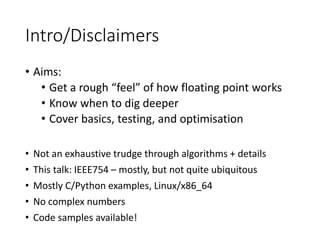
Intro/Disclaimers
• Aims:
• Get a rough “feel” of how floating point works
• Know when to dig deeper
• Cover basics, testing, and optimisation
• Not an exhaustive trudge through algorithms + details
• This talk: IEEE754 – mostly, but not quite ubiquitous
• Mostly C/Python examples, Linux/x86_64
• No complex numbers
• Code samples available!
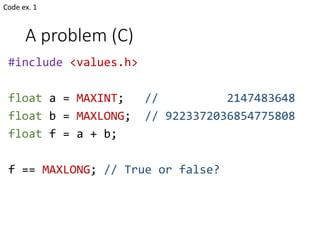
A problem (C)
#include <values.h>
float a = MAXINT; // 2147483648
float b = MAXLONG; // 9223372036854775808
float f = a + b;
f == MAXLONG; // True or false?
Code ex. 1
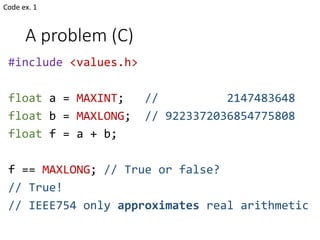
A problem (C)
#include <values.h>
float a = MAXINT; // 2147483648
float b = MAXLONG; // 9223372036854775808
float f = a + b;
f == MAXLONG; // True or false?
// True!
// IEEE754 only approximates real arithmetic
Code ex. 1
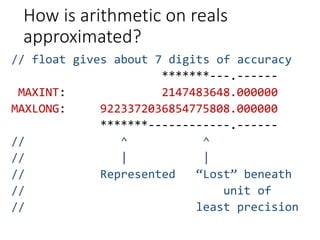
How is arithmetic on reals
approximated?
// float gives about 7 digits of accuracy
*******---.------
MAXINT: 2147483648.000000
MAXLONG: 9223372036854775808.000000
*******------------.------
// ^ ^
// | |
// Represented “Lost” beneath
// unit of
// least precision
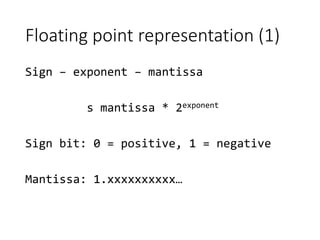
Floating point representation (1)
Sign – exponent – mantissa
s mantissa * 2exponent
Sign bit: 0 = positive, 1 = negative
Mantissa: 1.xxxxxxxxxx…
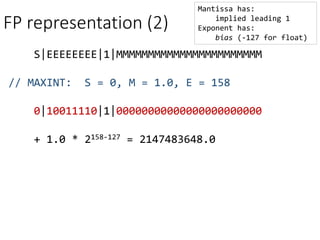
FP representation (2)
S|EEEEEEEE|1|MMMMMMMMMMMMMMMMMMMMMMM
// MAXINT: S = 0, M = 1.0, E = 158
0|10011110|1|00000000000000000000000
+ 1.0 * 2158-127 = 2147483648.0
A
A
A
a
Mantissa has:
implied leading 1
Exponent has:
bias (-127 for float)
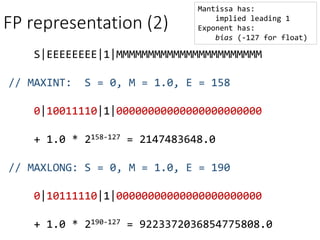
FP representation (2)
S|EEEEEEEE|1|MMMMMMMMMMMMMMMMMMMMMMM
// MAXINT: S = 0, M = 1.0, E = 158
0|10011110|1|00000000000000000000000
+ 1.0 * 2158-127 = 2147483648.0
// MAXLONG: S = 0, M = 1.0, E = 190
0|10111110|1|00000000000000000000000
+ 1.0 * 2190-127 = 9223372036854775808.0
Mantissa has:
implied leading 1
Exponent has:
bias (-127 for float)
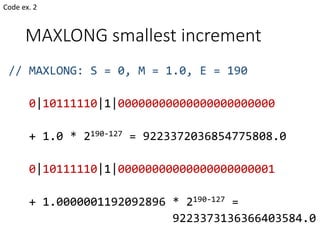
MAXLONG smallest increment
// MAXLONG: S = 0, M = 1.0, E = 190
0|10111110|1|00000000000000000000000
+ 1.0 * 2190-127 = 9223372036854775808.0
0|10111110|1|00000000000000000000001
+ 1.0000001192092896 * 2190-127 =
9223373136366403584.0
Code ex. 2
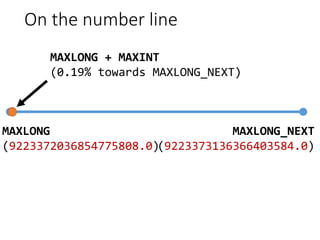
On the number line
MAXLONG
(9223372036854775808.0)
MAXLONG_NEXT
(9223373136366403584.0)
MAXLONG + MAXINT
(0.19% towards MAXLONG_NEXT)
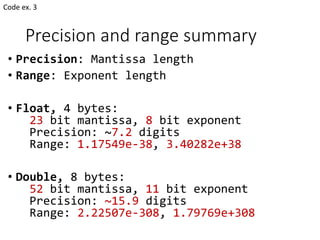
Precision and range summary
• Precision: Mantissa length
• Range: Exponent length
• Float, 4 bytes:
23 bit mantissa, 8 bit exponent
Precision: ~7.2 digits
Range: 1.17549e-38, 3.40282e+38
• Double, 8 bytes:
52 bit mantissa, 11 bit exponent
Precision: ~15.9 digits
Range: 2.22507e-308, 1.79769e+308
Code ex. 3
Special cases
When is a number not a number?
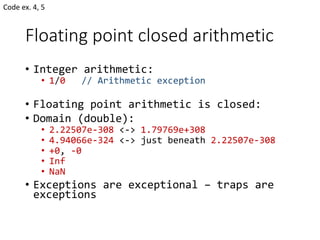
Floating point closed arithmetic
• Integer arithmetic:
• 1/0 // Arithmetic exception
• Floating point arithmetic is closed:
• Domain (double):
• 2.22507e-308 <-> 1.79769e+308
• 4.94066e-324 <-> just beneath 2.22507e-308
• +0, -0
• Inf
• NaN
• Exceptions are exceptional – traps are
exceptions
Code ex. 4, 5
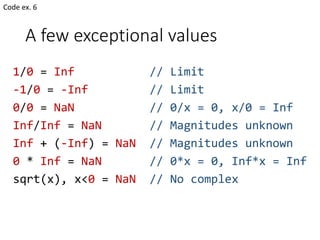
A few exceptional values
1/0 = Inf // Limit
-1/0 = -Inf // Limit
0/0 = NaN // 0/x = 0, x/0 = Inf
Inf/Inf = NaN // Magnitudes unknown
Inf + (-Inf) = NaN // Magnitudes unknown
0 * Inf = NaN // 0*x = 0, Inf*x = Inf
sqrt(x), x<0 = NaN // No complex
Code ex. 6
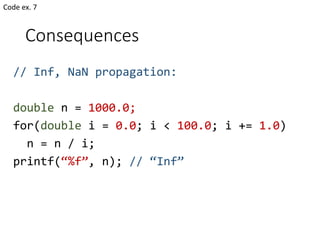
Consequences
// Inf, NaN propagation:
double n = 1000.0;
for(double i = 0.0; i < 100.0; i += 1.0)
n = n / i;
printf(“%f”, n); // “Inf”
Code ex. 7
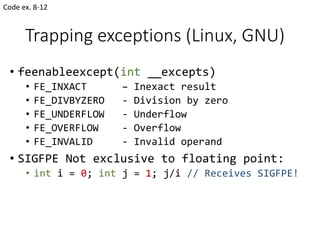
Trapping exceptions (Linux, GNU)
• feenableexcept(int __excepts)
• FE_INXACT – Inexact result
• FE_DIVBYZERO - Division by zero
• FE_UNDERFLOW - Underflow
• FE_OVERFLOW - Overflow
• FE_INVALID - Invalid operand
• SIGFPE Not exclusive to floating point:
• int i = 0; int j = 1; j/i // Receives SIGFPE!
Code ex. 8-12
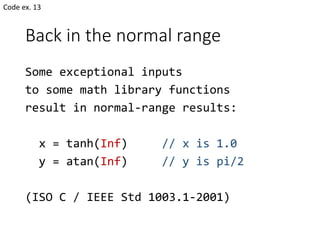
Back in the normal range
Some exceptional inputs
to some math library functions
result in normal-range results:
x = tanh(Inf) // x is 1.0
y = atan(Inf) // y is pi/2
(ISO C / IEEE Std 1003.1-2001)
Code ex. 13
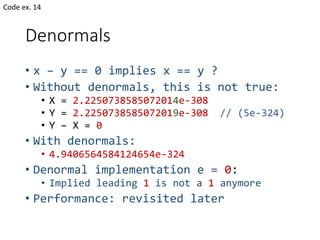
Denormals
• x – y == 0 implies x == y ?
• Without denormals, this is not true:
• X = 2.2250738585072014e-308
• Y = 2.2250738585072019e-308 // (5e-324)
• Y – X = 0
• With denormals:
• 4.9406564584124654e-324
• Denormal implementation e = 0:
• Implied leading 1 is not a 1 anymore
• Performance: revisited later
Code ex. 14
Testing
Getting getting right right
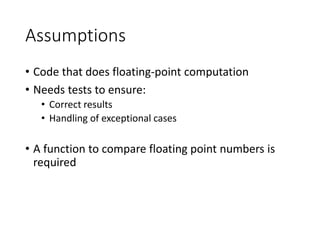
Assumptions
• Code that does floating-point computation
• Needs tests to ensure:
• Correct results
• Handling of exceptional cases
• A function to compare floating point numbers is
required
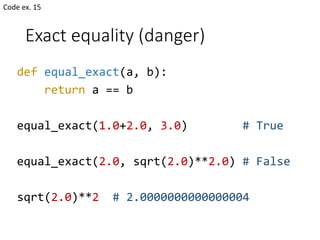
Exact equality (danger)
def equal_exact(a, b):
return a == b
equal_exact(1.0+2.0, 3.0) # True
equal_exact(2.0, sqrt(2.0)**2.0) # False
sqrt(2.0)**2 # 2.0000000000000004
Code ex. 15
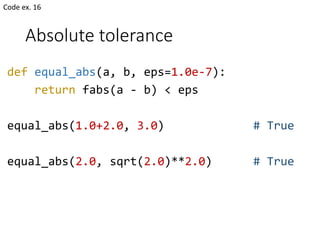
Absolute tolerance
def equal_abs(a, b, eps=1.0e-7):
return fabs(a - b) < eps
equal_abs(1.0+2.0, 3.0) # True
equal_abs(2.0, sqrt(2.0)**2.0) # True
Code ex. 16
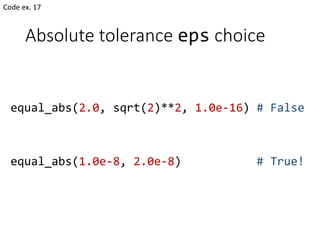
Absolute tolerance eps choice
equal_abs(2.0, sqrt(2)**2, 1.0e-16) # False
equal_abs(1.0e-8, 2.0e-8) # True!
Code ex. 17
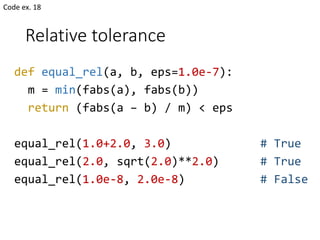
Relative tolerance
def equal_rel(a, b, eps=1.0e-7):
m = min(fabs(a), fabs(b))
return (fabs(a – b) / m) < eps
equal_rel(1.0+2.0, 3.0) # True
equal_rel(2.0, sqrt(2.0)**2.0) # True
equal_rel(1.0e-8, 2.0e-8) # False
Code ex. 18
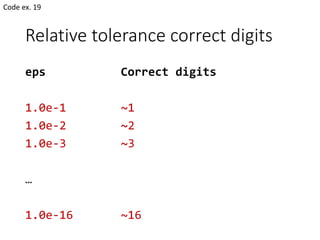
Relative tolerance correct digits
eps Correct digits
1.0e-1 ~1
1.0e-2 ~2
1.0e-3 ~3
…
1.0e-16 ~16
Code ex. 19
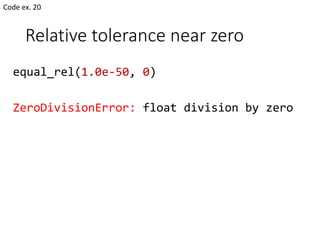
Relative tolerance near zero
equal_rel(1.0e-50, 0)
ZeroDivisionError: float division by zero
Code ex. 20
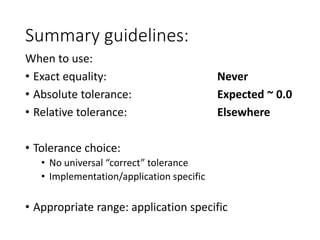
Summary guidelines:
When to use:
• Exact equality: Never
• Absolute tolerance: Expected ~ 0.0
• Relative tolerance: Elsewhere
• Tolerance choice:
• No universal “correct” tolerance
• Implementation/application specific
• Appropriate range: application specific
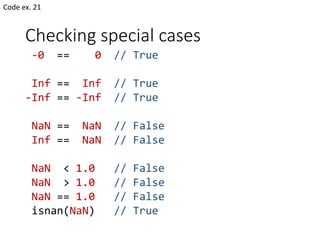
Checking special cases
-0 == 0 // True
Inf == Inf // True
-Inf == -Inf // True
NaN == NaN // False
Inf == NaN // False
NaN < 1.0 // False
NaN > 1.0 // False
NaN == 1.0 // False
isnan(NaN) // True
Code ex. 21
Performance
optimisation
Manual and automated.
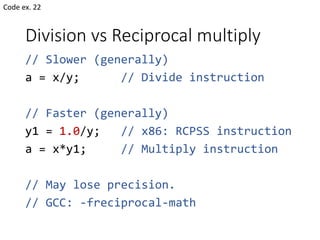
Division vs Reciprocal multiply
// Slower (generally)
a = x/y; // Divide instruction
// Faster (generally)
y1 = 1.0/y; // x86: RCPSS instruction
a = x*y1; // Multiply instruction
// May lose precision.
// GCC: -freciprocal-math
Code ex. 22
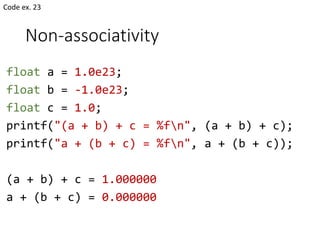
Non-associativity
float a = 1.0e23;
float b = -1.0e23;
float c = 1.0;
printf("(a + b) + c = %fn", (a + b) + c);
printf("a + (b + c) = %fn", a + (b + c));
(a + b) + c = 1.000000
a + (b + c) = 0.000000
Code ex. 23
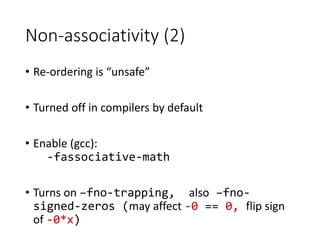
Non-associativity (2)
• Re-ordering is “unsafe”
• Turned off in compilers by default
• Enable (gcc):
-fassociative-math
• Turns on –fno-trapping, also –fno-
signed-zeros (may affect -0 == 0, flip sign
of -0*x)
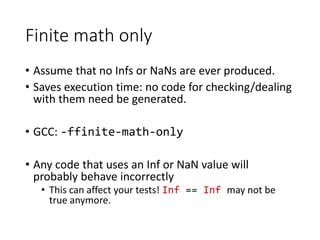
Finite math only
• Assume that no Infs or NaNs are ever produced.
• Saves execution time: no code for checking/dealing
with them need be generated.
• GCC: -ffinite-math-only
• Any code that uses an Inf or NaN value will
probably behave incorrectly
• This can affect your tests! Inf == Inf may not be
true anymore.
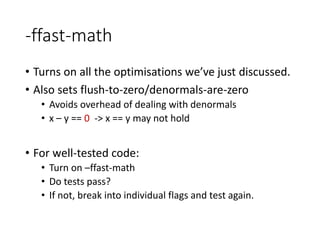
-ffast-math
• Turns on all the optimisations we’ve just discussed.
• Also sets flush-to-zero/denormals-are-zero
• Avoids overhead of dealing with denormals
• x – y == 0 -> x == y may not hold
• For well-tested code:
• Turn on –ffast-math
• Do tests pass?
• If not, break into individual flags and test again.
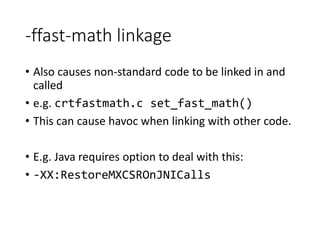
-ffast-math linkage
• Also causes non-standard code to be linked in and
called
• e.g. crtfastmath.c set_fast_math()
• This can cause havoc when linking with other code.
• E.g. Java requires option to deal with this:
• -XX:RestoreMXCSROnJNICalls
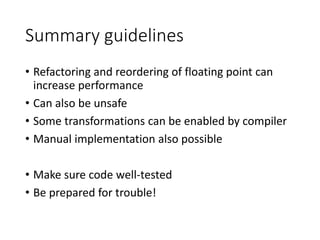
Summary guidelines
• Refactoring and reordering of floating point can
increase performance
• Can also be unsafe
• Some transformations can be enabled by compiler
• Manual implementation also possible
• Make sure code well-tested
• Be prepared for trouble!
Wrap up
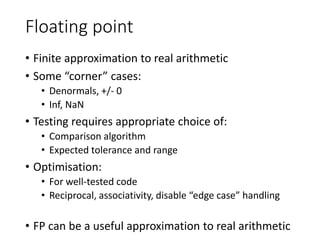
Floating point
• Finite approximation to real arithmetic
• Some “corner” cases:
• Denormals, +/- 0
• Inf, NaN
• Testing requires appropriate choice of:
• Comparison algorithm
• Expected tolerance and range
• Optimisation:
• For well-tested code
• Reciprocal, associativity, disable “edge case” handling
• FP can be a useful approximation to real arithmetic
Code samples/examples:
https://github.com/gmarkall/PitfallsFP
Watch the video with slide synchronization on
InfoQ.com!
http://www.infoq.com/presentations/IEEE754

Catastrophic Cancellation

  • 2.
    InfoQ.com: News &Community Site • 750,000 unique visitors/month • Published in 4 languages (English, Chinese, Japanese and Brazilian Portuguese) • Post content from our QCon conferences • News 15-20 / week • Articles 3-4 / week • Presentations (videos) 12-15 / week • Interviews 2-3 / week • Books 1 / month Watch the video with slide synchronization on InfoQ.com! http://www.infoq.com/presentations /IEEE754 http://www.infoq.com/presentati ons/nasa-big-data http://www.infoq.com/presentati ons/nasa-big-data
  • 3.
    Presented at QConLondon www.qconlondon.com Purpose of QCon - to empower software development by facilitating the spread of knowledge and innovation Strategy - practitioner-driven conference designed for YOU: influencers of change and innovation in your teams - speakers and topics driving the evolution and innovation - connecting and catalyzing the influencers and innovators Highlights - attended by more than 12,000 delegates since 2007 - held in 9 cities worldwide
  • 4.
    Catastrophic cancellation: the pitfallsof floating point arithmetic (and how to avoid them!) Graham Markall Quantitative Developer, OpenGamma
  • 5.
    Intro/Disclaimers • Aims: • Geta rough “feel” of how floating point works • Know when to dig deeper • Cover basics, testing, and optimisation • Not an exhaustive trudge through algorithms + details • This talk: IEEE754 – mostly, but not quite ubiquitous • Mostly C/Python examples, Linux/x86_64 • No complex numbers • Code samples available!
  • 6.
    A problem (C) #include<values.h> float a = MAXINT; // 2147483648 float b = MAXLONG; // 9223372036854775808 float f = a + b; f == MAXLONG; // True or false? Code ex. 1
  • 7.
    A problem (C) #include<values.h> float a = MAXINT; // 2147483648 float b = MAXLONG; // 9223372036854775808 float f = a + b; f == MAXLONG; // True or false? // True! // IEEE754 only approximates real arithmetic Code ex. 1
  • 8.
    How is arithmeticon reals approximated? // float gives about 7 digits of accuracy *******---.------ MAXINT: 2147483648.000000 MAXLONG: 9223372036854775808.000000 *******------------.------ // ^ ^ // | | // Represented “Lost” beneath // unit of // least precision
  • 9.
    Floating point representation(1) Sign – exponent – mantissa s mantissa * 2exponent Sign bit: 0 = positive, 1 = negative Mantissa: 1.xxxxxxxxxx…
  • 10.
    FP representation (2) S|EEEEEEEE|1|MMMMMMMMMMMMMMMMMMMMMMM //MAXINT: S = 0, M = 1.0, E = 158 0|10011110|1|00000000000000000000000 + 1.0 * 2158-127 = 2147483648.0 A A A a Mantissa has: implied leading 1 Exponent has: bias (-127 for float)
  • 11.
    FP representation (2) S|EEEEEEEE|1|MMMMMMMMMMMMMMMMMMMMMMM //MAXINT: S = 0, M = 1.0, E = 158 0|10011110|1|00000000000000000000000 + 1.0 * 2158-127 = 2147483648.0 // MAXLONG: S = 0, M = 1.0, E = 190 0|10111110|1|00000000000000000000000 + 1.0 * 2190-127 = 9223372036854775808.0 Mantissa has: implied leading 1 Exponent has: bias (-127 for float)
  • 12.
    MAXLONG smallest increment //MAXLONG: S = 0, M = 1.0, E = 190 0|10111110|1|00000000000000000000000 + 1.0 * 2190-127 = 9223372036854775808.0 0|10111110|1|00000000000000000000001 + 1.0000001192092896 * 2190-127 = 9223373136366403584.0 Code ex. 2
  • 13.
    On the numberline MAXLONG (9223372036854775808.0) MAXLONG_NEXT (9223373136366403584.0) MAXLONG + MAXINT (0.19% towards MAXLONG_NEXT)
  • 14.
    Precision and rangesummary • Precision: Mantissa length • Range: Exponent length • Float, 4 bytes: 23 bit mantissa, 8 bit exponent Precision: ~7.2 digits Range: 1.17549e-38, 3.40282e+38 • Double, 8 bytes: 52 bit mantissa, 11 bit exponent Precision: ~15.9 digits Range: 2.22507e-308, 1.79769e+308 Code ex. 3
  • 15.
    Special cases When isa number not a number?
  • 16.
    Floating point closedarithmetic • Integer arithmetic: • 1/0 // Arithmetic exception • Floating point arithmetic is closed: • Domain (double): • 2.22507e-308 <-> 1.79769e+308 • 4.94066e-324 <-> just beneath 2.22507e-308 • +0, -0 • Inf • NaN • Exceptions are exceptional – traps are exceptions Code ex. 4, 5
  • 17.
    A few exceptionalvalues 1/0 = Inf // Limit -1/0 = -Inf // Limit 0/0 = NaN // 0/x = 0, x/0 = Inf Inf/Inf = NaN // Magnitudes unknown Inf + (-Inf) = NaN // Magnitudes unknown 0 * Inf = NaN // 0*x = 0, Inf*x = Inf sqrt(x), x<0 = NaN // No complex Code ex. 6
  • 18.
    Consequences // Inf, NaNpropagation: double n = 1000.0; for(double i = 0.0; i < 100.0; i += 1.0) n = n / i; printf(“%f”, n); // “Inf” Code ex. 7
  • 19.
    Trapping exceptions (Linux,GNU) • feenableexcept(int __excepts) • FE_INXACT – Inexact result • FE_DIVBYZERO - Division by zero • FE_UNDERFLOW - Underflow • FE_OVERFLOW - Overflow • FE_INVALID - Invalid operand • SIGFPE Not exclusive to floating point: • int i = 0; int j = 1; j/i // Receives SIGFPE! Code ex. 8-12
  • 20.
    Back in thenormal range Some exceptional inputs to some math library functions result in normal-range results: x = tanh(Inf) // x is 1.0 y = atan(Inf) // y is pi/2 (ISO C / IEEE Std 1003.1-2001) Code ex. 13
  • 21.
    Denormals • x –y == 0 implies x == y ? • Without denormals, this is not true: • X = 2.2250738585072014e-308 • Y = 2.2250738585072019e-308 // (5e-324) • Y – X = 0 • With denormals: • 4.9406564584124654e-324 • Denormal implementation e = 0: • Implied leading 1 is not a 1 anymore • Performance: revisited later Code ex. 14
  • 22.
  • 23.
    Assumptions • Code thatdoes floating-point computation • Needs tests to ensure: • Correct results • Handling of exceptional cases • A function to compare floating point numbers is required
  • 24.
    Exact equality (danger) defequal_exact(a, b): return a == b equal_exact(1.0+2.0, 3.0) # True equal_exact(2.0, sqrt(2.0)**2.0) # False sqrt(2.0)**2 # 2.0000000000000004 Code ex. 15
  • 25.
    Absolute tolerance def equal_abs(a,b, eps=1.0e-7): return fabs(a - b) < eps equal_abs(1.0+2.0, 3.0) # True equal_abs(2.0, sqrt(2.0)**2.0) # True Code ex. 16
  • 26.
    Absolute tolerance epschoice equal_abs(2.0, sqrt(2)**2, 1.0e-16) # False equal_abs(1.0e-8, 2.0e-8) # True! Code ex. 17
  • 27.
    Relative tolerance def equal_rel(a,b, eps=1.0e-7): m = min(fabs(a), fabs(b)) return (fabs(a – b) / m) < eps equal_rel(1.0+2.0, 3.0) # True equal_rel(2.0, sqrt(2.0)**2.0) # True equal_rel(1.0e-8, 2.0e-8) # False Code ex. 18
  • 28.
    Relative tolerance correctdigits eps Correct digits 1.0e-1 ~1 1.0e-2 ~2 1.0e-3 ~3 … 1.0e-16 ~16 Code ex. 19
  • 29.
    Relative tolerance nearzero equal_rel(1.0e-50, 0) ZeroDivisionError: float division by zero Code ex. 20
  • 30.
    Summary guidelines: When touse: • Exact equality: Never • Absolute tolerance: Expected ~ 0.0 • Relative tolerance: Elsewhere • Tolerance choice: • No universal “correct” tolerance • Implementation/application specific • Appropriate range: application specific
  • 31.
    Checking special cases -0== 0 // True Inf == Inf // True -Inf == -Inf // True NaN == NaN // False Inf == NaN // False NaN < 1.0 // False NaN > 1.0 // False NaN == 1.0 // False isnan(NaN) // True Code ex. 21
  • 32.
  • 33.
    Division vs Reciprocalmultiply // Slower (generally) a = x/y; // Divide instruction // Faster (generally) y1 = 1.0/y; // x86: RCPSS instruction a = x*y1; // Multiply instruction // May lose precision. // GCC: -freciprocal-math Code ex. 22
  • 34.
    Non-associativity float a =1.0e23; float b = -1.0e23; float c = 1.0; printf("(a + b) + c = %fn", (a + b) + c); printf("a + (b + c) = %fn", a + (b + c)); (a + b) + c = 1.000000 a + (b + c) = 0.000000 Code ex. 23
  • 35.
    Non-associativity (2) • Re-orderingis “unsafe” • Turned off in compilers by default • Enable (gcc): -fassociative-math • Turns on –fno-trapping, also –fno- signed-zeros (may affect -0 == 0, flip sign of -0*x)
  • 36.
    Finite math only •Assume that no Infs or NaNs are ever produced. • Saves execution time: no code for checking/dealing with them need be generated. • GCC: -ffinite-math-only • Any code that uses an Inf or NaN value will probably behave incorrectly • This can affect your tests! Inf == Inf may not be true anymore.
  • 37.
    -ffast-math • Turns onall the optimisations we’ve just discussed. • Also sets flush-to-zero/denormals-are-zero • Avoids overhead of dealing with denormals • x – y == 0 -> x == y may not hold • For well-tested code: • Turn on –ffast-math • Do tests pass? • If not, break into individual flags and test again.
  • 38.
    -ffast-math linkage • Alsocauses non-standard code to be linked in and called • e.g. crtfastmath.c set_fast_math() • This can cause havoc when linking with other code. • E.g. Java requires option to deal with this: • -XX:RestoreMXCSROnJNICalls
  • 39.
    Summary guidelines • Refactoringand reordering of floating point can increase performance • Can also be unsafe • Some transformations can be enabled by compiler • Manual implementation also possible • Make sure code well-tested • Be prepared for trouble!
  • 40.
  • 41.
    Floating point • Finiteapproximation to real arithmetic • Some “corner” cases: • Denormals, +/- 0 • Inf, NaN • Testing requires appropriate choice of: • Comparison algorithm • Expected tolerance and range • Optimisation: • For well-tested code • Reciprocal, associativity, disable “edge case” handling • FP can be a useful approximation to real arithmetic
  • 42.
  • 43.
    Watch the videowith slide synchronization on InfoQ.com! http://www.infoq.com/presentations/IEEE754