University of Washington
•
•
•
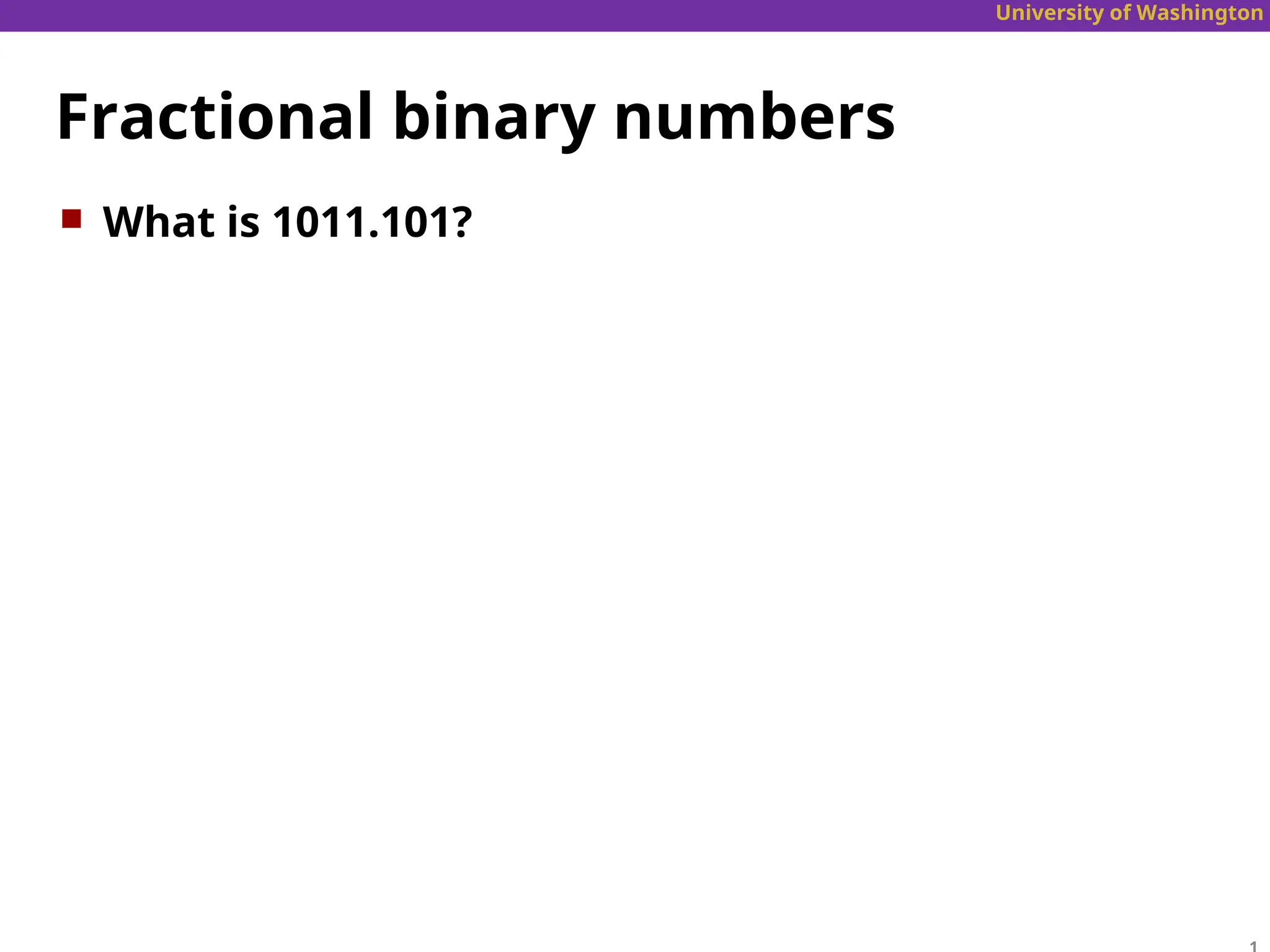
b–1
.
FractionalBinary Numbers
Representation
Bits to right of “binary point” represent fractional powers of
2
Represents rational number:
bi bi–1 b2 b1 b0 b–2 b–3 b–j
• • •
• • •
1
2
4
2i–1
2i
• • •
1/2
1/4
1/8
2–j
3.
University of Washington
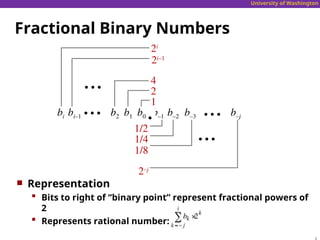
FractionalBinary Numbers:
Examples
Value Representation
5 and 3/4
2 and 7/8
63/64
Observations
Divide by 2 by shifting right
Multiply by 2 by shifting left
Numbers of form 0.111111…2 are just below 1.0
1/2 + 1/4 + 1/8 + … + 1/2i
+ … → 1.0
Use notation 1.0 – ε
101.112
10.1112
0.1111112
4.
University of Washington
RepresentableNumbers
Limitation
Can only exactly represent numbers of the form x/2k
Other rational numbers have repeating bit representations
Value Representation
1/3 0.0101010101[01]…2
1/5 0.001100110011[0011]…2
1/10 0.0001100110011[0011]…2
5.
University of Washington
FixedPoint Representation
float 32 bits; double 64 bits
→ →
We might try representing fractional binary numbers
by picking a fixed place for an implied binary point
“fixed point binary numbers”
Let's do that, using 8 bit floating point numbers as an example
#1: the binary point is between bits 2 and 3
b7
b6
b5
b4
b3
[.] b2
b1
b0
#2: the binary point is between bits 4 and 5
b7
b6
b5
[.] b4
b3
b2
b1
b0
The position of the binary point affects the range and
precision
range: difference between the largest and smallest
representable numbers
precision: smallest possible difference between any two numbers
6.
University of Washington
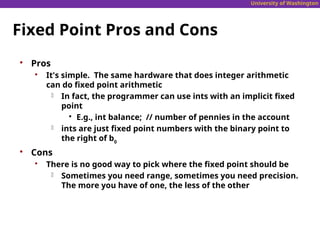
FixedPoint Pros and Cons
Pros
It's simple. The same hardware that does integer arithmetic
can do fixed point arithmetic
In fact, the programmer can use ints with an implicit fixed
point
E.g., int balance; // number of pennies in the account
ints are just fixed point numbers with the binary point to
the right of b0
Cons
There is no good way to pick where the fixed point should be
Sometimes you need range, sometimes you need precision.
The more you have of one, the less of the other
7.
University of Washington
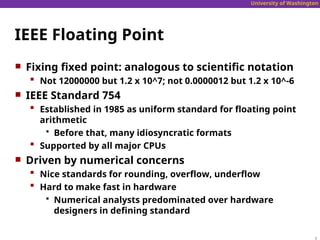
IEEEFloating Point
Fixing fixed point: analogous to scientific notation
Not 12000000 but 1.2 x 10^7; not 0.0000012 but 1.2 x 10^-6
IEEE Standard 754
Established in 1985 as uniform standard for floating point
arithmetic
Before that, many idiosyncratic formats
Supported by all major CPUs
Driven by numerical concerns
Nice standards for rounding, overflow, underflow
Hard to make fast in hardware
Numerical analysts predominated over hardware
designers in defining standard
8.
University of Washington
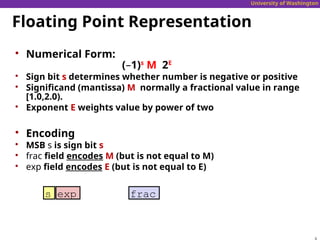
NumericalForm:
(–1)s
M 2E
Sign bit s determines whether number is negative or positive
Significand (mantissa) M normally a fractional value in range
[1.0,2.0).
Exponent E weights value by power of two
Encoding
MSB s is sign bit s
frac field encodes M (but is not equal to M)
exp field encodes E (but is not equal to E)
Floating Point Representation
s exp frac
9.
University of Washington
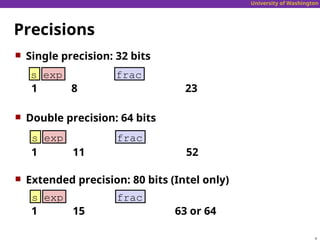
Precisions
Single precision: 32 bits
Double precision: 64 bits
Extended precision: 80 bits (Intel only)
s exp frac
s exp frac
s exp frac
1 8 23
1 11 52
1 15 63 or 64
10.
University of Washington
Normalizationand Special
Values
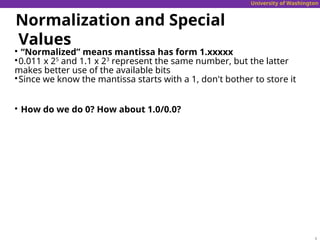
“Normalized” means mantissa has form 1.xxxxx
0.011 x 25
and 1.1 x 23
represent the same number, but the latter
makes better use of the available bits
Since we know the mantissa starts with a 1, don't bother to store it
How do we do 0? How about 1.0/0.0?
11.
University of Washington
Normalizationand Special
Values
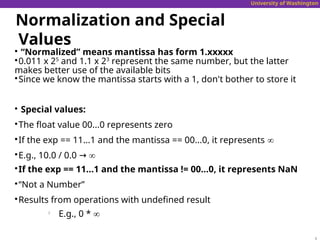
“Normalized” means mantissa has form 1.xxxxx
0.011 x 25
and 1.1 x 23
represent the same number, but the latter
makes better use of the available bits
Since we know the mantissa starts with a 1, don't bother to store it
Special values:
The float value 00...0 represents zero
If the exp == 11...1 and the mantissa == 00...0, it represents ∞
E.g., 10.0 / 0.0 → ∞
If the exp == 11...1 and the mantissa != 00...0, it represents NaN
“Not a Number”
Results from operations with undefined result
E.g., 0 * ∞
12.
University of Washington
Howdo we do operations?
Is representation exact?
How are the operations carried out?
13.
University of Washington
FloatingPoint Operations: Basic
Idea
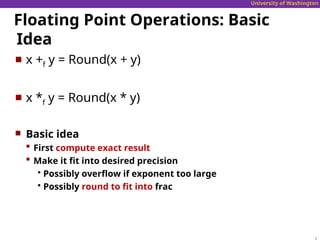
x +f y = Round(x + y)
x *f y = Round(x * y)
Basic idea
First compute exact result
Make it fit into desired precision
Possibly overflow if exponent too large
Possibly round to fit into frac
14.
University of Washington
FloatingPoint Multiplication
(–1)s1
M1 2E1
* (–1)s2
M2 2E2
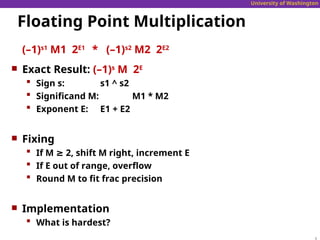
Exact Result: (–1)s
M 2E
Sign s: s1 ^ s2
Significand M: M1 * M2
Exponent E: E1 + E2
Fixing
If M ≥ 2, shift M right, increment E
If E out of range, overflow
Round M to fit frac precision
Implementation
What is hardest?
15.
University of Washington
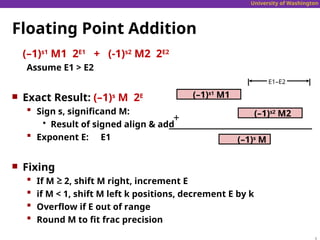
FloatingPoint Addition
(–1)s1
M1 2E1
+ (-1)s2
M2 2E2
Assume E1 > E2
Exact Result: (–1)s
M 2E
Sign s, significand M:
Result of signed align & add
Exponent E: E1
Fixing
If M ≥ 2, shift M right, increment E
if M < 1, shift M left k positions, decrement E by k
Overflow if E out of range
Round M to fit frac precision
(–1)s1
M1
(–1)s2
M2
E1–E2
+
(–1)s
M
University of Washington
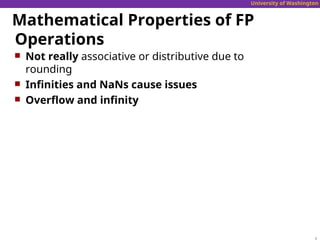
MathematicalProperties of FP
Operations
Not really associative or distributive due to
rounding
Infinities and NaNs cause issues
Overflow and infinity
18.
University of Washington
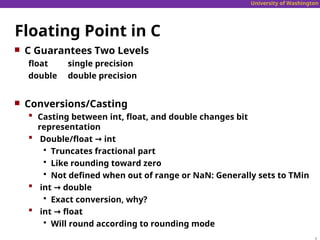
FloatingPoint in C
C Guarantees Two Levels
float single precision
double double precision
Conversions/Casting
Casting between int, float, and double changes bit
representation
Double/float → int
Truncates fractional part
Like rounding toward zero
Not defined when out of range or NaN: Generally sets to TMin
int → double
Exact conversion, why?
int → float
Will round according to rounding mode
19.
University of Washington
MemoryReferencing Bug
double fun(int i)
{
volatile double d[1] = {3.14};
volatile long int a[2];
a[i] = 1073741824; /* Possibly out of bounds */
return d[0];
}
fun(0) –> 3.14
fun(1) –> 3.14
fun(2) –> 3.1399998664856
fun(3) –> 2.00000061035156
fun(4) –> 3.14, then segmentation fault
Saved State
d7 … d4
d3 … d0
a[1]
a[0] 0
1
2
3
4
Location accessed
by fun(i)
20.
University of Washington
FloatingPoint and the Programmer
#include <stdio.h>
int main(int argc, char* argv[]) {
float f1 = 1.0;
float f2 = 0.0;
int i;
for ( i=0; i<10; i++ ) {
f2 += 1.0/10.0;
}
printf("0x%08x 0x%08xn", *(int*)&f1, *(int*)&f2);
printf("f1 = %10.8fn", f1);
printf("f2 = %10.8fnn", f2);
f1 = 1E30;
f2 = 1E-30;
float f3 = f1 + f2;
printf ("f1 == f3? %sn", f1 == f3 ? "yes" : "no" );
return 0;
}
21.
University of Washington
FloatingPoint and the Programmer
#include <stdio.h>
int main(int argc, char* argv[]) {
float f1 = 1.0;
float f2 = 0.0;
int i;
for ( i=0; i<10; i++ ) {
f2 += 1.0/10.0;
}
printf("0x%08x 0x%08xn", *(int*)&f1, *(int*)&f2);
printf("f1 = %10.8fn", f1);
printf("f2 = %10.8fnn", f2);
f1 = 1E30;
f2 = 1E-30;
float f3 = f1 + f2;
printf ("f1 == f3? %sn", f1 == f3 ? "yes" : "no" );
return 0;
}
$ ./a.out
0x3f800000 0x3f800001
f1 = 1.000000000
f2 = 1.000000119
f1 == f3? yes
22.
University of Washington
Summary
Aswith integers, floats suffer from the fixed number
of bits
available to represent them
Can get overflow/underflow, just like ints
Some “simple fractions” have no exact representation
E.g., 0.1
Can also lose precision, unlike ints
“Every operation gets a slightly wrong result”
Mathematically equivalent ways of writing an
expression may
compute differing results
NEVER test floating point values for equality!

![University of Washington
Representable Numbers
Limitation
Can only exactly represent numbers of the form x/2k
Other rational numbers have repeating bit representations
Value Representation
1/3 0.0101010101[01]…2
1/5 0.001100110011[0011]…2
1/10 0.0001100110011[0011]…2](https://image.slidesharecdn.com/04-floats-260122152835-e150f90b/85/04-floats-point-representation-of-numbers-4-320.jpg)
![University of Washington
Fixed Point Representation
float 32 bits; double 64 bits
→ →
We might try representing fractional binary numbers
by picking a fixed place for an implied binary point
“fixed point binary numbers”
Let's do that, using 8 bit floating point numbers as an example
#1: the binary point is between bits 2 and 3
b7
b6
b5
b4
b3
[.] b2
b1
b0
#2: the binary point is between bits 4 and 5
b7
b6
b5
[.] b4
b3
b2
b1
b0
The position of the binary point affects the range and
precision
range: difference between the largest and smallest
representable numbers
precision: smallest possible difference between any two numbers](https://image.slidesharecdn.com/04-floats-260122152835-e150f90b/85/04-floats-point-representation-of-numbers-5-320.jpg)

![University of Washington
Memory Referencing Bug
double fun(int i)
{
volatile double d[1] = {3.14};
volatile long int a[2];
a[i] = 1073741824; /* Possibly out of bounds */
return d[0];
}
fun(0) –> 3.14
fun(1) –> 3.14
fun(2) –> 3.1399998664856
fun(3) –> 2.00000061035156
fun(4) –> 3.14, then segmentation fault
Saved State
d7 … d4
d3 … d0
a[1]
a[0] 0
1
2
3
4
Location accessed
by fun(i)](https://image.slidesharecdn.com/04-floats-260122152835-e150f90b/85/04-floats-point-representation-of-numbers-19-320.jpg)
![University of Washington
Floating Point and the Programmer
#include <stdio.h>
int main(int argc, char* argv[]) {
float f1 = 1.0;
float f2 = 0.0;
int i;
for ( i=0; i<10; i++ ) {
f2 += 1.0/10.0;
}
printf("0x%08x 0x%08xn", *(int*)&f1, *(int*)&f2);
printf("f1 = %10.8fn", f1);
printf("f2 = %10.8fnn", f2);
f1 = 1E30;
f2 = 1E-30;
float f3 = f1 + f2;
printf ("f1 == f3? %sn", f1 == f3 ? "yes" : "no" );
return 0;
}](https://image.slidesharecdn.com/04-floats-260122152835-e150f90b/85/04-floats-point-representation-of-numbers-20-320.jpg)
![University of Washington
Floating Point and the Programmer
#include <stdio.h>
int main(int argc, char* argv[]) {
float f1 = 1.0;
float f2 = 0.0;
int i;
for ( i=0; i<10; i++ ) {
f2 += 1.0/10.0;
}
printf("0x%08x 0x%08xn", *(int*)&f1, *(int*)&f2);
printf("f1 = %10.8fn", f1);
printf("f2 = %10.8fnn", f2);
f1 = 1E30;
f2 = 1E-30;
float f3 = f1 + f2;
printf ("f1 == f3? %sn", f1 == f3 ? "yes" : "no" );
return 0;
}
$ ./a.out
0x3f800000 0x3f800001
f1 = 1.000000000
f2 = 1.000000119
f1 == f3? yes](https://image.slidesharecdn.com/04-floats-260122152835-e150f90b/85/04-floats-point-representation-of-numbers-21-320.jpg)