
Catalan Numbers
and
Their Interpretations
Presented by
Pai Sukanya Suksak
What are the Catalan
Numbers?
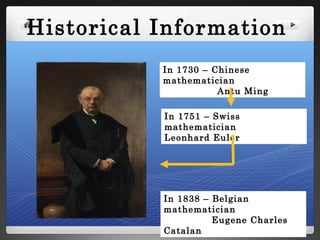
Historical Information
In 1730 – Chinese
mathematician
Antu Ming
In 1751 – Swiss
mathematician
Leonhard Euler
In 1838 – Belgian
mathematician
Eugene Charles
Catalan
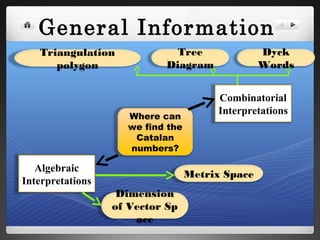
General Information
Where can
we find the
Catalan
numbers?
Combinatorial
Interpretations
Triangulation
polygon
Tree
Diagram
Dyck
Words
Algebraic
Interpretations
Dimension
of Vector Sp
ace
Metrix Space
The Catalan Numbers:
Sequence of Integer
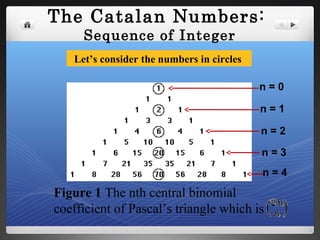
Figure 1 The nth central binomial
coefficient of Pascal’s triangle which is
Let’s consider the numbers in circles
n = 0
n = 1
n = 2
n = 3
n = 4
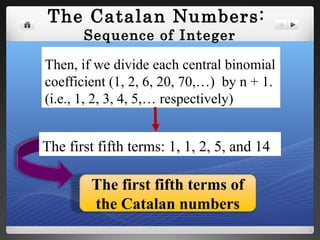
Then, if we divide each central binomial
coefficient (1, 2, 6, 20, 70,…) by n + 1.
(i.e., 1, 2, 3, 4, 5,… respectively)
The first fifth terms: 1, 1, 2, 5, and 14
The first fifth terms of
the Catalan numbers
The Catalan Numbers:
Sequence of Integer
The Catalan Numbers:
The Formula
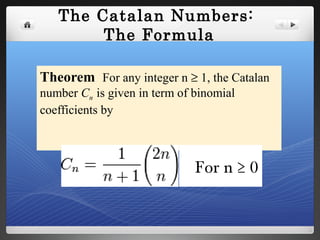
Theorem For any integer n ≥ 1, the Catalan
number Cn is given in term of binomial
coefficients by
For n ≥ 0
Proof by Triangulation Definition
The Catalan Numbers:
Proof of the Formula
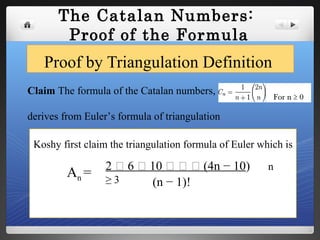
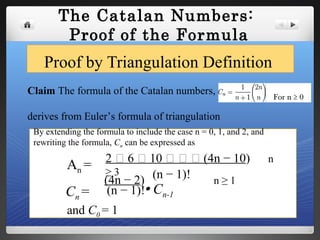
Claim The formula of the Catalan numbers,
derives from Euler’s formula of triangulation
For n ≥ 0
Koshy first claim the triangulation formula of Euler which is
An = 2  6  10    (4n − 10) n
≥ 3 (n − 1)!
Proof by Triangulation Definition
The Catalan Numbers:
Proof of the Formula
Claim The formula of the Catalan numbers,
derives from Euler’s formula of triangulation
For n ≥ 0
An = 2  6  10    (4n − 10) n
≥ 3 (n − 1)!
By extending the formula to include the case n = 0, 1, and 2, and
rewriting the formula, Cn can be expressed as
Cn =
(4n − 2) n ≥ 1
(n − 1)! Cn-1
and C0 = 1
The Catalan Numbers:
Proof of the Formula
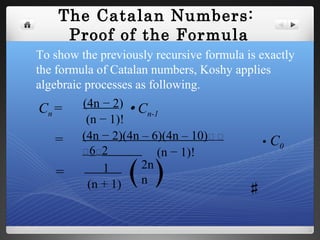
Cn = (4n − 2)
(n − 1)!
 Cn-1
To show the previously recursive formula is exactly
the formula of Catalan numbers, Koshy applies
algebraic processes as following.
(4n − 2)(4n – 6)(4n – 10) 
62 (n − 1)!
 C0
=
= 1
(n + 1) ( )2n
n
♯
The Catalan Numbers:
Some Interpretations
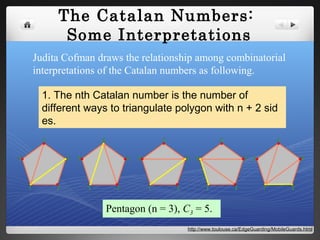
Judita Cofman draws the relationship among combinatorial
interpretations of the Catalan numbers as following.
1. The nth Catalan number is the number of
different ways to triangulate polygon with n + 2 sid
es.
Pentagon (n = 3), C3 = 5.
http://www.toulouse.ca/EdgeGuarding/MobileGuards.html
The Catalan Numbers:
Some Interpretations
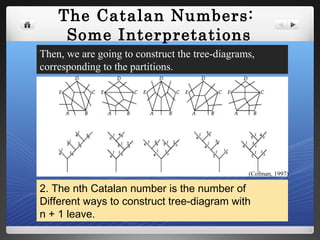
Then, we are going to construct the tree-diagrams,
corresponding to the partitions.
2. The nth Catalan number is the number of
Different ways to construct tree-diagram with
n + 1 leave.
(Cofman, 1997)
The Catalan Numbers:
Some Interpretations
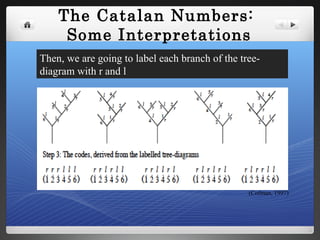
Then, we are going to label each branch of the tree-
diagram with r and l
(Cofman, 1997)
The Catalan Numbers:
Some Interpretations
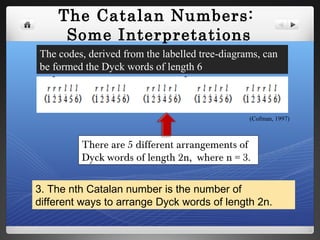
The codes, derived from the labelled tree-diagrams, can
be formed the Dyck words of length 6
3. The nth Catalan number is the number of
different ways to arrange Dyck words of length 2n.
There are 5 different arrangements of
Dyck words of length 2n, where n = 3.
(Cofman, 1997)
The Catalan Numbers:
Some Interpretations
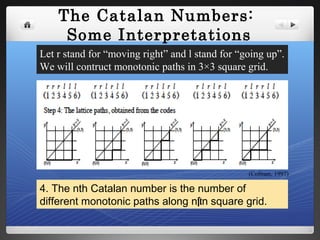
Let r stand for “moving right” and l stand for “going up”.
We will contruct monotonic paths in 3×3 square grid.
4. The nth Catalan number is the number of
different monotonic paths along n×n square grid.
(Cofman, 1997)
What is the Catalan
Numbers?
References
The Catalan Numbers
Conway, J., Guy, R. (1996). “THE BOOK OF NUMBERS”.
Copericus, New York.
Cofman, Judita (08/01/1997). "Catalan Numbers for the Classroom?".
Elemente der Mathematik (0013-6018), 52 (3), p. 108.
Koshy, T. (2007). “ELEMENTARY NUMBER THEORY WITH
APPLICATIONS”. Boston Academic Press, Massachusetts.
Stanley, R. (1944). “ENUMERATIVE COMBENATORICS”.
Wadsworth & Brooks/Cole Advanced Books & Software,
California.
Wikipedia, “Catalan Numbers”. Retrived November 3, 2010.
Thank you for your
attention

Catalan number presentation2

  • 1.
  • 2.
    What are theCatalan Numbers?
  • 3.
    Historical Information In 1730– Chinese mathematician Antu Ming In 1751 – Swiss mathematician Leonhard Euler In 1838 – Belgian mathematician Eugene Charles Catalan
  • 4.
    General Information Where can wefind the Catalan numbers? Combinatorial Interpretations Triangulation polygon Tree Diagram Dyck Words Algebraic Interpretations Dimension of Vector Sp ace Metrix Space
  • 5.
    The Catalan Numbers: Sequenceof Integer Figure 1 The nth central binomial coefficient of Pascal’s triangle which is Let’s consider the numbers in circles n = 0 n = 1 n = 2 n = 3 n = 4
  • 6.
    Then, if wedivide each central binomial coefficient (1, 2, 6, 20, 70,…) by n + 1. (i.e., 1, 2, 3, 4, 5,… respectively) The first fifth terms: 1, 1, 2, 5, and 14 The first fifth terms of the Catalan numbers The Catalan Numbers: Sequence of Integer
  • 7.
    The Catalan Numbers: TheFormula Theorem For any integer n ≥ 1, the Catalan number Cn is given in term of binomial coefficients by For n ≥ 0
  • 8.
    Proof by TriangulationDefinition The Catalan Numbers: Proof of the Formula Claim The formula of the Catalan numbers, derives from Euler’s formula of triangulation For n ≥ 0 Koshy first claim the triangulation formula of Euler which is An = 2  6  10    (4n − 10) n ≥ 3 (n − 1)!
  • 9.
    Proof by TriangulationDefinition The Catalan Numbers: Proof of the Formula Claim The formula of the Catalan numbers, derives from Euler’s formula of triangulation For n ≥ 0 An = 2  6  10    (4n − 10) n ≥ 3 (n − 1)! By extending the formula to include the case n = 0, 1, and 2, and rewriting the formula, Cn can be expressed as Cn = (4n − 2) n ≥ 1 (n − 1)! Cn-1 and C0 = 1
  • 10.
    The Catalan Numbers: Proofof the Formula Cn = (4n − 2) (n − 1)!  Cn-1 To show the previously recursive formula is exactly the formula of Catalan numbers, Koshy applies algebraic processes as following. (4n − 2)(4n – 6)(4n – 10)  62 (n − 1)!  C0 = = 1 (n + 1) ( )2n n ♯
  • 11.
    The Catalan Numbers: SomeInterpretations Judita Cofman draws the relationship among combinatorial interpretations of the Catalan numbers as following. 1. The nth Catalan number is the number of different ways to triangulate polygon with n + 2 sid es. Pentagon (n = 3), C3 = 5. http://www.toulouse.ca/EdgeGuarding/MobileGuards.html
  • 12.
    The Catalan Numbers: SomeInterpretations Then, we are going to construct the tree-diagrams, corresponding to the partitions. 2. The nth Catalan number is the number of Different ways to construct tree-diagram with n + 1 leave. (Cofman, 1997)
  • 13.
    The Catalan Numbers: SomeInterpretations Then, we are going to label each branch of the tree- diagram with r and l (Cofman, 1997)
  • 14.
    The Catalan Numbers: SomeInterpretations The codes, derived from the labelled tree-diagrams, can be formed the Dyck words of length 6 3. The nth Catalan number is the number of different ways to arrange Dyck words of length 2n. There are 5 different arrangements of Dyck words of length 2n, where n = 3. (Cofman, 1997)
  • 15.
    The Catalan Numbers: SomeInterpretations Let r stand for “moving right” and l stand for “going up”. We will contruct monotonic paths in 3×3 square grid. 4. The nth Catalan number is the number of different monotonic paths along n×n square grid. (Cofman, 1997)
  • 16.
    What is theCatalan Numbers?
  • 17.
    References The Catalan Numbers Conway,J., Guy, R. (1996). “THE BOOK OF NUMBERS”. Copericus, New York. Cofman, Judita (08/01/1997). "Catalan Numbers for the Classroom?". Elemente der Mathematik (0013-6018), 52 (3), p. 108. Koshy, T. (2007). “ELEMENTARY NUMBER THEORY WITH APPLICATIONS”. Boston Academic Press, Massachusetts. Stanley, R. (1944). “ENUMERATIVE COMBENATORICS”. Wadsworth & Brooks/Cole Advanced Books & Software, California. Wikipedia, “Catalan Numbers”. Retrived November 3, 2010.
  • 18.
    Thank you foryour attention

Editor's Notes

  • #9 Move three objects
  • #10 Move three objects
  • #11 Finish this page dauy!!!!
  • #12 Triangulation
  • #13 This tree-diagram is called full binary tree
  • #15 Give def of Dyck word
  • #16 Def of monotonic paths
  • #17 It is a special kind of integer sequence that is used widespread in counting problems, abstract algebra, combinatorics, computer sci, and geometry.
  • #18 It is a special kind of integer sequence that is used widespread in counting problems, abstract algebra, combinatorics, computer sci, and geometry.