Casting Quality
• There are numerous opportunities for things to go
wrong in a casting operation, resulting in quality
defects in the product
• The defects can be classified as follows:
• General defects common to all casting processes
• Defects related to sand casting process
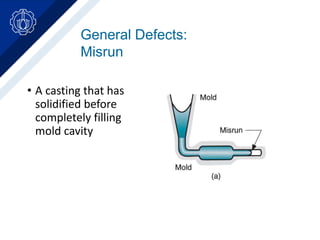
• A casting that has
solidified before
completely filling
mold cavity
General Defects:
Misrun
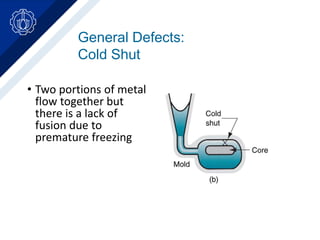
• Two portions of metal
flow together but
there is a lack of
fusion due to
premature freezing
General Defects:
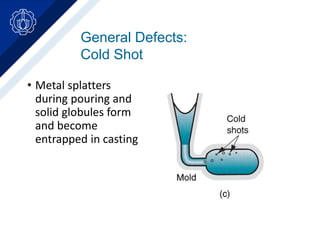
Cold Shut
• Metal splatters
during pouring and
solid globules form
and become
entrapped in casting
General Defects:
Cold Shot
• Depression in surface or
internal void caused by
solidification shrinkage
that restricts amount of
molten metal available
in last region to freeze
General Defects:
Shrinkage Cavity
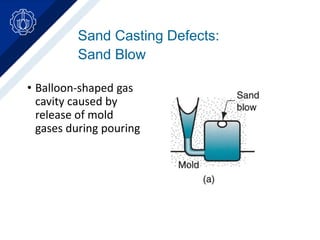
• Balloon-shaped gas
cavity caused by
release of mold
gases during pouring
Sand Casting Defects:
Sand Blow
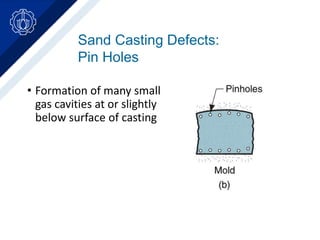
• Formation of many small
gas cavities at or slightly
below surface of casting
Sand Casting Defects:
Pin Holes
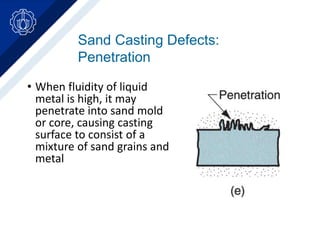
• When fluidity of liquid
metal is high, it may
penetrate into sand mold
or core, causing casting
surface to consist of a
mixture of sand grains and
metal
Sand Casting Defects:
Penetration
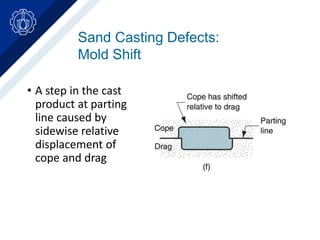
• A step in the cast
product at parting
line caused by
sidewise relative
displacement of
cope and drag
Sand Casting Defects:
Mold Shift
Foundry Inspection
Methods
• Visual inspection to detect obvious defects such as
misruns, cold shuts, and severe surface flaws
• Dimensional measurements to insure that
tolerances have been met
• Metallurgical, chemical, physical, and other tests
concerned with quality of cast metal
Metals for Casting
• Most commercial castings are made of alloys rather
than pure metals
• Alloys are generally easier to cast, and properties of
product are better
• Casting alloys can be classified as:
• Ferrous
• Nonferrous
Ferrous Casting Alloys:
Cast Iron
• Most important of all casting alloys
• Tonnage of cast iron castings is several times that
of all other metals combined
• Several types: (1) gray cast iron, (2) nodular iron,
(3) white cast iron, (4) malleable iron, and (5) alloy
cast irons
• Typical pouring temperatures  1400C (2500F),
depending on composition
Ferrous Casting Alloys:
Steel
• The mechanical properties of steel make it an
attractive engineering material
• The capability to create complex geometries makes
casting an attractive shaping process
• Difficulties when casting steel:
• Pouring temperature is high  1650C (3000F)
• At such temperatures, steel readily oxidizes, so
molten metal must be isolated from air
• Molten steel has relatively poor fluidity
Nonferrous Casting
Alloys: Aluminum
• Generally considered to be very castable
• Low pouring temperatures due to low melting
temperature
• Pure Aluminum Tm = 660C (1220F)
• Properties:
• Light weight
• Range of strength properties by heat treatment
• Easy to machine
Nonferrous Casting Alloys:
Copper Alloys
• Includes bronze, brass, and aluminum bronze
• Properties:
• Corrosion resistance
• Attractive appearance
• Good bearing qualities
• Limitation: high cost of copper
• Applications: pipe fittings, marine propeller blades,
pump components, ornamental jewelry
Nonferrous Casting Alloys:
Zinc Alloys
• Very castable, commonly used in die casting
• Low pouring temperatures due to low melting
temperature
• Pure zinc Tm = 419C (786F)
• Good fluidity for ease of casting
• Properties:
• Low creep strength, so castings cannot be subjected
to prolonged high stresses
Product Design
Considerations
• Geometric simplicity
• Although casting can be used to produce complex part
geometries, simplifying the part design usually improves
castability
• Avoiding unnecessary complexities:
• Simplifies mold-making
• Reduces the need for cores
• Improves the strength of the casting
Product Design
Considerations
• Corners on the casting
• Sharp corners and angles should be avoided, since
they are sources of stress concentrations and may
cause hot tearing and cracks
• Generous fillets should be designed on inside corners
and sharp edges should be blended
Product Design Considerations
• Dimensional Tolerances and Surface Finish
• Draft Allowance
• Machining Allowances

Casting Defect.pptx

  • 1.
    Casting Quality • Thereare numerous opportunities for things to go wrong in a casting operation, resulting in quality defects in the product • The defects can be classified as follows: • General defects common to all casting processes • Defects related to sand casting process
  • 2.
    • A castingthat has solidified before completely filling mold cavity General Defects: Misrun
  • 3.
    • Two portionsof metal flow together but there is a lack of fusion due to premature freezing General Defects: Cold Shut
  • 4.
    • Metal splatters duringpouring and solid globules form and become entrapped in casting General Defects: Cold Shot
  • 5.
    • Depression insurface or internal void caused by solidification shrinkage that restricts amount of molten metal available in last region to freeze General Defects: Shrinkage Cavity
  • 6.
    • Balloon-shaped gas cavitycaused by release of mold gases during pouring Sand Casting Defects: Sand Blow
  • 7.
    • Formation ofmany small gas cavities at or slightly below surface of casting Sand Casting Defects: Pin Holes
  • 8.
    • When fluidityof liquid metal is high, it may penetrate into sand mold or core, causing casting surface to consist of a mixture of sand grains and metal Sand Casting Defects: Penetration
  • 9.
    • A stepin the cast product at parting line caused by sidewise relative displacement of cope and drag Sand Casting Defects: Mold Shift
  • 10.
    Foundry Inspection Methods • Visualinspection to detect obvious defects such as misruns, cold shuts, and severe surface flaws • Dimensional measurements to insure that tolerances have been met • Metallurgical, chemical, physical, and other tests concerned with quality of cast metal
  • 11.
    Metals for Casting •Most commercial castings are made of alloys rather than pure metals • Alloys are generally easier to cast, and properties of product are better • Casting alloys can be classified as: • Ferrous • Nonferrous
  • 12.
    Ferrous Casting Alloys: CastIron • Most important of all casting alloys • Tonnage of cast iron castings is several times that of all other metals combined • Several types: (1) gray cast iron, (2) nodular iron, (3) white cast iron, (4) malleable iron, and (5) alloy cast irons • Typical pouring temperatures  1400C (2500F), depending on composition
  • 13.
    Ferrous Casting Alloys: Steel •The mechanical properties of steel make it an attractive engineering material • The capability to create complex geometries makes casting an attractive shaping process • Difficulties when casting steel: • Pouring temperature is high  1650C (3000F) • At such temperatures, steel readily oxidizes, so molten metal must be isolated from air • Molten steel has relatively poor fluidity
  • 14.
    Nonferrous Casting Alloys: Aluminum •Generally considered to be very castable • Low pouring temperatures due to low melting temperature • Pure Aluminum Tm = 660C (1220F) • Properties: • Light weight • Range of strength properties by heat treatment • Easy to machine
  • 15.
    Nonferrous Casting Alloys: CopperAlloys • Includes bronze, brass, and aluminum bronze • Properties: • Corrosion resistance • Attractive appearance • Good bearing qualities • Limitation: high cost of copper • Applications: pipe fittings, marine propeller blades, pump components, ornamental jewelry
  • 16.
    Nonferrous Casting Alloys: ZincAlloys • Very castable, commonly used in die casting • Low pouring temperatures due to low melting temperature • Pure zinc Tm = 419C (786F) • Good fluidity for ease of casting • Properties: • Low creep strength, so castings cannot be subjected to prolonged high stresses
  • 17.
    Product Design Considerations • Geometricsimplicity • Although casting can be used to produce complex part geometries, simplifying the part design usually improves castability • Avoiding unnecessary complexities: • Simplifies mold-making • Reduces the need for cores • Improves the strength of the casting
  • 18.
    Product Design Considerations • Cornerson the casting • Sharp corners and angles should be avoided, since they are sources of stress concentrations and may cause hot tearing and cracks • Generous fillets should be designed on inside corners and sharp edges should be blended
  • 19.
    Product Design Considerations •Dimensional Tolerances and Surface Finish • Draft Allowance • Machining Allowances