Cassava flour making process
Cassava flour is a kind of white power extracted from cassava tubers, which can be
used as a substitute for wheat flour. In countries where wheat flour must be
imported in quantity, bread can be made by mixing cassava flour with wheat flour.
Therefore, the demand for cassava flour is gradually increasing, and so is the
requirement for the quality of cassava flour.
Cassava flour making process
Here are cassava flour making process:
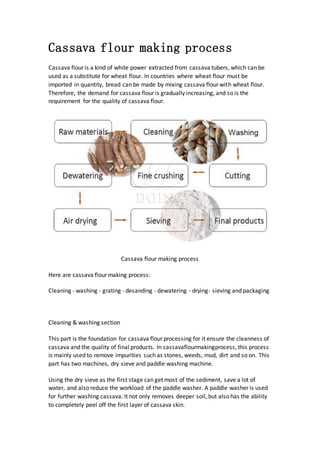
Cleaning - washing - grating - desanding - dewatering - drying- sieving and packaging
Cleaning & washing section
This part is the foundation for cassava flour processing for it ensure the cleanness of
cassava and the quality of final products. In cassavaflourmakingprocess, this process
is mainly used to remove impurities such as stones, weeds, mud, dirt and so on. This
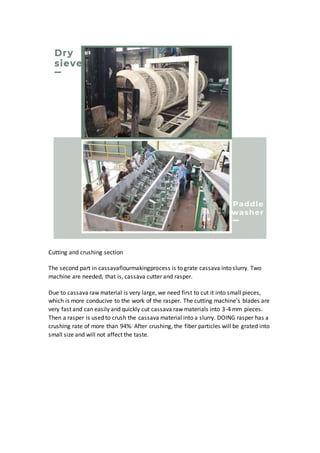
part has two machines, dry sieve and paddle washing machine.
Using the dry sieve as the first stage can get most of the sediment, save a lot of
water, and also reduce the workload of the paddle washer. A paddle washer is used
for further washing cassava. It not only removes deeper soil, but also has the ability
to completely peel off the first layer of cassava skin.
Cutting and crushing section
The second part in cassavaflourmakingprocess is to grate cassava into slurry. Two
machine are needed, that is, cassava cutter and rasper.
Due to cassava raw material is very large, we need first to cut it into small pieces,
which is more conducive to the work of the rasper. The cutting machine's blades are
very fast and can easily and quickly cut cassava raw materials into 3-4 mm pieces.
Then a rasper is used to crush the cassava material into a slurry. DOING rasper has a
crushing rate of more than 94%. After crushing, the fiber particles will be grated into
small size and will not affect the taste.
Desander section
After desanding, the starch slurry is pushed into a desander by the pressure pump,
where the small sand that affects the taste and quality of cassava flour will be
removed. After desanding, the sand content is less than 0.2%.
Dewatering section
Dewatering is then carried out by using a plate frame filter press in
cassavaflourmakingprocess. The cassava slurry flows under pressure into the filter
press through a pipe. The filter cloth of the filter press has a good filtering effect. It
prevents the passage of flour particles. Under the dual action of pressure and filter
cloth, the flour forms an object similar to the shape of the filter cake, with a water
content of less than 40%.
Drying section
Then, after dewatering, the moisture content of wet cassava cake reaches the flash
dryer operation requirements. The flash dryer adopts the method of negative
pressure drying, which can effectively reduce the loss and waste of flour and
meanwhile can complete the drying in seconds. After drying, the moisture content of
the flour is about 14%.
Sieving and packaging section
This is the last step for cassava flour making process. The sieving machine has
meshes of different sizes that block the passage of fibers and large flour particles. So
the fineness and texture of the flour granules are effectively ensured by the sieving
device. And finally cassava flour is automatic packaged by a packaging machine.
Tel/Whatsapp: +86-13526615783
Website: www.cassavaprocessing.com.cn
Email: sales@doingmachinery.com

Cassava flour making process

  • 1.
    Cassava flour makingprocess Cassava flour is a kind of white power extracted from cassava tubers, which can be used as a substitute for wheat flour. In countries where wheat flour must be imported in quantity, bread can be made by mixing cassava flour with wheat flour. Therefore, the demand for cassava flour is gradually increasing, and so is the requirement for the quality of cassava flour. Cassava flour making process Here are cassava flour making process: Cleaning - washing - grating - desanding - dewatering - drying- sieving and packaging Cleaning & washing section This part is the foundation for cassava flour processing for it ensure the cleanness of cassava and the quality of final products. In cassavaflourmakingprocess, this process is mainly used to remove impurities such as stones, weeds, mud, dirt and so on. This part has two machines, dry sieve and paddle washing machine. Using the dry sieve as the first stage can get most of the sediment, save a lot of water, and also reduce the workload of the paddle washer. A paddle washer is used for further washing cassava. It not only removes deeper soil, but also has the ability to completely peel off the first layer of cassava skin.
  • 2.
    Cutting and crushingsection The second part in cassavaflourmakingprocess is to grate cassava into slurry. Two machine are needed, that is, cassava cutter and rasper. Due to cassava raw material is very large, we need first to cut it into small pieces, which is more conducive to the work of the rasper. The cutting machine's blades are very fast and can easily and quickly cut cassava raw materials into 3-4 mm pieces. Then a rasper is used to crush the cassava material into a slurry. DOING rasper has a crushing rate of more than 94%. After crushing, the fiber particles will be grated into small size and will not affect the taste.
  • 3.
    Desander section After desanding,the starch slurry is pushed into a desander by the pressure pump, where the small sand that affects the taste and quality of cassava flour will be removed. After desanding, the sand content is less than 0.2%. Dewatering section Dewatering is then carried out by using a plate frame filter press in cassavaflourmakingprocess. The cassava slurry flows under pressure into the filter press through a pipe. The filter cloth of the filter press has a good filtering effect. It prevents the passage of flour particles. Under the dual action of pressure and filter cloth, the flour forms an object similar to the shape of the filter cake, with a water content of less than 40%.
  • 4.
    Drying section Then, afterdewatering, the moisture content of wet cassava cake reaches the flash dryer operation requirements. The flash dryer adopts the method of negative pressure drying, which can effectively reduce the loss and waste of flour and meanwhile can complete the drying in seconds. After drying, the moisture content of the flour is about 14%. Sieving and packaging section This is the last step for cassava flour making process. The sieving machine has meshes of different sizes that block the passage of fibers and large flour particles. So the fineness and texture of the flour granules are effectively ensured by the sieving device. And finally cassava flour is automatic packaged by a packaging machine. Tel/Whatsapp: +86-13526615783 Website: www.cassavaprocessing.com.cn Email: sales@doingmachinery.com