IT’S A
SNAPINITIAL PUBLIC OFFERING
By: Chase Bradley
OVERVIEW
▸Look over Snapchat’s IPO Campaign
▸What Snap had to do to get to IPO
▸Evaluation
▸Conclusion
HISTORY OF SNAP
▸Snapchat is an image and video messaging application
created in 2011 by Evan Spiegel, Bobby Murphy, and
Reggie Brown
▸Created at Stanford for their product design class
▸Initially called Picaboo
WHAT IS AN IPO
▸The grand launching of a private company that has decided
to go “public”
▸Company’s status moves from privately held, to individuals
or families, to publicly held by stockholders
▸Companies go public when it has grown to a point where it
needs more money to keep their competitive edge
PROS AND CONS AN IPO
PROS CONS
‣ Raises Money Fast ‣ Requires Disclosure
‣ Increases Financial
Discipline
‣ Increases Scrutiny
‣Offers Unique
Marketing Opportunity
‣ Activist Shareholders
‣ Provides Stock Option
Plans
WHAT INFO FINANCIAL ANALYSTS AND
INVESTORS SEEK
‣ REVENUE AT SCALE—can the company get bigger and still maintain growth
‣ CASH ON HAND—is the company already successful and financial disciplined
‣ PROVABILITY—does it have the ability to become profitably
‣ MARKET SIZE—how many customers are there for product or service
‣ COMPETITION—see how they stack up against competitors
‣ PRODUCTS—
‣ LEADERSHIP—CEO must be able to assure potential shareholders
‣ SALES AND MARKETING—must show their expertise with sales and marketing leadership
‣ OTHER BUSINESS FUNDAMENTALS—strong IPOs are companies with sound fundamentals and
professional direction
STEPS FOR SNAP IPO
▸STEP 1: PICK THE BANK UNDERWRITERS
▸STEP 2: PROVIDE SNAP’S CASE—SEC FORM S-
1(PROSPECTUS)
▸STEP 3: CONDUCT A ROAD SHOW
▸STEP 4: TIME TO CONSIDER— A QUIET PERIOD
▸STEP 5: PRICE THE STOCK AND SET A DATE
▸STEP 6: OFFER THE STOCK
STEP 1: PICK THE BANK
UNDERWRITERS
▸Not absolutely necessary
▸Most companies work with banks to underwrite their IPO’s
shares
▸Snap’s biggest bank underwrites were Morgan Stanley and
Goldman Sachs Group Inc.
▸Benefit of buying shares at the IPO price before they’re listed
STEP 2 PROVIDE SNAP’S CASE- SEC
FORM S-1 (PROSECTUS)
▸Requires frequent and detailed information about it’s
business model
▸Snap’s 178-page document, was dated Feb. 2, 2017, was
conducted with lead investment bankers
▸Key details included, revenues increase, daily active users,
user engagement, user growth, profit/losses, voting rights,
and competitors
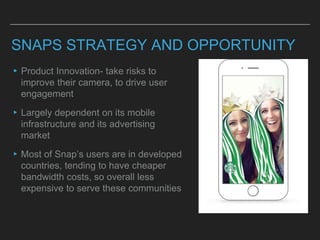
SNAPS STRATEGY AND OPPORTUNITY
▸Product Innovation- take risks to
improve their camera, to drive user
engagement
▸Largely dependent on its mobile
infrastructure and its advertising
market
▸Most of Snap’s users are in developed
countries, tending to have cheaper
bandwidth costs, so overall less
expensive to serve these communities
CONT.
▸Size of advertising market
▸Global advertising is 70% on mobile devices and nearly 85%
of mobile advertising is in the top 10 advertising markets
▸Over 60% of Snap’s daily users comes from this list
EXAMPLES OF SNAP ADVERTISING
▸According to New York Times, a lens sponsorship can cost
up to the $450,000-$750,000 depending on the day
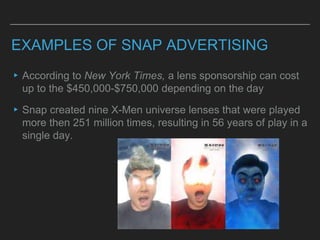
▸Snap created nine X-Men universe lenses that were played
more then 251 million times, resulting in 56 years of play in a
single day.
STEP 3 CONDUCT A ROAD SHOW
▸ Once the SEC papers are filed Snap went on a road show
to seven cities in under two weeks ending in NYC
▸35 min video, talked about business model, user metrics,
and ended with safeguarding privacy and providing an
innovative work environment
▸Talked about Spectacles product
▸For private investors not media
STEP 4 TIME TO CONSIDER—A QUIET
PERIOD
▸Once a company files for SEC(prospectus), federal
regulations require a “quiet period”
▸Reviewing is taking place, Snap cannot provide any new
information
▸Once the final version is approved with a price range, an
“effective date” is set for the IPO
▸Keep everything consistent with past practice
STEP 5 PRICE THE STOCK AND SET A
DATE
▸On March 2, 2017, Snap released a news release the day
before the public offering
▸Let the investors know its stock would sell 200 million
shares, for $17 per share, for a total offering of $3.4 billion
▸Sale represented about 1/5 of the company’s value
STEP 6 OFFER THE STOCK
▸Despite the company’s $515 million loss the pervious year, it’s IPO was highly anticipated
▸When the stock opened it sold at $24 a share and a high of $26.05
▸44 percent jump valuing the company at $28 billion
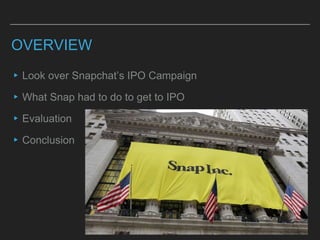
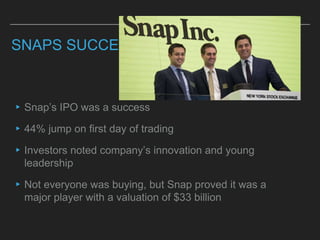
▸CEO was there with supermodel fiancé, posting pics on Snap at NYSE with giant yellow
banners, festive atmosphere
SNAPS SUCCESS
▸Snap’s IPO was a success
▸44% jump on first day of trading
▸Investors noted company’s innovation and young
leadership
▸Not everyone was buying, but Snap proved it was a
major player with a valuation of $33 billion
INVESTOR RELATIONS: SNAP’S PUBLICS
▸Most important relationship are with research analysts, and
financial/business journalists, not investors
▸The mere mention of a company by a popular analyst can
temporarily cause its stock to rise or fall-even if nothing in
the company has changed
▸IR staff help coordinate press conferences, shareholders
meetings, etc.
BUMPY ROAD AHEAD
▸July 11, 2017, Morgan Stanley(Snaps lead IPO investment bank),
downgraded the stock based on it’s own financial analysis
($16.15)
▸Nov. 29, 2017 Snap had a redesign, that made Kylie Jenner tweet
bad things, that dropped their stock 7%
▸Feb. 7, 2018 Snap announced it’s first motive earning, and stock
rose 40 percent
▸March 10, 2018 “would you rather! Slap Rihanna—Punch Chris
Brown”, stock fell 7 percent
FIRST QUARTER WOES
▸After successfully IPO, the company’s failure to meet
revenue (150M vs.158M) and daily active user growth(166M
vs. 167.3M) this sent investors into a sell mode
▸Stock dropped 20% after the earnings report released
▸Snap released a statement saying users spend an average
of 30 min a day, so advertisers should invest

Case study snap

  • 1.
    IT’S A SNAPINITIAL PUBLICOFFERING By: Chase Bradley
  • 2.
    OVERVIEW ▸Look over Snapchat’sIPO Campaign ▸What Snap had to do to get to IPO ▸Evaluation ▸Conclusion
  • 3.
    HISTORY OF SNAP ▸Snapchatis an image and video messaging application created in 2011 by Evan Spiegel, Bobby Murphy, and Reggie Brown ▸Created at Stanford for their product design class ▸Initially called Picaboo
  • 4.
    WHAT IS ANIPO ▸The grand launching of a private company that has decided to go “public” ▸Company’s status moves from privately held, to individuals or families, to publicly held by stockholders ▸Companies go public when it has grown to a point where it needs more money to keep their competitive edge
  • 5.
    PROS AND CONSAN IPO PROS CONS ‣ Raises Money Fast ‣ Requires Disclosure ‣ Increases Financial Discipline ‣ Increases Scrutiny ‣Offers Unique Marketing Opportunity ‣ Activist Shareholders ‣ Provides Stock Option Plans
  • 6.
    WHAT INFO FINANCIALANALYSTS AND INVESTORS SEEK ‣ REVENUE AT SCALE—can the company get bigger and still maintain growth ‣ CASH ON HAND—is the company already successful and financial disciplined ‣ PROVABILITY—does it have the ability to become profitably ‣ MARKET SIZE—how many customers are there for product or service ‣ COMPETITION—see how they stack up against competitors ‣ PRODUCTS— ‣ LEADERSHIP—CEO must be able to assure potential shareholders ‣ SALES AND MARKETING—must show their expertise with sales and marketing leadership ‣ OTHER BUSINESS FUNDAMENTALS—strong IPOs are companies with sound fundamentals and professional direction
  • 7.
    STEPS FOR SNAPIPO ▸STEP 1: PICK THE BANK UNDERWRITERS ▸STEP 2: PROVIDE SNAP’S CASE—SEC FORM S- 1(PROSPECTUS) ▸STEP 3: CONDUCT A ROAD SHOW ▸STEP 4: TIME TO CONSIDER— A QUIET PERIOD ▸STEP 5: PRICE THE STOCK AND SET A DATE ▸STEP 6: OFFER THE STOCK
  • 8.
    STEP 1: PICKTHE BANK UNDERWRITERS ▸Not absolutely necessary ▸Most companies work with banks to underwrite their IPO’s shares ▸Snap’s biggest bank underwrites were Morgan Stanley and Goldman Sachs Group Inc. ▸Benefit of buying shares at the IPO price before they’re listed
  • 9.
    STEP 2 PROVIDESNAP’S CASE- SEC FORM S-1 (PROSECTUS) ▸Requires frequent and detailed information about it’s business model ▸Snap’s 178-page document, was dated Feb. 2, 2017, was conducted with lead investment bankers ▸Key details included, revenues increase, daily active users, user engagement, user growth, profit/losses, voting rights, and competitors
  • 10.
    SNAPS STRATEGY ANDOPPORTUNITY ▸Product Innovation- take risks to improve their camera, to drive user engagement ▸Largely dependent on its mobile infrastructure and its advertising market ▸Most of Snap’s users are in developed countries, tending to have cheaper bandwidth costs, so overall less expensive to serve these communities
  • 12.
    CONT. ▸Size of advertisingmarket ▸Global advertising is 70% on mobile devices and nearly 85% of mobile advertising is in the top 10 advertising markets ▸Over 60% of Snap’s daily users comes from this list
  • 13.
    EXAMPLES OF SNAPADVERTISING ▸According to New York Times, a lens sponsorship can cost up to the $450,000-$750,000 depending on the day ▸Snap created nine X-Men universe lenses that were played more then 251 million times, resulting in 56 years of play in a single day.
  • 15.
    STEP 3 CONDUCTA ROAD SHOW ▸ Once the SEC papers are filed Snap went on a road show to seven cities in under two weeks ending in NYC ▸35 min video, talked about business model, user metrics, and ended with safeguarding privacy and providing an innovative work environment ▸Talked about Spectacles product ▸For private investors not media
  • 17.
    STEP 4 TIMETO CONSIDER—A QUIET PERIOD ▸Once a company files for SEC(prospectus), federal regulations require a “quiet period” ▸Reviewing is taking place, Snap cannot provide any new information ▸Once the final version is approved with a price range, an “effective date” is set for the IPO ▸Keep everything consistent with past practice
  • 18.
    STEP 5 PRICETHE STOCK AND SET A DATE ▸On March 2, 2017, Snap released a news release the day before the public offering ▸Let the investors know its stock would sell 200 million shares, for $17 per share, for a total offering of $3.4 billion ▸Sale represented about 1/5 of the company’s value
  • 19.
    STEP 6 OFFERTHE STOCK ▸Despite the company’s $515 million loss the pervious year, it’s IPO was highly anticipated ▸When the stock opened it sold at $24 a share and a high of $26.05 ▸44 percent jump valuing the company at $28 billion ▸CEO was there with supermodel fiancé, posting pics on Snap at NYSE with giant yellow banners, festive atmosphere
  • 20.
    SNAPS SUCCESS ▸Snap’s IPOwas a success ▸44% jump on first day of trading ▸Investors noted company’s innovation and young leadership ▸Not everyone was buying, but Snap proved it was a major player with a valuation of $33 billion
  • 21.
    INVESTOR RELATIONS: SNAP’SPUBLICS ▸Most important relationship are with research analysts, and financial/business journalists, not investors ▸The mere mention of a company by a popular analyst can temporarily cause its stock to rise or fall-even if nothing in the company has changed ▸IR staff help coordinate press conferences, shareholders meetings, etc.
  • 22.
    BUMPY ROAD AHEAD ▸July11, 2017, Morgan Stanley(Snaps lead IPO investment bank), downgraded the stock based on it’s own financial analysis ($16.15) ▸Nov. 29, 2017 Snap had a redesign, that made Kylie Jenner tweet bad things, that dropped their stock 7% ▸Feb. 7, 2018 Snap announced it’s first motive earning, and stock rose 40 percent ▸March 10, 2018 “would you rather! Slap Rihanna—Punch Chris Brown”, stock fell 7 percent
  • 23.
    FIRST QUARTER WOES ▸Aftersuccessfully IPO, the company’s failure to meet revenue (150M vs.158M) and daily active user growth(166M vs. 167.3M) this sent investors into a sell mode ▸Stock dropped 20% after the earnings report released ▸Snap released a statement saying users spend an average of 30 min a day, so advertisers should invest