Case Study
Renee is the lab safety manager for a small (<50 employees)
blood and urine sample
analysis company, Best Pet Test, Inc. The company receives
samples from veterinarian
offices and animal shelters in the tri-state area. Rene began
working with Best Pet Test
six months earlier. Her predecessor, Harold, held the position
for 15 years and did not
keep accurate records. Rene has been looking through old files
and contacting clients,
suppliers, and contractors to better grasp the current status of
workflow at Best Pet Test,
Inc.
In the sample analysis lab, ten employees and one supervisor
are responsible for
receiving, cataloging, and testing samples. When samples
arrive, they are given a bar-
coded decal in order to track them through the process. For the
last year, however, the
two of the three hand-held bar-code readers have not been
working and staff compensate
by adding a hand written label to the samples. Recently, the lab
staff has begun to notice
inconsistencies in the performance or results of sample testing.
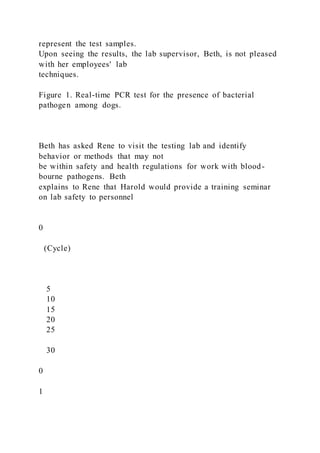
Below is a graph of a
recent real-time or quantitative PCR of canine blood samples
for the presence of a
bacterial pathogen (Figure 1). The solid line on the graph
represents the negative control
sample, which contained water plus reagents. The dotted lines
represent the test samples.
Upon seeing the results, the lab supervisor, Beth, is not pleased
with her employees' lab
techniques.
Figure 1. Real-time PCR test for the presence of bacterial
pathogen among dogs.
Beth has asked Rene to visit the testing lab and identify
behavior or methods that may not
be within safety and health regulations for work with blood-
bourne pathogens. Beth
explains to Rene that Harold would provide a training seminar
on lab safety to personnel
0
(Cycle)
5
10
15
20
25
30
0
1
2
3
4
5
6
7
8
9
(F
lu
or
es
ce
n
ce
(R
FU
))
once every two years. Since Harold was known for taking
shortcuts, Beth was concerned
that he had not presented the most recent safety guidelines
available or enforce accepted
standards. Lab staff members are often seen in the lunch area or
mail room wearing their
lab coats. Once in the lab, Rene notices an overfilled Sharps
container and unlabeled
bottles of chemicals cluttering the fume hoods. All staff
members testing blood samples
were wearing gloves and eye protection, but two individuals had
their morning coffee
sitting next to a centrifuge. Rene prepares a short presentation
of proper lab safety to
provide to the lab staff and includes personal protective
equipment, waste disposal and
emergency protocols.
Rene's week has gone from bad to worse. A local newspaper has
published a story that
laboratory waste with labels from Best Pet Test, Inc. was found
at an abandoned quarry
nearby. Since the story was published that morning, your
company has received
numerous phone calls from concerned citizens. The company
owner has requested Rene
investigate where there was a failure in the removal and
incineration of the laboratory
waste. Rene knows from invoices that a waste incineration
company (Medi-Waste) has
been paid in the past to pick up weekly from the loading doc.
Rene travels to the quarry
and collects several samples of discarded polycarbonate test
tubes, and two bags of lab
wastes with used agarose gels, nitrocellulose membranes from
Southern Blots, and
disposable pipettes. Rene does not contact the county health
department at that time; she
decides to wait until she examines the collected wastes at the
company. Furthermore, she
is unsure if there is ethidium bromide or radioactive material
contaminating the gels and
membranes. The company owner has stressed to Rene to provide
a clean and efficient
analysis of the situation in order to avoid poor public relations.
The owner does not want
to lose customers or receive additional bad publicity. Rene
designs a short experiment to
track which wastes may be contaminated with hazardous
materials. She also begins
surveying the habits of the lab members and the janitorial staff.
Grading Rubric
Exceptional
(86-100%)
Fair Assessment
(70-85%)
Poor or
Unacceptable
(<70%)
Score and
Comments
Organization
and Layout
(10 points)
Objectives well-
organized and in
a logical
sequence. Page
length
requirement met
Stated objectives
are not followed
in a logical
manner.
No Objectives or
Statement of
Purpose included.
Page length
requirement not
met.
Written
Format
(grammar,
writing
style)
(10 points)
Language and
terminology used
accurately.
Spelling,
punctuation and
grammar
Writing is
somewhat clear.
Scientific or lab
terms used
sparingly, but
accurately.
Scientific or lab
terms used
improperly.
Numerous spelling
or grammatical
mistakes. Writing
properly used.
Writing style is
professional and
not casual.
Spelling,
punctuation and
grammar mostly
properly used.
or presentation
style is casual.
Introduction
(25 points)
Researched and
identified proper
lab safety, ethics,
and best practices
for this type of
lab setting.
Provides
statement of
criteria
investigated in
the paper.
Proper lab safety,
ethics or best
practices
discussed are not
fitting with this
lab setting.
Statement of
criteria
investigated
unclear.
Fails to address one
or more of the
critical lab areas.
Statement of
criteria not
provided.
Scientific
Assessment
(30 points)
Identified
problems or
inconsistencies in
the company or
lab practices.
Researched tests
or regulations
that should be
followed at the
company to
ensure
compliance.
Provides
recommendations
based on
assessment.
Problems or
inconsistencies
identified.
Limited research
identified in order
for the company
to be
incompliance.
Too few problems
or inconsistencies
identified. No
course of action
recommended for
the company to be
in compliance.
Summary
and
Conclusions
(25 points)
Depth of
understanding of
lab environment
reflected.
Statements
linked to key
aspects of lab
organization,
safety protocols,
and
communication.
Final
recommendations
included.
Depth of
understanding of
lab environment
reflected. Key
aspects and
protocols
reviewed are not
fully discussed in
paper. Brief
recommendation
included.
Superficial
understanding of
lab environment.
Key aspects and
protocols reviewed
are not provided in
paper. No final
recommendations
included.
Consider the various perspectives on humor that we have read
and discussed. Choose one question among the several that have
arisen. To write your Summary & Synthesis essay, articulate a
level-three question that you see highlighted in our course texts.
Summarize and synthesize the conversation that three authors
would have about this controlling question. (The controlling
question is “How does a joke positively or negatively affect
different society groups or different people from different
cultural backgrounds ”, and you can modify this question
appropriately to make a more open-ended question. )
A successful essay will be organized effectively around a
clearly articulated question or idea; will summarize arguments
concisely and accurately; will articulate clear connections
between authors’ ideas; will make good use of textual evidence
via quoting, paraphrasing, and summarizing; and will be clearly
written.
https://nautil.us/issue/30/identity/identity-is-an-inside-joke
Identity Is an Inside Joke
Why you laugh with your friends.
By Zach St. George
Illustration by Robin Davey
November 26, 2015
I got one for you: It’s 1990, and there’s this group of 27 people
who go to a six-week law
enforcement leadership course in Ottawa. The first day, the
newly elected class president
announces that at the start of class each day, he wants someone
to tell a joke. The president is
from Newfoundland, and so he leads by example—basically, a
Newfoundlander finds a genie in
a bottle and is granted two wishes. His first wish is to be on a
beach on Tahiti, which the genie
grants immediately. For his second wish, he says, “I don’t want
to work no more.” Instantly, he
finds himself on the streets of Sydney, Nova Scotia, a town
known among Canadians for its high
rate of unemployment. Everybody laughs. This is a pretty funny
joke.
This is also a good move by the Newfie class president. These
people come from different
cultures and different economic backgrounds. They have
different religions, most but not all of
them are cops, most but not all of them are Canadian, and most
but not all of them are male. The
Newfie joke does a couple things. First, it shows who he is.
He’s a guy who can laugh at himself.
He’s not a prick. Second, it gives all these people from all these
different backgrounds at least
one thing they can all laugh about. They’re all employed. The
class starts to figure out who it is
one joke at a time.
“The judgment of whether something is funny or not is
spontaneous, automatic, almost a
reflex,” writes Dutch sociologist Giselinde Kuipers. “Sense of
humor thus lies very close to self-
image.” Humor also takes on the shape of the teller’s
surroundings: age, gender, class, and clan.
Shared humor implies shared identity, shared ways of
confronting reality. When we don’t get a
joke, we feel left out; when we get a joke, or better yet, tell the
joke that everyone roars at, we
belong. “If you’re both laughing, it means you see the world in
the same way,” says Peter
McGraw, psychologist and co-author of The Humor Code: A
Global Search for What Makes
Things Funny.
In the gamut of humor, from the offensive to the simply dull,
we find the boundaries of our own
group. We’re bounded by things we don’t find funny. McGraw
calls the meat in this unfunny
sandwich “benign violation,” or “things that are wrong yet
okay, things that make sense yet don’t
make sense.” On the one side is humor that doesn’t go far
enough. Consider the purported
“world’s funniest joke”: Two hunters are out in the woods when
one of them collapses. He
doesn’t seem to be breathing and his eyes are rolled back into
his head. The other guy whips out
his phone and calls 911. He gasps, “My friend is dead! What
can I do?” The operator says “Calm
down. I can help. First, let’s make sure that he’s dead.” There is
a silence, then a shot is heard.
Back on the phone, the guy says, “OK, now what?”
British scientist Richard Wiseman discovered this funniest joke
by soliciting jokes online, and
then asking which ones were funniest. In one year, people gave
almost 2 million reviews, and
submitted more than 40,000 jokes of their own. You’d think in a
pool that big there would be
something funnier. But cognitive neuroscientist Scott Weems
points out that Wiseman’s study
was pinched in a couple ways. The main problem was that
Wiseman rejected a lot of jokes that
he deemed too dirty, sexist, or racist to distribute under his
name. In the end, Weems writes in
his book Ha: The Science of When We Laugh and Why, the 911
joke got the most votes because
it was well shy of what he calls the “provocation threshold”—
social and moral boundaries. It
offends nobody, but it also doesn’t particularly impress most
people. It wouldn’t have done much
good in the law enforcement course.
On the other side of McGraw’s benign violation are the things
that violate and fail at being
harmless. At the end of the second week of class, an instructor
in the course gets up and tells this
joke: someone calls a lawyer’s office, and he gets the secretary.
The secretary tells him that the
lawyer’s dead. They hang up. A second later, this person calls
again, asking for the lawyer.
Again, the secretary tells him that the lawyer is dead. Then he
calls again. Finally, the secretary
asks the caller why he keeps calling when he already knows the
lawyer’s dead. The caller says,
“I just like to hear you say it!” Only two people laugh, and then
there is a silent moment.
The guy’s delivery isn’t good, notes Jenepher Lennox-Terrion, a
doctoral candidate in
communications sitting at the back of the class. That’s the first
problem. Second, the joke relies
on an assumed common hatred of lawyers that may or may not
exist. Third, one of the members
of class, along with being a cop, is a lawyer. The real problem
here is the relative standing of the
http://nautil.us/issue/30/identity/drums-lies-and-audiotape
lawyer-cop and the joke-teller: The lawyer-cop is well known in
class, and is well liked, while
the instructor is new, and is not. “Insiders, who share a common
social identity, can often take
liberties that others cannot,” Lennox Terrion explains. “When
someone from outside puts down a
high status, well-liked member, that won’t be well-received.”
You have to know your audience.
The instructor, in thinking himself part of the group, has
misjudged his own identity.
In her book Good Humor, Bad Taste: Sociology of a Joke,
Kuipers investigates a specific kind of
humor, of the type also favored by the Canadian cops: the short
humorous anecdote leading to a
punchline. This type of joke is popular in the Netherlands.
There’s even a special word in Dutch
for the genre—mop—and there was a popular TV show,
Moppentoppers, where contestants
competed to tell the best joke. It’s also a type of humor specific
to a certain type of person; if you
know somebody likes moppen, you could make some specific
inferences about them (and their
friends). Kuipers’ research supported the anecdotal evidence,
which was that men like the
moppen more than women, and that among these men, the less
educated they were, the more
they liked them. Although the Dutch tend to believe they live in
a classless society, Kuipers
writes that her interviews with dozens of self-identified
moppentoppers made clear to her the
depth of the cultural divide, as well as her place on one side of
it.
“If I told the interviewees that the educated, like my university
colleagues, didn’t tell many
[moppen], they were quite surprised,” Kuipers writes. “They
derived from this that university
employees didn’t like humor or that they were boring and
serious.” As one 49-year-old janitor
told her, “Maybe laughing a bit more would do them good.” Her
highly educated colleagues
were equally bewildered by the moppentoppers. “If I run into
someone at a party who’s really
into jokes, then I try to escape,” a 40-year-old marketing
researcher told her. “There’s no way
you can have a conversation with somebody like that.”
Kuipers isn’t exempt from these boundaries. She struggles to
talk to the moppentoppers; they, in
turn, don’t want to share their jokes with her. “I had to go to
great lengths to convince people
that I was hard enough to hear certain jokes,” she writes. The
jokes reflect an identity that
Kuipers doesn’t share, both as an academic and as a woman.
The moppen are usually told in a
like-minded group. Recited to a solitary outsider, they lose
context, even becoming embarrassing
to the moppentoppers; it is painful to tell a joke know ing that it
won’t be funny. “The interviews
had a very specific tinge: older men telling dirty jokes to a
much younger woman,” she says.
“Sometimes that was awkward for both parties.”
Jokes throw the boundaries of perceived gender identities, in
particular, into sharp relief. In his
well-known 2007 column, “Why Women Aren’t Funny,” late
Vanity Fair columnist and
provocateur Christopher Hitchens asks, “Why are men, taken on
average and as a whole, funnier
than women?” The explanation, he posits, is basically that men
are attracted to women’s bodies,
and therefore, evolutionarily, women didn’t need to develop as
good a sense of humor as men,
who have to rely on their wit alone to get laid. In the following
months, many women wrote in to
point out the false assumption behind Hitchens’ argument—that
his sense of humor was
somehow broadly representative of both men and women in
general. As Robin Schiff of Los
Angeles explained in a letter to the editor, “We are funny—but
only behind your backs! […]”
Hitchens, she’s saying, isn’t in the club.
In other words, humor isn’t just about the joke. There’s an
audience, too. The supposed un-
funniness of women should be seen as a symptom of a male-
centric society, writes Rebecca
Krefting, which is why many publicly funny women employ
what she calls “charged humor.”
This humor carries a message, meant to change perceptions by
knowingly pushing the
boundaries of one or more dominant groups. “Despite collective
desire to imagine we have
achieved gender parity, charged humor and our consumption of
it (or not) give us away,”
Krefting writes in her book All Joking Aside: American Humor
and Its Discontents. But you
have to make it with the audience before you tell them off. Amy
Schumer, Sarah Silverman, and
Aziz Ansari all use charged humor, but also hit themes that are
broad enough to catch many
people in the benign-violation sweet spot. “It’s a careful dance
that comics have to do,” Krefting
says, “where they’ve already earned the respect of their
audience, that they’re not going to lose
them along the way.”
The gender role narrative as told by jokes is eminently
adaptable to specific audiences. In one
study, Limor Shifman, an Israeli professor of communication,
followed a certain type of English-
language joke in which men and women are like computers.
They have names like “girlfriend
3.4” and “boyfriend 5.0,” and then they get upgraded to
“husband 1.0” and “wife 1.0.” The set-
up is that someone is trying to troubleshoot all the bad stuff that
came with the upgrade—“the
new program began unexpected child processing,” “wife 1.0
installed itself onto all other
programs and now monitors all other system activity,” and
“husband 1.0 uninstalled romance
9.5.” Sometimes the jokes are from the man’s point of view,
sometimes from the woman’s but
they basically riff on the simplest stereotypes—men like sports
and don’t like feelings and
women like shopping and do like feelings.
Shifman gathered as many instances of these types of jokes as
she could find on the Internet. She
then picked several hundred of these at random and sorted them
into a list of the basic variations
on the form. She translated the key bits of these jokes into the
nine most popular languages on
the Internet, after English: Chinese, Spanish, Japanese, French,
German, Portuguese, Arabic,
Korean, and Italian. Using these translations, she searched
again, and came up with hundreds or
thousands of URLs containing jokes of this type. As these jokes
spread across the Internet and
are translated, she found, they are transformed. In Japan, the
jokes are overwhelmingly on the
wives, while in Korea they’re largely on the husbands. In
Portuguese, the jokes become more
sexually explicit. In Chinese, a mother-in-law is often thrown
into the mix. “People need to
localize the joke,” Shifman says. “They don’t only translate it,
they add those local spices to
make it their own.”
When jokes can’t be un-localized, they fail. In a second study,
when Shifman started with 100
popular English-language (mostly American) jokes, she found
far more of them on websites with
languages spoken in Europe or the Americas. She found few of
them on Chinese and Arabic
websites, and even fewer on Japanese and Korean websites—the
greater the geographical,
cultural, and linguistic distance from the United States, the
more the jokes seem to defy
translation. Jokes about American politics and American
regional differences—jokes about a
specific identity—don’t do well abroad.
Jokes that are popular globally, by contrast, hewed to broad
themes, namely money and gender
stereotypes; wife 1.0 goes shopping, it seems, is something
everyone can laugh at. But there’s
also something stale about that kind of joke. To reach the
lowest common denominator, it needs
to distance itself from specific identities, and loses much of its
humor. Like Wisemans’ “world’s
funniest,” or the kind of gag you often find in Garfield,
Guinness World Record holder for the
world’s most widely syndicated comic strip. There was a classic
Garfield in the newspaper this
weekend: Jon and Garfield are at the counter, and there’s a
buzzing noise coming from Jon’s
pocket. “That’s just my phone,” he says. “I have it set on
‘vibrate.’ ” But wait! “Isn’t that your
phone?” says Garfield. The angle widens, and indeed, there is
Jon’s phone on the counter beside
Garfield. Jon’s eyes get big, and he runs screaming off-panel.
“Aren’t you going to answer your
bee?” Garfield says.
Ha.
It’s the beginning of the third week at officer training class and
everyone’s really good buddies
by now. They’re taking courses on how to talk to the media, on
project management, on
presentation skills and leadership techniques, as well as things
like social etiquette and table
manners. It’s the start of class, and a member of class gets up,
and he tells a joke about a dream
he had—“I was speaking to St. Peter at the Pearly Gates, and he
told me that if I wanted to come
in there’s some things I’d have to do. He said, ‘To pay your
penance, you’re going to have to
spend your life in heaven with this woman,’ and out of this cave
came the worst looking hag
you’ve ever seen. St. Peter pointed to her and said, ‘Latch onto
her son, she’s yours.’ Then I saw
[another member of the class] walking along with the most
beautiful woman on his arm, so I
went over to St. Peter and said, ‘Hey, what’s the score? I know
[said member of class] is a lady’s
man [aside to the class: ‘He is you know’], but how come he got
her and I got this hag?’ And St.
Peter responded, ‘Hey, she’s got to pay her penance too, you
know.” The class starts laughing,
really laughing, and then it breaks into applause.
This is the best reception any joke has gotten so far. It’s also
the first time the person telling the
pre-class joke has actually named another member of the class
and made them the butt of the
joke. As Kuipers writes in a collection of essays about the 2006
riots over Dutch cartoons
depicting the Muslim prophet Muhammad, “Humor and laughter
are directly connected with the
drawing of social boundaries: laughing at someone is among the
strongest markers of social
exclusion in human connection.” But ridicule can actually
reinforce a group when the target is
confident in their in-group status. In laughing along, the target
of the joke shows that he’s a good
sport, thereby completing the ritual. By laughing together at
each other and at themselves, the
students show their membership. “Well-liked leaders tend to be
most picked on,” Lennox
Terrion says. “If someone considered weaker status was picked
on, that wouldn’t have been
funny. It didn’t really happen.”
The buddy-buddy put-downs started in the first minutes of
class, even before the class
president’s Newfie joke, when the course director, by way of
welcoming the female officer,
called the two male officers she was sitting next to ugly. All of
them laughed. On the third day,
someone not from Newfoundland made a Newfie joke, both
reaffirming the class president’s
ability to laugh at himself and legitimizing Newfoundland jokes
as a consistent hit. Things
developed from there. “The second week appeared to mark the
beginning of more ‘uninvited’
direct putdowns,” notes Lennox-Terrion. These putdowns focus
“on the backgrounds and
imputed traits and motives of individuals.” The cops begin to
banter, and from banter grows
friendship. Bit by bit, the boundaries are pushed farther out, and
as they do, a common identity
forms.
In the fourth week, one of the pre-class jokes, about a blind
lumberyard assistant, is dirty and
seems to violate the group norm of not making fun of
potentially stigmatizing attributes (which,
in the context of the male-dominated class, included being
female). The joke is sexist and
inappropriate for the classroom, as several of the class members
later tell Terrion in private
interviews. But the class bursts out laughing, shouting, howling,
slapping the table. The guy who
told the joke knows he doesn’t have to worry. It’s four weeks in
and the class members know
each other well by now. The joke is a small violation, deeper
into offensive territory than
previous jokes, but is treated as harmless. Students request it be
retold twice more over the
course of the class.
The group’s sense of humor became its defining feature, says
Lennox Terrion, a feature
cultivated right to the end. A few days before the class members
graduated, they had a fancy
dinner together. They showed up looking nice, ready to put their
new skills at the dining room to
the test. Later that night, she says, many of them would get
screaming drunk. The next morning
they’d each give presentations on one aspect of what they’d
learned. Soon after that, they’d all
go their separate ways. There was a lot of hugging, Lennox
Terrion says, a feeling of euphoria
that reminds her of picking her kids from summer camp—“
‘You’re my best friend forever!’
Even though you don’t necessarily follow up after that.” At
their request, she gave a speech
during the dinner, although she says she can’t remember what it
was about. It was well received,
but was overshadowed when, right after, somebody stood up to
tell a joke.
Zach St. George is a freelance reporter based in California,
writing about science and the
environment. Follow him on Twitter @ZachStGeorge.
fpsyg-07-01495 October 4, 2016 Time: 13:22 # 1
ORIGINAL RESEARCH
published: 04 October 2016
doi: 10.3389/fpsyg.2016.01495
Edited by:
Vinai Norasakkunkit,
Gonzaga University, USA
Reviewed by:
Jenn-Yeu Chen,
National Taiwan Normal University,
Taiwan
Chris Sinha,
Hunan University, UK
*Correspondence:
Feng Jiang
[email protected]
Specialty section:
This article was submitted to
Cultural Psychology,
a section of the journal
Frontiers in Psychology
Received: 04 May 2016
Accepted: 16 September 2016
Published: 04 October 2016
Citation:
Yue X, Jiang F, Lu S and
Hiranandani N (2016) To Be or Not To
Be Humorous? Cross Cultural
Perspectives on Humor.
Front. Psychol. 7:1495.
doi: 10.3389/fpsyg.2016.01495
To Be or Not To Be Humorous? Cross
Cultural Perspectives on Humor
Xiaodong Yue1, Feng Jiang2*, Su Lu3 and Neelam
Hiranandani1
1 Department of Social Science, City University of Hong Kong,
Hong Kong, Hong Kong, 2 Department of Organization and
Human Resources Management, Central University of Finance
and Economics, Beijing, China, 3 Department of Human
Resources Management, University of International Business
and Economics, Beijing, China
Humor seems to manifest differently in Western and Eastern
cultures, although little
is known about how culture shapes humor perceptions. The
authors suggest that
Westerners regard humor as a common and positive disposition;
the Chinese regard
humor as a special disposition particular to humorists, with
controversial aspects. In
Study 1, Hong Kong participants primed with Western culture
evaluate humor more
positively than they do when primed with Chinese culture. In
Study 2a, Canadians
evaluate humor as being more important in comparison with
Chinese participants. In
Study 2b, Canadians expect ordinary people to possess humor,
while Chinese expect
specialized comedians to be humorous. The implications and
limitations are discussed.
Keywords: Chinese, humor perception, humor evaluation,
cultural priming, Western
INTRODUCTION
On December 14, 2008, an Iraqi journalist startled attendees at
a press conference at the prime
minister’s palace in Baghdad, Iraq, by throwing a shoe at U.S.
President George W. Bush. After
the incident, Bush joked: “If you want the facts, it’s a size 10”
(BBC, 2008). A few weeks later, on
February 2, 2009, a student threw a shoe at Chinese Premier
Wen Jiabao as he was giving a speech at
the University of Cambridge. The student was removed from the
lecture hall, but Premier Wen was
not amused: “this despicable behavior will do nothing to hold
back the friendship of the Chinese
and British people” (China View, 2009). Two leaders, Western
and Chinese, and two vastly di�erent
reactions to an unexpected insult, one humorous and one
serious: the incidents highlight culturally
di�erent attitudes toward humor, the subject of this article.
Humor is a broad and multifaceted concept. The Oxford English
dictionary defines humor
as “the faculty of observing what is ludicrous or amusing or of
expressing it; jocose imagination
or treatment of a subject” (SOED, third edition). Humor
encompasses amusement and comic
reactions (Simpson and Weiner, 1989), psychological cognitive
appraisals comprising perceptions
of playful incongruity, mirthful emotions, and vocal-behavioral
expressions of laughter (Martin,
2007, p. 10). Although humor is a universal human experience,
people of di�erent societies
perceive and use humor di�erently (Martin, 2007; Yue, 2010).
In the context of cross-cultural
di�erences between Westerners and the Chinese, Judge Wu
said: “Whereas Westerners are
seriously humorous, Chinese people are humorously serious”
(quoted in Kao, 1974, p. xviii).
Styles of humor are categorized as self-enhancing, a�liative,
self-defeating, and aggressive
(Kuiper et al., 2004; Martin, 2007). The four humor types have
been investigated across cultures to
show that both Westerners and Easterners are saddened and
repelled by aggressive humor (Kuiper
et al., 2010). North Americans react positively to self-enhancing
humor, while Easterners do not
(Kuiper et al., 2004; Chen and Martin, 2005). The cultural
di�erences are attributed to the Western
individualistic versus Eastern collectivistic cultural distinctions.
In other words, Easterners have a
Frontiers in Psychology | www.frontiersin.org 1 October 2016 |
Volume 7 | Article 1495
fpsyg-07-01495 October 4, 2016 Time: 13:22 # 2
Yue et al. Culture and Humor
collectivistic orientation that blurs the distinction between self
and others so that they have weaker perceptions regarding self-
oriented (self-enhancing) and other-oriented (a�liative) humor.
In general, Western individuals tolerate and use humor more
than Chinese individuals do (e.g., Liao, 1998; Chen and Martin,
2007; Davis, 2011; Yue, 2011). Research has focused on
specific
humor styles but not on general perceptions of humor. The
shoe-
throwing incidents that sparked such diverse reactions inspired
us to examine how people from di�erent cultural backgrounds
view humor in general, rather than focusing on the specific
styles. We propose that Westerners will see humor as a positive
disposition that enhances self-actualization and interpersonal
relationships, and that everyone possesses the popular trait
(e.g.,
Maslow, 1968; Martin, 2007). In contrast, the Chinese will view
humor as a controversial disposition in social interactions and
a personality trait possessed largely by specialists in humor -
related fields (e.g., Lin, 1974; Yue, 2010, 2011; Davis, 2011;
Xu,
2011). Next we present a detailed description of the two views
on
humor.
The Western View on Humor
Westerners tend to take humor as a natural feature of life
and to use it wherever and whenever possible (Apte, 1985). In
fact, Westerners have valued humor since the era of Plato and
Aristotle as a natural expression of amusement, fun, and delight
in social interactions (Grant, 1924/1970). The 19th and early
20th
centuries are thought to be the beginning of a golden age of
humor, particularly for American society (Bier, 1968; Blair and
Hill, 1978):
Humor is ubiquitous in American society and nothing escapes
from becoming its target. Humor in its numerous techniques
and forms is directed at the population through all conceivable
channels – newsprint, magazines, books, visual and plastic
arts, comedy performances, and amateur joke-telling contests,
as well as many types of artifacts such as T-shirts, watches,
bumper stickers, greeting cards, sculptures, toys, and so forth
(Apte, 1985, p. 30).
Freud (1928) posited that humor is an e�ective defense
mechanism against negative emotions. On one hand, laughter
releases excess nervous energy; on the other hand, humor
provides alternative perspectives about fear, sadness, or anger
in
the face of incongruous or amusing components (Martin, 2007).
Early 20th century Western psychologists argued that humor
and
laughter enhance human health (e.g., Sully, 1902; McDougall,
1922), promote creativity (e.g., Guilford, 1950; Richards,
1990),
and strengthen coping and optimism (e.g., Walsh, 1928).
Western research shows that humor could be an indispensable
“panacea” in daily life to facilitate coping (e.g., Lefcourt et al.,
1995; Kuiper and Martin, 1998; Moran and Massam, 1999;
Lefcourt, 2001), promote impression management (e.g., Mettee
et al., 1971), and enhance interpersonal attraction (e.g., Fraley
and Aron, 2004). In addition, Westerners tend to regard humor
as a core trait of self-actualization (Maslow, 1968; Mintz, 1983;
Mindess et al., 1985) and an essential characteristic of
creativity
(Guilford, 1950; Sternberg, 1985).
Moreover, in the West, individuals who engage in humorous
behavior are often perceived as positive and attractive (Bressler
et al., 2006). Westerners tend to rate humor as an ideal and
critical personal characteristic for dating or romantic partners
(Hansen and Hicks, 1980; Regan and Joshi, 2003). Beyond
romantic a�liations, Westerners have positive perceptions about
humorous individuals. For example, a study in organizational
contexts revealed that subordinates view humorous supervisors
as more motivating, confident, friendly, intelligent, and
pleasant
leaders (Decker, 1987; Priest and Swain, 2002). Similarly, in
competitive sports contexts, players wanted to play for a
humorous coach and perceived the coach as competent (Grisa�e
et al., 2003). In short, in Western society, people who have a
sense of humor are positively perceived as more extroverted and
socially desirable; in contrast, those who lack a sense of humor
draw negative perceptions (Allport, 1961; Cann and Calhoun,
2001; Priest and Swain, 2002).
As such, it is no surprise that President Bush joked about
the size of the shoe that was thrown at him. True to Western
perceptions of humor, he demonstrated wit and charisma in the
face of an embarrassing situation.
The Chinese View on Humor
In China, humor was first documented about 2,000 years ago
(Yue, 2010; Chey, 2011; Davis, 2011). The Chinese term huaji
is
regarded as an alternative word for humor meaning wit, irony,
and sarcasm (Chen, 1985; Liao, 2003). The earliest form of
Chinese humor could be pai shuo, which means small talk or
jokes (see Yue, 2010, for a review). In the 1920s, Lin Yu-tang
(1895–1976), a well-known writer and scholar, used the Chinese
character youmo as the Chinese version of humor. Since then,
youmo has widely represented wit, irony, and hilarity (Lin,
1974).
Although humor has a long past, for the past 2000 years it
has been devalued under Confucianism (Lin, 1974; Yue, 2010,
2011; Xu, 2011). Lin (1974) used the term Confucian
Puritanism
to depict how humor was despised:
Confucian decorum put a damper on light, humorous
writing, as well as on all imaginative literature, except poetry.
Drama and the novel were despised as unworthy of a
respectable scholar’s occupation...... This puritanical, austere
public attitude has persisted to this day (Lin, 1974, p. xxxi).
As such, the Confucian way of a gentleman requires restraint
from laughter to demonstrate dignity and social formality
(Yue, 2010; Xu, 2011). The Confucian doctrine of moderation
advocates against hilarious laughter because it expresses
extreme
emotion (Liao, 1998). The Confucian orthodox literary writings
forbade humorous expressions as being beneath proper literature
(Lin, 1974; Yue, 2010; Qian, 2011). Confucius even said “a man
has to be serious to be respected” (Liao, 2007). As a result, the
Chinese feel that they should laugh only at certain times, in
conjunction with certain subjects, and only with certain people
(Yue, 2011).
If they chose to laugh, Chinese people were advised to laugh
gently. Chinese women were advised to cover their mouths with
their hands (Lin, 1934). In short, owing to Confucian concerns
Frontiers in Psychology | www.frontiersin.org 2 October 2016 |
Volume 7 | Article 1495
fpsyg-07-01495 October 4, 2016 Time: 13:22 # 3
Yue et al. Culture and Humor
for maintaining proper social order and hierarchy, proper
humor is “a form of private, moderate, good-natured, tasteful,
and didactically useful mirth” (Xu, 2011, p. 70). Consequently,
Chinese people have long scorned public humor. Confucian
moralists feared that once humorous writing styles spread,
life would lose its seriousness, and sophistry would overturn
orthodoxy (Yue, 2010, 2011; Sample, 2011).
Though humor has thrived in China since the downfall of
the Qing dynasty (1644–1911), Chinese people are still heavily
influenced by cultural biases against public humor that are
deeply rooted in Confucianism (Davis, 2011; Xu, 2011). For
example, humor has been consistently omitted from the list of
qualities required for being a typical and creative Chinese
thinker
(Rudowicz and Yue, 2000, 2003; Rudowicz, 2003; Yue et al.,
2006;
Yue, 2011). Loud laughter tends to make Chinese people feel
nervous and uncomfortable (Liao, 1998). In addition, Chinese
students tend to consider themselves as being less humorous
than
Canadian students, and they tend to use less humor to cope with
stress (Chen and Martin, 2005). Similarly, American students
rated sexual and aggressive jokes as funnier than Singaporean
Chinese students who preferred harmless humor (Nevo et al.,
2001). Those findings support the claim that Chinese prefer a
“thoughtful smile” to “hilarious laughter” (Lin, 1974). Thus, it
is no surprise that Premier Wen would respond sternly to the
shoe-throwing incident to keep his dignity.
Consistent with those observations, Yue (2011) systematically
reviewed Chinese perceptions and identified three Chinese
ambivalences toward humor. First, the Chinese tend to value
humor but devalue humor as a trait of self. Chinese traditional
social norms value seriousness, so Chinese people tend to
fear that being humorous will jeopardize their social status.
For instance, although Chinese undergraduates self-reported
that humor is important in everyday life, they reported that
they were not humorous themselves (Yue et al., 2006; Yue,
2011). Second, as Yue (2011) explained, being humorous
is inappropriate for orthodox Chinese because Confucianism
has equated humor with intellectual shallowness and social
informality (Yue, 2010). For example, Chinese students do not
rank humor as characteristic of an ideal Chinese personality
(Rudowicz and Yue, 2003; Yue et al., 2006). Chen (1985)
argued
that Chinese jokes have always focused on “denial humor” that
criticizes reality and “complimentary humor” that praises
reality,
in contrast with the “pure humor” that makes people laugh in
Western jokes. Third, the Chinese tend to believe that humor is
important but only for professional entertainers with exclusive
expertise and special talent.
Although the four styles of humor have been examined cross-
culturally, few empirical studies have examined cross-cultural
di�erences on general humor perceptions (e.g., Nevo et al.,
2001; Jiang et al., 2011). Jiang et al. (2011) found that Chinese
undergraduates tended to associate humor with unpleasant
adjectives and seriousness with pleasant adjectives; the opposite
was true for American undergraduates. Such a finding indicates
that Westerners and Chinese may hold di�erent views toward
humor in general. In addition, little work has been done to
provide a comprehensive picture of the cultural di�erences
on humor perception. Therefore, we conducted two studies
to systematically verify the proposed dichotomy between the
Western and Chinese view on humor.
OVERVIEW OF THE RESEARCH
Two studies were conducted to examine Western versus Chinese
views on humor. In Study 1, Hong Kong Chinese participants
(bicultural samples) were first primed with either Western
culture
icons or Chinese culture icons. Then they were asked to use
adjectives from a list to describe a humorous person. We
expected
the priming with Western culture icons would cause Hong Kong
participants to assign significantly more positive adjectives,
while
the priming with Chinese culture icons would have the opposite
e�ect. In Study 2a, participants from Canada and China were
asked to rate the importance of humor, self-humor, and sense
of humor. We expected that the Chinese would give
significantly
lower ratings to all three. In Study 2b, participants from Canada
and China were asked to identify the names and occupations
of up to three humorous persons. We expected that Canadian
participants would nominate significantly more ordinary people
than Chinese participants, and Chinese participants would
nominate significantly more humor-relevant specialists such as
comedians and cartoonists. Taken together, we hoped to find
consistent findings for the proposed dichotomy between
Western
and Chinese views on humor.
STUDY 1
We conducted Study 1 as a between subject design by priming
Chinese and Western cultural di�erences. Bicultural Hong
Kong
people are considered appropriate for cultural priming studies.
(For details, see Hong et al., 2000). Our purpose was to
determine
whether study participants exposed to pictures associated with
Chinese or Western culture would be induced to perceive
di�erent qualities in a humorous person.
Method
Participants and Design
Ninety-six Hong Kong college students (31 men, 65 women)
were recruited. They averaged 24.01 years old (SD = 3.78
years).
Participants were randomly assigned to two experimental
groups: the Chinese picture-priming condition or the Western
picture-priming condition. Following the priming (about 15 s),
participants were asked to judge a humorous person by choosing
from a list of 40 adjectives (Zhang et al., 1998). Oral
instructions
were given in Chinese and English and were counterbalanced
across the priming condition to reduce potential language
biases (e.g., Meier and Cheng, 2004). After the experiment, all
participants were debriefed, thanked, and dismissed.
Materials and Procedures
Priming
We used 26 priming pictures, 13 for each culture (Figures 1
and 2), from priming materials developed by Ng and Lai (2009)
and based on the work of Hong et al. (2000). Moreover, the
Frontiers in Psychology | www.frontiersin.org 3 October 2016 |
Volume 7 | Article 1495
fpsyg-07-01495 October 4, 2016 Time: 13:22 # 8
Yue et al. Culture and Humor
while Westerners value it (Kuiper et al., 2010). The di �erent
cultural views may lead to cultural biases. For instance, Chinese
children tend to see humor as aggressive and disruptive (Chen
et al., 1992). Consequently, Americans and Chinese who try to
communicate cross culturally many find that cultural variations
regarding humor may disrupt their communications.
Third, we are not saying that Chinese people lack humor.
On the contrary, abundant evidence shows that humor has been
common and popular throughout Chinese history (Xiao, 1996).
Instead, we argue that Confucian biases have caused public
humor to be more “in deeds than in words, more practiced than
preached” in China (Kao, 1974, p. xxii). Thus, before a Chinese
leader such as Wen Jiabao could joke about an embarrassing
situation, the general Chinese population must first see humor
as positive and desirable. They must go beyond Confucian
puritanism that frowns on humor and instead learn to value,
appreciate, and use humor whenever and wherever possible
(Chen and Martin, 2005; Yue, 2010, 2011).
As Lin Yutang said, “the secret of humor is to be natural and
to be oneself, to face oneself in the mirror and to tear down the
hypocritical disguise” (Qian, 2011, p. 211). After all, the ability
to laugh at ourselves comes from broad-minded detachment
regarding our own imperfections. And this remains to be further
examined in later studies.
Limitations and Future Directions
The current study has several inherent limitations that should
be noted. First, Hong Kong Chinese, not Mainland Chinese,
participated in Study 2. As Hong Kong is highly westernized,
the students may not perfectly represent Chinese society. The
findings may lend credence to the expectation that Mainland
Chinese will show even greater di�erences with Westerners.
Consequently, future investigations should replicate the current
findings with more Mainland Chinese samples. Second,
although
the results of Study 2a are consistent with what we found in
Studies 1 and 2b, it still bears the contamination of culture-
related
response biases (e.g., Chen et al., 1995; Heine et al., 2002). As
we know, people from di�erent cultures tend to use di�erent
referents in their self-reported values. Thus, Canadians in the
current research evaluated humor in comparison with other
Canadians, whereas Chinese evaluated humor in comparison
with other Chinese. In addition, Chinese are more likely than
Canadians to use the midpoint on self-reported scales (e.g.,
Markus and Kitayama, 1991; Chen et al., 1995). For future
investigations, it would be necessary to measure participants’
evaluation on both humor and seriousness. In doing so, we
can examine the di�erences of rating patterns instead of direct
rating scores between Chinese and Canadians. In other words,
it allows us to investigate whether Canadian participants would
rate humor as being more important to them than being
serious, while the opposite pattern would be true for Chinese
participants. Third, the nomination method (Study 2b) helped to
validate the two contrasting views of humor between the West
and the East, but social media influences and entertainment
development could be confounding factors (e.g., Buijzen and
Valkenburg, 2004). Therefore, future studies should control
for interfering factors. Fourth, all samples were confined to
university students. For broader generalization, future studies
should recruit participants of various ages and from various
backgrounds.
CONCLUSION
The current research provides new evidence and a broader
perspective for studying cultural di�erences regarding humor
perception. Westerners view humor as a commonly owned trait
and as a positive disposition for self-actualization. In contrast,
the
Chinese consider humor to be restricted to humor professionals
and less desirable for social interactions. Two studies
employing
priming paradigm, questionnaire measurement, and nomination
technique presented in this paper reveal the dichotomy. We
hope
that these findings stimulate future studies that venture further
into the frontier area of humor.
AUTHOR CONTRIBUTIONS
All authors conceptualized the manuscript, XY and FJ wrote the
first complete draft, XY and SL contributed additional writing,
FJ,
SL, and NH contributed data collection and analysis, all authors
edited the manuscript and approved the final version.
FUNDING
The current work was supported by Research grant of City
University of Hong Kong (No. 7004315) awarded to XY, and
National Natural Science Foundation of China awarded to FJ
(No.71401190) and SL (No.71401036).
ACKNOWLEDGMENT
We would like to thanks Mr. Chun Wing Lai for helping data
collection.
REFERENCES
Allport, G. W. (1961). Pattern and Growth in Personality. New
York: Holt, Rinehart
and Winston.
Apte, M. L. (1985). Humor and Laughter: An Anthropological
Approach. Ithaca, NY:
Cornell University Press.
BBC (2008). Shoes Thrown at Bush on Iraq Trip. Available at:
http://news.bbc.co.uk/
2/hi/7782422.stm
Bier, J. (1968). The Rise and Fall of American Humor. New
York, NY: Holt, Rinehart
& Winston.
Blair, W., and Hill, H. (1978). America’s Humor: From Poor
Richard to Doonesbury. New York, NY: Oxford University
Press.
Bressler, E. R., Martin, R. A., and Balshine, S. (2006).
Production and appreciation
of humor as sexually selected traits. Evol. Hum. Behav. 27,
121–130. doi:
10.1016/j.evolhumbehav.2005.09.001
Frontiers in Psychology | www.frontiersin.org 8 October 2016 |
Volume 7 | Article 1495
fpsyg-07-01495 October 4, 2016 Time: 13:22 # 9
Yue et al. Culture and Humor
Buijzen, M., and Valkenburg, P. M. (2004). Developing a
typology of
humor in audiovisual media. Media Psychol. 6, 147–167. doi:
10.1207/
s1532785xmep0602_2
Cann, A., and Calhoun, L. G. (2001). Perceived personality
associations with
di�erences in sense of humor: stereotypes of hypothetical
others with high or
low senses of humor. Humor 14, 117–130. doi:
10.1515/humr.14.2.117
Chen, C., Lee, S. Y., and Stevenson, H. W. (1995). Response
style and cross-cultural
comparisons of rating scales among East Asian and North
American students.
Psychol. Sci. 6, 170–175. doi: 10.1111/j.1467-
9280.1995.tb00327.x
Chen, C. C. (1985). A Study of Ancient Chinese Jokes (in
Chinese). Master’s thesis,
National Taiwan Normal University, Taipei.
Chen, G. H., and Martin, R. D. (2005). Coping humor of 354
Chinese university
students. Chin. Mental Health J. 19, 307–309.
Chen, G. H., and Martin, R. D. (2007). A comparison of humor
styles,
coping humor, and mental health between Chinese and Canadian
university
students. Humor Int. J. Humor Res. 20, 215–234. doi:
10.1515/HUMOR.
2007.011
Chen, X., Rubin, K. H., and Sun, Y. (1992). Social reputation
and peer relationships
in Chinese and Canadian children: a cross-cultural study. Child
Dev. 63,
1336–1343. doi: 10.2307/1131559
Chey, J. (2011). “Youmo and Chinese sense of humor,” in
Humour in Chinese Life
and Letters, eds J. Chey and J. M. Davis (Pok Fu Lam: Hong
Kong University
Press), 1–29.
China View (2009). Premier Wen Dismisses Shoe-Throwing.
Available at:
http://news.xinhuanet.com/english/2009-
02/04/content_10761937.htm
Davis, J. (2011). “The Theory of Humours and the Traditional
Chinese Medicine,”
in Humour in Chinese Life and Letters, eds J. Chey and J. M.
Davis (Pok Fu Lam:
Hong Kong University Press), 31–36.
Decker, W. H. (1987). Managerial humor and subordinate
satisfaction. Soc. Behav.
Pers. Int. J. 15, 225–232. doi: 10.2224/sbp.1987.15.2.225
Fraley, B., and Aron, A. (2004). The e�ect of a shared
humorous experience
on closeness in initial encounters. Pers. Relat. 11, 61–78. doi:
10.1111/j.1475-
6811.2004.00071.x
Freud, S. (1928). Humor. Int. J. Psychoanal. 9, 1–6.
Galloway, G., and Cropley, A. (1999). Benefits of humor for
mental health:
empirical findings and directions for further research. Humor
12, 301–314. doi:
10.1515/humr.1999.12.3.301
Grant, M. A. (1924/1970). The Ancient Rhetorical Theories of
the Laughable: the
Greek Rhetoricians and Cicero. Madison, WI: University of
Wisconsin Studies
in Language and Literature.
Grisa�e, C., Blom, L. C., and Burke, K. L. (2003). The e�ects
of head and assistant
coaches’ uses of humor on collegiate soccer players’ evaluation
of their coaches.
J. Sport Behav. 26, 103–108.
Guilford, J. P. (1950). Creativity. Am. Psychol. 5, 444–454.
doi: 10.1037/h00
63487
Hansen, S. L., and Hicks, M. W. (1980). Sex role attitudes and
perceived dating-
mating choices of youth. Adolescence 15, 83–90.
Heine, S. J., Lehman, D. R., Peng, K., and Greenholtz, J.
(2002). What’s wrong
with cross-cultural comparisons of subjective likert scales? The
reference-
group e�ect. J. Pers. Soc. Psychol. 82, 903–918. doi:
10.1037/0022-3514.
82.6.903
Herzog, T. R., and Strevey, S. J. (2008). Contact with nature,
sense of
humor, and psychological well-being. Environ. Behav. 40, 747–
776. doi:
10.1177/0013916507308524
Hong, Y. I., Morris, M. W., Chiu, C. Y., and Benet-Martinez, V.
(2000). Multi-
cultural minds: a dynamic constructivist approach to culture and
cognition.
Am. Psychol. 55, 709–720. doi: 10.1037/0003-066X.55.7.709
Jiang, F., Yue, X. D., and Lu, S. (2011). Di�erent attitudes
towards humor between
Chinese and American students: evidence from the implicit
association test.
Psychol. Rep. 109, 99–107. doi:
10.2466/09.17.21.PR0.109.4.99-107
Kao, G. (1974). Chinese Wit and Humor. New York, NY:
Sterling.
Kuiper, N. A., Grimshaw, M., Leite, C., and Kirsh, G. (2004).
Humor is not always
the best medicine: specific components of sense of humor and
psychological
well-being. Humor 17, 135–168. doi: 10.1515/humr.2004.002
Kuiper, N. A., Kazarian, S. S., Sine, J., and Bassil, M. (2010).
The impact of humor
in North American versus Middle East cultures. Eur. J. Psychol.
6, 149–173. doi:
10.5964/ejop.v6i3.212
Kuiper, N. A., and Martin, R. A. (1998). “Sense of humor –A
positive
personality characteristic,” in Sense of Humor: Explorations of
Positive
Personality Characteristic, ed. W. Ruch (New York, NY:
Mouton de Gruyter),
159–178.
Lefcourt, H. M. (2001). Humor: The Psychology of Living
Buoyantly. New York, NY:
Kluwer Academic.
Lefcourt, H. M., Davidson, K., Shepherd, R., Phillips, M.,
Prkachin, K., and Mills, D.
(1995). Perspective-taking humor: accounting for stress
moderation. J. Soc.
Clin. Psychol. 14, 373–391. doi: 10.1521/jscp.1995.14.4.373
Liao, C. C. (1998). Jokes, Humor and Chinese People. Taipei:
Crane.
Liao, C. C. (2003). Humor versus huaji. J. Lang. Linguist. 2,
25–46.
Liao, C. C. (2007). One aspect of Taiwanese and American
sense of humour:
attitudes toward pranks. J. Humanit. Res. 2, 289–324.
Liao, C. C., Chang, T. C., and Ming, Y. C. (2006). Sense of
humor: americans
vs taiwanese. Paper Presented at 18th International Society of
Humor Studies
Conference, Copenhagen: Danish University of Education.
Lin, Y. T. (1934). On humor. Analects Fortnightly 33, 434–438.
Lin, Y. T. (1974). “Introduction to Chinese wit and humor,” in
Chinese wit and
humor, ed. G. Kao (New York, NY: Sterling).
Markus, H. R., and Kitayama, S. (1991). Culture and the self:
implications
for cognition, emotion, and motivation. Psychol. Rev. 98, 224–
253. doi:
10.1037/0033-295X.98.2.224
Martin, R. A. (2002). Is laughter the best medicine? Humor,
laughter, and
physical health. Curr. Dir. Psychol. Sci. 11, 216–220. doi:
10.1111/1467-8721.
00204
Martin, R. A. (2007). The Psychology of Humor: An Integrative
Approach.
Burlington, MA: Elsevier Academic Press.
Maslow, A. (1968). Toward a Psychology of Being. New York,
NY: Van Nostrand
Reinhold.
McDougall, W. (1922). A new theory of laughter. Psyche 2,
292–303.
Meier, M. K., and Cheng, B. Y. M. (2004). Language and self-
construal priming:
a replication and extension in a Hong Kong sample. J. Cross
Cult. Psychol. 35,
705–712. doi: 10.1177/0022022104270112
Mettee, D. R., Hrelec, E. S., and Wilkens, P. C. (1971). Humor
as an
interpersonal asset and liability. J. Social Psychol. 85, 51–64.
doi:
10.1080/00224545.1971.9918544
Mindess, H., Miller, C., Turek, J., Bender, A., and Corbin, S.
(1985). The Antioch
Humor Test: Making Sense of Humor. New York, NY: Avon.
Mintz, L. E. (1983). “Humor and popular culture,” in Handbook
of Humor Research,
eds P. E. McGhee and J. H. Goldstein (New York, NY:
Springer-Verlag).
Moran, C., and Massam, M. M. (1999). Di�erential influences
of coping humor
and humor bias on mood. Behav. Med. 25, 36–42. doi:
10.1080/089642899095
96737
Nevo, O., Nevo, B., and Yin, J. L. (2001). Singaporean humor:
a cross-
cultural, cross-gender comparison. J. Gen. Psychol. 128, 143–
156. doi:
10.1080/00221300109598904
Ng, S. H., and Lai, J. C. (2009). E�ects of culture priming on
the social
connectedness of the bicultural self: a self-reference e�ect
approach. J. Cross
Cult. Psychol. 40, 170–186. doi: 10.1177/0022022108328818
Priest, R. F., and Swain, J. E. (2002). Humor and its
implications for leadership
e�ectiveness. Humor 15, 169–189. doi: 10.1515/humr.2002.010
Qian, S. (2011). “Discovering humor in modern china,” in
Humour in Chinese Life
and Letters, eds J. Chey and J. M. Davis (Pok Fu Lam: Hong
Kong University
Press), 192–218.
Regan, P. C., and Joshi, A. (2003). Ideal partner preferences
among adolescents.
Soc. Behav. Pers. 31, 13–20. doi: 10.2224/sbp.2003.31.1.13
Richards, R. (1990). Everyday creativity, eminent creativity,
and health: aftervie”
for CRJ issues on creativity and health. Creat. Res. J. 3, 300–
326. doi:
10.1080/10400419009534363
Rudowicz, E. (2003). Creativity and culture: a two way
interaction. Scand. J. Educ.
Res. 47, 273–290. doi: 10.1080/00313830308602
Rudowicz, E., and Yue, X. D. (2000). Concepts of creativity:
similarities and
di�erences among Hong Kong, Mainland and Taiwanese
Chinese. J. Creat.
Behav. 34, 175–192. doi: 10.1002/j.2162-6057.2000.tb01210.x
Rudowicz, E., and Yue, X. D. (2003). Compatibility of Chinese
and creative
personalities. Creat. Res. J. 14, 387–394. doi:
10.1207/S15326934CRJ
1434_9
Frontiers in Psychology | www.frontiersin.org 9 October 2016 |
Volume 7 | Article 1495
fpsyg-07-01495 October 4, 2016 Time: 13:22 # 10
Yue et al. Culture and Humor
Sample, J. (2011). “Contextualizing Lin Yutang’s essay on
humor,” in Humour in
Chinese Life and Letters, eds J. Chey and J. M. Davis (Pok Fu
Lam: Hong Kong
University Press), 169–189.
Simpson, J. A., and Weiner, E. S. C. (1989). The Oxford
English Dictionary.
New York, NY: Oxford University Press.
Sternberg, R. J. (1985). Implicit theories of intelligence,
creativity, and
wisdom. J. Pers. Soc. Psychol. 49, 607–627. doi: 10.1037/0022-
3514.49.
3.607
Sully, J. (1902). Essays on Laughter. New York, NY:
Longmans, Green.
Triandis, H. C., and Gelfand, M. J. (1998). Converging
measurement of horizontal
and vertical individualism and collectivism. J. Pers. Soc.
Psychol. 74, 118–128.
doi: 10.1037/0022-3514.74.1.118
Walsh, J. J. (1928). Laughter and Health. New York, NY:
Appleton.
Xiao, L. (1996). Chinese Humorous Stories (in Chinese).
Beijing: Chinese
Broadcasting Press.
Xu, W. (2011). “The classical confucian concepts of human
emotion and proper
humour,” in Humour in Chinese Life and Letters, eds J. Chey
and J. M. Davis
(Pok Fu Lam: Hong Kong University Press), 50–71.
Yue, X. D. (2010). Exploration of Chinese humor: historical
review,
empirical findings, and critical reflections. Humor Int. J. Humor
Res. 23,
403–420.
Yue, X. D. (2011). The Chinese ambivalence to humor: views
from undergraduates
in Hong Kong and China. Humor Int. J. Humor Res. 24, 463–
480. doi:
10.1515/humr.2011.026
Yue, X. D., Hao, X., Lan, L., and Yan, F. (2006). Humor and
youth empowerment:
a self-cultivation approach, Paper Presented at the 2nd
International Conference
on Youth Empowerment, Pok Fu Lam: City University of Hong
Kong.
Zhang, Z. Y., Wang, L., and Qi, M. (1998). Basic dimensions of
Chinese personality
traits: a factor analysis of the self description in a sample of
Chinese college
students. Acta Psychol. Sin. 30, 85–92.
Conflict of Interest Statement: The authors declare that the
research was
conducted in the absence of any commercial or financial
relationships that could
be construed as a potential conflict of interest.
Copyright © 2016 Yue, Jiang, Lu and Hiranandani. This is an
open-access
article distributed under the terms of the Creative Commons
Attribution License
(CC BY). The use, distribution or reproduction in other forums
is permitted,
provided the original author(s) or licensor are credited and that
the original
publication in this journal is cited, in accordance with accepted
academic practice.
No use, distribution or reproduction is permitted which does not
comply with these
terms.
Frontiers in Psychology | www.frontiersin.org 10 October 2016 |
Volume 7 | Article 1495
DID YOU HEAR THE ONE ABOUT THE PHILOSOPHER
WRITING A BOOK ON HUMOUR?
Simon Critchley
Simon Critchley, Professor of Philosophy at the Uni-
versity of Essex, investigates humour. And tells some
pretty good jokes.
Philosophy is a funny business and some philosophers 5*
are funny people. The philosopher asks you to look at the * "
world awry, to place in question your usual habits, assump- ^
tions, prejudices and expectations. The philosopher asks £"
you to be sceptical about all sorts of things you would ordi- 3
narily take for granted, like the reality of things in the world =3
or whether the people around you are actually human or o
really robots. In this regard, the philosopher has, I think, a §
family resemblance with the comedian, who also asks us to •
look at the world askance, to imagine a topsy-turvy universe T?
where horses and dogs talk and where lifeless objects be- GO
come miraculously animated. Both the philosopher and the
comedian ask you to view the world from a Martian perspec-
tive, to look at things as if you had just landed from another
planet. With this rough resemblance in mind, I became in-
terested in jokes, humour and the comic and I have just
finished writing a short book on the topic.1
Let's begin by considering what takes place in a joke. The
first thing we can say is that joking is a specific and mean-
ingful practice that the audience and the joke-teller recog-
nize as such. There is what we might call a tacit social
contract at work here, namely some agreement about the
social world in which we find ourselves as the implicit back-
ground to the joke. There has to be a sort of consensus or
implicit shared understanding as to what constitutes joking
'for us', as to which linguistic or visual routines are recog-
nized as joking and which ones are not. Most jokes work
through the experience of a felt incongruity between what
we expect to be the case and what actually takes place in
https://doi.org/10.1017/S147717560000035X
subject to the Cambridge Core terms of use, available at
https://www.cambridge.org/core/terms.
Downloaded from https://www.cambridge.org/core. UCSD
University of California San Diego, on 18 Oct 2021 at 21:29:30,
https://doi.org/10.1017/S147717560000035X
https://www.cambridge.org/core/terms
https://www.cambridge.org/core
the joke: 'Did you see me at Princess Diana's funeral? I
was the one that started the Mexican wave.' But in order for
the incongruity of the joke to be seen as such, there has to
be a congruence between joke structure and social struc-
ture. It is necessary that we all know that a Mexican wave
certainly did not take place on the occasion of Diana's fu-
neral in order to appreciate the incongruity of the above joke,
f̂r When this implicit congruence or tacit contract is missing,
•— then laughter will probably not result, which can be the ex-
• perience of trying - and failing - to tell a joke in a foreign
D language. In his classic book, Laughter, published in 1900,
2 the French philosopher Henri Bergson explains what he calls
3 'the leading idea in all our investigations',
X
^" To understand laughter, we must put it back into its
2 : natural environment, which is society, and above all
• ; we must determine the utility of its function, which is
< j a social one. [...] Laughter must answer to certai n
requirements of life in common. It must have a social
signification.2
So, in listening to a joke, I am presupposing a social world
that is shared, the forms of which the practice of joke-telling
is going to play with. Joking is a game that players only
play successfully when they both understand and follow the
rules. Ludwig Wittgenstein puts the point perspicuously in
one of his posthumously published remarks,
What is it like for people not to have the same sense
of humour? They do not react properly to each other.
It's as though there were a custom amongst certain
people for one person to throw another a ball which
he is supposed to catch and throw back; but some
people, instead of throwing it back, put it in their
pocket.3
With this in mind, some anthropologists have compared
jokes with rites.4 A rite is here understood as a symbolic
https://doi.org/10.1017/S147717560000035X
subject to the Cambridge Core terms of use, available at
https://www.cambridge.org/core/terms.
Downloaded from https://www.cambridge.org/core. UCSD
University of California San Diego, on 18 Oct 2021 at 21:29:30,
https://doi.org/10.1017/S147717560000035X
https://www.cambridge.org/core/terms
https://www.cambridge.org/core
act that derives its meaning from a cluster of socially l egiti-
mated symbols, such as a funeral. But insofar as the joke
plays with the symbolic forms of society - the bishop gets
stuck in a lift, I spread margarine on the communion wafer -
jokes might be thought of as anti-rites. They mock, parody
or deride the ritual practices of a given society, as the Czech
novelist Milan Kundera, remarks, 'Someone's hat falls on
the coffin in a freshly dug grave, the funeral loses its mean- z !
ing and laughter is born'.5 5*
Suppose that someone starts to tell you a joke: 'I never * "
left the house as a child. My family were so poor that my ^
mother couldn't afford to buy us clothes'. Firstly, I recognize £"
that a joke is being told and I assent to having my attention 3
caught in this way. Assenting to having my attention caught -3
is very important and if someone interrupts the joke-teller or o
simply walks away in the middle of the joke, then the tacit §
social contract of humour has been broken. This is bad form •
or simply bad manners. Instead of throwing the ball back, I - r
put it in my pocket. In thus assenting and going along with en
the joke, a certain tension is created in the listener and I
follow along willingly with the story that is being recounted.
When the punch-line kicks in, and the little bubble of ten-
sion pops, I experience an affect that can be described as
pleasure, and I laugh or just smile: 'When I was ten my
mother bought me a hat, so that I could look out of the
window'.
What happens here is, as Immanuel Kant puts it in a bril -
liant short discussion of laughter from The Critique of Judge-
ment, a sudden evaporation of expectation to nothing.6 In
hearing the punch-line, the tension disappears and we ex-
perience comic relief. Rather than the tiresome and indeed
racist examples of jokes that Kant recounts, involving Indi-
ans and bottles of beer, witness the poet Philip Larkin in a
characteristic flourish,
When I drop four cubes of ice
Chimingly in a glass, and add
Three goes of gin, a lemon slice,
https://doi.org/10.1017/S147717560000035X
subject to the Cambridge Core terms of use, available at
https://www.cambridge.org/core/terms.
Downloaded from https://www.cambridge.org/core. UCSD
University of California San Diego, on 18 Oct 2021 at 21:29:30,
https://doi.org/10.1017/S147717560000035X
https://www.cambridge.org/core/terms
https://www.cambridge.org/core
And let a ten-ounce tonic void
In foaming gulps until it smothers
Everything else up to the edge,
I lift the lot in silent pledge:
He devoted his life to others.7
The admittedly rather dry humour here is found in a com-
-o bination of two features: conceptual and rhetorical. On the
<— one hand, there is the conceptual disjunction between the
* wanton hedonism involved in preparing the gin and tonic,
3 and the avowed altruism of the final line. But also - more
2 importantly - there is the rhetorical effect generated by the
3 sudden bathos of the final line in comparison to the cumula-
te tive overkill of what precedes it. It is important to emphasize
ty* the necessary suddenness of the conceptual and rhetorical
E shift. Both brevity and speed are the soul of wit.
•^
Changing the situation
But is that an end to the matter? Is that it? Hopefully not.
I want to claim that humour is not just comic relief, a tran-
sient corporeal affect induced by the raising and extinguish-
ing of tension, of as little social consequence as masturba-
tion, although slightly more acceptable to perform in public.
I rather want to claim that what goes on in humour is a form
of liberation or elevation that expresses something essen-
tial to the humanity of the human being. The shape of the
thought I am after is expressed by Eddie Waters, the phi -
losopher-comedian from Trevor Griffiths's brilliant 1976 drama
Comedians,
A real comedian - that's a daring man. He dares to
see what his listeners shy away from, fear to express.
And what he sees is a sort of truth about people,
about their situation, about what hurts or terrifies them,
about what's hard, above all, about what they want. A
joke releases the tension, says the unsayable, any
joke pretty well. But a true joke, a comedian's joke,
https://doi.org/10.1017/S147717560000035X
subject to the Cambridge Core terms of use, available at
https://www.cambridge.org/core/terms.
Downloaded from https://www.cambridge.org/core. UCSD
University of California San Diego, on 18 Oct 2021 at 21:29:30,
https://doi.org/10.1017/S147717560000035X
https://www.cambridge.org/core/terms
https://www.cambridge.org/core
has to do more than release tension, it has to liber-
ate the will and the desire, it has to change the situ-
ation.6
The claim here is that any joke releases tension, but a
true joke, a comedian's joke, suddenly and explosively lets
us see the familiar defamiliarized, the ordinary made ex-
traordinary and the real rendered surreal, and we laugh in a =•
physiological squeal of transient delight, like an infant play- 5*
ing peek-a-boo. In my view, the best humour brings about a * "
change of situation, a transient but significant shift in the ^
way we view reality. cf
This idea of a change of situation can be caught in Mary 3
Douglas's claim that, 'A joke is a play upon form that af- 3
fords an opportunity for realising that an accepted pattern o
has no necessity'-9 Thus, jokes are a play upon form, where {o
what is played with are the accepted practices of a given •
society. The incongruities of humour both speak out of a -?
massive congruence between joke structure and social struc- v j
ture, and speak against those structures by showing that
they have no necessity. The anti-rite of the joke shows the
sheer contingency or arbitrariness of the social rites in which
we engage. By producing a consciousness of contingency,
humour can change the situation in which we find ourselves,
and can even have a critical function with respect to society.
Hence the great importance that humour has played in so-
cial movements that have set out to criticize the established
order, such as radical feminist humour, 'How many men does
it take to tile a bathroom?', 'I don't know', 'It depends how
thinly you slice them'. As the Italian street slogan has it,
Una risata vi seppellira, it will be a laugh that buries you,
where the 'you' refers to those in power. By laughing at power,
we expose its contingency, we realise that what appeared
to be fixed and oppressive is in fact the emperor's new
clothes, and just the sort of thing that should be mocked
and ridiculed.
https://doi.org/10.1017/S147717560000035X
subject to the Cambridge Core terms of use, available at
https://www.cambridge.org/core/terms.
Downloaded from https://www.cambridge.org/core. UCSD
University of California San Diego, on 18 Oct 2021 at 21:29:30,
https://doi.org/10.1017/S147717560000035X
https://www.cambridge.org/core/terms
https://www.cambridge.org/core
Reactionary humour
But before we get carried away, it is important to recog-
nize that not all humour is of this type, and most of the best
jokes are fairly reactionary or, at best, simply serve to rein-
force social consensus. You will have noticed a couple of
paragraphs back that, following Eddie Waters, I introduced
the adjective 'true' into our discussion of humour. True' hu-
oo mour changes the situation, tells us something about who
•— we are and the sort of place we live in, and perhaps indi -
• cates to us how it might be changed. This sounds very nice,
D but it presupposes a great deal. A number of items cry out
2 for recognition here.
3 Most humour, in particular the comedy of recognition -
-C and most humour is comedy of recognition - simply seeks
<y to reinforce consensus and in no way seeks to criticize the
JE established order or change the situation in which we find
* ; ourselves. Such humour does not seek to change the situ-
( j ation, but simply toys with existing social hierarchies in a
charming but quite benign fashion, as in P G Wodehouse's
The World of Jeeves. This is the comic as sheer pleasing
diversion, and it has an important place in any taxonomy of
humour. More egregiously, much humour seeks to confirm
the status quo either by denigrating a certain sector of soci-
ety, as in sexist humour, or by laughing at the alleged stu-
pidity of a social outsider. Thus, the British laugh at the
Irish, the Canadians laugh at the Newfies, the Americans
laugh at the Poles, the Swedes laugh at the Finns, the Ger-
mans laugh at the Ostfrieslanders, the Greeks laugh at the
Pontians, the Czechs laugh at the Slovaks, the Russians
laugh at the Ukrainians, the French laugh at the Belgians,
the Dutch also laugh at the Belgians, and so on and so
forth. Such comic scapegoating corresponds to what Hobbes
means in suggesting that laughter is a feeling of sudden
glory where I find another person ridiculous and laugh at
their expense. Such humour is not laughter at power, but
the powerful laughing at the powerless.
https://doi.org/10.1017/S147717560000035X
subject to the Cambridge Core terms of use, available at
https://www.cambridge.org/core/terms.
Downloaded from https://www.cambridge.org/core. UCSD
University of California San Diego, on 18 Oct 2021 at 21:29:30,
https://doi.org/10.1017/S147717560000035X
https://www.cambridge.org/core/terms
https://www.cambridge.org/core
The reactionary quality of much humour, in particular eth-
nic humour, must be analysed, which I cannot do fully here,
but my claim is that such humour lets us reflect upon the
anxious nature of our thrownness in the world. What I mean
by the latter is that in its 'untruth', as it were, reactionary
humour tells us important truths about who we are. Jokes
can therefore be read as symptoms of societal repression
and their study might be said to amount to what Freud would z !
call 'a return of the repressed'. In other words, humour can 5*
reveal us to be persons that, frankly, we would really not * "
rather be. ^
c"
Structured fun 3
Humour is being employed as a management tool by con- -5
sultants - imagine, if you will, a company called 'Humour o
Solution
s International' - who endeavour to show how it can §
produce greater cohesion amongst the workforce and •
thereby increase efficiency and productivity. This is beauti - —"
fully caught in the slogan: 'laughter loves company and com- ^o
panies love laughter'. Some management consultants refer
to such activity as 'structured fun', which includes innova-
tions like 'inside out day', where all employees are asked to
wear their clothes inside out, or 'silly hat day', which rather
speaks for itself. Despite the backslapping bonhomie that
such fun must inspire, it is difficult not to feel a little cynical
about these endeavours, and the question that one wants to
pose to the idea of 'structured fun' is: who is structuring the
fun and for what end? Such enforced fun is a form of com-
pulsory happiness, and it is tempting to see it as one further
sign of the ways in which employees' private lives are being
increasingly regulated by the interests of their employers.
I was recently in Atlanta, staying at a huge hotel, and had
occasion to observe some structured fun from my breakfast
table one morning. In one of the vast, anonymous, carpeted,
windowless suites that pepper every large hotel in the USA,
about fifty people from the same company were engaged in
https://doi.org/10.1017/S147717560000035X
subject to the Cambridge Core terms of use, available at
https://www.cambridge.org/core/terms.
Downloaded from https://www.cambridge.org/core. UCSD
University of California San Diego, on 18 Oct 2021 at 21:29:30,
https://doi.org/10.1017/S147717560000035X
https://www.cambridge.org/core/terms
https://www.cambridge.org/core
collective hopscotch, frisbee and kickball. It was quite a
sight and much yelping and clapping was to be heard - the
very soundtrack to happiness, I pondered. But looking at
the sweating, slightly desperate faces of these mostly over -
weight grown-ups, one almost felt moved to tears. After break-
fast, I found a huddle of employees standing outside, reso-
lutely smoking in the Georgian January drizzle and we ex-
0 changed a few words. I was enormously reassured that they
— felt just as cynical about the whole business as I did, but
• one of them said that they didn't want to appear to be a bad
D sport or a party pooper at work and that was why they went
2 along with it. Also, he concluded, they weren't really offered
3 a choice. I think this incident is interesting for it reveals a
1 vitally subversive feature of humour in the workplace.
Namely,
<D that as much as management consultants might try and
JE formalize fun for the benefit of the company, where the
comic
• ; punch-line and the economic bottom line might be seen to
< j blend, such fun is always capable of being ridiculed by
infor-
mal, unofficial relations amongst employees, by backchat
and salacious gossip. Anyone who has worked in a factory
or office knows how the most scurrilous and usually ob-
scene stories, songs and cartoons about the management
are the very bread and butter of survival. Humour might well
be a management tool but it is also a tool against the man-
agement.
Common and uncommon sense
Laughter is contagious - think about the phenomenon of
giggling, particularly when it concerns something obscene
in a context where one should be serious, such as listening
to a formal academic paper. In such cases, and I am sure
(or hope) that we all know them, the laughter can really hurt.
One might say that the simple telling of a joke recalls us to
what is shared in our everyday practices. It makes explicit
the enormous commonality that is implicit in our social life.
This is what the philosopher and aesthetician Shaftesbury
had in mind in the early 18th Century when he spoke of hu-
https://doi.org/10.1017/S147717560000035X
subject to the Cambridge Core terms of use, available at
https://www.cambridge.org/core/terms.
Downloaded from https://www.cambridge.org/core. UCSD
University of California San Diego, on 18 Oct 2021 at 21:29:30,
https://doi.org/10.1017/S147717560000035X
https://www.cambridge.org/core/terms
https://www.cambridge.org/core
mour as a form of sensus communis, common sense.10
So, humour reveals the depth of what we share. But, cru-
cially, it does this not through the clumsiness a theoretical
description, but more quietly, practically and discreetly.
Laughter suddenly breaks out in a bus queue, watching a
party political broadcast in a pub, or when someone farts in
a lift. Humour is an exemplary practice because it is a uni -
versal human activity that invites us to become philosophi- z !
cal spectators upon our lives. It is practically enacted theory. 5"
I think this is why Wittgenstein once said that he could * "
imagine a book of philosophy that would be written entirely ^
in the form of jokes. £"
The extraordinary thing about humour is that it returns us 3
to common sense by distancing us from it, humour familiar- -3
izes us with a common world through its miniature strate- o
gies of defamiliarization. If humour recalls us to sensus com- §
munis, then it does this by momentarily pulling us out of •
common sense, where jokes function as moments of what ^
we might call dissensus communis, uncommon sense. At —•
its most powerful, say in those insanely punning dialogues
between Chico and Groucho Marx, humour is a paradoxical
form of speech and action that defeats our expectations,
producing laughter with its unexpected verbal inversions,
contortions and explosions. Let me close this ail-too theo-
retical essay with six practical examples:
1. 'Do you believe in the life to come?' 'Mine was al-
ways that.'
2. 'Have you lived in Blackpool all your life?' 'Not yet.'
3. 'Do me a favour and close the window; it's cold out-
side.' 'And if I close it, will that make it warm out-
side?'
4. 'Do you want to use a pen?' 'I can't write.' That's
OK, there wasn't any ink in it anyway.'
5. 'Which of the following is the odd one out? Greed,
envy, malice, anger and kindness.' (Pause) 'And.'
https://doi.org/10.1017/S147717560000035X
subject to the Cambridge Core terms of use, available at
https://www.cambridge.org/core/terms.
Downloaded from https://www.cambridge.org/core. UCSD
University of California San Diego, on 18 Oct 2021 at 21:29:30,
https://doi.org/10.1017/S147717560000035X
https://www.cambridge.org/core/ terms
https://www.cambridge.org/core
6. 'What'll I say?' Tell them you're not here.' 'Suppose
they don't believe me?' They'll believe you when you
start talking.'11
Simon Critchley is professor at the University of Essex
and his most recent publications are Continental Philoso-
phy. A Very Short Introduction (Oxford, 2001) and On Hu-
mour (Routledge, 2002)
3 ' On Hu/77our(Routledge: London and New York, 2002).
O 2 Henri Bergson, Laughter (The Johns Hopkins University
Press:
£ Baltimore, 1980), p.65.
=> 3 Ludwig Wittgenstein, Culture and Value, ed. G.H. Von
Wright
^ (Blackwell: Oxford, 1980), p. 83.
^ " 4 See Mary Douglas, 'Do Dogs Laugh?' and 'Jokes' from
Implicit
2= Meanings. Essays in Anthropology (Routledge: London,
1975).
O 5 Milan Kundera, The Book of Laughter and Forgetting
(Penguin:
^ London, 1983), pp. 232-33.
U 6 Immanuel Kant, The Critique of Judgement, trans. J.C.
Meredith
(Oxford: Oxford University Press, 1952), pp. 196-203.
7 Philip Larkin, High Windows (London: Faber, 1974), p. 11.
8 Trevor Griffiths, Comedians (London: Faber, 1976), p. 20.
9 Douglas, Implicit Meanings, op.cit., p. 96.
10 Shaftesbury, Sensus Communis. An Essay on the Freedom of
Wit
and Humour, in Characteristics of Men, Manners, Opinions,
Times,
Vol.1-2 (New York: Bobbs-Merrill, 1964), p. 49.
11 From various Marx Brothers' scripts, Peter Chelsom's
wonderful
1994 film Funny Bones, and Samuel Beckett's Endgame
(London: Faber,
1958).
https://doi.org/10.1017/S147717560000035X
subject to the Cambridge Core terms of use, available at
https://www.cambridge.org/core/terms.
Downloaded from https://www.cambridge.org/core. UCSD
University of California San Diego, on 18 Oct 2021 at 21:29:30,
https://doi.org/10.1017/S147717560000035X
https://www.cambridge.org/core/terms
https://www.cambridge.org/core

Case Study Renee is the lab safety manager for a small (50

  • 1.
    Case Study Renee isthe lab safety manager for a small (<50 employees) blood and urine sample analysis company, Best Pet Test, Inc. The company receives samples from veterinarian offices and animal shelters in the tri-state area. Rene began working with Best Pet Test six months earlier. Her predecessor, Harold, held the position for 15 years and did not keep accurate records. Rene has been looking through old files and contacting clients, suppliers, and contractors to better grasp the current status of workflow at Best Pet Test, Inc. In the sample analysis lab, ten employees and one supervisor are responsible for receiving, cataloging, and testing samples. When samples arrive, they are given a bar- coded decal in order to track them through the process. For the last year, however, the two of the three hand-held bar-code readers have not been working and staff compensate by adding a hand written label to the samples. Recently, the lab staff has begun to notice inconsistencies in the performance or results of sample testing. Below is a graph of a recent real-time or quantitative PCR of canine blood samples for the presence of a bacterial pathogen (Figure 1). The solid line on the graph represents the negative control sample, which contained water plus reagents. The dotted lines
  • 2.
    represent the testsamples. Upon seeing the results, the lab supervisor, Beth, is not pleased with her employees' lab techniques. Figure 1. Real-time PCR test for the presence of bacterial pathogen among dogs. Beth has asked Rene to visit the testing lab and identify behavior or methods that may not be within safety and health regulations for work with blood- bourne pathogens. Beth explains to Rene that Harold would provide a training seminar on lab safety to personnel 0 (Cycle) 5 10 15 20 25 30 0 1
  • 3.
  • 4.
    once every twoyears. Since Harold was known for taking shortcuts, Beth was concerned that he had not presented the most recent safety guidelines available or enforce accepted standards. Lab staff members are often seen in the lunch area or mail room wearing their lab coats. Once in the lab, Rene notices an overfilled Sharps container and unlabeled bottles of chemicals cluttering the fume hoods. All staff members testing blood samples were wearing gloves and eye protection, but two individuals had their morning coffee sitting next to a centrifuge. Rene prepares a short presentation of proper lab safety to provide to the lab staff and includes personal protective equipment, waste disposal and emergency protocols. Rene's week has gone from bad to worse. A local newspaper has published a story that laboratory waste with labels from Best Pet Test, Inc. was found at an abandoned quarry nearby. Since the story was published that morning, your company has received numerous phone calls from concerned citizens. The company owner has requested Rene investigate where there was a failure in the removal and incineration of the laboratory waste. Rene knows from invoices that a waste incineration company (Medi-Waste) has been paid in the past to pick up weekly from the loading doc. Rene travels to the quarry and collects several samples of discarded polycarbonate test
  • 5.
    tubes, and twobags of lab wastes with used agarose gels, nitrocellulose membranes from Southern Blots, and disposable pipettes. Rene does not contact the county health department at that time; she decides to wait until she examines the collected wastes at the company. Furthermore, she is unsure if there is ethidium bromide or radioactive material contaminating the gels and membranes. The company owner has stressed to Rene to provide a clean and efficient analysis of the situation in order to avoid poor public relations. The owner does not want to lose customers or receive additional bad publicity. Rene designs a short experiment to track which wastes may be contaminated with hazardous materials. She also begins surveying the habits of the lab members and the janitorial staff. Grading Rubric Exceptional (86-100%) Fair Assessment (70-85%) Poor or Unacceptable (<70%) Score and Comments Organization and Layout
  • 6.
    (10 points) Objectives well- organizedand in a logical sequence. Page length requirement met Stated objectives are not followed in a logical manner. No Objectives or Statement of Purpose included. Page length requirement not met. Written Format (grammar, writing style) (10 points) Language and terminology used accurately. Spelling, punctuation and grammar
  • 7.
    Writing is somewhat clear. Scientificor lab terms used sparingly, but accurately. Scientific or lab terms used improperly. Numerous spelling or grammatical mistakes. Writing properly used. Writing style is professional and not casual. Spelling, punctuation and grammar mostly properly used. or presentation style is casual. Introduction (25 points) Researched and
  • 8.
    identified proper lab safety,ethics, and best practices for this type of lab setting. Provides statement of criteria investigated in the paper. Proper lab safety, ethics or best practices discussed are not fitting with this lab setting. Statement of criteria investigated unclear. Fails to address one or more of the critical lab areas. Statement of criteria not provided. Scientific Assessment (30 points) Identified problems or
  • 9.
    inconsistencies in the companyor lab practices. Researched tests or regulations that should be followed at the company to ensure compliance. Provides recommendations based on assessment. Problems or inconsistencies identified. Limited research identified in order for the company to be incompliance. Too few problems or inconsistencies identified. No course of action recommended for the company to be in compliance. Summary and Conclusions
  • 10.
    (25 points) Depth of understandingof lab environment reflected. Statements linked to key aspects of lab organization, safety protocols, and communication. Final recommendations included. Depth of understanding of lab environment reflected. Key aspects and protocols reviewed are not fully discussed in paper. Brief recommendation included. Superficial understanding of lab environment. Key aspects and protocols reviewed are not provided in paper. No final
  • 11.
    recommendations included. Consider the variousperspectives on humor that we have read and discussed. Choose one question among the several that have arisen. To write your Summary & Synthesis essay, articulate a level-three question that you see highlighted in our course texts. Summarize and synthesize the conversation that three authors would have about this controlling question. (The controlling question is “How does a joke positively or negatively affect different society groups or different people from different cultural backgrounds ”, and you can modify this question appropriately to make a more open-ended question. ) A successful essay will be organized effectively around a clearly articulated question or idea; will summarize arguments concisely and accurately; will articulate clear connections between authors’ ideas; will make good use of textual evidence via quoting, paraphrasing, and summarizing; and will be clearly written. https://nautil.us/issue/30/identity/identity-is-an-inside-joke Identity Is an Inside Joke Why you laugh with your friends. By Zach St. George
  • 12.
    Illustration by RobinDavey November 26, 2015 I got one for you: It’s 1990, and there’s this group of 27 people who go to a six-week law enforcement leadership course in Ottawa. The first day, the newly elected class president announces that at the start of class each day, he wants someone to tell a joke. The president is from Newfoundland, and so he leads by example—basically, a Newfoundlander finds a genie in a bottle and is granted two wishes. His first wish is to be on a beach on Tahiti, which the genie grants immediately. For his second wish, he says, “I don’t want to work no more.” Instantly, he finds himself on the streets of Sydney, Nova Scotia, a town known among Canadians for its high rate of unemployment. Everybody laughs. This is a pretty funny joke. This is also a good move by the Newfie class president. These people come from different cultures and different economic backgrounds. They have different religions, most but not all of them are cops, most but not all of them are Canadian, and most
  • 13.
    but not allof them are male. The Newfie joke does a couple things. First, it shows who he is. He’s a guy who can laugh at himself. He’s not a prick. Second, it gives all these people from all these different backgrounds at least one thing they can all laugh about. They’re all employed. The class starts to figure out who it is one joke at a time. “The judgment of whether something is funny or not is spontaneous, automatic, almost a reflex,” writes Dutch sociologist Giselinde Kuipers. “Sense of humor thus lies very close to self- image.” Humor also takes on the shape of the teller’s surroundings: age, gender, class, and clan. Shared humor implies shared identity, shared ways of confronting reality. When we don’t get a joke, we feel left out; when we get a joke, or better yet, tell the joke that everyone roars at, we belong. “If you’re both laughing, it means you see the world in the same way,” says Peter McGraw, psychologist and co-author of The Humor Code: A Global Search for What Makes
  • 14.
    Things Funny. In thegamut of humor, from the offensive to the simply dull, we find the boundaries of our own group. We’re bounded by things we don’t find funny. McGraw calls the meat in this unfunny sandwich “benign violation,” or “things that are wrong yet okay, things that make sense yet don’t make sense.” On the one side is humor that doesn’t go far enough. Consider the purported “world’s funniest joke”: Two hunters are out in the woods when one of them collapses. He doesn’t seem to be breathing and his eyes are rolled back into his head. The other guy whips out his phone and calls 911. He gasps, “My friend is dead! What can I do?” The operator says “Calm down. I can help. First, let’s make sure that he’s dead.” There is a silence, then a shot is heard. Back on the phone, the guy says, “OK, now what?” British scientist Richard Wiseman discovered this funniest joke by soliciting jokes online, and then asking which ones were funniest. In one year, people gave almost 2 million reviews, and submitted more than 40,000 jokes of their own. You’d think in a pool that big there would be
  • 15.
    something funnier. Butcognitive neuroscientist Scott Weems points out that Wiseman’s study was pinched in a couple ways. The main problem was that Wiseman rejected a lot of jokes that he deemed too dirty, sexist, or racist to distribute under his name. In the end, Weems writes in his book Ha: The Science of When We Laugh and Why, the 911 joke got the most votes because it was well shy of what he calls the “provocation threshold”— social and moral boundaries. It offends nobody, but it also doesn’t particularly impress most people. It wouldn’t have done much good in the law enforcement course. On the other side of McGraw’s benign violation are the things that violate and fail at being harmless. At the end of the second week of class, an instructor in the course gets up and tells this joke: someone calls a lawyer’s office, and he gets the secretary. The secretary tells him that the lawyer’s dead. They hang up. A second later, this person calls again, asking for the lawyer. Again, the secretary tells him that the lawyer is dead. Then he calls again. Finally, the secretary
  • 16.
    asks the callerwhy he keeps calling when he already knows the lawyer’s dead. The caller says, “I just like to hear you say it!” Only two people laugh, and then there is a silent moment. The guy’s delivery isn’t good, notes Jenepher Lennox-Terrion, a doctoral candidate in communications sitting at the back of the class. That’s the first problem. Second, the joke relies on an assumed common hatred of lawyers that may or may not exist. Third, one of the members of class, along with being a cop, is a lawyer. The real problem here is the relative standing of the http://nautil.us/issue/30/identity/drums-lies-and-audiotape lawyer-cop and the joke-teller: The lawyer-cop is well known in class, and is well liked, while the instructor is new, and is not. “Insiders, who share a common social identity, can often take liberties that others cannot,” Lennox Terrion explains. “When someone from outside puts down a high status, well-liked member, that won’t be well-received.” You have to know your audience. The instructor, in thinking himself part of the group, has misjudged his own identity.
  • 17.
    In her bookGood Humor, Bad Taste: Sociology of a Joke, Kuipers investigates a specific kind of humor, of the type also favored by the Canadian cops: the short humorous anecdote leading to a punchline. This type of joke is popular in the Netherlands. There’s even a special word in Dutch for the genre—mop—and there was a popular TV show, Moppentoppers, where contestants competed to tell the best joke. It’s also a type of humor specific to a certain type of person; if you know somebody likes moppen, you could make some specific inferences about them (and their friends). Kuipers’ research supported the anecdotal evidence, which was that men like the moppen more than women, and that among these men, the less educated they were, the more they liked them. Although the Dutch tend to believe they live in a classless society, Kuipers writes that her interviews with dozens of self-identified moppentoppers made clear to her the depth of the cultural divide, as well as her place on one side of it. “If I told the interviewees that the educated, like my university colleagues, didn’t tell many
  • 18.
    [moppen], they werequite surprised,” Kuipers writes. “They derived from this that university employees didn’t like humor or that they were boring and serious.” As one 49-year-old janitor told her, “Maybe laughing a bit more would do them good.” Her highly educated colleagues were equally bewildered by the moppentoppers. “If I run into someone at a party who’s really into jokes, then I try to escape,” a 40-year-old marketing researcher told her. “There’s no way you can have a conversation with somebody like that.” Kuipers isn’t exempt from these boundaries. She struggles to talk to the moppentoppers; they, in turn, don’t want to share their jokes with her. “I had to go to great lengths to convince people that I was hard enough to hear certain jokes,” she writes. The jokes reflect an identity that Kuipers doesn’t share, both as an academic and as a woman. The moppen are usually told in a like-minded group. Recited to a solitary outsider, they lose context, even becoming embarrassing to the moppentoppers; it is painful to tell a joke know ing that it won’t be funny. “The interviews had a very specific tinge: older men telling dirty jokes to a
  • 19.
    much younger woman,”she says. “Sometimes that was awkward for both parties.” Jokes throw the boundaries of perceived gender identities, in particular, into sharp relief. In his well-known 2007 column, “Why Women Aren’t Funny,” late Vanity Fair columnist and provocateur Christopher Hitchens asks, “Why are men, taken on average and as a whole, funnier than women?” The explanation, he posits, is basically that men are attracted to women’s bodies, and therefore, evolutionarily, women didn’t need to develop as good a sense of humor as men, who have to rely on their wit alone to get laid. In the following months, many women wrote in to point out the false assumption behind Hitchens’ argument—that his sense of humor was somehow broadly representative of both men and women in general. As Robin Schiff of Los Angeles explained in a letter to the editor, “We are funny—but only behind your backs! […]” Hitchens, she’s saying, isn’t in the club. In other words, humor isn’t just about the joke. There’s an
  • 20.
    audience, too. Thesupposed un- funniness of women should be seen as a symptom of a male- centric society, writes Rebecca Krefting, which is why many publicly funny women employ what she calls “charged humor.” This humor carries a message, meant to change perceptions by knowingly pushing the boundaries of one or more dominant groups. “Despite collective desire to imagine we have achieved gender parity, charged humor and our consumption of it (or not) give us away,” Krefting writes in her book All Joking Aside: American Humor and Its Discontents. But you have to make it with the audience before you tell them off. Amy Schumer, Sarah Silverman, and Aziz Ansari all use charged humor, but also hit themes that are broad enough to catch many people in the benign-violation sweet spot. “It’s a careful dance that comics have to do,” Krefting says, “where they’ve already earned the respect of their audience, that they’re not going to lose them along the way.” The gender role narrative as told by jokes is eminently adaptable to specific audiences. In one
  • 21.
    study, Limor Shifman,an Israeli professor of communication, followed a certain type of English- language joke in which men and women are like computers. They have names like “girlfriend 3.4” and “boyfriend 5.0,” and then they get upgraded to “husband 1.0” and “wife 1.0.” The set- up is that someone is trying to troubleshoot all the bad stuff that came with the upgrade—“the new program began unexpected child processing,” “wife 1.0 installed itself onto all other programs and now monitors all other system activity,” and “husband 1.0 uninstalled romance 9.5.” Sometimes the jokes are from the man’s point of view, sometimes from the woman’s but they basically riff on the simplest stereotypes—men like sports and don’t like feelings and women like shopping and do like feelings. Shifman gathered as many instances of these types of jokes as she could find on the Internet. She then picked several hundred of these at random and sorted them into a list of the basic variations on the form. She translated the key bits of these jokes into the nine most popular languages on
  • 22.
    the Internet, afterEnglish: Chinese, Spanish, Japanese, French, German, Portuguese, Arabic, Korean, and Italian. Using these translations, she searched again, and came up with hundreds or thousands of URLs containing jokes of this type. As these jokes spread across the Internet and are translated, she found, they are transformed. In Japan, the jokes are overwhelmingly on the wives, while in Korea they’re largely on the husbands. In Portuguese, the jokes become more sexually explicit. In Chinese, a mother-in-law is often thrown into the mix. “People need to localize the joke,” Shifman says. “They don’t only translate it, they add those local spices to make it their own.” When jokes can’t be un-localized, they fail. In a second study, when Shifman started with 100 popular English-language (mostly American) jokes, she found far more of them on websites with languages spoken in Europe or the Americas. She found few of them on Chinese and Arabic websites, and even fewer on Japanese and Korean websites—the greater the geographical, cultural, and linguistic distance from the United States, the
  • 23.
    more the jokesseem to defy translation. Jokes about American politics and American regional differences—jokes about a specific identity—don’t do well abroad. Jokes that are popular globally, by contrast, hewed to broad themes, namely money and gender stereotypes; wife 1.0 goes shopping, it seems, is something everyone can laugh at. But there’s also something stale about that kind of joke. To reach the lowest common denominator, it needs to distance itself from specific identities, and loses much of its humor. Like Wisemans’ “world’s funniest,” or the kind of gag you often find in Garfield, Guinness World Record holder for the world’s most widely syndicated comic strip. There was a classic Garfield in the newspaper this weekend: Jon and Garfield are at the counter, and there’s a buzzing noise coming from Jon’s pocket. “That’s just my phone,” he says. “I have it set on ‘vibrate.’ ” But wait! “Isn’t that your phone?” says Garfield. The angle widens, and indeed, there is Jon’s phone on the counter beside
  • 24.
    Garfield. Jon’s eyesget big, and he runs screaming off-panel. “Aren’t you going to answer your bee?” Garfield says. Ha. It’s the beginning of the third week at officer training class and everyone’s really good buddies by now. They’re taking courses on how to talk to the media, on project management, on presentation skills and leadership techniques, as well as things like social etiquette and table manners. It’s the start of class, and a member of class gets up, and he tells a joke about a dream he had—“I was speaking to St. Peter at the Pearly Gates, and he told me that if I wanted to come in there’s some things I’d have to do. He said, ‘To pay your penance, you’re going to have to spend your life in heaven with this woman,’ and out of this cave came the worst looking hag you’ve ever seen. St. Peter pointed to her and said, ‘Latch onto her son, she’s yours.’ Then I saw [another member of the class] walking along with the most beautiful woman on his arm, so I went over to St. Peter and said, ‘Hey, what’s the score? I know [said member of class] is a lady’s
  • 25.
    man [aside tothe class: ‘He is you know’], but how come he got her and I got this hag?’ And St. Peter responded, ‘Hey, she’s got to pay her penance too, you know.” The class starts laughing, really laughing, and then it breaks into applause. This is the best reception any joke has gotten so far. It’s also the first time the person telling the pre-class joke has actually named another member of the class and made them the butt of the joke. As Kuipers writes in a collection of essays about the 2006 riots over Dutch cartoons depicting the Muslim prophet Muhammad, “Humor and laughter are directly connected with the drawing of social boundaries: laughing at someone is among the strongest markers of social exclusion in human connection.” But ridicule can actually reinforce a group when the target is confident in their in-group status. In laughing along, the target of the joke shows that he’s a good sport, thereby completing the ritual. By laughing together at each other and at themselves, the students show their membership. “Well-liked leaders tend to be most picked on,” Lennox
  • 26.
    Terrion says. “Ifsomeone considered weaker status was picked on, that wouldn’t have been funny. It didn’t really happen.” The buddy-buddy put-downs started in the first minutes of class, even before the class president’s Newfie joke, when the course director, by way of welcoming the female officer, called the two male officers she was sitting next to ugly. All of them laughed. On the third day, someone not from Newfoundland made a Newfie joke, both reaffirming the class president’s ability to laugh at himself and legitimizing Newfoundland jokes as a consistent hit. Things developed from there. “The second week appeared to mark the beginning of more ‘uninvited’ direct putdowns,” notes Lennox-Terrion. These putdowns focus “on the backgrounds and imputed traits and motives of individuals.” The cops begin to banter, and from banter grows friendship. Bit by bit, the boundaries are pushed farther out, and as they do, a common identity forms.
  • 27.
    In the fourthweek, one of the pre-class jokes, about a blind lumberyard assistant, is dirty and seems to violate the group norm of not making fun of potentially stigmatizing attributes (which, in the context of the male-dominated class, included being female). The joke is sexist and inappropriate for the classroom, as several of the class members later tell Terrion in private interviews. But the class bursts out laughing, shouting, howling, slapping the table. The guy who told the joke knows he doesn’t have to worry. It’s four weeks in and the class members know each other well by now. The joke is a small violation, deeper into offensive territory than previous jokes, but is treated as harmless. Students request it be retold twice more over the course of the class. The group’s sense of humor became its defining feature, says Lennox Terrion, a feature cultivated right to the end. A few days before the class members graduated, they had a fancy dinner together. They showed up looking nice, ready to put their new skills at the dining room to the test. Later that night, she says, many of them would get
  • 28.
    screaming drunk. Thenext morning they’d each give presentations on one aspect of what they’d learned. Soon after that, they’d all go their separate ways. There was a lot of hugging, Lennox Terrion says, a feeling of euphoria that reminds her of picking her kids from summer camp—“ ‘You’re my best friend forever!’ Even though you don’t necessarily follow up after that.” At their request, she gave a speech during the dinner, although she says she can’t remember what it was about. It was well received, but was overshadowed when, right after, somebody stood up to tell a joke. Zach St. George is a freelance reporter based in California, writing about science and the environment. Follow him on Twitter @ZachStGeorge. fpsyg-07-01495 October 4, 2016 Time: 13:22 # 1 ORIGINAL RESEARCH published: 04 October 2016 doi: 10.3389/fpsyg.2016.01495
  • 29.
    Edited by: Vinai Norasakkunkit, GonzagaUniversity, USA Reviewed by: Jenn-Yeu Chen, National Taiwan Normal University, Taiwan Chris Sinha, Hunan University, UK *Correspondence: Feng Jiang [email protected] Specialty section: This article was submitted to Cultural Psychology, a section of the journal Frontiers in Psychology Received: 04 May 2016 Accepted: 16 September 2016 Published: 04 October 2016 Citation: Yue X, Jiang F, Lu S and
  • 30.
    Hiranandani N (2016)To Be or Not To Be Humorous? Cross Cultural Perspectives on Humor. Front. Psychol. 7:1495. doi: 10.3389/fpsyg.2016.01495 To Be or Not To Be Humorous? Cross Cultural Perspectives on Humor Xiaodong Yue1, Feng Jiang2*, Su Lu3 and Neelam Hiranandani1 1 Department of Social Science, City University of Hong Kong, Hong Kong, Hong Kong, 2 Department of Organization and Human Resources Management, Central University of Finance and Economics, Beijing, China, 3 Department of Human Resources Management, University of International Business and Economics, Beijing, China Humor seems to manifest differently in Western and Eastern cultures, although little is known about how culture shapes humor perceptions. The authors suggest that Westerners regard humor as a common and positive disposition; the Chinese regard humor as a special disposition particular to humorists, with controversial aspects. In Study 1, Hong Kong participants primed with Western culture evaluate humor more positively than they do when primed with Chinese culture. In Study 2a, Canadians evaluate humor as being more important in comparison with Chinese participants. In Study 2b, Canadians expect ordinary people to possess humor, while Chinese expect
  • 31.
    specialized comedians tobe humorous. The implications and limitations are discussed. Keywords: Chinese, humor perception, humor evaluation, cultural priming, Western INTRODUCTION On December 14, 2008, an Iraqi journalist startled attendees at a press conference at the prime minister’s palace in Baghdad, Iraq, by throwing a shoe at U.S. President George W. Bush. After the incident, Bush joked: “If you want the facts, it’s a size 10” (BBC, 2008). A few weeks later, on February 2, 2009, a student threw a shoe at Chinese Premier Wen Jiabao as he was giving a speech at the University of Cambridge. The student was removed from the lecture hall, but Premier Wen was not amused: “this despicable behavior will do nothing to hold back the friendship of the Chinese and British people” (China View, 2009). Two leaders, Western and Chinese, and two vastly di�erent reactions to an unexpected insult, one humorous and one serious: the incidents highlight culturally di�erent attitudes toward humor, the subject of this article. Humor is a broad and multifaceted concept. The Oxford English dictionary defines humor as “the faculty of observing what is ludicrous or amusing or of expressing it; jocose imagination or treatment of a subject” (SOED, third edition). Humor encompasses amusement and comic reactions (Simpson and Weiner, 1989), psychological cognitive appraisals comprising perceptions of playful incongruity, mirthful emotions, and vocal-behavioral expressions of laughter (Martin,
  • 32.
    2007, p. 10).Although humor is a universal human experience, people of di�erent societies perceive and use humor di�erently (Martin, 2007; Yue, 2010). In the context of cross-cultural di�erences between Westerners and the Chinese, Judge Wu said: “Whereas Westerners are seriously humorous, Chinese people are humorously serious” (quoted in Kao, 1974, p. xviii). Styles of humor are categorized as self-enhancing, a�liative, self-defeating, and aggressive (Kuiper et al., 2004; Martin, 2007). The four humor types have been investigated across cultures to show that both Westerners and Easterners are saddened and repelled by aggressive humor (Kuiper et al., 2010). North Americans react positively to self-enhancing humor, while Easterners do not (Kuiper et al., 2004; Chen and Martin, 2005). The cultural di�erences are attributed to the Western individualistic versus Eastern collectivistic cultural distinctions. In other words, Easterners have a Frontiers in Psychology | www.frontiersin.org 1 October 2016 | Volume 7 | Article 1495 fpsyg-07-01495 October 4, 2016 Time: 13:22 # 2 Yue et al. Culture and Humor collectivistic orientation that blurs the distinction between self and others so that they have weaker perceptions regarding self- oriented (self-enhancing) and other-oriented (a�liative) humor. In general, Western individuals tolerate and use humor more
  • 33.
    than Chinese individualsdo (e.g., Liao, 1998; Chen and Martin, 2007; Davis, 2011; Yue, 2011). Research has focused on specific humor styles but not on general perceptions of humor. The shoe- throwing incidents that sparked such diverse reactions inspired us to examine how people from di�erent cultural backgrounds view humor in general, rather than focusing on the specific styles. We propose that Westerners will see humor as a positive disposition that enhances self-actualization and interpersonal relationships, and that everyone possesses the popular trait (e.g., Maslow, 1968; Martin, 2007). In contrast, the Chinese will view humor as a controversial disposition in social interactions and a personality trait possessed largely by specialists in humor - related fields (e.g., Lin, 1974; Yue, 2010, 2011; Davis, 2011; Xu, 2011). Next we present a detailed description of the two views on humor. The Western View on Humor Westerners tend to take humor as a natural feature of life and to use it wherever and whenever possible (Apte, 1985). In fact, Westerners have valued humor since the era of Plato and Aristotle as a natural expression of amusement, fun, and delight in social interactions (Grant, 1924/1970). The 19th and early 20th centuries are thought to be the beginning of a golden age of humor, particularly for American society (Bier, 1968; Blair and Hill, 1978): Humor is ubiquitous in American society and nothing escapes from becoming its target. Humor in its numerous techniques and forms is directed at the population through all conceivable channels – newsprint, magazines, books, visual and plastic
  • 34.
    arts, comedy performances,and amateur joke-telling contests, as well as many types of artifacts such as T-shirts, watches, bumper stickers, greeting cards, sculptures, toys, and so forth (Apte, 1985, p. 30). Freud (1928) posited that humor is an e�ective defense mechanism against negative emotions. On one hand, laughter releases excess nervous energy; on the other hand, humor provides alternative perspectives about fear, sadness, or anger in the face of incongruous or amusing components (Martin, 2007). Early 20th century Western psychologists argued that humor and laughter enhance human health (e.g., Sully, 1902; McDougall, 1922), promote creativity (e.g., Guilford, 1950; Richards, 1990), and strengthen coping and optimism (e.g., Walsh, 1928). Western research shows that humor could be an indispensable “panacea” in daily life to facilitate coping (e.g., Lefcourt et al., 1995; Kuiper and Martin, 1998; Moran and Massam, 1999; Lefcourt, 2001), promote impression management (e.g., Mettee et al., 1971), and enhance interpersonal attraction (e.g., Fraley and Aron, 2004). In addition, Westerners tend to regard humor as a core trait of self-actualization (Maslow, 1968; Mintz, 1983; Mindess et al., 1985) and an essential characteristic of creativity (Guilford, 1950; Sternberg, 1985). Moreover, in the West, individuals who engage in humorous behavior are often perceived as positive and attractive (Bressler et al., 2006). Westerners tend to rate humor as an ideal and critical personal characteristic for dating or romantic partners (Hansen and Hicks, 1980; Regan and Joshi, 2003). Beyond romantic a�liations, Westerners have positive perceptions about humorous individuals. For example, a study in organizational
  • 35.
    contexts revealed thatsubordinates view humorous supervisors as more motivating, confident, friendly, intelligent, and pleasant leaders (Decker, 1987; Priest and Swain, 2002). Similarly, in competitive sports contexts, players wanted to play for a humorous coach and perceived the coach as competent (Grisa�e et al., 2003). In short, in Western society, people who have a sense of humor are positively perceived as more extroverted and socially desirable; in contrast, those who lack a sense of humor draw negative perceptions (Allport, 1961; Cann and Calhoun, 2001; Priest and Swain, 2002). As such, it is no surprise that President Bush joked about the size of the shoe that was thrown at him. True to Western perceptions of humor, he demonstrated wit and charisma in the face of an embarrassing situation. The Chinese View on Humor In China, humor was first documented about 2,000 years ago (Yue, 2010; Chey, 2011; Davis, 2011). The Chinese term huaji is regarded as an alternative word for humor meaning wit, irony, and sarcasm (Chen, 1985; Liao, 2003). The earliest form of Chinese humor could be pai shuo, which means small talk or jokes (see Yue, 2010, for a review). In the 1920s, Lin Yu-tang (1895–1976), a well-known writer and scholar, used the Chinese character youmo as the Chinese version of humor. Since then, youmo has widely represented wit, irony, and hilarity (Lin, 1974). Although humor has a long past, for the past 2000 years it has been devalued under Confucianism (Lin, 1974; Yue, 2010, 2011; Xu, 2011). Lin (1974) used the term Confucian Puritanism to depict how humor was despised:
  • 36.
    Confucian decorum puta damper on light, humorous writing, as well as on all imaginative literature, except poetry. Drama and the novel were despised as unworthy of a respectable scholar’s occupation...... This puritanical, austere public attitude has persisted to this day (Lin, 1974, p. xxxi). As such, the Confucian way of a gentleman requires restraint from laughter to demonstrate dignity and social formality (Yue, 2010; Xu, 2011). The Confucian doctrine of moderation advocates against hilarious laughter because it expresses extreme emotion (Liao, 1998). The Confucian orthodox literary writings forbade humorous expressions as being beneath proper literature (Lin, 1974; Yue, 2010; Qian, 2011). Confucius even said “a man has to be serious to be respected” (Liao, 2007). As a result, the Chinese feel that they should laugh only at certain times, in conjunction with certain subjects, and only with certain people (Yue, 2011). If they chose to laugh, Chinese people were advised to laugh gently. Chinese women were advised to cover their mouths with their hands (Lin, 1934). In short, owing to Confucian concerns Frontiers in Psychology | www.frontiersin.org 2 October 2016 | Volume 7 | Article 1495 fpsyg-07-01495 October 4, 2016 Time: 13:22 # 3 Yue et al. Culture and Humor for maintaining proper social order and hierarchy, proper humor is “a form of private, moderate, good-natured, tasteful, and didactically useful mirth” (Xu, 2011, p. 70). Consequently, Chinese people have long scorned public humor. Confucian
  • 37.
    moralists feared thatonce humorous writing styles spread, life would lose its seriousness, and sophistry would overturn orthodoxy (Yue, 2010, 2011; Sample, 2011). Though humor has thrived in China since the downfall of the Qing dynasty (1644–1911), Chinese people are still heavily influenced by cultural biases against public humor that are deeply rooted in Confucianism (Davis, 2011; Xu, 2011). For example, humor has been consistently omitted from the list of qualities required for being a typical and creative Chinese thinker (Rudowicz and Yue, 2000, 2003; Rudowicz, 2003; Yue et al., 2006; Yue, 2011). Loud laughter tends to make Chinese people feel nervous and uncomfortable (Liao, 1998). In addition, Chinese students tend to consider themselves as being less humorous than Canadian students, and they tend to use less humor to cope with stress (Chen and Martin, 2005). Similarly, American students rated sexual and aggressive jokes as funnier than Singaporean Chinese students who preferred harmless humor (Nevo et al., 2001). Those findings support the claim that Chinese prefer a “thoughtful smile” to “hilarious laughter” (Lin, 1974). Thus, it is no surprise that Premier Wen would respond sternly to the shoe-throwing incident to keep his dignity. Consistent with those observations, Yue (2011) systematically reviewed Chinese perceptions and identified three Chinese ambivalences toward humor. First, the Chinese tend to value humor but devalue humor as a trait of self. Chinese traditional social norms value seriousness, so Chinese people tend to fear that being humorous will jeopardize their social status. For instance, although Chinese undergraduates self-reported that humor is important in everyday life, they reported that they were not humorous themselves (Yue et al., 2006; Yue, 2011). Second, as Yue (2011) explained, being humorous
  • 38.
    is inappropriate fororthodox Chinese because Confucianism has equated humor with intellectual shallowness and social informality (Yue, 2010). For example, Chinese students do not rank humor as characteristic of an ideal Chinese personality (Rudowicz and Yue, 2003; Yue et al., 2006). Chen (1985) argued that Chinese jokes have always focused on “denial humor” that criticizes reality and “complimentary humor” that praises reality, in contrast with the “pure humor” that makes people laugh in Western jokes. Third, the Chinese tend to believe that humor is important but only for professional entertainers with exclusive expertise and special talent. Although the four styles of humor have been examined cross- culturally, few empirical studies have examined cross-cultural di�erences on general humor perceptions (e.g., Nevo et al., 2001; Jiang et al., 2011). Jiang et al. (2011) found that Chinese undergraduates tended to associate humor with unpleasant adjectives and seriousness with pleasant adjectives; the opposite was true for American undergraduates. Such a finding indicates that Westerners and Chinese may hold di�erent views toward humor in general. In addition, little work has been done to provide a comprehensive picture of the cultural di�erences on humor perception. Therefore, we conducted two studies to systematically verify the proposed dichotomy between the Western and Chinese view on humor. OVERVIEW OF THE RESEARCH Two studies were conducted to examine Western versus Chinese views on humor. In Study 1, Hong Kong Chinese participants (bicultural samples) were first primed with either Western culture icons or Chinese culture icons. Then they were asked to use
  • 39.
    adjectives from alist to describe a humorous person. We expected the priming with Western culture icons would cause Hong Kong participants to assign significantly more positive adjectives, while the priming with Chinese culture icons would have the opposite e�ect. In Study 2a, participants from Canada and China were asked to rate the importance of humor, self-humor, and sense of humor. We expected that the Chinese would give significantly lower ratings to all three. In Study 2b, participants from Canada and China were asked to identify the names and occupations of up to three humorous persons. We expected that Canadian participants would nominate significantly more ordinary people than Chinese participants, and Chinese participants would nominate significantly more humor-relevant specialists such as comedians and cartoonists. Taken together, we hoped to find consistent findings for the proposed dichotomy between Western and Chinese views on humor. STUDY 1 We conducted Study 1 as a between subject design by priming Chinese and Western cultural di�erences. Bicultural Hong Kong people are considered appropriate for cultural priming studies. (For details, see Hong et al., 2000). Our purpose was to determine whether study participants exposed to pictures associated with Chinese or Western culture would be induced to perceive di�erent qualities in a humorous person. Method Participants and Design
  • 40.
    Ninety-six Hong Kongcollege students (31 men, 65 women) were recruited. They averaged 24.01 years old (SD = 3.78 years). Participants were randomly assigned to two experimental groups: the Chinese picture-priming condition or the Western picture-priming condition. Following the priming (about 15 s), participants were asked to judge a humorous person by choosing from a list of 40 adjectives (Zhang et al., 1998). Oral instructions were given in Chinese and English and were counterbalanced across the priming condition to reduce potential language biases (e.g., Meier and Cheng, 2004). After the experiment, all participants were debriefed, thanked, and dismissed. Materials and Procedures Priming We used 26 priming pictures, 13 for each culture (Figures 1 and 2), from priming materials developed by Ng and Lai (2009) and based on the work of Hong et al. (2000). Moreover, the Frontiers in Psychology | www.frontiersin.org 3 October 2016 | Volume 7 | Article 1495 fpsyg-07-01495 October 4, 2016 Time: 13:22 # 8 Yue et al. Culture and Humor while Westerners value it (Kuiper et al., 2010). The di �erent cultural views may lead to cultural biases. For instance, Chinese children tend to see humor as aggressive and disruptive (Chen et al., 1992). Consequently, Americans and Chinese who try to communicate cross culturally many find that cultural variations regarding humor may disrupt their communications.
  • 41.
    Third, we arenot saying that Chinese people lack humor. On the contrary, abundant evidence shows that humor has been common and popular throughout Chinese history (Xiao, 1996). Instead, we argue that Confucian biases have caused public humor to be more “in deeds than in words, more practiced than preached” in China (Kao, 1974, p. xxii). Thus, before a Chinese leader such as Wen Jiabao could joke about an embarrassing situation, the general Chinese population must first see humor as positive and desirable. They must go beyond Confucian puritanism that frowns on humor and instead learn to value, appreciate, and use humor whenever and wherever possible (Chen and Martin, 2005; Yue, 2010, 2011). As Lin Yutang said, “the secret of humor is to be natural and to be oneself, to face oneself in the mirror and to tear down the hypocritical disguise” (Qian, 2011, p. 211). After all, the ability to laugh at ourselves comes from broad-minded detachment regarding our own imperfections. And this remains to be further examined in later studies. Limitations and Future Directions The current study has several inherent limitations that should be noted. First, Hong Kong Chinese, not Mainland Chinese, participated in Study 2. As Hong Kong is highly westernized, the students may not perfectly represent Chinese society. The findings may lend credence to the expectation that Mainland Chinese will show even greater di�erences with Westerners. Consequently, future investigations should replicate the current findings with more Mainland Chinese samples. Second, although the results of Study 2a are consistent with what we found in Studies 1 and 2b, it still bears the contamination of culture- related response biases (e.g., Chen et al., 1995; Heine et al., 2002). As we know, people from di�erent cultures tend to use di�erent
  • 42.
    referents in theirself-reported values. Thus, Canadians in the current research evaluated humor in comparison with other Canadians, whereas Chinese evaluated humor in comparison with other Chinese. In addition, Chinese are more likely than Canadians to use the midpoint on self-reported scales (e.g., Markus and Kitayama, 1991; Chen et al., 1995). For future investigations, it would be necessary to measure participants’ evaluation on both humor and seriousness. In doing so, we can examine the di�erences of rating patterns instead of direct rating scores between Chinese and Canadians. In other words, it allows us to investigate whether Canadian participants would rate humor as being more important to them than being serious, while the opposite pattern would be true for Chinese participants. Third, the nomination method (Study 2b) helped to validate the two contrasting views of humor between the West and the East, but social media influences and entertainment development could be confounding factors (e.g., Buijzen and Valkenburg, 2004). Therefore, future studies should control for interfering factors. Fourth, all samples were confined to university students. For broader generalization, future studies should recruit participants of various ages and from various backgrounds. CONCLUSION The current research provides new evidence and a broader perspective for studying cultural di�erences regarding humor perception. Westerners view humor as a commonly owned trait and as a positive disposition for self-actualization. In contrast, the Chinese consider humor to be restricted to humor professionals and less desirable for social interactions. Two studies employing priming paradigm, questionnaire measurement, and nomination technique presented in this paper reveal the dichotomy. We
  • 43.
    hope that these findingsstimulate future studies that venture further into the frontier area of humor. AUTHOR CONTRIBUTIONS All authors conceptualized the manuscript, XY and FJ wrote the first complete draft, XY and SL contributed additional writing, FJ, SL, and NH contributed data collection and analysis, all authors edited the manuscript and approved the final version. FUNDING The current work was supported by Research grant of City University of Hong Kong (No. 7004315) awarded to XY, and National Natural Science Foundation of China awarded to FJ (No.71401190) and SL (No.71401036). ACKNOWLEDGMENT We would like to thanks Mr. Chun Wing Lai for helping data collection. REFERENCES Allport, G. W. (1961). Pattern and Growth in Personality. New York: Holt, Rinehart and Winston. Apte, M. L. (1985). Humor and Laughter: An Anthropological Approach. Ithaca, NY: Cornell University Press. BBC (2008). Shoes Thrown at Bush on Iraq Trip. Available at: http://news.bbc.co.uk/
  • 44.
    2/hi/7782422.stm Bier, J. (1968).The Rise and Fall of American Humor. New York, NY: Holt, Rinehart & Winston. Blair, W., and Hill, H. (1978). America’s Humor: From Poor Richard to Doonesbury. New York, NY: Oxford University Press. Bressler, E. R., Martin, R. A., and Balshine, S. (2006). Production and appreciation of humor as sexually selected traits. Evol. Hum. Behav. 27, 121–130. doi: 10.1016/j.evolhumbehav.2005.09.001 Frontiers in Psychology | www.frontiersin.org 8 October 2016 | Volume 7 | Article 1495 fpsyg-07-01495 October 4, 2016 Time: 13:22 # 9 Yue et al. Culture and Humor Buijzen, M., and Valkenburg, P. M. (2004). Developing a typology of humor in audiovisual media. Media Psychol. 6, 147–167. doi: 10.1207/ s1532785xmep0602_2 Cann, A., and Calhoun, L. G. (2001). Perceived personality associations with di�erences in sense of humor: stereotypes of hypothetical others with high or low senses of humor. Humor 14, 117–130. doi:
  • 45.
    10.1515/humr.14.2.117 Chen, C., Lee,S. Y., and Stevenson, H. W. (1995). Response style and cross-cultural comparisons of rating scales among East Asian and North American students. Psychol. Sci. 6, 170–175. doi: 10.1111/j.1467- 9280.1995.tb00327.x Chen, C. C. (1985). A Study of Ancient Chinese Jokes (in Chinese). Master’s thesis, National Taiwan Normal University, Taipei. Chen, G. H., and Martin, R. D. (2005). Coping humor of 354 Chinese university students. Chin. Mental Health J. 19, 307–309. Chen, G. H., and Martin, R. D. (2007). A comparison of humor styles, coping humor, and mental health between Chinese and Canadian university students. Humor Int. J. Humor Res. 20, 215–234. doi: 10.1515/HUMOR. 2007.011 Chen, X., Rubin, K. H., and Sun, Y. (1992). Social reputation and peer relationships in Chinese and Canadian children: a cross-cultural study. Child Dev. 63, 1336–1343. doi: 10.2307/1131559 Chey, J. (2011). “Youmo and Chinese sense of humor,” in Humour in Chinese Life and Letters, eds J. Chey and J. M. Davis (Pok Fu Lam: Hong Kong University Press), 1–29.
  • 46.
    China View (2009).Premier Wen Dismisses Shoe-Throwing. Available at: http://news.xinhuanet.com/english/2009- 02/04/content_10761937.htm Davis, J. (2011). “The Theory of Humours and the Traditional Chinese Medicine,” in Humour in Chinese Life and Letters, eds J. Chey and J. M. Davis (Pok Fu Lam: Hong Kong University Press), 31–36. Decker, W. H. (1987). Managerial humor and subordinate satisfaction. Soc. Behav. Pers. Int. J. 15, 225–232. doi: 10.2224/sbp.1987.15.2.225 Fraley, B., and Aron, A. (2004). The e�ect of a shared humorous experience on closeness in initial encounters. Pers. Relat. 11, 61–78. doi: 10.1111/j.1475- 6811.2004.00071.x Freud, S. (1928). Humor. Int. J. Psychoanal. 9, 1–6. Galloway, G., and Cropley, A. (1999). Benefits of humor for mental health: empirical findings and directions for further research. Humor 12, 301–314. doi: 10.1515/humr.1999.12.3.301 Grant, M. A. (1924/1970). The Ancient Rhetorical Theories of the Laughable: the Greek Rhetoricians and Cicero. Madison, WI: University of Wisconsin Studies in Language and Literature.
  • 47.
    Grisa�e, C., Blom,L. C., and Burke, K. L. (2003). The e�ects of head and assistant coaches’ uses of humor on collegiate soccer players’ evaluation of their coaches. J. Sport Behav. 26, 103–108. Guilford, J. P. (1950). Creativity. Am. Psychol. 5, 444–454. doi: 10.1037/h00 63487 Hansen, S. L., and Hicks, M. W. (1980). Sex role attitudes and perceived dating- mating choices of youth. Adolescence 15, 83–90. Heine, S. J., Lehman, D. R., Peng, K., and Greenholtz, J. (2002). What’s wrong with cross-cultural comparisons of subjective likert scales? The reference- group e�ect. J. Pers. Soc. Psychol. 82, 903–918. doi: 10.1037/0022-3514. 82.6.903 Herzog, T. R., and Strevey, S. J. (2008). Contact with nature, sense of humor, and psychological well-being. Environ. Behav. 40, 747– 776. doi: 10.1177/0013916507308524 Hong, Y. I., Morris, M. W., Chiu, C. Y., and Benet-Martinez, V. (2000). Multi- cultural minds: a dynamic constructivist approach to culture and cognition. Am. Psychol. 55, 709–720. doi: 10.1037/0003-066X.55.7.709 Jiang, F., Yue, X. D., and Lu, S. (2011). Di�erent attitudes towards humor between
  • 48.
    Chinese and Americanstudents: evidence from the implicit association test. Psychol. Rep. 109, 99–107. doi: 10.2466/09.17.21.PR0.109.4.99-107 Kao, G. (1974). Chinese Wit and Humor. New York, NY: Sterling. Kuiper, N. A., Grimshaw, M., Leite, C., and Kirsh, G. (2004). Humor is not always the best medicine: specific components of sense of humor and psychological well-being. Humor 17, 135–168. doi: 10.1515/humr.2004.002 Kuiper, N. A., Kazarian, S. S., Sine, J., and Bassil, M. (2010). The impact of humor in North American versus Middle East cultures. Eur. J. Psychol. 6, 149–173. doi: 10.5964/ejop.v6i3.212 Kuiper, N. A., and Martin, R. A. (1998). “Sense of humor –A positive personality characteristic,” in Sense of Humor: Explorations of Positive Personality Characteristic, ed. W. Ruch (New York, NY: Mouton de Gruyter), 159–178. Lefcourt, H. M. (2001). Humor: The Psychology of Living Buoyantly. New York, NY: Kluwer Academic. Lefcourt, H. M., Davidson, K., Shepherd, R., Phillips, M., Prkachin, K., and Mills, D. (1995). Perspective-taking humor: accounting for stress moderation. J. Soc.
  • 49.
    Clin. Psychol. 14,373–391. doi: 10.1521/jscp.1995.14.4.373 Liao, C. C. (1998). Jokes, Humor and Chinese People. Taipei: Crane. Liao, C. C. (2003). Humor versus huaji. J. Lang. Linguist. 2, 25–46. Liao, C. C. (2007). One aspect of Taiwanese and American sense of humour: attitudes toward pranks. J. Humanit. Res. 2, 289–324. Liao, C. C., Chang, T. C., and Ming, Y. C. (2006). Sense of humor: americans vs taiwanese. Paper Presented at 18th International Society of Humor Studies Conference, Copenhagen: Danish University of Education. Lin, Y. T. (1934). On humor. Analects Fortnightly 33, 434–438. Lin, Y. T. (1974). “Introduction to Chinese wit and humor,” in Chinese wit and humor, ed. G. Kao (New York, NY: Sterling). Markus, H. R., and Kitayama, S. (1991). Culture and the self: implications for cognition, emotion, and motivation. Psychol. Rev. 98, 224– 253. doi: 10.1037/0033-295X.98.2.224 Martin, R. A. (2002). Is laughter the best medicine? Humor, laughter, and physical health. Curr. Dir. Psychol. Sci. 11, 216–220. doi: 10.1111/1467-8721. 00204 Martin, R. A. (2007). The Psychology of Humor: An Integrative
  • 50.
    Approach. Burlington, MA: ElsevierAcademic Press. Maslow, A. (1968). Toward a Psychology of Being. New York, NY: Van Nostrand Reinhold. McDougall, W. (1922). A new theory of laughter. Psyche 2, 292–303. Meier, M. K., and Cheng, B. Y. M. (2004). Language and self- construal priming: a replication and extension in a Hong Kong sample. J. Cross Cult. Psychol. 35, 705–712. doi: 10.1177/0022022104270112 Mettee, D. R., Hrelec, E. S., and Wilkens, P. C. (1971). Humor as an interpersonal asset and liability. J. Social Psychol. 85, 51–64. doi: 10.1080/00224545.1971.9918544 Mindess, H., Miller, C., Turek, J., Bender, A., and Corbin, S. (1985). The Antioch Humor Test: Making Sense of Humor. New York, NY: Avon. Mintz, L. E. (1983). “Humor and popular culture,” in Handbook of Humor Research, eds P. E. McGhee and J. H. Goldstein (New York, NY: Springer-Verlag). Moran, C., and Massam, M. M. (1999). Di�erential influences of coping humor and humor bias on mood. Behav. Med. 25, 36–42. doi: 10.1080/089642899095 96737
  • 51.
    Nevo, O., Nevo,B., and Yin, J. L. (2001). Singaporean humor: a cross- cultural, cross-gender comparison. J. Gen. Psychol. 128, 143– 156. doi: 10.1080/00221300109598904 Ng, S. H., and Lai, J. C. (2009). E�ects of culture priming on the social connectedness of the bicultural self: a self-reference e�ect approach. J. Cross Cult. Psychol. 40, 170–186. doi: 10.1177/0022022108328818 Priest, R. F., and Swain, J. E. (2002). Humor and its implications for leadership e�ectiveness. Humor 15, 169–189. doi: 10.1515/humr.2002.010 Qian, S. (2011). “Discovering humor in modern china,” in Humour in Chinese Life and Letters, eds J. Chey and J. M. Davis (Pok Fu Lam: Hong Kong University Press), 192–218. Regan, P. C., and Joshi, A. (2003). Ideal partner preferences among adolescents. Soc. Behav. Pers. 31, 13–20. doi: 10.2224/sbp.2003.31.1.13 Richards, R. (1990). Everyday creativity, eminent creativity, and health: aftervie” for CRJ issues on creativity and health. Creat. Res. J. 3, 300– 326. doi: 10.1080/10400419009534363 Rudowicz, E. (2003). Creativity and culture: a two way interaction. Scand. J. Educ. Res. 47, 273–290. doi: 10.1080/00313830308602
  • 52.
    Rudowicz, E., andYue, X. D. (2000). Concepts of creativity: similarities and di�erences among Hong Kong, Mainland and Taiwanese Chinese. J. Creat. Behav. 34, 175–192. doi: 10.1002/j.2162-6057.2000.tb01210.x Rudowicz, E., and Yue, X. D. (2003). Compatibility of Chinese and creative personalities. Creat. Res. J. 14, 387–394. doi: 10.1207/S15326934CRJ 1434_9 Frontiers in Psychology | www.frontiersin.org 9 October 2016 | Volume 7 | Article 1495 fpsyg-07-01495 October 4, 2016 Time: 13:22 # 10 Yue et al. Culture and Humor Sample, J. (2011). “Contextualizing Lin Yutang’s essay on humor,” in Humour in Chinese Life and Letters, eds J. Chey and J. M. Davis (Pok Fu Lam: Hong Kong University Press), 169–189. Simpson, J. A., and Weiner, E. S. C. (1989). The Oxford English Dictionary. New York, NY: Oxford University Press. Sternberg, R. J. (1985). Implicit theories of intelligence, creativity, and wisdom. J. Pers. Soc. Psychol. 49, 607–627. doi: 10.1037/0022- 3514.49.
  • 53.
    3.607 Sully, J. (1902).Essays on Laughter. New York, NY: Longmans, Green. Triandis, H. C., and Gelfand, M. J. (1998). Converging measurement of horizontal and vertical individualism and collectivism. J. Pers. Soc. Psychol. 74, 118–128. doi: 10.1037/0022-3514.74.1.118 Walsh, J. J. (1928). Laughter and Health. New York, NY: Appleton. Xiao, L. (1996). Chinese Humorous Stories (in Chinese). Beijing: Chinese Broadcasting Press. Xu, W. (2011). “The classical confucian concepts of human emotion and proper humour,” in Humour in Chinese Life and Letters, eds J. Chey and J. M. Davis (Pok Fu Lam: Hong Kong University Press), 50–71. Yue, X. D. (2010). Exploration of Chinese humor: historical review, empirical findings, and critical reflections. Humor Int. J. Humor Res. 23, 403–420. Yue, X. D. (2011). The Chinese ambivalence to humor: views from undergraduates in Hong Kong and China. Humor Int. J. Humor Res. 24, 463– 480. doi: 10.1515/humr.2011.026
  • 54.
    Yue, X. D.,Hao, X., Lan, L., and Yan, F. (2006). Humor and youth empowerment: a self-cultivation approach, Paper Presented at the 2nd International Conference on Youth Empowerment, Pok Fu Lam: City University of Hong Kong. Zhang, Z. Y., Wang, L., and Qi, M. (1998). Basic dimensions of Chinese personality traits: a factor analysis of the self description in a sample of Chinese college students. Acta Psychol. Sin. 30, 85–92. Conflict of Interest Statement: The authors declare that the research was conducted in the absence of any commercial or financial relationships that could be construed as a potential conflict of interest. Copyright © 2016 Yue, Jiang, Lu and Hiranandani. This is an open-access article distributed under the terms of the Creative Commons Attribution License (CC BY). The use, distribution or reproduction in other forums is permitted, provided the original author(s) or licensor are credited and that the original publication in this journal is cited, in accordance with accepted academic practice. No use, distribution or reproduction is permitted which does not comply with these terms. Frontiers in Psychology | www.frontiersin.org 10 October 2016 | Volume 7 | Article 1495
  • 55.
    DID YOU HEARTHE ONE ABOUT THE PHILOSOPHER WRITING A BOOK ON HUMOUR? Simon Critchley Simon Critchley, Professor of Philosophy at the Uni- versity of Essex, investigates humour. And tells some pretty good jokes. Philosophy is a funny business and some philosophers 5* are funny people. The philosopher asks you to look at the * " world awry, to place in question your usual habits, assump- ^ tions, prejudices and expectations. The philosopher asks £" you to be sceptical about all sorts of things you would ordi- 3 narily take for granted, like the reality of things in the world =3 or whether the people around you are actually human or o really robots. In this regard, the philosopher has, I think, a § family resemblance with the comedian, who also asks us to • look at the world askance, to imagine a topsy-turvy universe T? where horses and dogs talk and where lifeless objects be- GO come miraculously animated. Both the philosopher and the comedian ask you to view the world from a Martian perspec- tive, to look at things as if you had just landed from another planet. With this rough resemblance in mind, I became in- terested in jokes, humour and the comic and I have just finished writing a short book on the topic.1 Let's begin by considering what takes place in a joke. The first thing we can say is that joking is a specific and mean- ingful practice that the audience and the joke-teller recog- nize as such. There is what we might call a tacit social contract at work here, namely some agreement about the
  • 56.
    social world inwhich we find ourselves as the implicit back- ground to the joke. There has to be a sort of consensus or implicit shared understanding as to what constitutes joking 'for us', as to which linguistic or visual routines are recog- nized as joking and which ones are not. Most jokes work through the experience of a felt incongruity between what we expect to be the case and what actually takes place in https://doi.org/10.1017/S147717560000035X subject to the Cambridge Core terms of use, available at https://www.cambridge.org/core/terms. Downloaded from https://www.cambridge.org/core. UCSD University of California San Diego, on 18 Oct 2021 at 21:29:30, https://doi.org/10.1017/S147717560000035X https://www.cambridge.org/core/terms https://www.cambridge.org/core the joke: 'Did you see me at Princess Diana's funeral? I was the one that started the Mexican wave.' But in order for the incongruity of the joke to be seen as such, there has to be a congruence between joke structure and social struc- ture. It is necessary that we all know that a Mexican wave certainly did not take place on the occasion of Diana's fu- neral in order to appreciate the incongruity of the above joke, f̂r When this implicit congruence or tacit contract is missing, •— then laughter will probably not result, which can be the ex- • perience of trying - and failing - to tell a joke in a foreign D language. In his classic book, Laughter, published in 1900, 2 the French philosopher Henri Bergson explains what he calls 3 'the leading idea in all our investigations', X ^" To understand laughter, we must put it back into its 2 : natural environment, which is society, and above all
  • 57.
    • ; wemust determine the utility of its function, which is < j a social one. [...] Laughter must answer to certai n requirements of life in common. It must have a social signification.2 So, in listening to a joke, I am presupposing a social world that is shared, the forms of which the practice of joke-telling is going to play with. Joking is a game that players only play successfully when they both understand and follow the rules. Ludwig Wittgenstein puts the point perspicuously in one of his posthumously published remarks, What is it like for people not to have the same sense of humour? They do not react properly to each other. It's as though there were a custom amongst certain people for one person to throw another a ball which he is supposed to catch and throw back; but some people, instead of throwing it back, put it in their pocket.3 With this in mind, some anthropologists have compared jokes with rites.4 A rite is here understood as a symbolic https://doi.org/10.1017/S147717560000035X subject to the Cambridge Core terms of use, available at https://www.cambridge.org/core/terms. Downloaded from https://www.cambridge.org/core. UCSD University of California San Diego, on 18 Oct 2021 at 21:29:30, https://doi.org/10.1017/S147717560000035X https://www.cambridge.org/core/terms https://www.cambridge.org/core act that derives its meaning from a cluster of socially l egiti-
  • 58.
    mated symbols, suchas a funeral. But insofar as the joke plays with the symbolic forms of society - the bishop gets stuck in a lift, I spread margarine on the communion wafer - jokes might be thought of as anti-rites. They mock, parody or deride the ritual practices of a given society, as the Czech novelist Milan Kundera, remarks, 'Someone's hat falls on the coffin in a freshly dug grave, the funeral loses its mean- z ! ing and laughter is born'.5 5* Suppose that someone starts to tell you a joke: 'I never * " left the house as a child. My family were so poor that my ^ mother couldn't afford to buy us clothes'. Firstly, I recognize £" that a joke is being told and I assent to having my attention 3 caught in this way. Assenting to having my attention caught -3 is very important and if someone interrupts the joke-teller or o simply walks away in the middle of the joke, then the tacit § social contract of humour has been broken. This is bad form • or simply bad manners. Instead of throwing the ball back, I - r put it in my pocket. In thus assenting and going along with en the joke, a certain tension is created in the listener and I follow along willingly with the story that is being recounted. When the punch-line kicks in, and the little bubble of ten- sion pops, I experience an affect that can be described as pleasure, and I laugh or just smile: 'When I was ten my mother bought me a hat, so that I could look out of the window'. What happens here is, as Immanuel Kant puts it in a bril - liant short discussion of laughter from The Critique of Judge- ment, a sudden evaporation of expectation to nothing.6 In hearing the punch-line, the tension disappears and we ex- perience comic relief. Rather than the tiresome and indeed racist examples of jokes that Kant recounts, involving Indi- ans and bottles of beer, witness the poet Philip Larkin in a characteristic flourish,
  • 59.
    When I dropfour cubes of ice Chimingly in a glass, and add Three goes of gin, a lemon slice, https://doi.org/10.1017/S147717560000035X subject to the Cambridge Core terms of use, available at https://www.cambridge.org/core/terms. Downloaded from https://www.cambridge.org/core. UCSD University of California San Diego, on 18 Oct 2021 at 21:29:30, https://doi.org/10.1017/S147717560000035X https://www.cambridge.org/core/terms https://www.cambridge.org/core And let a ten-ounce tonic void In foaming gulps until it smothers Everything else up to the edge, I lift the lot in silent pledge: He devoted his life to others.7 The admittedly rather dry humour here is found in a com- -o bination of two features: conceptual and rhetorical. On the <— one hand, there is the conceptual disjunction between the * wanton hedonism involved in preparing the gin and tonic, 3 and the avowed altruism of the final line. But also - more 2 importantly - there is the rhetorical effect generated by the 3 sudden bathos of the final line in comparison to the cumula- te tive overkill of what precedes it. It is important to emphasize ty* the necessary suddenness of the conceptual and rhetorical E shift. Both brevity and speed are the soul of wit. •^ Changing the situation
  • 60.
    But is thatan end to the matter? Is that it? Hopefully not. I want to claim that humour is not just comic relief, a tran- sient corporeal affect induced by the raising and extinguish- ing of tension, of as little social consequence as masturba- tion, although slightly more acceptable to perform in public. I rather want to claim that what goes on in humour is a form of liberation or elevation that expresses something essen- tial to the humanity of the human being. The shape of the thought I am after is expressed by Eddie Waters, the phi - losopher-comedian from Trevor Griffiths's brilliant 1976 drama Comedians, A real comedian - that's a daring man. He dares to see what his listeners shy away from, fear to express. And what he sees is a sort of truth about people, about their situation, about what hurts or terrifies them, about what's hard, above all, about what they want. A joke releases the tension, says the unsayable, any joke pretty well. But a true joke, a comedian's joke, https://doi.org/10.1017/S147717560000035X subject to the Cambridge Core terms of use, available at https://www.cambridge.org/core/terms. Downloaded from https://www.cambridge.org/core. UCSD University of California San Diego, on 18 Oct 2021 at 21:29:30, https://doi.org/10.1017/S147717560000035X https://www.cambridge.org/core/terms https://www.cambridge.org/core has to do more than release tension, it has to liber- ate the will and the desire, it has to change the situ- ation.6 The claim here is that any joke releases tension, but a
  • 61.
    true joke, acomedian's joke, suddenly and explosively lets us see the familiar defamiliarized, the ordinary made ex- traordinary and the real rendered surreal, and we laugh in a =• physiological squeal of transient delight, like an infant play- 5* ing peek-a-boo. In my view, the best humour brings about a * " change of situation, a transient but significant shift in the ^ way we view reality. cf This idea of a change of situation can be caught in Mary 3 Douglas's claim that, 'A joke is a play upon form that af- 3 fords an opportunity for realising that an accepted pattern o has no necessity'-9 Thus, jokes are a play upon form, where {o what is played with are the accepted practices of a given • society. The incongruities of humour both speak out of a -? massive congruence between joke structure and social struc- v j ture, and speak against those structures by showing that they have no necessity. The anti-rite of the joke shows the sheer contingency or arbitrariness of the social rites in which we engage. By producing a consciousness of contingency, humour can change the situation in which we find ourselves, and can even have a critical function with respect to society. Hence the great importance that humour has played in so- cial movements that have set out to criticize the established order, such as radical feminist humour, 'How many men does it take to tile a bathroom?', 'I don't know', 'It depends how thinly you slice them'. As the Italian street slogan has it, Una risata vi seppellira, it will be a laugh that buries you, where the 'you' refers to those in power. By laughing at power, we expose its contingency, we realise that what appeared to be fixed and oppressive is in fact the emperor's new clothes, and just the sort of thing that should be mocked and ridiculed. https://doi.org/10.1017/S147717560000035X subject to the Cambridge Core terms of use, available at
  • 62.
    https://www.cambridge.org/core/terms. Downloaded from https://www.cambridge.org/core.UCSD University of California San Diego, on 18 Oct 2021 at 21:29:30, https://doi.org/10.1017/S147717560000035X https://www.cambridge.org/core/terms https://www.cambridge.org/core Reactionary humour But before we get carried away, it is important to recog- nize that not all humour is of this type, and most of the best jokes are fairly reactionary or, at best, simply serve to rein- force social consensus. You will have noticed a couple of paragraphs back that, following Eddie Waters, I introduced the adjective 'true' into our discussion of humour. True' hu- oo mour changes the situation, tells us something about who •— we are and the sort of place we live in, and perhaps indi - • cates to us how it might be changed. This sounds very nice, D but it presupposes a great deal. A number of items cry out 2 for recognition here. 3 Most humour, in particular the comedy of recognition - -C and most humour is comedy of recognition - simply seeks <y to reinforce consensus and in no way seeks to criticize the JE established order or change the situation in which we find * ; ourselves. Such humour does not seek to change the situ- ( j ation, but simply toys with existing social hierarchies in a charming but quite benign fashion, as in P G Wodehouse's The World of Jeeves. This is the comic as sheer pleasing diversion, and it has an important place in any taxonomy of humour. More egregiously, much humour seeks to confirm the status quo either by denigrating a certain sector of soci-
  • 63.
    ety, as insexist humour, or by laughing at the alleged stu- pidity of a social outsider. Thus, the British laugh at the Irish, the Canadians laugh at the Newfies, the Americans laugh at the Poles, the Swedes laugh at the Finns, the Ger- mans laugh at the Ostfrieslanders, the Greeks laugh at the Pontians, the Czechs laugh at the Slovaks, the Russians laugh at the Ukrainians, the French laugh at the Belgians, the Dutch also laugh at the Belgians, and so on and so forth. Such comic scapegoating corresponds to what Hobbes means in suggesting that laughter is a feeling of sudden glory where I find another person ridiculous and laugh at their expense. Such humour is not laughter at power, but the powerful laughing at the powerless. https://doi.org/10.1017/S147717560000035X subject to the Cambridge Core terms of use, available at https://www.cambridge.org/core/terms. Downloaded from https://www.cambridge.org/core. UCSD University of California San Diego, on 18 Oct 2021 at 21:29:30, https://doi.org/10.1017/S147717560000035X https://www.cambridge.org/core/terms https://www.cambridge.org/core The reactionary quality of much humour, in particular eth- nic humour, must be analysed, which I cannot do fully here, but my claim is that such humour lets us reflect upon the anxious nature of our thrownness in the world. What I mean by the latter is that in its 'untruth', as it were, reactionary humour tells us important truths about who we are. Jokes can therefore be read as symptoms of societal repression and their study might be said to amount to what Freud would z ! call 'a return of the repressed'. In other words, humour can 5* reveal us to be persons that, frankly, we would really not * " rather be. ^
  • 64.
    c" Structured fun 3 Humouris being employed as a management tool by con- -5 sultants - imagine, if you will, a company called 'Humour o Solution s International' - who endeavour to show how it can § produce greater cohesion amongst the workforce and • thereby increase efficiency and productivity. This is beauti - —" fully caught in the slogan: 'laughter loves company and com- ^o panies love laughter'. Some management consultants refer to such activity as 'structured fun', which includes innova- tions like 'inside out day', where all employees are asked to wear their clothes inside out, or 'silly hat day', which rather speaks for itself. Despite the backslapping bonhomie that such fun must inspire, it is difficult not to feel a little cynical about these endeavours, and the question that one wants to pose to the idea of 'structured fun' is: who is structuring the fun and for what end? Such enforced fun is a form of com- pulsory happiness, and it is tempting to see it as one further sign of the ways in which employees' private lives are being increasingly regulated by the interests of their employers.
  • 65.
    I was recentlyin Atlanta, staying at a huge hotel, and had occasion to observe some structured fun from my breakfast table one morning. In one of the vast, anonymous, carpeted, windowless suites that pepper every large hotel in the USA, about fifty people from the same company were engaged in https://doi.org/10.1017/S147717560000035X subject to the Cambridge Core terms of use, available at https://www.cambridge.org/core/terms. Downloaded from https://www.cambridge.org/core. UCSD University of California San Diego, on 18 Oct 2021 at 21:29:30, https://doi.org/10.1017/S147717560000035X https://www.cambridge.org/core/terms https://www.cambridge.org/core collective hopscotch, frisbee and kickball. It was quite a sight and much yelping and clapping was to be heard - the very soundtrack to happiness, I pondered. But looking at the sweating, slightly desperate faces of these mostly over - weight grown-ups, one almost felt moved to tears. After break- fast, I found a huddle of employees standing outside, reso- lutely smoking in the Georgian January drizzle and we ex-
  • 66.
    0 changed afew words. I was enormously reassured that they — felt just as cynical about the whole business as I did, but • one of them said that they didn't want to appear to be a bad D sport or a party pooper at work and that was why they went 2 along with it. Also, he concluded, they weren't really offered 3 a choice. I think this incident is interesting for it reveals a 1 vitally subversive feature of humour in the workplace. Namely, <D that as much as management consultants might try and JE formalize fun for the benefit of the company, where the comic • ; punch-line and the economic bottom line might be seen to < j blend, such fun is always capable of being ridiculed by infor- mal, unofficial relations amongst employees, by backchat and salacious gossip. Anyone who has worked in a factory or office knows how the most scurrilous and usually ob- scene stories, songs and cartoons about the management are the very bread and butter of survival. Humour might well be a management tool but it is also a tool against the man- agement.
  • 67.
    Common and uncommonsense Laughter is contagious - think about the phenomenon of giggling, particularly when it concerns something obscene in a context where one should be serious, such as listening to a formal academic paper. In such cases, and I am sure (or hope) that we all know them, the laughter can really hurt. One might say that the simple telling of a joke recalls us to what is shared in our everyday practices. It makes explicit the enormous commonality that is implicit in our social life. This is what the philosopher and aesthetician Shaftesbury had in mind in the early 18th Century when he spoke of hu- https://doi.org/10.1017/S147717560000035X subject to the Cambridge Core terms of use, available at https://www.cambridge.org/core/terms. Downloaded from https://www.cambridge.org/core. UCSD University of California San Diego, on 18 Oct 2021 at 21:29:30, https://doi.org/10.1017/S147717560000035X https://www.cambridge.org/core/terms https://www.cambridge.org/core mour as a form of sensus communis, common sense.10
  • 68.
    So, humour revealsthe depth of what we share. But, cru- cially, it does this not through the clumsiness a theoretical description, but more quietly, practically and discreetly. Laughter suddenly breaks out in a bus queue, watching a party political broadcast in a pub, or when someone farts in a lift. Humour is an exemplary practice because it is a uni - versal human activity that invites us to become philosophi- z ! cal spectators upon our lives. It is practically enacted theory. 5" I think this is why Wittgenstein once said that he could * " imagine a book of philosophy that would be written entirely ^ in the form of jokes. £" The extraordinary thing about humour is that it returns us 3 to common sense by distancing us from it, humour familiar- -3 izes us with a common world through its miniature strate- o gies of defamiliarization. If humour recalls us to sensus com- § munis, then it does this by momentarily pulling us out of • common sense, where jokes function as moments of what ^ we might call dissensus communis, uncommon sense. At —• its most powerful, say in those insanely punning dialogues between Chico and Groucho Marx, humour is a paradoxical form of speech and action that defeats our expectations, producing laughter with its unexpected verbal inversions,
  • 69.
    contortions and explosions.Let me close this ail-too theo- retical essay with six practical examples: 1. 'Do you believe in the life to come?' 'Mine was al- ways that.' 2. 'Have you lived in Blackpool all your life?' 'Not yet.' 3. 'Do me a favour and close the window; it's cold out- side.' 'And if I close it, will that make it warm out- side?' 4. 'Do you want to use a pen?' 'I can't write.' That's OK, there wasn't any ink in it anyway.' 5. 'Which of the following is the odd one out? Greed, envy, malice, anger and kindness.' (Pause) 'And.' https://doi.org/10.1017/S147717560000035X subject to the Cambridge Core terms of use, available at https://www.cambridge.org/core/terms. Downloaded from https://www.cambridge.org/core. UCSD University of California San Diego, on 18 Oct 2021 at 21:29:30, https://doi.org/10.1017/S147717560000035X
  • 70.
    https://www.cambridge.org/core/ terms https://www.cambridge.org/core 6. 'What'llI say?' Tell them you're not here.' 'Suppose they don't believe me?' They'll believe you when you start talking.'11 Simon Critchley is professor at the University of Essex and his most recent publications are Continental Philoso- phy. A Very Short Introduction (Oxford, 2001) and On Hu- mour (Routledge, 2002) 3 ' On Hu/77our(Routledge: London and New York, 2002). O 2 Henri Bergson, Laughter (The Johns Hopkins University Press: £ Baltimore, 1980), p.65. => 3 Ludwig Wittgenstein, Culture and Value, ed. G.H. Von Wright ^ (Blackwell: Oxford, 1980), p. 83. ^ " 4 See Mary Douglas, 'Do Dogs Laugh?' and 'Jokes' from Implicit 2= Meanings. Essays in Anthropology (Routledge: London, 1975). O 5 Milan Kundera, The Book of Laughter and Forgetting
  • 71.
    (Penguin: ^ London, 1983),pp. 232-33. U 6 Immanuel Kant, The Critique of Judgement, trans. J.C. Meredith (Oxford: Oxford University Press, 1952), pp. 196-203. 7 Philip Larkin, High Windows (London: Faber, 1974), p. 11. 8 Trevor Griffiths, Comedians (London: Faber, 1976), p. 20. 9 Douglas, Implicit Meanings, op.cit., p. 96. 10 Shaftesbury, Sensus Communis. An Essay on the Freedom of Wit and Humour, in Characteristics of Men, Manners, Opinions, Times, Vol.1-2 (New York: Bobbs-Merrill, 1964), p. 49. 11 From various Marx Brothers' scripts, Peter Chelsom's wonderful 1994 film Funny Bones, and Samuel Beckett's Endgame (London: Faber, 1958). https://doi.org/10.1017/S147717560000035X subject to the Cambridge Core terms of use, available at https://www.cambridge.org/core/terms.
  • 72.
    Downloaded from https://www.cambridge.org/core.UCSD University of California San Diego, on 18 Oct 2021 at 21:29:30, https://doi.org/10.1017/S147717560000035X https://www.cambridge.org/core/terms https://www.cambridge.org/core