Competency Mapping &Performance Management
MBA SEM IV- Dr. Neha Gupta
Discussion forum
2.
Competency Mapping &Performance Management
MBA SEM IV- Dr. Neha Gupta
Discussion forum
Case Study: Revitalizing Performance Management at Zenith Tech Solutions
Background:
Zenith Tech Solutions, a mid-sized IT services company, experienced a sharp decline in employee
engagement and productivity over the past three years. This decline coincided with the
introduction of a new performance management system (PMS), which employees found overly
rigid and focused solely on annual evaluations.
Key issues included:
•Delayed Feedback: Employees received performance reviews only once a year.
•Lack of Transparency: Employees were unclear about performance expectations and appraisal criteria.
•Bias Concerns: Reviews heavily relied on subjective manager ratings, leading to perceptions of favoritism.
•Missed Development Opportunities: The system lacked mechanisms for ongoing skill development and career
planning.
3.
Competency Mapping &Performance Management
MBA SEM IV- Dr. Neha Gupta
Discussion Forum
Impact
•Employee turnover increased by 15% annually, especially among high performers.
•Productivity dropped by 12%, and client satisfaction scores fell by 8%.
•Employee engagement survey scores plummeted from 72% to 58% in two years.
The Challenge
The HR team at Zenith Tech was tasked with overhauling the performance management system to:
1.Improve engagement and retention of top talent.
2.Foster a culture of continuous improvement and development.
3.Align employee goals with the company’s strategic objectives.
4.
Competency Mapping &Performance Management
MBA SEM IV- Dr. Neha Gupta
Discussion Forum
Proposed Solution: A Modernized Performance Management Approach
The HR team decided to implement a PMS based on continuous feedback, transparent goal setting, and career
development. Key elements of the new system included:
1.Regular Check-Ins: Introduced quarterly one-on-one meetings between employees and managers.
1. Focused discussions on goals, challenges, achievements, and development needs.
2.SMART Goals
1. Established clear and measurable performance goals aligned with organizational objectives.
2. Encouraged collaborative goal-setting to boost employee ownership.
3.360-Degree Feedback
1. Incorporated feedback from peers, subordinates, and clients to reduce manager bias.
2. Used feedback as input for personal and professional growth, not just appraisal ratings.
4.Continuous Learning and Development
1. Created personal development plans with access to online courses, mentoring, and certifications.
2. Tied 30% of performance evaluation criteria to skill acquisition and improvement.
5.Recognition and Rewards: Launched a monthly recognition program for outstanding performers.
1. Redesigned the compensation system to include performance-based bonuses.
5.
Competency Mapping &Performance Management
MBA SEM IV- Dr. Neha Gupta
Discussion Forum
Implementation and Outcomes
Implementation Steps
•Pilot Testing: The new PMS was piloted in two departments over six months.
•Training: Managers underwent coaching on conducting meaningful feedback sessions.
•Feedback Loops: Collected employee input to refine the system before full-scale rollout.
Results (One Year Post-Implementation)
•Increased Engagement: Employee engagement scores rose to 81%.
•Reduced Turnover: Annual turnover dropped from 15% to 9%.
•Improved Productivity: Productivity increased by 18%, with a corresponding 10% rise in client satisfaction.
•Stronger Culture: Employees reported a stronger sense of belonging and career direction.
6.
Competency Mapping &Performance Management
MBA SEM IV- Dr. Neha Gupta
Discussion Forum
Google’s performance management system
Google, one of the world’s leading tech giants, has long been renowned for its innovative approach to performance
management. At the heart of Google’s success lies its commitment to fostering a culture of continuous
improvement. Rather than relying on traditional annual performance reviews, Google encourages frequent and
informal feedback between employees and their managers. This approach, often referred to as “real-time
feedback,” enables employees to address issues promptly, make necessary adjustments, and stay aligned with
organizational goals.
Furthermore, Google places a strong emphasis on setting clear and ambitious performance goals. These objectives
are not only specific but also measurable, attainable, relevant, and time-bound (SMART). Employees are
encouraged to define their own objectives in collaboration with their managers, fostering a sense of ownership and
accountability.
Google’s unique performance management system extends beyond individual contributions. The company
recognizes the importance of team dynamics and collaboration. Thus, it incorporates 360-degree feedback, where
employees receive input not only from their superiors but also from peers and subordinates. This holistic approach
ensures a well-rounded assessment of an individual’s performance and encourages a collaborative spirit within the
organization.
7.
Competency Mapping &Performance Management
MBA SEM IV- Dr. Neha Gupta
Discussion Forum
Google’s performance management system
Additionally, Google’s performance management system places great value on employee development. The company
provides various opportunities for skill enhancement, personal growth, and career advancement. Employees are
encouraged to pursue learning and development initiatives, contributing to their long-term success within the
company.
In summary, Google’s performance management approach is characterized by a commitment to real-time feedback,
SMART goal setting, 360-degree assessments, and a strong focus on employee development. This holistic approach
to performance management has not only contributed to Google’s success but also serves as a model for
organizations seeking to enhance their own performance management systems.
Aims & Key Outcomes (AKOs) is a target-establishing structure that assists associations with characterizing &
following targets and their outcomes. Initially evolved by Intel, AKOs have been generally embraced by different
organizations, with Google being perhaps the most remarkable model. The system is intended to guarantee that
everybody in the association is adjusted with the organization’s objectives & can gauge their advancement
successfully.
8.
Competency Mapping &Performance Management
MBA SEM IV- Dr. Neha Gupta
Discussion Forum
Case Study: Amazon’s Data-Driven Performance Management
Amazon is famous for its information-driven strategy to execution supervision. The firm utilizes huge measures of
information to screen & assess worker execution. This information incorporates measurements like efficiency
paces, client input, and adherence to organization arrangements. By breaking down these measurements, Amazon
can distinguish top entertainers and regions requiring improvement.
To put into practice a comparable information-driven strategy, businesses can commence by gathering pertinent
execution information. Instruments like Tableau & Power BI can assist in visualizing & analyzing this data
successfully. For additional insights on utilizing data analytics in performance administration, you can refer to this
detailed guide.
Strategies and Tools Used
Amazon utilizes various tactics & methods to oversee performance. A crucial approach involves real-time response
frameworks. Workers get constant input on their output, enabling them to make prompt enhancements. This
strategy is backed by tools like Workday & BambooHR, which ease real-time performance monitoring and feedback.
Another tactic involves utilizing performance enhancement programs (PIPs) intended for workers whose output falls
short. These outlines detail precise objectives & actions mandated to boost productivity. For an exhaustive guide
on crafting customized performance management blueprints, check out this resource.
9.
Competency Mapping &Performance Management
MBA SEM IV- Dr. Neha Gupta
Discussion Forum
Case Study: Amazon’s Data-Driven Performance Management
Amazon also places a strong emphasis on performance metrics and data analysis. The company uses a wide range
of key performance indicators (KPIs) to evaluate employee contributions. These metrics help identify top
performers, areas for improvement, and trends within the organization. By relying on data, Amazon ensures that
its performance evaluations are objective and based on measurable results.
Furthermore, Amazon’s approach to performance management extends to its commitment to employee
development. The company provides numerous opportunities for skill enhancement and career growth, including
extensive training programs and tuition assistance. This investment in employee development not only benefits
individuals but also contributes to Amazon’s ongoing success.
In summary, Amazon’s performance management principles are characterized by real-time feedback, radical
candor, data-driven evaluations, and a strong focus on employee development. These innovative practices have
positioned Amazon as a leader in the industry and offer valuable insights for organizations looking to improve their
own performance management systems.
10.
Competency Mapping &Performance Management
MBA SEM IV- Dr. Neha Gupta
Discussion Forum
Case Study: Microsoft’s Growth Mindset Approach
Concept of Growth Mindset
The idea of a development attitude, made popular by psychologist Carol Dweck, focuses on the conviction that
capabilities & intelligence can be cultivated through commitment & hard effort. This contrasts with a fixed
mentality, where people think their talents are inborn & unchangeable. Microsoft embraced the growth mindset to
nurture a culture of constant learning & progress, motivating workers to view difficulties as chances for growth
instead of hurdles.
Case Study: Microsoft’s Growth Mindset Approach
Concept of Growth Mindset
The idea of a development attitude, made popular by psychologist Carol Dweck, focuses on the conviction that
capabilities & intelligence can be cultivated through commitment & hard effort. This contrasts with a fixed
mentality, where people think their talents are inborn & unchangeable. Microsoft embraced the growth mindset to
nurture a culture of constant learning & progress, motivating workers to view difficulties as chances for growth
instead of hurdles.
11.
Competency Mapping &Performance Management
MBA SEM IV- Dr. Neha Gupta
Discussion Forum
Case Study: Microsoft’s Growth Mindset Approach
Developmental Input: Critique was phrased in a manner that stressed learning & progress. Supervisors were
instructed to give constructive comments that highlighted areas for improvement rather than merely pointing out
shortcomings.
Objective Establishing: Workers were motivated to establish challenging, however reachable targets. These
objectives were frequently reviewed to guarantee harmony with individual & organizational development.
Acknowledgment of Hard Work: Achievement wasn’t just evaluated by results but additionally by the exertion &
learning journey. This assisted with distinguishing & compensating the excursion of advancement.
Outcomes and Organizational Impact
Boosted Worker Involvement: Staff members sensed more appreciated & driven as their attempts & development
were acknowledged. This resulted in greater levels of engagement & job contentment.
Improved Creativity: Through nurturing an environment that inspired taking chances & gaining knowledge from
mistakes, Microsoft witnessed a rise in creative concepts & answers.
Enhanced Productivity: Ongoing input & growth resulted in boosted output at personal & company-wide scales.
Workers were more prepared to accomplish their targets & add to the firm’s triumph.
12.
Competency Mapping &Performance Management
MBA SEM IV- Dr. Neha Gupta
Discussion Forum
PERFORMANCE MANGEMENT SYSTEM: A CASE STUDY OF NTPC
The performance management system has an intrinsic motivational significance that facilitates learning and brings
about role clarity which helps people focus on performance development. It is a continuous process to understand
the employee’s ability, competencies, relative merits and worth of the organization. The present study explores
performance management system (PMS) of National Thermal Power Corporation Limited (NTPC), a leading public
sector organization in the power sector. It is descriptive in nature, and based on information obtained from
secondary as well as primary source. The study observed that NTPC believes in achieving organizational excellence
through human resource. The organizations system is based upon the four building blocks i.e. competence building,
commitment building, culture building, and systems building. At NTPC, performance management system evaluates
five components namely performance, competencies, values, potential appraisal, performance and potential
appraisal. The study observed that the performance management system in the organization is capable to
specifically address the developmental needs in order to overcome competency gaps in the employees under
appraisal.
13.
Competency Mapping &Performance Management
MBA SEM IV- Dr. Neha Gupta
Discussion Forum
OBJECTIVES OF PMS OF NTPC:
To accomplish organizational goals through a system of performance assessment linked to company's objectives.
To encourage a two-way communication process between the Appraisee and the Reporting Officer for bringing
objectivity in Performance Appraisal System.
To evaluate the potential of the executive to assume higher responsibilities along the hierarchy.
To involve the Appraisee through various stages of Performance Management, thereby reducing the Performance
gaps
To map competencies and potential of executives for enabling the organization to source the talent generally from
within the company for meeting organizational growth.
To involve the executive to share the responsibility and become accountable for efficient management of the
business for result oriented performance through mutual involvement.
To provide a transparent system to help each executive to evaluate his own performance and develop himself with
the help of Reporting Officer To provide for removal of differences, if any, in performance appraisal through
intervention of the Reviewing Officer.
14.
Competency Mapping &Performance Management
MBA SEM IV- Dr. Neha Gupta
Discussion Forum
Human Resources:
NTPC believes in achieving organizational excellence through Human Resources and follows "People First" approach
to leverage the potential of its 24,500 employees to fulfill its business plans. 'People before PLF (Plant Load
Factor)' is the guiding philosophy behind the entire gamut of HR policies at NTPC. NTPC are strongly committed to
the development and growth of all our employees as individuals and not just as employees.
PERFORMANCE MEASURES OF NTPC: Performance management system at NTPC comprises appraisal of 5
components:
I – PERFORMANCE PART
II –COMPETENCIES PART
III - VALUES PART
IV – POTENTIAL APPRAISAL
V – PERFORMANCE & POTENTIAL APPRAISAL
15.
Competency Mapping &Performance Management
MBA SEM IV- Dr. Neha Gupta
Discussion Forum
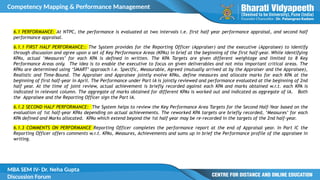
6.1 PERFORMANCE: At NTPC, the performance is evaluated at two intervals i.e. first half year performance appraisal, and second half
performance appraisal.
6.1.1 FIRST HALF PERFORMANCE:: The System provides for the Reporting Officer (Appraiser) and the executive (Appraisee) to identify
through discussion and agree upon a set of Key Performance Areas (KPAs) in brief at the beginning of the first half-year. While identifying
KPAs, actual ‘Measures’ for each KPA is defined in written. The KPA Targets are given different weightage and limited to 8 Key
Performance Areas only. The idea is to enable the executive to focus on given deliverables and not miss important critical areas. The
KPAs are determined using ‘SMART’ approach i.e. Specific, Measurable, Agreed (mutually arrived at by the Appraiser and the Appraisee),
Realistic and Time-Bound. The Appraiser and Appraisee jointly evolve KPAs, define measures and allocate marks for each KPA at the
beginning of first half-year in April. The Performance under Part IA is jointly reviewed and performance evaluated at the beginning of 2nd
half year. At the time of joint review, actual achievement is briefly recorded against each KPA and marks obtained w.r.t. each KPA is
indicated in relevant column. The aggregate of marks obtained for different KPAs is worked out and indicated as aggregate of IA. Both
the Appraisee and the Reporting Officer sign the Part IA.
6.1.2 SECOND HALF PERFORMANCE: The System helps to review the Key Performance Area Targets for the Second Half-Year based on the
evaluation of 1st half-year KPAs depending on actual achievements. The reworked KPA targets are briefly recorded, ‘Measures’ for each
KPA defined and Marks allocated. KPAs which extend beyond the 1st half year may be re-recorded in the targets of the 2nd half-year.
6.1.3 COMMENTS ON PERFORMANCE Reporting Officer completes the performance report at the end of Appraisal year. In Part IC the
Reporting Officer offers comments w.r.t. KPAs, Measures, Achievements and sums up in brief the Performance profile of the appraisee in
writing.
16.
Competency Mapping &Performance Management
MBA SEM IV- Dr. Neha Gupta
Discussion Forum
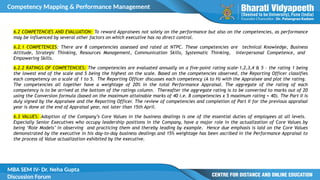
6.2 COMPETENCIES AND EVALUATION: To reward Appraisees not solely on the performance but also on the competencies, as performance
may be influenced by several other factors on which executive has no direct control.
6.2.1 COMPETENCES: There are 8 competencies assessed and rated at NTPC. These competencies are technical Knowledge, Business
Attitude, Strategic Thinking, Resources Management, Communication Skills, Systematic Thinking, Interpersonal Competence, and
Empowering Skills.
6.2.2 RATINGS OF COMPETENCIES: The competencies are evaluated annually on a five-point rating scale-1,2,3,4 & 5 - the rating 1 being
the lowest end of the scale and 5 being the highest on the scale. Based on the competencies observed, the Reporting Officer classifies
each competency on a scale of 1 to 5. The Reporting Officer discusses each competency (A to H) with the Appraisee and plot the rating.
The competencies all together have a weightage of 20% in the total Performance Appraisal. The aggregate of the rating of each
competency is to be arrived at the bottom of the ratings column. Thereafter the aggregate rating is to be converted to marks out of 20
using the Conversion formula (based on the maximum attainable marks of 40 i.e. 8 competencies x 5 maximum rating = 40). The Part II is
duly signed by the Appraisee and the Reporting Officer. The review of competencies and completion of Part II for the previous appraisal
year is done at the end of Appraisal year, not later than 15th April.
6.3 VALUES: Adoption of the Company’s Core Values in the business dealings is one of the essential duties of employees at all levels.
Especially Senior Executives who occupy leadership positions in the Company, have a major role in the actualization of Core Values by
being ‘Role Models’ in observing and practicing them and thereby leading by example. Hence due emphasis is laid on the Core Values
demonstrated by the executive in his day-to-day business dealings and 15% weightage has been ascribed in the Performance Appraisal to
the process of Value actualization exhibited by the executive.
17.
Competency Mapping &Performance Management
MBA SEM IV- Dr. Neha Gupta
Discussion Forum
6.4 POTENTIAL APPRAISAL: In due course of time, the appraisal of ‘Potential Component’ may be done through Assessment Centre or
with the help of such other means, to make the appraisal more broad-based. The personality profile of each individual based on the
Assessment Centre or with the help of other process can become available to the Reporting Officer to enable him to evaluate potential of
the appraise with more objectivity. The Reporting Officer would objectively evaluate the potential of the assessee based on factual
information observed during assessment year.
6.4.1 POTENTIAL EVALUATION CRITERIAS: There are 4 generic competencies i.e. Team Building, Conceptual Ability, Strategic Vision, and
Leadership Abilities are covered for potential evaluation of Executives.
6.4.2 RATING OF POTENTIAL EVALUATION: The evaluation of ‘Generic Competencies’ for potential Appraisal is done through discussion on a
rating scale of 1 to 5. Rating 1 is the lowest and rating 5 being the highest. The evaluation of potential is done on each competency and
rating given against each in the rating column by the Reporting Officer. The aggregate of all the competencies A to D would be arrived at
by totaling all the ratings. This would be out of 20 marks. The Potential Appraisal has a weightage of 15% in the total Performance
Appraisal. The rating on potential out of 15 marks is obtained by using the Conversion formula at the bottom of Part IV. The marks so
obtained out of 15 marks is written in the Box. The Part IV is jointly signed by the Reporting Officer and the Appraisee at the bottom of
the page. The appraisal of this Part for the previous appraisal year is done at the end of Performance Appraisal year, not later than 15th
April.
6.5 PERFORMANCE AND POTENTIAL PROFILE: The Part V would sum up all marks scored for the Performance Appraisal year. The marks
scored for Part I, Part II, Part III and Part IV is transferred to this section and entered against respective item. The aggregate of the marks
scored is arrived at by adding all marks scored for different components. This would form the Final score of Performance & Potential
Appraisal rating of the executive out of 100 marks.
18.
Competency Mapping &Performance Management
MBA SEM IV- Dr. Neha Gupta
Discussion Forum
Example 1: Sales Manager Competency Mapping
A sales manager is a key role in any business. The competencies required for this role may include leadership, strategic thinking,
communication, sales planning, customer relationship management, and results orientation. By mapping the competencies of existing
sales managers against these desired competencies, organizations can identify areas for improvement or potential successors for future
growth. A typical topic for this role is product knowledge: every sales manager needs to know the product they sell particularly well and
in some cases, that requires technical or domain-specific knowledge. Mapping the skills of your sales managers helps the company
understand how quickly they can bring to market new products but also how they can assign specific sales managers to particular products
or regions based on their product knowledge understanding.
Adopting Anthropos, the company can map the skills of every single employee inside the organization and centralize all of them to quickly
find employees for specific skills, projects or needs. Not only that, it’s easy to use our career paths to automatically assign specific
training to a group of people based on their skills or lack of. In this case it would be easy to automatically train all the sales managers to
be at a specific product knowledge. The career path – like the skills – can be fully customized inside Anthropos and you can even decide to
create a Job Simulation to let your sales manager test their product knowledge skills in a safe environment as if they were in front of real
customers.
Example 2: Software Engineer Competency Mapping: Software engineers are among the most competitive roles you can try to hire and
retain in your company (more about software engineers retention in our recent guide). Mapping their skills is usually a great strategy to
help their retention creating a clear career path but also a critical step to make sure your business has an idea of the skills and
technologies you have access to inside your team: a great example is how AI is changing the way companies build their services and
software. Several companies are now relying on their internal software engineers to introduce AI in their products: having a clear
mapping of their skills helps them identify those engineers that have already built software using AI solutions like OpenAI or even better
the ones that aspire to do more with AI and have been playing in their spare time with these tools.
19.
Competency Mapping &Performance Management
MBA SEM IV- Dr. Neha Gupta
Discussion Forum
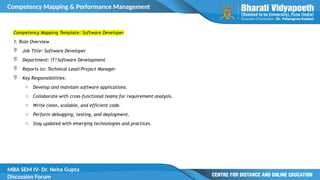
Competency Mapping Template: Software Developer
1. Role Overview
Job Title: Software Developer
Department: IT/Software Development
Reports to: Technical Lead/Project Manager
Key Responsibilities:
o Develop and maintain software applications.
o Collaborate with cross-functional teams for requirement analysis.
o Write clean, scalable, and efficient code.
o Perform debugging, testing, and deployment.
o Stay updated with emerging technologies and practices.
20.
Competency Mapping &Performance Management
MBA SEM IV- Dr. Neha Gupta
Discussion Forum
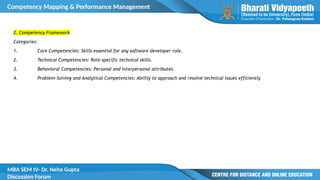
2. Competency Framework
Categories:
1. Core Competencies: Skills essential for any software developer role.
2. Technical Competencies: Role-specific technical skills.
3. Behavioral Competencies: Personal and interpersonal attributes.
4. Problem-Solving and Analytical Competencies: Ability to approach and resolve technical issues efficiently
21.
Competency Mapping &Performance Management
MBA SEM IV- Dr. Neha Gupta
Discussion Forum
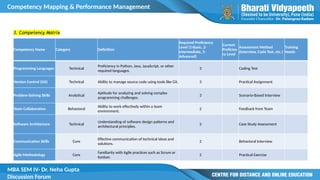
3. Competency Matrix
Competency Name Category Definition
Required Proficiency
Level (1-Basic, 2-
Intermediate, 3-
Advanced)
Current
Proficien
cy Level
Assessment Method
(Interview, Code Test, etc.)
Training
Needs
Programming Languages Technical
Proficiency in Python, Java, JavaScript, or other
required languages.
3 Coding Test
Version Control (Git) Technical Ability to manage source code using tools like Git. 3 Practical Assignment
Problem-Solving Skills Analytical
Aptitude for analyzing and solving complex
programming challenges.
3 Scenario-Based Interview
Team Collaboration Behavioral
Ability to work effectively within a team
environment.
2 Feedback from Team
Software Architecture Technical
Understanding of software design patterns and
architectural principles.
2 Case Study Assessment
Communication Skills Core
Effective communication of technical ideas and
solutions.
2 Behavioral Interview
Agile Methodology Core
Familiarity with Agile practices such as Scrum or
Kanban.
2 Practical Exercise
22.
Competency Mapping &Performance Management
MBA SEM IV- Dr. Neha Gupta
Discussion Forum
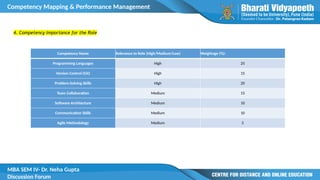
4. Competency Importance for the Role
Competency Name Relevance to Role (High/Medium/Low) Weightage (%):
Programming Languages High 25
Version Control (Git) High 15
Problem-Solving Skills High 20
Team Collaboration Medium 15
Software Architecture Medium 10
Communication Skills Medium 10
Agile Methodology Medium 5
23.
Competency Mapping &Performance Management
MBA SEM IV- Dr. Neha Gupta
Discussion Forum
5. Gap Analysis
Competency Name Current Proficiency Level Required Proficiency Level Gap (if any) Action Plan to Bridge the Gap Timeline
Programming Languages 3 Advanced Programming Workshop 3 Months
Version Control (Git) 3 Git Best Practices Training 1 Month
Problem-Solving Skills 3
Participate in Hackathons/Code
Challenges
Ongoing
Team Collaboration 2 Team-Building Exercises 6 Weeks
Software Architecture 2 Attend System Design Seminars 3 Months
24.
Competency Mapping &Performance Management
MBA SEM IV- Dr. Neha Gupta
Discussion Forum
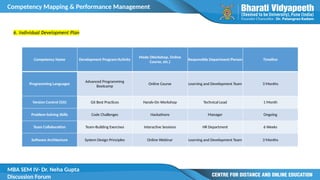
6. Individual Development Plan
Competency Name Development Program/Activity
Mode (Workshop, Online
Course, etc.)
Responsible Department/Person Timeline
Programming Languages
Advanced Programming
Bootcamp
Online Course Learning and Development Team 3 Months
Version Control (Git) Git Best Practices Hands-On Workshop Technical Lead 1 Month
Problem-Solving Skills Code Challenges Hackathons Manager Ongoing
Team Collaboration Team-Building Exercises Interactive Sessions HR Department 6 Weeks
Software Architecture System Design Principles Online Webinar Learning and Development Team 3 Months
25.
Competency Mapping &Performance Management
MBA SEM IV- Dr. Neha Gupta
Discussion Forum
Competency mapping case study
Abstract
Developing employees holistically entails proper observation of their workplace behaviors by the respective managers. Mapping these
observations on the relevant competencies helps in evaluating the current level of employees in each competency.
This leads to the creation of a ‘Development Plan’ for each employee. This case study illustrates, with the help of an example, how an
Empxtrack client utilized the HR system for effectively deploying their competency framework.
Problem Areas
A company highly focused on employee development had identified a set of competencies which were uniformly applicable to all levels of
employees: Junior Executives, Managers and Senior Managers. They needed a process (preferably automated) to evaluate competencies.
This was a PCMM requirement from their quality department.
HR Consultancy
Checking ‘observed behaviors’ at workplace against one or more of the competencies chosen by the organization, and assigning
appropriate weights to each behavior at different employee levels, helped our business analysts create a competency evaluation model. A
scale was then evolved to estimate the current ‘proficiency level’ for each employee.
26.
Competency Mapping &Performance Management
MBA SEM IV- Dr. Neha Gupta
Discussion Forum
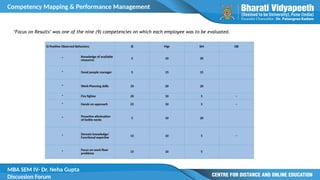
‘Focus on Results’ was one of the nine (9) competencies on which each employee was to be evaluated.
ii) Positive Observed Behaviors: JE Mgr SM OB
*
Knowledge of available
resources 5 10 20
* Good people manager 5 15 15
* Work-Planning skills 10 20 20
* Fire fighter 20 10 5 –
* Hands on approach 25 10 5 –
*
Proactive elimination
of bottle-necks 5 10 20
* Domain knowledge/
Functional expertise 15 10 5 –
*
Focus on work floor
problems 15 10 5
27.
Competency Mapping &Performance Management
MBA SEM IV- Dr. Neha Gupta
Discussion Forum
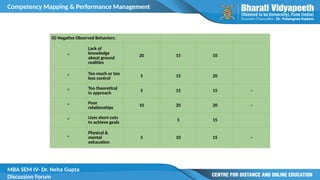
iii) Negative Observed Behaviors:
*
Lack of
knowledge
about ground
realities
20 15 10
*
Too much or too
less control 5 15 20
* Too theoretical
in approach
5 15 15 –
* Poor
relationships
10 20 20 –
*
Uses short-cuts
to achieve goals
5 15
*
Physical &
mental
exhaustion
5 10 15 –
28.
Competency Mapping &Performance Management
MBA SEM IV- Dr. Neha Gupta
Discussion Forum
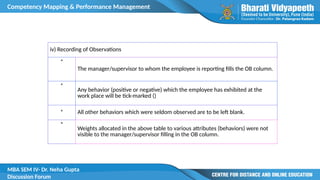
iv) Recording of Observations
*
The manager/supervisor to whom the employee is reporting fills the OB column.
*
Any behavior (positive or negative) which the employee has exhibited at the
work place will be tick-marked ()
* All other behaviors which were seldom observed are to be left blank.
*
Weights allocated in the above table to various attributes (behaviors) were not
visible to the manager/supervisor filling in the OB column.
29.
Competency Mapping &Performance Management
MBA SEM IV- Dr. Neha Gupta
Discussion Forum
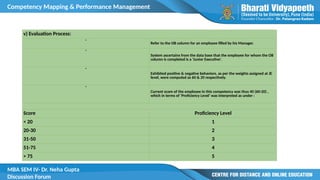
v) Evaluation Process:
*
Refer to the OB column for an employee filled by his Manager.
*
System ascertains from the data base that the employee for whom the OB
column is completed is a ‘Junior Executive’.
*
Exhibited positive & negative behaviors, as per the weights assigned at JE
level, were computed as 60 & 20 respectively.
*
Current score of the employee in this competency was thus 40 (60-20) ,
which in terms of ‘Proficiency Level’ was interpreted as under :
Score Proficiency Level
< 20 1
20-30 2
31-50 3
51-75 4
> 75 5
30.
Competency Mapping &Performance Management
MBA SEM IV- Dr. Neha Gupta
Discussion Forum
Employee Counseling & Development
Based on the above analysis, the employee receives counselling from his Manager to:
1.Improve his domain knowledge.
2.Acquire work planning skills.
3.Enhance relationship with other team members.
For other eight (8) competencies the observed vital behaviors were captured in the same manner and included in the manager’s notes.
The gap between the desired and current proficiency levels for each competency helps the company identify the training needs for each
employee and is then reflected in the ‘Employee Development Plan‘ (for the case in view , the desired proficiency level for ‘Focus on
Results’ was 3. The gap being 0, this competency did not feature in this employee’s Development Plan.
However, as per their succession planning logic, which is based on the overall performance & potential profile of an employee, this
employee was considered fit for induction into the succession pipeline. And since for succession to the Manager’s position, this
competency: ‘Focus on Results’ carried a ‘desired level’ of 4, the employee’s current competency indicated a time frame of 2 – 3 years to
enhance the level from 3 to 4.
31.
Competency Mapping &Performance Management
MBA SEM IV- Dr. Neha Gupta
Discussion Forum
Lessons Learned
• Employee development requires detailed evaluation of the competency profiles.
• Competency management is typically process-oriented. It is a difficult process to be managed manually in either mid-size or
large organizations.
• Performance appraisal, employee counselling, training management plans and succession planning are co-related with
competencies evaluation.
• Automation of the above activities requires an integrated and holistic approach.
32.
Competency Mapping &Performance Management
MBA SEM IV- Dr. Neha Gupta
Discussion Forum
Case Study: Implementing a New Performance Management System using the ADKAR Change Model
Background:
A Project with Company ABC Technology (Name Changed) a technology firm with over two hundred employees. The company decided to
implement a new performance management system to enhance employee productivity and align individual goals with organizational
objectives. As a project consultant and lead I recognized the need for a structured change management approach and chose to use the
ADKAR Change Model to ensure successful adoption and minimize resistance to the new system.
ADKAR Change Model:
The ADKAR Change Model is a framework that focuses on five key elements required for successful change: Awareness, Desire, Knowledge,
Ability, and Reinforcement. Each element represents a stage of the change process and provides a roadmap for managing individual
transitions within an organization.
33.
Competency Mapping &Performance Management
MBA SEM IV- Dr. Neha Gupta
Discussion Forum
Case Study: Implementing a New Performance Management System using the ADKAR Change Model
Implementation Steps:
1. Awareness:
We brainstormed all the possible channels of communication with employees and then created awareness about the need for the new
performance management system. We started with town hall meetings, then sent out company-wide emails, held departmental briefings
to explain the reasons for the change, its benefits, and how it aligned with the company's strategic goals and most importantly how it
benefits them. The goal was to ensure employees understood the need for change and how it would impact on them, their work and
development of themselves as well as their company.
2. Desire:
To build desire for the new performance management system, the implementation team focused on addressing potential concerns and
highlighting the benefits for employees. They emphasized how the system would provide regular feedback, facilitate career growth, and
increase transparency in performance evaluation. The team also engaged key stakeholders and managers to function as change champions,
promoting the benefits and sharing success stories. We also gamified our awareness program by introducing quizzes, games and
associating them with prizes to increase participation and motivation.
34.
Competency Mapping &Performance Management
MBA SEM IV- Dr. Neha Gupta
Discussion Forum
Case Study: Implementing a New Performance Management System using the ADKAR Change Model
3. Knowledge:
We developed comprehensive training programs to equip employees with the necessary knowledge and skills to use the new performance
management system effectively. We conducted workshops, online modules, and one-on-one coaching sessions to ensure employees
understood the system's features, evaluation criteria, and how to set goals. The training materials were tailored to different employee
groups, considering their roles and responsibilities within the organization.
4. Ability:
To ensure employees had the ability to use the new performance management system, we provided ongoing support and resources. They
established a dedicated helpdesk to address technical issues and answer user queries. Additionally, they arranged practice sessions and
mock evaluations to build employees' confidence in using the system. Managers received specific training on providing feedback and
coaching to support their teams through the transition. We had Daily Open Window with the project team in case anyone has any
questions with respect to use of tool and may have encountered issues while using the tool and would like to get it clarified. This helped
the employees to get familiar with the tool and increase their ability to use the tool effectively.
35.
Competency Mapping &Performance Management
MBA SEM IV- Dr. Neha Gupta
Discussion Forum
Case Study: Implementing a New Performance Management System using the ADKAR Change Model
5. Reinforcement:
To reinforce the adoption of the new performance management system, we implemented various strategies. We recognized and rewarded
employees who effectively utilized the system, shared success stories, and highlighted the positive impact on individual and
organizational performance. Regular check-ins and surveys were conducted to gather feedback and identify areas for improvement. We
also monitored system usage and provided additional training and support to individuals or teams struggling with adoption.
Outcomes:
By following the ADKAR Change Model, Company XYZ successfully implemented the new performance management system. Most
employees transitioned smoothly, and the system became an integral part of the company's performance culture. Key outcomes included
increased employee engagement, improved goal alignment, enhanced individual development, and greater transparency in performance
evaluation. The ADKAR model provided a structured approach that facilitated effective change management, minimized resistance, and
ensured the successful adoption of the new system across the organization.
36.
Competency Mapping &Performance Management
MBA SEM IV- Dr. Neha Gupta
Discussion Forum
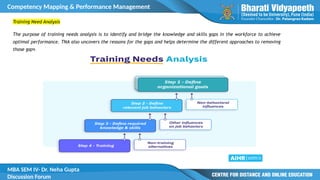
Training Need Analysis
The purpose of training needs analysis is to identify and bridge the knowledge and skills gaps in the workforce to achieve
optimal performance. TNA also uncovers the reasons for the gaps and helps determine the different approaches to removing
those gaps.
37.
Competency Mapping &Performance Management
MBA SEM IV- Dr. Neha Gupta
Discussion Forum
Training Need Analysis
1. Email Marketing Executive example
• Let’s have a look at a practical training needs analysis example for a specific role – Email Marketing Executive.
• First, we need to define a goal. What should an employee in this role achieve? Then, we look at job behaviors that will
enable an employee to achieve this goal. Each behavior comprises specific knowledge, skills, and ability requirements.
• Once you break down the job behaviors into KSA, you can look at the current level of each KSA within your organization or
in a particular employee and determine what the need for training is. Finally, you can identify the right type of training
that will help develop the required knowledge, skill, or ability.
38.
Competency Mapping &Performance Management
MBA SEM IV- Dr. Neha Gupta
Discussion Forum
Training Need Analysis
39.
Competency Mapping &Performance Management
MBA SEM IV- Dr. Neha Gupta
Discussion Forum
Training Need Analysis
2. Organizational level training needs analysis example
Another example of a training needs analysis would be on an organizational level. Let’s consider a simple example of a training needs
analysis (TNA) conducted at an organizational level for a company experiencing a decline in sales performance over the last quarter.
An analysis of sales data and employee feedback indicates that the sales team lacks advanced negotiation skills and up-to-date knowledge
of the latest product features, which are critical for closing deals.
Goal:
Increase quarterly sales performance by 15% to reverse the recent decline and improve overall revenue.
Job behaviors:
Effective negotiation with clients to secure sales
Accurate and persuasive presentation of product features and benefits
40.
Competency Mapping &Performance Management
MBA SEM IV- Dr. Neha Gupta
Discussion Forum
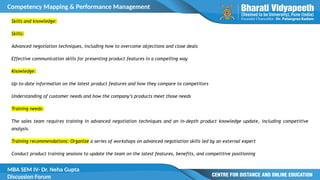
Skills and knowledge:
Skills:
Advanced negotiation techniques, including how to overcome objections and close deals
Effective communication skills for presenting product features in a compelling way
Knowledge:
Up-to-date information on the latest product features and how they compare to competitors
Understanding of customer needs and how the company’s products meet those needs
Training needs:
The sales team requires training in advanced negotiation techniques and an in-depth product knowledge update, including competitive
analysis.
Training recommendations: Organize a series of workshops on advanced negotiation skills led by an external expert
Conduct product training sessions to update the team on the latest features, benefits, and competitive positioning
41.
Competency Mapping &Performance Management
MBA SEM IV- Dr. Neha Gupta
Discussion Forum
3. Hiring Manager example
Steve Dion, Founder & CEO of a leadership consultancy company Dion Leadership, shares a training needs analysis example from a client.
The company was looking to implement interview training on their relatively new process. A training needs analysis revealed that the
problem wasn’t that hiring managers didn’t know or understand the process.
“They too often “freestyled” their approach to interviews to fit their comfort level, thus missing key points the process was designed to
address, which resulted in poor hires,” says Dion. “The training solution we designed covered not only the mechanics of the process, but
the “whys” of each detail, the “unlearning” of old habits, and the clarification of expectations and support.”
42.
Competency Mapping &Performance Management
MBA SEM IV- Dr. Neha Gupta
Discussion Forum
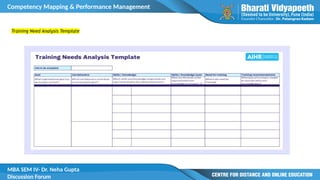
Training Need Analysis Template
43.
Competency Mapping &Performance Management
MBA SEM IV- Dr. Neha Gupta
Discussion Forum
Training needs analysis questions
In each step of the training needs analysis process, you can ask specific question that will help you conduct the assessment in an
effective way.
Step 1. Define organizational goals
• What problems are occurring in the organization?
• What is the organization trying to achieve?
• Which organizational goals require the biggest change in employee behaviors?
• Which departmental goals are lagging?
• Which individual performance goals should be improved?
• Can these problems be solved through different behaviors?
44.
Competency Mapping &Performance Management
MBA SEM IV- Dr. Neha Gupta
Discussion Forum
Training needs analysis questions
Step 2. Define relevant job behaviors
• Which job behaviors contribute to the goals defined in step 1?
• If the listed job behaviors are ‘fixed’, does that bring us closer to the goals defined in step 1?
• Do the listed job behaviors align with our organizational core values?
• Which cultural cues reinforce undesirable behavior?
• What other influences play a role in reinforcing undesirable behavior?
Step 3. Define the required knowledge & skills
• Which skills are required to display the behaviors we defined in step 2?
• Which knowledge components are required to display the behaviors we defined in step 2?
• Once the listed skills and knowledge components are taught, will the relevant job behaviors always be displayed?
• What is hindering the display of relevant job behaviors once the listed skills and knowledge components are taught?
Step 4. Develop training
• Is all the information required to start the training design and development process present?
• Are there non-training alternatives that we can deploy that will have a similar effect?
45.
Competency Mapping &Performance Management
MBA SEM IV- Dr. Neha Gupta
Discussion Forum
Performance Management Case Study: How Benesch Connected the Dots Between Performance and
Engagement
Benesch, a leading firm in the AEC industry, faced several challenges in the last several years. They
needed employees to understand how their performance was being measured, a more effective
strategy for hiring and retaining top talent, and enhanced learning and development tied to succession
planning.
To solve these challenges, they needed to analyze their strategies for effective 1-on-1 performance
conversations, feedback, and build transparency and trust between employees and managers.
The solutions Benesch implemented reduced turnover, boosted employee engagement, and increased
participation in development programs.
By doing these three things, Benesch revamped their performance management strategy and processes:
46.
Competency Mapping &Performance Management
MBA SEM IV- Dr. Neha Gupta
Discussion Forum
1.They identified areas of improvement through feedback and metrics.
It all starts with feedback. Through engagement surveys and employee feedback to managers, they gathered
employee perspectives they could use to understand what was working and where they could improve. They listened
to employee feedback, analyzed the data, and used that information to inform strategic decision-making and take
action.
2. They trained managers to have meaningful 1-on-1 conversations.
Benesch held a training course for managers on how to have successful 1-on-1 conversations with their employees.
This helped them communicate better, as well as build transparency. By including clear performance measures in
those performance conversations, employees could better understand what was expected of them. By doing this,
employees communicated in surveys that they understood performance expectations.
3. HR empowered managers with data and analytics.
Managers were given access to their team engagement results and analytics so they could use those to have better
team discussions. Those discussions led to improved goal-setting. By empowering managers and acting on employee
feedback, Benesch proactively updated its talent management strategies to bridge the gap between engagement and
performance.
47.
Competency Mapping &Performance Management
MBA SEM IV- Dr. Neha Gupta
Discussion Forum
1.They identified areas of improvement through feedback and metrics.
It all starts with feedback. Through engagement surveys and employee feedback to managers, they gathered
employee perspectives they could use to understand what was working and where they could improve. They listened
to employee feedback, analyzed the data, and used that information to inform strategic decision-making and take
action.
2. They trained managers to have meaningful 1-on-1 conversations.
Benesch held a training course for managers on how to have successful 1-on-1 conversations with their employees.
This helped them communicate better, as well as build transparency. By including clear performance measures in
those performance conversations, employees could better understand what was expected of them. By doing this,
employees communicated in surveys that they understood performance expectations.
3. HR empowered managers with data and analytics.
Managers were given access to their team engagement results and analytics so they could use those to have better
team discussions. Those discussions led to improved goal-setting. By empowering managers and acting on employee
feedback, Benesch proactively updated its talent management strategies to bridge the gap between engagement and
performance.
48.
Competency Mapping &Performance Management
MBA SEM IV- Dr. Neha Gupta
Discussion Forum
Performance Management Case Study: How Fossil Group Evolved Its Performance Management
Practices
At a time when the retail industry was undergoing rapid change and increased competition, Fossil Group knew it
needed to find more efficient and effective ways to keep its managers focused on performance management and
results.
Fossil Group used a complex, 100% paper process for performance reviews and check-ins for more than 15,000
global employees. They wanted to move toward a digital performance management strategy, but knew they needed
to simplify the process first.
Fossil Group set up four traditional components that were stretched across three strategic touch points throughout
the year. These touch points were supplemented with ongoing performance conversations that could be initiated by
any employee, at any time.
As Fossil Group evolved its company-wide performance approach, they were happy to see immediate progress.
92% of employees participated in goal-setting reviews, setting an average of six goals per employee.
49.
Competency Mapping &Performance Management
MBA SEM IV- Dr. Neha Gupta
Discussion Forum
Performance Management Case Study: How Fossil Group Evolved Its Performance Management
Practices
However, when they dug into the data, they found that 35% of individual goals created were misaligned or
did not have an impact on the organization and its strategic priorities. They knew they needed to get better
at goal alignment if they wanted to meet important business objectives.
Explore the three ways Fossil Group simplified performance management.
1. They scheduled ongoing performance conversations and continuous feedback.
Although the three formal performance touch points in place were working, Fossil Group knew teams
needed to have goal conversations more frequently. They implemented informal “check-ins” that could be
launched by any employee at any time.
To ensure adequate time was made for important performance conversations and other performance-related
activities, Fossil Group implemented "Performance Days" — days strictly dedicated to employee
performance. On these days, no task-related meetings are scheduled, and all work is set aside for the day.
Conversations between managers, employees, and teams are all centered on performance.
50.
Competency Mapping &Performance Management
MBA SEM IV- Dr. Neha Gupta
Discussion Forum
Performance Management Case Study: How Fossil Group Evolved Its Performance Management
Practices
2. They created intuitive goal conversation templates.
Fossil Group recognized that simply having more performance conversations wasn’t enough — the
conversations needed to include healthy dialogue, debate, and collaboration from managers and employees.
They created 1-on-1 templates to help guide managers and employees through an effective and productive
goal conversation.
Check-in templates could be customized to the needs and work of individual teams and team members. The
templates helped ensure conversations were focused on creating clear, aligned, and motivating goals.
3. They used recognition to keep performance conversations fresh.
Fossil Group wanted to bring performance conversations full circle by recognizing employee performance
daily. They created recognition toolkits for managers including fun notecards, gift cards, and employee
recognition tips. They also launched an online, peer-to-peer recognition program that generated an average
of 140 recognition stories each week.
By taking time to uncover the needs of its employees, and delegating time for managers to focus on
performance, Fossil Group was able to listen and act on employee voices and evolve their performance
strategy for success.
51.
Competency Mapping &Performance Management
MBA SEM IV- Dr. Neha Gupta
Discussion Forum
How Can You See Success in Changing Your Approach to Performance Management?
When it comes to performance management, each organization’s approach is unique. Crafting your strategy is an evolution. You
can’t transform it overnight
As you develop your customized process, follow these steps:
1. Read success stories. Find a performance management case study. Take notes about how you can replicate their success.
2. Act on feedback. What are employees telling you in your engagement survey, pulse surveys, and feedback to managers? How can
it shape your new process?
3. Make one change. The middle ground between traditional and continuous performance is vast. Find one thing you can do now to
move the needle.
4. Train your managers. Make sure your managers understand the change. Coach them in what you expect and how they will
operate with the changes.
5. Get employee buy-in. Explain to employees why you’re making the change. After you’ve made the change, ask employees what
they think.
6. Repeat the process. Take the feedback you get from employees and make another change for continuous process improvement.
Then identify the next action you’re going to take to improve performance management
52.
Competency Mapping &Performance Management
MBA SEM IV- Dr. Neha Gupta
Discussion Forum
What is a competency-based performance management system?
A competency-based performance management system is a set of processes and frameworks organizations use to assess and manage
employee performance based on specific competencies required for their roles.
Competencies are the skills, knowledge, abilities, and behaviors that contribute to an individual's effectiveness in their job. For
each role, specific competencies relate to completing job responsibilities and achieving business goals.
Rather than just focusing on output or results, this type of performance management system emphasizes the processes and
behaviors employees engage in to achieve those results. It enables a more holistic, balanced assessment of employee performance,
incorporating what employees accomplish and how they do it.
How does a competency-based performance management system differ from traditional performance management systems?
A traditional performance management system typically focuses on assessing employees based on their job performance and
achieving predefined objectives. In contrast, a competency-based performance management system evaluates employees based on
their proficiency in specific competencies essential for their roles.
This shift emphasizes developing skills and behaviors that contribute to long-term success rather than short-term performance
metrics.
53.
Competency Mapping &Performance Management
MBA SEM IV- Dr. Neha Gupta
Discussion Forum
What are the key components of a competency-based performance management system?
A competency-based performance management system typically includes the following components:
Competency framework(s): A structured set of competencies required for various organizational roles—they include a mix of core,
functional, technical, and leadership competencies
Competency-based performance appraisal: Regular assessments of employee performance against predefined competencies
(competency frameworks set the expected level of mastery for all relevant competencies)
Competency-based development plans: Personalized plans to help employees improve their competencies
Feedback mechanisms: Processes for providing constructive feedback to employees to support their growth and development
Goal setting: Aligning individual competency profiles and goals with organizational objectives
Training and development: Organizational programs designed to enhance employee competencies
54.
Competency Mapping &Performance Management
MBA SEM IV- Dr. Neha Gupta
Discussion Forum
Traditional performance management
• Setting goals: Goal-setting typically happens annually, and goals are mostly task-oriented
• Focus: The focus is primarily on achieving specific job-related targets and outcomes
• Appraisals: Typically focus on past performance and outcomes
• Behavior change: Behavior change is often secondary, focusing more on end results
• Growth: Growth is typically a function of job performance and achievement of targets
• Check-ins: Performance reviews are often conducted annually or biannually, with few to no check-ins between appraisals
Competency-based performance management
• Setting goals: Goals target job-specific tasks and development of specific competencies
• Focus: The focus is on developing a broad range of competencies and skills alongside achieving job-related targets
• Appraisals: Emphasize both past performance and future competency development
• Behavior change: Competency-based performance management emphasizes behavior change through the development and
reinforcement of key competencies
• Growth: Growth results from both job performance and improvement in key competencies
• Check-ins: Regular check-ins (quarterly or more frequently) take place throughout the year to assess competency development
and performance
55.
Competency Mapping &Performance Management
MBA SEM IV- Dr. Neha Gupta
Discussion Forum
How can organizations identify the right competencies for their performance management system?
Organizations can identify the right competencies through the following methods:
Job analysis: Conducting a thorough analysis of job roles to determine the necessary skills and behaviors
Benchmarking: Comparing with industry standards and best practices
Employee input: Gathering feedback from employees and managers on essential competencies
Strategic goals: Aligning competencies with the organization's long-term strategic goals
Expert consultation: Seeking advice from HR experts and consultants
56.
Competency Mapping &Performance Management
MBA SEM IV- Dr. Neha Gupta
Discussion Forum
What are the benefits of implementing a competency-based performance management system?
1.Standardize performance evaluations
Competency-based performance management standardizes the evaluation process by providing clear criteria for assessing employee
performance. This approach:
• Reduces subjectivity and bias in performance reviews
• Ensures fair and consistent evaluations across the organization
• Helps employees understand role expectations and how you will measure their performance
For example, a financial services firm implements a competency-based performance evaluation system. All employees are assessed
based on standardized competencies such as analytical thinking, customer service, and regulatory compliance.
Managers use these criteria to conduct performance reviews, leading to more objective and transparent evaluations. This
standardization ensures fair employee evaluations, regardless of department or job level.
2.Enable clear career development paths for employees: Competency-based performance management helps define career
development paths, outlining the specific competencies needed for various roles and career progression. Employees can see the
skills and behaviors they need to advance in their careers, fostering motivation and engagement.
For example, a large consulting firm uses competency-based management to outline career paths for its employees. Each role within
the firm has a defined set of competencies required for progression.
Employees can see what skills and competencies they need to develop to move from an associate to a senior consultant and
eventually to a partner. This clear roadmap helps employees focus their development efforts and prepares them for future roles
within the company.
A senior marketer aiming to become head of marketing will know they must develop analytical skills to interpret the data from
different marketing channels and learn to make strategic decisions.
57.
Competency Mapping &Performance Management
MBA SEM IV- Dr. Neha Gupta
Discussion Forum
Create a high-performance organization
Competency-based performance management fosters a culture of continuous improvement and excellence. By focusing on developing
specific competencies, companies encourage employees to enhance their skills and performance continually. This growth-focused
culture leads to higher productivity, innovation, and organizational performance.
For example, a manufacturing company adopts a competency framework emphasizing innovation, quality control, and teamwork. It
regularly trains and assesses workers on these competencies, improving product quality and production efficiency. This high-
performance culture gives the company a competitive edge in the market.
Enable strategic succession planning
Organizations can create targeted development plans for high-potential employees by understanding the competencies required for
key positions, ensuring a solid talent pipeline for critical roles.
For example, a healthcare organization uses a competency-based approach to identify future leaders. They assess current
employees against leadership competencies such as strategic thinking, decision-making, and empathy. High-potential employees can
develop these competencies through mentorship programs and leadership training, ensuring they are ready to step into leadership
roles when needed.
58.
Competency Mapping &Performance Management
MBA SEM IV- Dr. Neha Gupta
Discussion Forum
Improve organization-wide alignment
Competency-based performance management aligns individual performance with organizational goals and values. By establishing a
standard set of competencies across the organization, employees at all levels understand the behaviors and skills the organization
values and expects. This creates a unified approach to achieving business objectives and promotes a cohesive organizational
culture.
For example, a retail company implements a competency framework emphasizing customer focus, communication, and adaptability.
Based on these competencies, they evaluate all employees, from sales associates to senior managers. As a result, the entire
organization aligns around providing exceptional customer service, leading to increased customer satisfaction and loyalty.
Facilitate better hiring decisions
By clearly outlining the specific skills, knowledge, and behaviors required for each role, hiring managers can effectively identify
candidates with the necessary attributes to succeed. This leads to better hiring decisions, as candidates are evaluated not just on
their experience and qualifications but on their ability to meet the competency requirements of the job.
For example: A tech company needs to hire a software engineer. Using a competency-based approach, the hiring manager identifies
critical competencies such as problem-solving, teamwork, and proficiency in specific programming languages.
During the hiring process, they assess candidates on these competencies through targeted interview questions and coding tests,
selecting a candidate who is technically proficient and a great fit for the team dynamic.
59.
Competency Mapping &Performance Management
MBA SEM IV- Dr. Neha Gupta
Discussion Forum
12 Performance Appraisal Competencies
What are Performance Competencies?
Performance competencies are integral components of a performance management system, representing the values and skills
deemed essential for effective job performance within a company. When hiring a new employee, competencies are the standards on
which you base your assessment of the interview.
60.
Competency Mapping &Performance Management
MBA SEM IV- Dr. Neha Gupta
Discussion Forum
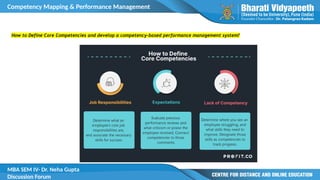
How to Define Core Competencies and develop a competency-based performance management system?
61.
Competency Mapping &Performance Management
MBA SEM IV- Dr. Neha Gupta
Discussion Forum
How to Define Core Competencies and develop a competency-based performance management system?
1. Job Responsibilities
What are the core elements of an employee’s responsibilities?
Consider what their day-to-day tasks might be, challenges that will be faced, and how you expect them to respond to these
challenges.
For example, if you are hiring someone for a front-end retail position, your core competencies might be: customer service,
communication, and teamwork.
If you are reviewing the performance of an engineer, consider core competencies such as technical skill, decision-making, and
planning and organizing.
2. Expectations
During a performance review, it’s wise for a manager to think about their expectations for the employee. Thinking about the level of
performance that you anticipated for an employee as well as their potential for development, can help you evaluate the reality of
their performance. Additionally, you may look at their previous work performance to see how their current performance measures
up against the past, and if they’ve learned from experience.
3. Lack of Competency
You might find that after setting core competencies, some people do not meet the required standards. This might be a major red
flag– however, it’s important to evaluate your options.
Most core competencies can be developed through training or mentoring, and many can be improved with the right guidance.
However, there are some competencies that cannot be easily developed, and can negatively impact an employee’s quality of work
each day. For example, poor technical skills can greatly impact an employee’s contributions to an organization.
62.
Competency Mapping &Performance Management
MBA SEM IV- Dr. Neha Gupta
Discussion Forum
Competencies Evaluation
When evaluating employee performance competency evaluation plays a crucial role in identifying strengths and areas for
improvement. But it’s not just about ticking boxes—it’s about aligning the individual’s capabilities with the business’s goals. To make
competency evaluations more effective, here are some essential points to consider:
1. Clearly Define Core Competencies
What are the key skills or behaviors required for success in each role?
Are these competencies aligned with your business objectives and team needs?
Clearly defined competencies like teamwork, problem-solving, and communication help make the feedback specific and actionable.
2. Evaluate How Competencies Impact Daily Performance
How does an employee demonstrate competencies like teamwork in day-to-day tasks?
Are they using their strengths to solve problems effectively or contributing to group goals?
Competency evaluation should focus on how well an employee applies these skills to everyday tasks, which is crucial for the overall
success of the team and company.
3. Provide Specific and Actionable Feedback
Are you giving actionable feedback? For example, instead of saying, “Work better with the team,” suggest how they can improve
collaboration, like initiating team discussions or sharing updates regularly.
Providing examples of success and where they can improve is needed for employees to understand precisely what they can work on.
63.
Competency Mapping &Performance Management
MBA SEM IV- Dr. Neha Gupta
Discussion Forum
4. Incorporate Regular Check-ins
How often are you assessing competency? Is it part of ongoing feedback rather than only during formal performance reviews?
Regular check-ins allow continuous improvement for employees to stay on track or adjust as needed. This also helps to create a
culture of transparency and trust.
5. Adapt Competencies to Changing Business Needs
• Are the competencies you’re evaluating still relevant to the current business goals?
• Are there new skills or competencies added as your company evolves?
As businesses grow and shift, competencies should evolve, too. Regularly revisiting your competency framework is vital to keeping it
relevant to both employee and organizational needs.
Framing competency evaluation is a dynamic and ongoing process; these steps help managers and employees work together toward
continuous improvement. Instead of a one-time event, competency evaluation becomes a tool for long-term growth, helping to build
a stronger, more capable team.
64.
Competency Mapping &Performance Management
MBA SEM IV- Dr. Neha Gupta
Discussion Forum
How Competency Evaluation Drives Employee Development?
Competency evaluation isn’t only about assessing performance; it’s a tool for boosting employee growth and aligning their goals
with the company’s objectives. Here are some competency-based evaluations that can help
Identify Strengths & Opportunities for Growth
Use the evaluation to highlight what your employees do best and where they can improve. For example, if an employee excels at
teamwork but needs help with time management, focus your feedback on developing both areas.
Set Clear Development Goals
After identifying areas for growth, set actionable goals with your employees. For instance, if communication is an area of
improvement, you can set the goal for the employee to attend a communication skills workshop within the next quarter.
Use PIP (Performance Improvement Plans)
If a competency gap is significant, implement a performance improvement plan (PIP). This plan should include clear benchmarks, a
timeline for improvement, and regular feedback sessions. For example, if an employee’s technical skills lag, outline specific
milestones for progress and training sessions.
Utilize IDPs (Individual Development Plans)
IDPs are essential for ongoing development. These plans focus on long-term career growth. A good IDP might involve setting
educational goals, mentorship opportunities, and projects that stretch the employee’s capabilities. If an employee shows potential
in leadership but lacks experience, you can plan mentoring sessions and leadership training programs.
65.
Competency Mapping &Performance Management
MBA SEM IV- Dr. Neha Gupta
Discussion Forum
12 Performance Appraisal Competency Examples
To help you build your core competencies for a performance review, here are 12 core competencies.
These examples are relatively general and can be adjusted for use in any department or industry. We’ll first provide a competency
statement example to help you understand how these evaluations should be structured, and then we’ll offer up some examples of
performance evaluation comments, including competency & career development plan appraisal comments
1. Problem Solving
Example: “Employees can identify problems in a timely manner and rectify them without issue.”
Praise: “Your ability to effectively diagnose complex problems and find simple solutions is outstanding.”
Constructive comments: “If you’re addressed with a problem you’re unsure how to solve, try to ask myself or one of your peers for
help. Finding solutions is a team effort, and together, we can come up with solutions that work for everyone.”
2. Decision-Making
Example: “Employee has shown to make decisions when asked, and has been able to follow through on those decisions with the best
of their ability.”
Praise: “You’ve shown great initiative making decisions that have led to good outcomes. We’re proud to have you as a part of our
team.”
Constructive comments: “When making decisions, try to understand the whole situation so you can make the best judgment on it.
One good idea is to weigh the pros and cons to understand if the outcome will be the best.”
66.
Competency Mapping &Performance Management
MBA SEM IV- Dr. Neha Gupta
Discussion Forum
12 Performance Appraisal Competency Examples
3. Teamwork
Example: “Employee has been an integral part of the workforce and has acted in team efforts responsibly.”
Praise: “You’re great with working with our team, and everyone values your input.” Or, “You’ve shown great leadership and are
great at playing to everyone’s strengths.”
Constructive comments: “It’s great that you succeed in doing your job, but when others need help, try to offer help or even praise to
cheer them on.” Or, “Try to communicate more with your team to best understand how the team can work towards our collective
goals.”
4. Work Ethics and Standards
Example: “Employee has worked hard towards the company’s goals and has met standards of goals worthy of praise.”
Praise: “We’re so thrilled you put in your best work and would love to extend our congratulations. Good job, as always.”
Constructive comments: “We want you to embody our company’s ethics and standards. Here are a few suggestions we can work on to
improve that.”
67.
Competency Mapping &Performance Management
MBA SEM IV- Dr. Neha Gupta
Discussion Forum
12 Performance Appraisal Competency Examples
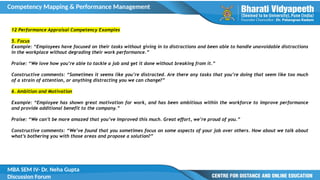
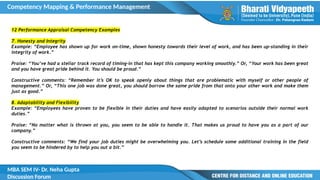
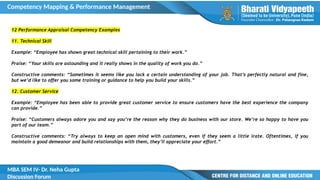
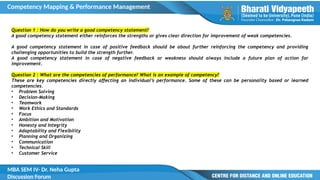
5. Focus
Example: “Employees have focused on their tasks without giving in to distractions and been able to handle unavoidable distractions
in the workplace without degrading their work performance.”
Praise: “We love how you’re able to tackle a job and get it done without breaking from it.”
Constructive comments: “Sometimes it seems like you’re distracted. Are there any tasks that you’re doing that seem like too much
of a strain of attention, or anything distracting you we can change?”
6. Ambition and Motivation
Example: “Employee has shown great motivation for work, and has been ambitious within the workforce to improve performance
and provide additional benefit to the company.”
Praise: “We can’t be more amazed that you’ve improved this much. Great effort, we’re proud of you.”
Constructive comments: “We’ve found that you sometimes focus on some aspects of your job over others. How about we talk about
what’s bothering you with those areas and propose a solution?”
68.
Competency Mapping &Performance Management
MBA SEM IV- Dr. Neha Gupta
Discussion Forum
12 Performance Appraisal Competency Examples
7. Honesty and Integrity
Example: “Employee has shown up for work on-time, shown honesty towards their level of work, and has been up-standing in their
integrity of work.”
Praise: “You’ve had a stellar track record of timing-in that has kept this company working smoothly.” Or, “Your work has been great
and you have great pride behind it. You should be proud.”
Constructive comments: “Remember it’s OK to speak openly about things that are problematic with myself or other people of
management.” Or, “This one job was done great, you should borrow the same pride from that onto your other work and make them
just as good.”
8. Adaptability and Flexibility
Example: “Employees have proven to be flexible in their duties and have easily adapted to scenarios outside their normal work
duties.”
Praise: “No matter what is thrown at you, you seem to be able to handle it. That makes us proud to have you as a part of our
company.”
Constructive comments: “We find your job duties might be overwhelming you. Let’s schedule some additional training in the field
you seem to be hindered by to help you out a bit.”
69.
Competency Mapping &Performance Management
MBA SEM IV- Dr. Neha Gupta
Discussion Forum
12 Performance Appraisal Competency Examples
9. Planning and Organizing
Example: “Employee has created plans that they have followed through with, and has shown great organizational abilities that
benefit workflow.”
Praise: “It’s amazing how well you can plan and organize your job duties and we’re impressed on how thorough and simple to
follow.”
Constructive comments: “When tasked with a big project, try to work out a plan of action and tackle each step one by one.” Or, “To
ensure your working conditions are as efficient as possible so you don’t run into issues. Try to organize a bit more.”
10. Communication
Example: “Employee has respectfully and effectively communicated with customers, fellow workers, and management.”
Praise: “Customers and your fellow coworkers all feel like you can communicate with great ability. We really value that in our
company.”
Constructive comments: “When explaining things to other people, try to keep in mind they might not know what you’re talking
about. It’s best to thoroughly but concisely explain your thoughts.”
70.
Competency Mapping &Performance Management
MBA SEM IV- Dr. Neha Gupta
Discussion Forum
12 Performance Appraisal Competency Examples
11. Technical Skill
Example: “Employee has shown great technical skill pertaining to their work.”
Praise: “Your skills are astounding and it really shows in the quality of work you do.”
Constructive comments: “Sometimes it seems like you lack a certain understanding of your job. That’s perfectly natural and fine,
but we’d like to offer you some training or guidance to help you build your skills.”
12. Customer Service
Example: “Employee has been able to provide great customer service to ensure customers have the best experience the company
can provide.”
Praise: “Customers always adore you and say you’re the reason why they do business with our store. We’re so happy to have you
part of our team.”
Constructive comments: “Try always to keep an open mind with customers, even if they seem a little irate. Oftentimes, if you
maintain a good demeanor and build relationships with them, they’ll appreciate your effort.”
71.
Competency Mapping &Performance Management
MBA SEM IV- Dr. Neha Gupta
Discussion Forum
Question 1 : How do you write a good competency statement?
A good competency statement either reinforces the strengths or gives clear direction for improvement of weak competencies.
A good competency statement in case of positive feedback should be about further reinforcing the competency and providing
challenging opportunities to build the strength further.
A good competency statement in case of negative feedback or weakness should always include a future plan of action for
improvement.
Question 2 : What are the competencies of performance? What is an example of competency?
These are key competencies directly affecting an individual’s performance. Some of these can be personality based or learned
competencies.
• Problem Solving
• Decision-Making
• Teamwork
• Work Ethics and Standards
• Focus
• Ambition and Motivation
• Honesty and Integrity
• Adaptability and Flexibility
• Planning and Organizing
• Communication
• Technical Skill
• Customer Service
72.
Competency Mapping &Performance Management
MBA SEM IV- Dr. Neha Gupta
Unit No 5 –Competency Appraisal & Performance Management
Editor's Notes
#14 6.1 PERFORMANCE: At NTPC, the performance is evaluated at two intervals i.e. first half year performance appraisal, and second half performance appraisal. 6.1.1 FIRST HALF PERFORMANCE:: The System provides for the Reporting Officer (Appraiser) and the executive (Appraisee) to identify through discussion and agree upon a set of Key Performance Areas (KPAs) in brief at the beginning of the first half-year. While identifying KPAs, actual ‘Measures’ for each KPA is defined in written. The KPA Targets are given different weightage and limited to 8 Key Performance Areas only. The idea is to enable the executive to focus on given deliverables and not miss important critical areas. The KPAs are determined using ‘SMART’ approach i.e. Specific, Measurable, Agreed (mutually arrived at by the Appraiser and the Appraisee), Realistic and Time-Bound. The Appraiser and Appraisee jointly evolve KPAs, define measures and allocate marks for each KPA at the beginning of first half-year in April. The Performance under Part IA is jointly reviewed and performance evaluated at the beginning of 2nd half year. At the time of joint review, actual achievement is briefly recorded against each KPA and marks obtained w.r.t. each KPA is indicated in relevant column. The aggregate of marks obtained for different KPAs is worked out and indicated as aggregate of IA. Both the Appraisee and the Reporting Officer sign the Part IA. 6.1.2 SECOND HALF PERFORMANCE: The System helps to review the Key Performance Area Targets for the Second Half-Year based on the evaluation of 1st half-year KPAs depending on actual achievements. The reworked KPA targets are briefly recorded, ‘Measures’ for each KPA defined and Marks allocated. KPAs which extend beyond the 1st half year may be re-recorded in the targets of the 2nd half-year. 6.1.3 COMMENTS ON PERFORMANCE Reporting Officer completes the performance report at the end of Appraisal year. In Part IC the Reporting Officer offers comments w.r.t. KPAs, Measures, Achievements and sums up in brief the Performance profile of the appraisee in writing.
6.2 COMPETENCIES AND EVALUATION: To reward Appraisees not solely on the performance but also on the competencies, as performance may be influenced by several other factors on which executive has no direct control. Competency based evaluation would help the organisation to take systematic steps for bridging the competency gaps.
6.2.1 COMPETENCES: There are 8 competencies assessed and rated at NTPC. These competencies are technical Knowledge, Business Attitude, Strategic Thinking, Resources Management, Communication Skills, Systematic Thinking, Interpersonal Competence, and Empowering Skills. 6.2.2 RATINGS OF COMPETENCIES: The competencies are evaluated annually on a five-point rating scale-1,2,3,4 & 5 - the rating 1 being the lowest end of the scale and 5 being the highest on the scale. Based on the competencies observed, the Reporting Officer classifies each competency on a scale of 1 to 5. The Reporting Officer discusses each competency (A to H) with the Appraisee and plot the rating. The competencies all together have a weightage of 20% in the total Performance Appraisal. The aggregate of the rating of each competency is to be arrived at the bottom of the ratings column. Thereafter the aggregate rating is to be converted to marks out of 20 using the Conversion formula (based on the maximum attainable marks of 40 i.e. 8 competencies x 5 maximum rating = 40). The Part II is duly signed by the Appraisee and the Reporting Officer. The review of competencies and completion of Part II for the previous appraisal year is done at the end of Appraisal year, not later than 15th April. 6.3 VALUES: Adoption of the Company’s Core Values in the business dealings is one of the essential duties of employees at all levels. Especially Senior Executives who occupy leadership positions in the Company, have a major role in the actualisation of Core Values by being ‘Role Models’ in observing and practising them and thereby leading by example. Hence due emphasis is laid on the Core Values demonstrated by the executive in his day-to-day business dealings and 15% weightage has been ascribed in the Performance Appraisal to the process of Value actualisation exhibited by the executive. 6.3.1 COMPANY VALUES: The Corporate Values ‘COMIT’ and the indicative observable behavior in respect of each value is Customer Focus, Organisational Pride, Mutual Respect and Trust, Initiative and Speed, Total Quality 6.3.2 RATINGS Each value has to be evaluated through discussion on a rating scale of 1 to 5 the rating 1 being the lowest and 5 being the highest. The Reporting Officer would evaluate the Appraisee on each of the Value and mark the rating for each value. The ratings are then aggregated at the bottom of the rating column out of maximum of 25. The ratings so obtained would be converted to 15 marks by the conversion formula given. The marks obtained out of 15 marks is written in the Box. The Part III is signed jointly by the Reporting Officer and the Appraisee.
6.4 POTENTIAL APPRAISAL: Potential is a component related to “Competencies”. It seeks to achieve one of the major objectives of the Performance Appraisal System, namely evaluating the suitability of the executive to assume higher responsibilities along the hierarchy. In due course of time, the appraisal of ‘Potential Component’ may be done through Assessment Centre or with the help of such other means, to make the appraisal more broad-based. The personality profile of each individual based on the Assessment Centre or with the help of other process can become available to the Reporting Officer to enable him to evaluate potential of the appraise with more objectivity. The Reporting Officer would objectively evaluate the potential of the assessee based on factual information observed during assessment year. 6.4.1 POTENTIAL EVALUATION CRITERIAS: There are 4 generic competencies i.e.Team Building, Conceptual Ability, Strategic Vision, and Leadership Abilities are covered for potential evaluation of Executives. 6.4.2 RATING OF POTENTIAL EVALUATION:The evaluation of ‘Generic Competencies’ for potential Appraisal is done through discussion on a rating scale of 1 to 5. Rating 1 is the lowest and rating 5 being the highest. The evaluation of potential is done on each competency and rating given against each in the rating column by the Reporting Officer. The aggregate of all the comptencies A to D would be arrived at by totalling all the ratings. This would be out of 20 marks. The Potential Appraisal has a weightage of 15% in the total Performance Appraisal. The rating on potential out of 15 marks is obtained by using the Conversion formula at the bottom of Part IV. The marks so obtained out of 15 marks is written in the Box.The Part IV is jointly signed by the Reporting Officer and the Appraisee at the bottom of the page. The appraisal of this Part for the previous appraisal year is done at the end of Performance Appraisal year, not later than 15th April. 6.5 PERFORMANCE AND POTENTIAL PROFILE: The Part V would sum up all marks scored for the Performance Appraisal year. The marks scored for Part I, Part II, Part III and Part IV is transferred to this section and entered against respective item. The aggregate of the marks scored is arrived at by adding all marks scored for different components. This would form the Final score of Performance & Potential Appraisal rating of the executive out of 100 marks.