` 
CASE STUDY 
Insurance based on 
User Driving Behaviour 
Author – Rajnish Goswami - CEO 
Ingenious Qube Pvt. Ltd. 
info@ingeniousqube.com 
sales@ingeniousqube.com
P a g e | 2 
CASE STUDY 
Insurance based on User Driving Behaviour 
© Copyright. www.ingeniousqube.com 
The Situation 
Insurance companies around the world strive to provide lower insurance rates and auto 
insurance is no exception to this phenomenon. The automobile insurance companies are 
devising ways to derive innovative pricing model that would help the customers reduce their 
insurance premiums, however it requires understanding of how one drives the vehicle. 
Insurance companies determined the premiums not just by the driver’s/vehicle’s history, but 
also by statistical probabilities including age and gender. 
Usage-based insurance (UBI) also known as pay as you drive (PAYD) and pay how you drive 
(PHYD) and mile-based auto insurance is a type of vehicle insurance whereby the costs are 
dependent upon type of vehicle used, measured against time, distance, behaviour and place. 
This differs from traditional insurance, which attempts to differentiate and reward "safe" 
drivers by giving lower premiums and/or a no-claims bonus. 
“Pay How you Drive” (PHYD) car insurance, enables the insurance companies to charge the 
client based on how they actually drive their vehicle. This radically changes the insurance 
model where distance driven and insurance premiums are not aligned (except sometimes 
based on declaration). 
This requires integration of several technologies to enable an end-to-end system including an 
in-vehicle device, communication network and an application platform hosting a number of 
capabilities including a Geographical Information System (GIS) and Customer Relationship 
Management (CRM) system. 
The European and North American motor insurance industries have been operating at a loss 
due to price pressure and the customer acquisitions costs related to the need to hold a 
statistically viable data set that actuaries can analyse to define risk against. 
PHYD based insurance is able to offer an alternative to this method by charging an insurance 
premium based on the actual risk of the driver and reduce the size and volume of claims by 
between 17% and 50%. 
Implementation 
PHYD requires an insurance company to source the driving data and is usually achieved by 
offering a traditional policy at a discount and by installing a telematics device. The driver’s 
data can be analysed against existing risk measurement tools and insurance segmentation. 
Products can then be structured around charging for high risk behaviours or reducing the
P a g e | 3 
premium for low risk. The complexities of the charging regime are only limited by the ability 
to communicate the proposition to the end user. 
PHYD has traditionally been targeted at the extremes of insurance customer segments that 
are either associated as high risk or safer drivers, some examples are: 
· Young Drivers (under 23 years old) – size of premium 
· Family Drivers (females between 30 – 45 years old) – safe defensive drivers 
· Retired Drivers (over 55 years old) – law abiding & low speed drivers 
· Green Drivers (male / females 30 – 70 years old) – reduced mileage & 
© Copyright. www.ingeniousqube.com 
environmentally aware driving 
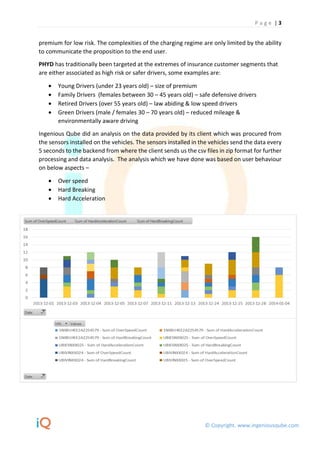
Ingenious Qube did an analysis on the data provided by its client which was procured from 
the sensors installed on the vehicles. The sensors installed in the vehicles send the data every 
5 seconds to the backend from where the client sends us the csv files in zip format for further 
processing and data analysis. The analysis which we have done was based on user behaviour 
on below aspects – 
· Over speed 
· Hard Breaking 
· Hard Acceleration
P a g e | 4 
The data has provided the ability to our client to better its services and to provide best 
premium rates to its customers based on the above data. 
This helps in defining actual risk rather than projected risk at a specific underwritten group of 
users based on their driving behaviour. The transition from projected to actual risk is based 
on the insurers’ ability to identify new risk factors from the data and apply these within a 
product. 
Driver activity data can be mapped and used to identify generic high risk behaviours. This 
method of detecting risk by applying algorithms to automatically analyse the data is 
sometimes referred to as the driver fingerprinting or DNA. 
Mapping driver behaviour. Source: Norwich Union PAYD driver behaviour fingerprint 
© Copyright. www.ingeniousqube.com 
Technology 
Ingenious Qube helped the client in identifying the technology to be used for the POC. We 
have used Hortonworks, HBase, Pig, Hive , Apache Solr, SQOOP. The proposed solution is not 
only highly scalable, but it also securely connects disparate databases / data-sources with 
replication of the data which provides availability of data under all circumstances. Also, the 
proposed system is capable of processing huge chunks of data (Terabytes/Petabytes) in much 
faster manner as compared to the traditional databases. 
Potential Benefits 
· Social and environmental benefits from more responsible driving. 
· Commercial benefits to the insurance company from better alignment of insurance 
with actual risk. Improved customer segmentation. 
· Potential cost-savings for responsible customers. 
· Technology that powers UBI/PHYD enables other vehicle-to-infrastructure solutions 
including drive-through payments, emergency road assistance, etc. 
· More choice for consumers on type of car insurance available to buy.
P a g e | 5 
· Higher-risk drivers pay most per use, thus have highest incentive to change driving 
© Copyright. www.ingeniousqube.com 
patterns or get off the roads, leaving roads safer. 
· For usage-based insurance: Continuous tracking of vehicle location enhances both 
personal security and vehicle security. The GPS technology could be used to trace 
the vehicle whereabouts following an accident, breakdown or theft.

Case study Big Data Insurance

  • 1.
    ` CASE STUDY Insurance based on User Driving Behaviour Author – Rajnish Goswami - CEO Ingenious Qube Pvt. Ltd. info@ingeniousqube.com sales@ingeniousqube.com
  • 2.
    P a ge | 2 CASE STUDY Insurance based on User Driving Behaviour © Copyright. www.ingeniousqube.com The Situation Insurance companies around the world strive to provide lower insurance rates and auto insurance is no exception to this phenomenon. The automobile insurance companies are devising ways to derive innovative pricing model that would help the customers reduce their insurance premiums, however it requires understanding of how one drives the vehicle. Insurance companies determined the premiums not just by the driver’s/vehicle’s history, but also by statistical probabilities including age and gender. Usage-based insurance (UBI) also known as pay as you drive (PAYD) and pay how you drive (PHYD) and mile-based auto insurance is a type of vehicle insurance whereby the costs are dependent upon type of vehicle used, measured against time, distance, behaviour and place. This differs from traditional insurance, which attempts to differentiate and reward "safe" drivers by giving lower premiums and/or a no-claims bonus. “Pay How you Drive” (PHYD) car insurance, enables the insurance companies to charge the client based on how they actually drive their vehicle. This radically changes the insurance model where distance driven and insurance premiums are not aligned (except sometimes based on declaration). This requires integration of several technologies to enable an end-to-end system including an in-vehicle device, communication network and an application platform hosting a number of capabilities including a Geographical Information System (GIS) and Customer Relationship Management (CRM) system. The European and North American motor insurance industries have been operating at a loss due to price pressure and the customer acquisitions costs related to the need to hold a statistically viable data set that actuaries can analyse to define risk against. PHYD based insurance is able to offer an alternative to this method by charging an insurance premium based on the actual risk of the driver and reduce the size and volume of claims by between 17% and 50%. Implementation PHYD requires an insurance company to source the driving data and is usually achieved by offering a traditional policy at a discount and by installing a telematics device. The driver’s data can be analysed against existing risk measurement tools and insurance segmentation. Products can then be structured around charging for high risk behaviours or reducing the
  • 3.
    P a ge | 3 premium for low risk. The complexities of the charging regime are only limited by the ability to communicate the proposition to the end user. PHYD has traditionally been targeted at the extremes of insurance customer segments that are either associated as high risk or safer drivers, some examples are: · Young Drivers (under 23 years old) – size of premium · Family Drivers (females between 30 – 45 years old) – safe defensive drivers · Retired Drivers (over 55 years old) – law abiding & low speed drivers · Green Drivers (male / females 30 – 70 years old) – reduced mileage & © Copyright. www.ingeniousqube.com environmentally aware driving Ingenious Qube did an analysis on the data provided by its client which was procured from the sensors installed on the vehicles. The sensors installed in the vehicles send the data every 5 seconds to the backend from where the client sends us the csv files in zip format for further processing and data analysis. The analysis which we have done was based on user behaviour on below aspects – · Over speed · Hard Breaking · Hard Acceleration
  • 4.
    P a ge | 4 The data has provided the ability to our client to better its services and to provide best premium rates to its customers based on the above data. This helps in defining actual risk rather than projected risk at a specific underwritten group of users based on their driving behaviour. The transition from projected to actual risk is based on the insurers’ ability to identify new risk factors from the data and apply these within a product. Driver activity data can be mapped and used to identify generic high risk behaviours. This method of detecting risk by applying algorithms to automatically analyse the data is sometimes referred to as the driver fingerprinting or DNA. Mapping driver behaviour. Source: Norwich Union PAYD driver behaviour fingerprint © Copyright. www.ingeniousqube.com Technology Ingenious Qube helped the client in identifying the technology to be used for the POC. We have used Hortonworks, HBase, Pig, Hive , Apache Solr, SQOOP. The proposed solution is not only highly scalable, but it also securely connects disparate databases / data-sources with replication of the data which provides availability of data under all circumstances. Also, the proposed system is capable of processing huge chunks of data (Terabytes/Petabytes) in much faster manner as compared to the traditional databases. Potential Benefits · Social and environmental benefits from more responsible driving. · Commercial benefits to the insurance company from better alignment of insurance with actual risk. Improved customer segmentation. · Potential cost-savings for responsible customers. · Technology that powers UBI/PHYD enables other vehicle-to-infrastructure solutions including drive-through payments, emergency road assistance, etc. · More choice for consumers on type of car insurance available to buy.
  • 5.
    P a ge | 5 · Higher-risk drivers pay most per use, thus have highest incentive to change driving © Copyright. www.ingeniousqube.com patterns or get off the roads, leaving roads safer. · For usage-based insurance: Continuous tracking of vehicle location enhances both personal security and vehicle security. The GPS technology could be used to trace the vehicle whereabouts following an accident, breakdown or theft.