9 yr old female child presented at ER with complaints of fever, cough and fast breathing for 2 days
Known case of SLE on Hydroxychloroquine , Azathioprine and Prednisolone .
O/E : Lethargic , tachypnea , febrile feeble peripheral pulse, Temp : 104 F ,
CBC : 22,000 , Neutrophilia
Blood culture was done
Started on empirical antibiotic therapy with Meropenem and Vancomycin
Case
Significance of MIC values in Blood culture report
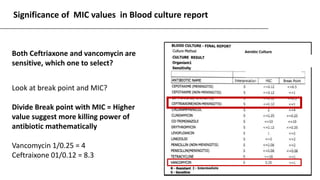
Both Ceftriaxone and vancomycin are
sensitive, which one to select?
Look at break point and MIC?
Divide Break point with MIC = Higher
value suggest more killing power of
antibiotic mathematically
Vancomycin 1/0.25 = 4
Ceftraixone 01/0.12 = 8.3
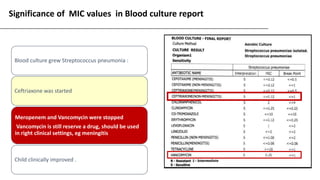
Blood culture grew Streptococcus pneumonia :
Ceftriaxone was started
Meropenem and Vancomycin were stopped
Vancomycin is still reserve a drug, should be used
in right clinical settings, eg meningitis
Child clinically improved .
Significance of MIC values in Blood culture report
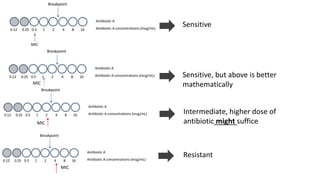
Sensitive
Sensitive, but above is better
mathematically
MIC
MIC
MIC
Intermediate, higher dose of
antibiotic might suffice
Resistant

Case on MIC & Breakpoints.pptx

  • 1.
    9 yr oldfemale child presented at ER with complaints of fever, cough and fast breathing for 2 days Known case of SLE on Hydroxychloroquine , Azathioprine and Prednisolone . O/E : Lethargic , tachypnea , febrile feeble peripheral pulse, Temp : 104 F , CBC : 22,000 , Neutrophilia Blood culture was done Started on empirical antibiotic therapy with Meropenem and Vancomycin Case
  • 2.
    Significance of MICvalues in Blood culture report Both Ceftriaxone and vancomycin are sensitive, which one to select? Look at break point and MIC? Divide Break point with MIC = Higher value suggest more killing power of antibiotic mathematically Vancomycin 1/0.25 = 4 Ceftraixone 01/0.12 = 8.3
  • 3.
    Blood culture grewStreptococcus pneumonia : Ceftriaxone was started Meropenem and Vancomycin were stopped Vancomycin is still reserve a drug, should be used in right clinical settings, eg meningitis Child clinically improved . Significance of MIC values in Blood culture report
  • 4.
    Sensitive Sensitive, but aboveis better mathematically MIC MIC MIC Intermediate, higher dose of antibiotic might suffice Resistant

Editor's Notes

  • #3 MIC (minimum inhibitory concentration), is defined as the lowest concentration of the antibiotic that inhibits growth of the organism. Clinical breakpoints or MIC breakpoints are what microbiology labs use to qualitatively categorize bacteria and other microorganisms in order to help guide clinicians on potential agents to utilize. The breakpoint is the highest plasma concentration of the drug that can safely be achieved in a patient to define susceptibility to an organism. (They’re essentially MIC values that predict probability of treatment success.) Clinical breakpoints are standardized for a specific organism and each antibiotic tested for that organism, not for an individual patient. On the other hand, the MIC is at the patient level. The patient’s MIC is compared to a predetermined standardized breakpoint and subsequently categorized. Standards development organizations such as CLSI or EUCAST determine what the clinical breakpoint for a specific antibiotic would be to a specific organism.
  • #5 The more the distance between MIC and BC – more is the killing power Susceptible (S) MIC is less than the determined breakpoint for the organism. Intermediate (I) / SDD MIC is approaching or at the determined breakpoint. The antibiotic in question may be effective at higher doses. SDD – Susceptible dose dependent : cefepime or piptaz in ESBL , increase dose / reduce frequency might be an option. Colistin is always reported as intermediate , never sensitive as per CLSI - USA. Colistin is an exception in all antibiotics. Resistant (R) MIC is greater than the determined breakpoint. The antibiotic would be unlikely to achieve therapeutic success at safely attainable doses.