Studies & Analyses 355 – Using Resources to Diversify the Economy: Agricultural Price… 
Materials published here have a working paper character. They can be subject to further publication. 
The views and opinions expressed here reflect the author point of view and not necessarily those of 
CASE Network. 
Paper to be presented at CASE - Centre for Social and Economic Research in Warsaw on 4th. 
December 2007. This paper draws upon research undertaken as part of a World Bank project on 
agricultural distortions coordinated by Kym Anderson and Jo Swinnen; more details of the data and 
calculations are in the working paper posted at www.worldbank.org/agdistortions. An earlier version of 
the paper was presented at a seminar at the University of Trento on 23rd. October 2007, and a later 
version will be presented at the American Economic Association meetings in New Orleans on January 4 
2008. 
The publication was financed by Rabobank Polska S.A. 
. 
Keywords: Kazakhstan, diversification, agriculture 
JEL code: Q18 Q32 O13 F14 
© CASE – Center for Social and Economic Research, Warsaw, 2007 
Graphic Design: Agnieszka Natalia Bury 
ISBN 978-83-7178-450-7 EAN 9788371784507 
Publisher: 
CASE-Center for Social and Economic Research on behalf of CASE Network 
12 Sienkiewicza, 00-010 Warsaw, Poland 
tel.: (48 22) 622 66 27, 828 61 33, fax: (48 22) 828 60 69 
e-mail: case@case-research.eu 
http://www.case-research.eu
Studies & Analyses 355 – Using Resources to Diversify the Economy: Agricultural Price… 1 
This report is part of the CASE Network Studies and Analyses series. 
The CASE Network is a group of economic and social research centers in Poland, 
Kyrgyzstan, Ukraine, Georgia, Moldova, and Belarus. Organizations in the network 
regularly conduct joint research and advisory projects. The research covers a wide 
spectrum of economic and social issues, including economic effects of the European 
integration process, economic relations between the EU and CIS, monetary policy 
and euro-accession, innovation and competitiveness, and labour markets and social 
policy. The network aims to increase the range and quality of economic research and 
information available to policy-makers and civil society, and takes an active role in 
on-going debates on how to meet the economic challenges facing the EU, post-transition 
countries and the global economy. 
1 
The CASE network consists of: 
• CASE – Center for Social and Economic Research, Warsaw, est. 1991, 
www.case-research.eu 
• CASE – Center for Social and Economic Research – Kyrgyzstan, est. 1998, 
www.case.elcat.kg 
• Center for Social and Economic Research - CASE Ukraine, est. 1999, 
www.case-ukraine.kiev.ua 
• CASE –Transcaucasus Center for Social and Economic Research, est. 2000, 
www.case-transcaucasus.org.ge 
• Foundation for Social and Economic Research CASE Moldova, est. 2003, 
www.case.com.md 
• CASE Belarus - Center for Social and Economic Research Belarus, est. 
2007.
Studies & Analyses 355 – Using Resources to Diversify the Economy: Agricultural Price… 2 
2 
Contents 
Abstract ..........................................................................................................4 
Introduction....................................................................................................5 
1. Historical Background...............................................................................7 
2. Evolution of Policies since 1991...............................................................9 
(a) Prices and subsidies ..........................................................................10 
(b) Privatization and organizational structure .......................................13 
(c) Trade policies......................................................................................15 
(d) Exchange rate regimes ......................................................................17 
3. Quantifying the distortions .....................................................................20 
(a) Wheat ...................................................................................................22 
(b) Cotton ..................................................................................................25 
(c) Livestock .............................................................................................27 
(d) Other Agricultural Products...............................................................30 
(e) Trade Costs .........................................................................................30 
(f) Rate of Assistance Estimates.............................................................33 
4. Conclusions .............................................................................................35 
References ...................................................................................................48 
Appendix ......................................................................................................54
Studies & Analyses 355 – Using Resources to Diversify the Economy: Agricultural Price… 3 
Richard Pomfret, Professor at the University of Adelaide, received his PhD from 
Simon Fraser University in Vancouver, Canada. Before coming to University of 
Adelaide in 1992, he was Professor of Economics at the Johns Hopkins University 
School of Advanced International Studies in Washington DC, Bologna (Italy) and 
Nanjing (China). He previously worked at Concordia University in Montréal and the 
Institut für Weltwirtschaft at the University of Kiel in Germany. He has also held one-semester 
visiting positions at La Trobe University (1979), the American University of 
Paris (1990), Simon Fraser University and Fudan University in Shanghai (1991), and 
Vanderbilt University (1996).Research interests have centred on economic 
development and international economics. He has written sixteen books, including 
Investing in China 1979-1989. Ten Years of the Open Door Policy (1991); The 
Economies of Central Asia (1995); Asian Economies in Transition (1996); The 
Economics of Regional Trading Arrangements (1997 and 2002), and Constructing a 
Market Economy: Diverse Paths from Central Planning in Asia and Europe (2002); 
Consequences of Creating a Market Economy: Evidence from Household Surveys on 
Central Asia (co-authored with Kathryn Anderson, 2003); The Central Asian 
Economies since Independence (2006). 
3
Studies & Analyses 355 – Using Resources to Diversify the Economy: Agricultural Price… 4 
4 
Abstract 
The agricultural sector in Kazakhstan experienced declining output throughout 
the 1990s, partly because relative prices shifted from being distorted in favor of 
farmers to being distorted against them. After the end of the decade public policy 
shifted towards support for (or less discrimination against) agriculture, boosted by a 
billion-dollar Agriculture and Food Program for 2003-5, which was made possible by 
booming oil revenues. This paper provides estimates of producer support for the 
main agricultural products in Kazakhstan, and analyses the consequences of shifts in 
farm support policy. Methodologically, the paper’s primary concerns are how to 
capture the direction and magnitude of price distortions, how to interpret the 
measures, and what are the policy implications.
Studies & Analyses 355 – Using Resources to Diversify the Economy: Agricultural Price… 5 
5 
Introduction 
Measuring the extent to which an economic activity is protected from import 
competition or favoured by subsidies has a long history. The nominal tariff is only 
one part of the story and since the early 1960s trade economists have used the 
effective rate of protection, i.e. the impact of tariffs on inputs as well as on the output 
of an activity to capture overall protection. In the project evaluation literature, since 
at least the influential work of Little and Mirrlees (1969), world prices have been 
recognized to be the appropriate opportunity cost measures which should generally 
be used in assessing social costs and benefits. In the contentious area of 
agricultural trade, the OECD has pioneered the use of producer support estimates - 
differences between farmgate and border price plus budget transfers - to capture the 
all-of-government distortions facing farmers. 
In this paper the direction and magnitude of price distortions facing farmers are 
estimated to assess the actual impact of what appear to be large swings in policies 
towards agriculture in a tumultuous economic period for Kazakhstan. Border 
measures such as tariffs are not of great importance in this case, and the paper 
attempts to separate the impact of behind the border trade costs (Anderson and van 
Wincoop, 2004) and direct support such as input or other subsidies. 
The economic history of Kazakhstan since the country became independent 
at the end of 1991 divides sharply into two eras. From 1991 until 1998 the economy 
went through a severe recession, which was prolonged by the 1998 Russian Crisis 
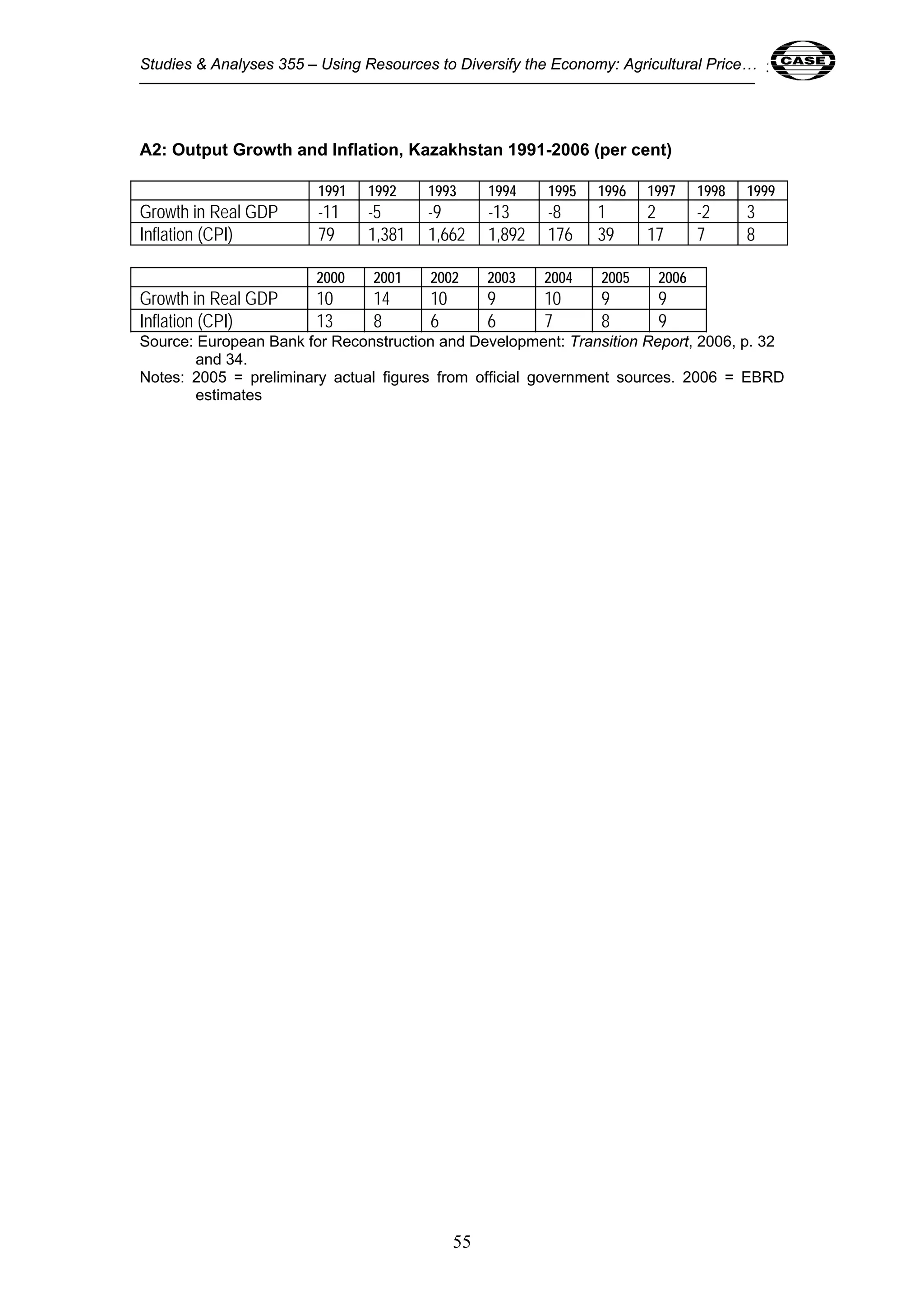
and only turned around in 1999 (Appendix Table A2). The post-1999 growth was in 
part recovery and in part stimulated by a large currency depreciation, but most of all it 
has been driven by oil exports. New discoveries, new pipelines which reduced 
transport costs, and soaring oil prices combined to increase Kazakhstan’s oil exports 
from $1.6 billion in 1998 to $7.3 billion in 2003, and fuel double-digit GDP growth in 
the early years of the twenty-first century (Pomfret, 2005). 
The agricultural sector is a major part of Kazakhstan’s economy, with between 
a quarter and a half of the population depending upon it.1 Following the Virgin Lands 
1 The number of people involved in agriculture is difficult to define, because many people who 
lost their jobs during the transition from central planning reverted to growing their own food, 
although they may not have been officially recorded as employed in agriculture. Even though
Studies & Analyses 355 – Using Resources to Diversify the Economy: Agricultural Price… 6 
program of the late 1950s and 1960s, Kazakhstan became a major grain producer, 
on top of the traditional pastoral economy and a cotton sector concentrated in the 
south. After independence the agricultural sector experienced a severe decline; the 
annual growth rate of agricultural value-added 1990-2001 was -3.22%. The decline 
was reversed around the turn of the century, and from 1999 to 2004 agricultural 
output grew at over 5% a year, mostly due to increased crop production while 
livestock growth was more modest.2 One reason for the decline was a policy 
vacuum, which saw the rapid switch in the early 1990s from support for farmers to a 
market situation where prices of inputs rose much faster than output prices. The 
policy situation was reversed in the early 2000s as the government responded to the 
oilboom by the establishment of an oil fund and promotion of economic 
diversification. One aspect of the diversification strategy was generous support for 
agriculture. 
The first two sections of this paper examine the historical background and the 
evolution of policies since independence. The third section presents estimates of the 
distortions, with emphasis on three principal and different sectors of the farm 
economy: the grains which dominate agricultural exports, the livestock sector, and 
the regionally concentrated cotton sector. The fourth section draws conclusions 
it accounts for less than ten percent of GDP, the farm sector involves perhaps a third of the 
population. According to FAO data for 2001, out of a population of 15.5 million, 6.9 million 
was rural and 3.0 million agricultural, but of the economically active population of 7.6 million 
only 1.3 million was recorded as being in agriculture. According to World Bank data, 
agricultural value-added as a share of GDP in 2001 was 9.37%, but the World Bank’s 2006 
Agricultural Policy Assessment stated that about 43% of the population rely on agriculture for 
their livelihood. 
2 The growth rate is from the World Bank’s 2006 Agricultural Policy Assessment. It is largely 
driven by the increased wheat harvest - from 4.7 million tons in 1998 to 11.5 million tons in 
2003 - which may reflect year-on-year fluctuations rather than an increase in the average 
harvest (Table 1). 
6
Studies & Analyses 355 – Using Resources to Diversify the Economy: Agricultural Price… 7 
7 
1. Historical Background 
Agriculture in the territory of Kazakhstan was traditionally pastoral and 
nomadic. From the mid-1800s, as Russia exercised greater control over the territory, 
public policy encouraged sedentarisation, and a growing proportion of nomads, as 
well as Russian settlers, were planting winter grain by the end of the century. The 
most dramatic change after the 1917 revolution was the enforced collectivization of 
1928-9, which resulted in huge loss of livestock and a great famine. In the 1950s the 
Virgin Lands program brought about 25 million hectares into cultivation (ie. over 60% 
of the current arable land). Northern Kazakhstan became a major producer of wheat 
and barley, although a substantial portion of the land could not sustain long-term 
agriculture and due to the variable climate harvests were highly volatile (Pomfret, 
1995, 82). Agricultural production was carried out on large state or collective farms, 
whose size averaged 35-40,000 hectares in Kazakhstan, and on over 3 million small 
private plots which produced over a third of total output (Green and Vokes, 1997, 
262-3). 
In 1991, just over a quarter of the workforce was employed in agriculture, but 
agricultural output accounted for less than 15% of GDP. Grazing and rangeland 
occupied 140 million hectares, and the livestock sector comprised mainly cattle and 
sheep. Of 39 million hectares of cultivated land, 65% was devoted to cereals and 
33% to fodder crops. In the 1980s Kazakhstan exported up to 10 million tons of 
wheat, and around 300,000 tons of meat, 250,000 tons of milk and 150 million eggs a 
year to other Soviet republics (de Broeck and Kostial, 1998, 39-49). Other crops, 
while minor in terms of overall acreage, were regionally significant. In the south, rice 
and cotton were important crops, and in 1991 cotton was Kazakhstan’s third-largest 
export to non-USSR markets, after mineral fertilizers and coal. Oil crops (sunflower, 
soy, rape, etc), mainly grown in East Kazakhstan and Pavlodar oblasts, satisfied 
about two-fifths of domestic demand. 
In the Soviet economy agriculture received net support as key inputs such as 
fuel and fertilizers were provided at below world prices, and some inputs would not 
have been used had they been fully costed (eg. fodder transported over large 
distances by rail or cotton-harvesting machines). Under the state order system there 
was considerable variation in the profitability of different agricultural activities. In
Studies & Analyses 355 – Using Resources to Diversify the Economy: Agricultural Price… 8 
1991, the purchase price of wheat was more than triple production costs; the 
corresponding ratios were 156% for sunflower, 98% for raw cotton and 75% for 
potatoes, but less than 20% for sugar beets, poultry or pigs. Comparative advantage 
is reflected in lower production costs, but these numbers also suggest that there 
were positive incentives for Kazakhstan’s major crops while import-competing items 
like sugar beet and poultry were less favored. This incentive structure based on 
artificial prices would, of course, change during the transition to a market-based 
economy. 
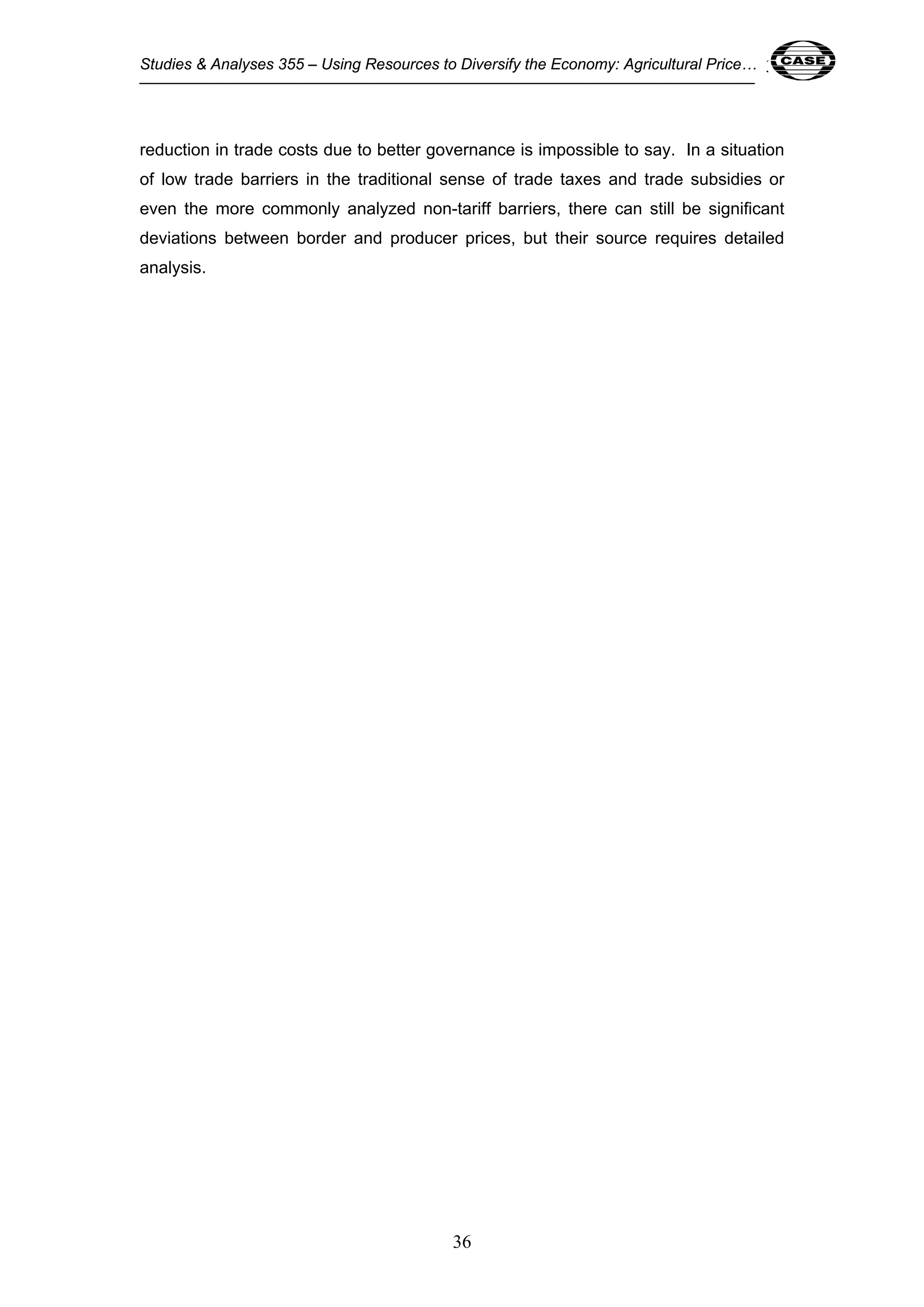
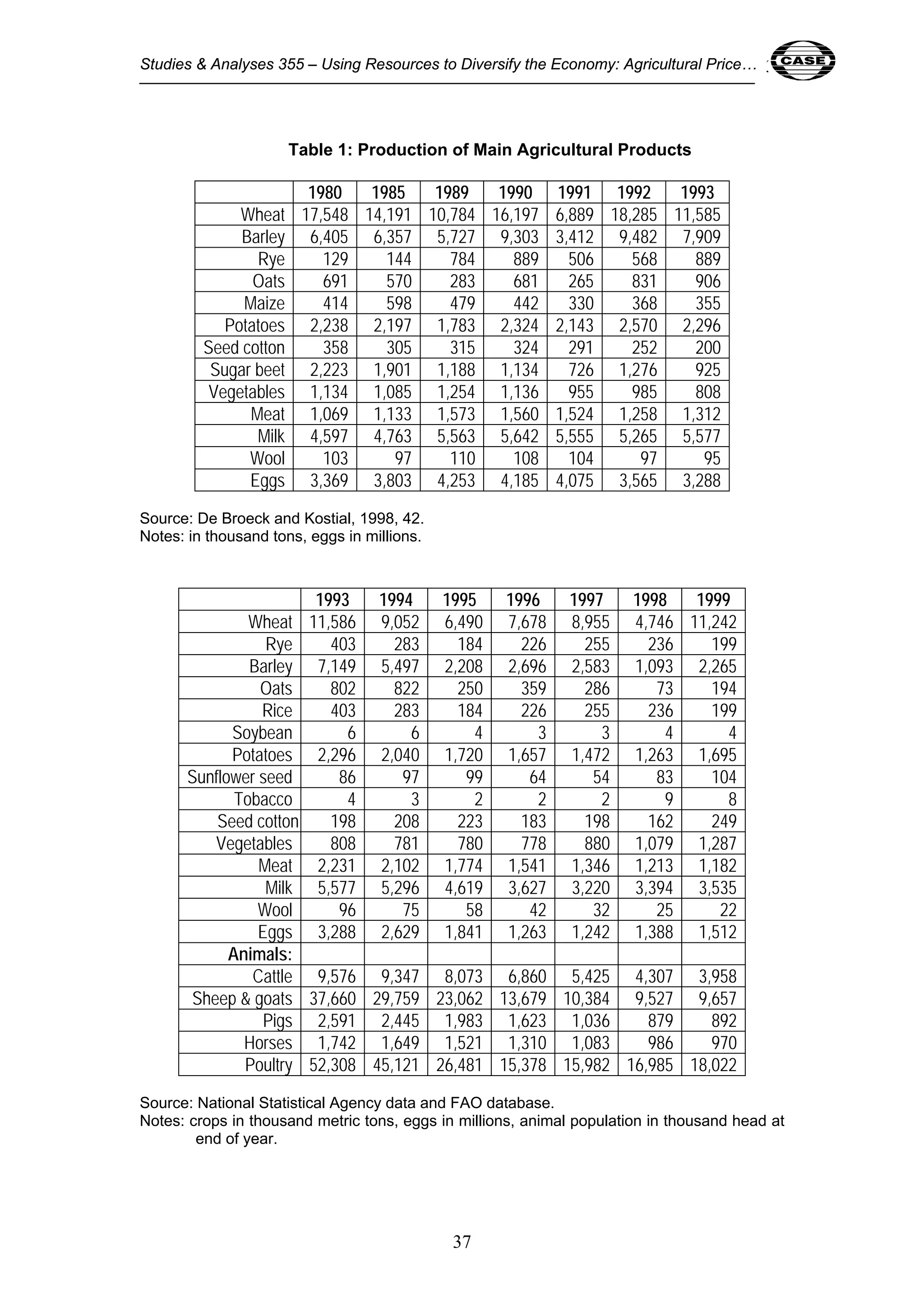
During the 1990s output of all major agricultural products declined substantially 
(Table 1). Recovery started around 1999, although the pattern is complicated by 
huge annual variations in the wheat harvest. In southern Kazakhstan, the turnaround 
started slightly earlier. Cotton output almost tripled between 1998 and 2003, as the 
area sown with cotton, which was more or less constant in the first half of the 1990s 
at 107-111 thousand hectares, increased from 115 thousand hectares in 1998 to 182 
thousand hectares in 2003.3 
The level of agricultural trade as well as the relative importance of food exports 
declined substantially after independence. In 1988 agriculture accounted for 17% of 
exports and the food industry for 7%, but by 2000 these shares had fallen to 6% and 
1% (Freinkman et al., 2004, Table 1.4). In this period the share of oil and gas rose 
from 10% of exports to 50% and that of metals from 19% to 32%. Oil accounted for 
an ever-increasing share after 2000 as both output and the world price increased. 
The post-independence pattern of agricultural trade was of primary products 
being exported and processed food products of higher perceived quality being 
imported.4 Kazakhstan continued to be a substantial food exporter, selling grains, 
and fruit and vegetables primarily to Russia and other CIS markets, and a minor 
3 In part, this reflected an earlier reform of farms in southern Kazakhstan and the decision of 
farmers, especially in the Kzylorda region to shift from rice to cotton production. Cotton 
output figures need to be treated with caution due to the extensive smuggling from 
Uzbekistan and to a lesser extent Turkmenistan as farmgate prices in those countries were 
increasingly repressed by state marketing agencies. Sadler (2006, 104) reports estimates 
that smuggled cotton from Uzbekistan accounted for 25-50% of Kazakhstan’s reported output 
in the early 2000s, but it is hard to evaluate such ballpark figures. The volatility of the cotton 
sector, as reported in the official data (Table 1), is reflected in the 42% decline in the value of 
the crop in 2004 and in the 25% drop in output in 2005. 
4 There were some idiosyncratic short-term developments. Food aid in the early 1990s 
included low-cost chicken parts whose importation exacerbated the problems faced by 
domestic poultry producers, who were among the most-affected by increased prices for fuel 
and concentrate feed. As livestock were slaughtered during the transitional recession, the 
oversupply of low quality hides and skins provided an opportunity for itinerant traders to 
arrange international export of these less-perishable products during the mid-1990s. For an 
analysis of Kazakhstan’s agricultural trade in 1997, see Weber (2003, 395). 
8
Studies & Analyses 355 – Using Resources to Diversify the Economy: Agricultural Price… 9 
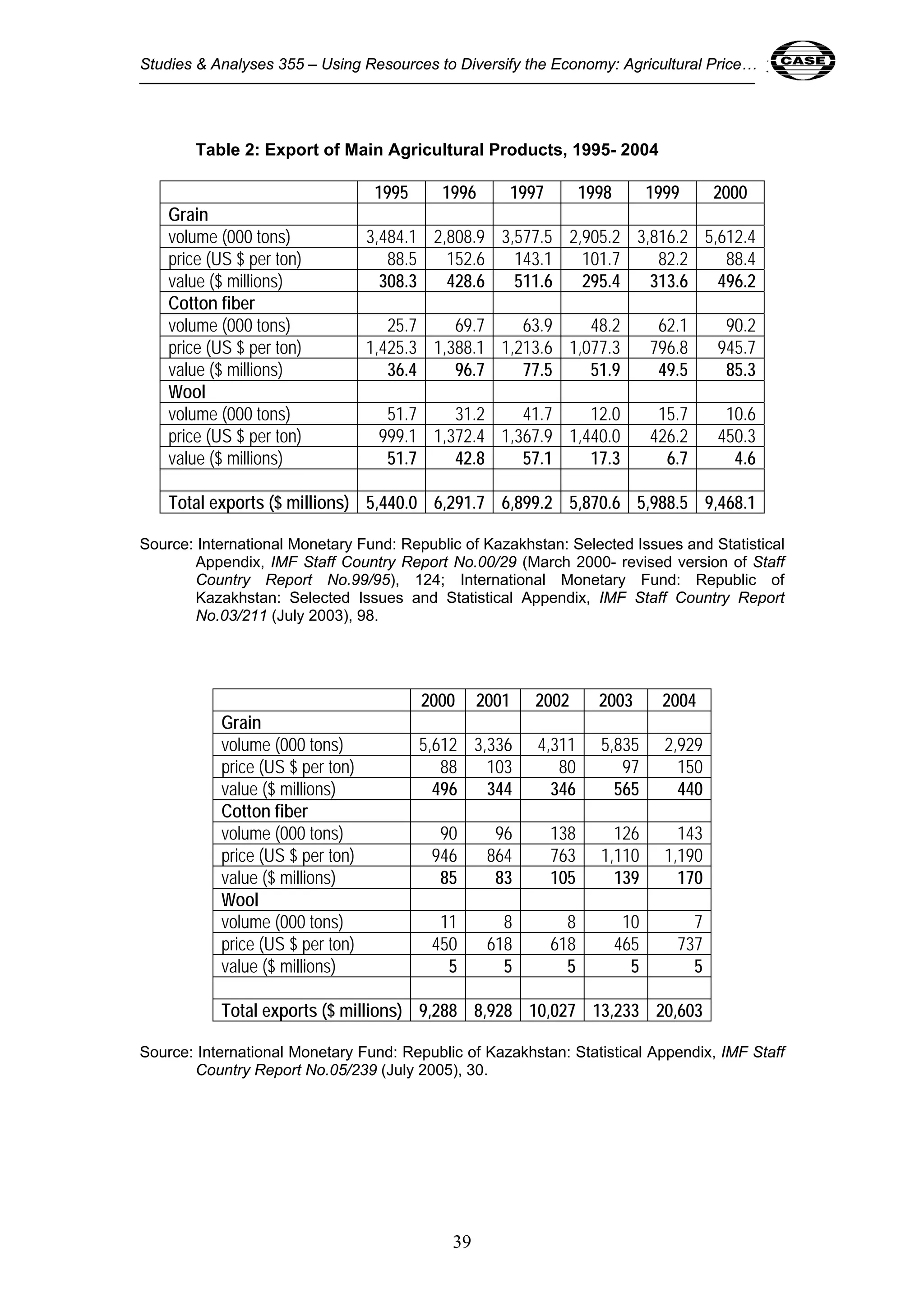
cotton exporter (Table 2). Exports of livestock products declined substantially; dairy 
exports were negligible by the late 1990s and meat exports continued to fall, from 
$16 million in 1998 to $5 million in 2001. In the early 2000s, meat, milk and eggs – 
all important exports in the Soviet era – had almost become non-traded items. 
Kazakhstan was a net importer of sugar (from outside the CIS) and of chicken and 
dairy products (from Russia). Between 1998 and 2001 imports of dairy products rose 
substantially (from $12.3 to $27.0 million for milk and cream, and from $6.6 to $8.4 
million for butter), while meat imports fell (from $32.1 to $18.2 million), suggesting 
some import substitution in the latter but not in the former.5 
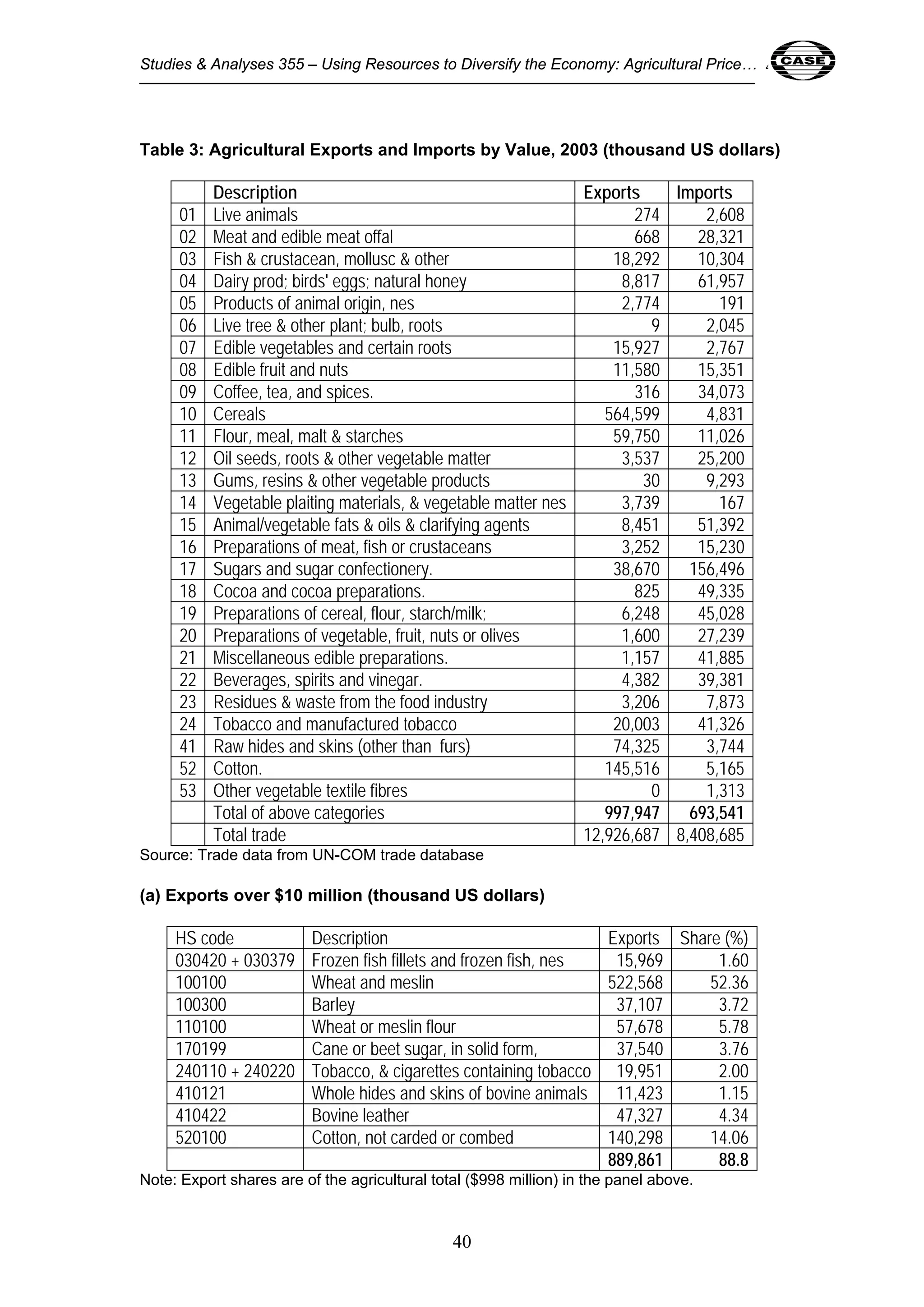
Table 3 presents data on the value of Kazakhstan’s agricultural trade in 2003, 
the latest year available from the UN-COM trade database. The twenty-seven 2-digit 
agricultural and agri-processing sectors sold $998 million worth of exports (7.7% of 
total exports), while imports of these goods amounted to $694 million. This was a 
record year for wheat exports and a good year for cotton exports (Table 2), so the 
total may be unrepresentative, but panel (a) indicates the high level of concentration 
of farm exports. Wheat and wheat flour (58%), cotton (14%), and hides and leather 
(5%) account for over three-quarters of agricultural exports. Imports are more 
diverse, with only raw sugar accounting for over 10% of agricultural imports. Other 
substantial import categories tend to be semi-processed items, such as tea and 
coffee, alcoholic beverages, dairy products and ice cream, edible oils, tobacco 
products, chocolate and confectionary and bakery products. 
2. Evolution of Policies since 1991 
The general policy stance towards agriculture was one of neglect in the 1990s, 
followed by more positive attention in the early 2000s. The effect was that relative 
prices shifted against farmers as agriculture went from being a relatively favored 
economic activity in the late Soviet era to one suffering from net discrimination (or at 
5 The import dominance of Russia reflects an earlier start to investment in agro-processing 
after the end of central planning. There are anecdotal reports of dairy farmers in northern 
Kazakhstan beginning to improve quality after the 1999 devaluation of the tenge in order to 
reclaim milk markets in Russia that they had lost during the 1990s, but this had had little 
impact on export sales by 2003 (Table 3). The recent situation in milk appears to be one of 
intra-industry trade with northern Kazakhstan exporting to Russia and south-east Kazakhstan 
importing from the Kyrgyz Republic. 
9
Studies & Analyses 355 – Using Resources to Diversify the Economy: Agricultural Price… 10 
best neutrality) by the late 1990s. The large currency depreciation in 1999 helped 
the traded goods sector, including producers of the main farm exports (wheat and 
cotton). As government revenues were boosted from the oilboom, budgetary 
assistance to the agricultural sector increased, especially in the billion-dollar 
Agriculture and Food Program for 2003-5 (AFP), which had a variety of objectives 
including consolidation of farms and improving infrastructure and provision of public 
goods. 
10 
(a) Prices and subsidies 
Following the dissolution of the USSR in December 1991, Kazakhstan 
attempted to maintain traditional trade ties through bilateral agreements for interstate 
deliveries. The modified state order system underpinning these arrangements 
covered about three-quarters of 1992 output, including most primary products. 
Delivery targets were, however, not met and in 1993 the government replaced state 
orders by a more flexible state needs system, covering about a fifth of output, mainly 
agricultural products. Compliance was poor, and in 1994 the state needs system 
was downsized and by 1995 it only applied to grains. After state orders were 
abolished the government continued to purchase grain for the strategic reserves - 
700,000 tonnes in 1997 (Csaki and Nash 1998, 91) - and this price was often used 
as a reference price. 
The general price liberalization process was completed at the end of 1994 with 
the abolition of fixed prices for bread and for oil products. Foreign exchange 
surrender requirements were abolished in July 1995, and most export restrictions 
had been lifted by 1996. Export taxes on grain were abolished in April 1996 and 
minimum export prices for farm products were ended in December 1996. Some 
agricultural exports (wheat, rice and cotton) still had to be registered, but this was 
abolished at the end of 1997. 
The farm sector was in deep crisis throughout the 1990s (Gray, 2000). 
Between 1992 and 1995, as prices were liberalized, input prices rose rapidly but 
important output prices remained controlled or rose slowly because of monopsonistic 
markets (eg. many farmers sold their output to the single grain elevator or cotton gin 
in their district), leading to farm losses and resort to barter.6 Subsidies for agriculture 
6 De Broeck and Kostial (1998, 41) estimate that in 1993 the price of inputs used in 
agriculture increased 18.8 times while output prices rose 8.8 times. Green and Vokes (1997,
Studies & Analyses 355 – Using Resources to Diversify the Economy: Agricultural Price… 11 
were substantially reduced from 10-12% of GDP before 1991, to 2-3% in 1993.7 The 
profit squeeze was accentuated in 1994 as directed credits dried up (subsidized 
credits to agriculture, which amounted to 5% of GDP in 1993, were abolished in 
February 1995), and as input subsidy programs were terminated (de Broeck and 
Kostial, 1998, 40). Fertilizer application rates in the wheat sector collapsed; 150,000 
tons of nitrogen, 315,000 tons of phosphates and 10,000 tons of potash were used in 
1992, while in 1994 the corresponding numbers were 65,000, 50,000 and 6,000 
(Meng, Longmire, and Moldashev, 2000, 710). Baydildina et al. (2000, 185) and de 
Broeck and Kostial (1998, 49) report official statistics that the only profitable crops in 
1995 were potatoes and sunflowers; grains, vegetables and eggs made small losses, 
while sugar beet losses were 19% and the average loss for all animal products was 
40%.8 
The second half of the 1990s was characterized by an increasing debt crisis. 
Direction by local authorities led to farms concentrating on activities which they knew 
to be loss-making, while the continued extension of (non-subsidized) loans to loss-making 
farmers sunk them ever deeper into debt. Imposition of heavy penalties for 
tax arrears distorted farmers’ incentives to repay their creditors.9 The problem was 
exacerbated by drought conditions in much of the country during the 1996-8 
seasons. Grain production in 1998 was 6.5 million tons compared to 30 million tons 
in 1992, and the number of cattle fell from nine million to less than four million over 
266) report ADB estimates that a tractor cost 76 tons of wheat in 1990 and 310 tons in 1995, 
while the cost of a combine harvester went from 50 to 580 tons of wheat, and the relative 
price of fuel tripled over the same period. Livestock farmers were hit by increased prices for 
fuel, feed ingredients and animal medicines in 1992-4, while domestic consumption of 
livestock products was hurt by declining incomes (between 1990 and 1998 domestic 
consumption of livestock products fell by about two-fifths) and meat and dairy exports almost 
disappeared amidst the disruption following the dissolution of the USSR (particularly 
important for livestock farmers in eastern and northern Kazakhstan had been supplies of 
meat, wool and other animal products to the Soviet Ministry of Defence). 
7 Measuring subsidies in the early 1990s is complicated because of payment delays. Delayed 
payment of budgetary subsidies to farmers is an implicit tax. On the other hand, many loans 
were not repaid on time, so that calculating the difference between the subsidised interest 
rate and a commercial interest rate understates the credit subsidy. Arrears and repayment 
problems were only really brought under control by 1996-7. By the 1998 budget, only $80 
million was directed to agriculture, of which the largest subsidy was a $33 million credit 
scheme whereby interest rates were half the commercial rate. 
8 A World Bank report on Kzylorda oblast (Kzyl Orda, Regional Development Priorities, Report 
No. 16248 KZ, World Bank, Washington DC, April 1997, 27) presented a similarly dismal 
picture in 1995 but with differing patterns: small profits on grains and wool, but losses of over 
100% on milk, vegetables, potatoes and beef. 
9 The situation was further distorted by arrears in the payment of pensions and other social 
benefits. To a substantial extent in the years up to 1998 cash constraints distorted decision-making, 
and in part explain the huge decline in livestock numbers on the large farms (Table 
4), as farm managers used livestock to pay for inputs or paid workers with sheep in lieu of 
money wages. 
11
Studies & Analyses 355 – Using Resources to Diversify the Economy: Agricultural Price… 12 
the same period.10 At the macroeconomic level, 1998 was the nadir of Kazakhstan’s 
transitional recession, as an incipient recovery in 1996-7 was obliterated by fallout 
from the 1998 Russian Crisis. In 1998 inflation was brought down to single digits, 
and in 1999 growth resumed, accelerating in the early twenty-first century (Pomfret, 
2006, chapter 3). 
For agriculture, reversal of the price squeeze began in 1999, when the 
government introduced a price support system for wheat and then extended it to 
other goods. This was followed by a dramatic increase in the numbers employed in 
agriculture, from 1.3 million in 1999 to 2.4 million in 2001, although some of this is 
due to statistical reclassification of the shadow economy. The Food Contract 
Corporation (FCC) currently purchases about 10-17% of national production with the 
goal of maintaining grain reserves and alleviating short-term price fluctuations, but as 
a large net exporter the FCC cannot deviate far from world prices without risking 
large losses. 
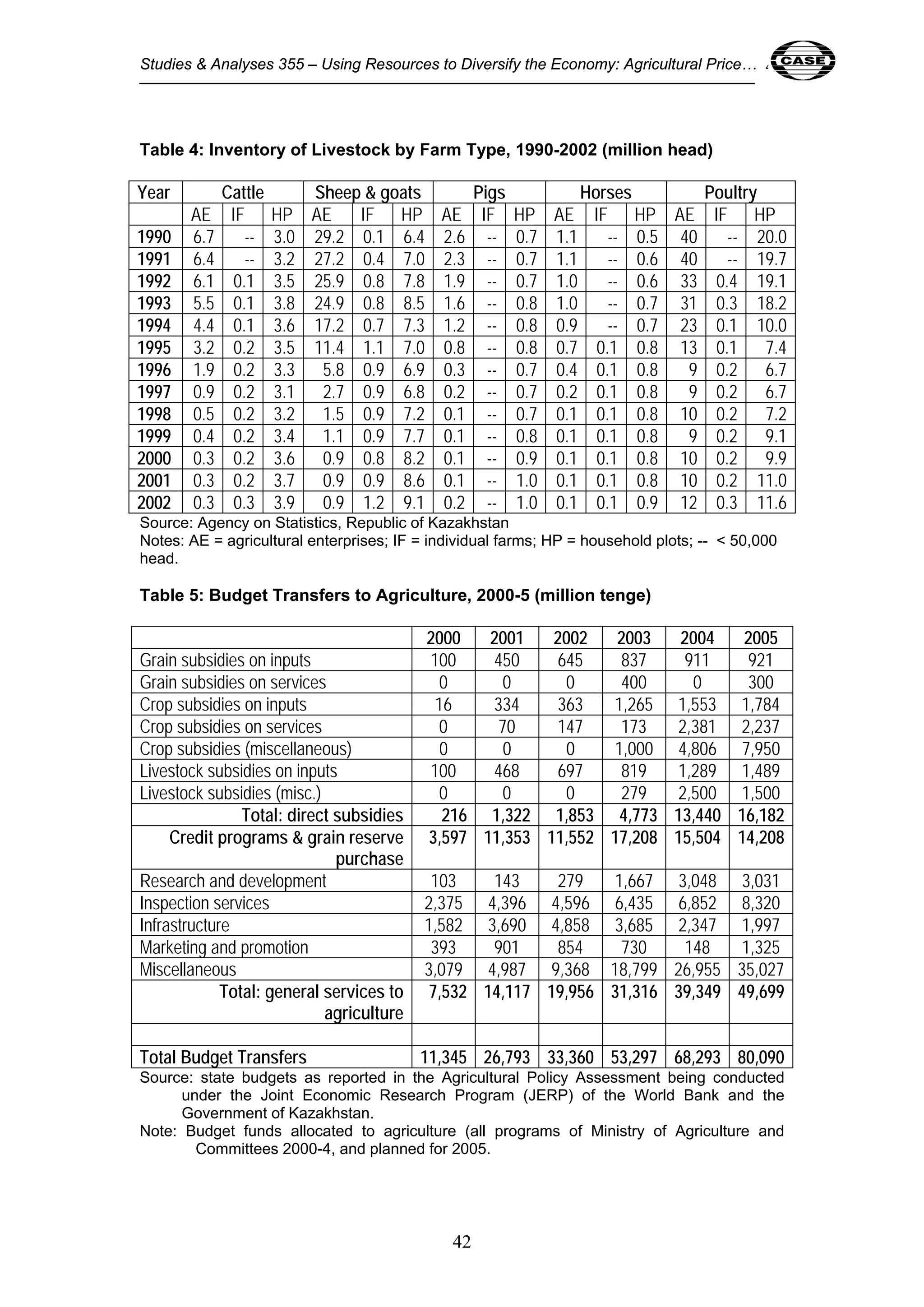
Public expenditure on agriculture, forestry, fisheries and environmental 
protection increased by an average forty percent per year between 2000 and 2005, 
as the budget of the Ministry of Agriculture increased from 11,345 million tenge (less 
than $80 million) to 80,090 million tenge ($600 million) and its share of the total 
central budget went from 2.5% to 6.5%. Much of this allocation was under the billion-dollar 
Agriculture and Food Program for 2003-5 (AFP), which provided general 
services support to agriculture aimed at improving infrastructure and product quality 
(Table 5).11 
The AFP’s stated objectives were to ensure food security, establish an efficient 
agro-industrial system, increase sales of farm products and processed farm products 
in domestic and foreign markets, and optimize state support for agriculture. The 
specifics focused on efficiency and competitiveness, recognizing that technical 
support is an important public service to agriculture. On the other hand, the AFP 
could be used to justify interventionist policies, eg. mention is made of “reasonable 
10 Figures from the United Nations Common Country Assessment – Kazakhstan: 
Achievements, Issues and Prospects, Almaty 2003, 9. The World Bank (Kazakhstan, 
Governance and Service Delivery, Report No. 23257-KZ, May 2002) estimated the decline in 
agricultural production following the dissolution of the USSR at 55% from 1991 to 1998. 
Because of the volatility of grain harvests such estimates are sensitive to the choice of dates, 
but 1991 had already seen a massive decline over 1990 (Table 1). In 1999 agricultural output 
increased by 28%, then fell by 4% in 2000, and increased by 17% in 2001 (EBRD Transition 
Reports). 
11 The initial AFP proposal envisaged expenditures of $271 million in 2003, $330 million in 
2004, and $368 million in 2004. Actual expenditures in the last two years were higher, 
probably due to the burgeoning public receipts from the oilboom. 
12
Studies & Analyses 355 – Using Resources to Diversify the Economy: Agricultural Price… 13 
protectionism” to reduce import dependency. Many incentives are provided by 
subsidies to reduce the cost of inputs (eg. fertilizers, fuel and seeds) and through 
price support schemes, which may work against the aim of increasing efficiency and 
competitiveness.12 
(b) Privatization and organizational structure 
In 1994 farms were in principle privatized, as shares were distributed to 
employees, but most farms were simply reorganized into cooperatives under the 
same management as previously. When land share certificates were issued, most 
were turned over to the collective farm’s management who could use them to 
purchase equipment.13 By 1995 there had been zero decollectivization in the sense 
of breaking up Soviet farms (a unique extreme, according to Mathijs and Swinnen, 
1998, 5), but use rights on private plots (of less than one hectare) were more secure 
in Kazakhstan than in neighboring Uzbekistan or Turkmenistan. 
The 1995 Farm Reform established the principle of state ownership of land, 
with private use-rights under long-term (99-year) leases. The government adopted a 
fresh approach to restructuring in 1998, based on acceptance of the need for 
bankruptcies that would lead to changes in ownership and management. In 2003 the 
government announced several new agriculture initiatives, most of which reflected 
statist attempts to modernize infrastructure, relocate farmers and publicize output 
targets (Nursenkova, 2004). Despite these announced reforms, the overall 
impression is that the government has still not resolved the issue of how the farm 
sector should be organized in the market-based economy. 
The continued large farm size may reflect scale economies in grain farming on 
the Virgin Lands. The small total of farmland that has been purchased and is 
12 Price support was provided through increased funds for the Food Contract Corporation, 
which had been established in 1997 and purchased 1.5 million tons or 20% of the grain 
harvest in 2002, and Mal Onimdery Corporation which had been created in 2001 to provide 
producer support and market regulation for the livestock sector. The fuel subsidies 
encouraged corruption as farmers requested more gasoline than they needed and sold the 
surplus for profit. The fertilizer subsides were paid only to domestic suppliers, acting in a 
similar trade-distorting way to local-content requirements. The price support and subsidies 
were justified by reference to EU and US farm policies, but they may be less sustainable in 
Kazakhstan given the state’s dependence on the volatile oil sector for revenue. 
13 Deininger (2002, 993-4 and 1000) and Lerman et al. (2002, 154) ascribe this renunciation 
of claims to land ownership to lack of asset management experience among the rural 
population. Behnke (2003) reports field research from 1998-9 which showed how state farm 
managers retained control of sampled farms in south-eastern Kazakhstan. 
13
Studies & Analyses 355 – Using Resources to Diversify the Economy: Agricultural Price… 14 
cultivated independently (146,642 ha. by 2005) is almost exclusively in the south, 
where most of the farming is done on individual farms which concentrate on cotton 
production. Livestock farming, apart from chickens, had almost disappeared from 
large farms by the end of the 1990s; the numbers of cattle, sheep and goats, pigs 
and horses in agricultural enterprises had by 2002 all fallen to 5% or less of the 
number in 1990, while the number of animals on individual peasant farms has 
increased by huge percentages but remained small in absolute numbers (Table 4). 
By contrast, livestock inventories on household plots remained fairly stable during the 
transitional recession and have substantially increased since 1997; the overwhelming 
share of animals is now on the over two million household plots (average size 0.2 
hectares), and these backyard farms produced 87% of meat, 91% of milk, 49% of 
wool and 49% of eggs in 2003. 
Land tenure arrangements posed particular problems for the pastoral sector, 
where seasonal migration patterns which had already been eroded over decades of 
deliberate sedentarization were further disrupted by changes in access rights 
(Swinnen and Heinegg, 2002, 1027). Restoring the traditional (pre-Soviet) 
transhumance grazing system could ameliorate the current situation of overgrazing 
on open access lands close to settlements and under-utilization of the country’s 
abundant rangelands, but no legal framework exists to define routes along which 
animals can be moved at low cost to summer pastures and back. 
One problem facing the farm sector has been lack of investment to improve the 
infrastructure and permit quality upgrading. The capital-output ratio, labor 
productivity and total factor productivity all continued to decline in the second half of 
the 1990s and early 2000s, when productivity growth had become positive in other 
sectors.14 Much of the farm produce was spoilt or had become overpriced before 
reaching its primary market. The fruit and vegetables and processed food products 
often became uncompetitive with imported goods because of poor storage, 
processing or packaging. In microcosm and with its own specific problems, the 
agricultural sector typifies the failure of Kazakhstan’s non-oil economy to adapt to 
and flourish in a market-based environment. The government’s three-year program 
14 According to IMF estimates TFP in agriculture declined by an annual average of 1.8% 
during the period 1996-2001, when TFP growth averaged 5.8% in industry, 9.5% in 
construction and 4.0% in services, and labor productivity fell by 8.2% per year in agriculture 
while it was increasing by more than TFP in the other sectors. See International Monetary 
Fund, “Republic of Kazakhstan: Selected Issues and Statistical Appendix”, IMF Country 
Report No. 03/211, July 2003, p.23. 
14
Studies & Analyses 355 – Using Resources to Diversify the Economy: Agricultural Price… 15 
(the 2003-5 AFP) for restoration and development of the agriculture sector began to 
address some of these problems. 
The cotton ginning sector is an exception to this negative picture. By 1998 the 
existing gins had been fully privatized, and several new gins have been constructed 
since then. This is partly explained by the participation of Russian investors wishing 
to access cotton for export directly to textile mills in Russia, and also by the 
increased demand for ginning services in southern Kazakhstan due to large-scale 
smuggling of seed cotton from Uzbekistan (Sadler, 2006, 105). 
15 
(c) Trade policies 
Kazakhstan‘s trade policies are difficult to track in the early post-independence 
years because borders were extremely porous.15 Different practices applied to trade 
with CIS countries and external trade, although the two may not have been easy to 
distinguish at the Russian or Kyrgyz border. Since 1995 Kazakhstan has pursued a 
trade policy based on moderate most-favored nation (MFN) tariffs, although with 
some variability of implementation. Kazakhstan is a member of several regional 
organizations, although the only one to have a significant influence is the Eurasian 
Economic Community. The external environment is also affected by the exchange 
rate regime, which changed in the wake of the 1998 Russian Crisis. 
Following the Russian price reform of January 1992, an immediate concern in 
Kazakhstan was the fear of losing goods in return for rapidly depreciating Soviet 
rubles, and export restrictions were imposed. The export controls were also aimed at 
supporting the interstate delivery system, although, as mentioned above, this 
disintegrated rapidly in 1992-4 as exporters found more favorable prices outside the 
system. Export duties were simplified in 1995 and abolished in 1996. The 
government itself showed some predilection for non-CIS markets as the value-added 
tax was initially refunded only on exports to non-CIS markets; this disincentive to 
15 A large part of international trade in the 1990s was conducted by individual shuttle traders 
(chelnoki) operating between Central Asia and cities in the Gulf, China, India or southeast 
Asia, and often bypassing or bribing the customs officials. The Kazakh authorities estimated 
that over a quarter of total imports in 1995 and a third in 1996 were shuttle imports (reported 
in the International Monetary Fund IMF Staff Country Report No. 97/67 Republic of Kazakstan 
- Recent Economic Developments, August 1997, p. 114-50), but by their nature such 
estimates are gross approximations. The shuttle trade phenomenon has become relatively 
less important in the twenty-first century as the retail sector, especially in the principal cities 
has become better organized.
Studies & Analyses 355 – Using Resources to Diversify the Economy: Agricultural Price… 16 
supply CIS markets was removed in the 1997 budget, and all exports are now zero-rated 
for VAT.16 
The initially ad hoc tariff schedule was simplified during 1995 and 1996 to form 
12 bands, ranging from 1-100%. In January 1997, a new tariff schedule reverted to 
13 bands, but with a maximum of 50% and a lower weighted average tariff (12%). 
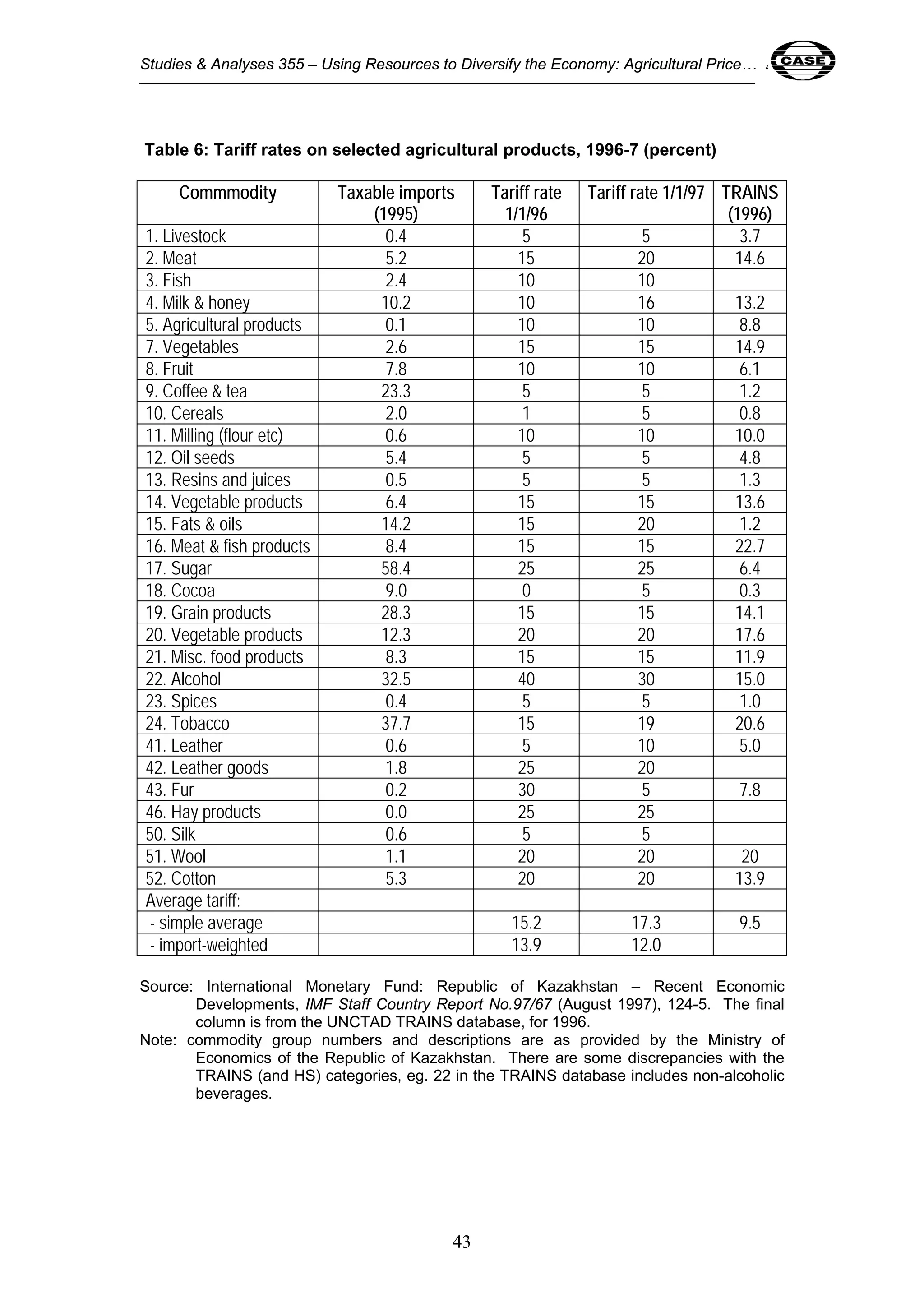
Table 6 provides tariff rates on selected agricultural products in 1996-7. Tariffs were 
further reduced in July 1998, with fewer tariffs over 20% and a weighted average 
tariff of slightly less than 9%. After the Russian crisis and appreciation of the tenge, 
several temporary tariffs of up to 200% and bans on some imports, mainly food 
products from Russia, the Kyrgyz Republic and Uzbekistan, were introduced in the 
first half of 1999, although these were rescinded fairly quickly. Apart from these 
temporary spikes, the only major peak at the 6-digit level is the 100% duty on ethyl 
alcohol (220700); no other category in Table 5 had an individual tariff line peak over 
30%. 
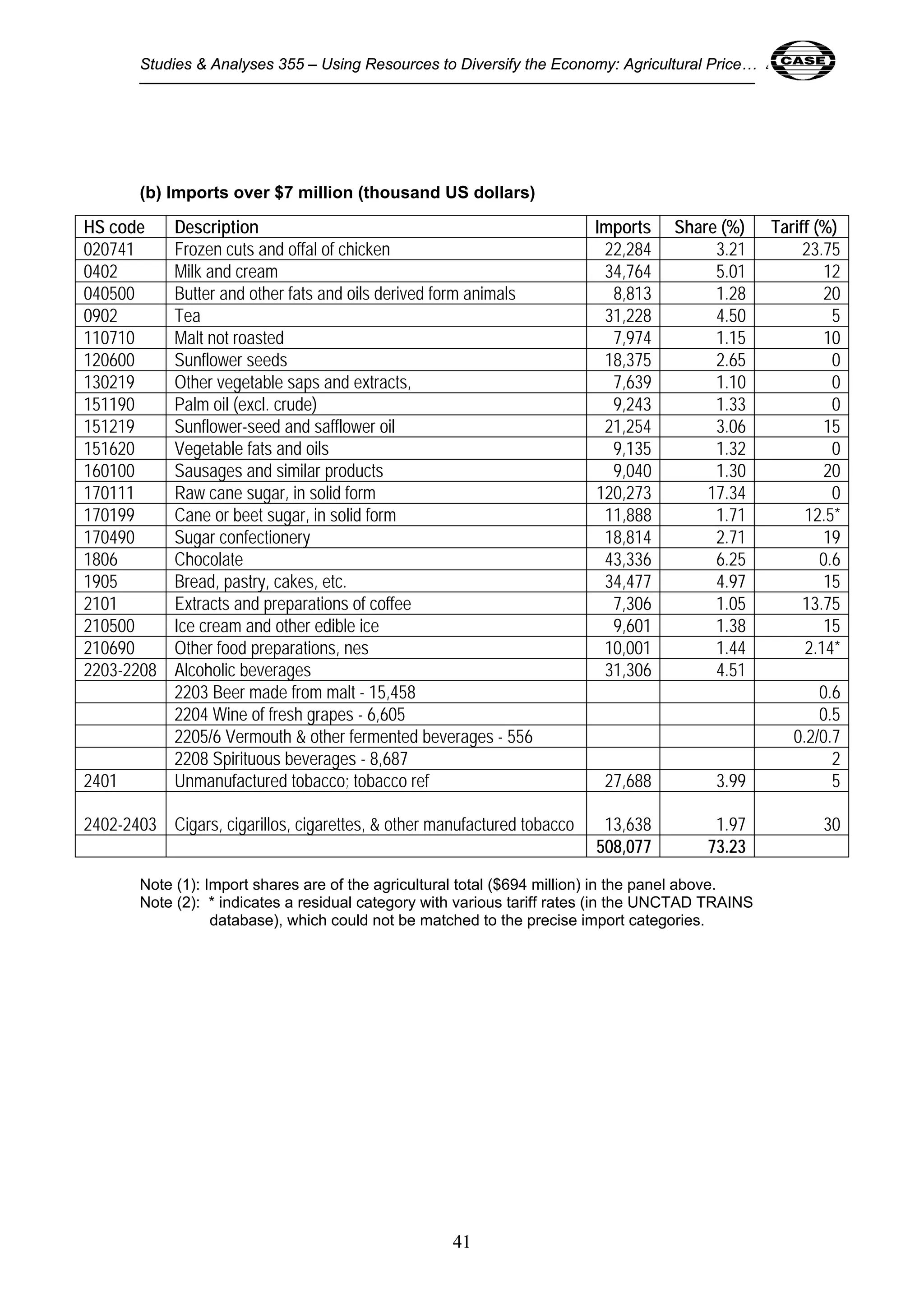
The final column of Table 3(b) matches tariff rates with twenty-two major 
disaggregated import categories (those with over one percent of all agricultural 
imports). Some of the largest import categories enjoyed duty-free status, notably raw 
sugar. Products enjoying the highest tariff protection include manufactured products 
(cigarettes 30%) or processed products (frozen chicken pieces 23.75%, sausages 
20%, sugar confectionary 19%, bread, pastries, ice cream 15%). Dairy products 
(butter 20%, milk 12%) and sunflower seeds (15%) are the only primary farm 
products which Kazakhstan imports in significant amounts with tariffs over 5% 
In January 1996 Kazakhstan lodged its application for WTO membership. The 
process lagged in the late 1990s, associated with slowing reform and economic 
crisis, but resumed in the early 2000s. Key issues in Working Party meetings in 
2003-4 concerned high tariffs on some industrial and agricultural goods, 
Kazakhstan’s desire to maintain some export subsidies and to have ‘developing 
country’ status, inadequate coverage of areas for liberalization under GATS, and 
weak legislation on TRIMS and inadequate institutions to meet SPS, TBT or TRIPS 
requirements. The Draft Report of the Working Party, which is the basis for the final 
negotiations phase of WTO accession, was completed in May 2005 and revised in 
September 2006. 
16 There is no general VAT exemption for the agricultural or agri-processing sectors, but small 
farmers do not pay VAT. This exemption may not help small farmers if agro-processors offer 
a lower price to farmers which are not maintaining VAT accounting in order to compensate for 
the inflated VAT that the processors will have to pay. 
16
Studies & Analyses 355 – Using Resources to Diversify the Economy: Agricultural Price… 17 
Kazakhstan has aimed to keep special ties with other former Soviet republics, 
variously described as a free trade area, customs union or unified economic space, 
although the practical implementation has often been difficult to document. In May 
1993, when the CIS was clearly failing to establish itself as an economic 
organization, ten CIS members, including Kazakhstan, reached an agreement to 
form an economic union, and a formal treaty to that effect was signed in September 
1993. This treaty had little or no effect, although much bilateral trade among CIS 
members (including Kazakhstan’s trade with Russia, Kyrgyz Republic, Uzbekistan 
and Turkmenistan) was unmonitored and hence treated differently to extra-CIS trade. 
In January 1995 Kazakhstan signed a customs union agreement with Belarus 
and Russia. Tariffs on trade between members were eliminated in March, and there 
were moves towards harmonizing external tariffs in 1995-6, although this seemed to 
halt with Kazakhstan’s January 1997 tariff revision. The union was extended to 
include the Kyrgyz Republic in 1996 and Tajikistan in 1999. In February 2000, 
reflecting the lack of progress towards a customs union, a new agreement was 
signed, which envisaged tariff harmonization within five years. In October 2000 the 
union was renamed the Eurasian Economic Community (EurAsEc) and the 
institutional structure was strengthened, and in October 2005 Uzbekistan acceded to 
EurAsEc. Despite the higher profile progress towards a customs union was limited, 
and by 2005 the common external tariff covered only 6,156 of the 11,086 tariff lines 
identified in the union’s classification system (and these were largely ones where the 
members’ pre-existing tariffs had been similar).17 
17 
(d) Exchange rate regimes 
Kazakhstan’s exchange rate history since independence can be divided into 
four phases. Kazakhstan continued to use the ruble until November 1993. From the 
introduction of the national currency until early 1999 the central bank adopted an 
17 The main reason why a EurAsEc common external tariff is unacceptable to Kazakhstan is 
that Russia’s tariffs are higher than those of Kazakhstan, both on average and with peaks on 
individual items. Although the Kazakh authorities have indicated that Russia’s tariff is used as 
an informal benchmark for Kazakhstan’s offers of bound tariff levels in its WTO negotiations, it 
is unlikely that Kazakhstan would want to raise tariffs which would hurt the country’s 
consumers to the benefit of Russian producers, when Russia’s own tariffs would remain 
unchanged providing no new preferential advantage to Kazakh exporters. Tumbarello (2005, 
Table 4) estimates the net welfare costs to Kazakhstan from tariff harmonization at Russian 
levels to be $32 million; the trade diversion and trade destruction impose large costs on 
consumers, which are only partially offset by higher tariff revenue.
Studies & Analyses 355 – Using Resources to Diversify the Economy: Agricultural Price… 18 
almost-fixed crawling peg regime, which was successful in ending hyperinflation and 
resulted in substantial real exchange rate appreciation during 1994-6. In April 1999, 
driven by a large appreciation of the tenge relative to the ruble following the 1998 
Russian crisis, the tenge was allowed to float. Since May 1999, the central bank has 
pursued a dirty float; despite pressures for appreciation of the tenge, it has 
maintained an exchange rate anchor. 
In 1992 and for most of 1993, the country continued to use the ruble. The 
institutional features of the ruble zone allowed each member country to create ruble 
credits, which set up a classic free rider situation and led to hyperinflation (Pomfret, 
1995). During these first two years following the dissolution of the Soviet Union, with 
prices rising at over fifty percent a month, frequent currency shortages and the 
sudden replacement of Soviet rubles by Russian rubles in mid-1993, relative prices 
did not operate as efficient signaling mechanisms and it is impossible to measure 
price distortions in any meaningful way. 
In November 1993 Kazakhstan introduced a national currency, the tenge. For 
the first few months of 1994, the new currency depreciated in real terms. The 
stabilization program introduced in 1994 used the exchange rate as an anchor – an 
almost-fixed crawling peg, which gave credibility to monetary policy. The shift to a 
non-accommodating monetary policy was accompanied by a real appreciation from 
mid-1994 to 1996, by which time annual inflation had been brought below 50%. In 
July 1996 Kazakhstan accepted IMF Article VIII, making the tenge convertible for 
current account transactions. This exchange rate policy was, with minor 
adjustments, maintained through the 1997 Asian Crisis and the 1998 Russian Crisis. 
Failure to follow the large ruble devaluation in August 1998 led to loss of 
competitiveness vis-à-vis Russia, the country’s largest trading partner. Throughout 
1997 and the first half of 1998 the tenge remained at 75-77/US$, and although the 
tenge depreciated in the second half of 1998 it stood at 88/$ at the start of April 1999. 
Meanwhile, the Russian ruble, which through 1997 and up to the start of August 1998 
had traded at 6/$, fell to 13/$ by the end of August and further depreciated to 26/$ by 
April 1999. Thus, the tenge/ruble exchange rate had appreciated from a fairly stable 
12-13 before August 1998 to less than 4 tenge to the ruble eight months later. The 
consequence for Kazakhstan was a severe recession. 
In April 1999 Kazakhstan allowed the tenge to float. After the announcement of 
the float, the tenge fell to 99/$ on April 4th and to 130/$ by the end of May 1999. The 
large depreciation of the tenge in April and May 1999 fuelled a rapid recovery. The 
subsequent sustained boom was driven by the expansion of oil exports as world 
18
Studies & Analyses 355 – Using Resources to Diversify the Economy: Agricultural Price… 19 
prices soared from less than $10 a barrel in 1998 to $99 in 2007, new oil fields came 
into production, and new pipeline routes undermined the monopsony power of the 
Russian state company, Transneft. 
Since May 1999, the central bank appears to have reverted to an exchange-rate 
anchor. Although there have been fluctuations, the exchange rate in February 
2006 was 130/$, the same as at the end of May 1999, despite strong pressures for 
currency appreciation. In 2007 the tenge appreciated to around 120/$ in May, and 
remained in the 120s through the summer, but this may reflect keeping a balance 
between the dollar and the euro (against which the tenge depreciated from 162 to 
172 between May and August 2007) rather than acceptance of a real appreciation.18 
By the end of 2003 the economy was already exhibiting signs of overheating due to 
demand pressure from large FDI-financed oil investments, fiscal and public sector 
expansion, and a credit-fuelled private boom. All of these pressures were driven by 
the oilboom and expectation of its continuation, and in 2004-7 these expectations 
were more than justified as oil prices continued to rise. 
The current exchange rate regime is unsustainable. Oil income will force 
appreciation of the tenge, and the key issue is the pace and manner of the 
appreciation and whether volatility can be minimized. The central bank has 
accumulated foreign exchange reserves to limit exchange rate appreciation, while 
issuing domestic debt to reduce prospects for recession in the non-oil sector. At the 
end of 2006 reserves including oil fund assets, stood at $33 billion, or over twelve 
months of imports. Rapid expansion of domestic credit may be dangerous given the 
limited experience of the banks in managing credit exposure and of the banking 
supervisors; temptations to lend for construction and real estate, for example, could 
be producing an asset bubble. From 2005 to 2006 government spending increased 
from 1,687 to 2,060 billion tenge, but the general government surplus still increased 
from 5.8 to 7.5 percent of GDP due to burgeoning revenues, and in 2006 the central 
bank increased interest rates and broadened reserve requirements. Inflation was 
18 Measurement of the real exchange rate is complicated by the need to change weights. 
Kazakhstan’s economy remained heavily oriented towards Russia, at least with respect to 
trade, until 1998, but after the crisis there appears to be a more concerted effort to diversify 
international economic relations, so that exchange rates relative to the US dollar, the euro 
and the yuan have become more important since the turn of the century. Kuralbayeva et al. 
(2001, Figure 2) illustrate a plausible pattern of real exchange rate depreciation in early 1994, 
followed by sharp appreciation which flattens out in 1996 and then another sharp depreciation 
in 1999 followed by a plateau, but estimating the magnitude of the real exchange rate 
changes is difficult. The IMF (Country Report No.07/235, July 2007, 11) estimated that “as of 
end-2006, the tenge may have been up to 20 percent undervalued in real, trade-weighted 
terms form a medium-term perspective.” 
19
Studies & Analyses 355 – Using Resources to Diversify the Economy: Agricultural Price… 20 
edging up (Table A2), and expansionary fiscal policies (putting pressure on the price 
of non-tradables) and tight monetary policies (leading to nominal appreciation) could 
exacerbate the problem if they lead to the real appreciation overshooting. 
This exchange rate history has implications for calculation of support to the 
agricultural sector. With perfectly functioning markets exchange rate changes will be 
reflected immediately in domestic prices unless public policies shield a sector from 
such changes, and any gap between domestic and world prices can be considered a 
policy distortion, but in transition economies such pass-through is far from perfect. 
The exchange rate volatility in 1993-4 and 1998-9 in Kazakhstan affected the gap 
between border and farmgate prices even in the absence of any policy distortion. In 
the current environment, increased fiscal spending on agriculture if accompanied by 
tight monetary policy will have an ambiguous effect on incentives to tradable farm 
goods as the real appreciation overshoots. The level of the exchange rate can also 
distort the interpretation of producer support based on the price gap, eg. an 
overvalued currency will hurt the tradables sector, and worries about “Dutch disease” 
effects are a genuine concern for an oilboom economy. In sum, attention should be 
paid to reading too much into annual variations in support estimates based on the 
price gap, especially at times of large shifts in the exchange rate.19 
3. Quantifying the distortions 
The expectation from the discussion in the previous section is that policy-induced 
price distortions should be small both within Kazakhstan’s agricultural sector 
and for agriculture relative to other sectors. Kazakhstan is a net agricultural exporter 
and the main export products, grains and cotton, are not characterized by significant 
subsidies or by taxes. For cotton this is in contrast to neighboring Uzbekistan and 
Turkmenistan where state marketing boards cream off a large part of the rents 
19 Some OECD studies have used a shadow exchange rate in calculating Producer Support 
Estimates. Melyukhina (2003, 127) argues that the discretion in the choice of appropriate rate 
creates non-transparency, and that the nominal exchange rate should be used. Shick (nd.) 
argues that this is misleading for Russia where PSE calculations for 1999 and 2000 are 
dominated by exchange rate changes following the 1998 Crisis, rather than reflecting 
changes in agricultural support policies. Because Kazakhstan’s currency is convertible the 
nominal rate is less obviously inappropriate for PSE estimation than it would be for, say, 
Uzbekistan or Turkmenistan. 
20
Studies & Analyses 355 – Using Resources to Diversify the Economy: Agricultural Price… 21 
(inducing farmers to smuggle their crops across the border into Kazakhstan where 
they can receive closer to the world price). 
The government drastically cut back on subsidies to the farm sector during the 
1990s, although there has been some revival of support in the twenty-first century, 
especially since 2003 (Table 5). In general, input prices have been unregulated 
since the early 1990s, although a key exception is water which is not so important for 
the rain-watered grain lands but is crucial for the irrigated cottonfields of southern 
Kazakhstan. Agriculture has also benefited from credit subsidies, although as 
mentioned above these appear to have been minor since the early 1990s. 
Agricultural activities have, apart from exceptional episodes such as in 1999, 
not been heavily protected by tariffs, either as a group or individually. In broad 
sectoral terms, the minerals and metals sector receives little tariff protection, while 
other sectors are treated roughly equally. The average import-weighted tariffs, using 
the 1996 tariff schedule and 1995 weights, are:20 
Agricultural products 18.3% 
Minerals and metals 6.3% 
Textiles, clothing and footwear 20.8% 
Other manufactures 18.4% 
The tariff structure has not changed significantly since 1995/6 although some 
rates have been reduced. It should also be noted that the MFN tariff rates in Tables 
3(b) and 6 overstate the applied tariffs; most of the dairy imports, for example, are 
from CIS countries. 
There are no published producer support estimates (PSEs) for Kazakhstan. 
The OECD has produced estimates for transition economies, but the only CIS 
countries covered were Russia (Melyukhina, 2003) and Ukraine (OECD and World 
Bank, 2004), which indicate at the aggregate level large positive PSEs up to 1991, 
sharply reversed in 1992 and then increasing to positive values.21 In broad terms, we 
20 The group averages are calculated from tariff data in “Republic of Kazakhstan – Recent 
Economic Developments”, IMF Staff Country Report No.97/67 (August 1997), 124-5, as cited 
in Table 6 in this paper. Agricultural products are lines 1-24, 41-6 and 51-2, minerals and 
metals 25-9 and 68-82, textiles, clothing and footwear 50 and 53-67, and other manufactures 
30-40, 47-9 and 83-96. The average for “other manufactures” may be inflated by the use of 
1995 import weights, because in that year nuclear reactors with a 20% tariff accounted for 
two-fifths of the imports in this group. 
21 In Russia the aggregate PSE rose to 17-30% of gross farm receipts in 1995-7, before 
falling to positive single-digit rates after the 1998 Crisis. In Ukraine post-1993 PSEs were 
lower and in some years negative for grains, oilseeds, livestock and dairy products, but higher 
for sugar beet; the most recent OECD estimates indicate average Ukraine PSEs of 3% in 
2004 and 12% in 2005. Although Russia and Ukraine are the countries most similar to 
Kazakhstan in agricultural structure and history, the pattern of disprotection moving to 
21
Studies & Analyses 355 – Using Resources to Diversify the Economy: Agricultural Price… 22 
may expect PSEs in Kazakhstan to have exhibited a similar pattern of pre-1991 
positive PSEs turning sharply negative in 1992, but policy divergence among the 
Soviet successor states is likely to have increased as the Soviet legacy recedes 
further into the past. 
In a report to the World Bank, Serova (2004) calculated PSE-style estimates for 
1998-2002. The reference prices, unit values of exports (for grains and sunflowers) 
or imports (for meats, poultry and wool), were compared to farmgate prices adjusted 
by 30% for domestic handling costs. Serova’s grain and sunflower estimates are 
plausible, with minimal support in 1998, followed by negative estimates for 1999- 
2002, indicating incomplete pass-through from the large currency depreciation. The 
estimates indicate a strong shift from negative support for meat and poultry in 1998 
and 1999, to increasing positive support in 2000-2. Less convincing are the 
estimates for cotton, which are increasingly negative from -116% in 1998 to -232% in 
2001 (no estimate for 2002), which is far out of line with the description of a 
competitive post-1998 cotton sector (Section 2b). 
The remainder of this section reports a preliminary attempt at assessing the net 
distortions facing producers of the main agricultural products. The first two 
subsections deal with Kazakhstan’s main farm exports: wheat, which together with 
barley and flour is produced by the farmers in the north and centre of the country, 
and cotton, which is produced in a small area adjacent to the border with Uzbekistan. 
The third subsection covers livestock farming and the fourth subsection import-competing 
crops. A fundamental conclusion is that the gap between farmgate prices 
and border prices, which is often used as a first-cut measure of price distortions to 
agricultural incentives and competitiveness, is an imperfect measure in Kazakhstan 
because all producers in the country face high trade costs. Evidence on these costs, 
and assessment of the extent to which they can be interpreted as distortions against 
particular branches of farming are discussed in the fifth subsection. The final 
subsection presents preliminary estimates of rates of assistance to agricultural 
producers in 2000-4. 
22 
(a) Wheat 
moderate support also characterizes agricultural policy in China and Vietnam since reforms 
began (Orden et al., 2007).
Studies & Analyses 355 – Using Resources to Diversify the Economy: Agricultural Price… 23 
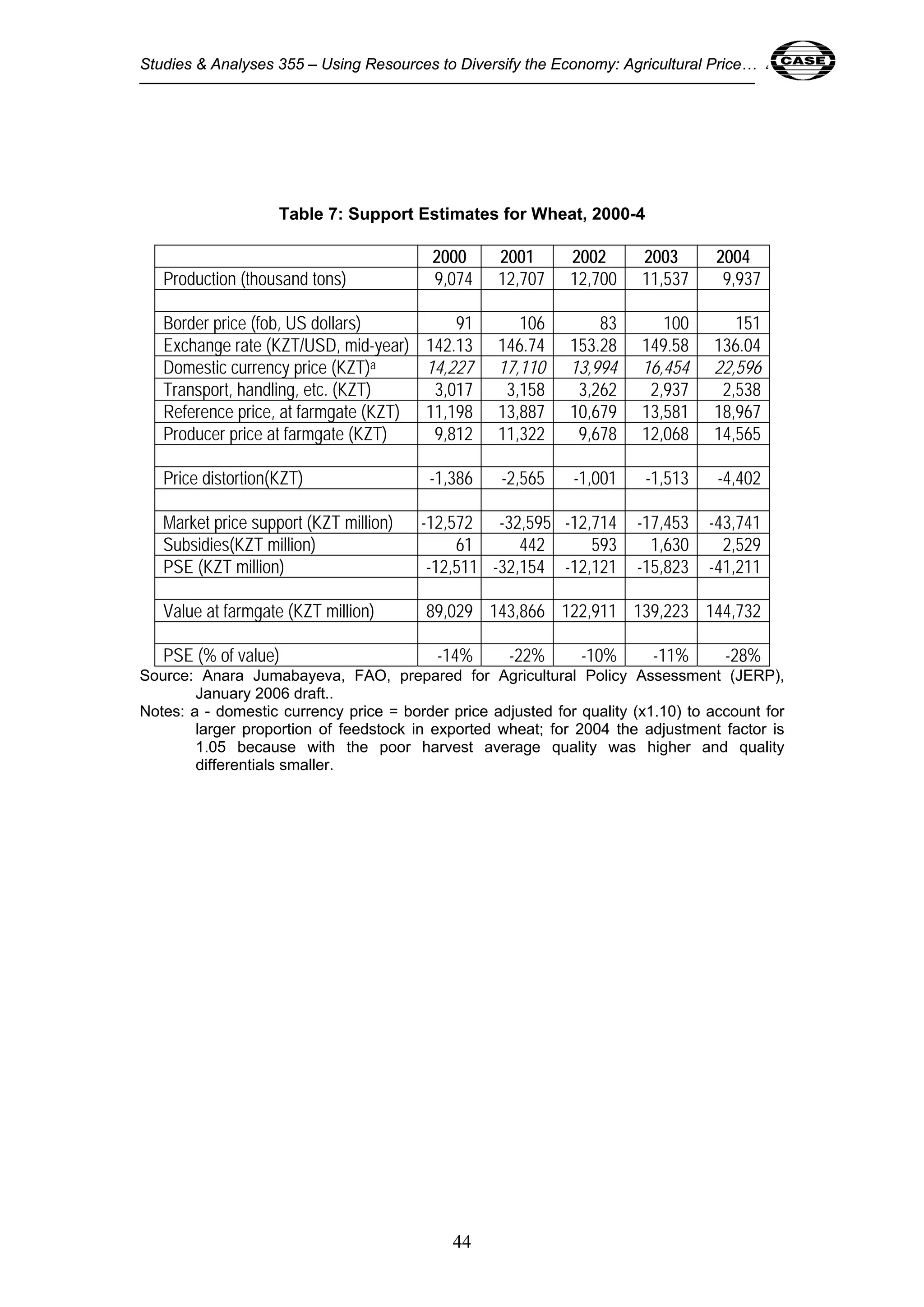
Table 7 presents preliminary estimates for wheat in the early 2000s, prepared 
by Anara Jumabayeva of the FAO for the World Bank’s Agricultural Policy 
Assessment. The fundamental finding is that the farmgate price received by wheat 
producers in Kazakhstan during the 2000-4 period was well below the world price 
minus the costs of getting wheat to the border. Perhaps even more striking is that 
the net distortion against wheat farmers, which had fallen from 14-22% in 2000-1 to 
9-10% in 2002-3, rose to 28% of the producer price in 2004 despite an apparently 
more supportive policy stance. 
Two points emerge from the estimates in Table 7: first the estimates are 
dominated by the price gap, and second the price gap is difficult to estimate. Despite 
increasing from 61 million tenge in 2000 to 2,529 million tenge in 2004, budget 
assistance to wheat farmers plays a minor role in determining estimates of producer 
support. Even in 2004, when the subsidies are at their highest, they only amount to 
1.75% of the farmgate value of wheat. In sum, the estimated distortion in Table 7 is 
dominated by the negative price gap. The estimated magnitudes of the price gap 
must, however, be treated with caution. In a period when the government was not 
intervening in the market to any great extent, it is difficult to explain the volatility of 
the estimated gap between border and farmgate prices -- from 1,386 tenge per ton in 
2000, to 2,565 in 2001, 1,001 in 2002, 1,513 in 2003, and 4,402 in 2004. 
Obtaining a reference price which can be compared to the producer price at the 
farmgate involved three steps: the export unit value in US dollars was calculated from 
official trade data, the dollar value was converted into tenge at the current exchange 
rate, and the domestic currency price was adjusted for transport and handling costs 
between the farm and the border. The quality-adjusted border price is the weakest 
link in the wheat calculations.22 Converting the quality-adjusted dollar border price 
into a domestic currency reference price involves assumptions about the exchange 
rate and transport costs, but the overall results are not greatly sensitive to these 
22 The wheat grown in Kazakhstan includes high quality hard wheat and lesser quality wheat, 
which commands a far lower price. The quality composition of wheat exports varies from year 
to year, largely due to the volatility of wheat harvests in Kazakhstan. There is an association 
between harvest size and average quality of the crop, and there is also a connection between 
the harvest size and the quantities of various types of wheat sold in the domestic market and 
exported. In the poor 2004 harvest, for example, average quality was higher than in previous 
years and the gap between the quality of wheat exports and the quality of total wheat output 
was smaller. The variable output combination makes it difficult to estimate a single border 
price, or to have a constant quality-adjustment factor. In Table 7 a simple 10% adjustment 
factor is used to account for the generally larger proportion of feedstock in exported wheat, 
and the factor is reduced to 5% in 2004 to allow for the known higher average quality of 
exports in that year, but these are rough approximations. 
23
Studies & Analyses 355 – Using Resources to Diversify the Economy: Agricultural Price… 24 
assumptions, and the last two steps do not appear to be likely sources of misleading 
errors.23 
The unit value of wheat exports fluctuates more than might be expected for the 
true border price. Commonly used indices of world wheat prices indicate, at most, a 
small increase from 2003 to 2004; for example, the FAO world price increased from 
150 to 161 and the OECD world price fell from 156 to 152.24 The unit value of 
Kazakhstan’s wheat exports may have reflected specific marketing features in 2002- 
4, which make it an inappropriate reference price for distortion calculations. Most of 
Kazakhstan’s wheat exports are to CIS markets, although sales to Central Asian 
neighbors have been reduced as a result of import-substitution strategies in 
Turkmenistan and Uzbekistan. Some part of sales to Russia and Ukraine is re-exported, 
but transport costs to more distant markets are high (eg. in 2003-4 when 
the price was about $100 per ton at the elevator in Kazakhstan it cost $16 per ton to 
get the wheat on the train and to the border, $30 to transport it through Russia to the 
Ukraine border, and $13 for transport within Ukraine). The years 2000 to 2002 saw a 
large increase in Russian wheat production (from 34 to 51 million tons) and 2002 saw 
a surge of Ukraine exports to the EU. At the wrong end of this chain, Kazakh wheat 
exporters may have found themselves squeezed by the price offered by Russian 
traders, although sales might hold up if the price were sufficiently low that it became 
profitable to import cheap Kazakh wheat and export Russian or Ukrainian wheat to 
the EU. In 2004 the quantity exported by Kazakhstan was especially low (2.5 million 
tons, or about half of that in the previous year), which may have reflected a decision 
to stockpile wheat for strategic reasons.25 Under these conditions, because the 
border price is not that determined in a competitive “world market”, it is difficult to 
conceptualize the appropriate reference price for assessing domestic distortions. 
From all of the evidence, a 51% increase in border price between 2003 and 2004 
23 The method of calculating transport, handling and other costs assumed a substantial fixed-cost 
component, so that the annual variation of this line in Table 8 shows less variation than 
might be expected from the volatility of the crop. In the smallest harvest year, 2000, transport 
costs account for a surprisingly large share (over 20%) of the border price, but, if transport 
costs are overestimated, then it is even more striking that the bottom line is negative. As 
described in section 2d, the periods of large real exchange rate changes, mid-1994 to early 
1996 and mid-1998 to May 1999 (see also Figure 2 in Kuralbayeva et al., 2001), are outside 
the time period covered by Table 7. 
24 The IFS commodity database gives an almost flat world wheat price in 2002-4 ($149, $146 
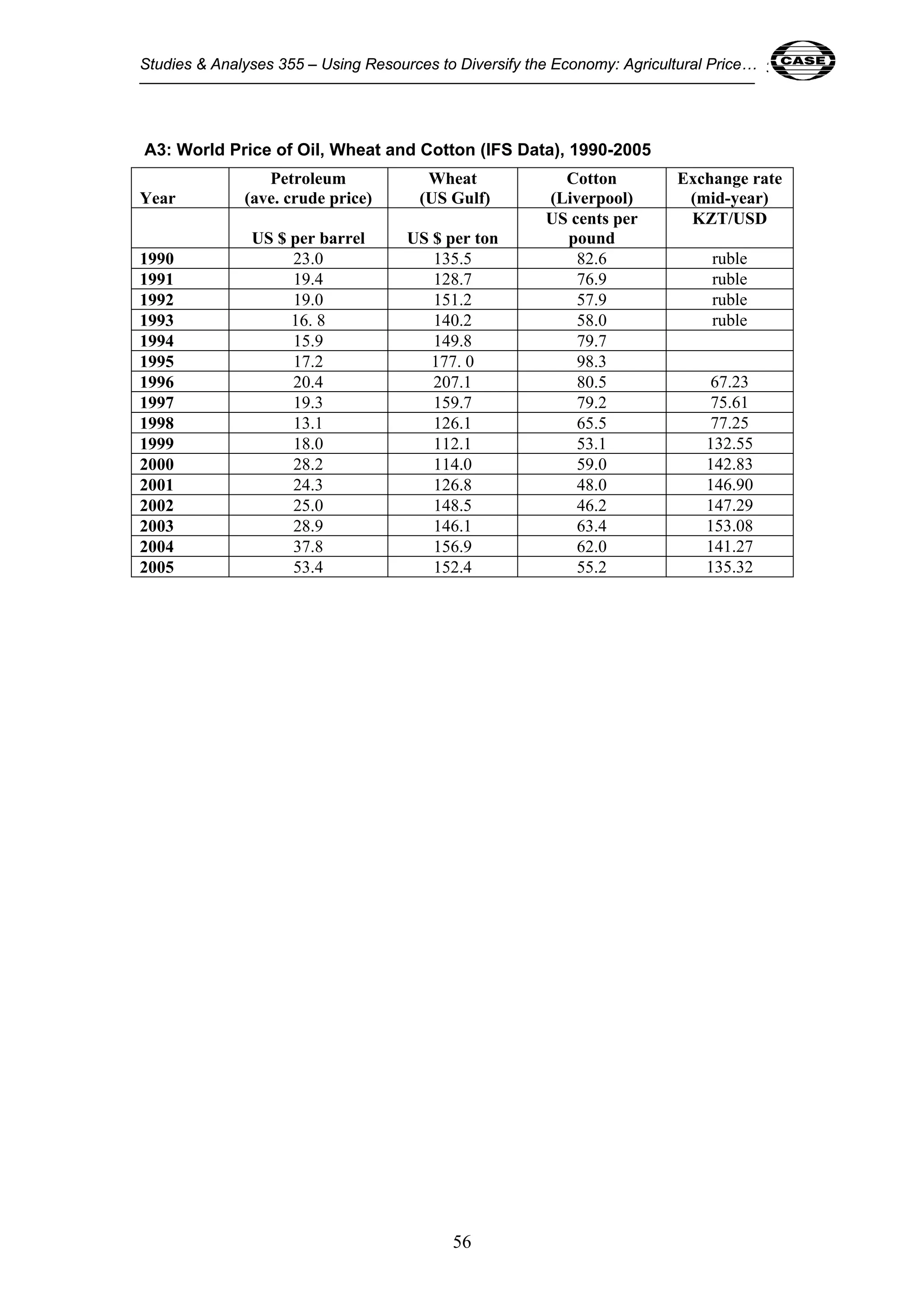
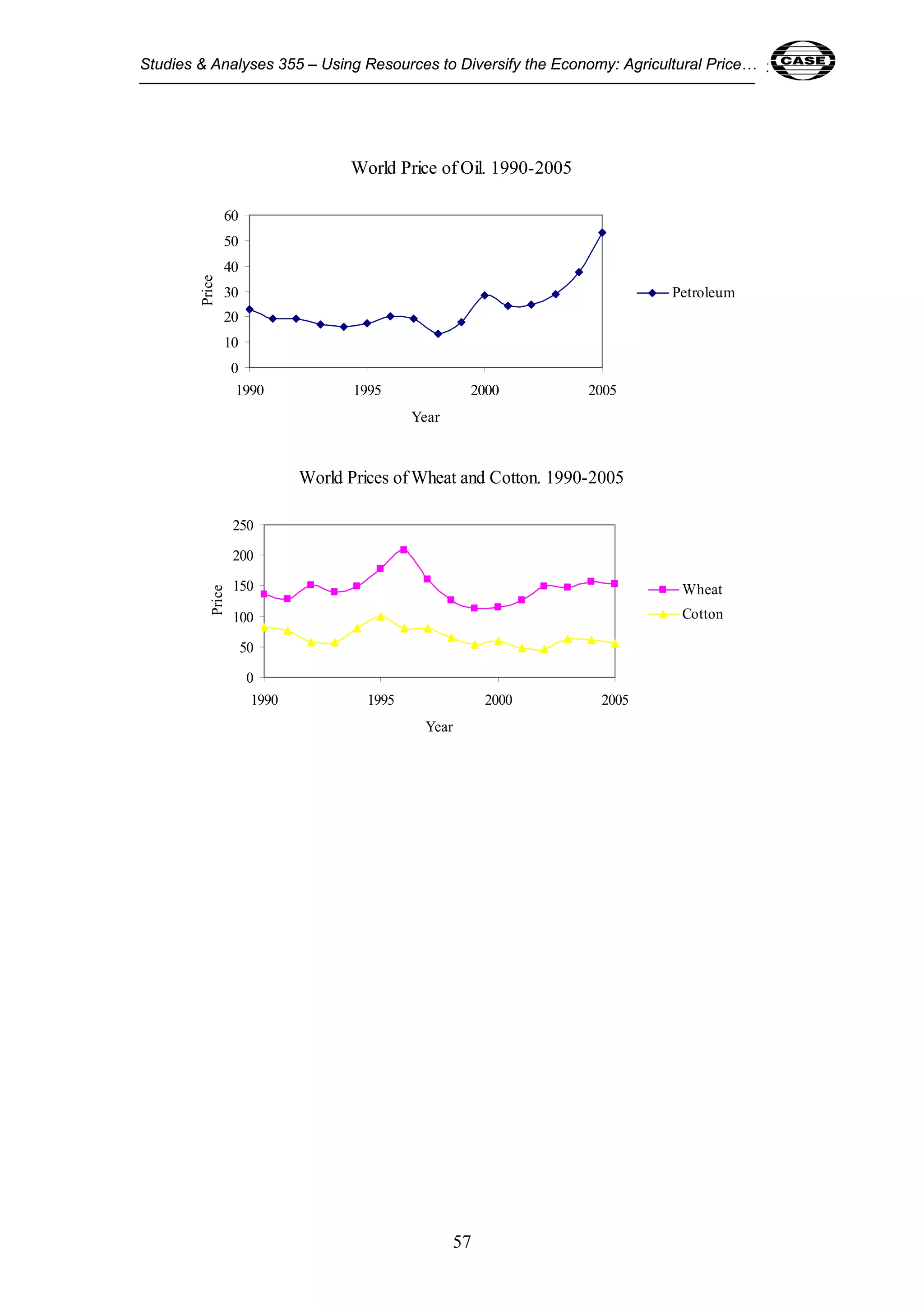
and $157; see Table A3), whereas Table 7 has border prices of $83, $100 and $151 in these 
years. The US Gulf price used in the IFS is not the right benchmark for Kazakhstan’s wheat, 
which is mainly shipped across the Russian border, but the differences in price patterns is 
startling. 
25 Wheat output was lower in 2004 than in 2003, but only by about 15% (Table 1), while the 
volume exported fell by half. 
24
Studies & Analyses 355 – Using Resources to Diversify the Economy: Agricultural Price… 25 
appears misleading, and a more plausible reference price would not show the 
dramatic decline in support for wheat between 2003 and 2004 that appears in Table 
8. 
In sum, from the OECD’s PSE estimates for Russia and Ukraine it is likely that 
Kazakhstan’s situation switched from substantial distortions in favor of wheat farmers 
at the time of independence to negative support in 1992. The estimates in Table 7, 
suggest that the negative support persisted into the twenty-first century, although the 
increasingly negative support in 2004 may be a false indicator based on an 
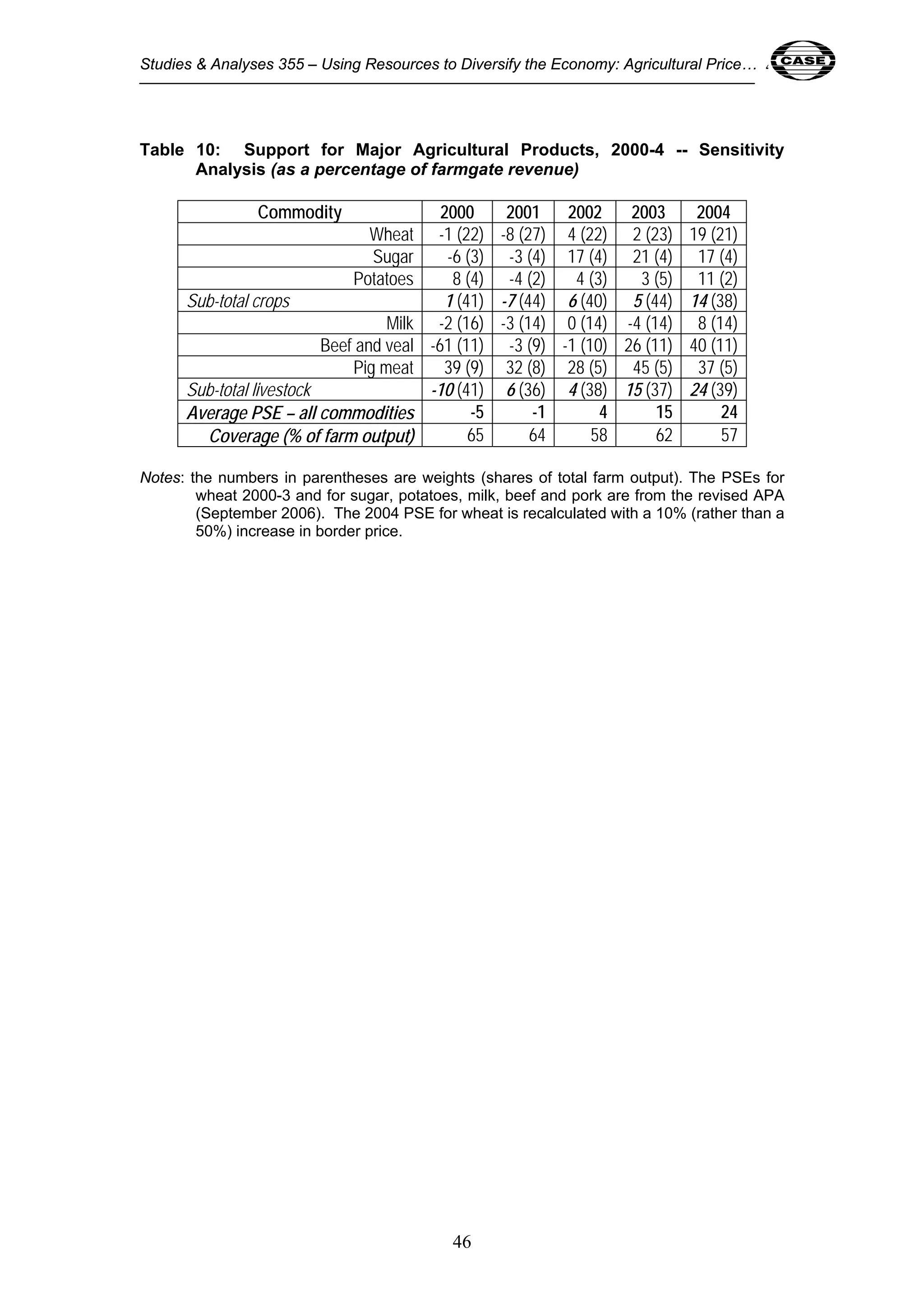
inappropriate reference price. A sensitivity analysis of the support estimates is 
carried out in section 3f. 
The picture of wheat growers in Kazakhstan facing negative net incentives 
driven by negative “market price support” appears to contradict the description of 
farm polices in the previous section, which found little evidence of policy-induced 
distortions against wheat farmers by the late 1990s, and a positive policy stance 
towards them in more recent years. The paradox can be resolved in two 
complementary ways. In Section 3e an interpretation of the negative signs in Table 7 
is presented in terms of the inefficiency of internal trade in Kazakhstan; behind-the-border 
inefficiencies create a wedge between the world price and the farmgate price. 
The sensitivity analysis in section 3f shows that allowing for the potential bias in the 
2004 wheat estimate due to using an inappropriate border price is sufficient to 
reverse the finding that the situation for wheat farmers deteriorated in 2004 and the 
support could plausibly have been positive in that year. 
25 
(b) Cotton 
After the end of government controls in the mid-1990s, cotton farmers in 
Kazakhstan faced slightly unfavorable relative prices. Relative to both wheat and 
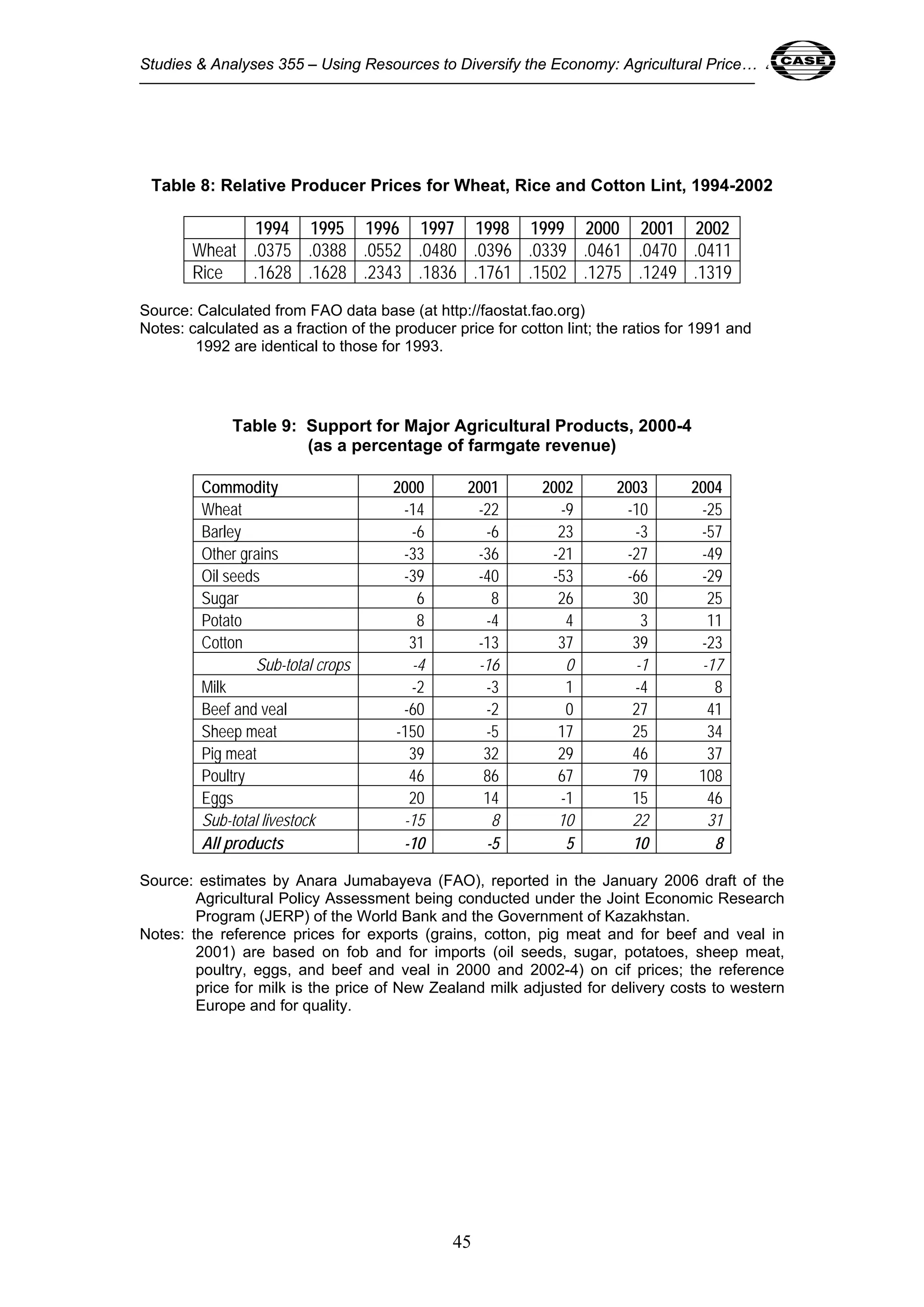
rice, the producer price of cotton declined in 1996 (Table 8). For the 1997 harvest 
season, Goletti and Chabot (2000, 55) estimated the average border parity price for 
raw cotton in Central Asia at $404 per ton. The local currency price of raw cotton 
received by farmers in Kazakhstan was 25,500 tenge, or $349, which was less than 
the price received by farmers in the Kyrgyz Republic ($394) or Tajikistan ($388), but 
substantially above the prices which farmers received in Turkmenistan ($240) or 
Uzbekistan ($242). The gap in Kazakhstan reflected a mixture of monopsony power
Studies & Analyses 355 – Using Resources to Diversify the Economy: Agricultural Price… 26 
of the cotton gin owners, quality differences and transport and other costs of getting 
the cotton to the border, rather than policy-induced distortions against farmers. 
The situation changed significantly around 1997-8 as producer prices for cotton 
improved relative to those for other crops (Table 8).26 Between 2000 and 2002, as 
world cotton prices fell by 20% domestic producer prices were stable. This reduction 
in the price gap reflected changes in the organization of the domestic market rather 
than any public policy changes. The key relationship is between cotton farmers and 
cotton gins, and the farmers’ market position improved as the number of cotton gins 
increased in the early 2000s. 
Land reform led to the creation of a large number of independent small-scale 
cotton producers in southern Kazakhstan. Producers enter into a contract to supply 
a gin with a fixed amount of cotton, for which they will receive a price linked to a 
world price index at the time of delivery. They do so in order to obtain pre-finance, 
which is provided 30% on signing an agreement to deliver a certain amount of cotton, 
40% at harvest and 30% upon delivery. Some of the finance is provided in kind as 
gins organize supply of seeds, fertilizer, fuel and water. The formal fee structure is 
$150 per ton for ginning and 18% per annum interest on financing, although it is 
suspected that inputs obtained through gins are overpriced and that the gins are not 
scrupulous in assessing and rewarding quality. There is also a market for free seed 
cotton, ie. cotton production in excess of original agreements, which can pay a 
significant premium over contract prices (eg. in 2003 free seed cotton prices were on 
average $500 or 21% above prices paid for contracted cotton).27 
The extent of distortions facing cotton farmers in Kazakhstan in the early 2000s 
is unclear. The price differential for free seed cotton might suggest that supplies 
under contract are underpriced as the gins exploit the farmers’ lack of access to 
financing. On the other hand, the increase in number of gins, with a variety of 
owners, suggests that the gin sector is competitive and cotton farmers do not face 
distorted net output prices. Sadler (2006) reporting on the results of a survey of 
cotton producers during the 2003 crop season states that, although many farmers 
showed ignorance on their part and complained of dubious practices on the gins’ 
part, 97% of respondents said they could change their ginners if they wished to do so 
26 Between 1996 and 1999 cotton prices increased by over 35% relative to the price of both 
wheat and rice. The cotton/rice price ratio, which is more relevant in southern Kazakhstan, 
continued to increase during 2000 and 2001 
27 There is an incentive to renege on contracts, but penalties for breach of contract were 
sufficiently high and credible that the price differential did not undermine the contract system 
(Sadler, 2006, 107). 
26
Studies & Analyses 355 – Using Resources to Diversify the Economy: Agricultural Price… 27 
and 92% had actually done so. Competition among gins appeared to be intensifying 
in the early 2000s, as gins increasingly provided collection points outside of their own 
immediate area. Unlike the situation for wheat exporting farmers who face high trade 
costs, the cotton ginners reduce trade transactions costs for agricultural exporters by 
managing efficient transport of the baled cotton to foreign buyers. After strong 
competition among gins in 2004, however, the gins established an informal cartel in 
2005, which has reduced farmers’ bargaining power. 
In sum, cotton farmers in Kazakhstan have been operating since the late 1990s 
under largely undistorted market–driven incentives. Apart from seed and fertilizers 
the main input is labor, especially at harvest time. Mechanized cotton-harvesting, 
which was vigorously promoted in the Soviet era, is not economic at Central Asian 
factor prices (Pomfret, 2002), and in addition hand-picking gives a higher quality 
harvest. Labor markets are highly competitive in Kazakhstan’s cotton-growing 
regions, which have access to cheap migrant labor from neighboring Uzbekistan. 
Despite the frequent reports of harassment of migrants and the lack of basic 
employment rights, there is an almost unlimited supply of skilled Uzbek cotton-pickers 
willing to migrate to Kazakhstan during the harvest season because a good 
picker can clear $200 in a month, compared to average wages in Uzbekistan of 
around $20. Farmers in Kazakhstan are keen to employ the migrants because illegal 
workers will pick for 3-5 tenge per kilogram, while Kazakh cotton-pickers demand at 
least 10 tenge. In the absence of policy-driven distortions to incentives, year-to-year 
variations in cotton farmers’ situation reflect changes in industrial organization in the 
ginning sector and, to a lesser extent, changes in labor market conditions depending 
upon the openness of the border with Uzbekistan.28 
27 
(c) Livestock 
The livestock sector followed a different path to the commercial grain and 
cotton sectors. The large agricultural enterprises (successors to the collective and 
state farms), which dominate the agricultural sector in terms of acreage, dramatically 
reduced their livestock numbers, and this explains the poor aggregate performance 
of the livestock sector during the 1990s (Table 1). The new individual peasant farms 
28 Fertilizers and seed, which are subsidized in Uzbekistan and Turkmenistan, are smuggled 
across the border.
Studies & Analyses 355 – Using Resources to Diversify the Economy: Agricultural Price… 28 
have increased their animal numbers, but the total head of livestock on these farms 
remains small (Table 4). Today, livestock farming is concentrated on the small 
household plots which survived from the Soviet era (see section 2b), although the 
aggregate numbers remain well below 1991 levels (Table 4). 
The elimination of large-scale livestock farming was due to unfavorable initial 
conditions combined with rapid economic restructuring. During the 1950s and 1960s 
the fodder base had increased rapidly in order to sustain growth in the sedentarized 
livestock sector. Livestock farms relied on fodder which was often transported over a 
substantial distance via the Soviet transportation system at no cost to the farm. The 
long-range mobility of livestock, which had characterized traditional herding 
practices, was effectively eliminated and any property rights to re-establish 
transhumance were impossible to negotiate during the fairly rapid privatization 
process. With the end of Soviet central planning and the decline in available fodder, 
the large-scale livestock-farming sector collapsed in half a decade after 
independence.29 The large agricultural enterprises traded animals to settle their 
debts, or slaughtered them to obtain working capital and cut costs. 
In the early 1990s, as relative prices turned against farmers and a tight 
monetary policy followed introduction of the national currency in late 1993, barter 
became the main trading tool to pay for essential supplies. Livestock became the 
most commonly used means for settling farm debts, and a crucial buffer against the 
belated payment of wages and salaries, pensions and other social security 
payments. During this period many families relied on the cow or pig or a few sheep 
on their household plot as a coping measure against the deprivation of the 
transitional recession. The animals were a means of subsistence, and also a source 
of insurance in case the family should need to provide for culturally important events 
like weddings. Although families used their animals to weather the economic 
uncertainties of the 1990s, they were careful to husband their stock and maintain 
their capital. At the trough of the recession in 1997, the number of cows, pigs, sheep 
and goats on household plots was almost the same as it had been at the start of the 
decade; only the chicken population declined on household plots (Table 4). 
Since the late 1990s barter has given way to monetary transactions, and much 
of the household plot production of meat, milk and eggs is sold in local markets to 
29 The situation in Kazakhstan was exacerbated, relative to that in the southern Central Asian 
countries, by the harsher winters which precluded leaving animals outdoors in winter and 
required more fodder and heating, both of which became dramatically more expensive after 
independence (see Suleimenov et al., 2000, and Kerven, 2003). 
28
Studies & Analyses 355 – Using Resources to Diversify the Economy: Agricultural Price… 29 
cover household consumption of non-self-produced items.30 Over half of rural 
households sell livestock products, with meat showing the highest sales-to-production 
ratio (0.36) of any major home-produced good, followed by eggs (0.15) 
and milk (0.12).31 Although farmgate prices are reported to have risen substantially in 
tenge since 1993, they vary substantially by season and location, and it is difficult to 
isolate a real price index or to establish a reference price for most farmers’ livestock 
products which are sold locally. Export of livestock products, except for wool and 
skins, is limited to local cross-border trade with Russia, China, the Kyrgyz Republic 
and Uzbekistan. 
The livestock sector has no major price distortions, but it faces the high 
infrastructure costs shared by all dispersed producers in Kazakhstan and it receives 
three sets of subsidies. First, the purchase of stock-breeding materials and livestock 
is subsidized, although budget allocations are small and disbursements less.32 
Second, larger subsidies (3,298 million tenge in 2003) are provided for veterinary 
control of contagious diseases. Third, Mal Onimderi Korporatsiyasi (MOK), 
established in 2001 as a government-owned joint stock company aimed at 
stimulating the livestock sector and developing new export markets, received an 
initial loan of two billion tenge at an interest rate about ten percent lower than it would 
have paid for a commercial line of credit. Commercial banks also receive from the 
government partial reimbursement of interest on loans to agricultural processing 
companies, which allows them to offer discounted credit to such companies. 
It is difficult to evaluate the impact of this recent assistance to livestock 
producers, but it coincided with a turnaround in the livestock sector. Data on animal 
30 Farmers may sell directly to consumers or use local traders. The traders are typically self-financed 
and without access to storage or refrigeration facilities, so that their sales are 
overwhelmingly at bazaars within the district (rayon) of production. The rise of supermarkets, 
with their impact on agricultural marketing channels in Central and Eastern Europe (Dries, 
Reardon and Swinnen, 2004), is not yet a major feature in Kazakhstan. Supermarkets have 
opened in the large cities, especially since the oilboom began, but they focus on middle and 
upper class customers and account for a small part of the market available to domestic 
producers of livestock products. 
31 These ratios, drawn from Kazakhstan’s high quality (since 2001) household survey data, 
are cited in the report Kazakhstan’s Livestock Sector – Supporting its Revival written in June 
2004 under the Joint Economic Research Program of the Government of Kazakhstan and the 
World Bank. Annex II of the report describes marketing channels in Kazakhstan; Table 2 of 
the Annex reports that over twice as much farm households’ income comes from selling own-produced 
meat, cheese, butter, etc. as from sale of live animals. 
32 Concerns about breeding arose from the sharp decline in the herds during the 1990s, which 
included loss of many purebred animals, and the fragmentation of livestock production units. 
The budget allocation for bovine artificial insemination was 947 million tenge for 2001-5. 
There is also provision for subsidizing the purchase of breeding livestock, set at 416 million 
tenge in 2002 and 2003, and increased to 478 million in 2005, but in 2002 actual 
disbursement was only 131 million tenge. 
29
Studies & Analyses 355 – Using Resources to Diversify the Economy: Agricultural Price… 30 
stocks from the FAO, which are not always consistent with the National Statistical 
Agency numbers in Tables 1 and 4, show a substantial recovery in livestock numbers 
since the turn of the century. Between 2000 and 2005, according to the FAO data, 
the number of cattle increased from 4.0 to 5.2 million, the number of sheep from 8.7 
to 11.3 million, goats from 0.9 to 2.0 million, pigs from 1.0 to 1.3 million and chickens 
from 17.9 to 25.5 million. 
30 
(d) Other Agricultural Products 
Other crops followed the overall pattern of declining output until 1997 followed 
by varying degree of recovery, epitomized by potatoes and by sunflower seed in 
Table 1 and by sugar beet. Valued at domestic producer prices potatoes are a more 
important crop than cotton, although the trade data show that they are grown 
overwhelmingly for domestic consumption. Rice production in southern Kazakhstan 
has declined as farmers have shifted land from rice to cotton production, especially in 
Kzylorda, which agronomists would consider climatically marginal for cotton-growing. 
This may reflect distortions against rice, but more likely reflects the profitability of 
cotton in the relatively undistorted post-1998 environment described in Section 3(b). 
The relative price of rice to cotton lint, which had been stable at 0.16 in the first half 
of the 1990s, jumped to 0.23 in 1996 but then fell dramatically in the rest of the 
decade to 0.13 in 2000 (Table 8). 
(e) Trade Costs 
The gap between farmgate prices and a border reference price, adjusted for 
normal transport costs, is not just a measure of policy distortions. It also includes 
transactions costs which may be defined as “transport costs”, but whose magnitude 
is heightened by poor soft infrastructure as well as by inadequate hard infrastructure 
(eg. poor roads and railways). This is not just an issue in transition economies. 
Reduction of barriers to trade such as tariffs and quantitative restrictions in rounds of 
multilateral trade negotiations has raised the profile of the remaining behind and at 
the border trade costs, and trade facilitation has become a major concern of 
policymakers wishing to increase the gains from trade. Such costs are especially
Studies & Analyses 355 – Using Resources to Diversify the Economy: Agricultural Price… 31 
high in transition economies, and amenable to change by policymakers if they are 
willing and able to strengthen the rule of law. 
The most obvious trade costs are internal and can be addressed by national 
governments.33 In Kazakhstan bureaucratic and other obstacles to trading and 
exporting became a striking feature of the economy during the 1990s, when 
provincial and district governments created their own policies and local policemen 
and other officials relied on arbitrary fees to supplement their meager or unpaid 
salaries. When each individual with the power to levy a fee along the road from the 
farm to the market or the border thinks only of maximizing their own returns and 
ignores potential externalities of their actions, too little trade takes place and in 
extreme cases trade may be eliminated altogether. The solution in well-functioning 
market economies is for the government to exert its influence to prevent a tragedy of 
the anti-commons by protecting producers and traders from arbitrary intrusion into 
property rights.34 In Kazakhstan, the internal levies are an example of the 
augmented trade costs due to the central government’s failure to establish its 
authority. 
High transactions costs are symptomatic of incomplete transition to a market 
economy, and reflect policy choices (of omission to protect and enforce traders’ 
property rights, rather than a choice of commission). While such obstacles do not 
apply specifically to farm products, many are related to distance and vary according 
to local jurisdiction, features which make them especially onerous for geographically 
specific but dispersed activities.35 Thus, they often effectively discriminate against 
agriculture, and against some farmers more than others, depending upon location, 
perishability of output, and so forth. 
The problems related to output marketing of a fairly typical independent farm 
are illustrated by a case study from the survey of farms in northern Kazakhstan in 
1999 reported by Gray (2000, 59-60). The farm’s 36 workers produced wheat, barley 
and mustard seed for export to Russia. The akim (provincial governor) frequently 
banned the export of grain, even to neighboring provinces, until all farms in the 
33 Some trade costs require bilateral attention, eg. coordination of opening times of border 
crossings, and, especially for a landlocked country like Kazakhstan, some require regional or 
multilateral action. Reports by the United Nations Development Programme (2005) and Asian 
Development Bank (2006) estimated that the Central Asian countries, including Kazakhstan, 
were trading below potential and a major reason was high trade costs. 
34 The term “tragedy of the anti-commons” was coined by James Buchanan to describe the 
situation where viewing something as an open-access common property resource (eg. 
traders’ rents) leads to too little of a desirable activity occurring. Douglass North has 
emphasised reducing transactions costs as the key to explaining economic development. 
35 The poor quality of roads in Central Asia is emphasised by Shepherd and Wilson (2006). 
31
Studies & Analyses 355 – Using Resources to Diversify the Economy: Agricultural Price… 32 
province had paid all arrears on inputs, which was unfair on farms with no arrears. 
When permission to export was available, the farm had to obtain (1) a permit from 
the provincial Department of Agriculture, (2) a permit from the provincial Department 
of External Relations, (3) phytosanitary certification, (4) a quality certificate from 
Gostandard, (5) clearance from the Commodity Exchange, (6) a licence from the 
Chamber of Trade, (7) clearance from the Customs Committee, (8) a certificate from 
the Tax Inspectorate of no outstanding tax, and (9) a certificate from the Russian 
Committee for Standards and Metrology. The last consignment before the farm was 
interviewed required twenty-two days of full-time effort to obtain the clearances and 
permits. Once the consignment left the farm, corruption on the road was a major 
problem. The farm reported facing many checks, each of which required 15-20 
Russian rubles per policeman. Reviewing the broader evidence from the survey of 
farms in northern Kazakhstan in 1999, Gray (2000, 32) found that “Harassment by 
uniformed officers appears to be universal, with established normal bribes required to 
pass each of a large number of police checks, even if papers are in order”. The 
situation has improved since 1999, but anecdotal evidence suggests that such 
obstacles to trade remain substantial, despite presidential decrees on simplification.36 
There are regional variations.37 The logistical situation for farmers is better in 
southern Kazakhstan, where agricultural recovery began in 1997-8 as opposed to 
1999 or later in northern Kazakhstan. For cotton producers this reflects the active 
role of the gin-owners, described in section 3b, and for other farmers the most likely 
reason is better market access: urban markets in Almaty, Bishkek, Chimkent, Taraz 
or Tashkent are within 200 kilometers of most southern farms. In western 
Kazakhstan, the situation is worse because of the poor hard infrastructure, in 
particular the larger proportion of unpaved rural roads, and greater distance to 
markets. The wheat farmers of northern and central Kazakhstan are exposed to 
these costs, because they are responsible for trucking their crop either to the 
Russian border or to the railway, and this is likely to explain the magnitude of the 
price gap reported in section 3a (and in Table 7). 
36 Kazakhstan scores poorly on international measures of economic freedom or corruption. 
By the Heritage Foundation index of economic freedom it is “mostly unfree” with “high levels 
of administrative barriers”, ranking 113th out of the 157 countries graded in 2006. 
Transparency International ranked Kazakhstan the (equal) 150th most corrupt country in 2007, 
out of 179 countries covered. The World Bank’s quality of governance indicators give low 
marks to Kazakhstan in areas such as governance efficiency, regulatory quality and the rule 
of law. 
37 Based on relative prices of standard goods Grafe, Raiser and Sakatsume (2005) conclude 
that there is more price variation among regions of Kazakhstan than between countries in 
Central Asia. 
32
Studies & Analyses 355 – Using Resources to Diversify the Economy: Agricultural Price… 33 
33 
(f) Rate of Assistance Estimates 
Table 9 presents support estimates for 2000-4 for fifteen major products, 
accounting for about four-fifths of agricultural output (Table 1). The method, 
comparable to that used for wheat in section 3a, is to divide market price support (the 
gap between a reference price based on the border price adjusted for trade and 
handling costs, Pb, and the farmgate price, Pd) plus budget support per unit of output 
(B) by the farmgate price: 
Support = (Pd - Pb + B) / Pd 
The general picture is of negative support for grains and oilseeds, and positive 
support for potatoes, sugar and especially livestock. The trend towards increased 
support for livestock products is very strong, especially for meat, while support for the 
two main exports (wheat and cotton) is variable. Although budget support increased 
during this period (Table 5), the support estimates are dominated by the gap between 
the farmgate price and a reference price. 
The estimates reported in Table 9 are an early attempt at such an exercise for 
Kazakhstan, and the numbers should be treated with caution, especially in light of the 
high internal trade costs described in the previous sub-section. Poor infrastructure is 
associated with weak transmission of border prices and permits market segmentation 
and local monopolies. During a poor harvest, even small increases in excess 
demand may lead to large domestic price increases because trade costs limit the 
import response; conversely a bumper harvest may depress domestic prices well 
below the border price because trade costs limit the extent to which the surplus is 
exported. Perhaps most fundamentally, high trade costs have turned most of the 
commodities in Table 9 into essentially non-traded goods for which the unit value of 
the small quantities exported or imported in any year may be a poor guide to true 
undistorted opportunity cost prices.38 
38 The estimates in Table 9 treat grains, cotton and pig meat as exports (ie. export unit values 
are fob border prices) and oilseeds, sugar and sheep meat as imports (ie. import unit values 
are cif border prices). Beef and veal are exports for 2000-1 and imports for 2002-4. Only milk 
is treated as a non-traded good, with the quality-adjusted price of New Zealand milk for 
delivery to western Europe as the reference price.
Studies & Analyses 355 – Using Resources to Diversify the Economy: Agricultural Price… 34 
The results are sensitive to assumptions, which may even affect the overall or 
sector averages if they apply to products with a large weight or lead to large outliers. 
The earlier discussion of the wheat estimate, which concluded that the negative 
support estimate may be too large for 2004, is the most important example. Given 
the weight of wheat (55% of the value of crops covered), this dominates the 
aggregate 2004 PSE for crops. If the wheat numbers were smaller (as calculated by 
Serova for the years up to 2002), then the aggregate picture would be of more 
positive support for farmers. The aggregate PSEs for livestock producers indicate 
increasing support since 2000 which is consistent with the rising farmgate prices, but 
caveats need to be made about individual meat PSEs (eg. the sheep meat numbers). 
As a sensitivity analysis, the aggregate estimates in Table 9 can be compared 
to a simple hypothetical alternative to show the importance of removing outliers (or 
the least plausible PSEs) and of reviewing the PSE for the largest commodity, wheat 
(Table 10). The coverage is reduced below normal minima of 70-75%, but in practice 
wheat may be a good proxy for barley and other grains and the pattern of other 
meats’ PSEs may be similar to that of beef and pork. The crop/livestock balance 
remains representative of the national proportions. The omission of oil seeds, barley 
and other grains, and cotton is more or less off-setting in its effect on the sub-total for 
crops. Because some PSEs were extreme values, omitting sheep meat, poultry and 
eggs from the livestock category does have a significant effect in reducing the sub-sector’s 
negative PSE in 2000 and increasing it in 2003-4. By far the biggest source 
of variation, however, is the treatment of the 2004 wheat PSE. 
The alternative estimates imply that the increasing producer support during 
2000-4 applied to both crop and livestock farmers, although the rate of increase was 
larger for the latter. The increase in aggregate support in 2000-3 is more consistent 
in the alternative estimates, and the final year’s level is higher. The general 
conclusion is that the pattern of support reported in earlier sections of this chapter is 
robust to alternative assumptions about appropriate reference prices, although 
caution should be exercised in interpreting the support for crops in 2004. 
The qualitative picture in Tables 9 and 10 is consistent with the description of 
agricultural policies in Section 2. After generally operating since 1992 in an 
environment of policy neglect which was associated with a negative price gap, in the 
period 2000-4 the farm sector moved from facing negative to positive distortions. 
Most livestock sub-sectors (cattle farming for meat and milk, sheep and goats, and 
poultry) have performed well since the end of the 1990s, which is partly recovery 
34
Studies & Analyses 355 – Using Resources to Diversify the Economy: Agricultural Price… 35 
from a deep trough but has been helped by a more positive policy and price 
environment.39 The situation facing farmers of grains and other crops is less clear-cut; 
estimates of negative support for crops around the turn of the century may reflect 
high trade costs rather than policy-induced distortions specific to grain producers, 
although the negative support for grains and oilseeds could also be evidence of feed 
subsidies to livestock producers. Since the formulation of the AFP in 2002 there may 
have been growing support for grain farmers, although the estimates in Tables 9 and 
10 are contradictory on this point. 
35 
4. Conclusions 
Measuring the policy-induced distortions facing Kazakhstan’s farmers is 
challenging but also informative. For the main product groups the expected 
measures are fairly clear. Grains and cotton are export items where there should be 
small distortions, perhaps shifting from negative to positive after the turn of the 
century, while for livestock products the picture is more opaque because they had 
become largely non-traded goods by the late 1990s before benefiting from favorable 
polices in the 2000s. In practice it is not easy to capture these patterns in producer 
support estimates, largely because border prices are hard to define for wheat (due to 
quality variations, long and varied land borders, and imperfectly competitive markets) 
and for cotton (due to large-scale smuggling across neighboring borders). For 
livestock products the absence of trade leads to some extreme values depending on 
the assumptions made. 
Nevertheless, the estimates presented in Tables 9 and 10 provide insights. 
The negative estimates for the export goods in 2000 and 2001 suggest substantial 
behind-the-border trade costs of the kind highlighted by Anderson and van Wincoop. 
The shift from negative to positive support is captured especially in Table 10 where 
outliers are removed and a more plausible border price for wheat is assumed, but the 
extent to which this result is due to the policy shift embodied in the 2003-5 AFP or 
39 Booming domestic demand as a result of rapid economic growth and the large devaluation 
against the Russian ruble in 1999, which restricted import competition, stimulated the revival 
of livestock farming. The inward orientation of growth in the livestock sector is reflected in the 
production of pig-meat - consumed by Russians rather than by Kazakhs or their Islamic 
southern neighbors - which was given a short-term boost by the devaluation but has benefited 
little from domestic growth.
Studies & Analyses 355 – Using Resources to Diversify the Economy: Agricultural Price… 36 
reduction in trade costs due to better governance is impossible to say. In a situation 
of low trade barriers in the traditional sense of trade taxes and trade subsidies or 
even the more commonly analyzed non-tariff barriers, there can still be significant 
deviations between border and producer prices, but their source requires detailed 
analysis. 
36
Studies & Analyses 355 – Using Resources to Diversify the Economy: Agricultural Price… 37 
Table 1: Production of Main Agricultural Products 
1980 1985 1989 1990 1991 1992 1993 
Wheat 17,548 14,191 10,784 16,197 6,889 18,285 11,585 
Barley 6,405 6,357 5,727 9,303 3,412 9,482 7,909 
Rye 129 144 784 889 506 568 889 
Oats 691 570 283 681 265 831 906 
Maize 414 598 479 442 330 368 355 
Potatoes 2,238 2,197 1,783 2,324 2,143 2,570 2,296 
Seed cotton 358 305 315 324 291 252 200 
Sugar beet 2,223 1,901 1,188 1,134 726 1,276 925 
Vegetables 1,134 1,085 1,254 1,136 955 985 808 
Meat 1,069 1,133 1,573 1,560 1,524 1,258 1,312 
Milk 4,597 4,763 5,563 5,642 5,555 5,265 5,577 
Wool 103 97 110 108 104 97 95 
Eggs 3,369 3,803 4,253 4,185 4,075 3,565 3,288 
37 
Source: De Broeck and Kostial, 1998, 42. 
Notes: in thousand tons, eggs in millions. 
1993 1994 1995 1996 1997 1998 1999 
Wheat 11,586 9,052 6,490 7,678 8,955 4,746 11,242 
Rye 403 283 184 226 255 236 199 
Barley 7,149 5,497 2,208 2,696 2,583 1,093 2,265 
Oats 802 822 250 359 286 73 194 
Rice 403 283 184 226 255 236 199 
Soybean 6 6 4 3 3 4 4 
Potatoes 2,296 2,040 1,720 1,657 1,472 1,263 1,695 
Sunflower seed 86 97 99 64 54 83 104 
Tobacco 4 3 2 2 2 9 8 
Seed cotton 198 208 223 183 198 162 249 
Vegetables 808 781 780 778 880 1,079 1,287 
Meat 2,231 2,102 1,774 1,541 1,346 1,213 1,182 
Milk 5,577 5,296 4,619 3,627 3,220 3,394 3,535 
Wool 96 75 58 42 32 25 22 
Eggs 3,288 2,629 1,841 1,263 1,242 1,388 1,512 
Animals: 
Cattle 9,576 9,347 8,073 6,860 5,425 4,307 3,958 
Sheep & goats 37,660 29,759 23,062 13,679 10,384 9,527 9,657 
Pigs 2,591 2,445 1,983 1,623 1,036 879 892 
Horses 1,742 1,649 1,521 1,310 1,083 986 970 
Poultry 52,308 45,121 26,481 15,378 15,982 16,985 18,022 
Source: National Statistical Agency data and FAO database. 
Notes: crops in thousand metric tons, eggs in millions, animal population in thousand head at 
end of year.
Studies & Analyses 355 – Using Resources to Diversify the Economy: Agricultural Price… 38 
2000 2001 2002 2003 2004 2005 
Wheat 9,073 12,707 12,700 11,537 9,937 11,300 
Rye 48 43 106 42 20 23 
Barley 1,664 2,244 2,209 2,154 1,388 1,600 
Oats 182 220 183 171 130 150 
Rice 214 199 199 273 276 310 
Soybean 4 7 25 38 47 45 
Potatoes 1,692 2,185 2,269 2,308 2,261 2,300 
Sunflower seed 105 149 190 293 266 240 
Tobacco 16 15 16 16 14 14 
Seed cotton 287 418 361 480 467 350 
Vegetables 1,544 1,782 1,867 1,938 2,058 1,939 
Meat 1,140 1,155 1,191 1,243 inc inc 
Milk 3,730 3,923 4,110 4,317 4,557 4,713 
Wool 23 24 25 27 28 29 
Eggs 1,692 inc inc inc inc inc 
Animals: 
Cattle 3,998 4,107 4,294 4,560 4,871 5,204 
Sheep & goats 9,981 10,400 11,171 inc inc inc 
Pigs 984 1,076 1,124 1,230 1,369 1,292 
Horses 976 986 990 1,019 1,064 1,120 
Poultry 19,700 21,300 23,800 inc inc inc 
Source: FAO database; inc = inconsistent with earlier series. 
Notes: crops in thousand metric tons, eggs in millions, animal population in 
thousand head at end of year. 
Value of main crops 2000 2001 2002 2003 2004 
Wheat 89.0 143.9 122.9 139.2 144.7 
Rye 0.4 0.4 1.0 0.4 0.2 
Barley 10.7 17.7 15.7 14.7 11.9 
Oats 0.9 1.2 1.2 1.0 0.9 
Maize 2.3 3.4 4.7 4.5 5.7 
Sugar 11.2 18.6 22.2 25.1 26.1 
Potatoes 31.2 36.0 35.6 48.2 47.4 
Sunflower seed 1.8 2.8 4.9 7.0 6.7 
Seed cotton 14.7 12.6 16.5 29.7 16.3 
38 
Value of livestock production 
Beef and veal 42.3 49.4 57.5 65.6 76.8 
Sheep and goat meat 10.2 12.4 28.1 32.6 38.2 
Pig meat 34.9 42.1 26.4 27.5 31.8 
Poultry meat 4.4 5.1 6.3 7.1 7.9 
Cow milk 64.8 72.0 79.6 84.5 101.0 
Eggs 9.0 10.7 11.6 13.6 16.5 
(15 items as % of total ag.output) 82% 80% 78% 81% 76% 
Source: quantities and producer prices from national statistical authorities (also as 
reported on the FAO database). 
Notes: value at farmgate prices (animals – live weight), in billion tenge.
Studies & Analyses 355 – Using Resources to Diversify the Economy: Agricultural Price… 39 
Table 2: Export of Main Agricultural Products, 1995- 2004 
1995 1996 1997 1998 1999 2000 
Grain 
volume (000 tons) 3,484.1 2,808.9 3,577.5 2,905.2 3,816.2 5,612.4 
price (US $ per ton) 88.5 152.6 143.1 101.7 82.2 88.4 
value ($ millions) 308.3 428.6 511.6 295.4 313.6 496.2 
Cotton fiber 
volume (000 tons) 25.7 69.7 63.9 48.2 62.1 90.2 
price (US $ per ton) 1,425.3 1,388.1 1,213.6 1,077.3 796.8 945.7 
value ($ millions) 36.4 96.7 77.5 51.9 49.5 85.3 
Wool 
volume (000 tons) 51.7 31.2 41.7 12.0 15.7 10.6 
price (US $ per ton) 999.1 1,372.4 1,367.9 1,440.0 426.2 450.3 
value ($ millions) 51.7 42.8 57.1 17.3 6.7 4.6 
Total exports ($ millions) 5,440.0 6,291.7 6,899.2 5,870.6 5,988.5 9,468.1 
Source: International Monetary Fund: Republic of Kazakhstan: Selected Issues and Statistical 
Appendix, IMF Staff Country Report No.00/29 (March 2000- revised version of Staff 
Country Report No.99/95), 124; International Monetary Fund: Republic of 
Kazakhstan: Selected Issues and Statistical Appendix, IMF Staff Country Report 
No.03/211 (July 2003), 98. 
2000 2001 2002 2003 2004 
Grain 
volume (000 tons) 5,612 3,336 4,311 5,835 2,929 
price (US $ per ton) 88 103 80 97 150 
value ($ millions) 496 344 346 565 440 
Cotton fiber 
volume (000 tons) 90 96 138 126 143 
price (US $ per ton) 946 864 763 1,110 1,190 
value ($ millions) 85 83 105 139 170 
Wool 
volume (000 tons) 11 8 8 10 7 
price (US $ per ton) 450 618 618 465 737 
value ($ millions) 5 5 5 5 5 
Total exports ($ millions) 9,288 8,928 10,027 13,233 20,603 
Source: International Monetary Fund: Republic of Kazakhstan: Statistical Appendix, IMF Staff 
Country Report No.05/239 (July 2005), 30. 
39
Studies & Analyses 355 – Using Resources to Diversify the Economy: Agricultural Price… 40 
Table 3: Agricultural Exports and Imports by Value, 2003 (thousand US dollars) 
Description Exports Imports 
01 Live animals 274 2,608 
02 Meat and edible meat offal 668 28,321 
03 Fish & crustacean, mollusc & other 18,292 10,304 
04 Dairy prod; birds' eggs; natural honey 8,817 61,957 
05 Products of animal origin, nes 2,774 191 
06 Live tree & other plant; bulb, roots 9 2,045 
07 Edible vegetables and certain roots 15,927 2,767 
08 Edible fruit and nuts 11,580 15,351 
09 Coffee, tea, and spices. 316 34,073 
10 Cereals 564,599 4,831 
11 Flour, meal, malt & starches 59,750 11,026 
12 Oil seeds, roots & other vegetable matter 3,537 25,200 
13 Gums, resins & other vegetable products 30 9,293 
14 Vegetable plaiting materials, & vegetable matter nes 3,739 167 
15 Animal/vegetable fats & oils & clarifying agents 8,451 51,392 
16 Preparations of meat, fish or crustaceans 3,252 15,230 
17 Sugars and sugar confectionery. 38,670 156,496 
18 Cocoa and cocoa preparations. 825 49,335 
19 Preparations of cereal, flour, starch/milk; 6,248 45,028 
20 Preparations of vegetable, fruit, nuts or olives 1,600 27,239 
21 Miscellaneous edible preparations. 1,157 41,885 
22 Beverages, spirits and vinegar. 4,382 39,381 
23 Residues & waste from the food industry 3,206 7,873 
24 Tobacco and manufactured tobacco 20,003 41,326 
41 Raw hides and skins (other than furs) 74,325 3,744 
52 Cotton. 145,516 5,165 
53 Other vegetable textile fibres 0 1,313 
Total of above categories 997,947 693,541 
Total trade 12,926,687 8,408,685 
Source: Trade data from UN-COM trade database 
(a) Exports over $10 million (thousand US dollars) 
HS code Description Exports Share (%) 
030420 + 030379 Frozen fish fillets and frozen fish, nes 15,969 1.60 
100100 Wheat and meslin 522,568 52.36 
100300 Barley 37,107 3.72 
110100 Wheat or meslin flour 57,678 5.78 
170199 Cane or beet sugar, in solid form, 37,540 3.76 
240110 + 240220 Tobacco, & cigarettes containing tobacco 19,951 2.00 
410121 Whole hides and skins of bovine animals 11,423 1.15 
410422 Bovine leather 47,327 4.34 
520100 Cotton, not carded or combed 140,298 14.06 
40 
889,861 88.8 
Note: Export shares are of the agricultural total ($998 million) in the panel above.
Studies & Analyses 355 – Using Resources to Diversify the Economy: Agricultural Price… 41 
(b) Imports over $7 million (thousand US dollars) 
HS code Description Imports Share (%) Tariff (%) 
020741 Frozen cuts and offal of chicken 22,284 3.21 23.75 
0402 Milk and cream 34,764 5.01 12 
040500 Butter and other fats and oils derived form animals 8,813 1.28 20 
0902 Tea 31,228 4.50 5 
110710 Malt not roasted 7,974 1.15 10 
120600 Sunflower seeds 18,375 2.65 0 
130219 Other vegetable saps and extracts, 7,639 1.10 0 
151190 Palm oil (excl. crude) 9,243 1.33 0 
151219 Sunflower-seed and safflower oil 21,254 3.06 15 
151620 Vegetable fats and oils 9,135 1.32 0 
160100 Sausages and similar products 9,040 1.30 20 
170111 Raw cane sugar, in solid form 120,273 17.34 0 
170199 Cane or beet sugar, in solid form 11,888 1.71 12.5* 
170490 Sugar confectionery 18,814 2.71 19 
1806 Chocolate 43,336 6.25 0.6 
1905 Bread, pastry, cakes, etc. 34,477 4.97 15 
2101 Extracts and preparations of coffee 7,306 1.05 13.75 
210500 Ice cream and other edible ice 9,601 1.38 15 
210690 Other food preparations, nes 10,001 1.44 2.14* 
2203-2208 Alcoholic beverages 31,306 4.51 
2203 Beer made from malt - 15,458 0.6 
2204 Wine of fresh grapes - 6,605 0.5 
2205/6 Vermouth & other fermented beverages - 556 0.2/0.7 
2208 Spirituous beverages - 8,687 2 
2401 Unmanufactured tobacco; tobacco ref 27,688 3.99 5 
2402-2403 Cigars, cigarillos, cigarettes, & other manufactured tobacco 13,638 1.97 30 
Note (1): Import shares are of the agricultural total ($694 million) in the panel above. 
Note (2): * indicates a residual category with various tariff rates (in the UNCTAD TRAINS 
database), which could not be matched to the precise import categories. 
41 
508,077 73.23
Studies & Analyses 355 – Using Resources to Diversify the Economy: Agricultural Price… 42 
Table 4: Inventory of Livestock by Farm Type, 1990-2002 (million head) 
Year Cattle Sheep & goats Pigs Horses Poultry 
AE IF HP AE IF HP AE IF HP AE IF HP AE IF HP 
1990 6.7 -- 3.0 29.2 0.1 6.4 2.6 -- 0.7 1.1 -- 0.5 40 -- 20.0 
1991 6.4 -- 3.2 27.2 0.4 7.0 2.3 -- 0.7 1.1 -- 0.6 40 -- 19.7 
1992 6.1 0.1 3.5 25.9 0.8 7.8 1.9 -- 0.7 1.0 -- 0.6 33 0.4 19.1 
1993 5.5 0.1 3.8 24.9 0.8 8.5 1.6 -- 0.8 1.0 -- 0.7 31 0.3 18.2 
1994 4.4 0.1 3.6 17.2 0.7 7.3 1.2 -- 0.8 0.9 -- 0.7 23 0.1 10.0 
1995 3.2 0.2 3.5 11.4 1.1 7.0 0.8 -- 0.8 0.7 0.1 0.8 13 0.1 7.4 
1996 1.9 0.2 3.3 5.8 0.9 6.9 0.3 -- 0.7 0.4 0.1 0.8 9 0.2 6.7 
1997 0.9 0.2 3.1 2.7 0.9 6.8 0.2 -- 0.7 0.2 0.1 0.8 9 0.2 6.7 
1998 0.5 0.2 3.2 1.5 0.9 7.2 0.1 -- 0.7 0.1 0.1 0.8 10 0.2 7.2 
1999 0.4 0.2 3.4 1.1 0.9 7.7 0.1 -- 0.8 0.1 0.1 0.8 9 0.2 9.1 
2000 0.3 0.2 3.6 0.9 0.8 8.2 0.1 -- 0.9 0.1 0.1 0.8 10 0.2 9.9 
2001 0.3 0.2 3.7 0.9 0.9 8.6 0.1 -- 1.0 0.1 0.1 0.8 10 0.2 11.0 
2002 0.3 0.3 3.9 0.9 1.2 9.1 0.2 -- 1.0 0.1 0.1 0.9 12 0.3 11.6 
Source: Agency on Statistics, Republic of Kazakhstan 
Notes: AE = agricultural enterprises; IF = individual farms; HP = household plots; -- < 50,000 
head. 
Table 5: Budget Transfers to Agriculture, 2000-5 (million tenge) 
2000 2001 2002 2003 2004 2005 
Grain subsidies on inputs 100 450 645 837 911 921 
Grain subsidies on services 0 0 0 400 0 300 
Crop subsidies on inputs 16 334 363 1,265 1,553 1,784 
Crop subsidies on services 0 70 147 173 2,381 2,237 
Crop subsidies (miscellaneous) 0 0 0 1,000 4,806 7,950 
Livestock subsidies on inputs 100 468 697 819 1,289 1,489 
Livestock subsidies (misc.) 0 0 0 279 2,500 1,500 
Total: direct subsidies 216 1,322 1,853 4,773 13,440 16,182 
42 
Credit programs & grain reserve 
purchase 
3,597 11,353 11,552 17,208 15,504 14,208 
Research and development 103 143 279 1,667 3,048 3,031 
Inspection services 2,375 4,396 4,596 6,435 6,852 8,320 
Infrastructure 1,582 3,690 4,858 3,685 2,347 1,997 
Marketing and promotion 393 901 854 730 148 1,325 
Miscellaneous 3,079 4,987 9,368 18,799 26,955 35,027 
Total: general services to 
agriculture 
7,532 14,117 19,956 31,316 39,349 49,699 
Total Budget Transfers 11,345 26,793 33,360 53,297 68,293 80,090 
Source: state budgets as reported in the Agricultural Policy Assessment being conducted 
under the Joint Economic Research Program (JERP) of the World Bank and the 
Government of Kazakhstan. 
Note: Budget funds allocated to agriculture (all programs of Ministry of Agriculture and 
Committees 2000-4, and planned for 2005.
Studies & Analyses 355 – Using Resources to Diversify the Economy: Agricultural Price… 43 
Table 6: Tariff rates on selected agricultural products, 1996-7 (percent) 
Commmodity Taxable imports 
43 
(1995) 
Tariff rate 
1/1/96 
Tariff rate 1/1/97 TRAINS 
(1996) 
1. Livestock 0.4 5 5 3.7 
2. Meat 5.2 15 20 14.6 
3. Fish 2.4 10 10 
4. Milk & honey 10.2 10 16 13.2 
5. Agricultural products 0.1 10 10 8.8 
7. Vegetables 2.6 15 15 14.9 
8. Fruit 7.8 10 10 6.1 
9. Coffee & tea 23.3 5 5 1.2 
10. Cereals 2.0 1 5 0.8 
11. Milling (flour etc) 0.6 10 10 10.0 
12. Oil seeds 5.4 5 5 4.8 
13. Resins and juices 0.5 5 5 1.3 
14. Vegetable products 6.4 15 15 13.6 
15. Fats & oils 14.2 15 20 1.2 
16. Meat & fish products 8.4 15 15 22.7 
17. Sugar 58.4 25 25 6.4 
18. Cocoa 9.0 0 5 0.3 
19. Grain products 28.3 15 15 14.1 
20. Vegetable products 12.3 20 20 17.6 
21. Misc. food products 8.3 15 15 11.9 
22. Alcohol 32.5 40 30 15.0 
23. Spices 0.4 5 5 1.0 
24. Tobacco 37.7 15 19 20.6 
41. Leather 0.6 5 10 5.0 
42. Leather goods 1.8 25 20 
43. Fur 0.2 30 5 7.8 
46. Hay products 0.0 25 25 
50. Silk 0.6 5 5 
51. Wool 1.1 20 20 20 
52. Cotton 5.3 20 20 13.9 
Average tariff: 
- simple average 15.2 17.3 9.5 
- import-weighted 13.9 12.0 
Source: International Monetary Fund: Republic of Kazakhstan – Recent Economic 
Developments, IMF Staff Country Report No.97/67 (August 1997), 124-5. The final 
column is from the UNCTAD TRAINS database, for 1996. 
Note: commodity group numbers and descriptions are as provided by the Ministry of 
Economics of the Republic of Kazakhstan. There are some discrepancies with the 
TRAINS (and HS) categories, eg. 22 in the TRAINS database includes non-alcoholic 
beverages.
Studies & Analyses 355 – Using Resources to Diversify the Economy: Agricultural Price… 44 
Table 7: Support Estimates for Wheat, 2000-4 
2000 2001 2002 2003 2004 
Production (thousand tons) 9,074 12,707 12,700 11,537 9,937 
Border price (fob, US dollars) 91 106 83 100 151 
Exchange rate (KZT/USD, mid-year) 142.13 146.74 153.28 149.58 136.04 
Domestic currency price (KZT)a 14,227 17,110 13,994 16,454 22,596 
Transport, handling, etc. (KZT) 3,017 3,158 3,262 2,937 2,538 
Reference price, at farmgate (KZT) 11,198 13,887 10,679 13,581 18,967 
Producer price at farmgate (KZT) 9,812 11,322 9,678 12,068 14,565 
Price distortion(KZT) -1,386 -2,565 -1,001 -1,513 -4,402 
Market price support (KZT million) -12,572 -32,595 -12,714 -17,453 -43,741 
Subsidies(KZT million) 61 442 593 1,630 2,529 
PSE (KZT million) -12,511 -32,154 -12,121 -15,823 -41,211 
Value at farmgate (KZT million) 89,029 143,866 122,911 139,223 144,732 
PSE (% of value) -14% -22% -10% -11% -28% 
Source: Anara Jumabayeva, FAO, prepared for Agricultural Policy Assessment (JERP), 
44 
January 2006 draft.. 
Notes: a - domestic currency price = border price adjusted for quality (x1.10) to account for 
larger proportion of feedstock in exported wheat; for 2004 the adjustment factor is 
1.05 because with the poor harvest average quality was higher and quality 
differentials smaller.
Studies & Analyses 355 – Using Resources to Diversify the Economy: Agricultural Price… 45 
Table 8: Relative Producer Prices for Wheat, Rice and Cotton Lint, 1994-2002 
1994 1995 1996 1997 1998 1999 2000 2001 2002 
Wheat .0375 .0388 .0552 .0480 .0396 .0339 .0461 .0470 .0411 
Rice .1628 .1628 .2343 .1836 .1761 .1502 .1275 .1249 .1319 
Source: Calculated from FAO data base (at http://faostat.fao.org) 
Notes: calculated as a fraction of the producer price for cotton lint; the ratios for 1991 and 
45 
1992 are identical to those for 1993. 
Table 9: Support for Major Agricultural Products, 2000-4 
(as a percentage of farmgate revenue) 
Commodity 2000 2001 2002 2003 2004 
Wheat -14 -22 -9 -10 -25 
Barley -6 -6 23 -3 -57 
Other grains -33 -36 -21 -27 -49 
Oil seeds -39 -40 -53 -66 -29 
Sugar 6 8 26 30 25 
Potato 8 -4 4 3 11 
Cotton 31 -13 37 39 -23 
Sub-total crops -4 -16 0 -1 -17 
Milk -2 -3 1 -4 8 
Beef and veal -60 -2 0 27 41 
Sheep meat -150 -5 17 25 34 
Pig meat 39 32 29 46 37 
Poultry 46 86 67 79 108 
Eggs 20 14 -1 15 46 
Sub-total livestock -15 8 10 22 31 
All products -10 -5 5 10 8 
Source: estimates by Anara Jumabayeva (FAO), reported in the January 2006 draft of the 
Agricultural Policy Assessment being conducted under the Joint Economic Research 
Program (JERP) of the World Bank and the Government of Kazakhstan. 
Notes: the reference prices for exports (grains, cotton, pig meat and for beef and veal in 
2001) are based on fob and for imports (oil seeds, sugar, potatoes, sheep meat, 
poultry, eggs, and beef and veal in 2000 and 2002-4) on cif prices; the reference 
price for milk is the price of New Zealand milk adjusted for delivery costs to western 
Europe and for quality.
Studies & Analyses 355 – Using Resources to Diversify the Economy: Agricultural Price… 46 
Table 10: Support for Major Agricultural Products, 2000-4 -- Sensitivity 
Analysis (as a percentage of farmgate revenue) 
Commodity 2000 2001 2002 2003 2004 
Wheat -1 (22) -8 (27) 4 (22) 2 (23) 19 (21) 
Sugar -6 (3) -3 (4) 17 (4) 21 (4) 17 (4) 
Potatoes 8 (4) -4 (2) 4 (3) 3 (5) 11 (2) 
Sub-total crops 1 (41) -7 (44) 6 (40) 5 (44) 14 (38) 
Milk -2 (16) -3 (14) 0 (14) -4 (14) 8 (14) 
Beef and veal -61 (11) -3 (9) -1 (10) 26 (11) 40 (11) 
Pig meat 39 (9) 32 (8) 28 (5) 45 (5) 37 (5) 
Sub-total livestock -10 (41) 6 (36) 4 (38) 15 (37) 24 (39) 
Average PSE – all commodities -5 -1 4 15 24 
Coverage (% of farm output) 65 64 58 62 57 
Notes: the numbers in parentheses are weights (shares of total farm output). The PSEs for 
wheat 2000-3 and for sugar, potatoes, milk, beef and pork are from the revised APA 
(September 2006). The 2004 PSE for wheat is recalculated with a 10% (rather than a 
50%) increase in border price. 
46
Studies & Analyses 355 – Using Resources to Diversify the Economy: Agricultural Price… 47 
APA 
1999 2000 2001 2002 2003 2004 2005 
1999 2000 2001 2002 2003 2004 2005 
47 
25 
20 
15 
10 
5 
0 
-5 
-10 
-15 
-20 
Crops 
Livestock 
All products 
Alternative 
30 
25 
20 
15 
10 
5 
0 
-5 
-10 
-15 
Crops 
Livestock 
All products
Studies & Analyses 355 – Using Resources to Diversify the Economy: Agricultural Price… 48 
48 
References 
Anderson, James, and Eric van Wincoop (2004): Trade Costs, Journal of Economic 
Literature 42, September, 691-751 
Anderson, Kathryn, and Richard Pomfret (2003): Creating a Market Economy: 
Evidence from Household Surveys in Central Asia, Edward Elgar: Cheltenham 
UK. 
Anderson, Kathryn, and Richard Pomfret (2006): Spatial Inequality and Development 
in Central Asia, in Ravi Kanbur, Anthony Venables and Guanghua Wan (eds.) 
Spatial Disparities in Human Development: Perspectives from Asia (United 
Nations University Press, Tokyo), 233-69. 
Asian Development Bank (2006): Central Asia: Increasing Gains from Trade through 
Regional Cooperation in Trade Policy, Transport and Customs Transit. Asian 
Development Bank, Manila. 
Baydildina, Adilya, Aynur Alishinbay and Manshuk Bayetova (2000): Policy Reforms 
in Kazakhstan and their Implications for Policy Research Needs, in Suresh 
Babu and Alisher Tashmatov (eds.) Food Policy Reforms in Central Asia 
(International Food Policy Research Institute: Washington DC), 177-92. 
Behnke, Roy (2003): Reconfiguring Property Rights and Land Use, in Carol Kerven, 
ed., Prospects for Pastoralism in Kazakstan and Turkmenistan 
(RoutledgeCurzon, London), 75-107. 
Cadot, Olivier, Celine Carrere and Christopher Grigorion (2006): Landlockedness, 
Infrastructure and Trade in Central Asia, study in two volumes prepared for the 
World Bank, June.
Studies & Analyses 355 – Using Resources to Diversify the Economy: Agricultural Price… 49 
Csaki, Csaba, and John Nash (1998): The Agrarian Economies of Central and 
Eastern Europe and the Commonwealth of Independent States: Situation and 
perspectives, 1997, World Bank Discussion Paper No.387, World Bank: 
Washington DC. 
De Broeck, Mark, and K. Kostial (1998): Output Decline in Transition: The case of 
Kazakhstan, IMF Working Paper WP/98/45. International Monetary Fund: 
Washington DC. 
Deininger, Klaus (2002): Agrarian Reforms in Eastern European Countries: Lessons 
from international experience, Journal of International Development 14, 987- 
1003. 
Dosybiev, Daur (2005): Uzbek Labour Migrants in Kazakh Cotton Fields, paper 
presented at the conference "Cotton Sector in Central Asia: Economic Policy 
and Development Challenges" held at the School of Oriental and African 
Studies, University of London 
3-4 November 2005 – summary available at: 
http://www.soas.ac.uk/cccacfiles/cottonsector/powerpoint/DaurDosybiev.ppt 
Dreies, Liesbeth, Thomas Reardon and Johan Swinnen (2004): The Rapid Rise of 
Supermarkets in Central and Eastern Europe: Implications for the agrifood 
sector and rural development, ODI Development Policy Review, 22(5). 
Freinkman, Lev, Evgeny Polyakov and Carolina Revenco (2004): Trade Performance 
and Regional Integration of the CIS Countries, World Bank: Washington DC. 
Goletti, Francesco, and Philippe Chabot (2000): Food Policy Research for Improving 
the Reform of Agricultural Input and Output Markets in Central Asia, in Suresh 
Babu and Alisher Tashmatov, eds., Food Policy Reforms in Central Asia 
(International Food Policy Research Institute, Washington DC), 45-69 – also in 
Food Policy, 25(6), December 2000, 661-79. 
Grafe, Clemens, Martin Raiser and Toshiaki Sakatsume (2005): Regional Borders: 
Reconsidering regional trade in Central Asia, EBRD Working Paper No.95, 
European Bank for Reconstruction and Development, London, December. 
49
Studies & Analyses 355 – Using Resources to Diversify the Economy: Agricultural Price… 50 
Gray, John (2000): Kazakhstan: A Review of Farm Restructuring, World Bank 
Technical Paper No.458. World Bank: Washington DC. 
Green, David, and Richard Vokes (1997): Agriculture and the Transition to the 
Market in Asia, Journal of Comparative Economics, 25(4), 250-80. 
Kalyuzhnova, Yelena (1998): The Kazakstani Economy: Independence and Transition. 
50 
Macmillan: Basingstoke UK. 
Kalyuzhnova, Yelena (2003): Privatisation and Structural Reforms: Case Study 
Kazakhstan, in Yelena Kalyuzhnova and Wladimir Andreff (eds.), Privatisation 
and Structural Change in Transition Economies (Palgrave Macmillan, 
Basingstoke UK), 158-79. 
Kerven, Carol ed. (2003): Prospects for Pastoralism in Kazakstan and Turkmenistan. 
RoutledgeCurzon, London. 
Kuralbayeva, Karlygash, Ali Kutan and Michael Wyzan (2001): Is Kazakhstan 
vulnerable to the Dutch Disease? ZEI Working Paper B29, Zentrum für 
Europäische Integrationsforschung, Bonn. 
Lerman, Zvi, Csaba Csaki and Gershon Feder (2002): Land Policies and Evolving 
Farm Structures in Transition Countries, Policy Research Working Paper 2794, 
World Bank: Washington DC. 
Little, Ian, and James Mirrlees (1969): Manual of Industrial Policy Analysis 
(Organisation for Economic Cooperation and Development, Paris). 
Mathijs, Erik, and Johan Swinnen (1998): The Economics of Agricultural 
Decollectivization in East Central Europe and the Former Soviet Union, 
Economic Development and Cultural Change 47(1), 1-26. 
Melyuhina, Olga (2003): Policy and Non-Policy Sources of Agricultural Price 
Distortions: Evidence from the measurement of support in selected transition
Studies & Analyses 355 – Using Resources to Diversify the Economy: Agricultural Price… 51 
economies, Agricultural Trade and Poverty: Making policy analysis count, 
Organisation for Economic Cooperation and Development, Paris, 119-39. 
Meng, Erika, Jim Longmire and Altynbeck Moldashev (2000): Kazakhstan’s Wheat 
System: Priorities, Constraints, and Future Prospects, Food Policy, 25(6), 701-17. 
Najman Boris, Richard Pomfret, Gaël Raballand and Patricia Sourdin (2007): How 
are Oil Revenues Redistributed in an Oil Economy? The Case of Kazakhstan, 
in Boris Najman, Richard Pomfret and Gaël Raballand (eds.) The Economics 
and Politics of Oil in the Caspian Basin: The redistribution of oil revenues in 
Azerbaijan and Central Asia (Routledge, London). 
Nursenkova, Assel (2004): Kazakhstan has high Hopes for Agricultural Reform, 
Eurasianet Business and Economics, posted at www.eurasianet.org on 29 
January 2004. 
OECD and World Bank (2004): Achieving Ukraine’s Agricultural Potential: Stimulating 
agricultural growth and improving rural life, Joint Publication by the 
Organization for Economic Co-operation and Development and the 
Environmentally and Socially Sustainable Development Unit, Europe and 
Central Asia Region of the World Bank (World Bank: Washington DC). 
Olcott, Martha Brill (2002): Kazakhstan: A Faint-hearted Democracy. Carnegie 
Endowment for International Peace: Washington DC. 
Orden, David, Fuzhi Cheng, Hoa Nguyen, Ulrike Grote, Marcelle Thomas, Kathleen 
Mullen and Dongsheng Sun (2007): Agricultural Producer Support Estimates for 
Developing Countries: Measurement Issues and Evidence from India, 
Indonesia, China and Vietnam, Research Report 152, International Food Policy 
Research Institute, Washington DC. 
Peck, Anne (2003): Economic Development in Kazakhstan: The Role of Large 
Enterprises and Foreign Investment, Routledge Curzon: London. 
Pomfret, Richard (1995): The Economies of Central Asia. Princeton University Press: 
51 
Princeton NJ.
Studies & Analyses 355 – Using Resources to Diversify the Economy: Agricultural Price… 52 
Pomfret, Richard (2002): State-Directed Diffusion of Technology: The Mechanization 
of Cotton-Harvesting in Soviet Central Asia, Journal of Economic History, 62(1), 
170-88. 
Pomfret, Richard (2005): Kazakhstan’s Economy since Independence: Does the oil 
boom offer a second chance for sustainable development? Europe-Asia 
Studies 57(6), 859-76. 
Pomfret, Richard (2006): The Central Asian Economies since Independence. 
Princeton University Press: Princeton NJ. 
Sadler, Marc (2006): Vertical Coordination in the Cotton Supply Chains in Central 
Asia, in Johan Swinnen ed. The Dynamics of Vertical Coordination in Agrifood 
Chains in Eastern Europe and Central Asia, Environmentally and Socially 
Sustainable Development (ECSSD) Europe and Central Asia Region, Working 
Paper No.42, World Bank, Washington DC, 73-114. 
Serova, E. (2004): Overview of the Food and Agricultural Policy in the Republic of 
Kazakhstan. Unpublished report prepared for the World Bank. 
Shepherd, Ben, and John S. Wilson (2006): Road Infrastructure in Europe and 
Central Asia. Does Network Quality affect Trade? Unpublished paper, World 
Bank, Washington DC. 
Shick, Olga (nd): Adjustment of Conventional PSEs Methodology for Economy in 
Transition, unpublished ms., Analytical Centre on Agri-Food Economics, Russia 
(shick@iet.ru). 
Suleimenov, Mekhilis, and Peter Oram (2000): Trends in Feed, Livestock Production, 
and Rangelands during the Transition Period in Three Central Asian Countries, 
Food Policy, 25(6), 681-700. 
Swinnen, Johan, and Ayo Heinegg (2002): On the Political Economy of Land 
Reforms in the Former Soviet Union, Journal of International Development 14, 
1019-31. 
52
Studies & Analyses 355 – Using Resources to Diversify the Economy: Agricultural Price… 53 
Tumbarello, Patrizia (2005): Regional Integration and WTO Accession: Which is the 
right sequencing? An application to the CIS. IMF Working Paper, February. 
United Nations Development Programme (2005): Central Asia Human Development 
Report: Bringing Down Barriers: Regional cooperation for human development 
and human society. United Nations, Bratislava. 
Valdés, Alberto (2000): Measures of Agricultural Support in Transition Economies: 
1994-1997, in Alberto Valdés, ed., Agricultural Support Policies in Transition 
Economies, World Bank Technical Paper No.470, 1-25. 
Verme, Paolo (2001): Transition, Recession and Labour Supply, Ashgate Publishing, 
53 
Aldershot UK. 
Weber, Gerald (2003): Russia’s and Kazakhstan’s Agro-food Sectors under liberalized 
Agricultural Trade: A case for national product differentiation, Economic Systems 
27, 391-413. 
.
Studies & Analyses 355 – Using Resources to Diversify the Economy: Agricultural Price… 54 
Appendix 
Statistical Tables: A1 Basic Data, Kazakhstan, 1992-2004 (WDI data) 
54 
Year 
Agriculture 
(percent of 
GDP) 
Industry 
(percent of 
GDP) 
Manufacturing 
(percent of 
GDP) 
Services 
(percent of 
GDP) 
Exchange 
rate (tenge 
per US$, 
period 
average) 
Total 
Merchandise 
Exports 
(current US$) 
Total 
Merchandise 
Imports 
(current US$) 
1992 26.7 44.6 8.9 28.7 
1993 17.5 40.0 42.5 
1994 15. 5 41.2 43.4 35.5 3.231E+09 3.561E+09 
1995 12. 9 32.0 15.3 55.1 61.0 5.25E+09 3.807E+09 
1996 12. 8 27.4 13.9 59.8 67.3 5.911E+09 4.241E+09 
1997 12.0 27.3 14.0 60.7 75.4 6.497E+09 4.301E+09 
1998 9.1 31.2 12.8 59.7 78.3 5.334E+09 4.314E+09 
1999 10.5 34.9 14.9 54.6 119.5 5.872E+09 3.655E+09 
2000 8. 7 40.5 17 7 50.8 142.1 8.812E+09 5.04E+09 
2001 9.4 38.8 17.6 51.8 146.7 8.639E+09 6.446E+09 
2002 8.6 38.6 15.6 52.8 153.3 9.67E+09 6.584E+09 
2003 8.4 37.6 15.3 53.9 149.6 1.293E+10 8.409E+09 
2004 8.4 39.5 15.5 52.0 136.0 2.009E+10 1.278E+10 
Year Population Income Agriculture 
total rural GNI per 
capita 
Number 
employed 
in 
agriculture 
Arable land 
area 
Arable 
land (per 
person) 
Arable Land 
by 
Agriculture 
worker 
Crop and 
pasture 
Land per 
capita 
million US$ million hectares hectares 
1992 16.4 7.1 1,480 1.7 35,055,000 2.13 20.62 13.47 
1993 16.3 7.1 1,430 1.7 35,040,000 2.15 21.10 13.58 
1994 16.1 7.0 1,310 1.6 34,683,000 2.15 21.44 13.77 
1995 15.8 6.9 1,280 1.6 31,742,000 2.01 20.18 13.54 
1996 15.6 6.8 1,340 1.5 29,000,000 1.86 19.02 13.57 
1997 15.3 6.7 1,390 1.5 26,500,000 1.73 17.95 13.67 
1998 15.1 6.6 1,390 1.4 24,205,000 1.61 16.96 13.76 
1999 14.9 6.6 1,290 1.4 21,914,000 1.47 15.87 13.73 
2000 14.9 6.6 1,270 1.3 21,535,000 1.45 16.07 13.89 
2001 14.9 6.6 1,350 1.3 22,133,000 1.49 16.88 13.96 
2002 14.9 6.6 1,520 1.3 22,663,000 1.53 17.61 13.99 
2003 14.9 6.6 1,800 1.3 22,550,000 1.51 17.81 13.94 
2004 15.0 6.6 2,250
Studies & Analyses 355 – Using Resources to Diversify the Economy: Agricultural Price… 55 
A2: Output Growth and Inflation, Kazakhstan 1991-2006 (per cent) 
1991 1992 1993 1994 1995 1996 1997 1998 1999 
Growth in Real GDP -11 -5 -9 -13 -8 1 2 -2 3 
Inflation (CPI) 79 1,381 1,662 1,892 176 39 17 7 8 
2000 2001 2002 2003 2004 2005 2006 
Growth in Real GDP 10 14 10 9 10 9 9 
Inflation (CPI) 13 8 6 6 7 8 9 
Source: European Bank for Reconstruction and Development: Transition Report, 2006, p. 32 
55 
and 34. 
Notes: 2005 = preliminary actual figures from official government sources. 2006 = EBRD 
estimates
Studies & Analyses 355 – Using Resources to Diversify the Economy: Agricultural Price… 56 
A3: World Price of Oil, Wheat and Cotton (IFS Data), 1990-2005 
56 
Year 
Petroleum 
(ave. crude price) 
Wheat 
(US Gulf) 
Cotton 
(Liverpool) 
Exchange rate 
(mid-year) 
US $ per barrel US $ per ton 
US cents per 
pound 
KZT/USD 
1990 23.0 135.5 82.6 ruble 
1991 19.4 128.7 76.9 ruble 
1992 19.0 151.2 57.9 ruble 
1993 16. 8 140.2 58.0 ruble 
1994 15.9 149.8 79.7 
1995 17.2 177. 0 98.3 
1996 20.4 207.1 80.5 67.23 
1997 19.3 159.7 79.2 75.61 
1998 13.1 126.1 65.5 77.25 
1999 18.0 112.1 53.1 132.55 
2000 28.2 114.0 59.0 142.83 
2001 24.3 126.8 48.0 146.90 
2002 25.0 148.5 46.2 147.29 
2003 28.9 146.1 63.4 153.08 
2004 37.8 156.9 62.0 141.27 
2005 53.4 152.4 55.2 135.32
Studies & Analyses 355 – Using Resources to Diversify the Economy: Agricultural Price… 57 
World Price of Oil. 1990-2005 
57 
60 
50 
40 
30 
20 
10 
0 
1990 1995 2000 2005 
Year 
Price 
Petroleum 
World Prices of Wheat and Cotton. 1990-2005 
250 
200 
150 
100 
50 
0 
1990 1995 2000 2005 
Year 
Price 
Wheat 
Cotton

CASE Network Studies and Analyses 355 - Using Energy Resources to Diversify the Economy: Agricultural Price

  • 2.
    Studies & Analyses355 – Using Resources to Diversify the Economy: Agricultural Price… Materials published here have a working paper character. They can be subject to further publication. The views and opinions expressed here reflect the author point of view and not necessarily those of CASE Network. Paper to be presented at CASE - Centre for Social and Economic Research in Warsaw on 4th. December 2007. This paper draws upon research undertaken as part of a World Bank project on agricultural distortions coordinated by Kym Anderson and Jo Swinnen; more details of the data and calculations are in the working paper posted at www.worldbank.org/agdistortions. An earlier version of the paper was presented at a seminar at the University of Trento on 23rd. October 2007, and a later version will be presented at the American Economic Association meetings in New Orleans on January 4 2008. The publication was financed by Rabobank Polska S.A. . Keywords: Kazakhstan, diversification, agriculture JEL code: Q18 Q32 O13 F14 © CASE – Center for Social and Economic Research, Warsaw, 2007 Graphic Design: Agnieszka Natalia Bury ISBN 978-83-7178-450-7 EAN 9788371784507 Publisher: CASE-Center for Social and Economic Research on behalf of CASE Network 12 Sienkiewicza, 00-010 Warsaw, Poland tel.: (48 22) 622 66 27, 828 61 33, fax: (48 22) 828 60 69 e-mail: case@case-research.eu http://www.case-research.eu
  • 3.
    Studies & Analyses355 – Using Resources to Diversify the Economy: Agricultural Price… 1 This report is part of the CASE Network Studies and Analyses series. The CASE Network is a group of economic and social research centers in Poland, Kyrgyzstan, Ukraine, Georgia, Moldova, and Belarus. Organizations in the network regularly conduct joint research and advisory projects. The research covers a wide spectrum of economic and social issues, including economic effects of the European integration process, economic relations between the EU and CIS, monetary policy and euro-accession, innovation and competitiveness, and labour markets and social policy. The network aims to increase the range and quality of economic research and information available to policy-makers and civil society, and takes an active role in on-going debates on how to meet the economic challenges facing the EU, post-transition countries and the global economy. 1 The CASE network consists of: • CASE – Center for Social and Economic Research, Warsaw, est. 1991, www.case-research.eu • CASE – Center for Social and Economic Research – Kyrgyzstan, est. 1998, www.case.elcat.kg • Center for Social and Economic Research - CASE Ukraine, est. 1999, www.case-ukraine.kiev.ua • CASE –Transcaucasus Center for Social and Economic Research, est. 2000, www.case-transcaucasus.org.ge • Foundation for Social and Economic Research CASE Moldova, est. 2003, www.case.com.md • CASE Belarus - Center for Social and Economic Research Belarus, est. 2007.
  • 4.
    Studies & Analyses355 – Using Resources to Diversify the Economy: Agricultural Price… 2 2 Contents Abstract ..........................................................................................................4 Introduction....................................................................................................5 1. Historical Background...............................................................................7 2. Evolution of Policies since 1991...............................................................9 (a) Prices and subsidies ..........................................................................10 (b) Privatization and organizational structure .......................................13 (c) Trade policies......................................................................................15 (d) Exchange rate regimes ......................................................................17 3. Quantifying the distortions .....................................................................20 (a) Wheat ...................................................................................................22 (b) Cotton ..................................................................................................25 (c) Livestock .............................................................................................27 (d) Other Agricultural Products...............................................................30 (e) Trade Costs .........................................................................................30 (f) Rate of Assistance Estimates.............................................................33 4. Conclusions .............................................................................................35 References ...................................................................................................48 Appendix ......................................................................................................54
  • 5.
    Studies & Analyses355 – Using Resources to Diversify the Economy: Agricultural Price… 3 Richard Pomfret, Professor at the University of Adelaide, received his PhD from Simon Fraser University in Vancouver, Canada. Before coming to University of Adelaide in 1992, he was Professor of Economics at the Johns Hopkins University School of Advanced International Studies in Washington DC, Bologna (Italy) and Nanjing (China). He previously worked at Concordia University in Montréal and the Institut für Weltwirtschaft at the University of Kiel in Germany. He has also held one-semester visiting positions at La Trobe University (1979), the American University of Paris (1990), Simon Fraser University and Fudan University in Shanghai (1991), and Vanderbilt University (1996).Research interests have centred on economic development and international economics. He has written sixteen books, including Investing in China 1979-1989. Ten Years of the Open Door Policy (1991); The Economies of Central Asia (1995); Asian Economies in Transition (1996); The Economics of Regional Trading Arrangements (1997 and 2002), and Constructing a Market Economy: Diverse Paths from Central Planning in Asia and Europe (2002); Consequences of Creating a Market Economy: Evidence from Household Surveys on Central Asia (co-authored with Kathryn Anderson, 2003); The Central Asian Economies since Independence (2006). 3
  • 6.
    Studies & Analyses355 – Using Resources to Diversify the Economy: Agricultural Price… 4 4 Abstract The agricultural sector in Kazakhstan experienced declining output throughout the 1990s, partly because relative prices shifted from being distorted in favor of farmers to being distorted against them. After the end of the decade public policy shifted towards support for (or less discrimination against) agriculture, boosted by a billion-dollar Agriculture and Food Program for 2003-5, which was made possible by booming oil revenues. This paper provides estimates of producer support for the main agricultural products in Kazakhstan, and analyses the consequences of shifts in farm support policy. Methodologically, the paper’s primary concerns are how to capture the direction and magnitude of price distortions, how to interpret the measures, and what are the policy implications.
  • 7.
    Studies & Analyses355 – Using Resources to Diversify the Economy: Agricultural Price… 5 5 Introduction Measuring the extent to which an economic activity is protected from import competition or favoured by subsidies has a long history. The nominal tariff is only one part of the story and since the early 1960s trade economists have used the effective rate of protection, i.e. the impact of tariffs on inputs as well as on the output of an activity to capture overall protection. In the project evaluation literature, since at least the influential work of Little and Mirrlees (1969), world prices have been recognized to be the appropriate opportunity cost measures which should generally be used in assessing social costs and benefits. In the contentious area of agricultural trade, the OECD has pioneered the use of producer support estimates - differences between farmgate and border price plus budget transfers - to capture the all-of-government distortions facing farmers. In this paper the direction and magnitude of price distortions facing farmers are estimated to assess the actual impact of what appear to be large swings in policies towards agriculture in a tumultuous economic period for Kazakhstan. Border measures such as tariffs are not of great importance in this case, and the paper attempts to separate the impact of behind the border trade costs (Anderson and van Wincoop, 2004) and direct support such as input or other subsidies. The economic history of Kazakhstan since the country became independent at the end of 1991 divides sharply into two eras. From 1991 until 1998 the economy went through a severe recession, which was prolonged by the 1998 Russian Crisis and only turned around in 1999 (Appendix Table A2). The post-1999 growth was in part recovery and in part stimulated by a large currency depreciation, but most of all it has been driven by oil exports. New discoveries, new pipelines which reduced transport costs, and soaring oil prices combined to increase Kazakhstan’s oil exports from $1.6 billion in 1998 to $7.3 billion in 2003, and fuel double-digit GDP growth in the early years of the twenty-first century (Pomfret, 2005). The agricultural sector is a major part of Kazakhstan’s economy, with between a quarter and a half of the population depending upon it.1 Following the Virgin Lands 1 The number of people involved in agriculture is difficult to define, because many people who lost their jobs during the transition from central planning reverted to growing their own food, although they may not have been officially recorded as employed in agriculture. Even though
  • 8.
    Studies & Analyses355 – Using Resources to Diversify the Economy: Agricultural Price… 6 program of the late 1950s and 1960s, Kazakhstan became a major grain producer, on top of the traditional pastoral economy and a cotton sector concentrated in the south. After independence the agricultural sector experienced a severe decline; the annual growth rate of agricultural value-added 1990-2001 was -3.22%. The decline was reversed around the turn of the century, and from 1999 to 2004 agricultural output grew at over 5% a year, mostly due to increased crop production while livestock growth was more modest.2 One reason for the decline was a policy vacuum, which saw the rapid switch in the early 1990s from support for farmers to a market situation where prices of inputs rose much faster than output prices. The policy situation was reversed in the early 2000s as the government responded to the oilboom by the establishment of an oil fund and promotion of economic diversification. One aspect of the diversification strategy was generous support for agriculture. The first two sections of this paper examine the historical background and the evolution of policies since independence. The third section presents estimates of the distortions, with emphasis on three principal and different sectors of the farm economy: the grains which dominate agricultural exports, the livestock sector, and the regionally concentrated cotton sector. The fourth section draws conclusions it accounts for less than ten percent of GDP, the farm sector involves perhaps a third of the population. According to FAO data for 2001, out of a population of 15.5 million, 6.9 million was rural and 3.0 million agricultural, but of the economically active population of 7.6 million only 1.3 million was recorded as being in agriculture. According to World Bank data, agricultural value-added as a share of GDP in 2001 was 9.37%, but the World Bank’s 2006 Agricultural Policy Assessment stated that about 43% of the population rely on agriculture for their livelihood. 2 The growth rate is from the World Bank’s 2006 Agricultural Policy Assessment. It is largely driven by the increased wheat harvest - from 4.7 million tons in 1998 to 11.5 million tons in 2003 - which may reflect year-on-year fluctuations rather than an increase in the average harvest (Table 1). 6
  • 9.
    Studies & Analyses355 – Using Resources to Diversify the Economy: Agricultural Price… 7 7 1. Historical Background Agriculture in the territory of Kazakhstan was traditionally pastoral and nomadic. From the mid-1800s, as Russia exercised greater control over the territory, public policy encouraged sedentarisation, and a growing proportion of nomads, as well as Russian settlers, were planting winter grain by the end of the century. The most dramatic change after the 1917 revolution was the enforced collectivization of 1928-9, which resulted in huge loss of livestock and a great famine. In the 1950s the Virgin Lands program brought about 25 million hectares into cultivation (ie. over 60% of the current arable land). Northern Kazakhstan became a major producer of wheat and barley, although a substantial portion of the land could not sustain long-term agriculture and due to the variable climate harvests were highly volatile (Pomfret, 1995, 82). Agricultural production was carried out on large state or collective farms, whose size averaged 35-40,000 hectares in Kazakhstan, and on over 3 million small private plots which produced over a third of total output (Green and Vokes, 1997, 262-3). In 1991, just over a quarter of the workforce was employed in agriculture, but agricultural output accounted for less than 15% of GDP. Grazing and rangeland occupied 140 million hectares, and the livestock sector comprised mainly cattle and sheep. Of 39 million hectares of cultivated land, 65% was devoted to cereals and 33% to fodder crops. In the 1980s Kazakhstan exported up to 10 million tons of wheat, and around 300,000 tons of meat, 250,000 tons of milk and 150 million eggs a year to other Soviet republics (de Broeck and Kostial, 1998, 39-49). Other crops, while minor in terms of overall acreage, were regionally significant. In the south, rice and cotton were important crops, and in 1991 cotton was Kazakhstan’s third-largest export to non-USSR markets, after mineral fertilizers and coal. Oil crops (sunflower, soy, rape, etc), mainly grown in East Kazakhstan and Pavlodar oblasts, satisfied about two-fifths of domestic demand. In the Soviet economy agriculture received net support as key inputs such as fuel and fertilizers were provided at below world prices, and some inputs would not have been used had they been fully costed (eg. fodder transported over large distances by rail or cotton-harvesting machines). Under the state order system there was considerable variation in the profitability of different agricultural activities. In
  • 10.
    Studies & Analyses355 – Using Resources to Diversify the Economy: Agricultural Price… 8 1991, the purchase price of wheat was more than triple production costs; the corresponding ratios were 156% for sunflower, 98% for raw cotton and 75% for potatoes, but less than 20% for sugar beets, poultry or pigs. Comparative advantage is reflected in lower production costs, but these numbers also suggest that there were positive incentives for Kazakhstan’s major crops while import-competing items like sugar beet and poultry were less favored. This incentive structure based on artificial prices would, of course, change during the transition to a market-based economy. During the 1990s output of all major agricultural products declined substantially (Table 1). Recovery started around 1999, although the pattern is complicated by huge annual variations in the wheat harvest. In southern Kazakhstan, the turnaround started slightly earlier. Cotton output almost tripled between 1998 and 2003, as the area sown with cotton, which was more or less constant in the first half of the 1990s at 107-111 thousand hectares, increased from 115 thousand hectares in 1998 to 182 thousand hectares in 2003.3 The level of agricultural trade as well as the relative importance of food exports declined substantially after independence. In 1988 agriculture accounted for 17% of exports and the food industry for 7%, but by 2000 these shares had fallen to 6% and 1% (Freinkman et al., 2004, Table 1.4). In this period the share of oil and gas rose from 10% of exports to 50% and that of metals from 19% to 32%. Oil accounted for an ever-increasing share after 2000 as both output and the world price increased. The post-independence pattern of agricultural trade was of primary products being exported and processed food products of higher perceived quality being imported.4 Kazakhstan continued to be a substantial food exporter, selling grains, and fruit and vegetables primarily to Russia and other CIS markets, and a minor 3 In part, this reflected an earlier reform of farms in southern Kazakhstan and the decision of farmers, especially in the Kzylorda region to shift from rice to cotton production. Cotton output figures need to be treated with caution due to the extensive smuggling from Uzbekistan and to a lesser extent Turkmenistan as farmgate prices in those countries were increasingly repressed by state marketing agencies. Sadler (2006, 104) reports estimates that smuggled cotton from Uzbekistan accounted for 25-50% of Kazakhstan’s reported output in the early 2000s, but it is hard to evaluate such ballpark figures. The volatility of the cotton sector, as reported in the official data (Table 1), is reflected in the 42% decline in the value of the crop in 2004 and in the 25% drop in output in 2005. 4 There were some idiosyncratic short-term developments. Food aid in the early 1990s included low-cost chicken parts whose importation exacerbated the problems faced by domestic poultry producers, who were among the most-affected by increased prices for fuel and concentrate feed. As livestock were slaughtered during the transitional recession, the oversupply of low quality hides and skins provided an opportunity for itinerant traders to arrange international export of these less-perishable products during the mid-1990s. For an analysis of Kazakhstan’s agricultural trade in 1997, see Weber (2003, 395). 8
  • 11.
    Studies & Analyses355 – Using Resources to Diversify the Economy: Agricultural Price… 9 cotton exporter (Table 2). Exports of livestock products declined substantially; dairy exports were negligible by the late 1990s and meat exports continued to fall, from $16 million in 1998 to $5 million in 2001. In the early 2000s, meat, milk and eggs – all important exports in the Soviet era – had almost become non-traded items. Kazakhstan was a net importer of sugar (from outside the CIS) and of chicken and dairy products (from Russia). Between 1998 and 2001 imports of dairy products rose substantially (from $12.3 to $27.0 million for milk and cream, and from $6.6 to $8.4 million for butter), while meat imports fell (from $32.1 to $18.2 million), suggesting some import substitution in the latter but not in the former.5 Table 3 presents data on the value of Kazakhstan’s agricultural trade in 2003, the latest year available from the UN-COM trade database. The twenty-seven 2-digit agricultural and agri-processing sectors sold $998 million worth of exports (7.7% of total exports), while imports of these goods amounted to $694 million. This was a record year for wheat exports and a good year for cotton exports (Table 2), so the total may be unrepresentative, but panel (a) indicates the high level of concentration of farm exports. Wheat and wheat flour (58%), cotton (14%), and hides and leather (5%) account for over three-quarters of agricultural exports. Imports are more diverse, with only raw sugar accounting for over 10% of agricultural imports. Other substantial import categories tend to be semi-processed items, such as tea and coffee, alcoholic beverages, dairy products and ice cream, edible oils, tobacco products, chocolate and confectionary and bakery products. 2. Evolution of Policies since 1991 The general policy stance towards agriculture was one of neglect in the 1990s, followed by more positive attention in the early 2000s. The effect was that relative prices shifted against farmers as agriculture went from being a relatively favored economic activity in the late Soviet era to one suffering from net discrimination (or at 5 The import dominance of Russia reflects an earlier start to investment in agro-processing after the end of central planning. There are anecdotal reports of dairy farmers in northern Kazakhstan beginning to improve quality after the 1999 devaluation of the tenge in order to reclaim milk markets in Russia that they had lost during the 1990s, but this had had little impact on export sales by 2003 (Table 3). The recent situation in milk appears to be one of intra-industry trade with northern Kazakhstan exporting to Russia and south-east Kazakhstan importing from the Kyrgyz Republic. 9
  • 12.
    Studies & Analyses355 – Using Resources to Diversify the Economy: Agricultural Price… 10 best neutrality) by the late 1990s. The large currency depreciation in 1999 helped the traded goods sector, including producers of the main farm exports (wheat and cotton). As government revenues were boosted from the oilboom, budgetary assistance to the agricultural sector increased, especially in the billion-dollar Agriculture and Food Program for 2003-5 (AFP), which had a variety of objectives including consolidation of farms and improving infrastructure and provision of public goods. 10 (a) Prices and subsidies Following the dissolution of the USSR in December 1991, Kazakhstan attempted to maintain traditional trade ties through bilateral agreements for interstate deliveries. The modified state order system underpinning these arrangements covered about three-quarters of 1992 output, including most primary products. Delivery targets were, however, not met and in 1993 the government replaced state orders by a more flexible state needs system, covering about a fifth of output, mainly agricultural products. Compliance was poor, and in 1994 the state needs system was downsized and by 1995 it only applied to grains. After state orders were abolished the government continued to purchase grain for the strategic reserves - 700,000 tonnes in 1997 (Csaki and Nash 1998, 91) - and this price was often used as a reference price. The general price liberalization process was completed at the end of 1994 with the abolition of fixed prices for bread and for oil products. Foreign exchange surrender requirements were abolished in July 1995, and most export restrictions had been lifted by 1996. Export taxes on grain were abolished in April 1996 and minimum export prices for farm products were ended in December 1996. Some agricultural exports (wheat, rice and cotton) still had to be registered, but this was abolished at the end of 1997. The farm sector was in deep crisis throughout the 1990s (Gray, 2000). Between 1992 and 1995, as prices were liberalized, input prices rose rapidly but important output prices remained controlled or rose slowly because of monopsonistic markets (eg. many farmers sold their output to the single grain elevator or cotton gin in their district), leading to farm losses and resort to barter.6 Subsidies for agriculture 6 De Broeck and Kostial (1998, 41) estimate that in 1993 the price of inputs used in agriculture increased 18.8 times while output prices rose 8.8 times. Green and Vokes (1997,
  • 13.
    Studies & Analyses355 – Using Resources to Diversify the Economy: Agricultural Price… 11 were substantially reduced from 10-12% of GDP before 1991, to 2-3% in 1993.7 The profit squeeze was accentuated in 1994 as directed credits dried up (subsidized credits to agriculture, which amounted to 5% of GDP in 1993, were abolished in February 1995), and as input subsidy programs were terminated (de Broeck and Kostial, 1998, 40). Fertilizer application rates in the wheat sector collapsed; 150,000 tons of nitrogen, 315,000 tons of phosphates and 10,000 tons of potash were used in 1992, while in 1994 the corresponding numbers were 65,000, 50,000 and 6,000 (Meng, Longmire, and Moldashev, 2000, 710). Baydildina et al. (2000, 185) and de Broeck and Kostial (1998, 49) report official statistics that the only profitable crops in 1995 were potatoes and sunflowers; grains, vegetables and eggs made small losses, while sugar beet losses were 19% and the average loss for all animal products was 40%.8 The second half of the 1990s was characterized by an increasing debt crisis. Direction by local authorities led to farms concentrating on activities which they knew to be loss-making, while the continued extension of (non-subsidized) loans to loss-making farmers sunk them ever deeper into debt. Imposition of heavy penalties for tax arrears distorted farmers’ incentives to repay their creditors.9 The problem was exacerbated by drought conditions in much of the country during the 1996-8 seasons. Grain production in 1998 was 6.5 million tons compared to 30 million tons in 1992, and the number of cattle fell from nine million to less than four million over 266) report ADB estimates that a tractor cost 76 tons of wheat in 1990 and 310 tons in 1995, while the cost of a combine harvester went from 50 to 580 tons of wheat, and the relative price of fuel tripled over the same period. Livestock farmers were hit by increased prices for fuel, feed ingredients and animal medicines in 1992-4, while domestic consumption of livestock products was hurt by declining incomes (between 1990 and 1998 domestic consumption of livestock products fell by about two-fifths) and meat and dairy exports almost disappeared amidst the disruption following the dissolution of the USSR (particularly important for livestock farmers in eastern and northern Kazakhstan had been supplies of meat, wool and other animal products to the Soviet Ministry of Defence). 7 Measuring subsidies in the early 1990s is complicated because of payment delays. Delayed payment of budgetary subsidies to farmers is an implicit tax. On the other hand, many loans were not repaid on time, so that calculating the difference between the subsidised interest rate and a commercial interest rate understates the credit subsidy. Arrears and repayment problems were only really brought under control by 1996-7. By the 1998 budget, only $80 million was directed to agriculture, of which the largest subsidy was a $33 million credit scheme whereby interest rates were half the commercial rate. 8 A World Bank report on Kzylorda oblast (Kzyl Orda, Regional Development Priorities, Report No. 16248 KZ, World Bank, Washington DC, April 1997, 27) presented a similarly dismal picture in 1995 but with differing patterns: small profits on grains and wool, but losses of over 100% on milk, vegetables, potatoes and beef. 9 The situation was further distorted by arrears in the payment of pensions and other social benefits. To a substantial extent in the years up to 1998 cash constraints distorted decision-making, and in part explain the huge decline in livestock numbers on the large farms (Table 4), as farm managers used livestock to pay for inputs or paid workers with sheep in lieu of money wages. 11
  • 14.
    Studies & Analyses355 – Using Resources to Diversify the Economy: Agricultural Price… 12 the same period.10 At the macroeconomic level, 1998 was the nadir of Kazakhstan’s transitional recession, as an incipient recovery in 1996-7 was obliterated by fallout from the 1998 Russian Crisis. In 1998 inflation was brought down to single digits, and in 1999 growth resumed, accelerating in the early twenty-first century (Pomfret, 2006, chapter 3). For agriculture, reversal of the price squeeze began in 1999, when the government introduced a price support system for wheat and then extended it to other goods. This was followed by a dramatic increase in the numbers employed in agriculture, from 1.3 million in 1999 to 2.4 million in 2001, although some of this is due to statistical reclassification of the shadow economy. The Food Contract Corporation (FCC) currently purchases about 10-17% of national production with the goal of maintaining grain reserves and alleviating short-term price fluctuations, but as a large net exporter the FCC cannot deviate far from world prices without risking large losses. Public expenditure on agriculture, forestry, fisheries and environmental protection increased by an average forty percent per year between 2000 and 2005, as the budget of the Ministry of Agriculture increased from 11,345 million tenge (less than $80 million) to 80,090 million tenge ($600 million) and its share of the total central budget went from 2.5% to 6.5%. Much of this allocation was under the billion-dollar Agriculture and Food Program for 2003-5 (AFP), which provided general services support to agriculture aimed at improving infrastructure and product quality (Table 5).11 The AFP’s stated objectives were to ensure food security, establish an efficient agro-industrial system, increase sales of farm products and processed farm products in domestic and foreign markets, and optimize state support for agriculture. The specifics focused on efficiency and competitiveness, recognizing that technical support is an important public service to agriculture. On the other hand, the AFP could be used to justify interventionist policies, eg. mention is made of “reasonable 10 Figures from the United Nations Common Country Assessment – Kazakhstan: Achievements, Issues and Prospects, Almaty 2003, 9. The World Bank (Kazakhstan, Governance and Service Delivery, Report No. 23257-KZ, May 2002) estimated the decline in agricultural production following the dissolution of the USSR at 55% from 1991 to 1998. Because of the volatility of grain harvests such estimates are sensitive to the choice of dates, but 1991 had already seen a massive decline over 1990 (Table 1). In 1999 agricultural output increased by 28%, then fell by 4% in 2000, and increased by 17% in 2001 (EBRD Transition Reports). 11 The initial AFP proposal envisaged expenditures of $271 million in 2003, $330 million in 2004, and $368 million in 2004. Actual expenditures in the last two years were higher, probably due to the burgeoning public receipts from the oilboom. 12
  • 15.
    Studies & Analyses355 – Using Resources to Diversify the Economy: Agricultural Price… 13 protectionism” to reduce import dependency. Many incentives are provided by subsidies to reduce the cost of inputs (eg. fertilizers, fuel and seeds) and through price support schemes, which may work against the aim of increasing efficiency and competitiveness.12 (b) Privatization and organizational structure In 1994 farms were in principle privatized, as shares were distributed to employees, but most farms were simply reorganized into cooperatives under the same management as previously. When land share certificates were issued, most were turned over to the collective farm’s management who could use them to purchase equipment.13 By 1995 there had been zero decollectivization in the sense of breaking up Soviet farms (a unique extreme, according to Mathijs and Swinnen, 1998, 5), but use rights on private plots (of less than one hectare) were more secure in Kazakhstan than in neighboring Uzbekistan or Turkmenistan. The 1995 Farm Reform established the principle of state ownership of land, with private use-rights under long-term (99-year) leases. The government adopted a fresh approach to restructuring in 1998, based on acceptance of the need for bankruptcies that would lead to changes in ownership and management. In 2003 the government announced several new agriculture initiatives, most of which reflected statist attempts to modernize infrastructure, relocate farmers and publicize output targets (Nursenkova, 2004). Despite these announced reforms, the overall impression is that the government has still not resolved the issue of how the farm sector should be organized in the market-based economy. The continued large farm size may reflect scale economies in grain farming on the Virgin Lands. The small total of farmland that has been purchased and is 12 Price support was provided through increased funds for the Food Contract Corporation, which had been established in 1997 and purchased 1.5 million tons or 20% of the grain harvest in 2002, and Mal Onimdery Corporation which had been created in 2001 to provide producer support and market regulation for the livestock sector. The fuel subsidies encouraged corruption as farmers requested more gasoline than they needed and sold the surplus for profit. The fertilizer subsides were paid only to domestic suppliers, acting in a similar trade-distorting way to local-content requirements. The price support and subsidies were justified by reference to EU and US farm policies, but they may be less sustainable in Kazakhstan given the state’s dependence on the volatile oil sector for revenue. 13 Deininger (2002, 993-4 and 1000) and Lerman et al. (2002, 154) ascribe this renunciation of claims to land ownership to lack of asset management experience among the rural population. Behnke (2003) reports field research from 1998-9 which showed how state farm managers retained control of sampled farms in south-eastern Kazakhstan. 13
  • 16.
    Studies & Analyses355 – Using Resources to Diversify the Economy: Agricultural Price… 14 cultivated independently (146,642 ha. by 2005) is almost exclusively in the south, where most of the farming is done on individual farms which concentrate on cotton production. Livestock farming, apart from chickens, had almost disappeared from large farms by the end of the 1990s; the numbers of cattle, sheep and goats, pigs and horses in agricultural enterprises had by 2002 all fallen to 5% or less of the number in 1990, while the number of animals on individual peasant farms has increased by huge percentages but remained small in absolute numbers (Table 4). By contrast, livestock inventories on household plots remained fairly stable during the transitional recession and have substantially increased since 1997; the overwhelming share of animals is now on the over two million household plots (average size 0.2 hectares), and these backyard farms produced 87% of meat, 91% of milk, 49% of wool and 49% of eggs in 2003. Land tenure arrangements posed particular problems for the pastoral sector, where seasonal migration patterns which had already been eroded over decades of deliberate sedentarization were further disrupted by changes in access rights (Swinnen and Heinegg, 2002, 1027). Restoring the traditional (pre-Soviet) transhumance grazing system could ameliorate the current situation of overgrazing on open access lands close to settlements and under-utilization of the country’s abundant rangelands, but no legal framework exists to define routes along which animals can be moved at low cost to summer pastures and back. One problem facing the farm sector has been lack of investment to improve the infrastructure and permit quality upgrading. The capital-output ratio, labor productivity and total factor productivity all continued to decline in the second half of the 1990s and early 2000s, when productivity growth had become positive in other sectors.14 Much of the farm produce was spoilt or had become overpriced before reaching its primary market. The fruit and vegetables and processed food products often became uncompetitive with imported goods because of poor storage, processing or packaging. In microcosm and with its own specific problems, the agricultural sector typifies the failure of Kazakhstan’s non-oil economy to adapt to and flourish in a market-based environment. The government’s three-year program 14 According to IMF estimates TFP in agriculture declined by an annual average of 1.8% during the period 1996-2001, when TFP growth averaged 5.8% in industry, 9.5% in construction and 4.0% in services, and labor productivity fell by 8.2% per year in agriculture while it was increasing by more than TFP in the other sectors. See International Monetary Fund, “Republic of Kazakhstan: Selected Issues and Statistical Appendix”, IMF Country Report No. 03/211, July 2003, p.23. 14
  • 17.
    Studies & Analyses355 – Using Resources to Diversify the Economy: Agricultural Price… 15 (the 2003-5 AFP) for restoration and development of the agriculture sector began to address some of these problems. The cotton ginning sector is an exception to this negative picture. By 1998 the existing gins had been fully privatized, and several new gins have been constructed since then. This is partly explained by the participation of Russian investors wishing to access cotton for export directly to textile mills in Russia, and also by the increased demand for ginning services in southern Kazakhstan due to large-scale smuggling of seed cotton from Uzbekistan (Sadler, 2006, 105). 15 (c) Trade policies Kazakhstan‘s trade policies are difficult to track in the early post-independence years because borders were extremely porous.15 Different practices applied to trade with CIS countries and external trade, although the two may not have been easy to distinguish at the Russian or Kyrgyz border. Since 1995 Kazakhstan has pursued a trade policy based on moderate most-favored nation (MFN) tariffs, although with some variability of implementation. Kazakhstan is a member of several regional organizations, although the only one to have a significant influence is the Eurasian Economic Community. The external environment is also affected by the exchange rate regime, which changed in the wake of the 1998 Russian Crisis. Following the Russian price reform of January 1992, an immediate concern in Kazakhstan was the fear of losing goods in return for rapidly depreciating Soviet rubles, and export restrictions were imposed. The export controls were also aimed at supporting the interstate delivery system, although, as mentioned above, this disintegrated rapidly in 1992-4 as exporters found more favorable prices outside the system. Export duties were simplified in 1995 and abolished in 1996. The government itself showed some predilection for non-CIS markets as the value-added tax was initially refunded only on exports to non-CIS markets; this disincentive to 15 A large part of international trade in the 1990s was conducted by individual shuttle traders (chelnoki) operating between Central Asia and cities in the Gulf, China, India or southeast Asia, and often bypassing or bribing the customs officials. The Kazakh authorities estimated that over a quarter of total imports in 1995 and a third in 1996 were shuttle imports (reported in the International Monetary Fund IMF Staff Country Report No. 97/67 Republic of Kazakstan - Recent Economic Developments, August 1997, p. 114-50), but by their nature such estimates are gross approximations. The shuttle trade phenomenon has become relatively less important in the twenty-first century as the retail sector, especially in the principal cities has become better organized.
  • 18.
    Studies & Analyses355 – Using Resources to Diversify the Economy: Agricultural Price… 16 supply CIS markets was removed in the 1997 budget, and all exports are now zero-rated for VAT.16 The initially ad hoc tariff schedule was simplified during 1995 and 1996 to form 12 bands, ranging from 1-100%. In January 1997, a new tariff schedule reverted to 13 bands, but with a maximum of 50% and a lower weighted average tariff (12%). Table 6 provides tariff rates on selected agricultural products in 1996-7. Tariffs were further reduced in July 1998, with fewer tariffs over 20% and a weighted average tariff of slightly less than 9%. After the Russian crisis and appreciation of the tenge, several temporary tariffs of up to 200% and bans on some imports, mainly food products from Russia, the Kyrgyz Republic and Uzbekistan, were introduced in the first half of 1999, although these were rescinded fairly quickly. Apart from these temporary spikes, the only major peak at the 6-digit level is the 100% duty on ethyl alcohol (220700); no other category in Table 5 had an individual tariff line peak over 30%. The final column of Table 3(b) matches tariff rates with twenty-two major disaggregated import categories (those with over one percent of all agricultural imports). Some of the largest import categories enjoyed duty-free status, notably raw sugar. Products enjoying the highest tariff protection include manufactured products (cigarettes 30%) or processed products (frozen chicken pieces 23.75%, sausages 20%, sugar confectionary 19%, bread, pastries, ice cream 15%). Dairy products (butter 20%, milk 12%) and sunflower seeds (15%) are the only primary farm products which Kazakhstan imports in significant amounts with tariffs over 5% In January 1996 Kazakhstan lodged its application for WTO membership. The process lagged in the late 1990s, associated with slowing reform and economic crisis, but resumed in the early 2000s. Key issues in Working Party meetings in 2003-4 concerned high tariffs on some industrial and agricultural goods, Kazakhstan’s desire to maintain some export subsidies and to have ‘developing country’ status, inadequate coverage of areas for liberalization under GATS, and weak legislation on TRIMS and inadequate institutions to meet SPS, TBT or TRIPS requirements. The Draft Report of the Working Party, which is the basis for the final negotiations phase of WTO accession, was completed in May 2005 and revised in September 2006. 16 There is no general VAT exemption for the agricultural or agri-processing sectors, but small farmers do not pay VAT. This exemption may not help small farmers if agro-processors offer a lower price to farmers which are not maintaining VAT accounting in order to compensate for the inflated VAT that the processors will have to pay. 16
  • 19.
    Studies & Analyses355 – Using Resources to Diversify the Economy: Agricultural Price… 17 Kazakhstan has aimed to keep special ties with other former Soviet republics, variously described as a free trade area, customs union or unified economic space, although the practical implementation has often been difficult to document. In May 1993, when the CIS was clearly failing to establish itself as an economic organization, ten CIS members, including Kazakhstan, reached an agreement to form an economic union, and a formal treaty to that effect was signed in September 1993. This treaty had little or no effect, although much bilateral trade among CIS members (including Kazakhstan’s trade with Russia, Kyrgyz Republic, Uzbekistan and Turkmenistan) was unmonitored and hence treated differently to extra-CIS trade. In January 1995 Kazakhstan signed a customs union agreement with Belarus and Russia. Tariffs on trade between members were eliminated in March, and there were moves towards harmonizing external tariffs in 1995-6, although this seemed to halt with Kazakhstan’s January 1997 tariff revision. The union was extended to include the Kyrgyz Republic in 1996 and Tajikistan in 1999. In February 2000, reflecting the lack of progress towards a customs union, a new agreement was signed, which envisaged tariff harmonization within five years. In October 2000 the union was renamed the Eurasian Economic Community (EurAsEc) and the institutional structure was strengthened, and in October 2005 Uzbekistan acceded to EurAsEc. Despite the higher profile progress towards a customs union was limited, and by 2005 the common external tariff covered only 6,156 of the 11,086 tariff lines identified in the union’s classification system (and these were largely ones where the members’ pre-existing tariffs had been similar).17 17 (d) Exchange rate regimes Kazakhstan’s exchange rate history since independence can be divided into four phases. Kazakhstan continued to use the ruble until November 1993. From the introduction of the national currency until early 1999 the central bank adopted an 17 The main reason why a EurAsEc common external tariff is unacceptable to Kazakhstan is that Russia’s tariffs are higher than those of Kazakhstan, both on average and with peaks on individual items. Although the Kazakh authorities have indicated that Russia’s tariff is used as an informal benchmark for Kazakhstan’s offers of bound tariff levels in its WTO negotiations, it is unlikely that Kazakhstan would want to raise tariffs which would hurt the country’s consumers to the benefit of Russian producers, when Russia’s own tariffs would remain unchanged providing no new preferential advantage to Kazakh exporters. Tumbarello (2005, Table 4) estimates the net welfare costs to Kazakhstan from tariff harmonization at Russian levels to be $32 million; the trade diversion and trade destruction impose large costs on consumers, which are only partially offset by higher tariff revenue.
  • 20.
    Studies & Analyses355 – Using Resources to Diversify the Economy: Agricultural Price… 18 almost-fixed crawling peg regime, which was successful in ending hyperinflation and resulted in substantial real exchange rate appreciation during 1994-6. In April 1999, driven by a large appreciation of the tenge relative to the ruble following the 1998 Russian crisis, the tenge was allowed to float. Since May 1999, the central bank has pursued a dirty float; despite pressures for appreciation of the tenge, it has maintained an exchange rate anchor. In 1992 and for most of 1993, the country continued to use the ruble. The institutional features of the ruble zone allowed each member country to create ruble credits, which set up a classic free rider situation and led to hyperinflation (Pomfret, 1995). During these first two years following the dissolution of the Soviet Union, with prices rising at over fifty percent a month, frequent currency shortages and the sudden replacement of Soviet rubles by Russian rubles in mid-1993, relative prices did not operate as efficient signaling mechanisms and it is impossible to measure price distortions in any meaningful way. In November 1993 Kazakhstan introduced a national currency, the tenge. For the first few months of 1994, the new currency depreciated in real terms. The stabilization program introduced in 1994 used the exchange rate as an anchor – an almost-fixed crawling peg, which gave credibility to monetary policy. The shift to a non-accommodating monetary policy was accompanied by a real appreciation from mid-1994 to 1996, by which time annual inflation had been brought below 50%. In July 1996 Kazakhstan accepted IMF Article VIII, making the tenge convertible for current account transactions. This exchange rate policy was, with minor adjustments, maintained through the 1997 Asian Crisis and the 1998 Russian Crisis. Failure to follow the large ruble devaluation in August 1998 led to loss of competitiveness vis-à-vis Russia, the country’s largest trading partner. Throughout 1997 and the first half of 1998 the tenge remained at 75-77/US$, and although the tenge depreciated in the second half of 1998 it stood at 88/$ at the start of April 1999. Meanwhile, the Russian ruble, which through 1997 and up to the start of August 1998 had traded at 6/$, fell to 13/$ by the end of August and further depreciated to 26/$ by April 1999. Thus, the tenge/ruble exchange rate had appreciated from a fairly stable 12-13 before August 1998 to less than 4 tenge to the ruble eight months later. The consequence for Kazakhstan was a severe recession. In April 1999 Kazakhstan allowed the tenge to float. After the announcement of the float, the tenge fell to 99/$ on April 4th and to 130/$ by the end of May 1999. The large depreciation of the tenge in April and May 1999 fuelled a rapid recovery. The subsequent sustained boom was driven by the expansion of oil exports as world 18
  • 21.
    Studies & Analyses355 – Using Resources to Diversify the Economy: Agricultural Price… 19 prices soared from less than $10 a barrel in 1998 to $99 in 2007, new oil fields came into production, and new pipeline routes undermined the monopsony power of the Russian state company, Transneft. Since May 1999, the central bank appears to have reverted to an exchange-rate anchor. Although there have been fluctuations, the exchange rate in February 2006 was 130/$, the same as at the end of May 1999, despite strong pressures for currency appreciation. In 2007 the tenge appreciated to around 120/$ in May, and remained in the 120s through the summer, but this may reflect keeping a balance between the dollar and the euro (against which the tenge depreciated from 162 to 172 between May and August 2007) rather than acceptance of a real appreciation.18 By the end of 2003 the economy was already exhibiting signs of overheating due to demand pressure from large FDI-financed oil investments, fiscal and public sector expansion, and a credit-fuelled private boom. All of these pressures were driven by the oilboom and expectation of its continuation, and in 2004-7 these expectations were more than justified as oil prices continued to rise. The current exchange rate regime is unsustainable. Oil income will force appreciation of the tenge, and the key issue is the pace and manner of the appreciation and whether volatility can be minimized. The central bank has accumulated foreign exchange reserves to limit exchange rate appreciation, while issuing domestic debt to reduce prospects for recession in the non-oil sector. At the end of 2006 reserves including oil fund assets, stood at $33 billion, or over twelve months of imports. Rapid expansion of domestic credit may be dangerous given the limited experience of the banks in managing credit exposure and of the banking supervisors; temptations to lend for construction and real estate, for example, could be producing an asset bubble. From 2005 to 2006 government spending increased from 1,687 to 2,060 billion tenge, but the general government surplus still increased from 5.8 to 7.5 percent of GDP due to burgeoning revenues, and in 2006 the central bank increased interest rates and broadened reserve requirements. Inflation was 18 Measurement of the real exchange rate is complicated by the need to change weights. Kazakhstan’s economy remained heavily oriented towards Russia, at least with respect to trade, until 1998, but after the crisis there appears to be a more concerted effort to diversify international economic relations, so that exchange rates relative to the US dollar, the euro and the yuan have become more important since the turn of the century. Kuralbayeva et al. (2001, Figure 2) illustrate a plausible pattern of real exchange rate depreciation in early 1994, followed by sharp appreciation which flattens out in 1996 and then another sharp depreciation in 1999 followed by a plateau, but estimating the magnitude of the real exchange rate changes is difficult. The IMF (Country Report No.07/235, July 2007, 11) estimated that “as of end-2006, the tenge may have been up to 20 percent undervalued in real, trade-weighted terms form a medium-term perspective.” 19
  • 22.
    Studies & Analyses355 – Using Resources to Diversify the Economy: Agricultural Price… 20 edging up (Table A2), and expansionary fiscal policies (putting pressure on the price of non-tradables) and tight monetary policies (leading to nominal appreciation) could exacerbate the problem if they lead to the real appreciation overshooting. This exchange rate history has implications for calculation of support to the agricultural sector. With perfectly functioning markets exchange rate changes will be reflected immediately in domestic prices unless public policies shield a sector from such changes, and any gap between domestic and world prices can be considered a policy distortion, but in transition economies such pass-through is far from perfect. The exchange rate volatility in 1993-4 and 1998-9 in Kazakhstan affected the gap between border and farmgate prices even in the absence of any policy distortion. In the current environment, increased fiscal spending on agriculture if accompanied by tight monetary policy will have an ambiguous effect on incentives to tradable farm goods as the real appreciation overshoots. The level of the exchange rate can also distort the interpretation of producer support based on the price gap, eg. an overvalued currency will hurt the tradables sector, and worries about “Dutch disease” effects are a genuine concern for an oilboom economy. In sum, attention should be paid to reading too much into annual variations in support estimates based on the price gap, especially at times of large shifts in the exchange rate.19 3. Quantifying the distortions The expectation from the discussion in the previous section is that policy-induced price distortions should be small both within Kazakhstan’s agricultural sector and for agriculture relative to other sectors. Kazakhstan is a net agricultural exporter and the main export products, grains and cotton, are not characterized by significant subsidies or by taxes. For cotton this is in contrast to neighboring Uzbekistan and Turkmenistan where state marketing boards cream off a large part of the rents 19 Some OECD studies have used a shadow exchange rate in calculating Producer Support Estimates. Melyukhina (2003, 127) argues that the discretion in the choice of appropriate rate creates non-transparency, and that the nominal exchange rate should be used. Shick (nd.) argues that this is misleading for Russia where PSE calculations for 1999 and 2000 are dominated by exchange rate changes following the 1998 Crisis, rather than reflecting changes in agricultural support policies. Because Kazakhstan’s currency is convertible the nominal rate is less obviously inappropriate for PSE estimation than it would be for, say, Uzbekistan or Turkmenistan. 20
  • 23.
    Studies & Analyses355 – Using Resources to Diversify the Economy: Agricultural Price… 21 (inducing farmers to smuggle their crops across the border into Kazakhstan where they can receive closer to the world price). The government drastically cut back on subsidies to the farm sector during the 1990s, although there has been some revival of support in the twenty-first century, especially since 2003 (Table 5). In general, input prices have been unregulated since the early 1990s, although a key exception is water which is not so important for the rain-watered grain lands but is crucial for the irrigated cottonfields of southern Kazakhstan. Agriculture has also benefited from credit subsidies, although as mentioned above these appear to have been minor since the early 1990s. Agricultural activities have, apart from exceptional episodes such as in 1999, not been heavily protected by tariffs, either as a group or individually. In broad sectoral terms, the minerals and metals sector receives little tariff protection, while other sectors are treated roughly equally. The average import-weighted tariffs, using the 1996 tariff schedule and 1995 weights, are:20 Agricultural products 18.3% Minerals and metals 6.3% Textiles, clothing and footwear 20.8% Other manufactures 18.4% The tariff structure has not changed significantly since 1995/6 although some rates have been reduced. It should also be noted that the MFN tariff rates in Tables 3(b) and 6 overstate the applied tariffs; most of the dairy imports, for example, are from CIS countries. There are no published producer support estimates (PSEs) for Kazakhstan. The OECD has produced estimates for transition economies, but the only CIS countries covered were Russia (Melyukhina, 2003) and Ukraine (OECD and World Bank, 2004), which indicate at the aggregate level large positive PSEs up to 1991, sharply reversed in 1992 and then increasing to positive values.21 In broad terms, we 20 The group averages are calculated from tariff data in “Republic of Kazakhstan – Recent Economic Developments”, IMF Staff Country Report No.97/67 (August 1997), 124-5, as cited in Table 6 in this paper. Agricultural products are lines 1-24, 41-6 and 51-2, minerals and metals 25-9 and 68-82, textiles, clothing and footwear 50 and 53-67, and other manufactures 30-40, 47-9 and 83-96. The average for “other manufactures” may be inflated by the use of 1995 import weights, because in that year nuclear reactors with a 20% tariff accounted for two-fifths of the imports in this group. 21 In Russia the aggregate PSE rose to 17-30% of gross farm receipts in 1995-7, before falling to positive single-digit rates after the 1998 Crisis. In Ukraine post-1993 PSEs were lower and in some years negative for grains, oilseeds, livestock and dairy products, but higher for sugar beet; the most recent OECD estimates indicate average Ukraine PSEs of 3% in 2004 and 12% in 2005. Although Russia and Ukraine are the countries most similar to Kazakhstan in agricultural structure and history, the pattern of disprotection moving to 21
  • 24.
    Studies & Analyses355 – Using Resources to Diversify the Economy: Agricultural Price… 22 may expect PSEs in Kazakhstan to have exhibited a similar pattern of pre-1991 positive PSEs turning sharply negative in 1992, but policy divergence among the Soviet successor states is likely to have increased as the Soviet legacy recedes further into the past. In a report to the World Bank, Serova (2004) calculated PSE-style estimates for 1998-2002. The reference prices, unit values of exports (for grains and sunflowers) or imports (for meats, poultry and wool), were compared to farmgate prices adjusted by 30% for domestic handling costs. Serova’s grain and sunflower estimates are plausible, with minimal support in 1998, followed by negative estimates for 1999- 2002, indicating incomplete pass-through from the large currency depreciation. The estimates indicate a strong shift from negative support for meat and poultry in 1998 and 1999, to increasing positive support in 2000-2. Less convincing are the estimates for cotton, which are increasingly negative from -116% in 1998 to -232% in 2001 (no estimate for 2002), which is far out of line with the description of a competitive post-1998 cotton sector (Section 2b). The remainder of this section reports a preliminary attempt at assessing the net distortions facing producers of the main agricultural products. The first two subsections deal with Kazakhstan’s main farm exports: wheat, which together with barley and flour is produced by the farmers in the north and centre of the country, and cotton, which is produced in a small area adjacent to the border with Uzbekistan. The third subsection covers livestock farming and the fourth subsection import-competing crops. A fundamental conclusion is that the gap between farmgate prices and border prices, which is often used as a first-cut measure of price distortions to agricultural incentives and competitiveness, is an imperfect measure in Kazakhstan because all producers in the country face high trade costs. Evidence on these costs, and assessment of the extent to which they can be interpreted as distortions against particular branches of farming are discussed in the fifth subsection. The final subsection presents preliminary estimates of rates of assistance to agricultural producers in 2000-4. 22 (a) Wheat moderate support also characterizes agricultural policy in China and Vietnam since reforms began (Orden et al., 2007).
  • 25.
    Studies & Analyses355 – Using Resources to Diversify the Economy: Agricultural Price… 23 Table 7 presents preliminary estimates for wheat in the early 2000s, prepared by Anara Jumabayeva of the FAO for the World Bank’s Agricultural Policy Assessment. The fundamental finding is that the farmgate price received by wheat producers in Kazakhstan during the 2000-4 period was well below the world price minus the costs of getting wheat to the border. Perhaps even more striking is that the net distortion against wheat farmers, which had fallen from 14-22% in 2000-1 to 9-10% in 2002-3, rose to 28% of the producer price in 2004 despite an apparently more supportive policy stance. Two points emerge from the estimates in Table 7: first the estimates are dominated by the price gap, and second the price gap is difficult to estimate. Despite increasing from 61 million tenge in 2000 to 2,529 million tenge in 2004, budget assistance to wheat farmers plays a minor role in determining estimates of producer support. Even in 2004, when the subsidies are at their highest, they only amount to 1.75% of the farmgate value of wheat. In sum, the estimated distortion in Table 7 is dominated by the negative price gap. The estimated magnitudes of the price gap must, however, be treated with caution. In a period when the government was not intervening in the market to any great extent, it is difficult to explain the volatility of the estimated gap between border and farmgate prices -- from 1,386 tenge per ton in 2000, to 2,565 in 2001, 1,001 in 2002, 1,513 in 2003, and 4,402 in 2004. Obtaining a reference price which can be compared to the producer price at the farmgate involved three steps: the export unit value in US dollars was calculated from official trade data, the dollar value was converted into tenge at the current exchange rate, and the domestic currency price was adjusted for transport and handling costs between the farm and the border. The quality-adjusted border price is the weakest link in the wheat calculations.22 Converting the quality-adjusted dollar border price into a domestic currency reference price involves assumptions about the exchange rate and transport costs, but the overall results are not greatly sensitive to these 22 The wheat grown in Kazakhstan includes high quality hard wheat and lesser quality wheat, which commands a far lower price. The quality composition of wheat exports varies from year to year, largely due to the volatility of wheat harvests in Kazakhstan. There is an association between harvest size and average quality of the crop, and there is also a connection between the harvest size and the quantities of various types of wheat sold in the domestic market and exported. In the poor 2004 harvest, for example, average quality was higher than in previous years and the gap between the quality of wheat exports and the quality of total wheat output was smaller. The variable output combination makes it difficult to estimate a single border price, or to have a constant quality-adjustment factor. In Table 7 a simple 10% adjustment factor is used to account for the generally larger proportion of feedstock in exported wheat, and the factor is reduced to 5% in 2004 to allow for the known higher average quality of exports in that year, but these are rough approximations. 23
  • 26.
    Studies & Analyses355 – Using Resources to Diversify the Economy: Agricultural Price… 24 assumptions, and the last two steps do not appear to be likely sources of misleading errors.23 The unit value of wheat exports fluctuates more than might be expected for the true border price. Commonly used indices of world wheat prices indicate, at most, a small increase from 2003 to 2004; for example, the FAO world price increased from 150 to 161 and the OECD world price fell from 156 to 152.24 The unit value of Kazakhstan’s wheat exports may have reflected specific marketing features in 2002- 4, which make it an inappropriate reference price for distortion calculations. Most of Kazakhstan’s wheat exports are to CIS markets, although sales to Central Asian neighbors have been reduced as a result of import-substitution strategies in Turkmenistan and Uzbekistan. Some part of sales to Russia and Ukraine is re-exported, but transport costs to more distant markets are high (eg. in 2003-4 when the price was about $100 per ton at the elevator in Kazakhstan it cost $16 per ton to get the wheat on the train and to the border, $30 to transport it through Russia to the Ukraine border, and $13 for transport within Ukraine). The years 2000 to 2002 saw a large increase in Russian wheat production (from 34 to 51 million tons) and 2002 saw a surge of Ukraine exports to the EU. At the wrong end of this chain, Kazakh wheat exporters may have found themselves squeezed by the price offered by Russian traders, although sales might hold up if the price were sufficiently low that it became profitable to import cheap Kazakh wheat and export Russian or Ukrainian wheat to the EU. In 2004 the quantity exported by Kazakhstan was especially low (2.5 million tons, or about half of that in the previous year), which may have reflected a decision to stockpile wheat for strategic reasons.25 Under these conditions, because the border price is not that determined in a competitive “world market”, it is difficult to conceptualize the appropriate reference price for assessing domestic distortions. From all of the evidence, a 51% increase in border price between 2003 and 2004 23 The method of calculating transport, handling and other costs assumed a substantial fixed-cost component, so that the annual variation of this line in Table 8 shows less variation than might be expected from the volatility of the crop. In the smallest harvest year, 2000, transport costs account for a surprisingly large share (over 20%) of the border price, but, if transport costs are overestimated, then it is even more striking that the bottom line is negative. As described in section 2d, the periods of large real exchange rate changes, mid-1994 to early 1996 and mid-1998 to May 1999 (see also Figure 2 in Kuralbayeva et al., 2001), are outside the time period covered by Table 7. 24 The IFS commodity database gives an almost flat world wheat price in 2002-4 ($149, $146 and $157; see Table A3), whereas Table 7 has border prices of $83, $100 and $151 in these years. The US Gulf price used in the IFS is not the right benchmark for Kazakhstan’s wheat, which is mainly shipped across the Russian border, but the differences in price patterns is startling. 25 Wheat output was lower in 2004 than in 2003, but only by about 15% (Table 1), while the volume exported fell by half. 24
  • 27.
    Studies & Analyses355 – Using Resources to Diversify the Economy: Agricultural Price… 25 appears misleading, and a more plausible reference price would not show the dramatic decline in support for wheat between 2003 and 2004 that appears in Table 8. In sum, from the OECD’s PSE estimates for Russia and Ukraine it is likely that Kazakhstan’s situation switched from substantial distortions in favor of wheat farmers at the time of independence to negative support in 1992. The estimates in Table 7, suggest that the negative support persisted into the twenty-first century, although the increasingly negative support in 2004 may be a false indicator based on an inappropriate reference price. A sensitivity analysis of the support estimates is carried out in section 3f. The picture of wheat growers in Kazakhstan facing negative net incentives driven by negative “market price support” appears to contradict the description of farm polices in the previous section, which found little evidence of policy-induced distortions against wheat farmers by the late 1990s, and a positive policy stance towards them in more recent years. The paradox can be resolved in two complementary ways. In Section 3e an interpretation of the negative signs in Table 7 is presented in terms of the inefficiency of internal trade in Kazakhstan; behind-the-border inefficiencies create a wedge between the world price and the farmgate price. The sensitivity analysis in section 3f shows that allowing for the potential bias in the 2004 wheat estimate due to using an inappropriate border price is sufficient to reverse the finding that the situation for wheat farmers deteriorated in 2004 and the support could plausibly have been positive in that year. 25 (b) Cotton After the end of government controls in the mid-1990s, cotton farmers in Kazakhstan faced slightly unfavorable relative prices. Relative to both wheat and rice, the producer price of cotton declined in 1996 (Table 8). For the 1997 harvest season, Goletti and Chabot (2000, 55) estimated the average border parity price for raw cotton in Central Asia at $404 per ton. The local currency price of raw cotton received by farmers in Kazakhstan was 25,500 tenge, or $349, which was less than the price received by farmers in the Kyrgyz Republic ($394) or Tajikistan ($388), but substantially above the prices which farmers received in Turkmenistan ($240) or Uzbekistan ($242). The gap in Kazakhstan reflected a mixture of monopsony power
  • 28.
    Studies & Analyses355 – Using Resources to Diversify the Economy: Agricultural Price… 26 of the cotton gin owners, quality differences and transport and other costs of getting the cotton to the border, rather than policy-induced distortions against farmers. The situation changed significantly around 1997-8 as producer prices for cotton improved relative to those for other crops (Table 8).26 Between 2000 and 2002, as world cotton prices fell by 20% domestic producer prices were stable. This reduction in the price gap reflected changes in the organization of the domestic market rather than any public policy changes. The key relationship is between cotton farmers and cotton gins, and the farmers’ market position improved as the number of cotton gins increased in the early 2000s. Land reform led to the creation of a large number of independent small-scale cotton producers in southern Kazakhstan. Producers enter into a contract to supply a gin with a fixed amount of cotton, for which they will receive a price linked to a world price index at the time of delivery. They do so in order to obtain pre-finance, which is provided 30% on signing an agreement to deliver a certain amount of cotton, 40% at harvest and 30% upon delivery. Some of the finance is provided in kind as gins organize supply of seeds, fertilizer, fuel and water. The formal fee structure is $150 per ton for ginning and 18% per annum interest on financing, although it is suspected that inputs obtained through gins are overpriced and that the gins are not scrupulous in assessing and rewarding quality. There is also a market for free seed cotton, ie. cotton production in excess of original agreements, which can pay a significant premium over contract prices (eg. in 2003 free seed cotton prices were on average $500 or 21% above prices paid for contracted cotton).27 The extent of distortions facing cotton farmers in Kazakhstan in the early 2000s is unclear. The price differential for free seed cotton might suggest that supplies under contract are underpriced as the gins exploit the farmers’ lack of access to financing. On the other hand, the increase in number of gins, with a variety of owners, suggests that the gin sector is competitive and cotton farmers do not face distorted net output prices. Sadler (2006) reporting on the results of a survey of cotton producers during the 2003 crop season states that, although many farmers showed ignorance on their part and complained of dubious practices on the gins’ part, 97% of respondents said they could change their ginners if they wished to do so 26 Between 1996 and 1999 cotton prices increased by over 35% relative to the price of both wheat and rice. The cotton/rice price ratio, which is more relevant in southern Kazakhstan, continued to increase during 2000 and 2001 27 There is an incentive to renege on contracts, but penalties for breach of contract were sufficiently high and credible that the price differential did not undermine the contract system (Sadler, 2006, 107). 26
  • 29.
    Studies & Analyses355 – Using Resources to Diversify the Economy: Agricultural Price… 27 and 92% had actually done so. Competition among gins appeared to be intensifying in the early 2000s, as gins increasingly provided collection points outside of their own immediate area. Unlike the situation for wheat exporting farmers who face high trade costs, the cotton ginners reduce trade transactions costs for agricultural exporters by managing efficient transport of the baled cotton to foreign buyers. After strong competition among gins in 2004, however, the gins established an informal cartel in 2005, which has reduced farmers’ bargaining power. In sum, cotton farmers in Kazakhstan have been operating since the late 1990s under largely undistorted market–driven incentives. Apart from seed and fertilizers the main input is labor, especially at harvest time. Mechanized cotton-harvesting, which was vigorously promoted in the Soviet era, is not economic at Central Asian factor prices (Pomfret, 2002), and in addition hand-picking gives a higher quality harvest. Labor markets are highly competitive in Kazakhstan’s cotton-growing regions, which have access to cheap migrant labor from neighboring Uzbekistan. Despite the frequent reports of harassment of migrants and the lack of basic employment rights, there is an almost unlimited supply of skilled Uzbek cotton-pickers willing to migrate to Kazakhstan during the harvest season because a good picker can clear $200 in a month, compared to average wages in Uzbekistan of around $20. Farmers in Kazakhstan are keen to employ the migrants because illegal workers will pick for 3-5 tenge per kilogram, while Kazakh cotton-pickers demand at least 10 tenge. In the absence of policy-driven distortions to incentives, year-to-year variations in cotton farmers’ situation reflect changes in industrial organization in the ginning sector and, to a lesser extent, changes in labor market conditions depending upon the openness of the border with Uzbekistan.28 27 (c) Livestock The livestock sector followed a different path to the commercial grain and cotton sectors. The large agricultural enterprises (successors to the collective and state farms), which dominate the agricultural sector in terms of acreage, dramatically reduced their livestock numbers, and this explains the poor aggregate performance of the livestock sector during the 1990s (Table 1). The new individual peasant farms 28 Fertilizers and seed, which are subsidized in Uzbekistan and Turkmenistan, are smuggled across the border.
  • 30.
    Studies & Analyses355 – Using Resources to Diversify the Economy: Agricultural Price… 28 have increased their animal numbers, but the total head of livestock on these farms remains small (Table 4). Today, livestock farming is concentrated on the small household plots which survived from the Soviet era (see section 2b), although the aggregate numbers remain well below 1991 levels (Table 4). The elimination of large-scale livestock farming was due to unfavorable initial conditions combined with rapid economic restructuring. During the 1950s and 1960s the fodder base had increased rapidly in order to sustain growth in the sedentarized livestock sector. Livestock farms relied on fodder which was often transported over a substantial distance via the Soviet transportation system at no cost to the farm. The long-range mobility of livestock, which had characterized traditional herding practices, was effectively eliminated and any property rights to re-establish transhumance were impossible to negotiate during the fairly rapid privatization process. With the end of Soviet central planning and the decline in available fodder, the large-scale livestock-farming sector collapsed in half a decade after independence.29 The large agricultural enterprises traded animals to settle their debts, or slaughtered them to obtain working capital and cut costs. In the early 1990s, as relative prices turned against farmers and a tight monetary policy followed introduction of the national currency in late 1993, barter became the main trading tool to pay for essential supplies. Livestock became the most commonly used means for settling farm debts, and a crucial buffer against the belated payment of wages and salaries, pensions and other social security payments. During this period many families relied on the cow or pig or a few sheep on their household plot as a coping measure against the deprivation of the transitional recession. The animals were a means of subsistence, and also a source of insurance in case the family should need to provide for culturally important events like weddings. Although families used their animals to weather the economic uncertainties of the 1990s, they were careful to husband their stock and maintain their capital. At the trough of the recession in 1997, the number of cows, pigs, sheep and goats on household plots was almost the same as it had been at the start of the decade; only the chicken population declined on household plots (Table 4). Since the late 1990s barter has given way to monetary transactions, and much of the household plot production of meat, milk and eggs is sold in local markets to 29 The situation in Kazakhstan was exacerbated, relative to that in the southern Central Asian countries, by the harsher winters which precluded leaving animals outdoors in winter and required more fodder and heating, both of which became dramatically more expensive after independence (see Suleimenov et al., 2000, and Kerven, 2003). 28
  • 31.
    Studies & Analyses355 – Using Resources to Diversify the Economy: Agricultural Price… 29 cover household consumption of non-self-produced items.30 Over half of rural households sell livestock products, with meat showing the highest sales-to-production ratio (0.36) of any major home-produced good, followed by eggs (0.15) and milk (0.12).31 Although farmgate prices are reported to have risen substantially in tenge since 1993, they vary substantially by season and location, and it is difficult to isolate a real price index or to establish a reference price for most farmers’ livestock products which are sold locally. Export of livestock products, except for wool and skins, is limited to local cross-border trade with Russia, China, the Kyrgyz Republic and Uzbekistan. The livestock sector has no major price distortions, but it faces the high infrastructure costs shared by all dispersed producers in Kazakhstan and it receives three sets of subsidies. First, the purchase of stock-breeding materials and livestock is subsidized, although budget allocations are small and disbursements less.32 Second, larger subsidies (3,298 million tenge in 2003) are provided for veterinary control of contagious diseases. Third, Mal Onimderi Korporatsiyasi (MOK), established in 2001 as a government-owned joint stock company aimed at stimulating the livestock sector and developing new export markets, received an initial loan of two billion tenge at an interest rate about ten percent lower than it would have paid for a commercial line of credit. Commercial banks also receive from the government partial reimbursement of interest on loans to agricultural processing companies, which allows them to offer discounted credit to such companies. It is difficult to evaluate the impact of this recent assistance to livestock producers, but it coincided with a turnaround in the livestock sector. Data on animal 30 Farmers may sell directly to consumers or use local traders. The traders are typically self-financed and without access to storage or refrigeration facilities, so that their sales are overwhelmingly at bazaars within the district (rayon) of production. The rise of supermarkets, with their impact on agricultural marketing channels in Central and Eastern Europe (Dries, Reardon and Swinnen, 2004), is not yet a major feature in Kazakhstan. Supermarkets have opened in the large cities, especially since the oilboom began, but they focus on middle and upper class customers and account for a small part of the market available to domestic producers of livestock products. 31 These ratios, drawn from Kazakhstan’s high quality (since 2001) household survey data, are cited in the report Kazakhstan’s Livestock Sector – Supporting its Revival written in June 2004 under the Joint Economic Research Program of the Government of Kazakhstan and the World Bank. Annex II of the report describes marketing channels in Kazakhstan; Table 2 of the Annex reports that over twice as much farm households’ income comes from selling own-produced meat, cheese, butter, etc. as from sale of live animals. 32 Concerns about breeding arose from the sharp decline in the herds during the 1990s, which included loss of many purebred animals, and the fragmentation of livestock production units. The budget allocation for bovine artificial insemination was 947 million tenge for 2001-5. There is also provision for subsidizing the purchase of breeding livestock, set at 416 million tenge in 2002 and 2003, and increased to 478 million in 2005, but in 2002 actual disbursement was only 131 million tenge. 29
  • 32.
    Studies & Analyses355 – Using Resources to Diversify the Economy: Agricultural Price… 30 stocks from the FAO, which are not always consistent with the National Statistical Agency numbers in Tables 1 and 4, show a substantial recovery in livestock numbers since the turn of the century. Between 2000 and 2005, according to the FAO data, the number of cattle increased from 4.0 to 5.2 million, the number of sheep from 8.7 to 11.3 million, goats from 0.9 to 2.0 million, pigs from 1.0 to 1.3 million and chickens from 17.9 to 25.5 million. 30 (d) Other Agricultural Products Other crops followed the overall pattern of declining output until 1997 followed by varying degree of recovery, epitomized by potatoes and by sunflower seed in Table 1 and by sugar beet. Valued at domestic producer prices potatoes are a more important crop than cotton, although the trade data show that they are grown overwhelmingly for domestic consumption. Rice production in southern Kazakhstan has declined as farmers have shifted land from rice to cotton production, especially in Kzylorda, which agronomists would consider climatically marginal for cotton-growing. This may reflect distortions against rice, but more likely reflects the profitability of cotton in the relatively undistorted post-1998 environment described in Section 3(b). The relative price of rice to cotton lint, which had been stable at 0.16 in the first half of the 1990s, jumped to 0.23 in 1996 but then fell dramatically in the rest of the decade to 0.13 in 2000 (Table 8). (e) Trade Costs The gap between farmgate prices and a border reference price, adjusted for normal transport costs, is not just a measure of policy distortions. It also includes transactions costs which may be defined as “transport costs”, but whose magnitude is heightened by poor soft infrastructure as well as by inadequate hard infrastructure (eg. poor roads and railways). This is not just an issue in transition economies. Reduction of barriers to trade such as tariffs and quantitative restrictions in rounds of multilateral trade negotiations has raised the profile of the remaining behind and at the border trade costs, and trade facilitation has become a major concern of policymakers wishing to increase the gains from trade. Such costs are especially
  • 33.
    Studies & Analyses355 – Using Resources to Diversify the Economy: Agricultural Price… 31 high in transition economies, and amenable to change by policymakers if they are willing and able to strengthen the rule of law. The most obvious trade costs are internal and can be addressed by national governments.33 In Kazakhstan bureaucratic and other obstacles to trading and exporting became a striking feature of the economy during the 1990s, when provincial and district governments created their own policies and local policemen and other officials relied on arbitrary fees to supplement their meager or unpaid salaries. When each individual with the power to levy a fee along the road from the farm to the market or the border thinks only of maximizing their own returns and ignores potential externalities of their actions, too little trade takes place and in extreme cases trade may be eliminated altogether. The solution in well-functioning market economies is for the government to exert its influence to prevent a tragedy of the anti-commons by protecting producers and traders from arbitrary intrusion into property rights.34 In Kazakhstan, the internal levies are an example of the augmented trade costs due to the central government’s failure to establish its authority. High transactions costs are symptomatic of incomplete transition to a market economy, and reflect policy choices (of omission to protect and enforce traders’ property rights, rather than a choice of commission). While such obstacles do not apply specifically to farm products, many are related to distance and vary according to local jurisdiction, features which make them especially onerous for geographically specific but dispersed activities.35 Thus, they often effectively discriminate against agriculture, and against some farmers more than others, depending upon location, perishability of output, and so forth. The problems related to output marketing of a fairly typical independent farm are illustrated by a case study from the survey of farms in northern Kazakhstan in 1999 reported by Gray (2000, 59-60). The farm’s 36 workers produced wheat, barley and mustard seed for export to Russia. The akim (provincial governor) frequently banned the export of grain, even to neighboring provinces, until all farms in the 33 Some trade costs require bilateral attention, eg. coordination of opening times of border crossings, and, especially for a landlocked country like Kazakhstan, some require regional or multilateral action. Reports by the United Nations Development Programme (2005) and Asian Development Bank (2006) estimated that the Central Asian countries, including Kazakhstan, were trading below potential and a major reason was high trade costs. 34 The term “tragedy of the anti-commons” was coined by James Buchanan to describe the situation where viewing something as an open-access common property resource (eg. traders’ rents) leads to too little of a desirable activity occurring. Douglass North has emphasised reducing transactions costs as the key to explaining economic development. 35 The poor quality of roads in Central Asia is emphasised by Shepherd and Wilson (2006). 31
  • 34.
    Studies & Analyses355 – Using Resources to Diversify the Economy: Agricultural Price… 32 province had paid all arrears on inputs, which was unfair on farms with no arrears. When permission to export was available, the farm had to obtain (1) a permit from the provincial Department of Agriculture, (2) a permit from the provincial Department of External Relations, (3) phytosanitary certification, (4) a quality certificate from Gostandard, (5) clearance from the Commodity Exchange, (6) a licence from the Chamber of Trade, (7) clearance from the Customs Committee, (8) a certificate from the Tax Inspectorate of no outstanding tax, and (9) a certificate from the Russian Committee for Standards and Metrology. The last consignment before the farm was interviewed required twenty-two days of full-time effort to obtain the clearances and permits. Once the consignment left the farm, corruption on the road was a major problem. The farm reported facing many checks, each of which required 15-20 Russian rubles per policeman. Reviewing the broader evidence from the survey of farms in northern Kazakhstan in 1999, Gray (2000, 32) found that “Harassment by uniformed officers appears to be universal, with established normal bribes required to pass each of a large number of police checks, even if papers are in order”. The situation has improved since 1999, but anecdotal evidence suggests that such obstacles to trade remain substantial, despite presidential decrees on simplification.36 There are regional variations.37 The logistical situation for farmers is better in southern Kazakhstan, where agricultural recovery began in 1997-8 as opposed to 1999 or later in northern Kazakhstan. For cotton producers this reflects the active role of the gin-owners, described in section 3b, and for other farmers the most likely reason is better market access: urban markets in Almaty, Bishkek, Chimkent, Taraz or Tashkent are within 200 kilometers of most southern farms. In western Kazakhstan, the situation is worse because of the poor hard infrastructure, in particular the larger proportion of unpaved rural roads, and greater distance to markets. The wheat farmers of northern and central Kazakhstan are exposed to these costs, because they are responsible for trucking their crop either to the Russian border or to the railway, and this is likely to explain the magnitude of the price gap reported in section 3a (and in Table 7). 36 Kazakhstan scores poorly on international measures of economic freedom or corruption. By the Heritage Foundation index of economic freedom it is “mostly unfree” with “high levels of administrative barriers”, ranking 113th out of the 157 countries graded in 2006. Transparency International ranked Kazakhstan the (equal) 150th most corrupt country in 2007, out of 179 countries covered. The World Bank’s quality of governance indicators give low marks to Kazakhstan in areas such as governance efficiency, regulatory quality and the rule of law. 37 Based on relative prices of standard goods Grafe, Raiser and Sakatsume (2005) conclude that there is more price variation among regions of Kazakhstan than between countries in Central Asia. 32
  • 35.
    Studies & Analyses355 – Using Resources to Diversify the Economy: Agricultural Price… 33 33 (f) Rate of Assistance Estimates Table 9 presents support estimates for 2000-4 for fifteen major products, accounting for about four-fifths of agricultural output (Table 1). The method, comparable to that used for wheat in section 3a, is to divide market price support (the gap between a reference price based on the border price adjusted for trade and handling costs, Pb, and the farmgate price, Pd) plus budget support per unit of output (B) by the farmgate price: Support = (Pd - Pb + B) / Pd The general picture is of negative support for grains and oilseeds, and positive support for potatoes, sugar and especially livestock. The trend towards increased support for livestock products is very strong, especially for meat, while support for the two main exports (wheat and cotton) is variable. Although budget support increased during this period (Table 5), the support estimates are dominated by the gap between the farmgate price and a reference price. The estimates reported in Table 9 are an early attempt at such an exercise for Kazakhstan, and the numbers should be treated with caution, especially in light of the high internal trade costs described in the previous sub-section. Poor infrastructure is associated with weak transmission of border prices and permits market segmentation and local monopolies. During a poor harvest, even small increases in excess demand may lead to large domestic price increases because trade costs limit the import response; conversely a bumper harvest may depress domestic prices well below the border price because trade costs limit the extent to which the surplus is exported. Perhaps most fundamentally, high trade costs have turned most of the commodities in Table 9 into essentially non-traded goods for which the unit value of the small quantities exported or imported in any year may be a poor guide to true undistorted opportunity cost prices.38 38 The estimates in Table 9 treat grains, cotton and pig meat as exports (ie. export unit values are fob border prices) and oilseeds, sugar and sheep meat as imports (ie. import unit values are cif border prices). Beef and veal are exports for 2000-1 and imports for 2002-4. Only milk is treated as a non-traded good, with the quality-adjusted price of New Zealand milk for delivery to western Europe as the reference price.
  • 36.
    Studies & Analyses355 – Using Resources to Diversify the Economy: Agricultural Price… 34 The results are sensitive to assumptions, which may even affect the overall or sector averages if they apply to products with a large weight or lead to large outliers. The earlier discussion of the wheat estimate, which concluded that the negative support estimate may be too large for 2004, is the most important example. Given the weight of wheat (55% of the value of crops covered), this dominates the aggregate 2004 PSE for crops. If the wheat numbers were smaller (as calculated by Serova for the years up to 2002), then the aggregate picture would be of more positive support for farmers. The aggregate PSEs for livestock producers indicate increasing support since 2000 which is consistent with the rising farmgate prices, but caveats need to be made about individual meat PSEs (eg. the sheep meat numbers). As a sensitivity analysis, the aggregate estimates in Table 9 can be compared to a simple hypothetical alternative to show the importance of removing outliers (or the least plausible PSEs) and of reviewing the PSE for the largest commodity, wheat (Table 10). The coverage is reduced below normal minima of 70-75%, but in practice wheat may be a good proxy for barley and other grains and the pattern of other meats’ PSEs may be similar to that of beef and pork. The crop/livestock balance remains representative of the national proportions. The omission of oil seeds, barley and other grains, and cotton is more or less off-setting in its effect on the sub-total for crops. Because some PSEs were extreme values, omitting sheep meat, poultry and eggs from the livestock category does have a significant effect in reducing the sub-sector’s negative PSE in 2000 and increasing it in 2003-4. By far the biggest source of variation, however, is the treatment of the 2004 wheat PSE. The alternative estimates imply that the increasing producer support during 2000-4 applied to both crop and livestock farmers, although the rate of increase was larger for the latter. The increase in aggregate support in 2000-3 is more consistent in the alternative estimates, and the final year’s level is higher. The general conclusion is that the pattern of support reported in earlier sections of this chapter is robust to alternative assumptions about appropriate reference prices, although caution should be exercised in interpreting the support for crops in 2004. The qualitative picture in Tables 9 and 10 is consistent with the description of agricultural policies in Section 2. After generally operating since 1992 in an environment of policy neglect which was associated with a negative price gap, in the period 2000-4 the farm sector moved from facing negative to positive distortions. Most livestock sub-sectors (cattle farming for meat and milk, sheep and goats, and poultry) have performed well since the end of the 1990s, which is partly recovery 34
  • 37.
    Studies & Analyses355 – Using Resources to Diversify the Economy: Agricultural Price… 35 from a deep trough but has been helped by a more positive policy and price environment.39 The situation facing farmers of grains and other crops is less clear-cut; estimates of negative support for crops around the turn of the century may reflect high trade costs rather than policy-induced distortions specific to grain producers, although the negative support for grains and oilseeds could also be evidence of feed subsidies to livestock producers. Since the formulation of the AFP in 2002 there may have been growing support for grain farmers, although the estimates in Tables 9 and 10 are contradictory on this point. 35 4. Conclusions Measuring the policy-induced distortions facing Kazakhstan’s farmers is challenging but also informative. For the main product groups the expected measures are fairly clear. Grains and cotton are export items where there should be small distortions, perhaps shifting from negative to positive after the turn of the century, while for livestock products the picture is more opaque because they had become largely non-traded goods by the late 1990s before benefiting from favorable polices in the 2000s. In practice it is not easy to capture these patterns in producer support estimates, largely because border prices are hard to define for wheat (due to quality variations, long and varied land borders, and imperfectly competitive markets) and for cotton (due to large-scale smuggling across neighboring borders). For livestock products the absence of trade leads to some extreme values depending on the assumptions made. Nevertheless, the estimates presented in Tables 9 and 10 provide insights. The negative estimates for the export goods in 2000 and 2001 suggest substantial behind-the-border trade costs of the kind highlighted by Anderson and van Wincoop. The shift from negative to positive support is captured especially in Table 10 where outliers are removed and a more plausible border price for wheat is assumed, but the extent to which this result is due to the policy shift embodied in the 2003-5 AFP or 39 Booming domestic demand as a result of rapid economic growth and the large devaluation against the Russian ruble in 1999, which restricted import competition, stimulated the revival of livestock farming. The inward orientation of growth in the livestock sector is reflected in the production of pig-meat - consumed by Russians rather than by Kazakhs or their Islamic southern neighbors - which was given a short-term boost by the devaluation but has benefited little from domestic growth.
  • 38.
    Studies & Analyses355 – Using Resources to Diversify the Economy: Agricultural Price… 36 reduction in trade costs due to better governance is impossible to say. In a situation of low trade barriers in the traditional sense of trade taxes and trade subsidies or even the more commonly analyzed non-tariff barriers, there can still be significant deviations between border and producer prices, but their source requires detailed analysis. 36
  • 39.
    Studies & Analyses355 – Using Resources to Diversify the Economy: Agricultural Price… 37 Table 1: Production of Main Agricultural Products 1980 1985 1989 1990 1991 1992 1993 Wheat 17,548 14,191 10,784 16,197 6,889 18,285 11,585 Barley 6,405 6,357 5,727 9,303 3,412 9,482 7,909 Rye 129 144 784 889 506 568 889 Oats 691 570 283 681 265 831 906 Maize 414 598 479 442 330 368 355 Potatoes 2,238 2,197 1,783 2,324 2,143 2,570 2,296 Seed cotton 358 305 315 324 291 252 200 Sugar beet 2,223 1,901 1,188 1,134 726 1,276 925 Vegetables 1,134 1,085 1,254 1,136 955 985 808 Meat 1,069 1,133 1,573 1,560 1,524 1,258 1,312 Milk 4,597 4,763 5,563 5,642 5,555 5,265 5,577 Wool 103 97 110 108 104 97 95 Eggs 3,369 3,803 4,253 4,185 4,075 3,565 3,288 37 Source: De Broeck and Kostial, 1998, 42. Notes: in thousand tons, eggs in millions. 1993 1994 1995 1996 1997 1998 1999 Wheat 11,586 9,052 6,490 7,678 8,955 4,746 11,242 Rye 403 283 184 226 255 236 199 Barley 7,149 5,497 2,208 2,696 2,583 1,093 2,265 Oats 802 822 250 359 286 73 194 Rice 403 283 184 226 255 236 199 Soybean 6 6 4 3 3 4 4 Potatoes 2,296 2,040 1,720 1,657 1,472 1,263 1,695 Sunflower seed 86 97 99 64 54 83 104 Tobacco 4 3 2 2 2 9 8 Seed cotton 198 208 223 183 198 162 249 Vegetables 808 781 780 778 880 1,079 1,287 Meat 2,231 2,102 1,774 1,541 1,346 1,213 1,182 Milk 5,577 5,296 4,619 3,627 3,220 3,394 3,535 Wool 96 75 58 42 32 25 22 Eggs 3,288 2,629 1,841 1,263 1,242 1,388 1,512 Animals: Cattle 9,576 9,347 8,073 6,860 5,425 4,307 3,958 Sheep & goats 37,660 29,759 23,062 13,679 10,384 9,527 9,657 Pigs 2,591 2,445 1,983 1,623 1,036 879 892 Horses 1,742 1,649 1,521 1,310 1,083 986 970 Poultry 52,308 45,121 26,481 15,378 15,982 16,985 18,022 Source: National Statistical Agency data and FAO database. Notes: crops in thousand metric tons, eggs in millions, animal population in thousand head at end of year.
  • 40.
    Studies & Analyses355 – Using Resources to Diversify the Economy: Agricultural Price… 38 2000 2001 2002 2003 2004 2005 Wheat 9,073 12,707 12,700 11,537 9,937 11,300 Rye 48 43 106 42 20 23 Barley 1,664 2,244 2,209 2,154 1,388 1,600 Oats 182 220 183 171 130 150 Rice 214 199 199 273 276 310 Soybean 4 7 25 38 47 45 Potatoes 1,692 2,185 2,269 2,308 2,261 2,300 Sunflower seed 105 149 190 293 266 240 Tobacco 16 15 16 16 14 14 Seed cotton 287 418 361 480 467 350 Vegetables 1,544 1,782 1,867 1,938 2,058 1,939 Meat 1,140 1,155 1,191 1,243 inc inc Milk 3,730 3,923 4,110 4,317 4,557 4,713 Wool 23 24 25 27 28 29 Eggs 1,692 inc inc inc inc inc Animals: Cattle 3,998 4,107 4,294 4,560 4,871 5,204 Sheep & goats 9,981 10,400 11,171 inc inc inc Pigs 984 1,076 1,124 1,230 1,369 1,292 Horses 976 986 990 1,019 1,064 1,120 Poultry 19,700 21,300 23,800 inc inc inc Source: FAO database; inc = inconsistent with earlier series. Notes: crops in thousand metric tons, eggs in millions, animal population in thousand head at end of year. Value of main crops 2000 2001 2002 2003 2004 Wheat 89.0 143.9 122.9 139.2 144.7 Rye 0.4 0.4 1.0 0.4 0.2 Barley 10.7 17.7 15.7 14.7 11.9 Oats 0.9 1.2 1.2 1.0 0.9 Maize 2.3 3.4 4.7 4.5 5.7 Sugar 11.2 18.6 22.2 25.1 26.1 Potatoes 31.2 36.0 35.6 48.2 47.4 Sunflower seed 1.8 2.8 4.9 7.0 6.7 Seed cotton 14.7 12.6 16.5 29.7 16.3 38 Value of livestock production Beef and veal 42.3 49.4 57.5 65.6 76.8 Sheep and goat meat 10.2 12.4 28.1 32.6 38.2 Pig meat 34.9 42.1 26.4 27.5 31.8 Poultry meat 4.4 5.1 6.3 7.1 7.9 Cow milk 64.8 72.0 79.6 84.5 101.0 Eggs 9.0 10.7 11.6 13.6 16.5 (15 items as % of total ag.output) 82% 80% 78% 81% 76% Source: quantities and producer prices from national statistical authorities (also as reported on the FAO database). Notes: value at farmgate prices (animals – live weight), in billion tenge.
  • 41.
    Studies & Analyses355 – Using Resources to Diversify the Economy: Agricultural Price… 39 Table 2: Export of Main Agricultural Products, 1995- 2004 1995 1996 1997 1998 1999 2000 Grain volume (000 tons) 3,484.1 2,808.9 3,577.5 2,905.2 3,816.2 5,612.4 price (US $ per ton) 88.5 152.6 143.1 101.7 82.2 88.4 value ($ millions) 308.3 428.6 511.6 295.4 313.6 496.2 Cotton fiber volume (000 tons) 25.7 69.7 63.9 48.2 62.1 90.2 price (US $ per ton) 1,425.3 1,388.1 1,213.6 1,077.3 796.8 945.7 value ($ millions) 36.4 96.7 77.5 51.9 49.5 85.3 Wool volume (000 tons) 51.7 31.2 41.7 12.0 15.7 10.6 price (US $ per ton) 999.1 1,372.4 1,367.9 1,440.0 426.2 450.3 value ($ millions) 51.7 42.8 57.1 17.3 6.7 4.6 Total exports ($ millions) 5,440.0 6,291.7 6,899.2 5,870.6 5,988.5 9,468.1 Source: International Monetary Fund: Republic of Kazakhstan: Selected Issues and Statistical Appendix, IMF Staff Country Report No.00/29 (March 2000- revised version of Staff Country Report No.99/95), 124; International Monetary Fund: Republic of Kazakhstan: Selected Issues and Statistical Appendix, IMF Staff Country Report No.03/211 (July 2003), 98. 2000 2001 2002 2003 2004 Grain volume (000 tons) 5,612 3,336 4,311 5,835 2,929 price (US $ per ton) 88 103 80 97 150 value ($ millions) 496 344 346 565 440 Cotton fiber volume (000 tons) 90 96 138 126 143 price (US $ per ton) 946 864 763 1,110 1,190 value ($ millions) 85 83 105 139 170 Wool volume (000 tons) 11 8 8 10 7 price (US $ per ton) 450 618 618 465 737 value ($ millions) 5 5 5 5 5 Total exports ($ millions) 9,288 8,928 10,027 13,233 20,603 Source: International Monetary Fund: Republic of Kazakhstan: Statistical Appendix, IMF Staff Country Report No.05/239 (July 2005), 30. 39
  • 42.
    Studies & Analyses355 – Using Resources to Diversify the Economy: Agricultural Price… 40 Table 3: Agricultural Exports and Imports by Value, 2003 (thousand US dollars) Description Exports Imports 01 Live animals 274 2,608 02 Meat and edible meat offal 668 28,321 03 Fish & crustacean, mollusc & other 18,292 10,304 04 Dairy prod; birds' eggs; natural honey 8,817 61,957 05 Products of animal origin, nes 2,774 191 06 Live tree & other plant; bulb, roots 9 2,045 07 Edible vegetables and certain roots 15,927 2,767 08 Edible fruit and nuts 11,580 15,351 09 Coffee, tea, and spices. 316 34,073 10 Cereals 564,599 4,831 11 Flour, meal, malt & starches 59,750 11,026 12 Oil seeds, roots & other vegetable matter 3,537 25,200 13 Gums, resins & other vegetable products 30 9,293 14 Vegetable plaiting materials, & vegetable matter nes 3,739 167 15 Animal/vegetable fats & oils & clarifying agents 8,451 51,392 16 Preparations of meat, fish or crustaceans 3,252 15,230 17 Sugars and sugar confectionery. 38,670 156,496 18 Cocoa and cocoa preparations. 825 49,335 19 Preparations of cereal, flour, starch/milk; 6,248 45,028 20 Preparations of vegetable, fruit, nuts or olives 1,600 27,239 21 Miscellaneous edible preparations. 1,157 41,885 22 Beverages, spirits and vinegar. 4,382 39,381 23 Residues & waste from the food industry 3,206 7,873 24 Tobacco and manufactured tobacco 20,003 41,326 41 Raw hides and skins (other than furs) 74,325 3,744 52 Cotton. 145,516 5,165 53 Other vegetable textile fibres 0 1,313 Total of above categories 997,947 693,541 Total trade 12,926,687 8,408,685 Source: Trade data from UN-COM trade database (a) Exports over $10 million (thousand US dollars) HS code Description Exports Share (%) 030420 + 030379 Frozen fish fillets and frozen fish, nes 15,969 1.60 100100 Wheat and meslin 522,568 52.36 100300 Barley 37,107 3.72 110100 Wheat or meslin flour 57,678 5.78 170199 Cane or beet sugar, in solid form, 37,540 3.76 240110 + 240220 Tobacco, & cigarettes containing tobacco 19,951 2.00 410121 Whole hides and skins of bovine animals 11,423 1.15 410422 Bovine leather 47,327 4.34 520100 Cotton, not carded or combed 140,298 14.06 40 889,861 88.8 Note: Export shares are of the agricultural total ($998 million) in the panel above.
  • 43.
    Studies & Analyses355 – Using Resources to Diversify the Economy: Agricultural Price… 41 (b) Imports over $7 million (thousand US dollars) HS code Description Imports Share (%) Tariff (%) 020741 Frozen cuts and offal of chicken 22,284 3.21 23.75 0402 Milk and cream 34,764 5.01 12 040500 Butter and other fats and oils derived form animals 8,813 1.28 20 0902 Tea 31,228 4.50 5 110710 Malt not roasted 7,974 1.15 10 120600 Sunflower seeds 18,375 2.65 0 130219 Other vegetable saps and extracts, 7,639 1.10 0 151190 Palm oil (excl. crude) 9,243 1.33 0 151219 Sunflower-seed and safflower oil 21,254 3.06 15 151620 Vegetable fats and oils 9,135 1.32 0 160100 Sausages and similar products 9,040 1.30 20 170111 Raw cane sugar, in solid form 120,273 17.34 0 170199 Cane or beet sugar, in solid form 11,888 1.71 12.5* 170490 Sugar confectionery 18,814 2.71 19 1806 Chocolate 43,336 6.25 0.6 1905 Bread, pastry, cakes, etc. 34,477 4.97 15 2101 Extracts and preparations of coffee 7,306 1.05 13.75 210500 Ice cream and other edible ice 9,601 1.38 15 210690 Other food preparations, nes 10,001 1.44 2.14* 2203-2208 Alcoholic beverages 31,306 4.51 2203 Beer made from malt - 15,458 0.6 2204 Wine of fresh grapes - 6,605 0.5 2205/6 Vermouth & other fermented beverages - 556 0.2/0.7 2208 Spirituous beverages - 8,687 2 2401 Unmanufactured tobacco; tobacco ref 27,688 3.99 5 2402-2403 Cigars, cigarillos, cigarettes, & other manufactured tobacco 13,638 1.97 30 Note (1): Import shares are of the agricultural total ($694 million) in the panel above. Note (2): * indicates a residual category with various tariff rates (in the UNCTAD TRAINS database), which could not be matched to the precise import categories. 41 508,077 73.23
  • 44.
    Studies & Analyses355 – Using Resources to Diversify the Economy: Agricultural Price… 42 Table 4: Inventory of Livestock by Farm Type, 1990-2002 (million head) Year Cattle Sheep & goats Pigs Horses Poultry AE IF HP AE IF HP AE IF HP AE IF HP AE IF HP 1990 6.7 -- 3.0 29.2 0.1 6.4 2.6 -- 0.7 1.1 -- 0.5 40 -- 20.0 1991 6.4 -- 3.2 27.2 0.4 7.0 2.3 -- 0.7 1.1 -- 0.6 40 -- 19.7 1992 6.1 0.1 3.5 25.9 0.8 7.8 1.9 -- 0.7 1.0 -- 0.6 33 0.4 19.1 1993 5.5 0.1 3.8 24.9 0.8 8.5 1.6 -- 0.8 1.0 -- 0.7 31 0.3 18.2 1994 4.4 0.1 3.6 17.2 0.7 7.3 1.2 -- 0.8 0.9 -- 0.7 23 0.1 10.0 1995 3.2 0.2 3.5 11.4 1.1 7.0 0.8 -- 0.8 0.7 0.1 0.8 13 0.1 7.4 1996 1.9 0.2 3.3 5.8 0.9 6.9 0.3 -- 0.7 0.4 0.1 0.8 9 0.2 6.7 1997 0.9 0.2 3.1 2.7 0.9 6.8 0.2 -- 0.7 0.2 0.1 0.8 9 0.2 6.7 1998 0.5 0.2 3.2 1.5 0.9 7.2 0.1 -- 0.7 0.1 0.1 0.8 10 0.2 7.2 1999 0.4 0.2 3.4 1.1 0.9 7.7 0.1 -- 0.8 0.1 0.1 0.8 9 0.2 9.1 2000 0.3 0.2 3.6 0.9 0.8 8.2 0.1 -- 0.9 0.1 0.1 0.8 10 0.2 9.9 2001 0.3 0.2 3.7 0.9 0.9 8.6 0.1 -- 1.0 0.1 0.1 0.8 10 0.2 11.0 2002 0.3 0.3 3.9 0.9 1.2 9.1 0.2 -- 1.0 0.1 0.1 0.9 12 0.3 11.6 Source: Agency on Statistics, Republic of Kazakhstan Notes: AE = agricultural enterprises; IF = individual farms; HP = household plots; -- < 50,000 head. Table 5: Budget Transfers to Agriculture, 2000-5 (million tenge) 2000 2001 2002 2003 2004 2005 Grain subsidies on inputs 100 450 645 837 911 921 Grain subsidies on services 0 0 0 400 0 300 Crop subsidies on inputs 16 334 363 1,265 1,553 1,784 Crop subsidies on services 0 70 147 173 2,381 2,237 Crop subsidies (miscellaneous) 0 0 0 1,000 4,806 7,950 Livestock subsidies on inputs 100 468 697 819 1,289 1,489 Livestock subsidies (misc.) 0 0 0 279 2,500 1,500 Total: direct subsidies 216 1,322 1,853 4,773 13,440 16,182 42 Credit programs & grain reserve purchase 3,597 11,353 11,552 17,208 15,504 14,208 Research and development 103 143 279 1,667 3,048 3,031 Inspection services 2,375 4,396 4,596 6,435 6,852 8,320 Infrastructure 1,582 3,690 4,858 3,685 2,347 1,997 Marketing and promotion 393 901 854 730 148 1,325 Miscellaneous 3,079 4,987 9,368 18,799 26,955 35,027 Total: general services to agriculture 7,532 14,117 19,956 31,316 39,349 49,699 Total Budget Transfers 11,345 26,793 33,360 53,297 68,293 80,090 Source: state budgets as reported in the Agricultural Policy Assessment being conducted under the Joint Economic Research Program (JERP) of the World Bank and the Government of Kazakhstan. Note: Budget funds allocated to agriculture (all programs of Ministry of Agriculture and Committees 2000-4, and planned for 2005.
  • 45.
    Studies & Analyses355 – Using Resources to Diversify the Economy: Agricultural Price… 43 Table 6: Tariff rates on selected agricultural products, 1996-7 (percent) Commmodity Taxable imports 43 (1995) Tariff rate 1/1/96 Tariff rate 1/1/97 TRAINS (1996) 1. Livestock 0.4 5 5 3.7 2. Meat 5.2 15 20 14.6 3. Fish 2.4 10 10 4. Milk & honey 10.2 10 16 13.2 5. Agricultural products 0.1 10 10 8.8 7. Vegetables 2.6 15 15 14.9 8. Fruit 7.8 10 10 6.1 9. Coffee & tea 23.3 5 5 1.2 10. Cereals 2.0 1 5 0.8 11. Milling (flour etc) 0.6 10 10 10.0 12. Oil seeds 5.4 5 5 4.8 13. Resins and juices 0.5 5 5 1.3 14. Vegetable products 6.4 15 15 13.6 15. Fats & oils 14.2 15 20 1.2 16. Meat & fish products 8.4 15 15 22.7 17. Sugar 58.4 25 25 6.4 18. Cocoa 9.0 0 5 0.3 19. Grain products 28.3 15 15 14.1 20. Vegetable products 12.3 20 20 17.6 21. Misc. food products 8.3 15 15 11.9 22. Alcohol 32.5 40 30 15.0 23. Spices 0.4 5 5 1.0 24. Tobacco 37.7 15 19 20.6 41. Leather 0.6 5 10 5.0 42. Leather goods 1.8 25 20 43. Fur 0.2 30 5 7.8 46. Hay products 0.0 25 25 50. Silk 0.6 5 5 51. Wool 1.1 20 20 20 52. Cotton 5.3 20 20 13.9 Average tariff: - simple average 15.2 17.3 9.5 - import-weighted 13.9 12.0 Source: International Monetary Fund: Republic of Kazakhstan – Recent Economic Developments, IMF Staff Country Report No.97/67 (August 1997), 124-5. The final column is from the UNCTAD TRAINS database, for 1996. Note: commodity group numbers and descriptions are as provided by the Ministry of Economics of the Republic of Kazakhstan. There are some discrepancies with the TRAINS (and HS) categories, eg. 22 in the TRAINS database includes non-alcoholic beverages.
  • 46.
    Studies & Analyses355 – Using Resources to Diversify the Economy: Agricultural Price… 44 Table 7: Support Estimates for Wheat, 2000-4 2000 2001 2002 2003 2004 Production (thousand tons) 9,074 12,707 12,700 11,537 9,937 Border price (fob, US dollars) 91 106 83 100 151 Exchange rate (KZT/USD, mid-year) 142.13 146.74 153.28 149.58 136.04 Domestic currency price (KZT)a 14,227 17,110 13,994 16,454 22,596 Transport, handling, etc. (KZT) 3,017 3,158 3,262 2,937 2,538 Reference price, at farmgate (KZT) 11,198 13,887 10,679 13,581 18,967 Producer price at farmgate (KZT) 9,812 11,322 9,678 12,068 14,565 Price distortion(KZT) -1,386 -2,565 -1,001 -1,513 -4,402 Market price support (KZT million) -12,572 -32,595 -12,714 -17,453 -43,741 Subsidies(KZT million) 61 442 593 1,630 2,529 PSE (KZT million) -12,511 -32,154 -12,121 -15,823 -41,211 Value at farmgate (KZT million) 89,029 143,866 122,911 139,223 144,732 PSE (% of value) -14% -22% -10% -11% -28% Source: Anara Jumabayeva, FAO, prepared for Agricultural Policy Assessment (JERP), 44 January 2006 draft.. Notes: a - domestic currency price = border price adjusted for quality (x1.10) to account for larger proportion of feedstock in exported wheat; for 2004 the adjustment factor is 1.05 because with the poor harvest average quality was higher and quality differentials smaller.
  • 47.
    Studies & Analyses355 – Using Resources to Diversify the Economy: Agricultural Price… 45 Table 8: Relative Producer Prices for Wheat, Rice and Cotton Lint, 1994-2002 1994 1995 1996 1997 1998 1999 2000 2001 2002 Wheat .0375 .0388 .0552 .0480 .0396 .0339 .0461 .0470 .0411 Rice .1628 .1628 .2343 .1836 .1761 .1502 .1275 .1249 .1319 Source: Calculated from FAO data base (at http://faostat.fao.org) Notes: calculated as a fraction of the producer price for cotton lint; the ratios for 1991 and 45 1992 are identical to those for 1993. Table 9: Support for Major Agricultural Products, 2000-4 (as a percentage of farmgate revenue) Commodity 2000 2001 2002 2003 2004 Wheat -14 -22 -9 -10 -25 Barley -6 -6 23 -3 -57 Other grains -33 -36 -21 -27 -49 Oil seeds -39 -40 -53 -66 -29 Sugar 6 8 26 30 25 Potato 8 -4 4 3 11 Cotton 31 -13 37 39 -23 Sub-total crops -4 -16 0 -1 -17 Milk -2 -3 1 -4 8 Beef and veal -60 -2 0 27 41 Sheep meat -150 -5 17 25 34 Pig meat 39 32 29 46 37 Poultry 46 86 67 79 108 Eggs 20 14 -1 15 46 Sub-total livestock -15 8 10 22 31 All products -10 -5 5 10 8 Source: estimates by Anara Jumabayeva (FAO), reported in the January 2006 draft of the Agricultural Policy Assessment being conducted under the Joint Economic Research Program (JERP) of the World Bank and the Government of Kazakhstan. Notes: the reference prices for exports (grains, cotton, pig meat and for beef and veal in 2001) are based on fob and for imports (oil seeds, sugar, potatoes, sheep meat, poultry, eggs, and beef and veal in 2000 and 2002-4) on cif prices; the reference price for milk is the price of New Zealand milk adjusted for delivery costs to western Europe and for quality.
  • 48.
    Studies & Analyses355 – Using Resources to Diversify the Economy: Agricultural Price… 46 Table 10: Support for Major Agricultural Products, 2000-4 -- Sensitivity Analysis (as a percentage of farmgate revenue) Commodity 2000 2001 2002 2003 2004 Wheat -1 (22) -8 (27) 4 (22) 2 (23) 19 (21) Sugar -6 (3) -3 (4) 17 (4) 21 (4) 17 (4) Potatoes 8 (4) -4 (2) 4 (3) 3 (5) 11 (2) Sub-total crops 1 (41) -7 (44) 6 (40) 5 (44) 14 (38) Milk -2 (16) -3 (14) 0 (14) -4 (14) 8 (14) Beef and veal -61 (11) -3 (9) -1 (10) 26 (11) 40 (11) Pig meat 39 (9) 32 (8) 28 (5) 45 (5) 37 (5) Sub-total livestock -10 (41) 6 (36) 4 (38) 15 (37) 24 (39) Average PSE – all commodities -5 -1 4 15 24 Coverage (% of farm output) 65 64 58 62 57 Notes: the numbers in parentheses are weights (shares of total farm output). The PSEs for wheat 2000-3 and for sugar, potatoes, milk, beef and pork are from the revised APA (September 2006). The 2004 PSE for wheat is recalculated with a 10% (rather than a 50%) increase in border price. 46
  • 49.
    Studies & Analyses355 – Using Resources to Diversify the Economy: Agricultural Price… 47 APA 1999 2000 2001 2002 2003 2004 2005 1999 2000 2001 2002 2003 2004 2005 47 25 20 15 10 5 0 -5 -10 -15 -20 Crops Livestock All products Alternative 30 25 20 15 10 5 0 -5 -10 -15 Crops Livestock All products
  • 50.
    Studies & Analyses355 – Using Resources to Diversify the Economy: Agricultural Price… 48 48 References Anderson, James, and Eric van Wincoop (2004): Trade Costs, Journal of Economic Literature 42, September, 691-751 Anderson, Kathryn, and Richard Pomfret (2003): Creating a Market Economy: Evidence from Household Surveys in Central Asia, Edward Elgar: Cheltenham UK. Anderson, Kathryn, and Richard Pomfret (2006): Spatial Inequality and Development in Central Asia, in Ravi Kanbur, Anthony Venables and Guanghua Wan (eds.) Spatial Disparities in Human Development: Perspectives from Asia (United Nations University Press, Tokyo), 233-69. Asian Development Bank (2006): Central Asia: Increasing Gains from Trade through Regional Cooperation in Trade Policy, Transport and Customs Transit. Asian Development Bank, Manila. Baydildina, Adilya, Aynur Alishinbay and Manshuk Bayetova (2000): Policy Reforms in Kazakhstan and their Implications for Policy Research Needs, in Suresh Babu and Alisher Tashmatov (eds.) Food Policy Reforms in Central Asia (International Food Policy Research Institute: Washington DC), 177-92. Behnke, Roy (2003): Reconfiguring Property Rights and Land Use, in Carol Kerven, ed., Prospects for Pastoralism in Kazakstan and Turkmenistan (RoutledgeCurzon, London), 75-107. Cadot, Olivier, Celine Carrere and Christopher Grigorion (2006): Landlockedness, Infrastructure and Trade in Central Asia, study in two volumes prepared for the World Bank, June.
  • 51.
    Studies & Analyses355 – Using Resources to Diversify the Economy: Agricultural Price… 49 Csaki, Csaba, and John Nash (1998): The Agrarian Economies of Central and Eastern Europe and the Commonwealth of Independent States: Situation and perspectives, 1997, World Bank Discussion Paper No.387, World Bank: Washington DC. De Broeck, Mark, and K. Kostial (1998): Output Decline in Transition: The case of Kazakhstan, IMF Working Paper WP/98/45. International Monetary Fund: Washington DC. Deininger, Klaus (2002): Agrarian Reforms in Eastern European Countries: Lessons from international experience, Journal of International Development 14, 987- 1003. Dosybiev, Daur (2005): Uzbek Labour Migrants in Kazakh Cotton Fields, paper presented at the conference "Cotton Sector in Central Asia: Economic Policy and Development Challenges" held at the School of Oriental and African Studies, University of London 3-4 November 2005 – summary available at: http://www.soas.ac.uk/cccacfiles/cottonsector/powerpoint/DaurDosybiev.ppt Dreies, Liesbeth, Thomas Reardon and Johan Swinnen (2004): The Rapid Rise of Supermarkets in Central and Eastern Europe: Implications for the agrifood sector and rural development, ODI Development Policy Review, 22(5). Freinkman, Lev, Evgeny Polyakov and Carolina Revenco (2004): Trade Performance and Regional Integration of the CIS Countries, World Bank: Washington DC. Goletti, Francesco, and Philippe Chabot (2000): Food Policy Research for Improving the Reform of Agricultural Input and Output Markets in Central Asia, in Suresh Babu and Alisher Tashmatov, eds., Food Policy Reforms in Central Asia (International Food Policy Research Institute, Washington DC), 45-69 – also in Food Policy, 25(6), December 2000, 661-79. Grafe, Clemens, Martin Raiser and Toshiaki Sakatsume (2005): Regional Borders: Reconsidering regional trade in Central Asia, EBRD Working Paper No.95, European Bank for Reconstruction and Development, London, December. 49
  • 52.
    Studies & Analyses355 – Using Resources to Diversify the Economy: Agricultural Price… 50 Gray, John (2000): Kazakhstan: A Review of Farm Restructuring, World Bank Technical Paper No.458. World Bank: Washington DC. Green, David, and Richard Vokes (1997): Agriculture and the Transition to the Market in Asia, Journal of Comparative Economics, 25(4), 250-80. Kalyuzhnova, Yelena (1998): The Kazakstani Economy: Independence and Transition. 50 Macmillan: Basingstoke UK. Kalyuzhnova, Yelena (2003): Privatisation and Structural Reforms: Case Study Kazakhstan, in Yelena Kalyuzhnova and Wladimir Andreff (eds.), Privatisation and Structural Change in Transition Economies (Palgrave Macmillan, Basingstoke UK), 158-79. Kerven, Carol ed. (2003): Prospects for Pastoralism in Kazakstan and Turkmenistan. RoutledgeCurzon, London. Kuralbayeva, Karlygash, Ali Kutan and Michael Wyzan (2001): Is Kazakhstan vulnerable to the Dutch Disease? ZEI Working Paper B29, Zentrum für Europäische Integrationsforschung, Bonn. Lerman, Zvi, Csaba Csaki and Gershon Feder (2002): Land Policies and Evolving Farm Structures in Transition Countries, Policy Research Working Paper 2794, World Bank: Washington DC. Little, Ian, and James Mirrlees (1969): Manual of Industrial Policy Analysis (Organisation for Economic Cooperation and Development, Paris). Mathijs, Erik, and Johan Swinnen (1998): The Economics of Agricultural Decollectivization in East Central Europe and the Former Soviet Union, Economic Development and Cultural Change 47(1), 1-26. Melyuhina, Olga (2003): Policy and Non-Policy Sources of Agricultural Price Distortions: Evidence from the measurement of support in selected transition
  • 53.
    Studies & Analyses355 – Using Resources to Diversify the Economy: Agricultural Price… 51 economies, Agricultural Trade and Poverty: Making policy analysis count, Organisation for Economic Cooperation and Development, Paris, 119-39. Meng, Erika, Jim Longmire and Altynbeck Moldashev (2000): Kazakhstan’s Wheat System: Priorities, Constraints, and Future Prospects, Food Policy, 25(6), 701-17. Najman Boris, Richard Pomfret, Gaël Raballand and Patricia Sourdin (2007): How are Oil Revenues Redistributed in an Oil Economy? The Case of Kazakhstan, in Boris Najman, Richard Pomfret and Gaël Raballand (eds.) The Economics and Politics of Oil in the Caspian Basin: The redistribution of oil revenues in Azerbaijan and Central Asia (Routledge, London). Nursenkova, Assel (2004): Kazakhstan has high Hopes for Agricultural Reform, Eurasianet Business and Economics, posted at www.eurasianet.org on 29 January 2004. OECD and World Bank (2004): Achieving Ukraine’s Agricultural Potential: Stimulating agricultural growth and improving rural life, Joint Publication by the Organization for Economic Co-operation and Development and the Environmentally and Socially Sustainable Development Unit, Europe and Central Asia Region of the World Bank (World Bank: Washington DC). Olcott, Martha Brill (2002): Kazakhstan: A Faint-hearted Democracy. Carnegie Endowment for International Peace: Washington DC. Orden, David, Fuzhi Cheng, Hoa Nguyen, Ulrike Grote, Marcelle Thomas, Kathleen Mullen and Dongsheng Sun (2007): Agricultural Producer Support Estimates for Developing Countries: Measurement Issues and Evidence from India, Indonesia, China and Vietnam, Research Report 152, International Food Policy Research Institute, Washington DC. Peck, Anne (2003): Economic Development in Kazakhstan: The Role of Large Enterprises and Foreign Investment, Routledge Curzon: London. Pomfret, Richard (1995): The Economies of Central Asia. Princeton University Press: 51 Princeton NJ.
  • 54.
    Studies & Analyses355 – Using Resources to Diversify the Economy: Agricultural Price… 52 Pomfret, Richard (2002): State-Directed Diffusion of Technology: The Mechanization of Cotton-Harvesting in Soviet Central Asia, Journal of Economic History, 62(1), 170-88. Pomfret, Richard (2005): Kazakhstan’s Economy since Independence: Does the oil boom offer a second chance for sustainable development? Europe-Asia Studies 57(6), 859-76. Pomfret, Richard (2006): The Central Asian Economies since Independence. Princeton University Press: Princeton NJ. Sadler, Marc (2006): Vertical Coordination in the Cotton Supply Chains in Central Asia, in Johan Swinnen ed. The Dynamics of Vertical Coordination in Agrifood Chains in Eastern Europe and Central Asia, Environmentally and Socially Sustainable Development (ECSSD) Europe and Central Asia Region, Working Paper No.42, World Bank, Washington DC, 73-114. Serova, E. (2004): Overview of the Food and Agricultural Policy in the Republic of Kazakhstan. Unpublished report prepared for the World Bank. Shepherd, Ben, and John S. Wilson (2006): Road Infrastructure in Europe and Central Asia. Does Network Quality affect Trade? Unpublished paper, World Bank, Washington DC. Shick, Olga (nd): Adjustment of Conventional PSEs Methodology for Economy in Transition, unpublished ms., Analytical Centre on Agri-Food Economics, Russia (shick@iet.ru). Suleimenov, Mekhilis, and Peter Oram (2000): Trends in Feed, Livestock Production, and Rangelands during the Transition Period in Three Central Asian Countries, Food Policy, 25(6), 681-700. Swinnen, Johan, and Ayo Heinegg (2002): On the Political Economy of Land Reforms in the Former Soviet Union, Journal of International Development 14, 1019-31. 52
  • 55.
    Studies & Analyses355 – Using Resources to Diversify the Economy: Agricultural Price… 53 Tumbarello, Patrizia (2005): Regional Integration and WTO Accession: Which is the right sequencing? An application to the CIS. IMF Working Paper, February. United Nations Development Programme (2005): Central Asia Human Development Report: Bringing Down Barriers: Regional cooperation for human development and human society. United Nations, Bratislava. Valdés, Alberto (2000): Measures of Agricultural Support in Transition Economies: 1994-1997, in Alberto Valdés, ed., Agricultural Support Policies in Transition Economies, World Bank Technical Paper No.470, 1-25. Verme, Paolo (2001): Transition, Recession and Labour Supply, Ashgate Publishing, 53 Aldershot UK. Weber, Gerald (2003): Russia’s and Kazakhstan’s Agro-food Sectors under liberalized Agricultural Trade: A case for national product differentiation, Economic Systems 27, 391-413. .
  • 56.
    Studies & Analyses355 – Using Resources to Diversify the Economy: Agricultural Price… 54 Appendix Statistical Tables: A1 Basic Data, Kazakhstan, 1992-2004 (WDI data) 54 Year Agriculture (percent of GDP) Industry (percent of GDP) Manufacturing (percent of GDP) Services (percent of GDP) Exchange rate (tenge per US$, period average) Total Merchandise Exports (current US$) Total Merchandise Imports (current US$) 1992 26.7 44.6 8.9 28.7 1993 17.5 40.0 42.5 1994 15. 5 41.2 43.4 35.5 3.231E+09 3.561E+09 1995 12. 9 32.0 15.3 55.1 61.0 5.25E+09 3.807E+09 1996 12. 8 27.4 13.9 59.8 67.3 5.911E+09 4.241E+09 1997 12.0 27.3 14.0 60.7 75.4 6.497E+09 4.301E+09 1998 9.1 31.2 12.8 59.7 78.3 5.334E+09 4.314E+09 1999 10.5 34.9 14.9 54.6 119.5 5.872E+09 3.655E+09 2000 8. 7 40.5 17 7 50.8 142.1 8.812E+09 5.04E+09 2001 9.4 38.8 17.6 51.8 146.7 8.639E+09 6.446E+09 2002 8.6 38.6 15.6 52.8 153.3 9.67E+09 6.584E+09 2003 8.4 37.6 15.3 53.9 149.6 1.293E+10 8.409E+09 2004 8.4 39.5 15.5 52.0 136.0 2.009E+10 1.278E+10 Year Population Income Agriculture total rural GNI per capita Number employed in agriculture Arable land area Arable land (per person) Arable Land by Agriculture worker Crop and pasture Land per capita million US$ million hectares hectares 1992 16.4 7.1 1,480 1.7 35,055,000 2.13 20.62 13.47 1993 16.3 7.1 1,430 1.7 35,040,000 2.15 21.10 13.58 1994 16.1 7.0 1,310 1.6 34,683,000 2.15 21.44 13.77 1995 15.8 6.9 1,280 1.6 31,742,000 2.01 20.18 13.54 1996 15.6 6.8 1,340 1.5 29,000,000 1.86 19.02 13.57 1997 15.3 6.7 1,390 1.5 26,500,000 1.73 17.95 13.67 1998 15.1 6.6 1,390 1.4 24,205,000 1.61 16.96 13.76 1999 14.9 6.6 1,290 1.4 21,914,000 1.47 15.87 13.73 2000 14.9 6.6 1,270 1.3 21,535,000 1.45 16.07 13.89 2001 14.9 6.6 1,350 1.3 22,133,000 1.49 16.88 13.96 2002 14.9 6.6 1,520 1.3 22,663,000 1.53 17.61 13.99 2003 14.9 6.6 1,800 1.3 22,550,000 1.51 17.81 13.94 2004 15.0 6.6 2,250
  • 57.
    Studies & Analyses355 – Using Resources to Diversify the Economy: Agricultural Price… 55 A2: Output Growth and Inflation, Kazakhstan 1991-2006 (per cent) 1991 1992 1993 1994 1995 1996 1997 1998 1999 Growth in Real GDP -11 -5 -9 -13 -8 1 2 -2 3 Inflation (CPI) 79 1,381 1,662 1,892 176 39 17 7 8 2000 2001 2002 2003 2004 2005 2006 Growth in Real GDP 10 14 10 9 10 9 9 Inflation (CPI) 13 8 6 6 7 8 9 Source: European Bank for Reconstruction and Development: Transition Report, 2006, p. 32 55 and 34. Notes: 2005 = preliminary actual figures from official government sources. 2006 = EBRD estimates
  • 58.
    Studies & Analyses355 – Using Resources to Diversify the Economy: Agricultural Price… 56 A3: World Price of Oil, Wheat and Cotton (IFS Data), 1990-2005 56 Year Petroleum (ave. crude price) Wheat (US Gulf) Cotton (Liverpool) Exchange rate (mid-year) US $ per barrel US $ per ton US cents per pound KZT/USD 1990 23.0 135.5 82.6 ruble 1991 19.4 128.7 76.9 ruble 1992 19.0 151.2 57.9 ruble 1993 16. 8 140.2 58.0 ruble 1994 15.9 149.8 79.7 1995 17.2 177. 0 98.3 1996 20.4 207.1 80.5 67.23 1997 19.3 159.7 79.2 75.61 1998 13.1 126.1 65.5 77.25 1999 18.0 112.1 53.1 132.55 2000 28.2 114.0 59.0 142.83 2001 24.3 126.8 48.0 146.90 2002 25.0 148.5 46.2 147.29 2003 28.9 146.1 63.4 153.08 2004 37.8 156.9 62.0 141.27 2005 53.4 152.4 55.2 135.32
  • 59.
    Studies & Analyses355 – Using Resources to Diversify the Economy: Agricultural Price… 57 World Price of Oil. 1990-2005 57 60 50 40 30 20 10 0 1990 1995 2000 2005 Year Price Petroleum World Prices of Wheat and Cotton. 1990-2005 250 200 150 100 50 0 1990 1995 2000 2005 Year Price Wheat Cotton