3 0 2 
Iurie Gotisan, Karina Kostrzewa, Eugen Osmochescu 
Polish best practices on European integration process – 
- recommendations for Moldova 
W a r s a w , JJ u n e 2 0 0 5
Studies & Analyses No. 302 – Polish best practices on European integration process... 
Materials published here have a working paper character. They can be subject to further publication. The views 
and opinions expressed here reflect the author(s) point of view and not necessarily those of the CASE. 
A postconference paper related to the international conference "Europe after the Enlargement", organized by 
CASE – Center for Social and Economic Research in Warsaw on April 8-9, 2005. 
Keywords: European Union Integration, Trade and Trade Policy, Transition. 
© CASE – Center for Social and Economic Research, Warsaw 2005 
Graphic Design: Agnieszka Natalia Bury 
DTP: CeDeWu Sp. z o.o. 
ISSN 1506-1701, ISBN: 83-7178-378-7 
Publisher: 
CASE – Center for Social and Economic Research 
12 Sienkiewicza, 00-944 Warsaw, Poland 
tel.: (48 22) 622 66 27, 828 61 33, fax: (48 22) 828 60 69 
e-mail: case@case.com.pl 
http://www.case.com.pl/ 
2
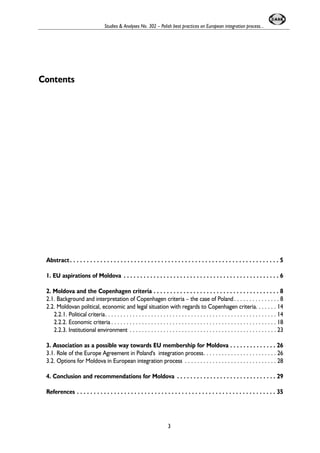
Contents 
Studies & Analyses No. 302 – Polish best practices on European integration process... 
Abstract . . . . . . . . . . . . . . . . . . . . . . . . . . . . . . . . . . . . . . . . . . . . . . . . . . . . . . . . . . . . . . 5 
1. EU aspirations of Moldova . . . . . . . . . . . . . . . . . . . . . . . . . . . . . . . . . . . . . . . . . . . . . . . 6 
2. Moldova and the Copenhagen criteria . . . . . . . . . . . . . . . . . . . . . . . . . . . . . . . . . . . . . . 8 
2.1. Background and interpretation of Copenhagen criteria – the case of Poland . . . . . . . . . . . . . . . 8 
2.2. Moldovan political, economic and legal situation with regards to Copenhagen criteria. . . . . . . 14 
2.2.1. Political criteria. . . . . . . . . . . . . . . . . . . . . . . . . . . . . . . . . . . . . . . . . . . . . . . . . . . . . . . . 14 
2.2.2. Economic criteria . . . . . . . . . . . . . . . . . . . . . . . . . . . . . . . . . . . . . . . . . . . . . . . . . . . . . . 18 
2.2.3. Institutional environment . . . . . . . . . . . . . . . . . . . . . . . . . . . . . . . . . . . . . . . . . . . . . . . . 23 
3. Association as a possible way towards EU membership for Moldova . . . . . . . . . . . . . . 26 
3.1. Role of the Europe Agreement in Poland's integration process. . . . . . . . . . . . . . . . . . . . . . . . 26 
3.2. Options for Moldova in European integration process . . . . . . . . . . . . . . . . . . . . . . . . . . . . . . 28 
4. Conclusion and recommendations for Moldova . . . . . . . . . . . . . . . . . . . . . . . . . . . . . . 29 
References . . . . . . . . . . . . . . . . . . . . . . . . . . . . . . . . . . . . . . . . . . . . . . . . . . . . . . . . . . . 35 
3
Studies & Analyses No. 302 – Polish best practices on European integration process... 
Iurie Gotisan is an economic expert for Association for Participatory Democracy ADEPT in Chisinau, Moldova. 
Mr Gotisan holds a doctor degree in economics from Academy of Economic Studies, Bucarest, Romania. His 
thesis covered analysis of monetary market in the mechanism of economic development of the Republic of 
Moldova. His research interests are money market, currency policies and their role on function and economic 
development. 
Karina Kostrzewa is EU external relations and neighborhood policy specialist at the Cabinet of the Minister for 
European Affairs, Warsaw, Poland. Ms Kostrzewa holds a master degree on international relations of Warsaw School 
of Economics, Poland. She focuses on EU external relations, international trade as well as institutional capacity 
building and development policy. She has worked for the Chief Negotiator of Poland's accession to the EU. 
Eugen Osmochescu holds LL.M in European Community Law and Comparative Law of Maastricht University, 
the Netherlands. He is a deputy chairman of International Law and Foreign Economic Relations Department 
at the State University of Moldova, Law Faculty. Mr Osmochescu works as a department manager on policy and 
regulatory reform for Development Aternatives Inc. in Chisinau. He served also as a policy advisor to the 
government, Parliament, and local public authorities of the Republic of Moldova. 
4
Abstract 
Studies & Analyses No. 302 – Polish best practices on European integration process... 
Moldova unilaterally declares its EU membership aspirations and started the process of economic, legal 
and institutional approximation targeted at establishing free market economy, stable democratic 
institutions and sound legal system. In the paper the authors made an attempt to assess the competitive 
and institutional capacity of Moldova in the context of EU membership requirements. It presents Polish 
achievements in European integration process as a CEE successful way towards full membership. The 
paper is devoted to transfer know how on Polish experience in EU integration at first stages of the process, 
with the emphasis on assessment of fulfillment of Copenhagen criteria and the role of association stage in 
the integration process as a whole. Basing on Poland's example, it provides the recommendations for 
Moldova on possible ways of integration with the EU so that Moldovan economy and society would be able 
to benefit most from the process - in other words, to successfully conclude the transformation of economy 
and adjust law and state institutions to European standards. 
The analysis does not cover the political aspects of Transdniestrian conflict as it is an important and 
broad issue that requires deep separate analysis. In the paper there is also no evaluation of cooperation 
within Stability Pact for South Eastern Europe since we consider Moldova as Eastern European country 
with clear geopolitical position neighboring Ukraine and Romania. 
5
Studies & Analyses No. 302 – Polish best practices on European integration process... 
1. EU aspirations of Moldova 
Having declared its independence on August 27, 1991, the Republic of Moldova became one of the first 
sovereign states from the former Soviet Union. The newly created state was facing a set of political, economic 
and social problems which it had to resolve alone, relying on its own potential and resources. State-building and 
economic transformation were influenced by certain conditions: the country was highly dependent on the 
Russian economy, newly created state institutions were unstable, radical transformation of the economic system 
resulted in deep crisis through the 1990s. Moreover, Moldova had to confront the armed conflict in 1992 which 
generated the Transdniestrian separatism that caused disintegration of the country, the loss of a considerable part 
of energy resources and border control. 
However, during the 1990s Moldova managed to accomplish certain development goals. By the mid-1990s, 
first generation reforms were successfully introduced such as freeing up the vast majority of prices and domestic 
trade, fight over the hyperinflation. Liberalisation of trade policy permitted Moldova to become one of the first 
CIS countries to join the WTO. In terms of privatisation, a mass voucher scheme relatively quickly sold out the 
state-run small and medium enterprise sector. As a result, Moldova’s private sector accounted for 50% of official 
GDP in 2002. Moldova’s economy and trade, earlier fully oriented to the Eastern markets, have started to turn 
gradually to Europe. 
Moldova, as a newly established state was firmly expressing its intention to integrate into the international 
society as well as gaining credibility and financial assistance. To strengthen its security and stability, the young state 
has made concrete steps towards joining international institutions such as the United Nations, World Bank, 
International Monetary Fund and recently, World Trade Organisation. In this context, Moldova’s participation in 
regional and sub-regional structures such as the European Bank for Reconstruction and Development, the 
Council of Europe, the Organisation for Security and Co-operation in Europe and the Pact for South-Eastern 
Europe hold an important place. 
However, taking into account geopolitical, economic and social values, it is the European Union that 
represents a priority among Moldova's fundamental objectives. Yet, due to unstable democratic institutions and 
lack of clear foreign policy objectives, the evolution of Moldova-EU relations has been rather slow in comparison 
to other new democracies from Central and Eastern Europe. 
The existing legal basis of EU-Moldova relations is formed within the contractual framework of the 
Partnership and Cooperation Agreement (PCA). The PCA between Moldova and the EU was signed in 
November, 1994 and entered into force in July, 1998. It was signed for an initial period of 10 years. After the 
expiration of this period it is automatically renewed on an annual basis, except for cases when one of parties 
declares its termination. 
Throughout the period between the signing of PCA and its enforcement, EU-Moldova relations were based 
on the Interim Agreement on trade and related measures from October, 1995, in force since May, 1996. The 
Interim Agreement contained provisions related to trade with goods, payments, competition, intellectual and 
commercial property. On its basis, according to art.10 of PCA, the most significant part of the agreement was 
introduced concerning mutual trade relations. The parties accord to one another most favored nation (MFN) 
treatment and limit the possibility of imposing restrictions on imports and exports. 
PCA is the most advanced and important agreement under which Moldova regulates its relations with the 
European Union. The document gave political dimension of bilateral co-operation based on common democratic 
and economic objectives and developed common institutions for the first time, namely Cooperation Council, 
Cooperation Committee and Parliamentary Cooperation Committee. PCA covers a wide range of areas 
including political dialogue, trade and investment, economic co-operation, legislative approximation, culture and 
6
Studies & Analyses No. 302 – Polish best practices on European integration process... 
science as well as financial assistance. The parties recall the common values that they share and state their 
commitment to respect for democratic principles and human rights. Moreover, it establishes the conditions for 
liberalization of goods trade and offers the perspective to set up a free trade area (FTA)1. 
The pace and utilisation in practice the cooperation framework and financial tools proposed by the EU 
depended on Moldova. European choice should be a strong incentive since it provides the country with both 
democracy and institution building, internal stability and external security. However, during almost seven years 
of its enforcement, PCA aims are still not fulfilled2. There was no political consequent willingness and clear 
national strategy towards economic and social development according to European standards. As a result, 
Moldova so far has not benefited fully from given possibilities. At the same time though, the country has 
expressed several times its expectations for more generous EU offers, including membership. 
Yet for the EU, which faced 2004 enlargement and institutional and policies reforms, Moldova was not a 
priority. However, since Moldova is located directly on the border of a future enlarged EU3, instability and 
poverty in this country are a matter of concern for the EU. The European Union had to reconsider its position 
towards Moldova. The European Neighborhood Policy (ENP) is a response to this new situation. Within this 
initiative PCA remains the legal framework of cooperation. However, the miserable effects in implementation of 
its commitments prove that new incentives and more active involvement from both sides are needed. European 
Neighborhood Policy offers an ambitious and realistic framework for strengthening their partnership. The 
objectives for the next years are to reduce poverty and create an area of shared prosperity and values based on 
deeper economic integration (including creation of FTA, investment promotion, legal approximation), intensified 
political and cultural relations, enhanced cross-border co-operation and shared responsibility for the conflict 
prevention. It also provides financial assistance. The proposed closer co-operation strategy, together with 
concrete tasks and time framework to be achieved enlisted in Action Plan, is the first step of the new EU 
approach towards its neighbor. 
Within ENP, Moldova is not considered a candidate for EU membership at least in the mid-term perspective. 
However, the EU enlargement circumstances have created both new opportunities and challenges for the 
country. In fact, the offered privileged relationship covers all fields of integration apart from the access to EU 
institutions4, which should be fully utilized by Moldova. This refers not only to economic, social and institutional 
development but to the Transdniestria problem5 as the EU priority is to establish stability in the region as well. 
The ENP, including the EU-Moldova Action Plan, signed on 13 December 2004, is a strong signal of the EU 
determination to continue to step up its engagement with Moldova and to assist the country towards a significant 
degree of economic integration and a deepening of political cooperation. The Action Plan is to become a solid 
platform for moving ahead on this path. Though, again, the speed and intensity of the integration process will 
depend on the will and capability of Moldova to engage in the broad agenda of ENP. 
The first political steps from the Moldova side have already been undertaken. President V. Voronin clearly 
declared that European integration is a foreign policy priority. The provisional structure for future coordination 
system of European policy has been established within public administration. The government has prepared the 
Concept for European Integration6 enlisting the areas of closer cooperation and internal actions to fulfil the PCA 
commitments. After being reelected during the elections on 6 March 2005, the President acknowledged 
1 Art. 4 of PCA. 
2 See: European Neighborhood Policy, Country Report on Moldova, European Commission, 12.05.2004. 
3 In 2007 Romania and Bulgaria are to join the EU. 
4 Speech by Romano Prodi President of the European Commission A Wider Europe – A Proximity Policy as the key to stability “Peace, Security 
And Stability International Dialogue and the Role of the EU” Sixth ECSA-World Conference. Jean Monnet Project. Brussels, 5-6 December 2002. 
5 The European Council Conclusions on Moldova as of 14 June, 2004 reaffirms the importance of outstanding border management issues on 
the entire Moldovan-Ukrainian border, in particular the Transdniestrian section, being addressed by the parties concerned; 
http://europa.eu.int/comm/external_relations/moldova/intro/gac.htm#mo230204 
6 V. Gheorghiu, European Strategy of Moldova, Institute for Public Policy, Chisinau, 2004. 
7
Studies & Analyses No. 302 – Polish best practices on European integration process... 
continuity of his political program concerning Moldova’s accession to the EU7. He ensured the implementation 
of Action Plan. In April 2005 the National Commission for European Integration (NCEI) has unveiled European 
Strategy of the Republic of Moldova (ESRM) which is now submitted to the Parliament. ESRM comprises of the 
following basic fields for every sector of activity: analysis of legislative framework; analysis of institutional 
framework, formulation of existing problems; formulation of short- and medium-term priorities. The strategy is 
in-line with the Action Plan. ESRM will be periodically reviewed according as implementation of the EU Action 
Plan for Moldova, and this would allow it to be used as an internal tool for monitoring the process of 
implementation of this plan. Till the expiration of PCA and implementation deadline of Action Plan in 2008, NCEI 
assesses to make considerable progress in carrying out ESRM within three years. Under this condition, Moldova 
expects the EU to advance the status of dialogue by signing either a new agreement (on association or 
neighborhood) or a new action plan or a strategy, if there is enough political will in Brussels. 
The EU engagements towards Moldova has been also confirmed by appointing the Special Representative for 
Moldova by the Council of the European Union on March 23, 2005. It shows EU interest to play greater political 
role in Moldova. EU Special Representative will commence its mission in August 2005. He will monitor the 
respect of human rights and fundamental freedoms, the political processes and the consolidation of the 
democratic institutions with the main emphasis on resolving the Transdniestrian conflict. He will oversee the 
implementation of Action Plan, boost bilateral ties, fight human trafficking etc. 
2. Moldova and the Copenhagen criteria 
2.1. Background and interpretation of Copenhagen criteria – the case 
of Poland 
The basic conditions for enlargement of the European Union are laid out in article 49 of the EC Treaty, which 
stipulates that “any European state may apply to become a member of the Union. It shall address its application 
to the Council, which shall act unanimously after consulting the Commission and after receiving the assent of the 
European Parliament. The conditions of admission and the adjustments to the Treaties on which the Union is 
founded, and which such admission entails, shall be the subject of an agreement between the member states and 
the applicant state. Their agreement shall be submitted for ratification by all the contracting states in accordance 
with their respective constitutional requirements”. In principle, the only material condition relating to the 
accession of a new state to the European Union is that the applicant is a “European state”. The term “European” 
has not been officially defined. It is therefore interpreted in terms of geography, culture and history. These are 
the factors that would contribute to the forging of a European identity and that is how the XX-century EU 
enlargements were. However, once the former communist countries from Central and Eastern Europe have 
expressed their intensions to become member states, the EU had to identify political and economic values 
common for each “European country”. 
The conditions that pre-accession candidates have to fulfil were specified by the member states at the 
Copenhagen European Council8 in June 1993. The Council concluded that “the associated countries in Central 
and Eastern Europe that so desire shall become members of the Union”. Accession could take place as soon as 
an applicant was able to “assume the obligations of membership by satisfying the economic and political 
7 ADEPT E-journal, III year, no.48, March 7-April 3, 2005, p. 3. 
8 Conclusions of the Presidency, European Council, Copenhagen, 21-22 June, 1993, SN 180/93. 
8
Studies & Analyses No. 302 – Polish best practices on European integration process... 
conditions”. Member states also set out the qualifying criteria for EU membership, referred to as the so-called 
Copenhagen criteria. According to the conclusions of the Copenhagen summit, membership requires: 
1. The achievement of stable institutions guaranteeing democracy, the rule of law, human rights and respect 
for and protection of minorities (political criterion); 
2. The existence of a functioning market economy, as well as the capacity to cope with competitive pressure 
and market forces within the Union (economic criterion); 
3. The ability to take on the obligations of membership, that is to adopt the common rules, standards and 
policies that make up the body of EU law, including adherence to the aims of political, economic and 
monetary union (acquis criterion). 
In the context of Copenhagen criteria the political, economic and institutional situation of Poland of 
1997 is presented. It is the year when, for the first time, the official evaluation according to Copenhagen 
criteria was made by the European Commission. It is to show the stage of advancement when comparing 
to today’s Moldova in next subchapter. It presents Poland’s achievements towards fulfillment of the 
accession criteria from the time it was first assessed in 1997 till the last 2002 report when the country was 
recommended to be ready for membership. The aim is to learn from the Polish example on the solutions 
and processes that were undertaken on the way, as well as to help to develop Moldova’s own long-term 
strategy on European integration. 
In the case of Poland, it must be clearly stated that the transformation and structural changes of the 
Polish economy were undertaken by the politicians in terms of 1993 European conditions. Within the legal 
framework of the Europe Agreement, following governments committed their work towards building a free 
market economy adjusted to EU requirements. Not mentioning that unilateral preparation towards 
membership started just after the collapse of communism in 1989 as it was continuously declared by the 
Polish authorities. 
The first assessment of Poland’s fulfillment of the Copenhagen criteria was made in 19979. In Avis10 the EU 
member states stressed profound systemic and economic transformations, which had triggered considerable 
economic growth and social progress, and brought Poland markedly closer to EU standards. In 1997, eight years 
after the collapse of communism regime, Poland, being on its half way to conclude creation of free trade area, 
managed to successfully accomplish the main stages of structural transformation. Democratic powers were 
acting smoothly and the rules of law were obeyed. At the same time, the Commission identified those areas in 
which adjustments to EU solutions required continued reform for Poland to meet EU member obligations in the 
near future. From the Commission point of view, the assessment of country’s ability to fulfil the criteria is not 
only its economic outcomes, but also the continuation of systemic changes undertaken to be able to sustain 
economic growth, internal stability etc. Poland was still facing important reforms such as further decentralization, 
pension and health care systems. 
In the conclusion of the 1997 Avis, the European Commission recommended to start the accession 
negotiations with Poland and stated on the elimination of shortcomings which were to be monitored on the 
regular basis in the reports in following years. Positive recommendations included in Avis, though not binding of 
the European Council, were crucial for further accession process. The assessment allowed the government to 
modify at home the existing structural programmes and reinforce the pointed areas of adjustments. Avis 
confirmed that the Polish government took the right direction of reforming the country and enforced the hope 
that, due to its continuation, Poland should join the EU in the medium-term. Avis acted also as an incentive 
instrument for government administration to strengthen the adjustments efforts. 
9 
9 European Council in Luxembourg, 12-13 December, 1997. 
10 Avis on Poland’s political and economic situation; Agenda 2000, 1997.
Political criterion11 
Studies & Analyses No. 302 – Polish best practices on European integration process... 
The upholding of democracy and human rights is a key criterion for belonging to the EU. To join, prospective 
member states must have stable institutions that guarantee democracy and the rule of law that contain individual 
freedom, political pluralism, democratic institutions, independent judiciary and constitutional authority, free and 
fair elections etc. They must also ensure the respect for human rights, especially those rights included in the 
European Convention of Human Rights and Fundamental Freedoms of 4 November 1950 and the European 
Charter of Fundamental Rights that was declared in Nice in November 2000 and included in the EU 
Constitutional Treaty. Respect for human rights and protection of minorities must be guaranteed by internal law 
and joining the international conventions. 
Poland was always assessed by the European Commission as a democratic country, respecting human rights 
and minorities. Considerable progress was made in consolidating and deepening the stability of its institutions 
guaranteeing democracy, the rule of law, human rights and respect for and protection of minorities. However, a 
few significant problems were identified that needed many improvements: 
• reinforcement of administrative capacity across the civil service was still an important issue and further 
efforts were needed. In the area of public administration progress in the implementation of the 1999 Civil 
Service Law was limited by the temporary suspension of the system of recruitment by open competition. 
It was essential that the pace of implementation, most notably with respect to recruitment, be accelerated 
so as to ensure that an independent, well-trained and motivated civil service is in place by the time of 
accession. 
• Poland made further progress in reforming the judiciary and in creating conditions to allow for a reduction 
in the most pressing problems. Strong efforts had to be focused on ensuring that the progress to date 
delivers the desired result in terms of improved efficacy of the judiciary. Similar priority needed to be given 
to the training of judges, in particular in EC law. The ongoing efforts on a sustainable structured programme 
of training needed to be put in place. 
• corruption remained a cause for serious concern, a comprehensive strategy was adopted to combat the 
problem. Substantial efforts were required to ensure concrete results, which to date were limited, and in 
particular to develop a political, administrative and business culture which can resist corruption. 
Economic criterion 
EU established a twofold aspect of economic criterion to examine the economic readiness towards the 
membership of the applicant country that requires the candidate to have: 
• a functioning market economy; 
• the capacity to be competitive on the EU market. 
The former requires the functioning of a viable market economy, with free and open competition, price and 
trade liberalisation, and a developed financial services sector. The latter consist of two dimensions of the 
environment of competitiveness according to the definition recognized by the European Commission. It 
concerns the enterprises that must develop the ability to cope with the competitive pressures and forces of the 
European Union’s internal market as well as the whole economy of the applicant country compared to the 
economies of EU members. 
These criteria are linked. Firstly, a functioning market economy will be better able to cope with competitive 
pressure. Secondly, in the context of membership of the Union, the functioning market is the internal market. 
11 In the meantime, through the entry into force of the Treaty of Amsterdam in May 1999, the political criteria defined at Copenhagen have 
been essentially enshrined as a constitutional principle in the Treaty on European Union. Article 6(1) of the consolidated Treaty on European 
Union reads: “The Union is founded on the principles of liberty, democracy, respect for human rights and fundamental freedoms and the rule 
of law.” More recently, these principles were emphasized in the Charter of Fundamental Rights of the European Union, that was proclaimed 
at the Nice European Council in December 2000 and included in the Constitutional Treaty being under ratification process. 
10
Studies & Analyses No. 302 – Polish best practices on European integration process... 
Without integration into the internal market, EU membership would lose its economic meaning, both for the 
applicant country and for its partners. The ability to cope with competitive forces depends on the level of 
integration with the body of the European Union in terms of legislation, common market requirements and 
trade. The adoption of the acquis, which is the third Copenhagen criterion, and in particular the internal market 
acquis, is therefore essential for a candidate country, which must commit itself permanently to the economic 
obligations of membership. This irreversible commitment is needed to provide the certainty that every part of 
the enlarged EU market will continue to operate by common rules. At the level of the public authorities, 
membership of the Union requires the administrative and legal capacity to transpose and implement the wide 
range of technical legislation needed to remove obstacles to freedom of movement within the Union and so 
ensure the working of the single market. At the level of individual firms, the impact on their competitiveness of 
adopting the acquis depends on their capacity to adapt to the new economic environment. 
Despite the exclusive right of the EU to free interpretation of the criterion, essentially, the definition of a free 
market economy is based on concrete indicators taken into account by the European Commission12 such as: 
• overall assessment of the transformation process, including the privatisation progress and the role of the 
state in the economy, economic structure; 
• liberalisation of prices and external liberalisation (elimination of any trade barriers; complete convertibility 
of national currency); 
• establishment of a sound legal system and institutional infrastructure of the economy, including the 
regulation of property rights, absence of significant barriers to market entries (establishment of new 
companies) and exits (bankruptcies and liquidations) and free competition; 
• macroeconomic stability (i.e. stabilisation of prices, reducing inflation, GDP growth, FDI inflow, foreign 
trade, sustainable public finance); 
• broad consensus about the essentials of economic policy; 
• well developed financial sector to channel savings towards productive investment. 
The existence of a market economy requires that equilibrium between supply and demand is established by 
the free interplay of market forces. In particular, the existence of a functioning market economy requires that 
prices, as well as trade, are liberalised and that an enforceable legal system, including property rights, is in place. 
Macroeconomic stability and consensus about economic policy enhance the performance of a market economy. 
A well-developed financial sector and the absence of any significant barriers to market entry and exit improve 
the efficiency of the economy. 
The capacity to cope with competitive pressure and market forces within the Union requires a stable 
macroeconomic framework, but allowing economic agents to make decisions in a climate of predictability. It also 
requires a sufficient amount of human and physical capital, including infrastructure. State enterprises need to be 
restructured and all enterprises need to invest to improve their efficiency. Furthermore, the more access 
enterprises have to outside finance and the more successful they are at restructuring and innovating, the greater 
their capacity will be to adapt. Overall, an economy will be better able to take on the obligations of membership 
the higher the degree of economic integration it achieves with the Union before accession. Both the volume and 
the range of products traded with EU member states provide evidence of such integration. 
Concerning Poland’s example the 1997 Avis already acknowledged the comprehensive reform efforts 
undertaken by the Polish authorities to transform their economy. Since the Avis, and against a challenging 
international economic environment, economic performance was improving. In general, the state of Polish 
economy was positively evaluated. Macroeconomic stability was achieved, reforms continued while the Polish 
authorities’ commitment to the economic requirements of EU accession was sustained. The economic situation 
of Poland was perceived very well against other candidate states due to the high GDP of average above 5% 
12 Avis on Poland’s political and economic situation; Agenda 2000, 1997, p. 19. 
11
Studies & Analyses No. 302 – Polish best practices on European integration process... 
within the period of 1996-200013. However, it was only the last 2002 Regular Report which estimated that 
Poland should be able to compete with the EU economy on the internal market within a short period of time14. 
Acquis criterion 
When declaring the willingness to join the EU, the country must share the basic aims of the Union, including its 
policies and instruments. The legal and administrative criterion obliges a country to adopt and implement the entire 
body of the Community law and policy. The European Commission then examines the country’s capacity to assume 
the obligations of membership - that is, the legal and institutional framework, known as the acquis communautaire, 
by means of which the Union puts into effect its objectives. The applicant country must be able to take on all 
obligations of membership and develop the ability to implement the acquis so that the Union would operate 
smoothly after enlargement and new member states could participate successfully in its decisions and actions. 
The condition of the effective institutional capacity development is considered by EU states to be extremely 
vague, as it was underpinning each of the three criteria. Although neither the EU nor its members have the 
competence to influence the national administrative structures and procedures. Nevertheless, the Madrid 
Council in 1995 emphasized the importance of reinforcing the third criterion by adding the necessity of building 
an adequate administrative capacity in the candidate countries, in order to efficiently deal with the adoption and 
the implementation of the common acquis. This trend was also confirmed during other following European 
Councils, in Luxembourg (1997), Helsinki (1999), Santa Maria da Feira (2000), Nice (2000) and Göteborg (2001). 
In the Göteborg Council, the conclusions provided recommendations to undertake additional efforts to reform 
judicial and administrative structures in applicant countries. 
Concerning acquis criterion in the case of Poland much more efforts were necessary to speed up legal 
adjustments and to enforce EU laws. The condition covered also the issue of institutional ability to adaptation, 
implementation and execution of law. Such a great impact was put by the European Commission to 
administrative effectiveness of future member state because otherwise the carrying out of aims and policies of 
the EU would be threatened as well as decision-making process would be blocked. 
From the overview above it is noticeable that Copenhagen criteria are formulated in a very general way. It 
may suggest that it will be easier to fulfil them, as with comparison to convergence criteria, they do not contain 
any strict economic indexes. On the other hand, the way criteria are formulated can easily be interpreted for 
the benefit of the member states and postpone the EU enlargement momentum even though the reforms are 
advanced and requirements are fulfilled by the applicant countries. It is worth remembering that this is European 
Union which has the unilateral right to revise and to change the accession conditions. Although there is one 
common aim of enlargement for both applicant and member states, there is no doubt that between candidate 
states and members of the EU there is asymmetrical interdependence in which the latter ones have the last 
unanimous word. 
It is confirmed15 that a number of issues represent interpretation problems with the Copenhagen criteria 
as established in 1993. First of all, criteria are formulated in such a way that they are considered to be a 
moving target problem, i.e. meeting the accession conditions is almost impossible because their specific 
content keeps changing. This perception tends to generate frustration in the candidate states and further 
suspicious about the EU commitment to enlargement in general and a transparent criteria-based approach in 
particular. Partly, the problem arises from the development and amendment of the acquis itself. However, the 
13 According to Eurostat the average pace of GDP growth (5,1%) in Poland in 1996-2000 was the highest one among 12 candidate states. 
14 “(…)Poland is a functioning market economy. The continuation of its current reform path should enable Poland to cope with competitive 
pressure and market forces within the Union (…)”, 2002 Regular Report on Poland’s progress towards accession, {com(2002) 700 final}, 
Brussels, 9.10.2002, sec(2002) 1408. 
15 “Assessing the Accession Criteria”, Report from workshop: Political Dimensions of the Accession Criteria, European Research Institute, 
University of Birmingham, 30 November 2002. 
12
Studies & Analyses No. 302 – Polish best practices on European integration process... 
large scope of the accession conditions has also allowed the EU to stress different issues at different times for 
the candidates. Particularly over a long accession process amid rapidly changing conditions, and when the EU 
is engaged in a steep learning process regarding its future members, flexibility has considerable advantages. 
There might have been a political rationale for focusing on key demands early in the process so as not to 
discourage candidates before moving on to more challenging requirements for more advanced applicants. It 
is necessary to realise that the EU is constantly deepening its integration level. With the development of the 
Union, the acquis has become progressively more advanced and presents a greater challenge for future 
accessions than it was the case in the past. 
Furthermore, the measurement problem arises. Many of the requirements falling both, under the political 
and economic criteria are difficult to measure in any objective sense. Where quantitative measures might be 
available for the assessment of the political criterion, the Union has chosen not to develop or use them. The 
application of conditionality is not transparent and consistent. 
Another issue is the consistency problem. This applies to the way in which the EU has related membership 
conditions to progress in accession, both between enlargement ‘waves’ – such as the southern enlargement of 
the 1980s compared to the 2004 – and between the 10 former candidates. In particular, whereas the EU has 
made the minority rights issue a key reason not to open accession negotiations with Turkey so far, some 
contended that the minority rights question is far from being solved in Estonia or Latvia. Apart from the 
possibility that inconsistency could undermine the system of conditionality in general, there is risk of uneven use 
of conditionality in the case of Moldova. 
The sufficiency problem is also specific for Copenhagen criteria. A particular aspect of the consistency 
issue is the question of the minimum degree of fulfillment of the criteria which is necessary and sufficient for 
the attainment of each stage in the accession process, especially accession itself. No need mentioning that 
the scale of requirements is changing, i.e. there was a general agreement that the Helsinki 1999 summit 
decision represented the key shift away from the previous practice that the political criterion had to be fully 
satisfied before accession negotiation could begin, as demonstrated in the 1997 Luxembourg Council’s 
decision to exclude Slovakia from initial accession talks. This is a problem of establishing minimum sufficient 
entry conditions. 
From the EU side, Copenhagen criteria are considered as a “stick and carrot” instrument encouraging further 
transformation and democratization processes. Through the progressive development and deployment of 
accession conditionality, the EU is effectively using the prospect of membership as its main foreign policy 
instrument in its immediate neighborhood. However, where the reforms in aspirant states face difficulties, it can 
be argued that an early ‘reward’, such as progress through the accession process even where conditions have 
not been satisfactory fulfilled, can benefit reformers-although there is the counter-argument that an even more 
rigid adherence to conditionality will in fact yield the greater reform results. Either way, enlargement decisions 
can become prospective tools to influence the domestic balance of forces, rather than retrospective reflections 
of conditionality fulfillment. If this is the case that the prospect of the EU membership is the only way of securing 
democracy, political stability and greater long-term economic prosperity in its neighborhood the EU faces 
considerable ethical and practical challenges. 
The general formulation of Copenhagen criteria by EU member states and specific interpretation of 
them in the fulfillment process by the European Commission is shown on the example of Poland. Polish 
experience in this respect is useful for Moldova to assess at what stage of development the country begins 
its road towards European standards as well as to cover the areas and problems it should pay particular 
attention to. 
13
Studies & Analyses No. 302 – Polish best practices on European integration process... 
2.2. Moldovan political, economic and legal situation with regards 
to Copenhagen criteria 
Taking into account President V. Voronin’s official statement of Moldova EU aspirations, as well as pro- 
European declarations of Moldovan elites that European integration is the priority in external policy of the 
country, it has been confirmed in the Concept of Foreign Policy of the Republic of Moldova16 which stresses that 
EU accession is a main objective. The European integration is considered as one of the main long-term objectives 
of the country, next to sustainable social and economic development and the reintegration problem, according 
to Moldova’s Constitution and the government action program for 2001-2005 “Revival of the economy-Revival 
of the country”. The European integration is defined by Moldova as a fundamental development objective, which 
means the consistent implementation of common values and standards, living conditions and economic 
development models. With this respect the government has prepared the Concept for European Integration17 
which clearly emphasizes that “(…) on the internal level the actions of the Republic of Moldova will be mostly 
oriented towards meeting the Copenhagen criteria”. 
2.2.1. Political criteria 
Democracy and the rule of law 
The first act to be noted is the Moldovan Constitution of 1994, according to which democratic institutions as 
well as the rule of law are established. Moldova is a parliamentary republic based on the separation of powers. 
After 2004 constitutional modifications, the Parliament elects the President of the country, who is a leader of the 
majority party in the former, and who proposes the candidature of Prime Minister. 
Moldova’s legal framework provides a basis for democratic elections, although some modification and 
clarification of current legislation is still ongoing. The OSCE and the Council of Europe have expressed concerns 
about the practical implementation of basic democratic principles in Moldova, though the 2005 parliamentary 
elections were recognized as in line with democratic rules. 
Another political concern is that the legal powers do not supervise the whole country area due to the 
separatist movement in Transdniestrian region. As a result of the territorial disintegration, Chisinau lost control 
of the considerable part of its area and borders. The deadlock still persists over the status of this region, where 
separatists declared independence from Moldova after the latter’s independence in 1991. Despite the signing of 
the agreement about the withdrawal of Russian forces in 1994 and the commitments taken by the Russian 
Federation at the 1999 OSCE summit in Istanbul, there are still Russian soldiers in the region – including those 
involved in peace-keeping activity. Observers report that the area has become a ground for trafficking of human 
beings, illegal goods and proliferation of weapons and organised crime. 
The undeniable fact is that the Transdniestrian problem affects Moldova’s foreign relations and economic 
development as well as democratic consolidation. Solving the conflict on Transdniestria is a key to making further 
progress towards building a strong and stable Moldova. 
The judicial and legal reforms were launched in 1994. The main step in the establishment of the legal 
framework and the rule of law has been the adoption of the Constitution, which includes a separate chapter 
dedicated to judiciary authority. Both, the Constitution and the Law on the Court System stipulate that the 
judiciary system is independent from the executive and the legislative powers. 
16 http://www.pressbox.md/news.php of 7 May, 2002. 
17 V. Gheorghiu, European Strategy of Moldova, Institute for Public Policy, Chisinau, 2004. 
14
Studies & Analyses No. 302 – Polish best practices on European integration process... 
The judicial reform has caused essential changes with regards to the status, role and functions of courts of 
law resulting in the introduction of judicial competence in all areas of social and economic relations. The judicial 
system in Moldova comprises the Supreme Court of Justice, courts of appeal, and courts of first instance as well 
as a system of economic courts including an Economic Court of Appeal18. The central idea has been to focus 
the judiciary on the protection of personal rights, thereby upholding the principle of free access to justice and 
the right to satisfaction from competent courts of law. The status of judges has been modified based on the 
principles of independence, impartiality and immovability. The reform process is a comprehensive and a long 
one, and experience has shown that the judiciary system still represents a barrier to the constitutional right to 
free access to justice. The third power – judiciary – still has no real independency despite the fact that legal 
framework declares it19. 
Public administration and the fight against corruption 
Since independence, macroeconomic and structural reforms have proceeded faster in Moldova than reforms 
to the system of state administration. The latter were essentially limited to reductions in the numbers of state 
employees due to the need to minimise the budget deficit. In general, reform and restructuring of public 
administration have been led by changes of political administration, rather than by a coherent, consistent, long-term 
reform plan. The current situation of public administration is characterised by insufficient functional and 
institutional adaptation to the requirements set by the transformation results. The existing capacities are 
insufficient for using modern management methods. The principles and method of recruitment and promotion 
of public servants are not consistent with efficient administration and development of high quality policy. 
The main emphasis of recent reforms has been to decentralise government functions and responsibilities by 
reorganising the local public administration bodies. In 2003 the former administrative structure based on 10 
judets was replaced by an expanded structure of 32 regions. The actual reforms provide conditions for 
continuing the decentralisation process. The rights and responsibilities of local public administration are 
stipulated in laws regarding the drafting and approval of local budgets, the management of local public finance, 
guarantees of local autonomy, power of local authorities. 
Moldova faced two reforms of territorial-administrative structure, which were important challenges in terms 
of expenditures and promotion of transparency and fighting corruption. Some improvements have been 
achieved lately, but problems persist in terms of efficacy of the administrative system, of smoothing bureaucracy 
and of efficiently training civil servants. Corruption exists at all levels of public sector and is fuelled by the 
opportunities and incentives created by the governance system. Poor public sector wages also contribute to 
driving corruption at the lower levels of the public administration. It is also accompanied by the expansion of the 
unofficial economy and worsening of public services. Corruption affects also business activity. The costs of 
corruption to enterprises are large, and its direct and indirect costs exceed by far the benefits in the areas of 
hiring personnel, licensing, inspection, and trade. According to Transparency International surveys20, Moldova 
ranks 100 out of 133 countries. Among most corrupted sectors there are customs, fiscal authorities and the 
police as well as education and health sectors. Certain actions are undertaken. The Center for Fighting Economic 
Crime and Corruption is formally mandated with the task of fighting corruption. Its main aims are: reduction and 
simplification of regulations; free access to information; elaboration of code of conduct, to which the institutions 
will adhere to eliminate corruption and the conflict of interest rules prohibiting participation in decision making 
whenever private interests may be present in the performance of public duties; declaration of incomes and their 
effective monitoring, promotion of coalition among groups with similar interests for preventing corruption, 
18 Law on Judicial Organisation as of 06.07.1995; Law on the Status of Judge as of 20.07.1995; Law on the Military Courts System as of 
17.05.1996; Law on Supreme Council of Magistrates as of 19.07.1996. 
19 Economic Growth and Poverty Reduction Strategy Paper (2004-2006), Government of the Republic of Moldova, Chisinau, June 2004, p.55. 
20 The 2003 Transparency International report on Corruption. 
15
Studies & Analyses No. 302 – Polish best practices on European integration process... 
establishment of vigilance unit. Integral part of these actions is general training of legislators and civil servants, 
overall public sector reform and reliance on informational technologies in the future. 
Removal of corruption will stimulate economic activity in the country. Moldova should become a more 
attractive country for foreign investors, benefits of private sectors will increase, budgetary resources collection 
will be more efficient, conditions will be created for better remuneration of civil servants, the quality of services 
delivered to the population will be improved. 
Human rights 
Moldova is a part to most international instruments on human rights protection21. Art. 4 of the Constitution 
of Moldova guarantees not only fundamental human rights and freedoms but also establishes the precedence of 
international law regarding human rights, in case national legislation sets contradictory rules. 
Gender 
Gender issues was covered within a UNIFEM Project in Moldova, under the auspices of which, a group of 
experts have elaborated draft legislation on assuring the equal treatment as well as equal opportunities for 
women and men. In this respect a draft law was presented, and modifications to other normative acts, including 
the Constitution, Penal Code, Penal Procedure Code, Family Code, Labour Code etc. 
Child protection 
Moldova has joined the main international instruments on the rights of the child, and in particular, the 
International Convention on Children's Rights. Official statistics from 2001indicate that there are approximately 
13,500 children institutionalized in orphanages, while NGOs estimate that up to 30,000 children are in 
institutions or foster homes22. Therefore relevant legislative framework, as well as instruments for further 
improvements to secure implementation and adequate financing, are needed. 
National minorities 
With respect to minority rights protection23 Moldova has been recognised as one of the most advanced on 
the issue because of granting to Gagauz autonomy. The Law on Rights of Persons belonging to National 
Minorities and the Legal Status of their Organisations as of 19 June, 2001 demonstrates the political will to 
respect and implement national minorities’ rights. 
Yet, one of the existing problems is the decision, based on the regulation of the Ministry of Education to 
impose as compulsory course the Russian language in national schools, as well as the tendency to declare Russian 
as a second official language. On the other hand, not all necessary measures are undertaken to assure a proper 
teaching of national languages in schools as well as teaching in those languages in national schools. 
Another problem that Moldova faces related to minority rights protection is rural Roma population. It 
has to be stressed that Roma people have never been officially recognised and seen as a national minority. 
They are considered quite distinct from the other population through peculiarities of culture, distinguished 
language and mostly traditions, they are not granted the status of an ethnic groups, ethnic community, 
national minority, etc. 
21 Including the European Convention of Human Rights and Fundamental Freedoms (ECHR) of 4 November 1950. 
22 European Neighborhood Policy, Moldova Country Report 2004, European Commission, Brussels, 12 May 2004, p. 8. 
23 Moldova is a part to the Framework Convention on National Minorities Protection as of 22.10.1996; CoE Recommendations 1201 on 
additional protocol to ECHR regarding the national minorities rights: Oslo and The Hague Recommendations on linguistic rights and 
education rights of national minorities. 
16
Studies & Analyses No. 302 – Polish best practices on European integration process... 
In this regard the following are identified as needs/lacks: 
• material situation; 
• access to education system; 
• access to assets and means to generation of living income; 
• participation in representation in public life; 
• assimilation and right to enjoy distinctive culture. 
The human rights situation in the Transdniestria separatist region24 is also unsatisfactory. Right of minorities, 
in particular language rights, are not respected. A small group of schools in Moldovan language operate thanks 
to the efforts of the OSCE. Freedom of speech and diversity of opinion have been continuously under attack. So 
have associations and political parties that were not fully in line with the view of the ruling group. Transdniestria 
is also frequently cited as a hub for all kinds of illicit trafficking such as smuggling in arms, human beings, drugs. 
Political criterion evaluation based on EU documents on Moldova 
European Commission stated that democracy is established in Moldova. Country Strategy Paper25 of 12 May 
2004 stresses that further progress is needed to consolidate civil society, public governance and the rule of law. 
It provided in the Country Strategy Paper areas of needed cooperation, namely fighting crime, corruption, 
smuggling and illegal migration. Needs for improved public administration and the rule of law are also specified. 
According to the Action Plan the following are identified as priorities for actions: 
• further strengthening the stability and effectiveness of institutions guaranteeing democracy and the rule of law; 
• further reinforcing administrative and judicial capacity; 
• review the existing legislation to ensure the independence and impartiality of the judiciary; 
• continue administrative reform and strengthening of local self government in line with European standards; 
• further fight against corruption; 
• ensure respect of human rights and fundamental freedoms, including rights of national minorities, children’s 
rights, torture prevention; 
• stepping up the fight against organised crime, including trafficking in human beings; 
• ensuring respect for the freedom of the media and the freedom of expression; 
• ensure respect for freedom of association; 
• foster development of civil society; 
• ensuring the efficient management of migratory flows, including initiating the process towards conclusion 
of a readmission agreement between the European Community and Moldova. 
As the values of democracy, rule of law and human rights are common for all European states the respect 
for them in neighboring countries is also a matter of great concern of the EU. The above analysis reflects the 
EU position on political system of Moldova without referring directly to political Copenhagen criteria. It 
proves that there are still certain areas of violence of human rights and unstable functioning of democratic 
institutions (pluralism, judiciary system, corruption). The Action Plan provides tools and actions to be 
undertaken by Moldova to achieve the European standards in political requirements. It is recommended to 
follow the steps as stated in Action Plan to strengthen the institutions and ensure respect for human rights 
and development of civil society. 
24 Ethnic Moldovans constitute roughly 40% of the population, the remaining 60% being mainly ethnic Ukrainians and Russians. The “official” 
languages are Russian, Moldovan and Ukrainian. 
25 COM (2004) 373final, http://www.europa.eu.int/comm/world/enp/pdf/country/Moldova_11_May_EN.pdf 
17
2.2.2. Economic criteria 
Studies & Analyses No. 302 – Polish best practices on European integration process... 
The assessment of the country based on the fulfilment of the economic criterion can be made not only on 
the basis of the country reports of the European Commission, but also as a result of the endorsements of 
international organizations (IMF, WB) and independent analysis undertaken by consultants or national public 
institutions. 
The existence of a functioning market economy 
Internal and external liberalization 
Price and trade liberalization is the area where Moldova probably made the most progress. With regard to 
liberalization, Moldova completed the necessary reforms in the first few years of transition. Thus, price 
liberalization – the key-stone in the functioning market economy – commenced at the end of 1994, and after 
three years of successive liberalizations the share of liberalized prices reached 80% of GDP26; the process 
continues to nowadays. 
Generally the prices are liberalized and to a large extent follow the dominant tendencies on the market. The 
state monopoly has been removed from most sectors of the economy and the privatization of a large number 
of enterprises has been completed. There are only a few socially-sensitive sectors of the economy where the 
prices remain fixed by the state. This is, however, completely in line with the practices of a functioning market 
economy that is socially-oriented. In European countries, including Poland, certain prices for products, and 
especially, services of public importance are fixed. 
At the same time, it is necessary to undergo a periodic review of the fixed price levels in complete agreement 
with both producers and consumers, as for example, for utilities. Price level that is too low will simply jeopardize 
the public and private producers of utilities and lead them into bankruptcy. In addition, there are a few economic 
sectors that are not liberalized, such as telecommunications. 
With regard to external liberalization, there are no significant quantitative restrictions on imports or exports. 
Practically, all quantitative barriers have been removed. The Republic of Moldova is one of the most open 
economies in Europe and its foreign trade, which exceeds even the level of GDP27 (share of imports in GDP 
stands for 65% and exports – 55% of 2003), reflects its dependence on the evolution of international economy. 
The Moldovan Leu is freely convertible and there are no significant barriers in bringing in or removing the 
currency out of the country (liberalization of the capital account). 
The labor market has also undergone liberalization, and the salaries are established through negotiations 
between trade unions and employers. Concurrently, the real wages are not sufficient to cover the subsistence 
level of income. This is a very complex problem in the area of public policy. The banking and insurance sector 
has also been liberalized. However, despite liberalization, the banking sector does not offer the contribution it 
could have to the economic development of the economy. This deficiency is not directly related to the 
liberalization process. Partially, it is reflected by the objective risks prevailing in the Moldovan economy, partially 
– by the emphatic corporate nature of the banking system, and finally – by the weak managerial capacity of 
economic agents. 
Nonetheless, a free economy does not mean only free prices and exchange rate, but also the absence of any 
abusive intrusion into the activity of the companies. In the second half of the 90s, Moldova was regarded by the 
international community as a country with advanced progress towards economic liberalization. Concurrently, the 
unfounded government intervention in the economy and the inertia of structural reforms led to the increase in 
26 CISR, Economic Survey of Moldova in Transition. No. 9, www.cisr-md.org, 2002. 
27 www.statistica.md 
18
Studies & Analyses No. 302 – Polish best practices on European integration process... 
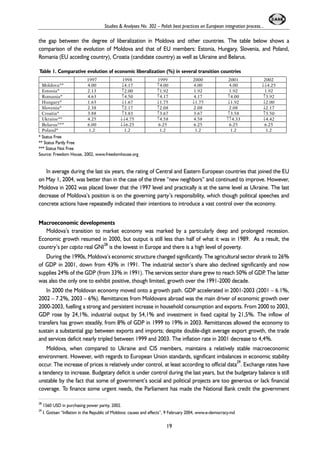
the gap between the degree of liberalization in Moldova and other countries. The table below shows a 
comparison of the evolution of Moldova and that of EU members: Estonia, Hungary, Slovenia, and Poland, 
Romania (EU acceding country), Croatia (candidate country) as well as Ukraine and Belarus. 
Table 1. Comparative evolution of economic liberalization (%) in several transition countries 
1997 1998 1999 2000 2001 2002 
Moldova** 4.00 ↓4.17 ↑4.00 4.00 4.00 ↓↓4.25 
Estonia* 2.13 ↑2.00 ↑1.92 1.92 1.92 1.92 
Romania* 4.63 ↑4.50 ↑4.17 4.17 ↑4.00 ↑3.92 
Hungary* 1.63 ↓1.67 ↓1.75 ↓1.75 ↓1.92 ↓2.00 
Slovenia* 2.38 ↑2.17 ↑2.08 2.08 2.08 ↓2.17 
Croatia* 3.88 ↑3.83 ↑3.67 3.67 ↑3.58 ↑3.50 
Ukraine** 4.25 ↓↓4.75 ↑4.58 4.58 ↑↑4.33 ↓4.42 
Belarus*** 6.00 ↓↓6.25 6.25 6.25 6.25 6.25 
Poland* 1.2 1.2 1.2 1.2 1.2 1.2 
* Status Free 
** Status Partly Free 
*** Status Not Free 
Source: Freedom House, 2002, www.freedomhouse.org 
In average during the last six years, the rating of Central and Eastern European countries that joined the EU 
on May 1, 2004, was better than in the case of the three “new neighbors” and continued to improve. However, 
Moldova in 2002 was placed lower that the 1997 level and practically is at the same level as Ukraine. The last 
decrease of Moldova’s position is on the governing party’s responsibility, which though political speeches and 
concrete actions have repeatedly indicated their intentions to introduce a vast control over the economy. 
Macroeconomic developments 
Moldova’s transition to market economy was marked by a particularly deep and prolonged recession. 
Economic growth resumed in 2000, but output is still less than half of what it was in 1989. As a result, the 
country’s per capita real GNI28 is the lowest in Europe and there is a high level of poverty. 
During the 1990s, Moldova’s economic structure changed significantly. The agricultural sector shrank to 26% 
of GDP in 2001, down from 43% in 1991. The industrial sector’s share also declined significantly and now 
supplies 24% of the GDP (from 33% in 1991). The services sector share grew to reach 50% of GDP. The latter 
was also the only one to exhibit positive, though limited, growth over the 1991-2000 decade. 
In 2000 the Moldovan economy moved onto a growth path. GDP accelerated in 2001-2003 (2001 – 6.1%, 
2002 – 7.2%, 2003 – 6%). Remittances from Moldovans abroad was the main driver of economic growth over 
2000-2003, fuelling a strong and persistent increase in household consumption and exports. From 2000 to 2003, 
GDP rose by 24,1%, industrial output by 54,1% and investment in fixed capital by 21,5%. The inflow of 
transfers has grown steadily, from 8% of GDP in 1999 to 19% in 2003. Remittances allowed the economy to 
sustain a substantial gap between exports and imports; despite double-digit average export growth, the trade 
and services deficit nearly tripled between 1999 and 2003. The inflation rate in 2001 decrease to 4,4%. 
Moldova, when compared to Ukraine and CIS members, maintains a relatively stable macroeconomic 
environment. However, with regards to European Union standards, significant imbalances in economic stability 
occur. The increase of prices is relatively under control, at least according to official data29. Exchange rates have 
a tendency to increase. Budgetary deficit is under control during the last years, but the budgetary balance is still 
unstable by the fact that some of government’s social and political projects are too generous or lack financial 
coverage. To finance some urgent needs, the Parliament has made the National Bank credit the government 
28 1560 USD in purchasing power parity, 2002. 
29 I. Gotisan “Inflation in the Republic of Moldova: causes and effects”, 9 February 2004, www.e-democracy.md 
19
Studies & Analyses No. 302 – Polish best practices on European integration process... 
actions. The main macroeconomic problems of Moldova are the trends of external financial imbalance and risk 
of trade balance deficit aggravation. 
According to official statistics, in 2003 Moldova's trade deficit with EU countries reached 163.5 million USD, 
CIS – 153.7 million USD, Central and Eastern Europe – 45.4 million USD, and other countries – 83.7 million 
USD. Moldova registered the highest trade deficit with Ukraine 222 million USD, largely due to the imports of 
energy and raw materials. The main trade partners still remain Russia and Ukraine, next to the EU. However, 
there is positive tendency of trade towards Western markets. 
Foreign direct investment in Moldova remains low because the market is small and the legal and 
administrative environment is difficult and unpredictable. Moreover, several foreign enterprises were confronted 
with unclear and contradictory decisions of the administration. In 2002 the EU companies invested almost 1.6 
billion USD in Moldova30. 
Public finance31 
Moldova’s public finance management is constrained by a large debt, which the country was unable to service. 
The fiscal situation remains serious. Projections for 2004 show an ongoing financing gap. A tight fiscal stance, 
IFI support, as well as securing preferential debt terms, will remain necessary to re-establish macroeconomic 
stability. 
During the 1990s, the National Bank of Moldova (NBM) managed to gradually reduce inflation and stabilize 
the exchange rate (although the 1998 Russian crisis temporarily led to a marked nominal depreciation of the Leu 
and to a spike in inflation). 
Moldova's current account has persistently shown large deficits. The deficit grew in 1998 to around 20% of 
the GDP. It was subsequently reduced but started to grow again in 2002 owing to a strong import demand. 
Exports and workers' remittances, however, have offset to some extent the negative effect of imports’ growth 
on the balance of payments. 
State involvement in the economy and privatization 
Despite a good start in the early 1990s and positive subsequent results in some areas (e.g. accession to the 
WTO in 2001), Moldova’s achievements in structural reform and the creation of a fully functional market 
economy remain partial. Since 2000 reform has slowed noticeably due to increasing political demands for state 
intervention in the economy. New regulations do not always present a coherent and consistent strategy. 
Moreover, regulations are often ignored. Widespread corruption further complicates the situation. 
State involvement in the economy is still extensive, the private sector answering for only 50% of GDP (in 
2002). No progress is visible since 1998, highlighting the difficulties encountered by both large and small scale 
privatization. Several important asset sales, e.g. that of the telecoms company Moldtelecom – failed or were 
postponed. 
A crucial element in the failure of the privatization programme to reach planned sales volumes was the lack 
of interest of international investors, also due to discrimination by Moldovan authorities. Heavy administrative 
procedures are an additional aspect of excessive state involvement in the economy. Moldova rates poorly in 
terms of corporate governance and enterprise restructuring. According to an EBRD indicator, Moldova’s rating 
in this category is among the 4 lowest of 27 transition countries. Privatization and enterprise restructuring made 
significant progress in the agricultural sector, despite some setbacks. The share of privately operating farms has 
30 http://europa.eu.int/comm/trade/issues/bilateral/countries/moldova/index.htm 
31 Evaluation based on European Neighborhood Policy, Country Report: Moldova, European Commission, Brussels, 2004, p.13. 
20
Studies & Analyses No. 302 – Polish best practices on European integration process... 
been growing strongly. The country depends to a large extent on FDI to complete the privatization process and 
to finance enterprise restructuring. 
Private sector development 
Despite creation of a legislative framework theoretically conceived to stimulate and consolidate private business, 
for now this sector does not have the same contribution to country’s economic development as in the case of CEE 
countries. In 1999-2002, the share of private sector in Moldova’s GDP was somewhat more than 50%32. 
Notwithstanding the fact that the main branches of economy are privatized and any private economic agent 
can legally initiate a business on its own risk and account, the private sector is still very fragile, and a large part of 
private economic activity is taking place in the shadow sector of the economy. This is dictated by several factors: 
fiscal pressures, regime of frequent controls and bureaucracy impose to high costs of economic agents. In an 
economy that is only in the incipient stage of establishment and growth, the stability of rules is more important 
than their strictness. As it is being shown in a mini-opinion poll, the largest part of businessmen consider that in 
2002-2003 the business environment in Moldova has worsened (24%) or even became unbearable (28%). 
There is general distrust of entrepreneurs in the capacity of the judicial system and public institutions to 
ensure a stable and fair business environment and to impose the universal respect for laws. In average, 75% of 
businessmen consider that the official judiciary system is unfair (tendentious), costly (time and money) and 
incapable of imposing the execution of a court decision33. 
There are limited institutional capacities of the state, including the guarantee of the inalienable character of 
private property. According to the EBRD estimations, in 2001 about 80% of entrepreneurs interviewed in 
Moldova considered that the security of their ownership rights is extremely reduced. This is related to both the 
possibilities of criminal groups to attempt on private property, and to the risk of expropriation and abusive 
confiscation, which can be operated by state bodies. 
Evolution of relations with foreign investors confirms the last thesis. Foreign investors became extremely 
cautious in evaluating the possibilities of placing their capitals in Moldova. The consequences of certain revisionist 
economic policies can be dramatic for Moldova, especially taking into consideration that decisions taken by 
foreign investors are based not only on country analyses done by specialized international organizations and 
agencies, but on concrete case studies too. The attempts of power to regulate the business, especially the 
foreign one, end up with large scandals and worsening of country’s image. 
Financial system 
The financial system in Moldova seems to be relatively stable, and National Bank of Moldova (NBM) is 
efficient enough in supervising the activity of commercial banks. Yet, despite the control from NBM, some 
commercial banks identify possibilities for practicing risky businesses and even for getting involved in criminal 
businesses. The most notorious business of this kind was the participation of Moldovan commercial bank 
(PetrolBank, Moldindconbank, Businessbank) together with “partners” from Transdniestria and Russia, in 
international money laundering mechanisms. 
Despite the relatively stable situation of the banking system, the contribution of commercial banks to the 
development of the real sector of economy still is reduced. There is a high level of geographic and sector business 
concentration. The most underdeveloped segment of Moldova’s financial system is the insurance sector. The 
number of insurance operators is reduced, the turnover is quite small, and the quality of services is honestly bad. 
The capital market is underdeveloped and inefficient. The under-capitalization of stock-exchange is due to 
32 Centre for Economic Policy of the IDIS “Viitorul”, Economic Statewatch: quarterly analyses and forecast, Issue 1, Quarter 2, 2004. 
33 CISR, Economic Survey of Moldova in Transition. No. 9, www.cisr-md.org 
21
Studies & Analyses No. 302 – Polish best practices on European integration process... 
both objective deficiencies met by Moldovan corporations, and by the limited capacities of adequate corporate 
management. 
Social development 
Poverty is an acute problem. As a result of the long 1990s recession, large swathes of the population were 
impoverished, particularly in rural areas, where the incidence of food poverty is 60% higher than in urban areas. The 
consequences are increasing child mortality, declining access to basic education, and an increase in human trafficking. 
There are signs that the improving economic situation since 2001 has begun a deviating poverty, but in 2002 over 
40% of the Moldovan population lived under the absolute poverty. An Enhanced Growth-Poverty Reduction Strategy 
Paper (EG-PRSP) for 2004-2006 has been prepared, though delays in its implementation are observed. 
Taking into account the above analysis of macroeconomic indicators and market developments according to 
the European Union indicators, Moldova is not meeting the conditions of well functioning market economy. Price 
and trade liberalization is the area where Moldova probably made the most progress. However, the remaining 
administrative barriers in trade need to be removed. Moldova is perceived as the poorest country in Europe with 
unstable economic situation due to recession with bad economic indicators. The involvement of the state into 
business is still high and there are difficulties with further privatization and enterprise restructuring process. It is 
advisable to continue transformation reform that is accompanied by stabilization of macroeconomic indicators, 
improvement of public finance and building market and financial institutions assuring development of private 
sectors and FDI inflow. 
In obtaining the EU recognition of the market economy in Moldova, WTO membership can play an important 
role. Still, in order to be recognized as a functioning market economy or at least to have several positive trends 
in this direction confirmed, it will be crucial to have the positive endorsement of the international financial-crediting 
organizations – mainly, IMF and World Bank. 
The capacity to cope with competitive pressure and market forces within the Union 
This economic criterion is hard for evaluation in the case of Moldova because it refers to much higher level 
of integration and advanced aqcuis harmonization. At the present stage of Moldovan economic performance and 
little integration with European Union policies and market as well as law approximation it is difficult to form a 
judgment of the country’s ability to fulfil the economic criterion concerning its capacity to cope with competitive 
pressure and EU market forces. So far Moldova has failed in implementing the parts of acquis according to PCA 
agreement. Unsatisfactory results in implementing the PCA obligations have led to introduce Action Plan tool to 
set time framework and detailed measures to be undertaken to fulfil the commitments. 
The level of economic integration with the EU is related also to both the range and volume of goods traded 
with member states. With this respect there is a positive trend of gradually increasing share of trade with EU 
member states in total trade performance. However, Moldova is facing to further market and institutional 
preparations for establishing free trade area as deeper step of integration with the EU. 
Moldovan economy will be better able to take on the obligations of membership the higher the degree of 
economic integration it achieves with the Union ahead of accession. The more integrated a country already is 
with the EU, the less the further restructuring implied by membership. 
In comparison to Moldova, Poland, when first assessed with respect to Copenhagen criteria in 1997, was 
recognized as a functioning market economy with its half way to full establishment of free trade area and certain 
level of acquis approximation. The achieved level of free market economy allowed European Commission to 
recommend Poland for starting the accession negotiation. 
22
Studies & Analyses No. 302 – Polish best practices on European integration process... 
2.2.3. Institutional environment 
According to this criterion a candidate country has to harmonize its legislation with acquis communautaire. 
There are no negotiations held with Moldova regarding accession, so that we cannot refer to chapters of 
negotiation as a starting point. Yet, unilaterally, it has been recognized the need to transpose the EU legislation 
into the domestic legislation basing on Partnership and Co-operation Agreement and Action Plan. Moldova’s 
ability to take on the acquis communautaire should be evaluated on the basis of PCA and instruments developed 
within European Neighborhood Policy. Within this context, the legal adjustment and institutional capacity of 
Moldova should be focused on fields of cooperation covered by PCA and ENP with particular emphasis on 
building free market and investment environment. According to art. 50 of PCA, at the current stage of 
integration, harmonization of legislation covers the following areas: customs law, law on societies, law on banks, 
enterprises accounting and taxation, intellectual property, protection of employees at their workplaces, financial 
services, competition rules, public supplies, health protection and protection of people’s, animals, plants lives, 
environment, consumers protection, indirect taxation, technical rules and standards, laws and regulations on 
nuclear energy, transportation. 
As obvious from art. 50 of the PCA, the analysed international tool comprises a list of areas to which an 
express reference to harmonization with EU norms is made. However, in the context of the PCA this is just an 
indicative list, because from the contents of the Agreement, there are other subjects where the approximation 
of state legislation to the EU norms is necessary: investments,34 mining and raw materials sector35, agriculture 
and agro-industrial sector36, introduction of legal conditions to encourage trade and investments in the energy 
sector37, telecommunication and mail services38, developing the framework for small and medium enterprises39, 
border protection. 
From PCA provisions it is clear that it is to ensure a gradual compatibility with regulations and directives 
necessary to ensure stability, free market development as well as infrastructure for trade and investment. 
Legislation harmonization and appropriate application of legislation have been expressly mentioned during the 
meetings of the Cooperation Council from 2001 and 2002 along with other issues, having a certain relation to 
the legislation, on which an effort from Moldova is necessary: customs and cross-border cooperation, fighting 
corruption, FTA creation, investments. 
Following this analyses the objective of legislation harmonization is materialised – creation of a legal 
framework and favourable climate to legal entities from Moldova, the EU and member states, necessary to 
ensure the achievement of the four fundamental freedoms: free movement of goods, people, services and 
capital. The achievement of this objective is one of the most difficult efforts Moldova may be put to, because 
with the EU development the acquis has progressively become more and more burdensome and represents a 
“trial” for the future EU joining. The possibility for Moldova to implement the acquis will represent the basic 
proof of the state’s capacity to cope with obligations of a member state. 
Within the framework of the Cooperation Council meeting, the priority and problematic areas of legislation 
harmonization have been specified: competition, Civil Code, economic right, rules of origin, intellectual property, 
standardization, taxation, investments, customs and cross-border cooperation, fighting crime and corruption. At 
the initial step of integration it is necessary for Moldova to focus on existing framework of cooperation and fully 
adopt its provisions to be prepared for closer partnership wit the EU. With this respect it must be stated that to 
23 
34 Art.53(2) of the PCA. 
35 Art.56(2) of the PCA. 
36 Art.59 of the PCA. 
37 Art.60(2) of the PCA. 
38 Art.63 of the PCA. 
39 Art.70 of the PCA.
Studies & Analyses No. 302 – Polish best practices on European integration process... 
a large extent the provisions of PCA are not implemented into the legal system of Moldova. Existent deficiencies 
in legislation harmonization are also recognized by the Cooperation Council, which stated that in priority areas 
positive results may be achieved only in case of real efforts. With response to the situation is the enhanced 
cooperation within the ENP and recently published Action Plan that covers the areas of closer approximation. 
Institutional and legal environment for proper functioning of market 
It is the criterion that assesses the institutional infrastructure and administrative capacity to enforce legislation 
and ensure the effective functioning of the market. An indirect illustration of Moldovan legislation compatibility 
with acquis could be seen from the chart below which links competitive performance to evolving market 
architectures in terms of demand patterns and preferences, rules and incentives, and competitor behaviour. 
Chart 1. Moldova's Policy Environment compared to new EU members 
Foreign Trade and Exchange 
Controls 
100% 
90% 
80% 
70% 
60% 
50% 
40% 
30% 
20% 
10% 
Political Environment 
Market Opportunities 
Taxes 
Using the Economist Intelligence Unit scores on business environment, the position of Moldova for the 10 
principal indicators relative to selected benchmark countries is sketched. The chart shows a comparison of 
Moldova’s scores with those for the EU accession countries in East-Central Europe and the Baltics. The 
comparison highlights the gap in a number of key policy areas, although the largest gap, for “market 
opportunities,” is more a function of the small size of the domestic economy. Many of the laws and regulations 
that account for major benchmark gaps are effectively in violation of Moldova’s obligations under its WTO 
membership. Just bringing the legal and regulatory system into compliance with WTO obligations would narrow 
many of these gaps. 
From all aspects of the reforms in Moldova the slowest progress during the last decade was made in 
institutional reforms. This thing is demonstrated by the recent example of the Civil Code that was adopted only 
in 2002, meaning more than ten years since the transition. In other words, reforms oriented to establishment of 
a market economy have passed in the absence of an “economic constitution”, the middle name of the Civil Code 
– and which could be adequate to the transition realities and not the soviet period ones. In fact, the code was 
adopted only as a result of pressures made by international financial institutions (IMF and WB) and not as a result 
of a policy originating from within the governing elite. 
24 
0% 
Macroeconomic Environment 
Private Enterprises Policy 
Access to Finance 
Infrastructure 
Labor Market 
Foreign Investments Policy 
Source: Assessing Competitiveness in Moldova's Economy. A study conducted for USAID, July 2004, p. 4.
Studies & Analyses No. 302 – Polish best practices on European integration process... 
Policy and Regulatory Reform 
The Republic of Moldova increasingly recognises that high-quality regulation at the national and regional level 
is an essential precondition for effectively responding to a range of fundamental trends of the country: legislative 
harmonization with acquis communautaire, increased competition, decreased state aid transfers, increased global 
trade, domestic private sector development, SME promotion, regional and environmental policies, enhancement 
of social and labour market policies, improving the climate for investments etc. 
An important element to evaluate the quality of regulatory policies in the state consists in differentiating 
inputs, outputs and outcomes of the policy. From the input viewpoint, the state needs to elaborate and adopt 
new policies and normative acts as well as to create a new institutional framework based on its activities on new 
efficient tools. However, this is not sufficient – new capacities need to be implemented, enforced, and ultimately 
deliver results to be deemed successful. The political will need to be tested in the face of opposition from public, 
and especially from private interests. The institutions need to have human and budgetary resources necessary to 
apply the policies and created tools. 
The second array of test focuses on the outputs of the policy and question whether the inputs have produced 
better quality regulations. Finally, the institutional framework needs to implement and enforce the tools to 
achieve concrete results for individuals and businesses. These would lead to positive consequences related, as 
has been mentioned, to higher investments, economic growth, better natural environment quality, increased 
social welfare etc. 
The essence of policy and regulatory reform consists in a well-balanced approach to drafting and 
implementing regulations. Such a balance is reached by analysing the problem, possible solutions and interests of 
all parties that will be impacted by new regulations – the state, business and the general public. 
Taking into considerations the realities of the Republic of Moldova the main objective of the policy and 
regulatory reform is the substantive diminishing of entrepreneurial dependence from excessive administrative 
regulations, minimisation of financial and time costs supported by entrepreneurs for opening and maintaining 
business, which requires obtaining licences, authorisations, and permissions. Here we include also expenditures 
for paid services provided by bodies having supervising and inspection authority. 
The ultimate goal of the regulatory reform is the elaboration of new state policies and includes elaboration 
of new norms as well as creation of new regulatory mechanisms based on the regulatory impact analysis. The 
new legal and institutional framework shall be subject to an efficient state supervision for the fructification of the 
expected results. 
The regulatory reform being a complex process includes as an indispensable element the institutional reform. 
In this context it is being intended to revise the structures, functions, and procedures in the activity of certain 
ministries and departments as well as other bodies which have a role to play in state policy elaboration in the 
area of entrepreneurial activity. 
The above issues were presented as priorities for the Republic of Moldova at the OECD Stability Pact 
Meeting on Regulatory Governance Initiative in South East Europe, held in Slovenia on May 10-11, 2004. As a 
major consequence of the event was the elaboration of the White Paper on Policy and Regulatory Reform as well 
as acceptance of the Guillotine Principle in Policy and Regulatory Reform in Moldova. The latter was presented 
and accepted by the President of the country in July 2004. 
The draft Law on streamlining the legal and regulatory environment for business activity (Guillotine Law) was 
adopted by the government on October 15, 2004 and presented to the Parliament as a legislative initiative. 
Discussions on draft Guillotine Law were held within parliamentary commissions since October 25, 2004, and 
now it has been passed. As specified above one of the consequences would be a diminished corruption and high 
level of transparency in the field. 
25
Studies & Analyses No. 302 – Polish best practices on European integration process... 
It is also a criterion of institutional and administrative capacity building necessary to coordinate the tasks 
connected with European integration within the country. With this respect, the system of coordination of 
European policy should be established. According to the Governmental Decision as of 8 August 2003 in each 
ministry subdivisions on European integration are created that ensure the accomplishment of a European 
integration policy40. The institution responsible for the whole coordination system is department for European 
integration within MFA. The problems arise that there were no human resources and financial resources 
allocated for building internal system of European policy coordination. Subdivision in most cases being created 
based on international/foreign relations units of the ministries/departments. There is a need to learn on the 
processes and inter-ministerial cooperation on European issues. 
Important step within the framework of national measures was the creation a National Commission for 
European Integration (NCEI)41. The body consists of members not only from government officials, but includes 
representatives of the Parliament and independent advisers as well. The NCEI has just accomplished work on 
the European Strategy of the Republic of Moldova. 
There is also no complete understanding of acquis and need for its transportation into the national legislation 
among politicians and public administration staff. All the efforts which are being undertaken are within the limits 
of each ministries/departments, which while elaborating draft legislation take into account EU instruments. 
There is neither national program on acquis translation nor a unit conferred with this authority42. 
3. Association as a possible way towards EU membership 
for Moldova 
The CEE way towards European Union was specific when comparing to previous enlargements. Association 
Agreements were considered mainly as a tool in concluding transformation process and establishing the political 
and economic relations with Western world. The idea was to give a kind of incentives to further economic 
changes. It acted also as a basis for deepening the integration process, though without membership perspective. 
The chapter presents the Polish example of the association stage in European integration process as a possible 
way for Moldova to follow. 
3.1. Role of the Europe Agreement in Poland’s integration process 
The idea of Poland’s membership in the European Communities appeared just after the collapse of the 
socialist system in 1989 and remained the main goal of successive Polish governments since that time. Before the 
accession perspective became possible, important changes in Poland’s relations with the EU occurred. A new, 
adequate to the political situation contractual framework of relations was needed43. The political decision was 
taken on establishing closer cooperation with the CEE countries. The new form of association relations was 
40 Governmental Decision on approving the structure, personnel and Regulation of the European Integration Department, nr. 981, 8 July 2003 
(MO 177-181/1013, 15 July 2003). 
41 Decree of the President of Moldova nr. 957-III from November 13, 2002 (Official Gazette, 14 November, 2002, nr. 151-153, p.I.art.1196). 
42 Moldova could use the translations done by Romania, but a political problem might arise since despite the same language, the official one of 
Moldova is called Moldovan and not Romanian. 
43 The existing Agreement on Trade and Commercial and Economic Cooperation between Poland and the EU was signed before the radical 
political and economic changes began and did not correspond to the new situation, i.e. granted no trade preferences; however the 
Agreement provided for a slow elimination of quantitative restrictions applied unilaterally by the EEC on Polish imports; restrictions applied 
by the EEC under the so called sectoral agreements were excluded from the Agreement. 
26
Studies & Analyses No. 302 – Polish best practices on European integration process... 
based on the document known as Europe Agreement (EA). The agreement was signed in December, 1991. Its 
commercial part entered into force on 1 March 1992. The document as a whole was subject to a ratification 
procedure and entered into force on 1 February 1994. 
The Europe Agreement was the most comprehensive agreement ever signed in the postwar history of 
Poland. It covered areas of economic, social, legal, and political life. The most important provisions of the Europe 
Agreement concerned the gradual liberalization of foreign trade resulting in establishing free trade area in 
industrial goods. 
In addition to the commercial part, the Europe Agreement also contained provisions concerning the 
movement of workers, the supply of services and establishment of companies, as well as transfer of capital. As 
for the movement of workers, the Europe Agreement has provided for very limited opening of markets – only 
for self-employed persons and key personnel. With regard to the supply of services and establishment of 
companies, it has been decided that private persons could establish companies in the EU which implicated their 
right to run their own business on the basis of self-employment rule. Furthermore, companies operating in the 
partner’s country have a right to employ only the key-personnel from the country of origin. To eliminate 
restrictions on establishment of companies, the rule of national treatment has been applied (treatment of foreign 
companies and nationals can not be less favourable than that accorded to own companies and nationals). In the 
field of movement of capital, Poland and the EU member states have committed themselves to ensure full 
liberalization of current account payments applying to transactions which have been liberalised pursuant to the 
Agreement. The liberalisation of movement of capital has been applied also to payments related to foreign direct 
investments. Other capital flows were to be liberalised gradually. 
The very important part of the Europe Agreement concerned the adjustment of Polish law to the acquis 
communautaire. In the 1990s, Poland adopted many new laws harmonizing domestic laws with the EU legal 
system and creating the rules of a free market economy. Especially important modifications concerned 
competition and banking laws, intellectual property protection, customs procedures, and technical requirements 
of goods. 
The EU never referred in the EA to full membership possibility for Poland. Nevertheless, the association 
agreement was important stage of strengthened cooperation that was anchoring Polish economic and political 
transformation into the western system of democracy and market economy. EA guaranteed stabilisation of 
economic policy and the legal system through acting as an incentive for domestic policy orientation and changes 
in the legal system. Another argument for participation in association stage was the economic advantages of free 
trade (economies of scale, cheaper imports and increased efficiency, gradual increase of foreign competition 
forcing Polish producers to be more competitive). Thanks to EA, Poland was supposed to gain credibility in the 
international scene that would result in inflow of FDI to Poland. From the Polish side, the association was seen 
as a indirect phase towards achieving full EU membership in the long run. 
The association was to be so important as the EU was already at that time the main trading partner (after the 
deep recession, collapse of the CMEA and demand for Polish products). 
The conclusion of EA was regarded in Poland as a stable point of reorientation in the difficult process of 
economic and political transformation. In the sensitive economic and political situation at the end of 1990 and in 
1991 when the negotiations were conducted, a closer relationship with the EU was a key element determining 
Poland’s economic and political future and supporting the creation of democratic institutions. 
The EA was also considered a guideline for the creation of a legal system of market economy. 
Certainly, it was also to bring about the maximum possible economic benefits, connected with liberalization 
of trade and of other areas of economic relations. Abolition of trade and other barriers to economic cooperation 
was to stimulate better allocation of resources and to improve efficiency, to increase economies of scale. At the 
same time, gradually increasing foreign competition should stimulate domestic restructuring. It was also 
27
Studies & Analyses No. 302 – Polish best practices on European integration process... 
expected that the EA would encourage foreign direct investments in Poland by offering them a large market and 
the improved creditworthiness of the country. 
Altogether, the association was to become an instrument accelerating the process of building a market 
economy and stabilizing economic and political changes, increasing Poland’s security as well as the creation of a 
democratic parliamentary system in Poland. 
EA contributed greatly to trade liberalization and its volume. However, the importance of EA was much 
greater than that of its commercial provisions. It was its stabilizing role in Poland’s economic policy during the 
transformation period. This function can be understood in two ways: first, anchoring domestic policy due to 
international commitments undertaken by Poland (among them the standstill principle, thus preventing frequent 
and unjustified trade policy changes and creating internal pressure that could assist domestic policy makers in 
resisting influential protectionist lobbies) and second, stable and secure conditions of access to foreign markets. 
Stability of the emerging market economy system in Poland was also enhanced by the approximation of the 
domestic legal system to that existing in the EU. The process of harmonization of Polish laws included two 
elements: gradual adjustment of laws into force to the respective EU regulations (some of them were mandatory 
under the EA, e.g. adoption by Poland of the Customs Code, of the EU competition policy rules, of protection 
of intellectual property rights) and review of all proposed legislation from the point of view of compatibility with 
the EU legal system. The idea was to avoid a situation in which new laws were, from the very beginning, 
incompatible with the corresponding regulations in the EU. This requirement was later made mandatory by a 
special resolution of the Council of Ministers. 
In general, EA was the most significant economic agreement signed by Poland in the 1990s which through 
trade liberalization became a driving force of economic transformation and at the same time it guaranteed 
continuation of transformation process and structural reforms. Thanks to the Agreement, Poland achieved 
institutional and economic stability as well as credibility in the international scene that attracted FDI to the 
country. Some negative social effects of the association cannot be neglected. 
Association supported significantly the process of economic and legal adjustment to the internal market. It 
also acted as an instrument in preparing the economy, administration and society for membership, though the 
EA contained no guarantee from EU side to assure Poland’s accession in the future. Additionally, EA common 
institutions were used in further steps of the integration process. 
It is worth mentioning that the provisions of the Association Agreement44 did not guarantee membership in 
the European Union. However, the Europe Agreement played an important role in legal and real preparations 
for EU accession. As a main instrument, it was helping Poland to better prepare to fulfill EU membership criteria. 
Moreover, during the negotiation process, the Europe Agreement acted as the legal basis of Poland’s relations 
with the European Union. Its institutional framework and decision-making provisions provided a fully operational 
mechanism for implementation, management and monitoring of all areas of co-operation, including the accession 
negotiations. Subcommittees examined questions at a technical level. The Association Committee during regular 
meetings provided for monitoring of specific areas of law adjustment and implementation of commitments. The 
Association Council, at the ministerial level, examined the overall status of relations and provided the formulation 
and review of strategy and main policy for carrying out the commitments. 
3.2. Options for Moldova in European integration process 
Assuming the current framework of bilateral relations between the Moldova and the EU45 it is clearly seen 
that the association stage is not the only option for Moldova striving for closer contacts with the EU. As in the 
44 Europe Agreement establishing an association between the European Communities and their Member States, of the one part, and the 
Republic of Poland, of the other part, OJ L 348, 31 December, 1993. 
45 See: chapter 1. 
28
Studies & Analyses No. 302 – Polish best practices on European integration process... 
case of CEE countries the Europe Agreements never guaranteed full membership. Association stage does not 
have to result in joining the EU. 
Europe Agreements regulated the EU relations with CEE states but they were not an obligatory condition 
for becoming an EU member state. Europe Agreements, with a 10-year perspective of carrying on all steps for 
building FTA, did not mention the EU membership option. Without Poland’s proactive approach the accession 
to the EU would have been postponed. 
In the case of Poland Europe Agreement was necessary to establish legal framework for bilateral relations 
suitable for new political situation at the beginning of the 1990s. It consists also in introducing more favourable 
trade relations aiming at free trade area. At that time the Europe Agreement played the same role as PCA in the 
countries which still remained under the political influence of Russia and were neighboring the EU. However, the 
interpretation possibilities and the wide range of issues covered by PCA for future cooperation is comparable to 
association status. 
Existing the legal platform of relations between the EU and Moldova in the form of PCA seems to be paying 
good basis for strengthening the bilateral ties in economic and legislative aspects of integration. There is no need 
to negotiate EA as it takes time and was good for establishing formal contacts with EU. It does not matter what 
kind of agreement regulates it. Moreover, in case of Moldova it could even postpone the integration process due 
to long negotiation and ratification procedures46. 
Certainly there is no clear perspective for Moldova to become EU member in a mid-term. However, after 
the 2004 enlargement EU shows its great concern to the stability and security in the region neighboring its 
borders. The European Neighborhood Policy and EU-Moldova Action Plan are a response to this new situation. 
They should be considered by Moldova as instruments of the next step in integration process resulting in 
strengthening mutual relations, gaining technical and financial assistance and turning into more advanced stages 
of integration process (FTA) without naming it “membership road” from the very beginning. 
The process of integration itself (long before concrete EU decisions) is important to change the legal system, 
to modernize the economy. An important element of European integration should be a well designed program of 
technical assistance aiming at implementation of market reforms in Moldova. An essential part of such program 
should be gradual anchoring of the Moldovan legal system into the selected areas of EU acquis communautaire. 
Moldovan elites should be aware of the fact that integration and transformation are closely interrelated: without 
integration into the EU, Poland’s transformation would have been delayed; concurrently the deeper integration 
with the EU was impossible without radical changes in the economic and political system in Poland. 
4. Conclusion and recommendations for Moldova 
Strong political will and strategic vision of the integration process 
The Republic of Moldova wishes to join the European Union. However, gaining a status of EU member 
requires years of preparations to be able to exist effectively among strong “old” member states in terms of 
economic competitiveness and institutions. So far, Moldova has not passed the exam. On its way towards EU, it 
has not managed to develop consequent political consensus and clear strategy on European integration followed 
by consistent structural reforms and transformation into free market economy. The EU offered framework of 
cooperation and partnership was neglected by Moldova and little progress has been made upon fulfilment of the 
first steps of possible integration. 
29 
46 With 25 member states of enlarged EU.
Studies & Analyses No. 302 – Polish best practices on European integration process... 
Strong and consequent political will to join the European Union is necessary. It should consist of domestic 
support from both executive and parliamentary powers as well as business community and society. It seems that 
the present Moldova’s leadership puts the question more actively. It declares that European integration is an 
external policy priority of the country. The government has prepared the Concept for European Integration, 
which states that internal actions will be focused on Copenhagen criteria. It says “(…) a progressive economic 
development of the Republic of Moldova represents the basis for the improvement of economic environment 
and consolidation of the relations with the EU47. Promotion of structural reforms is a way to modernize the 
Republic of Moldova, to lessen and gradually eliminate gaps between developed European states and to create 
a functional and transparent market economy compatible with the EU principles, norms, mechanisms, 
institutions and policies”. 
Next, the political declarations must be followed by clear vision and long-term national strategy. Process of 
Moldova’s European integration requires a lot of efforts and time. Therefore, it is necessary to set up ultimate 
objective that is EU membership as well as goals to be achieved gradually on the way. The long term prospective 
and consequent strategy is needed. It should be focused on existing legal framework of bilateral relations. 
Additional financial resources are required and the EU support would be very helpful in this respect. It is obvious, 
however, that the pace of fulfilling the European standards and economic development will depend first of all on 
political will and consistency of actions of the Moldovan side. 
Subsequently, the strategy must be carried out by consequent actions and policies. It may be observed 
nowadays that Moldovan elites have acknowledged that moving closer to the EU and possible integration of their 
country with the EU is not merely a political act, but requires visible and effective efforts on the part of Moldova 
in carrying forward further economic and political reforms, modernising the country, and adopting European 
standards. These are the intentions of President V. Voronin and the government who issued a Concept on 
European Integration. The initial proposal thus must be turned into in-depth operational programme that should 
cover priorities and concrete actions in each sector as well as at the horizontal level. 
It must be underlined that in each case the actions towards closer European integration undertaken by the 
political elites require a wider public support. According to the polls, population favours EU and CIS almost 
equally. Taking this into account, a two-level EU policy concerning Moldova is important – addressing both, the 
government level and the civil society. The public debate as well as information policy is needed. In the country 
like Moldova notion of “integration” should link closer to such notions as “democracy” and “sustainable 
development”. A lesson for Moldova is to create a social support for pro-integration policy which should include 
non-governmental organizations, representatives of the academic community, cultural elites, politicians, 
representatives of industry and agricultural organizations, etc. One of the long-term instruments of such policy 
should be new academic curricula relating to European integration process and creation of European Information 
Centres (the European Commission might be helpful to assist financially such centres). 
So far Moldova’s declarations on joining the EU are neglected by the EU, as it was in the case of Poland and 
other CEE countries at the beginning of the 1990s. However, strong commitment and visible economic 
performance of CEE convinced EU member states to start accession negotiations with those countries. It was 
observed that the aspiration for integration into the EU has been a strong driving force for positive changes in 
the economic policy process in transition countries. All associated countries have speeded up reforms in trade 
policy and in other areas to be eligible for the EU membership. It should be also the case of Moldova. Since 
Moldova is not a real candidate for EU membership in the mid-term perspective, there is enough time for 
adaptation of its economy and institutions to the European criteria as an EU neighbor. European choice should 
be a strong incentive for Moldova. 
47 In Poland the overall consensus in favor of economic transformation has been shared by all governments in office since 1990. In Moldova, on 
the contrary, the government announces the European strategy and at the same time takes actions towards approaching CIS. 
30
Studies & Analyses No. 302 – Polish best practices on European integration process... 
Considering European integration as a process 
It is necessary for Moldova to consider the present situation of European integration as a process. The 2007 
enlargement will result in common borders. It will definitely enhance the position of Moldova. In that context 
the year 2007 will probably bring to further modification of bilateral relations. Moldova should do its best to use 
the forthcoming years to prepare the economy, state institutions and society for negotiations in order to have 
better bargaining position. 
Moldova should use existing contractual framework to utilize the European integration process for deep 
restructuring of the economy and building the prosperous state. The European Neighborhood Policy based on 
PCA offers all possible areas of cooperation except for the participation in European institutions. Moldova’s task 
is to make sure that it has used all the given mechanisms and tools in the PCA to integrate as much as possible 
with EU market and sectoral policies. Moldova should not slacken efforts to realize political and economic 
clauses of the PCA. The PCA potential has been far from being fully realized so far. With strong commitment the 
country may achieve the following benefits: 
• becoming a modern country with European values and better standard of living, 
• getting a guaranty of further economic transformation: continuation of structural reforms, trade 
liberalisation, market deregulation, decentralisation and fostering the privatisation, improving the 
competitiveness and legal environment, 
• guaranteeing institutional development, well functioning administration and judiciary system, 
• developing cross border co-operation, 
• introducing better education and training system, 
• formation of the functioning legal environment through approximation of Moldovan legislation to the EU one, 
• accustoming to universally recognised rules of international trade; 
• delivering financial assistance of the EU in developing key sectors of Moldova, which will help implement 
economic and social reforms as well as training in effective absorption of financial support. 
The existing framework of partnership does not exclude the possibility of deeper integration. On the 
contrary, it guaranties the wide spectrum of cooperation that covers all common values, various fields of actions 
and policies. 
At present the most advantageous legal basis for cooperation for Moldova seems to be the participation in 
process of trade and sectoral integration with the EU. This means ensuring Moldova with autonomous trade 
preferences followed by the FTA, infrastructure development, border control, agriculture, industry, 
environment, energy, R&I, etc., in order to fully exploit the chances offered by the EU. To achieve the above it 
is necessary for Moldova to improve administrative and institutional capacity. 
In the case of Moldova the process of legal and institutional adjustments should be developed parallel to 
economic transformation so that the economic development and competitive ability are not delayed or limited 
due to bad functioning of the state. 
Moldova should be more active at the political level in attracting EU enhanced financial assistance within 
European Neighborhood Policy (European Neighborhood Financial Instrument) as well as through such 
programmes as TACIS, EIDHR, SIGMA, etc. Moldova should also ask EU member states and Romania for 
advisory and technical assistance in sectoral issues, i.e. creation of national strategy of European integration, 
harmonisation of law, building institutions, staff training, etc. It is of great importance to gain the possibility to 
participate in EU educational programmes TEMPUS/ERASMUS and TAIEX as well as in twinning cooperation for 
research and advisory projects. 
31
Free trade area 
Studies & Analyses No. 302 – Polish best practices on European integration process... 
There is no doubt that Moldovan next step towards the EU consists of introducing free trade area. It is both the 
necessary stage of integration and the driving force for enhancing the transformation of domestic economy. 
Moreover, it will improve investment climate and international credibility of Moldova. Creation of FTA between 
Moldova and EU is also one of the priority directions of the PCA implementation. At the moment, Moldova should 
exploit fully the chances offered by GSP and utilise the following years for preparation towards effective introducing 
FTA. It is necessary to develop competitive export capacity of Moldovan producers as well as finish to implement 
trade-related issues such as: protection of property, intellectual rights, elimination of corruption and informal 
market restrictions, rule of origin, border control (according to WTO commitments) and improve investment 
environment. Otherwise, Moldova will not be able to benefit much from free trade access to the EU market. 
Regional trade liberalisation agreements are also crucial. Thanks to them Moldova could gradually strengthen 
its trading position before opening into highly competitive European market. Ukrainian-Moldovan FTA 
agreement should enter into force in 2005. Creation of FTA is also one of the aims of the GUUAM48 organisation. 
Making most of the existing legal framework of bilateral relations 
PCA can also act as a tool to achieve maximum benefits from existing legal framework of bilateral co-operation 
and improve Moldova’s bargaining position against EU: 
• it gives the opportunity to understand the integration; deliver knowledge on European processes and 
functioning of institutions: learn ‘how to play with EU’, e.g. how to be effective negotiator and how to 
influence particular bodies; 
• it offers a basis for PR of Moldova among EU member states as well as in Brussels; 
• it allows Moldova to use joint institutions set up for PCA implementation for further steps of integration 
and to create a basis for constant contacts with the EU. 
ENP is a great platform that takes into account the country’s objectives, as well as those of the Partnership 
and Cooperation Agreement. It can most effectively assist Moldova technically and financially by focusing on the 
following areas: 
• fulfilment of the acquis criteria: implementation of institutional, legal and administrative reforms 
(consolidation of the rule of law, approximation of legislation including the reform of the health sector, 
cross-border cooperation, fight against crime, civil society development and training (vocational and higher 
education), statistical infrastructure as well as environmental issues; 
• fulfilment of economic criteria: increased competitiveness of private sector and faster economic 
development (in particular enterprise development in rural and urban areas and trade/export/investment 
promotion), and 
• alleviation of the social consequences of transition (e.g. poverty reduction, social assistance via 
strengthened NGOs, health and childcare). 
Domestic efforts 
Domestic efforts are crucial for the success of transformation and integration into the EU. The government 
and the business community must concentrate on improving the functioning of the economy and state. The 
following actions need to be continued or undertaken: 
• according to political criteria: 
• strengthening of democratic institutions; 
• protection of human rights is necessary; 
48 Its members are: Georgia, Ukraine, Uzbekistan, Azerbaijan and Moldova. 
32
Studies & Analyses No. 302 – Polish best practices on European integration process... 
• according to economic criteria: 
• maintaining macroeconomic stability, ensuring stability of public finances; 
• normalizing relations between state and economy, improving the business environment, developing the 
legal and institutional market infrastructure and elimination the non-market mechanisms of market 
regulation; 
• creating a coherent set of rules facilitating the development of trade between Moldova and the EU. From 
the point of view of the economy, the most important are the rules regulating the financial sector and 
functioning of economic entities, and the norms regulating economic relations. 
• implementing restructuring programmes, allocating resources to the most efficient sectors of the industry, 
increasing productivity and the competitiveness of products which will take into consideration the 
timetable for liberalisation of the trade between Moldova and the EU. Industrial policy of the government 
must be based on the assumption that the key to success of Moldovan enterprises in the Union market will 
be the role of management and their market strategies as well as the ability to achieve fast increases of 
productivity through investing in both human and material resources; 
• structural transformation of agriculture and rural development: modernisation of agriculture aimed at 
improving the agricultural and Social structure and increasing the competitiveness of Moldova’s agriculture; 
development of the technical and social infrastructure of rural areas; 
• intensifying state and private sector participation in the development of the infrastructure (of energy sector, 
telecommunication, transport, water supply) through their financing from the budget resources and 
creating incentives for participation of foreign investors; 
• development of human resources and in particular providing the necessary funds for the development of 
innovation and improvements in the quality of education; 
• regulatory framework reform to eliminate barriers for private sector development; 
• ensuring a well-balanced socio-economic development of the country’s regions based on efficient 
utilisation of human resources, financial and natural resources, capacities formed within the EU 
programmes such as Euro-regions or cross border cooperation; 
• according to acquis criteria: 
• adjusting the existing and future Moldovan legislation with the EU law; 
• building sufficient and efficient administrative capacity; 
• ensuring high quality law by using good-law-making principles; improving of law-drafting process; 
• improving qualifications of public administration staff. 
It is true that every European country is allowed to apply for membership. However, the pure fact of 
application for EU membership must be preceded by many talks with EU partners as well as lobbying actions 
aiming at preparing counterparts to give positive reaction from EU side. Strong economic arguments must be 
presented to convince 25 EU member states towards Moldova accession as well. In this context it is advisable 
to bear in mind the case of FYRoM which has submitted the application without previous consultations. The EU 
noted the fact and declared to respond in due time. In other words, the country, when applying for membership, 
must be sure of the willingness of the EU member states to give positive answer. 
Lobbying 
Domestic efforts should be accompanied by diplomatic actions and political lobbying in Brussels and towards 
member states is necessary to promote the country’s potential and build strategic support abroad for Moldova 
EU aspirations. The revival of good proximity relations with Romania is a priority. 
The new political situation in close neighborhood of Moldova will have great influence on the future status of 
the country. The presidential election in Ukraine is of enormous importance for Moldova. Thanks to it the new 
33
Studies & Analyses No. 302 – Polish best practices on European integration process... 
positive circumstances appeared in solving Transdniestrian problem. It is believed to establish new stable and 
comprehensive bilateral relations between Ukraine and Moldova as well as to change the approach towards 
Moldova on the international scene that will contribute to resolving the Transdniestrian conflict. The present 
geopolitical situation is much favourable for Moldova. The unexpected external events involved the EU into the 
problems of the Eastern Europe and might eventually help result in reintegration of the country. Reunion of state 
would open new possibilities for Moldova. First of all, it allows to establish and control borders on the whole 
territory, strengthening of statehood based on international rules, improving country’s image abroad that should 
aim at ensuring economic growth, FDI inflow and trade volume, etc. Above of all, reintegration of the country 
would contribute to fulfilment of political EU membership criterion. 
The best scenario for the Republic of Moldova is a complete integration with the European Union (future 
membership) and not only sectoral or trade integration. Moldova wants and needs to be a developed country 
with stable democratic institutions and well-functioning free market as well as integral from political, social and 
territorial points of view. The process of gradual integration into the EU will contribute to the achievement of 
these goals. It will undoubtedly constitute an external positive impact upon the quality of governance, business 
and living in the country. 
34
References 
Studies & Analyses No. 302 – Polish best practices on European integration process... 
Assessing Competitiveness In Moldova’s Economy. A study conducted for USAID, July, 2004 
Assessing the Accession Criteria, Report from workshop: Political Dimensions of the Accession Criteria, European 
Research Institute, University of Birmingham, 30 November, 2002 
Avis on Poland’s political and economic situation; Agenda 2000, 1997 
Centre for Economic Policy of the IDIS “Viitorul”, Economic Statewatch: quarterly analyses and forecast, issue 1, Quarter 
2, 2004 
CISR, Economic Survey of Moldova in Transition. No. 9, 2002 
Communication on European Neighborhood Policy. Strategy Paper, Com(2004) 373 Final, Brussels, 12 May, 2004 
Conclusions of the Presidency, European Council, Copenhagen, 21-22 June, 1993, SN 180/93 
Conclusions of the Presidency, European Council, Helsinki, 10-11 December, 1999 
Conclusions of the Presidency, European Council, Luxembourg, 12-13 December, 1997 
Conclusions of the Presidency, European Council, Madrid, 15-16 December, 1995 
Country Strategy Paper 2002-2006, National Indicative Programme 2002-2003, Moldova, European Commission, 27 
December, 2001 
Cukrowski, J., Gortat, R., Kazmierkiewicz, P., Moldova: Assessment of Civil Society and Democratic Institutions, Warszawa, 
November, 2003 
Decision of the Constitutional Court on interpretation certain provisions of art. 4 of the Constitution of Moldova, nr. 55, 
14 October 1999 (MO, nr. 118-119/64, 28 October 1999) 
Decision on Accession of the Republic of Moldova to World Trade Organization, WT/ACC/MOL/39., 14 May, 2001 
Decision on application in judicial practice by the courts of certain provisions of the ECHR, nr. 17, 19 June 2000 (Bulletin 
of the SCJM, 2000, nr. 9-10) 
Economic Growth and Poverty Reduction Strategy Paper (2004-2006), Government of the Republic of Moldova, Chisinau, 
June, 2004 
EU Moldova Action Plan, European Commission, 13 December, 2004 
Europe Agreement establishing an association between the European Communities and their Member States, of the one 
part, and the Republic of Poland, of the other part, OJ L 348, 31 December, 1993 
European Neighborhood Policy Country Report: Moldova, European Commission,{COM(2004)373 final}, Brussels, 12 
May, 2004 
Gheorghiu V., European Strategy of Moldova, Institute for Public Policy, Chisinau, 2004 
Gotisan I., Inflation in the Republic of Moldova: causes and effects, 9 February, 2004 
Gudim, A., Moldova as a Neighbor of an Expanding EU: Economic Challenges, Stability Pact for South-East Europe, Munich, 
2003 
Interim Agreement on trade and trade-related matters between the European Community, the European Coal and Steel 
Community and the European Atomic Energy Community, of the one part, and the Republic of Moldova, of the other 
part, 1995 
Kawecka-Wyrzykowska E., Stosunki Polski ze Wspólnotami Europejskimi od 1989 roku, Szko³a G³ówna Handlowa, Instytut 
Miêdzynarodowych Stosunków Gospodarczych, Warszawa 1997 
35
Studies & Analyses No. 302 – Polish best practices on European integration process... 
Kawecka-Wyrzykowska E., Synowiec E., Unia Europejska, Przygotowania Polski do cz³onkostwa, Instytut Koniunktur i Cen 
Handlu Zagranicznego, Warszawa 2001 
Kotyñski J., The Benefits and Costs of Poland’s Membership in the European Union, Foreign Trade Research Institute, 
Warsaw 2000 
Law on Judicial Organisation as of 06.07.1995 Law on the Status of Judge as of 20.07.1995 
OECD Report on Regulatory Reform. Synthesis; OECD, Paris 1997 
Partnership and Cooperation Agreement, the European Union, the Republic of Moldova, 28 November, 1994 
Prodi R., President of the European Commission, speech A Wider Europe - A Proximity Policy as the key to stability "Peace, 
Security And Stability International Dialogue and the Role of the EU" Sixth ECSA-World Conference. Jean Monnet 
Project. Brussels, 5-6 December 2002 
Questionnaire Poland. Information requested for the preparation of the opinion (avis) on the application for membership of 
the European Union, Government of Poland, July 1996 
2002 Regular Report on Poland’s progress towards accession, {com(2002) 700 final}, Brussels, 9.10.2000 
Regulation of the European Integration Department, nr. 981, 8 July 2003 (MO 177-181/1013, 15 July 2003) 
2003 Transparency International Report on Corruption 
Wider Europe –Neighborhood: A new Framework for relations with our Eastern and Southern Neighbors, COM(2003) 
104 final, Brussels, 11 March, 2003 
http://europa.eu.int/comm/external_relations/moldova/intro/gac.htm#mo230204 
http://europa.eu.int/comm/taxation_customs/dds/en/tarhome.htm 
http://www.europa.eu.int/comm/world/enp/pdf/action_plans/Proposed_Action_Plan_EU-Moldova.pdf 
http://www.oecd.org/EN/document.html 
http://www.parties.e-democracy.md 
www.allmoldova.com 
www.cisr-md.org 
www.e-democracy.md 
www.statistica.md 
36

CASE Network Studies and Analyses 302 - Polish Best Practices on European Integration Process - Recommendations for Moldova

  • 1.
    3 0 2 Iurie Gotisan, Karina Kostrzewa, Eugen Osmochescu Polish best practices on European integration process – - recommendations for Moldova W a r s a w , JJ u n e 2 0 0 5
  • 2.
    Studies & AnalysesNo. 302 – Polish best practices on European integration process... Materials published here have a working paper character. They can be subject to further publication. The views and opinions expressed here reflect the author(s) point of view and not necessarily those of the CASE. A postconference paper related to the international conference "Europe after the Enlargement", organized by CASE – Center for Social and Economic Research in Warsaw on April 8-9, 2005. Keywords: European Union Integration, Trade and Trade Policy, Transition. © CASE – Center for Social and Economic Research, Warsaw 2005 Graphic Design: Agnieszka Natalia Bury DTP: CeDeWu Sp. z o.o. ISSN 1506-1701, ISBN: 83-7178-378-7 Publisher: CASE – Center for Social and Economic Research 12 Sienkiewicza, 00-944 Warsaw, Poland tel.: (48 22) 622 66 27, 828 61 33, fax: (48 22) 828 60 69 e-mail: case@case.com.pl http://www.case.com.pl/ 2
  • 3.
    Contents Studies &Analyses No. 302 – Polish best practices on European integration process... Abstract . . . . . . . . . . . . . . . . . . . . . . . . . . . . . . . . . . . . . . . . . . . . . . . . . . . . . . . . . . . . . . 5 1. EU aspirations of Moldova . . . . . . . . . . . . . . . . . . . . . . . . . . . . . . . . . . . . . . . . . . . . . . . 6 2. Moldova and the Copenhagen criteria . . . . . . . . . . . . . . . . . . . . . . . . . . . . . . . . . . . . . . 8 2.1. Background and interpretation of Copenhagen criteria – the case of Poland . . . . . . . . . . . . . . . 8 2.2. Moldovan political, economic and legal situation with regards to Copenhagen criteria. . . . . . . 14 2.2.1. Political criteria. . . . . . . . . . . . . . . . . . . . . . . . . . . . . . . . . . . . . . . . . . . . . . . . . . . . . . . . 14 2.2.2. Economic criteria . . . . . . . . . . . . . . . . . . . . . . . . . . . . . . . . . . . . . . . . . . . . . . . . . . . . . . 18 2.2.3. Institutional environment . . . . . . . . . . . . . . . . . . . . . . . . . . . . . . . . . . . . . . . . . . . . . . . . 23 3. Association as a possible way towards EU membership for Moldova . . . . . . . . . . . . . . 26 3.1. Role of the Europe Agreement in Poland's integration process. . . . . . . . . . . . . . . . . . . . . . . . 26 3.2. Options for Moldova in European integration process . . . . . . . . . . . . . . . . . . . . . . . . . . . . . . 28 4. Conclusion and recommendations for Moldova . . . . . . . . . . . . . . . . . . . . . . . . . . . . . . 29 References . . . . . . . . . . . . . . . . . . . . . . . . . . . . . . . . . . . . . . . . . . . . . . . . . . . . . . . . . . . 35 3
  • 4.
    Studies & AnalysesNo. 302 – Polish best practices on European integration process... Iurie Gotisan is an economic expert for Association for Participatory Democracy ADEPT in Chisinau, Moldova. Mr Gotisan holds a doctor degree in economics from Academy of Economic Studies, Bucarest, Romania. His thesis covered analysis of monetary market in the mechanism of economic development of the Republic of Moldova. His research interests are money market, currency policies and their role on function and economic development. Karina Kostrzewa is EU external relations and neighborhood policy specialist at the Cabinet of the Minister for European Affairs, Warsaw, Poland. Ms Kostrzewa holds a master degree on international relations of Warsaw School of Economics, Poland. She focuses on EU external relations, international trade as well as institutional capacity building and development policy. She has worked for the Chief Negotiator of Poland's accession to the EU. Eugen Osmochescu holds LL.M in European Community Law and Comparative Law of Maastricht University, the Netherlands. He is a deputy chairman of International Law and Foreign Economic Relations Department at the State University of Moldova, Law Faculty. Mr Osmochescu works as a department manager on policy and regulatory reform for Development Aternatives Inc. in Chisinau. He served also as a policy advisor to the government, Parliament, and local public authorities of the Republic of Moldova. 4
  • 5.
    Abstract Studies &Analyses No. 302 – Polish best practices on European integration process... Moldova unilaterally declares its EU membership aspirations and started the process of economic, legal and institutional approximation targeted at establishing free market economy, stable democratic institutions and sound legal system. In the paper the authors made an attempt to assess the competitive and institutional capacity of Moldova in the context of EU membership requirements. It presents Polish achievements in European integration process as a CEE successful way towards full membership. The paper is devoted to transfer know how on Polish experience in EU integration at first stages of the process, with the emphasis on assessment of fulfillment of Copenhagen criteria and the role of association stage in the integration process as a whole. Basing on Poland's example, it provides the recommendations for Moldova on possible ways of integration with the EU so that Moldovan economy and society would be able to benefit most from the process - in other words, to successfully conclude the transformation of economy and adjust law and state institutions to European standards. The analysis does not cover the political aspects of Transdniestrian conflict as it is an important and broad issue that requires deep separate analysis. In the paper there is also no evaluation of cooperation within Stability Pact for South Eastern Europe since we consider Moldova as Eastern European country with clear geopolitical position neighboring Ukraine and Romania. 5
  • 6.
    Studies & AnalysesNo. 302 – Polish best practices on European integration process... 1. EU aspirations of Moldova Having declared its independence on August 27, 1991, the Republic of Moldova became one of the first sovereign states from the former Soviet Union. The newly created state was facing a set of political, economic and social problems which it had to resolve alone, relying on its own potential and resources. State-building and economic transformation were influenced by certain conditions: the country was highly dependent on the Russian economy, newly created state institutions were unstable, radical transformation of the economic system resulted in deep crisis through the 1990s. Moreover, Moldova had to confront the armed conflict in 1992 which generated the Transdniestrian separatism that caused disintegration of the country, the loss of a considerable part of energy resources and border control. However, during the 1990s Moldova managed to accomplish certain development goals. By the mid-1990s, first generation reforms were successfully introduced such as freeing up the vast majority of prices and domestic trade, fight over the hyperinflation. Liberalisation of trade policy permitted Moldova to become one of the first CIS countries to join the WTO. In terms of privatisation, a mass voucher scheme relatively quickly sold out the state-run small and medium enterprise sector. As a result, Moldova’s private sector accounted for 50% of official GDP in 2002. Moldova’s economy and trade, earlier fully oriented to the Eastern markets, have started to turn gradually to Europe. Moldova, as a newly established state was firmly expressing its intention to integrate into the international society as well as gaining credibility and financial assistance. To strengthen its security and stability, the young state has made concrete steps towards joining international institutions such as the United Nations, World Bank, International Monetary Fund and recently, World Trade Organisation. In this context, Moldova’s participation in regional and sub-regional structures such as the European Bank for Reconstruction and Development, the Council of Europe, the Organisation for Security and Co-operation in Europe and the Pact for South-Eastern Europe hold an important place. However, taking into account geopolitical, economic and social values, it is the European Union that represents a priority among Moldova's fundamental objectives. Yet, due to unstable democratic institutions and lack of clear foreign policy objectives, the evolution of Moldova-EU relations has been rather slow in comparison to other new democracies from Central and Eastern Europe. The existing legal basis of EU-Moldova relations is formed within the contractual framework of the Partnership and Cooperation Agreement (PCA). The PCA between Moldova and the EU was signed in November, 1994 and entered into force in July, 1998. It was signed for an initial period of 10 years. After the expiration of this period it is automatically renewed on an annual basis, except for cases when one of parties declares its termination. Throughout the period between the signing of PCA and its enforcement, EU-Moldova relations were based on the Interim Agreement on trade and related measures from October, 1995, in force since May, 1996. The Interim Agreement contained provisions related to trade with goods, payments, competition, intellectual and commercial property. On its basis, according to art.10 of PCA, the most significant part of the agreement was introduced concerning mutual trade relations. The parties accord to one another most favored nation (MFN) treatment and limit the possibility of imposing restrictions on imports and exports. PCA is the most advanced and important agreement under which Moldova regulates its relations with the European Union. The document gave political dimension of bilateral co-operation based on common democratic and economic objectives and developed common institutions for the first time, namely Cooperation Council, Cooperation Committee and Parliamentary Cooperation Committee. PCA covers a wide range of areas including political dialogue, trade and investment, economic co-operation, legislative approximation, culture and 6
  • 7.
    Studies & AnalysesNo. 302 – Polish best practices on European integration process... science as well as financial assistance. The parties recall the common values that they share and state their commitment to respect for democratic principles and human rights. Moreover, it establishes the conditions for liberalization of goods trade and offers the perspective to set up a free trade area (FTA)1. The pace and utilisation in practice the cooperation framework and financial tools proposed by the EU depended on Moldova. European choice should be a strong incentive since it provides the country with both democracy and institution building, internal stability and external security. However, during almost seven years of its enforcement, PCA aims are still not fulfilled2. There was no political consequent willingness and clear national strategy towards economic and social development according to European standards. As a result, Moldova so far has not benefited fully from given possibilities. At the same time though, the country has expressed several times its expectations for more generous EU offers, including membership. Yet for the EU, which faced 2004 enlargement and institutional and policies reforms, Moldova was not a priority. However, since Moldova is located directly on the border of a future enlarged EU3, instability and poverty in this country are a matter of concern for the EU. The European Union had to reconsider its position towards Moldova. The European Neighborhood Policy (ENP) is a response to this new situation. Within this initiative PCA remains the legal framework of cooperation. However, the miserable effects in implementation of its commitments prove that new incentives and more active involvement from both sides are needed. European Neighborhood Policy offers an ambitious and realistic framework for strengthening their partnership. The objectives for the next years are to reduce poverty and create an area of shared prosperity and values based on deeper economic integration (including creation of FTA, investment promotion, legal approximation), intensified political and cultural relations, enhanced cross-border co-operation and shared responsibility for the conflict prevention. It also provides financial assistance. The proposed closer co-operation strategy, together with concrete tasks and time framework to be achieved enlisted in Action Plan, is the first step of the new EU approach towards its neighbor. Within ENP, Moldova is not considered a candidate for EU membership at least in the mid-term perspective. However, the EU enlargement circumstances have created both new opportunities and challenges for the country. In fact, the offered privileged relationship covers all fields of integration apart from the access to EU institutions4, which should be fully utilized by Moldova. This refers not only to economic, social and institutional development but to the Transdniestria problem5 as the EU priority is to establish stability in the region as well. The ENP, including the EU-Moldova Action Plan, signed on 13 December 2004, is a strong signal of the EU determination to continue to step up its engagement with Moldova and to assist the country towards a significant degree of economic integration and a deepening of political cooperation. The Action Plan is to become a solid platform for moving ahead on this path. Though, again, the speed and intensity of the integration process will depend on the will and capability of Moldova to engage in the broad agenda of ENP. The first political steps from the Moldova side have already been undertaken. President V. Voronin clearly declared that European integration is a foreign policy priority. The provisional structure for future coordination system of European policy has been established within public administration. The government has prepared the Concept for European Integration6 enlisting the areas of closer cooperation and internal actions to fulfil the PCA commitments. After being reelected during the elections on 6 March 2005, the President acknowledged 1 Art. 4 of PCA. 2 See: European Neighborhood Policy, Country Report on Moldova, European Commission, 12.05.2004. 3 In 2007 Romania and Bulgaria are to join the EU. 4 Speech by Romano Prodi President of the European Commission A Wider Europe – A Proximity Policy as the key to stability “Peace, Security And Stability International Dialogue and the Role of the EU” Sixth ECSA-World Conference. Jean Monnet Project. Brussels, 5-6 December 2002. 5 The European Council Conclusions on Moldova as of 14 June, 2004 reaffirms the importance of outstanding border management issues on the entire Moldovan-Ukrainian border, in particular the Transdniestrian section, being addressed by the parties concerned; http://europa.eu.int/comm/external_relations/moldova/intro/gac.htm#mo230204 6 V. Gheorghiu, European Strategy of Moldova, Institute for Public Policy, Chisinau, 2004. 7
  • 8.
    Studies & AnalysesNo. 302 – Polish best practices on European integration process... continuity of his political program concerning Moldova’s accession to the EU7. He ensured the implementation of Action Plan. In April 2005 the National Commission for European Integration (NCEI) has unveiled European Strategy of the Republic of Moldova (ESRM) which is now submitted to the Parliament. ESRM comprises of the following basic fields for every sector of activity: analysis of legislative framework; analysis of institutional framework, formulation of existing problems; formulation of short- and medium-term priorities. The strategy is in-line with the Action Plan. ESRM will be periodically reviewed according as implementation of the EU Action Plan for Moldova, and this would allow it to be used as an internal tool for monitoring the process of implementation of this plan. Till the expiration of PCA and implementation deadline of Action Plan in 2008, NCEI assesses to make considerable progress in carrying out ESRM within three years. Under this condition, Moldova expects the EU to advance the status of dialogue by signing either a new agreement (on association or neighborhood) or a new action plan or a strategy, if there is enough political will in Brussels. The EU engagements towards Moldova has been also confirmed by appointing the Special Representative for Moldova by the Council of the European Union on March 23, 2005. It shows EU interest to play greater political role in Moldova. EU Special Representative will commence its mission in August 2005. He will monitor the respect of human rights and fundamental freedoms, the political processes and the consolidation of the democratic institutions with the main emphasis on resolving the Transdniestrian conflict. He will oversee the implementation of Action Plan, boost bilateral ties, fight human trafficking etc. 2. Moldova and the Copenhagen criteria 2.1. Background and interpretation of Copenhagen criteria – the case of Poland The basic conditions for enlargement of the European Union are laid out in article 49 of the EC Treaty, which stipulates that “any European state may apply to become a member of the Union. It shall address its application to the Council, which shall act unanimously after consulting the Commission and after receiving the assent of the European Parliament. The conditions of admission and the adjustments to the Treaties on which the Union is founded, and which such admission entails, shall be the subject of an agreement between the member states and the applicant state. Their agreement shall be submitted for ratification by all the contracting states in accordance with their respective constitutional requirements”. In principle, the only material condition relating to the accession of a new state to the European Union is that the applicant is a “European state”. The term “European” has not been officially defined. It is therefore interpreted in terms of geography, culture and history. These are the factors that would contribute to the forging of a European identity and that is how the XX-century EU enlargements were. However, once the former communist countries from Central and Eastern Europe have expressed their intensions to become member states, the EU had to identify political and economic values common for each “European country”. The conditions that pre-accession candidates have to fulfil were specified by the member states at the Copenhagen European Council8 in June 1993. The Council concluded that “the associated countries in Central and Eastern Europe that so desire shall become members of the Union”. Accession could take place as soon as an applicant was able to “assume the obligations of membership by satisfying the economic and political 7 ADEPT E-journal, III year, no.48, March 7-April 3, 2005, p. 3. 8 Conclusions of the Presidency, European Council, Copenhagen, 21-22 June, 1993, SN 180/93. 8
  • 9.
    Studies & AnalysesNo. 302 – Polish best practices on European integration process... conditions”. Member states also set out the qualifying criteria for EU membership, referred to as the so-called Copenhagen criteria. According to the conclusions of the Copenhagen summit, membership requires: 1. The achievement of stable institutions guaranteeing democracy, the rule of law, human rights and respect for and protection of minorities (political criterion); 2. The existence of a functioning market economy, as well as the capacity to cope with competitive pressure and market forces within the Union (economic criterion); 3. The ability to take on the obligations of membership, that is to adopt the common rules, standards and policies that make up the body of EU law, including adherence to the aims of political, economic and monetary union (acquis criterion). In the context of Copenhagen criteria the political, economic and institutional situation of Poland of 1997 is presented. It is the year when, for the first time, the official evaluation according to Copenhagen criteria was made by the European Commission. It is to show the stage of advancement when comparing to today’s Moldova in next subchapter. It presents Poland’s achievements towards fulfillment of the accession criteria from the time it was first assessed in 1997 till the last 2002 report when the country was recommended to be ready for membership. The aim is to learn from the Polish example on the solutions and processes that were undertaken on the way, as well as to help to develop Moldova’s own long-term strategy on European integration. In the case of Poland, it must be clearly stated that the transformation and structural changes of the Polish economy were undertaken by the politicians in terms of 1993 European conditions. Within the legal framework of the Europe Agreement, following governments committed their work towards building a free market economy adjusted to EU requirements. Not mentioning that unilateral preparation towards membership started just after the collapse of communism in 1989 as it was continuously declared by the Polish authorities. The first assessment of Poland’s fulfillment of the Copenhagen criteria was made in 19979. In Avis10 the EU member states stressed profound systemic and economic transformations, which had triggered considerable economic growth and social progress, and brought Poland markedly closer to EU standards. In 1997, eight years after the collapse of communism regime, Poland, being on its half way to conclude creation of free trade area, managed to successfully accomplish the main stages of structural transformation. Democratic powers were acting smoothly and the rules of law were obeyed. At the same time, the Commission identified those areas in which adjustments to EU solutions required continued reform for Poland to meet EU member obligations in the near future. From the Commission point of view, the assessment of country’s ability to fulfil the criteria is not only its economic outcomes, but also the continuation of systemic changes undertaken to be able to sustain economic growth, internal stability etc. Poland was still facing important reforms such as further decentralization, pension and health care systems. In the conclusion of the 1997 Avis, the European Commission recommended to start the accession negotiations with Poland and stated on the elimination of shortcomings which were to be monitored on the regular basis in the reports in following years. Positive recommendations included in Avis, though not binding of the European Council, were crucial for further accession process. The assessment allowed the government to modify at home the existing structural programmes and reinforce the pointed areas of adjustments. Avis confirmed that the Polish government took the right direction of reforming the country and enforced the hope that, due to its continuation, Poland should join the EU in the medium-term. Avis acted also as an incentive instrument for government administration to strengthen the adjustments efforts. 9 9 European Council in Luxembourg, 12-13 December, 1997. 10 Avis on Poland’s political and economic situation; Agenda 2000, 1997.
  • 10.
    Political criterion11 Studies& Analyses No. 302 – Polish best practices on European integration process... The upholding of democracy and human rights is a key criterion for belonging to the EU. To join, prospective member states must have stable institutions that guarantee democracy and the rule of law that contain individual freedom, political pluralism, democratic institutions, independent judiciary and constitutional authority, free and fair elections etc. They must also ensure the respect for human rights, especially those rights included in the European Convention of Human Rights and Fundamental Freedoms of 4 November 1950 and the European Charter of Fundamental Rights that was declared in Nice in November 2000 and included in the EU Constitutional Treaty. Respect for human rights and protection of minorities must be guaranteed by internal law and joining the international conventions. Poland was always assessed by the European Commission as a democratic country, respecting human rights and minorities. Considerable progress was made in consolidating and deepening the stability of its institutions guaranteeing democracy, the rule of law, human rights and respect for and protection of minorities. However, a few significant problems were identified that needed many improvements: • reinforcement of administrative capacity across the civil service was still an important issue and further efforts were needed. In the area of public administration progress in the implementation of the 1999 Civil Service Law was limited by the temporary suspension of the system of recruitment by open competition. It was essential that the pace of implementation, most notably with respect to recruitment, be accelerated so as to ensure that an independent, well-trained and motivated civil service is in place by the time of accession. • Poland made further progress in reforming the judiciary and in creating conditions to allow for a reduction in the most pressing problems. Strong efforts had to be focused on ensuring that the progress to date delivers the desired result in terms of improved efficacy of the judiciary. Similar priority needed to be given to the training of judges, in particular in EC law. The ongoing efforts on a sustainable structured programme of training needed to be put in place. • corruption remained a cause for serious concern, a comprehensive strategy was adopted to combat the problem. Substantial efforts were required to ensure concrete results, which to date were limited, and in particular to develop a political, administrative and business culture which can resist corruption. Economic criterion EU established a twofold aspect of economic criterion to examine the economic readiness towards the membership of the applicant country that requires the candidate to have: • a functioning market economy; • the capacity to be competitive on the EU market. The former requires the functioning of a viable market economy, with free and open competition, price and trade liberalisation, and a developed financial services sector. The latter consist of two dimensions of the environment of competitiveness according to the definition recognized by the European Commission. It concerns the enterprises that must develop the ability to cope with the competitive pressures and forces of the European Union’s internal market as well as the whole economy of the applicant country compared to the economies of EU members. These criteria are linked. Firstly, a functioning market economy will be better able to cope with competitive pressure. Secondly, in the context of membership of the Union, the functioning market is the internal market. 11 In the meantime, through the entry into force of the Treaty of Amsterdam in May 1999, the political criteria defined at Copenhagen have been essentially enshrined as a constitutional principle in the Treaty on European Union. Article 6(1) of the consolidated Treaty on European Union reads: “The Union is founded on the principles of liberty, democracy, respect for human rights and fundamental freedoms and the rule of law.” More recently, these principles were emphasized in the Charter of Fundamental Rights of the European Union, that was proclaimed at the Nice European Council in December 2000 and included in the Constitutional Treaty being under ratification process. 10
  • 11.
    Studies & AnalysesNo. 302 – Polish best practices on European integration process... Without integration into the internal market, EU membership would lose its economic meaning, both for the applicant country and for its partners. The ability to cope with competitive forces depends on the level of integration with the body of the European Union in terms of legislation, common market requirements and trade. The adoption of the acquis, which is the third Copenhagen criterion, and in particular the internal market acquis, is therefore essential for a candidate country, which must commit itself permanently to the economic obligations of membership. This irreversible commitment is needed to provide the certainty that every part of the enlarged EU market will continue to operate by common rules. At the level of the public authorities, membership of the Union requires the administrative and legal capacity to transpose and implement the wide range of technical legislation needed to remove obstacles to freedom of movement within the Union and so ensure the working of the single market. At the level of individual firms, the impact on their competitiveness of adopting the acquis depends on their capacity to adapt to the new economic environment. Despite the exclusive right of the EU to free interpretation of the criterion, essentially, the definition of a free market economy is based on concrete indicators taken into account by the European Commission12 such as: • overall assessment of the transformation process, including the privatisation progress and the role of the state in the economy, economic structure; • liberalisation of prices and external liberalisation (elimination of any trade barriers; complete convertibility of national currency); • establishment of a sound legal system and institutional infrastructure of the economy, including the regulation of property rights, absence of significant barriers to market entries (establishment of new companies) and exits (bankruptcies and liquidations) and free competition; • macroeconomic stability (i.e. stabilisation of prices, reducing inflation, GDP growth, FDI inflow, foreign trade, sustainable public finance); • broad consensus about the essentials of economic policy; • well developed financial sector to channel savings towards productive investment. The existence of a market economy requires that equilibrium between supply and demand is established by the free interplay of market forces. In particular, the existence of a functioning market economy requires that prices, as well as trade, are liberalised and that an enforceable legal system, including property rights, is in place. Macroeconomic stability and consensus about economic policy enhance the performance of a market economy. A well-developed financial sector and the absence of any significant barriers to market entry and exit improve the efficiency of the economy. The capacity to cope with competitive pressure and market forces within the Union requires a stable macroeconomic framework, but allowing economic agents to make decisions in a climate of predictability. It also requires a sufficient amount of human and physical capital, including infrastructure. State enterprises need to be restructured and all enterprises need to invest to improve their efficiency. Furthermore, the more access enterprises have to outside finance and the more successful they are at restructuring and innovating, the greater their capacity will be to adapt. Overall, an economy will be better able to take on the obligations of membership the higher the degree of economic integration it achieves with the Union before accession. Both the volume and the range of products traded with EU member states provide evidence of such integration. Concerning Poland’s example the 1997 Avis already acknowledged the comprehensive reform efforts undertaken by the Polish authorities to transform their economy. Since the Avis, and against a challenging international economic environment, economic performance was improving. In general, the state of Polish economy was positively evaluated. Macroeconomic stability was achieved, reforms continued while the Polish authorities’ commitment to the economic requirements of EU accession was sustained. The economic situation of Poland was perceived very well against other candidate states due to the high GDP of average above 5% 12 Avis on Poland’s political and economic situation; Agenda 2000, 1997, p. 19. 11
  • 12.
    Studies & AnalysesNo. 302 – Polish best practices on European integration process... within the period of 1996-200013. However, it was only the last 2002 Regular Report which estimated that Poland should be able to compete with the EU economy on the internal market within a short period of time14. Acquis criterion When declaring the willingness to join the EU, the country must share the basic aims of the Union, including its policies and instruments. The legal and administrative criterion obliges a country to adopt and implement the entire body of the Community law and policy. The European Commission then examines the country’s capacity to assume the obligations of membership - that is, the legal and institutional framework, known as the acquis communautaire, by means of which the Union puts into effect its objectives. The applicant country must be able to take on all obligations of membership and develop the ability to implement the acquis so that the Union would operate smoothly after enlargement and new member states could participate successfully in its decisions and actions. The condition of the effective institutional capacity development is considered by EU states to be extremely vague, as it was underpinning each of the three criteria. Although neither the EU nor its members have the competence to influence the national administrative structures and procedures. Nevertheless, the Madrid Council in 1995 emphasized the importance of reinforcing the third criterion by adding the necessity of building an adequate administrative capacity in the candidate countries, in order to efficiently deal with the adoption and the implementation of the common acquis. This trend was also confirmed during other following European Councils, in Luxembourg (1997), Helsinki (1999), Santa Maria da Feira (2000), Nice (2000) and Göteborg (2001). In the Göteborg Council, the conclusions provided recommendations to undertake additional efforts to reform judicial and administrative structures in applicant countries. Concerning acquis criterion in the case of Poland much more efforts were necessary to speed up legal adjustments and to enforce EU laws. The condition covered also the issue of institutional ability to adaptation, implementation and execution of law. Such a great impact was put by the European Commission to administrative effectiveness of future member state because otherwise the carrying out of aims and policies of the EU would be threatened as well as decision-making process would be blocked. From the overview above it is noticeable that Copenhagen criteria are formulated in a very general way. It may suggest that it will be easier to fulfil them, as with comparison to convergence criteria, they do not contain any strict economic indexes. On the other hand, the way criteria are formulated can easily be interpreted for the benefit of the member states and postpone the EU enlargement momentum even though the reforms are advanced and requirements are fulfilled by the applicant countries. It is worth remembering that this is European Union which has the unilateral right to revise and to change the accession conditions. Although there is one common aim of enlargement for both applicant and member states, there is no doubt that between candidate states and members of the EU there is asymmetrical interdependence in which the latter ones have the last unanimous word. It is confirmed15 that a number of issues represent interpretation problems with the Copenhagen criteria as established in 1993. First of all, criteria are formulated in such a way that they are considered to be a moving target problem, i.e. meeting the accession conditions is almost impossible because their specific content keeps changing. This perception tends to generate frustration in the candidate states and further suspicious about the EU commitment to enlargement in general and a transparent criteria-based approach in particular. Partly, the problem arises from the development and amendment of the acquis itself. However, the 13 According to Eurostat the average pace of GDP growth (5,1%) in Poland in 1996-2000 was the highest one among 12 candidate states. 14 “(…)Poland is a functioning market economy. The continuation of its current reform path should enable Poland to cope with competitive pressure and market forces within the Union (…)”, 2002 Regular Report on Poland’s progress towards accession, {com(2002) 700 final}, Brussels, 9.10.2002, sec(2002) 1408. 15 “Assessing the Accession Criteria”, Report from workshop: Political Dimensions of the Accession Criteria, European Research Institute, University of Birmingham, 30 November 2002. 12
  • 13.
    Studies & AnalysesNo. 302 – Polish best practices on European integration process... large scope of the accession conditions has also allowed the EU to stress different issues at different times for the candidates. Particularly over a long accession process amid rapidly changing conditions, and when the EU is engaged in a steep learning process regarding its future members, flexibility has considerable advantages. There might have been a political rationale for focusing on key demands early in the process so as not to discourage candidates before moving on to more challenging requirements for more advanced applicants. It is necessary to realise that the EU is constantly deepening its integration level. With the development of the Union, the acquis has become progressively more advanced and presents a greater challenge for future accessions than it was the case in the past. Furthermore, the measurement problem arises. Many of the requirements falling both, under the political and economic criteria are difficult to measure in any objective sense. Where quantitative measures might be available for the assessment of the political criterion, the Union has chosen not to develop or use them. The application of conditionality is not transparent and consistent. Another issue is the consistency problem. This applies to the way in which the EU has related membership conditions to progress in accession, both between enlargement ‘waves’ – such as the southern enlargement of the 1980s compared to the 2004 – and between the 10 former candidates. In particular, whereas the EU has made the minority rights issue a key reason not to open accession negotiations with Turkey so far, some contended that the minority rights question is far from being solved in Estonia or Latvia. Apart from the possibility that inconsistency could undermine the system of conditionality in general, there is risk of uneven use of conditionality in the case of Moldova. The sufficiency problem is also specific for Copenhagen criteria. A particular aspect of the consistency issue is the question of the minimum degree of fulfillment of the criteria which is necessary and sufficient for the attainment of each stage in the accession process, especially accession itself. No need mentioning that the scale of requirements is changing, i.e. there was a general agreement that the Helsinki 1999 summit decision represented the key shift away from the previous practice that the political criterion had to be fully satisfied before accession negotiation could begin, as demonstrated in the 1997 Luxembourg Council’s decision to exclude Slovakia from initial accession talks. This is a problem of establishing minimum sufficient entry conditions. From the EU side, Copenhagen criteria are considered as a “stick and carrot” instrument encouraging further transformation and democratization processes. Through the progressive development and deployment of accession conditionality, the EU is effectively using the prospect of membership as its main foreign policy instrument in its immediate neighborhood. However, where the reforms in aspirant states face difficulties, it can be argued that an early ‘reward’, such as progress through the accession process even where conditions have not been satisfactory fulfilled, can benefit reformers-although there is the counter-argument that an even more rigid adherence to conditionality will in fact yield the greater reform results. Either way, enlargement decisions can become prospective tools to influence the domestic balance of forces, rather than retrospective reflections of conditionality fulfillment. If this is the case that the prospect of the EU membership is the only way of securing democracy, political stability and greater long-term economic prosperity in its neighborhood the EU faces considerable ethical and practical challenges. The general formulation of Copenhagen criteria by EU member states and specific interpretation of them in the fulfillment process by the European Commission is shown on the example of Poland. Polish experience in this respect is useful for Moldova to assess at what stage of development the country begins its road towards European standards as well as to cover the areas and problems it should pay particular attention to. 13
  • 14.
    Studies & AnalysesNo. 302 – Polish best practices on European integration process... 2.2. Moldovan political, economic and legal situation with regards to Copenhagen criteria Taking into account President V. Voronin’s official statement of Moldova EU aspirations, as well as pro- European declarations of Moldovan elites that European integration is the priority in external policy of the country, it has been confirmed in the Concept of Foreign Policy of the Republic of Moldova16 which stresses that EU accession is a main objective. The European integration is considered as one of the main long-term objectives of the country, next to sustainable social and economic development and the reintegration problem, according to Moldova’s Constitution and the government action program for 2001-2005 “Revival of the economy-Revival of the country”. The European integration is defined by Moldova as a fundamental development objective, which means the consistent implementation of common values and standards, living conditions and economic development models. With this respect the government has prepared the Concept for European Integration17 which clearly emphasizes that “(…) on the internal level the actions of the Republic of Moldova will be mostly oriented towards meeting the Copenhagen criteria”. 2.2.1. Political criteria Democracy and the rule of law The first act to be noted is the Moldovan Constitution of 1994, according to which democratic institutions as well as the rule of law are established. Moldova is a parliamentary republic based on the separation of powers. After 2004 constitutional modifications, the Parliament elects the President of the country, who is a leader of the majority party in the former, and who proposes the candidature of Prime Minister. Moldova’s legal framework provides a basis for democratic elections, although some modification and clarification of current legislation is still ongoing. The OSCE and the Council of Europe have expressed concerns about the practical implementation of basic democratic principles in Moldova, though the 2005 parliamentary elections were recognized as in line with democratic rules. Another political concern is that the legal powers do not supervise the whole country area due to the separatist movement in Transdniestrian region. As a result of the territorial disintegration, Chisinau lost control of the considerable part of its area and borders. The deadlock still persists over the status of this region, where separatists declared independence from Moldova after the latter’s independence in 1991. Despite the signing of the agreement about the withdrawal of Russian forces in 1994 and the commitments taken by the Russian Federation at the 1999 OSCE summit in Istanbul, there are still Russian soldiers in the region – including those involved in peace-keeping activity. Observers report that the area has become a ground for trafficking of human beings, illegal goods and proliferation of weapons and organised crime. The undeniable fact is that the Transdniestrian problem affects Moldova’s foreign relations and economic development as well as democratic consolidation. Solving the conflict on Transdniestria is a key to making further progress towards building a strong and stable Moldova. The judicial and legal reforms were launched in 1994. The main step in the establishment of the legal framework and the rule of law has been the adoption of the Constitution, which includes a separate chapter dedicated to judiciary authority. Both, the Constitution and the Law on the Court System stipulate that the judiciary system is independent from the executive and the legislative powers. 16 http://www.pressbox.md/news.php of 7 May, 2002. 17 V. Gheorghiu, European Strategy of Moldova, Institute for Public Policy, Chisinau, 2004. 14
  • 15.
    Studies & AnalysesNo. 302 – Polish best practices on European integration process... The judicial reform has caused essential changes with regards to the status, role and functions of courts of law resulting in the introduction of judicial competence in all areas of social and economic relations. The judicial system in Moldova comprises the Supreme Court of Justice, courts of appeal, and courts of first instance as well as a system of economic courts including an Economic Court of Appeal18. The central idea has been to focus the judiciary on the protection of personal rights, thereby upholding the principle of free access to justice and the right to satisfaction from competent courts of law. The status of judges has been modified based on the principles of independence, impartiality and immovability. The reform process is a comprehensive and a long one, and experience has shown that the judiciary system still represents a barrier to the constitutional right to free access to justice. The third power – judiciary – still has no real independency despite the fact that legal framework declares it19. Public administration and the fight against corruption Since independence, macroeconomic and structural reforms have proceeded faster in Moldova than reforms to the system of state administration. The latter were essentially limited to reductions in the numbers of state employees due to the need to minimise the budget deficit. In general, reform and restructuring of public administration have been led by changes of political administration, rather than by a coherent, consistent, long-term reform plan. The current situation of public administration is characterised by insufficient functional and institutional adaptation to the requirements set by the transformation results. The existing capacities are insufficient for using modern management methods. The principles and method of recruitment and promotion of public servants are not consistent with efficient administration and development of high quality policy. The main emphasis of recent reforms has been to decentralise government functions and responsibilities by reorganising the local public administration bodies. In 2003 the former administrative structure based on 10 judets was replaced by an expanded structure of 32 regions. The actual reforms provide conditions for continuing the decentralisation process. The rights and responsibilities of local public administration are stipulated in laws regarding the drafting and approval of local budgets, the management of local public finance, guarantees of local autonomy, power of local authorities. Moldova faced two reforms of territorial-administrative structure, which were important challenges in terms of expenditures and promotion of transparency and fighting corruption. Some improvements have been achieved lately, but problems persist in terms of efficacy of the administrative system, of smoothing bureaucracy and of efficiently training civil servants. Corruption exists at all levels of public sector and is fuelled by the opportunities and incentives created by the governance system. Poor public sector wages also contribute to driving corruption at the lower levels of the public administration. It is also accompanied by the expansion of the unofficial economy and worsening of public services. Corruption affects also business activity. The costs of corruption to enterprises are large, and its direct and indirect costs exceed by far the benefits in the areas of hiring personnel, licensing, inspection, and trade. According to Transparency International surveys20, Moldova ranks 100 out of 133 countries. Among most corrupted sectors there are customs, fiscal authorities and the police as well as education and health sectors. Certain actions are undertaken. The Center for Fighting Economic Crime and Corruption is formally mandated with the task of fighting corruption. Its main aims are: reduction and simplification of regulations; free access to information; elaboration of code of conduct, to which the institutions will adhere to eliminate corruption and the conflict of interest rules prohibiting participation in decision making whenever private interests may be present in the performance of public duties; declaration of incomes and their effective monitoring, promotion of coalition among groups with similar interests for preventing corruption, 18 Law on Judicial Organisation as of 06.07.1995; Law on the Status of Judge as of 20.07.1995; Law on the Military Courts System as of 17.05.1996; Law on Supreme Council of Magistrates as of 19.07.1996. 19 Economic Growth and Poverty Reduction Strategy Paper (2004-2006), Government of the Republic of Moldova, Chisinau, June 2004, p.55. 20 The 2003 Transparency International report on Corruption. 15
  • 16.
    Studies & AnalysesNo. 302 – Polish best practices on European integration process... establishment of vigilance unit. Integral part of these actions is general training of legislators and civil servants, overall public sector reform and reliance on informational technologies in the future. Removal of corruption will stimulate economic activity in the country. Moldova should become a more attractive country for foreign investors, benefits of private sectors will increase, budgetary resources collection will be more efficient, conditions will be created for better remuneration of civil servants, the quality of services delivered to the population will be improved. Human rights Moldova is a part to most international instruments on human rights protection21. Art. 4 of the Constitution of Moldova guarantees not only fundamental human rights and freedoms but also establishes the precedence of international law regarding human rights, in case national legislation sets contradictory rules. Gender Gender issues was covered within a UNIFEM Project in Moldova, under the auspices of which, a group of experts have elaborated draft legislation on assuring the equal treatment as well as equal opportunities for women and men. In this respect a draft law was presented, and modifications to other normative acts, including the Constitution, Penal Code, Penal Procedure Code, Family Code, Labour Code etc. Child protection Moldova has joined the main international instruments on the rights of the child, and in particular, the International Convention on Children's Rights. Official statistics from 2001indicate that there are approximately 13,500 children institutionalized in orphanages, while NGOs estimate that up to 30,000 children are in institutions or foster homes22. Therefore relevant legislative framework, as well as instruments for further improvements to secure implementation and adequate financing, are needed. National minorities With respect to minority rights protection23 Moldova has been recognised as one of the most advanced on the issue because of granting to Gagauz autonomy. The Law on Rights of Persons belonging to National Minorities and the Legal Status of their Organisations as of 19 June, 2001 demonstrates the political will to respect and implement national minorities’ rights. Yet, one of the existing problems is the decision, based on the regulation of the Ministry of Education to impose as compulsory course the Russian language in national schools, as well as the tendency to declare Russian as a second official language. On the other hand, not all necessary measures are undertaken to assure a proper teaching of national languages in schools as well as teaching in those languages in national schools. Another problem that Moldova faces related to minority rights protection is rural Roma population. It has to be stressed that Roma people have never been officially recognised and seen as a national minority. They are considered quite distinct from the other population through peculiarities of culture, distinguished language and mostly traditions, they are not granted the status of an ethnic groups, ethnic community, national minority, etc. 21 Including the European Convention of Human Rights and Fundamental Freedoms (ECHR) of 4 November 1950. 22 European Neighborhood Policy, Moldova Country Report 2004, European Commission, Brussels, 12 May 2004, p. 8. 23 Moldova is a part to the Framework Convention on National Minorities Protection as of 22.10.1996; CoE Recommendations 1201 on additional protocol to ECHR regarding the national minorities rights: Oslo and The Hague Recommendations on linguistic rights and education rights of national minorities. 16
  • 17.
    Studies & AnalysesNo. 302 – Polish best practices on European integration process... In this regard the following are identified as needs/lacks: • material situation; • access to education system; • access to assets and means to generation of living income; • participation in representation in public life; • assimilation and right to enjoy distinctive culture. The human rights situation in the Transdniestria separatist region24 is also unsatisfactory. Right of minorities, in particular language rights, are not respected. A small group of schools in Moldovan language operate thanks to the efforts of the OSCE. Freedom of speech and diversity of opinion have been continuously under attack. So have associations and political parties that were not fully in line with the view of the ruling group. Transdniestria is also frequently cited as a hub for all kinds of illicit trafficking such as smuggling in arms, human beings, drugs. Political criterion evaluation based on EU documents on Moldova European Commission stated that democracy is established in Moldova. Country Strategy Paper25 of 12 May 2004 stresses that further progress is needed to consolidate civil society, public governance and the rule of law. It provided in the Country Strategy Paper areas of needed cooperation, namely fighting crime, corruption, smuggling and illegal migration. Needs for improved public administration and the rule of law are also specified. According to the Action Plan the following are identified as priorities for actions: • further strengthening the stability and effectiveness of institutions guaranteeing democracy and the rule of law; • further reinforcing administrative and judicial capacity; • review the existing legislation to ensure the independence and impartiality of the judiciary; • continue administrative reform and strengthening of local self government in line with European standards; • further fight against corruption; • ensure respect of human rights and fundamental freedoms, including rights of national minorities, children’s rights, torture prevention; • stepping up the fight against organised crime, including trafficking in human beings; • ensuring respect for the freedom of the media and the freedom of expression; • ensure respect for freedom of association; • foster development of civil society; • ensuring the efficient management of migratory flows, including initiating the process towards conclusion of a readmission agreement between the European Community and Moldova. As the values of democracy, rule of law and human rights are common for all European states the respect for them in neighboring countries is also a matter of great concern of the EU. The above analysis reflects the EU position on political system of Moldova without referring directly to political Copenhagen criteria. It proves that there are still certain areas of violence of human rights and unstable functioning of democratic institutions (pluralism, judiciary system, corruption). The Action Plan provides tools and actions to be undertaken by Moldova to achieve the European standards in political requirements. It is recommended to follow the steps as stated in Action Plan to strengthen the institutions and ensure respect for human rights and development of civil society. 24 Ethnic Moldovans constitute roughly 40% of the population, the remaining 60% being mainly ethnic Ukrainians and Russians. The “official” languages are Russian, Moldovan and Ukrainian. 25 COM (2004) 373final, http://www.europa.eu.int/comm/world/enp/pdf/country/Moldova_11_May_EN.pdf 17
  • 18.
    2.2.2. Economic criteria Studies & Analyses No. 302 – Polish best practices on European integration process... The assessment of the country based on the fulfilment of the economic criterion can be made not only on the basis of the country reports of the European Commission, but also as a result of the endorsements of international organizations (IMF, WB) and independent analysis undertaken by consultants or national public institutions. The existence of a functioning market economy Internal and external liberalization Price and trade liberalization is the area where Moldova probably made the most progress. With regard to liberalization, Moldova completed the necessary reforms in the first few years of transition. Thus, price liberalization – the key-stone in the functioning market economy – commenced at the end of 1994, and after three years of successive liberalizations the share of liberalized prices reached 80% of GDP26; the process continues to nowadays. Generally the prices are liberalized and to a large extent follow the dominant tendencies on the market. The state monopoly has been removed from most sectors of the economy and the privatization of a large number of enterprises has been completed. There are only a few socially-sensitive sectors of the economy where the prices remain fixed by the state. This is, however, completely in line with the practices of a functioning market economy that is socially-oriented. In European countries, including Poland, certain prices for products, and especially, services of public importance are fixed. At the same time, it is necessary to undergo a periodic review of the fixed price levels in complete agreement with both producers and consumers, as for example, for utilities. Price level that is too low will simply jeopardize the public and private producers of utilities and lead them into bankruptcy. In addition, there are a few economic sectors that are not liberalized, such as telecommunications. With regard to external liberalization, there are no significant quantitative restrictions on imports or exports. Practically, all quantitative barriers have been removed. The Republic of Moldova is one of the most open economies in Europe and its foreign trade, which exceeds even the level of GDP27 (share of imports in GDP stands for 65% and exports – 55% of 2003), reflects its dependence on the evolution of international economy. The Moldovan Leu is freely convertible and there are no significant barriers in bringing in or removing the currency out of the country (liberalization of the capital account). The labor market has also undergone liberalization, and the salaries are established through negotiations between trade unions and employers. Concurrently, the real wages are not sufficient to cover the subsistence level of income. This is a very complex problem in the area of public policy. The banking and insurance sector has also been liberalized. However, despite liberalization, the banking sector does not offer the contribution it could have to the economic development of the economy. This deficiency is not directly related to the liberalization process. Partially, it is reflected by the objective risks prevailing in the Moldovan economy, partially – by the emphatic corporate nature of the banking system, and finally – by the weak managerial capacity of economic agents. Nonetheless, a free economy does not mean only free prices and exchange rate, but also the absence of any abusive intrusion into the activity of the companies. In the second half of the 90s, Moldova was regarded by the international community as a country with advanced progress towards economic liberalization. Concurrently, the unfounded government intervention in the economy and the inertia of structural reforms led to the increase in 26 CISR, Economic Survey of Moldova in Transition. No. 9, www.cisr-md.org, 2002. 27 www.statistica.md 18
  • 19.
    Studies & AnalysesNo. 302 – Polish best practices on European integration process... the gap between the degree of liberalization in Moldova and other countries. The table below shows a comparison of the evolution of Moldova and that of EU members: Estonia, Hungary, Slovenia, and Poland, Romania (EU acceding country), Croatia (candidate country) as well as Ukraine and Belarus. Table 1. Comparative evolution of economic liberalization (%) in several transition countries 1997 1998 1999 2000 2001 2002 Moldova** 4.00 ↓4.17 ↑4.00 4.00 4.00 ↓↓4.25 Estonia* 2.13 ↑2.00 ↑1.92 1.92 1.92 1.92 Romania* 4.63 ↑4.50 ↑4.17 4.17 ↑4.00 ↑3.92 Hungary* 1.63 ↓1.67 ↓1.75 ↓1.75 ↓1.92 ↓2.00 Slovenia* 2.38 ↑2.17 ↑2.08 2.08 2.08 ↓2.17 Croatia* 3.88 ↑3.83 ↑3.67 3.67 ↑3.58 ↑3.50 Ukraine** 4.25 ↓↓4.75 ↑4.58 4.58 ↑↑4.33 ↓4.42 Belarus*** 6.00 ↓↓6.25 6.25 6.25 6.25 6.25 Poland* 1.2 1.2 1.2 1.2 1.2 1.2 * Status Free ** Status Partly Free *** Status Not Free Source: Freedom House, 2002, www.freedomhouse.org In average during the last six years, the rating of Central and Eastern European countries that joined the EU on May 1, 2004, was better than in the case of the three “new neighbors” and continued to improve. However, Moldova in 2002 was placed lower that the 1997 level and practically is at the same level as Ukraine. The last decrease of Moldova’s position is on the governing party’s responsibility, which though political speeches and concrete actions have repeatedly indicated their intentions to introduce a vast control over the economy. Macroeconomic developments Moldova’s transition to market economy was marked by a particularly deep and prolonged recession. Economic growth resumed in 2000, but output is still less than half of what it was in 1989. As a result, the country’s per capita real GNI28 is the lowest in Europe and there is a high level of poverty. During the 1990s, Moldova’s economic structure changed significantly. The agricultural sector shrank to 26% of GDP in 2001, down from 43% in 1991. The industrial sector’s share also declined significantly and now supplies 24% of the GDP (from 33% in 1991). The services sector share grew to reach 50% of GDP. The latter was also the only one to exhibit positive, though limited, growth over the 1991-2000 decade. In 2000 the Moldovan economy moved onto a growth path. GDP accelerated in 2001-2003 (2001 – 6.1%, 2002 – 7.2%, 2003 – 6%). Remittances from Moldovans abroad was the main driver of economic growth over 2000-2003, fuelling a strong and persistent increase in household consumption and exports. From 2000 to 2003, GDP rose by 24,1%, industrial output by 54,1% and investment in fixed capital by 21,5%. The inflow of transfers has grown steadily, from 8% of GDP in 1999 to 19% in 2003. Remittances allowed the economy to sustain a substantial gap between exports and imports; despite double-digit average export growth, the trade and services deficit nearly tripled between 1999 and 2003. The inflation rate in 2001 decrease to 4,4%. Moldova, when compared to Ukraine and CIS members, maintains a relatively stable macroeconomic environment. However, with regards to European Union standards, significant imbalances in economic stability occur. The increase of prices is relatively under control, at least according to official data29. Exchange rates have a tendency to increase. Budgetary deficit is under control during the last years, but the budgetary balance is still unstable by the fact that some of government’s social and political projects are too generous or lack financial coverage. To finance some urgent needs, the Parliament has made the National Bank credit the government 28 1560 USD in purchasing power parity, 2002. 29 I. Gotisan “Inflation in the Republic of Moldova: causes and effects”, 9 February 2004, www.e-democracy.md 19
  • 20.
    Studies & AnalysesNo. 302 – Polish best practices on European integration process... actions. The main macroeconomic problems of Moldova are the trends of external financial imbalance and risk of trade balance deficit aggravation. According to official statistics, in 2003 Moldova's trade deficit with EU countries reached 163.5 million USD, CIS – 153.7 million USD, Central and Eastern Europe – 45.4 million USD, and other countries – 83.7 million USD. Moldova registered the highest trade deficit with Ukraine 222 million USD, largely due to the imports of energy and raw materials. The main trade partners still remain Russia and Ukraine, next to the EU. However, there is positive tendency of trade towards Western markets. Foreign direct investment in Moldova remains low because the market is small and the legal and administrative environment is difficult and unpredictable. Moreover, several foreign enterprises were confronted with unclear and contradictory decisions of the administration. In 2002 the EU companies invested almost 1.6 billion USD in Moldova30. Public finance31 Moldova’s public finance management is constrained by a large debt, which the country was unable to service. The fiscal situation remains serious. Projections for 2004 show an ongoing financing gap. A tight fiscal stance, IFI support, as well as securing preferential debt terms, will remain necessary to re-establish macroeconomic stability. During the 1990s, the National Bank of Moldova (NBM) managed to gradually reduce inflation and stabilize the exchange rate (although the 1998 Russian crisis temporarily led to a marked nominal depreciation of the Leu and to a spike in inflation). Moldova's current account has persistently shown large deficits. The deficit grew in 1998 to around 20% of the GDP. It was subsequently reduced but started to grow again in 2002 owing to a strong import demand. Exports and workers' remittances, however, have offset to some extent the negative effect of imports’ growth on the balance of payments. State involvement in the economy and privatization Despite a good start in the early 1990s and positive subsequent results in some areas (e.g. accession to the WTO in 2001), Moldova’s achievements in structural reform and the creation of a fully functional market economy remain partial. Since 2000 reform has slowed noticeably due to increasing political demands for state intervention in the economy. New regulations do not always present a coherent and consistent strategy. Moreover, regulations are often ignored. Widespread corruption further complicates the situation. State involvement in the economy is still extensive, the private sector answering for only 50% of GDP (in 2002). No progress is visible since 1998, highlighting the difficulties encountered by both large and small scale privatization. Several important asset sales, e.g. that of the telecoms company Moldtelecom – failed or were postponed. A crucial element in the failure of the privatization programme to reach planned sales volumes was the lack of interest of international investors, also due to discrimination by Moldovan authorities. Heavy administrative procedures are an additional aspect of excessive state involvement in the economy. Moldova rates poorly in terms of corporate governance and enterprise restructuring. According to an EBRD indicator, Moldova’s rating in this category is among the 4 lowest of 27 transition countries. Privatization and enterprise restructuring made significant progress in the agricultural sector, despite some setbacks. The share of privately operating farms has 30 http://europa.eu.int/comm/trade/issues/bilateral/countries/moldova/index.htm 31 Evaluation based on European Neighborhood Policy, Country Report: Moldova, European Commission, Brussels, 2004, p.13. 20
  • 21.
    Studies & AnalysesNo. 302 – Polish best practices on European integration process... been growing strongly. The country depends to a large extent on FDI to complete the privatization process and to finance enterprise restructuring. Private sector development Despite creation of a legislative framework theoretically conceived to stimulate and consolidate private business, for now this sector does not have the same contribution to country’s economic development as in the case of CEE countries. In 1999-2002, the share of private sector in Moldova’s GDP was somewhat more than 50%32. Notwithstanding the fact that the main branches of economy are privatized and any private economic agent can legally initiate a business on its own risk and account, the private sector is still very fragile, and a large part of private economic activity is taking place in the shadow sector of the economy. This is dictated by several factors: fiscal pressures, regime of frequent controls and bureaucracy impose to high costs of economic agents. In an economy that is only in the incipient stage of establishment and growth, the stability of rules is more important than their strictness. As it is being shown in a mini-opinion poll, the largest part of businessmen consider that in 2002-2003 the business environment in Moldova has worsened (24%) or even became unbearable (28%). There is general distrust of entrepreneurs in the capacity of the judicial system and public institutions to ensure a stable and fair business environment and to impose the universal respect for laws. In average, 75% of businessmen consider that the official judiciary system is unfair (tendentious), costly (time and money) and incapable of imposing the execution of a court decision33. There are limited institutional capacities of the state, including the guarantee of the inalienable character of private property. According to the EBRD estimations, in 2001 about 80% of entrepreneurs interviewed in Moldova considered that the security of their ownership rights is extremely reduced. This is related to both the possibilities of criminal groups to attempt on private property, and to the risk of expropriation and abusive confiscation, which can be operated by state bodies. Evolution of relations with foreign investors confirms the last thesis. Foreign investors became extremely cautious in evaluating the possibilities of placing their capitals in Moldova. The consequences of certain revisionist economic policies can be dramatic for Moldova, especially taking into consideration that decisions taken by foreign investors are based not only on country analyses done by specialized international organizations and agencies, but on concrete case studies too. The attempts of power to regulate the business, especially the foreign one, end up with large scandals and worsening of country’s image. Financial system The financial system in Moldova seems to be relatively stable, and National Bank of Moldova (NBM) is efficient enough in supervising the activity of commercial banks. Yet, despite the control from NBM, some commercial banks identify possibilities for practicing risky businesses and even for getting involved in criminal businesses. The most notorious business of this kind was the participation of Moldovan commercial bank (PetrolBank, Moldindconbank, Businessbank) together with “partners” from Transdniestria and Russia, in international money laundering mechanisms. Despite the relatively stable situation of the banking system, the contribution of commercial banks to the development of the real sector of economy still is reduced. There is a high level of geographic and sector business concentration. The most underdeveloped segment of Moldova’s financial system is the insurance sector. The number of insurance operators is reduced, the turnover is quite small, and the quality of services is honestly bad. The capital market is underdeveloped and inefficient. The under-capitalization of stock-exchange is due to 32 Centre for Economic Policy of the IDIS “Viitorul”, Economic Statewatch: quarterly analyses and forecast, Issue 1, Quarter 2, 2004. 33 CISR, Economic Survey of Moldova in Transition. No. 9, www.cisr-md.org 21
  • 22.
    Studies & AnalysesNo. 302 – Polish best practices on European integration process... both objective deficiencies met by Moldovan corporations, and by the limited capacities of adequate corporate management. Social development Poverty is an acute problem. As a result of the long 1990s recession, large swathes of the population were impoverished, particularly in rural areas, where the incidence of food poverty is 60% higher than in urban areas. The consequences are increasing child mortality, declining access to basic education, and an increase in human trafficking. There are signs that the improving economic situation since 2001 has begun a deviating poverty, but in 2002 over 40% of the Moldovan population lived under the absolute poverty. An Enhanced Growth-Poverty Reduction Strategy Paper (EG-PRSP) for 2004-2006 has been prepared, though delays in its implementation are observed. Taking into account the above analysis of macroeconomic indicators and market developments according to the European Union indicators, Moldova is not meeting the conditions of well functioning market economy. Price and trade liberalization is the area where Moldova probably made the most progress. However, the remaining administrative barriers in trade need to be removed. Moldova is perceived as the poorest country in Europe with unstable economic situation due to recession with bad economic indicators. The involvement of the state into business is still high and there are difficulties with further privatization and enterprise restructuring process. It is advisable to continue transformation reform that is accompanied by stabilization of macroeconomic indicators, improvement of public finance and building market and financial institutions assuring development of private sectors and FDI inflow. In obtaining the EU recognition of the market economy in Moldova, WTO membership can play an important role. Still, in order to be recognized as a functioning market economy or at least to have several positive trends in this direction confirmed, it will be crucial to have the positive endorsement of the international financial-crediting organizations – mainly, IMF and World Bank. The capacity to cope with competitive pressure and market forces within the Union This economic criterion is hard for evaluation in the case of Moldova because it refers to much higher level of integration and advanced aqcuis harmonization. At the present stage of Moldovan economic performance and little integration with European Union policies and market as well as law approximation it is difficult to form a judgment of the country’s ability to fulfil the economic criterion concerning its capacity to cope with competitive pressure and EU market forces. So far Moldova has failed in implementing the parts of acquis according to PCA agreement. Unsatisfactory results in implementing the PCA obligations have led to introduce Action Plan tool to set time framework and detailed measures to be undertaken to fulfil the commitments. The level of economic integration with the EU is related also to both the range and volume of goods traded with member states. With this respect there is a positive trend of gradually increasing share of trade with EU member states in total trade performance. However, Moldova is facing to further market and institutional preparations for establishing free trade area as deeper step of integration with the EU. Moldovan economy will be better able to take on the obligations of membership the higher the degree of economic integration it achieves with the Union ahead of accession. The more integrated a country already is with the EU, the less the further restructuring implied by membership. In comparison to Moldova, Poland, when first assessed with respect to Copenhagen criteria in 1997, was recognized as a functioning market economy with its half way to full establishment of free trade area and certain level of acquis approximation. The achieved level of free market economy allowed European Commission to recommend Poland for starting the accession negotiation. 22
  • 23.
    Studies & AnalysesNo. 302 – Polish best practices on European integration process... 2.2.3. Institutional environment According to this criterion a candidate country has to harmonize its legislation with acquis communautaire. There are no negotiations held with Moldova regarding accession, so that we cannot refer to chapters of negotiation as a starting point. Yet, unilaterally, it has been recognized the need to transpose the EU legislation into the domestic legislation basing on Partnership and Co-operation Agreement and Action Plan. Moldova’s ability to take on the acquis communautaire should be evaluated on the basis of PCA and instruments developed within European Neighborhood Policy. Within this context, the legal adjustment and institutional capacity of Moldova should be focused on fields of cooperation covered by PCA and ENP with particular emphasis on building free market and investment environment. According to art. 50 of PCA, at the current stage of integration, harmonization of legislation covers the following areas: customs law, law on societies, law on banks, enterprises accounting and taxation, intellectual property, protection of employees at their workplaces, financial services, competition rules, public supplies, health protection and protection of people’s, animals, plants lives, environment, consumers protection, indirect taxation, technical rules and standards, laws and regulations on nuclear energy, transportation. As obvious from art. 50 of the PCA, the analysed international tool comprises a list of areas to which an express reference to harmonization with EU norms is made. However, in the context of the PCA this is just an indicative list, because from the contents of the Agreement, there are other subjects where the approximation of state legislation to the EU norms is necessary: investments,34 mining and raw materials sector35, agriculture and agro-industrial sector36, introduction of legal conditions to encourage trade and investments in the energy sector37, telecommunication and mail services38, developing the framework for small and medium enterprises39, border protection. From PCA provisions it is clear that it is to ensure a gradual compatibility with regulations and directives necessary to ensure stability, free market development as well as infrastructure for trade and investment. Legislation harmonization and appropriate application of legislation have been expressly mentioned during the meetings of the Cooperation Council from 2001 and 2002 along with other issues, having a certain relation to the legislation, on which an effort from Moldova is necessary: customs and cross-border cooperation, fighting corruption, FTA creation, investments. Following this analyses the objective of legislation harmonization is materialised – creation of a legal framework and favourable climate to legal entities from Moldova, the EU and member states, necessary to ensure the achievement of the four fundamental freedoms: free movement of goods, people, services and capital. The achievement of this objective is one of the most difficult efforts Moldova may be put to, because with the EU development the acquis has progressively become more and more burdensome and represents a “trial” for the future EU joining. The possibility for Moldova to implement the acquis will represent the basic proof of the state’s capacity to cope with obligations of a member state. Within the framework of the Cooperation Council meeting, the priority and problematic areas of legislation harmonization have been specified: competition, Civil Code, economic right, rules of origin, intellectual property, standardization, taxation, investments, customs and cross-border cooperation, fighting crime and corruption. At the initial step of integration it is necessary for Moldova to focus on existing framework of cooperation and fully adopt its provisions to be prepared for closer partnership wit the EU. With this respect it must be stated that to 23 34 Art.53(2) of the PCA. 35 Art.56(2) of the PCA. 36 Art.59 of the PCA. 37 Art.60(2) of the PCA. 38 Art.63 of the PCA. 39 Art.70 of the PCA.
  • 24.
    Studies & AnalysesNo. 302 – Polish best practices on European integration process... a large extent the provisions of PCA are not implemented into the legal system of Moldova. Existent deficiencies in legislation harmonization are also recognized by the Cooperation Council, which stated that in priority areas positive results may be achieved only in case of real efforts. With response to the situation is the enhanced cooperation within the ENP and recently published Action Plan that covers the areas of closer approximation. Institutional and legal environment for proper functioning of market It is the criterion that assesses the institutional infrastructure and administrative capacity to enforce legislation and ensure the effective functioning of the market. An indirect illustration of Moldovan legislation compatibility with acquis could be seen from the chart below which links competitive performance to evolving market architectures in terms of demand patterns and preferences, rules and incentives, and competitor behaviour. Chart 1. Moldova's Policy Environment compared to new EU members Foreign Trade and Exchange Controls 100% 90% 80% 70% 60% 50% 40% 30% 20% 10% Political Environment Market Opportunities Taxes Using the Economist Intelligence Unit scores on business environment, the position of Moldova for the 10 principal indicators relative to selected benchmark countries is sketched. The chart shows a comparison of Moldova’s scores with those for the EU accession countries in East-Central Europe and the Baltics. The comparison highlights the gap in a number of key policy areas, although the largest gap, for “market opportunities,” is more a function of the small size of the domestic economy. Many of the laws and regulations that account for major benchmark gaps are effectively in violation of Moldova’s obligations under its WTO membership. Just bringing the legal and regulatory system into compliance with WTO obligations would narrow many of these gaps. From all aspects of the reforms in Moldova the slowest progress during the last decade was made in institutional reforms. This thing is demonstrated by the recent example of the Civil Code that was adopted only in 2002, meaning more than ten years since the transition. In other words, reforms oriented to establishment of a market economy have passed in the absence of an “economic constitution”, the middle name of the Civil Code – and which could be adequate to the transition realities and not the soviet period ones. In fact, the code was adopted only as a result of pressures made by international financial institutions (IMF and WB) and not as a result of a policy originating from within the governing elite. 24 0% Macroeconomic Environment Private Enterprises Policy Access to Finance Infrastructure Labor Market Foreign Investments Policy Source: Assessing Competitiveness in Moldova's Economy. A study conducted for USAID, July 2004, p. 4.
  • 25.
    Studies & AnalysesNo. 302 – Polish best practices on European integration process... Policy and Regulatory Reform The Republic of Moldova increasingly recognises that high-quality regulation at the national and regional level is an essential precondition for effectively responding to a range of fundamental trends of the country: legislative harmonization with acquis communautaire, increased competition, decreased state aid transfers, increased global trade, domestic private sector development, SME promotion, regional and environmental policies, enhancement of social and labour market policies, improving the climate for investments etc. An important element to evaluate the quality of regulatory policies in the state consists in differentiating inputs, outputs and outcomes of the policy. From the input viewpoint, the state needs to elaborate and adopt new policies and normative acts as well as to create a new institutional framework based on its activities on new efficient tools. However, this is not sufficient – new capacities need to be implemented, enforced, and ultimately deliver results to be deemed successful. The political will need to be tested in the face of opposition from public, and especially from private interests. The institutions need to have human and budgetary resources necessary to apply the policies and created tools. The second array of test focuses on the outputs of the policy and question whether the inputs have produced better quality regulations. Finally, the institutional framework needs to implement and enforce the tools to achieve concrete results for individuals and businesses. These would lead to positive consequences related, as has been mentioned, to higher investments, economic growth, better natural environment quality, increased social welfare etc. The essence of policy and regulatory reform consists in a well-balanced approach to drafting and implementing regulations. Such a balance is reached by analysing the problem, possible solutions and interests of all parties that will be impacted by new regulations – the state, business and the general public. Taking into considerations the realities of the Republic of Moldova the main objective of the policy and regulatory reform is the substantive diminishing of entrepreneurial dependence from excessive administrative regulations, minimisation of financial and time costs supported by entrepreneurs for opening and maintaining business, which requires obtaining licences, authorisations, and permissions. Here we include also expenditures for paid services provided by bodies having supervising and inspection authority. The ultimate goal of the regulatory reform is the elaboration of new state policies and includes elaboration of new norms as well as creation of new regulatory mechanisms based on the regulatory impact analysis. The new legal and institutional framework shall be subject to an efficient state supervision for the fructification of the expected results. The regulatory reform being a complex process includes as an indispensable element the institutional reform. In this context it is being intended to revise the structures, functions, and procedures in the activity of certain ministries and departments as well as other bodies which have a role to play in state policy elaboration in the area of entrepreneurial activity. The above issues were presented as priorities for the Republic of Moldova at the OECD Stability Pact Meeting on Regulatory Governance Initiative in South East Europe, held in Slovenia on May 10-11, 2004. As a major consequence of the event was the elaboration of the White Paper on Policy and Regulatory Reform as well as acceptance of the Guillotine Principle in Policy and Regulatory Reform in Moldova. The latter was presented and accepted by the President of the country in July 2004. The draft Law on streamlining the legal and regulatory environment for business activity (Guillotine Law) was adopted by the government on October 15, 2004 and presented to the Parliament as a legislative initiative. Discussions on draft Guillotine Law were held within parliamentary commissions since October 25, 2004, and now it has been passed. As specified above one of the consequences would be a diminished corruption and high level of transparency in the field. 25
  • 26.
    Studies & AnalysesNo. 302 – Polish best practices on European integration process... It is also a criterion of institutional and administrative capacity building necessary to coordinate the tasks connected with European integration within the country. With this respect, the system of coordination of European policy should be established. According to the Governmental Decision as of 8 August 2003 in each ministry subdivisions on European integration are created that ensure the accomplishment of a European integration policy40. The institution responsible for the whole coordination system is department for European integration within MFA. The problems arise that there were no human resources and financial resources allocated for building internal system of European policy coordination. Subdivision in most cases being created based on international/foreign relations units of the ministries/departments. There is a need to learn on the processes and inter-ministerial cooperation on European issues. Important step within the framework of national measures was the creation a National Commission for European Integration (NCEI)41. The body consists of members not only from government officials, but includes representatives of the Parliament and independent advisers as well. The NCEI has just accomplished work on the European Strategy of the Republic of Moldova. There is also no complete understanding of acquis and need for its transportation into the national legislation among politicians and public administration staff. All the efforts which are being undertaken are within the limits of each ministries/departments, which while elaborating draft legislation take into account EU instruments. There is neither national program on acquis translation nor a unit conferred with this authority42. 3. Association as a possible way towards EU membership for Moldova The CEE way towards European Union was specific when comparing to previous enlargements. Association Agreements were considered mainly as a tool in concluding transformation process and establishing the political and economic relations with Western world. The idea was to give a kind of incentives to further economic changes. It acted also as a basis for deepening the integration process, though without membership perspective. The chapter presents the Polish example of the association stage in European integration process as a possible way for Moldova to follow. 3.1. Role of the Europe Agreement in Poland’s integration process The idea of Poland’s membership in the European Communities appeared just after the collapse of the socialist system in 1989 and remained the main goal of successive Polish governments since that time. Before the accession perspective became possible, important changes in Poland’s relations with the EU occurred. A new, adequate to the political situation contractual framework of relations was needed43. The political decision was taken on establishing closer cooperation with the CEE countries. The new form of association relations was 40 Governmental Decision on approving the structure, personnel and Regulation of the European Integration Department, nr. 981, 8 July 2003 (MO 177-181/1013, 15 July 2003). 41 Decree of the President of Moldova nr. 957-III from November 13, 2002 (Official Gazette, 14 November, 2002, nr. 151-153, p.I.art.1196). 42 Moldova could use the translations done by Romania, but a political problem might arise since despite the same language, the official one of Moldova is called Moldovan and not Romanian. 43 The existing Agreement on Trade and Commercial and Economic Cooperation between Poland and the EU was signed before the radical political and economic changes began and did not correspond to the new situation, i.e. granted no trade preferences; however the Agreement provided for a slow elimination of quantitative restrictions applied unilaterally by the EEC on Polish imports; restrictions applied by the EEC under the so called sectoral agreements were excluded from the Agreement. 26
  • 27.
    Studies & AnalysesNo. 302 – Polish best practices on European integration process... based on the document known as Europe Agreement (EA). The agreement was signed in December, 1991. Its commercial part entered into force on 1 March 1992. The document as a whole was subject to a ratification procedure and entered into force on 1 February 1994. The Europe Agreement was the most comprehensive agreement ever signed in the postwar history of Poland. It covered areas of economic, social, legal, and political life. The most important provisions of the Europe Agreement concerned the gradual liberalization of foreign trade resulting in establishing free trade area in industrial goods. In addition to the commercial part, the Europe Agreement also contained provisions concerning the movement of workers, the supply of services and establishment of companies, as well as transfer of capital. As for the movement of workers, the Europe Agreement has provided for very limited opening of markets – only for self-employed persons and key personnel. With regard to the supply of services and establishment of companies, it has been decided that private persons could establish companies in the EU which implicated their right to run their own business on the basis of self-employment rule. Furthermore, companies operating in the partner’s country have a right to employ only the key-personnel from the country of origin. To eliminate restrictions on establishment of companies, the rule of national treatment has been applied (treatment of foreign companies and nationals can not be less favourable than that accorded to own companies and nationals). In the field of movement of capital, Poland and the EU member states have committed themselves to ensure full liberalization of current account payments applying to transactions which have been liberalised pursuant to the Agreement. The liberalisation of movement of capital has been applied also to payments related to foreign direct investments. Other capital flows were to be liberalised gradually. The very important part of the Europe Agreement concerned the adjustment of Polish law to the acquis communautaire. In the 1990s, Poland adopted many new laws harmonizing domestic laws with the EU legal system and creating the rules of a free market economy. Especially important modifications concerned competition and banking laws, intellectual property protection, customs procedures, and technical requirements of goods. The EU never referred in the EA to full membership possibility for Poland. Nevertheless, the association agreement was important stage of strengthened cooperation that was anchoring Polish economic and political transformation into the western system of democracy and market economy. EA guaranteed stabilisation of economic policy and the legal system through acting as an incentive for domestic policy orientation and changes in the legal system. Another argument for participation in association stage was the economic advantages of free trade (economies of scale, cheaper imports and increased efficiency, gradual increase of foreign competition forcing Polish producers to be more competitive). Thanks to EA, Poland was supposed to gain credibility in the international scene that would result in inflow of FDI to Poland. From the Polish side, the association was seen as a indirect phase towards achieving full EU membership in the long run. The association was to be so important as the EU was already at that time the main trading partner (after the deep recession, collapse of the CMEA and demand for Polish products). The conclusion of EA was regarded in Poland as a stable point of reorientation in the difficult process of economic and political transformation. In the sensitive economic and political situation at the end of 1990 and in 1991 when the negotiations were conducted, a closer relationship with the EU was a key element determining Poland’s economic and political future and supporting the creation of democratic institutions. The EA was also considered a guideline for the creation of a legal system of market economy. Certainly, it was also to bring about the maximum possible economic benefits, connected with liberalization of trade and of other areas of economic relations. Abolition of trade and other barriers to economic cooperation was to stimulate better allocation of resources and to improve efficiency, to increase economies of scale. At the same time, gradually increasing foreign competition should stimulate domestic restructuring. It was also 27
  • 28.
    Studies & AnalysesNo. 302 – Polish best practices on European integration process... expected that the EA would encourage foreign direct investments in Poland by offering them a large market and the improved creditworthiness of the country. Altogether, the association was to become an instrument accelerating the process of building a market economy and stabilizing economic and political changes, increasing Poland’s security as well as the creation of a democratic parliamentary system in Poland. EA contributed greatly to trade liberalization and its volume. However, the importance of EA was much greater than that of its commercial provisions. It was its stabilizing role in Poland’s economic policy during the transformation period. This function can be understood in two ways: first, anchoring domestic policy due to international commitments undertaken by Poland (among them the standstill principle, thus preventing frequent and unjustified trade policy changes and creating internal pressure that could assist domestic policy makers in resisting influential protectionist lobbies) and second, stable and secure conditions of access to foreign markets. Stability of the emerging market economy system in Poland was also enhanced by the approximation of the domestic legal system to that existing in the EU. The process of harmonization of Polish laws included two elements: gradual adjustment of laws into force to the respective EU regulations (some of them were mandatory under the EA, e.g. adoption by Poland of the Customs Code, of the EU competition policy rules, of protection of intellectual property rights) and review of all proposed legislation from the point of view of compatibility with the EU legal system. The idea was to avoid a situation in which new laws were, from the very beginning, incompatible with the corresponding regulations in the EU. This requirement was later made mandatory by a special resolution of the Council of Ministers. In general, EA was the most significant economic agreement signed by Poland in the 1990s which through trade liberalization became a driving force of economic transformation and at the same time it guaranteed continuation of transformation process and structural reforms. Thanks to the Agreement, Poland achieved institutional and economic stability as well as credibility in the international scene that attracted FDI to the country. Some negative social effects of the association cannot be neglected. Association supported significantly the process of economic and legal adjustment to the internal market. It also acted as an instrument in preparing the economy, administration and society for membership, though the EA contained no guarantee from EU side to assure Poland’s accession in the future. Additionally, EA common institutions were used in further steps of the integration process. It is worth mentioning that the provisions of the Association Agreement44 did not guarantee membership in the European Union. However, the Europe Agreement played an important role in legal and real preparations for EU accession. As a main instrument, it was helping Poland to better prepare to fulfill EU membership criteria. Moreover, during the negotiation process, the Europe Agreement acted as the legal basis of Poland’s relations with the European Union. Its institutional framework and decision-making provisions provided a fully operational mechanism for implementation, management and monitoring of all areas of co-operation, including the accession negotiations. Subcommittees examined questions at a technical level. The Association Committee during regular meetings provided for monitoring of specific areas of law adjustment and implementation of commitments. The Association Council, at the ministerial level, examined the overall status of relations and provided the formulation and review of strategy and main policy for carrying out the commitments. 3.2. Options for Moldova in European integration process Assuming the current framework of bilateral relations between the Moldova and the EU45 it is clearly seen that the association stage is not the only option for Moldova striving for closer contacts with the EU. As in the 44 Europe Agreement establishing an association between the European Communities and their Member States, of the one part, and the Republic of Poland, of the other part, OJ L 348, 31 December, 1993. 45 See: chapter 1. 28
  • 29.
    Studies & AnalysesNo. 302 – Polish best practices on European integration process... case of CEE countries the Europe Agreements never guaranteed full membership. Association stage does not have to result in joining the EU. Europe Agreements regulated the EU relations with CEE states but they were not an obligatory condition for becoming an EU member state. Europe Agreements, with a 10-year perspective of carrying on all steps for building FTA, did not mention the EU membership option. Without Poland’s proactive approach the accession to the EU would have been postponed. In the case of Poland Europe Agreement was necessary to establish legal framework for bilateral relations suitable for new political situation at the beginning of the 1990s. It consists also in introducing more favourable trade relations aiming at free trade area. At that time the Europe Agreement played the same role as PCA in the countries which still remained under the political influence of Russia and were neighboring the EU. However, the interpretation possibilities and the wide range of issues covered by PCA for future cooperation is comparable to association status. Existing the legal platform of relations between the EU and Moldova in the form of PCA seems to be paying good basis for strengthening the bilateral ties in economic and legislative aspects of integration. There is no need to negotiate EA as it takes time and was good for establishing formal contacts with EU. It does not matter what kind of agreement regulates it. Moreover, in case of Moldova it could even postpone the integration process due to long negotiation and ratification procedures46. Certainly there is no clear perspective for Moldova to become EU member in a mid-term. However, after the 2004 enlargement EU shows its great concern to the stability and security in the region neighboring its borders. The European Neighborhood Policy and EU-Moldova Action Plan are a response to this new situation. They should be considered by Moldova as instruments of the next step in integration process resulting in strengthening mutual relations, gaining technical and financial assistance and turning into more advanced stages of integration process (FTA) without naming it “membership road” from the very beginning. The process of integration itself (long before concrete EU decisions) is important to change the legal system, to modernize the economy. An important element of European integration should be a well designed program of technical assistance aiming at implementation of market reforms in Moldova. An essential part of such program should be gradual anchoring of the Moldovan legal system into the selected areas of EU acquis communautaire. Moldovan elites should be aware of the fact that integration and transformation are closely interrelated: without integration into the EU, Poland’s transformation would have been delayed; concurrently the deeper integration with the EU was impossible without radical changes in the economic and political system in Poland. 4. Conclusion and recommendations for Moldova Strong political will and strategic vision of the integration process The Republic of Moldova wishes to join the European Union. However, gaining a status of EU member requires years of preparations to be able to exist effectively among strong “old” member states in terms of economic competitiveness and institutions. So far, Moldova has not passed the exam. On its way towards EU, it has not managed to develop consequent political consensus and clear strategy on European integration followed by consistent structural reforms and transformation into free market economy. The EU offered framework of cooperation and partnership was neglected by Moldova and little progress has been made upon fulfilment of the first steps of possible integration. 29 46 With 25 member states of enlarged EU.
  • 30.
    Studies & AnalysesNo. 302 – Polish best practices on European integration process... Strong and consequent political will to join the European Union is necessary. It should consist of domestic support from both executive and parliamentary powers as well as business community and society. It seems that the present Moldova’s leadership puts the question more actively. It declares that European integration is an external policy priority of the country. The government has prepared the Concept for European Integration, which states that internal actions will be focused on Copenhagen criteria. It says “(…) a progressive economic development of the Republic of Moldova represents the basis for the improvement of economic environment and consolidation of the relations with the EU47. Promotion of structural reforms is a way to modernize the Republic of Moldova, to lessen and gradually eliminate gaps between developed European states and to create a functional and transparent market economy compatible with the EU principles, norms, mechanisms, institutions and policies”. Next, the political declarations must be followed by clear vision and long-term national strategy. Process of Moldova’s European integration requires a lot of efforts and time. Therefore, it is necessary to set up ultimate objective that is EU membership as well as goals to be achieved gradually on the way. The long term prospective and consequent strategy is needed. It should be focused on existing legal framework of bilateral relations. Additional financial resources are required and the EU support would be very helpful in this respect. It is obvious, however, that the pace of fulfilling the European standards and economic development will depend first of all on political will and consistency of actions of the Moldovan side. Subsequently, the strategy must be carried out by consequent actions and policies. It may be observed nowadays that Moldovan elites have acknowledged that moving closer to the EU and possible integration of their country with the EU is not merely a political act, but requires visible and effective efforts on the part of Moldova in carrying forward further economic and political reforms, modernising the country, and adopting European standards. These are the intentions of President V. Voronin and the government who issued a Concept on European Integration. The initial proposal thus must be turned into in-depth operational programme that should cover priorities and concrete actions in each sector as well as at the horizontal level. It must be underlined that in each case the actions towards closer European integration undertaken by the political elites require a wider public support. According to the polls, population favours EU and CIS almost equally. Taking this into account, a two-level EU policy concerning Moldova is important – addressing both, the government level and the civil society. The public debate as well as information policy is needed. In the country like Moldova notion of “integration” should link closer to such notions as “democracy” and “sustainable development”. A lesson for Moldova is to create a social support for pro-integration policy which should include non-governmental organizations, representatives of the academic community, cultural elites, politicians, representatives of industry and agricultural organizations, etc. One of the long-term instruments of such policy should be new academic curricula relating to European integration process and creation of European Information Centres (the European Commission might be helpful to assist financially such centres). So far Moldova’s declarations on joining the EU are neglected by the EU, as it was in the case of Poland and other CEE countries at the beginning of the 1990s. However, strong commitment and visible economic performance of CEE convinced EU member states to start accession negotiations with those countries. It was observed that the aspiration for integration into the EU has been a strong driving force for positive changes in the economic policy process in transition countries. All associated countries have speeded up reforms in trade policy and in other areas to be eligible for the EU membership. It should be also the case of Moldova. Since Moldova is not a real candidate for EU membership in the mid-term perspective, there is enough time for adaptation of its economy and institutions to the European criteria as an EU neighbor. European choice should be a strong incentive for Moldova. 47 In Poland the overall consensus in favor of economic transformation has been shared by all governments in office since 1990. In Moldova, on the contrary, the government announces the European strategy and at the same time takes actions towards approaching CIS. 30
  • 31.
    Studies & AnalysesNo. 302 – Polish best practices on European integration process... Considering European integration as a process It is necessary for Moldova to consider the present situation of European integration as a process. The 2007 enlargement will result in common borders. It will definitely enhance the position of Moldova. In that context the year 2007 will probably bring to further modification of bilateral relations. Moldova should do its best to use the forthcoming years to prepare the economy, state institutions and society for negotiations in order to have better bargaining position. Moldova should use existing contractual framework to utilize the European integration process for deep restructuring of the economy and building the prosperous state. The European Neighborhood Policy based on PCA offers all possible areas of cooperation except for the participation in European institutions. Moldova’s task is to make sure that it has used all the given mechanisms and tools in the PCA to integrate as much as possible with EU market and sectoral policies. Moldova should not slacken efforts to realize political and economic clauses of the PCA. The PCA potential has been far from being fully realized so far. With strong commitment the country may achieve the following benefits: • becoming a modern country with European values and better standard of living, • getting a guaranty of further economic transformation: continuation of structural reforms, trade liberalisation, market deregulation, decentralisation and fostering the privatisation, improving the competitiveness and legal environment, • guaranteeing institutional development, well functioning administration and judiciary system, • developing cross border co-operation, • introducing better education and training system, • formation of the functioning legal environment through approximation of Moldovan legislation to the EU one, • accustoming to universally recognised rules of international trade; • delivering financial assistance of the EU in developing key sectors of Moldova, which will help implement economic and social reforms as well as training in effective absorption of financial support. The existing framework of partnership does not exclude the possibility of deeper integration. On the contrary, it guaranties the wide spectrum of cooperation that covers all common values, various fields of actions and policies. At present the most advantageous legal basis for cooperation for Moldova seems to be the participation in process of trade and sectoral integration with the EU. This means ensuring Moldova with autonomous trade preferences followed by the FTA, infrastructure development, border control, agriculture, industry, environment, energy, R&I, etc., in order to fully exploit the chances offered by the EU. To achieve the above it is necessary for Moldova to improve administrative and institutional capacity. In the case of Moldova the process of legal and institutional adjustments should be developed parallel to economic transformation so that the economic development and competitive ability are not delayed or limited due to bad functioning of the state. Moldova should be more active at the political level in attracting EU enhanced financial assistance within European Neighborhood Policy (European Neighborhood Financial Instrument) as well as through such programmes as TACIS, EIDHR, SIGMA, etc. Moldova should also ask EU member states and Romania for advisory and technical assistance in sectoral issues, i.e. creation of national strategy of European integration, harmonisation of law, building institutions, staff training, etc. It is of great importance to gain the possibility to participate in EU educational programmes TEMPUS/ERASMUS and TAIEX as well as in twinning cooperation for research and advisory projects. 31
  • 32.
    Free trade area Studies & Analyses No. 302 – Polish best practices on European integration process... There is no doubt that Moldovan next step towards the EU consists of introducing free trade area. It is both the necessary stage of integration and the driving force for enhancing the transformation of domestic economy. Moreover, it will improve investment climate and international credibility of Moldova. Creation of FTA between Moldova and EU is also one of the priority directions of the PCA implementation. At the moment, Moldova should exploit fully the chances offered by GSP and utilise the following years for preparation towards effective introducing FTA. It is necessary to develop competitive export capacity of Moldovan producers as well as finish to implement trade-related issues such as: protection of property, intellectual rights, elimination of corruption and informal market restrictions, rule of origin, border control (according to WTO commitments) and improve investment environment. Otherwise, Moldova will not be able to benefit much from free trade access to the EU market. Regional trade liberalisation agreements are also crucial. Thanks to them Moldova could gradually strengthen its trading position before opening into highly competitive European market. Ukrainian-Moldovan FTA agreement should enter into force in 2005. Creation of FTA is also one of the aims of the GUUAM48 organisation. Making most of the existing legal framework of bilateral relations PCA can also act as a tool to achieve maximum benefits from existing legal framework of bilateral co-operation and improve Moldova’s bargaining position against EU: • it gives the opportunity to understand the integration; deliver knowledge on European processes and functioning of institutions: learn ‘how to play with EU’, e.g. how to be effective negotiator and how to influence particular bodies; • it offers a basis for PR of Moldova among EU member states as well as in Brussels; • it allows Moldova to use joint institutions set up for PCA implementation for further steps of integration and to create a basis for constant contacts with the EU. ENP is a great platform that takes into account the country’s objectives, as well as those of the Partnership and Cooperation Agreement. It can most effectively assist Moldova technically and financially by focusing on the following areas: • fulfilment of the acquis criteria: implementation of institutional, legal and administrative reforms (consolidation of the rule of law, approximation of legislation including the reform of the health sector, cross-border cooperation, fight against crime, civil society development and training (vocational and higher education), statistical infrastructure as well as environmental issues; • fulfilment of economic criteria: increased competitiveness of private sector and faster economic development (in particular enterprise development in rural and urban areas and trade/export/investment promotion), and • alleviation of the social consequences of transition (e.g. poverty reduction, social assistance via strengthened NGOs, health and childcare). Domestic efforts Domestic efforts are crucial for the success of transformation and integration into the EU. The government and the business community must concentrate on improving the functioning of the economy and state. The following actions need to be continued or undertaken: • according to political criteria: • strengthening of democratic institutions; • protection of human rights is necessary; 48 Its members are: Georgia, Ukraine, Uzbekistan, Azerbaijan and Moldova. 32
  • 33.
    Studies & AnalysesNo. 302 – Polish best practices on European integration process... • according to economic criteria: • maintaining macroeconomic stability, ensuring stability of public finances; • normalizing relations between state and economy, improving the business environment, developing the legal and institutional market infrastructure and elimination the non-market mechanisms of market regulation; • creating a coherent set of rules facilitating the development of trade between Moldova and the EU. From the point of view of the economy, the most important are the rules regulating the financial sector and functioning of economic entities, and the norms regulating economic relations. • implementing restructuring programmes, allocating resources to the most efficient sectors of the industry, increasing productivity and the competitiveness of products which will take into consideration the timetable for liberalisation of the trade between Moldova and the EU. Industrial policy of the government must be based on the assumption that the key to success of Moldovan enterprises in the Union market will be the role of management and their market strategies as well as the ability to achieve fast increases of productivity through investing in both human and material resources; • structural transformation of agriculture and rural development: modernisation of agriculture aimed at improving the agricultural and Social structure and increasing the competitiveness of Moldova’s agriculture; development of the technical and social infrastructure of rural areas; • intensifying state and private sector participation in the development of the infrastructure (of energy sector, telecommunication, transport, water supply) through their financing from the budget resources and creating incentives for participation of foreign investors; • development of human resources and in particular providing the necessary funds for the development of innovation and improvements in the quality of education; • regulatory framework reform to eliminate barriers for private sector development; • ensuring a well-balanced socio-economic development of the country’s regions based on efficient utilisation of human resources, financial and natural resources, capacities formed within the EU programmes such as Euro-regions or cross border cooperation; • according to acquis criteria: • adjusting the existing and future Moldovan legislation with the EU law; • building sufficient and efficient administrative capacity; • ensuring high quality law by using good-law-making principles; improving of law-drafting process; • improving qualifications of public administration staff. It is true that every European country is allowed to apply for membership. However, the pure fact of application for EU membership must be preceded by many talks with EU partners as well as lobbying actions aiming at preparing counterparts to give positive reaction from EU side. Strong economic arguments must be presented to convince 25 EU member states towards Moldova accession as well. In this context it is advisable to bear in mind the case of FYRoM which has submitted the application without previous consultations. The EU noted the fact and declared to respond in due time. In other words, the country, when applying for membership, must be sure of the willingness of the EU member states to give positive answer. Lobbying Domestic efforts should be accompanied by diplomatic actions and political lobbying in Brussels and towards member states is necessary to promote the country’s potential and build strategic support abroad for Moldova EU aspirations. The revival of good proximity relations with Romania is a priority. The new political situation in close neighborhood of Moldova will have great influence on the future status of the country. The presidential election in Ukraine is of enormous importance for Moldova. Thanks to it the new 33
  • 34.
    Studies & AnalysesNo. 302 – Polish best practices on European integration process... positive circumstances appeared in solving Transdniestrian problem. It is believed to establish new stable and comprehensive bilateral relations between Ukraine and Moldova as well as to change the approach towards Moldova on the international scene that will contribute to resolving the Transdniestrian conflict. The present geopolitical situation is much favourable for Moldova. The unexpected external events involved the EU into the problems of the Eastern Europe and might eventually help result in reintegration of the country. Reunion of state would open new possibilities for Moldova. First of all, it allows to establish and control borders on the whole territory, strengthening of statehood based on international rules, improving country’s image abroad that should aim at ensuring economic growth, FDI inflow and trade volume, etc. Above of all, reintegration of the country would contribute to fulfilment of political EU membership criterion. The best scenario for the Republic of Moldova is a complete integration with the European Union (future membership) and not only sectoral or trade integration. Moldova wants and needs to be a developed country with stable democratic institutions and well-functioning free market as well as integral from political, social and territorial points of view. The process of gradual integration into the EU will contribute to the achievement of these goals. It will undoubtedly constitute an external positive impact upon the quality of governance, business and living in the country. 34
  • 35.
    References Studies &Analyses No. 302 – Polish best practices on European integration process... Assessing Competitiveness In Moldova’s Economy. A study conducted for USAID, July, 2004 Assessing the Accession Criteria, Report from workshop: Political Dimensions of the Accession Criteria, European Research Institute, University of Birmingham, 30 November, 2002 Avis on Poland’s political and economic situation; Agenda 2000, 1997 Centre for Economic Policy of the IDIS “Viitorul”, Economic Statewatch: quarterly analyses and forecast, issue 1, Quarter 2, 2004 CISR, Economic Survey of Moldova in Transition. No. 9, 2002 Communication on European Neighborhood Policy. Strategy Paper, Com(2004) 373 Final, Brussels, 12 May, 2004 Conclusions of the Presidency, European Council, Copenhagen, 21-22 June, 1993, SN 180/93 Conclusions of the Presidency, European Council, Helsinki, 10-11 December, 1999 Conclusions of the Presidency, European Council, Luxembourg, 12-13 December, 1997 Conclusions of the Presidency, European Council, Madrid, 15-16 December, 1995 Country Strategy Paper 2002-2006, National Indicative Programme 2002-2003, Moldova, European Commission, 27 December, 2001 Cukrowski, J., Gortat, R., Kazmierkiewicz, P., Moldova: Assessment of Civil Society and Democratic Institutions, Warszawa, November, 2003 Decision of the Constitutional Court on interpretation certain provisions of art. 4 of the Constitution of Moldova, nr. 55, 14 October 1999 (MO, nr. 118-119/64, 28 October 1999) Decision on Accession of the Republic of Moldova to World Trade Organization, WT/ACC/MOL/39., 14 May, 2001 Decision on application in judicial practice by the courts of certain provisions of the ECHR, nr. 17, 19 June 2000 (Bulletin of the SCJM, 2000, nr. 9-10) Economic Growth and Poverty Reduction Strategy Paper (2004-2006), Government of the Republic of Moldova, Chisinau, June, 2004 EU Moldova Action Plan, European Commission, 13 December, 2004 Europe Agreement establishing an association between the European Communities and their Member States, of the one part, and the Republic of Poland, of the other part, OJ L 348, 31 December, 1993 European Neighborhood Policy Country Report: Moldova, European Commission,{COM(2004)373 final}, Brussels, 12 May, 2004 Gheorghiu V., European Strategy of Moldova, Institute for Public Policy, Chisinau, 2004 Gotisan I., Inflation in the Republic of Moldova: causes and effects, 9 February, 2004 Gudim, A., Moldova as a Neighbor of an Expanding EU: Economic Challenges, Stability Pact for South-East Europe, Munich, 2003 Interim Agreement on trade and trade-related matters between the European Community, the European Coal and Steel Community and the European Atomic Energy Community, of the one part, and the Republic of Moldova, of the other part, 1995 Kawecka-Wyrzykowska E., Stosunki Polski ze Wspólnotami Europejskimi od 1989 roku, Szko³a G³ówna Handlowa, Instytut Miêdzynarodowych Stosunków Gospodarczych, Warszawa 1997 35
  • 36.
    Studies & AnalysesNo. 302 – Polish best practices on European integration process... Kawecka-Wyrzykowska E., Synowiec E., Unia Europejska, Przygotowania Polski do cz³onkostwa, Instytut Koniunktur i Cen Handlu Zagranicznego, Warszawa 2001 Kotyñski J., The Benefits and Costs of Poland’s Membership in the European Union, Foreign Trade Research Institute, Warsaw 2000 Law on Judicial Organisation as of 06.07.1995 Law on the Status of Judge as of 20.07.1995 OECD Report on Regulatory Reform. Synthesis; OECD, Paris 1997 Partnership and Cooperation Agreement, the European Union, the Republic of Moldova, 28 November, 1994 Prodi R., President of the European Commission, speech A Wider Europe - A Proximity Policy as the key to stability "Peace, Security And Stability International Dialogue and the Role of the EU" Sixth ECSA-World Conference. Jean Monnet Project. Brussels, 5-6 December 2002 Questionnaire Poland. Information requested for the preparation of the opinion (avis) on the application for membership of the European Union, Government of Poland, July 1996 2002 Regular Report on Poland’s progress towards accession, {com(2002) 700 final}, Brussels, 9.10.2000 Regulation of the European Integration Department, nr. 981, 8 July 2003 (MO 177-181/1013, 15 July 2003) 2003 Transparency International Report on Corruption Wider Europe –Neighborhood: A new Framework for relations with our Eastern and Southern Neighbors, COM(2003) 104 final, Brussels, 11 March, 2003 http://europa.eu.int/comm/external_relations/moldova/intro/gac.htm#mo230204 http://europa.eu.int/comm/taxation_customs/dds/en/tarhome.htm http://www.europa.eu.int/comm/world/enp/pdf/action_plans/Proposed_Action_Plan_EU-Moldova.pdf http://www.oecd.org/EN/document.html http://www.parties.e-democracy.md www.allmoldova.com www.cisr-md.org www.e-democracy.md www.statistica.md 36