Case List
LEGT 5512 LEGAL FOUNDATIONS FOR ACCOUNTANTS SESSION 2, 2010 CASE LIST This
Case List is not intended to cite every case quoted in lectures and tutorials during the course. Its
purpose is to give students a handy citation of a number of leading cases with brief statements to
help identify them. This list may not be taken into the Final Examination.
1. 2. 3 Commonwealth v State of Tasmania (1983) 46 ALR 625 Federal and State powers Lee v
Knapp [1967] 2 QB 442 "Stop after accident" – golden rule Smith v Hughes [1960] 2 All ER 859
"in the street" – mischief rule 4. Carlill v Carbolic Smoke Ball Co. [1893] 1 QB 256 Several
contract law principles 5. Harvey v Facey [1893] AC 552 Supply of information is not an offer 6.
Pharmaceutical Society of ... Show more content on Helpwriting.net ...
Ltd. (1991) 65 ALJR 334 Causation – "common sense" test 47. Alexander v Cambridge Credit
Corporation Ltd (1987) 9 NSWLR 310 Causation 48. Harris Scarfe Limited (Receivers and
Managers Appointed) (in liq) v Ernst & Young (Reg) [2005] SASC Causation 49. Unit 11 Pty Ltd v
Sharpe Partners Pty Ltd [2005] FCA 635 Causation 50. The Wagon Mound (No. 1) [1961] AC 388
Remoteness 51 52 53 54 55 56 57 58 The Wagon Mound (No. 2) [1967] 1 AC 617 Remoteness
Sayers v Harlow UDC [1958] 1 WLR 623 Contributory negligence Insurance Commissioners v
Joyce (1948) 77 CLR 39 Voluntary assumption of risk Caltex Oil (Aust.) Pty. Ltd. v The Dredge
"Willemstad" (1976) 136 CLR 529 Purely economic loss Hedley Byrne & Co. Ltd. v Heller &
Partners Ltd. [1964] AC 465 Duty of care in purely economic loss cases L. Shaddock & Associates
Pty. Ltd. v Parramatta City Council (1981) ALJR 713 Duty of care in purely economic loss caused
by negligent misstatement cases San Sebastian P/L v The Minister (1986) 61 ALJR 41 Duty of care
in purely economic loss caused by negligent misstatement cases Esanda Finance Corp. Ltd. v Peat
Marwick Hungerfords (1997) 142 ALR 750 Duty of care in purely economic loss caused by
negligent misstatement cases
Page 3 of
... Get more on HelpWriting.net ...
The Principles Of Proposal: Hyde V. Wrench (1840)
2.0 THE PRINCIPLES OF THE PROPOSAL
An offer or proposal is one of the essential elements of a contract which is an expression of
willingness of a promisor to bind on certain terms. Section 2(a) of Contracts Act 1950 states that
"when one person signifies to another his willingness to do or to abstain from doing anything, with a
view to obtaining the assent of that other to the act or abstinence, he is said to make a proposal"
Legal Rules Relating to Offer: 1
a) Offer may be expressed or implied.
Express offer: An express offer is made orally (words spoken) or written.
Implied offer: An implied offer is formed from the conduct of parties or from the circumstances.
b) Offer may be specific or general.
c) Offer must give rise to legal obligation.
d) An offer must be absolute and certain.
e) An offer must be distinguished from an invitation to treat.
f) An offer must be ... Show more content on Helpwriting.net ...
This has the effect of destroying the original offer so that it is no longer open for the offeree to
accept.
Decided Case Hyde v Wrench (1840)8
Facts: The defendant offered to sell a farm to the plaintiff for £1,000. The plaintiff responded for a
bargain of £950 which the defendant refused. The plaintiff then attempted to accept the original
offer price. The defendant refused to sell to the plaintiff and the plaintiff brought an action to the
court to seek for specific performance.
Held: There is no contract binding between the two parties. Counter offer that had made by the
plaintiff had cancelled the original offer.
Analysis: The bargain that has made by the plaintiff had terminated the original offer. Although he
had accepted the original offer after that, legally, it was not applicable. In this situation, the offer can
be made again on the same terms by the offeror but not oblige to do so. No binding contract has
formed. Defendant did not have to honour the
... Get more on HelpWriting.net ...
How Technology Has Changed The Most Important Ones Essay
The world is advancing in every type of aspect and a big part of this is to do with the way
technology has been taken use of. In the field of Law, contracts are formed between individuals or
groups, as of late, these contracts have been transmitted electronically between two parties. Of
course however, there can be existing issues with the use of forming a contract by electronic means;
this mainly has to do with misunderstanding or misinterpreting the information of the contract. Two
of six elements to a contract have been deemed the most important ones, these are offer and
acceptance. Offers can be personally aimed at someone or provided to the world at large, in contrast
to this, an invitation to treat can be displayed to grab the attention of people for them to listen to an
offer. A party is able to withdraw from a mistaken offer through a letter of Revocation that either
offeror or offeree produce before a contract has been completed. Disputes are able to occur
frequently as well, thankfully there are ways to fix these. The creation of contracts has been used
quite thoroughly in the new day and age rather than forming a contract in person, this is quickly
advancing the way the world is able to access these contracts.
A contract is a legally enforceable agreement between two parties. In order for there to be a contract
between the two parties, all six of the elements must be included, these being offer, acceptance,
consideration, intention to be legally bound, capacity to
... Get more on HelpWriting.net ...
Vailed Contract: Partridge V. Crittenden
On Sunday morning, Andrea, Kevin's neighbour, passes the newsagent's on her way to work. She
sees the advertisement and recognises the address. On her arrival at work, she sends Kevin an email
to the email address that he provided her with when they first met, two years ago, stating that she is
willing to pay €7,500 for the car. Kevin never receives the email as he no longer uses that email or
checks it.
Law
Invitation to treat is an invitation to another person to make an offer. An 'offer' can be converted into
a contract by acceptance, provided the other requirements of vailed contract are present but an
'invitation' to treat cannot be 'accepted'
To offer goods for sale in a shop window is to invite customers to make offers or an 'invitation ...
Show more content on Helpwriting.net ...
(Adams V Lindsell, 1818) The defendants wrote to the plaintiffs offering to sell them wool on the
2nd September. The plaintiffs received this letter on the 5th September. They posted their acceptance
on the same day but it was not received until the 9th September. However the defendants sold the
wool to someone else on the 8th September. The Court, formatting and applying the postal rule
found that the plaintiffs' acceptance took effect on the 5th September therefore the contract was in
place at that date and accordingly the defendants breached that contact when they sold the wool to a
third
... Get more on HelpWriting.net ...
Acceptance In Joseph Heiting And Sons V. Jacks Bean Co
Most time, acceptance would be made in clear and loud matters, such as saying "Yes, I accept." But
silence would constitute acceptance of an offer where the common–law and statutory law allows.
Supreme Court of Nebraska has confirmed in Joseph Heiting and Sons v. Jacks Bean Co that
acceptance may be established by silence or inaction of an offeree and acceptance occurs when the
buyer/offeree "does any act inconsistent with the seller/offeror's ownership..." Neb. U.C.C. section
2–606(1)(c). In Joseph Heiting and Sons v. Jacks Bean Co, 463 N.W.2d 817, 236 Neb. 765
(Neb.,1990), Heiting (Plaintiff) offered to sell its beans at the posted price on September 30, 1987,
but was never informed of acceptance or rejection of the offer. Heiting and Jacks ... Show more
content on Helpwriting.net ...
The Second Restatement of Contracts is very clear about the situations where acceptance is made by
silence or exercise of dominion. Section 69 of the Second Restatement of Contracts provides, (1)
Where an offeree fails to reply to an offer, his silence and inaction operate as an acceptance in the
following cases only: (a) Where an offeree takes the benefit of offered services with reasonable
opportunity to reject them and reason to know that they were offered with the expectation of
compensation. (b) Where because of previous dealings or otherwise, it is reasonable that the offeree
should notify the offeror if he does not intend to accept. (2) An offeree who does any act
inconsistent with the offeror's ownership of offered property is bound in accordance with the offered
terms unless they are manifestly unreasonable... Restatement (Second) of Contracts, §69. The core
of the restatement is about the meeting of the mind and reasonableness, i.e. the implied consent or
agreement by both parties. To sum up, this article clearly allows acceptance by silent action in the
contracts of selling
... Get more on HelpWriting.net ...
Contract Agreement By The Law Of A Stamp Shop Window
Contract – agreement by the law between two or more people to obtain from doing some act or acts
to create legal relation. Contract has 4 elements: offer, acceptance, consideration and intention to
legal relations. Without these 4 elements there is no contract.
TASK 1
Bob – the owner of a stamp shop in Muncaster High Street – placed and advertisement column of
the Muncaster Evening Gazette. He is selling 'Utopian penny red stamp', one only for £750 or
nearest offered price.
Legally by law an advertisement in the magazine is not considered as an offer. Seeing that people
cannot accept an advertisement to make a legally binding contract, we considered this as an
invitation to treat. Invitation to treat is a declaration for customers to enter negotiations or to submit
an offer (goods displayed in the shop window, an advertisements, auctions etc.). It cannot be
accepted and cannot form a binding contract; we saw this in cases such as Fisher V Bell (1961) and
Partridge V Crittenden (1968). An invitation to treat invites one party to make an offer to other party
to form a binding contract. On the other hand, an invitation to treat might be an offer if there is a
promise in the advertisement (Carlil V Carbolic smokeball CO 1893). Difference between offer and
invitation to treat is that when one party makes an offer to other party and the other party accepts –
there is a legally binding contract. You can't accept an invitation to treat. According to advertisement
in the magazine
... Get more on HelpWriting.net ...
NT1310 Unit 1 Assignment 2
QUESTION 1.1B
Issue :
Can I acquire the building of technical tower, spot light ramp along with certification to be
undertaken?
Rule :
Express terms are terms of the contract that are explicitly agreed on by all parties involved either in
verbal or written form (James, 2014, p284)
Non–contractual promise or representation is a promise or representation made during contractual
negotiations that was not intended to be a term of the contract and it is not enforceable under
contract law but is enforceable under promissory estoppel which is a principle that a promise will be
legally enforceable even if consideration for the promise was not provided by the promise so long as
some requirements are satisfied (James, 2014, p301)
Parol evidence rule
... Get more on HelpWriting.net ...
Carlill V Carbolic Smoke Ball Company Case Summary
Advertisement
Case 1
In the case of Carlill v Carbolic Smoke Ball Company, it's shown that advertisement can be amount
to an offer. The Carbolic Smoke Ball Company, the defendant had issued an advertisement in the
newspaper stated that they will offer to pay £100 to anyone who contracted with influenza after
having used one of their smoke ball three times daily for two weeks. In order to show their
seriousness and sincerity in the matter, the defendant deposited £1,000 into the Alliance Bank,
Regent Street. Mrs. Carlill, the plaintiff bought some of the smoke balls and used them according to
the directions that stated in the newspaper. Unfortunately, she caught flu after using the smoke balls
and she claim for the £100 reward from the defendant. ... Show more content on Helpwriting.net ...
The Plaintiff arrived first, thus, accepted the offer. The court held that a newspaper advertisement
could be considered an offer under certain circumstances, particularly when the actions needed to
accept the offer are clear. In this case, the advertisement was clear, specific, and leaves nothing to be
left open for negotiation.
 http://www.casebriefs.com/blog/law/contracts/contracts–keyed–to–murphy/the–bargain–
relationship/lefkowitz–v–great–minneapolis–surplus–store/
Display of goods for sale
Case 1
For example, in the case of Pharmaceutical Society of Great Britain v Boots shown that displaying
goods for sales is amount to an invitation to treat. The pharmacy displaying the medicine, which was
restricted by the poison act. Thus, the customer who took the medicine which was restricted by the
"poison" act without the knowledge of the pharmacy went to the cashier counter to bought it and at
last the pharmacy rejected to sell the product to that customer.
However, the court held that the pharmacy knows that is restricted medicine and notice that it is not
suitable for them to purchase so that the pharmacy as rights to rejected.
 http://www.australiancontractlaw.com/cases/boots.html
Case
... Get more on HelpWriting.net ...
What Makes Invitation Treat?
What is invitation to treat? An invitation to treat is an invitation to another person or party (general
public) to make an offer to enter in to a contract. What the different between offer and invitation to
treat. Advertisements, catalogues, store flyers or sign on a used car for sale is not an offer is an
invitation to treat. This is because an offer needs to be clear and unequivocal or direct approach to
another party to contract. A scenario, When there is a display of goods in a shop window at a fixed
price. That is an invitation to treat and is not an offer. You can make a offer by going into the store
and by taking the product to the till where the casher can may accept or reject that offer. This mean
you will be the offeror and ... Show more content on Helpwriting.net ...
The offer can be money or another thing of value in exchange for performance by the other party.
The offer can come in the form of a: Letter Newspaper Website Fax Email Behavior In technical
terms, the offer is not really an offer until it is received by the offeree. By listing the ad for the
condo in a newspaper or on a realtor 's website where Ronald is able to view it, the offer is valid.
There are other things to consider when determining the validity of an offer. Some offers have a
specific time limit to be accepted. In the case of a time limit, the offeree must respond with
acceptance of the offer prior to its expiration or the offer is no longer valid. An offer can also be
revoked or taken back by the offeror at any time prior to acceptance. If Ronald did not act fast
enough, it would be within the legal right of the seller to revoke his offer to sell his condo. It is also
possible to terminate an offer, or take the offer off of the table completely. There are a few ways this
can be done. Death of either party Insanity of either party Death or destruction of the person or the
thing required to perform the contract terms The offer can also be terminated if a counter–offer is
made by changing the terms of the original offer. If Ronald decides to offer a lower price for the
condo, the original offer would
... Get more on HelpWriting.net ...
Case Study Of Pharmaceutical Society Of Great Britain V...
Case note
Name
Institution
Pharmaceutical Society of Great Britain v Boots cash chemist (Southern) Ltd was a Court of Appeal
decision on the nature of an offer. The court held that a display of an item in a store with a price tag
is not enough to constitute an offer. Such a display would be a mere invitation to treat.
Boots implemented a new method for customers to buy medicine. As opposed to earlier practices
where medicines were stored behind a counter and an assistant would get what the customer wanted,
the company allowed customers to pick drugs off the shelves and pay for them at the till. The
Pharmaceutical Society objected to this practice and contended that Boots was in breach of s 18(1)
of the Pharmacy and Poisons Act 1933. The Act required pharmacist to supervise the sale of some
products listed on the Acts schedule of poisons.
The Society's argument was that the display of products was an offer, which was accepted when the
customer selected and placed the products into the shopping basket. Because a pharmacist did not
supervise this process, Boots was in breach of the Act. Boots argument was that the sale was
effected at the till and was supervised in accordance with the Act. The lower court had found that the
method used by Boots was not in contravention of the Act. Pharmaceutical Society appealed the
decision.
The question before the court was the stage of the purchase where the offer was accepted. The court
also inquired into whether a
... Get more on HelpWriting.net ...
Scots Law of Contract
All of the case studies are concerned with the Law of Contract, specifically the formation of a
contract and the differences between an invitation to treat and a contract. We will investigate each
consumers's specific contract or lack thereof individually and advise Bruce on his legal position. A
contract is an agreement between two or more parties which in Scotland does not need to take a
specific form, as a spoken agreement is still equally as enforceable as a written contract in certain
circumstances such as in most social and domestic arrangements. A contract creates a legally
binding bond between the parties involved. Contracts are made everyday sometimes without even
realising it from buying a coffee to buying a house. A ... Show more content on Helpwriting.net ...
The area of Law concerned in this case is The Law of Contract specifically relating to the revocation
of an offer and counter offers. The case Wolf and Wolf vs Forfar Potato Co Ltd (1984) directly links
to the case between Bruce and Ken. As Bruce is once again dealing with the Law of Contract
specifically the non–acceptance of an offer, he is under no legal obligation to sell Ken the rare vinyl
at the original price of £40. When Ken rejected the original offer he created a counter offer which in
Scots law is a completely new offer and caused Bruce's original offer to lapse and was up to Bruce
to decide wether or not to accept the new terms, after Bruce rejected the counter offer all offers
between Bruce and Ken had lapsed. When Ken came back insisting that there was a contract
between them and he was entitled to the album Bruce was in fact under no legal requirement to give
Ken the vinyl as all offers had lapsed and no contract existed between then. In the case of Fisher v
Bell (1961) a shopkeeper had displayed a flick–knife in his window with a price tag next to it but
under the restriction of Offensive Weapons Accontents Restriction of Offensive Act (1959) it was
illegal to sell hire or offer to sell or hire any knife which had a blade that opened automatically, on
December 12 1959 the shopkeeper was brought to trial alleging that the defendant had broken the
law by offering to sell the knife in his shop. The
... Get more on HelpWriting.net ...
Is There An Offer?
Is there an offer?
An offer is a clear indication by one person to another person of the offeror's willingness to enter
into a contract with the other person (the offeree) on certain stated terms upon acceptance of the
offer by the other person. There is an offer because it is not a statement of intention, mere supplying
of information, invitation to treat or mere puff. The offer was addressed to all Contracts Students.
How many tickets is Ronan liable?
In his first email, Ronan mentioned that he had three tickets and therefore three contracts had arisen
from the second he sent the email to the students. Under s14D of the Electronic Transactions Act
2000 (NSW), Ronan had the right to withdraw the email but he didn't have the right to terminate the
contracts. He should be liable for the third ticket as shown in Patterson v Dolman [1908]. In
Patterson, the defendant made three identical offers to two people and they both accepted the offer
but only one received the stack of hay. The plaintiff sued for breach of contract. The Court held that
the defendant was liable in damages for the breach of contract because he could only perform only
one contract when there are 2 contracts.
Ronan made three offers to the students and a number of students responded to him assuming that
there were three tickets. However, Ronan can only perform two of the three contracts. He is
therefore liable and may have to pay damages to the third person who is liable for a ticket.
Liam
Liam responded
... Get more on HelpWriting.net ...
The Case Of Daniel And Rhodri Essay
This essay will be assessing the case study of Daniel and Rhodri. It will be looking at the key facts
of the scenario to advise Rhodri on whether he has a legally binding contract based on the rules of
offer and acceptance. It will be applying case law to support this essay as well as information from
various sources. It will also be examining the various problems that arise in this scenario such as
rules around how to accept an offer, excepting an offer through a third party and accepting an offer
with the use of technology. Lastly, this essay will assess the nature of the offer and the way in which
an offer is revoked.
On a Monday, Daniel advertised his Fiat Punto for sale in the local newspaper. Within the
advertisement Daniel stated that he wanted "£3000 ono". By stating "or nearest offer" Daniel has
created an 'Invitation to Treat' and has supplied a telephone number and fax number for people to
contact him if they wished to purchase the car or offer him a similar amount. "An invitation to treat
is an invitation to others to make offers" – Oxford Law Dictionary. In the case of Fisher v Bell
[1961] a shop keeper had displayed a flick knife in the display window. However, the shop believed
that it was not an offer but an invitation to treat. When concerning companies, Case Law has shown
that everything is considered an invitation to treat. During the case of F v B Lord Parker stated that:
"when one is dealing with advertisements and circulars, unless they indeed come
... Get more on HelpWriting.net ...
Entering AAgreement Binding Agreement
The parties to the contract must have intended to enter legally binding relations, this is defined as
the intention to enter a legally binding agreement or contract. If the parties do not intend to enter a
legally binding contract, in which the parties must come to an agreement of both sides, the contract
may become a mere promise. In Balfour v Balfour, the husband promised to pay his wife £30 a
month, when he failed to pay his wife tried to sue him, the wife 's action failed as an intention to
enter a legally binding agreement could not be found, the court also held that the burden of proof of
entering a legally binding agreement is on the plaintiff to prove. Initially, what the courts will
recognise as a legally binding contract is that the parties to the contract intended to enter a legally
binding contract. Also the parties to the contract must have the legal capacity to enter into a contract.
Young person 's is defined in the S3 Age of Majority Act, as anyone under the age of 18. Young
person 's capacity to enter a legally binding contract is limited, however unclear in legislation
generally minors are not able to be a party to a contract. People with mental impairments are also
limited in being parties to a contract if they do not know what they are entering into. A valid contract
must firstly possess key terms in which both the promisee and promisor are initially creating a
purpose for the contract. The HL in the case of British Steel v Cleveland Bridge held
... Get more on HelpWriting.net ...
Case Study Of Carbolic Smoke Ball
In the case stated above, it's no offer was made by Bob and Cecil. Bob views an online
advertisement on Gumtree offering a second hand iphone 6. The advertisement contains the seller's
name, Cecil, and an address in Maze Hill. He did visit the seller but at the end Cecil doesn't want to
sell the iphone to Bob as few minutes earlier he had received a call from third parties that has
offering a better price for the iphone 6. At last, Bob decided to sue Cecil for his irresponsibility
attitude . In contract law, the definition of an offer is a promise in exchange for performance by
another party. Therefore, an offer will be cancelled or terminated under particular conditions. In the
same way, an offer also must be a very clear , unmistakable and directly approach to another party to
a contract. Carlil v Carbolic Smoke Ball Co. 1893 , Carbolic Smoke Ball Co. has manufactured and
sold The Carbolic Smoke Ball. The company has placed advertisement in various types of
newspapers that has offering a reward of 100 pounds to everyone who has used the smoke ball
which is three times per day as be directed and contracted influenza, colds, or any other disease.
After notice the advertisement, Carlill ... Show more content on Helpwriting.net ...
Facey (1893), Facey was in discusstion situation with the Mayor and Council of Kingston regarding
about the sale of his store. Harvey sent Facey a telegram which are stating: "Will you sell us Bumper
Hall Pen? Telegraph lowest cash price–answer paid." On the same day, Facey sent Harvey a reply by
telegram which are stating: "Lowest price for Bumper Hall Pen £900." Harvey sent Facey another
telegram that has been agreed to purchase the property at the asking price. Facey doesnt want to sell
and Harvey sued for specific performance and an directive to prevent Kingston from taking away
the property. The trial court has been dismissed on the grounds that established contract had not
been formed and Harvey appealed. The Supreme Court of Jamaica reversed and Facey
... Get more on HelpWriting.net ...
The Legal Effect Of Pre Contractual Representations (...
DATE: 26/09/2014
TO: Elena Rodriguez Advertising Manager
FROM: I–Shan Lai, Marketing Manager Department of Marketing
RE: The Legal Effect of Pre–Contractual Representations (brochure)
The brochure provides information of Sunlover Holidays, with a selection of rail holiday packages.
Information about what is included (cabin features, meals, toiletries), price per person, holiday
destinations is set out in each package in the brochure. The important booking conditions are set out
in the 'IMPORANT BOOKING CONDITIONS' section.
Principles of contract law
In order to make a contract valid, it must satisfies 7 elements in relation to principles of contract law.
1. Offer – is referred to statement that made in written or oral that implies an individual is willing to
buy or sell goods or services. An offer to public through advertising (including brochures,
newspaper, internet) do not consider as offer but merely an invitation to treat. However, an offer at
large could be consider as made if it includes the means of acceptance. In Carlill v. Carbolic Smoke
Ball Company (1839)(UK) , defendant offered to pay one hundred pounds in a newspaper
advertisement, if he or she caught influenza after taking the carbolic smoke ball as instructed. The
plaintiff who used the carbolic smoke ball as instructed and later caught influenza claim for her
hundred pounds. The plaintiff won the case as the court decided that an offer can be made to the
large public, and acceptance was
... Get more on HelpWriting.net ...
Nt1310 Unit 5 Essay
Each synchronized period consists of one CCH interval followed by a SCH interval. The default
division for each interval is 50 ms. Each CCH and SCH interval begins with a 4 ms guard interval,
which is used by the radio to transfer control from one channel to another. Compared to other 802.11
standards, 802.11p has a number of distinguishing features. For example, in 802.11p, a transmitter
broadcasts each packet to all other nodes in the network on the CCH. In order to prevent the
network from flooding with Acknowledgement messages (ACKs), 802.11p receivers do not send an
ACK to the transmitter. Thus, there is no feedback mechanism provided by the receiver, and
consequently, Contention Window size of the 802.11p transmitter remains fixed. If a DSRC ... Show
more content on Helpwriting.net ...
All vehicles transmit a 200–byte safety message at 10Hz with data rate of 6 Mbps. All vehicles
attempt to continuously route 64–byte packets at an application rate of 2.048 Kbps to one of 10
other vehicles, selected as sink vehicles. The antenna height AHk of each vehicle is 1.5m. Transmit
power is set to 10 dBm and the transmission range for safety message packet delivery is 145 m. For
each experiment PCAP trace file per node is enabled. The routing statistics are gathered and
compared for each experiment, i–e, with NS2 mobility trace file and with PySNS3. The simulation
parameters for performance evaluation of PySNS3 are shown in Table III. In order to calculate
packet delivery ratio (PDR), we must count; i) the packets that are actually received, and ii) the
transmitted packets that are expected to be received. Both are relative to a specified (circular)
coverage area shown in Fig. 6. Let's assume that the transmission range of vehicle A, is in meters,
such that TRA > dAB. Where, dAB is distance between A and B, and dBC is the distance between B
and
... Get more on HelpWriting.net ...
Assignment On Business Law Assignment
Assignment attachment form
When submitting your assignment it must be accompanied by this Assignment Attachment Form.
Please make sure that you complete all of the details correctly.
Provide ALL details requested on this form.
Use one form for each assignment.
Unit name: Business Law 1100
Given name: Elton Aik Yin
Surname: Goh
Student number: 90004481
Email: 90004481@learning.cic.wa.edu.au
Assignment title: Business Law Assignment
Date submitted: 25th August 2014
Student's comment to tutor:
Word Count: 3497
Marker's Comments
Recorded mark:
Marker:
Comments:
Part A
Question 1
Step 1: Area of law
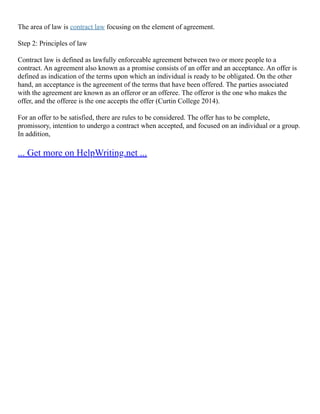
The area of law is contract law focusing on the element of agreement.
Step 2: Principles of law
Contract law is defined as lawfully enforceable agreement between two or more people to a
contract. An agreement also known as a promise consists of an offer and an acceptance. An offer is
defined as indication of the terms upon which an individual is ready to be obligated. On the other
hand, an acceptance is the agreement of the terms that have been offered. The parties associated
with the agreement are known as an offeror or an offeree. The offeror is the one who makes the
offer, and the offeree is the one accepts the offer (Curtin College 2014).
For an offer to be satisfied, there are rules to be considered. The offer has to be complete,
promissory, intention to undergo a contract when accepted, and focused on an individual or a group.
In addition,
... Get more on HelpWriting.net ...
Contract Essay
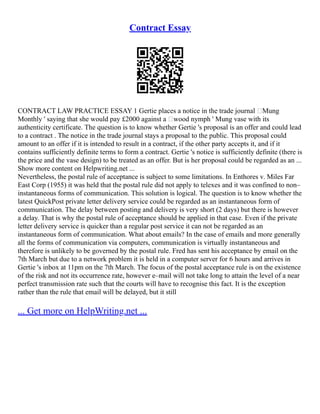
CONTRACT LAW PRACTICE ESSAY 1 Gertie places a notice in the trade journal ‘Mung
Monthly ' saying that she would pay £2000 against a ‘wood nymph ' Mung vase with its
authenticity certificate. The question is to know whether Gertie 's proposal is an offer and could lead
to a contract . The notice in the trade journal stays a proposal to the public. This proposal could
amount to an offer if it is intended to result in a contract, if the other party accepts it, and if it
contains sufficiently definite terms to form a contract. Gertie 's notice is sufficiently definite (there is
the price and the vase design) to be treated as an offer. But is her proposal could be regarded as an ...
Show more content on Helpwriting.net ...
Nevertheless, the postal rule of acceptance is subject to some limitations. In Enthores v. Miles Far
East Corp (1955) it was held that the postal rule did not apply to telexes and it was confined to non–
instantaneous forms of communication. This solution is logical. The question is to know whether the
latest QuickPost private letter delivery service could be regarded as an instantaneous form of
communication. The delay between posting and delivery is very short (2 days) but there is however
a delay. That is why the postal rule of acceptance should be applied in that case. Even if the private
letter delivery service is quicker than a regular post service it can not be regarded as an
instantaneous form of communication. What about emails? In the case of emails and more generally
all the forms of communication via computers, communication is virtually instantaneous and
therefore is unlikely to be governed by the postal rule. Fred has sent his acceptance by email on the
7th March but due to a network problem it is held in a computer server for 6 hours and arrives in
Gertie 's inbox at 11pm on the 7th March. The focus of the postal acceptance rule is on the existence
of the risk and not its occurrence rate, however e–mail will not take long to attain the level of a near
perfect transmission rate such that the courts will have to recognise this fact. It is the exception
rather than the rule that email will be delayed, but it still
... Get more on HelpWriting.net ...
Offerer & Acceptance (Law)
Offer and acceptance is one the main 7 essentials to create a legally binding contract since a contract
is based on agreement. It is also an essential for a court to arbitrate problems. An offer is a
manifestation (orally, in writing, or by conduct) of willingness to enter into bargain, which justifies
another person's understanding of assent to that bargain is invited and will conclude the transaction.
An Offeror is the party who makes the offer. An offeree is the party who receives the offer and is
asked to accept it and thus form a contract. An offer can be either bilateral (made to a specific
person(s)) or unilateral form (made to the whole world). (Frey & Frey, 2001)
An invitation to treat or invitation to chaffer is where a person ... Show more content on
Helpwriting.net ...
As Anjali refers to the offer made on the notice board –the notice on the staff notice board said that
the car would be sold to the first staff member who pays the money as she did not come with the
money it might make the acceptance invalid.
In Kavitha's case she conveyed her acceptance clearly in verbal form while she arrived with a
cheque which she handed over to Manuja therefore as she has accepted the offer validly and an
agreement exists thus Kavitha can sue Manjula for Breach of contract.
The offerors act of withdrawing an offer is referred to as revocation. Unless an offer is irrevocable,
the offeror can revoke the offer even if he or she has promised to keep the offer open (Miller &
Jentz, 2010). Revocation of offers should be made the same way offers were made as established in
the case of Shuey v US. Manjula's revocation of the offer fails because an offer cannot be reversed
once it has been accepted i.e. in a case like Payne v Cave the highest bidder could withdraw his bid
before the hammer was brought down (before acceptance) but in the case of Bryne v Van Tienhoven
the acceptor could not revoke his offer because he already accepted it. Thus Kavitha will be able to
successfully sue for breach of
... Get more on HelpWriting.net ...
Contract Law Essay
Contract Law
1.On 2nd January 1999, Sarah reads in a local newspaper, "The BrightonBugle", that a well known
local sports enthusiast, Mick Muscle, was offering £5,000 to the first person to swim from Southsea
to the Isle of Wightbefore 10th January, 1999. Sarah, a keen swimmer, set about her preparations.
On 6th January, 1999, a retraction appeared in "The Hove Herald' stating that Mick's original offer
was cancelled and, instead, the prize was now to be £500 to the first person to cycle from Brighton
to Oxford before 12th January, 1999. Sarah was a regular reader of "The BrightonBugle" and no
other newspaper. She did not see the retraction in "The HoveHerald".
On 9th January, Sarah went ... Show more content on Helpwriting.net ...
On appeal, the advertisement was held to be an 'invitation to treat', since it was necessary to protect
the advertiser from liability in Contract should demand for the advertised goods exceed supply.[3]
As a result, the appellant's criminal conviction was quashed.
In contrast, advertisements may sometimes be construed as being an offer if they are of the
unilateral type, where one party promises something in return for the specified act of another. The
general rule in Contract Law is that acceptance must be communicated to the offeror, but in
unilateral offers, performance of the specified act constitutes acceptance [4]. In Carlill v Carbolic
Smoke Ball Co.[5], the defendants advertised that they would pay £100 to anyone who contracted
influenza after using their smoke ball for a specified period, and that £1000 had been deposited in a
bank as proof of their sincerity. Mrs Carlill bought and used the smokeballl in accordance with the
manufacturer's instructions but then contracted influenza, so claimed her reward. The defendants
claimed that the advertisement was an
... Get more on HelpWriting.net ...
Essay about A Contract
A Contract Beatson, in Anson's Law of contract, defines a contract as 'A legally binding agreement
made between two or more persons, by which rights are acquired by one or more to acts or
forbearances on the part of the other or others.'[1] In simpler terms a contract is an agreement made
between two or more parties who intend that the agreement will be legally binding. The essential
elements of a contract are, offer, acceptance, intention to create legal relations, capacity, form and
legality.
For a contract to be valid there must be an agreement and an offer between the two parties
In ... Show more content on Helpwriting.net ...
Julia reply's that the item is not a sale item and she refuses to sell the item to roger for £25.
The sign displayed was an 'invitation to treat', were Lord Parker stated:
'It is clear according to the ordinary law of contract that the display of an article with a price on it in
a shop window is merely an invitation to treat. It is in no sense an offer for sale, the acceptance of
which constitutes a contract.'[2]
In the above case for a contract to take place there must be an offer and an acceptance. It is clear that
Electrical World was not making the offer, where customers have been invited to make offers, an
invitation to treat. It is obvious that the sign Roger saw, which stated 'last few sale items all £25 or
less' was an invitation to treat. It is clear in the case that Roger was making the offer by taking the
item to the counter, with an intention to pay £25, so Roger made an offer as he took the item to the
counter, so Roger is the offeree. And the sale assistance Julia is the offeror on behalf of Electrical
World.
Julia made a counter offer[3] by destroying Rogers offer. Julia destroyed the offer when she
requested £75, and Roger refused to pay. This rejection was in the response of a different price,
instead of the price that Roger
... Get more on HelpWriting.net ...
Normal Business Contracts
As in normal business contracts, offer should be first existing between two parties alongside the
acceptance. Offer is accepting the terms of negotiation and discussion after an invitation to treat.
The external look of an offer and invitation of treat sometimes look the same and hard to
differentiate but different by the core means of commercial law. So what is difference between offer
and invitation of treat? As Guenter Heinz Treitel defines offer as " an expression of willingness to
contract on certain terms, made with the intention that it shall become binding as soon as it is
accepted by the person to whom it is addressed, the offeree"1. It is a statement of terms and
conditions of that will be passed to the offeree. It might be passed through letters, newspaper and
advertisement. While Andrew Burrows defines the invitation of treat as "an expression of
willingness to negotiate. A person making an invitation of treats does not intend to bind as soon as it
is acceptable by the person to whom the statement is addressed"2 The difference between an offer
and invitation of treat is that if offeree accepts an offer from the offerer, both created a bound of
contract while if supplier accepts an invitation of treat from the client to negotiate and discuss terms
they created an offer. So the difference is between both subjects is the legal binds of contract
formation. It depends also solely on the promisor's intention. Among the history, several case studies
prove
... Get more on HelpWriting.net ...
The Law Of Contract Essay
Semester 1
The Law of Contract Essay
Introduction
The case study which I have chosen is Case Study 4. A contract is a legally enforceable agreement
which the courts will enforce and it is between two or more legally distinct parties which is called a
Bilateral Agreement, e.g. a buyer and a seller in a contract for the sales of goods. However it is
possible for more than two individuals to be involved in a contract e.g. partners in a firm or
shareholders in a limited company which is called a Multilateral Agreement. A legally enforceable
agreement or contract has two basic elements – an offer and an acceptance of that offer. This can be
expressed in a simple formula as:
Offer + Acceptance = Contract
Cast Study 4
"Louise is walking down ... Show more content on Helpwriting.net ...
An invitation to treat can most effectively be explained with reference to the phrase 'make me an
offer which I may or may not accept'. This is a marketing tactic which provokes an offer. This was
accepted by Louise it was not an offer to her it was her who made the offer to buy it. As Louise sees
the advert displayed on the shop window which is an offer to her, by believing that the price is really
that low priced of such a popular and expensive product by not wasting more time she quickly goes
inside the shop and accepts to buy the goods. But however she is told by the sales rep that this is a
misrepresentation as the advertisement is wrongly priced and it is not for £25 but is for £250.
Misrepresentation
A misrepresentation occurs when a party states a false statement of fact, or misleading conduct
which forms a contract as the other party is encouraged or induced to enter into an agreement. It is
usually after the contract has been formed that the party who relied on the statement will discover
that it was factually false. A contract could also result in being voidable in misrepresentation. It is
also up to Louise who is the victim of misrepresentation if she wants to take any steps against the
company. The innocent party which is Louise would not have entered into a contract at first place if
she had known that the statement made on the poster outside the shop window was in fact false. She
also has evidence of the poster outside the shop window which
... Get more on HelpWriting.net ...
Contract Law Is A Legal Agreement
A. Introduction Contract law is a legal agreement through which single or several persons are
obliged to bind together towards single or several persons to perform certain task. It deals with
understanding and enforcement of written agreement between two different parties. A contract exist
when an offer is proposed to a party and is accepted. In order to create a binding agreement, there
must be offer and acceptance. Acceptance of an offer means an unconditional agreement between
parties and becomes final and binding once communicated of being accepted. It may be oral, written
or acceptance by way of conduct. It is a response to the offer made. An offer made by one party and
accepted by the other party makes it a binding agreement. For an example, Micheal offers a job to
Cherry in his organization on terms and conditions specified in lieu of compensation of $40,000 per
month. Once Cherry accepts the offer, an agreement shall come into existence. The various terms
that creates a binding agreement: Multiple Parties: Two or more people shall come together and
make a contract. One person cannot get into a contract with it. 1. Offer: An offer is promising or
proposal by one person to another person, class of people or to the whole world. It might be an offer
to do certain acts or give something. An offer becomes binding once it is accepted by the party to
whom the offer is being made. An offer can be withdrawn by an individual before they accept the
proposed offer. In order to
... Get more on HelpWriting.net ...
Case Study: Crazy Festive Costumes Ltd
LG127 GROUP ASSIGNMENT
Crazy Festive Costumes Ltd.
Our goal within this case study is to provide our advice to Crazy Festive Costumes Ltd., in relation
to their offer printed in the Irish Independent advertising the sale of Santa hats available to purchase
via telephone, email and post.
Firstly we must layout the basics. A contract can be defined as 'an agreement with specific terms
between two or more persons or entities in which there is a promise to do something in return for a
valuable benefit known as consideration.' Throughout this case study, we will delve into the details
of Crazy Festive Costumes Ltd.'s advertisement and determine whether it can be deemed a unilateral
contract or if this, like the majority of other advertisements, is just an invitation to treat. ... Show
more content on Helpwriting.net ...
Whereas an invitation to treat is simply an invitation for customers to submit an offer.
Secondly, within this case study we aim to evaluate the validation of Charles, Charlotte and Emmas
communication's of acceptance, had the advertisement been deemed a traditional offer. In
accordance with this issue, it is important to note the crucial difference between a unilateral and
traditional contract. A traditional contract (also known as a bilateral contract) is one in which both
parties make promises to carry out certain acts, whereas, (as stated above) a unilateral contract
involves a promise made by only one
... Get more on HelpWriting.net ...
Objective Theory of Contracts
The four elements of a valid contract are offer and acceptance, meeting of the minds, consideration
and competent parties. The contract must cover a legal purpose or objective as well (Binder, 2012).
The objective theory of contracts holds that contract formation is dependent on what is
communicated, rather than what is thought by one of the parties (Barnes, 2008).
The Pepsi Harrier case (Leonard v. PepsiCo) is an example of a situation where the four elements of
a contract are simply not met. Advertisements in general constitute an invitation to treat, rather than
an offer. Therefore, Leonard was not able to accept the offer, because the offer never existed. As
such, the basic elements of a contract were not present in their entirety, meaning that no contract
existed between Pepsi and the Seattle man.
The objective theory of contracts is relevant to this case, because there was a clear difference
between what Pepsi was thinking and what Leonard was thinking. Each had their own view of what
the advertisement constituted, and it is from these differing views that the contract dispute arose.
The judge in this situation must use the objective theory to decide the case. This means that the case
can only rest on what has actually been communicated between the two parties. In this case, Pepsi
has an advertisement that discusses its promotion. The promotion describes a bargain in which a
customer presents Pepsi with "points" and Pepsi allows the customer to redeem those points
... Get more on HelpWriting.net ...
Bilateral Vs. Unilateral Contracts
Esmeralda Aguayo Bus–18 Term Paper Bilateral vs. unilateral contracts As mentioned in "The Legal
Environment of Business" by Don Mayer, Daniel M. Warner, George J. Siedel, and Jethro K.
Lieberman, a contract can be defined as a legally binding agreement. The requirements of a contract
include an agreement meaning tan offer that has been accepted, consideration which is something of
value, legal purpose defined as the requirement that the consideration matter be legal, proper form
which is the requirement that certain contracts be in writing, and two or more competent parties.
When a contract is formed it must be established whether the contract bilateral or unilateral. A
bilateral contract exchanges a promise for a promise, the offer ... Show more content on
Helpwriting.net ...
The notice of the terms was included outside the parking lot and Thornton accepted the offer by
entering. An example of unilateral can be seen in the case Carlill v. Carbolic Smoke Ball Co Ltd.
Frederick Roe who is the defendant and the proprietor of "The Carbolic Smoke Ball', placed an
advertisement and promised to pay $100 to anyone who used the Carbolic Smoke Ball for two
weeks. Mrs. Louise Carlill did both and sued to recover her $100, as was promised by Frederick
Roe. Carlill stated that some arguments on the advertisement were not accurately reported. It was
also seen that Carlill had not used the smoke ball correctly or even get influenza which was also one
of the requirements in order to receive the $100. At the court, Carbolic Smoke Ball Co brought up
many legal issues in regards to contract law. One of the claims was that the advertisement was an
open door to treat and that it was too popular in order for the advertisement to be an offer.
Furthermore, in a bilateral contract the acceptance of the offer needs to be communicated and ad
seen Carlill never did that. The court rejected most of these arguments and continued that there was
a contract. Moreover, communication is not necessary since this case has to do with a unilateral
contract. Acceptance and consideration as mentioned is something of value could be establish in the
caser of Mrs. Carlill since she used the Smoke Ball for those two
... Get more on HelpWriting.net ...
Examples Of Legal Advice For Donothy
Legal Advice for Donothy In this assignment, I am going to discuss legal issues of Donothy's case,
apply legal principles and give her legal advice. The fact of the present case is that an advertisement
expressed that their slimming product Lemon Grass Pills could guarantee the customer who used
their products would lose 20kg within two months if he continuously drank one pill every day for a
period of two months, or they would pay for 50000hkd. Donothy, a consumer who wanted to lose
weight successfully before the wedding was attracted by the advertisement and bought Lemon Grass
Pills for 1000hkd per bottle. After six weeks, she had not lost a single kilogram which drove her
mad. The key legal issues are as follows: Was there a contract ... Show more content on
Helpwriting.net ...
According to 〖Ewan McKendrick〗^2, "A unilateral contract is a contract whereby one party
promises to pay to the other a sum of money or to do some act if that other party will do or refrain
from doing something without making a promise to that effect." Cases in point are Williams v
Carwardine [1833] EWHC KB J44, Errington v Errington [1951] EWCA Civ 2 and Woods, R v
Clarke (1927) 40 CLR 227. The essence of the transaction is that Donothy should take in pills for
two months as requested. It is unnecessary that there should be any notification of acceptance in the
present situation. A leading case is the Carlill v Carbolic Smoke Ball Co [1983] 1 QB
... Get more on HelpWriting.net ...
The Formation Of A Contract Requires Offer And Acceptance
The formation of a contract requires offer and acceptance in order to become legally binding. An
offer is an expression of willingness to contract on specified terms made with the intention that it is
to become legally binding as soon as it is accepted by the person to whom it is addressed. The advert
above is a unilateral contract as "one party assumes an obligation under the contract". Consideration
is the act of performance in accordance with the terms of the offer, in this case acceptance would
take place once the offeree starts the race. For example, the case of Carlill v Carbolic Smoke Ball
Co [1892] where Mrs Carlill was entitled to the reward as the advert constituted an offer of a
unilateral contract. She had accepted by ... Show more content on Helpwriting.net ...
The Borough of Mayfair cannot revoke the offer, as revocation can only be made at any time before
acceptance. In addition, withdrawal of an offer has to be communicated between both parties and in
this case withdrawal was not communicated. Nicole was informed of the withdrawal of the money
after acceptance and performing the actions required were completed. Therefore, the contract cannot
be terminated. A person cannot accept an offer of which they are unaware of because in order to
create a binding contract, parties must reach an agreement. In this case Sylvie had no knowledge of
the offer and she did not intend to run the race in order to receive any rewards. It can be said that the
only intention she had was to accompany the rest of the competitors. The stages of a formation of a
contract were not complete as offer was made to 'anyone', but Sylvie was not aware of the offer.
This restricts the next stages of acceptance and consideration. Therefore, a legally binding contract
was not made between the Borough of Mayfair and Sylvie, due to the missing stages of a formation
of a contract. The Taylor v Laird [1856] case illustrates how a claim failed because one party did not
have an offer from the other party to do a different job. This illustrates that a contract requires
communication in order for it to become legally binding. Even though the conditions which were
required were performed,
... Get more on HelpWriting.net ...
The Contract Will Stand Between Ben And Colin Essay
Defined by MacQueen and Thomson, a contract is: "... an agreement between two or more parties
having the capacity to make it, in the form demanded by law, to perform, on one side or both, acts
which are not trifling, indeterminate, impossible or illegal." . While drunk on a stag night out in
Glasburgh, Ben bought a 1970s London–style Routemaster for £57,000. Which on the following
morning he said that did not mean to order the vehicle, but Colin (the seller) insisted on the deal. To
determine whether the contract will stand between Ben and Colin, as defined by MacQueen and
Thomson, the essential features of contract formation, together with the intention to create legal
relations and his contractual capacity will need to be examined.
The first important issue that would have to be tackled is that of contract formation. Was there an
offer and a relevant acceptance of that offer? To begin with, it needs to be determined whether there
was an offer. Ben bought the bus through the 'garthdon–jumbles.eu' website and despite a price
being displayed the initial advert was an invitation to treat. An invitation to treat is "when the person
who made the invitation to treat is not obligated to accept the offer in the absence of a promise to do
so" . The invitation to treat was only then made into an offer when Colin sent an email of acceptance
saying: "Hello Ben! Thank you buying the Routemaster! I confirm that I accept your offer to buy the
vehicle for £57,000. When can I expect you to
... Get more on HelpWriting.net ...
Unit 21 P1
Importance of Contracts & Business Law in a Business Unit No. 21: Aspects of Contract and
Business Law Mr. Irshad Ahmed Alvi Date Submitted: 08/23/2016 Carl Loraine Cruz 20154176 The
organization that I chose for this assignment is Zara HOME. CONTRACT: FACTS: TASK 1 (P1,
P2, P3, M1) In this task I will explain when and why the contract came into existence. Contract
comes into existence when both parties (offeror and offeree) have agreed terms in negotiations. The
contract becomes binding when there is an agreement from both sides. It is not effective until there
is communication. A contract is legally binding in a court law and an agreement between two or
more parties. a contract can be written or verbal. A written contract is an agreement by two or more
parties on a printed file that has been signed by both of the parties while verbal contracts are
agreement which have been agreed by verbal statement. Written contracts are legally binding and it
is easier to implement than verbal contracts. It is better that the business arrangements are in a
written contract to avoid facing problems when you are trying to prove a contract existed. ... Show
more content on Helpwriting.net ...
So, here are the four essential elements of a contract: 1. Offer – to form a contract there must be an
offer by one party. It is a definite and clear statement of willingness to be bound on stated terms
without further consultations. Offer can be in written or oral form but it is not effective if it is not
being communicated to the offeree. An offer can be discontinued by the
... Get more on HelpWriting.net ...
Essay on Assignment 2 Four Step Process
Assignment Cover Sheet When submitting your assignment it must be accompanied by this
Assignment Cover Sheet. Please make sure that you complete all of the details correctly.  Provide
ALL details requested on this form.  Use one form for each assignment. Given name Hui Leen
Surname Lau Student number 17620987 Email 7E3A1662@student.curtin.edu.my Unit name
Business Law 100 Unit code 11011 Assignment title Assignment Two Date submitted 5 MAY 2014
Student‟s comment to tutor Mr. Ariffin is a good lecturer. He assists us when we have any problem.
Marker's comments Recorded mark Marker Comments Question 1: Using the four step process,
discuss the element of agreement required for the formation of a legally binding contract ... Show
more content on Helpwriting.net ...
In this case, Carbolic Smoke Ball Company has published an advertisement in London newspaper to
promote the use of the Carbolic Smoke Ball to prevent influenza. In the advertisement, the company
offered £ 100 to the people, who bought the smoke balls and used them according the instructions
given, but still contracted influenza. Mrs Carlill purchased the smoke balls after she read the
advertisement. She used them according the directions, but nevertheless caught influenza. She
claimed for the £ 100 which promised by the company but they refused to pay her. The court had to
decide whether an offer that made to the world at large is valid to accept by an individual who read
the advertisement or not. The court judged that the offer made to the whole world at large is the
acceptance of the offer by everyone who knew about it. Acceptance is an agreement on the terms of
an offer. It must be made when the offer is still present. Terms of acceptance must be unanimous
with the offer and cannot be conditional. It can only come from the person to whom the offer was
made. Apart from that, acceptance must be communicated with the offeror and no certain form is
necessary (Duperouzel 2014). According to the general rule of acceptance, the acceptance is
effective immediately when received. Once the acceptance is communicated to the offeror, the
acceptance is effective and the agreement is reached. The case of Entores Ltd v
... Get more on HelpWriting.net ...
Tony Vs Emma
The issue in this question is that if there is a contract between Tony and Emma. A contract is a
formal agreement in which the right of party will be enforce by law. The formation of contract
includes formal contract and simple contract. Formal contract has to be valid from its specified
form: deed or under seal also written and signed by parties. Simple contract must be supported by
consideration. A valid simple contract includes 3 elements: agreement, which include an offer and
acceptance to hat offer, valid consideration and intention to create legal relation. In this case Tony
and Emma are two parties, no written contract has been made by the two parties. Tues, there is no
formal contract. To create simple contract between them, the 3 elements are necessary. An offer is a
promise made in return to a promise ... Show more content on Helpwriting.net ...
Emma took no response, if she made a valid acceptance to the offer, there would be a valid
acceptance. Consideration is necessary in simple contract, executory and executed consideration is
accepted by law. Executory is consist of a promise to do something, and executed consideration
takes the form of performing an act. Past consideration, consideration per–dates the promise, is not
accepted by law. In this case, Emma want to buy a television from Tony. The consideration is a
promise to pay a certain amount of money in return of the television or a promise of offer the
television in return of a certain amount of money paid. The consideration took the form of the
exchange of promise. It is an executory consideration, which is valid in law. Parties must have
intention to create legal relation to create a legal contract. When the agreement is made between
business partners, it is presumed that the parties are intent to create legal relations. When an
agreement is made between family members or social friends, it is presumed as no intention to
create legal relations. Both presumptions could be
... Get more on HelpWriting.net ...
LW2903 Individual Assignment Essay
Tsang Ching Hung
53081466
LW2903 S05
Human Resources Management
Charu SHARMA
ASSIGNMENT QUESTION
Semester B, 2013/2014
On Monday, 13 January 2014, Ada wrote to Ben saying, "Please sell me your vintage BNW car for
$80,000". On Tuesday, 14 January 2014, Ben replied by leaving a message on Ada's voicemail,
"Sure, provided you pay by cash". Ben then changed his mind and he posted a letter to Ada which
read, "I have reconsidered the matter. I am no longer able to sell you my BNW". This letter arrived
on Thursday, 16 January 2014, before Ada checked her voicemail.
1) Advise Ada and Ben.
There is no contract between Ada and Ben. This is because initially Ben leaves a message on Ada's
voicemail to accept the offer. However, Ben changes his ... Show more content on Helpwriting.net ...
On the other hand, there is a binding contract between Ada and Ben if Ada has knowledge of the
acceptance by Ben. The contract comes into existence as soon as Ada checks the voicemail. With
reference to the case of Entores Ltd v. Miles Far East Corporation in 1955, the plaintiff in London
sent a telex to the defendant in Amsterdam offering to buy goods from the defendant. The defendant
sent a telex in return to the plaintiff accepting the offer. Therefore, a contract was made between the
parties when the defendant's acceptance was accepted by the plaintiff.4
b) Because of a fault on Ada's voicemail system, Ben's message had not been recorded;
There is no contract between Ben and Ada. This is because Ben's message has not been recorded, so
Ada does not receive and read the message. Since there cannot be acceptance of an offer without the
knowledge of it, acceptance must be communicated to the offer, and mere inactivity or silence on
the offeree does not create a contract as well. The rule laid down in Felthouse v. Bindley that mere
inactivity or silence cannot amount to an acceptance is correct in 1862. The plaintiff offered to buy a
horse from his nephew, John, who was going to sell it by auction. John intended to accept his uncle's
offer and advised the
... Get more on HelpWriting.net ...
Offer and Acceptance
Without offer and acceptance there can be no contract and so it is essential that the law provides
rules to identify what constitutes both an offer and an acceptance. An offer may be defined as a
statement of willingness to contract on specified terms made with the intention that, if accepted, it
shall become a binding contract. An offer may be express or implied from conduct. In many cases it
is crucial to determine when and where a contract is actually formed and this too needs rules. In the
vast majority of contracts these rules do not prove difficult to explain or complicated to apply but in
some areas there is confusion. Initially there can be significant problems in identifying what an offer
actually is. An offer must be ... Show more content on Helpwriting.net ...
It was held that where a communication arrived but was not seen immediately because it arrived out
of office hours, the case established that the acceptance would take place bearing in mind the
intentions of the parties, sounds business practice and where the risk might lie. This is a practical
solution but it does mean that it is likely to be determined on a case by case basis as the factors are
likely to change. It is interesting to note that the above cases deal with telex machines – a now
obsolete form of instantaneous communication. There are no authorities dealing with faxes, text
messages, instant messages or email but it is likely that the principle of sound business practice,
established in Brinkibon, will continue to guide the courts. The final area of discussion is that of the
the "battle of the forms" – the traditional approach to offer and acceptance is that acceptance will
only work if it exactly matches the offer. This is the so–called "mirror–image" approach. Even the
slightest ambiguity in an 'acceptance' can render it ineffective, as in the case of Gibson v
Manchester, where the word "may" proved fatal. This problem becomes apparent when companies
negotiate on their 'standard terms' which may never exactly match. In Butler Machine Tool the court
said that the right approach is to pick apart the negotiations until a matching offer and acceptance is
found. If one is
... Get more on HelpWriting.net ...
Scenario Between Arnold, Bertram, Charlie, And Patice
Scenario Explained
The scenario between Arnold, Bertram, Charlie and Doris is a classic issue of offer and acceptance.
These are two elements of a valid contract. The scenario also raises its potential of being an
invitation to treat as this is a stark contrast to that of an offer. That is, we must consider whether the
notice placed on the car constitutes a valid offer or if it was a mere invitation to treat. If this notice
does amount to a valid offer where Arnold outlines the terms and conditions (the price at which he
was willing to sell and his telephone number) by which he is willing to be legally bound we must
look at the possible issues that may arise and what possible steps Arnold can take to deal with his
situation.
Arnold appears to be the principal party who makes definite terms pertaining to the sale of his car,
from this we can conclude that the notice placed on his cars does in fact demonstrate a clear intent to
be legally bound. This is a unilateral offer where Arnold outlined the terms and condition to which
he is willing to be legally bound, he is inviting the public to ... Show more content on
Helpwriting.net ...
One may however argue the case that Felicity was not an agent for Arnold citing the case Powell V
Lee (1908), where Mr. Powell applied for a job, one of the school managers acting without authority
told Mr. Powell he had been accepted. The managers decided to hire someone else. The court held
that there was no contract and there had been no authorized communication between the managers
and Mr. Powell. Also Charlie complied with Arnold's notice for sale, by visiting Arnold's house and
leaving his acceptance he used a method that was quicker and more efficient that the one that was
stipulated on the windscreen of the
... Get more on HelpWriting.net ...
Josh and Breakout Skincare
Apply:
If the price paid for a promise was paid by the promisee before the promise was made it is
insufficient consideration. Josh and Breakout skincare formed a contract when Josh first purchased a
6– month supply of the product from the company to which they promised that "Breakout skincare
is guaranteed to work on teenage skin, if this does not happen we will refund the purchase price and
pay you $100.00", however this was not the case. If Josh can establish that there was a promise
made in the advertisement to which he accepted the offer from the company, then the new promise
only made a month earlier, advertising that the company was cancelling all previous offers, would
not constitute consideration for a new promise, Roscorla v Thomas (1842).
Most advertisements are deemed to be 'invitations to treat' rather than offers to the world at large.
However, if Josh can establish whether or not there was a contract between him and Breakout
skincare upon agreeing to purchasing their product after reading about it, then if the case were to be
presented to the court, they would be able to decide whether the advertisement was more than a
mere invitation to treat, considering it was a legal offer to the world as it was clearly written as
"Breakout skincare is guaranteed to work on teenage skin, if this does not happen we will refund the
purchase price and pay you $100.00", thus willingly entering into legal relations with anyone who
accepted the offer such as Josh, Carlill v
... Get more on HelpWriting.net ...
The Influence Of Honda-Toyota Ownership On Lindsay
In this problem Finnin, McPherson and Wright (FMW) expressed to negotiate on buying the
Honda–Toyota dealership on Lindsay. Based on the proposed agreement, FMW should pay a certain
amount of $1.1million of the stock of Lindsay. And so, this case should be based under the common
law. Common law governs the contracts for services, intangible assets and other contracts not
governed by the Uniform Commercial Code (Mallor, Barnes, Bowers, Langvardt, 2013). Formation
of the contract under the common law includes an offer, acceptance and consideration. And in order
for an offer to be binding the offeree (the person to whom the offer is made) must accept the offer.
An offer gives the power of acceptance to another party and includes the agreements essential
elements, which must be definite and certain. ... Show more content on Helpwriting.net ...
In this case, Lindsay acted as the offeror and FMW is the offeree. One of the arguments relative to
this case is that FMW had signed the agreement they received from Lindsay(supposed to be an
acceptance of the offer), however they made some modifications in the agreement by changing the
agreed stock purchase price of $1.1 million to the purchase price of $700,000 in Exhibit A and
removing all references related on the sale of goodwill. In common law contract, the acceptance
must be a mirror image of the offer to constitute valid acceptance (Magee v. Garreau, 2002). This
means that the acceptance must be precisely the same as the offer. So, if the acceptance is not
exactly the same, then it will fail to meet the requirements of acceptance and will not constitute a
valid element of the formation in contract. Because FMW modified the amount of the purchase price
of $1.1million to $700,000 in Exhibit A, though they've
... Get more on HelpWriting.net ...

Case List

  • 1.
    Case List LEGT 5512LEGAL FOUNDATIONS FOR ACCOUNTANTS SESSION 2, 2010 CASE LIST This Case List is not intended to cite every case quoted in lectures and tutorials during the course. Its purpose is to give students a handy citation of a number of leading cases with brief statements to help identify them. This list may not be taken into the Final Examination. 1. 2. 3 Commonwealth v State of Tasmania (1983) 46 ALR 625 Federal and State powers Lee v Knapp [1967] 2 QB 442 "Stop after accident" – golden rule Smith v Hughes [1960] 2 All ER 859 "in the street" – mischief rule 4. Carlill v Carbolic Smoke Ball Co. [1893] 1 QB 256 Several contract law principles 5. Harvey v Facey [1893] AC 552 Supply of information is not an offer 6. Pharmaceutical Society of ... Show more content on Helpwriting.net ... Ltd. (1991) 65 ALJR 334 Causation – "common sense" test 47. Alexander v Cambridge Credit Corporation Ltd (1987) 9 NSWLR 310 Causation 48. Harris Scarfe Limited (Receivers and Managers Appointed) (in liq) v Ernst & Young (Reg) [2005] SASC Causation 49. Unit 11 Pty Ltd v Sharpe Partners Pty Ltd [2005] FCA 635 Causation 50. The Wagon Mound (No. 1) [1961] AC 388 Remoteness 51 52 53 54 55 56 57 58 The Wagon Mound (No. 2) [1967] 1 AC 617 Remoteness Sayers v Harlow UDC [1958] 1 WLR 623 Contributory negligence Insurance Commissioners v Joyce (1948) 77 CLR 39 Voluntary assumption of risk Caltex Oil (Aust.) Pty. Ltd. v The Dredge "Willemstad" (1976) 136 CLR 529 Purely economic loss Hedley Byrne & Co. Ltd. v Heller & Partners Ltd. [1964] AC 465 Duty of care in purely economic loss cases L. Shaddock & Associates Pty. Ltd. v Parramatta City Council (1981) ALJR 713 Duty of care in purely economic loss caused by negligent misstatement cases San Sebastian P/L v The Minister (1986) 61 ALJR 41 Duty of care in purely economic loss caused by negligent misstatement cases Esanda Finance Corp. Ltd. v Peat Marwick Hungerfords (1997) 142 ALR 750 Duty of care in purely economic loss caused by negligent misstatement cases Page 3 of ... Get more on HelpWriting.net ...
  • 3.
    The Principles OfProposal: Hyde V. Wrench (1840) 2.0 THE PRINCIPLES OF THE PROPOSAL An offer or proposal is one of the essential elements of a contract which is an expression of willingness of a promisor to bind on certain terms. Section 2(a) of Contracts Act 1950 states that "when one person signifies to another his willingness to do or to abstain from doing anything, with a view to obtaining the assent of that other to the act or abstinence, he is said to make a proposal" Legal Rules Relating to Offer: 1 a) Offer may be expressed or implied. Express offer: An express offer is made orally (words spoken) or written. Implied offer: An implied offer is formed from the conduct of parties or from the circumstances. b) Offer may be specific or general. c) Offer must give rise to legal obligation. d) An offer must be absolute and certain. e) An offer must be distinguished from an invitation to treat. f) An offer must be ... Show more content on Helpwriting.net ... This has the effect of destroying the original offer so that it is no longer open for the offeree to accept. Decided Case Hyde v Wrench (1840)8 Facts: The defendant offered to sell a farm to the plaintiff for £1,000. The plaintiff responded for a bargain of £950 which the defendant refused. The plaintiff then attempted to accept the original offer price. The defendant refused to sell to the plaintiff and the plaintiff brought an action to the court to seek for specific performance. Held: There is no contract binding between the two parties. Counter offer that had made by the plaintiff had cancelled the original offer. Analysis: The bargain that has made by the plaintiff had terminated the original offer. Although he had accepted the original offer after that, legally, it was not applicable. In this situation, the offer can be made again on the same terms by the offeror but not oblige to do so. No binding contract has formed. Defendant did not have to honour the ... Get more on HelpWriting.net ...
  • 5.
    How Technology HasChanged The Most Important Ones Essay The world is advancing in every type of aspect and a big part of this is to do with the way technology has been taken use of. In the field of Law, contracts are formed between individuals or groups, as of late, these contracts have been transmitted electronically between two parties. Of course however, there can be existing issues with the use of forming a contract by electronic means; this mainly has to do with misunderstanding or misinterpreting the information of the contract. Two of six elements to a contract have been deemed the most important ones, these are offer and acceptance. Offers can be personally aimed at someone or provided to the world at large, in contrast to this, an invitation to treat can be displayed to grab the attention of people for them to listen to an offer. A party is able to withdraw from a mistaken offer through a letter of Revocation that either offeror or offeree produce before a contract has been completed. Disputes are able to occur frequently as well, thankfully there are ways to fix these. The creation of contracts has been used quite thoroughly in the new day and age rather than forming a contract in person, this is quickly advancing the way the world is able to access these contracts. A contract is a legally enforceable agreement between two parties. In order for there to be a contract between the two parties, all six of the elements must be included, these being offer, acceptance, consideration, intention to be legally bound, capacity to ... Get more on HelpWriting.net ...
  • 7.
    Vailed Contract: PartridgeV. Crittenden On Sunday morning, Andrea, Kevin's neighbour, passes the newsagent's on her way to work. She sees the advertisement and recognises the address. On her arrival at work, she sends Kevin an email to the email address that he provided her with when they first met, two years ago, stating that she is willing to pay €7,500 for the car. Kevin never receives the email as he no longer uses that email or checks it. Law Invitation to treat is an invitation to another person to make an offer. An 'offer' can be converted into a contract by acceptance, provided the other requirements of vailed contract are present but an 'invitation' to treat cannot be 'accepted' To offer goods for sale in a shop window is to invite customers to make offers or an 'invitation ... Show more content on Helpwriting.net ... (Adams V Lindsell, 1818) The defendants wrote to the plaintiffs offering to sell them wool on the 2nd September. The plaintiffs received this letter on the 5th September. They posted their acceptance on the same day but it was not received until the 9th September. However the defendants sold the wool to someone else on the 8th September. The Court, formatting and applying the postal rule found that the plaintiffs' acceptance took effect on the 5th September therefore the contract was in place at that date and accordingly the defendants breached that contact when they sold the wool to a third ... Get more on HelpWriting.net ...
  • 9.
    Acceptance In JosephHeiting And Sons V. Jacks Bean Co Most time, acceptance would be made in clear and loud matters, such as saying "Yes, I accept." But silence would constitute acceptance of an offer where the common–law and statutory law allows. Supreme Court of Nebraska has confirmed in Joseph Heiting and Sons v. Jacks Bean Co that acceptance may be established by silence or inaction of an offeree and acceptance occurs when the buyer/offeree "does any act inconsistent with the seller/offeror's ownership..." Neb. U.C.C. section 2–606(1)(c). In Joseph Heiting and Sons v. Jacks Bean Co, 463 N.W.2d 817, 236 Neb. 765 (Neb.,1990), Heiting (Plaintiff) offered to sell its beans at the posted price on September 30, 1987, but was never informed of acceptance or rejection of the offer. Heiting and Jacks ... Show more content on Helpwriting.net ... The Second Restatement of Contracts is very clear about the situations where acceptance is made by silence or exercise of dominion. Section 69 of the Second Restatement of Contracts provides, (1) Where an offeree fails to reply to an offer, his silence and inaction operate as an acceptance in the following cases only: (a) Where an offeree takes the benefit of offered services with reasonable opportunity to reject them and reason to know that they were offered with the expectation of compensation. (b) Where because of previous dealings or otherwise, it is reasonable that the offeree should notify the offeror if he does not intend to accept. (2) An offeree who does any act inconsistent with the offeror's ownership of offered property is bound in accordance with the offered terms unless they are manifestly unreasonable... Restatement (Second) of Contracts, §69. The core of the restatement is about the meeting of the mind and reasonableness, i.e. the implied consent or agreement by both parties. To sum up, this article clearly allows acceptance by silent action in the contracts of selling ... Get more on HelpWriting.net ...
  • 11.
    Contract Agreement ByThe Law Of A Stamp Shop Window Contract – agreement by the law between two or more people to obtain from doing some act or acts to create legal relation. Contract has 4 elements: offer, acceptance, consideration and intention to legal relations. Without these 4 elements there is no contract. TASK 1 Bob – the owner of a stamp shop in Muncaster High Street – placed and advertisement column of the Muncaster Evening Gazette. He is selling 'Utopian penny red stamp', one only for £750 or nearest offered price. Legally by law an advertisement in the magazine is not considered as an offer. Seeing that people cannot accept an advertisement to make a legally binding contract, we considered this as an invitation to treat. Invitation to treat is a declaration for customers to enter negotiations or to submit an offer (goods displayed in the shop window, an advertisements, auctions etc.). It cannot be accepted and cannot form a binding contract; we saw this in cases such as Fisher V Bell (1961) and Partridge V Crittenden (1968). An invitation to treat invites one party to make an offer to other party to form a binding contract. On the other hand, an invitation to treat might be an offer if there is a promise in the advertisement (Carlil V Carbolic smokeball CO 1893). Difference between offer and invitation to treat is that when one party makes an offer to other party and the other party accepts – there is a legally binding contract. You can't accept an invitation to treat. According to advertisement in the magazine ... Get more on HelpWriting.net ...
  • 13.
    NT1310 Unit 1Assignment 2 QUESTION 1.1B Issue : Can I acquire the building of technical tower, spot light ramp along with certification to be undertaken? Rule : Express terms are terms of the contract that are explicitly agreed on by all parties involved either in verbal or written form (James, 2014, p284) Non–contractual promise or representation is a promise or representation made during contractual negotiations that was not intended to be a term of the contract and it is not enforceable under contract law but is enforceable under promissory estoppel which is a principle that a promise will be legally enforceable even if consideration for the promise was not provided by the promise so long as some requirements are satisfied (James, 2014, p301) Parol evidence rule ... Get more on HelpWriting.net ...
  • 15.
    Carlill V CarbolicSmoke Ball Company Case Summary Advertisement Case 1 In the case of Carlill v Carbolic Smoke Ball Company, it's shown that advertisement can be amount to an offer. The Carbolic Smoke Ball Company, the defendant had issued an advertisement in the newspaper stated that they will offer to pay £100 to anyone who contracted with influenza after having used one of their smoke ball three times daily for two weeks. In order to show their seriousness and sincerity in the matter, the defendant deposited £1,000 into the Alliance Bank, Regent Street. Mrs. Carlill, the plaintiff bought some of the smoke balls and used them according to the directions that stated in the newspaper. Unfortunately, she caught flu after using the smoke balls and she claim for the £100 reward from the defendant. ... Show more content on Helpwriting.net ... The Plaintiff arrived first, thus, accepted the offer. The court held that a newspaper advertisement could be considered an offer under certain circumstances, particularly when the actions needed to accept the offer are clear. In this case, the advertisement was clear, specific, and leaves nothing to be left open for negotiation.  http://www.casebriefs.com/blog/law/contracts/contracts–keyed–to–murphy/the–bargain– relationship/lefkowitz–v–great–minneapolis–surplus–store/ Display of goods for sale Case 1 For example, in the case of Pharmaceutical Society of Great Britain v Boots shown that displaying goods for sales is amount to an invitation to treat. The pharmacy displaying the medicine, which was restricted by the poison act. Thus, the customer who took the medicine which was restricted by the "poison" act without the knowledge of the pharmacy went to the cashier counter to bought it and at last the pharmacy rejected to sell the product to that customer. However, the court held that the pharmacy knows that is restricted medicine and notice that it is not suitable for them to purchase so that the pharmacy as rights to rejected.  http://www.australiancontractlaw.com/cases/boots.html Case ... Get more on HelpWriting.net ...
  • 17.
    What Makes InvitationTreat? What is invitation to treat? An invitation to treat is an invitation to another person or party (general public) to make an offer to enter in to a contract. What the different between offer and invitation to treat. Advertisements, catalogues, store flyers or sign on a used car for sale is not an offer is an invitation to treat. This is because an offer needs to be clear and unequivocal or direct approach to another party to contract. A scenario, When there is a display of goods in a shop window at a fixed price. That is an invitation to treat and is not an offer. You can make a offer by going into the store and by taking the product to the till where the casher can may accept or reject that offer. This mean you will be the offeror and ... Show more content on Helpwriting.net ... The offer can be money or another thing of value in exchange for performance by the other party. The offer can come in the form of a: Letter Newspaper Website Fax Email Behavior In technical terms, the offer is not really an offer until it is received by the offeree. By listing the ad for the condo in a newspaper or on a realtor 's website where Ronald is able to view it, the offer is valid. There are other things to consider when determining the validity of an offer. Some offers have a specific time limit to be accepted. In the case of a time limit, the offeree must respond with acceptance of the offer prior to its expiration or the offer is no longer valid. An offer can also be revoked or taken back by the offeror at any time prior to acceptance. If Ronald did not act fast enough, it would be within the legal right of the seller to revoke his offer to sell his condo. It is also possible to terminate an offer, or take the offer off of the table completely. There are a few ways this can be done. Death of either party Insanity of either party Death or destruction of the person or the thing required to perform the contract terms The offer can also be terminated if a counter–offer is made by changing the terms of the original offer. If Ronald decides to offer a lower price for the condo, the original offer would ... Get more on HelpWriting.net ...
  • 19.
    Case Study OfPharmaceutical Society Of Great Britain V... Case note Name Institution Pharmaceutical Society of Great Britain v Boots cash chemist (Southern) Ltd was a Court of Appeal decision on the nature of an offer. The court held that a display of an item in a store with a price tag is not enough to constitute an offer. Such a display would be a mere invitation to treat. Boots implemented a new method for customers to buy medicine. As opposed to earlier practices where medicines were stored behind a counter and an assistant would get what the customer wanted, the company allowed customers to pick drugs off the shelves and pay for them at the till. The Pharmaceutical Society objected to this practice and contended that Boots was in breach of s 18(1) of the Pharmacy and Poisons Act 1933. The Act required pharmacist to supervise the sale of some products listed on the Acts schedule of poisons. The Society's argument was that the display of products was an offer, which was accepted when the customer selected and placed the products into the shopping basket. Because a pharmacist did not supervise this process, Boots was in breach of the Act. Boots argument was that the sale was effected at the till and was supervised in accordance with the Act. The lower court had found that the method used by Boots was not in contravention of the Act. Pharmaceutical Society appealed the decision. The question before the court was the stage of the purchase where the offer was accepted. The court also inquired into whether a ... Get more on HelpWriting.net ...
  • 21.
    Scots Law ofContract All of the case studies are concerned with the Law of Contract, specifically the formation of a contract and the differences between an invitation to treat and a contract. We will investigate each consumers's specific contract or lack thereof individually and advise Bruce on his legal position. A contract is an agreement between two or more parties which in Scotland does not need to take a specific form, as a spoken agreement is still equally as enforceable as a written contract in certain circumstances such as in most social and domestic arrangements. A contract creates a legally binding bond between the parties involved. Contracts are made everyday sometimes without even realising it from buying a coffee to buying a house. A ... Show more content on Helpwriting.net ... The area of Law concerned in this case is The Law of Contract specifically relating to the revocation of an offer and counter offers. The case Wolf and Wolf vs Forfar Potato Co Ltd (1984) directly links to the case between Bruce and Ken. As Bruce is once again dealing with the Law of Contract specifically the non–acceptance of an offer, he is under no legal obligation to sell Ken the rare vinyl at the original price of £40. When Ken rejected the original offer he created a counter offer which in Scots law is a completely new offer and caused Bruce's original offer to lapse and was up to Bruce to decide wether or not to accept the new terms, after Bruce rejected the counter offer all offers between Bruce and Ken had lapsed. When Ken came back insisting that there was a contract between them and he was entitled to the album Bruce was in fact under no legal requirement to give Ken the vinyl as all offers had lapsed and no contract existed between then. In the case of Fisher v Bell (1961) a shopkeeper had displayed a flick–knife in his window with a price tag next to it but under the restriction of Offensive Weapons Accontents Restriction of Offensive Act (1959) it was illegal to sell hire or offer to sell or hire any knife which had a blade that opened automatically, on December 12 1959 the shopkeeper was brought to trial alleging that the defendant had broken the law by offering to sell the knife in his shop. The ... Get more on HelpWriting.net ...
  • 23.
    Is There AnOffer? Is there an offer? An offer is a clear indication by one person to another person of the offeror's willingness to enter into a contract with the other person (the offeree) on certain stated terms upon acceptance of the offer by the other person. There is an offer because it is not a statement of intention, mere supplying of information, invitation to treat or mere puff. The offer was addressed to all Contracts Students. How many tickets is Ronan liable? In his first email, Ronan mentioned that he had three tickets and therefore three contracts had arisen from the second he sent the email to the students. Under s14D of the Electronic Transactions Act 2000 (NSW), Ronan had the right to withdraw the email but he didn't have the right to terminate the contracts. He should be liable for the third ticket as shown in Patterson v Dolman [1908]. In Patterson, the defendant made three identical offers to two people and they both accepted the offer but only one received the stack of hay. The plaintiff sued for breach of contract. The Court held that the defendant was liable in damages for the breach of contract because he could only perform only one contract when there are 2 contracts. Ronan made three offers to the students and a number of students responded to him assuming that there were three tickets. However, Ronan can only perform two of the three contracts. He is therefore liable and may have to pay damages to the third person who is liable for a ticket. Liam Liam responded ... Get more on HelpWriting.net ...
  • 25.
    The Case OfDaniel And Rhodri Essay This essay will be assessing the case study of Daniel and Rhodri. It will be looking at the key facts of the scenario to advise Rhodri on whether he has a legally binding contract based on the rules of offer and acceptance. It will be applying case law to support this essay as well as information from various sources. It will also be examining the various problems that arise in this scenario such as rules around how to accept an offer, excepting an offer through a third party and accepting an offer with the use of technology. Lastly, this essay will assess the nature of the offer and the way in which an offer is revoked. On a Monday, Daniel advertised his Fiat Punto for sale in the local newspaper. Within the advertisement Daniel stated that he wanted "£3000 ono". By stating "or nearest offer" Daniel has created an 'Invitation to Treat' and has supplied a telephone number and fax number for people to contact him if they wished to purchase the car or offer him a similar amount. "An invitation to treat is an invitation to others to make offers" – Oxford Law Dictionary. In the case of Fisher v Bell [1961] a shop keeper had displayed a flick knife in the display window. However, the shop believed that it was not an offer but an invitation to treat. When concerning companies, Case Law has shown that everything is considered an invitation to treat. During the case of F v B Lord Parker stated that: "when one is dealing with advertisements and circulars, unless they indeed come ... Get more on HelpWriting.net ...
  • 27.
    Entering AAgreement BindingAgreement The parties to the contract must have intended to enter legally binding relations, this is defined as the intention to enter a legally binding agreement or contract. If the parties do not intend to enter a legally binding contract, in which the parties must come to an agreement of both sides, the contract may become a mere promise. In Balfour v Balfour, the husband promised to pay his wife £30 a month, when he failed to pay his wife tried to sue him, the wife 's action failed as an intention to enter a legally binding agreement could not be found, the court also held that the burden of proof of entering a legally binding agreement is on the plaintiff to prove. Initially, what the courts will recognise as a legally binding contract is that the parties to the contract intended to enter a legally binding contract. Also the parties to the contract must have the legal capacity to enter into a contract. Young person 's is defined in the S3 Age of Majority Act, as anyone under the age of 18. Young person 's capacity to enter a legally binding contract is limited, however unclear in legislation generally minors are not able to be a party to a contract. People with mental impairments are also limited in being parties to a contract if they do not know what they are entering into. A valid contract must firstly possess key terms in which both the promisee and promisor are initially creating a purpose for the contract. The HL in the case of British Steel v Cleveland Bridge held ... Get more on HelpWriting.net ...
  • 29.
    Case Study OfCarbolic Smoke Ball In the case stated above, it's no offer was made by Bob and Cecil. Bob views an online advertisement on Gumtree offering a second hand iphone 6. The advertisement contains the seller's name, Cecil, and an address in Maze Hill. He did visit the seller but at the end Cecil doesn't want to sell the iphone to Bob as few minutes earlier he had received a call from third parties that has offering a better price for the iphone 6. At last, Bob decided to sue Cecil for his irresponsibility attitude . In contract law, the definition of an offer is a promise in exchange for performance by another party. Therefore, an offer will be cancelled or terminated under particular conditions. In the same way, an offer also must be a very clear , unmistakable and directly approach to another party to a contract. Carlil v Carbolic Smoke Ball Co. 1893 , Carbolic Smoke Ball Co. has manufactured and sold The Carbolic Smoke Ball. The company has placed advertisement in various types of newspapers that has offering a reward of 100 pounds to everyone who has used the smoke ball which is three times per day as be directed and contracted influenza, colds, or any other disease. After notice the advertisement, Carlill ... Show more content on Helpwriting.net ... Facey (1893), Facey was in discusstion situation with the Mayor and Council of Kingston regarding about the sale of his store. Harvey sent Facey a telegram which are stating: "Will you sell us Bumper Hall Pen? Telegraph lowest cash price–answer paid." On the same day, Facey sent Harvey a reply by telegram which are stating: "Lowest price for Bumper Hall Pen £900." Harvey sent Facey another telegram that has been agreed to purchase the property at the asking price. Facey doesnt want to sell and Harvey sued for specific performance and an directive to prevent Kingston from taking away the property. The trial court has been dismissed on the grounds that established contract had not been formed and Harvey appealed. The Supreme Court of Jamaica reversed and Facey ... Get more on HelpWriting.net ...
  • 31.
    The Legal EffectOf Pre Contractual Representations (... DATE: 26/09/2014 TO: Elena Rodriguez Advertising Manager FROM: I–Shan Lai, Marketing Manager Department of Marketing RE: The Legal Effect of Pre–Contractual Representations (brochure) The brochure provides information of Sunlover Holidays, with a selection of rail holiday packages. Information about what is included (cabin features, meals, toiletries), price per person, holiday destinations is set out in each package in the brochure. The important booking conditions are set out in the 'IMPORANT BOOKING CONDITIONS' section. Principles of contract law In order to make a contract valid, it must satisfies 7 elements in relation to principles of contract law. 1. Offer – is referred to statement that made in written or oral that implies an individual is willing to buy or sell goods or services. An offer to public through advertising (including brochures, newspaper, internet) do not consider as offer but merely an invitation to treat. However, an offer at large could be consider as made if it includes the means of acceptance. In Carlill v. Carbolic Smoke Ball Company (1839)(UK) , defendant offered to pay one hundred pounds in a newspaper advertisement, if he or she caught influenza after taking the carbolic smoke ball as instructed. The plaintiff who used the carbolic smoke ball as instructed and later caught influenza claim for her hundred pounds. The plaintiff won the case as the court decided that an offer can be made to the large public, and acceptance was ... Get more on HelpWriting.net ...
  • 33.
    Nt1310 Unit 5Essay Each synchronized period consists of one CCH interval followed by a SCH interval. The default division for each interval is 50 ms. Each CCH and SCH interval begins with a 4 ms guard interval, which is used by the radio to transfer control from one channel to another. Compared to other 802.11 standards, 802.11p has a number of distinguishing features. For example, in 802.11p, a transmitter broadcasts each packet to all other nodes in the network on the CCH. In order to prevent the network from flooding with Acknowledgement messages (ACKs), 802.11p receivers do not send an ACK to the transmitter. Thus, there is no feedback mechanism provided by the receiver, and consequently, Contention Window size of the 802.11p transmitter remains fixed. If a DSRC ... Show more content on Helpwriting.net ... All vehicles transmit a 200–byte safety message at 10Hz with data rate of 6 Mbps. All vehicles attempt to continuously route 64–byte packets at an application rate of 2.048 Kbps to one of 10 other vehicles, selected as sink vehicles. The antenna height AHk of each vehicle is 1.5m. Transmit power is set to 10 dBm and the transmission range for safety message packet delivery is 145 m. For each experiment PCAP trace file per node is enabled. The routing statistics are gathered and compared for each experiment, i–e, with NS2 mobility trace file and with PySNS3. The simulation parameters for performance evaluation of PySNS3 are shown in Table III. In order to calculate packet delivery ratio (PDR), we must count; i) the packets that are actually received, and ii) the transmitted packets that are expected to be received. Both are relative to a specified (circular) coverage area shown in Fig. 6. Let's assume that the transmission range of vehicle A, is in meters, such that TRA > dAB. Where, dAB is distance between A and B, and dBC is the distance between B and ... Get more on HelpWriting.net ...
  • 35.
    Assignment On BusinessLaw Assignment Assignment attachment form When submitting your assignment it must be accompanied by this Assignment Attachment Form. Please make sure that you complete all of the details correctly. Provide ALL details requested on this form. Use one form for each assignment. Unit name: Business Law 1100 Given name: Elton Aik Yin Surname: Goh Student number: 90004481 Email: 90004481@learning.cic.wa.edu.au Assignment title: Business Law Assignment Date submitted: 25th August 2014 Student's comment to tutor: Word Count: 3497 Marker's Comments Recorded mark: Marker: Comments: Part A Question 1 Step 1: Area of law
  • 36.
    The area oflaw is contract law focusing on the element of agreement. Step 2: Principles of law Contract law is defined as lawfully enforceable agreement between two or more people to a contract. An agreement also known as a promise consists of an offer and an acceptance. An offer is defined as indication of the terms upon which an individual is ready to be obligated. On the other hand, an acceptance is the agreement of the terms that have been offered. The parties associated with the agreement are known as an offeror or an offeree. The offeror is the one who makes the offer, and the offeree is the one accepts the offer (Curtin College 2014). For an offer to be satisfied, there are rules to be considered. The offer has to be complete, promissory, intention to undergo a contract when accepted, and focused on an individual or a group. In addition, ... Get more on HelpWriting.net ...
  • 38.
    Contract Essay CONTRACT LAWPRACTICE ESSAY 1 Gertie places a notice in the trade journal ‘Mung Monthly ' saying that she would pay £2000 against a ‘wood nymph ' Mung vase with its authenticity certificate. The question is to know whether Gertie 's proposal is an offer and could lead to a contract . The notice in the trade journal stays a proposal to the public. This proposal could amount to an offer if it is intended to result in a contract, if the other party accepts it, and if it contains sufficiently definite terms to form a contract. Gertie 's notice is sufficiently definite (there is the price and the vase design) to be treated as an offer. But is her proposal could be regarded as an ... Show more content on Helpwriting.net ... Nevertheless, the postal rule of acceptance is subject to some limitations. In Enthores v. Miles Far East Corp (1955) it was held that the postal rule did not apply to telexes and it was confined to non– instantaneous forms of communication. This solution is logical. The question is to know whether the latest QuickPost private letter delivery service could be regarded as an instantaneous form of communication. The delay between posting and delivery is very short (2 days) but there is however a delay. That is why the postal rule of acceptance should be applied in that case. Even if the private letter delivery service is quicker than a regular post service it can not be regarded as an instantaneous form of communication. What about emails? In the case of emails and more generally all the forms of communication via computers, communication is virtually instantaneous and therefore is unlikely to be governed by the postal rule. Fred has sent his acceptance by email on the 7th March but due to a network problem it is held in a computer server for 6 hours and arrives in Gertie 's inbox at 11pm on the 7th March. The focus of the postal acceptance rule is on the existence of the risk and not its occurrence rate, however e–mail will not take long to attain the level of a near perfect transmission rate such that the courts will have to recognise this fact. It is the exception rather than the rule that email will be delayed, but it still ... Get more on HelpWriting.net ...
  • 40.
    Offerer & Acceptance(Law) Offer and acceptance is one the main 7 essentials to create a legally binding contract since a contract is based on agreement. It is also an essential for a court to arbitrate problems. An offer is a manifestation (orally, in writing, or by conduct) of willingness to enter into bargain, which justifies another person's understanding of assent to that bargain is invited and will conclude the transaction. An Offeror is the party who makes the offer. An offeree is the party who receives the offer and is asked to accept it and thus form a contract. An offer can be either bilateral (made to a specific person(s)) or unilateral form (made to the whole world). (Frey & Frey, 2001) An invitation to treat or invitation to chaffer is where a person ... Show more content on Helpwriting.net ... As Anjali refers to the offer made on the notice board –the notice on the staff notice board said that the car would be sold to the first staff member who pays the money as she did not come with the money it might make the acceptance invalid. In Kavitha's case she conveyed her acceptance clearly in verbal form while she arrived with a cheque which she handed over to Manuja therefore as she has accepted the offer validly and an agreement exists thus Kavitha can sue Manjula for Breach of contract. The offerors act of withdrawing an offer is referred to as revocation. Unless an offer is irrevocable, the offeror can revoke the offer even if he or she has promised to keep the offer open (Miller & Jentz, 2010). Revocation of offers should be made the same way offers were made as established in the case of Shuey v US. Manjula's revocation of the offer fails because an offer cannot be reversed once it has been accepted i.e. in a case like Payne v Cave the highest bidder could withdraw his bid before the hammer was brought down (before acceptance) but in the case of Bryne v Van Tienhoven the acceptor could not revoke his offer because he already accepted it. Thus Kavitha will be able to successfully sue for breach of ... Get more on HelpWriting.net ...
  • 42.
    Contract Law Essay ContractLaw 1.On 2nd January 1999, Sarah reads in a local newspaper, "The BrightonBugle", that a well known local sports enthusiast, Mick Muscle, was offering £5,000 to the first person to swim from Southsea to the Isle of Wightbefore 10th January, 1999. Sarah, a keen swimmer, set about her preparations. On 6th January, 1999, a retraction appeared in "The Hove Herald' stating that Mick's original offer was cancelled and, instead, the prize was now to be £500 to the first person to cycle from Brighton to Oxford before 12th January, 1999. Sarah was a regular reader of "The BrightonBugle" and no other newspaper. She did not see the retraction in "The HoveHerald". On 9th January, Sarah went ... Show more content on Helpwriting.net ... On appeal, the advertisement was held to be an 'invitation to treat', since it was necessary to protect the advertiser from liability in Contract should demand for the advertised goods exceed supply.[3] As a result, the appellant's criminal conviction was quashed. In contrast, advertisements may sometimes be construed as being an offer if they are of the unilateral type, where one party promises something in return for the specified act of another. The general rule in Contract Law is that acceptance must be communicated to the offeror, but in unilateral offers, performance of the specified act constitutes acceptance [4]. In Carlill v Carbolic Smoke Ball Co.[5], the defendants advertised that they would pay £100 to anyone who contracted influenza after using their smoke ball for a specified period, and that £1000 had been deposited in a bank as proof of their sincerity. Mrs Carlill bought and used the smokeballl in accordance with the manufacturer's instructions but then contracted influenza, so claimed her reward. The defendants claimed that the advertisement was an ... Get more on HelpWriting.net ...
  • 44.
    Essay about AContract A Contract Beatson, in Anson's Law of contract, defines a contract as 'A legally binding agreement made between two or more persons, by which rights are acquired by one or more to acts or forbearances on the part of the other or others.'[1] In simpler terms a contract is an agreement made between two or more parties who intend that the agreement will be legally binding. The essential elements of a contract are, offer, acceptance, intention to create legal relations, capacity, form and legality. For a contract to be valid there must be an agreement and an offer between the two parties In ... Show more content on Helpwriting.net ... Julia reply's that the item is not a sale item and she refuses to sell the item to roger for £25. The sign displayed was an 'invitation to treat', were Lord Parker stated: 'It is clear according to the ordinary law of contract that the display of an article with a price on it in a shop window is merely an invitation to treat. It is in no sense an offer for sale, the acceptance of which constitutes a contract.'[2] In the above case for a contract to take place there must be an offer and an acceptance. It is clear that Electrical World was not making the offer, where customers have been invited to make offers, an invitation to treat. It is obvious that the sign Roger saw, which stated 'last few sale items all £25 or less' was an invitation to treat. It is clear in the case that Roger was making the offer by taking the item to the counter, with an intention to pay £25, so Roger made an offer as he took the item to the counter, so Roger is the offeree. And the sale assistance Julia is the offeror on behalf of Electrical World. Julia made a counter offer[3] by destroying Rogers offer. Julia destroyed the offer when she requested £75, and Roger refused to pay. This rejection was in the response of a different price, instead of the price that Roger ... Get more on HelpWriting.net ...
  • 46.
    Normal Business Contracts Asin normal business contracts, offer should be first existing between two parties alongside the acceptance. Offer is accepting the terms of negotiation and discussion after an invitation to treat. The external look of an offer and invitation of treat sometimes look the same and hard to differentiate but different by the core means of commercial law. So what is difference between offer and invitation of treat? As Guenter Heinz Treitel defines offer as " an expression of willingness to contract on certain terms, made with the intention that it shall become binding as soon as it is accepted by the person to whom it is addressed, the offeree"1. It is a statement of terms and conditions of that will be passed to the offeree. It might be passed through letters, newspaper and advertisement. While Andrew Burrows defines the invitation of treat as "an expression of willingness to negotiate. A person making an invitation of treats does not intend to bind as soon as it is acceptable by the person to whom the statement is addressed"2 The difference between an offer and invitation of treat is that if offeree accepts an offer from the offerer, both created a bound of contract while if supplier accepts an invitation of treat from the client to negotiate and discuss terms they created an offer. So the difference is between both subjects is the legal binds of contract formation. It depends also solely on the promisor's intention. Among the history, several case studies prove ... Get more on HelpWriting.net ...
  • 48.
    The Law OfContract Essay Semester 1 The Law of Contract Essay Introduction The case study which I have chosen is Case Study 4. A contract is a legally enforceable agreement which the courts will enforce and it is between two or more legally distinct parties which is called a Bilateral Agreement, e.g. a buyer and a seller in a contract for the sales of goods. However it is possible for more than two individuals to be involved in a contract e.g. partners in a firm or shareholders in a limited company which is called a Multilateral Agreement. A legally enforceable agreement or contract has two basic elements – an offer and an acceptance of that offer. This can be expressed in a simple formula as: Offer + Acceptance = Contract Cast Study 4 "Louise is walking down ... Show more content on Helpwriting.net ... An invitation to treat can most effectively be explained with reference to the phrase 'make me an offer which I may or may not accept'. This is a marketing tactic which provokes an offer. This was accepted by Louise it was not an offer to her it was her who made the offer to buy it. As Louise sees the advert displayed on the shop window which is an offer to her, by believing that the price is really that low priced of such a popular and expensive product by not wasting more time she quickly goes inside the shop and accepts to buy the goods. But however she is told by the sales rep that this is a misrepresentation as the advertisement is wrongly priced and it is not for £25 but is for £250. Misrepresentation A misrepresentation occurs when a party states a false statement of fact, or misleading conduct which forms a contract as the other party is encouraged or induced to enter into an agreement. It is usually after the contract has been formed that the party who relied on the statement will discover that it was factually false. A contract could also result in being voidable in misrepresentation. It is also up to Louise who is the victim of misrepresentation if she wants to take any steps against the company. The innocent party which is Louise would not have entered into a contract at first place if she had known that the statement made on the poster outside the shop window was in fact false. She also has evidence of the poster outside the shop window which ... Get more on HelpWriting.net ...
  • 50.
    Contract Law IsA Legal Agreement A. Introduction Contract law is a legal agreement through which single or several persons are obliged to bind together towards single or several persons to perform certain task. It deals with understanding and enforcement of written agreement between two different parties. A contract exist when an offer is proposed to a party and is accepted. In order to create a binding agreement, there must be offer and acceptance. Acceptance of an offer means an unconditional agreement between parties and becomes final and binding once communicated of being accepted. It may be oral, written or acceptance by way of conduct. It is a response to the offer made. An offer made by one party and accepted by the other party makes it a binding agreement. For an example, Micheal offers a job to Cherry in his organization on terms and conditions specified in lieu of compensation of $40,000 per month. Once Cherry accepts the offer, an agreement shall come into existence. The various terms that creates a binding agreement: Multiple Parties: Two or more people shall come together and make a contract. One person cannot get into a contract with it. 1. Offer: An offer is promising or proposal by one person to another person, class of people or to the whole world. It might be an offer to do certain acts or give something. An offer becomes binding once it is accepted by the party to whom the offer is being made. An offer can be withdrawn by an individual before they accept the proposed offer. In order to ... Get more on HelpWriting.net ...
  • 52.
    Case Study: CrazyFestive Costumes Ltd LG127 GROUP ASSIGNMENT Crazy Festive Costumes Ltd. Our goal within this case study is to provide our advice to Crazy Festive Costumes Ltd., in relation to their offer printed in the Irish Independent advertising the sale of Santa hats available to purchase via telephone, email and post. Firstly we must layout the basics. A contract can be defined as 'an agreement with specific terms between two or more persons or entities in which there is a promise to do something in return for a valuable benefit known as consideration.' Throughout this case study, we will delve into the details of Crazy Festive Costumes Ltd.'s advertisement and determine whether it can be deemed a unilateral contract or if this, like the majority of other advertisements, is just an invitation to treat. ... Show more content on Helpwriting.net ... Whereas an invitation to treat is simply an invitation for customers to submit an offer. Secondly, within this case study we aim to evaluate the validation of Charles, Charlotte and Emmas communication's of acceptance, had the advertisement been deemed a traditional offer. In accordance with this issue, it is important to note the crucial difference between a unilateral and traditional contract. A traditional contract (also known as a bilateral contract) is one in which both parties make promises to carry out certain acts, whereas, (as stated above) a unilateral contract involves a promise made by only one ... Get more on HelpWriting.net ...
  • 54.
    Objective Theory ofContracts The four elements of a valid contract are offer and acceptance, meeting of the minds, consideration and competent parties. The contract must cover a legal purpose or objective as well (Binder, 2012). The objective theory of contracts holds that contract formation is dependent on what is communicated, rather than what is thought by one of the parties (Barnes, 2008). The Pepsi Harrier case (Leonard v. PepsiCo) is an example of a situation where the four elements of a contract are simply not met. Advertisements in general constitute an invitation to treat, rather than an offer. Therefore, Leonard was not able to accept the offer, because the offer never existed. As such, the basic elements of a contract were not present in their entirety, meaning that no contract existed between Pepsi and the Seattle man. The objective theory of contracts is relevant to this case, because there was a clear difference between what Pepsi was thinking and what Leonard was thinking. Each had their own view of what the advertisement constituted, and it is from these differing views that the contract dispute arose. The judge in this situation must use the objective theory to decide the case. This means that the case can only rest on what has actually been communicated between the two parties. In this case, Pepsi has an advertisement that discusses its promotion. The promotion describes a bargain in which a customer presents Pepsi with "points" and Pepsi allows the customer to redeem those points ... Get more on HelpWriting.net ...
  • 56.
    Bilateral Vs. UnilateralContracts Esmeralda Aguayo Bus–18 Term Paper Bilateral vs. unilateral contracts As mentioned in "The Legal Environment of Business" by Don Mayer, Daniel M. Warner, George J. Siedel, and Jethro K. Lieberman, a contract can be defined as a legally binding agreement. The requirements of a contract include an agreement meaning tan offer that has been accepted, consideration which is something of value, legal purpose defined as the requirement that the consideration matter be legal, proper form which is the requirement that certain contracts be in writing, and two or more competent parties. When a contract is formed it must be established whether the contract bilateral or unilateral. A bilateral contract exchanges a promise for a promise, the offer ... Show more content on Helpwriting.net ... The notice of the terms was included outside the parking lot and Thornton accepted the offer by entering. An example of unilateral can be seen in the case Carlill v. Carbolic Smoke Ball Co Ltd. Frederick Roe who is the defendant and the proprietor of "The Carbolic Smoke Ball', placed an advertisement and promised to pay $100 to anyone who used the Carbolic Smoke Ball for two weeks. Mrs. Louise Carlill did both and sued to recover her $100, as was promised by Frederick Roe. Carlill stated that some arguments on the advertisement were not accurately reported. It was also seen that Carlill had not used the smoke ball correctly or even get influenza which was also one of the requirements in order to receive the $100. At the court, Carbolic Smoke Ball Co brought up many legal issues in regards to contract law. One of the claims was that the advertisement was an open door to treat and that it was too popular in order for the advertisement to be an offer. Furthermore, in a bilateral contract the acceptance of the offer needs to be communicated and ad seen Carlill never did that. The court rejected most of these arguments and continued that there was a contract. Moreover, communication is not necessary since this case has to do with a unilateral contract. Acceptance and consideration as mentioned is something of value could be establish in the caser of Mrs. Carlill since she used the Smoke Ball for those two ... Get more on HelpWriting.net ...
  • 58.
    Examples Of LegalAdvice For Donothy Legal Advice for Donothy In this assignment, I am going to discuss legal issues of Donothy's case, apply legal principles and give her legal advice. The fact of the present case is that an advertisement expressed that their slimming product Lemon Grass Pills could guarantee the customer who used their products would lose 20kg within two months if he continuously drank one pill every day for a period of two months, or they would pay for 50000hkd. Donothy, a consumer who wanted to lose weight successfully before the wedding was attracted by the advertisement and bought Lemon Grass Pills for 1000hkd per bottle. After six weeks, she had not lost a single kilogram which drove her mad. The key legal issues are as follows: Was there a contract ... Show more content on Helpwriting.net ... According to 〖Ewan McKendrick〗^2, "A unilateral contract is a contract whereby one party promises to pay to the other a sum of money or to do some act if that other party will do or refrain from doing something without making a promise to that effect." Cases in point are Williams v Carwardine [1833] EWHC KB J44, Errington v Errington [1951] EWCA Civ 2 and Woods, R v Clarke (1927) 40 CLR 227. The essence of the transaction is that Donothy should take in pills for two months as requested. It is unnecessary that there should be any notification of acceptance in the present situation. A leading case is the Carlill v Carbolic Smoke Ball Co [1983] 1 QB ... Get more on HelpWriting.net ...
  • 60.
    The Formation OfA Contract Requires Offer And Acceptance The formation of a contract requires offer and acceptance in order to become legally binding. An offer is an expression of willingness to contract on specified terms made with the intention that it is to become legally binding as soon as it is accepted by the person to whom it is addressed. The advert above is a unilateral contract as "one party assumes an obligation under the contract". Consideration is the act of performance in accordance with the terms of the offer, in this case acceptance would take place once the offeree starts the race. For example, the case of Carlill v Carbolic Smoke Ball Co [1892] where Mrs Carlill was entitled to the reward as the advert constituted an offer of a unilateral contract. She had accepted by ... Show more content on Helpwriting.net ... The Borough of Mayfair cannot revoke the offer, as revocation can only be made at any time before acceptance. In addition, withdrawal of an offer has to be communicated between both parties and in this case withdrawal was not communicated. Nicole was informed of the withdrawal of the money after acceptance and performing the actions required were completed. Therefore, the contract cannot be terminated. A person cannot accept an offer of which they are unaware of because in order to create a binding contract, parties must reach an agreement. In this case Sylvie had no knowledge of the offer and she did not intend to run the race in order to receive any rewards. It can be said that the only intention she had was to accompany the rest of the competitors. The stages of a formation of a contract were not complete as offer was made to 'anyone', but Sylvie was not aware of the offer. This restricts the next stages of acceptance and consideration. Therefore, a legally binding contract was not made between the Borough of Mayfair and Sylvie, due to the missing stages of a formation of a contract. The Taylor v Laird [1856] case illustrates how a claim failed because one party did not have an offer from the other party to do a different job. This illustrates that a contract requires communication in order for it to become legally binding. Even though the conditions which were required were performed, ... Get more on HelpWriting.net ...
  • 62.
    The Contract WillStand Between Ben And Colin Essay Defined by MacQueen and Thomson, a contract is: "... an agreement between two or more parties having the capacity to make it, in the form demanded by law, to perform, on one side or both, acts which are not trifling, indeterminate, impossible or illegal." . While drunk on a stag night out in Glasburgh, Ben bought a 1970s London–style Routemaster for £57,000. Which on the following morning he said that did not mean to order the vehicle, but Colin (the seller) insisted on the deal. To determine whether the contract will stand between Ben and Colin, as defined by MacQueen and Thomson, the essential features of contract formation, together with the intention to create legal relations and his contractual capacity will need to be examined. The first important issue that would have to be tackled is that of contract formation. Was there an offer and a relevant acceptance of that offer? To begin with, it needs to be determined whether there was an offer. Ben bought the bus through the 'garthdon–jumbles.eu' website and despite a price being displayed the initial advert was an invitation to treat. An invitation to treat is "when the person who made the invitation to treat is not obligated to accept the offer in the absence of a promise to do so" . The invitation to treat was only then made into an offer when Colin sent an email of acceptance saying: "Hello Ben! Thank you buying the Routemaster! I confirm that I accept your offer to buy the vehicle for £57,000. When can I expect you to ... Get more on HelpWriting.net ...
  • 64.
    Unit 21 P1 Importanceof Contracts & Business Law in a Business Unit No. 21: Aspects of Contract and Business Law Mr. Irshad Ahmed Alvi Date Submitted: 08/23/2016 Carl Loraine Cruz 20154176 The organization that I chose for this assignment is Zara HOME. CONTRACT: FACTS: TASK 1 (P1, P2, P3, M1) In this task I will explain when and why the contract came into existence. Contract comes into existence when both parties (offeror and offeree) have agreed terms in negotiations. The contract becomes binding when there is an agreement from both sides. It is not effective until there is communication. A contract is legally binding in a court law and an agreement between two or more parties. a contract can be written or verbal. A written contract is an agreement by two or more parties on a printed file that has been signed by both of the parties while verbal contracts are agreement which have been agreed by verbal statement. Written contracts are legally binding and it is easier to implement than verbal contracts. It is better that the business arrangements are in a written contract to avoid facing problems when you are trying to prove a contract existed. ... Show more content on Helpwriting.net ... So, here are the four essential elements of a contract: 1. Offer – to form a contract there must be an offer by one party. It is a definite and clear statement of willingness to be bound on stated terms without further consultations. Offer can be in written or oral form but it is not effective if it is not being communicated to the offeree. An offer can be discontinued by the ... Get more on HelpWriting.net ...
  • 66.
    Essay on Assignment2 Four Step Process Assignment Cover Sheet When submitting your assignment it must be accompanied by this Assignment Cover Sheet. Please make sure that you complete all of the details correctly.  Provide ALL details requested on this form.  Use one form for each assignment. Given name Hui Leen Surname Lau Student number 17620987 Email 7E3A1662@student.curtin.edu.my Unit name Business Law 100 Unit code 11011 Assignment title Assignment Two Date submitted 5 MAY 2014 Student‟s comment to tutor Mr. Ariffin is a good lecturer. He assists us when we have any problem. Marker's comments Recorded mark Marker Comments Question 1: Using the four step process, discuss the element of agreement required for the formation of a legally binding contract ... Show more content on Helpwriting.net ... In this case, Carbolic Smoke Ball Company has published an advertisement in London newspaper to promote the use of the Carbolic Smoke Ball to prevent influenza. In the advertisement, the company offered £ 100 to the people, who bought the smoke balls and used them according the instructions given, but still contracted influenza. Mrs Carlill purchased the smoke balls after she read the advertisement. She used them according the directions, but nevertheless caught influenza. She claimed for the £ 100 which promised by the company but they refused to pay her. The court had to decide whether an offer that made to the world at large is valid to accept by an individual who read the advertisement or not. The court judged that the offer made to the whole world at large is the acceptance of the offer by everyone who knew about it. Acceptance is an agreement on the terms of an offer. It must be made when the offer is still present. Terms of acceptance must be unanimous with the offer and cannot be conditional. It can only come from the person to whom the offer was made. Apart from that, acceptance must be communicated with the offeror and no certain form is necessary (Duperouzel 2014). According to the general rule of acceptance, the acceptance is effective immediately when received. Once the acceptance is communicated to the offeror, the acceptance is effective and the agreement is reached. The case of Entores Ltd v ... Get more on HelpWriting.net ...
  • 68.
    Tony Vs Emma Theissue in this question is that if there is a contract between Tony and Emma. A contract is a formal agreement in which the right of party will be enforce by law. The formation of contract includes formal contract and simple contract. Formal contract has to be valid from its specified form: deed or under seal also written and signed by parties. Simple contract must be supported by consideration. A valid simple contract includes 3 elements: agreement, which include an offer and acceptance to hat offer, valid consideration and intention to create legal relation. In this case Tony and Emma are two parties, no written contract has been made by the two parties. Tues, there is no formal contract. To create simple contract between them, the 3 elements are necessary. An offer is a promise made in return to a promise ... Show more content on Helpwriting.net ... Emma took no response, if she made a valid acceptance to the offer, there would be a valid acceptance. Consideration is necessary in simple contract, executory and executed consideration is accepted by law. Executory is consist of a promise to do something, and executed consideration takes the form of performing an act. Past consideration, consideration per–dates the promise, is not accepted by law. In this case, Emma want to buy a television from Tony. The consideration is a promise to pay a certain amount of money in return of the television or a promise of offer the television in return of a certain amount of money paid. The consideration took the form of the exchange of promise. It is an executory consideration, which is valid in law. Parties must have intention to create legal relation to create a legal contract. When the agreement is made between business partners, it is presumed that the parties are intent to create legal relations. When an agreement is made between family members or social friends, it is presumed as no intention to create legal relations. Both presumptions could be ... Get more on HelpWriting.net ...
  • 70.
    LW2903 Individual AssignmentEssay Tsang Ching Hung 53081466 LW2903 S05 Human Resources Management Charu SHARMA ASSIGNMENT QUESTION Semester B, 2013/2014 On Monday, 13 January 2014, Ada wrote to Ben saying, "Please sell me your vintage BNW car for $80,000". On Tuesday, 14 January 2014, Ben replied by leaving a message on Ada's voicemail, "Sure, provided you pay by cash". Ben then changed his mind and he posted a letter to Ada which read, "I have reconsidered the matter. I am no longer able to sell you my BNW". This letter arrived on Thursday, 16 January 2014, before Ada checked her voicemail. 1) Advise Ada and Ben. There is no contract between Ada and Ben. This is because initially Ben leaves a message on Ada's voicemail to accept the offer. However, Ben changes his ... Show more content on Helpwriting.net ... On the other hand, there is a binding contract between Ada and Ben if Ada has knowledge of the acceptance by Ben. The contract comes into existence as soon as Ada checks the voicemail. With reference to the case of Entores Ltd v. Miles Far East Corporation in 1955, the plaintiff in London sent a telex to the defendant in Amsterdam offering to buy goods from the defendant. The defendant sent a telex in return to the plaintiff accepting the offer. Therefore, a contract was made between the parties when the defendant's acceptance was accepted by the plaintiff.4 b) Because of a fault on Ada's voicemail system, Ben's message had not been recorded; There is no contract between Ben and Ada. This is because Ben's message has not been recorded, so Ada does not receive and read the message. Since there cannot be acceptance of an offer without the knowledge of it, acceptance must be communicated to the offer, and mere inactivity or silence on the offeree does not create a contract as well. The rule laid down in Felthouse v. Bindley that mere inactivity or silence cannot amount to an acceptance is correct in 1862. The plaintiff offered to buy a horse from his nephew, John, who was going to sell it by auction. John intended to accept his uncle's offer and advised the ... Get more on HelpWriting.net ...
  • 72.
    Offer and Acceptance Withoutoffer and acceptance there can be no contract and so it is essential that the law provides rules to identify what constitutes both an offer and an acceptance. An offer may be defined as a statement of willingness to contract on specified terms made with the intention that, if accepted, it shall become a binding contract. An offer may be express or implied from conduct. In many cases it is crucial to determine when and where a contract is actually formed and this too needs rules. In the vast majority of contracts these rules do not prove difficult to explain or complicated to apply but in some areas there is confusion. Initially there can be significant problems in identifying what an offer actually is. An offer must be ... Show more content on Helpwriting.net ... It was held that where a communication arrived but was not seen immediately because it arrived out of office hours, the case established that the acceptance would take place bearing in mind the intentions of the parties, sounds business practice and where the risk might lie. This is a practical solution but it does mean that it is likely to be determined on a case by case basis as the factors are likely to change. It is interesting to note that the above cases deal with telex machines – a now obsolete form of instantaneous communication. There are no authorities dealing with faxes, text messages, instant messages or email but it is likely that the principle of sound business practice, established in Brinkibon, will continue to guide the courts. The final area of discussion is that of the the "battle of the forms" – the traditional approach to offer and acceptance is that acceptance will only work if it exactly matches the offer. This is the so–called "mirror–image" approach. Even the slightest ambiguity in an 'acceptance' can render it ineffective, as in the case of Gibson v Manchester, where the word "may" proved fatal. This problem becomes apparent when companies negotiate on their 'standard terms' which may never exactly match. In Butler Machine Tool the court said that the right approach is to pick apart the negotiations until a matching offer and acceptance is found. If one is ... Get more on HelpWriting.net ...
  • 74.
    Scenario Between Arnold,Bertram, Charlie, And Patice Scenario Explained The scenario between Arnold, Bertram, Charlie and Doris is a classic issue of offer and acceptance. These are two elements of a valid contract. The scenario also raises its potential of being an invitation to treat as this is a stark contrast to that of an offer. That is, we must consider whether the notice placed on the car constitutes a valid offer or if it was a mere invitation to treat. If this notice does amount to a valid offer where Arnold outlines the terms and conditions (the price at which he was willing to sell and his telephone number) by which he is willing to be legally bound we must look at the possible issues that may arise and what possible steps Arnold can take to deal with his situation. Arnold appears to be the principal party who makes definite terms pertaining to the sale of his car, from this we can conclude that the notice placed on his cars does in fact demonstrate a clear intent to be legally bound. This is a unilateral offer where Arnold outlined the terms and condition to which he is willing to be legally bound, he is inviting the public to ... Show more content on Helpwriting.net ... One may however argue the case that Felicity was not an agent for Arnold citing the case Powell V Lee (1908), where Mr. Powell applied for a job, one of the school managers acting without authority told Mr. Powell he had been accepted. The managers decided to hire someone else. The court held that there was no contract and there had been no authorized communication between the managers and Mr. Powell. Also Charlie complied with Arnold's notice for sale, by visiting Arnold's house and leaving his acceptance he used a method that was quicker and more efficient that the one that was stipulated on the windscreen of the ... Get more on HelpWriting.net ...
  • 76.
    Josh and BreakoutSkincare Apply: If the price paid for a promise was paid by the promisee before the promise was made it is insufficient consideration. Josh and Breakout skincare formed a contract when Josh first purchased a 6– month supply of the product from the company to which they promised that "Breakout skincare is guaranteed to work on teenage skin, if this does not happen we will refund the purchase price and pay you $100.00", however this was not the case. If Josh can establish that there was a promise made in the advertisement to which he accepted the offer from the company, then the new promise only made a month earlier, advertising that the company was cancelling all previous offers, would not constitute consideration for a new promise, Roscorla v Thomas (1842). Most advertisements are deemed to be 'invitations to treat' rather than offers to the world at large. However, if Josh can establish whether or not there was a contract between him and Breakout skincare upon agreeing to purchasing their product after reading about it, then if the case were to be presented to the court, they would be able to decide whether the advertisement was more than a mere invitation to treat, considering it was a legal offer to the world as it was clearly written as "Breakout skincare is guaranteed to work on teenage skin, if this does not happen we will refund the purchase price and pay you $100.00", thus willingly entering into legal relations with anyone who accepted the offer such as Josh, Carlill v ... Get more on HelpWriting.net ...
  • 78.
    The Influence OfHonda-Toyota Ownership On Lindsay In this problem Finnin, McPherson and Wright (FMW) expressed to negotiate on buying the Honda–Toyota dealership on Lindsay. Based on the proposed agreement, FMW should pay a certain amount of $1.1million of the stock of Lindsay. And so, this case should be based under the common law. Common law governs the contracts for services, intangible assets and other contracts not governed by the Uniform Commercial Code (Mallor, Barnes, Bowers, Langvardt, 2013). Formation of the contract under the common law includes an offer, acceptance and consideration. And in order for an offer to be binding the offeree (the person to whom the offer is made) must accept the offer. An offer gives the power of acceptance to another party and includes the agreements essential elements, which must be definite and certain. ... Show more content on Helpwriting.net ... In this case, Lindsay acted as the offeror and FMW is the offeree. One of the arguments relative to this case is that FMW had signed the agreement they received from Lindsay(supposed to be an acceptance of the offer), however they made some modifications in the agreement by changing the agreed stock purchase price of $1.1 million to the purchase price of $700,000 in Exhibit A and removing all references related on the sale of goodwill. In common law contract, the acceptance must be a mirror image of the offer to constitute valid acceptance (Magee v. Garreau, 2002). This means that the acceptance must be precisely the same as the offer. So, if the acceptance is not exactly the same, then it will fail to meet the requirements of acceptance and will not constitute a valid element of the formation in contract. Because FMW modified the amount of the purchase price of $1.1million to $700,000 in Exhibit A, though they've ... Get more on HelpWriting.net ...