![To have an agreement, you must first have a valid offer.
An offer can be made in writing, verbally or by conduct
The rules of an offer are as follows
The offer must be communicated by the offeror
(which is the person making the offer) to the offeree
(which is the person receiving the offer)
Taylor v Laird [1856] 25 LJ EX 329
An offer can be withdrawn before acceptance
Routledge v Grant [1828] 4 Bing 653
An offer can be made to the whole world
Carlill v Carbolic Smoke Ball co [1893] 1 QB 256
The terms of the offer must be certain
Guthing v Lynn [1831] 2 B & AD 232](https://image.slidesharecdn.com/contractpresentation-120825151253-phpapp02/85/Contract-presentation-5-320.jpg)
![ Goods displayed in a shop window
Fisher v Bell [1961] 1 QB 394
Advertisements in Newspapers or a magazine
are also invitations to treat, there is no
contract in place until one party makes the
offer to buy, which then needs to be
accepted.
Partridge V Crittenden [1968] 1 WLR
1204
Goods displayed on a shelf
Pharmaceutical Society of GB V Boots
Cash Chemist Ltd [1953] 1 ALL ER 482
Mere statement of price](https://image.slidesharecdn.com/contractpresentation-120825151253-phpapp02/85/Contract-presentation-6-320.jpg)
![ Advertisements which state a promise such of that
in:
Carlill V Carbolic Smoke Ball LTD [1893] 1 QB
256
This is not an invitation to treat because of the
promise stated on the poster. The promise forms
the offer.](https://image.slidesharecdn.com/contractpresentation-120825151253-phpapp02/85/Contract-presentation-7-320.jpg)
![ An offer can be accepted verbally, in writing or by
conduct
Acceptance must be the mirror image of the offer.
Hyde V Wrench[1840] 49 ER 132
Acceptance must be communicated
Powell V Lee [1908] 99 LT 284
Silence is not considered acceptance
Felthouse V Bindley [1863] 142 ER 1037](https://image.slidesharecdn.com/contractpresentation-120825151253-phpapp02/85/Contract-presentation-8-320.jpg)
![Acceptance has taken place one the letter has
been posted
Adams V Lindsall [1818] 106 ER 250
Even if the letter is lost or destroyed
Household Fire Insurance Co V Grant [1879]](https://image.slidesharecdn.com/contractpresentation-120825151253-phpapp02/85/Contract-presentation-9-320.jpg)
![Consideration is defined as the price of which the promise of
the other is bought
Consideration doesn't have to be adequate
Thomas V Thomas[1842] 2 QB 851
But it must be real and have actual value
Chappell & Co Ltd V Nestle & Co Ltd [1960] AC 87
Consideration may be executionary but not past
Roscorla v Thomas [1842]](https://image.slidesharecdn.com/contractpresentation-120825151253-phpapp02/85/Contract-presentation-10-320.jpg)
![ Usually not legally binding
Balfour v Balfour [1919] 2 KB 571
Unless the couple are estranged
Merritt V Merritt [1970] 1 WLR 1211](https://image.slidesharecdn.com/contractpresentation-120825151253-phpapp02/85/Contract-presentation-12-320.jpg)
![ Usually legally binding
Edward V Skyways Ltd [1969] 1 WR 349
Unless
The intention not to be legally bound is made in
agreement
Jones V Vernon Pools Ltd [1938] 2 ALL ER 626](https://image.slidesharecdn.com/contractpresentation-120825151253-phpapp02/85/Contract-presentation-13-320.jpg)
![ If the poster had stated a unilateral promise as that in
Carlill V Carbolic Smoke Ball LTD [1893] 1 QB 256
Bobs poster would be a valid offer, which the customer could
accept
BUT the acceptance doesn’t mirror the offer
Therefore, there is no contract in place – so the customer
can’t sue Bob for breach of contract](https://image.slidesharecdn.com/contractpresentation-120825151253-phpapp02/85/Contract-presentation-15-320.jpg)
![ If this was a Social or domestic agreement it is
presumed not to be legally bound – there for No
contract
Lens v Devonshire Club (1914)
But commercial arrangements are presumed to be
legally binding, so Bob would be liable for breach of
contract.
Peter would be able to claim reliance loss for the work
Bob did not complete
Anglia Television Ltd v Reed [1972] 1 QB 60](https://image.slidesharecdn.com/contractpresentation-120825151253-phpapp02/85/Contract-presentation-16-320.jpg)

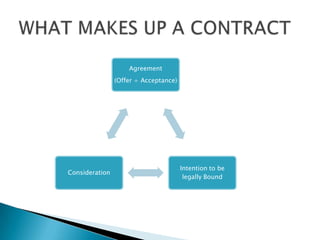
This document discusses the key elements of a valid contract: offer, acceptance, consideration, and intention to create legal relations. It defines these elements and provides examples to illustrate the rules around offers, acceptance, consideration, and the presumptions around social/domestic versus commercial arrangements. The key requirements for a valid contract are an agreement between two parties based on an offer and acceptance, where the parties intend to create legal relations and there is consideration in the form of something of value exchanged.


