Main Characters
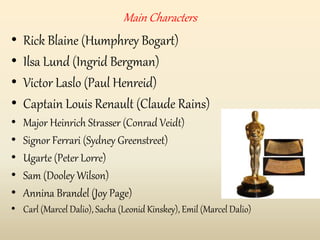
• Rick Blaine (Humphrey Bogart)
• Ilsa Lund (Ingrid Bergman)
• Victor Laslo (Paul Henreid)
• Captain Louis Renault (Claude Rains)
• Major Heinrich Strasser (Conrad Veidt)
• Signor Ferrari (Sydney Greenstreet)
• Ugarte (Peter Lorre)
• Sam (Dooley Wilson)
• Annina Brandel (Joy Page)
• Carl (Marcel Dalio), Sacha (Leonid Kinskey), Emil (Marcel Dalio)
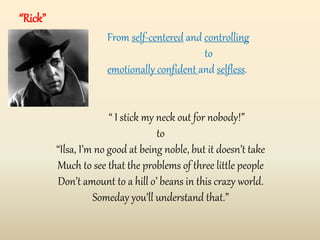
“Rick”
From self-centered and controlling
to
emotionally confident and selfless.
“ I stick my neck out for nobody!”
to
“Ilsa, I’m no good at being noble, but it doesn’t take
Much to see that the problems of three little people
Don’t amount to a hill o’ beans in this crazy world.
Someday you’ll understand that.”
Despite her obvious commitment to
her husband and her confessions of
love to Rick (both in Paris and in
Casablanca), she rarely displays much passion.
Cold and distant – reading her true thoughts or feelings is almost
impossible.
She is the one who connects the two men and motivates Rick to change.
Her motives are always shadowy because she always has possible, logical
ulterior motives.
Her fate is the most tragic in the film – no matter who she loves, there
can be no happy ending for her.
“Ilsa”
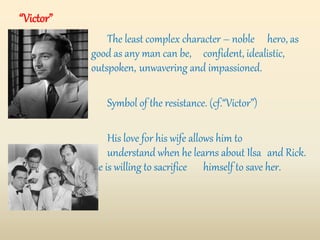
The least complex character – noble hero, as
good as any man can be, confident, idealistic,
outspoken, unwavering and impassioned.
Symbol of the resistance. (cf.“Victor”)
His love for his wife allows him to
understand when he learns about Ilsa and Rick.
He is willing to sacrifice himself to save her.
“Victor”
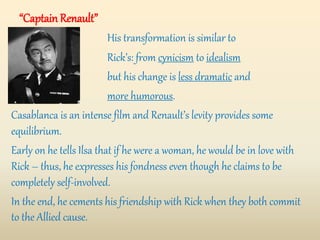
“Captain Renault”
His transformation is similar to
Rick’s: from cynicism to idealism
but his change is less dramatic and
more humorous.
Casablanca is an intense film and Renault’s levity provides some
equilibrium.
Early on he tells Ilsa that if he were a woman, he would be in love with
Rick – thus, he expresses his fondness even though he claims to be
completely self-involved.
In the end, he cements his friendship with Rick when they both commit
to the Allied cause.
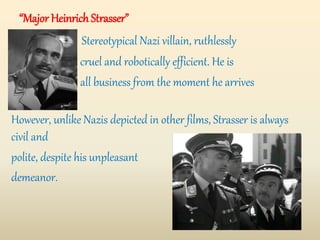
“Major Heinrich Strasser”
Stereotypical Nazi villain, ruthlessly
cruel and robotically efficient. He is
all business from the moment he arrives
at the airport.
However, unlike Nazis depicted in other films, Strasser is always
civil and
polite, despite his unpleasant
demeanor.
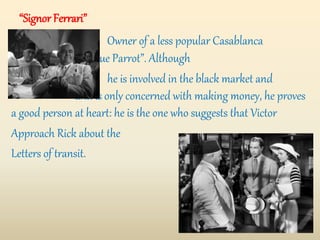
“Signor Ferrari”
Owner of a less popular Casablanca
bar – the “Blue Parrot”. Although
he is involved in the black market and
and is only concerned with making money, he proves
a good person at heart: he is the one who suggests that Victor
Approach Rick about the
Letters of transit.
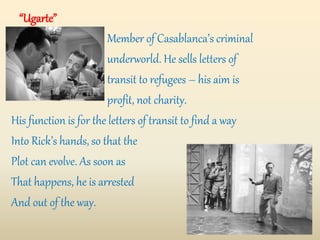
“Ugarte”
Member of Casablanca’s criminal
underworld. He sells letters of
transit to refugees – his aim is
profit, not charity.
His function is for the letters of transit to find a way
Into Rick’s hands, so that the
Plot can evolve. As soon as
That happens, he is arrested
And out of the way.
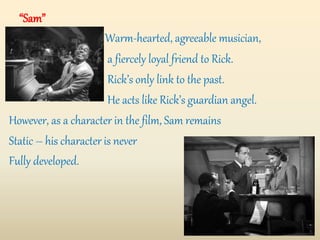
“Sam”
Warm-hearted, agreeable musician,
a fiercely loyal friend to Rick.
Rick’s only link to the past.
He acts like Rick’s guardian angel.
However, as a character in the film, Sam remains
Static – his character is never
Fully developed.
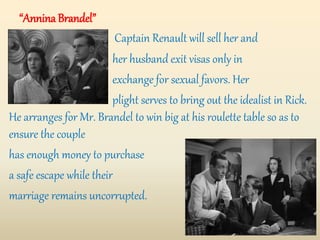
“Annina Brandel”
Captain Renault will sell her and
her husband exit visas only in
exchange for sexual favors. Her
plight serves to bring out the idealist in Rick.
He arranges for Mr. Brandel to win big at his roulette table so as to
ensure the couple
has enough money to purchase
a safe escape while their
marriage remains uncorrupted.
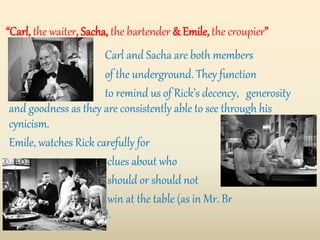
“Carl, the waiter, Sacha, the bartender & Emile, the croupier”
Carl and Sacha are both members
of the underground. They function
to remind us of Rick’s decency, generosity
and goodness as they are consistently able to see through his
cynicism.
Emile, watches Rick carefully for
clues about who
should or should not
win at the table (as in Mr. Br
Brandel’s case).
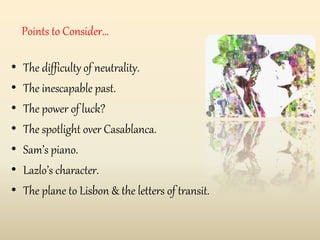
Points to Consider…
• The difficulty of neutrality.
• The inescapable past.
• The power of luck?
• The spotlight over Casablanca.
• Sam’s piano.
• Lazlo’s character.
• The plane to Lisbon & the letters of transit.
Sources
http://www.sparknotes.com/film/casablanca/canalysis.html
http://www.sparknotes.com/film/casablanca/themes.html

Casablanca

  • 2.
    Main Characters • RickBlaine (Humphrey Bogart) • Ilsa Lund (Ingrid Bergman) • Victor Laslo (Paul Henreid) • Captain Louis Renault (Claude Rains) • Major Heinrich Strasser (Conrad Veidt) • Signor Ferrari (Sydney Greenstreet) • Ugarte (Peter Lorre) • Sam (Dooley Wilson) • Annina Brandel (Joy Page) • Carl (Marcel Dalio), Sacha (Leonid Kinskey), Emil (Marcel Dalio)
  • 3.
    “Rick” From self-centered andcontrolling to emotionally confident and selfless. “ I stick my neck out for nobody!” to “Ilsa, I’m no good at being noble, but it doesn’t take Much to see that the problems of three little people Don’t amount to a hill o’ beans in this crazy world. Someday you’ll understand that.”
  • 4.
    Despite her obviouscommitment to her husband and her confessions of love to Rick (both in Paris and in Casablanca), she rarely displays much passion. Cold and distant – reading her true thoughts or feelings is almost impossible. She is the one who connects the two men and motivates Rick to change. Her motives are always shadowy because she always has possible, logical ulterior motives. Her fate is the most tragic in the film – no matter who she loves, there can be no happy ending for her. “Ilsa”
  • 5.
    The least complexcharacter – noble hero, as good as any man can be, confident, idealistic, outspoken, unwavering and impassioned. Symbol of the resistance. (cf.“Victor”) His love for his wife allows him to understand when he learns about Ilsa and Rick. He is willing to sacrifice himself to save her. “Victor”
  • 6.
    “Captain Renault” His transformationis similar to Rick’s: from cynicism to idealism but his change is less dramatic and more humorous. Casablanca is an intense film and Renault’s levity provides some equilibrium. Early on he tells Ilsa that if he were a woman, he would be in love with Rick – thus, he expresses his fondness even though he claims to be completely self-involved. In the end, he cements his friendship with Rick when they both commit to the Allied cause.
  • 7.
    “Major Heinrich Strasser” StereotypicalNazi villain, ruthlessly cruel and robotically efficient. He is all business from the moment he arrives at the airport. However, unlike Nazis depicted in other films, Strasser is always civil and polite, despite his unpleasant demeanor.
  • 8.
    “Signor Ferrari” Owner ofa less popular Casablanca bar – the “Blue Parrot”. Although he is involved in the black market and and is only concerned with making money, he proves a good person at heart: he is the one who suggests that Victor Approach Rick about the Letters of transit.
  • 9.
    “Ugarte” Member of Casablanca’scriminal underworld. He sells letters of transit to refugees – his aim is profit, not charity. His function is for the letters of transit to find a way Into Rick’s hands, so that the Plot can evolve. As soon as That happens, he is arrested And out of the way.
  • 10.
    “Sam” Warm-hearted, agreeable musician, afiercely loyal friend to Rick. Rick’s only link to the past. He acts like Rick’s guardian angel. However, as a character in the film, Sam remains Static – his character is never Fully developed.
  • 11.
    “Annina Brandel” Captain Renaultwill sell her and her husband exit visas only in exchange for sexual favors. Her plight serves to bring out the idealist in Rick. He arranges for Mr. Brandel to win big at his roulette table so as to ensure the couple has enough money to purchase a safe escape while their marriage remains uncorrupted.
  • 12.
    “Carl, the waiter,Sacha, the bartender & Emile, the croupier” Carl and Sacha are both members of the underground. They function to remind us of Rick’s decency, generosity and goodness as they are consistently able to see through his cynicism. Emile, watches Rick carefully for clues about who should or should not win at the table (as in Mr. Br Brandel’s case).
  • 13.
    Points to Consider… •The difficulty of neutrality. • The inescapable past. • The power of luck? • The spotlight over Casablanca. • Sam’s piano. • Lazlo’s character. • The plane to Lisbon & the letters of transit.
  • 14.