
Twitter: #Caring4NHSpeople #OurNHSpeople
The health and
wellbeing of our
NHS people during
the Covid-19
response
Virtual session
8th April 4pm
Twitter: #Caring4NHSpeople #OurNHSpeople
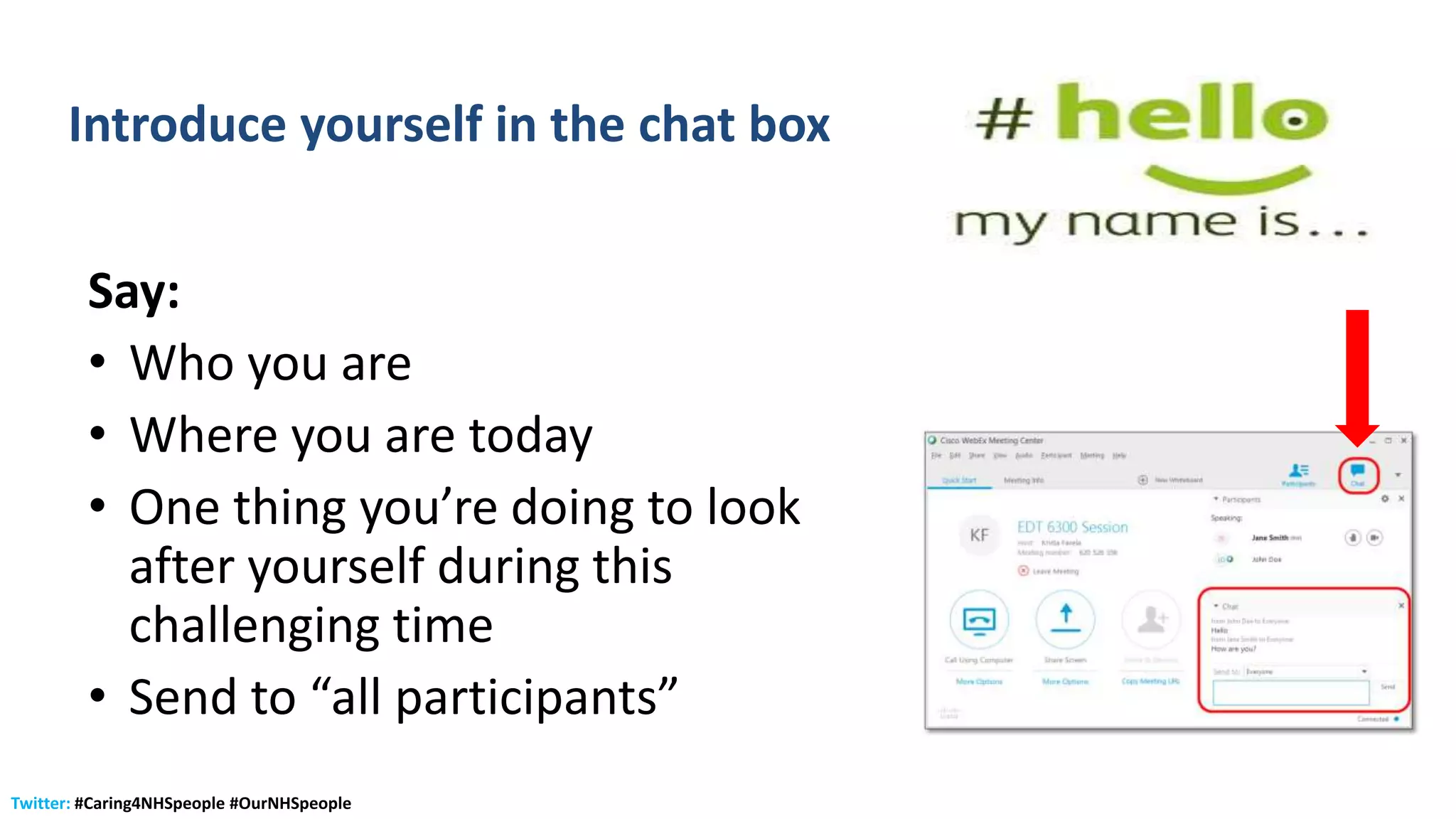
Introduce yourself in the chat box
Say:
• Who you are
• Where you are today
• One thing you’re doing to look
after yourself during this
challenging time
• Send to “all participants”
Twitter: #Caring4NHSpeople #OurNHSpeople
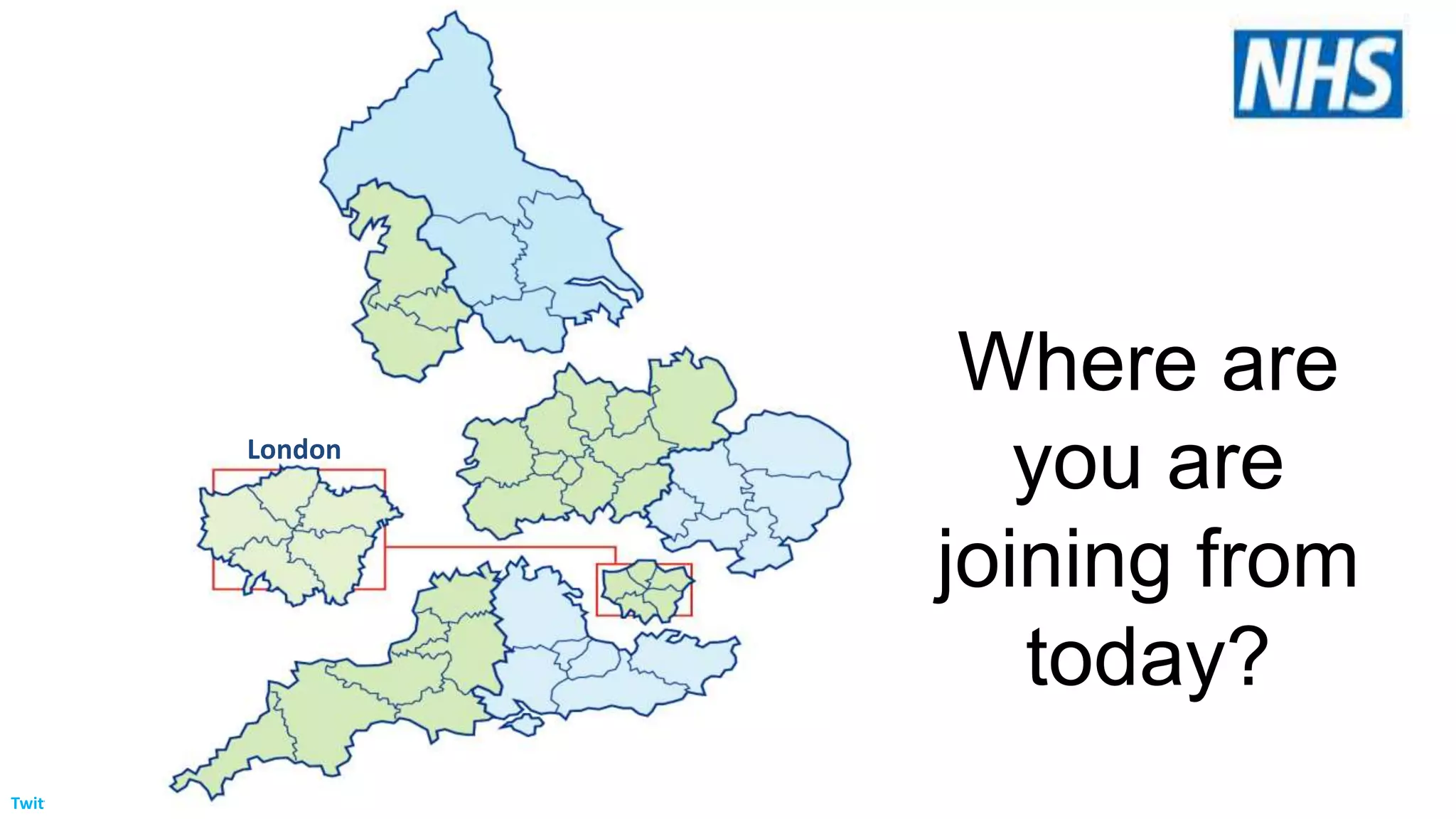
Where are
you are
joining from
today?
London
Twitter: #Caring4NHSpeople #OurNHSpeople
The health and
wellbeing of our
NHS people during
the Covid-19
response
Virtual session
8th April 4pm
Twitter: #Caring4NHSpeople #OurNHSpeople
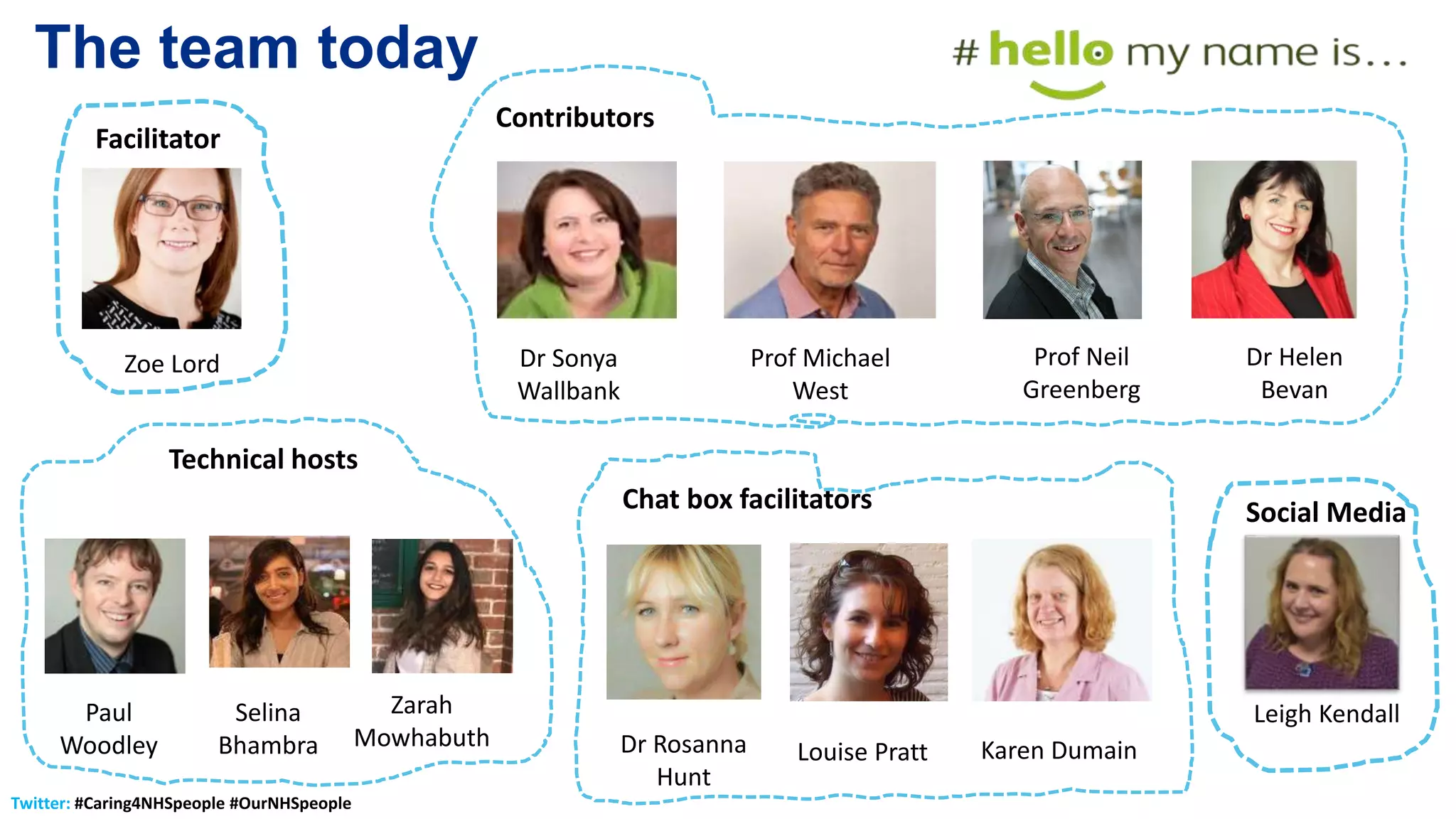
The team today
Chat box facilitators
Dr Rosanna
Hunt
Paul
Woodley
Technical hosts
Selina
Bhambra
Dr Sonya
Wallbank
Contributors
Zoe Lord
Facilitator
Prof Neil
Greenberg
Prof Michael
West
Dr Helen
Bevan
Zarah
Mowhabuth
Louise Pratt Karen Dumain
Social Media
Leigh Kendall
Twitter: #Caring4NHSpeople #OurNHSpeople
7 |
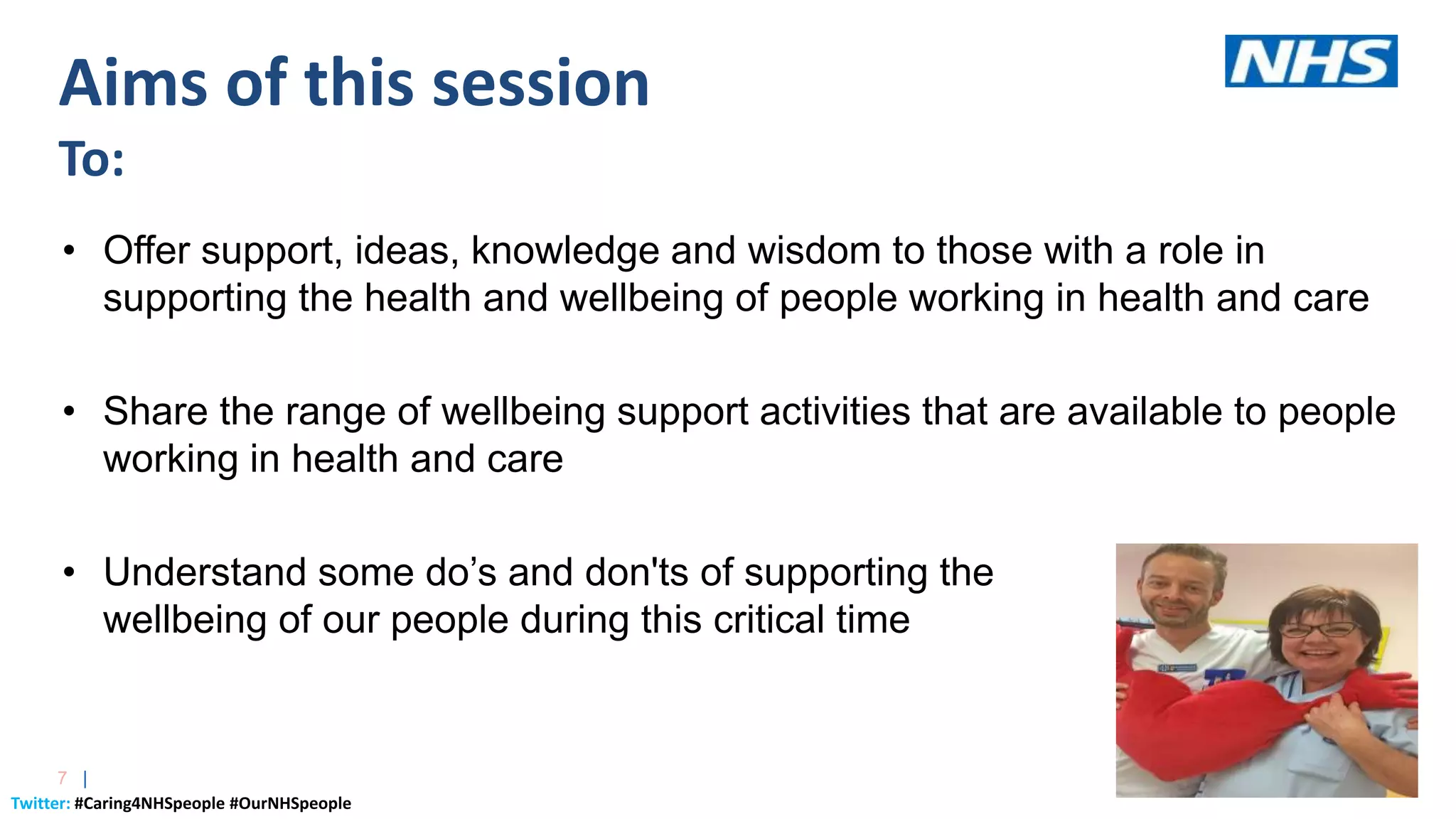
• Offer support, ideas, knowledge and wisdom to those with a role in
supporting the health and wellbeing of people working in health and care
• Share the range of wellbeing support activities that are available to people
working in health and care
• Understand some do’s and don'ts of supporting the
wellbeing of our people during this critical time
Aims of this session
To:
Twitter: #Caring4NHSpeople #OurNHSpeople
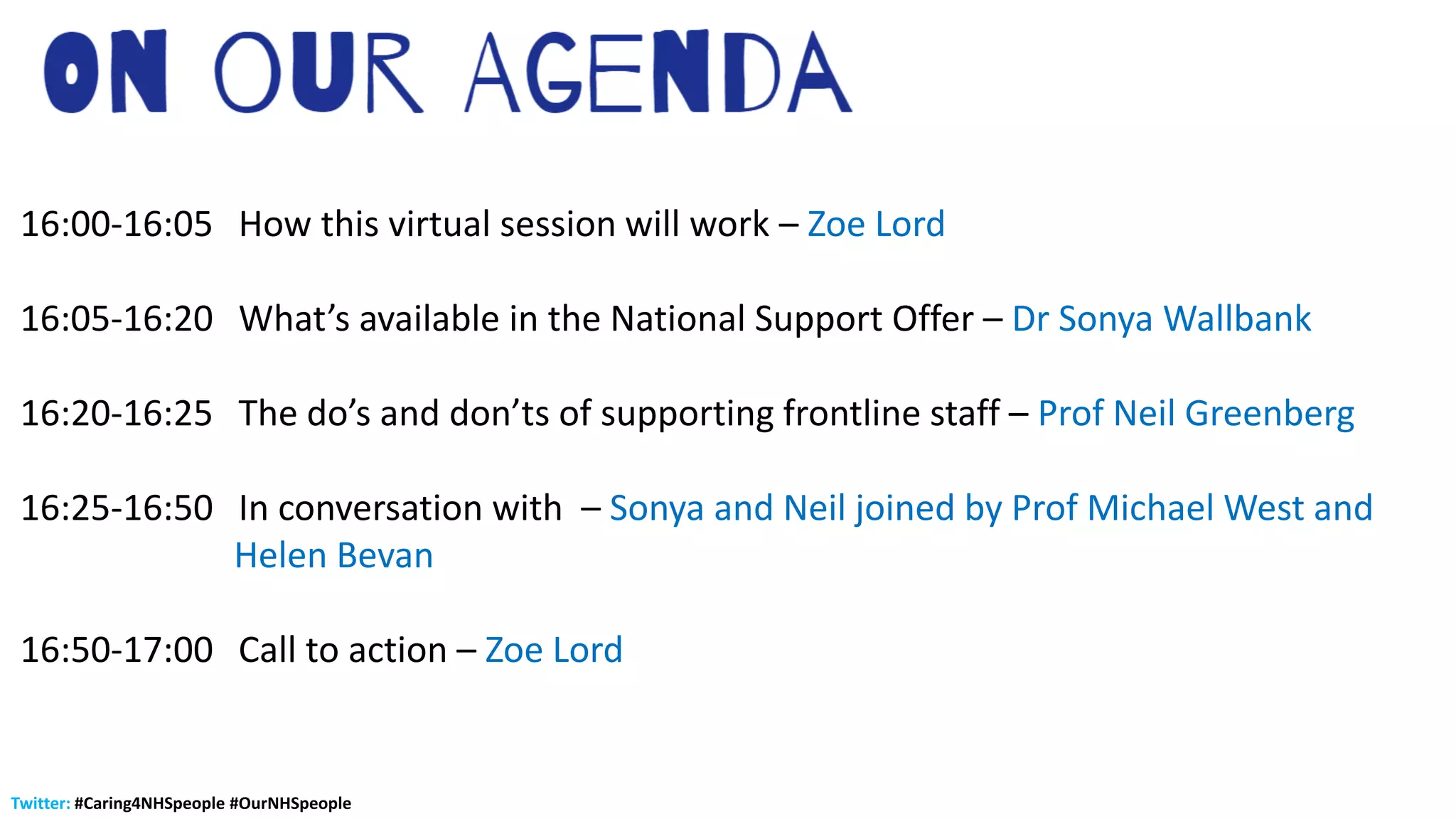
16:00-16:05 How this virtual session will work – Zoe Lord
16:05-16:20 What’s available in the National Support Offer – Dr Sonya Wallbank
16:20-16:25 The do’s and don’ts of supporting frontline staff – Prof Neil Greenberg
16:25-16:50 In conversation with – Sonya and Neil joined by Prof Michael West and
Helen Bevan
16:50-17:00 Call to action – Zoe Lord
Twitter: #Caring4NHSpeople #OurNHSpeople
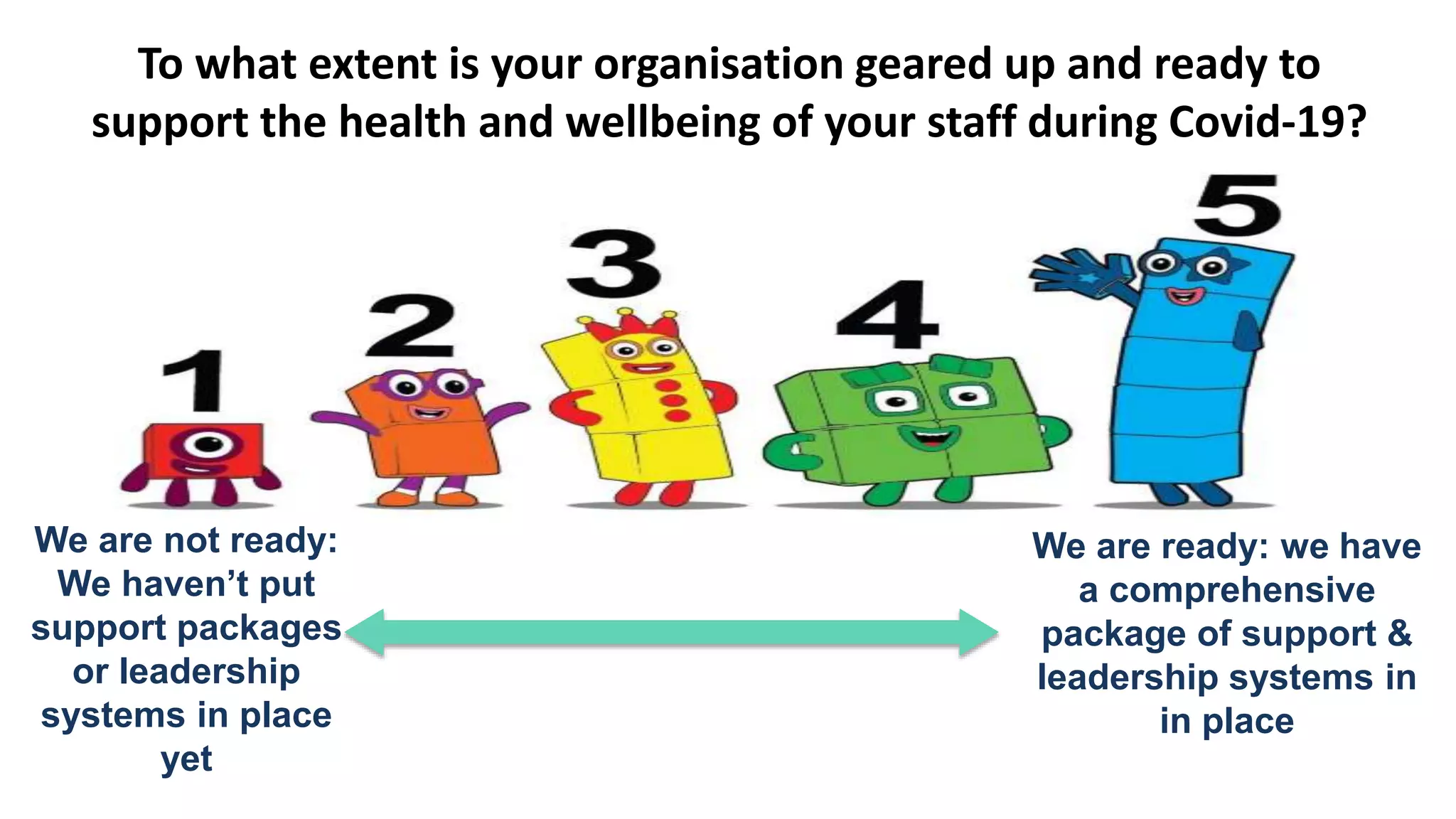
We are ready: we have
a comprehensive
package of support &
leadership systems in
in place
We are not ready:
We haven’t put
support packages
or leadership
systems in place
yet
To what extent is your organisation geared up and ready to
support the health and wellbeing of your staff during Covid-19?
Twitter: #Caring4NHSpeople #OurNHSpeople
Very clear: I’m part of
an agreed approach
and support system
and I have the skills
and back up to do this
role
I’m not clear
How clear are you about your own role & responsibilities in
supporting the health and wellbeing of staff during Covid-19?
The National
Wellbeing Offer
Dr Sonya Wallbank
Health and Wellbeing Clinical
Lead, NHS England &
Improvement
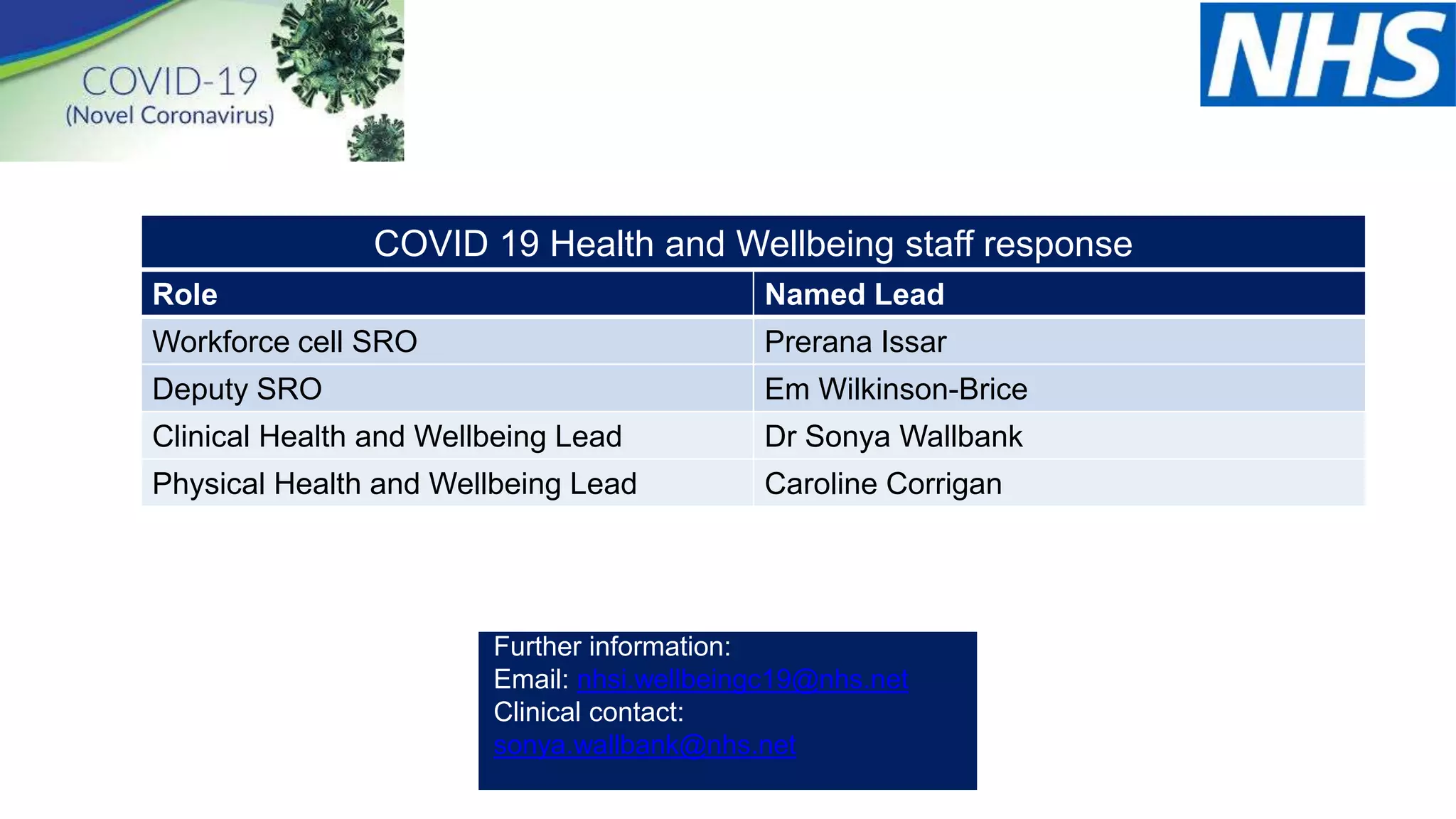
COVID 19 Health and Wellbeing staff response
Role Named Lead
Workforce cell SRO Prerana Issar
Deputy SRO Em Wilkinson-Brice
Clinical Health and Wellbeing Lead Dr Sonya Wallbank
Physical Health and Wellbeing Lead Caroline Corrigan
Further information:
Email: nhsi.wellbeingc19@nhs.net
Clinical contact:
sonya.wallbank@nhs.net
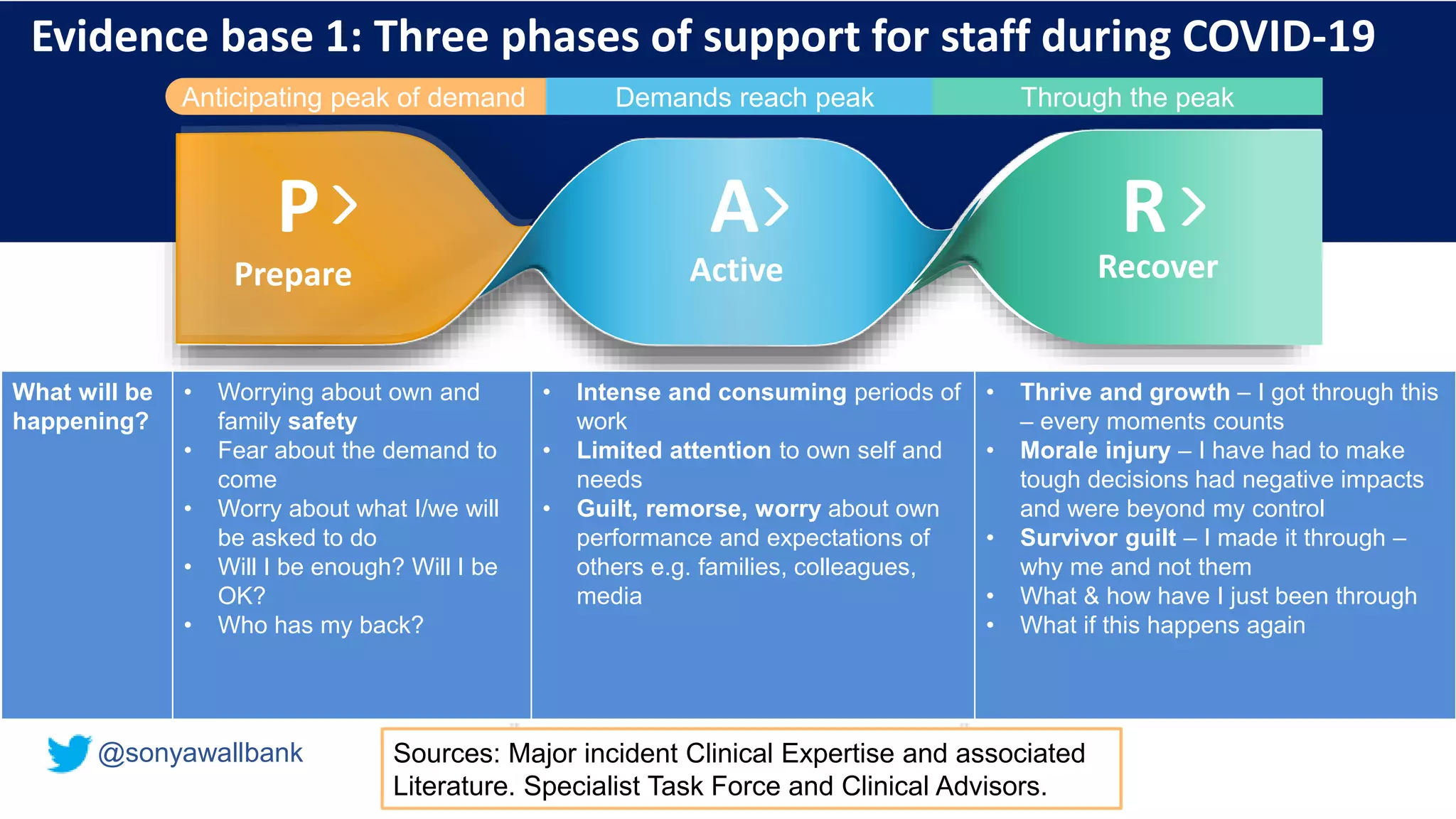
Evidence base 1: Three phases of support for staff during COVID-19
R
RecoverPrepare
P A
Active
Anticipating peak of demand Demands reach peak Through the peak
What will be
happening?
• Worrying about own and
family safety
• Fear about the demand to
come
• Worry about what I/we will
be asked to do
• Will I be enough? Will I be
OK?
• Who has my back?
• Intense and consuming periods of
work
• Limited attention to own self and
needs
• Guilt, remorse, worry about own
performance and expectations of
others e.g. families, colleagues,
media
• Thrive and growth – I got through this
– every moments counts
• Morale injury – I have had to make
tough decisions had negative impacts
and were beyond my control
• Survivor guilt – I made it through –
why me and not them
• What & how have I just been through
• What if this happens again
Sources: Major incident Clinical Expertise and associated
Literature. Specialist Task Force and Clinical Advisors.
@sonyawallbank
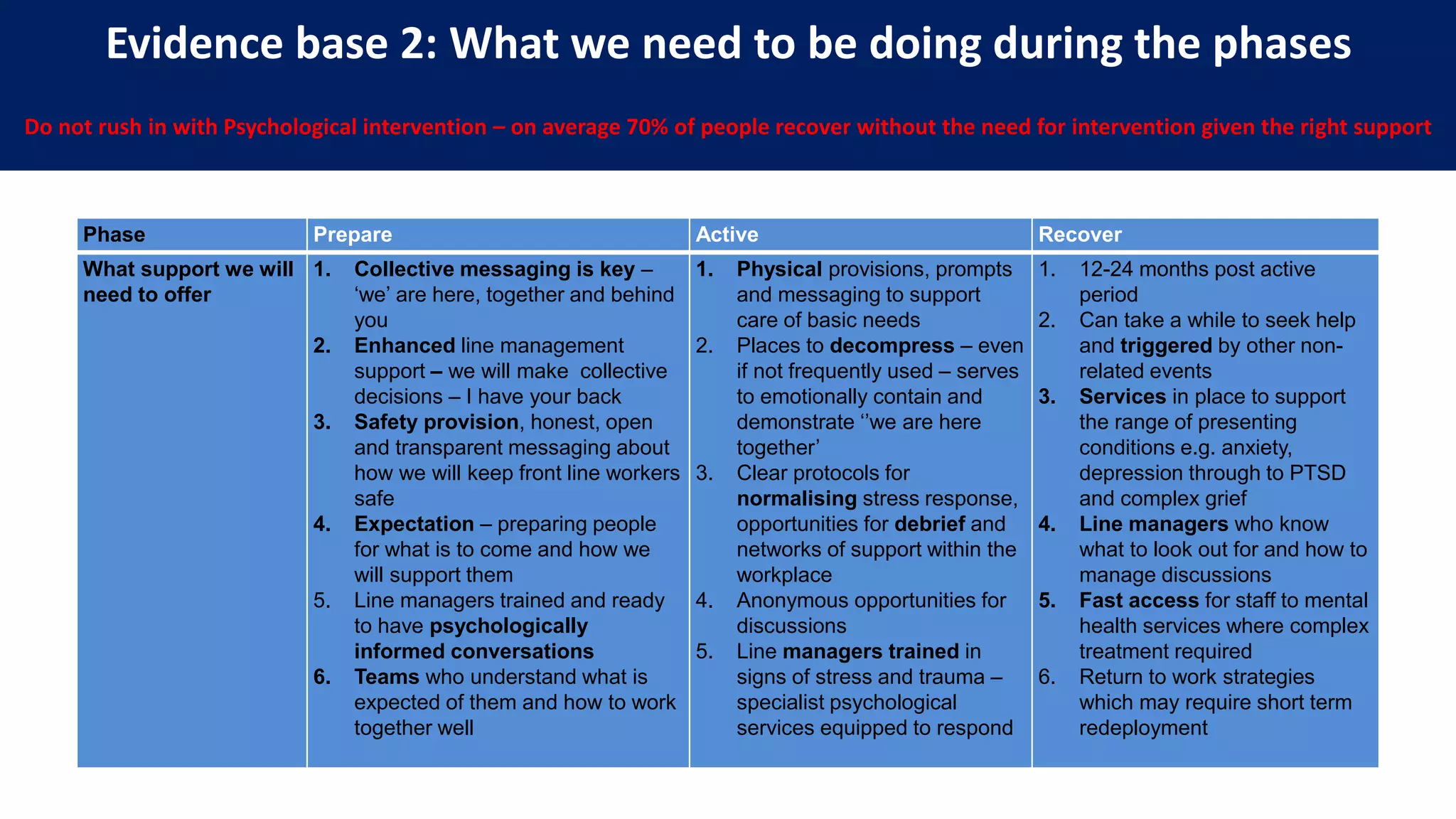
Do not rush in with Psychological intervention – on average 70% of people recover without the need for intervention given the right support
Phase Prepare Active Recover
What support we will
need to offer
1. Collective messaging is key –
‘we’ are here, together and behind
you
2. Enhanced line management
support – we will make collective
decisions – I have your back
3. Safety provision, honest, open
and transparent messaging about
how we will keep front line workers
safe
4. Expectation – preparing people
for what is to come and how we
will support them
5. Line managers trained and ready
to have psychologically
informed conversations
6. Teams who understand what is
expected of them and how to work
together well
1. Physical provisions, prompts
and messaging to support
care of basic needs
2. Places to decompress – even
if not frequently used – serves
to emotionally contain and
demonstrate ‘’we are here
together’
3. Clear protocols for
normalising stress response,
opportunities for debrief and
networks of support within the
workplace
4. Anonymous opportunities for
discussions
5. Line managers trained in
signs of stress and trauma –
specialist psychological
services equipped to respond
1. 12-24 months post active
period
2. Can take a while to seek help
and triggered by other non-
related events
3. Services in place to support
the range of presenting
conditions e.g. anxiety,
depression through to PTSD
and complex grief
4. Line managers who know
what to look out for and how to
manage discussions
5. Fast access for staff to mental
health services where complex
treatment required
6. Return to work strategies
which may require short term
redeployment
Evidence base 2: What we need to be doing during the phases
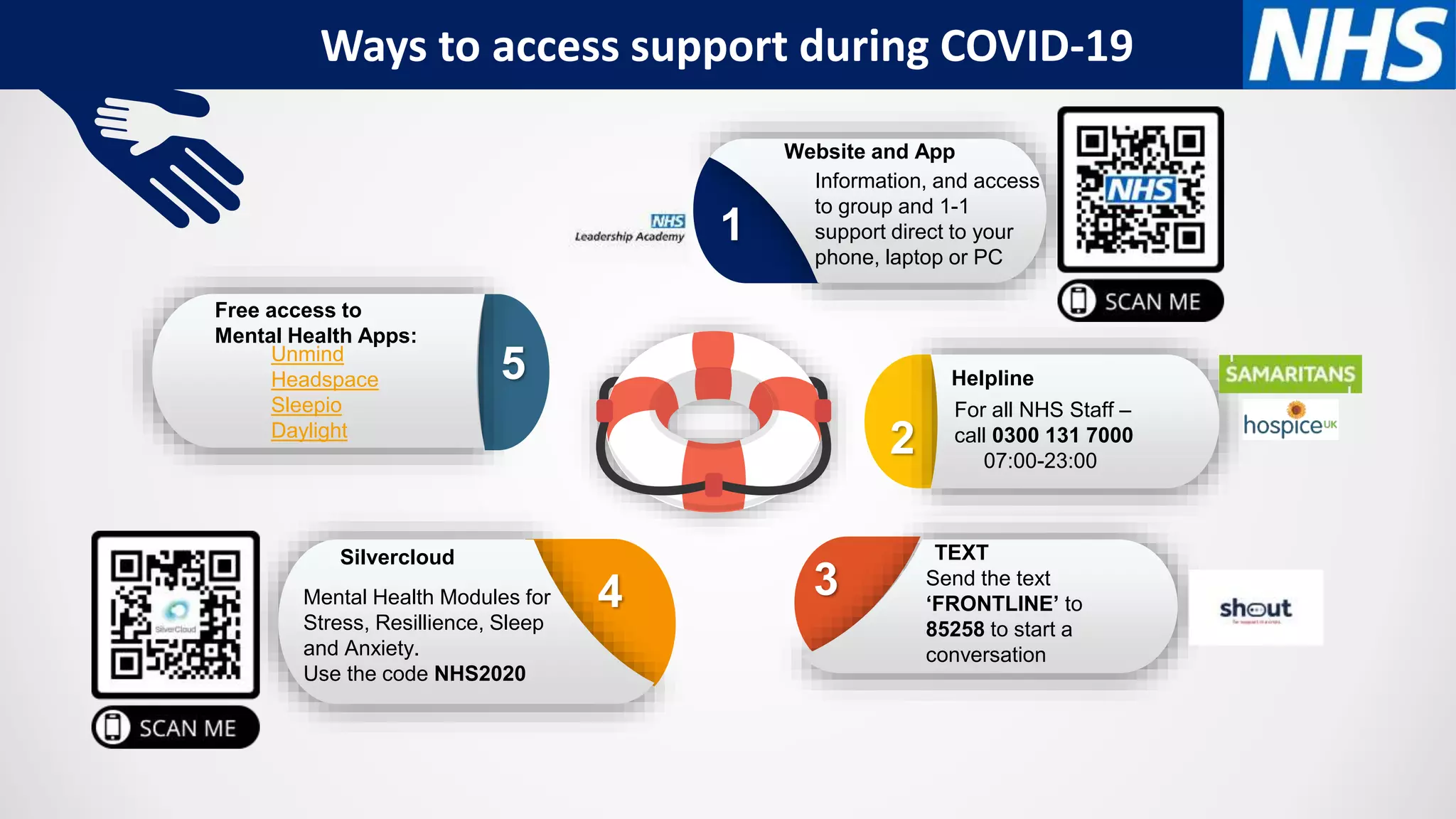
1
5Unmind
Headspace
Sleepio
Daylight
Free access to
Mental Health Apps:
2
For all NHS Staff –
call 0300 131 7000
07:00-23:00
34
Silvercloud
Information, and access
to group and 1-1
support direct to your
phone, laptop or PC
Website and App
TEXT
Ways to access support during COVID-19
Helpline
Send the text
‘FRONTLINE’ to
85258 to start a
conversation
Mental Health Modules for
Stress, Resillience, Sleep
and Anxiety.
Use the code NHS2020
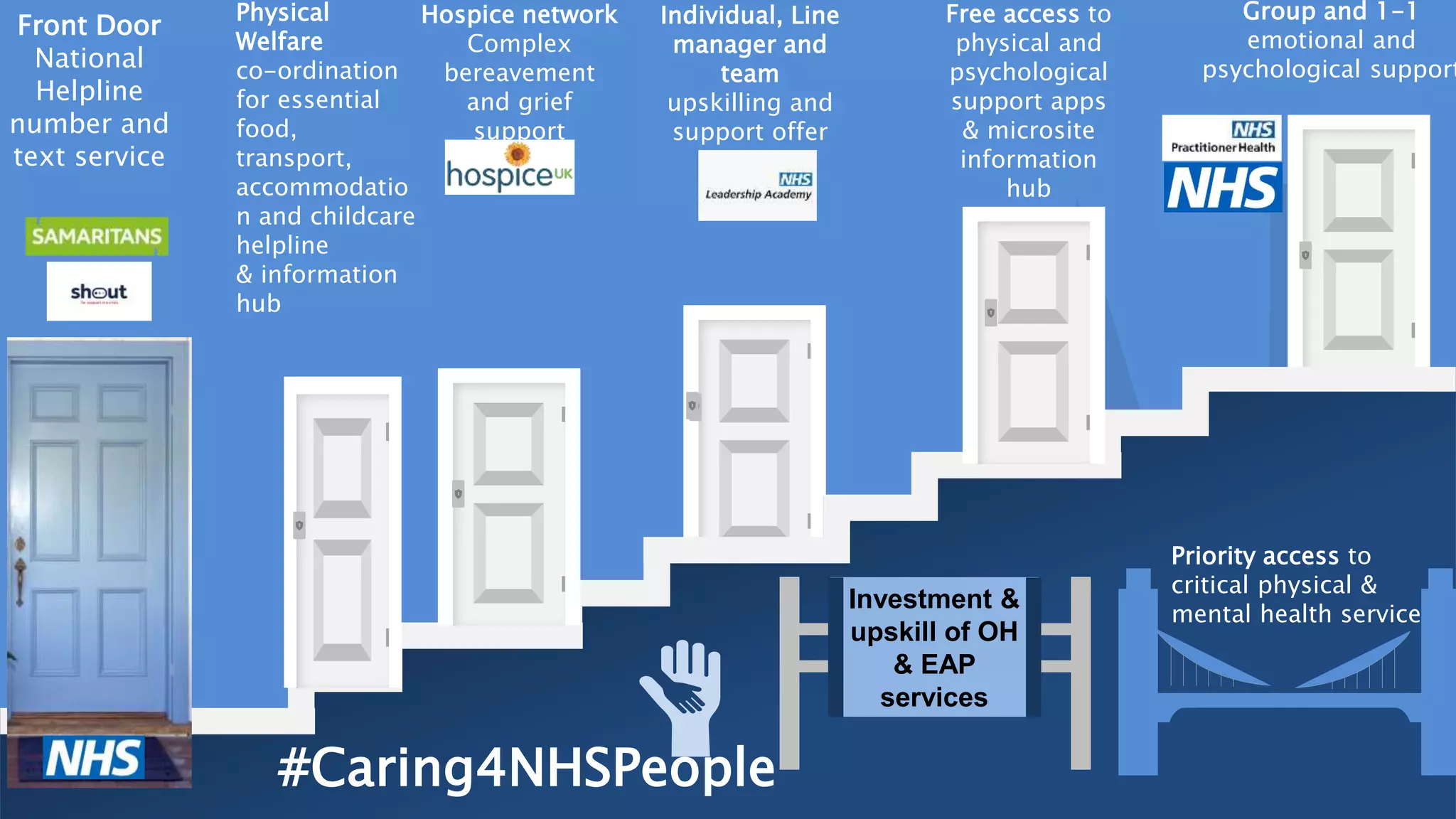
#Caring4NHSPeople
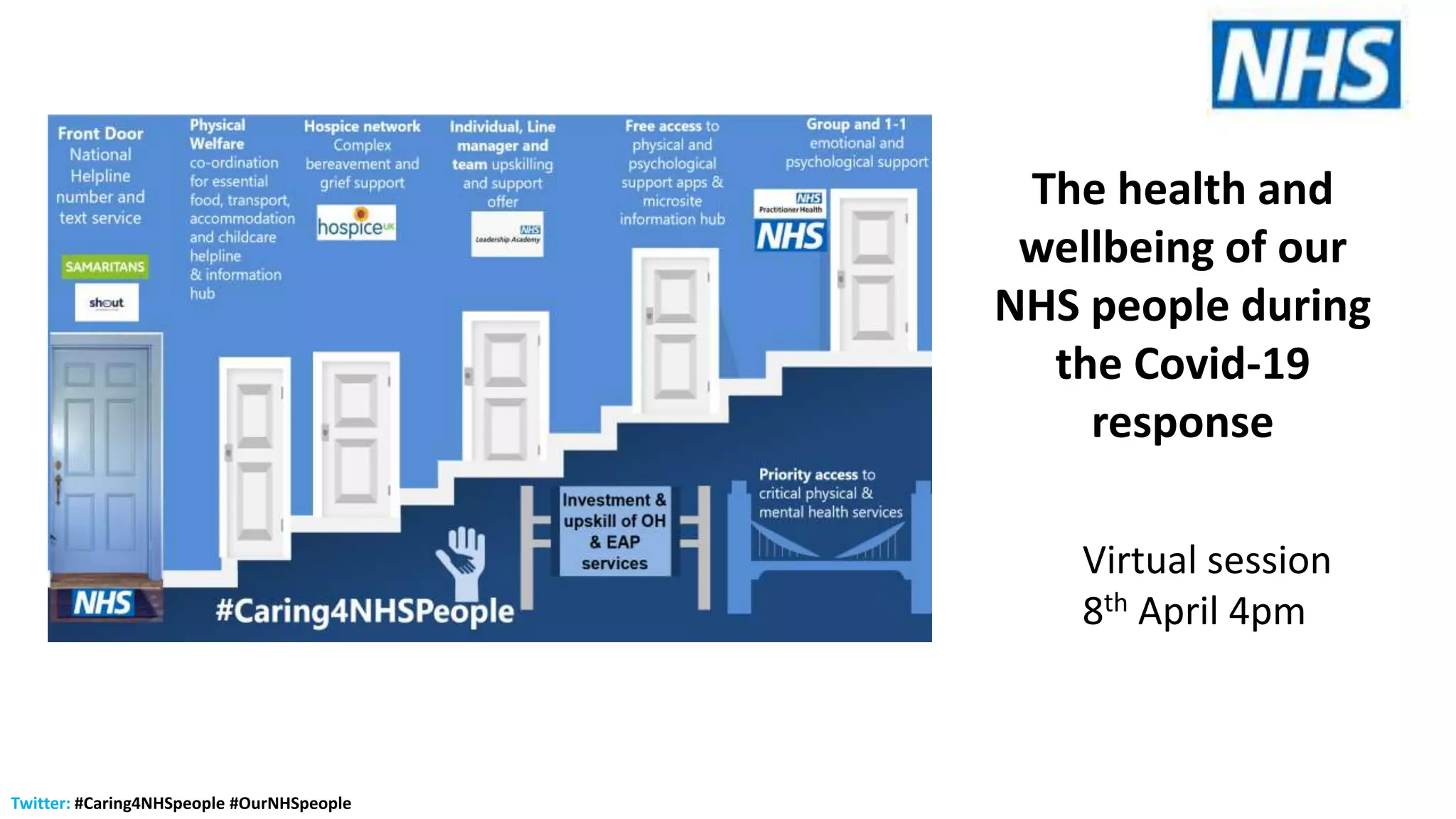
Group and 1-1
emotional and
psychological support
Hospice network
Complex
bereavement
and grief
support
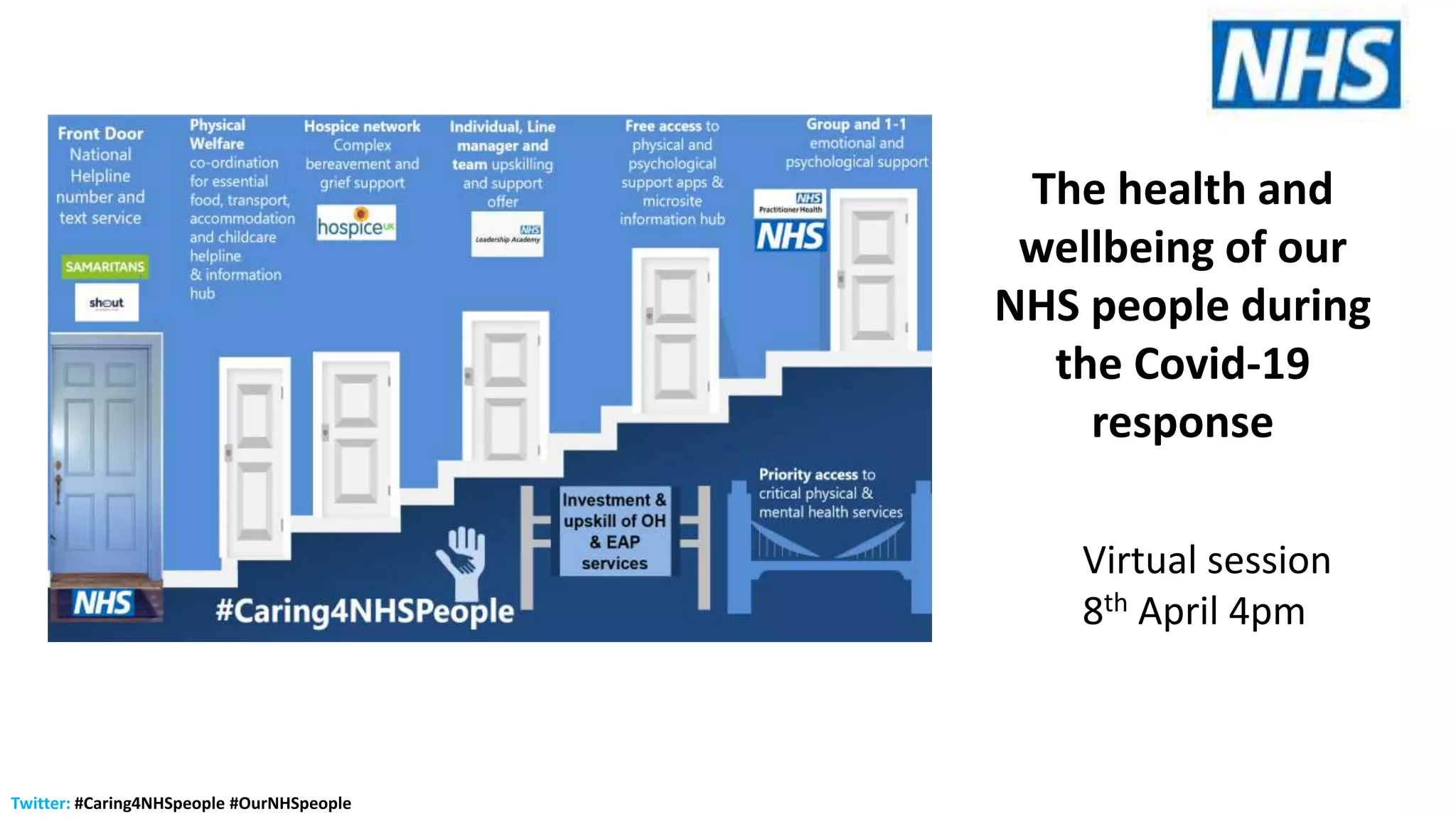
Front Door
National
Helpline
number and
text service
Physical
Welfare
co-ordination
for essential
food,
transport,
accommodatio
n and childcare
helpline
& information
hub
Individual, Line
manager and
team
upskilling and
support offer
Free access to
physical and
psychological
support apps
& microsite
information
hub
Investment &
upskill of OH
& EAP
services
Priority access to
critical physical &
mental health services
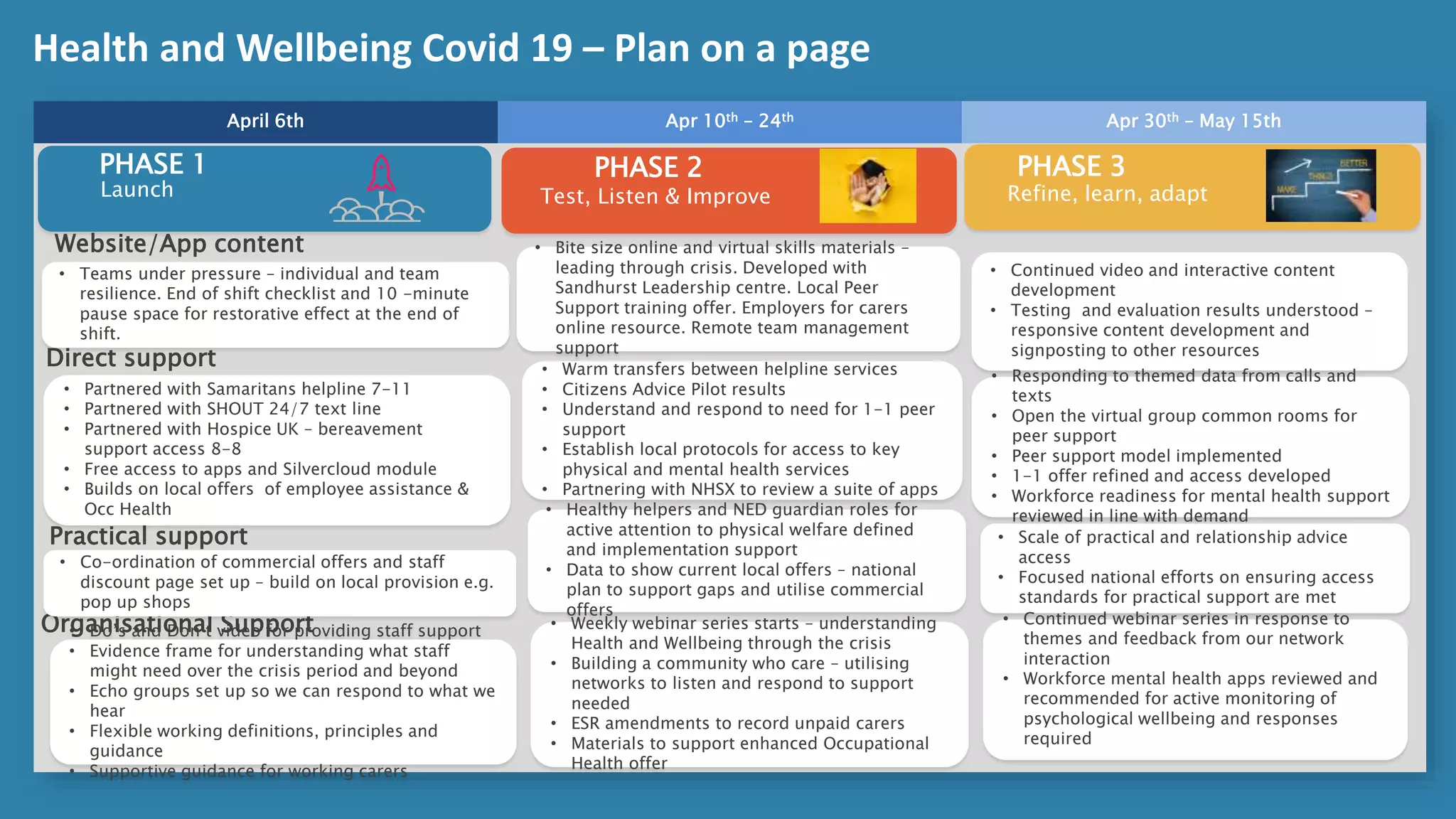
April 6th Apr 10th – 24th Apr 30th – May 15th
Health and Wellbeing Covid 19 – Plan on a page
PHASE 1
Launch
PHASE 2
Test, Listen & Improve
PHASE 3
Refine, learn, adapt
Website/App content
Direct support
Practical support
Organisational Support
• Teams under pressure – individual and team
resilience. End of shift checklist and 10 -minute
pause space for restorative effect at the end of
shift.
• Partnered with Samaritans helpline 7-11
• Partnered with SHOUT 24/7 text line
• Partnered with Hospice UK – bereavement
support access 8-8
• Free access to apps and Silvercloud module
• Builds on local offers of employee assistance &
Occ Health
• Co-ordination of commercial offers and staff
discount page set up – build on local provision e.g.
pop up shops
• Do’s and Don’t video for providing staff support
• Evidence frame for understanding what staff
might need over the crisis period and beyond
• Echo groups set up so we can respond to what we
hear
• Flexible working definitions, principles and
guidance
• Supportive guidance for working carers
• Continued video and interactive content
development
• Testing and evaluation results understood –
responsive content development and
signposting to other resources
• Responding to themed data from calls and
texts
• Open the virtual group common rooms for
peer support
• Peer support model implemented
• 1-1 offer refined and access developed
• Workforce readiness for mental health support
reviewed in line with demand
• Scale of practical and relationship advice
access
• Focused national efforts on ensuring access
standards for practical support are met
• Continued webinar series in response to
themes and feedback from our network
interaction
• Workforce mental health apps reviewed and
recommended for active monitoring of
psychological wellbeing and responses
required
• Bite size online and virtual skills materials –
leading through crisis. Developed with
Sandhurst Leadership centre. Local Peer
Support training offer. Employers for carers
online resource. Remote team management
support
• Warm transfers between helpline services
• Citizens Advice Pilot results
• Understand and respond to need for 1-1 peer
support
• Establish local protocols for access to key
physical and mental health services
• Partnering with NHSX to review a suite of apps
• Healthy helpers and NED guardian roles for
active attention to physical welfare defined
and implementation support
• Data to show current local offers – national
plan to support gaps and utilise commercial
offers
• Weekly webinar series starts – understanding
Health and Wellbeing through the crisis
• Building a community who care – utilising
networks to listen and respond to support
needed
• ESR amendments to record unpaid carers
• Materials to support enhanced Occupational
Health offer
For further information, recommendations or requests please use
our dedicated inbox at: nhsi.wellbeingc19@nhs.net
For specific clinical advice or further discussion:
Contact: sonya.wallbank@nhs.net
Scan the
link to send
us feedback
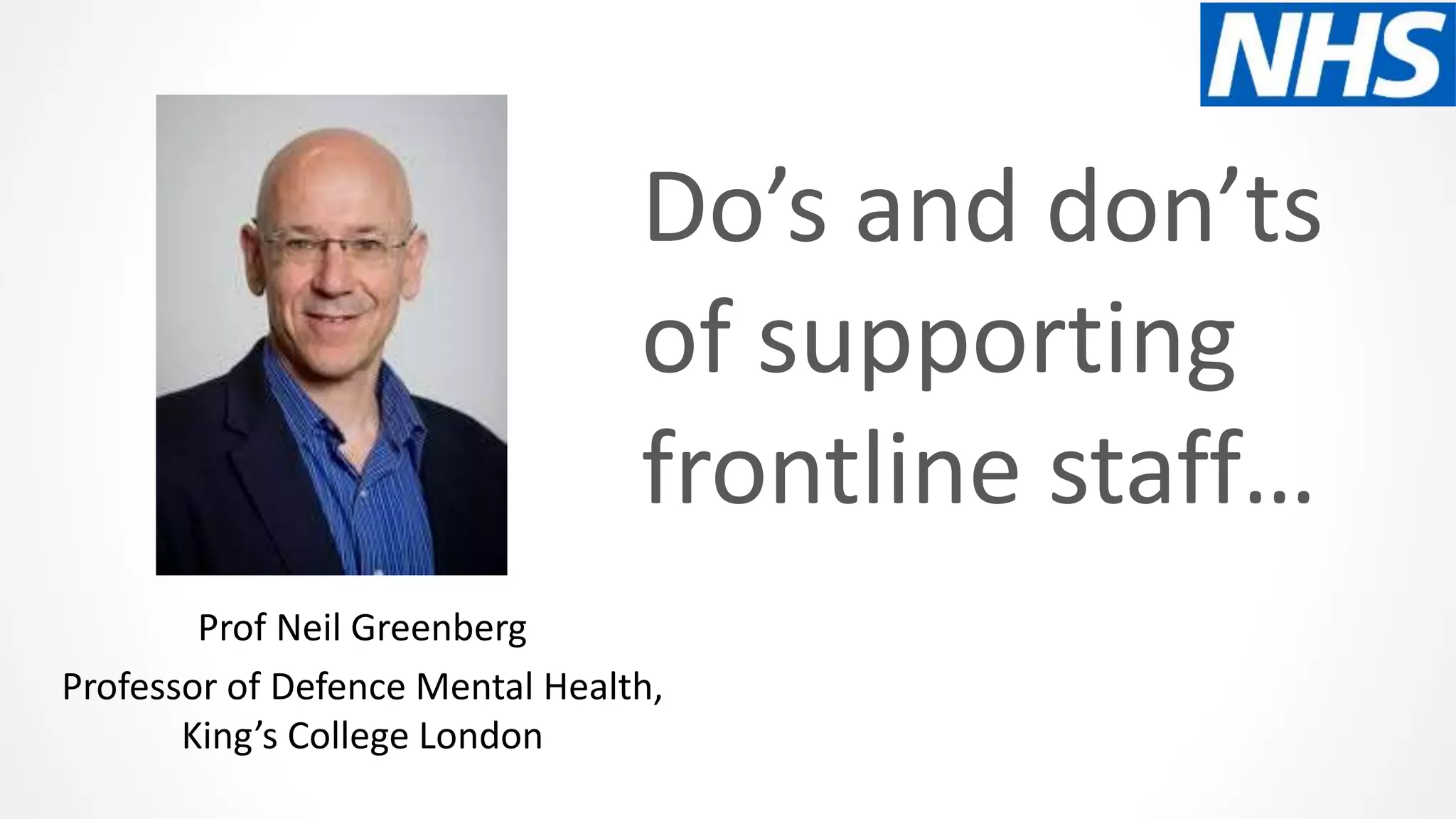
Do’s and don’ts
of supporting
frontline staff…
Prof Neil Greenberg
Professor of Defence Mental Health,
King’s College London
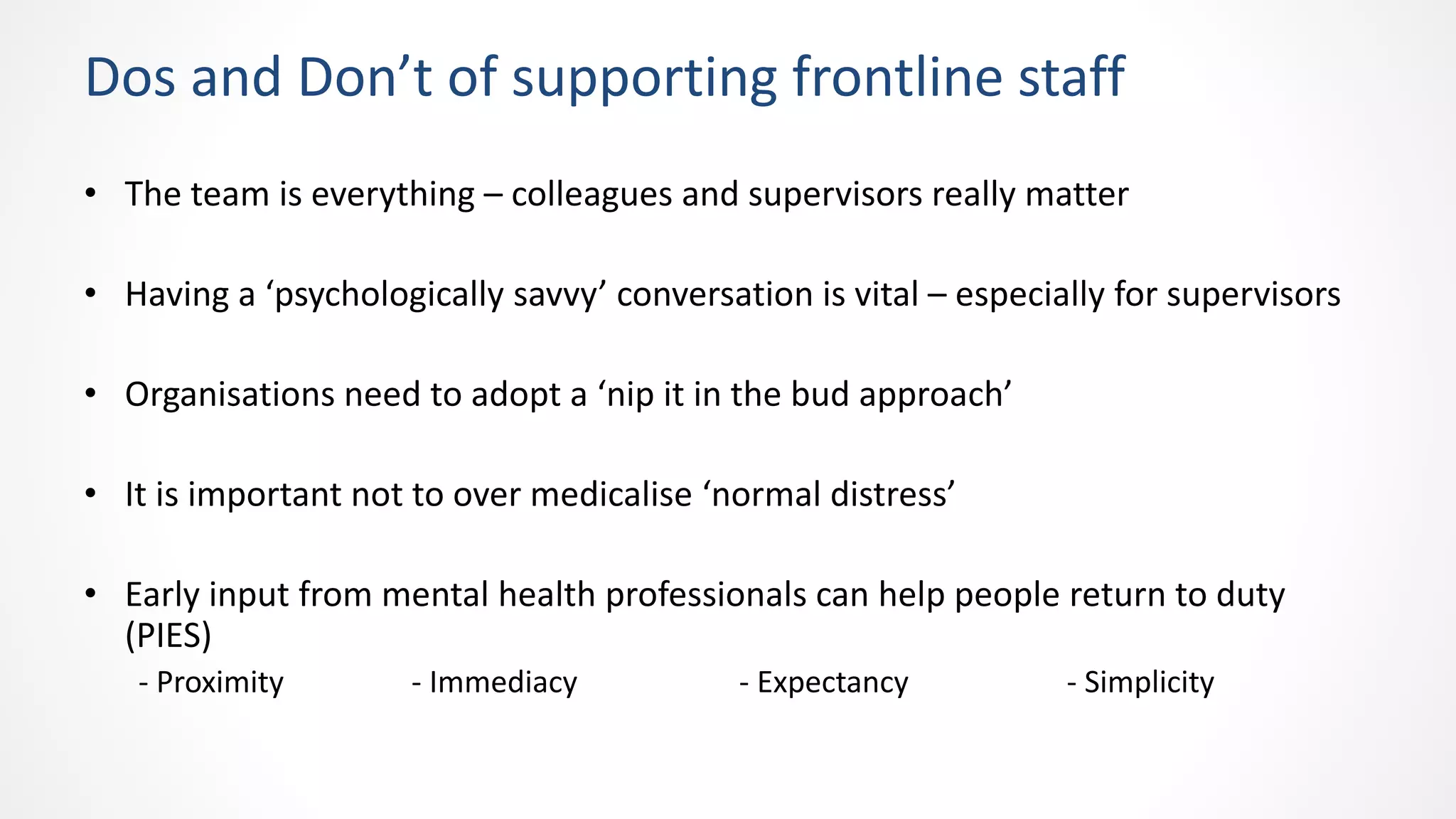
Dos and Don’t of supporting frontline staff
• The team is everything – colleagues and supervisors really matter
• Having a ‘psychologically savvy’ conversation is vital – especially for supervisors
• Organisations need to adopt a ‘nip it in the bud approach’
• It is important not to over medicalise ‘normal distress’
• Early input from mental health professionals can help people return to duty
(PIES)
- Proximity - Immediacy - Expectancy - Simplicity
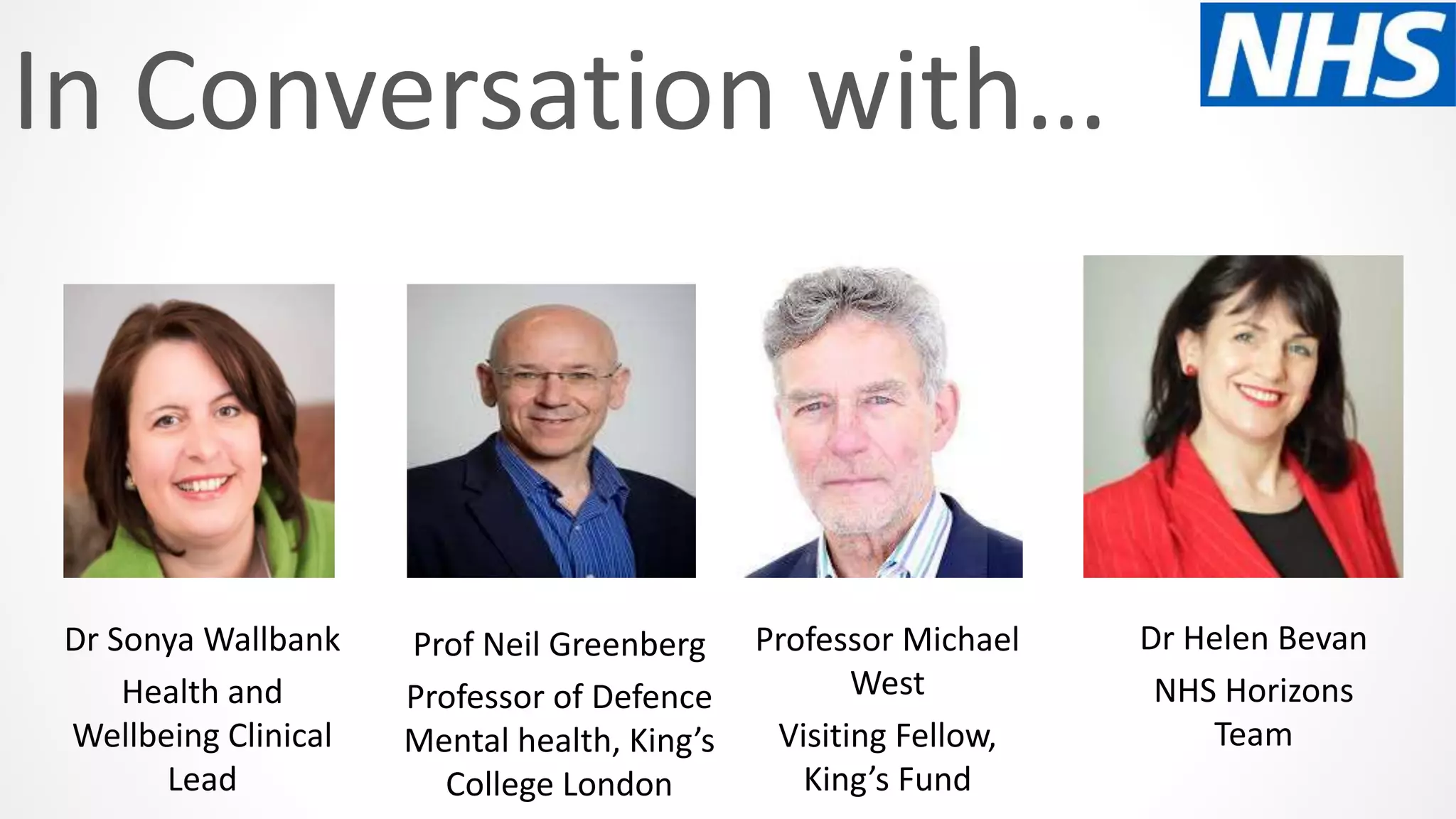
In Conversation with…
Prof Neil Greenberg
Professor of Defence
Mental health, King’s
College London
Dr Sonya Wallbank
Health and
Wellbeing Clinical
Lead
Professor Michael
West
Visiting Fellow,
King’s Fund
Dr Helen Bevan
NHS Horizons
Team
22 |
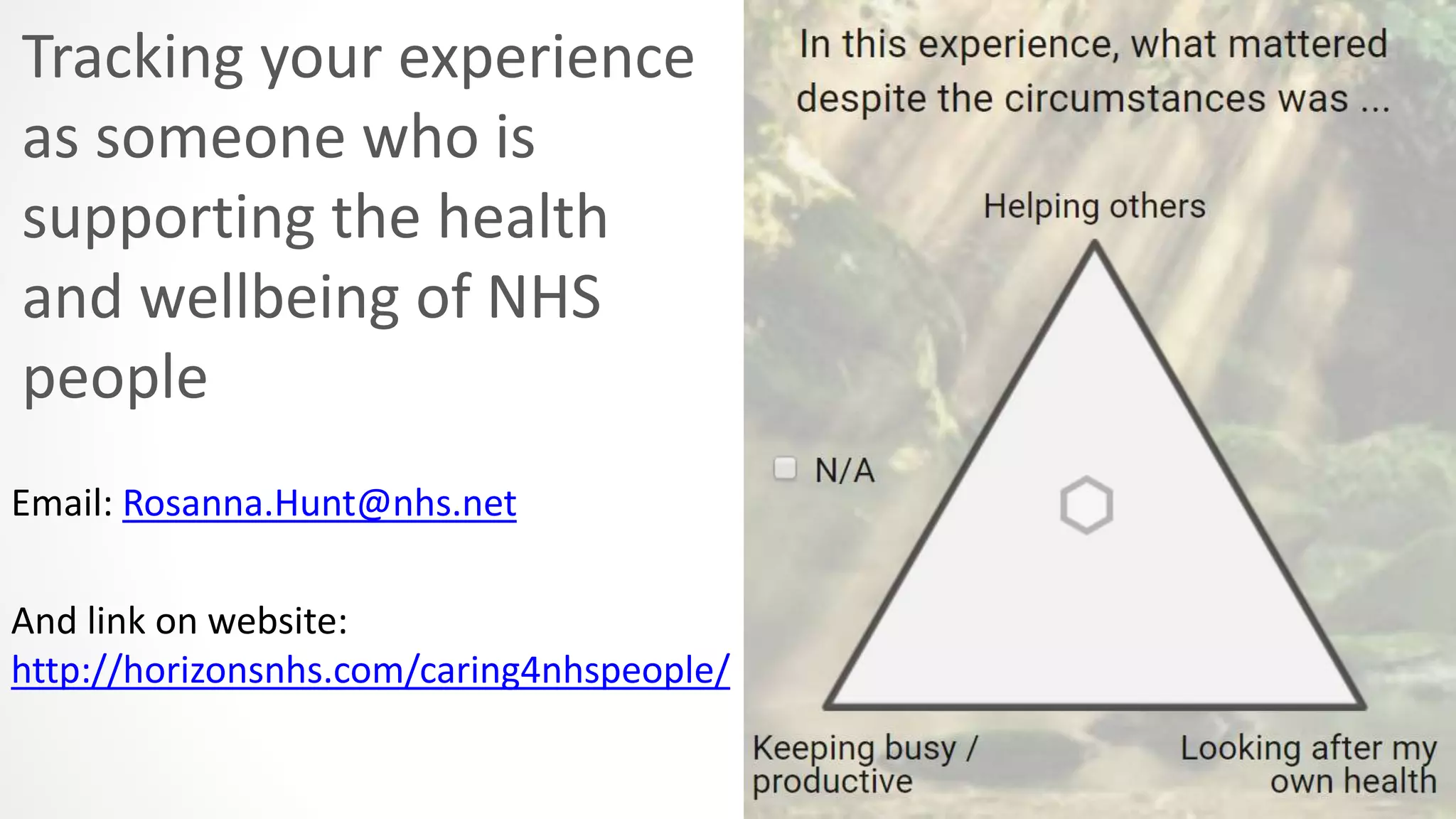
Tracking your experience
as someone who is
supporting the health
and wellbeing of NHS
people
Email: Rosanna.Hunt@nhs.net
And link on website:
http://horizonsnhs.com/caring4nhspeople/
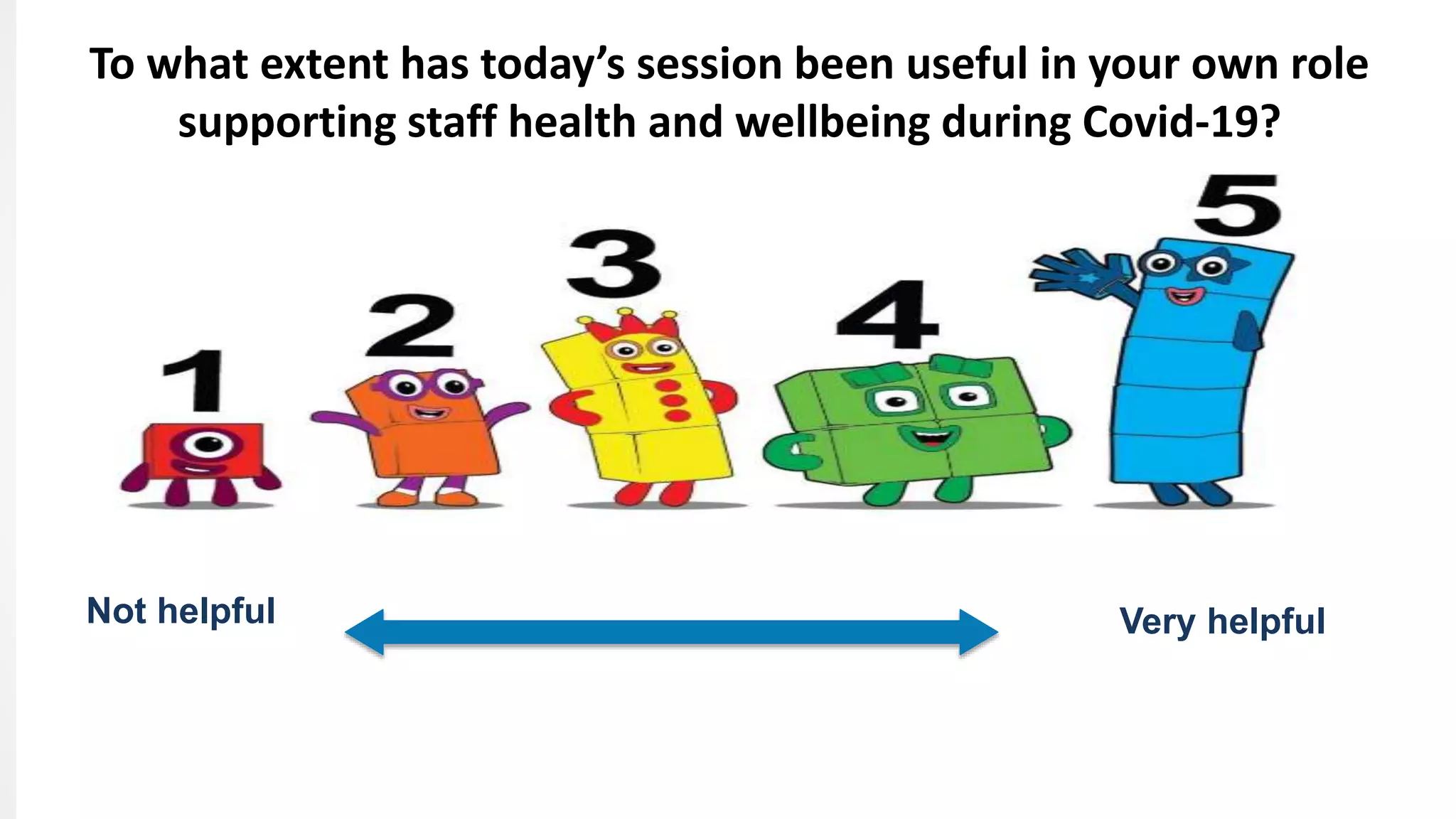
Very helpfulNot helpful
To what extent has today’s session been useful in your own role
supporting staff health and wellbeing during Covid-19?
In the chat box…
Where are the gaps and what do you need from your local, regional or
national team?
#Caring4NHSPeople - virtual expert session 8 April 2020

#Caring4NHSPeople - virtual expert session 8 April 2020

  • 1.
    Twitter: #Caring4NHSpeople #OurNHSpeople Thehealth and wellbeing of our NHS people during the Covid-19 response Virtual session 8th April 4pm
  • 3.
    Twitter: #Caring4NHSpeople #OurNHSpeople Introduceyourself in the chat box Say: • Who you are • Where you are today • One thing you’re doing to look after yourself during this challenging time • Send to “all participants”
  • 4.
    Twitter: #Caring4NHSpeople #OurNHSpeople Whereare you are joining from today? London
  • 5.
    Twitter: #Caring4NHSpeople #OurNHSpeople Thehealth and wellbeing of our NHS people during the Covid-19 response Virtual session 8th April 4pm
  • 6.
    Twitter: #Caring4NHSpeople #OurNHSpeople Theteam today Chat box facilitators Dr Rosanna Hunt Paul Woodley Technical hosts Selina Bhambra Dr Sonya Wallbank Contributors Zoe Lord Facilitator Prof Neil Greenberg Prof Michael West Dr Helen Bevan Zarah Mowhabuth Louise Pratt Karen Dumain Social Media Leigh Kendall
  • 7.
    Twitter: #Caring4NHSpeople #OurNHSpeople 7| • Offer support, ideas, knowledge and wisdom to those with a role in supporting the health and wellbeing of people working in health and care • Share the range of wellbeing support activities that are available to people working in health and care • Understand some do’s and don'ts of supporting the wellbeing of our people during this critical time Aims of this session To:
  • 8.
    Twitter: #Caring4NHSpeople #OurNHSpeople 16:00-16:05How this virtual session will work – Zoe Lord 16:05-16:20 What’s available in the National Support Offer – Dr Sonya Wallbank 16:20-16:25 The do’s and don’ts of supporting frontline staff – Prof Neil Greenberg 16:25-16:50 In conversation with – Sonya and Neil joined by Prof Michael West and Helen Bevan 16:50-17:00 Call to action – Zoe Lord
  • 9.
    Twitter: #Caring4NHSpeople #OurNHSpeople Weare ready: we have a comprehensive package of support & leadership systems in in place We are not ready: We haven’t put support packages or leadership systems in place yet To what extent is your organisation geared up and ready to support the health and wellbeing of your staff during Covid-19?
  • 10.
    Twitter: #Caring4NHSpeople #OurNHSpeople Veryclear: I’m part of an agreed approach and support system and I have the skills and back up to do this role I’m not clear How clear are you about your own role & responsibilities in supporting the health and wellbeing of staff during Covid-19?
  • 11.
    The National Wellbeing Offer DrSonya Wallbank Health and Wellbeing Clinical Lead, NHS England & Improvement
  • 12.
    COVID 19 Healthand Wellbeing staff response Role Named Lead Workforce cell SRO Prerana Issar Deputy SRO Em Wilkinson-Brice Clinical Health and Wellbeing Lead Dr Sonya Wallbank Physical Health and Wellbeing Lead Caroline Corrigan Further information: Email: nhsi.wellbeingc19@nhs.net Clinical contact: sonya.wallbank@nhs.net
  • 13.
    Evidence base 1:Three phases of support for staff during COVID-19 R RecoverPrepare P A Active Anticipating peak of demand Demands reach peak Through the peak What will be happening? • Worrying about own and family safety • Fear about the demand to come • Worry about what I/we will be asked to do • Will I be enough? Will I be OK? • Who has my back? • Intense and consuming periods of work • Limited attention to own self and needs • Guilt, remorse, worry about own performance and expectations of others e.g. families, colleagues, media • Thrive and growth – I got through this – every moments counts • Morale injury – I have had to make tough decisions had negative impacts and were beyond my control • Survivor guilt – I made it through – why me and not them • What & how have I just been through • What if this happens again Sources: Major incident Clinical Expertise and associated Literature. Specialist Task Force and Clinical Advisors. @sonyawallbank
  • 14.
    Do not rushin with Psychological intervention – on average 70% of people recover without the need for intervention given the right support Phase Prepare Active Recover What support we will need to offer 1. Collective messaging is key – ‘we’ are here, together and behind you 2. Enhanced line management support – we will make collective decisions – I have your back 3. Safety provision, honest, open and transparent messaging about how we will keep front line workers safe 4. Expectation – preparing people for what is to come and how we will support them 5. Line managers trained and ready to have psychologically informed conversations 6. Teams who understand what is expected of them and how to work together well 1. Physical provisions, prompts and messaging to support care of basic needs 2. Places to decompress – even if not frequently used – serves to emotionally contain and demonstrate ‘’we are here together’ 3. Clear protocols for normalising stress response, opportunities for debrief and networks of support within the workplace 4. Anonymous opportunities for discussions 5. Line managers trained in signs of stress and trauma – specialist psychological services equipped to respond 1. 12-24 months post active period 2. Can take a while to seek help and triggered by other non- related events 3. Services in place to support the range of presenting conditions e.g. anxiety, depression through to PTSD and complex grief 4. Line managers who know what to look out for and how to manage discussions 5. Fast access for staff to mental health services where complex treatment required 6. Return to work strategies which may require short term redeployment Evidence base 2: What we need to be doing during the phases
  • 15.
    1 5Unmind Headspace Sleepio Daylight Free access to MentalHealth Apps: 2 For all NHS Staff – call 0300 131 7000 07:00-23:00 34 Silvercloud Information, and access to group and 1-1 support direct to your phone, laptop or PC Website and App TEXT Ways to access support during COVID-19 Helpline Send the text ‘FRONTLINE’ to 85258 to start a conversation Mental Health Modules for Stress, Resillience, Sleep and Anxiety. Use the code NHS2020
  • 16.
    #Caring4NHSPeople Group and 1-1 emotionaland psychological support Hospice network Complex bereavement and grief support Front Door National Helpline number and text service Physical Welfare co-ordination for essential food, transport, accommodatio n and childcare helpline & information hub Individual, Line manager and team upskilling and support offer Free access to physical and psychological support apps & microsite information hub Investment & upskill of OH & EAP services Priority access to critical physical & mental health services
  • 17.
    April 6th Apr10th – 24th Apr 30th – May 15th Health and Wellbeing Covid 19 – Plan on a page PHASE 1 Launch PHASE 2 Test, Listen & Improve PHASE 3 Refine, learn, adapt Website/App content Direct support Practical support Organisational Support • Teams under pressure – individual and team resilience. End of shift checklist and 10 -minute pause space for restorative effect at the end of shift. • Partnered with Samaritans helpline 7-11 • Partnered with SHOUT 24/7 text line • Partnered with Hospice UK – bereavement support access 8-8 • Free access to apps and Silvercloud module • Builds on local offers of employee assistance & Occ Health • Co-ordination of commercial offers and staff discount page set up – build on local provision e.g. pop up shops • Do’s and Don’t video for providing staff support • Evidence frame for understanding what staff might need over the crisis period and beyond • Echo groups set up so we can respond to what we hear • Flexible working definitions, principles and guidance • Supportive guidance for working carers • Continued video and interactive content development • Testing and evaluation results understood – responsive content development and signposting to other resources • Responding to themed data from calls and texts • Open the virtual group common rooms for peer support • Peer support model implemented • 1-1 offer refined and access developed • Workforce readiness for mental health support reviewed in line with demand • Scale of practical and relationship advice access • Focused national efforts on ensuring access standards for practical support are met • Continued webinar series in response to themes and feedback from our network interaction • Workforce mental health apps reviewed and recommended for active monitoring of psychological wellbeing and responses required • Bite size online and virtual skills materials – leading through crisis. Developed with Sandhurst Leadership centre. Local Peer Support training offer. Employers for carers online resource. Remote team management support • Warm transfers between helpline services • Citizens Advice Pilot results • Understand and respond to need for 1-1 peer support • Establish local protocols for access to key physical and mental health services • Partnering with NHSX to review a suite of apps • Healthy helpers and NED guardian roles for active attention to physical welfare defined and implementation support • Data to show current local offers – national plan to support gaps and utilise commercial offers • Weekly webinar series starts – understanding Health and Wellbeing through the crisis • Building a community who care – utilising networks to listen and respond to support needed • ESR amendments to record unpaid carers • Materials to support enhanced Occupational Health offer
  • 18.
    For further information,recommendations or requests please use our dedicated inbox at: nhsi.wellbeingc19@nhs.net For specific clinical advice or further discussion: Contact: sonya.wallbank@nhs.net Scan the link to send us feedback
  • 19.
    Do’s and don’ts ofsupporting frontline staff… Prof Neil Greenberg Professor of Defence Mental Health, King’s College London
  • 20.
    Dos and Don’tof supporting frontline staff • The team is everything – colleagues and supervisors really matter • Having a ‘psychologically savvy’ conversation is vital – especially for supervisors • Organisations need to adopt a ‘nip it in the bud approach’ • It is important not to over medicalise ‘normal distress’ • Early input from mental health professionals can help people return to duty (PIES) - Proximity - Immediacy - Expectancy - Simplicity
  • 21.
    In Conversation with… ProfNeil Greenberg Professor of Defence Mental health, King’s College London Dr Sonya Wallbank Health and Wellbeing Clinical Lead Professor Michael West Visiting Fellow, King’s Fund Dr Helen Bevan NHS Horizons Team
  • 22.
  • 23.
    Tracking your experience assomeone who is supporting the health and wellbeing of NHS people Email: Rosanna.Hunt@nhs.net And link on website: http://horizonsnhs.com/caring4nhspeople/
  • 24.
    Very helpfulNot helpful Towhat extent has today’s session been useful in your own role supporting staff health and wellbeing during Covid-19?
  • 25.
    In the chatbox… Where are the gaps and what do you need from your local, regional or national team?

Editor's Notes

  • #10 Zoe
  • #11 Zoe
  • #16 https://www.freepik.com/free-vector/steampunk-brain-engine-with-cogs-and-gears_1311420.htm#term=head%20with%20gear%20icons&page=1&position=1
  • #22 Who you are and why this is important
  • #25 Zoe