CARGILL
BY
Elavarasi P
II MBA IB
INTRODUCTION :
• Cargill, Incorporated is a global food corporation based in the United States.
• Founded: 1865
• Headquarters: Wayzata, Minnesota, USA
• Industry: Food, agriculture, financial and industrial products and services
• Revenue: Over $100 billion (varies annually)
• Employees: Approximately 155,000 (as of recent reports)
• Operations: Present in more than 70 countries worldwide.
HISTORY:
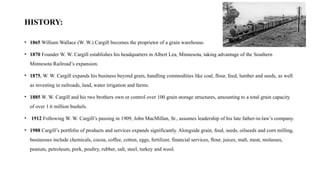
• 1865 William Wallace (W. W.) Cargill becomes the proprietor of a grain warehouse.
• 1870 Founder W. W. Cargill establishes his headquarters in Albert Lea, Minnesota, taking advantage of the Southern
Minnesota Railroad’s expansion.
• 1875, W. W. Cargill expands his business beyond grain, handling commodities like coal, flour, feed, lumber and seeds, as well
as investing in railroads, land, water irrigation and farms.
• 1885 W. W. Cargill and his two brothers own or control over 100 grain storage structures, amounting to a total grain capacity
of over 1.6 million bushels.
• 1912 Following W. W. Cargill’s passing in 1909, John MacMillan, Sr., assumes leadership of his late father-in-law’s company.
• 1988 Cargill’s portfolio of products and services expands significantly. Alongside grain, feed, seeds, oilseeds and corn milling,
businesses include chemicals, cocoa, coffee, cotton, eggs, fertilizer, financial services, flour, juices, malt, meat, molasses,
peanuts, petroleum, pork, poultry, rubber, salt, steel, turkey and wool.
AREAS OF FOCUS
• Food and Nutrition: Cargill invests heavily in creating healthier food products, developing new
food ingredients, and improving food safety. This includes work on plant-based proteins, natural
sweeteners, and functional ingredients.
• Agriculture: It enhancing crop yields, improving animal nutrition, and advancing sustainable
farming practices. This includes the development of new feed formulations and agricultural
technologies.
• Sustainability: Cargill is committed to reducing its environmental impact. Research initiatives
focus on sustainable supply chains, reducing greenhouse gas emissions, and promoting
biodiversity.
Cont…
• Biotechnology: Cargill explores biotechnological solutions for various applications, such as bio
industrial products and renewable energy sources.
• Innovation Centers: Cargill operates several innovation centers around the world, including
locations in North America, Europe, Asia, and Latin America. These centers focus on developing
new products, improving existing ones, and exploring novel technologies.
• Product Development: Cargill's R&D teams work on developing new products and improving
existing ones to meet evolving market demands. This includes the creation of more sustainable and
healthier food options, innovative agricultural solutions, and advanced industrial products.
CARGILL company information presentation

CARGILL company information presentation

  • 1.
  • 2.
    INTRODUCTION : • Cargill,Incorporated is a global food corporation based in the United States. • Founded: 1865 • Headquarters: Wayzata, Minnesota, USA • Industry: Food, agriculture, financial and industrial products and services • Revenue: Over $100 billion (varies annually) • Employees: Approximately 155,000 (as of recent reports) • Operations: Present in more than 70 countries worldwide.
  • 3.
    HISTORY: • 1865 WilliamWallace (W. W.) Cargill becomes the proprietor of a grain warehouse. • 1870 Founder W. W. Cargill establishes his headquarters in Albert Lea, Minnesota, taking advantage of the Southern Minnesota Railroad’s expansion. • 1875, W. W. Cargill expands his business beyond grain, handling commodities like coal, flour, feed, lumber and seeds, as well as investing in railroads, land, water irrigation and farms. • 1885 W. W. Cargill and his two brothers own or control over 100 grain storage structures, amounting to a total grain capacity of over 1.6 million bushels. • 1912 Following W. W. Cargill’s passing in 1909, John MacMillan, Sr., assumes leadership of his late father-in-law’s company. • 1988 Cargill’s portfolio of products and services expands significantly. Alongside grain, feed, seeds, oilseeds and corn milling, businesses include chemicals, cocoa, coffee, cotton, eggs, fertilizer, financial services, flour, juices, malt, meat, molasses, peanuts, petroleum, pork, poultry, rubber, salt, steel, turkey and wool.
  • 4.
    AREAS OF FOCUS •Food and Nutrition: Cargill invests heavily in creating healthier food products, developing new food ingredients, and improving food safety. This includes work on plant-based proteins, natural sweeteners, and functional ingredients. • Agriculture: It enhancing crop yields, improving animal nutrition, and advancing sustainable farming practices. This includes the development of new feed formulations and agricultural technologies. • Sustainability: Cargill is committed to reducing its environmental impact. Research initiatives focus on sustainable supply chains, reducing greenhouse gas emissions, and promoting biodiversity.
  • 5.
    Cont… • Biotechnology: Cargillexplores biotechnological solutions for various applications, such as bio industrial products and renewable energy sources. • Innovation Centers: Cargill operates several innovation centers around the world, including locations in North America, Europe, Asia, and Latin America. These centers focus on developing new products, improving existing ones, and exploring novel technologies. • Product Development: Cargill's R&D teams work on developing new products and improving existing ones to meet evolving market demands. This includes the creation of more sustainable and healthier food options, innovative agricultural solutions, and advanced industrial products.