Career
 Career is progress or
general course of action of a
person in some profession
or in an organization
CAREER PROCESS
 P
 O
 D
 S
 CO
 R
 B
Career
It includes the specific jobs that
a person performs the kind of responsibilities
and activities that comprise those jobs,
movement and transitions between jobs and An
individual’s overall assessment and feelings of
satisfaction with these companies of his or her
career.
Career planning cycle
Stages in career
Exploration
Stage
Establishment
Stage
Maintenance
stage
Decline Stage
Stages of career
• STAGE IV:
• The individual
equips themself for
a change, to
balance work and
non work activities.
• STAGE II
• The employee has
identified
and settled down in his
job
• STAGE III:
• Employees strives to
maintain a reputation and
provide major
contribution to the
organization
• STAGE I
• Identifies likes and
dislikes of the individual
Exploration Stage Maintenance
stage
Decline stageEstablishment
stage
Career Planning
 It is a process
whereby an individual
sets career goals and
identifies the means
to achieve them
Needs of career planning
 A college degree does not guarantee employment.
 A commitment to lifelong learning will help keep you
employable
 Individuals always have some control over their career.
 They must accept risks and plan for the future for their
betterment of their career.
Elements in career Planning Program
 Individual Assessment and need analysis
 Organizational assessment and Opportunity
Analysis
 Need- Opportunity Analysis
 Career counselling
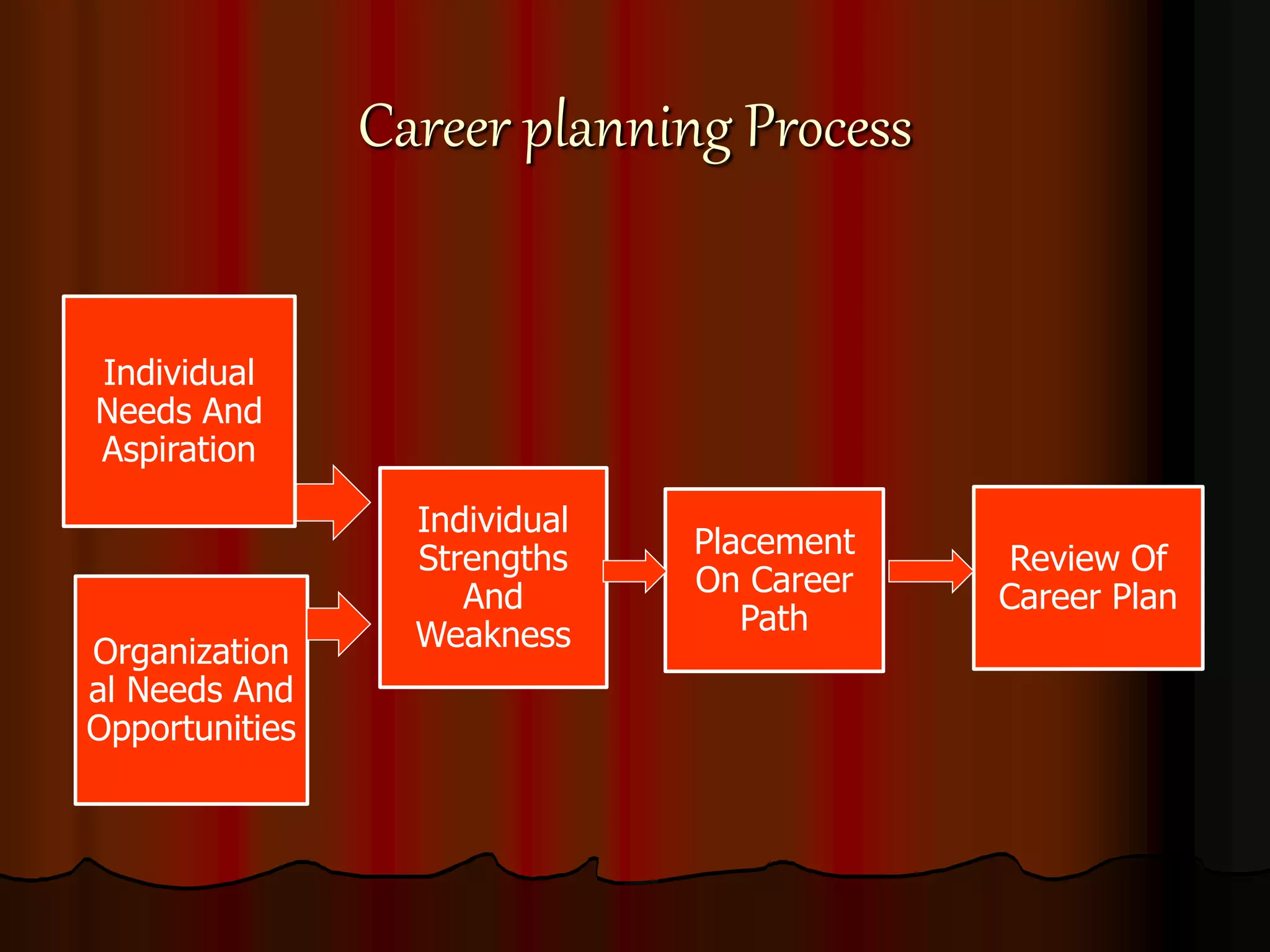
Career planning Process
Individual
Needs And
Aspiration
Placement
On Career
Path
Individual
Strengths
And
WeaknessOrganization
al Needs And
Opportunities
Review Of
Career Plan
Organizational career Planning
 Where the organization
intervenes in planning, it
becomes Organizational
career planning
Choosing a Career
Rule#1: Choose a career that is something
what we really like to do.
Rule#2: Do Internal research and choose
career choices carefully and thoughtfully.
Rule#3: Make it meaningful for us.
One of the hardest—and most exciting—choices
you’ll ever make is your career. Although
chance may play a part, come prepared!
we owe it to our self to look for work that
is meaningful and rewarding!
Choose Career Options That Match our Values
 The following criteria help to refine our career
search and choice:
 Prestige
 High income
 Flexible work hours
 Establish and align values, career choice, and
career goals for motivation.
Factors Affecting Career Choices
 Interests
 Skills
 Aptitudes
 Experience
 Family traditions
 Personality
 Life goals and
work values
Where to Go for Help
 Career center
 Faculty
 Upper-class students
 Student organizations
 Placement services
 Online sites
What to Look for in a
Career
 Major career field target
 Preferred type of work
 Income requirements
 Geographical requirements
 Special needs
 Industry preferences
 Stress level
 Level of interaction with other
people
 Indoor vs. outdoor
 Amount of independence
 The type of people you would
interact with
 Physical requirements
 Local/national/international
organization
 Benefits
 Advancement opportunities
 A good boss
 Training
 Industry outlook
 Reputation of the firm in the
industry
Select Several Careers,
Not Just One
 It’s a good idea to have several careers in mind
rather than just one in your first year of college.
 Approximately 60% of students change their
major at some point during their college career.
 It pays to be knowledgeable about more than
just one career field. The average graduate
changes their job seven times in their life.
 It also pays to develop a wide variety of general
skills, particular those related to communication.
 Assess Your Skills
 Academic Strengths
 Reading, Writing, Speaking, and Listening
 Math
 Creative Thinking
 Problem Solving and Decision Making
 Personal Qualities
 Self-Esteem, Self-Management, Responsibility
 People Skills
 Social, Negotiation, Leadership, Teamwork
See a Career Counselor
 The career counselors at your college
are trained professionals who can help
you
 discover your strengths and
weaknesses
 evaluate your values and goals
 sort through what type of career you
want
 They will not tell you what to do, they
will simply help identify what factors
may lead to successful and interesting
career options.
Getting Experience
 Volunteer or service learning
 Study abroad
 Internships
 On-campus employment
 Student projects/competitions
 Research
 On-the-job training
 Apprenticeships
Activity 1
Future Occupation Bio-Poem
Bio-poems are always quick, fun writing activities for students. It helps each
student imagine their future in a favorite occupation.
Here is the format for the occupational bio-poem:
Line 1 – Write your first name
Line 2 – Write your favorite occupation
Line 3 – Who can [Write something important you will do in this occupation]
Line 4 – Who earns [Write the median salary for this occupation]
Line 5 – Who knows how to [Write knowledge necessary for this occupation]
Line 6 – Who values [Write the work value(s) related to the occupation]
Line 7 – Write your last name
Get A Job--Activity 2
 In your group, create a classified ad for the “job” of
college student.
 For example, “_______________________
College/University is seeking applicants with
excellent skills in oral and written communication,
problem solving, time management, and technology
for positions as professional students preparing for
a variety of future opportunities…”
 Ads should list particular job requirements, benefits,
information about your institution and so on, and be
transferred to a large sheet of paper to present to the
group.
Web Resources for career planning
Occupational Outlook Handbook
11_Careers_new.ppt
Career Resource Center
http://www.careers.org/
Job Hunt
http://www.job-hunt.org
The Catapult on Job Web
http://www.job-hunt.org/
The Riley Guide: Employment
Opportunities and Job
Resources on the Internet
www.rileyguide.com
Monster.com
http://www.monster.com/
Quintessential Careers
http://www.quintcareers.com/index.html
Career Tree
Thank You

Career planning, stages, and choices

  • 2.
    Career  Career isprogress or general course of action of a person in some profession or in an organization
  • 3.
    CAREER PROCESS  P O  D  S  CO  R  B
  • 4.
    Career It includes thespecific jobs that a person performs the kind of responsibilities and activities that comprise those jobs, movement and transitions between jobs and An individual’s overall assessment and feelings of satisfaction with these companies of his or her career.
  • 5.
  • 6.
  • 7.
    Stages of career •STAGE IV: • The individual equips themself for a change, to balance work and non work activities. • STAGE II • The employee has identified and settled down in his job • STAGE III: • Employees strives to maintain a reputation and provide major contribution to the organization • STAGE I • Identifies likes and dislikes of the individual Exploration Stage Maintenance stage Decline stageEstablishment stage
  • 8.
    Career Planning  Itis a process whereby an individual sets career goals and identifies the means to achieve them
  • 9.
    Needs of careerplanning  A college degree does not guarantee employment.  A commitment to lifelong learning will help keep you employable  Individuals always have some control over their career.  They must accept risks and plan for the future for their betterment of their career.
  • 10.
    Elements in careerPlanning Program  Individual Assessment and need analysis  Organizational assessment and Opportunity Analysis  Need- Opportunity Analysis  Career counselling
  • 11.
    Career planning Process Individual NeedsAnd Aspiration Placement On Career Path Individual Strengths And WeaknessOrganization al Needs And Opportunities Review Of Career Plan
  • 12.
    Organizational career Planning Where the organization intervenes in planning, it becomes Organizational career planning
  • 13.
    Choosing a Career Rule#1:Choose a career that is something what we really like to do. Rule#2: Do Internal research and choose career choices carefully and thoughtfully. Rule#3: Make it meaningful for us. One of the hardest—and most exciting—choices you’ll ever make is your career. Although chance may play a part, come prepared! we owe it to our self to look for work that is meaningful and rewarding!
  • 14.
    Choose Career OptionsThat Match our Values  The following criteria help to refine our career search and choice:  Prestige  High income  Flexible work hours  Establish and align values, career choice, and career goals for motivation.
  • 15.
    Factors Affecting CareerChoices  Interests  Skills  Aptitudes  Experience  Family traditions  Personality  Life goals and work values
  • 16.
    Where to Gofor Help  Career center  Faculty  Upper-class students  Student organizations  Placement services  Online sites
  • 17.
    What to Lookfor in a Career  Major career field target  Preferred type of work  Income requirements  Geographical requirements  Special needs  Industry preferences  Stress level  Level of interaction with other people  Indoor vs. outdoor  Amount of independence  The type of people you would interact with  Physical requirements  Local/national/international organization  Benefits  Advancement opportunities  A good boss  Training  Industry outlook  Reputation of the firm in the industry
  • 18.
    Select Several Careers, NotJust One  It’s a good idea to have several careers in mind rather than just one in your first year of college.  Approximately 60% of students change their major at some point during their college career.  It pays to be knowledgeable about more than just one career field. The average graduate changes their job seven times in their life.  It also pays to develop a wide variety of general skills, particular those related to communication.
  • 19.
     Assess YourSkills  Academic Strengths  Reading, Writing, Speaking, and Listening  Math  Creative Thinking  Problem Solving and Decision Making  Personal Qualities  Self-Esteem, Self-Management, Responsibility  People Skills  Social, Negotiation, Leadership, Teamwork
  • 20.
    See a CareerCounselor  The career counselors at your college are trained professionals who can help you  discover your strengths and weaknesses  evaluate your values and goals  sort through what type of career you want  They will not tell you what to do, they will simply help identify what factors may lead to successful and interesting career options.
  • 21.
    Getting Experience  Volunteeror service learning  Study abroad  Internships  On-campus employment  Student projects/competitions  Research  On-the-job training  Apprenticeships
  • 22.
    Activity 1 Future OccupationBio-Poem Bio-poems are always quick, fun writing activities for students. It helps each student imagine their future in a favorite occupation. Here is the format for the occupational bio-poem: Line 1 – Write your first name Line 2 – Write your favorite occupation Line 3 – Who can [Write something important you will do in this occupation] Line 4 – Who earns [Write the median salary for this occupation] Line 5 – Who knows how to [Write knowledge necessary for this occupation] Line 6 – Who values [Write the work value(s) related to the occupation] Line 7 – Write your last name
  • 23.
    Get A Job--Activity2  In your group, create a classified ad for the “job” of college student.  For example, “_______________________ College/University is seeking applicants with excellent skills in oral and written communication, problem solving, time management, and technology for positions as professional students preparing for a variety of future opportunities…”  Ads should list particular job requirements, benefits, information about your institution and so on, and be transferred to a large sheet of paper to present to the group.
  • 24.
    Web Resources forcareer planning Occupational Outlook Handbook 11_Careers_new.ppt Career Resource Center http://www.careers.org/ Job Hunt http://www.job-hunt.org The Catapult on Job Web http://www.job-hunt.org/ The Riley Guide: Employment Opportunities and Job Resources on the Internet www.rileyguide.com Monster.com http://www.monster.com/ Quintessential Careers http://www.quintcareers.com/index.html
  • 25.
  • 26.