Building a
Career Portfolio
How to Present Yourself to
Potential Employers
Presented by April Legler,
Lecturer of Career Education, KSOB
2
What is a Portfolio?
 What is your understanding of a portfolio
and its purpose?
 Who has traditionally created portfolios?
 Does anyone have a portfolio?
3
Definition
A portfolio is a documentation and
demonstration of your accomplishments
representing growth in your skills and
understanding of those skills over time.
The portfolio not only documents your
results but also how you got there and
what you learned in the process.
4
Employers are asking…
 “How much will you cost me to train?”
 “Can you keep your personal life in order
so that it does not interfere with work?”
5
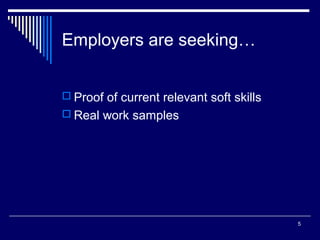
Employers are seeking…
 Proof of current relevant soft skills
 Real work samples
6
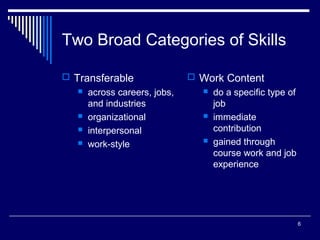
Two Broad Categories of Skills
 Transferable
 across careers, jobs,
and industries
 organizational
 interpersonal
 work-style
 Work Content
 do a specific type of
job
 immediate
contribution
 gained through
course work and job
experience
7
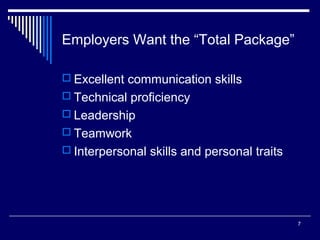
Employers Want the “Total Package”
 Excellent communication skills
 Technical proficiency
 Leadership
 Teamwork
 Interpersonal skills and personal traits
8
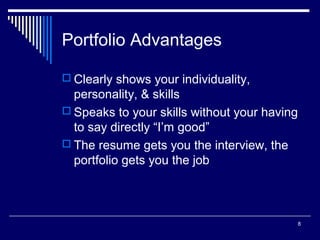
Portfolio Advantages
 Clearly shows your individuality,
personality, & skills
 Speaks to your skills without your having
to say directly “I’m good”
 The resume gets you the interview, the
portfolio gets you the job
9
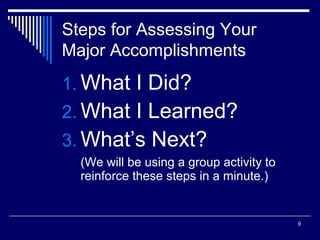
Steps for Assessing Your
Major Accomplishments
1. What I Did?
2. What I Learned?
3. What’s Next?
(We will be using a group activity to
reinforce these steps in a minute.)
10
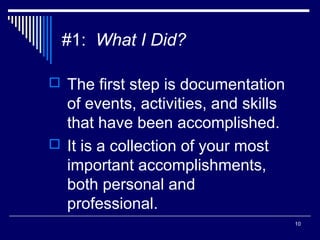
#1: What I Did?
 The first step is documentation
of events, activities, and skills
that have been accomplished.
 It is a collection of your most
important accomplishments,
both personal and
professional.
11
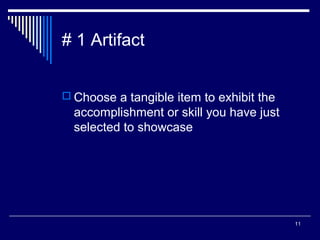
# 1 Artifact
 Choose a tangible item to exhibit the
accomplishment or skill you have just
selected to showcase
12
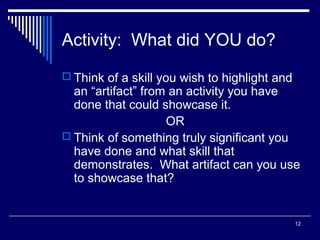
Activity: What did YOU do?
 Think of a skill you wish to highlight and
an “artifact” from an activity you have
done that could showcase it.
OR
 Think of something truly significant you
have done and what skill that
demonstrates. What artifact can you use
to showcase that?
13
#2: What I Learned?
 The next step is going back and looking at
each entry and writing “statements”
identifying and explaining the purpose of
each piece of evidence so that the entries
are meaningful when reviewed by others.
 These statements should also contain
reflective comments about your learning.
14
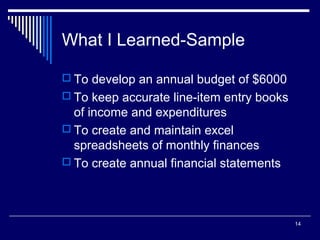
What I Learned-Sample
 To develop an annual budget of $6000
 To keep accurate line-item entry books
of income and expenditures
 To create and maintain excel
spreadsheets of monthly finances
 To create annual financial statements
15
Activity: What did YOU learn?
 Write a statement of what you gained
from the activity that you selected just
now.
16
#3: What’s Next?
 Review each entry
 View as springboard to future learning
 Revisit and examine work accomplished
 Professional and personal growth
 Assimilate information into
“skills and achievements”
for resume and interview process
17
What’s next-Sample
 Add activity and accomplishments to
resume
 Improve organization of records to
facilitate creation of annual report
18
Activity: What is next for YOU?
 Write what you will do to use or improve
what you have begun in this class
activity.
19
Sample Artifacts for a Portfolio
 Career & professional
development goals
 Resumes/Cover letters
 Your work philosophy
 Self-assessment records
 Transcripts
 Work history
 Skill areas
 Works in progress
(activities and projects)
 Work & learning samples
 Work term reports
 Certificates, diplomas,
degrees, & awards
 Professional
memberships & service
 Records of community
service/volunteer work
(brochures, letters of
recognition, etc.)
 Newspaper clippings
featuring you
 Letters of appreciation
 Photographs/Media
 Networking contacts
 Letters of
recommendation/
references
20
Career Portfolio Sections
 Management philosophy
 Professional goals
 Resume
 Work samples by skill areas
 Works in progress
 Community service (transferable skills)
 Professional memberships
 Degrees, certifications & awards
 References
21
Sections: Philosophy and Goals
 Mgmt Philosophy-brief description of
your beliefs about yourself and the
industry (Career Objective Statement)
 Career Goals-professional goals for the
next 2-5 years
22
Section: Resume
 Your resume provides a brief summary
of your education and experiences.
23
Section: Skill Areas
 Skill areas-tabbed sections containing
information on your skills and experiences
relating to specific areas
 Marketing
 People Management
 Technology
 Target skills desired by companies you are
interviewing
 Job advertisements
 Job descriptions
 Focus on measurable skills
 Technical skills
 Soft skills
24
Skill areas that employers want from
recent graduates.
 Analytical
 Communication(Oral & Written)
 Computer Skills
 Creativity
 Decision Making
 Flexibility
 Interpersonal
 Leadership
 Listening
 Multicultural
Understanding
 Organizational
 Problem Solving
 Research
 Teamwork
 Time Management
25
Work Samples
 Work sample-physical examples of your work
 One for every skill
 Projects, reports
 Real work samples preferable to school projects
 How do I get them?
 What are you good at doing?
 Rummage through your stuff at home and at work
for samples
 Plan to secure work samples
26
Propriety on Work Samples
 Do I need to get permission to take
copies of my work?
 If you signed a confidentiality agreement
 If you are a contractor or employee
 Use the templates of your work
 Do NOT share proprietary or personal
information
 Do share letters, customer comments,
class or workshop projects
27
Section: Additional Proof
 Works in Progress-brief list of works,
activities, projects or efforts that are on-
going.
 Letters of Recommendation-support or
reference that verify your abilities in a
certain skill area
28
Section: Transferable Skills
 Sources
 Community service
 Volunteer organizations
 Avocations (intense hobbies)
 Intramural activities
 Artifacts
 Letters of recognition
 Photos of projects completed
 Programs and brochures
29
Transferable Skills Support…
 Soft skills
 Teamwork
 Presentation skills
 Communication skills
 Attitude
 Leadership
 Others
30
Section: Professional Growth
 Memberships-member cards, citations,
letters
 Certifications
 Diplomas, Degrees, or Awards-copies of
actual recognition received
31
Section: Reference Materials
 Academic Plan of Study-list of courses
and what you learned in them
 Faculty and Employer Biographies-
descriptions of the people whose
signatures appear throughout—who are
they, what do they do
 References-list of people who can verify
your character, academic record or
employment history
32
Group Activity
1. Break into small groups and select an
individual to “record” for the group.
2. Pick 3 skills from the list provided.
3. Share experiences with your group, in which
you each have developed those 3 skill areas.
4. Identify and lists ways to document that
experience in your portfolio.
5. Report out to the group.
33
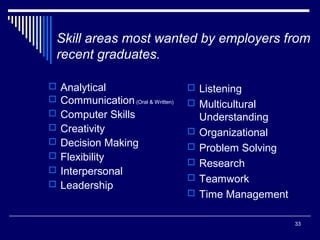
Skill areas most wanted by employers from
recent graduates.
 Analytical
 Communication(Oral & Written)
 Computer Skills
 Creativity
 Decision Making
 Flexibility
 Interpersonal
 Leadership
 Listening
 Multicultural
Understanding
 Organizational
 Problem Solving
 Research
 Teamwork
 Time Management
34
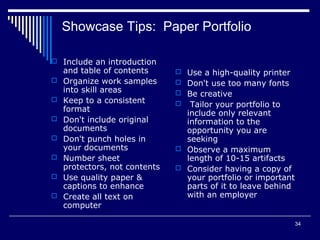
Showcase Tips: Paper Portfolio
 Include an introduction
and table of contents
 Organize work samples
into skill areas
 Keep to a consistent
format
 Don't include original
documents
 Don't punch holes in
your documents
 Number sheet
protectors, not contents
 Use quality paper &
captions to enhance
 Create all text on
computer
 Use a high-quality printer
 Don't use too many fonts
 Be creative
 Tailor your portfolio to
include only relevant
information to the
opportunity you are
seeking
 Observe a maximum
length of 10-15 artifacts
 Consider having a copy of
your portfolio or important
parts of it to leave behind
with an employer
35
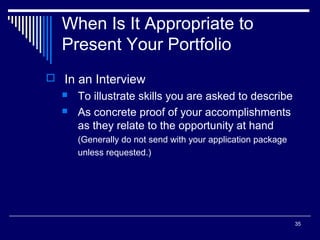
When Is It Appropriate to
Present Your Portfolio
 In an Interview
 To illustrate skills you are asked to describe
 As concrete proof of your accomplishments
as they relate to the opportunity at hand
(Generally do not send with your application package
unless requested.)
36
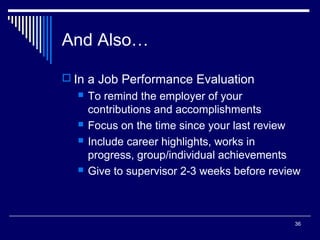
And Also…
 In a Job Performance Evaluation
 To remind the employer of your
contributions and accomplishments
 Focus on the time since your last review
 Include career highlights, works in
progress, group/individual achievements
 Give to supervisor 2-3 weeks before review
37
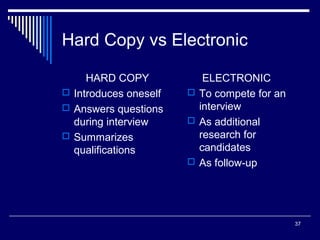
Hard Copy vs Electronic
HARD COPY
 Introduces oneself
 Answers questions
during interview
 Summarizes
qualifications
ELECTRONIC
 To compete for an
interview
 As additional
research for
candidates
 As follow-up
38
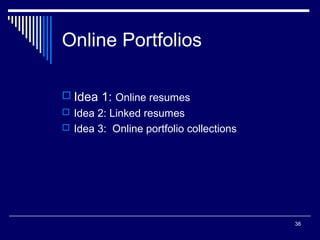
Online Portfolios
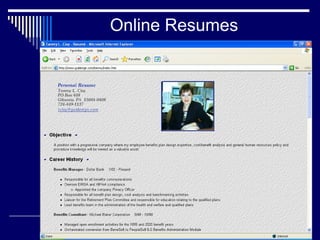
 Idea 1: Online resumes
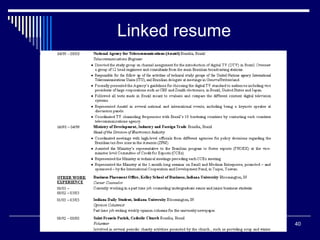
 Idea 2: Linked resumes
 Idea 3: Online portfolio collections
39
Online Resumes
40
Linked resume
41
42
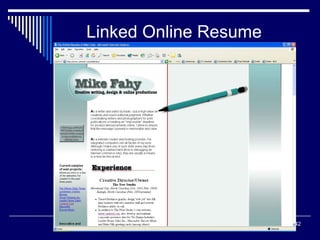
Linked Online Resume
43
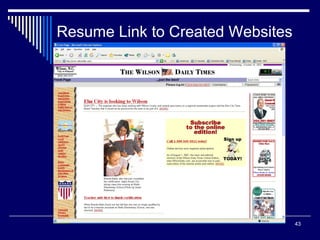
Resume Link to Created Websites
44
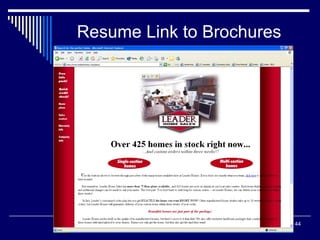
Resume Link to Brochures
45
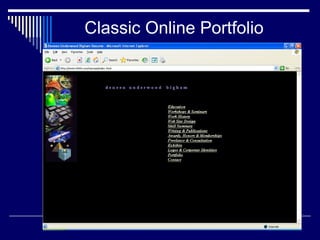
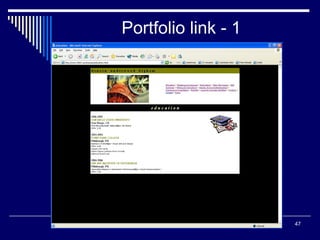
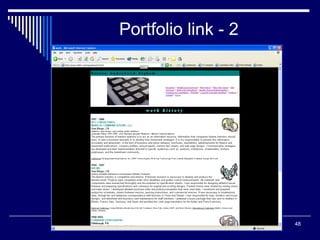
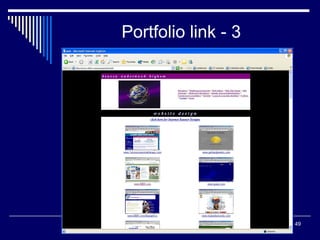
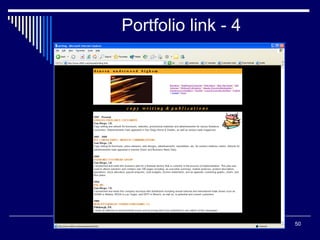
Classic Online Portfolio
46
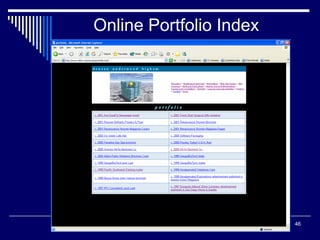
Online Portfolio Index
47
Portfolio link - 1
48
Portfolio link - 2
49
Portfolio link - 3
50
Portfolio link - 4
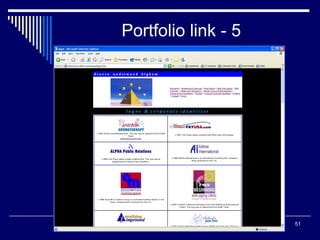
51
Portfolio link - 5
52
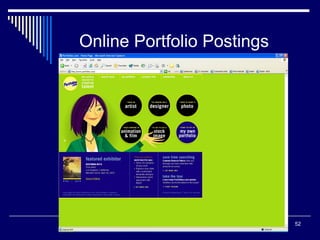
Online Portfolio Postings
 http://www.portfolios.com
53
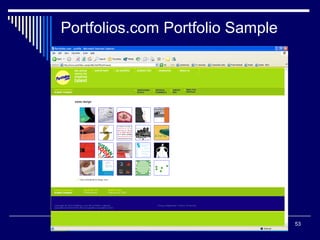
Portfolios.com Portfolio Sample
54
Portfolio link -1
55
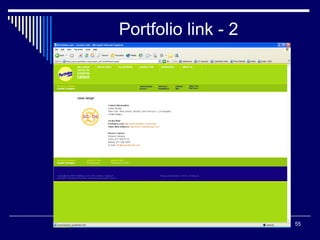
Portfolio link - 2
56
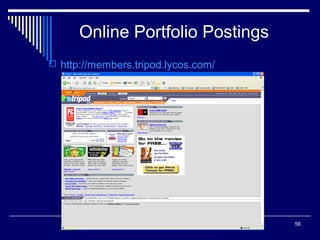
Online Portfolio Postings
 http://members.tripod.lycos.com/
57
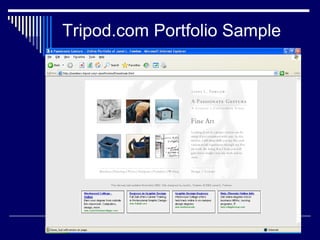
Tripod.com Portfolio Sample
58
Online Examples of Career Portfolios
Basic Online Resume:
http://www.guidesign.com/tammy/index.htm
This format is virtually identical to a paper-based resume format. Note lack
of internal links.
Web Designer's Portfolio:
http://www.carteret.com/mikefahy
A linked resume with good example of integrating work samples within a web site.
Graphic Designer's Portfolio:
http://www.6869.com/resume/index.html
A classic online portfolio with clean, simple design and great graphics.
Portfolio For Self-Employment:
http://careerlifeconsulting.com
Check out Joan Richard's on-line portfolio that promotes her company, CareerLife
Consulting Services.
59
Purposes of the Portfolio
 Self-assessment: who you are and what
you want to do
 Repository for necessary documents:
keeps everything for the career together
 Interviewing tool: sell yourself
 Performance appraisal tool: show
supervisor your work strengths
60
In Summary
 Everyone can use a portfolio to manage
both their professional or career assets
and showcase their potential.
 The very act of organizing your portfolio
brings clarity to your career direction.
 This process requires reflection & analysis.
 When you sequence your samples in your
portfolio, you begin thinking more broadly
about your collection of talents. You think
more deeply about who you are.
61
Collect NOW – Sort later
 Set up your system
 Calendar
 Designated collection point
 Schedule your self-review times
 Sort later
 Think Ahead—you are worth it!
62
Evaluation Questions
Use:
Strongly agree
Agree
Disagree
Strongly disagree
Don’t know
1. I found the presentation of material easy to
understand.
2. This Discussion session increased my
knowledge on the subject presented.
3. I will be able to use some of the information
from this Discussion session in the future.
4. The presenter was well prepared for this
Discussion session.
5. This presentation should be repeated in future
semesters.

career planning and development

  • 1.
    Building a Career Portfolio Howto Present Yourself to Potential Employers Presented by April Legler, Lecturer of Career Education, KSOB
  • 2.
    2 What is aPortfolio?  What is your understanding of a portfolio and its purpose?  Who has traditionally created portfolios?  Does anyone have a portfolio?
  • 3.
    3 Definition A portfolio isa documentation and demonstration of your accomplishments representing growth in your skills and understanding of those skills over time. The portfolio not only documents your results but also how you got there and what you learned in the process.
  • 4.
    4 Employers are asking… “How much will you cost me to train?”  “Can you keep your personal life in order so that it does not interfere with work?”
  • 5.
    5 Employers are seeking… Proof of current relevant soft skills  Real work samples
  • 6.
    6 Two Broad Categoriesof Skills  Transferable  across careers, jobs, and industries  organizational  interpersonal  work-style  Work Content  do a specific type of job  immediate contribution  gained through course work and job experience
  • 7.
    7 Employers Want the“Total Package”  Excellent communication skills  Technical proficiency  Leadership  Teamwork  Interpersonal skills and personal traits
  • 8.
    8 Portfolio Advantages  Clearlyshows your individuality, personality, & skills  Speaks to your skills without your having to say directly “I’m good”  The resume gets you the interview, the portfolio gets you the job
  • 9.
    9 Steps for AssessingYour Major Accomplishments 1. What I Did? 2. What I Learned? 3. What’s Next? (We will be using a group activity to reinforce these steps in a minute.)
  • 10.
    10 #1: What IDid?  The first step is documentation of events, activities, and skills that have been accomplished.  It is a collection of your most important accomplishments, both personal and professional.
  • 11.
    11 # 1 Artifact Choose a tangible item to exhibit the accomplishment or skill you have just selected to showcase
  • 12.
    12 Activity: What didYOU do?  Think of a skill you wish to highlight and an “artifact” from an activity you have done that could showcase it. OR  Think of something truly significant you have done and what skill that demonstrates. What artifact can you use to showcase that?
  • 13.
    13 #2: What ILearned?  The next step is going back and looking at each entry and writing “statements” identifying and explaining the purpose of each piece of evidence so that the entries are meaningful when reviewed by others.  These statements should also contain reflective comments about your learning.
  • 14.
    14 What I Learned-Sample To develop an annual budget of $6000  To keep accurate line-item entry books of income and expenditures  To create and maintain excel spreadsheets of monthly finances  To create annual financial statements
  • 15.
    15 Activity: What didYOU learn?  Write a statement of what you gained from the activity that you selected just now.
  • 16.
    16 #3: What’s Next? Review each entry  View as springboard to future learning  Revisit and examine work accomplished  Professional and personal growth  Assimilate information into “skills and achievements” for resume and interview process
  • 17.
    17 What’s next-Sample  Addactivity and accomplishments to resume  Improve organization of records to facilitate creation of annual report
  • 18.
    18 Activity: What isnext for YOU?  Write what you will do to use or improve what you have begun in this class activity.
  • 19.
    19 Sample Artifacts fora Portfolio  Career & professional development goals  Resumes/Cover letters  Your work philosophy  Self-assessment records  Transcripts  Work history  Skill areas  Works in progress (activities and projects)  Work & learning samples  Work term reports  Certificates, diplomas, degrees, & awards  Professional memberships & service  Records of community service/volunteer work (brochures, letters of recognition, etc.)  Newspaper clippings featuring you  Letters of appreciation  Photographs/Media  Networking contacts  Letters of recommendation/ references
  • 20.
    20 Career Portfolio Sections Management philosophy  Professional goals  Resume  Work samples by skill areas  Works in progress  Community service (transferable skills)  Professional memberships  Degrees, certifications & awards  References
  • 21.
    21 Sections: Philosophy andGoals  Mgmt Philosophy-brief description of your beliefs about yourself and the industry (Career Objective Statement)  Career Goals-professional goals for the next 2-5 years
  • 22.
    22 Section: Resume  Yourresume provides a brief summary of your education and experiences.
  • 23.
    23 Section: Skill Areas Skill areas-tabbed sections containing information on your skills and experiences relating to specific areas  Marketing  People Management  Technology  Target skills desired by companies you are interviewing  Job advertisements  Job descriptions  Focus on measurable skills  Technical skills  Soft skills
  • 24.
    24 Skill areas thatemployers want from recent graduates.  Analytical  Communication(Oral & Written)  Computer Skills  Creativity  Decision Making  Flexibility  Interpersonal  Leadership  Listening  Multicultural Understanding  Organizational  Problem Solving  Research  Teamwork  Time Management
  • 25.
    25 Work Samples  Worksample-physical examples of your work  One for every skill  Projects, reports  Real work samples preferable to school projects  How do I get them?  What are you good at doing?  Rummage through your stuff at home and at work for samples  Plan to secure work samples
  • 26.
    26 Propriety on WorkSamples  Do I need to get permission to take copies of my work?  If you signed a confidentiality agreement  If you are a contractor or employee  Use the templates of your work  Do NOT share proprietary or personal information  Do share letters, customer comments, class or workshop projects
  • 27.
    27 Section: Additional Proof Works in Progress-brief list of works, activities, projects or efforts that are on- going.  Letters of Recommendation-support or reference that verify your abilities in a certain skill area
  • 28.
    28 Section: Transferable Skills Sources  Community service  Volunteer organizations  Avocations (intense hobbies)  Intramural activities  Artifacts  Letters of recognition  Photos of projects completed  Programs and brochures
  • 29.
    29 Transferable Skills Support… Soft skills  Teamwork  Presentation skills  Communication skills  Attitude  Leadership  Others
  • 30.
    30 Section: Professional Growth Memberships-member cards, citations, letters  Certifications  Diplomas, Degrees, or Awards-copies of actual recognition received
  • 31.
    31 Section: Reference Materials Academic Plan of Study-list of courses and what you learned in them  Faculty and Employer Biographies- descriptions of the people whose signatures appear throughout—who are they, what do they do  References-list of people who can verify your character, academic record or employment history
  • 32.
    32 Group Activity 1. Breakinto small groups and select an individual to “record” for the group. 2. Pick 3 skills from the list provided. 3. Share experiences with your group, in which you each have developed those 3 skill areas. 4. Identify and lists ways to document that experience in your portfolio. 5. Report out to the group.
  • 33.
    33 Skill areas mostwanted by employers from recent graduates.  Analytical  Communication(Oral & Written)  Computer Skills  Creativity  Decision Making  Flexibility  Interpersonal  Leadership  Listening  Multicultural Understanding  Organizational  Problem Solving  Research  Teamwork  Time Management
  • 34.
    34 Showcase Tips: PaperPortfolio  Include an introduction and table of contents  Organize work samples into skill areas  Keep to a consistent format  Don't include original documents  Don't punch holes in your documents  Number sheet protectors, not contents  Use quality paper & captions to enhance  Create all text on computer  Use a high-quality printer  Don't use too many fonts  Be creative  Tailor your portfolio to include only relevant information to the opportunity you are seeking  Observe a maximum length of 10-15 artifacts  Consider having a copy of your portfolio or important parts of it to leave behind with an employer
  • 35.
    35 When Is ItAppropriate to Present Your Portfolio  In an Interview  To illustrate skills you are asked to describe  As concrete proof of your accomplishments as they relate to the opportunity at hand (Generally do not send with your application package unless requested.)
  • 36.
    36 And Also…  Ina Job Performance Evaluation  To remind the employer of your contributions and accomplishments  Focus on the time since your last review  Include career highlights, works in progress, group/individual achievements  Give to supervisor 2-3 weeks before review
  • 37.
    37 Hard Copy vsElectronic HARD COPY  Introduces oneself  Answers questions during interview  Summarizes qualifications ELECTRONIC  To compete for an interview  As additional research for candidates  As follow-up
  • 38.
    38 Online Portfolios  Idea1: Online resumes  Idea 2: Linked resumes  Idea 3: Online portfolio collections
  • 39.
  • 40.
  • 41.
  • 42.
  • 43.
    43 Resume Link toCreated Websites
  • 44.
  • 45.
  • 46.
  • 47.
  • 48.
  • 49.
  • 50.
  • 51.
  • 52.
    52 Online Portfolio Postings http://www.portfolios.com
  • 53.
  • 54.
  • 55.
  • 56.
    56 Online Portfolio Postings http://members.tripod.lycos.com/
  • 57.
  • 58.
    58 Online Examples ofCareer Portfolios Basic Online Resume: http://www.guidesign.com/tammy/index.htm This format is virtually identical to a paper-based resume format. Note lack of internal links. Web Designer's Portfolio: http://www.carteret.com/mikefahy A linked resume with good example of integrating work samples within a web site. Graphic Designer's Portfolio: http://www.6869.com/resume/index.html A classic online portfolio with clean, simple design and great graphics. Portfolio For Self-Employment: http://careerlifeconsulting.com Check out Joan Richard's on-line portfolio that promotes her company, CareerLife Consulting Services.
  • 59.
    59 Purposes of thePortfolio  Self-assessment: who you are and what you want to do  Repository for necessary documents: keeps everything for the career together  Interviewing tool: sell yourself  Performance appraisal tool: show supervisor your work strengths
  • 60.
    60 In Summary  Everyonecan use a portfolio to manage both their professional or career assets and showcase their potential.  The very act of organizing your portfolio brings clarity to your career direction.  This process requires reflection & analysis.  When you sequence your samples in your portfolio, you begin thinking more broadly about your collection of talents. You think more deeply about who you are.
  • 61.
    61 Collect NOW –Sort later  Set up your system  Calendar  Designated collection point  Schedule your self-review times  Sort later  Think Ahead—you are worth it!
  • 62.
    62 Evaluation Questions Use: Strongly agree Agree Disagree Stronglydisagree Don’t know 1. I found the presentation of material easy to understand. 2. This Discussion session increased my knowledge on the subject presented. 3. I will be able to use some of the information from this Discussion session in the future. 4. The presenter was well prepared for this Discussion session. 5. This presentation should be repeated in future semesters.