http://www.cit.ie
CV and Interview
Skills & Tips
Celvin Lane
Thursday: 03/05/2018
Room: C167 | 6 – 7 PM
Curriculum Vitae
 Curriculum Vitae (CV) means “course of life” in Latin.
 Written description of your work experience, educational
background and skills.
 A CV is typically a “living document” which will reflect the
developments in a professional’s career.
2018-08-14 www.cit.ie 2
Background
Curriculum Vitae
 Marketing tool: First impression is the one which lasts.
 Your “big picture”: A detailed snapshot of your professional
and academic life.
2018-08-14 www.cit.ie 3
Purpose of a CV
Curriculum Vitae
 Find out information about the role/position.
 Look at skills needed.
 Develop a Personal Profile.
 Tailor your CV (Structure, Layout & Content)
2018-08-14 www.cit.ie 4
Target your CV
Curriculum Vitae
 Personal Profile
 Education
 Projects
 Skills: Technical, communications, analytical etc.
 Work Experience
 Interests and Achievements
2018-08-14 www.cit.ie 5
CV Formats
Curriculum Vitae
 Format: 2 pages maximum.
 Academic: Work with your strengths, relevant subjects,
projects, and results.
 Course: Related Skills: IT, Software, Lab work, etc.…
 Work: Show skills, not only tasks involved.
Essential Tips
2018-08-14 6
Curriculum Vitae
 Name (Font 16 & Bold)
 Address (Font 12)
 Mobile Number (Font 12)
 Set up your voicemail!
 E-mail Address (Font 12)
 NB: Business-like
 LinkedIn
2018-08-14 7
Personal Details
Curriculum Vitae
• 2 to 3 purposeful sentences (the information has relevance to the employer
and/or the job for which you are applying.)
• Your profile demonstrates:
• Your current status
• 2 to 3 key skills and a proven achievement where possible
• CV objective – seeking a placement…
• Who you are?
• - Target driven Software student
• Functional Attributes
• - Excellent knowledge of key programming languages
• Desirable Personal Attributes
• - Genuine desire to succeed/make a contribution
• 2 or 3 targeted skills
2018-08-14 8
Personal Profile
Curriculum Vitae
• Provide information: dates, course title, College
• Outline details of subjects studied, specific modules, projects
undertaken, technical or lab skills acquired if applicable
• Provide information re: results achieved in specific
years/modules/projects.
2018-08-14 9
Education
Curriculum Vitae
 Provide information on relevant projects undertaken:
 Begin with the Title and a brief Description
 What research did you carry out?
 What Methods did you use?
 What was the analysis that you conducted?
 What were your findings?
 What result was achieved?
 Optional: Include web link to project
2018-08-14 10
Projects
Curriculum Vitae
• Outline the expertise you have developed in specific areas.
• Name the techniques/skills.
• Example:
• HTML: Excellent knowledge of HTML, developed while undertaking
individual web design project.
• Google Analytics: Excellent knowledge of Google Analytics, along with
achieving Goole Analytics IQ assessment.
• Communications Skills: communicating both verbal and written via
email and telephone.
• IT Skills: using laboratory software including SAP, LIMS, Empower.
2018-08-14 11
Skills
Curriculum Vitae
• Work: show skills not only obvious activity
• What exactly did I do?
• What skills did I use?
• What new skills did I develop?
• What did I do that I was proud of!
Tip: Tailor you're experience to the sector you are applying to Possible
Headings. For Example:
• Work Experience/ Professional Experience/ Relevant
Experience/Administrative Experience/ Marketing Experience…
2018-08-14 12
Education
Curriculum Vitae
• Don’t…
• Write Curriculum Vitae as a heading
• Don’t…
• Sign or date your CV
• Don’t
• Give incorrect information
• Don’t
• Have any spelling mistakes or typos
• Don’t
• No longer use I, My, We, etc…
2018-08-14 13
Don’t for your CV
Applying for roles
 Websites; Jobs.ie, Indeed.ie, and LinkedIn.
 Search companies/roles which you wish for and apply to
companies on their websites.
 Make a list of jobs you applied for!
 Follow up!
2018-08-14 www.cit.ie 14
Tips!
Interviews
 Interview: A meeting with an objective
 Employer’s objective is to find the best person for the job
 Employer: reviews candidate’s experience and abilities
 Can you do the job? (skills, abilities, qualifications)
 Will you do the job? (interest, attitude & motivation)
 How will you fit into the organisation? (personality)
 You: impress employer and assess position on offer
 What does this position offer me?
 How does it fit with my career plans?
 Congratulations: you have passed the first hurdle
 You must prove that you are the most suitable candidate for this
position
2018-08-14 www.cit.ie 15
What to expect
Interviews
 Review own skills, experiences and qualities
 Check CV
 Anticipate questions and identify relevant examples
 Prepare key selling points
 Research organisation
 Websites, reports, articles, company literature, etc
 Contacts with knowledge of organisation or sector
 Relevant articles in the press
 Personal visit or telephone call
 Research job and occupational area
 Job description – or similar
 Current issues
 Prepare your questions
 Practice
2018-08-14 www.cit.ie 16
Preparation is the key to success
Interviews
 First impressions are very powerful.
 Halo effect or Devil effect
 Allow time to relax.
 Dress appropriately.
 Entrance, introductions & handshake.
 Smile and make eye contact.
 Be aware of own movements.
 Watch body language of interviewer.
2018-08-14 www.cit.ie 17
Body Language
Interviews
 About you
 Tell me about yourself - Bring me up to date with your CV?
 Why did you choose that particular degree programme?
 What would you consider your major achievements to date?
 About the job
 What interests you about this job?
 What do you know about this organisation?
 What other options are you considering?
 How do you see your career developing – 5 years?
 General knowledge
 What do you think of the Government’s policy on college fees?
2018-08-14 www.cit.ie 18
Typical Questions
Interviews
 Company identifies key skills required for job
 Designs questions to elicit evidence of skills
 Emphasis on past behaviour as predictor of success
 Teamwork: Describe a team project you worked on. What problems arose?
How did you deal with them?
 Communication Skills: Describe situation when you had to persuade others to
support your view. Give an example of any reports you’ve written which
illustrate your writing skills
 Interpersonal skills: What kinds of people do you find it difficult to work with?
How do you handle those situations?
 Taking Responsibility: Describe a time when you took responsibility to achieve
a challenging goal
 Problem-solving: Tell about a time when you had several tasks to manage at
one time with conflicting deadlines.
2018-08-14 www.cit.ie 19
Competency-based Interviews
Interviews
 Q: Give me an example of a problem you encountered. How did
you approach it. What was the outcome?
 STAR response
 S: Describe the situation
 T: Explain the task/problem that arose
 A: What action did you take?
 R: What was the result or outcome?
 What did you learn from this experience?
2018-08-14 www.cit.ie 20
Responding to Competency Questions
Interview
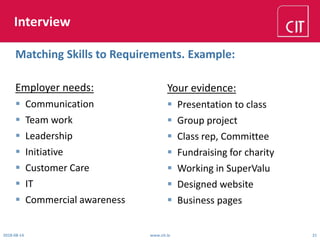
Employer needs:
 Communication
 Team work
 Leadership
 Initiative
 Customer Care
 IT
 Commercial awareness
2018-08-14 www.cit.ie 21
Matching Skills to Requirements. Example:
Your evidence:
 Presentation to class
 Group project
 Class rep, Committee
 Fundraising for charity
 Working in SuperValu
 Designed website
 Business pages
Interviews
 Listen carefully, seek clarification
 Illustrate answers with real examples and evidence
 Be positive – constructive criticism
 Keep answers specific and concise
 Take time to respond
 Be alert to interviewer’s body language
 Speak clearly, smile and show enthusiasm
 Know what you want to say, and find the opportunity
2018-08-14 www.cit.ie 22
Your Answers
Interviews
 Good all-round intelligence
 Enthusiasm, commitment and motivation
 Good communication skills
 Team work ability
 Ability to solve problems
 Capacity to work hard
 Initiative and self-reliance
 Balanced personality
2018-08-14 www.cit.ie 23
Qualities Employers Seek
Interviews
 Poor personal appearance
 Negative attitude – evasive, using excuses
 Lack of interest and enthusiasm
 Lack of preparation
 Poor knowledge of role
 Failure to give concrete examples of skills
 Over emphasis on money/rewards
 Lack of career plan
2018-08-14 www.cit.ie 24
What creates a bad impression
Interviews
 Review own performance
 What went well
 What went badly
 What you wished you had said
 Prepare for next stage
 Invitation to second / final round interviews
 Assessment centre
 Psychometric testing
 Panel interview
 Rejection letter / email
 If you can request feedback - use it
2018-08-14 www.cit.ie 25
What creates a bad impression
Interviews
 CV: Personal Statement, Experience, Education, and Skills
 Applying for jobs: Websites, LinkedIn.
 Interviews: Research business before, prepare questions, and use the STAR
response for answering.
 Email: celvin.lane@mycit.ie for further questions, advice, or help!
2018-08-14 www.cit.ie 26
Summarise
http://www.cit.ie
Celvin Lane
03/05/2018
Thank you
Any further questions, help or advice: Celvin.lane@mycit.ie

Activity 5; Presentation / Talk

  • 1.
    http://www.cit.ie CV and Interview Skills& Tips Celvin Lane Thursday: 03/05/2018 Room: C167 | 6 – 7 PM
  • 2.
    Curriculum Vitae  CurriculumVitae (CV) means “course of life” in Latin.  Written description of your work experience, educational background and skills.  A CV is typically a “living document” which will reflect the developments in a professional’s career. 2018-08-14 www.cit.ie 2 Background
  • 3.
    Curriculum Vitae  Marketingtool: First impression is the one which lasts.  Your “big picture”: A detailed snapshot of your professional and academic life. 2018-08-14 www.cit.ie 3 Purpose of a CV
  • 4.
    Curriculum Vitae  Findout information about the role/position.  Look at skills needed.  Develop a Personal Profile.  Tailor your CV (Structure, Layout & Content) 2018-08-14 www.cit.ie 4 Target your CV
  • 5.
    Curriculum Vitae  PersonalProfile  Education  Projects  Skills: Technical, communications, analytical etc.  Work Experience  Interests and Achievements 2018-08-14 www.cit.ie 5 CV Formats
  • 6.
    Curriculum Vitae  Format:2 pages maximum.  Academic: Work with your strengths, relevant subjects, projects, and results.  Course: Related Skills: IT, Software, Lab work, etc.…  Work: Show skills, not only tasks involved. Essential Tips 2018-08-14 6
  • 7.
    Curriculum Vitae  Name(Font 16 & Bold)  Address (Font 12)  Mobile Number (Font 12)  Set up your voicemail!  E-mail Address (Font 12)  NB: Business-like  LinkedIn 2018-08-14 7 Personal Details
  • 8.
    Curriculum Vitae • 2to 3 purposeful sentences (the information has relevance to the employer and/or the job for which you are applying.) • Your profile demonstrates: • Your current status • 2 to 3 key skills and a proven achievement where possible • CV objective – seeking a placement… • Who you are? • - Target driven Software student • Functional Attributes • - Excellent knowledge of key programming languages • Desirable Personal Attributes • - Genuine desire to succeed/make a contribution • 2 or 3 targeted skills 2018-08-14 8 Personal Profile
  • 9.
    Curriculum Vitae • Provideinformation: dates, course title, College • Outline details of subjects studied, specific modules, projects undertaken, technical or lab skills acquired if applicable • Provide information re: results achieved in specific years/modules/projects. 2018-08-14 9 Education
  • 10.
    Curriculum Vitae  Provideinformation on relevant projects undertaken:  Begin with the Title and a brief Description  What research did you carry out?  What Methods did you use?  What was the analysis that you conducted?  What were your findings?  What result was achieved?  Optional: Include web link to project 2018-08-14 10 Projects
  • 11.
    Curriculum Vitae • Outlinethe expertise you have developed in specific areas. • Name the techniques/skills. • Example: • HTML: Excellent knowledge of HTML, developed while undertaking individual web design project. • Google Analytics: Excellent knowledge of Google Analytics, along with achieving Goole Analytics IQ assessment. • Communications Skills: communicating both verbal and written via email and telephone. • IT Skills: using laboratory software including SAP, LIMS, Empower. 2018-08-14 11 Skills
  • 12.
    Curriculum Vitae • Work:show skills not only obvious activity • What exactly did I do? • What skills did I use? • What new skills did I develop? • What did I do that I was proud of! Tip: Tailor you're experience to the sector you are applying to Possible Headings. For Example: • Work Experience/ Professional Experience/ Relevant Experience/Administrative Experience/ Marketing Experience… 2018-08-14 12 Education
  • 13.
    Curriculum Vitae • Don’t… •Write Curriculum Vitae as a heading • Don’t… • Sign or date your CV • Don’t • Give incorrect information • Don’t • Have any spelling mistakes or typos • Don’t • No longer use I, My, We, etc… 2018-08-14 13 Don’t for your CV
  • 14.
    Applying for roles Websites; Jobs.ie, Indeed.ie, and LinkedIn.  Search companies/roles which you wish for and apply to companies on their websites.  Make a list of jobs you applied for!  Follow up! 2018-08-14 www.cit.ie 14 Tips!
  • 15.
    Interviews  Interview: Ameeting with an objective  Employer’s objective is to find the best person for the job  Employer: reviews candidate’s experience and abilities  Can you do the job? (skills, abilities, qualifications)  Will you do the job? (interest, attitude & motivation)  How will you fit into the organisation? (personality)  You: impress employer and assess position on offer  What does this position offer me?  How does it fit with my career plans?  Congratulations: you have passed the first hurdle  You must prove that you are the most suitable candidate for this position 2018-08-14 www.cit.ie 15 What to expect
  • 16.
    Interviews  Review ownskills, experiences and qualities  Check CV  Anticipate questions and identify relevant examples  Prepare key selling points  Research organisation  Websites, reports, articles, company literature, etc  Contacts with knowledge of organisation or sector  Relevant articles in the press  Personal visit or telephone call  Research job and occupational area  Job description – or similar  Current issues  Prepare your questions  Practice 2018-08-14 www.cit.ie 16 Preparation is the key to success
  • 17.
    Interviews  First impressionsare very powerful.  Halo effect or Devil effect  Allow time to relax.  Dress appropriately.  Entrance, introductions & handshake.  Smile and make eye contact.  Be aware of own movements.  Watch body language of interviewer. 2018-08-14 www.cit.ie 17 Body Language
  • 18.
    Interviews  About you Tell me about yourself - Bring me up to date with your CV?  Why did you choose that particular degree programme?  What would you consider your major achievements to date?  About the job  What interests you about this job?  What do you know about this organisation?  What other options are you considering?  How do you see your career developing – 5 years?  General knowledge  What do you think of the Government’s policy on college fees? 2018-08-14 www.cit.ie 18 Typical Questions
  • 19.
    Interviews  Company identifieskey skills required for job  Designs questions to elicit evidence of skills  Emphasis on past behaviour as predictor of success  Teamwork: Describe a team project you worked on. What problems arose? How did you deal with them?  Communication Skills: Describe situation when you had to persuade others to support your view. Give an example of any reports you’ve written which illustrate your writing skills  Interpersonal skills: What kinds of people do you find it difficult to work with? How do you handle those situations?  Taking Responsibility: Describe a time when you took responsibility to achieve a challenging goal  Problem-solving: Tell about a time when you had several tasks to manage at one time with conflicting deadlines. 2018-08-14 www.cit.ie 19 Competency-based Interviews
  • 20.
    Interviews  Q: Giveme an example of a problem you encountered. How did you approach it. What was the outcome?  STAR response  S: Describe the situation  T: Explain the task/problem that arose  A: What action did you take?  R: What was the result or outcome?  What did you learn from this experience? 2018-08-14 www.cit.ie 20 Responding to Competency Questions
  • 21.
    Interview Employer needs:  Communication Team work  Leadership  Initiative  Customer Care  IT  Commercial awareness 2018-08-14 www.cit.ie 21 Matching Skills to Requirements. Example: Your evidence:  Presentation to class  Group project  Class rep, Committee  Fundraising for charity  Working in SuperValu  Designed website  Business pages
  • 22.
    Interviews  Listen carefully,seek clarification  Illustrate answers with real examples and evidence  Be positive – constructive criticism  Keep answers specific and concise  Take time to respond  Be alert to interviewer’s body language  Speak clearly, smile and show enthusiasm  Know what you want to say, and find the opportunity 2018-08-14 www.cit.ie 22 Your Answers
  • 23.
    Interviews  Good all-roundintelligence  Enthusiasm, commitment and motivation  Good communication skills  Team work ability  Ability to solve problems  Capacity to work hard  Initiative and self-reliance  Balanced personality 2018-08-14 www.cit.ie 23 Qualities Employers Seek
  • 24.
    Interviews  Poor personalappearance  Negative attitude – evasive, using excuses  Lack of interest and enthusiasm  Lack of preparation  Poor knowledge of role  Failure to give concrete examples of skills  Over emphasis on money/rewards  Lack of career plan 2018-08-14 www.cit.ie 24 What creates a bad impression
  • 25.
    Interviews  Review ownperformance  What went well  What went badly  What you wished you had said  Prepare for next stage  Invitation to second / final round interviews  Assessment centre  Psychometric testing  Panel interview  Rejection letter / email  If you can request feedback - use it 2018-08-14 www.cit.ie 25 What creates a bad impression
  • 26.
    Interviews  CV: PersonalStatement, Experience, Education, and Skills  Applying for jobs: Websites, LinkedIn.  Interviews: Research business before, prepare questions, and use the STAR response for answering.  Email: celvin.lane@mycit.ie for further questions, advice, or help! 2018-08-14 www.cit.ie 26 Summarise
  • 27.
    http://www.cit.ie Celvin Lane 03/05/2018 Thank you Anyfurther questions, help or advice: Celvin.lane@mycit.ie