CARDIOMYOPATHY
ANIE GLADSTIN G.L
MSC NURSING
KIMS COLLEGE OF NURSING
DEFINITION
Cardiomyopathy(CMP) is a group of diseases that affect the structural and functional
ability of the myocardium.
CAUSES
PRIMARY CARDIOMYOPATHY
• Refers to those conditions in which the etiology of the heart disease is unknown.
• The heart muscle in this case is the only portion of the heart involved, and other
cardiac structures are unaffected.
SECONDARY CARDIOMYOPATHY
• The cause of myocardial disease is known and the secondary to another disease
process
CAUSES OF SECONDARY CARDIOMYOPATHY
• Cardiotoxic agents ( alcohol,cocaine)
• Genetic
• CAD
• Hypertension
• Myocarditis
• Valve disease
• Ventricular thrombus
• Endomyocardial fibrosis
TYPES
• Dilated cardiomyopathy
• Hypertrophic cardiomyopathy
• Restrictive cardiomyopathy
DILATED CARDIOMYOPATHY
A condition where the heart cannot pump blood effectively because the left
ventricle, the main pumping chamber, is enlarged and weakened.
CONTD……
• Common type
• The size of the ventricle cavity enlarges with reduced cardiac
output.
• Contractile function is reduced.
• Myocardial tissue is destroyed.
• Blood moves more slowly through the left ventricle which results
often results in blood clot formation.
• It is most frequent type of cardiomyopathy.
• It may be hereditary, infectious myocarditis or by caused by
alcohol or cocaine use, HIV, thiamine or zinc deficiencies.
PATHOPHYSIOLOGY
• Dilated CMP is characterized by a diffuse inflammation and rapid
degeneration of heart fibers.
• This results in ventricular dilation, impaired systolic function,
atrial enlargement stasis (slowing) of blood in the left ventricle.
• Cardiomegaly results from ventricular dilation.
• This causes contractile dysfunction and enlarged chamber size.
CLINICAL MANIFESTATIONS
• Decreased exercise capacity
• Fatigue
• Dyspnea at rest
• Paroxymal nocturnal dyspnea( dyspnea during sleep)
• Orthopnea( harder to breathe when lying down)
• Dry cough
• Palpitations
• Abdominal bloating( gas)
• Nausea
• Vomiting
Contd
• Anorexia (loss of appetite)
• Signs include abnormal S3 and S 4
• Dysrhythmias
• Heart murmers
• Pulmonary crackles
• Edema
• Weak peripheral pulses
• Pallor
• Hepatomegaly
• JVD
• Decreased blood flow through an enlarged heart promotes stasis
and blood clot formation and may lead to systemic embolization.
2.HYPERTROPHIC CARDIOMYOPATHY(HCM)
• Enlargement of the cardiac muscle wall, often of the septum .
• Hypertrophic cardiomyopathy (HCM) is a disease in which the heart muscle
becomes abnormally thick (hypertrophied).
• The thickened heart muscle can make it harder for the heart to pump blood.
• HCM, the thickened heart muscle can cause shortness of breath, chest pain or
problems in the heart's electrical system, resulting in life-threatening abnormal
heart rhythms (arrhythmias) or sudden death.
• Also known as: hypertrophic obstructive cardiomyopathy
• The four main characteristics of hypertrophic cardiomyopathy are
1. massive ventricular hypertrophy
2.rapid , forceful contraction of the left ventricle
3.Impaired relaxation
4.Obstruction to aortic outflow
CLINICAL MANIFESTATIONS
• Dyspnea-caused by elevated left ventricular diastolic pressure
• Fatigue- caused by decreased Cardiac output
• Angina- caused by increased Left ventricle mass
• Syncope- caused by obstruction in aortic outflow
3.RESTRICTIVE CARDIOMYOPATHY
• It impairs ventricular stretch and limits ventricular filling.
• Cardiac muscle stiffness is present with no ventricular dilation.
• Rarest form of cardiomyopathy.
• It may be caused by infiltrative diseases such as amyloidosis that
deposit the protein amyloid within the myocardial cells, making the
muscle stiff and resistant to stretching for easy ventricular filling.
Clinical manifestations
• Fatigue
• Exercise intolerance
• Dyspnea
• Angina
• Orthopnea
• Syncope
• Palpitations
• Weight gain
• Peripheral edema
• Ascites
• Hepatomegaly
• JVD(jugular venous distention)
Common Signs and symptoms
Commonly noted symptoms include:
• Shortness of breath even when resting
• Oedema of the legs and feet
• Swollen stomach due to fluid accumulation
• Chest pain
• Lightheadedness
• Feeling tired
• Increase in weight
DIAGNOSIS
• X-RAY EXAMINATION
Cardiomegaly x-ray will help detect dilated cardiomyopathy as
manifested by increased in the size of the heart.
• ECHOCARDIOGRAPHY
It shows muscle thickness and chamber size to differentiate
between the types of cardiomyopathy.
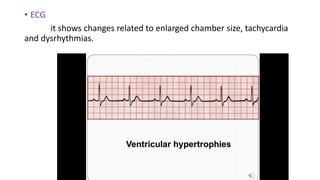
• ECG
it shows changes related to enlarged chamber size, tachycardia
and dysrhythmias.
• CARDIAC CATHETERIZATION
• Involves insertion of a narrow tube into the heart through an artery
to examine how well the heart is functioning.
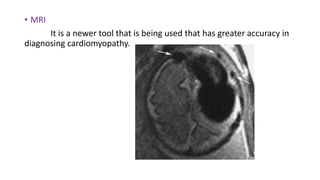
• MRI
It is a newer tool that is being used that has greater accuracy in
diagnosing cardiomyopathy.
MEDICAL MANAGEMENT
• Drug therapy can slow down progression and in some cases even
improve the heart condition.
• Salt restriction- Daily use only 2.5 gram only.
ACE INHIBITORS-It is widely used to treat high blood pressure and heart
failure and may be prescribed after a heart attack. It also lowers the
chances of having a heart attack or stroke.
• Diuretics-It is used for the emergency treatment of very high blood
pressure (hypertensive emergency), as it reduces the blood pressure
immediately. It also rapidly reduces the swelling (edema) caused by
too much water in the body.
BETA BLOCKERS- used to treat include high blood
pressure, angina, heart failure, cardiac arrhythmias
• Anticoagulants may also be used for antithrombotic therapy.
• Antiarrythmic medications –Suppress abnormal rhythms
Contd….
• Reduce inflammation. Medications used to reduce inflammation
include corticosteroids.
contd…..
• Fluid intake may be limited to 2 liters each day.
• Quit smoking
• Limit physical activity- Daily light exercises is safe for most people
with cardiomyopathy.
• Avoid fatty foods
• Avoid or Limit alcohol
• Maintain healthy weight.
• Reduce stress.
Contd…
• Treating underlying conditions, such as diabetes and high blood
pressure.
• Getting enough sleep and rest.
• Pacemaker implanted
• Pacemaker is a small device that sends electrical impulses to the
heart muscle to maintain a suitable heart rate and rhythm. For a
certain type of enlarged heart, a pacemaker that coordinates the
contrations between the left and right ventricles.
• Surgical insertion of a small device under the collarbone to control
the electrical events of the heart.
SURGICAL MANAGEMENT
• HEART TRANSPLANTATION
• A surgical procedure where the diseased heart is replaced with a
healthy heart from a donor.
• Heart transplantation can be a life saving therapeutic option for
patients with hypertrophic cardiomyopathy in a burn- out end stage
phase.
VENTRICULAR ASSIST DEVICES(VAD)
• Because of the limited supply of donar organs VAD used.
• A ventricular assist device (VAD) — also known as a mechanical
circulatory support device — is a device that helps pump blood from
the lower chambers of the heart (ventricles) to the rest of the body.
CONTD….
• The function of a VAD differs from that of an artificial cardiac pacemaker in
that a VAD pumps blood, whereas a pacemaker delivers electrical impulses
to the heart muscle.
• Some VADs are for short-term use, typically for patients recovering
from myocardial infarction (heart attack) and for patients recovering
from cardiac surgery; some are for long-term use (months to years to
perpetuity), typically for patients suffering from advanced heart failure.
CONTD…
• VATS are designed to assist either the right ventricle (RVAD) or the
left ventricle (LVAD), or to assist both ventricles (BiVAD). The type
of VAD implanted depends on the type of underlying heart disease,
TOTAL ARTIFICIAL HEART
CONTD…
• An artificial heart is a device that replaces the heart.
Contd…..
• A total artificial heart (TAH) is a pump that is placed in the chest to
replace damaged heart ventricles and valves. (Ventricles pump blood
to the lungs and other parts of the body.)
• A portable machine outside your body powers the artificial heart and
keeps it pumping at a steady rhythm. A driveline attached to the TAH
and the device exit your body through the skin in your stomach
(abdomen).
• Most people who receive a total artificial heart are waiting for a heart
transplant. A total artificial heart is a temporary solution until you get a
transplant.
SEPTAL MYECTOMY
• Septal myectomy is a cardiac surgery treatment for hypertrophic
cardiomyopathy (HCM).
• The open-heart surgery entails removing a portion of the septum that
is obstructing the flow of blood from the left ventricle to the aorta.
IMPLANTED CARDIOVERTER
DEFIBRILLATOR(ICD)
• An ICD works to control the heartbeat by delivering shocks to the
heart when the device detects an irregular heart beat.
• An implanted cardioverter – defibrillator is a small battery – powered
device placed in the chest to detect and stop irregular heart beats.
Contd….
• An ICD looks similar to a pacemaker, though slightly larger. It looks
very much like a pacemaker. But the ICD can send a shock that resets
an abnormal heartbeat back to normal.
• Alcohol septal ablation (nonsurgical procedure): Ethanol (a type of
alcohol) is injected through a tube into the small artery that supplies
blood to the area of heart muscle thickened by hypertrophic
cardiomyopathy.
• The alcohol causes these cells to die. The thickened tissue shrinks to a
more normal size.
NURSING MANAGEMENT
• IMPROVING CARDIAC OUTPUT
• Monitor heart rate, rhythm,temperature and respiratory rate atleast
every 4 hours.
• Evaluate CVP and pulmonary artery wedge pressure by pulmonary
artery catheter to assess progress and effect of drug therapy.
• Observe bp, change in mental status, decreased urine output.
• Administer pharmacological therapy.
• Administer anticoagulants.
• Administer antiarrythmic drugs
REDUCING FATIGUE
• Make sure that patient and visitors understand the importance of
rest.
• Assist patient in identifying stressors and reducing their effect.
• Assist with ambulation as ordered.
• Teach the use of diversional activities and relaxation techniques to
relieve tension.
HEALTH EDUCATION(prevention)
• Advice to take low sodium diet.
• Advice reporting signs of heart failure such as weight gain, edema, dyspnea, fatigue.
• stopping smoking
• maintaining a healthy weight
• monitoring blood pressure regularly
• doing physical activity most days of the week
• limiting alcohol and caffeine
• sleeping 7 to 9 hours a night
• increasing fruit and vegetable intake
• replacing refined grains, such as white bread and pasta, with whole grain versions
• cutting out processed, high-sugar, and high-fat foods
• consuming no more than 1,500 milligrams of salt daily
CARDIOMYOPATHY.pptx

CARDIOMYOPATHY.pptx

  • 1.
    CARDIOMYOPATHY ANIE GLADSTIN G.L MSCNURSING KIMS COLLEGE OF NURSING
  • 2.
    DEFINITION Cardiomyopathy(CMP) is agroup of diseases that affect the structural and functional ability of the myocardium.
  • 4.
    CAUSES PRIMARY CARDIOMYOPATHY • Refersto those conditions in which the etiology of the heart disease is unknown. • The heart muscle in this case is the only portion of the heart involved, and other cardiac structures are unaffected. SECONDARY CARDIOMYOPATHY • The cause of myocardial disease is known and the secondary to another disease process
  • 5.
    CAUSES OF SECONDARYCARDIOMYOPATHY • Cardiotoxic agents ( alcohol,cocaine) • Genetic • CAD • Hypertension • Myocarditis • Valve disease • Ventricular thrombus • Endomyocardial fibrosis
  • 6.
    TYPES • Dilated cardiomyopathy •Hypertrophic cardiomyopathy • Restrictive cardiomyopathy
  • 7.
    DILATED CARDIOMYOPATHY A conditionwhere the heart cannot pump blood effectively because the left ventricle, the main pumping chamber, is enlarged and weakened.
  • 8.
    CONTD…… • Common type •The size of the ventricle cavity enlarges with reduced cardiac output. • Contractile function is reduced. • Myocardial tissue is destroyed. • Blood moves more slowly through the left ventricle which results often results in blood clot formation. • It is most frequent type of cardiomyopathy. • It may be hereditary, infectious myocarditis or by caused by alcohol or cocaine use, HIV, thiamine or zinc deficiencies.
  • 10.
    PATHOPHYSIOLOGY • Dilated CMPis characterized by a diffuse inflammation and rapid degeneration of heart fibers. • This results in ventricular dilation, impaired systolic function, atrial enlargement stasis (slowing) of blood in the left ventricle. • Cardiomegaly results from ventricular dilation. • This causes contractile dysfunction and enlarged chamber size.
  • 12.
    CLINICAL MANIFESTATIONS • Decreasedexercise capacity • Fatigue • Dyspnea at rest • Paroxymal nocturnal dyspnea( dyspnea during sleep) • Orthopnea( harder to breathe when lying down) • Dry cough • Palpitations • Abdominal bloating( gas) • Nausea • Vomiting
  • 13.
    Contd • Anorexia (lossof appetite) • Signs include abnormal S3 and S 4 • Dysrhythmias • Heart murmers • Pulmonary crackles • Edema • Weak peripheral pulses • Pallor • Hepatomegaly • JVD • Decreased blood flow through an enlarged heart promotes stasis and blood clot formation and may lead to systemic embolization.
  • 14.
    2.HYPERTROPHIC CARDIOMYOPATHY(HCM) • Enlargementof the cardiac muscle wall, often of the septum . • Hypertrophic cardiomyopathy (HCM) is a disease in which the heart muscle becomes abnormally thick (hypertrophied). • The thickened heart muscle can make it harder for the heart to pump blood. • HCM, the thickened heart muscle can cause shortness of breath, chest pain or problems in the heart's electrical system, resulting in life-threatening abnormal heart rhythms (arrhythmias) or sudden death. • Also known as: hypertrophic obstructive cardiomyopathy
  • 15.
    • The fourmain characteristics of hypertrophic cardiomyopathy are 1. massive ventricular hypertrophy 2.rapid , forceful contraction of the left ventricle 3.Impaired relaxation 4.Obstruction to aortic outflow
  • 17.
    CLINICAL MANIFESTATIONS • Dyspnea-causedby elevated left ventricular diastolic pressure • Fatigue- caused by decreased Cardiac output • Angina- caused by increased Left ventricle mass • Syncope- caused by obstruction in aortic outflow
  • 18.
    3.RESTRICTIVE CARDIOMYOPATHY • Itimpairs ventricular stretch and limits ventricular filling. • Cardiac muscle stiffness is present with no ventricular dilation. • Rarest form of cardiomyopathy. • It may be caused by infiltrative diseases such as amyloidosis that deposit the protein amyloid within the myocardial cells, making the muscle stiff and resistant to stretching for easy ventricular filling.
  • 20.
    Clinical manifestations • Fatigue •Exercise intolerance • Dyspnea • Angina • Orthopnea • Syncope • Palpitations • Weight gain • Peripheral edema • Ascites • Hepatomegaly • JVD(jugular venous distention)
  • 21.
    Common Signs andsymptoms Commonly noted symptoms include: • Shortness of breath even when resting • Oedema of the legs and feet • Swollen stomach due to fluid accumulation • Chest pain • Lightheadedness • Feeling tired • Increase in weight
  • 22.
    DIAGNOSIS • X-RAY EXAMINATION Cardiomegalyx-ray will help detect dilated cardiomyopathy as manifested by increased in the size of the heart.
  • 23.
    • ECHOCARDIOGRAPHY It showsmuscle thickness and chamber size to differentiate between the types of cardiomyopathy.
  • 24.
    • ECG it showschanges related to enlarged chamber size, tachycardia and dysrhythmias.
  • 25.
    • CARDIAC CATHETERIZATION •Involves insertion of a narrow tube into the heart through an artery to examine how well the heart is functioning.
  • 26.
    • MRI It isa newer tool that is being used that has greater accuracy in diagnosing cardiomyopathy.
  • 27.
    MEDICAL MANAGEMENT • Drugtherapy can slow down progression and in some cases even improve the heart condition. • Salt restriction- Daily use only 2.5 gram only.
  • 28.
    ACE INHIBITORS-It iswidely used to treat high blood pressure and heart failure and may be prescribed after a heart attack. It also lowers the chances of having a heart attack or stroke.
  • 29.
    • Diuretics-It isused for the emergency treatment of very high blood pressure (hypertensive emergency), as it reduces the blood pressure immediately. It also rapidly reduces the swelling (edema) caused by too much water in the body.
  • 31.
    BETA BLOCKERS- usedto treat include high blood pressure, angina, heart failure, cardiac arrhythmias
  • 33.
    • Anticoagulants mayalso be used for antithrombotic therapy.
  • 34.
    • Antiarrythmic medications–Suppress abnormal rhythms
  • 35.
    Contd…. • Reduce inflammation.Medications used to reduce inflammation include corticosteroids.
  • 36.
    contd….. • Fluid intakemay be limited to 2 liters each day. • Quit smoking • Limit physical activity- Daily light exercises is safe for most people with cardiomyopathy. • Avoid fatty foods • Avoid or Limit alcohol • Maintain healthy weight. • Reduce stress.
  • 37.
    Contd… • Treating underlyingconditions, such as diabetes and high blood pressure. • Getting enough sleep and rest.
  • 38.
    • Pacemaker implanted •Pacemaker is a small device that sends electrical impulses to the heart muscle to maintain a suitable heart rate and rhythm. For a certain type of enlarged heart, a pacemaker that coordinates the contrations between the left and right ventricles. • Surgical insertion of a small device under the collarbone to control the electrical events of the heart.
  • 40.
  • 41.
    • A surgicalprocedure where the diseased heart is replaced with a healthy heart from a donor. • Heart transplantation can be a life saving therapeutic option for patients with hypertrophic cardiomyopathy in a burn- out end stage phase.
  • 42.
    VENTRICULAR ASSIST DEVICES(VAD) •Because of the limited supply of donar organs VAD used. • A ventricular assist device (VAD) — also known as a mechanical circulatory support device — is a device that helps pump blood from the lower chambers of the heart (ventricles) to the rest of the body.
  • 43.
    CONTD…. • The functionof a VAD differs from that of an artificial cardiac pacemaker in that a VAD pumps blood, whereas a pacemaker delivers electrical impulses to the heart muscle. • Some VADs are for short-term use, typically for patients recovering from myocardial infarction (heart attack) and for patients recovering from cardiac surgery; some are for long-term use (months to years to perpetuity), typically for patients suffering from advanced heart failure.
  • 44.
    CONTD… • VATS aredesigned to assist either the right ventricle (RVAD) or the left ventricle (LVAD), or to assist both ventricles (BiVAD). The type of VAD implanted depends on the type of underlying heart disease,
  • 46.
  • 47.
    CONTD… • An artificialheart is a device that replaces the heart.
  • 48.
    Contd….. • A totalartificial heart (TAH) is a pump that is placed in the chest to replace damaged heart ventricles and valves. (Ventricles pump blood to the lungs and other parts of the body.) • A portable machine outside your body powers the artificial heart and keeps it pumping at a steady rhythm. A driveline attached to the TAH and the device exit your body through the skin in your stomach (abdomen). • Most people who receive a total artificial heart are waiting for a heart transplant. A total artificial heart is a temporary solution until you get a transplant.
  • 49.
    SEPTAL MYECTOMY • Septalmyectomy is a cardiac surgery treatment for hypertrophic cardiomyopathy (HCM). • The open-heart surgery entails removing a portion of the septum that is obstructing the flow of blood from the left ventricle to the aorta.
  • 51.
    IMPLANTED CARDIOVERTER DEFIBRILLATOR(ICD) • AnICD works to control the heartbeat by delivering shocks to the heart when the device detects an irregular heart beat. • An implanted cardioverter – defibrillator is a small battery – powered device placed in the chest to detect and stop irregular heart beats.
  • 53.
    Contd…. • An ICDlooks similar to a pacemaker, though slightly larger. It looks very much like a pacemaker. But the ICD can send a shock that resets an abnormal heartbeat back to normal.
  • 54.
    • Alcohol septalablation (nonsurgical procedure): Ethanol (a type of alcohol) is injected through a tube into the small artery that supplies blood to the area of heart muscle thickened by hypertrophic cardiomyopathy. • The alcohol causes these cells to die. The thickened tissue shrinks to a more normal size.
  • 56.
    NURSING MANAGEMENT • IMPROVINGCARDIAC OUTPUT • Monitor heart rate, rhythm,temperature and respiratory rate atleast every 4 hours. • Evaluate CVP and pulmonary artery wedge pressure by pulmonary artery catheter to assess progress and effect of drug therapy. • Observe bp, change in mental status, decreased urine output. • Administer pharmacological therapy. • Administer anticoagulants. • Administer antiarrythmic drugs
  • 57.
    REDUCING FATIGUE • Makesure that patient and visitors understand the importance of rest. • Assist patient in identifying stressors and reducing their effect. • Assist with ambulation as ordered. • Teach the use of diversional activities and relaxation techniques to relieve tension.
  • 58.
    HEALTH EDUCATION(prevention) • Adviceto take low sodium diet. • Advice reporting signs of heart failure such as weight gain, edema, dyspnea, fatigue. • stopping smoking • maintaining a healthy weight • monitoring blood pressure regularly • doing physical activity most days of the week • limiting alcohol and caffeine • sleeping 7 to 9 hours a night • increasing fruit and vegetable intake • replacing refined grains, such as white bread and pasta, with whole grain versions • cutting out processed, high-sugar, and high-fat foods • consuming no more than 1,500 milligrams of salt daily