HEART BYPASS SURGERY
By : Mirza Muhammad Bilal
DEFINITION:
HEART SURGERY, also called CARDIAC SURGERY, involves
surgical operations performed on the heart under to correct life-
threatening conditions.
 The surgery can be either;
 OPEN HEART SURGERY
 CLOSED HEART SURGERY
HISTORY:
The first successful surgery (Open heart) on the heart was performed
by Dr. Daniel Hale Williams of Chicago, America in 1893.
PURPOSE:
▪ The purpose of Cardiac surgery is to improve the quality of life of the
patient and to extend the patient’s lifespan.
DESCRIPTION:
▪ To understand how cardiac surgery works, it is helpful to know something
about the ANATOMY OF THE HEART.
▪ The heart contains 4 chambers: the right atrium, left atrium, right
ventricle, and left ventricle. The atria are smaller than the ventricles and
have thinner, less muscular walls than the ventricles. The ventricles are
connected to the arteries that carry blood away from the heart.
TYPES OF CARDIAC SURGERY:
OPEN HEART SURGERY.
MODERN BEATING HEART SURGERY.
CABG (Coronary Artery Bypass Grafting) .
MINIMALLY INVASIVE SURGERY.
HEART TRANSPLANT.
ROBOT ASSISTED SURGERY.
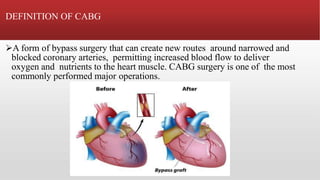
DEFINITION OF CABG
A form of bypass surgery that can create new routes around narrowed and
blocked coronary arteries, permitting increased blood flow to deliver
oxygen and nutrients to the heart muscle. CABG surgery is one of the most
commonly performed major operations.
PURPOSE
 Restore blood flow to the heart.
 Relieve chest pain.
 Improves the patient’s quality of life.
 Enables the patient to resume a normal life cycle.
 Lower the risk of a heart attack.
PROCEDURE
 The patient is brought to the operating room and moved onto the
operating table.
 An anesthetist injects to render the patient unconscious.
 The chest is opened and the heart is examined by the surgeon.
 The bypass grafts are harvested.
 In the case of "off-pump" surgery, the surgeon places devices to
stabilize the heart.
 Chest tubes are placed to drain blood from around the heart and lungs.
 The patient is moved to an intensive care unit (ICU). After awakening
and stabilizing in the ICU for 18 to 24 hours, the person is transferred to
the cardiac surgery ward.
RISK OF CABG (CORONARY ARTERY BYPASS GRAFTING)
Although complications from Coronary Artery Bypass Grafting (CABG) are
uncommon, the risks include:
 Wound infection and bleeding
 Reactions to anesthesia
 Fever
 Pain
 Stroke, heart attack, or even death
QUIZ TIME??

CardicSurgery By Bilal.pptx

  • 1.
    HEART BYPASS SURGERY By: Mirza Muhammad Bilal
  • 2.
    DEFINITION: HEART SURGERY, alsocalled CARDIAC SURGERY, involves surgical operations performed on the heart under to correct life- threatening conditions.  The surgery can be either;  OPEN HEART SURGERY  CLOSED HEART SURGERY
  • 3.
    HISTORY: The first successfulsurgery (Open heart) on the heart was performed by Dr. Daniel Hale Williams of Chicago, America in 1893.
  • 4.
    PURPOSE: ▪ The purposeof Cardiac surgery is to improve the quality of life of the patient and to extend the patient’s lifespan.
  • 5.
    DESCRIPTION: ▪ To understandhow cardiac surgery works, it is helpful to know something about the ANATOMY OF THE HEART. ▪ The heart contains 4 chambers: the right atrium, left atrium, right ventricle, and left ventricle. The atria are smaller than the ventricles and have thinner, less muscular walls than the ventricles. The ventricles are connected to the arteries that carry blood away from the heart.
  • 6.
    TYPES OF CARDIACSURGERY: OPEN HEART SURGERY. MODERN BEATING HEART SURGERY. CABG (Coronary Artery Bypass Grafting) . MINIMALLY INVASIVE SURGERY. HEART TRANSPLANT. ROBOT ASSISTED SURGERY.
  • 7.
    DEFINITION OF CABG Aform of bypass surgery that can create new routes around narrowed and blocked coronary arteries, permitting increased blood flow to deliver oxygen and nutrients to the heart muscle. CABG surgery is one of the most commonly performed major operations.
  • 8.
    PURPOSE  Restore bloodflow to the heart.  Relieve chest pain.  Improves the patient’s quality of life.  Enables the patient to resume a normal life cycle.  Lower the risk of a heart attack.
  • 9.
    PROCEDURE  The patientis brought to the operating room and moved onto the operating table.  An anesthetist injects to render the patient unconscious.  The chest is opened and the heart is examined by the surgeon.  The bypass grafts are harvested.  In the case of "off-pump" surgery, the surgeon places devices to stabilize the heart.  Chest tubes are placed to drain blood from around the heart and lungs.  The patient is moved to an intensive care unit (ICU). After awakening and stabilizing in the ICU for 18 to 24 hours, the person is transferred to the cardiac surgery ward.
  • 10.
    RISK OF CABG(CORONARY ARTERY BYPASS GRAFTING) Although complications from Coronary Artery Bypass Grafting (CABG) are uncommon, the risks include:  Wound infection and bleeding  Reactions to anesthesia  Fever  Pain  Stroke, heart attack, or even death
  • 12.