Running head: MANAGERIAL STRATEGIES FOR FOSTERING AN 1
Managerial Strategies for Fostering an Effective Multi-Generational Workforce
by
Tyler F. Will
Project Committee:
Name of Capstone Sponsor: Frank Plachecki, Ph.D.
Name of Second Reader: Joanne Smith, MA
Approved:
Submitted in partial fulfillment of the requirement for the degrees of Master of Business
Administration and Master of Arts in Management, The College of St. Scholastica, Duluth, MN.
MANAGERIAL STRATEGIES FOR FOSTERING AN 2
Acknowledgements
The process of completing not only this project, but program as well, would not have
been possible without the support of the following individuals. First, I would like to thank my
girlfriend, Bailey, and both my mother and father for the sacrifices they have made and the
support they have provided while I have embarked on this academic journey. Secondly, I would
like to extend my sincere gratitude to my project sponsors Frank Plachecki, Ph.D. and Joanne
Smith for their academic review and scholarly insights in helping navigate this project through to
completion. Finally, I would like to thank the professors at the College of St. Scholastica for the
high-level of instruction they have demonstrated and for providing me with an invaluable
educational experience.
MANAGERIAL STRATEGIES FOR FOSTERING AN 3
Abstract
The aging of the nation’s population coupled with the recent down-turn in the U.S. economy and
technological advancements has worked to facilitate an evolving domestic workforce. The
unease resulting from this economic angst has forced many of today’s older employees to defer
their retirement and continue to work well into their 70s. This transition in retirement strategy
has altered the dynamics of today’s workforce demographics, as for the first time in history five
(5) generations of employees are now active in the U.S. labor market. The purpose of this study
is to better understand the intergenerational differences that exist in today’s workforce to assist
organizational leaders in developing a managerial strategy effective across all generational
cohorts. A review of the technological impact, economic implications, and characteristics and
motivators of the generational cohorts was conducted in relation to this academic study.
Furthermore, this paper presents a topical approach to identifying a managerial strategy that
organizations can implement to assist them in effectively managing their multigenerational
workforces.
MANAGERIAL STRATEGIES FOR FOSTERING AN 4
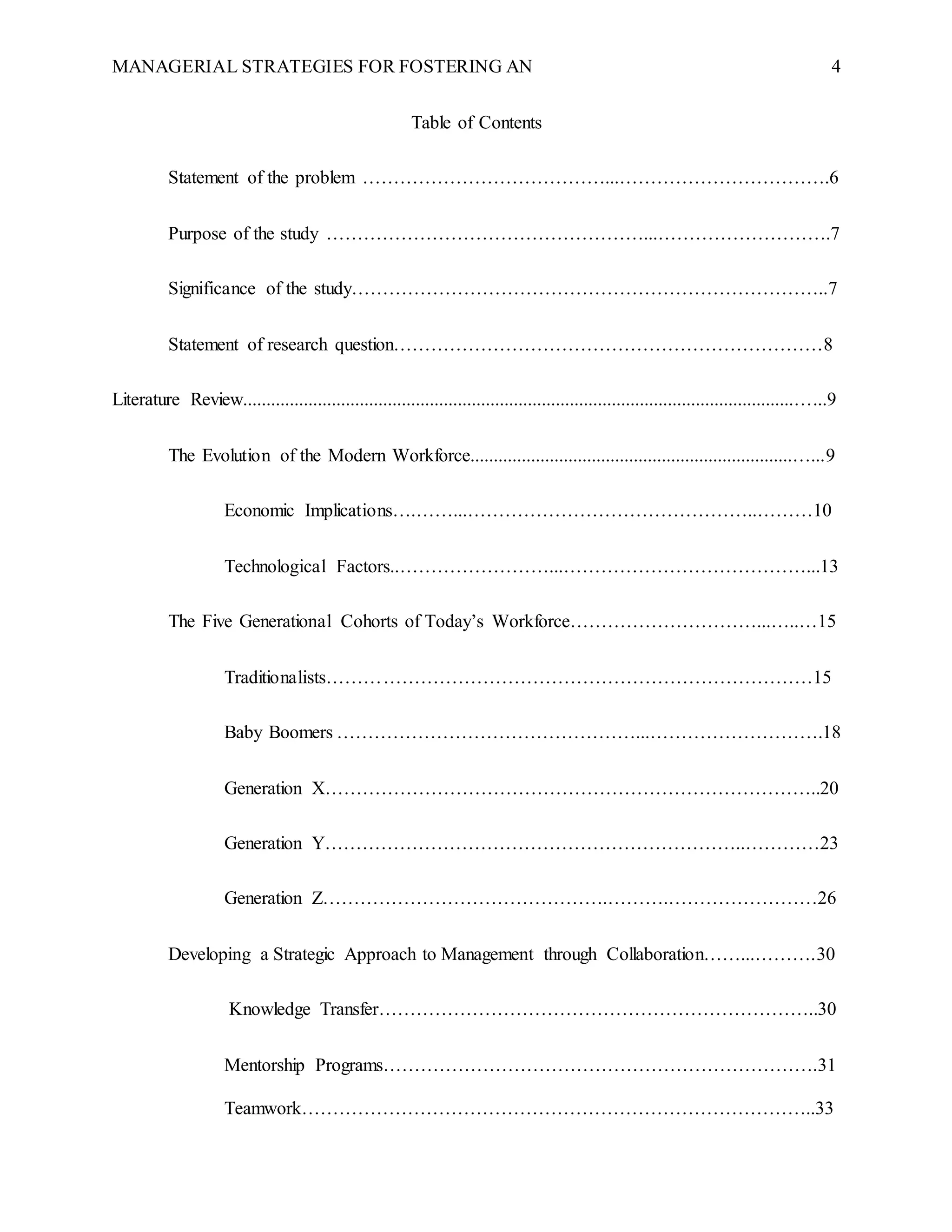
Table of Contents
Statement of the problem …………………………………...…………………………….6
Purpose of the study ……………………………………………...……………………….7
Significance of the study…………………………………………………………………..7
Statement of research question……………………………………………………………8
Literature Review......................................................................................................................…...9
The Evolution of the Modern Workforce.....................................................................…...9
Economic Implications….……...………………………………………..………10
Technological Factors..……………………...…………………………………...13
The Five Generational Cohorts of Today’s Workforce…………………………...…..…15
Traditionalists……………………………………………………………………15
Baby Boomers …………………………………………...……………………….18
Generation X……………………………………………………………………..20
Generation Y…………………………………………………………..…………23
Generation Z……………………………………….……….……………………26
Developing a Strategic Approach to Management through Collaboration……...……….30
Knowledge Transfer……………………………………………………………..30
Mentorship Programs…………………………………………………………….31
Teamwork………………………………………………………………………..33
MANAGERIAL STRATEGIES FOR FOSTERING AN 5
The Virtual Workplace…………………………………………………………..34
The Business Case for Effectively Managing a Multi-Generational Workforce………………...34
The Challenges of a Multi-Generational Workplace………………………………….....38
Application/Discussion……………………………………………………………………..……40
References……………………………………………………………………..…………………47
MANAGERIAL STRATEGIES FOR FOSTERING AN 6
Managerial Strategies for Fostering an Effective Multi-Generational Workforce
Statement of the Problem
As modern society has continued to evolve so have the dynamics of today’s workplace.
Organizations have been confronting many of the demographic changes occurring in today’s
workforce, such as increasing racial and ethnical diversity along with a greater number of female
workers. However, the workforce is also rapidly aging, though this demographic shift is only
beginning to be addressed by many organizations as a strategic and competitive challenge (Calo,
2008). In light of multiple age segments in the workforce and the aging population, human
resource management (HRM) strategies focused on attracting, engaging, and retaining
employees of all ages are of significant importance (Cogin, 2012). The purpose of this project
will be to demonstrate how an organization can develop a strategic approach to management that
will facilitate an effective multi-generational workforce across all organizational levels.
The recent downturn in the U.S. economy has played a significant role in the creation of
today’s dynamic and evolving workplace (Crawford, 2011). The unease resulting from this
current economic decline has forced many older employees to defer their retirement and continue
to work well into their 70s. This demographic shift in retirement age from 65 to 75 will require
management to incorporate the historical and common characteristics of the aging workforce into
their management styles in an effort to ensure a cohesive work environment (Crawford, 2011).
Consequently, recent technological advancements within the past 20 years have also driven a
demand in the labor market for young, educated, technology-savvy employees. With such a
diverse workforce it is imperative that organizations actively identify an effective approach to
management that, when properly implemented, can avoid increased internal costs related to job
MANAGERIAL STRATEGIES FOR FOSTERING AN 7
dissatisfaction, alienation, decreased productivity, diminished morale, and employee absences
and resignations (Bennett, Pitt, & Price, 2012).
Purpose of the Study
The purpose of this study is to review the research that has been conducted in regards to
strategic management, multi-generational workforces, and the benefits that an effective
intergenerational workforce can bring to an organization. This paper will seek to examine the
impact both the domestic economy and technological advancements have had on the U.S.
workforce, the characteristics and motivators of the five (5) generational cohorts present in
today’s labor market, and effective strategies for managing a multi-generational workforce in an
attempt to yield a sustainable competitive advantage. The objective of this research will be for
organizations to determine if their strategic approach to management is properly aligned with the
generational demographics present in their internal workforce.
Significance of the Study
As an Accounting Manager responsible for a team of five (5) individuals ranging in age
from 32 to 62, it is the author’s responsibility to ensure that his subset of the organization is
putting forth a concerted effort towards the goals of the team, department, and overall
organization. It is also the author’s responsibility to foster an organizational environment
conducive to collaboration and the fluid transfer of organizational knowledge across the
employees within his department. The author believes that if organizations were to develop an
approach to management that was effective across all generational cohorts they would (1)
possess the ability to better facilitate the transfer of tacit knowledge downward from older
generations to younger generations, (2) reduce the cost of their human capital while adding
MANAGERIAL STRATEGIES FOR FOSTERING AN 8
substantial value, and (3) create a sustainable competitive advantage over competition within the
industry.
Statement of ResearchQuestion
To understand how an effective multi-generational workforce can add value and reduce
hidden costs in an organization’s workforce, an in-depth analysis of the research questions noted
below was completed.
A. How has the U.S. workforce been impacted by the domestic economy, as well as
recent technological advancements?
B. How does an organization identify an approach to management that is properly
aligned with their goals and corporate mission?
C. What are the potential downfalls of using a single approach to management
across multiple generations and how to mitigate those risks?
MANAGERIAL STRATEGIES FOR FOSTERING AN 9
Literature Review
A review of the literature was conducted to evaluate how the proper approach to
management can yield organizational value through the facilitation of an effective multi-
generational workforce. The reasoning behind this literature review is to demonstrate that the
proper managerial strategy can foster an effective multi-generational workforce through the
promotion of collaboration, knowledge transfer, and reverse mentorship. Consequently,
organizations can realize a reduction in costs related to their human capital, improved internal
efficiencies, increased morale, and higher levels of organizational value. The goal of this
research is for organizations to better understand the benefits of implementing an approach to
management that is properly aligned with the demographics serving in their internal workforce.
This project will include (1) a review of the evolution of the modern workforce, (2) the
generational cohorts present in today’s workforce, (3) the benefits of organizational
collaboration, (4) the business case supporting a multi-generational workforce, and (5) the
challenges of an intergenerational workplace. Once a review of these components has been
completed a final assessment will be conducted to provide organizations with a conceptual
framework that they can utilize in the development of their own strategic approach to
management.
The Evolution of the Modern Workforce
Starting in 2008 the United States workforce began to experience the most radical
transformation since the end of the Great Depression in 1939. Most economists agree there
appears to be a fundamental long-term change in the patterns of job creation as a result of the
economic debacle caused by the sub-prime mortgage meltdown. As a result of the Great
Recession, many older workers planning on retiring will be unable to, and the next generation of
MANAGERIAL STRATEGIES FOR FOSTERING AN 10
employees will be impacted as a result of this current demographic shift in retirement strategy
(Crawford, 2011). In addition to the impact of the Great Recession, another element that has
contributed to the reshaping of the modern workforce is technology. The most important
changes that technology has introduced us to have been in the fields of production and
communication. Along with these technological advancements have come the generational
segments who helped to create the technology, and can effectively implement it within an
organization to add significant value (Kumar & Singh, 2014).
Economic implications. The recent down-turn in the U.S. economy has created a
dynamic and evolving workplace overwhelmed by critical issues undermining employee
productivity and mobility. The need to ascertain the viable solutions necessary to resolve these
problematic workplace challenges is critical to the recovery of our national malaise. The
workplace challenges and innovative solutions caused by this period of economic instability
must be analyzed to promote transparency and provide a roadmap for long-term success
(Crawford, 2011).
The primary problem stemming from the recent economic down-turn is that the largest
population of the domestic workforce projected to enter the retirement arena, the Baby Boomers,
has been forced to delay their retirement and continue their professional careers. The retirement
age of 65 has been replaced with a recognition that many of the 8,000 Baby Boomers turning 60
years old each day will be forced to work into their mid-70s in an effort to overcome the
financial decline caused by the sub-prime mortgage meltdown. In 2011, 77 million Baby
Boomers had attained the minimum 65 year age requirement necessary to meet the maximum
retirement benefits, but many were unable to step aside to provide the opportunity for the next
generation of workers due to a decline in their financial position (Crawford, 2011). Furthermore,
MANAGERIAL STRATEGIES FOR FOSTERING AN 11
labor statistics indicate that nearly 80 million Baby Boomers will exit the workplace within the
next decade—retiring at a rate of 8,000 per day, or more than 300 per hour, which will equate to
an unprecedented loss of skilled labor in the workforce (Kane, 2015). This is evident in the
federal government where it has been noted that the administration will need to hire more than
200,000 individuals to replenish its aging and retiring workforce (Government Business Council,
2012).
The evidence that the populations of developed countries are aging rapidly due to
decreased birth rates and longer life spans is undeniable (Calo, 2008). Although not every
country is experiencing this trend, world population reports suggest that people age 60 and older
now comprise a greater share of the world’s population than ever before, and projections indicate
that the upward trend will continue into the coming years. Moreover, the United Nations
projects that by 2050, the number of children ages 0 to 14 in developed regions will fall to only
15 percent of the population, while the percent of the population older than age 60 will reach
nearly 33 percent (Pitt-Catsouphe & Matz-Costa, 2008). There were early indications that the
workforce was aging, but predictions regarding aging issues were essentially overshadowed by
the more immediate complexities of racial, ethnic, and gender changes in the workforce that
needed to be confronted by organizations (Calo, 2008). Today, the delayed retirement of senior
employees in the workforce, coupled with an overall higher number of workers, has contributed
to a more diverse labor market.
During the downsizing drives of the 1980s and early 1990s that were predicated on
economic turbulence, many firms reduced their hiring and training initiatives. As a consequence,
many organizations are now experiencing shortages of mid-career managers and employees who
possess the skills, experience, and institutional knowledge needed to fill the knowledge gap that
MANAGERIAL STRATEGIES FOR FOSTERING AN 12
will occur when today’s elder generations slowly transition out of the workforce and into
retirement. It is noted that much of this dilemma has been precipitated by historical practices
within organizations that focused on systematically removing older workers from the workforce
(Calo, 2008).
Historically, older workers were viewed as an expendable resource to eliminate, as
opposed to a valuable resource to retain, and were therefore often subject to corporate layoffs. In
addition to corporate layoffs, many organizations also decided to offer early retirement
incentives to their long-standing employees. This move made it clear that accelerating the exit of
older workers from the workforce of many companies was either a conscious strategy or, at a
minimum, a passive acceptance that it was in the best interests of the organization’s older
workers to exit the workforce sooner rather than later (Calo, 2008).
Demographically, the United States has reached the point where the labor that is needed
and the labor that is currently available are beginning to diverge. Historically, supply has
exceeded the demand for labor, but there are now credible predictions of a general labor shortage
within the domestic economy (Calo, 2008). However, Cappelli (2008) notes that most studies
predicting future labor shortages are predicated on the assumption that the current retirement
patterns will not change and that people will continue to retire between the age of 60 and 65,
despite an increase in the overall life expectancy rate and general ability to work. While these
assumptions may be unrealistic, if for no other reason than that financial considerations will
require those in the workforce to work longer, as well as because the rising age for Social
Security benefit eligibility will delay many retirements (Calo, 2008).
These unprecedented changes in workforce demographics pose threats of both labor and
skill shortages, and are already becoming visible in unwanted turnover, skill shortages, and
MANAGERIAL STRATEGIES FOR FOSTERING AN 13
overall poor bench strength. To address these problems, organizations will need to change the
nature of the employment relationship and learning opportunities for older and younger workers
alike. Moreover, there is also the risk of losing a significant amount of the knowledge and skills
of those generations exiting the workforce if the knowledge and skills are not successfully
transferred to others prior to their departure (Calo, 2008). As a result, in a multi-generational
workforce, leaders must facilitate knowledge transfer among workers to optimize performance
and success as well as worker’s satisfaction and rewards (Wiedmer, 2015). Accordingly,
organizational leaders must devote time and planning to assess the most available knowledge,
understand who possesses key knowledge, and consider various methods of knowledge transfer
so the desired knowledge is converted and transferred to best serve a multi-generational
workforce (Stevens, 2010).
Technological factors. Aside from the aforementioned economic implications that have
contributed to the evolution of the modern workforce, technological advancements have also
played a critical role in the development of today’s employees and how they communicate in the
workplace. It has been noted that communication is the foundation for all social interaction, and
therefore the existence of society is predicated on effective communication. This means that
every significant change that humanity has experienced was derived from a technological
discovery related to communication (Rodriquez et al., 2015).
The first methods of communication, language and writing, have been followed by a
series of technologies, such as printing, telephone, radio, television, internet, and cellular phones,
which have allowed society to live more efficient lives. These new technologies have increased
the amount of communication, within and between societies, making the world more complex
than ever. Information and communication-based technology, characterized by continual
MANAGERIAL STRATEGIES FOR FOSTERING AN 14
innovation and rapid technological change, is having a significant impact on society and
accelerating social changes across the world (Rodriquez et al., 2015). These social changes are
magnified within organizations as they work to foster an environment that allows the various
segments of society to work together toward a common goal.
Today, it is widely accepted that technological change in the workplace is broadly skill
biased. It is technological advancements that drive skill and employment change, with any
organizational shifts following from the application of the new technology within the
organization. One common organizational change is the increase in employee involvement in
companies, which suggests workers are becoming more informed about their employer,
participating in discussions regarding immediate production issues or wider organizational
matters, working as contributing team members, participating in profit-sharing reward schemes
or similar performance-based incentives, being trained to perform jobs designed for greater
autonomy, and being a part of other tasks associated with the delayering of other management
activities. Typically, organizational practices such as these are referred to as “high-involvement
work practices” or “high-performance work systems.” These practices have implications for
skills utilization that run parallel with the demands of computer technologies in the workplace
(Green, 2012).
First, compared with organizations that operate more on command and control principles,
organizations that offer high-involvement environments are typically those in which
management exercises less direct control over the work of their employees. This style invokes a
need for employees to think proactively and provides a greater scope for problem-solving.
Second, there is likely to be an increased need for interaction skills in order to function well in
high-involvement corporate environments. In situations that require employees to work together
MANAGERIAL STRATEGIES FOR FOSTERING AN 15
more often and demonstrate cooperation with colleagues, to exchange critical information and
express personal opinions, and to learn and adopt at least some of the organization’s common
values and attitudes, communication activities acquire a greater range and importance in their
jobs. Since a good deal of communication occurs through the medium of the written word,
employee involvement also increases the importance of literacy (Green, 2012).
The Five Generational Cohorts of the Modern Workforce
Although age, race, and gender are three fundamental dimensions with which people
rapidly categorize themselves and others, race and gender have garnered significantly greater
research attention across various disciplines (North & Fiske, 2013). This is especially peculiar,
given that age comprises categories that every single living person eventually joins, provided
sufficient lifespan. Closely related to age is the concept of a generation, which formative work
in sociology defines as a common point in time and a “distinct consciousness” stemming from
foundational events of that time (North & Fiske, 2015). It is through these formative life
experiences that a generation develops a collective outlook on the expectations of the workplace
(Bursch & Kelly, 2014). Today, five (5) different generations comprise the domestic workforce
with trans-generation norms as well as intergenerational distinctions that define their existence
(Dixon et al., 2013).
Traditionalists. Also known as the Veterans’ Generation and the Silent Generation,
Traditionalists were born before 1946 (Bursch & Kelly, 2014). Historically, Traditionalists lived
through Adolf Hitler’s 1941 Russian invasion, the entry of the United States’ into World War II
in 1941 following the bombing of Pearl Harbor, the end of World War II in Japan and Europe in
1945, and the beginning of the Korean War in 1950 (Wiedmer, 2015). Most members of the
generation were also children during the era of the Great Depression and experienced traumatic
MANAGERIAL STRATEGIES FOR FOSTERING AN 16
times, economic strife, and high unemployment rates. As young adults during WWII, their lives
began with high expectations, which were eventually shattered by the traumatic events of the war
(Al-Asfour & Lettau, 2014). While many of the Traditionalists still in today’s workforce were
not old enough to serve in the war, they still reference it as the single most important event in
their childhood (Bursch & Kelly, 2014). Even if they and their family personally survived the
impact of the Great Depression, they witnessed the economic devastation of other countries torn
by the war (Tokar, 2013). For a Traditionalist, having a job is not an obligation, but rather a
better opportunity at survival.
Since the Traditionalists perceive work as a means of survival, they often demonstrate
intense loyalty to their employers, provide a consistent level of performance, exhibit a strong
work ethic, and place an emphasis on the betterment of their organizations ahead of their own
personal successes or failures (Macon & Artley, 2009). Consequently, the strong organizational
commitment displayed by Traditionalists fosters disdain for those who do not appreciate having
employment and those who are openly critical of the organization and its leadership.
Traditionalists generally prefer to work in conservative and hierarchical firms with a defined
organizational structure and a clear chain-of-command (Wiedmer, 2015). Traditionalists
understand the value of an organizational bureaucracy and are highly suspicious of those who
circumvent the proper communication channels within the organization (Tokar, 2013).
Traditionalists prefer managers who are directive, specific in their expectations, and who
take a logical approach to work-related challenges. They also prefer managers who demonstrate
respect, who set clear and attainable long-term goals, who are equitable and consistent, and who
also articulate clear job expectations (Bursch & Kelly, 2014). This generation likes to take
charge, delegate, and have a stake in the decision-making process (Al-Asfour & Lettau, 2014).
MANAGERIAL STRATEGIES FOR FOSTERING AN 17
In an effort to effectively manage this cohort, organizational leaders should be clear through
command-and-control management techniques and use formal communication whenever
possible (Hammill, 2005). The Society for Human Resource Management (SHRM), (2004)
recommends two effective leadership strategies for managing this generation: (1) gain their
confidence by demonstrating compassion and a deep understanding of their upbringing, and (2)
create positive working relationships by gaining trust and respecting their experience without
being intimidated by it.
The Silent Generation constitutes a mere 5 percent of today’s workforce (Wiedmer,
2015), but for financial and personal reasons, those in this generation who are still in the
workforce intend to stay (Bursch & Kelly, 2014). These underlying motives are further
supported by empirical evidence (Smyer & Pitt-Catsouphes, 2007), which suggests that three
categories of Traditionalists remain in the workforce today: (1) those who have a financial need
to work, (2) those who really enjoy work, and (3) those who fit both of the aforementioned
categories. Much of the financial pressure experienced by the Traditionalist generation can be
attributed to the recent U.S. economic implosion. As pensions and other investments seemingly
disappeared overnight many Traditionalists were forced to delay their retirement in an effort to
regain financial stability. Moreover, as the overall life expectancy of the world’s population has
increased due to advancements in healthcare, many Traditionalists have enthusiastically returned
to the workforce (Tokar, 2013). Employers, conversely, want to retain Traditionalists due to
their wealth of institutional knowledge and professional experiences, which are difficult to
replace (Bursch & Kelly, 2014). Crawford (2011) states, “Their experience, knowledge, and
wisdom are an integral component of the current workplace environment and must be preserved
to ensure a historical foundation.” (p. 85)
MANAGERIAL STRATEGIES FOR FOSTERING AN 18
Baby Boomers. The Baby Boomers were, until recently, the largest generation within
the domestic workforce. They were born in large numbers between 1946 and 1964, following
the conclusion of World War II (Bursch & Kelly, 2014). At this time thousands of soldiers,
sailors, and Marines returned home from the war and tapped into the surplus pool of women
seeking husbands. All of this resulted in a “baby boom” of 78 million babies who would soon
grow to enter the U.S. workforce (Tokar, 2013). Furthermore, those individuals born between
1945 and 1955 are often referred to as the Early Boomers, while those born after 1955 are
referred to as Late Boomers, with substantial differences existing between the two subgroups.
Today, the oldest Baby Boomers are considering their retirement options as well as seeking ways
and opportunities to make their elder years personally meaningful (Wiedmer, 2015).
The Baby Boomers were blessed to have been born at the height of America’s
international prestige, military power, and economic strength. Post-war incentives allowed their
parents to realize the American Dream in staggering numbers, and these post-war parents were
determined to lavish upon their children a lifestyle unimaginable by their Traditionalist parents
(Tokar, 2013). However, as the Baby Boomer generation grew up they were notably and
profoundly affected by historical events such as the Vietnam War, the Civil Rights riots, the
assassinations of John F. Kennedy and Dr. Martin Luther King, Watergate, and the sexual
revolution (Adams, 2000). The Baby Boomer’s perceived lack of respect for authority is
generally believed to originate from the political, religious, and business events that they
experienced as youths. Today, many Baby Boomers are culminating their careers as agents of
corporate and national power for which they were once notably disrespectful and rebellious.
Boomers are now recognized for their positive attitudes toward work and their ability to build
consensus, mentor, and affect organizational change (Dixon et al., 2013).
MANAGERIAL STRATEGIES FOR FOSTERING AN 19
Like their Traditionalist parents, Baby Boomers are characterized by their strong work
ethic, but not because they view work as a privilege as Traditionalists do, but because they are
motivated by rank, wealth, and prestige. Baby Boomers are also extremely loyal to their
employers, are service and goal-oriented, and are highly competitive in the workplace (Bursch &
Kelly, 2014). These intrinsic motivators stem from the stereotypical Baby Boomer upbringing in
which they were oftentimes the first to be educated in their families, and this education
ultimately translated into upward mobility (Wiedmer, 2015). Members of the Baby Boomer
generation also strive for authority and work prioritization, and they expect to be valued and
rewarded by the organizations that employ them. The strong work ethic and take-charge
attitudes of many Baby Boomers have helped propel them to very responsible positions that they
do not want to relinquish, as they see their identities are tied to their work (Wiedmer, 2015).
The Baby Boomer generation prefers managers who seek consensus and treat their
employees equitably. They want supervisors who employ a democratic approach to
management, works with their employees to define the team’s mission, and provides a warm and
caring work environment for all employees (Bursch & Kelly, 2014). Since the Baby Boomer
generation has such a high respect for authority within their organization, traditional hierarchy-
based approaches to leadership are recommended with this cohort. However, despite their
respect for the traditional organizational hierarchy, they still make every effort to be included in
the organizational decision-making process (Al-Asfour & Lettau, 2014). The SHRM (2004)
recommends the following leadership strategies which have been proven to work with this
generation: (1) support a work/life balance, (2) show appreciation for their energy and hard
work, (3) approach them with respect for their achievements, (4) employ a leadership style that is
collegial and consensual, (5) offer opportunities to serve as a coach as part of the change process,
MANAGERIAL STRATEGIES FOR FOSTERING AN 20
(6) challenge them to contribute as part of a team to solve organization problems, and (7) involve
them in participating in the organization’s direction and implementation of change initiatives.
With the oldest members of the Baby Boomer generation turning 65 in 2011 it was
projected that 10,000 Baby Boomers will reach retirement age each day through 2020. However,
while the oldest Boomers are approaching retirement this mass exodus of the generation from the
workforce has not happened in the expected numbers. According to the U.S. Department of
Labor, the participation rate for U.S. workers age 65 and older actually rose from 11.5% in 1992
to 18.5% in 2012. Some Baby Boomers continue to work well into their retirement years
because they have not experienced any physical issues that would prevent them from remaining
engaged in their work. Others note that they cannot afford to retire, either because they have
failed to save enough for retirement, or because their retirement funds suffered critical losses
during the recession that occurred in 2008 (Bursch & Kelly, 2014). From an organizational
standpoint a significant emphasis is placed on the fact that Baby Boomers hold leadership
positions, specialized positions, and a substantial amount of expertise in their fields. Upon
exiting the workforce, such workers take away valuable organizational knowledge and
experience with them. As a result, the organizations which employ them are affected negatively
by the lack of specialized skills (Crawford, 2011).
Generation X. This cohort, or the “me” generation, consists of the 84 million people in
the United States who were born between 1964 and 1976 (Martin & Gentry, 2011). Their most
notable life experiences included the energy crisis, Watergate, Three Mile Island, the AID’s
epidemic, Chernobyl, and the fall of the Berlin Wall (Bursch & Kelly, 2014). Their values and
priorities differ from those of the Baby Boomers because they were able to witness the outcomes
of the decisions made by their Baby Boomer parents. The members of Generation X perceive
MANAGERIAL STRATEGIES FOR FOSTERING AN 21
those in the Baby Boomer generation as hypocritical, due to their shift in priorities when
transitioning from young-adulthood to middle-age. There is also distance between the two
generations because adults, or Baby Boomers, viewed those representative of Generation X as a
disappointment (Martin & Gentry, 2011).
The members of Generation X also witnessed their mothers begin to enter the workforce
in large numbers, which would significantly alter the perception of the stereotypical family.
Many of them were also the children of broken families as the divorce rate skyrocketed in the
1960s and 1970s. During this period divorce rates reached an all-time high of 40 per 1,000
married women in the 1970s, compared to 15 per 1,000 women in the 1950’s (Bursch & Kelly,
2014). In addition to an increase in the divorce rate this period of time also experienced a
significant rise in reported suicides. This increase can be attributed to the generation’s Baby
Boomer parents who, while hardworking and loyal, struggled with corporate layoffs and
downsizing due to economic pressures related to the aforementioned world events (Martin &
Gentry, 2011). The observation of their parents’ job losses despite their parents’ demonstrated
organizational loyalty during the 1970s worked to foster a sense of distrust and pessimism
towards corporate America (Dixon et al., 2013). However, the shift in the family dynamic led
many members of Generation X to experience independence early in life, and ultimately allowed
them to thrive on change (Bursch & Kelly, 2014).
The members of Generation X watched their Baby Boomer parents get laid off and have
grown to expect and embrace change, which has not only made them more independent, but also
more probable to job hop to increase marketability, and more likely to view their work-and-life
balance as extremely important (Leibow, 2014). Recognizing the value of education, they
demonstrate low levels of organizational loyalty and high devotion to their personal goals (Dixon
MANAGERIAL STRATEGIES FOR FOSTERING AN 22
et al., 2013). Rather than working in an effort to attain money and status, they are more
interested in a job that is personally rewarding and caters to their interests. As a result, those in
generation X prefer a job that is flexible, stimulating, challenging, and interesting (Martin &
Gentry, 2011).
HR and talent management professionals who want to recruit and retain this generation
must appeal to its strong desire for flexibility in how and/or where work is conducted.
Generation X also places significant value on learning and craves experiences that will help them
attain new skills (Bursch & Kelly, 2014). This is critical as Gen-Xers are noted for their
willingness to develop new skills and apply them effectively. However, in return those members
of the generation expect employers to listen to their needs, provide an enabling culture and
organizational structure, and pay fairly (Dixon et al., 2013). Generation X workers typically
display resistant behaviors towards micromanaging bosses and find them to be distasteful and
undesirable. They also find informal policies on dress codes and workplace habits, or
formalities, to be rather fun and motivating. In the workplace Gen-Xers are pragmatic and
direct, expect change, and also require a degree of flexibility in the rules and regulations of the
workplace (Wiedmer, 2015).
The members of Generation X prefer managers who are straightforward, genuine, and
“hands-off” in their approach to management. They also want the opportunity to have ongoing
training and seek growth opportunities within their organization, even if those opportunities are
lateral (Bursch & Kelly, 2014). Traditional approaches to management are not recommended for
Generation X. Rather, a new leadership approach to this particular cohort needs to be
progressively focused, employee-centered, and collaborative to fit the needs of the generation
gap which exists between Generation X and the retiring Baby Boomers slowly exiting the
MANAGERIAL STRATEGIES FOR FOSTERING AN 23
workforce (Dwyer, 2009). The SHRM (2004) recommends the following leadership strategies
that have proven effective when working with this generation: (1) tell them the truth, (2) offer
mentoring programs, (3) clearly identify boundaries within the organization, (4) offer learning
opportunities, (5) honor the sense of a work/life balance, (6) respect the experiences that have
worked to shape their beliefs and thinking, and (7) clearly communicate that repetitive tasks and
quality checks are a part of the job.
As the Baby Boomers continue to slowly retire, generation X is increasing its presence in
the workforce followed by Generation Y, which is also growing its share in today’s labor market.
If Generation X is known as the “me generation,” Generation Y might be called the “why me”
generation. Today, these two cohorts are the most technologically savvy generations in the
workforce (Al-Asfour & Lettau, 2014).
Generation Y. This generation is commonly referred to as the Millennials or Generation
We and consists of the individuals born between 1976 and 1996 (Martin & Gentry, 2011). The
Millennial generation is larger than the 46 million individuals who are in Generation X and
nearly equal in size to the 76.4 million in the Baby Boomer generation. However, there are
likely to be differences between the younger and the older subsets within the cohort. Those
Millennials born between 1976 and 1992 were either established or entering the job market
during or at the end of the recent recession which began in December 2007 and ended in June
2009, while those Millennials born since 1992 might still be obtaining their education and
entering the workforce (DeVaney, 2015).
The Millennial generation has been exposed to educational, economic, social, and
political contexts that are relatively unique when compared to the other generations within
today’s workforce. For example, Generation Y has been shaped by, among other things,
MANAGERIAL STRATEGIES FOR FOSTERING AN 24
helicopter parents, frequent feedback and positive reassurance, significant technological
advances, and political and economic turmoil (Thompson & Gregory, 2012). Furthermore, this
generation experienced the Oklahoma City bombing, the Columbine shootings, 9/11 terrorist
attacks, Enron scandal, and Hurricane Katrina, which all contributed in influencing its members.
These events left an indelible mark on the Millennial generation, but nothing shaped and defined
this generation more than the internet, which opened an entirely new world of opportunities
(Bursch & Kelly, 2014). As the most technologically literate generation within the workforce,
these digitarians have grown up using computers and cellular phones and are frequently referred
to as the “Linked Generation” (Keepnews et al., 2010).
Generation Y grew up during a time of immense and fast-paced changes. These changes,
like those in Generation X, presented full-time employment opportunities for both parents and
significant respect for ethnic and cultural diversity including social awareness, social justice,
computer and internet use, home, school, and work (Al-Asfour & Lettau, 2014). It is believed
that much of the respect garnered for cultural awareness can be attributed to the demographic
differences that exist within the generational cohort. Millennials are more racially diverse than
any previous generation; 47% are minority as compared to 37% for Generation X, 26% for the
Baby Boomers, and 9% for Traditionalists. However, it is not just race or ethnicity that makes
this generation diverse. The home-life of this generation differs significantly from its
predecessors, originating from more single-parent homes, blended families, and same-sex
families than ever before (Brack, 2012). Furthermore, one fourth of the millennial generation
have college degrees, which is comparable to other generations. However, Millennials may
exceed the education levels of previous generations as time slowly passes and those in the latter
subset of the cohort complete their education (DeVaney, 2015). A 2010 Pew reported entitled
MANAGERIAL STRATEGIES FOR FOSTERING AN 25
Millennials: A Portrait of Generation Next projects that millennials will be the most educated
American generation (Mottola, 2014).
Millennials prefer managers who take an educational approach to management and who
take the time necessary to understand their personal and professional goals. Generation Y values
managers who coach them, are positive, motivational, collaborative, and achievement-oriented;
and who provide foundational structure (Bursch & Kelly, 2014). Kupperschmidt (2000)
identifies five important qualities Millennials seek in their employers: (1) fun environment, (2)
growth opportunities, (3) variety of work-related projects, (4) opportunity to learn new skills, and
(5) flexible schedules. They expect their peers to keep up with, and use, cutting edge
technology. However, this technological fluency and its effect on interactions with others and
expectations on the flow of information may be at the root of some workplace conflict between
the Millennial and Baby Boomer Generations (Bursch & Kelly, 2014). Moreover, Millennials
are often accustom to working in teams and expect supervision and task structure more so than
Baby Boomers and Generation X. They have adopted a global perspective and seek
organizations that lack a hierarchical structure and understand sustainability (Dixon et al., 2013).
While the leadership approach to Millennials is similar to that of Generation X, scholars
in the field tend to recommend an emphasis on continuous and instant feedback, as this
generation has come to expect instant and timely feedback on the work that they do. A polite
relationship with authority should be encouraged by leaders to use in leading this particular
cohort (Al-Asfour & Lettau, 2014). The U.S. Department of Commerce (2011) has made the
following recommendations for leaders directing this generation: (1) leaders should utilize email
as their primary communication tool, (2) feedback should be provided to and received from
Millennials on a regular basis, (3) an information-based communication style that emphasizes
MANAGERIAL STRATEGIES FOR FOSTERING AN 26
positivity should be used, and (4) information should be shared on a regular basis and
Millennials should be kept informed. SHRM (2004) also suggests additional recommendations
for leading both Generation X and Y. They recommend that leaders be honest with their
employees, clearly identify organizational boundaries, offer mentoring programs, communicate
in a clear and concise manner, express clarity regarding expectations, provide them opportunities
to learn, and provide them with feedback in a timely manner. While these suggestions should be
utilized with all generations in the workforce, they are especially critical when managing
Generation Y as they strongly admire leaders who display these characteristics and values (Al-
Asfour & Lettau, 2014).
Generation Z. As organizations attempt to understand the millennial generation, while
also keeping tabs on Generation X and the Baby Boomers, a new cohort is beginning to enter the
workforce. Roughly defined as those born after 1996, Generation Z is the group of under-20-
something-year-olds, the first generation born into the digital world. Generation Z, the next
generation of trendsetters, consisting of 23 million individuals (Wiedmer, 2015), or 25 percent of
the U.S. population, is already beginning to make its mark on the world (Dupont, 2015).
This generation is often associated with a variety of different names including the “New
Realists,” which relates to their grounded outlook on the future due to such events and conditions
as 9/11, the Great Recession, the war on terrorism, various mass school shootings and climate
change, as well as significant shifts in issues such as gay marriage and the legalization of
marijuana that were once considered taboo (Dupont, 2015). This generation has also seen the
cost of higher education rising coupled with an explosion in student loan debt. As a result,
members of this cohort place more value in work experience as opposed to formal education
(Bursch & Kelly, 2014). As higher education continues to become more cost prohibitive,
MANAGERIAL STRATEGIES FOR FOSTERING AN 27
Generation Z has begun to seek out alternative approaches to enter their preferred, chosen
professions (Wiedmer, 2015). Renfro (2012) notes that 65% of today’s grade-school students
will work in positions that do not currently exist. As more members of Generation Z begin to
enter the workforce they be a different type of professional: not 40-hour per week cubicle
workers, but freelance contractors with great flexibility, who possess the ability to solve
problems with a particular expertise (Renfro, 2012.).
Research also suggests that Generation Z possesses an even higher technological aptitude
as compared to Millennials (Bursch & Kelly, 2014). One survey found that Generation Z has the
highest level of technological connectivity, with many members of the generation spending
virtually all of their waking hours connected to a computer, tablet, smart phone, or other
electronic device (McCafferty, 2013). Renfro (2012) also notes that the earliest members of
Generation Z are beginning to enter the workforce, and they are typically technologically savvy;
socially connected to their peers through various social media outlets; bright, with I.Q. scores
higher than any generation before them; and generally accepting of diverse populations. Like the
Millennial generation before them, this will affect their preferences and work styles including
their method of communication, how they gather information and learn, and their ability to work
with others (Bursch & Kelly, 2014).
In an effort to foster more effective communication, Dupont (2015) suggests those
managing Generation Z speak in terms of value. Based on their experience with the recent Great
Recession, the New Realists want to know they are getting a good value for their dollar. While
they may be ready to purchase the new IPhone upon release, they will rarely take the value of a
hard-earned dollar for granted. Furthermore, Dupont (2015) also recommends that those leading
Generation Z should make a point to recognize their personal ambitions. It has been noted that
MANAGERIAL STRATEGIES FOR FOSTERING AN 28
the New Realists are under immense pressure from their Generation X and Baby Boomer parents
to gain critical professional experience early in their life. They’re facing parental pressures to
participate in extra-curricular activities that will allow them to gain work-related experience, as
well as enroll in Advanced Placement (AP) courses to get a head start on their bachelor’s degree
and save on tuition costs. Dupont (2015) also notes that those in Generation Z will begin seeking
internships and mentorship programs much earlier than their Millennial predecessors.
Organizations looking to effectively communicate with their Generation Z employees
should also provide them with shareable content as well as the tools necessary to create their
own. Dupont (2015) recommends speaking to Generation Z in “bursts” of communication that
they can easily share with others who require the knowledge being passed along. Supplementary
communication tools such as symbols, videos, and graphics should also be included to
complement the information being shared. These additional components to the communication
process are critical as Generation Z demonstrates more effective communication when they are
present. Dupont (2015) also notes that organizations must realize Generation Z is collaborative,
but also independent and entrepreneurial. The impact of the Great Recession has taught this
generation how to be independent, but the use of tools such as Google Docs, Google Drive, and
SharePoint in their educational upbringing has also fostered collaboration. Furthermore, the
New Realists also possess and entrepreneurial desire, as they have witnessed both their parents
and older siblings struggle in the workforce. For many in Generation Z, entrepreneurship
provides the opportunity to do something good for the world and experience a sense of
fulfillment. Lastly, Dupont (2015) suggests that managers should simply be honest when
communicating with their Generation Z employees. Having witnessed their older siblings
graduate from college only to move back home with no job, Generation Z abhors the corporate
MANAGERIAL STRATEGIES FOR FOSTERING AN 29
run-around. Those in the cohort want to know what is really taking place within the
organization; therefore, companies should emphasize transparency and authenticity when
working with this cohort.
MANAGERIAL STRATEGIES FOR FOSTERING AN 30
Discussion
Developing a Strategic Approach to Management through Collaboration
As a crucial generational transition begins to unfold, it must be managed consciously and
willingly in an effort to avoid a “war of talents.” Organizations must gain an understanding of
the variety of generational dynamics and the challenge of fostering an environment that enables
communication and knowledge transfer within the firm (Bennett et. al., 2012). Researchers and
practitioners have discussed the importance of knowledge transfer to an organization’s success,
and knowledge has become recognized as the most strategically significant resource of any
organization. When Peter Drucker alerted organizational leaders to the rise of the knowledge
society, he described the radical change in the meaning of knowledge and how knowledge had
assumed even greater importance than either capital or labor for nations (Calo, 2008).
Knowledge transfer. As the workforce driving the knowledge economy continues to
age, new challenges will arise, particularly the risk of a significant loss of valuable knowledge as
members of the Traditionalist and Baby Boomer generations begin to exit the workforce. Many
of these employees have amassed great knowledge, skills, and wisdom that has not been captured
within the organization’s collective memory system, or which has not been personally
transferred to other individuals within the company (Calo, 2008). Since each generation in
today’s workforce has skills and traits that other generations do not possess, and those skills can
serve the organization to increase productivity, firms should begin to emphasize the need for
knowledge transfer (Kilber et al., 2014).
Regardless of how generations may be conceptualized, the chronological
interdependencies between those individuals representing multiple generations serve as the basis
for the transmission of skills, knowledge, ideas, values, and experience within organizations
MANAGERIAL STRATEGIES FOR FOSTERING AN 31
(Joshi et al., 2010). Wiedmer (2015) states that identifying and retaining valuable intellectual
capital among a multigenerational workforce are critical goals for leaders who understand the
tremendous amount of institutional wisdom possessed by workers of all ages and generations.
Furthermore, it is noted that the overall wellbeing and effectiveness of schools and businesses
are fostered and built when organizational leaders exert a conscious effort to expand and share
knowledge among workers. However, many organizations fail to react with a sense of urgency
when the lack of an effective knowledge transfer process results in the continuous loss of
unrecoverable knowledge as valued employees transition to retirement or simply exit the
company (Calo, 2008).
Knowledge management is a broad concept that has been defined as “a conscious
strategy of getting the right knowledge to the right people at the right time” (O’Dell & Grayson,
1998) and as an attempt of putting knowledge into action to improve the overall performance of
an organization. The process of transferring knowledge from one person to another, or to the
broader organizational knowledge base, is a challenging aspect of the knowledge management
process because knowledge transfer does not occur spontaneously or naturally. Ensuring an
effective transfer of knowledge requires having an understanding of the dynamics and
organizational processes of knowledge transfer (Calo, 2008).
Mentorship programs. Today, many organizations who employ a multigenerational
workforces are beginning to emphasize the importance of collaboration within the workplace in
an effort to facilitate knowledge transfer. One of the best ways of ensuring an effective
transition of knowledge from the Traditionalists and Baby Boomers to the Millennials and
Generation Z is through the utilization of a mentoring program (Bennett, 2012). Appelbaum et
al. (2004) defines a mentoring program as a developmentally oriented relationship between
MANAGERIAL STRATEGIES FOR FOSTERING AN 32
senior and junior colleagues or peers that involves advising, role modeling, networking, and
sharing tacit knowledge. Furthermore, tacit knowledge is defined as “inexpressible and not
readily transferable to others.” It is informal and uncodified, and typically exists in the heads of
employees and in the experiences of the organization for which they work. This knowledge
differs from what is commonly known as explicit knowledge, which can be highly codified and
readily transferred within an organization, or between individuals without loss of meaning (Calo,
2008).
Since the attainment of tacit knowledge is often based on personal experiences within an
organization, members of all generations can possess the intangible wealth of knowledge. As a
result many organizations have begun to implement reverse, or reciprocal mentoring programs,
which pair younger workers with seasoned executives to work on specific business objectives,
usually involving technology (Knight, 2014). This practice is critical as younger generations,
such as Millennials and Generation Z, have grown up intertwined with today’s technology and
can serve as a wealth of knowledge to older generations who have little to no experience with
these technological advancements. For example, younger employees who grew up with the
internet can teach their older coworkers about the ability of social media to drive business
results, whereas the more experienced employee can pass institutional knowledge onto their
younger predecessor. This approach to mentorship is typically more effective for Millennials
and Generation Y as younger employees often find it easier to receive advice from a senior
employee as opposed to one of their peers since they are not competing in a similar framework
(Knight, 2014).
In an effort to ensure the longevity of the mentoring program it should be properly
aligned with the organization’s strategy (Appelbaum et al., 2004). Bennett et al. (2012) notes
MANAGERIAL STRATEGIES FOR FOSTERING AN 33
that in today’s escalating “war for talent,” mentoring can greatly assist an organization by
supporting career-development initiatives, helping to communicate values and behaviors,
enhancing staff recruitment and retention, providing employees with a sense of belonging,
providing opportunities to expand networks, empower employees, boost job satisfaction, and
facilitate knowledge transfer for example.
Teamwork. In addition to mentorship programs, many organizations that employ a
multigenerational workforce are beginning to adopt a team-based approach to work in an effort
to promote more intergenerational collaboration. Encouraging employees to work with one
another by developing training teamwork models will help employees to understand how to
leverage each other’s skills. This can be done by discussing with employees their generational
differences, looking for solutions to overcoming them during the training, and seeking ways to
increase collaboration and communication. While the development of training models can be a
daunting task, the organizational benefits can be seen in the maximization of employee creativity
and productivity (Al-Asfour & Lettau, 2014).
A team-oriented work environment also provides organizations with other benefits, and
increases the chance of attracting and retaining high-performance Generation Y employees. As
previously noted, the preferred workplace style of millennial employees is one that favors a non-
hierarchal management structure (Bennett, 2012). Moreover, Generation Y employees are
perceived as team players who prefer to work in teams rather than on their own due to their
constant need for social connections. They possess an innate need to share their ideas; being
able to bounce ideas off fellow team members can help to perfect both procedures and projects
(Kilber et al., 2014). As a result, it can be deemed that the most successful organizations will be
those who have adopted a more team-based approach to work. This internal structure will not
MANAGERIAL STRATEGIES FOR FOSTERING AN 34
only resonate with the characteristics of Millennials, but also provide an organizational
framework that facilitates the transfer of tacit knowledge from senior team members. Teamwork
and organizational collaboration naturally foster mentoring, teaching, and mutual learning,
therefore providing a platform conducive to the transfer of knowledge (Bennett, 2012).
The virtual workplace. As technology continues to blur the traditional distinctions
between work environments and buildings many businesses have increasingly adopted a virtual
approach to the workplace. This has led to businesses evolving into larger organizational
networks, containing a multigenerational workforce that is dispersed over different locations and
time zones (Bennett, 2012). This approach to work also fosters collaboration as it provides an
online platform for employees of all generations to work together on various projects and
organizational issues, regardless of their physical location. As Millennials are the most
technologically savvy generation in today’s workplace, they are perhaps best positioned to
mentor the Traditionalists and Boomers about the use of technology, social networking, and
social media—skills that will enable them to enjoy semi-retirement and keep working without
having to travel to the physical office so they wish (Bennett, 2012).
The Business Case for Effectively Managing a Multi-Generational Workforce
Generational differences in organizations inhibit the transfer of crucial information from
managers in leadership positions to entry-level employees. This can be attributed to differences
in the values, attitudes, and beliefs of each generation (Al-Asfour & Lettau, 2014). However,
bottom-line benefits do exist for those organizations that proactively address multi-generational
issues in the workplace. A qualitative summary of organizations that have made adjustments
focused on older workers, such as altering ergonomics and targeting older worker-specific skills,
indicates significant gains in both financial profits and employee retention (North & Hershfield,
MANAGERIAL STRATEGIES FOR FOSTERING AN 35
2014). Moreover, those who successfully avoid age discriminatory hiring practices experience
higher levels of overall success in terms of employment desirability, industry reputation, and
sales and profit rankings (Bendick et al, 1997).
According to Murphy (2007), an improved corporate culture is one of the advantages that
can stem from an effective multi-generational workforce. Human Resource and talent
management professionals who take the time necessary to educate employees on generational
issues will improve intergenerational understanding, multi-generational inclusiveness, respect,
and productivity (Bursch & Kelly, 2014). A successful corporate culture is one that
demonstrates openness and is perceived as inviting by those on the outside of the company. The
organizations that display this type of organizational culture will attract the best talent, who will
in turn make their own contributions to the culture, thus benefiting the overarching organization.
In an effort to educate employees about the various demographics present in their work
environment, many companies have adopted the organizational practice of diversity training.
The belief that underlies this strategy is that fault-lines foster tension because group members, by
default, behave accordingly with the behavior of their particular group identify (Lau &
Murnighan, 1998), but when the members of a group work toward a superordinate goal, this can
foster cultural values that supersede fault-line divisions (North & Fiske, 2015). In addition,
evidence argues for the importance of fostering dual identities within an organization’s older
employees. That is, as both a member of their generation and a member of their organization, as
a means of fostering intergenerational harmony and positive attitudes toward work among older
workers (Iweins et al., 2013). As a result, managers seeking to effectively harness multi-
generational collaboration should strive to emphasize superordinate, organization-focused goals
and identities (North & Fiske, 2015).
MANAGERIAL STRATEGIES FOR FOSTERING AN 36
In addition to an improved corporate culture, Murphy (2007) believes that increased
employee engagement and morale are additional benefits that can be derived from an effective
multi-generational workforce. Towers Perrin (2003) defines employee engagement as
employees’ willingness and ability to contribute to a company’s success by putting a
discretionary effort into their work, in the form of extra time, brain power, or energy. However,
it has also been noted that engagement goes beyond satisfaction and commitment and is an
enhanced state of thinking and acting that brings both personal fulfillment and positive
contributions for the organization at hand (Pitt-Catsouphes & Matz-Costa, 2008).
Enhanced employee engagement is associated with an array of benefits for both
employees and the organizations that employ them. Research indicates that workers who are
engaged in their work tend to be less stressed, more satisfied with their personal lives, use less
health care, and take fewer sick days than those employees who are actively disengaged from
their work (Harter et al., 2002). Other research has suggested that employee engagement can
foster good health and positive affect among employees. Furthermore, from the perspective of
the employer, engaged employees are typically more productive, more profitable, create stronger
relationships, and generally stay with their organizations longer than their less engaged
counterparts (Harter et al., 2002). Managers who know how to motivate employees from
different generations can improve employee engagement and morale, which can lead to
additional organizational benefits (Bursch & Kelly, 2014).
An organization that is properly educated regarding the generational segments present in
their workforce reduces the likelihood of age discrimination and alleviates potential “brain drain”
as members of the older generations begin to transition out of the workplace (Murphy, 2007). As
a result these companies can proactively address multi-generational issues within their
MANAGERIAL STRATEGIES FOR FOSTERING AN 37
workplace, thus providing them with a competitive advantage over their competitors, as well as
benefits to their bottom-line. Today, it is critical for organizations to leverage any advantage
they have, as the manufacturing and service industries have become hyper-competitive due to an
influx of new players flooding the market.
Crawford (2011) notes that the generations present in today’s labor pool are becoming
increasingly important in today’s work environment. The attempts of many business
organizations to create a diverse workforce have worked to reduce the level of racial, age, and
gender prejudice that once ran rampant in companies. In an effort to establish better professional
relationships and equality among their employees, many organizations have begun to implement
equal opportunity programs (Crawford, 2011). These programs help to ensure that organizations
provide a fair opportunity for employment to any candidate who displays interest regardless of
their age, sex, race, or other demographic factor. Equal opportunity programs work to educate
employers and employees about the various demographics present in today’s workforce to
reduce the potential of discriminatory hiring practices, and ultimately work to provide
organizations with the opportunity to hire the most qualified candidates. With the right
employees in place, regardless of their demographic profiles, organizations can leverage their
individual skill-sets to yield maximum value from their workforce.
It is also recommended that senior leaders work to cultivate new and innovative methods
of training and developing new leaders to lead their multi-generational organizations into the
future. Encouraging employees to work with one another by developing training teamwork
models will help employees to understand how to leverage each other’s skills. This can be done
by discussing with employees their generational differences and identifying solutions for
overcoming them during the training and seeking ways to increase organizational collaboration
MANAGERIAL STRATEGIES FOR FOSTERING AN 38
and communication. Developing training models to facilitate an effective multi-generational
workforce can be a challenging task; however, the benefits of such can overcome its cost with a
significant impact to the firm’s bottom line (Al-Asfour & Lettau, 2014).
The challenges of a multi-generational workforce. Organizations can benefit from a
diverse, multi-generational workplace, but they must also have a strategy in place to overcome
any potential challenges that may arise (Bursch & Kelly, 2014). A key roadblock in generations
working together productively is the potential for intergenerational tension. Broadly speaking,
tensions between people are particularly common between those experiencing close proximity
and interdependence—implicating gender and age more so than race—and the family and the
workplace as primary battlegrounds. Although not inevitable, the potential for generational
tensions is particularly high in a rapidly aging, modernized world, which exacerbates such latent
tensions, raises interdependence-oriented concerns, and stokes generational equity fires (North &
Fiske, 2013).
The seeds of generational clashes are also apparent at both the workforce and workplace
levels (North & Fiske, 2015). At a macro level, those employees belonging to Generation Z
currently hold the highest rates of unemployment by a significant margin, and a growing number
of individuals, including some Baby Boomers themselves, blame the older generations of today’s
workforce for the economic plight of the Millennial segment (Frezza, 2014). Moreover, more
than half of the Millennial generation believes that there will not be any Social Security funds
left for them to enjoy retirement, as older generations currently do, and current projections do
suggest that Baby Boomers will eventually reap more than they have paid into the program
(Hornick, 2011). On the contrary, some believe that low wages overall, rather than the behavior
of the Baby Boomers, are the main culprit behind the depleted, wage-funded social programs.
MANAGERIAL STRATEGIES FOR FOSTERING AN 39
Nevertheless, these far-reaching trends lead many younger workers to believe that they are the
“Screwed Generation” or the “Broke Generation” (Kotkin, 2012).
These broad anxieties might trickle down to managers attempting to accommodate the
different generations present in their workforce. On the one hand, the need to invest in older
workers is greater than ever, for the sole reason that they represent the only growing segments of
the labor market. On the other hand, investing solely in the elder generations of the workforce
risks exacerbating already present lamentations from younger generations about unequal
opportunities when compared with their older coworkers. Indeed, in the increasingly age-diverse
workplace, employee benefit programs which are primarily designed ostensibly to attract and
retain employees, may inadvertently spur intergenerational workplace conflict by placing
differential financial burden on different-aged employees to subsidize them (North & Fiske,
2015). Moreover, a recent survey finds approximately 60% of all workplaces report the presence
of intergenerational conflict, with over 70% of older employees expressing dismissal of the
abilities of their younger coworkers, while nearly half of the younger workers dismissed the
skills of their more seasoned colleagues (Murphy, 2007). Furthermore, the younger generations
said they hesitated to hold their older associates accountable, while the older Baby Boomers and
Traditionalists admitted that they tended to lose their temper more easily, with one in four noting
they became frustrated, upset, or angry during difficult conversations with their younger
colleagues (Bursch & Kelly, 2014). This further indicates the clash of the generations to be a
critical, practical, and timely managerial challenge (North & Fiske, 2015).
To reiterate the theory-driven roots of generational tensions, recent demographic trends
have intensified the potential of such fissures in the workplace. Increased levels of delayed
retirements and younger worker unemployment have presented emergent challenges for
MANAGERIAL STRATEGIES FOR FOSTERING AN 40
organizational leaders. These challenges include, but are not limited to, accommodating both
older workers and diverse generations within the modern workplace. Managers who
successfully distinguish perceptions from realities in accommodating their older employees stand
to benefit a great deal. However, at the same time, they must recognize that rapidly changing
organizational demography has threatened traditional, generational turn-taking, fostering
generational imbalances that may very well undermine workplace harmony (North & Fiske,
2015).
Application/Discussion
Those individuals who serve in leadership roles within their organizations do so because
of their ability to manage workplace problems. Today, one problem all mangers face is working
effectively with trans-generational work groups, despite diversity training interventions and other
internal practices. Leveraging generational differences for energy and drive requires managers
to harness the differences that constitute the intergenerational workforce into cohesive, inter-
dependent work groups (Dixon et al., 2013). Identifying and retaining valuable intellectual
capital among a multi-generational workforce are critical goals for those leaders who understand
the significant amount of institutional wisdom possessed by workers of all ages and generations
(Wiedmer, 2015). The struggle and challenge is how to harness the differences to benefit the
organization and the competitive posture of the business within the industry it operates (Dixon et
al., 2013).
While generational relations serve as the underlying transmission of genes, a process
believed to affect the structure of society, they play an equally important role within
organizations. Regardless of how generations may be conceptualized, the chronological
interdependencies between individuals representing multiple generations are the basis for the
MANAGERIAL STRATEGIES FOR FOSTERING AN 41
transmission of skills, knowledge, ideas, values, and experience in organizations (Joshi et al.,
2010). Researchers and practitioners have discussed the importance of knowledge transfer to an
organization’s success, and knowledge has become recognized as the most strategically
significant resource an organization can possess. However, the knowledge held by those
individuals within the company must be effectively transferred to others within the organization
in order for that knowledge to be leveraged (Calo, 2008). If the knowledge is not properly
transferred prior to the generation holding the knowledge transitioning out of the workforce, it
will be forever lost.
In an attempt to facilitate the transfer of organizational knowledge today’s business
leaders must identify and implement a managerial strategy that is predicated on fostering an
effective multi-generational workforce skilled in the process of knowledge transfer. However,
since the five generational cohorts currently active in today’s workforce have been shaped by
different experiences, educational accomplishments, and world events, this presents a significant
challenge to today’s organizational leaders. Despite this diversity within today’s labor pool Al-
Asfour and Lettau (2014) believe that in order to successfully lead a multi-generational venture
managers must utilize an assortment of different leadership strategies. Furthermore, academic
literature suggests that leaders need to “adjust” their management style appropriately in an effort
to resonate with the generation for which they are addressing. These adjustments are
recommended as long as they do not lead to favoritism or discrimination of employees based on
their generational cohort (Al-Asfour & Lettau, 2014). Managers must perform a general
assessment of the situations that they encounter, as well as the generational segments involved,
and apply the managerial approach that is deemed the best fit.
MANAGERIAL STRATEGIES FOR FOSTERING AN 42
The primary dimension of organizational leadership in which business leaders must
demonstrate fluidity in their strategic approach to management is employee engagement. The
concept of employee engagement has evolved from research on organizational commitment,
motivation, and employee involvement (Pitt-Catsouphes & Matz-Costa, 2008). Today,
engagement is defined as the degree to which employees make full use of their cognitive,
emotional, and physical resources in an effort to perform role-related work (May et al., 2004).
The need for organizational leaders to transform the work environment into a place and culture
where employees can feel engaged and psychologically safe to meet job and task requirements is
critical in establishing a work ethic conducive to both affective and normative commitment
(Dixon et al., 2013). When addressing employee engagement across a multi-generational
workforce, an effective manager will find it necessary to balance two objectives that can
compound the influence of multiple generations within the workforce.
In an effort to maximize employee engagement within a multigenerational workforce
organizational leaders must first work to leverage the “ought to stay” and “want to stay”
tendencies of Millennials as well as their Generation X predecessors in an effort to nurture more
productive employees (Dixon et al., 2013). This is imperative as academic research suggests that
employees who express a genuine desire to work for their organizations consistently exhibit
higher levels of motivation and overall productivity in their work. However, the challenge that
arises with this particular objective is that both Millennials and Generation X employees are
highly transient when it comes to their professional careers. This mobility stems from a lack of
organizational commitment that is frequently associated with those of the Traditionalist and
Baby Boomer generations, who oftentimes dedicate their professional careers to a single
company. In an effort to retain this new age of nomadic employees managers should adopt an
MANAGERIAL STRATEGIES FOR FOSTERING AN 43
employee-focused approach to management tailored to these individuals. This will elicit a sense
of personalization to employees and make them feel as though their contributions to the
organization are valued and that they are being acknowledged. Moreover, managers should
emphasize collaboration with these cohorts as it will serve as a platform to foster innovation and
cross-generational knowledge transfer.
Dixon et al. (2013) suggests that the second objective that must be balanced to reduce the
compounding effects of a multigenerational workforce is to maintain the “follower” behaviors of
assuming responsibilities and serving to focus both the morale and performance of the Baby
Boomers. This objective is predicated on the concept of “followership” which Chaleff (2009)
defines through the five unique organizational behaviors of having the courage to (1) assume
responsibility, (2) serve, (3) challenge, (4) transform, and (5) take moral action. When applying
this construct to the second objective presented by Dixon et al. (2013), it proposes that those who
manage an intergenerational workforce should focus on the Baby Boomer generation as the ideal
employee. This is because Boomers are now recognized for their positive attitudes toward work
and their ability to build consensus, mentor, and affect organizational change (Dixon et al.,
2013). As a result, managers can rely on this generation to serve as a role model for younger
employees with the hope that today’s Millennials and those composing Generation Z will adopt
similar values.
In addition to employee engagement, another critical element of an organizational
leader’s managerial strategy is their approach to employee motivation. Historically, employee
engagement and motivation have been used interchangeably as an employee that is engaged is
oftentimes perceived as motivated. Similar to engagement, motivation is a key element to
employee performance and productivity, making it a central part HRM. Work motivation factors
MANAGERIAL STRATEGIES FOR FOSTERING AN 44
include both intrinsic factors, desires from within to perform a certain task, and extrinsic factors,
influences external to the individual and unrelated to the task they are performing (Ryan & Deci,
2000). In the workplace, intrinsic motivation emphasizes rewards, derived from the work itself,
as well as the need for appreciation, achievement, and creativity. Extrinsic motivation focuses
on external rewards such as pay, monetary rewards, benefits, workplace characteristics, as well
as relationships with colleagues and supervisors (Pinder, 2008). As the different generations
within today’s workforce are motivated by a variety of needs, different work motivation theories
are developed to capture different aspects of the relationship existing between motivation and
productivity (Ertas, 2015).
All too often, managers assume that HRM practices that are used to motivate and engage
longstanding employees will be equally effective for employees of other generations, only to
discover that new entrants in today’s workforce possess different values, therefore deeming these
practices ineffective. Armstrong-Stassen and Lee (2009) emphasize that it is important for
employers to be cognizant of the generational cohorts within their organizations and to take the
steps necessary to bolster employees’ feeling of being valued organizational members.
Managers must first understand the generational segments present in their workforce before they
can make a valid attempt at making them feel valued. For example, a manager may be able to
make a Millennial employee feel valuable to the organization by proving them with continual
feedback, whereas a Boomer may require formal recognition of their work. Regardless, once
employees have been made to feel as though the organization views them as an irreplaceable
asset, they will become increasingly motivated to retain that status.
The final dimension of an organizational leader’s management strategy critical to
facilitating an effective multi-generational workforce is their approach to workplace flexibility.
MANAGERIAL STRATEGIES FOR FOSTERING AN 45
Over the past decade, increased attention has been focused on workplace flexibility, in part
because employers are beginning to frame workplace flexibility as a potential benefit for both the
organization and employees, rather than just an accommodation to employees (Pitt-Catsouphes
& Matz-Costa, 2008). The Center on Aging & Work (n.d.) has conceptualized workplace
flexibility as providing options, opportunities, choices, and control to employees and their
supervisors with regard to ‘when’, ‘where’, ‘how’, and ‘how much’ employees work. They also
recognize that flexibility in the workplace has multiple dimensions, including (1) formal and
informal policies and practices, (2) attitudes and values at the workplace; (3) work design and
employment structures; and (4) interpersonal communications and interactions that construct and
reconstruct the meanings and experiences of organizational flexibility.
The types of flexibility that may meet the needs of Traditionalist-aged employees may be
very different than the types of flexibility that may resonate with a Millennial or Generation X
employee. Moreover, provided the particular needs, preferences, and circumstances of any
employee, the type of flexibility needed or desired may vary significantly. Therefore,
employees’ subjective assessments of whether the types of flexibility offered by their employer
meet or “fit” their specific needs are critical (Pitt-Catsouphes & Matz-Costa, 2008).
Furthermore, in management’s assessment of workplace flexibility, an assumption that is
commonly made is that individuals, couples, and families often take the initiative to develop
adaptive strategies for maximizing their ability to fulfill both their work and personal needs.
When employees are able to successfully execute these strategies, they experience compatibility
and low distress, which has a significant impact on their motivation and overall productivity
(Gareis et al., 2003). However, Pitt-Catsouphes and Matz-Costa (2008) note that most studies on
organizational flexibility have examined the availability or utilization of different flexible work
MANAGERIAL STRATEGIES FOR FOSTERING AN 46
options assuming the ‘more is better’ perspective. This methodology overlooks the concept of
fit. Flexibility fit can be operationalized as an employee’s subjective assessment of the degree to
which the flexibility afforded to them at their workplace meets their specific needs (Pitt-
Catsouphes & Matz-Costa, 2008). In order to employ an effective managerial strategy across
several generational segments, managers must demonstrate elasticity in their approach to
flexibility to ensure a proper fit.
Organizations can increase their productivity, foster innovation, and maintain or increase
their competitive advantage in the marketplace through the development and implementation of a
managerial strategy conducive to fostering an effective multi-generational workforce, which has
been outlined in this paper. As the literature review highlighted, there are currently more
generations active in today’s workforce than ever before, and these cohorts include (1)
traditionalists, (2) Baby Boomers, (3) Generation X, (4) Millennials, and (5) Generation Z. After
uncovering details regarding these generations, the literature review proceeds to address the
factors critical to fostering collaboration across these generations, the business case for an
effective multi-generational workforce, and the challenges that may arise in doing so. This paper
provides several academically-backed approaches that organizational leaders can utilize in their
attempt at identifying a managerial strategy for fostering an effective multi-generational
workforce.
MANAGERIAL STRATEGIES FOR FOSTERING AN 47
References
Adams, S. J. (2000). Generation X. Professional Safety, 45(1), 26
Al-Asfour, A., & Lettau, L. (2014). Strategies for leadership styles for multi-generational
workforce. Journal of Leadership, Accountability, & Ethics, 11(2), 58-69.
Appelbaum, S.H., Serena, M. & Shapiro, B.T. (2004). Generation x and the boomers:
Organizational myths and literary realities. Management Research News, 27(11), 1-28.
Armstrong-Stassen, M., & Lee, S. H. (2009). The effect of relational age on older canadian
employees’ perceptions of human resource practices and sense of worth to their
organization. International Journal of Human Resource Management, 20(1), 1753-1769.
Bendick, M., Jackson, C., & Romer, J. H. (1997). Employment discrimination against older
workers. Journal of Aging and Social Policy, 8(4), 25-46.
Bennett, J., Pitt, M., & Price, S. (2012). Understanding the impact of generational issues in the
workplace. Facilities, 30(7/8), 278-288. doi:10.1108/02632771211220086
Brack, J. (2012). Maximizing millennials in the workplace. UNC Executive Development.
Retrieved from http://www.kenan-flagler.unc.edu/executive-development/custom-
programs/~/media/DF1C11C056874DDA8097271A1ED48662.ashx
Bursch, D., & Kelly, K. (2014). Managing the Multigenerational workplace. UNC Executive
Development. Retrieved from
http://www.kenan-flagler.unc.edu/~/media/Files/documents/executive-
development/managing-the-multigenerational-workplace-white-paper.pdf
Calo, T. (2008). Talent management in the era of the aging workforce: The critical role of
knowledge transfer. Public Personnel Management, 37(4), 403-416.
MANAGERIAL STRATEGIES FOR FOSTERING AN 48
Cappelli, P. (2003). Will there really be a labor shortage? Organizational Dynamics, 32(1), 221-
233.
Center on Aging & Work. (n.d.). Flexible work options. Retrieved from
http://agingandwork.bc.edu/documents/Center_on_Aging_and_Work_FlexAndOlderWor
kers.pdf
Chaleff, I. (2009). The courageous follower (3rd Ed.), San Francisco CA: Berrett-Koehler.
Cogin, J. (2012). Are generational differences in work values fact or fiction? Multi-country
evidence and implications. International Journal of Human Resource Management,
23(11), 2268-2294. doi:10.10180/09585192.2011.610967
Crawford, C. J. (2011). Workforce transformation issues: Can we enable workers to acquire
adequate skills and knowledge necessary to succeed in a multi-generational workforce
environment? Proceedings of the Northeast Business & Economics Association, 84-88.
DeVaney, S. A. (2015). Understanding the millennial generation. Journal of Financial Service
Professionals, 69(6), 11-14.
Dixon, G., Mercado, A., & Knowles, B. (2013). Followers and generations in the workplace.
Engineering Management Journal, 25(4), 62-72.
Dupont, S. (2015). Move over millennials. Here comes generation z. Public Relations Tactics,
22(5), 19.
Dwyer, R. (2009). Prepare for the impact of the multi-generational workforce. Transforming
Government: People, Process, and Policy, 3(2), 101-110.
doi: 10.1108/17506160910960513
Ertas, N. (2015). Turnover intentions and work motivations of millennial employees in federal
service. Public Personnel Management, 44(3), 401-423.
MANAGERIAL STRATEGIES FOR FOSTERING AN 49
Frezza, B. (2014). 10 ways to dodge the mess we boomers are leaving millennials. Forbes.
Retrieved from http://forbes.com/sites/billfrezza/2014/02/21/10-ways-to-dodge-the-
millennial-curse/
Gareis, K. C., Barnett, R. C., & Brennan, R. T. (2003). Individual and crossover effects of work
schedule fit: A within-couple analysis. Journal of Marriage and Family, 65(1), 1041-
1054.
Government Business Council. (2012). Minding the leadership gap: Attracting millennials to the
federal government. A briefing from GBC’s research analysts. Retrieved from
http://www.govexec.com/media/gbc/docs/gbc-issue-taleo-32012_final.pdf
Green F. (2012). Employee involvement, technology and evolution in job skills: A task-based
analysis. Industrial & Labor Relations Review, 65(1), 36-67.
Hammill, G. (2005). Mixing and managing four generations of employees. MDU Magazine.
Retrieved from http://www.fdu.edu/newspubs/magazine/05ws/generations.htm
Harter, J. K., Schmidt, F. L., & Hayes, T. L. (2002). Business-unit-level relationship between
employee satisfaction, employee engagement, and business outcomes: A meta-analysis.
Journal of Applied Psychology, 87(1), 119-127.
Hornick, E. (2011). Are baby boomers to blame for the debt crisis? CNN Retrieved from
http://cnn.com/2011/POLITICS/07/29/baby-boomers/
Iweins, C., Desmette, D., Yzerbyt, V. & Stinglhamber, F. (2013). Ageism at work: The impact of
intergenerational contact and organizational multi-age perspective. European Journal of
Work and Organizational Psychology, 22(3), 331-346.
Joshi, A, Dencker, J.C., Franz, G., & Martocchio, J.J. (2010). Unpacking generational identities
in organizations. Academy of Management Review, 35(3), 392-414.
MANAGERIAL STRATEGIES FOR FOSTERING AN 50
Kane, S. (2015). Traditionalists (aka The Silent Generation). About Careers. Retrieved from
http://legalcareers.about.com/od/practicetips/a/Traditionalists.htm
Keepnews, D.M., Brewer, C.S., Kovner, C.T., & Shin, J.H. (2010). Generational differences
among newly licensed registered nurses. Nursing Outlook, 58(1), 155-163.
Kilber, J., Barclay, A., & Ohmer, D. (2014). Seven tips for managing generation y. Journal of
Management Policy & Practice, 15(4), 80-91.
Knight, R. (2014). Managing people from 5 generations. Harvard Business Review. Retrieved
from https://hbr.org/2014/09/managing-people-from-5-generations
Kotkin, J. (2012). Are millennials the screwed generation? Newsweek. Retrieved from
http://www.newsweek.com
Kumar, A., & Singh, P. (2014). Information technology as facilitator of workforce. Business
Management Dynamics, 3(12), 15-20.
Kupperschmidt, B.R. (2000). Multi-generation employees: Strategies for effective management.
The Healthcare Manager, 19(1), 65-76.
Lau, D. C., & Murnighan, J. K. (1998). Demographic diversity and faultlines: The compositional
dynamics of organizational groups. Academy of Management Review, 23(2), 325-340.
Leibow, C. (2014). Work/life balance for the generations. Huffington Post Business. Retrieved
From http://www.huffingtonpost.com/cathy-leibow/worklife-balance-for-the-_1_b_
5992766.html
Macon, M., & Artley, J. (2009). Can’t we all just get along? A review of the challenges and
opportunities in a multigenerational workforce. International Journal of Business
Research, 9(6), 90-94.
MANAGERIAL STRATEGIES FOR FOSTERING AN 51
Martin, J., & Gentry, W.A. (2011). Derailment signs across generations: More in
common than expected. Psychologist-Manager Journal (Taylor & Francis Ltd), 14(3),
177-195. doi:10.1080/10887156.2011.595973
May, D. R., Gilson, R. L., & Harter, L. M. (2004). The psychological conditions of
meaningfulness, safety, and availability and the engagement of the human spirit at work.
Journal of Occupational and Organizational Psychology, 77(1), 11-37.
McCafferty, D. (2013). Workforce preview: What to expect from gen z. Baseline.
Retrieved from http://baselinemag.com/it-managment/slideshows/workforce-preview-
what-to-expect-from-gen-z
Mottola, Gary R. (2014). The financial capability of young adults- A generational view.
Financial Capability- March 2014. Washington, D.C.: FINRA Investor Education
Foundation.
Murphy, S. (2007). Leading a Multigenerational Workforce. Washington, D. C.: AARP.
North, M. S., & Fiske, S. T. (2013). Act your (old) age: Perspective, ageist biases over
succession, consumption, and identity. Personality & Social Psychology Bulletin, 39(6),
720-734.
North, M. S., & Fiske, S. T. (2015). Intergenerational resource tensions in the workplace and
beyond: Individual, interpersonal, institutional, and international. Research in
Organizational Behavior, 35(1), 159-179. doi:10.1016/j.riob.2015.10.003
North, M. S., & Hershfield, H. E. (2014). Four ways to adapt to an aging workforce. Harvard
Business Review. Retrieved from
https://hbr.org/2014/04/four-ways-to-adapt-to-an-aging-workforce/
O’Dell, C., & Grayson, C.J., Jr. (1998). If only we knew what we know. New York: Free Press.
MANAGERIAL STRATEGIES FOR FOSTERING AN 52
Pinder, C. C. (2008). Work motivation in organizational behavior (2nd e.d.). New York, NY:
Psychology Press.
Pitt-Catsouphe, M., & Matz-Costa, C. (2008). The multi-generational workforce: Workplace
flexibility and engagement. Community, Work & Family, 11(2), 215-229.
doi:10.1080/13668800802021906
Renfro, A. (2012). Meet generation z. Getting Smart.
Retrieved from http://gettingsmart.com/2012/12/meet-generation~z/
Rodriquez, D., Busco, C., & Flores, R. (2015). Information technology within society’s
evolution. Technology in Society, 40(1), 64-72.
doi:10.1016/j.techsoc.2014.08.006
Ryan, R. M., & Deci, E. L. (2000). Intrinsic and extrinsic motivations: Classic definitions and
new directions. Contemporary Educational Psychology, 25(1), 54-67.
Smyer, M.A., & Pitt-Catsouphes, M. (2007). The meanings of work for older generations.
Generations, 31(1), 23-30.
Society for Human Resource Management. (2004). Leadership styles series part ii: Leadership
styles. Society for Human Resource Management.
http://multigen.shrmindia.org/resources/articles/leadership-stylesseries-part-ii-leadership-
styles-generational-differences
Stevens, R.H. (2010). Managing human capital: How to use knowledge management to transfer
knowledge in today’s multi-generational workforce. International Business Research,
3(3), 77-83.
MANAGERIAL STRATEGIES FOR FOSTERING AN 53
Thompson, C. & Gregory, J. B. (2012). Managing millennials: A framework for improving
attraction, motivation, and retention. Psychologist-Manager Journal (Taylor & Francis
Ltd), 15(4), 237-246. doi:10.1080/10887156.2012.730444
Tokar, P. (2013). GEN busting. Economic Development Journal, 12(1), 41-46.
Towers Perrin. (2003). Working today: Understanding what drives employee engagement. The
2003 Towers Perrin Talent Report. Stamford, CT. Retrieved from:
www.towersperrin.com/tp/getwebcachedoc?webc=HRS/USA/2003/200309/Talent_2003.
pdf
United States Department of Commerce. (2011). Traditionalists, boomers, x’ers and nesters-
NOAA’s generation diversity at work. National Oceanic and Atmospheric
Administration, U.S. Department of Commerce. Retrieved from
http://rdc.noaa.gov/~Diversity/genarticle.html
Wiedmer, T. (2015). Generations do differ: Best practices in leading traditionalists, boomers, and
generations x, y, and z. Delta Kappa Gamma Bulletin, 82(1), 51-58.

Capstone Final

  • 1.
    Running head: MANAGERIALSTRATEGIES FOR FOSTERING AN 1 Managerial Strategies for Fostering an Effective Multi-Generational Workforce by Tyler F. Will Project Committee: Name of Capstone Sponsor: Frank Plachecki, Ph.D. Name of Second Reader: Joanne Smith, MA Approved: Submitted in partial fulfillment of the requirement for the degrees of Master of Business Administration and Master of Arts in Management, The College of St. Scholastica, Duluth, MN.
  • 2.
    MANAGERIAL STRATEGIES FORFOSTERING AN 2 Acknowledgements The process of completing not only this project, but program as well, would not have been possible without the support of the following individuals. First, I would like to thank my girlfriend, Bailey, and both my mother and father for the sacrifices they have made and the support they have provided while I have embarked on this academic journey. Secondly, I would like to extend my sincere gratitude to my project sponsors Frank Plachecki, Ph.D. and Joanne Smith for their academic review and scholarly insights in helping navigate this project through to completion. Finally, I would like to thank the professors at the College of St. Scholastica for the high-level of instruction they have demonstrated and for providing me with an invaluable educational experience.
  • 3.
    MANAGERIAL STRATEGIES FORFOSTERING AN 3 Abstract The aging of the nation’s population coupled with the recent down-turn in the U.S. economy and technological advancements has worked to facilitate an evolving domestic workforce. The unease resulting from this economic angst has forced many of today’s older employees to defer their retirement and continue to work well into their 70s. This transition in retirement strategy has altered the dynamics of today’s workforce demographics, as for the first time in history five (5) generations of employees are now active in the U.S. labor market. The purpose of this study is to better understand the intergenerational differences that exist in today’s workforce to assist organizational leaders in developing a managerial strategy effective across all generational cohorts. A review of the technological impact, economic implications, and characteristics and motivators of the generational cohorts was conducted in relation to this academic study. Furthermore, this paper presents a topical approach to identifying a managerial strategy that organizations can implement to assist them in effectively managing their multigenerational workforces.
  • 4.
    MANAGERIAL STRATEGIES FORFOSTERING AN 4 Table of Contents Statement of the problem …………………………………...…………………………….6 Purpose of the study ……………………………………………...……………………….7 Significance of the study…………………………………………………………………..7 Statement of research question……………………………………………………………8 Literature Review......................................................................................................................…...9 The Evolution of the Modern Workforce.....................................................................…...9 Economic Implications….……...………………………………………..………10 Technological Factors..……………………...…………………………………...13 The Five Generational Cohorts of Today’s Workforce…………………………...…..…15 Traditionalists……………………………………………………………………15 Baby Boomers …………………………………………...……………………….18 Generation X……………………………………………………………………..20 Generation Y…………………………………………………………..…………23 Generation Z……………………………………….……….……………………26 Developing a Strategic Approach to Management through Collaboration……...……….30 Knowledge Transfer……………………………………………………………..30 Mentorship Programs…………………………………………………………….31 Teamwork………………………………………………………………………..33
  • 5.
    MANAGERIAL STRATEGIES FORFOSTERING AN 5 The Virtual Workplace…………………………………………………………..34 The Business Case for Effectively Managing a Multi-Generational Workforce………………...34 The Challenges of a Multi-Generational Workplace………………………………….....38 Application/Discussion……………………………………………………………………..……40 References……………………………………………………………………..…………………47
  • 6.
    MANAGERIAL STRATEGIES FORFOSTERING AN 6 Managerial Strategies for Fostering an Effective Multi-Generational Workforce Statement of the Problem As modern society has continued to evolve so have the dynamics of today’s workplace. Organizations have been confronting many of the demographic changes occurring in today’s workforce, such as increasing racial and ethnical diversity along with a greater number of female workers. However, the workforce is also rapidly aging, though this demographic shift is only beginning to be addressed by many organizations as a strategic and competitive challenge (Calo, 2008). In light of multiple age segments in the workforce and the aging population, human resource management (HRM) strategies focused on attracting, engaging, and retaining employees of all ages are of significant importance (Cogin, 2012). The purpose of this project will be to demonstrate how an organization can develop a strategic approach to management that will facilitate an effective multi-generational workforce across all organizational levels. The recent downturn in the U.S. economy has played a significant role in the creation of today’s dynamic and evolving workplace (Crawford, 2011). The unease resulting from this current economic decline has forced many older employees to defer their retirement and continue to work well into their 70s. This demographic shift in retirement age from 65 to 75 will require management to incorporate the historical and common characteristics of the aging workforce into their management styles in an effort to ensure a cohesive work environment (Crawford, 2011). Consequently, recent technological advancements within the past 20 years have also driven a demand in the labor market for young, educated, technology-savvy employees. With such a diverse workforce it is imperative that organizations actively identify an effective approach to management that, when properly implemented, can avoid increased internal costs related to job
  • 7.
    MANAGERIAL STRATEGIES FORFOSTERING AN 7 dissatisfaction, alienation, decreased productivity, diminished morale, and employee absences and resignations (Bennett, Pitt, & Price, 2012). Purpose of the Study The purpose of this study is to review the research that has been conducted in regards to strategic management, multi-generational workforces, and the benefits that an effective intergenerational workforce can bring to an organization. This paper will seek to examine the impact both the domestic economy and technological advancements have had on the U.S. workforce, the characteristics and motivators of the five (5) generational cohorts present in today’s labor market, and effective strategies for managing a multi-generational workforce in an attempt to yield a sustainable competitive advantage. The objective of this research will be for organizations to determine if their strategic approach to management is properly aligned with the generational demographics present in their internal workforce. Significance of the Study As an Accounting Manager responsible for a team of five (5) individuals ranging in age from 32 to 62, it is the author’s responsibility to ensure that his subset of the organization is putting forth a concerted effort towards the goals of the team, department, and overall organization. It is also the author’s responsibility to foster an organizational environment conducive to collaboration and the fluid transfer of organizational knowledge across the employees within his department. The author believes that if organizations were to develop an approach to management that was effective across all generational cohorts they would (1) possess the ability to better facilitate the transfer of tacit knowledge downward from older generations to younger generations, (2) reduce the cost of their human capital while adding
  • 8.
    MANAGERIAL STRATEGIES FORFOSTERING AN 8 substantial value, and (3) create a sustainable competitive advantage over competition within the industry. Statement of ResearchQuestion To understand how an effective multi-generational workforce can add value and reduce hidden costs in an organization’s workforce, an in-depth analysis of the research questions noted below was completed. A. How has the U.S. workforce been impacted by the domestic economy, as well as recent technological advancements? B. How does an organization identify an approach to management that is properly aligned with their goals and corporate mission? C. What are the potential downfalls of using a single approach to management across multiple generations and how to mitigate those risks?
  • 9.
    MANAGERIAL STRATEGIES FORFOSTERING AN 9 Literature Review A review of the literature was conducted to evaluate how the proper approach to management can yield organizational value through the facilitation of an effective multi- generational workforce. The reasoning behind this literature review is to demonstrate that the proper managerial strategy can foster an effective multi-generational workforce through the promotion of collaboration, knowledge transfer, and reverse mentorship. Consequently, organizations can realize a reduction in costs related to their human capital, improved internal efficiencies, increased morale, and higher levels of organizational value. The goal of this research is for organizations to better understand the benefits of implementing an approach to management that is properly aligned with the demographics serving in their internal workforce. This project will include (1) a review of the evolution of the modern workforce, (2) the generational cohorts present in today’s workforce, (3) the benefits of organizational collaboration, (4) the business case supporting a multi-generational workforce, and (5) the challenges of an intergenerational workplace. Once a review of these components has been completed a final assessment will be conducted to provide organizations with a conceptual framework that they can utilize in the development of their own strategic approach to management. The Evolution of the Modern Workforce Starting in 2008 the United States workforce began to experience the most radical transformation since the end of the Great Depression in 1939. Most economists agree there appears to be a fundamental long-term change in the patterns of job creation as a result of the economic debacle caused by the sub-prime mortgage meltdown. As a result of the Great Recession, many older workers planning on retiring will be unable to, and the next generation of
  • 10.
    MANAGERIAL STRATEGIES FORFOSTERING AN 10 employees will be impacted as a result of this current demographic shift in retirement strategy (Crawford, 2011). In addition to the impact of the Great Recession, another element that has contributed to the reshaping of the modern workforce is technology. The most important changes that technology has introduced us to have been in the fields of production and communication. Along with these technological advancements have come the generational segments who helped to create the technology, and can effectively implement it within an organization to add significant value (Kumar & Singh, 2014). Economic implications. The recent down-turn in the U.S. economy has created a dynamic and evolving workplace overwhelmed by critical issues undermining employee productivity and mobility. The need to ascertain the viable solutions necessary to resolve these problematic workplace challenges is critical to the recovery of our national malaise. The workplace challenges and innovative solutions caused by this period of economic instability must be analyzed to promote transparency and provide a roadmap for long-term success (Crawford, 2011). The primary problem stemming from the recent economic down-turn is that the largest population of the domestic workforce projected to enter the retirement arena, the Baby Boomers, has been forced to delay their retirement and continue their professional careers. The retirement age of 65 has been replaced with a recognition that many of the 8,000 Baby Boomers turning 60 years old each day will be forced to work into their mid-70s in an effort to overcome the financial decline caused by the sub-prime mortgage meltdown. In 2011, 77 million Baby Boomers had attained the minimum 65 year age requirement necessary to meet the maximum retirement benefits, but many were unable to step aside to provide the opportunity for the next generation of workers due to a decline in their financial position (Crawford, 2011). Furthermore,
  • 11.
    MANAGERIAL STRATEGIES FORFOSTERING AN 11 labor statistics indicate that nearly 80 million Baby Boomers will exit the workplace within the next decade—retiring at a rate of 8,000 per day, or more than 300 per hour, which will equate to an unprecedented loss of skilled labor in the workforce (Kane, 2015). This is evident in the federal government where it has been noted that the administration will need to hire more than 200,000 individuals to replenish its aging and retiring workforce (Government Business Council, 2012). The evidence that the populations of developed countries are aging rapidly due to decreased birth rates and longer life spans is undeniable (Calo, 2008). Although not every country is experiencing this trend, world population reports suggest that people age 60 and older now comprise a greater share of the world’s population than ever before, and projections indicate that the upward trend will continue into the coming years. Moreover, the United Nations projects that by 2050, the number of children ages 0 to 14 in developed regions will fall to only 15 percent of the population, while the percent of the population older than age 60 will reach nearly 33 percent (Pitt-Catsouphe & Matz-Costa, 2008). There were early indications that the workforce was aging, but predictions regarding aging issues were essentially overshadowed by the more immediate complexities of racial, ethnic, and gender changes in the workforce that needed to be confronted by organizations (Calo, 2008). Today, the delayed retirement of senior employees in the workforce, coupled with an overall higher number of workers, has contributed to a more diverse labor market. During the downsizing drives of the 1980s and early 1990s that were predicated on economic turbulence, many firms reduced their hiring and training initiatives. As a consequence, many organizations are now experiencing shortages of mid-career managers and employees who possess the skills, experience, and institutional knowledge needed to fill the knowledge gap that
  • 12.
    MANAGERIAL STRATEGIES FORFOSTERING AN 12 will occur when today’s elder generations slowly transition out of the workforce and into retirement. It is noted that much of this dilemma has been precipitated by historical practices within organizations that focused on systematically removing older workers from the workforce (Calo, 2008). Historically, older workers were viewed as an expendable resource to eliminate, as opposed to a valuable resource to retain, and were therefore often subject to corporate layoffs. In addition to corporate layoffs, many organizations also decided to offer early retirement incentives to their long-standing employees. This move made it clear that accelerating the exit of older workers from the workforce of many companies was either a conscious strategy or, at a minimum, a passive acceptance that it was in the best interests of the organization’s older workers to exit the workforce sooner rather than later (Calo, 2008). Demographically, the United States has reached the point where the labor that is needed and the labor that is currently available are beginning to diverge. Historically, supply has exceeded the demand for labor, but there are now credible predictions of a general labor shortage within the domestic economy (Calo, 2008). However, Cappelli (2008) notes that most studies predicting future labor shortages are predicated on the assumption that the current retirement patterns will not change and that people will continue to retire between the age of 60 and 65, despite an increase in the overall life expectancy rate and general ability to work. While these assumptions may be unrealistic, if for no other reason than that financial considerations will require those in the workforce to work longer, as well as because the rising age for Social Security benefit eligibility will delay many retirements (Calo, 2008). These unprecedented changes in workforce demographics pose threats of both labor and skill shortages, and are already becoming visible in unwanted turnover, skill shortages, and
  • 13.
    MANAGERIAL STRATEGIES FORFOSTERING AN 13 overall poor bench strength. To address these problems, organizations will need to change the nature of the employment relationship and learning opportunities for older and younger workers alike. Moreover, there is also the risk of losing a significant amount of the knowledge and skills of those generations exiting the workforce if the knowledge and skills are not successfully transferred to others prior to their departure (Calo, 2008). As a result, in a multi-generational workforce, leaders must facilitate knowledge transfer among workers to optimize performance and success as well as worker’s satisfaction and rewards (Wiedmer, 2015). Accordingly, organizational leaders must devote time and planning to assess the most available knowledge, understand who possesses key knowledge, and consider various methods of knowledge transfer so the desired knowledge is converted and transferred to best serve a multi-generational workforce (Stevens, 2010). Technological factors. Aside from the aforementioned economic implications that have contributed to the evolution of the modern workforce, technological advancements have also played a critical role in the development of today’s employees and how they communicate in the workplace. It has been noted that communication is the foundation for all social interaction, and therefore the existence of society is predicated on effective communication. This means that every significant change that humanity has experienced was derived from a technological discovery related to communication (Rodriquez et al., 2015). The first methods of communication, language and writing, have been followed by a series of technologies, such as printing, telephone, radio, television, internet, and cellular phones, which have allowed society to live more efficient lives. These new technologies have increased the amount of communication, within and between societies, making the world more complex than ever. Information and communication-based technology, characterized by continual
  • 14.
    MANAGERIAL STRATEGIES FORFOSTERING AN 14 innovation and rapid technological change, is having a significant impact on society and accelerating social changes across the world (Rodriquez et al., 2015). These social changes are magnified within organizations as they work to foster an environment that allows the various segments of society to work together toward a common goal. Today, it is widely accepted that technological change in the workplace is broadly skill biased. It is technological advancements that drive skill and employment change, with any organizational shifts following from the application of the new technology within the organization. One common organizational change is the increase in employee involvement in companies, which suggests workers are becoming more informed about their employer, participating in discussions regarding immediate production issues or wider organizational matters, working as contributing team members, participating in profit-sharing reward schemes or similar performance-based incentives, being trained to perform jobs designed for greater autonomy, and being a part of other tasks associated with the delayering of other management activities. Typically, organizational practices such as these are referred to as “high-involvement work practices” or “high-performance work systems.” These practices have implications for skills utilization that run parallel with the demands of computer technologies in the workplace (Green, 2012). First, compared with organizations that operate more on command and control principles, organizations that offer high-involvement environments are typically those in which management exercises less direct control over the work of their employees. This style invokes a need for employees to think proactively and provides a greater scope for problem-solving. Second, there is likely to be an increased need for interaction skills in order to function well in high-involvement corporate environments. In situations that require employees to work together
  • 15.
    MANAGERIAL STRATEGIES FORFOSTERING AN 15 more often and demonstrate cooperation with colleagues, to exchange critical information and express personal opinions, and to learn and adopt at least some of the organization’s common values and attitudes, communication activities acquire a greater range and importance in their jobs. Since a good deal of communication occurs through the medium of the written word, employee involvement also increases the importance of literacy (Green, 2012). The Five Generational Cohorts of the Modern Workforce Although age, race, and gender are three fundamental dimensions with which people rapidly categorize themselves and others, race and gender have garnered significantly greater research attention across various disciplines (North & Fiske, 2013). This is especially peculiar, given that age comprises categories that every single living person eventually joins, provided sufficient lifespan. Closely related to age is the concept of a generation, which formative work in sociology defines as a common point in time and a “distinct consciousness” stemming from foundational events of that time (North & Fiske, 2015). It is through these formative life experiences that a generation develops a collective outlook on the expectations of the workplace (Bursch & Kelly, 2014). Today, five (5) different generations comprise the domestic workforce with trans-generation norms as well as intergenerational distinctions that define their existence (Dixon et al., 2013). Traditionalists. Also known as the Veterans’ Generation and the Silent Generation, Traditionalists were born before 1946 (Bursch & Kelly, 2014). Historically, Traditionalists lived through Adolf Hitler’s 1941 Russian invasion, the entry of the United States’ into World War II in 1941 following the bombing of Pearl Harbor, the end of World War II in Japan and Europe in 1945, and the beginning of the Korean War in 1950 (Wiedmer, 2015). Most members of the generation were also children during the era of the Great Depression and experienced traumatic
  • 16.
    MANAGERIAL STRATEGIES FORFOSTERING AN 16 times, economic strife, and high unemployment rates. As young adults during WWII, their lives began with high expectations, which were eventually shattered by the traumatic events of the war (Al-Asfour & Lettau, 2014). While many of the Traditionalists still in today’s workforce were not old enough to serve in the war, they still reference it as the single most important event in their childhood (Bursch & Kelly, 2014). Even if they and their family personally survived the impact of the Great Depression, they witnessed the economic devastation of other countries torn by the war (Tokar, 2013). For a Traditionalist, having a job is not an obligation, but rather a better opportunity at survival. Since the Traditionalists perceive work as a means of survival, they often demonstrate intense loyalty to their employers, provide a consistent level of performance, exhibit a strong work ethic, and place an emphasis on the betterment of their organizations ahead of their own personal successes or failures (Macon & Artley, 2009). Consequently, the strong organizational commitment displayed by Traditionalists fosters disdain for those who do not appreciate having employment and those who are openly critical of the organization and its leadership. Traditionalists generally prefer to work in conservative and hierarchical firms with a defined organizational structure and a clear chain-of-command (Wiedmer, 2015). Traditionalists understand the value of an organizational bureaucracy and are highly suspicious of those who circumvent the proper communication channels within the organization (Tokar, 2013). Traditionalists prefer managers who are directive, specific in their expectations, and who take a logical approach to work-related challenges. They also prefer managers who demonstrate respect, who set clear and attainable long-term goals, who are equitable and consistent, and who also articulate clear job expectations (Bursch & Kelly, 2014). This generation likes to take charge, delegate, and have a stake in the decision-making process (Al-Asfour & Lettau, 2014).
  • 17.
    MANAGERIAL STRATEGIES FORFOSTERING AN 17 In an effort to effectively manage this cohort, organizational leaders should be clear through command-and-control management techniques and use formal communication whenever possible (Hammill, 2005). The Society for Human Resource Management (SHRM), (2004) recommends two effective leadership strategies for managing this generation: (1) gain their confidence by demonstrating compassion and a deep understanding of their upbringing, and (2) create positive working relationships by gaining trust and respecting their experience without being intimidated by it. The Silent Generation constitutes a mere 5 percent of today’s workforce (Wiedmer, 2015), but for financial and personal reasons, those in this generation who are still in the workforce intend to stay (Bursch & Kelly, 2014). These underlying motives are further supported by empirical evidence (Smyer & Pitt-Catsouphes, 2007), which suggests that three categories of Traditionalists remain in the workforce today: (1) those who have a financial need to work, (2) those who really enjoy work, and (3) those who fit both of the aforementioned categories. Much of the financial pressure experienced by the Traditionalist generation can be attributed to the recent U.S. economic implosion. As pensions and other investments seemingly disappeared overnight many Traditionalists were forced to delay their retirement in an effort to regain financial stability. Moreover, as the overall life expectancy of the world’s population has increased due to advancements in healthcare, many Traditionalists have enthusiastically returned to the workforce (Tokar, 2013). Employers, conversely, want to retain Traditionalists due to their wealth of institutional knowledge and professional experiences, which are difficult to replace (Bursch & Kelly, 2014). Crawford (2011) states, “Their experience, knowledge, and wisdom are an integral component of the current workplace environment and must be preserved to ensure a historical foundation.” (p. 85)
  • 18.
    MANAGERIAL STRATEGIES FORFOSTERING AN 18 Baby Boomers. The Baby Boomers were, until recently, the largest generation within the domestic workforce. They were born in large numbers between 1946 and 1964, following the conclusion of World War II (Bursch & Kelly, 2014). At this time thousands of soldiers, sailors, and Marines returned home from the war and tapped into the surplus pool of women seeking husbands. All of this resulted in a “baby boom” of 78 million babies who would soon grow to enter the U.S. workforce (Tokar, 2013). Furthermore, those individuals born between 1945 and 1955 are often referred to as the Early Boomers, while those born after 1955 are referred to as Late Boomers, with substantial differences existing between the two subgroups. Today, the oldest Baby Boomers are considering their retirement options as well as seeking ways and opportunities to make their elder years personally meaningful (Wiedmer, 2015). The Baby Boomers were blessed to have been born at the height of America’s international prestige, military power, and economic strength. Post-war incentives allowed their parents to realize the American Dream in staggering numbers, and these post-war parents were determined to lavish upon their children a lifestyle unimaginable by their Traditionalist parents (Tokar, 2013). However, as the Baby Boomer generation grew up they were notably and profoundly affected by historical events such as the Vietnam War, the Civil Rights riots, the assassinations of John F. Kennedy and Dr. Martin Luther King, Watergate, and the sexual revolution (Adams, 2000). The Baby Boomer’s perceived lack of respect for authority is generally believed to originate from the political, religious, and business events that they experienced as youths. Today, many Baby Boomers are culminating their careers as agents of corporate and national power for which they were once notably disrespectful and rebellious. Boomers are now recognized for their positive attitudes toward work and their ability to build consensus, mentor, and affect organizational change (Dixon et al., 2013).
  • 19.
    MANAGERIAL STRATEGIES FORFOSTERING AN 19 Like their Traditionalist parents, Baby Boomers are characterized by their strong work ethic, but not because they view work as a privilege as Traditionalists do, but because they are motivated by rank, wealth, and prestige. Baby Boomers are also extremely loyal to their employers, are service and goal-oriented, and are highly competitive in the workplace (Bursch & Kelly, 2014). These intrinsic motivators stem from the stereotypical Baby Boomer upbringing in which they were oftentimes the first to be educated in their families, and this education ultimately translated into upward mobility (Wiedmer, 2015). Members of the Baby Boomer generation also strive for authority and work prioritization, and they expect to be valued and rewarded by the organizations that employ them. The strong work ethic and take-charge attitudes of many Baby Boomers have helped propel them to very responsible positions that they do not want to relinquish, as they see their identities are tied to their work (Wiedmer, 2015). The Baby Boomer generation prefers managers who seek consensus and treat their employees equitably. They want supervisors who employ a democratic approach to management, works with their employees to define the team’s mission, and provides a warm and caring work environment for all employees (Bursch & Kelly, 2014). Since the Baby Boomer generation has such a high respect for authority within their organization, traditional hierarchy- based approaches to leadership are recommended with this cohort. However, despite their respect for the traditional organizational hierarchy, they still make every effort to be included in the organizational decision-making process (Al-Asfour & Lettau, 2014). The SHRM (2004) recommends the following leadership strategies which have been proven to work with this generation: (1) support a work/life balance, (2) show appreciation for their energy and hard work, (3) approach them with respect for their achievements, (4) employ a leadership style that is collegial and consensual, (5) offer opportunities to serve as a coach as part of the change process,
  • 20.
    MANAGERIAL STRATEGIES FORFOSTERING AN 20 (6) challenge them to contribute as part of a team to solve organization problems, and (7) involve them in participating in the organization’s direction and implementation of change initiatives. With the oldest members of the Baby Boomer generation turning 65 in 2011 it was projected that 10,000 Baby Boomers will reach retirement age each day through 2020. However, while the oldest Boomers are approaching retirement this mass exodus of the generation from the workforce has not happened in the expected numbers. According to the U.S. Department of Labor, the participation rate for U.S. workers age 65 and older actually rose from 11.5% in 1992 to 18.5% in 2012. Some Baby Boomers continue to work well into their retirement years because they have not experienced any physical issues that would prevent them from remaining engaged in their work. Others note that they cannot afford to retire, either because they have failed to save enough for retirement, or because their retirement funds suffered critical losses during the recession that occurred in 2008 (Bursch & Kelly, 2014). From an organizational standpoint a significant emphasis is placed on the fact that Baby Boomers hold leadership positions, specialized positions, and a substantial amount of expertise in their fields. Upon exiting the workforce, such workers take away valuable organizational knowledge and experience with them. As a result, the organizations which employ them are affected negatively by the lack of specialized skills (Crawford, 2011). Generation X. This cohort, or the “me” generation, consists of the 84 million people in the United States who were born between 1964 and 1976 (Martin & Gentry, 2011). Their most notable life experiences included the energy crisis, Watergate, Three Mile Island, the AID’s epidemic, Chernobyl, and the fall of the Berlin Wall (Bursch & Kelly, 2014). Their values and priorities differ from those of the Baby Boomers because they were able to witness the outcomes of the decisions made by their Baby Boomer parents. The members of Generation X perceive
  • 21.
    MANAGERIAL STRATEGIES FORFOSTERING AN 21 those in the Baby Boomer generation as hypocritical, due to their shift in priorities when transitioning from young-adulthood to middle-age. There is also distance between the two generations because adults, or Baby Boomers, viewed those representative of Generation X as a disappointment (Martin & Gentry, 2011). The members of Generation X also witnessed their mothers begin to enter the workforce in large numbers, which would significantly alter the perception of the stereotypical family. Many of them were also the children of broken families as the divorce rate skyrocketed in the 1960s and 1970s. During this period divorce rates reached an all-time high of 40 per 1,000 married women in the 1970s, compared to 15 per 1,000 women in the 1950’s (Bursch & Kelly, 2014). In addition to an increase in the divorce rate this period of time also experienced a significant rise in reported suicides. This increase can be attributed to the generation’s Baby Boomer parents who, while hardworking and loyal, struggled with corporate layoffs and downsizing due to economic pressures related to the aforementioned world events (Martin & Gentry, 2011). The observation of their parents’ job losses despite their parents’ demonstrated organizational loyalty during the 1970s worked to foster a sense of distrust and pessimism towards corporate America (Dixon et al., 2013). However, the shift in the family dynamic led many members of Generation X to experience independence early in life, and ultimately allowed them to thrive on change (Bursch & Kelly, 2014). The members of Generation X watched their Baby Boomer parents get laid off and have grown to expect and embrace change, which has not only made them more independent, but also more probable to job hop to increase marketability, and more likely to view their work-and-life balance as extremely important (Leibow, 2014). Recognizing the value of education, they demonstrate low levels of organizational loyalty and high devotion to their personal goals (Dixon
  • 22.
    MANAGERIAL STRATEGIES FORFOSTERING AN 22 et al., 2013). Rather than working in an effort to attain money and status, they are more interested in a job that is personally rewarding and caters to their interests. As a result, those in generation X prefer a job that is flexible, stimulating, challenging, and interesting (Martin & Gentry, 2011). HR and talent management professionals who want to recruit and retain this generation must appeal to its strong desire for flexibility in how and/or where work is conducted. Generation X also places significant value on learning and craves experiences that will help them attain new skills (Bursch & Kelly, 2014). This is critical as Gen-Xers are noted for their willingness to develop new skills and apply them effectively. However, in return those members of the generation expect employers to listen to their needs, provide an enabling culture and organizational structure, and pay fairly (Dixon et al., 2013). Generation X workers typically display resistant behaviors towards micromanaging bosses and find them to be distasteful and undesirable. They also find informal policies on dress codes and workplace habits, or formalities, to be rather fun and motivating. In the workplace Gen-Xers are pragmatic and direct, expect change, and also require a degree of flexibility in the rules and regulations of the workplace (Wiedmer, 2015). The members of Generation X prefer managers who are straightforward, genuine, and “hands-off” in their approach to management. They also want the opportunity to have ongoing training and seek growth opportunities within their organization, even if those opportunities are lateral (Bursch & Kelly, 2014). Traditional approaches to management are not recommended for Generation X. Rather, a new leadership approach to this particular cohort needs to be progressively focused, employee-centered, and collaborative to fit the needs of the generation gap which exists between Generation X and the retiring Baby Boomers slowly exiting the
  • 23.
    MANAGERIAL STRATEGIES FORFOSTERING AN 23 workforce (Dwyer, 2009). The SHRM (2004) recommends the following leadership strategies that have proven effective when working with this generation: (1) tell them the truth, (2) offer mentoring programs, (3) clearly identify boundaries within the organization, (4) offer learning opportunities, (5) honor the sense of a work/life balance, (6) respect the experiences that have worked to shape their beliefs and thinking, and (7) clearly communicate that repetitive tasks and quality checks are a part of the job. As the Baby Boomers continue to slowly retire, generation X is increasing its presence in the workforce followed by Generation Y, which is also growing its share in today’s labor market. If Generation X is known as the “me generation,” Generation Y might be called the “why me” generation. Today, these two cohorts are the most technologically savvy generations in the workforce (Al-Asfour & Lettau, 2014). Generation Y. This generation is commonly referred to as the Millennials or Generation We and consists of the individuals born between 1976 and 1996 (Martin & Gentry, 2011). The Millennial generation is larger than the 46 million individuals who are in Generation X and nearly equal in size to the 76.4 million in the Baby Boomer generation. However, there are likely to be differences between the younger and the older subsets within the cohort. Those Millennials born between 1976 and 1992 were either established or entering the job market during or at the end of the recent recession which began in December 2007 and ended in June 2009, while those Millennials born since 1992 might still be obtaining their education and entering the workforce (DeVaney, 2015). The Millennial generation has been exposed to educational, economic, social, and political contexts that are relatively unique when compared to the other generations within today’s workforce. For example, Generation Y has been shaped by, among other things,
  • 24.
    MANAGERIAL STRATEGIES FORFOSTERING AN 24 helicopter parents, frequent feedback and positive reassurance, significant technological advances, and political and economic turmoil (Thompson & Gregory, 2012). Furthermore, this generation experienced the Oklahoma City bombing, the Columbine shootings, 9/11 terrorist attacks, Enron scandal, and Hurricane Katrina, which all contributed in influencing its members. These events left an indelible mark on the Millennial generation, but nothing shaped and defined this generation more than the internet, which opened an entirely new world of opportunities (Bursch & Kelly, 2014). As the most technologically literate generation within the workforce, these digitarians have grown up using computers and cellular phones and are frequently referred to as the “Linked Generation” (Keepnews et al., 2010). Generation Y grew up during a time of immense and fast-paced changes. These changes, like those in Generation X, presented full-time employment opportunities for both parents and significant respect for ethnic and cultural diversity including social awareness, social justice, computer and internet use, home, school, and work (Al-Asfour & Lettau, 2014). It is believed that much of the respect garnered for cultural awareness can be attributed to the demographic differences that exist within the generational cohort. Millennials are more racially diverse than any previous generation; 47% are minority as compared to 37% for Generation X, 26% for the Baby Boomers, and 9% for Traditionalists. However, it is not just race or ethnicity that makes this generation diverse. The home-life of this generation differs significantly from its predecessors, originating from more single-parent homes, blended families, and same-sex families than ever before (Brack, 2012). Furthermore, one fourth of the millennial generation have college degrees, which is comparable to other generations. However, Millennials may exceed the education levels of previous generations as time slowly passes and those in the latter subset of the cohort complete their education (DeVaney, 2015). A 2010 Pew reported entitled
  • 25.
    MANAGERIAL STRATEGIES FORFOSTERING AN 25 Millennials: A Portrait of Generation Next projects that millennials will be the most educated American generation (Mottola, 2014). Millennials prefer managers who take an educational approach to management and who take the time necessary to understand their personal and professional goals. Generation Y values managers who coach them, are positive, motivational, collaborative, and achievement-oriented; and who provide foundational structure (Bursch & Kelly, 2014). Kupperschmidt (2000) identifies five important qualities Millennials seek in their employers: (1) fun environment, (2) growth opportunities, (3) variety of work-related projects, (4) opportunity to learn new skills, and (5) flexible schedules. They expect their peers to keep up with, and use, cutting edge technology. However, this technological fluency and its effect on interactions with others and expectations on the flow of information may be at the root of some workplace conflict between the Millennial and Baby Boomer Generations (Bursch & Kelly, 2014). Moreover, Millennials are often accustom to working in teams and expect supervision and task structure more so than Baby Boomers and Generation X. They have adopted a global perspective and seek organizations that lack a hierarchical structure and understand sustainability (Dixon et al., 2013). While the leadership approach to Millennials is similar to that of Generation X, scholars in the field tend to recommend an emphasis on continuous and instant feedback, as this generation has come to expect instant and timely feedback on the work that they do. A polite relationship with authority should be encouraged by leaders to use in leading this particular cohort (Al-Asfour & Lettau, 2014). The U.S. Department of Commerce (2011) has made the following recommendations for leaders directing this generation: (1) leaders should utilize email as their primary communication tool, (2) feedback should be provided to and received from Millennials on a regular basis, (3) an information-based communication style that emphasizes
  • 26.
    MANAGERIAL STRATEGIES FORFOSTERING AN 26 positivity should be used, and (4) information should be shared on a regular basis and Millennials should be kept informed. SHRM (2004) also suggests additional recommendations for leading both Generation X and Y. They recommend that leaders be honest with their employees, clearly identify organizational boundaries, offer mentoring programs, communicate in a clear and concise manner, express clarity regarding expectations, provide them opportunities to learn, and provide them with feedback in a timely manner. While these suggestions should be utilized with all generations in the workforce, they are especially critical when managing Generation Y as they strongly admire leaders who display these characteristics and values (Al- Asfour & Lettau, 2014). Generation Z. As organizations attempt to understand the millennial generation, while also keeping tabs on Generation X and the Baby Boomers, a new cohort is beginning to enter the workforce. Roughly defined as those born after 1996, Generation Z is the group of under-20- something-year-olds, the first generation born into the digital world. Generation Z, the next generation of trendsetters, consisting of 23 million individuals (Wiedmer, 2015), or 25 percent of the U.S. population, is already beginning to make its mark on the world (Dupont, 2015). This generation is often associated with a variety of different names including the “New Realists,” which relates to their grounded outlook on the future due to such events and conditions as 9/11, the Great Recession, the war on terrorism, various mass school shootings and climate change, as well as significant shifts in issues such as gay marriage and the legalization of marijuana that were once considered taboo (Dupont, 2015). This generation has also seen the cost of higher education rising coupled with an explosion in student loan debt. As a result, members of this cohort place more value in work experience as opposed to formal education (Bursch & Kelly, 2014). As higher education continues to become more cost prohibitive,
  • 27.
    MANAGERIAL STRATEGIES FORFOSTERING AN 27 Generation Z has begun to seek out alternative approaches to enter their preferred, chosen professions (Wiedmer, 2015). Renfro (2012) notes that 65% of today’s grade-school students will work in positions that do not currently exist. As more members of Generation Z begin to enter the workforce they be a different type of professional: not 40-hour per week cubicle workers, but freelance contractors with great flexibility, who possess the ability to solve problems with a particular expertise (Renfro, 2012.). Research also suggests that Generation Z possesses an even higher technological aptitude as compared to Millennials (Bursch & Kelly, 2014). One survey found that Generation Z has the highest level of technological connectivity, with many members of the generation spending virtually all of their waking hours connected to a computer, tablet, smart phone, or other electronic device (McCafferty, 2013). Renfro (2012) also notes that the earliest members of Generation Z are beginning to enter the workforce, and they are typically technologically savvy; socially connected to their peers through various social media outlets; bright, with I.Q. scores higher than any generation before them; and generally accepting of diverse populations. Like the Millennial generation before them, this will affect their preferences and work styles including their method of communication, how they gather information and learn, and their ability to work with others (Bursch & Kelly, 2014). In an effort to foster more effective communication, Dupont (2015) suggests those managing Generation Z speak in terms of value. Based on their experience with the recent Great Recession, the New Realists want to know they are getting a good value for their dollar. While they may be ready to purchase the new IPhone upon release, they will rarely take the value of a hard-earned dollar for granted. Furthermore, Dupont (2015) also recommends that those leading Generation Z should make a point to recognize their personal ambitions. It has been noted that
  • 28.
    MANAGERIAL STRATEGIES FORFOSTERING AN 28 the New Realists are under immense pressure from their Generation X and Baby Boomer parents to gain critical professional experience early in their life. They’re facing parental pressures to participate in extra-curricular activities that will allow them to gain work-related experience, as well as enroll in Advanced Placement (AP) courses to get a head start on their bachelor’s degree and save on tuition costs. Dupont (2015) also notes that those in Generation Z will begin seeking internships and mentorship programs much earlier than their Millennial predecessors. Organizations looking to effectively communicate with their Generation Z employees should also provide them with shareable content as well as the tools necessary to create their own. Dupont (2015) recommends speaking to Generation Z in “bursts” of communication that they can easily share with others who require the knowledge being passed along. Supplementary communication tools such as symbols, videos, and graphics should also be included to complement the information being shared. These additional components to the communication process are critical as Generation Z demonstrates more effective communication when they are present. Dupont (2015) also notes that organizations must realize Generation Z is collaborative, but also independent and entrepreneurial. The impact of the Great Recession has taught this generation how to be independent, but the use of tools such as Google Docs, Google Drive, and SharePoint in their educational upbringing has also fostered collaboration. Furthermore, the New Realists also possess and entrepreneurial desire, as they have witnessed both their parents and older siblings struggle in the workforce. For many in Generation Z, entrepreneurship provides the opportunity to do something good for the world and experience a sense of fulfillment. Lastly, Dupont (2015) suggests that managers should simply be honest when communicating with their Generation Z employees. Having witnessed their older siblings graduate from college only to move back home with no job, Generation Z abhors the corporate
  • 29.
    MANAGERIAL STRATEGIES FORFOSTERING AN 29 run-around. Those in the cohort want to know what is really taking place within the organization; therefore, companies should emphasize transparency and authenticity when working with this cohort.
  • 30.
    MANAGERIAL STRATEGIES FORFOSTERING AN 30 Discussion Developing a Strategic Approach to Management through Collaboration As a crucial generational transition begins to unfold, it must be managed consciously and willingly in an effort to avoid a “war of talents.” Organizations must gain an understanding of the variety of generational dynamics and the challenge of fostering an environment that enables communication and knowledge transfer within the firm (Bennett et. al., 2012). Researchers and practitioners have discussed the importance of knowledge transfer to an organization’s success, and knowledge has become recognized as the most strategically significant resource of any organization. When Peter Drucker alerted organizational leaders to the rise of the knowledge society, he described the radical change in the meaning of knowledge and how knowledge had assumed even greater importance than either capital or labor for nations (Calo, 2008). Knowledge transfer. As the workforce driving the knowledge economy continues to age, new challenges will arise, particularly the risk of a significant loss of valuable knowledge as members of the Traditionalist and Baby Boomer generations begin to exit the workforce. Many of these employees have amassed great knowledge, skills, and wisdom that has not been captured within the organization’s collective memory system, or which has not been personally transferred to other individuals within the company (Calo, 2008). Since each generation in today’s workforce has skills and traits that other generations do not possess, and those skills can serve the organization to increase productivity, firms should begin to emphasize the need for knowledge transfer (Kilber et al., 2014). Regardless of how generations may be conceptualized, the chronological interdependencies between those individuals representing multiple generations serve as the basis for the transmission of skills, knowledge, ideas, values, and experience within organizations
  • 31.
    MANAGERIAL STRATEGIES FORFOSTERING AN 31 (Joshi et al., 2010). Wiedmer (2015) states that identifying and retaining valuable intellectual capital among a multigenerational workforce are critical goals for leaders who understand the tremendous amount of institutional wisdom possessed by workers of all ages and generations. Furthermore, it is noted that the overall wellbeing and effectiveness of schools and businesses are fostered and built when organizational leaders exert a conscious effort to expand and share knowledge among workers. However, many organizations fail to react with a sense of urgency when the lack of an effective knowledge transfer process results in the continuous loss of unrecoverable knowledge as valued employees transition to retirement or simply exit the company (Calo, 2008). Knowledge management is a broad concept that has been defined as “a conscious strategy of getting the right knowledge to the right people at the right time” (O’Dell & Grayson, 1998) and as an attempt of putting knowledge into action to improve the overall performance of an organization. The process of transferring knowledge from one person to another, or to the broader organizational knowledge base, is a challenging aspect of the knowledge management process because knowledge transfer does not occur spontaneously or naturally. Ensuring an effective transfer of knowledge requires having an understanding of the dynamics and organizational processes of knowledge transfer (Calo, 2008). Mentorship programs. Today, many organizations who employ a multigenerational workforces are beginning to emphasize the importance of collaboration within the workplace in an effort to facilitate knowledge transfer. One of the best ways of ensuring an effective transition of knowledge from the Traditionalists and Baby Boomers to the Millennials and Generation Z is through the utilization of a mentoring program (Bennett, 2012). Appelbaum et al. (2004) defines a mentoring program as a developmentally oriented relationship between
  • 32.
    MANAGERIAL STRATEGIES FORFOSTERING AN 32 senior and junior colleagues or peers that involves advising, role modeling, networking, and sharing tacit knowledge. Furthermore, tacit knowledge is defined as “inexpressible and not readily transferable to others.” It is informal and uncodified, and typically exists in the heads of employees and in the experiences of the organization for which they work. This knowledge differs from what is commonly known as explicit knowledge, which can be highly codified and readily transferred within an organization, or between individuals without loss of meaning (Calo, 2008). Since the attainment of tacit knowledge is often based on personal experiences within an organization, members of all generations can possess the intangible wealth of knowledge. As a result many organizations have begun to implement reverse, or reciprocal mentoring programs, which pair younger workers with seasoned executives to work on specific business objectives, usually involving technology (Knight, 2014). This practice is critical as younger generations, such as Millennials and Generation Z, have grown up intertwined with today’s technology and can serve as a wealth of knowledge to older generations who have little to no experience with these technological advancements. For example, younger employees who grew up with the internet can teach their older coworkers about the ability of social media to drive business results, whereas the more experienced employee can pass institutional knowledge onto their younger predecessor. This approach to mentorship is typically more effective for Millennials and Generation Y as younger employees often find it easier to receive advice from a senior employee as opposed to one of their peers since they are not competing in a similar framework (Knight, 2014). In an effort to ensure the longevity of the mentoring program it should be properly aligned with the organization’s strategy (Appelbaum et al., 2004). Bennett et al. (2012) notes
  • 33.
    MANAGERIAL STRATEGIES FORFOSTERING AN 33 that in today’s escalating “war for talent,” mentoring can greatly assist an organization by supporting career-development initiatives, helping to communicate values and behaviors, enhancing staff recruitment and retention, providing employees with a sense of belonging, providing opportunities to expand networks, empower employees, boost job satisfaction, and facilitate knowledge transfer for example. Teamwork. In addition to mentorship programs, many organizations that employ a multigenerational workforce are beginning to adopt a team-based approach to work in an effort to promote more intergenerational collaboration. Encouraging employees to work with one another by developing training teamwork models will help employees to understand how to leverage each other’s skills. This can be done by discussing with employees their generational differences, looking for solutions to overcoming them during the training, and seeking ways to increase collaboration and communication. While the development of training models can be a daunting task, the organizational benefits can be seen in the maximization of employee creativity and productivity (Al-Asfour & Lettau, 2014). A team-oriented work environment also provides organizations with other benefits, and increases the chance of attracting and retaining high-performance Generation Y employees. As previously noted, the preferred workplace style of millennial employees is one that favors a non- hierarchal management structure (Bennett, 2012). Moreover, Generation Y employees are perceived as team players who prefer to work in teams rather than on their own due to their constant need for social connections. They possess an innate need to share their ideas; being able to bounce ideas off fellow team members can help to perfect both procedures and projects (Kilber et al., 2014). As a result, it can be deemed that the most successful organizations will be those who have adopted a more team-based approach to work. This internal structure will not
  • 34.
    MANAGERIAL STRATEGIES FORFOSTERING AN 34 only resonate with the characteristics of Millennials, but also provide an organizational framework that facilitates the transfer of tacit knowledge from senior team members. Teamwork and organizational collaboration naturally foster mentoring, teaching, and mutual learning, therefore providing a platform conducive to the transfer of knowledge (Bennett, 2012). The virtual workplace. As technology continues to blur the traditional distinctions between work environments and buildings many businesses have increasingly adopted a virtual approach to the workplace. This has led to businesses evolving into larger organizational networks, containing a multigenerational workforce that is dispersed over different locations and time zones (Bennett, 2012). This approach to work also fosters collaboration as it provides an online platform for employees of all generations to work together on various projects and organizational issues, regardless of their physical location. As Millennials are the most technologically savvy generation in today’s workplace, they are perhaps best positioned to mentor the Traditionalists and Boomers about the use of technology, social networking, and social media—skills that will enable them to enjoy semi-retirement and keep working without having to travel to the physical office so they wish (Bennett, 2012). The Business Case for Effectively Managing a Multi-Generational Workforce Generational differences in organizations inhibit the transfer of crucial information from managers in leadership positions to entry-level employees. This can be attributed to differences in the values, attitudes, and beliefs of each generation (Al-Asfour & Lettau, 2014). However, bottom-line benefits do exist for those organizations that proactively address multi-generational issues in the workplace. A qualitative summary of organizations that have made adjustments focused on older workers, such as altering ergonomics and targeting older worker-specific skills, indicates significant gains in both financial profits and employee retention (North & Hershfield,
  • 35.
    MANAGERIAL STRATEGIES FORFOSTERING AN 35 2014). Moreover, those who successfully avoid age discriminatory hiring practices experience higher levels of overall success in terms of employment desirability, industry reputation, and sales and profit rankings (Bendick et al, 1997). According to Murphy (2007), an improved corporate culture is one of the advantages that can stem from an effective multi-generational workforce. Human Resource and talent management professionals who take the time necessary to educate employees on generational issues will improve intergenerational understanding, multi-generational inclusiveness, respect, and productivity (Bursch & Kelly, 2014). A successful corporate culture is one that demonstrates openness and is perceived as inviting by those on the outside of the company. The organizations that display this type of organizational culture will attract the best talent, who will in turn make their own contributions to the culture, thus benefiting the overarching organization. In an effort to educate employees about the various demographics present in their work environment, many companies have adopted the organizational practice of diversity training. The belief that underlies this strategy is that fault-lines foster tension because group members, by default, behave accordingly with the behavior of their particular group identify (Lau & Murnighan, 1998), but when the members of a group work toward a superordinate goal, this can foster cultural values that supersede fault-line divisions (North & Fiske, 2015). In addition, evidence argues for the importance of fostering dual identities within an organization’s older employees. That is, as both a member of their generation and a member of their organization, as a means of fostering intergenerational harmony and positive attitudes toward work among older workers (Iweins et al., 2013). As a result, managers seeking to effectively harness multi- generational collaboration should strive to emphasize superordinate, organization-focused goals and identities (North & Fiske, 2015).
  • 36.
    MANAGERIAL STRATEGIES FORFOSTERING AN 36 In addition to an improved corporate culture, Murphy (2007) believes that increased employee engagement and morale are additional benefits that can be derived from an effective multi-generational workforce. Towers Perrin (2003) defines employee engagement as employees’ willingness and ability to contribute to a company’s success by putting a discretionary effort into their work, in the form of extra time, brain power, or energy. However, it has also been noted that engagement goes beyond satisfaction and commitment and is an enhanced state of thinking and acting that brings both personal fulfillment and positive contributions for the organization at hand (Pitt-Catsouphes & Matz-Costa, 2008). Enhanced employee engagement is associated with an array of benefits for both employees and the organizations that employ them. Research indicates that workers who are engaged in their work tend to be less stressed, more satisfied with their personal lives, use less health care, and take fewer sick days than those employees who are actively disengaged from their work (Harter et al., 2002). Other research has suggested that employee engagement can foster good health and positive affect among employees. Furthermore, from the perspective of the employer, engaged employees are typically more productive, more profitable, create stronger relationships, and generally stay with their organizations longer than their less engaged counterparts (Harter et al., 2002). Managers who know how to motivate employees from different generations can improve employee engagement and morale, which can lead to additional organizational benefits (Bursch & Kelly, 2014). An organization that is properly educated regarding the generational segments present in their workforce reduces the likelihood of age discrimination and alleviates potential “brain drain” as members of the older generations begin to transition out of the workplace (Murphy, 2007). As a result these companies can proactively address multi-generational issues within their
  • 37.
    MANAGERIAL STRATEGIES FORFOSTERING AN 37 workplace, thus providing them with a competitive advantage over their competitors, as well as benefits to their bottom-line. Today, it is critical for organizations to leverage any advantage they have, as the manufacturing and service industries have become hyper-competitive due to an influx of new players flooding the market. Crawford (2011) notes that the generations present in today’s labor pool are becoming increasingly important in today’s work environment. The attempts of many business organizations to create a diverse workforce have worked to reduce the level of racial, age, and gender prejudice that once ran rampant in companies. In an effort to establish better professional relationships and equality among their employees, many organizations have begun to implement equal opportunity programs (Crawford, 2011). These programs help to ensure that organizations provide a fair opportunity for employment to any candidate who displays interest regardless of their age, sex, race, or other demographic factor. Equal opportunity programs work to educate employers and employees about the various demographics present in today’s workforce to reduce the potential of discriminatory hiring practices, and ultimately work to provide organizations with the opportunity to hire the most qualified candidates. With the right employees in place, regardless of their demographic profiles, organizations can leverage their individual skill-sets to yield maximum value from their workforce. It is also recommended that senior leaders work to cultivate new and innovative methods of training and developing new leaders to lead their multi-generational organizations into the future. Encouraging employees to work with one another by developing training teamwork models will help employees to understand how to leverage each other’s skills. This can be done by discussing with employees their generational differences and identifying solutions for overcoming them during the training and seeking ways to increase organizational collaboration
  • 38.
    MANAGERIAL STRATEGIES FORFOSTERING AN 38 and communication. Developing training models to facilitate an effective multi-generational workforce can be a challenging task; however, the benefits of such can overcome its cost with a significant impact to the firm’s bottom line (Al-Asfour & Lettau, 2014). The challenges of a multi-generational workforce. Organizations can benefit from a diverse, multi-generational workplace, but they must also have a strategy in place to overcome any potential challenges that may arise (Bursch & Kelly, 2014). A key roadblock in generations working together productively is the potential for intergenerational tension. Broadly speaking, tensions between people are particularly common between those experiencing close proximity and interdependence—implicating gender and age more so than race—and the family and the workplace as primary battlegrounds. Although not inevitable, the potential for generational tensions is particularly high in a rapidly aging, modernized world, which exacerbates such latent tensions, raises interdependence-oriented concerns, and stokes generational equity fires (North & Fiske, 2013). The seeds of generational clashes are also apparent at both the workforce and workplace levels (North & Fiske, 2015). At a macro level, those employees belonging to Generation Z currently hold the highest rates of unemployment by a significant margin, and a growing number of individuals, including some Baby Boomers themselves, blame the older generations of today’s workforce for the economic plight of the Millennial segment (Frezza, 2014). Moreover, more than half of the Millennial generation believes that there will not be any Social Security funds left for them to enjoy retirement, as older generations currently do, and current projections do suggest that Baby Boomers will eventually reap more than they have paid into the program (Hornick, 2011). On the contrary, some believe that low wages overall, rather than the behavior of the Baby Boomers, are the main culprit behind the depleted, wage-funded social programs.
  • 39.
    MANAGERIAL STRATEGIES FORFOSTERING AN 39 Nevertheless, these far-reaching trends lead many younger workers to believe that they are the “Screwed Generation” or the “Broke Generation” (Kotkin, 2012). These broad anxieties might trickle down to managers attempting to accommodate the different generations present in their workforce. On the one hand, the need to invest in older workers is greater than ever, for the sole reason that they represent the only growing segments of the labor market. On the other hand, investing solely in the elder generations of the workforce risks exacerbating already present lamentations from younger generations about unequal opportunities when compared with their older coworkers. Indeed, in the increasingly age-diverse workplace, employee benefit programs which are primarily designed ostensibly to attract and retain employees, may inadvertently spur intergenerational workplace conflict by placing differential financial burden on different-aged employees to subsidize them (North & Fiske, 2015). Moreover, a recent survey finds approximately 60% of all workplaces report the presence of intergenerational conflict, with over 70% of older employees expressing dismissal of the abilities of their younger coworkers, while nearly half of the younger workers dismissed the skills of their more seasoned colleagues (Murphy, 2007). Furthermore, the younger generations said they hesitated to hold their older associates accountable, while the older Baby Boomers and Traditionalists admitted that they tended to lose their temper more easily, with one in four noting they became frustrated, upset, or angry during difficult conversations with their younger colleagues (Bursch & Kelly, 2014). This further indicates the clash of the generations to be a critical, practical, and timely managerial challenge (North & Fiske, 2015). To reiterate the theory-driven roots of generational tensions, recent demographic trends have intensified the potential of such fissures in the workplace. Increased levels of delayed retirements and younger worker unemployment have presented emergent challenges for
  • 40.
    MANAGERIAL STRATEGIES FORFOSTERING AN 40 organizational leaders. These challenges include, but are not limited to, accommodating both older workers and diverse generations within the modern workplace. Managers who successfully distinguish perceptions from realities in accommodating their older employees stand to benefit a great deal. However, at the same time, they must recognize that rapidly changing organizational demography has threatened traditional, generational turn-taking, fostering generational imbalances that may very well undermine workplace harmony (North & Fiske, 2015). Application/Discussion Those individuals who serve in leadership roles within their organizations do so because of their ability to manage workplace problems. Today, one problem all mangers face is working effectively with trans-generational work groups, despite diversity training interventions and other internal practices. Leveraging generational differences for energy and drive requires managers to harness the differences that constitute the intergenerational workforce into cohesive, inter- dependent work groups (Dixon et al., 2013). Identifying and retaining valuable intellectual capital among a multi-generational workforce are critical goals for those leaders who understand the significant amount of institutional wisdom possessed by workers of all ages and generations (Wiedmer, 2015). The struggle and challenge is how to harness the differences to benefit the organization and the competitive posture of the business within the industry it operates (Dixon et al., 2013). While generational relations serve as the underlying transmission of genes, a process believed to affect the structure of society, they play an equally important role within organizations. Regardless of how generations may be conceptualized, the chronological interdependencies between individuals representing multiple generations are the basis for the
  • 41.
    MANAGERIAL STRATEGIES FORFOSTERING AN 41 transmission of skills, knowledge, ideas, values, and experience in organizations (Joshi et al., 2010). Researchers and practitioners have discussed the importance of knowledge transfer to an organization’s success, and knowledge has become recognized as the most strategically significant resource an organization can possess. However, the knowledge held by those individuals within the company must be effectively transferred to others within the organization in order for that knowledge to be leveraged (Calo, 2008). If the knowledge is not properly transferred prior to the generation holding the knowledge transitioning out of the workforce, it will be forever lost. In an attempt to facilitate the transfer of organizational knowledge today’s business leaders must identify and implement a managerial strategy that is predicated on fostering an effective multi-generational workforce skilled in the process of knowledge transfer. However, since the five generational cohorts currently active in today’s workforce have been shaped by different experiences, educational accomplishments, and world events, this presents a significant challenge to today’s organizational leaders. Despite this diversity within today’s labor pool Al- Asfour and Lettau (2014) believe that in order to successfully lead a multi-generational venture managers must utilize an assortment of different leadership strategies. Furthermore, academic literature suggests that leaders need to “adjust” their management style appropriately in an effort to resonate with the generation for which they are addressing. These adjustments are recommended as long as they do not lead to favoritism or discrimination of employees based on their generational cohort (Al-Asfour & Lettau, 2014). Managers must perform a general assessment of the situations that they encounter, as well as the generational segments involved, and apply the managerial approach that is deemed the best fit.
  • 42.
    MANAGERIAL STRATEGIES FORFOSTERING AN 42 The primary dimension of organizational leadership in which business leaders must demonstrate fluidity in their strategic approach to management is employee engagement. The concept of employee engagement has evolved from research on organizational commitment, motivation, and employee involvement (Pitt-Catsouphes & Matz-Costa, 2008). Today, engagement is defined as the degree to which employees make full use of their cognitive, emotional, and physical resources in an effort to perform role-related work (May et al., 2004). The need for organizational leaders to transform the work environment into a place and culture where employees can feel engaged and psychologically safe to meet job and task requirements is critical in establishing a work ethic conducive to both affective and normative commitment (Dixon et al., 2013). When addressing employee engagement across a multi-generational workforce, an effective manager will find it necessary to balance two objectives that can compound the influence of multiple generations within the workforce. In an effort to maximize employee engagement within a multigenerational workforce organizational leaders must first work to leverage the “ought to stay” and “want to stay” tendencies of Millennials as well as their Generation X predecessors in an effort to nurture more productive employees (Dixon et al., 2013). This is imperative as academic research suggests that employees who express a genuine desire to work for their organizations consistently exhibit higher levels of motivation and overall productivity in their work. However, the challenge that arises with this particular objective is that both Millennials and Generation X employees are highly transient when it comes to their professional careers. This mobility stems from a lack of organizational commitment that is frequently associated with those of the Traditionalist and Baby Boomer generations, who oftentimes dedicate their professional careers to a single company. In an effort to retain this new age of nomadic employees managers should adopt an
  • 43.
    MANAGERIAL STRATEGIES FORFOSTERING AN 43 employee-focused approach to management tailored to these individuals. This will elicit a sense of personalization to employees and make them feel as though their contributions to the organization are valued and that they are being acknowledged. Moreover, managers should emphasize collaboration with these cohorts as it will serve as a platform to foster innovation and cross-generational knowledge transfer. Dixon et al. (2013) suggests that the second objective that must be balanced to reduce the compounding effects of a multigenerational workforce is to maintain the “follower” behaviors of assuming responsibilities and serving to focus both the morale and performance of the Baby Boomers. This objective is predicated on the concept of “followership” which Chaleff (2009) defines through the five unique organizational behaviors of having the courage to (1) assume responsibility, (2) serve, (3) challenge, (4) transform, and (5) take moral action. When applying this construct to the second objective presented by Dixon et al. (2013), it proposes that those who manage an intergenerational workforce should focus on the Baby Boomer generation as the ideal employee. This is because Boomers are now recognized for their positive attitudes toward work and their ability to build consensus, mentor, and affect organizational change (Dixon et al., 2013). As a result, managers can rely on this generation to serve as a role model for younger employees with the hope that today’s Millennials and those composing Generation Z will adopt similar values. In addition to employee engagement, another critical element of an organizational leader’s managerial strategy is their approach to employee motivation. Historically, employee engagement and motivation have been used interchangeably as an employee that is engaged is oftentimes perceived as motivated. Similar to engagement, motivation is a key element to employee performance and productivity, making it a central part HRM. Work motivation factors
  • 44.
    MANAGERIAL STRATEGIES FORFOSTERING AN 44 include both intrinsic factors, desires from within to perform a certain task, and extrinsic factors, influences external to the individual and unrelated to the task they are performing (Ryan & Deci, 2000). In the workplace, intrinsic motivation emphasizes rewards, derived from the work itself, as well as the need for appreciation, achievement, and creativity. Extrinsic motivation focuses on external rewards such as pay, monetary rewards, benefits, workplace characteristics, as well as relationships with colleagues and supervisors (Pinder, 2008). As the different generations within today’s workforce are motivated by a variety of needs, different work motivation theories are developed to capture different aspects of the relationship existing between motivation and productivity (Ertas, 2015). All too often, managers assume that HRM practices that are used to motivate and engage longstanding employees will be equally effective for employees of other generations, only to discover that new entrants in today’s workforce possess different values, therefore deeming these practices ineffective. Armstrong-Stassen and Lee (2009) emphasize that it is important for employers to be cognizant of the generational cohorts within their organizations and to take the steps necessary to bolster employees’ feeling of being valued organizational members. Managers must first understand the generational segments present in their workforce before they can make a valid attempt at making them feel valued. For example, a manager may be able to make a Millennial employee feel valuable to the organization by proving them with continual feedback, whereas a Boomer may require formal recognition of their work. Regardless, once employees have been made to feel as though the organization views them as an irreplaceable asset, they will become increasingly motivated to retain that status. The final dimension of an organizational leader’s management strategy critical to facilitating an effective multi-generational workforce is their approach to workplace flexibility.
  • 45.
    MANAGERIAL STRATEGIES FORFOSTERING AN 45 Over the past decade, increased attention has been focused on workplace flexibility, in part because employers are beginning to frame workplace flexibility as a potential benefit for both the organization and employees, rather than just an accommodation to employees (Pitt-Catsouphes & Matz-Costa, 2008). The Center on Aging & Work (n.d.) has conceptualized workplace flexibility as providing options, opportunities, choices, and control to employees and their supervisors with regard to ‘when’, ‘where’, ‘how’, and ‘how much’ employees work. They also recognize that flexibility in the workplace has multiple dimensions, including (1) formal and informal policies and practices, (2) attitudes and values at the workplace; (3) work design and employment structures; and (4) interpersonal communications and interactions that construct and reconstruct the meanings and experiences of organizational flexibility. The types of flexibility that may meet the needs of Traditionalist-aged employees may be very different than the types of flexibility that may resonate with a Millennial or Generation X employee. Moreover, provided the particular needs, preferences, and circumstances of any employee, the type of flexibility needed or desired may vary significantly. Therefore, employees’ subjective assessments of whether the types of flexibility offered by their employer meet or “fit” their specific needs are critical (Pitt-Catsouphes & Matz-Costa, 2008). Furthermore, in management’s assessment of workplace flexibility, an assumption that is commonly made is that individuals, couples, and families often take the initiative to develop adaptive strategies for maximizing their ability to fulfill both their work and personal needs. When employees are able to successfully execute these strategies, they experience compatibility and low distress, which has a significant impact on their motivation and overall productivity (Gareis et al., 2003). However, Pitt-Catsouphes and Matz-Costa (2008) note that most studies on organizational flexibility have examined the availability or utilization of different flexible work
  • 46.
    MANAGERIAL STRATEGIES FORFOSTERING AN 46 options assuming the ‘more is better’ perspective. This methodology overlooks the concept of fit. Flexibility fit can be operationalized as an employee’s subjective assessment of the degree to which the flexibility afforded to them at their workplace meets their specific needs (Pitt- Catsouphes & Matz-Costa, 2008). In order to employ an effective managerial strategy across several generational segments, managers must demonstrate elasticity in their approach to flexibility to ensure a proper fit. Organizations can increase their productivity, foster innovation, and maintain or increase their competitive advantage in the marketplace through the development and implementation of a managerial strategy conducive to fostering an effective multi-generational workforce, which has been outlined in this paper. As the literature review highlighted, there are currently more generations active in today’s workforce than ever before, and these cohorts include (1) traditionalists, (2) Baby Boomers, (3) Generation X, (4) Millennials, and (5) Generation Z. After uncovering details regarding these generations, the literature review proceeds to address the factors critical to fostering collaboration across these generations, the business case for an effective multi-generational workforce, and the challenges that may arise in doing so. This paper provides several academically-backed approaches that organizational leaders can utilize in their attempt at identifying a managerial strategy for fostering an effective multi-generational workforce.
  • 47.
    MANAGERIAL STRATEGIES FORFOSTERING AN 47 References Adams, S. J. (2000). Generation X. Professional Safety, 45(1), 26 Al-Asfour, A., & Lettau, L. (2014). Strategies for leadership styles for multi-generational workforce. Journal of Leadership, Accountability, & Ethics, 11(2), 58-69. Appelbaum, S.H., Serena, M. & Shapiro, B.T. (2004). Generation x and the boomers: Organizational myths and literary realities. Management Research News, 27(11), 1-28. Armstrong-Stassen, M., & Lee, S. H. (2009). The effect of relational age on older canadian employees’ perceptions of human resource practices and sense of worth to their organization. International Journal of Human Resource Management, 20(1), 1753-1769. Bendick, M., Jackson, C., & Romer, J. H. (1997). Employment discrimination against older workers. Journal of Aging and Social Policy, 8(4), 25-46. Bennett, J., Pitt, M., & Price, S. (2012). Understanding the impact of generational issues in the workplace. Facilities, 30(7/8), 278-288. doi:10.1108/02632771211220086 Brack, J. (2012). Maximizing millennials in the workplace. UNC Executive Development. Retrieved from http://www.kenan-flagler.unc.edu/executive-development/custom- programs/~/media/DF1C11C056874DDA8097271A1ED48662.ashx Bursch, D., & Kelly, K. (2014). Managing the Multigenerational workplace. UNC Executive Development. Retrieved from http://www.kenan-flagler.unc.edu/~/media/Files/documents/executive- development/managing-the-multigenerational-workplace-white-paper.pdf Calo, T. (2008). Talent management in the era of the aging workforce: The critical role of knowledge transfer. Public Personnel Management, 37(4), 403-416.
  • 48.
    MANAGERIAL STRATEGIES FORFOSTERING AN 48 Cappelli, P. (2003). Will there really be a labor shortage? Organizational Dynamics, 32(1), 221- 233. Center on Aging & Work. (n.d.). Flexible work options. Retrieved from http://agingandwork.bc.edu/documents/Center_on_Aging_and_Work_FlexAndOlderWor kers.pdf Chaleff, I. (2009). The courageous follower (3rd Ed.), San Francisco CA: Berrett-Koehler. Cogin, J. (2012). Are generational differences in work values fact or fiction? Multi-country evidence and implications. International Journal of Human Resource Management, 23(11), 2268-2294. doi:10.10180/09585192.2011.610967 Crawford, C. J. (2011). Workforce transformation issues: Can we enable workers to acquire adequate skills and knowledge necessary to succeed in a multi-generational workforce environment? Proceedings of the Northeast Business & Economics Association, 84-88. DeVaney, S. A. (2015). Understanding the millennial generation. Journal of Financial Service Professionals, 69(6), 11-14. Dixon, G., Mercado, A., & Knowles, B. (2013). Followers and generations in the workplace. Engineering Management Journal, 25(4), 62-72. Dupont, S. (2015). Move over millennials. Here comes generation z. Public Relations Tactics, 22(5), 19. Dwyer, R. (2009). Prepare for the impact of the multi-generational workforce. Transforming Government: People, Process, and Policy, 3(2), 101-110. doi: 10.1108/17506160910960513 Ertas, N. (2015). Turnover intentions and work motivations of millennial employees in federal service. Public Personnel Management, 44(3), 401-423.
  • 49.
    MANAGERIAL STRATEGIES FORFOSTERING AN 49 Frezza, B. (2014). 10 ways to dodge the mess we boomers are leaving millennials. Forbes. Retrieved from http://forbes.com/sites/billfrezza/2014/02/21/10-ways-to-dodge-the- millennial-curse/ Gareis, K. C., Barnett, R. C., & Brennan, R. T. (2003). Individual and crossover effects of work schedule fit: A within-couple analysis. Journal of Marriage and Family, 65(1), 1041- 1054. Government Business Council. (2012). Minding the leadership gap: Attracting millennials to the federal government. A briefing from GBC’s research analysts. Retrieved from http://www.govexec.com/media/gbc/docs/gbc-issue-taleo-32012_final.pdf Green F. (2012). Employee involvement, technology and evolution in job skills: A task-based analysis. Industrial & Labor Relations Review, 65(1), 36-67. Hammill, G. (2005). Mixing and managing four generations of employees. MDU Magazine. Retrieved from http://www.fdu.edu/newspubs/magazine/05ws/generations.htm Harter, J. K., Schmidt, F. L., & Hayes, T. L. (2002). Business-unit-level relationship between employee satisfaction, employee engagement, and business outcomes: A meta-analysis. Journal of Applied Psychology, 87(1), 119-127. Hornick, E. (2011). Are baby boomers to blame for the debt crisis? CNN Retrieved from http://cnn.com/2011/POLITICS/07/29/baby-boomers/ Iweins, C., Desmette, D., Yzerbyt, V. & Stinglhamber, F. (2013). Ageism at work: The impact of intergenerational contact and organizational multi-age perspective. European Journal of Work and Organizational Psychology, 22(3), 331-346. Joshi, A, Dencker, J.C., Franz, G., & Martocchio, J.J. (2010). Unpacking generational identities in organizations. Academy of Management Review, 35(3), 392-414.
  • 50.
    MANAGERIAL STRATEGIES FORFOSTERING AN 50 Kane, S. (2015). Traditionalists (aka The Silent Generation). About Careers. Retrieved from http://legalcareers.about.com/od/practicetips/a/Traditionalists.htm Keepnews, D.M., Brewer, C.S., Kovner, C.T., & Shin, J.H. (2010). Generational differences among newly licensed registered nurses. Nursing Outlook, 58(1), 155-163. Kilber, J., Barclay, A., & Ohmer, D. (2014). Seven tips for managing generation y. Journal of Management Policy & Practice, 15(4), 80-91. Knight, R. (2014). Managing people from 5 generations. Harvard Business Review. Retrieved from https://hbr.org/2014/09/managing-people-from-5-generations Kotkin, J. (2012). Are millennials the screwed generation? Newsweek. Retrieved from http://www.newsweek.com Kumar, A., & Singh, P. (2014). Information technology as facilitator of workforce. Business Management Dynamics, 3(12), 15-20. Kupperschmidt, B.R. (2000). Multi-generation employees: Strategies for effective management. The Healthcare Manager, 19(1), 65-76. Lau, D. C., & Murnighan, J. K. (1998). Demographic diversity and faultlines: The compositional dynamics of organizational groups. Academy of Management Review, 23(2), 325-340. Leibow, C. (2014). Work/life balance for the generations. Huffington Post Business. Retrieved From http://www.huffingtonpost.com/cathy-leibow/worklife-balance-for-the-_1_b_ 5992766.html Macon, M., & Artley, J. (2009). Can’t we all just get along? A review of the challenges and opportunities in a multigenerational workforce. International Journal of Business Research, 9(6), 90-94.
  • 51.
    MANAGERIAL STRATEGIES FORFOSTERING AN 51 Martin, J., & Gentry, W.A. (2011). Derailment signs across generations: More in common than expected. Psychologist-Manager Journal (Taylor & Francis Ltd), 14(3), 177-195. doi:10.1080/10887156.2011.595973 May, D. R., Gilson, R. L., & Harter, L. M. (2004). The psychological conditions of meaningfulness, safety, and availability and the engagement of the human spirit at work. Journal of Occupational and Organizational Psychology, 77(1), 11-37. McCafferty, D. (2013). Workforce preview: What to expect from gen z. Baseline. Retrieved from http://baselinemag.com/it-managment/slideshows/workforce-preview- what-to-expect-from-gen-z Mottola, Gary R. (2014). The financial capability of young adults- A generational view. Financial Capability- March 2014. Washington, D.C.: FINRA Investor Education Foundation. Murphy, S. (2007). Leading a Multigenerational Workforce. Washington, D. C.: AARP. North, M. S., & Fiske, S. T. (2013). Act your (old) age: Perspective, ageist biases over succession, consumption, and identity. Personality & Social Psychology Bulletin, 39(6), 720-734. North, M. S., & Fiske, S. T. (2015). Intergenerational resource tensions in the workplace and beyond: Individual, interpersonal, institutional, and international. Research in Organizational Behavior, 35(1), 159-179. doi:10.1016/j.riob.2015.10.003 North, M. S., & Hershfield, H. E. (2014). Four ways to adapt to an aging workforce. Harvard Business Review. Retrieved from https://hbr.org/2014/04/four-ways-to-adapt-to-an-aging-workforce/ O’Dell, C., & Grayson, C.J., Jr. (1998). If only we knew what we know. New York: Free Press.
  • 52.
    MANAGERIAL STRATEGIES FORFOSTERING AN 52 Pinder, C. C. (2008). Work motivation in organizational behavior (2nd e.d.). New York, NY: Psychology Press. Pitt-Catsouphe, M., & Matz-Costa, C. (2008). The multi-generational workforce: Workplace flexibility and engagement. Community, Work & Family, 11(2), 215-229. doi:10.1080/13668800802021906 Renfro, A. (2012). Meet generation z. Getting Smart. Retrieved from http://gettingsmart.com/2012/12/meet-generation~z/ Rodriquez, D., Busco, C., & Flores, R. (2015). Information technology within society’s evolution. Technology in Society, 40(1), 64-72. doi:10.1016/j.techsoc.2014.08.006 Ryan, R. M., & Deci, E. L. (2000). Intrinsic and extrinsic motivations: Classic definitions and new directions. Contemporary Educational Psychology, 25(1), 54-67. Smyer, M.A., & Pitt-Catsouphes, M. (2007). The meanings of work for older generations. Generations, 31(1), 23-30. Society for Human Resource Management. (2004). Leadership styles series part ii: Leadership styles. Society for Human Resource Management. http://multigen.shrmindia.org/resources/articles/leadership-stylesseries-part-ii-leadership- styles-generational-differences Stevens, R.H. (2010). Managing human capital: How to use knowledge management to transfer knowledge in today’s multi-generational workforce. International Business Research, 3(3), 77-83.
  • 53.
    MANAGERIAL STRATEGIES FORFOSTERING AN 53 Thompson, C. & Gregory, J. B. (2012). Managing millennials: A framework for improving attraction, motivation, and retention. Psychologist-Manager Journal (Taylor & Francis Ltd), 15(4), 237-246. doi:10.1080/10887156.2012.730444 Tokar, P. (2013). GEN busting. Economic Development Journal, 12(1), 41-46. Towers Perrin. (2003). Working today: Understanding what drives employee engagement. The 2003 Towers Perrin Talent Report. Stamford, CT. Retrieved from: www.towersperrin.com/tp/getwebcachedoc?webc=HRS/USA/2003/200309/Talent_2003. pdf United States Department of Commerce. (2011). Traditionalists, boomers, x’ers and nesters- NOAA’s generation diversity at work. National Oceanic and Atmospheric Administration, U.S. Department of Commerce. Retrieved from http://rdc.noaa.gov/~Diversity/genarticle.html Wiedmer, T. (2015). Generations do differ: Best practices in leading traditionalists, boomers, and generations x, y, and z. Delta Kappa Gamma Bulletin, 82(1), 51-58.