CAPITAL STRUCTURE
Planning: Financial
Decision
Presented by: FREDEN DE VERA
CAPITAL STRUCTURE
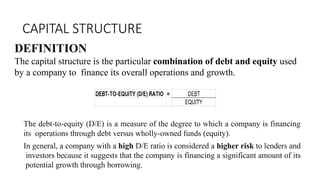
DEFINITION
The capital structure is the particular combination of debt and equity used
by a company to finance its overall operations and growth.
The debt-to-equity (D/E) is a measure of the degree to which a company is financing
its operations through debt versus wholly-owned funds (equity).
In general, a company with a high D/E ratio is considered a higher risk to lenders and
investors because it suggests that the company is financing a significant amount of its
potential growth through borrowing.
CAPITAL STRUCTURE
Optimal Capital Structure
The optimal capital structure of a firm is the best mix of debt
and equity financing that maximizes a company’s market value
while minimizing its cost of capital.
Thus, companies have to find the optimal point at which the
marginal benefit of debt equals the marginal cost.
(Benefit = Costs)
CAPITAL STRUCTURE
Capital Restructuring
Activities that alter the firm’s existing capital structure is called
capital restructuring.
Such as :
1) Increasing D/E ratio  Negotiating a long-term loan or
issue some bonds and use the proceeds to buy back some
stocks.
2) Decreasing D/E ratio  Issuing stock and use the money to
pay-off some debt.
 If a firm is not currently at its target capital structure, it may deliberately raise new money
in a manner that moves the actual structure towards the target.
CAPITAL STRUCTURE
REASON WHY CAPITAL STRUCTURE CHANGES OVER TIME
1) Deliberate management actions
2) Market actions


Changes in the market value of the debt and/or equity capital could result in large changes
in its measure of capital structure.
Factors :
1) Good economic returns
2) Change in interest rates
CAPITAL STRUCTURE
Traditional Approach
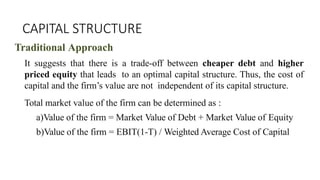
It suggests that there is a trade-off between cheaper debt and higher
priced equity that leads to an optimal capital structure. Thus, the cost of
capital and the firm’s value are not independent of its capital structure.
Total market value of the firm can be determined as :
a)Value of the firm = Market Value of Debt + Market Value of Equity
b)Value of the firm = EBIT(1-T) / Weighted Average Cost of Capital
CAPITAL STRUCTURE
Traditional Approach
Assumptions :
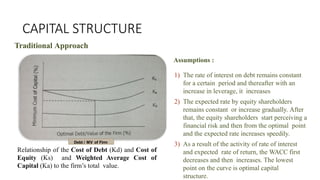
1) The rate of interest on debt remains constant
for a certain period and thereafter with an
increase in leverage, it increases
2) The expected rate by equity shareholders
remains constant or increase gradually. After
that, the equity shareholders start perceiving a
financial risk and then from the optimal point
and the expected rate increases speedily.
3) As a result of the activity of rate of interest
and expected rate of return, the WACC first
decreases and then increases. The lowest
point on the curve is optimal capital
structure.
Debt / MV of Firm
Relationship of the Cost of Debt (Kd) and Cost of
Equity (Ks) and Weighted Average Cost of
Capital (Ka) to the firm’s total value.
CAPITAL STRUCTURE
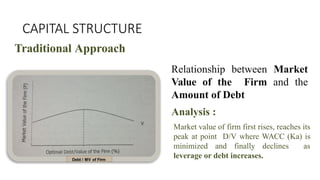
Traditional Approach
Relationship between Market
Value of the Firm and the
Amount of Debt
Analysis :
Market value of firm first rises, reaches its
peak at point D/V where WACC (Ka) is
minimized and finally declines as
leverage or debt increases.
Debt / MV of Firm
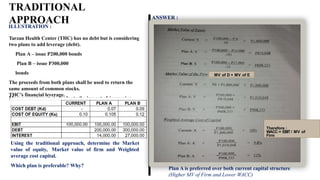
THC’s financial leverage.
Using the traditional approach, determine the Market
value of equity, Market value of firm and Weighted
average cost capital.
Which plan is preferable? Why?
ILLUSTRATION :
Tarzan Health Center (THC) has no debt but is considering
two plans to add leverage (debt).
Plan A – issue P200,000 bonds
Plan B – issue P300,000
bonds
The proceeds from both plans shall be used to return the
same amount of common stocks.
Management wants to evaluate the impact of increasing
ANSWER :
Plan A is preferred over both current capital structure
(Higher MV of Firm and Lower WACC)
MV of D + MV of E
Therefore :
WACC = EBIT / MV of
Firm
TRADITIONAL
APPROACH
CAPITAL STRUCTURE
Presented by: FREDEN DE VERA

CAPITAL-STRUCTURE-TRADITIONAL-APPROACH (1).pptx

  • 2.
  • 3.
    CAPITAL STRUCTURE DEFINITION The capitalstructure is the particular combination of debt and equity used by a company to finance its overall operations and growth. The debt-to-equity (D/E) is a measure of the degree to which a company is financing its operations through debt versus wholly-owned funds (equity). In general, a company with a high D/E ratio is considered a higher risk to lenders and investors because it suggests that the company is financing a significant amount of its potential growth through borrowing.
  • 4.
    CAPITAL STRUCTURE Optimal CapitalStructure The optimal capital structure of a firm is the best mix of debt and equity financing that maximizes a company’s market value while minimizing its cost of capital. Thus, companies have to find the optimal point at which the marginal benefit of debt equals the marginal cost. (Benefit = Costs)
  • 5.
    CAPITAL STRUCTURE Capital Restructuring Activitiesthat alter the firm’s existing capital structure is called capital restructuring. Such as : 1) Increasing D/E ratio  Negotiating a long-term loan or issue some bonds and use the proceeds to buy back some stocks. 2) Decreasing D/E ratio  Issuing stock and use the money to pay-off some debt.
  • 6.
     If afirm is not currently at its target capital structure, it may deliberately raise new money in a manner that moves the actual structure towards the target. CAPITAL STRUCTURE REASON WHY CAPITAL STRUCTURE CHANGES OVER TIME 1) Deliberate management actions 2) Market actions   Changes in the market value of the debt and/or equity capital could result in large changes in its measure of capital structure. Factors : 1) Good economic returns 2) Change in interest rates
  • 7.
    CAPITAL STRUCTURE Traditional Approach Itsuggests that there is a trade-off between cheaper debt and higher priced equity that leads to an optimal capital structure. Thus, the cost of capital and the firm’s value are not independent of its capital structure. Total market value of the firm can be determined as : a)Value of the firm = Market Value of Debt + Market Value of Equity b)Value of the firm = EBIT(1-T) / Weighted Average Cost of Capital
  • 8.
    CAPITAL STRUCTURE Traditional Approach Assumptions: 1) The rate of interest on debt remains constant for a certain period and thereafter with an increase in leverage, it increases 2) The expected rate by equity shareholders remains constant or increase gradually. After that, the equity shareholders start perceiving a financial risk and then from the optimal point and the expected rate increases speedily. 3) As a result of the activity of rate of interest and expected rate of return, the WACC first decreases and then increases. The lowest point on the curve is optimal capital structure. Debt / MV of Firm Relationship of the Cost of Debt (Kd) and Cost of Equity (Ks) and Weighted Average Cost of Capital (Ka) to the firm’s total value.
  • 9.
    CAPITAL STRUCTURE Traditional Approach Relationshipbetween Market Value of the Firm and the Amount of Debt Analysis : Market value of firm first rises, reaches its peak at point D/V where WACC (Ka) is minimized and finally declines as leverage or debt increases. Debt / MV of Firm
  • 10.
    THC’s financial leverage. Usingthe traditional approach, determine the Market value of equity, Market value of firm and Weighted average cost capital. Which plan is preferable? Why? ILLUSTRATION : Tarzan Health Center (THC) has no debt but is considering two plans to add leverage (debt). Plan A – issue P200,000 bonds Plan B – issue P300,000 bonds The proceeds from both plans shall be used to return the same amount of common stocks. Management wants to evaluate the impact of increasing ANSWER : Plan A is preferred over both current capital structure (Higher MV of Firm and Lower WACC) MV of D + MV of E Therefore : WACC = EBIT / MV of Firm TRADITIONAL APPROACH
  • 11.