E D G E I N N O V A T I O N N E T W O R K
J U N E 1 8 , 2 0 1 3
Capability Statements
Kachman Consulting Group
 Don Kachman, Principal
 20 years in Government Relations
 Support emerging and second stage businesses and
organizations
 Opportunity Identification
 Proposal Preparation
 Contract Management
Agenda/Outline
 What are capability statements
 The importance of a capability statement
 How to make a one or two page capability statement
W H A T A R E C A P A B I L I T Y S T A T E M E N T S
Capability Statements
Snapshot of Capability Statements
 A Capabilities Statement tells potential clients
 who you are
 what you do
 how you are different from your competitors.
 Once you tell clients – get their feedback and
update your capability statement.
 Allow clients to distribute your capability
statement within their organizations.
A critical tool to begin your dialog with your
government contacts.
What is a Capability Statement
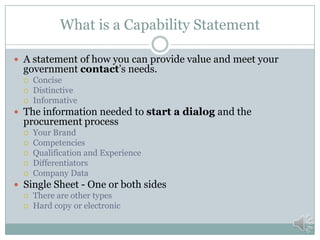
 A statement of how you can provide value and meet your
government contact’s needs.
 Concise
 Distinctive
 Informative
 The information needed to start a dialog and the
procurement process
 Your Brand
 Competencies
 Qualification and Experience
 Differentiators
 Company Data
 Single Sheet - One or both sides
 There are other types
 Hard copy or electronic
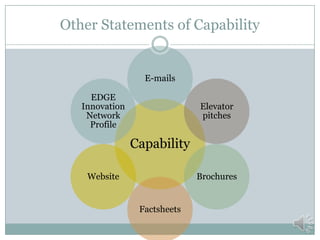
Other Statements of Capability
Capability
E-mails
Elevator
pitches
Brochures
Factsheets
Website
EDGE
Innovation
Network
Profile
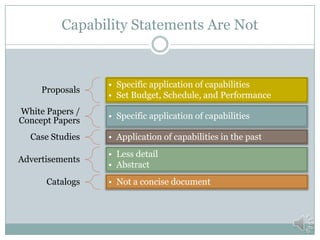
Capability Statements Are Not
Proposals
• Specific application of capabilities
• Set Budget, Schedule, and Performance
White Papers /
Concept Papers
• Specific application of capabilities
Case Studies • Application of capabilities in the past
Advertisements
• Less detail
• Abstract
Catalogs • Not a concise document
T H E I M P O R T A N C E
Capability Statements
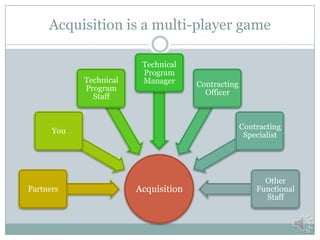
Acquisition is a multi-player game
AcquisitionPartners
You
Technical
Program
Staff
Technical
Program
Manager Contracting
Officer
Contracting
Specialist
Other
Functional
Staff
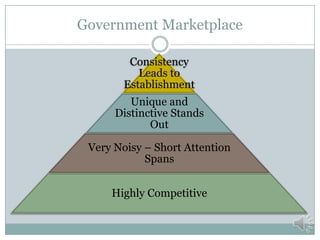
Government Marketplace
Consistency
Leads to
Establishment
Unique and
Distinctive Stands
Out
Very Noisy – Short Attention
Spans
Highly Competitive
Market Research - FAR requirements
 Major System Acquisition – FAR 7.102(a)
 Use FAR 10
 Commercial Items and Services – FAR 10
 … to arrive at the most suitable approach to acquiring,
distributing, and supporting supplies and services.
 Market research is conducted to determine if commercial
items or non-developmental items are available to meet the
Government’s needs.
 Research and Development – FAR 35.004
 Publicizing requirements and expanding research and
development sources.
Build Capability Statement To
 Raise awareness with your contacts
 Provide common ground to build a dialog
 Create trust with your contacts
 Test the marketplace
 Do you have the right understanding of players, needs, and
solutions?
Effective Use of Capability Statements
 First Contact
 Distribute to buyers and potential customers
 Use at trade shows, meetings, and events
 Getting the word out
 Distribute via website (pdf format)
 Responding to Request for Information or Sources Sought
 Following up and reinforcing your message
 After phone calls
 After “elevator speech”
 Include in proposals when allowed
 Send an updated capability statement annually to maintain contact
 Remember to tailor to specific audiences
P R E P A R I N G A C A P A B I L I T Y S T A T E M E N T
Capability Statements
Characteristics of a Capability Statement
 Professional Appearance
 Customer’s first impression
 Succinct
 Focus on strengths and core capabilities
 Easy to quickly scan (1-2 pages)
 Tailored
 Modify for specific opportunities or audiences
 Include additional info for government buyers
Drafting Your Capability Statement
 Research your desired targets
 Identify contacts
 Identify products and services they purchase
 Learn their language
 Identify needs
 Build solutions for your contact’s needs
 Map your company to the need
 Core Competencies, Capabilities, Resources
 Past Experience
 Differentiators
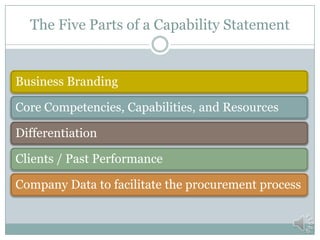
The Five Parts of a Capability Statement
Business Branding
Core Competencies, Capabilities, and Resources
Differentiation
Clients / Past Performance
Company Data to facilitate the procurement process
Your Business Branding
 Being Distinctive in the marketplace
 Logo
 Color scheme
 Fonts
 Business background / history / mission
 Ties in to other literature and website design
 Not being distinctive in your own messaging
Core Competencies, Capabilities, and Resources
 A core competence is a bundle of capabilities and
resources that enable your firm:
 To solve a particular class of problem
 To perform a particular service
 To delivery a particular product
 Identify core competencies and relate to your
contact’s specific needs.
 Only relevant capabilities and resources
 Present the unique value proposition
 Key personnel experience
Differentiators
 Explain how your company is unique, different, and
distinct from competitors in meeting the needs of your
contact.
 Show your unique understanding of your contact’s
needs.
 Show how no one else can respond to those needs.
 Examples
 Security Clearances
 Geographical Coverage
 Special Accreditations or Awards
 Etc.
 This is all about why your contact should pick your
company over your competitors.
Clients and Past Performance
 Provide examples from past work
 Relate to your contact’s needs
 Describe how you successfully completed the work
 Why that work is representative of your company’s
future performance.
 This is about building credibility and showing that
your company’s selection is a low risk choice.
Company Data
 Corporate Contact Info
 (Name, address, telephone, fax, e-mail, website, etc)
 DUNS #, CAGE code, NAICS, PSC/FSC codes
 Industry licenses/certifications or quality assurance certs
 Small Business Certifications (potential differentiator)
 Woman-owned small business
 Small disadvantaged business
 8(a) certified
 Service Disabled Veteran Owned Business
 HUBZone
 Acquisition Vehicles (potential differentiator)
 Government Wide Acquisition Contracts
 GSA Schedules
 Accept government credit cards
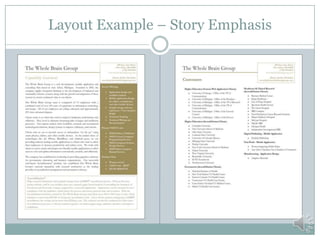
Layout Example – Story Emphasis
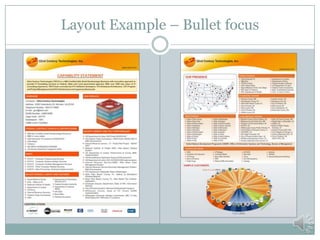
Layout Example – Bullet focus
Final Tips
 Professional appearance
 Cover elements as briefly as possible
 Easy to read
 Use bullets/short sentences/tables
 Be careful with acronyms and industry jargon
 Use company logos and color – reinforce branding
 A searchable document that can be easily changed
and sent as a PDF file.
 Continuously update!
Questions and Thank You
Don Kachman, Principal
Kachman Consulting Group
don@kachmanconsulting.com
(734) 730-2932
Signup for our newsletter at:
KachmanConsulting.com
Use Capability Statements to build a
dialog with your contacts.

The Importance of the Capability Statement Webinar by Kachman Consulting Group

  • 1.
    E D GE I N N O V A T I O N N E T W O R K J U N E 1 8 , 2 0 1 3 Capability Statements
  • 2.
    Kachman Consulting Group Don Kachman, Principal  20 years in Government Relations  Support emerging and second stage businesses and organizations  Opportunity Identification  Proposal Preparation  Contract Management
  • 3.
    Agenda/Outline  What arecapability statements  The importance of a capability statement  How to make a one or two page capability statement
  • 4.
    W H AT A R E C A P A B I L I T Y S T A T E M E N T S Capability Statements
  • 5.
    Snapshot of CapabilityStatements  A Capabilities Statement tells potential clients  who you are  what you do  how you are different from your competitors.  Once you tell clients – get their feedback and update your capability statement.  Allow clients to distribute your capability statement within their organizations. A critical tool to begin your dialog with your government contacts.
  • 6.
    What is aCapability Statement  A statement of how you can provide value and meet your government contact’s needs.  Concise  Distinctive  Informative  The information needed to start a dialog and the procurement process  Your Brand  Competencies  Qualification and Experience  Differentiators  Company Data  Single Sheet - One or both sides  There are other types  Hard copy or electronic
  • 7.
    Other Statements ofCapability Capability E-mails Elevator pitches Brochures Factsheets Website EDGE Innovation Network Profile
  • 8.
    Capability Statements AreNot Proposals • Specific application of capabilities • Set Budget, Schedule, and Performance White Papers / Concept Papers • Specific application of capabilities Case Studies • Application of capabilities in the past Advertisements • Less detail • Abstract Catalogs • Not a concise document
  • 9.
    T H EI M P O R T A N C E Capability Statements
  • 10.
    Acquisition is amulti-player game AcquisitionPartners You Technical Program Staff Technical Program Manager Contracting Officer Contracting Specialist Other Functional Staff
  • 11.
    Government Marketplace Consistency Leads to Establishment Uniqueand Distinctive Stands Out Very Noisy – Short Attention Spans Highly Competitive
  • 12.
    Market Research -FAR requirements  Major System Acquisition – FAR 7.102(a)  Use FAR 10  Commercial Items and Services – FAR 10  … to arrive at the most suitable approach to acquiring, distributing, and supporting supplies and services.  Market research is conducted to determine if commercial items or non-developmental items are available to meet the Government’s needs.  Research and Development – FAR 35.004  Publicizing requirements and expanding research and development sources.
  • 13.
    Build Capability StatementTo  Raise awareness with your contacts  Provide common ground to build a dialog  Create trust with your contacts  Test the marketplace  Do you have the right understanding of players, needs, and solutions?
  • 14.
    Effective Use ofCapability Statements  First Contact  Distribute to buyers and potential customers  Use at trade shows, meetings, and events  Getting the word out  Distribute via website (pdf format)  Responding to Request for Information or Sources Sought  Following up and reinforcing your message  After phone calls  After “elevator speech”  Include in proposals when allowed  Send an updated capability statement annually to maintain contact  Remember to tailor to specific audiences
  • 15.
    P R EP A R I N G A C A P A B I L I T Y S T A T E M E N T Capability Statements
  • 16.
    Characteristics of aCapability Statement  Professional Appearance  Customer’s first impression  Succinct  Focus on strengths and core capabilities  Easy to quickly scan (1-2 pages)  Tailored  Modify for specific opportunities or audiences  Include additional info for government buyers
  • 17.
    Drafting Your CapabilityStatement  Research your desired targets  Identify contacts  Identify products and services they purchase  Learn their language  Identify needs  Build solutions for your contact’s needs  Map your company to the need  Core Competencies, Capabilities, Resources  Past Experience  Differentiators
  • 18.
    The Five Partsof a Capability Statement Business Branding Core Competencies, Capabilities, and Resources Differentiation Clients / Past Performance Company Data to facilitate the procurement process
  • 19.
    Your Business Branding Being Distinctive in the marketplace  Logo  Color scheme  Fonts  Business background / history / mission  Ties in to other literature and website design  Not being distinctive in your own messaging
  • 20.
    Core Competencies, Capabilities,and Resources  A core competence is a bundle of capabilities and resources that enable your firm:  To solve a particular class of problem  To perform a particular service  To delivery a particular product  Identify core competencies and relate to your contact’s specific needs.  Only relevant capabilities and resources  Present the unique value proposition  Key personnel experience
  • 21.
    Differentiators  Explain howyour company is unique, different, and distinct from competitors in meeting the needs of your contact.  Show your unique understanding of your contact’s needs.  Show how no one else can respond to those needs.  Examples  Security Clearances  Geographical Coverage  Special Accreditations or Awards  Etc.  This is all about why your contact should pick your company over your competitors.
  • 22.
    Clients and PastPerformance  Provide examples from past work  Relate to your contact’s needs  Describe how you successfully completed the work  Why that work is representative of your company’s future performance.  This is about building credibility and showing that your company’s selection is a low risk choice.
  • 23.
    Company Data  CorporateContact Info  (Name, address, telephone, fax, e-mail, website, etc)  DUNS #, CAGE code, NAICS, PSC/FSC codes  Industry licenses/certifications or quality assurance certs  Small Business Certifications (potential differentiator)  Woman-owned small business  Small disadvantaged business  8(a) certified  Service Disabled Veteran Owned Business  HUBZone  Acquisition Vehicles (potential differentiator)  Government Wide Acquisition Contracts  GSA Schedules  Accept government credit cards
  • 24.
    Layout Example –Story Emphasis
  • 25.
    Layout Example –Bullet focus
  • 26.
    Final Tips  Professionalappearance  Cover elements as briefly as possible  Easy to read  Use bullets/short sentences/tables  Be careful with acronyms and industry jargon  Use company logos and color – reinforce branding  A searchable document that can be easily changed and sent as a PDF file.  Continuously update!
  • 27.
    Questions and ThankYou Don Kachman, Principal Kachman Consulting Group don@kachmanconsulting.com (734) 730-2932 Signup for our newsletter at: KachmanConsulting.com Use Capability Statements to build a dialog with your contacts.

Editor's Notes

  • #12 Other functional staff – auditing, cost estimating, public affairs, security, …
  • #22 Describe what a core competency is.