WELCOME TO:
ISTQB FOUNDATION LEVEL EXAM
PREPARATION COURSE
https://arshadqa.com/
COURSE OBJECTIVES
Any person who is
interested in QA or
wanted to learn
about testing can
enroll in this course.
100% success
guarantee
16 sample ISTQB
exam papers for
practice
By taking this
course you can
pass the ISTQB-FL
exam in 1st
attempt
https://arshadqa.com/
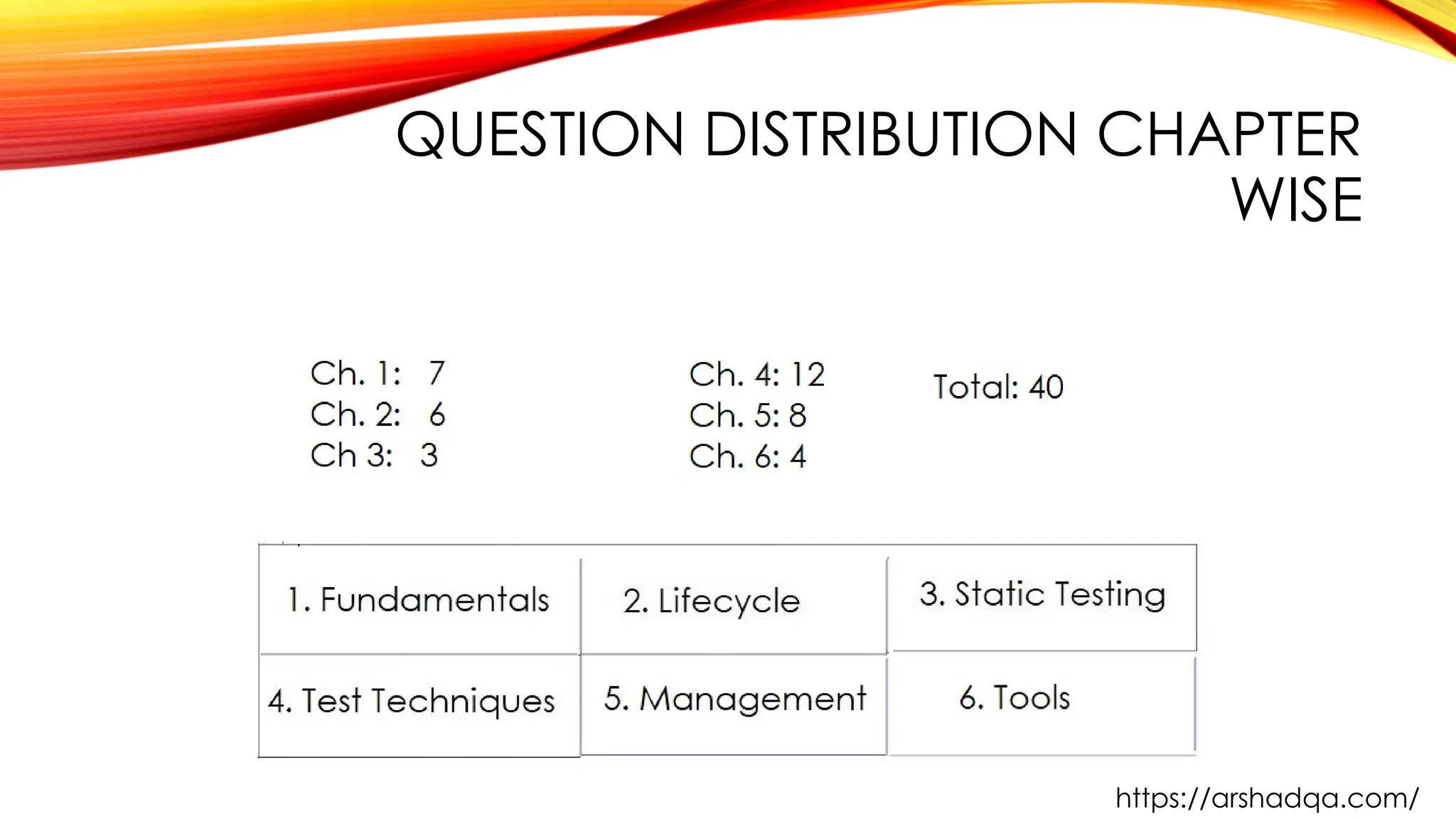
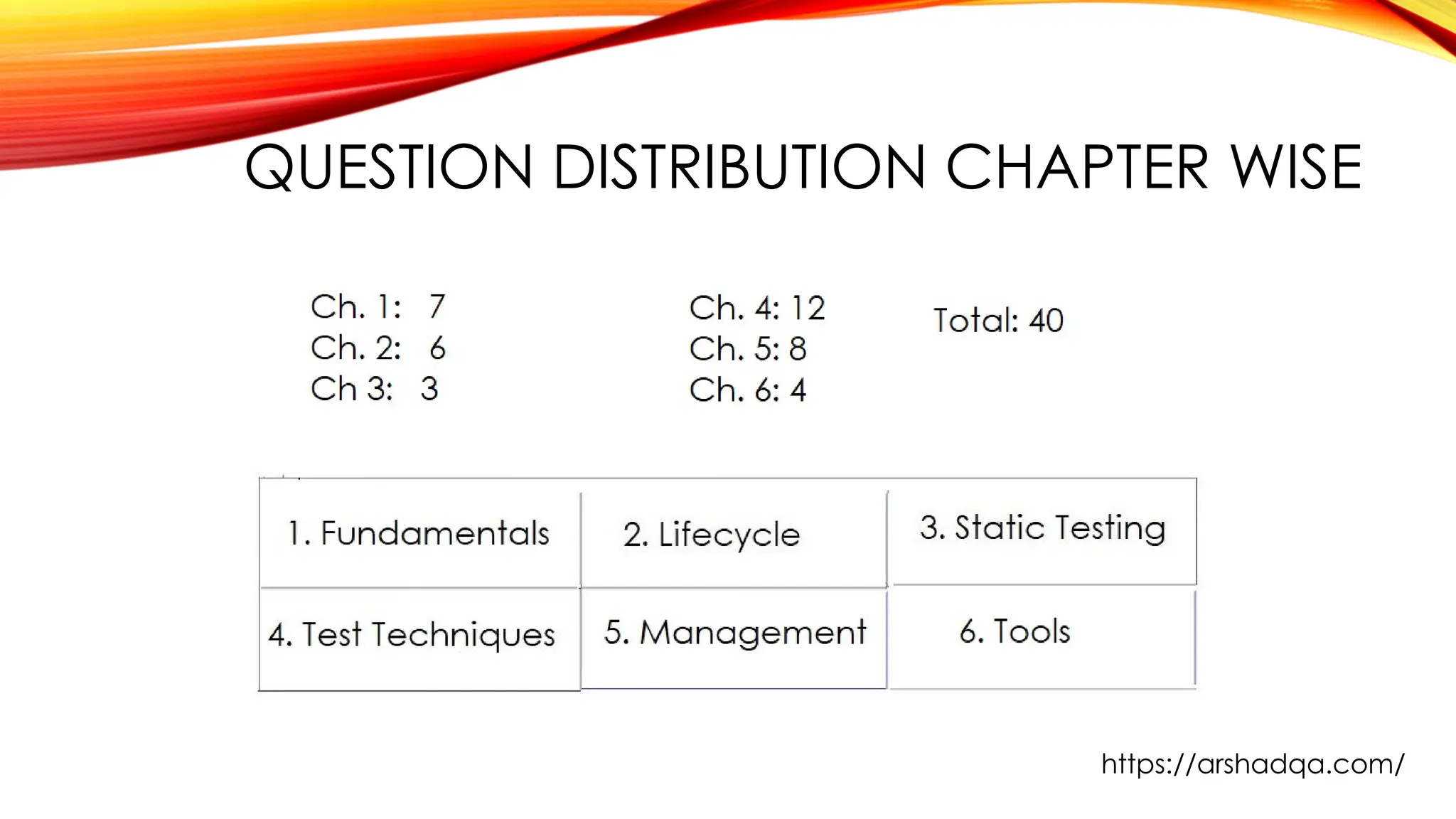
QUESTION DISTRIBUTION CHAPTER
WISE
https://arshadqa.com/
WHAT IS
QUALITY?
Synonyms
of Quality Excellence
Superiority
Class
Eminence
Value
Worth
ANTONYM OF
QUALITY
Inferiority
SOFTWARE QUALITY:
DEFINITION 1
Low levels of defects when deployed, ideally
approaching zero
SOFTWARE QUALITY:
DEFINITION 2
A majority of clients with high user-satisfaction when surveyed
SOFTWARE
QUALITY:
DEFINITION 3
A structure that can minimize
―bad fixes or insertion of new
‖
defects during repairs
SOFTWARE QUALITY:
DEFINITION 4
Effective customer support when problems do occur
SOFTWARE QUALITY:
DEFINITION 5
Rapid repairs for defects, especially for high-severity defects
BEYOND ABSENCE OF DEFECTS
Sense of beauty
• Sense of fitness for purpose
• Sense of elegance that goes beyond the simple absence of overt flaws
• Has well-formed requirements
• Robust
WHY SOFTWARE
QUALITY?
https://arshadqa.com/
SOFTWARE QUALITY
ASSURANCE ?
So the term software quality assurance would mean that the software guarantees high quality
ISTQB FOUNDATION LEVEL
EXAM PREPARATION
https://arshadqa.com/
ISTQB FOUNDATION
NEW SYLLABUS
https://arshadqa.com/
INTRODUCTION TO
ISTQB
International Software Testing Qualification
Board
About ISTQB
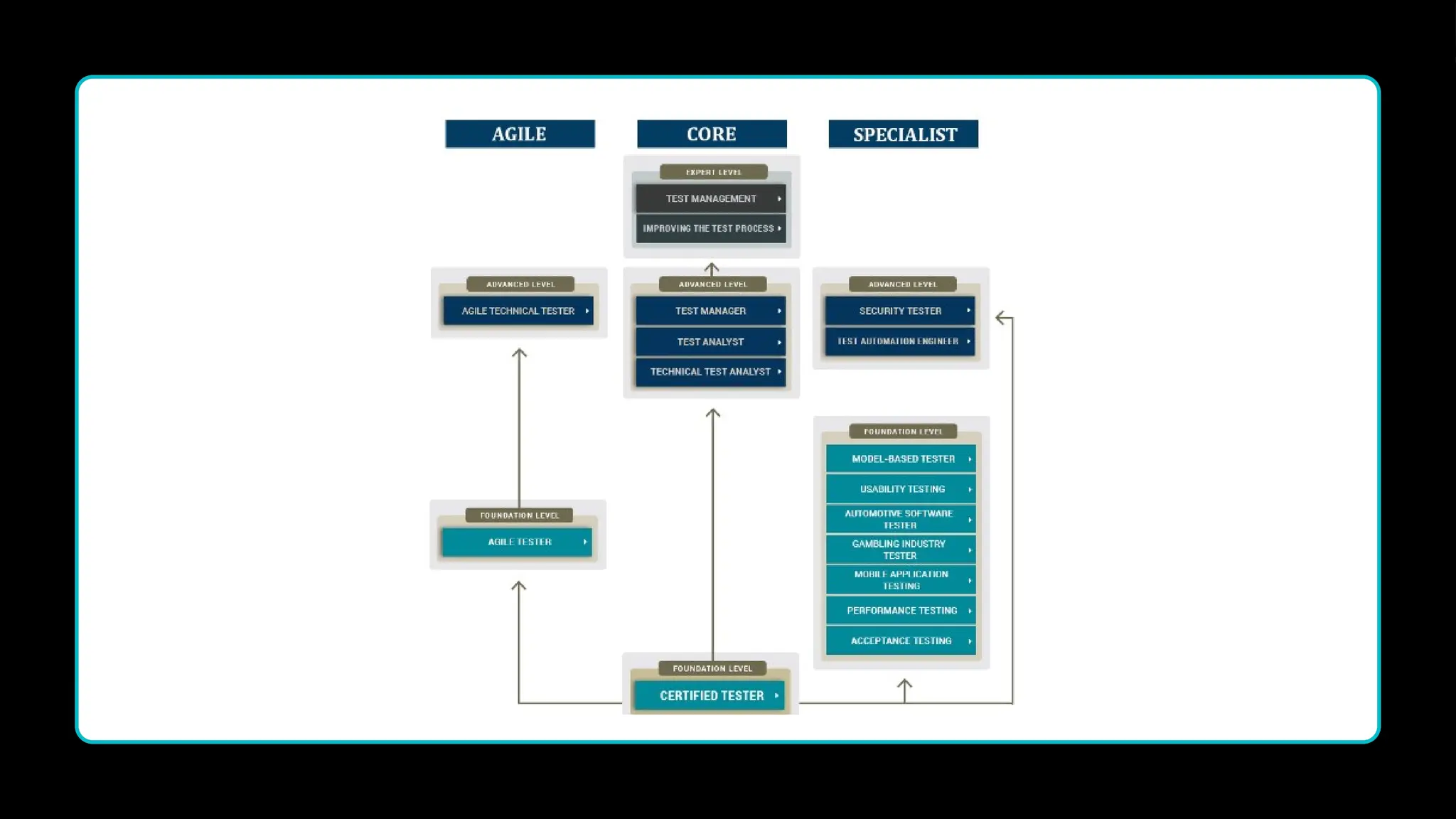
Certifications
Local body conducting exam
Who can appear?
What is the cost?
Validity
INTRODUCTION
TO ISTQB
About
Examination: Prerequisite
Exam type – Objective
Number of Questions
Duration
Schedule
Location/Venue
Passing Score
Additional Info
ISTQB
FOUNDATION
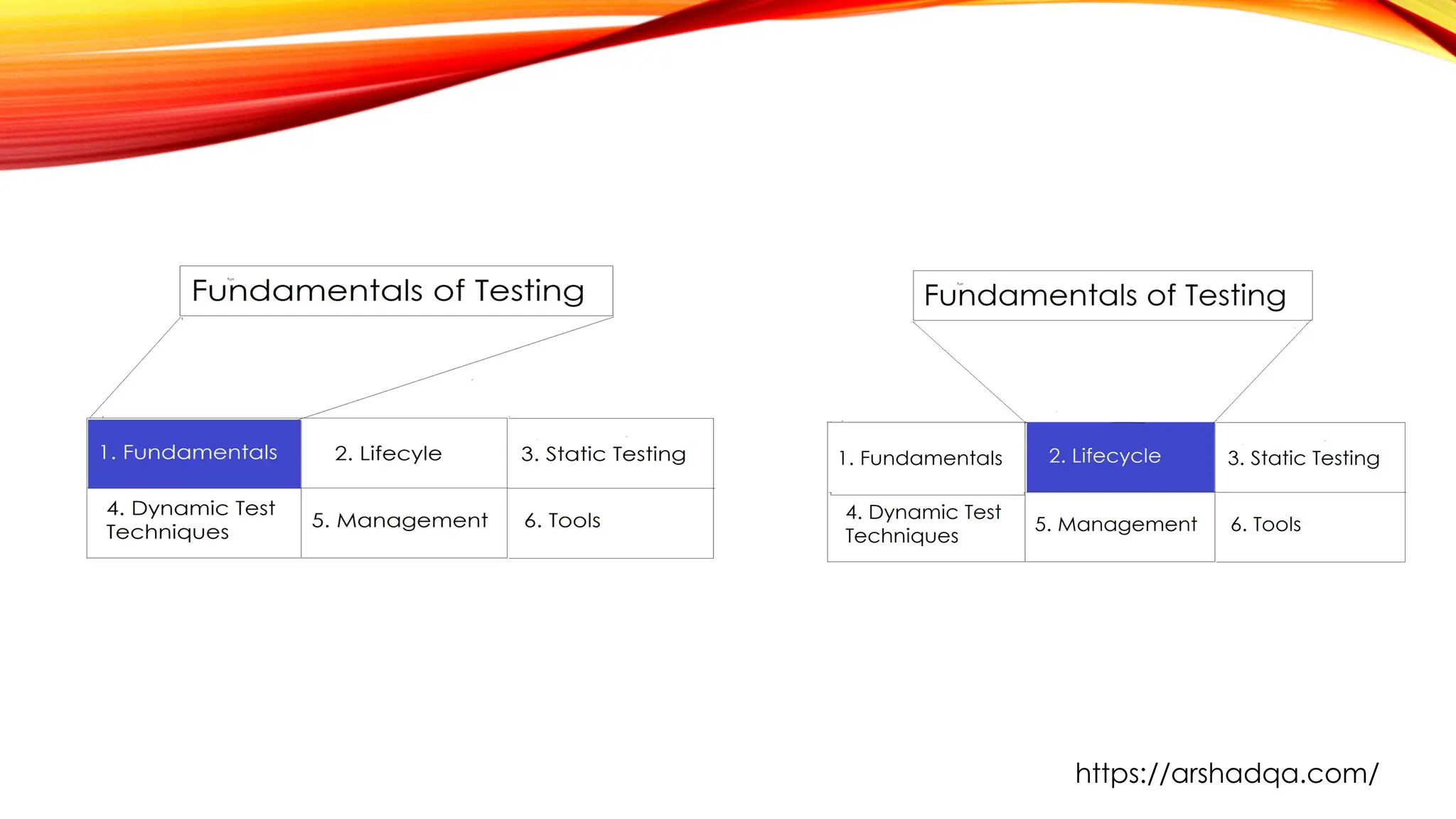
SYLLABUS
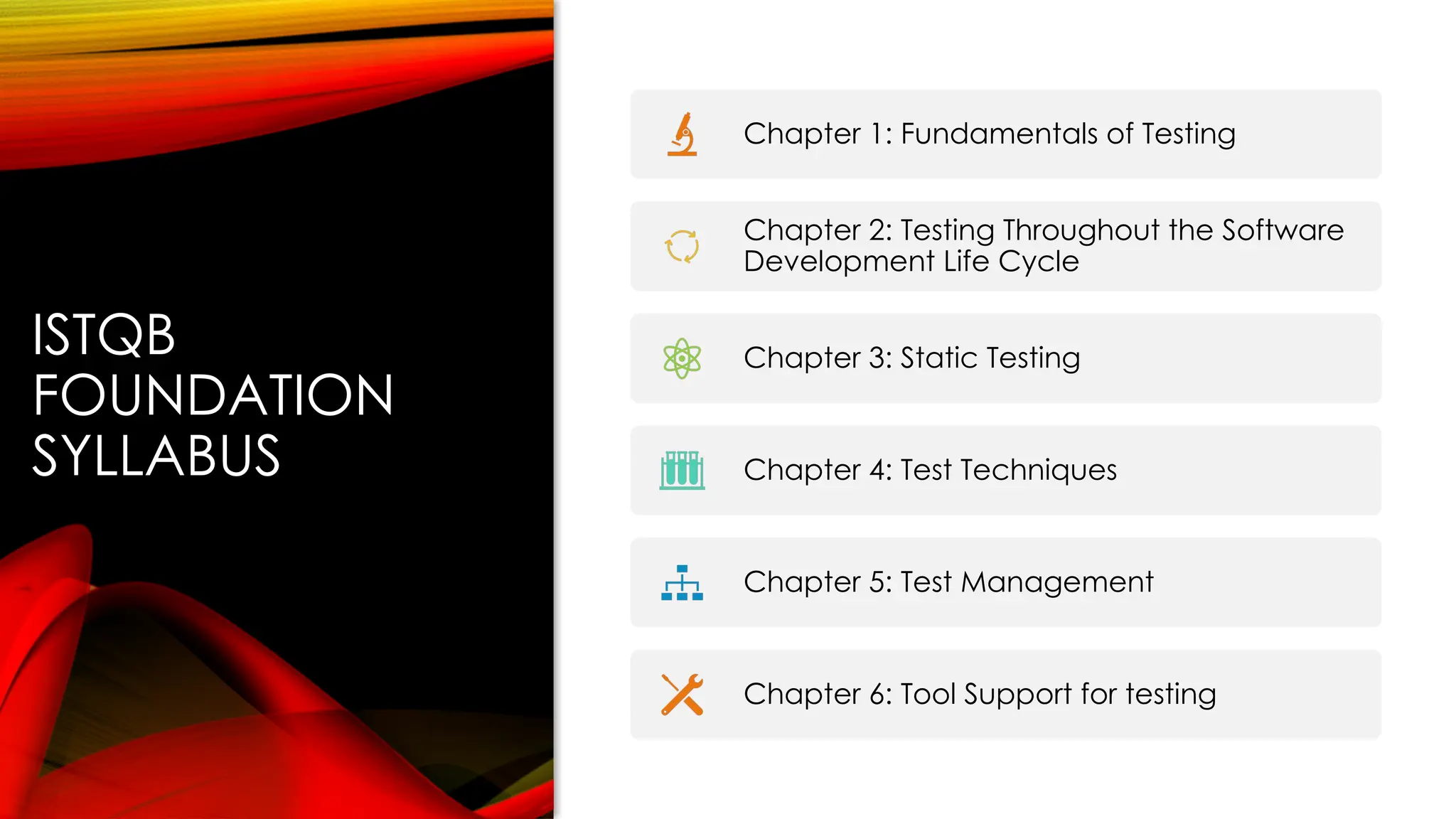
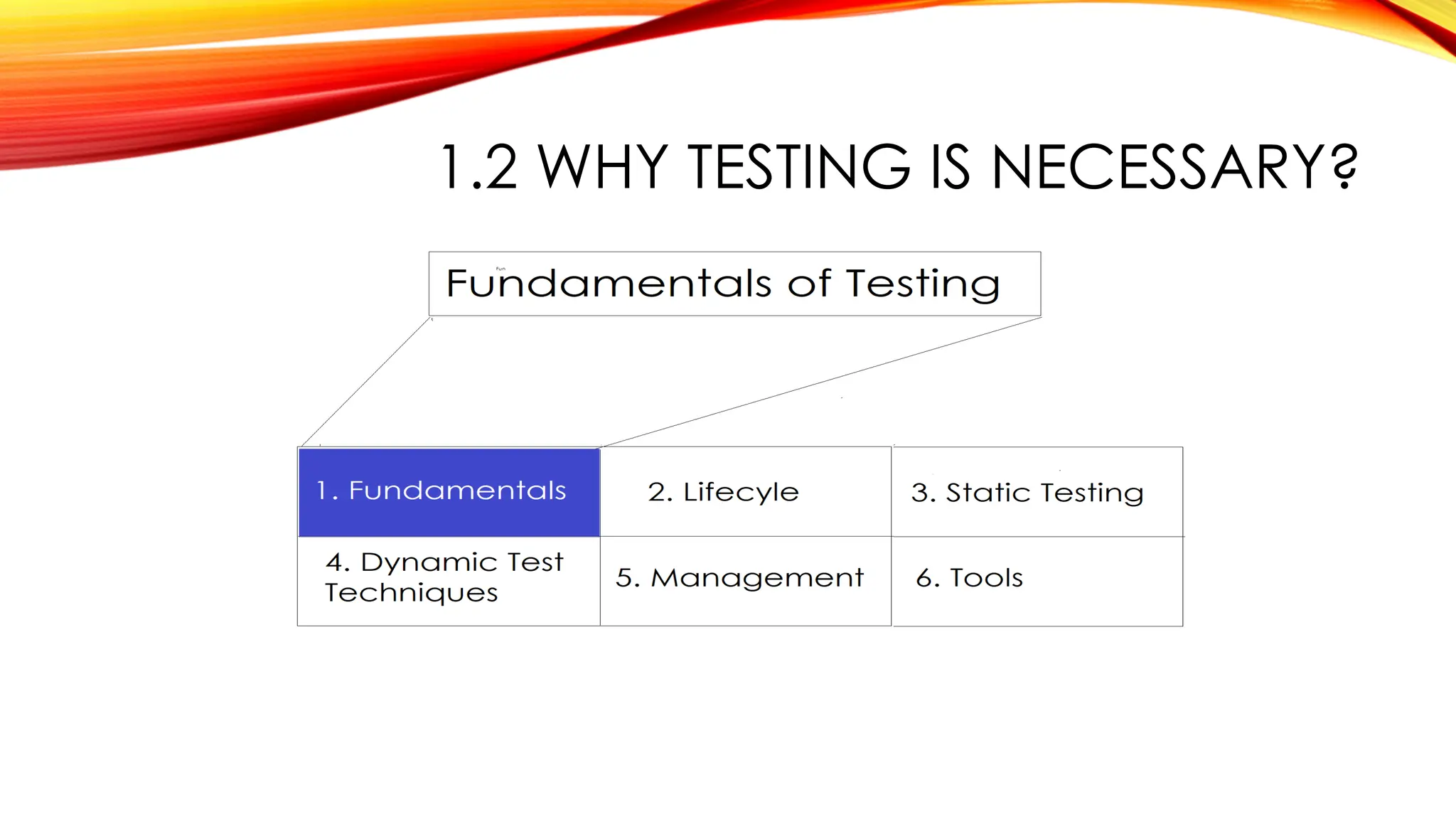
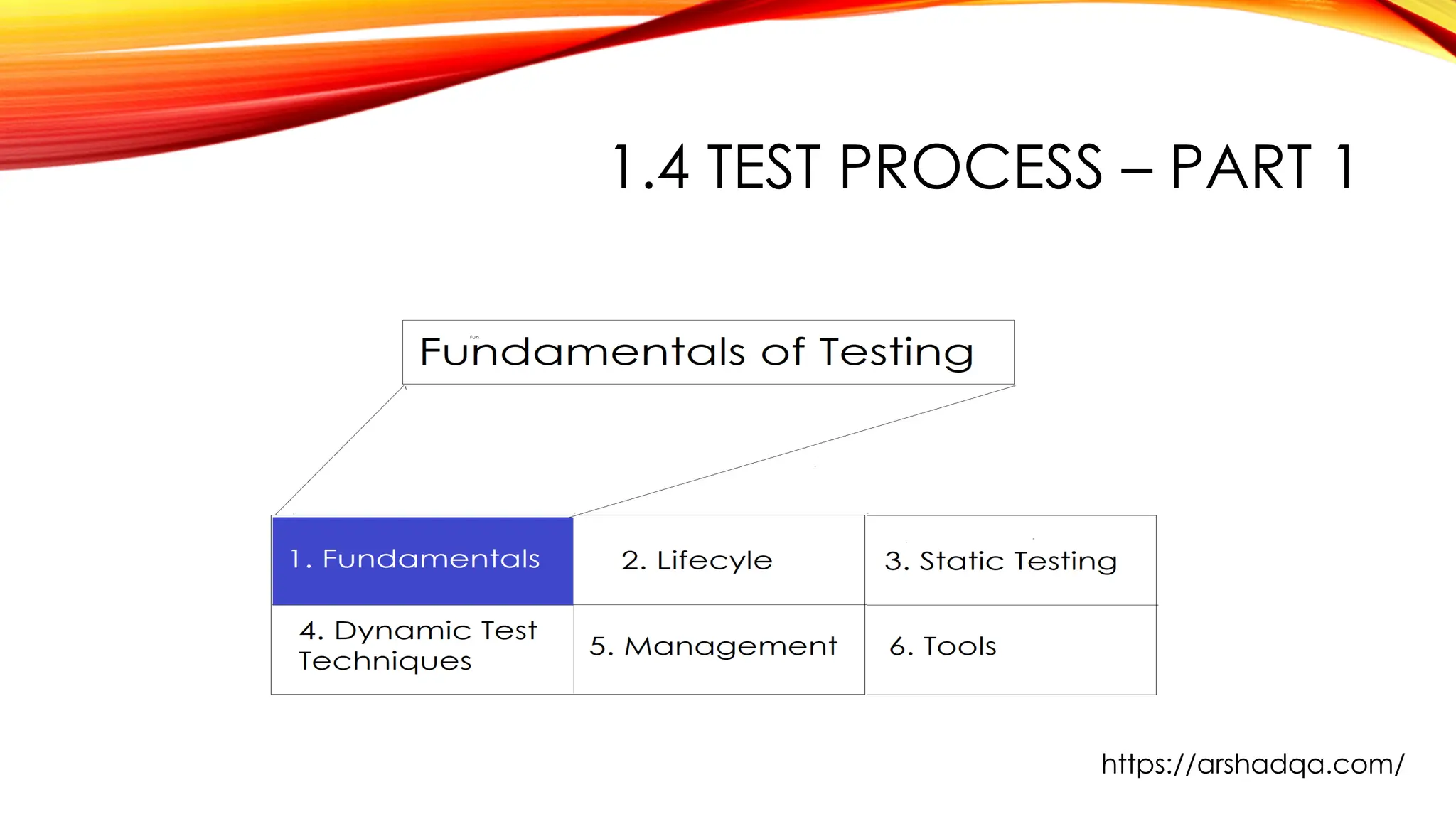
Chapter 1: Fundamentals of Testing
Chapter 2: Testing Throughout the Software
Development Life Cycle
Chapter 3: Static Testing
Chapter 4: Test Techniques
Chapter 5: Test Management
Chapter 6: Tool Support for testing
ISTQB FOUNDATION LEVEL
EXAM PREPARATION
https://arshadqa.com/
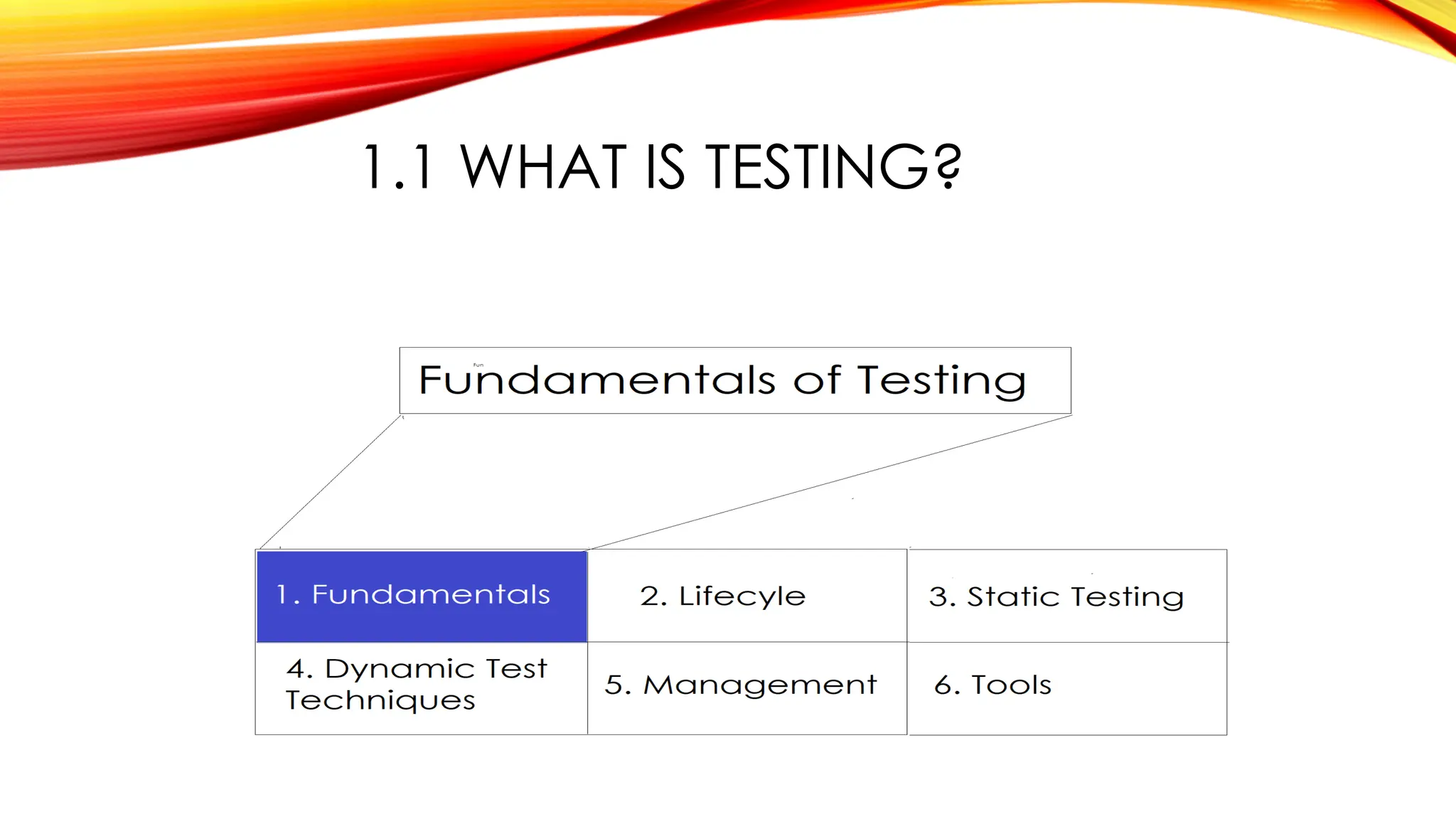
1.1 WHAT IS TESTING?
FUNDAMENTALS
OF TESTING
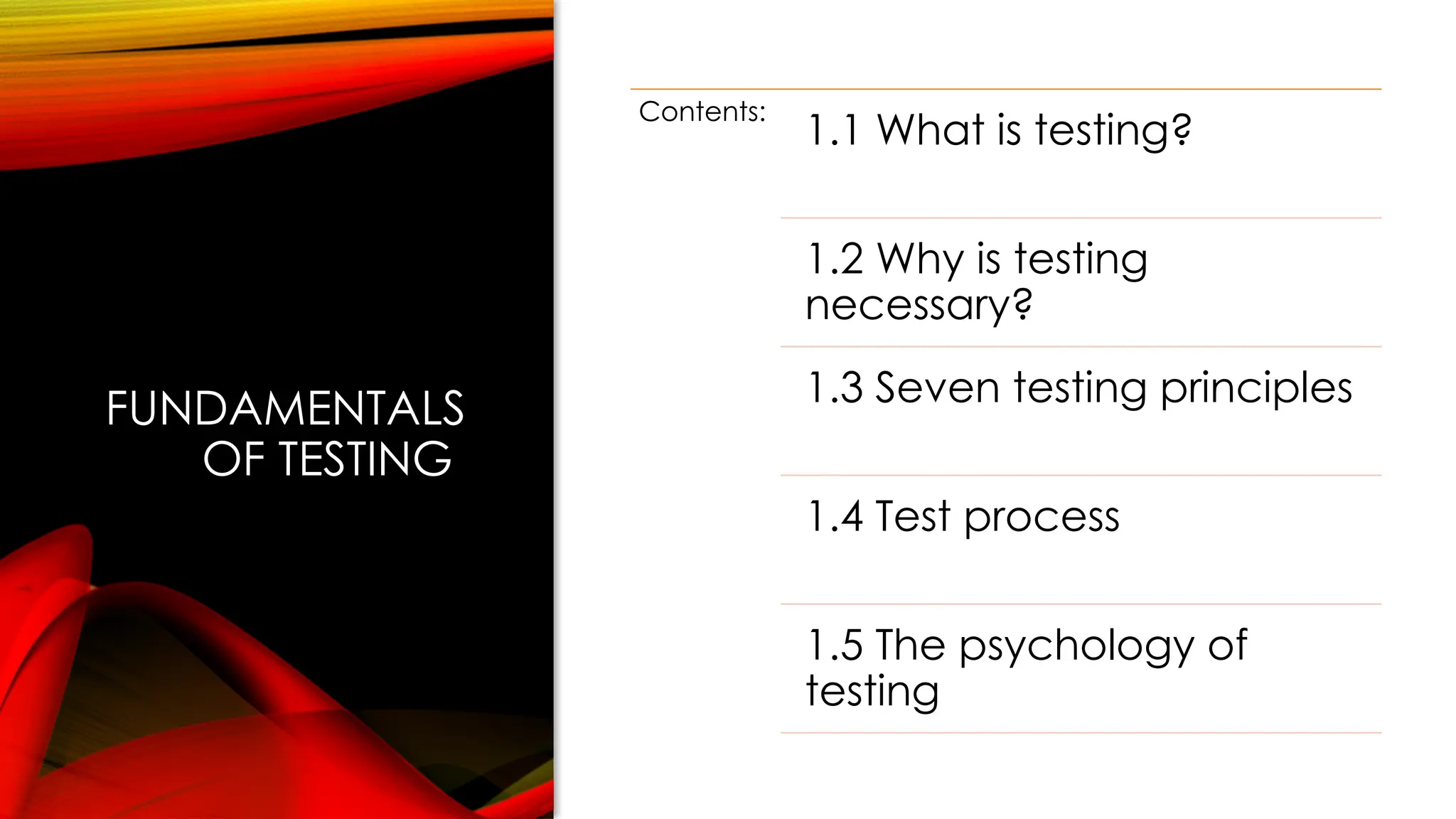
Contents:
1.1 What is testing?
1.2 Why is testing
necessary?
1.3 Seven testing principles
1.4 Test process
1.5 The psychology of
testing
WHAT IS TESTING? (K2)
Common perception is testing is
limited to execution
Test activities exist before and after
test execution as well
Other activities throughout the
development Lifecyle
Contributing to reviews
https://arshadqa.com/
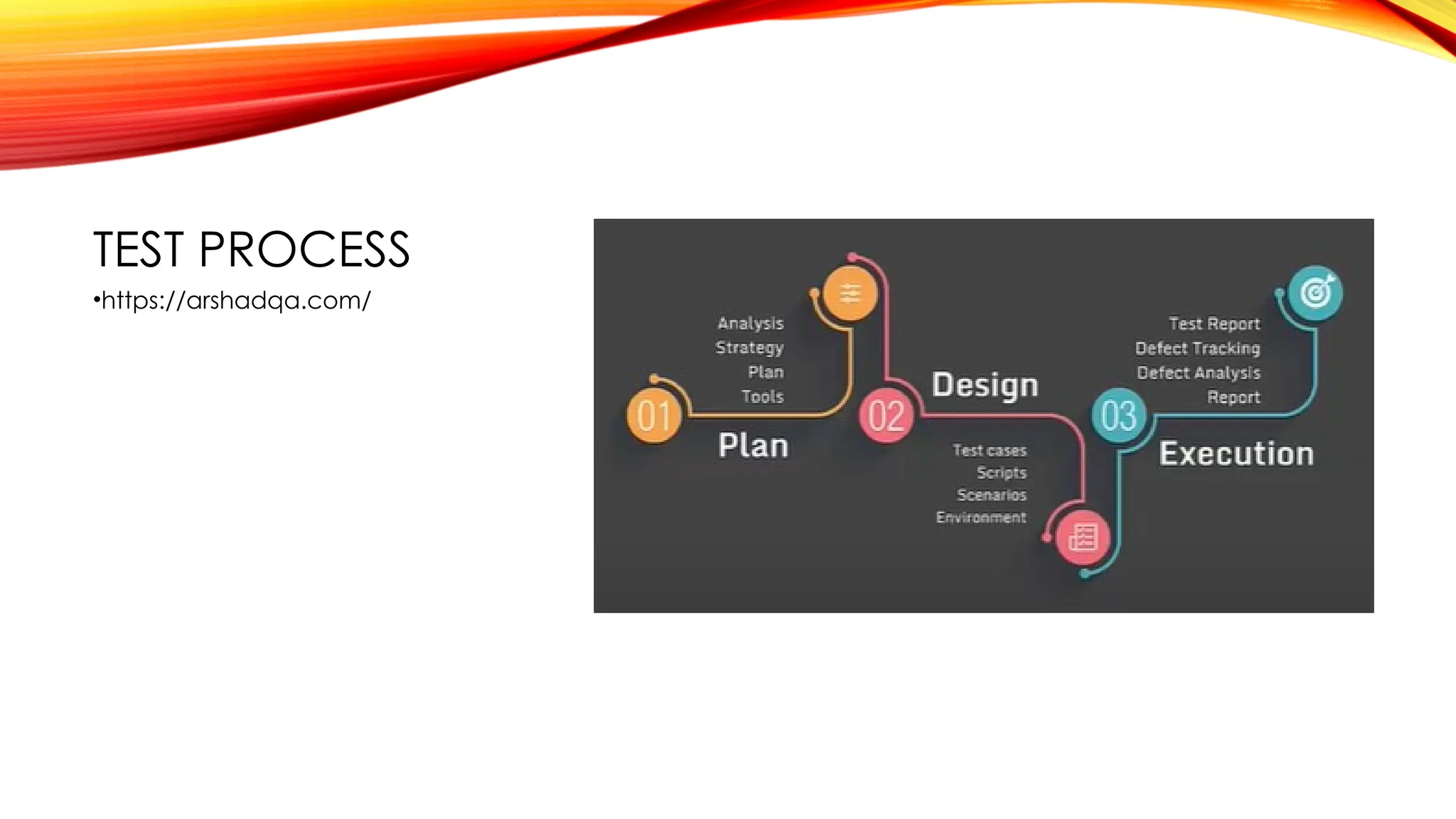
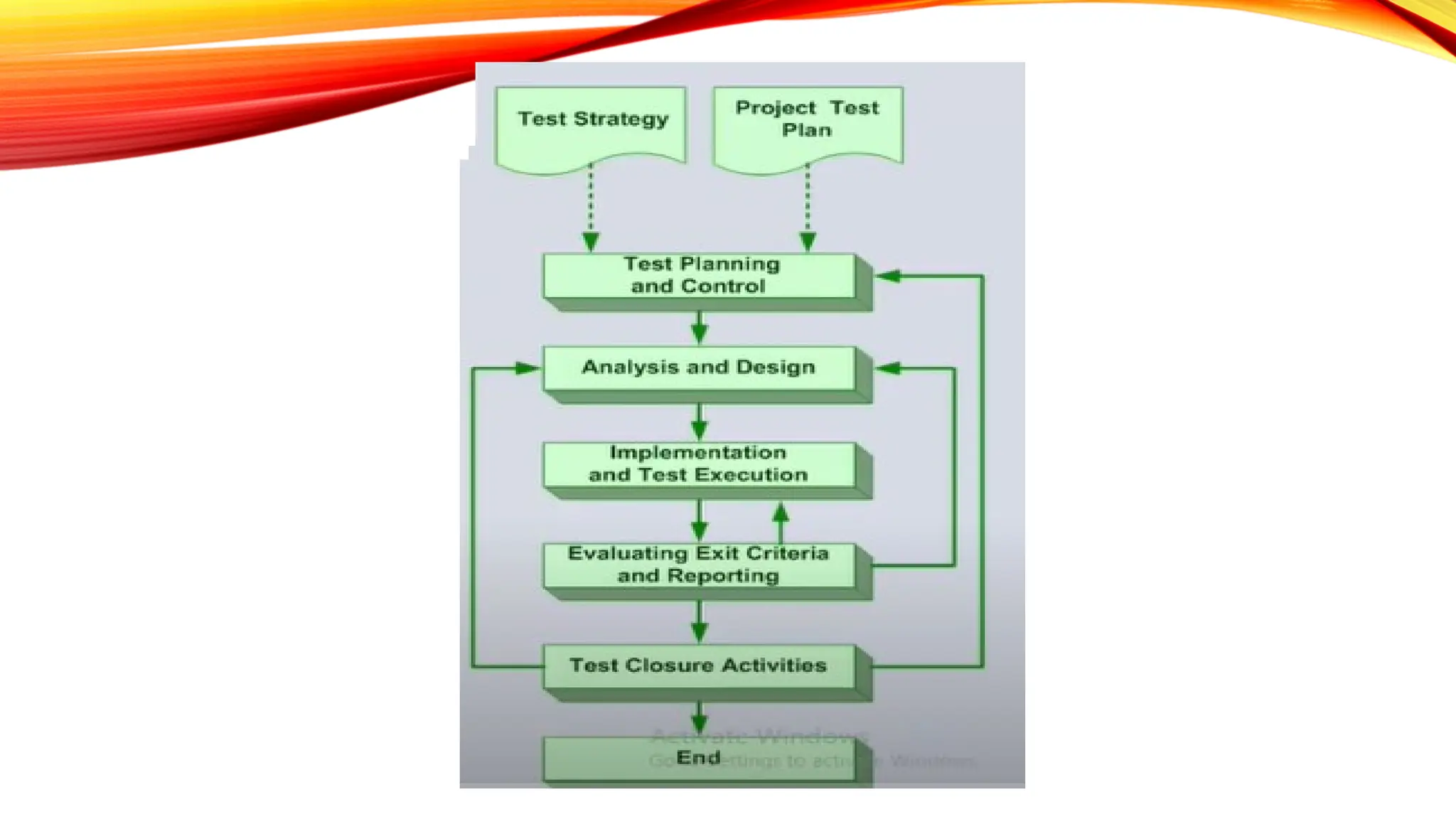
TEST PROCESS
•https://arshadqa.com/
OBJECTIVES OF TESTING
Testing is all about
Finding defects
Gaining confidence about quality
Providing information
Preventing defects
To evaluate work products
To verify if all the requirements have been met
To reduce the level of risk
To comply which contractual, legal or regulatory requirements
and standards https://arshadqa.com/
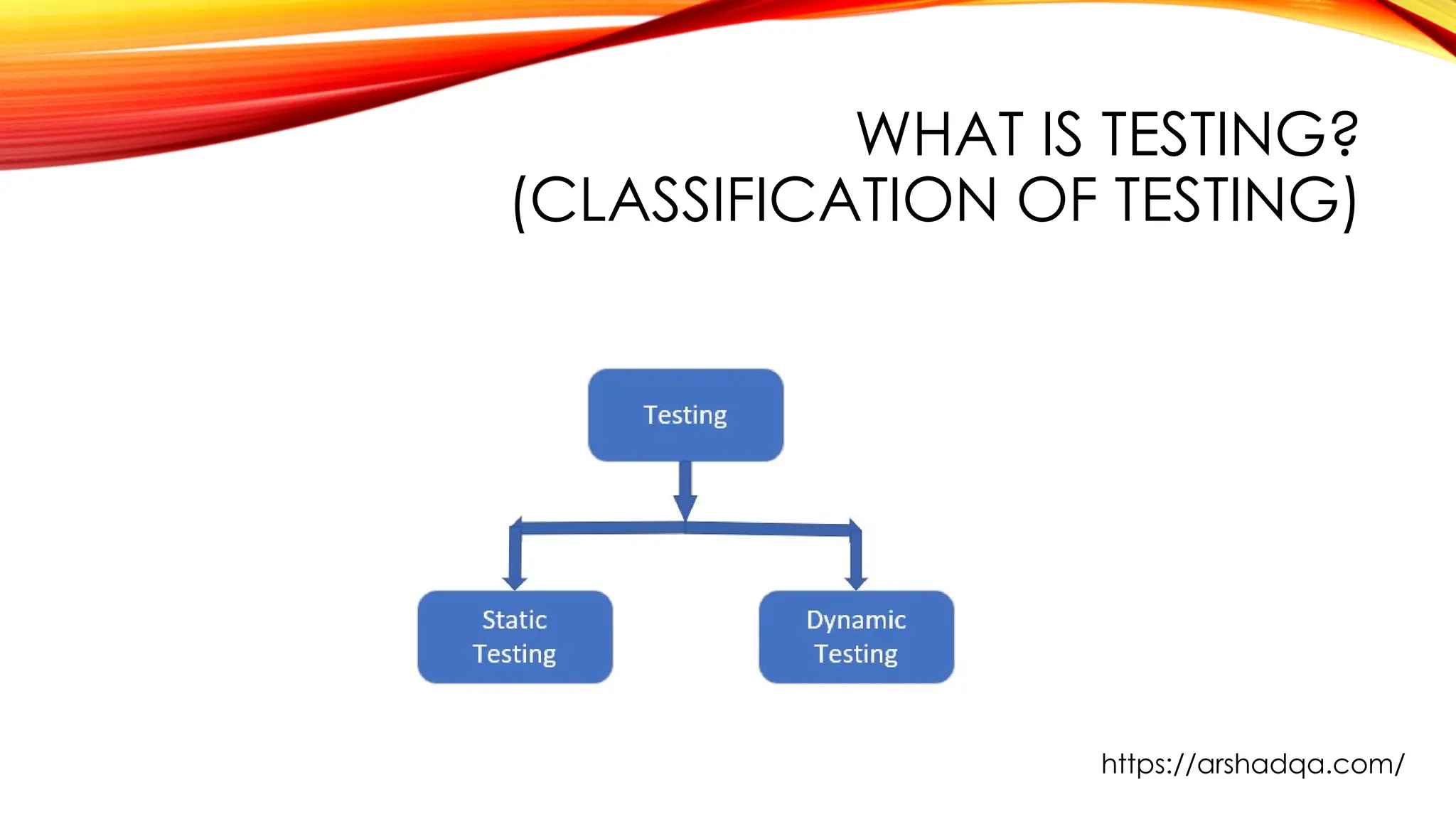
WHAT IS TESTING?
(CLASSIFICATION OF TESTING)
https://arshadqa.com/
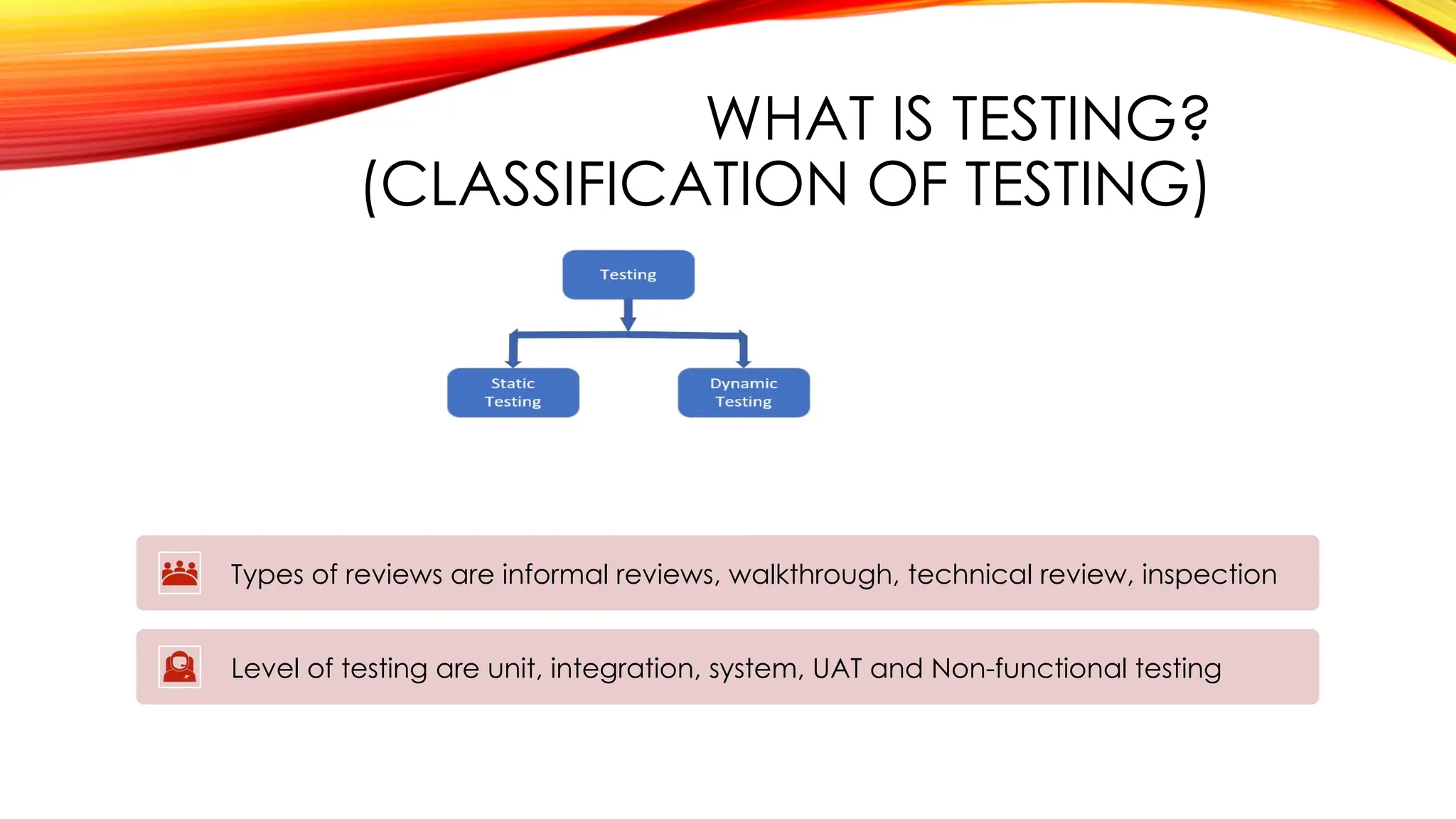
WHAT IS TESTING?
(CLASSIFICATION OF TESTING)
Types of reviews are informal reviews, walkthrough, technical review, inspection
Level of testing are unit, integration, system, UAT and Non-functional testing
WHAT IS TESTING? (DEBUGGING
AND TESTING)
Testing
Testing deal with finding the defects by
conducting failure on application or
product. This activity is performed by
testers.
Debugging
Debugging is a development activity which
deals with analyzing these defects, finding
the root cause and removes the cause of
defects. This activity is commonly
performed by developers.
ISTQB FOUNDATION LEVEL
EXAM PREPARATION
1.2 WHY TESTING IS NECESSARY?
1.2 WHY IS
TESTING
NECESSARY?
Having testers involved in
requirements reviews or user story
refinement could detect defects in
these work products.
Having testers work closely with
system designers while the system is
being designed can increase each
party’s understanding of the design
and how to test it.
WHY IS TESTING NECESSARY?
Having testers work closely with developers while the code is under
development can increase each party’s understanding of the code and
how to test it.
Having testers verify and validate the software prior to release can
detect failures that might otherwise have been missed,and support the
process of removing the defect that cause the failures (I.e., debugging).
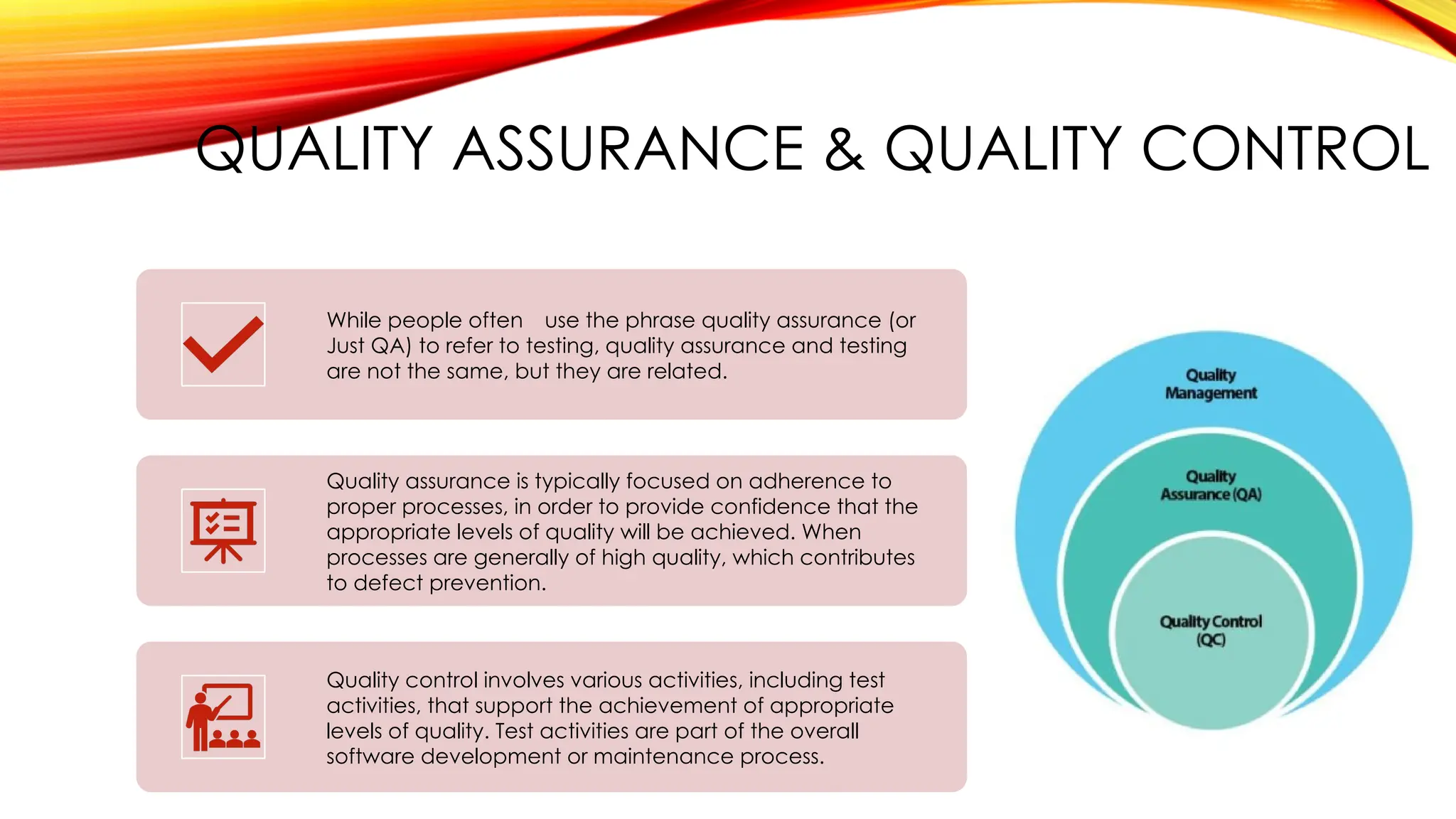
QUALITY ASSURANCE & QUALITY CONTROL
While people often use the phrase quality assurance (or
Just QA) to refer to testing, quality assurance and testing
are not the same, but they are related.
Quality assurance is typically focused on adherence to
proper processes, in order to provide confidence that the
appropriate levels of quality will be achieved. When
processes are generally of high quality, which contributes
to defect prevention.
Quality control involves various activities, including test
activities, that support the achievement of appropriate
levels of quality. Test activities are part of the overall
software development or maintenance process.
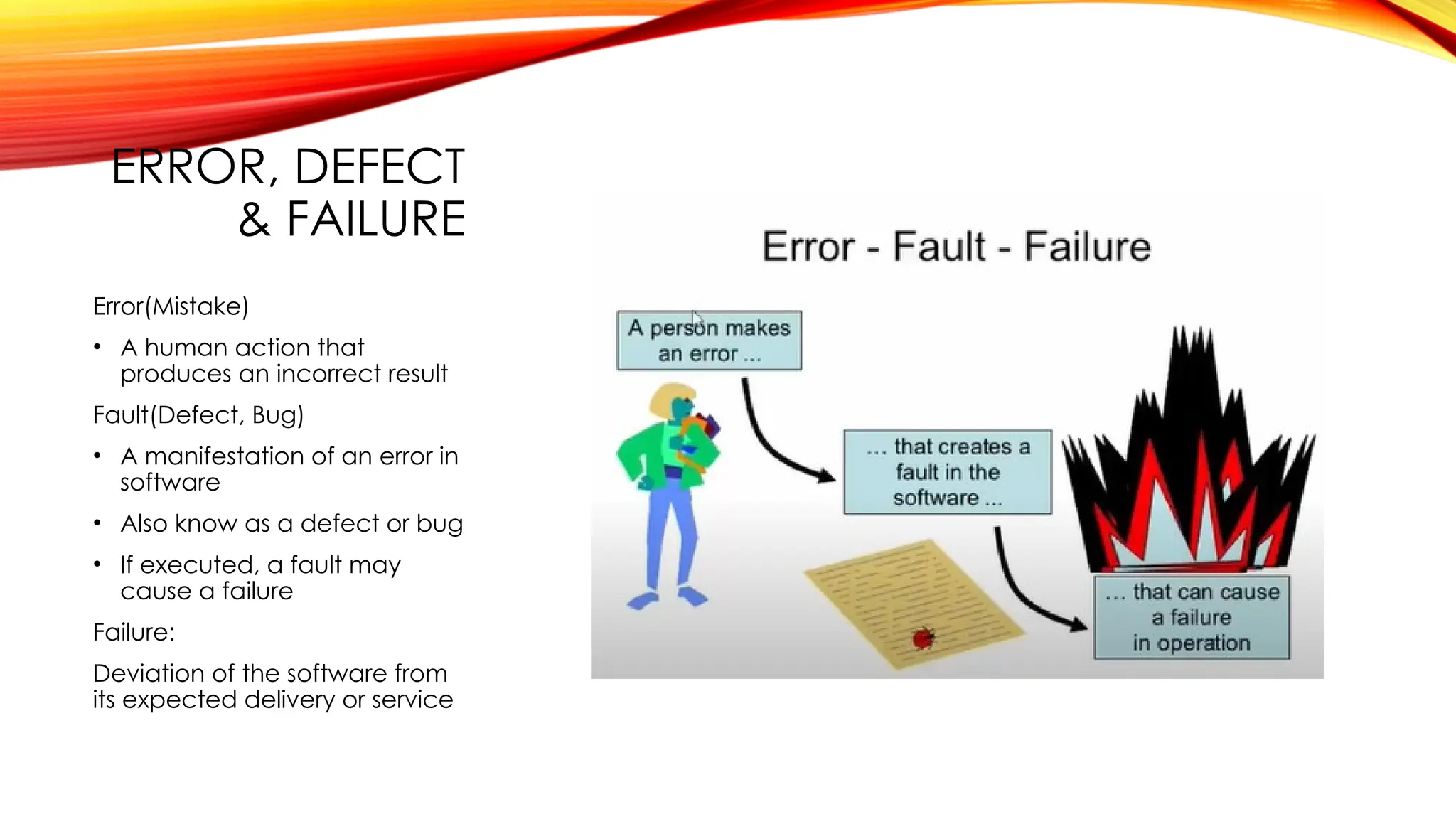
ERROR, DEFECT
& FAILURE
Error(Mistake)
• A human action that
produces an incorrect result
Fault(Defect, Bug)
• A manifestation of an error in
software
• Also know as a defect or bug
• If executed, a fault may
cause a failure
Failure:
Deviation of the software from
its expected delivery or service
CAUSES OF
SOFTWARE
DEFECTS
Errors may occur for many reasons, such as:
Time presser
Human is error prone
Inexperienced or insufficiently skilled project participants
Miscommunication between project participants, including
miscommunication about requirements and design
Complexity of the code, design, architecture, the underlying
problem to be solved, and/or the technologies used
Misunderstandings about intra-system and inter-system interfaces,
especially when such intrasystem and inter-system interactions
are large in number
New, unfamiliar technologies
ISTQB FOUNDATION
LEVEL EXAM
PREPARATION
FUNDAMENTALS
OF TESTING
Contents:
1.1 What is testing?
1.2 Why Testing Necessary?
1.3 Seven Testing Principles
1.4 Fundamental Test Process
1.5 The Psychology of Testing
1.3
PRINCIPLES
OF TESTING
Seven Testing Principles:
Principle 1: Testing shows presence of defects
Principle 2: Exhaustive testing is impossible
Principle 3: Earlier Testing
Principle 4: Defect clustering
Principle 5: Pesticide paradox
Principle 6: Testing is context dependent
Principle 7: Absence-of-error fallacy
PRINCIPLE 1:
TESTIGN SHOWS
PRESENCE OF
DEFECTS
Testing shows presence of defects, not
there absence
Testing can show that defects are
present in a system software, but no
matter whatever count of defects we
find, at any point of time we can’t say
there no more defects.
Also to add to it, in case no defects
are found, it’s not a proof of
correctness.
PRINCIPLE 2:
EXHAUSTIVE
TESTING IS
IMPOSSIBLE
Testing everything, which mean all possible
combination of inputs and preconditions is
generally not feasible to be conducted.
As an alternative to exhaustive testing, risk
analysis and priorities should be used to focus
on testing efforts
Example:
One screen has 15 input fields each have 5
possible values, then to test all the valid input
value combinations, you would need 5^15 =
30517578125 tests
PRINCIPLE 3: EARLY TESTING:
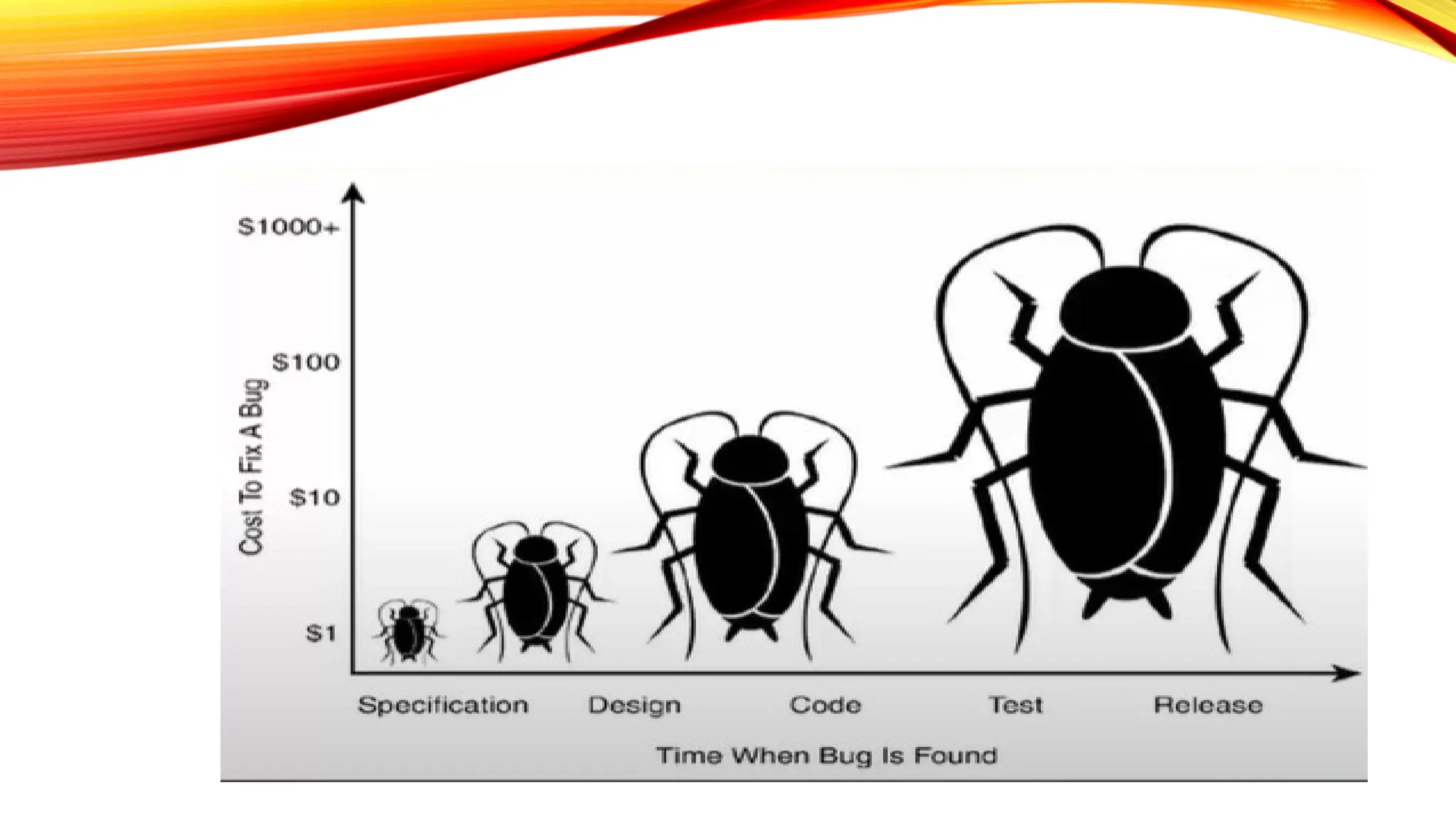
IT SAVES TIME AND MONEY
To find defects earlier or to
prevents defects being
introduced, testers must be
involved as early as possible in
developments life cycle.
Testing activities must be
coordinated with
corresponding development
activities.
Testers are good contributor in
reviews and must participate.
This helps them understand the
requirements earlier and
prepare test cases earlier in life
cycle.
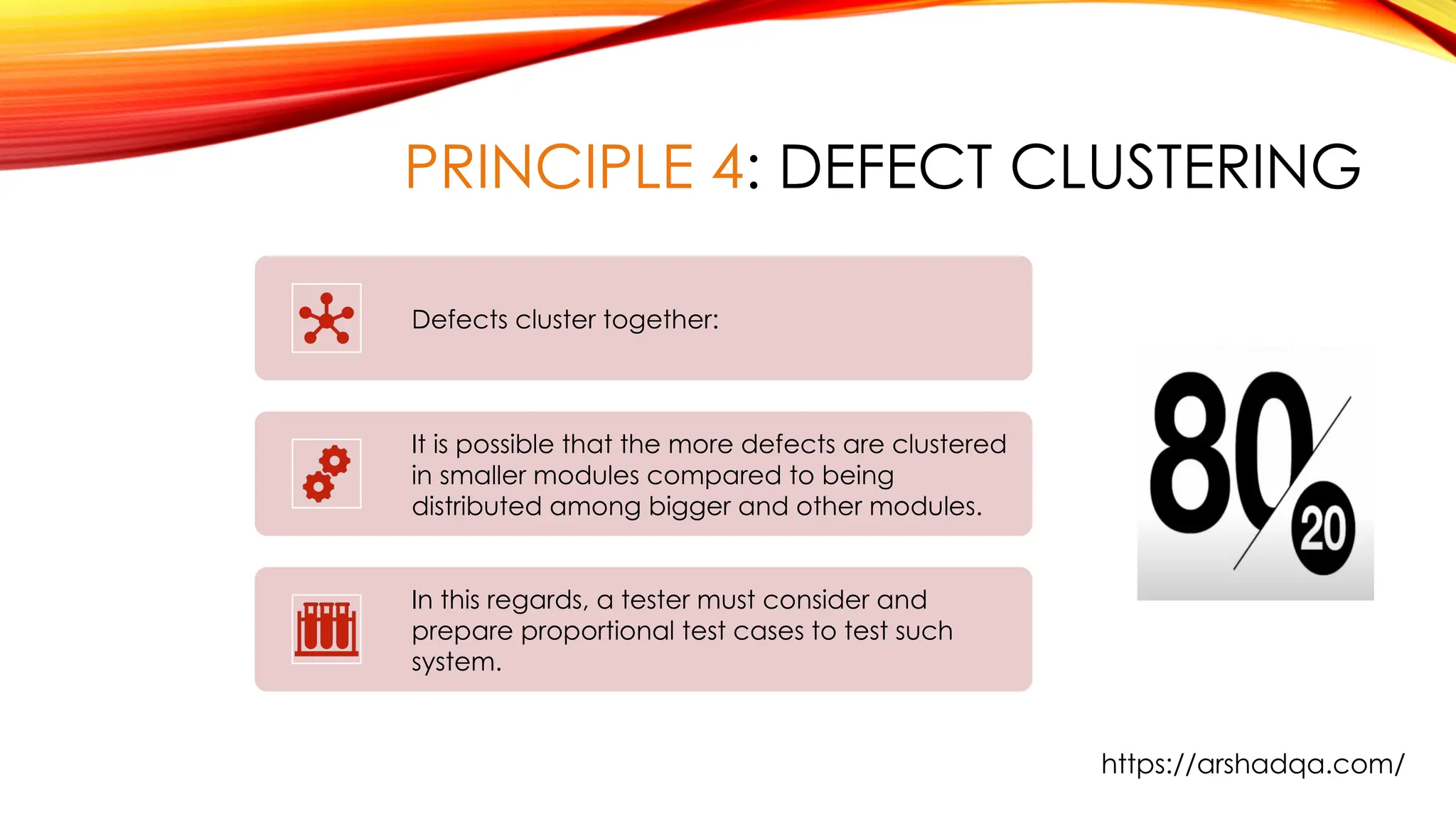
PRINCIPLE 4: DEFECT CLUSTERING
Defects cluster together:
It is possible that the more defects are clustered
in smaller modules compared to being
distributed among bigger and other modules.
In this regards, a tester must consider and
prepare proportional test cases to test such
system.
https://arshadqa.com/
PRINCIPLE 5: PESTICIDE PARADOX
If the same tests are prepared over and
over again, eventually the same set of test
cases will no longer help find new defects.
To overcome this “Pesticide Paradox” test
cases need to be regularly reviewed and
revised
https://arshadqa.com/
PRINCIPLE 6:
TESTING IS
CONTEXT
DEPENDENT
Testing is done differently
in different context
Two different software are
testing with different
strategy.
PRINCIPLE 7: ABSENCE-OF-ERROR FALLACY
• Meeting the requirement is equally important.
Finding and fixing defect doesn’t help if the
system built doesn’t fulfill the users’ need and
expectations.
TESTING PRINCIPLES
These principles provide a foundation for
making informed decisions during the testing
process. By applying these principles, testers
can focus on high-risk areas, avoid common
pitfalls, and ensure that their testing is both
efficient and effective.
ISTQB FOUNDATION
LEVEL EXAM
PREPARATION
1.4 TEST PROCESS – PART 1
https://arshadqa.com/
1.4 TEST
PROCESS –
PART 1
Contextual
factors that
influence
the test
process for
an
organizatio
n, include
but are not
limited to:
Software development lifecycle model and project
methodologies being used.
Test levels and test types being considered
Product and project risks
Business domain
Operational constraints, (Budgets and resources,
Timescales, complexity, contractual and regulatory
requirements)
Organizational policies and practices
Required internal and external standards
1.4 TEST PROCESS
In a QA (Quality Assurance) role, it’s crucial
to remember the key aspects of the test
process to ensure thorough and effective
testing.
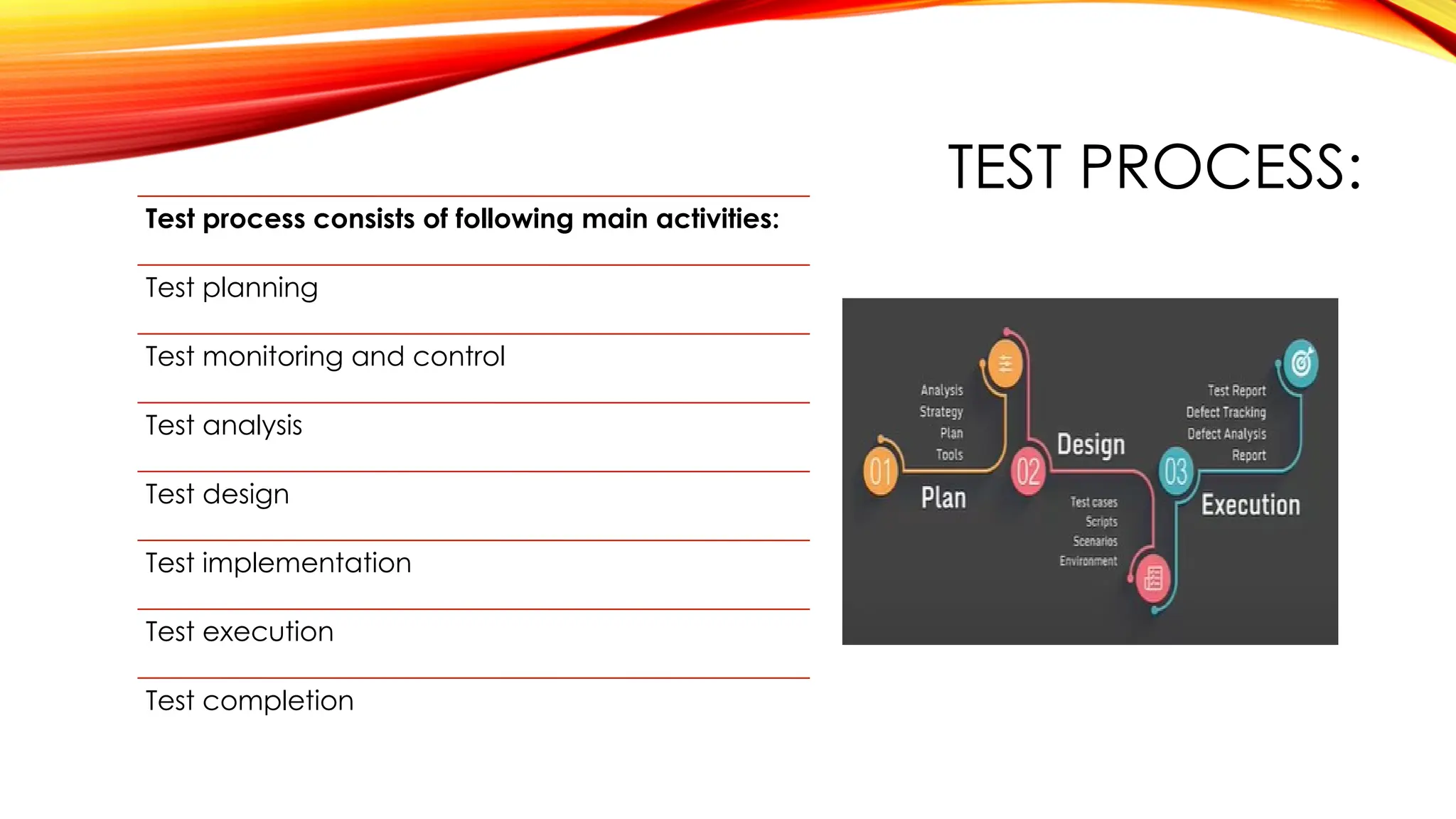
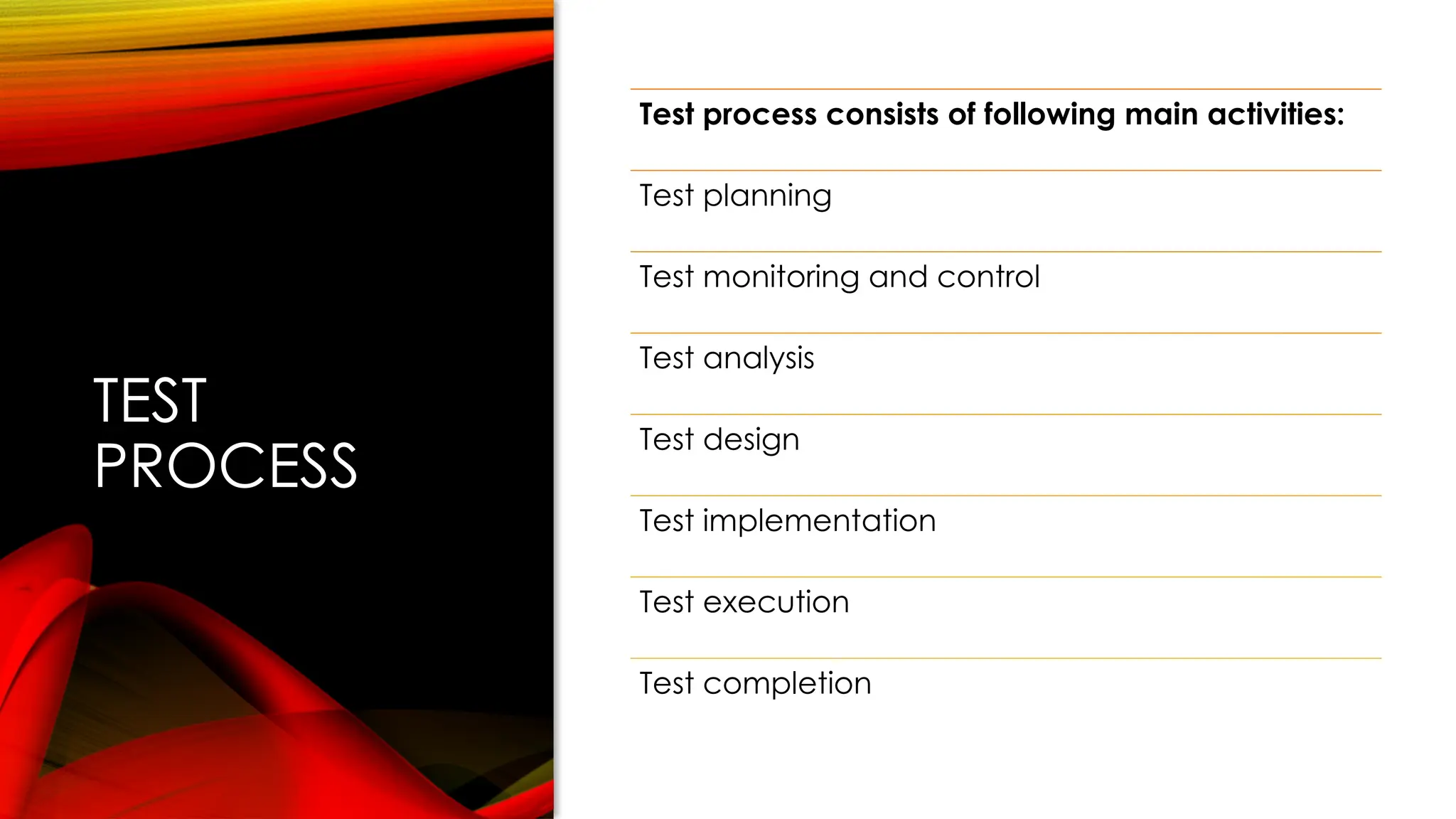
TEST PROCESS:
Test process consists of following main activities:
Test planning
Test monitoring and control
Test analysis
Test design
Test implementation
Test execution
Test completion
TEST
PLANNING
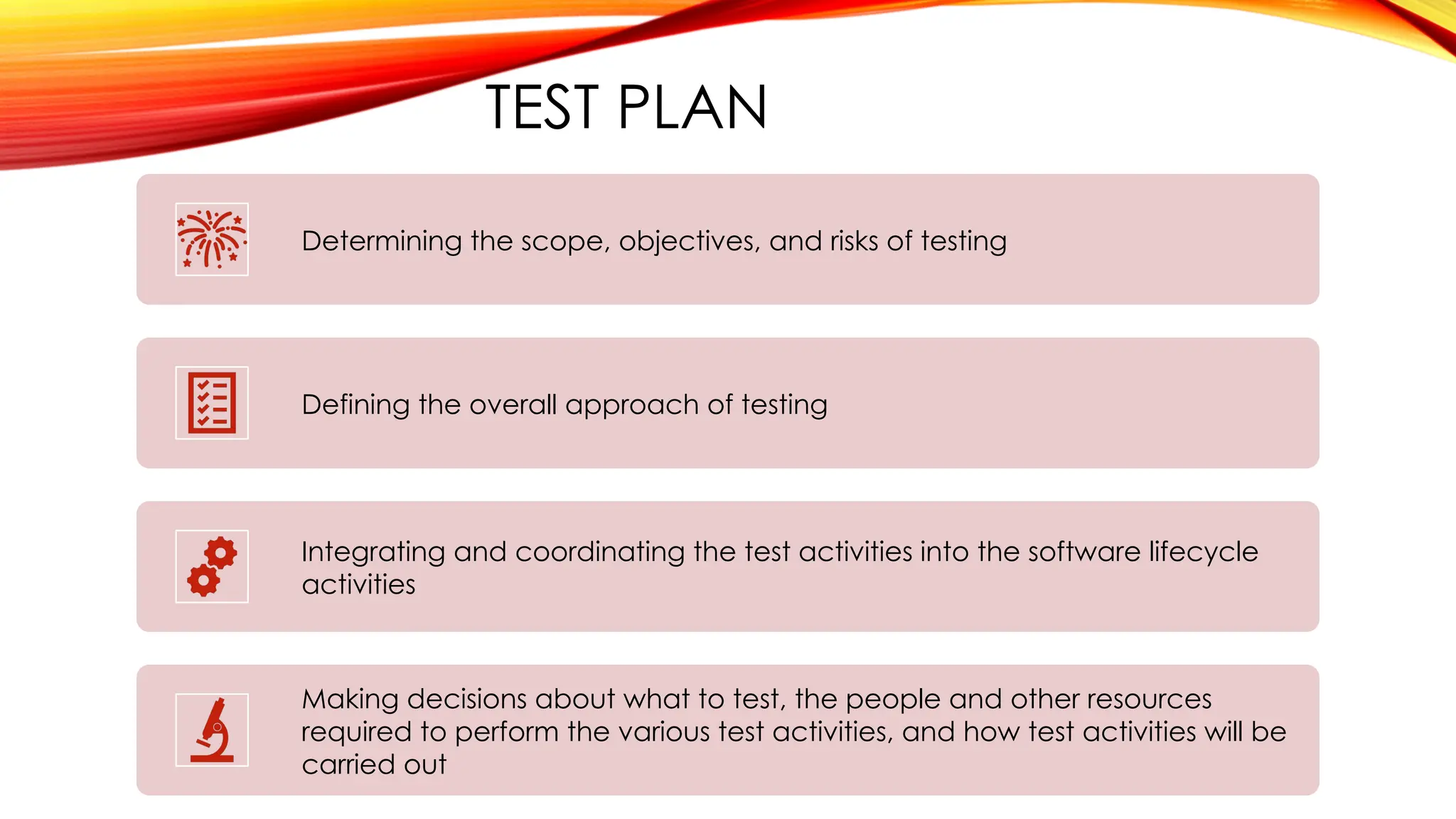
Test planning consists of following main activities:
Determining the scope and risks and identifying the
objective of testing
Defining the overall approach of testing
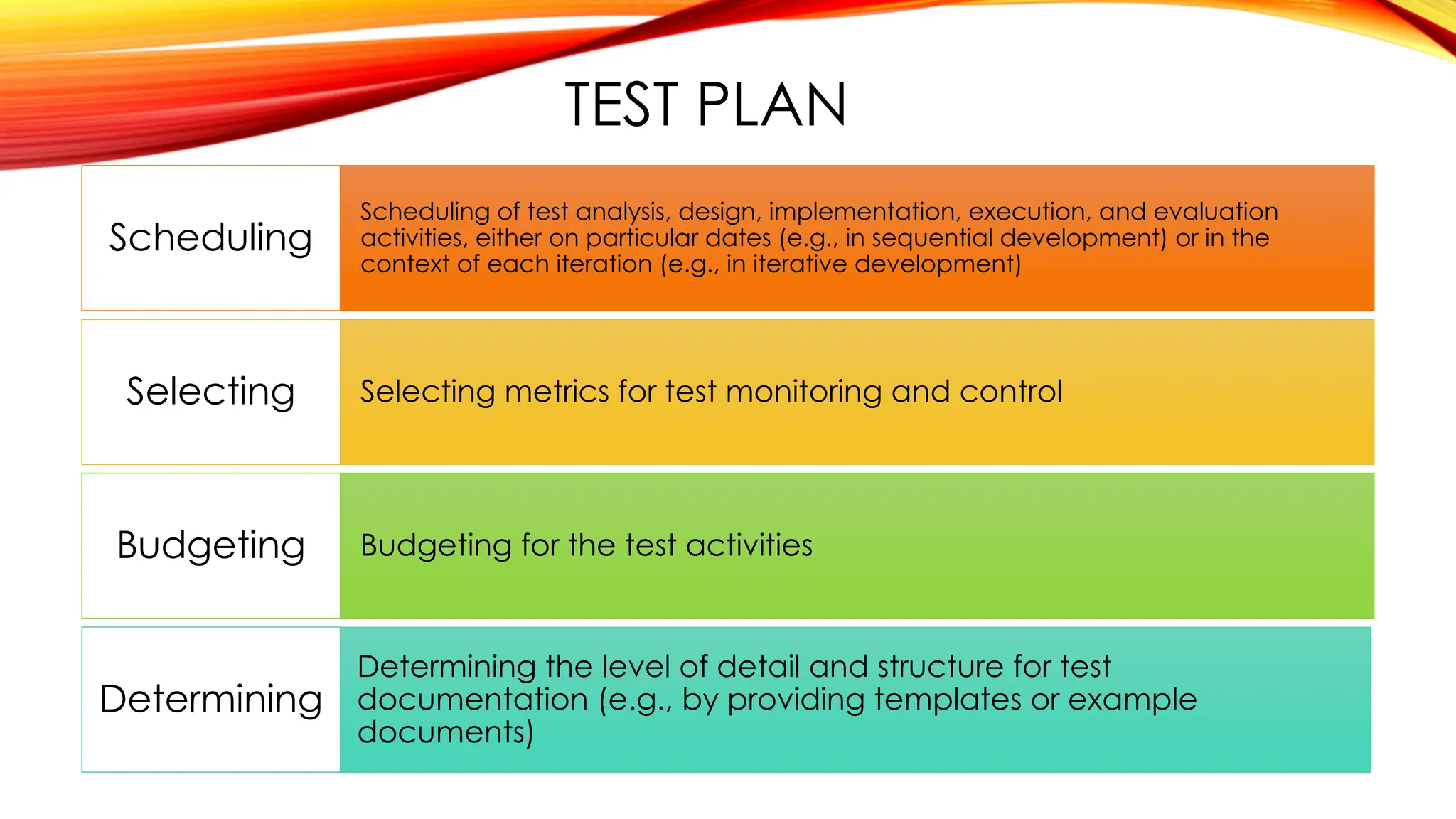
Scheduling test activities, assigning resources for the
activities
Defining the amount, detail, template for
documentation
Selecting metrics for monitoring and controlling
Defining entry and exit criteria
Deciding about automation.
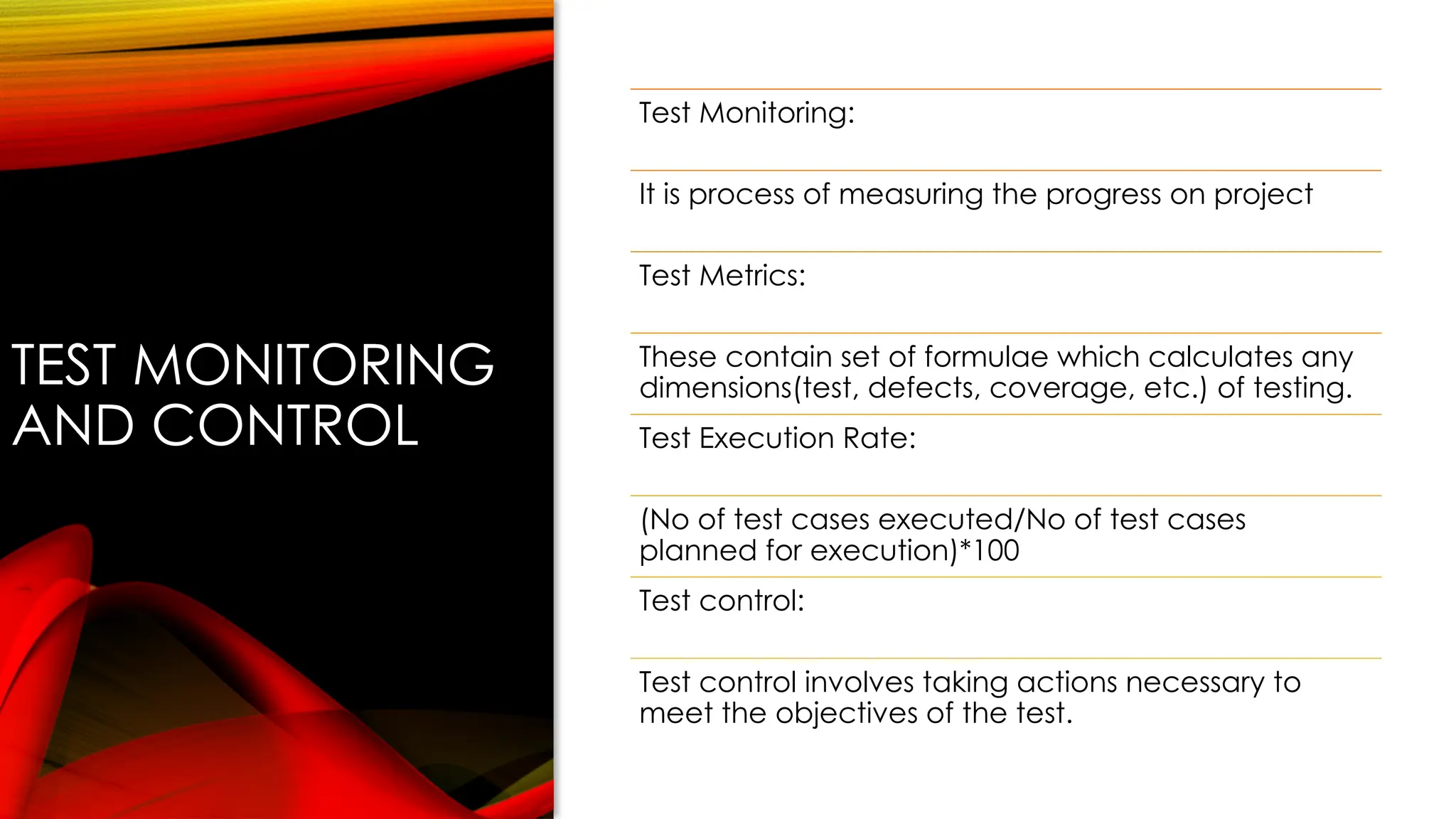
TEST MONITORING
AND CONTROL
Test Monitoring:
It is process of measuring the progress on project
Test Metrics:
These contain set of formulae which calculates any
dimensions(test, defects, coverage, etc.) of testing.
Test Execution Rate:
(No of test cases executed/No of test cases
planned for execution)*100
Test control:
Test control involves taking actions necessary to
meet the objectives of the test.
TEST
PROCESS
Test process consists of following main activities:
Test planning
Test monitoring and control
Test analysis
Test design
Test implementation
Test execution
Test completion
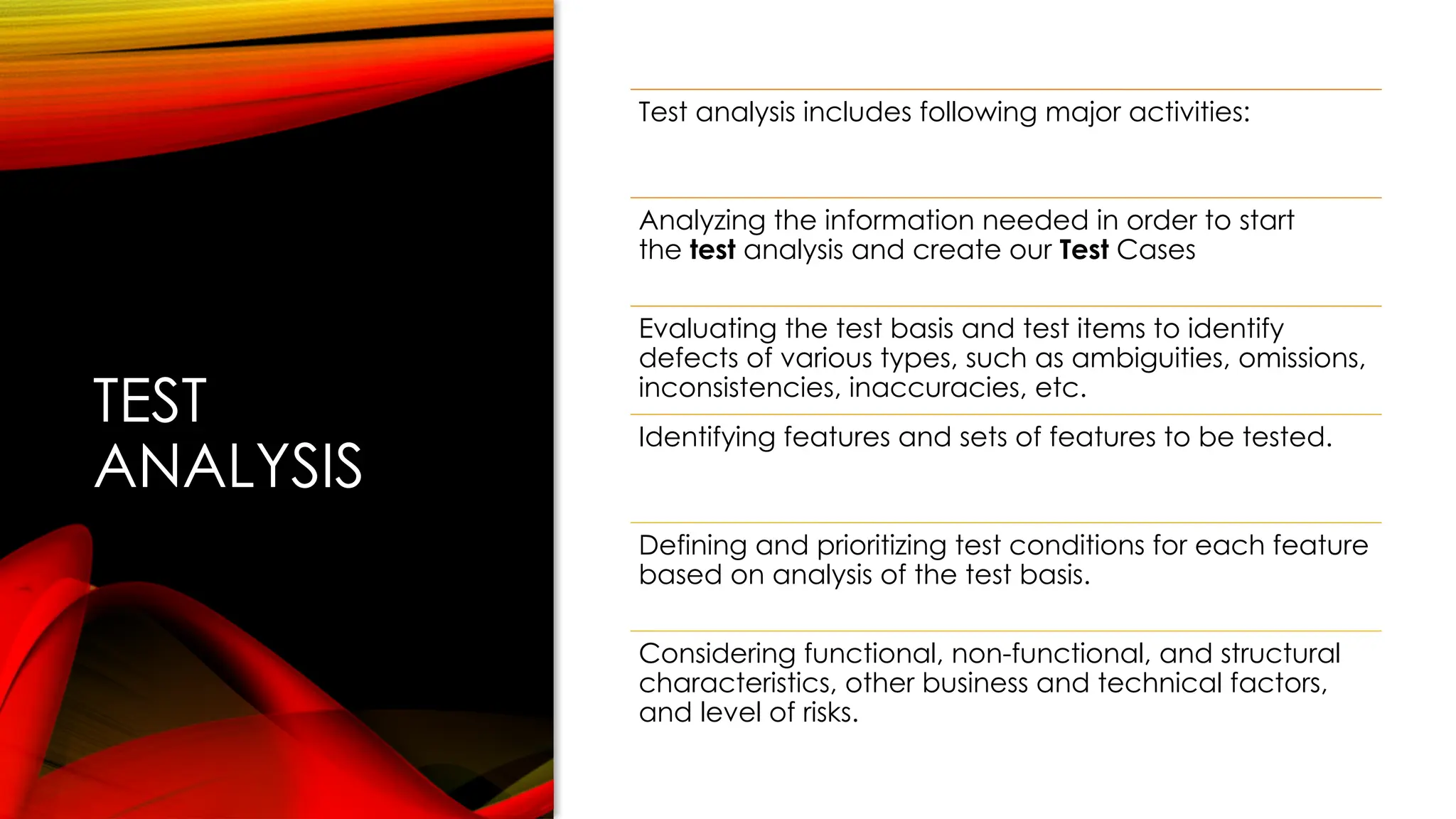
TEST
ANALYSIS
Test analysis includes following major activities:
Analyzing the information needed in order to start
the test analysis and create our Test Cases
Evaluating the test basis and test items to identify
defects of various types, such as ambiguities, omissions,
inconsistencies, inaccuracies, etc.
Identifying features and sets of features to be tested.
Defining and prioritizing test conditions for each feature
based on analysis of the test basis.
Considering functional, non-functional, and structural
characteristics, other business and technical factors,
and level of risks.
TEST DESIGN
Test design includes the
following major activities:
• Designing and prioritizing test
cases
• Identifying necessary test data to
support the test conditions and
test cases.
• Designing the test environment
and identifying required
infrastructure and tools.
• Creating bi-directional traceability
between test basis and test cases
TEST PROCESS
Test process consists of following main activities:
Test planning
Test monitoring and control
Test analysis
Test design
Test implementation
Test execution
Test completion
TEST IMPLEMENTATION
Test implementation includes the following activities
Developing and prioritizing test procedures and potentially,
creating automated test scripts
Creating test suites from the test procedures and (if any)
automated test scripts
Arranging the test suites within a test execution schedule in a way
that results in efficient test execution
Building the test environment (including, potentially, test harness,
service virtualization, simulators, and other infrastructure items)
and verifying the everything needed has been set up correctly.
Preparing test data and ensuring it is properly loaded in the test
environment. Verifying and updating bi-directional traceability
between the test basis, test conditions, test cases, test
procedures and test suits.
TEST EXECUTION
Test execution includes the following major
activities
• Recording the IDs and versions of the test item(s) or
test object, test tool(s) and testware.
• Executing tests either manually or by using test
execution tools
• Comparing actual results with expected results
• Analyzing anomalies to establish their likely causes
(e.g., failures my occur due to defects in code, but
false positives also may occur.
• Reporting defects based on the failures observed
• Logging the outcome of test execution (e.g., pass,
fail, blocked)
• Repeating test activities either as a result of action
taken for an anomaly, or as part of the planned
testing(e.g., execution of a corrected test,
confirmation testing and /or regression testing)
TEST COMPLETION
Test completion includes following major activities :
Checking whether all defects reports are closed, entering
change requests or product backlog items for any defects that
remain unresolved at the end of test execution.
Creating test summary report to be communicated to
stakeholders
Finalizing and archiving the test environment, the test data, the
test infrastructure and other testware for later reuse.
Handing over the testware to the maintenance teams, other
project teams, and /or other stakeholders who could benefit
from it’s use.
Analyzing lessons learned from the completed test activities to
determine changes needed for future iterations, releases and
projects.
Using the information gathered to improve test process
maturity.
ISTQB FOUNDATION LEVEL
EXAM PREPARATION
1.4 TEST PROCESS – PART 2
https://arshadqa.com/
TEST WORK
PRODUCTS
Test
planning
work
products:
Test planning work
products typically
include one or more
test plans. The test plan
includes information
about the test basis, to
which the other test
work products will be
related via traceability
information.
TEST WORK
PRODUCTS:
Test Monitoring and control work products:
Test
Test monitoring and control work products typically
include various types of test reports, including test
progress reports and test summary.
Test
Test monitoring and control work products should
also address project management concerns, such
as task completion, resource allocation and usage
and effort.
Test
TEST WORK
PRODUCTS:
Test analysis work products
Test
Test analysis work products include defined and
prioritized test conditions, each of which is ideally bi-
directional traceability to the specific element(s) of
the test basis it covers.
Test
For exploratory testing, test analysis may involve the
creation of test charters.
Test
TEST WORK
PRODUCTS:
Test Design Work Products:
• Test design results in test cases and
sets of test cases to exercise the
test conditions defined in test
analysis.
• Test design also results in the
design and/or identification of the
necessary test data, the design of
the test environment, and the
identification of infrastructure and
tools, though the extent to which
these results are documented
varies significantly.
TEST WORK
PRODUCTS:
Test implementation work
product include:
• Test procedures and the
sequencing of those test
procedures
• Test suites
• A test execution schedule
• Test implementation also may result
in the creation and verification of
test data and the test environment.
TEST WORK
PRODUCTS:
Test execution work
products include:
• Documentation of the status of
individual test cases or test
procedures(e.g., ready to run,
pass, fail, blocked, deliberately
skipped etc.
• Defect reports
• Documentation about which test
item(s), test object(s), test tool,
and testware were involved in
the testing.
TEST WORK
PRODUCTS:
Test completion work
products:
• Test completion work products
include test summary reports,
action items for improvement
of subsequent projects or
iterations(e.g., following a
project agile retrospective),
change requests product
backlog items, and finalized
testware.
TRACEABILITY
BETWEEN THE
TEST BASIS AND
TEST WORK
PRODUCTS
In addition to the evaluation of test coverage, good traceability
supports:
Analyzing the impact of changes
Making testing auditable
Meeting IT governance criteria
Improving the understanding of test progress reports and test summary
reports to include the status of elements of the test basis(e.g.,
requirements that passed their tests, requirements that failed their tests,
and requirements that have pending tests)
Relating the technical aspects of testing to stakeholders in terms that
they can understand.
Proving information to assess product quality, process capability, and
project progress against business goals.
ISTQB
FOUNDATION
LEVEL EXAM
PREPARATION
https://arshadqa.com/
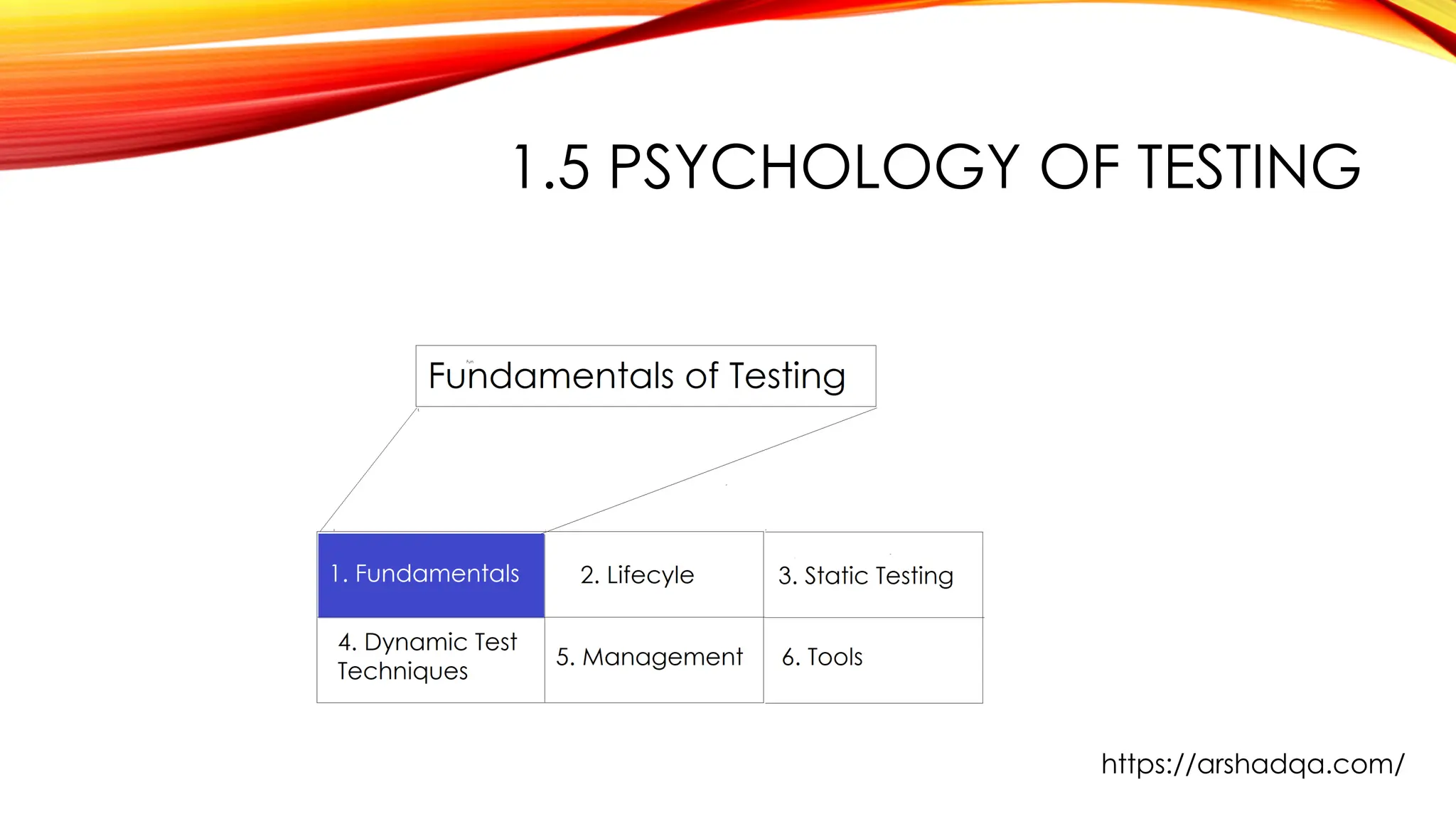
1.5 PSYCHOLOGY OF TESTING
https://arshadqa.com/
HUMAN
PSYCHOLOGY
AND TESTING
Identifying defects during a static test such as a
requirements review or user story refinement
session, or identifying failures during dynamic
test execution, may be perceived as criticism of
the product and of its author.
Since developers expect their code to be
correct, they have a confirmation bias that
makes it difficult to accept that the code is
incorrect
Information produced by testing often contains
bad news. it is a common human trait to blame
the bearer of bad news
HUMAN
PSYCHOLOGY AND
TESTING
As a result of these psychological
factors, some people may perceive
testing as a destructive activity, even
though it contributes greatly to project
progress and product quality.
Information about defects and failures
should be communicated in a
constructive way
This way, tensions between the testers
and the analysts, product owners,
designers, and developers can be
reduced.
HUMAN
PSYCHOLOGY
AND TESTING
Testers and test managers need to
have good interpersonal skills to be
able to communicate effectively
and to build positive relationships
with colleagues.
Ways to communicate well include
the following examples, let’s discuss
few of them one by one
WAYS TO
COMMUNICATE
WELL
Start with collaboration rather than battles. Remind
everyone of the common goal of better quality systems.
Emphasize the benefits of testing.
Communicate test results and other findings in a neutral,
fact-focused way without criticizing the person who created
the defective item.
Write objective and factual defect reports and review
findings.
Try to understand how the other person feels and the reasons
they may react negatively to the information.
Confirm that the other person has understood what has
been said and vice versa.
1.5.2 TESTER’S AND DEVELOPER’S MINDSETS
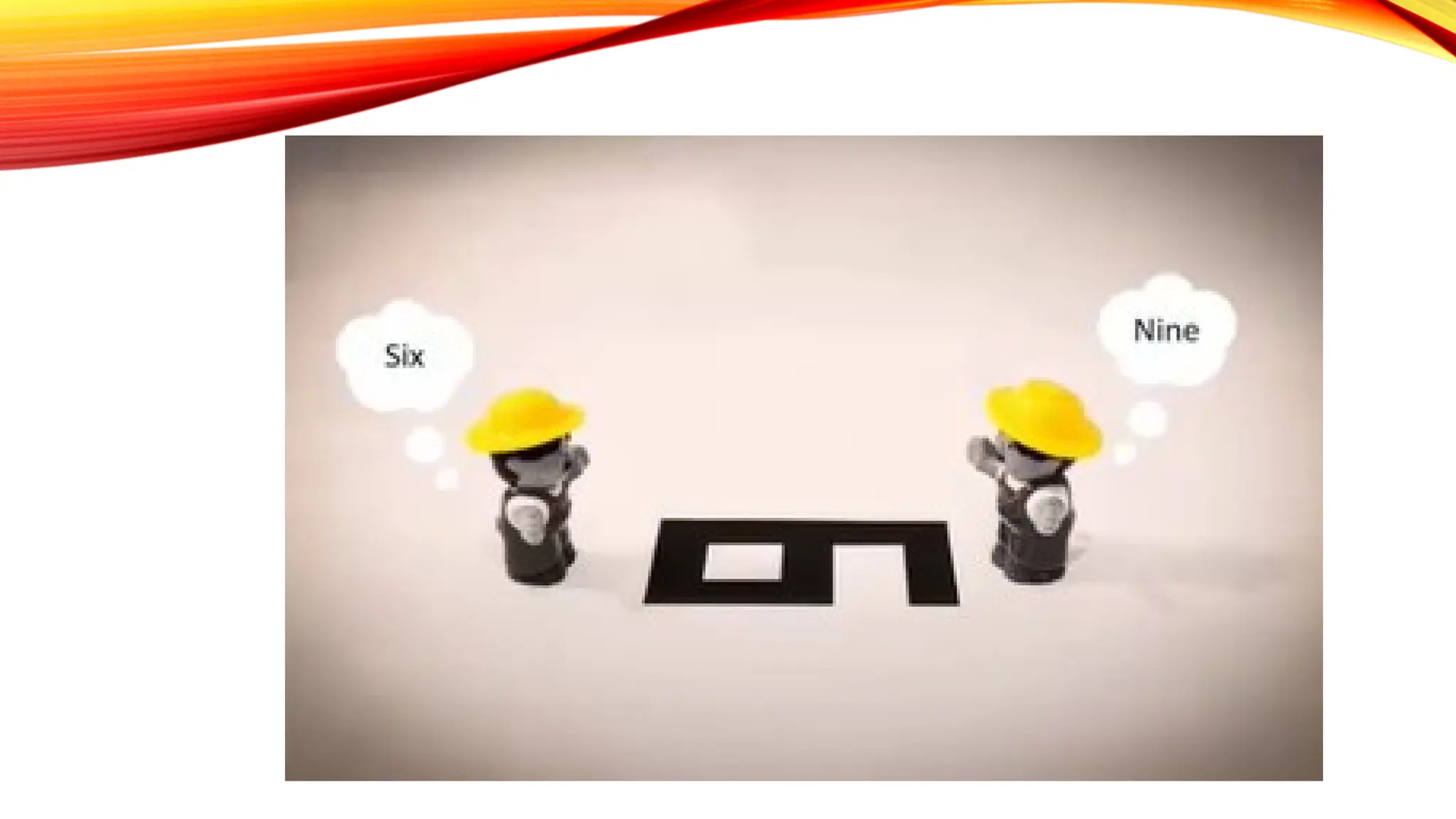
Developers and testers often think differently.
A mindset reflects an individual’s assumptions and preferred methods for decision
making and problem solving.
A tester’s mindset should include curiosity, professional pessimism, a critical eye, attention
to detail, and a motivation for good and positive communications and relationships
A tester’s mindset tends to grow and mature as the tester gains experience.
A DEVELOPER’S
MINDSET
A developer’s mindset may include some of the
elements of a tester’s mindset.
Successful developers are often more interested
in designing and building solutions than in
contemplating what might be wrong with those
solutions.
Confirmation bias makes it difficult to find
mistakes in their own work.
With the right mindset, developers are able to
test their own cod
INDEPENDENT
TESTING
Having some of the test activities
done by independent testers
increases defect detection
effectiveness.
Independent testers bring a
perspective which is different
than that of the work product
authors.
Independent tasters or third party
testers have different cognitive
biases from the authors.
LEVELS OF INDEPENDENT TESTERS
Tests designed by
the person who
wrote the software
under test
01
Tests designed by
another person
02
Tests designed by a
person from a
different
organizational
group or test
specialists.
03
Tests designed by a
person from a
different
organization or
company.
04
ISTQB
FOUNDATION
LEVEL EXAM
PREPARATION
https://arshadqa.com/
CHAPTER: 02
TESTING THROUGHOUT THE
SOFTWARE LIFE CYCLE
https://arshadqa.com/
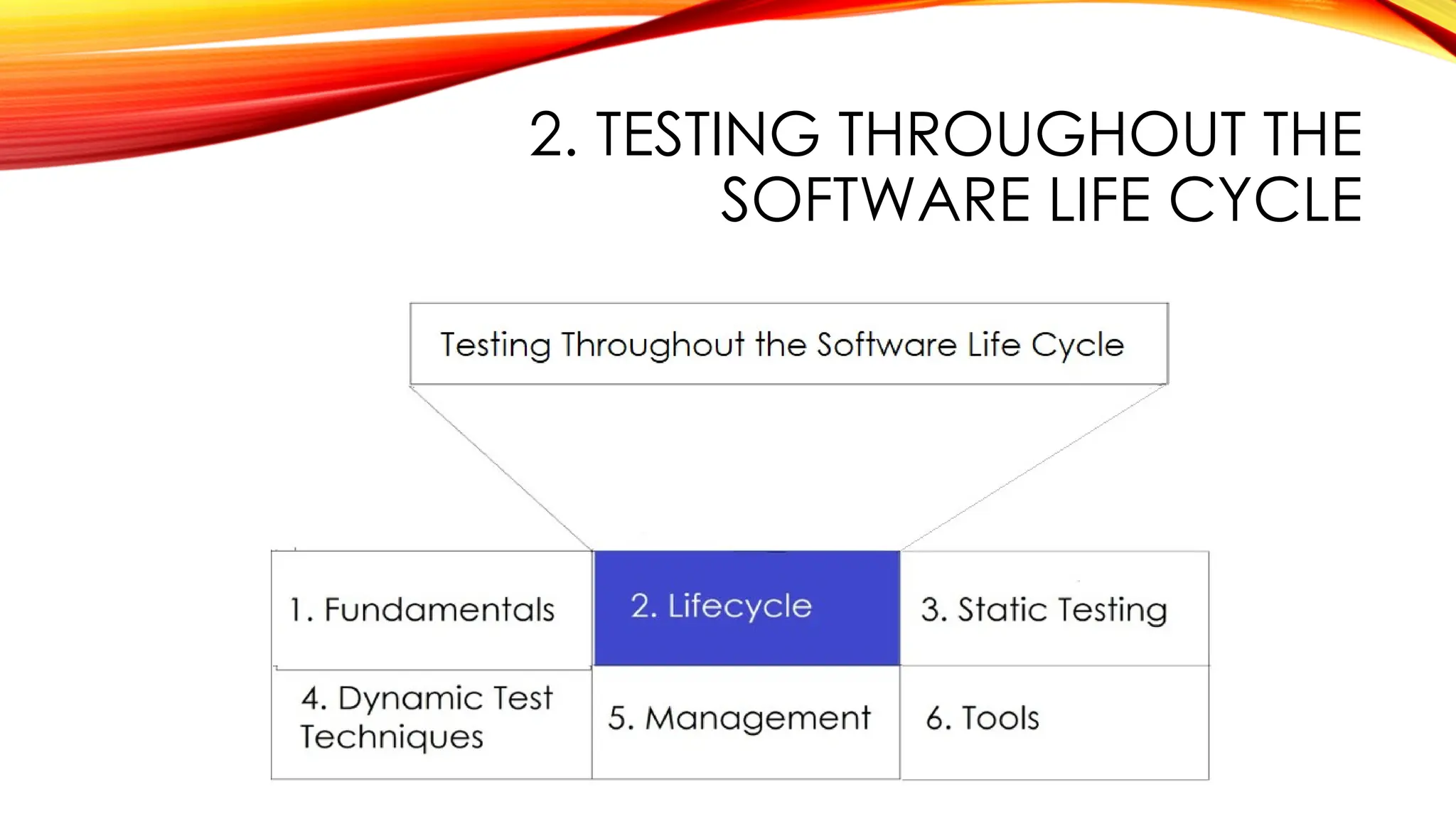
2. TESTING THROUGHOUT THE
SOFTWARE LIFE CYCLE
TESTING THROUGHOUT THE
SOFTWARE LIFE CYCLE
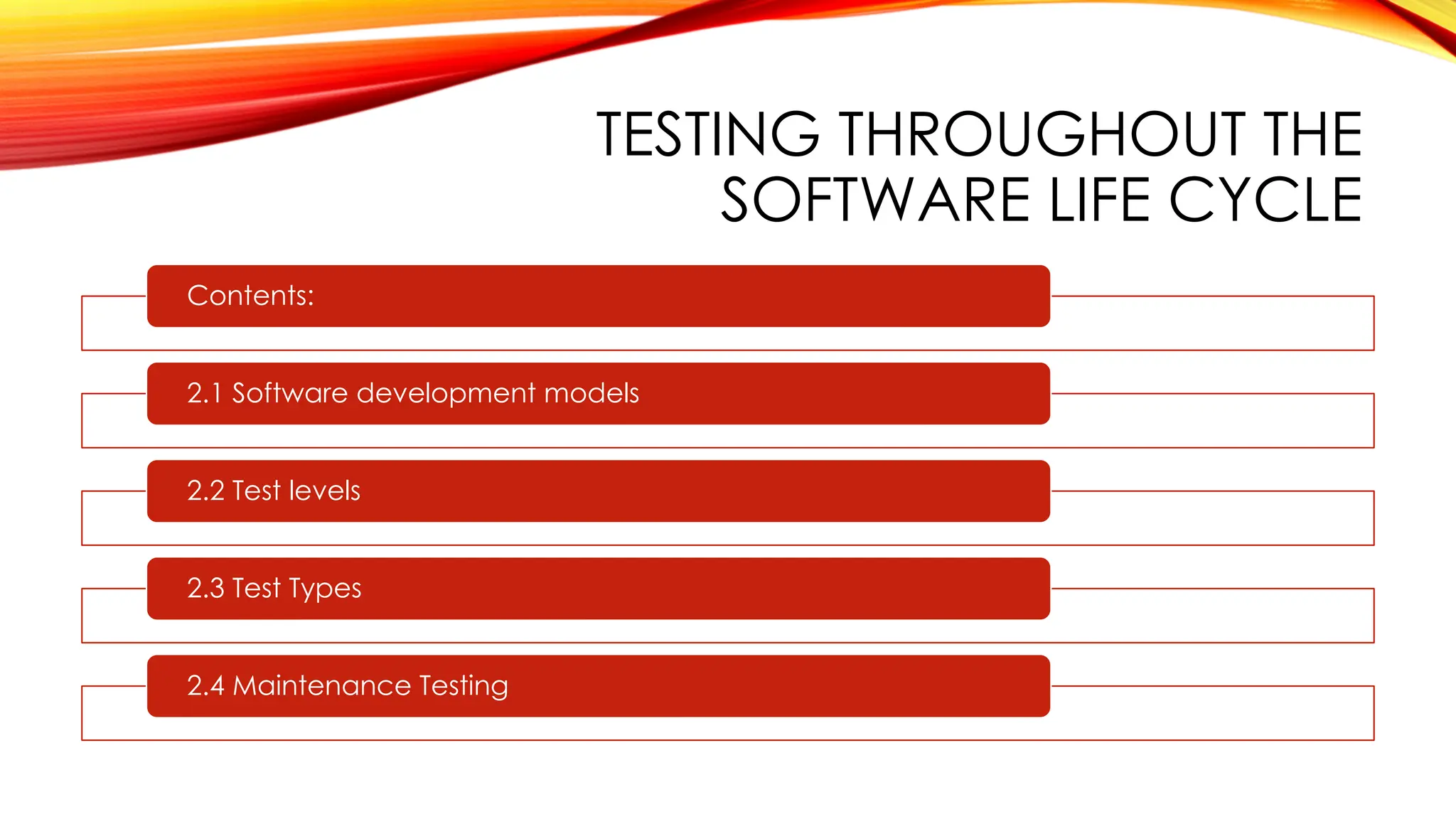
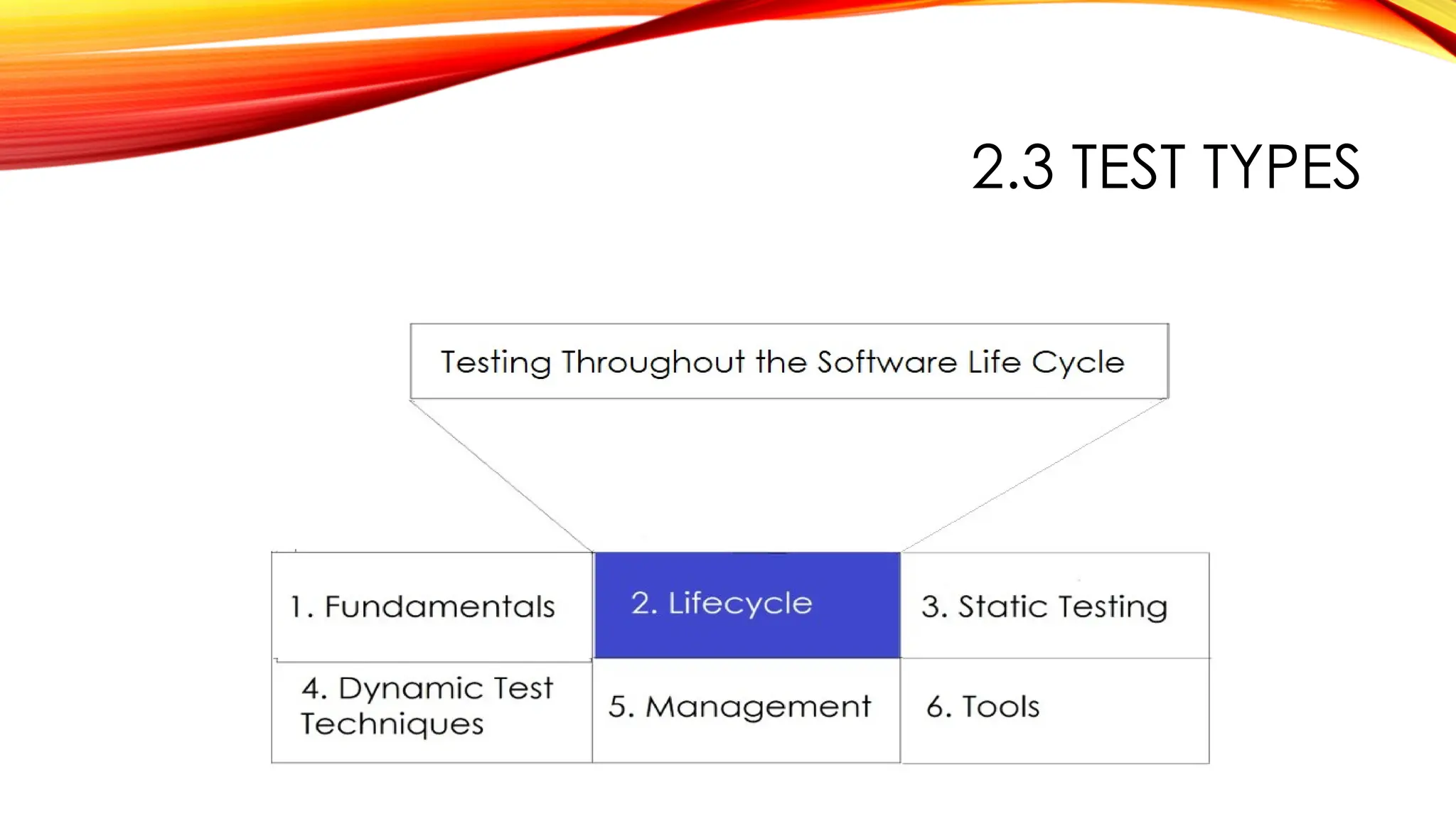
Contents:
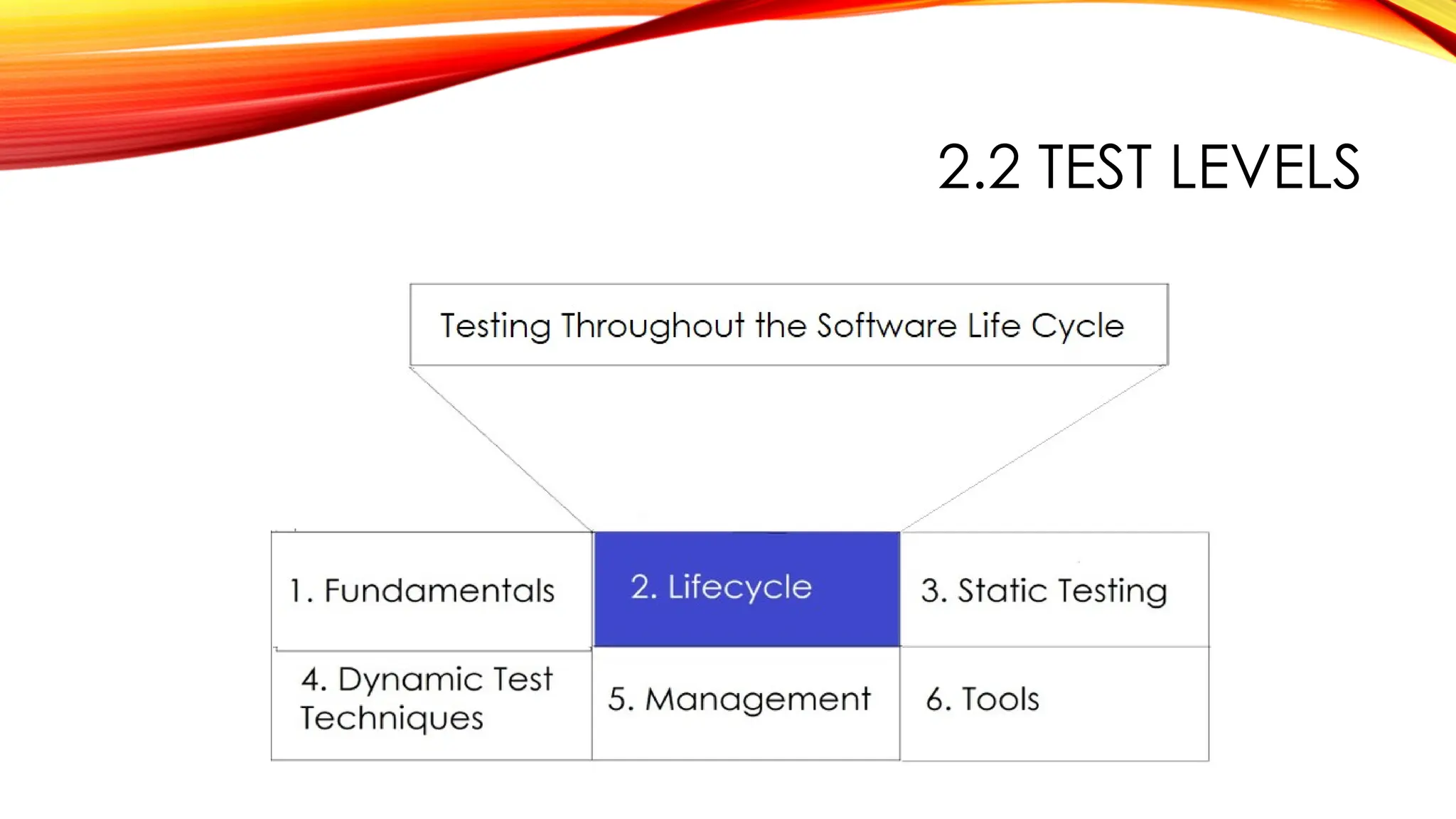
2.1 Software development models
2.2 Test levels
2.3 Test Types
2.4 Maintenance Testing
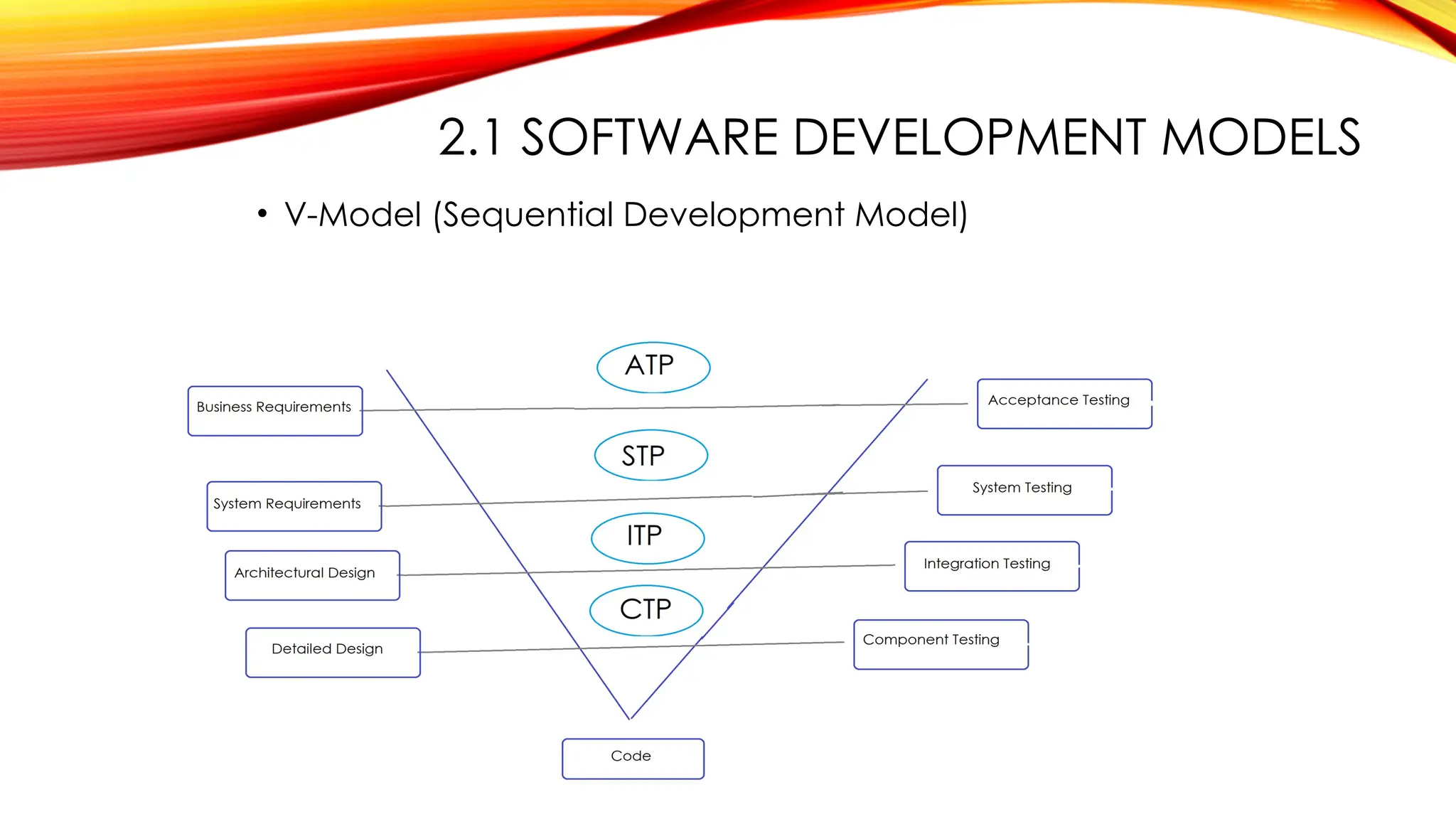
2.1 SOFTWARE DEVELOPMENT MODELS
• V-Model (Sequential Development Model)
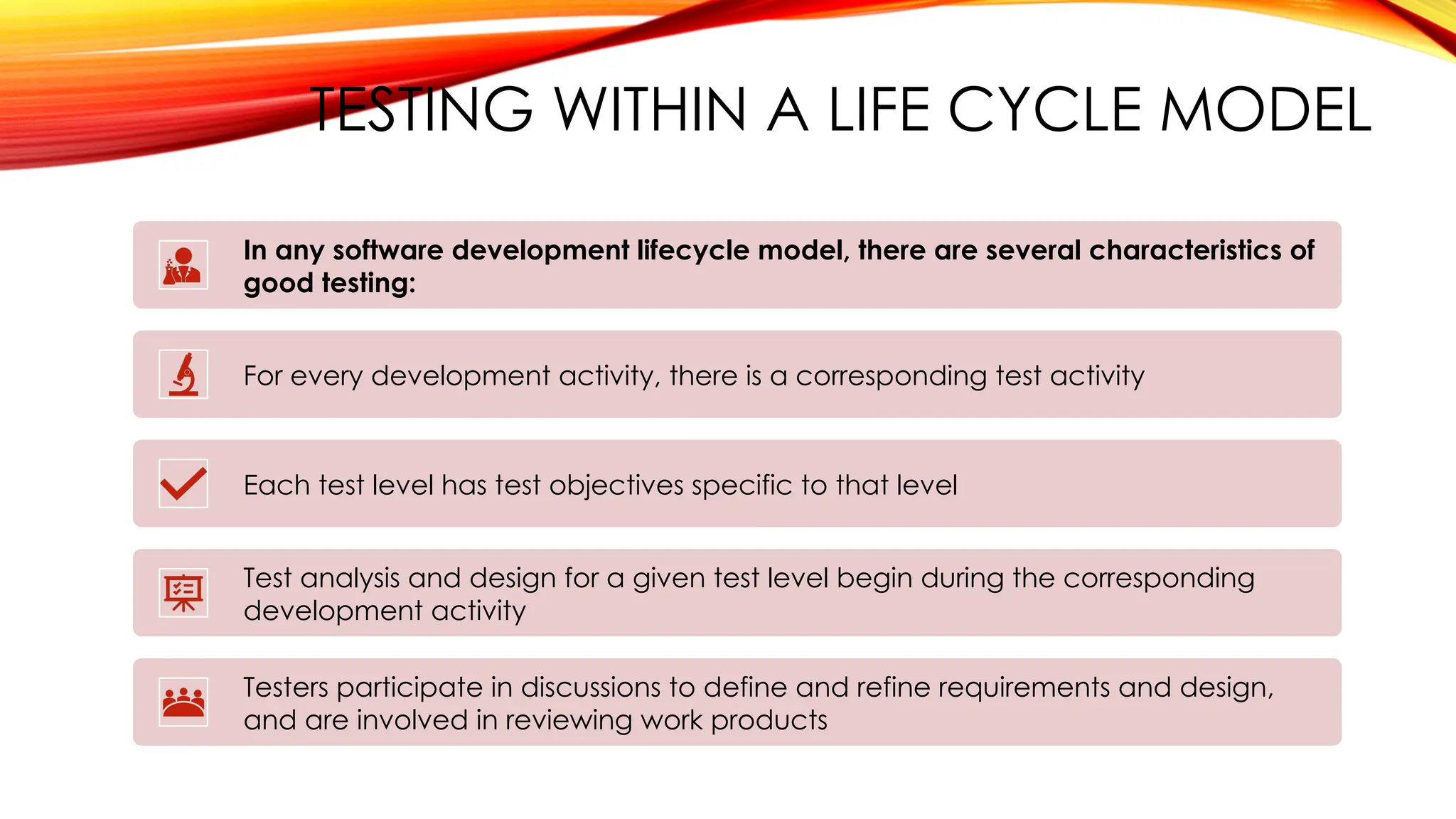
TESTING WITHIN A LIFE CYCLE MODEL
In any software development lifecycle model, there are several characteristics of
good testing:
For every development activity, there is a corresponding test activity
Each test level has test objectives specific to that level
Test analysis and design for a given test level begin during the corresponding
development activity
Testers participate in discussions to define and refine requirements and design,
and are involved in reviewing work products
SOFTWARE
DEVELOPMENT
MODEL
A sequential development model
describes the software development
process as a linear, sequential flow of
activities
Incremental development involves
establishing requirements, designing,
building, and testing a system in pieces,
which means that the software’s
features grow incrementally
Iterative development occurs when
groups of features are specified,
designed, built, and tested together in
a series of cycles, often of a fixed
duration
ITERATIVE
DEVELOPMENT
MODEL
EXAMPLES
Rational Unified Process: Each iteration tends to be
relatively long (e.g., two to three months).
Scrum: Each iteration tends to be relatively short (e.g.,
hours, days, or a few weeks), and the feature
increments are correspondingly small, such as a few
enhancements and/or two or three new features
Kanban: Implemented with or without fixed-length
iterations.
Spiral (or prototyping): Involves creating experimental
increments
SOFTWARE
DEVELOPMENT
LIFECYCLE
MODELS IN
CONTEXT
Software development lifecycle models must
be selected and adapted to the context of
project and product characteristics
Software development lifecycle models
themselves may be combined
Internet of Things (IoT) systems, which consist of
many different objects, such as devices,
products, and services, typically apply
separate software development lifecycle
models for each object. This presents a
particular challenge for the development of
Internet of Things system versions
ISTQB
FOUNDATION
LEVEL EXAM
PREPARATION
2.2 TEST LEVELS
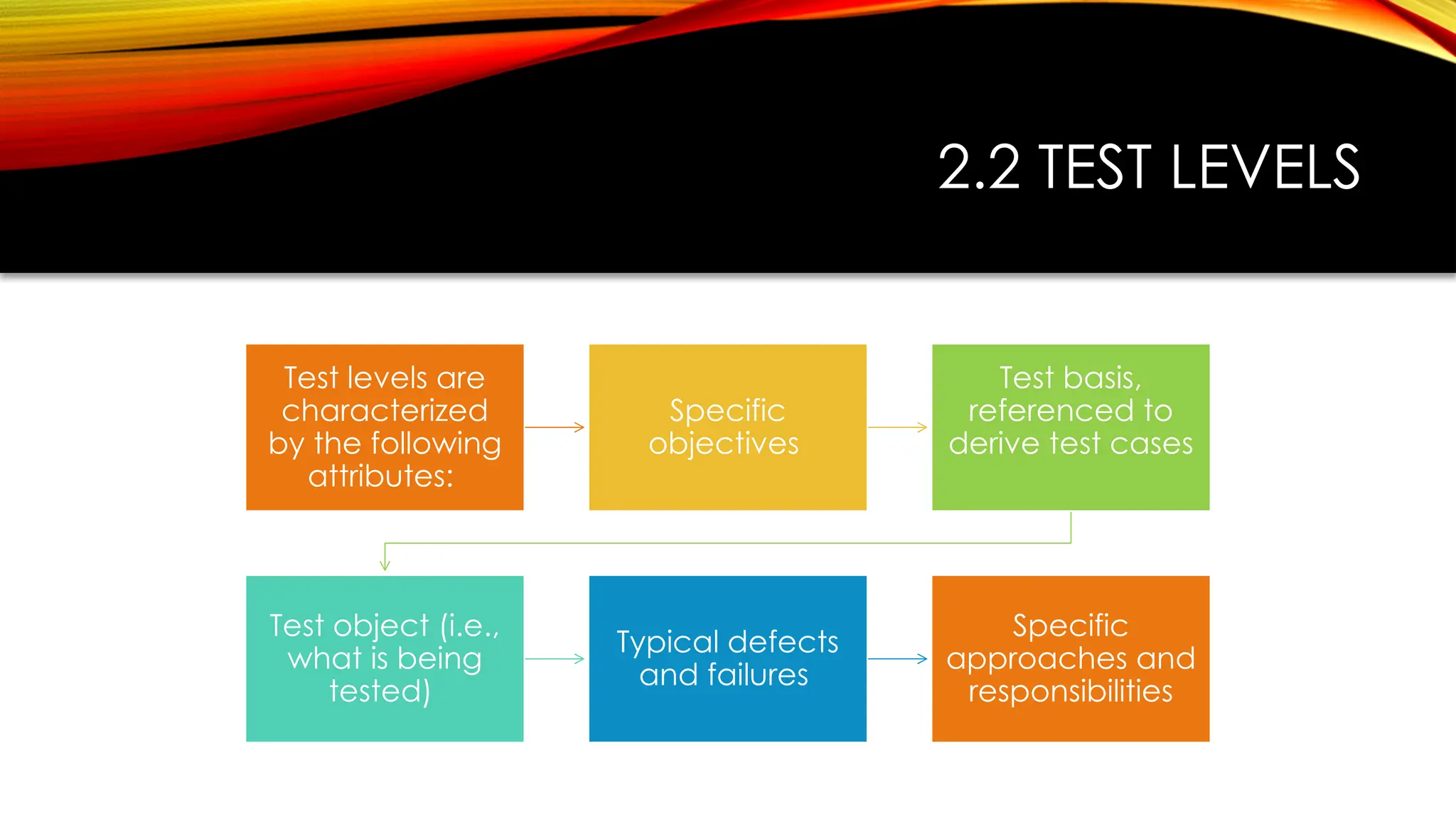
2.2 TEST LEVELS
Test levels are groups of test activities that are
organized and managed together
The test levels used in this syllabus are:
Component testing
Integration testing
System testing
Acceptance testing
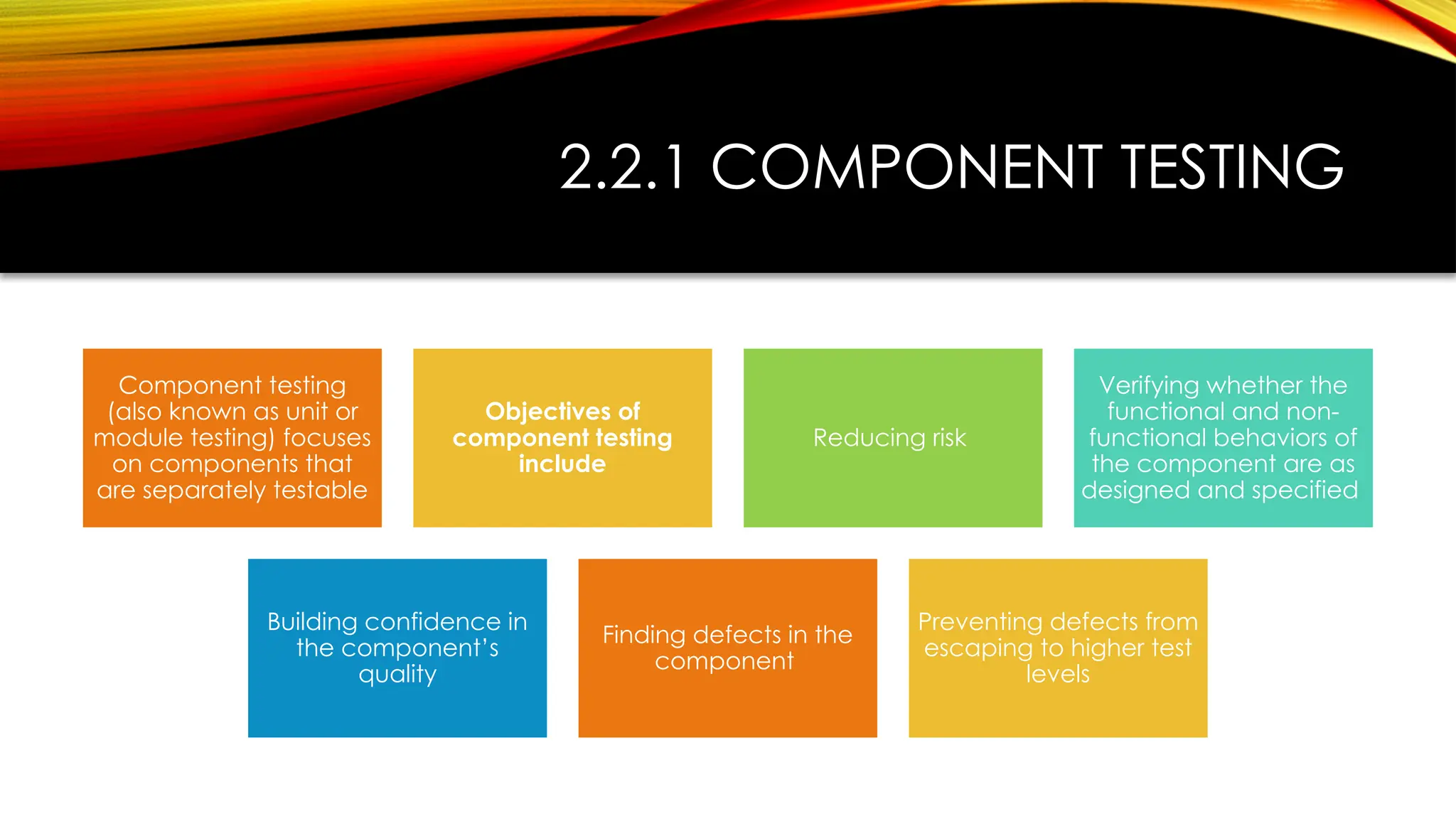
2.2 TEST LEVELS
Test levels are
characterized
by the following
attributes:
Specific
objectives
Test basis,
referenced to
derive test cases
Test object (i.e.,
what is being
tested)
Typical defects
and failures
Specific
approaches and
responsibilities
2.2.1 COMPONENT TESTING
Component testing
(also known as unit or
module testing) focuses
on components that
are separately testable
Objectives of
component testing
include
Reducing risk
Verifying whether the
functional and non-
functional behaviors of
the component are as
designed and specified
Building confidence in
the component’s
quality
Finding defects in the
component
Preventing defects from
escaping to higher test
levels
2.2.1 COMPONENT TESTING
• Test basis Examples of work products that can be used
as a test basis for component testing include:
• Detailed design
• Code
• Data model
• Test objects Typical test objects for component testing
include:
• Components, units or modules
• Code and data structures
• Classes
• Database modules
https://arshadqa.com/
2.2.2 INTEGRATION TESTING
• Integration testing focuses on interactions between
components or systems. Objectives of integration
testing include:
• Reducing risk
• Verifying whether the functional and non-functional
behaviors of the interfaces are as designed and
specified
• Building confidence in the quality of the interfaces
• Finding defects (which may be in the interfaces
themselves or within the components or systems)
• Preventing defects from escaping to higher test
levels
https://arshadqa.com/
TEST BASIS
Test basis
Examples
of work
products
that can
be used as
a test basis
for
integration
testing
include:
Software and system design
Sequence diagrams
Interface and communication
protocol specifications
Use cases
Architecture at component or system
level
Workflows
External interface definitions
TEST
OBJECTS
Typical test
objects for
integration
testing
include:
Subsystems
Databases
Infrastructure
Interfaces
APIs
Microservices
2.2.3 SYSTEM TESTING
System testing focuses on the behavior and
capabilities of a whole system or product
System testing often produces information that is
used by stakeholders to make release decisions.
System testing may also satisfy legal or regulatory
requirements or standards.
Independent testers typically carry out system
testing
https://arshadqa.com/
TEST BASIS
Examples
of work
products
that can
be used
as a test
basis for
system
testing
include:
System and software requirement
specifications (functional and non-functional)
Risk analysis reports
Use cases
Epics and user stories
Models of system behavior
State diagrams
System and user manuals
TEST
OBJECTS
Typical
test
objects
for
system
testing
include:
Applications
Hardware/software
systems
Operating systems
System under test (SUT)
System configuration and
configuration data
2.2.4 ACCEPTANCE
TESTING
Acceptance testing, like system testing, typically
focuses on the behavior and capabilities of a
whole system or product.
Objectives of acceptance testing include:
Establishing confidence in the quality of the system
as a whole
Validating that the system is complete and will
work as expected
Verifying that functional and non-functional
behaviors of the system are as specified
2.2.4 ACCEPTANCE TESTING
Common
forms of
acceptance
testing
include the
following:
User acceptance testing
Operational acceptance
testing
Contractual and regulatory
acceptance testing
Alpha and beta testing
SPECIFIC
APPROACHES
AND
RESPONSIBILITIES
Acceptance testing is often the
responsibility of the customers, business
users, product owners, or operators of a
system, and other stakeholders may be
involved as well
Acceptance testing of a COTS
software product may occur when it is
installed or integrated
Acceptance testing of a new
functional enhancement may occur
before system testing
TEST BASIS
Examples of
work
products
that can be
used as a
test basis for
any form of
acceptance
testing
include:
Business processes
User or business requirements
Regulations, legal contracts and standards
Use cases
System requirements
System or user documentation
Installation procedures
Risk analysis reports
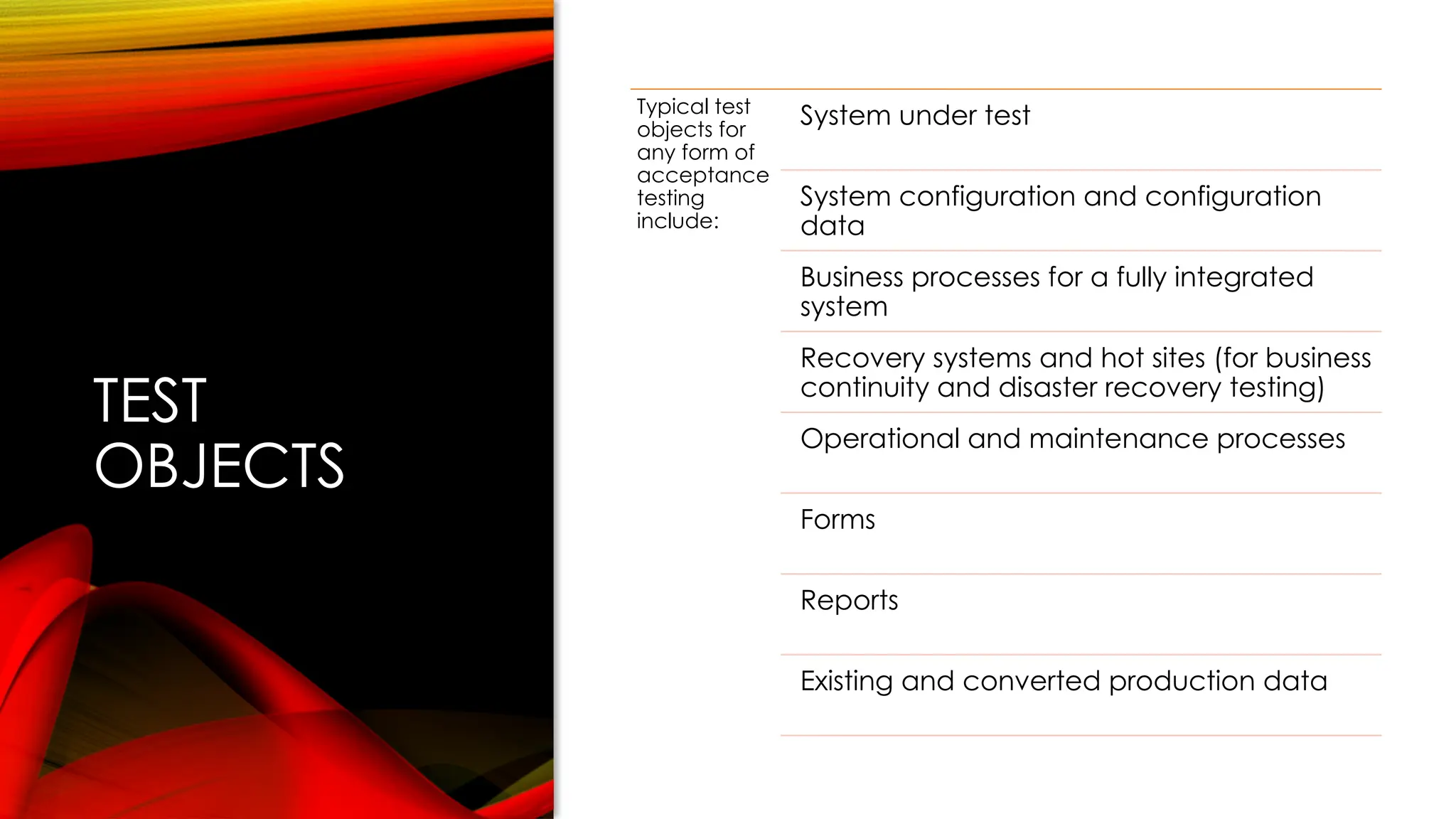
TEST
OBJECTS
Typical test
objects for
any form of
acceptance
testing
include:
System under test
System configuration and configuration
data
Business processes for a fully integrated
system
Recovery systems and hot sites (for business
continuity and disaster recovery testing)
Operational and maintenance processes
Forms
Reports
Existing and converted production data
ISTQB FOUNDATION
LEVEL EXAM
PREPARATION
https://arshadqa.com/
2.3 TEST TYPES
2.3 TEST TYPES
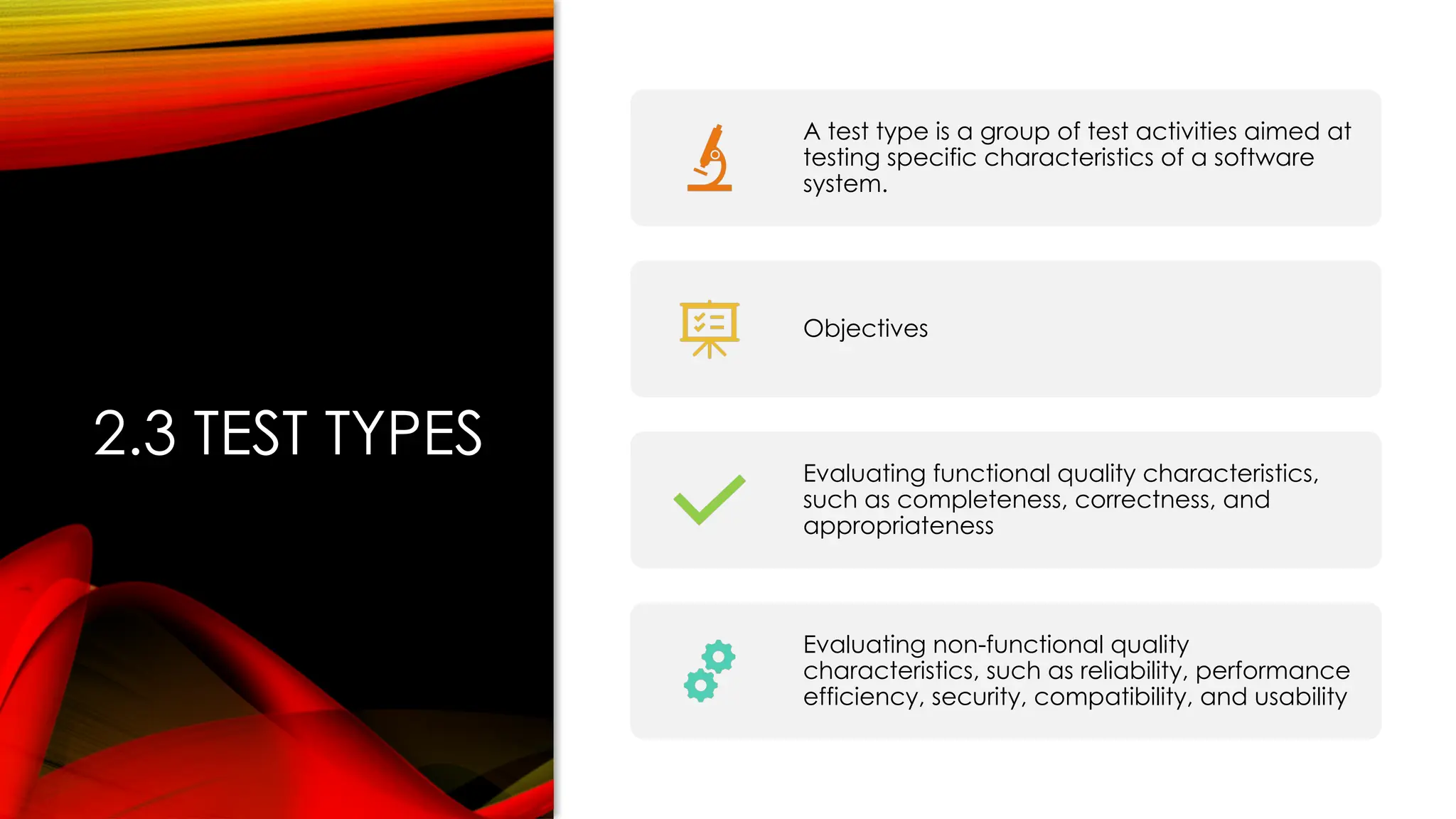
A test type is a group of test activities aimed at
testing specific characteristics of a software
system.
Objectives
Evaluating functional quality characteristics,
such as completeness, correctness, and
appropriateness
Evaluating non-functional quality
characteristics, such as reliability, performance
efficiency, security, compatibility, and usability
2.3 TEST TYPES
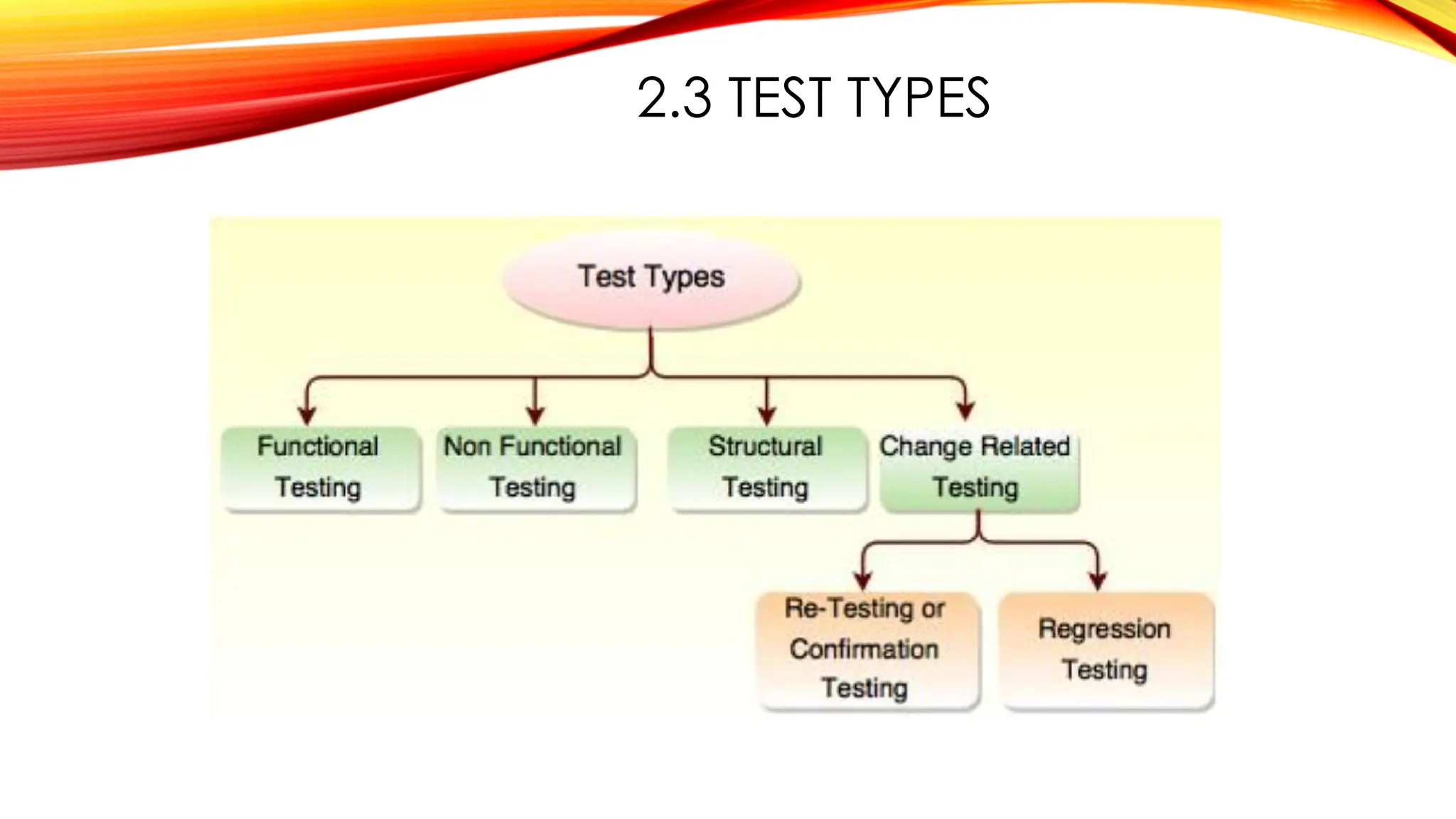
TEST TYPES
OBJECTIVES
Evaluating whether the structure or
architecture of the component or system is
correct, complete, and as specified
Evaluating the effects of changes, such as
confirming that defects have been fixed
(confirmation testing) and looking for
unintended changes in behavior resulting
from software or environment changes
(regression testing)
2.3.1 FUNCTIONAL TESTING
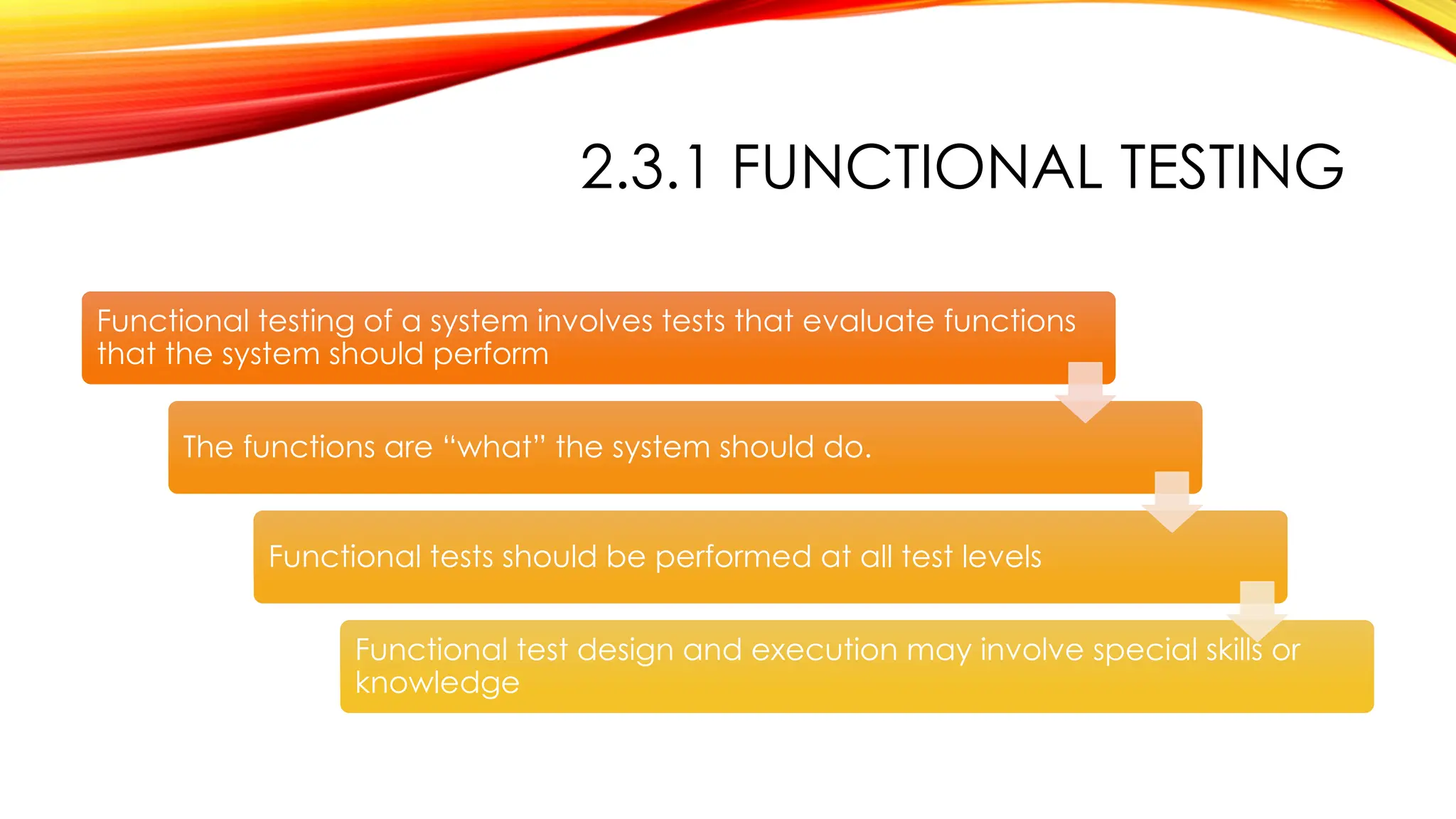
Functional testing of a system involves tests that evaluate functions
that the system should perform
The functions are “what” the system should do.
Functional tests should be performed at all test levels
Functional test design and execution may involve special skills or
knowledge
2.3.2 NON-FUNCTIONAL TESTING
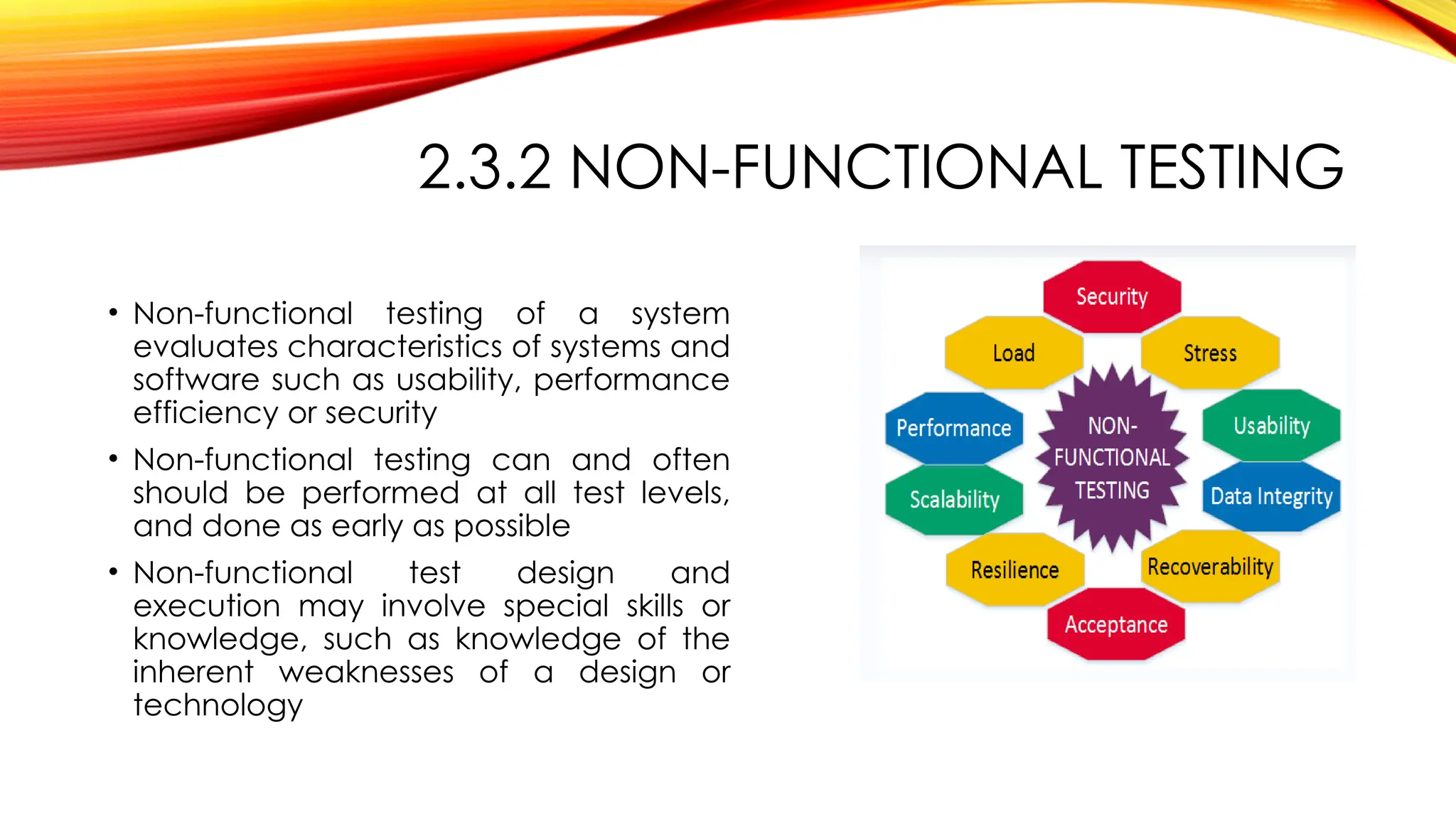
• Non-functional testing of a system
evaluates characteristics of systems and
software such as usability, performance
efficiency or security
• Non-functional testing can and often
should be performed at all test levels,
and done as early as possible
• Non-functional test design and
execution may involve special skills or
knowledge, such as knowledge of the
inherent weaknesses of a design or
technology
2.3.3 WHITE-BOX TESTING
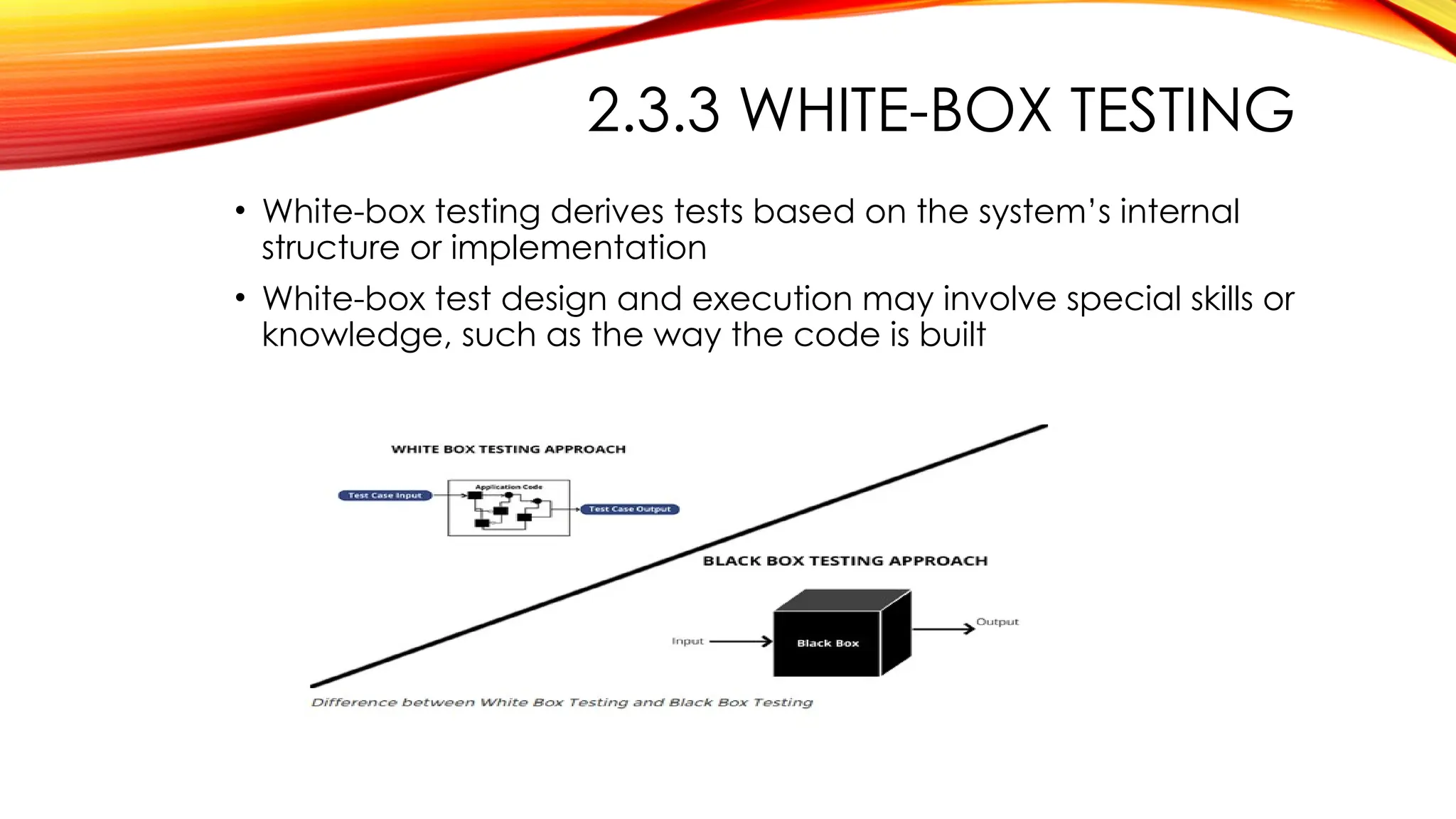
• White-box testing derives tests based on the system’s internal
structure or implementation
• White-box test design and execution may involve special skills or
knowledge, such as the way the code is built
2.3.4 CHANGE-
RELATED TESTING
When changes are made to a system,
either to correct a defect or because
of new or changing functionality,
testing should be done
Confirmation testing: After a defect is
fixed
Regression testing: It is possible that a
change made in one part of the code,
whether a fix or another type of
change, may accidentally affect the
behavior of other parts of the code
2.3.5 TEST TYPES AND TEST LEVELS
• It is possible to perform any of the test types mentioned
above at any test level
• Functional, non-functional, white-box, and change-related
tests will be given across all test levels which is
• Component testing
• Integration testing
• System testing
• Acceptance testing
ISTQB FOUNDATION
LEVEL EXAM
PREPARATION
https://arshadqa.com/
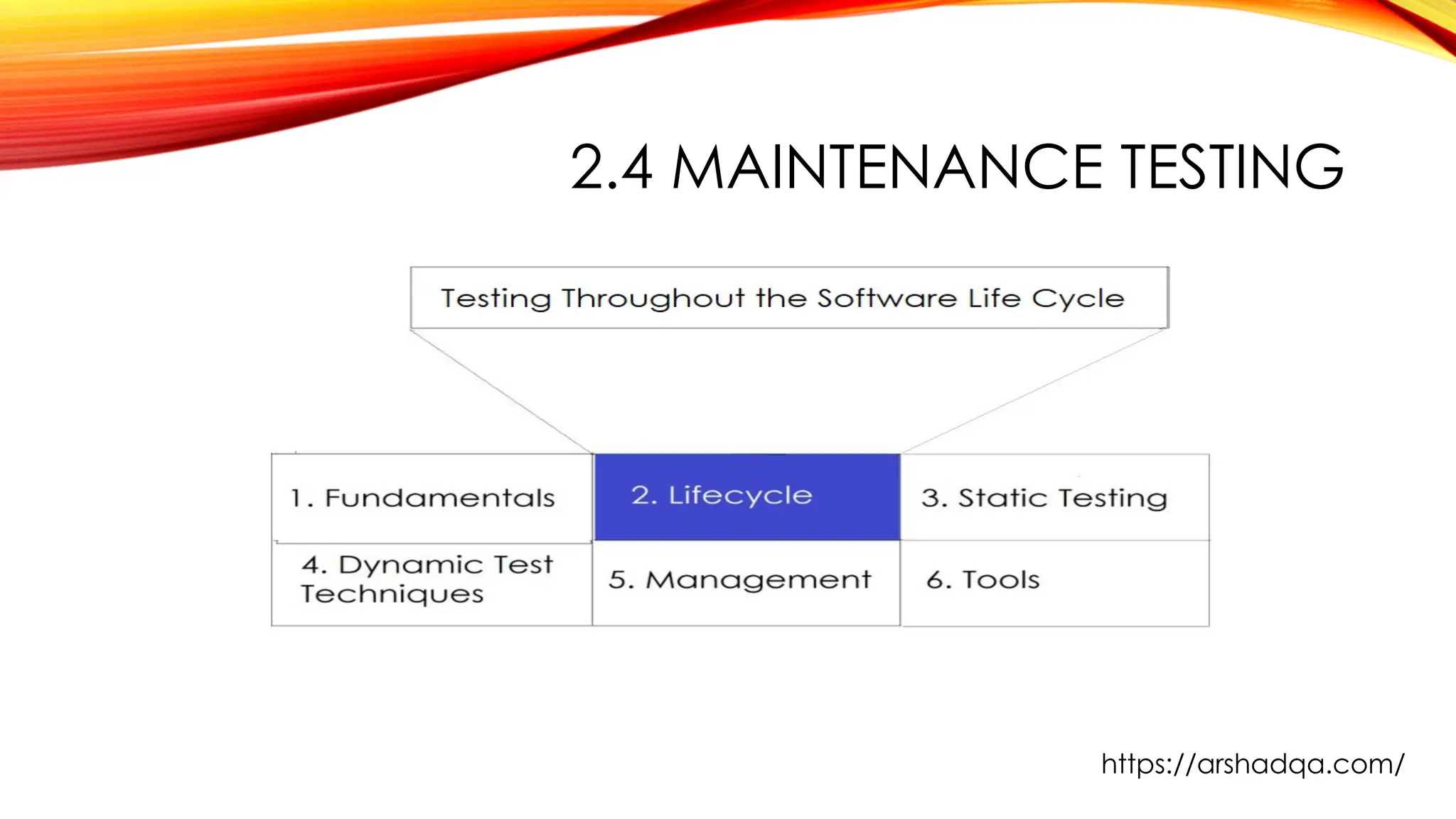
2.4 MAINTENANCE TESTING
https://arshadqa.com/
2.4 MAINTENANCE
TESTING
Once deployed to production
environments, software and
systems need to be maintained
When any changes are made as
part of maintenance,
maintenance testing should be
performed
A maintenance release may
require maintenance testing at
multiple test levels using various
test types, based on its scope
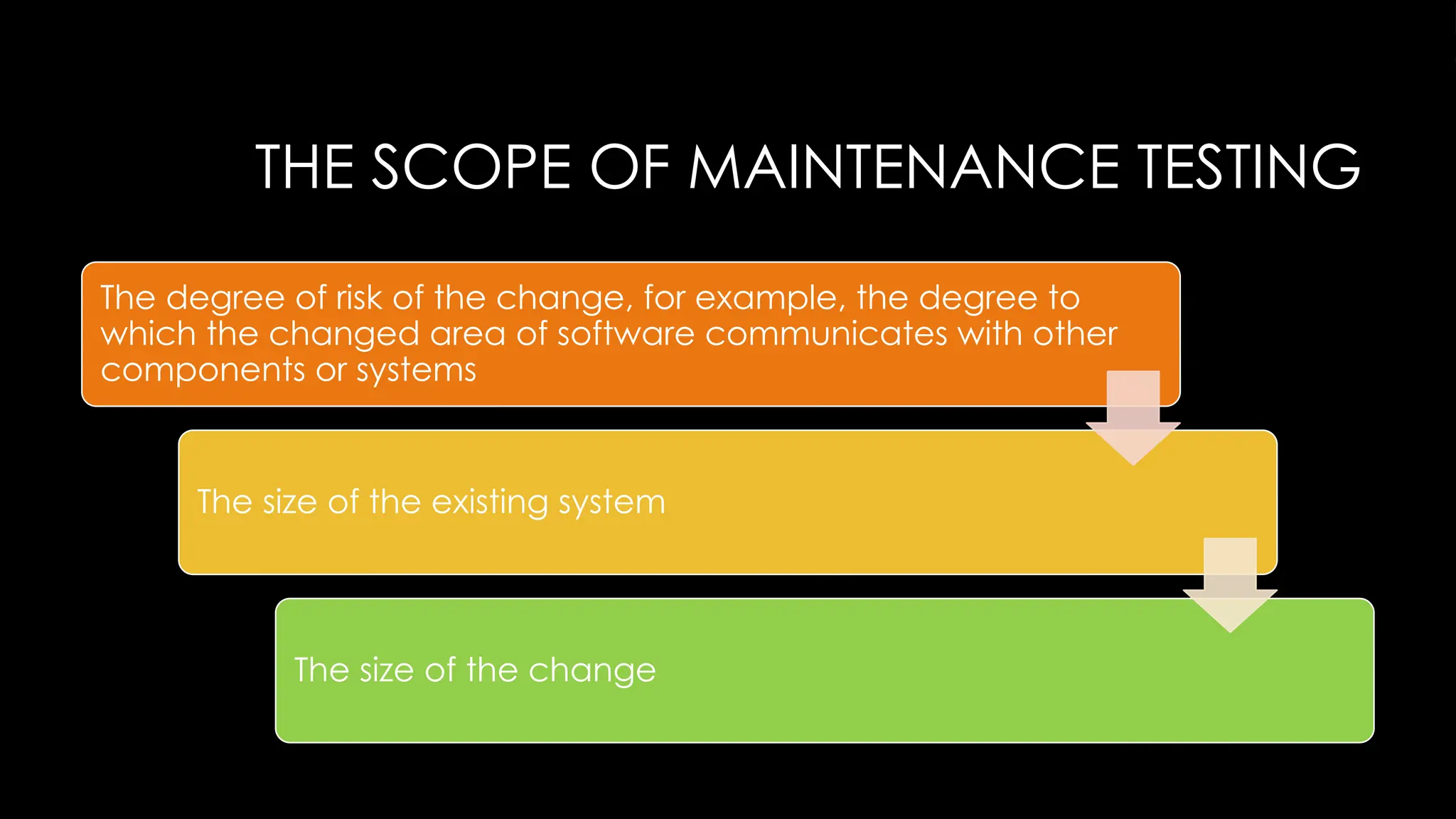
THE SCOPE OF MAINTENANCE TESTING
The degree of risk of the change, for example, the degree to
which the changed area of software communicates with other
components or systems
The size of the existing system
The size of the change
2.4.1 TRIGGERS
FOR
MAINTENANCE
There are several reasons why software
maintenance, and thus maintenance testing,
takes place, both for planned and unplanned
changes.
Modification, such as planned and unplanned
enhancements
Migration, such as from one platform to another
being maintained
Retirement, such as when an application
reaches the end of its life
2.4.1 TRIGGERS FOR MAINTENANCE
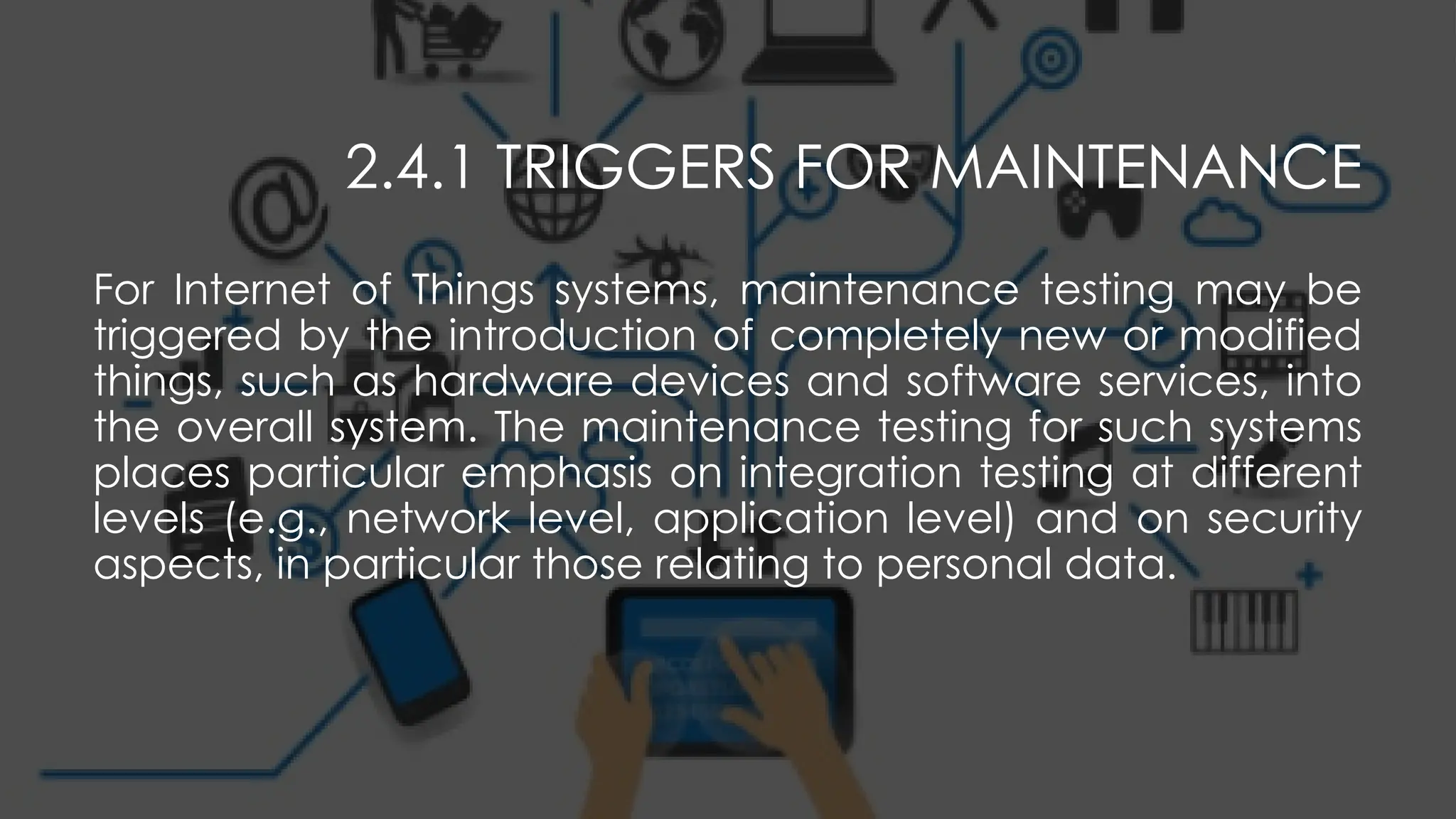
For Internet of Things systems, maintenance testing may be
triggered by the introduction of completely new or modified
things, such as hardware devices and software services, into
the overall system. The maintenance testing for such systems
places particular emphasis on integration testing at different
levels (e.g., network level, application level) and on security
aspects, in particular those relating to personal data.
2.4.2 IMPACT
ANALYSIS FOR
MAINTENANCE
Impact analysis evaluates the changes
that were made for a maintenance
release to identify the intended
consequences as well as expected and
possible side effects of a change
The side effects and affected areas in the
system need to be tested for regressions
Impact analysis may be done before a
change is made
2.4.2 IMPACT
ANALYSIS FOR
MAINTENANCE
Impact analysis can be difficult if:
Specifications (e.g., business requirements, user
stories, architecture) are out of date or missing
Test cases are not documented or are out of
date
Bi-directional traceability between tests and
the test basis has not been maintained
Tool support is weak or non-existent
The people involved do not have domain
and/or system knowledge
Insufficient attention has been paid to the
software's maintainability during development
ISTQB
FOUNDATION
LEVEL EXAM
PREPARATION
https://arshadqa.com/
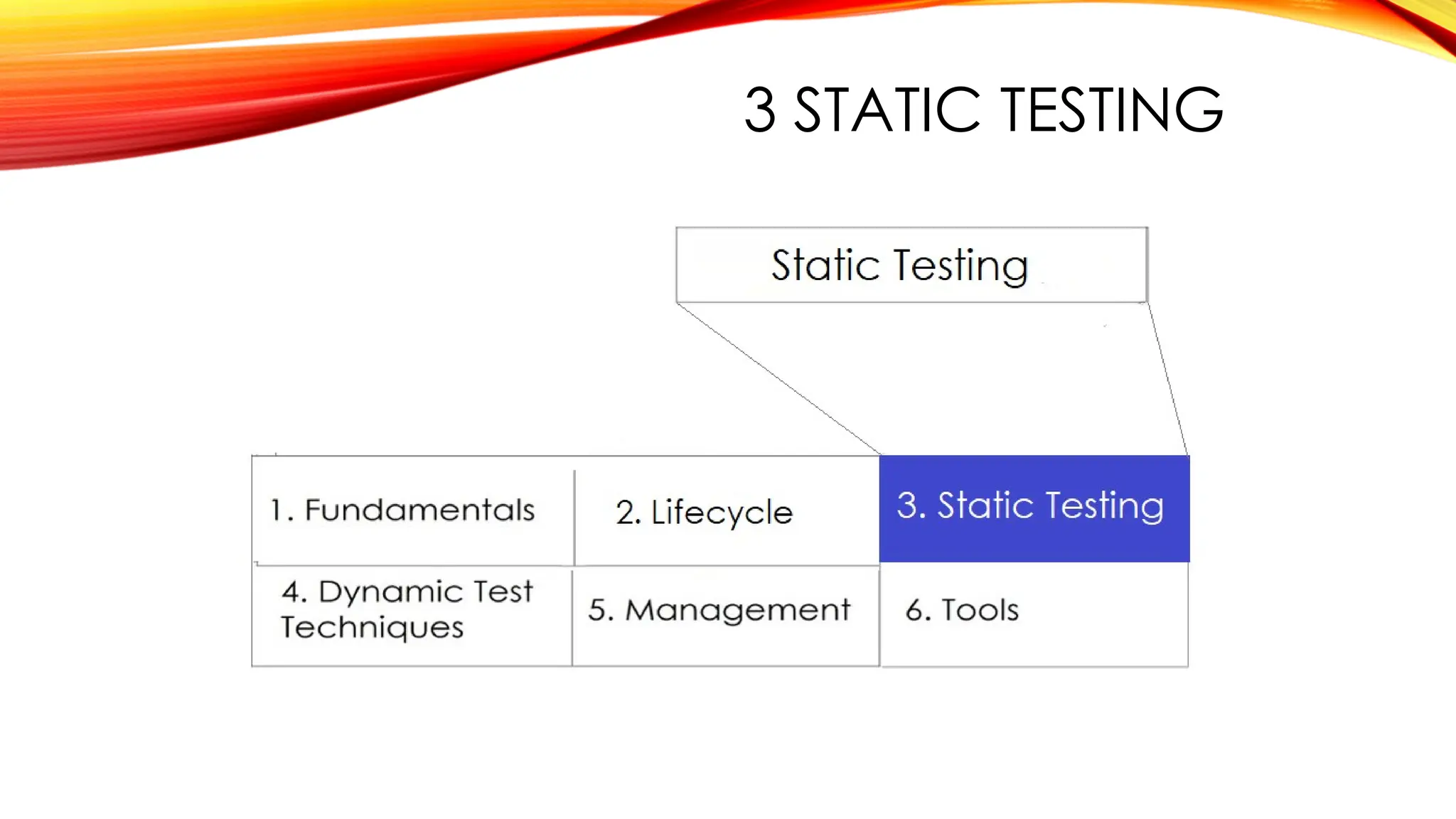
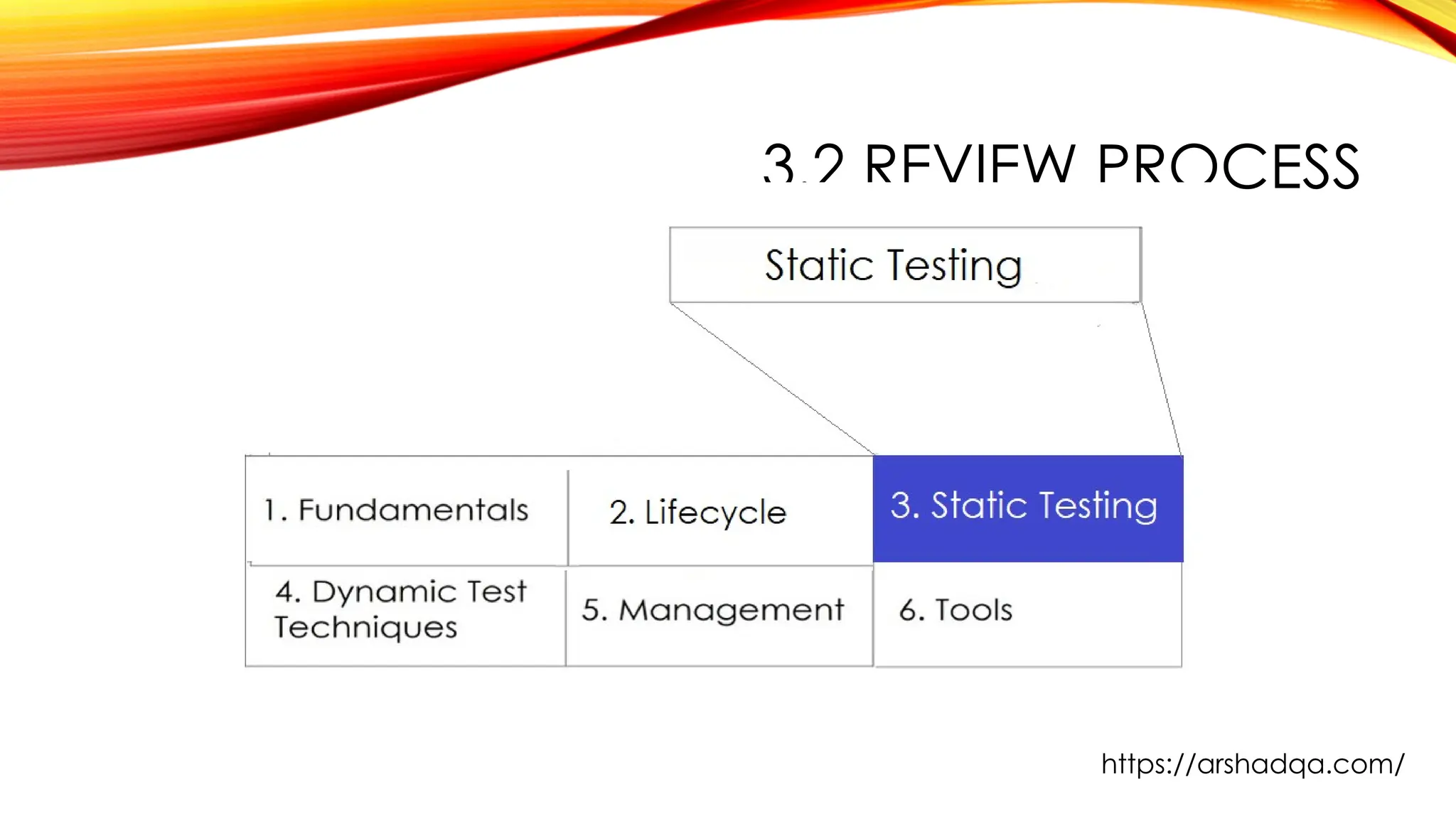
3 STATIC TESTING
3.1 STATIC TESTING BASICS
In contrast to dynamic testing, which requires the execution of the software
being tested
Static analysis is important for safety-critical computer systems (e.g., aviation,
medical, or nuclear software)
Static analysis is also often incorporated into automated build and delivery
systems, for example in Agile development, continuous delivery, and
continuous deployment
3.1.1 WORK
PRODUCTS
THAT CAN
BE
EXAMINED
BY STATIC
TESTING
Almost any work product can be examined using static
testing (reviews and/or static analysis), for example:
Specifications, including business requirements,
functional requirements, and security requirements
Epics, user stories, and acceptance criteria
Architecture and design specifications
Code
Testware, including test plans, test cases, test
procedures, and automated test scripts
3.1.1 WORK
PRODUCTS THAT
CAN BE EXAMINED
BY STATIC TESTING
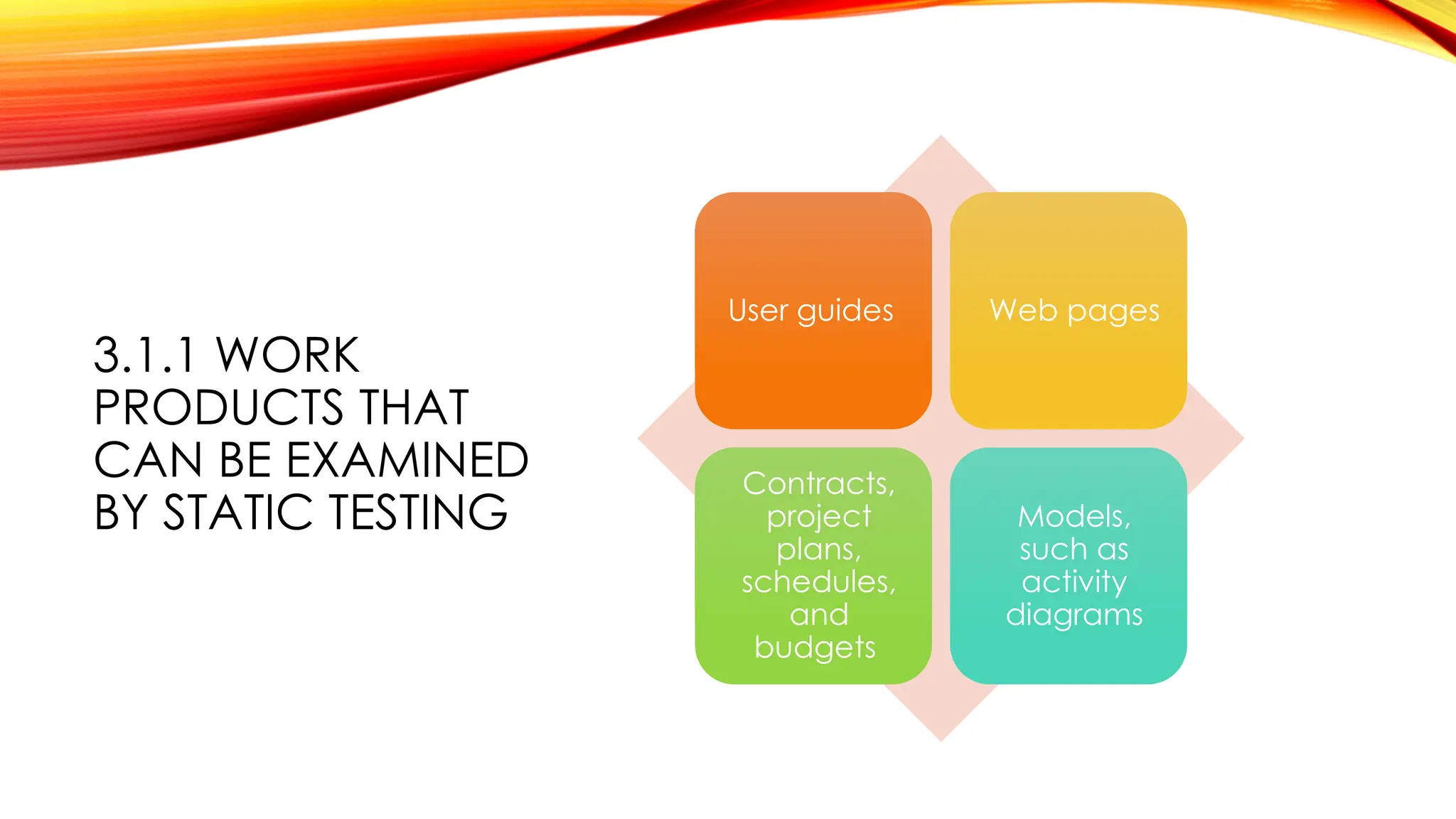
User guides Web pages
Contracts,
project
plans,
schedules,
and
budgets
Models,
such as
activity
diagrams
3.1.2
BENEFITS OF
STATIC
TESTING
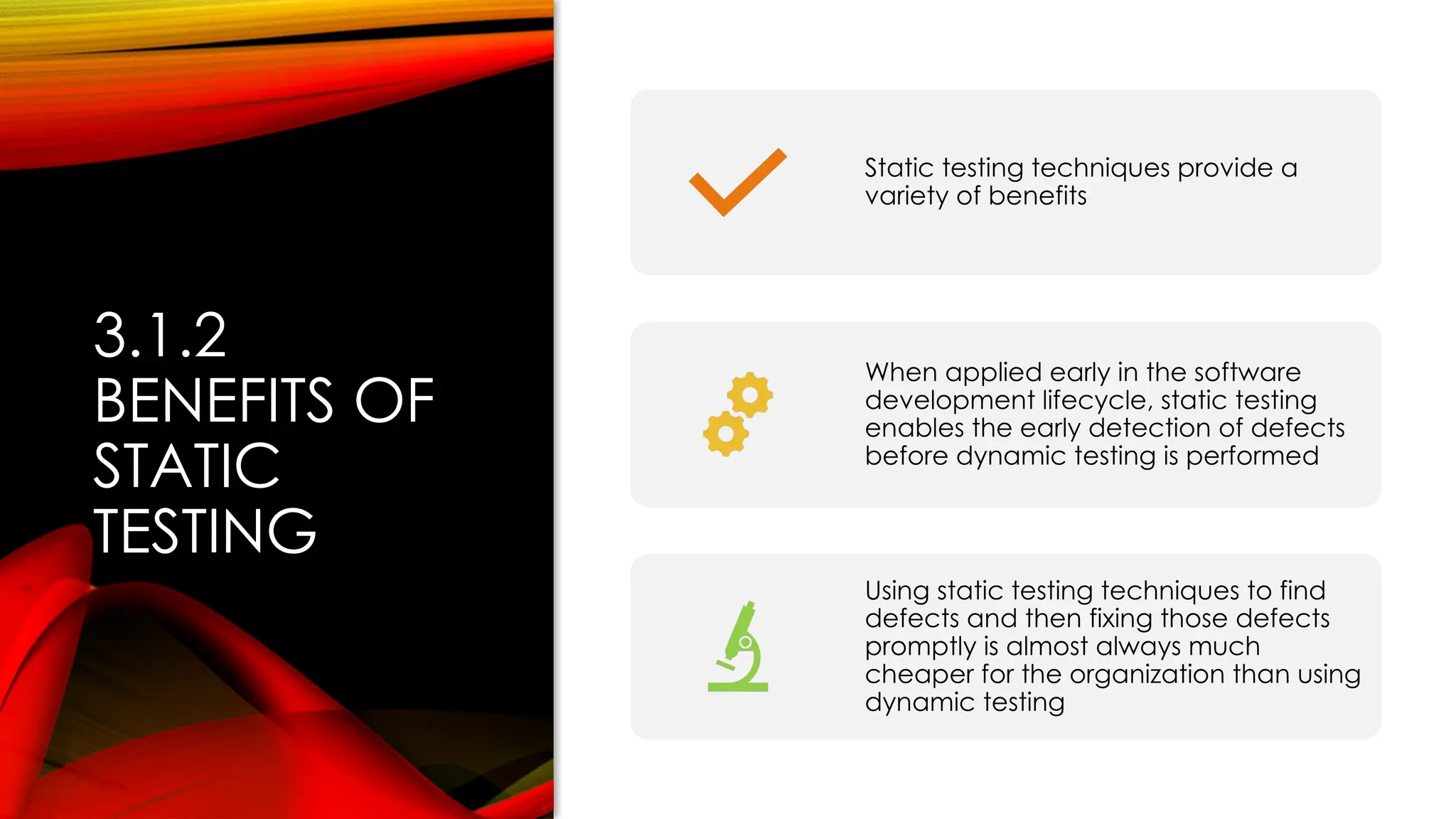
Static testing techniques provide a
variety of benefits
When applied early in the software
development lifecycle, static testing
enables the early detection of defects
before dynamic testing is performed
Using static testing techniques to find
defects and then fixing those defects
promptly is almost always much
cheaper for the organization than using
dynamic testing
3.1.2 BENEFITS OF
STATIC TESTING
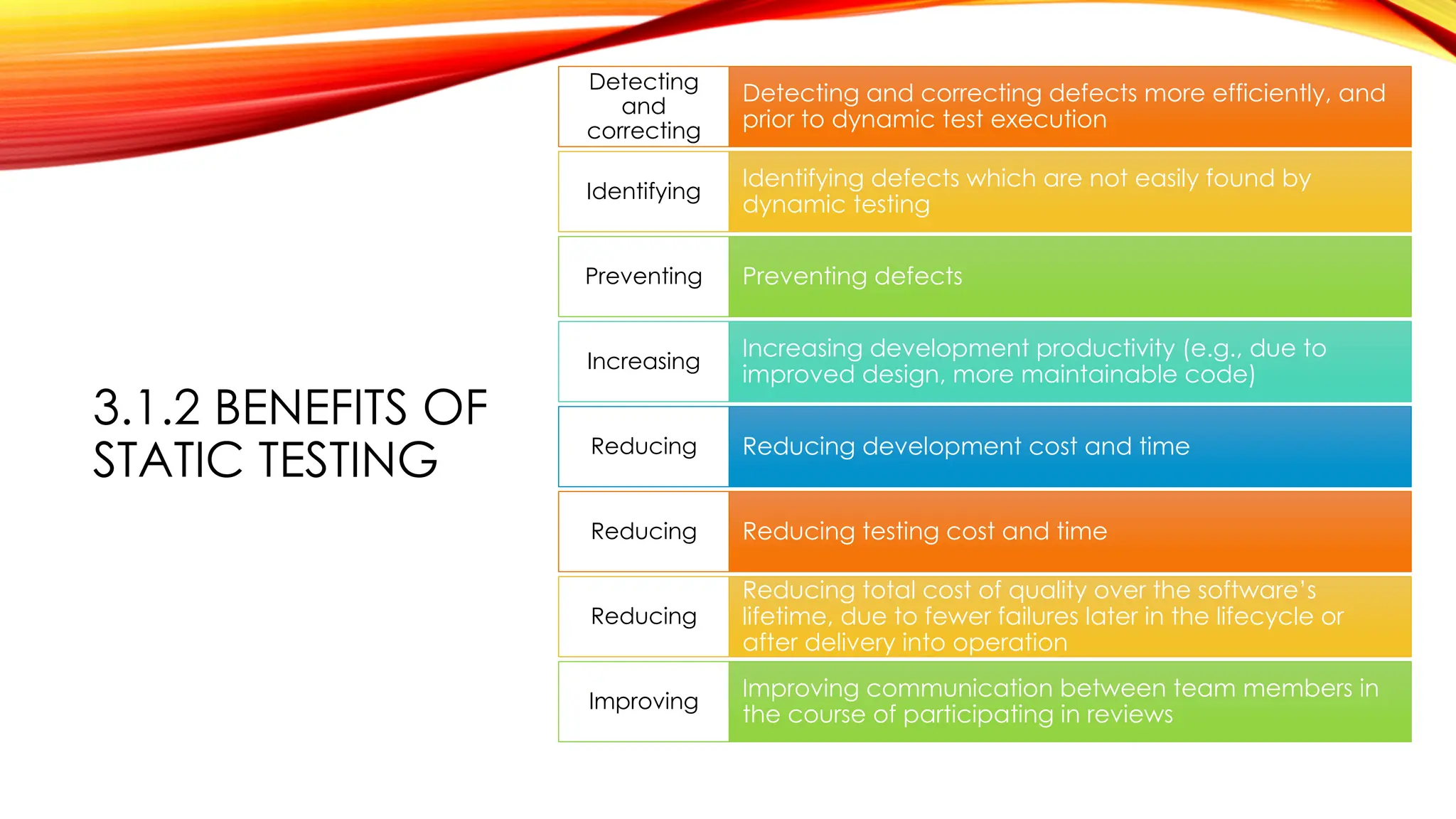
Detecting and correcting defects more efficiently, and
prior to dynamic test execution
Detecting
and
correcting
Identifying defects which are not easily found by
dynamic testing
Identifying
Preventing defects
Preventing
Increasing development productivity (e.g., due to
improved design, more maintainable code)
Increasing
Reducing development cost and time
Reducing
Reducing testing cost and time
Reducing
Reducing total cost of quality over the software’s
lifetime, due to fewer failures later in the lifecycle or
after delivery into operation
Reducing
Improving communication between team members in
the course of participating in reviews
Improving
3.1.3 DIFFERENCES
BETWEEN STATIC AND
DYNAMIC TESTING
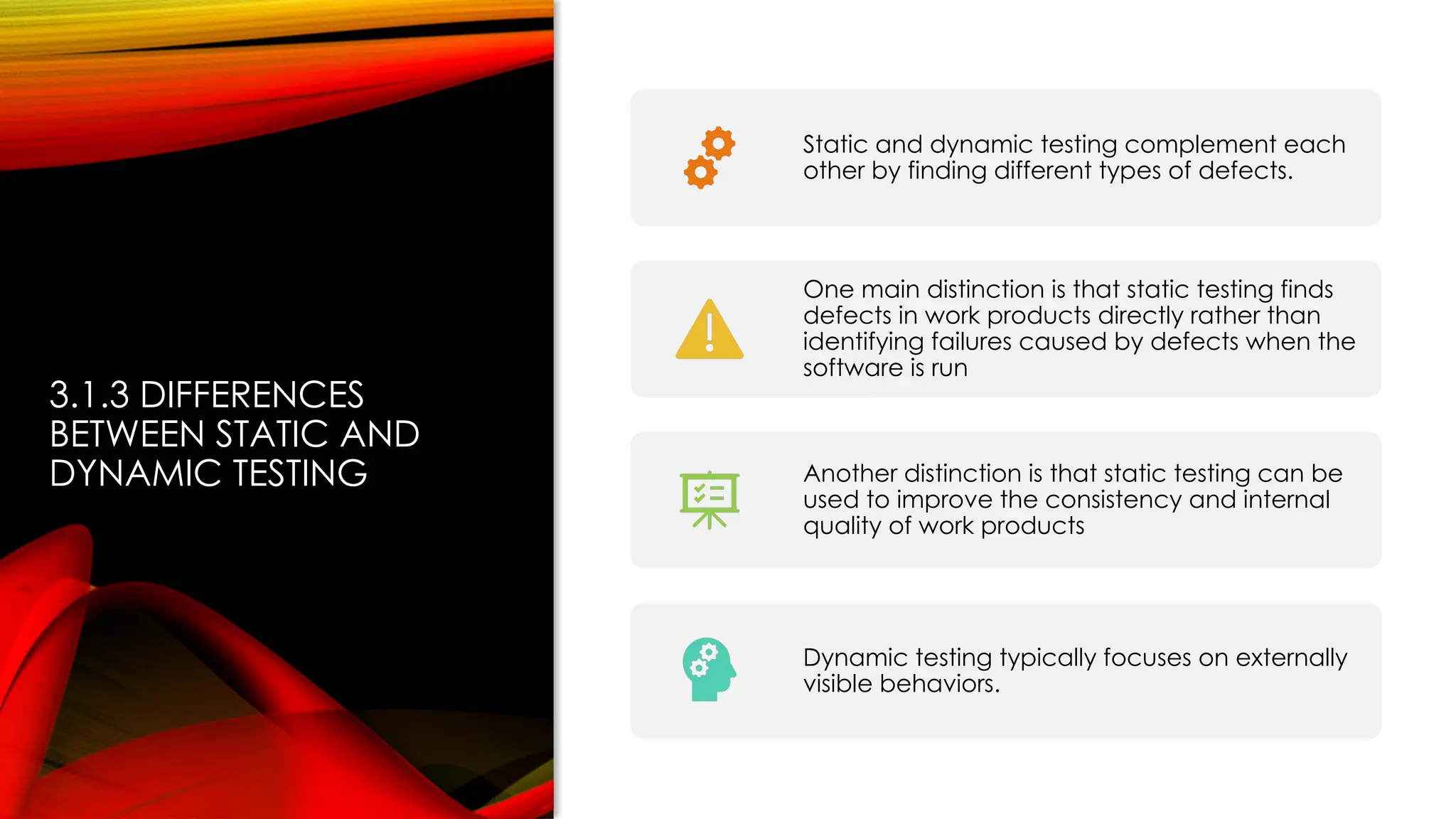
Static and dynamic testing complement each
other by finding different types of defects.
One main distinction is that static testing finds
defects in work products directly rather than
identifying failures caused by defects when the
software is run
Another distinction is that static testing can be
used to improve the consistency and internal
quality of work products
Dynamic testing typically focuses on externally
visible behaviors.
TYPICAL
DEFECTS
Requirement defects (e.g., inconsistencies, ambiguities,
contradictions, omissions, inaccuracies, and redundancies)
Design defects
Coding defects
Deviations from standards
Incorrect interface specifications (e.g., different units of
measurement used by the calling system than by the called
system)
Security vulnerabilities (e.g., susceptibility to buffer overflows)
Gaps or inaccuracies in test basis traceability or coverage (e.g.,
missing tests for an acceptance criterion)
ISTQB FOUNDATION
LEVEL EXAM
PREPARATION
https://arshadqa.com/
3.2 REVIEW PROCESS
https://arshadqa.com/
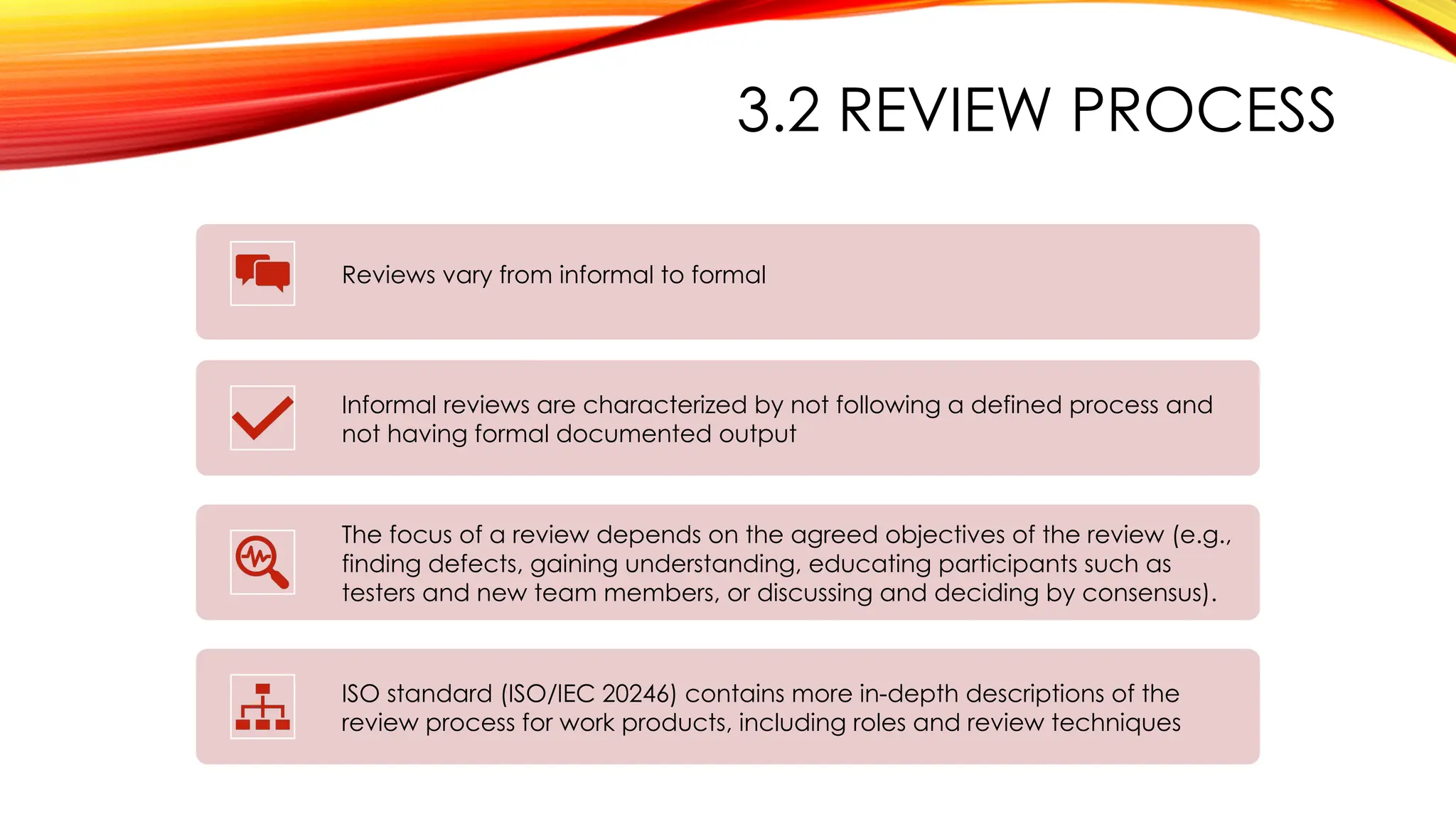
3.2 REVIEW PROCESS
Reviews vary from informal to formal
Informal reviews are characterized by not following a defined process and
not having formal documented output
The focus of a review depends on the agreed objectives of the review (e.g.,
finding defects, gaining understanding, educating participants such as
testers and new team members, or discussing and deciding by consensus).
ISO standard (ISO/IEC 20246) contains more in-depth descriptions of the
review process for work products, including roles and review techniques
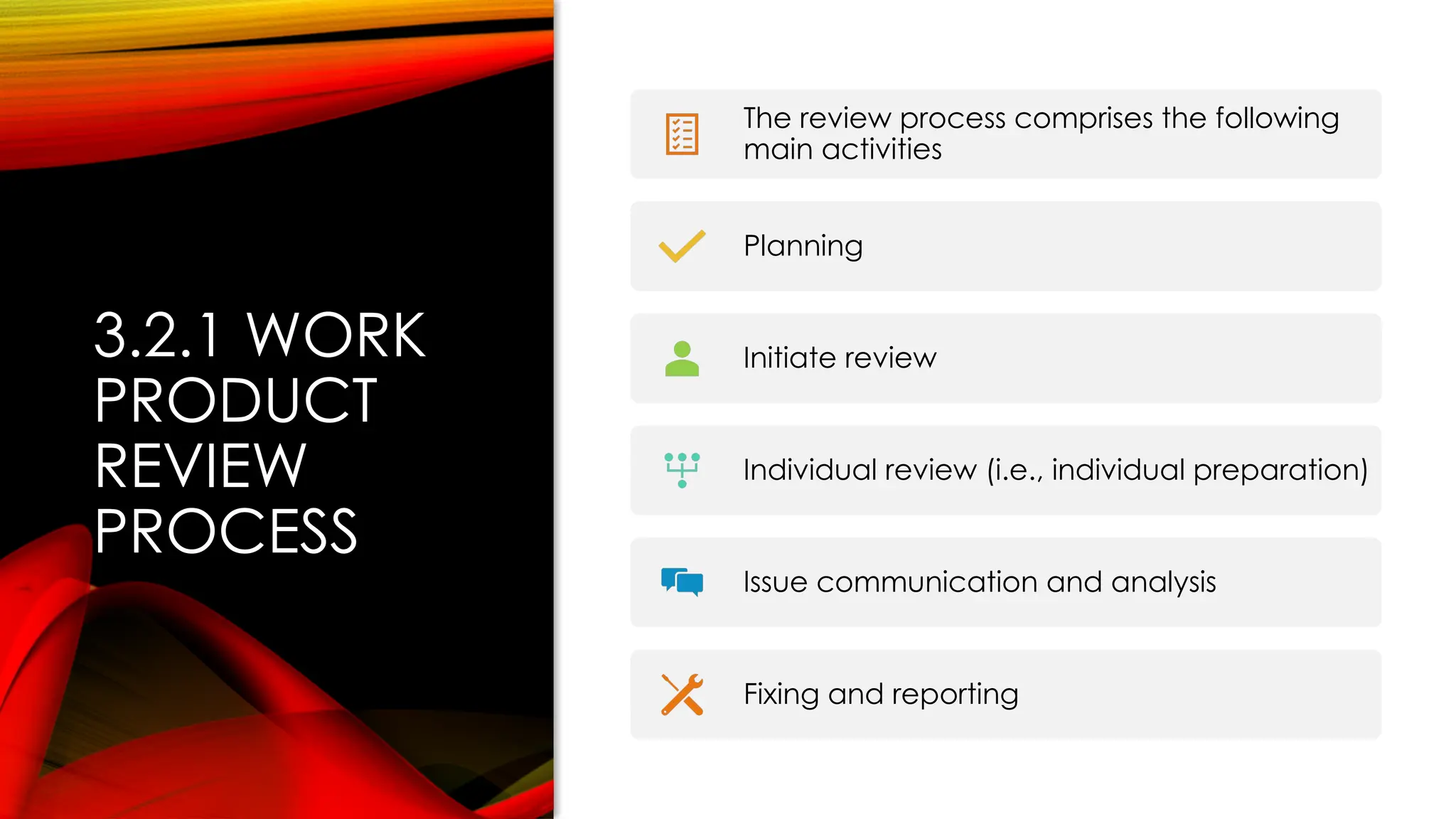
3.2.1 WORK
PRODUCT
REVIEW
PROCESS
The review process comprises the following
main activities
Planning
Initiate review
Individual review (i.e., individual preparation)
Issue communication and analysis
Fixing and reporting
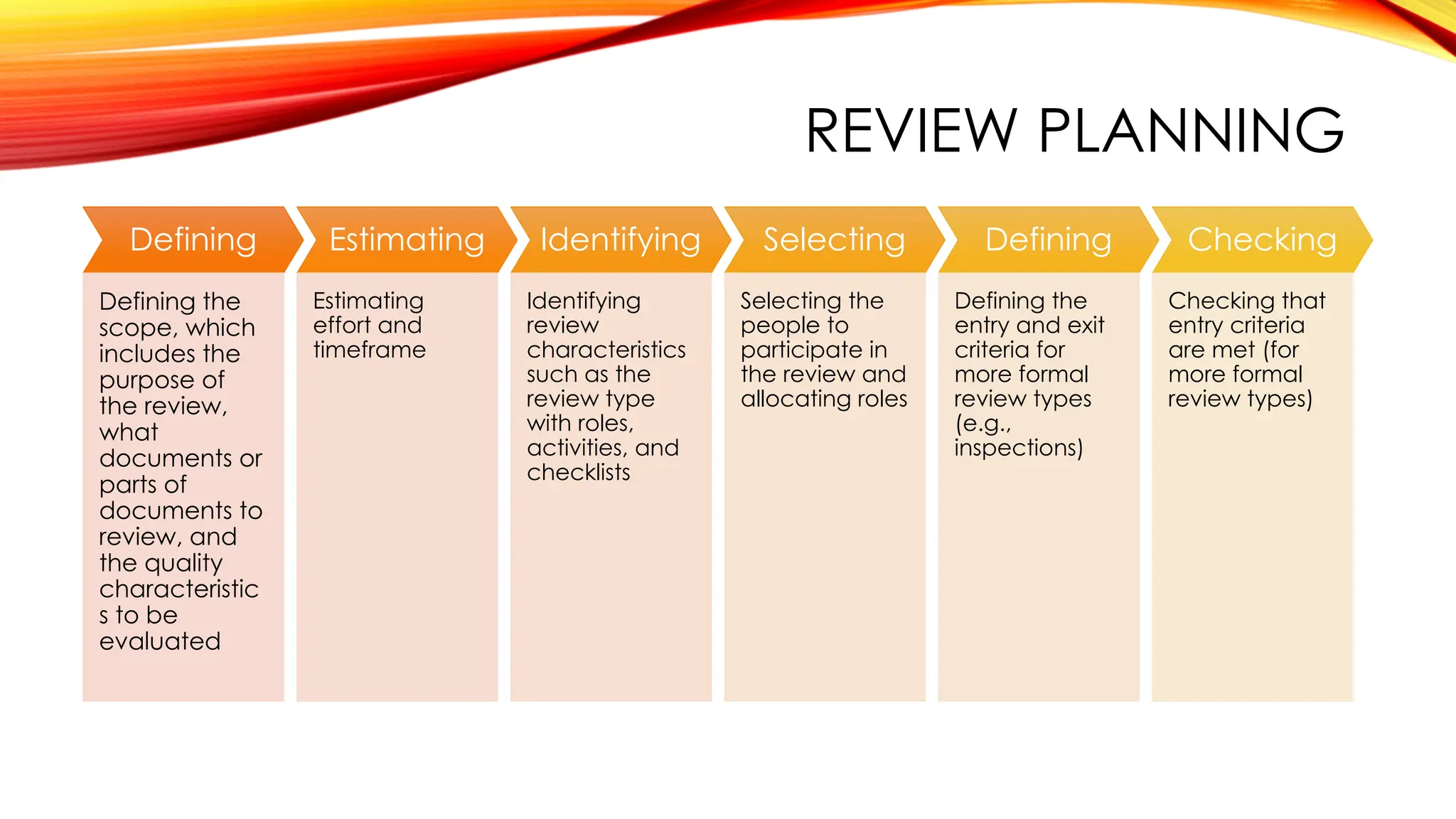
REVIEW PLANNING
Defining
Defining the
scope, which
includes the
purpose of
the review,
what
documents or
parts of
documents to
review, and
the quality
characteristic
s to be
evaluated
Estimating
Estimating
effort and
timeframe
Identifying
Identifying
review
characteristics
such as the
review type
with roles,
activities, and
checklists
Selecting
Selecting the
people to
participate in
the review and
allocating roles
Defining
Defining the
entry and exit
criteria for
more formal
review types
(e.g.,
inspections)
Checking
Checking that
entry criteria
are met (for
more formal
review types)
INITIATE
REVIEW
Distributing the work product (physically
or by electronic means) and other
material, such as issue log forms,
checklists, and related work products
Explaining the scope, objectives,
process, roles, and work products to
the participants
Answering any questions that
participants may have about the
review
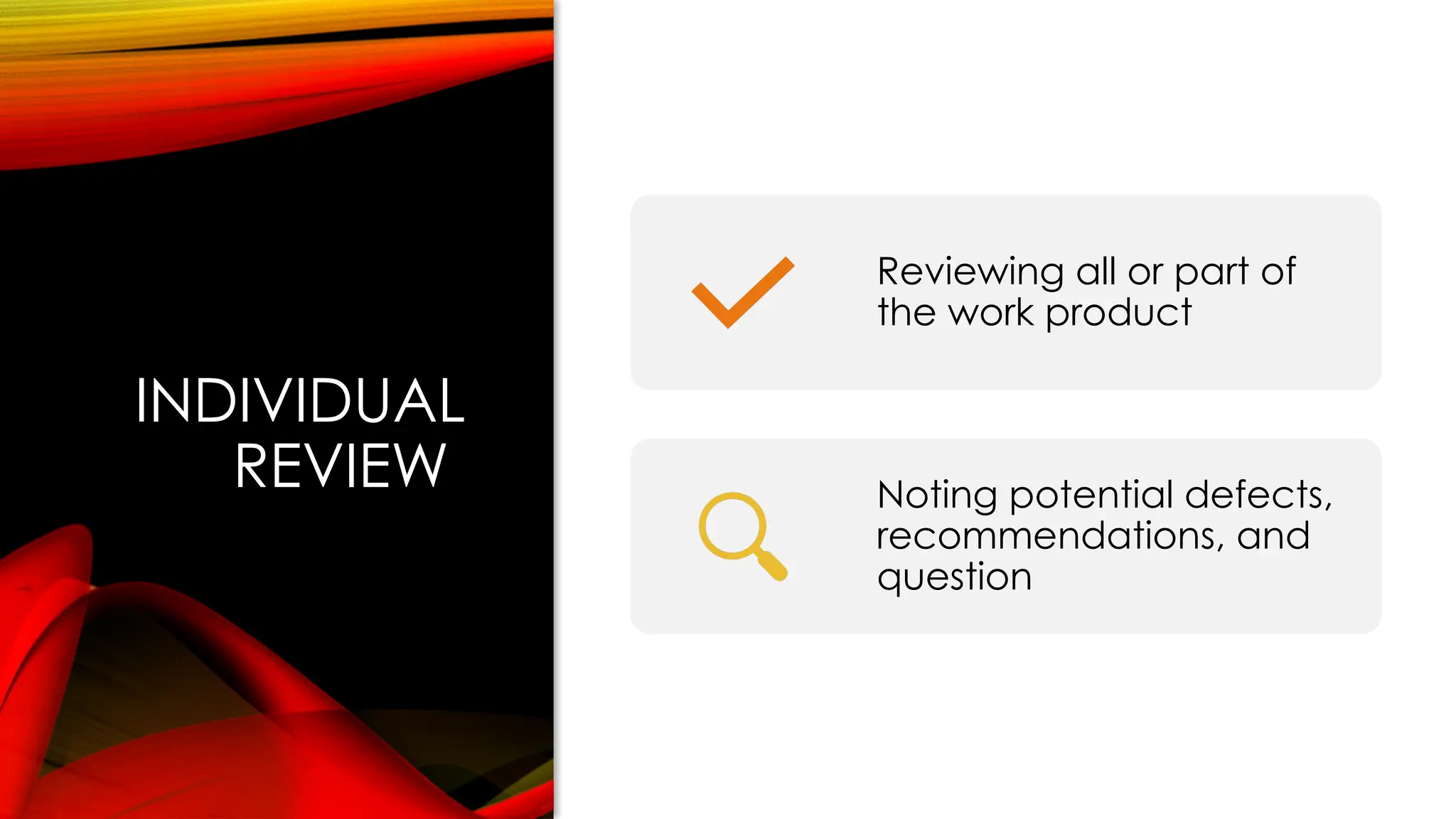
INDIVIDUAL
REVIEW
Reviewing all or part of
the work product
Noting potential defects,
recommendations, and
question
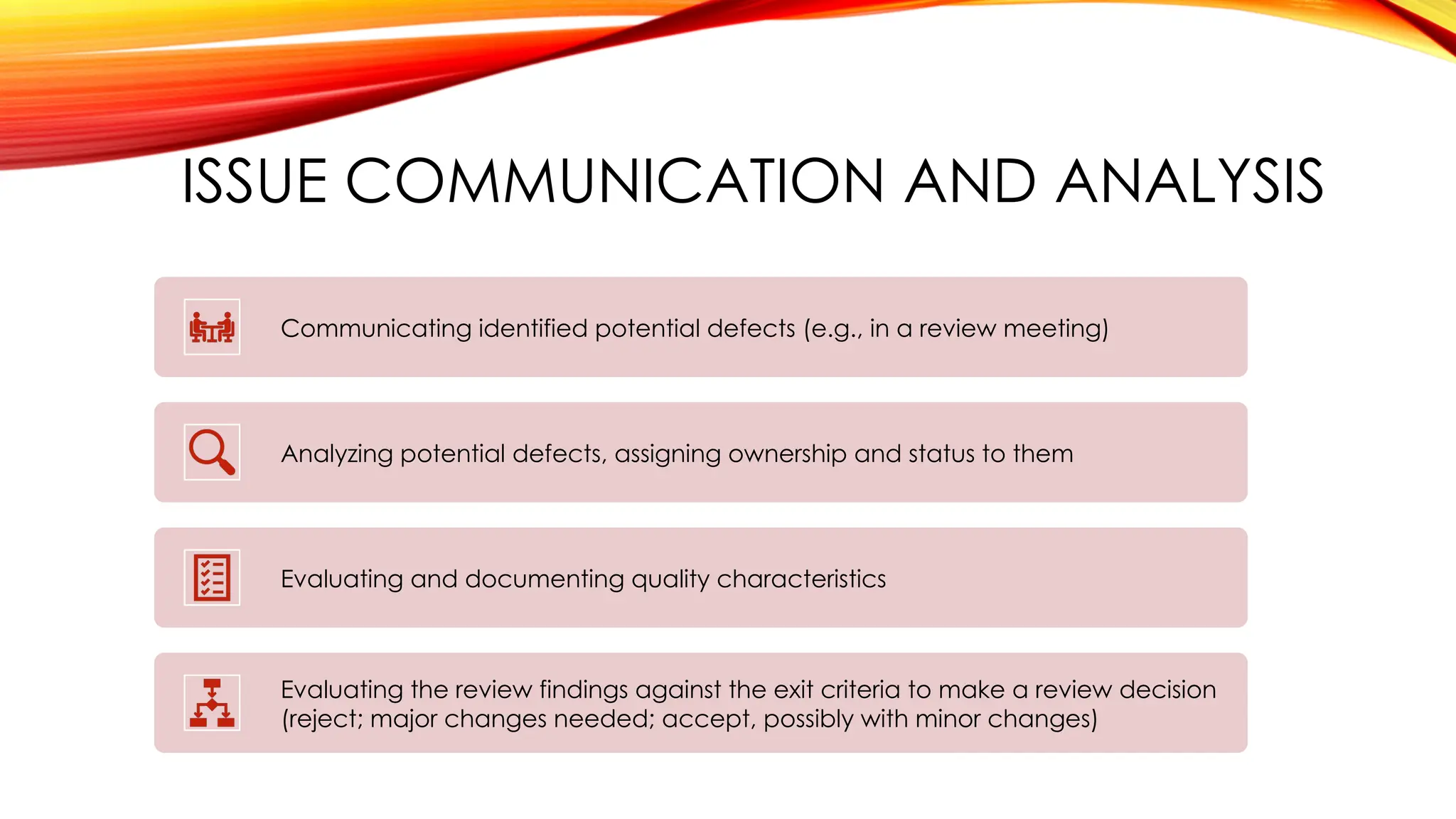
ISSUE COMMUNICATION AND ANALYSIS
Communicating identified potential defects (e.g., in a review meeting)
Analyzing potential defects, assigning ownership and status to them
Evaluating and documenting quality characteristics
Evaluating the review findings against the exit criteria to make a review decision
(reject; major changes needed; accept, possibly with minor changes)
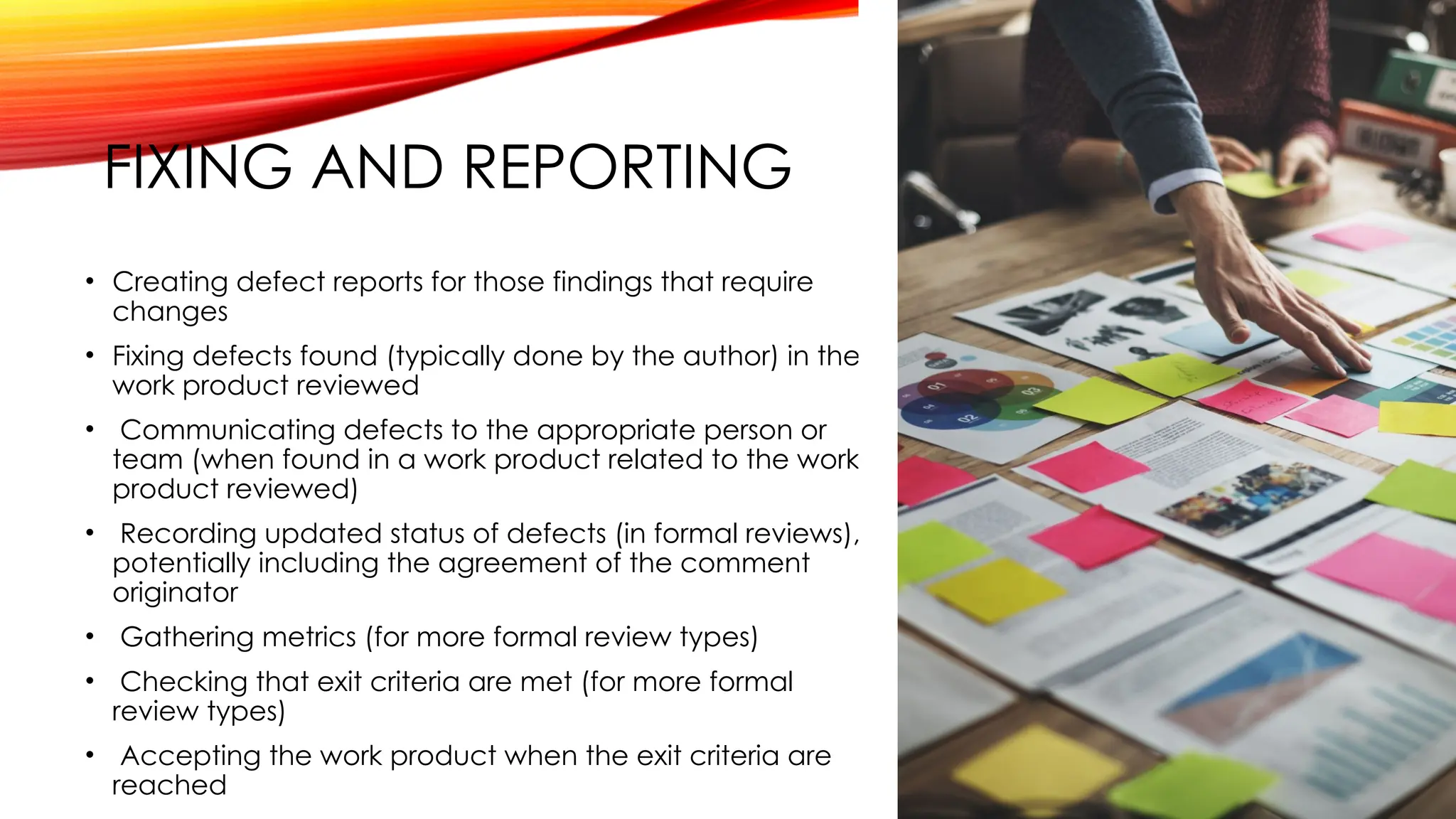
FIXING AND REPORTING
• Creating defect reports for those findings that require
changes
• Fixing defects found (typically done by the author) in the
work product reviewed
• Communicating defects to the appropriate person or
team (when found in a work product related to the work
product reviewed)
• Recording updated status of defects (in formal reviews),
potentially including the agreement of the comment
originator
• Gathering metrics (for more formal review types)
• Checking that exit criteria are met (for more formal
review types)
• Accepting the work product when the exit criteria are
reached
3.2.2 ROLES AND RESPONSIBILITIES IN A
FORMAL REVIEW
AUTHOR
• Creates the work product under review
• Fixes defects in the work product under
review (if necessary)
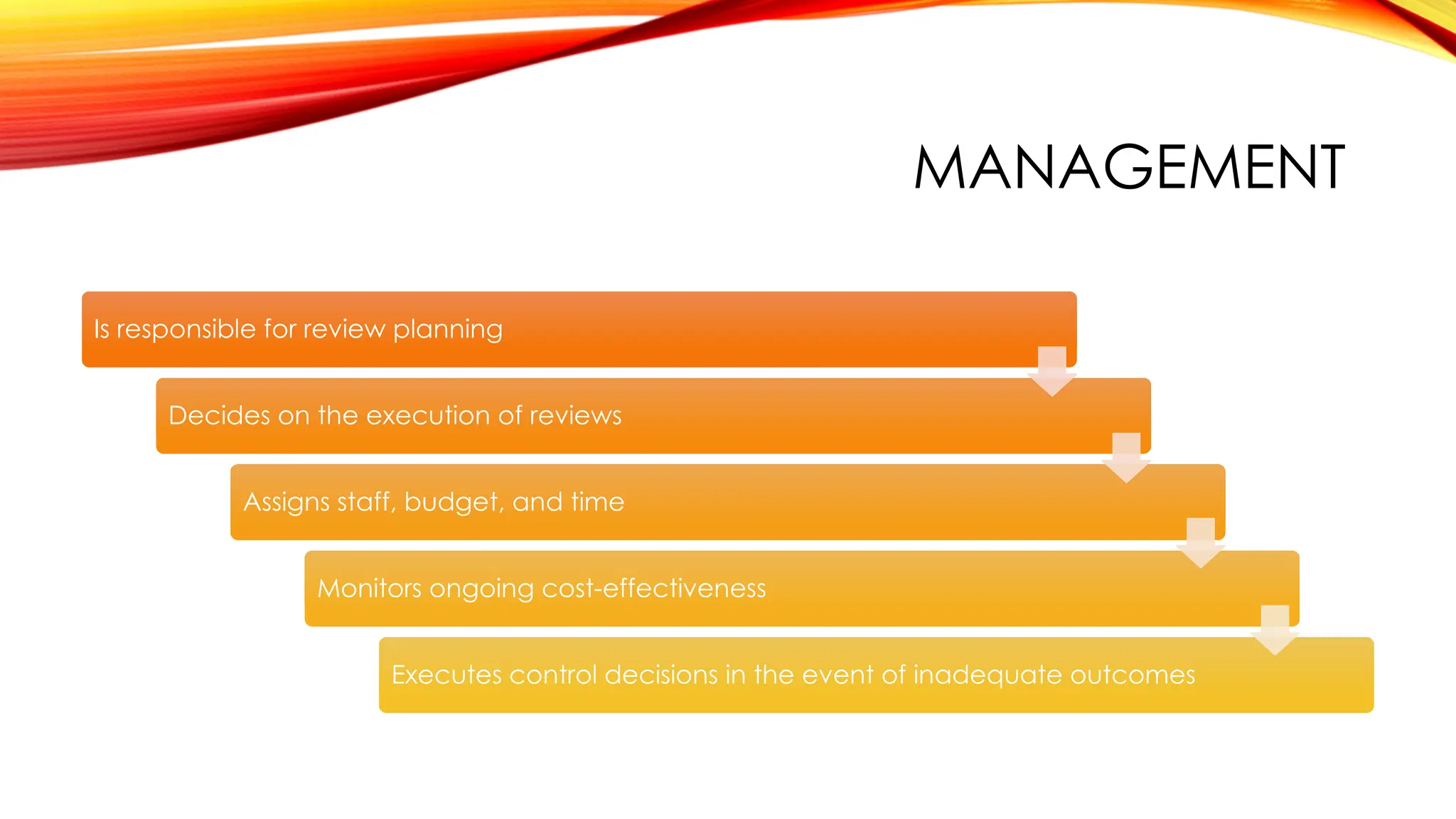
MANAGEMENT
Is responsible for review planning
Decides on the execution of reviews
Assigns staff, budget, and time
Monitors ongoing cost-effectiveness
Executes control decisions in the event of inadequate outcomes
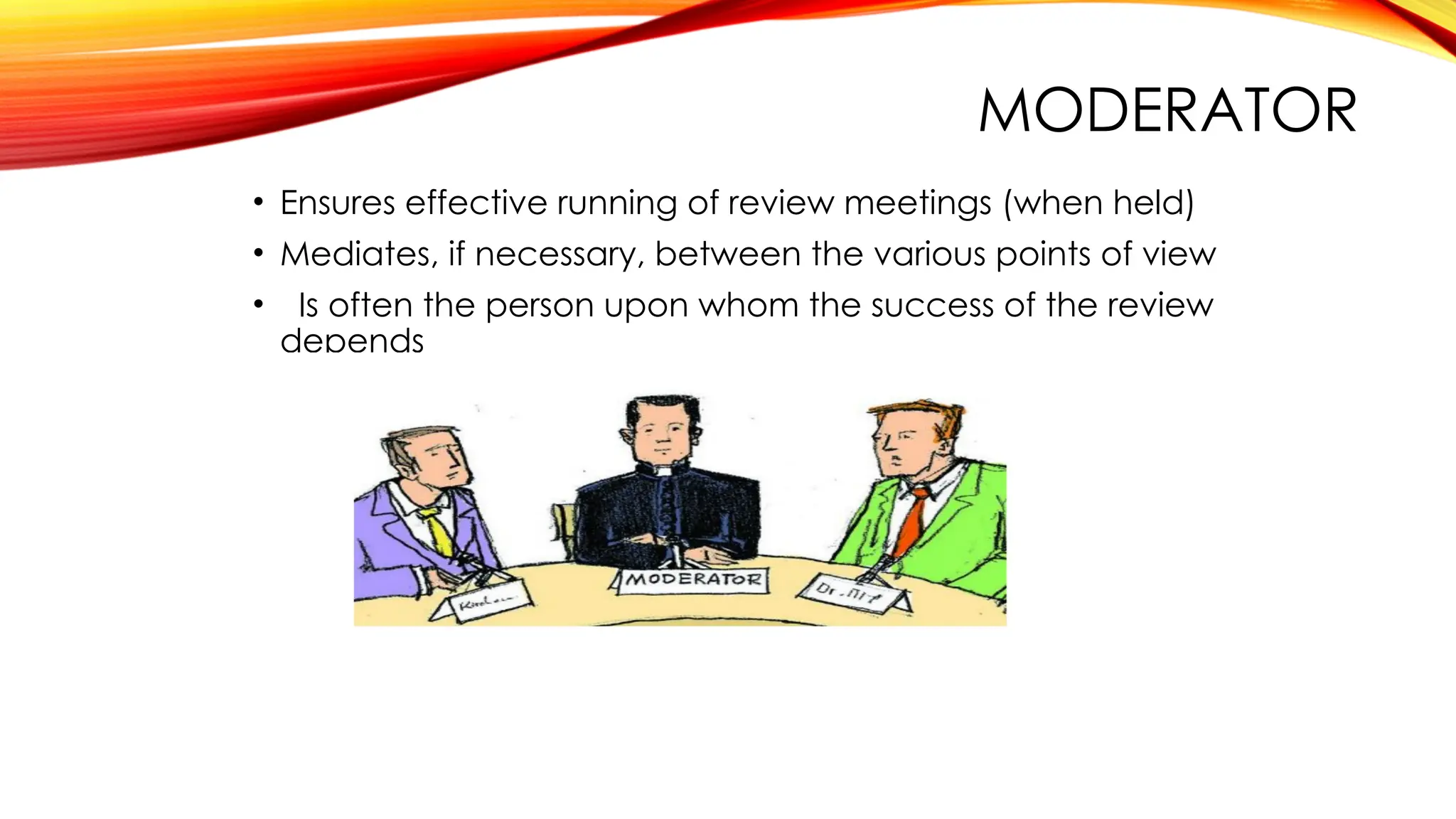
MODERATOR
• Ensures effective running of review meetings (when held)
• Mediates, if necessary, between the various points of view
• Is often the person upon whom the success of the review
depends
REVIEW LEADER
• Takes overall responsibility for the
review
• Decides who will be involved and
organizes when and where it will
take place
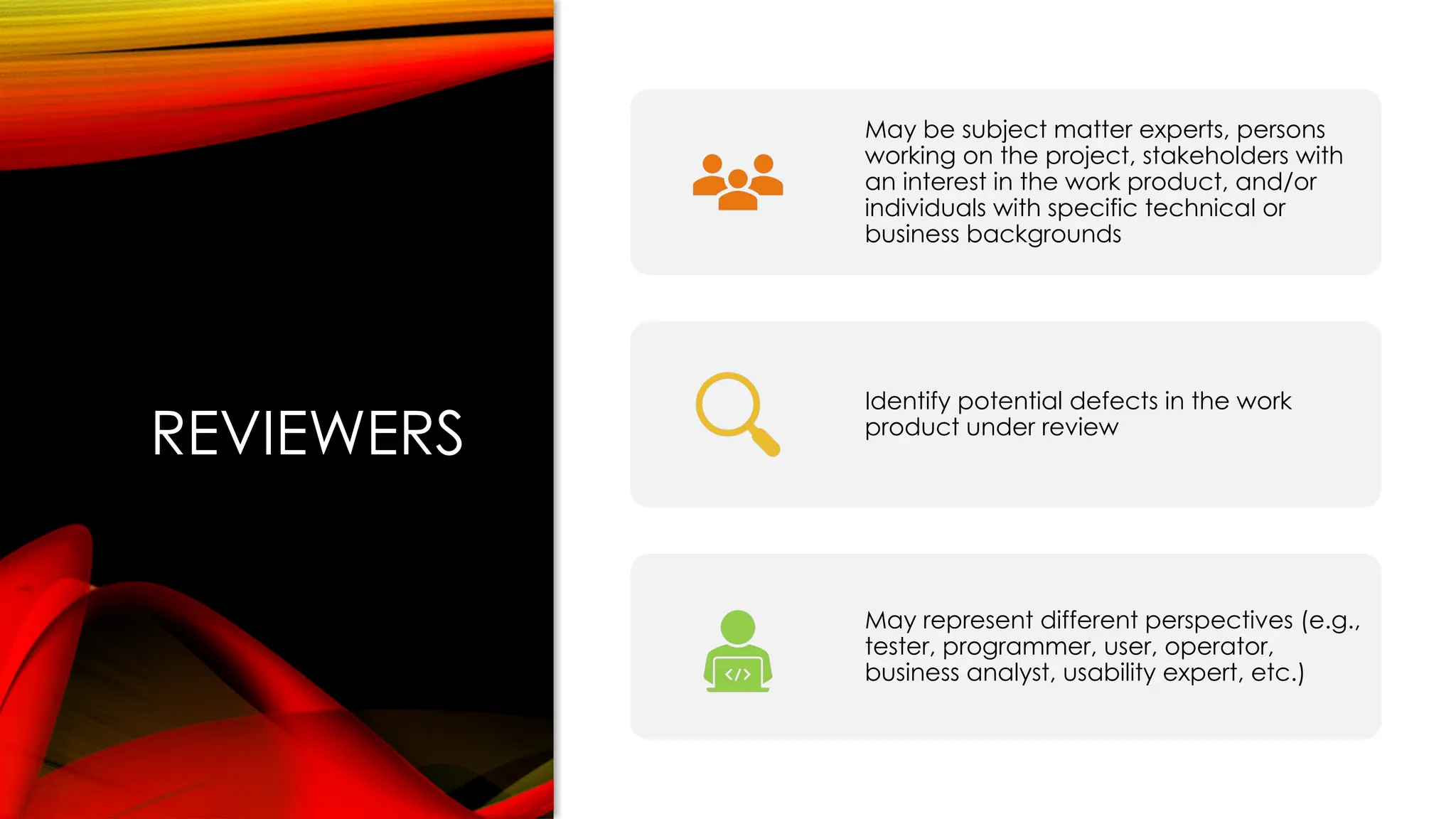
REVIEWERS
May be subject matter experts, persons
working on the project, stakeholders with
an interest in the work product, and/or
individuals with specific technical or
business backgrounds
Identify potential defects in the work
product under review
May represent different perspectives (e.g.,
tester, programmer, user, operator,
business analyst, usability expert, etc.)
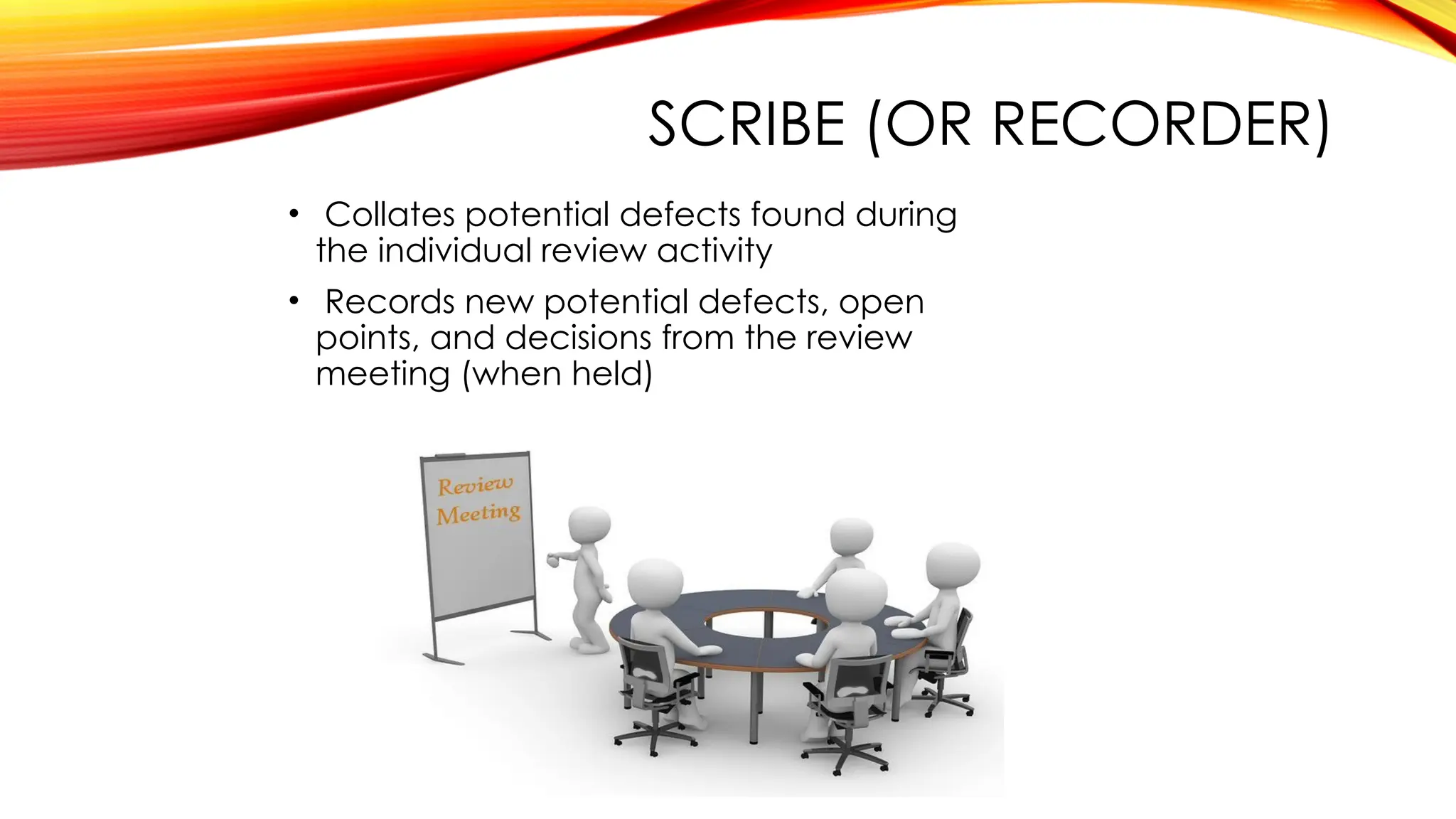
SCRIBE (OR RECORDER)
• Collates potential defects found during
the individual review activity
• Records new potential defects, open
points, and decisions from the review
meeting (when held)
3.2.3 REVIEW TYPES
One of the main objective of review is to uncover defects
INFORMAL REVIEW
Main purpose: detecting potential defects
Possible additional purposes: generating new ideas or solutions,
quickly solving minor problems
Not based on a formal (documented) process
May not involve a review meeting
INFORMAL REVIEW
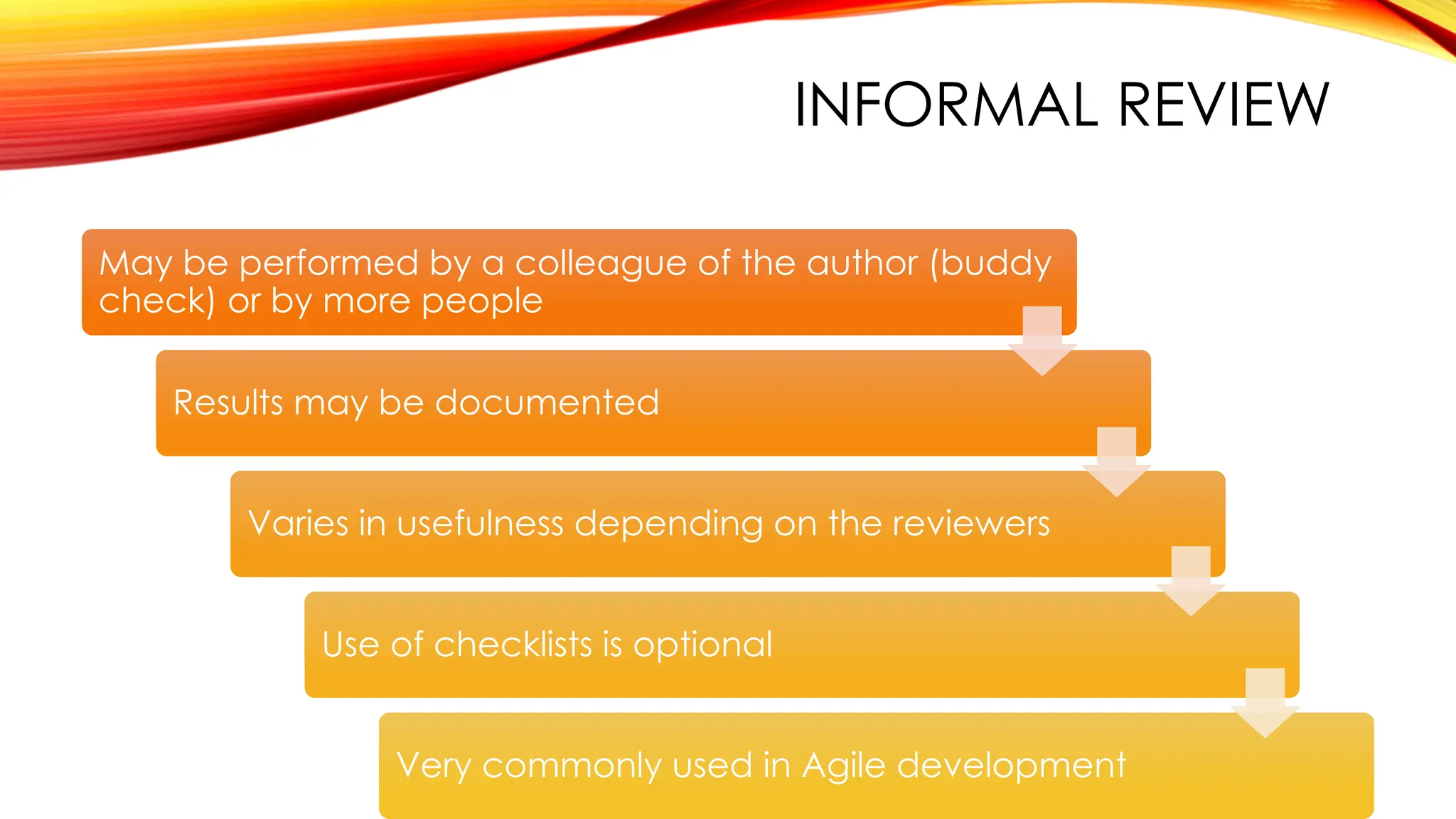
May be performed by a colleague of the author (buddy
check) or by more people
Results may be documented
Varies in usefulness depending on the reviewers
Use of checklists is optional
Very commonly used in Agile development
WALKTHROUGH
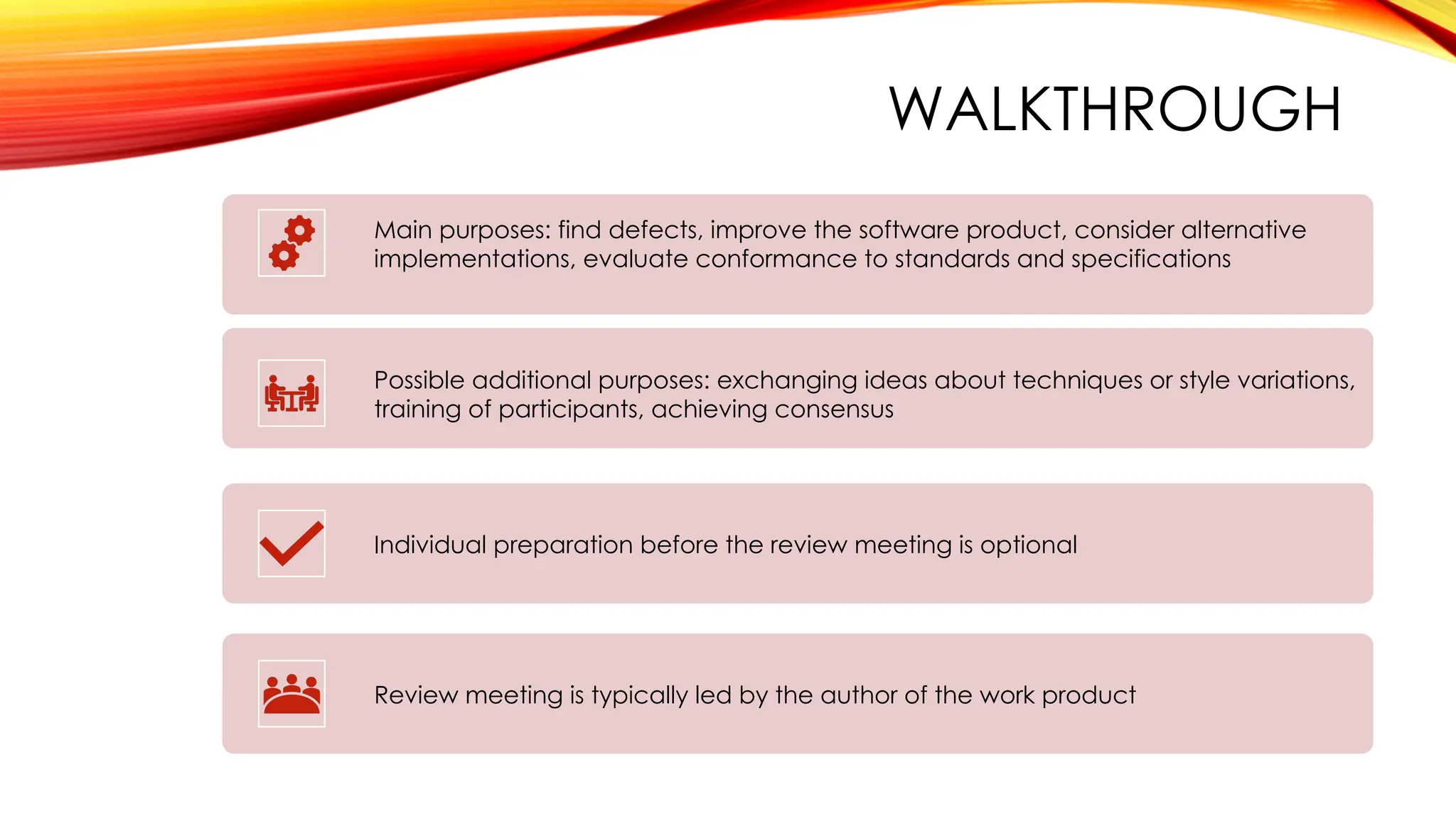
Main purposes: find defects, improve the software product, consider alternative
implementations, evaluate conformance to standards and specifications
Possible additional purposes: exchanging ideas about techniques or style variations,
training of participants, achieving consensus
Individual preparation before the review meeting is optional
Review meeting is typically led by the author of the work product
WALKTHROUGH
Scribe is mandatory
Use of checklists is optional
May take the form of scenarios, dry runs, or
simulations
Potential defect logs and review reports
may be produced
May vary in practice from quite informal to
very formal
TECHNICAL REVIEW
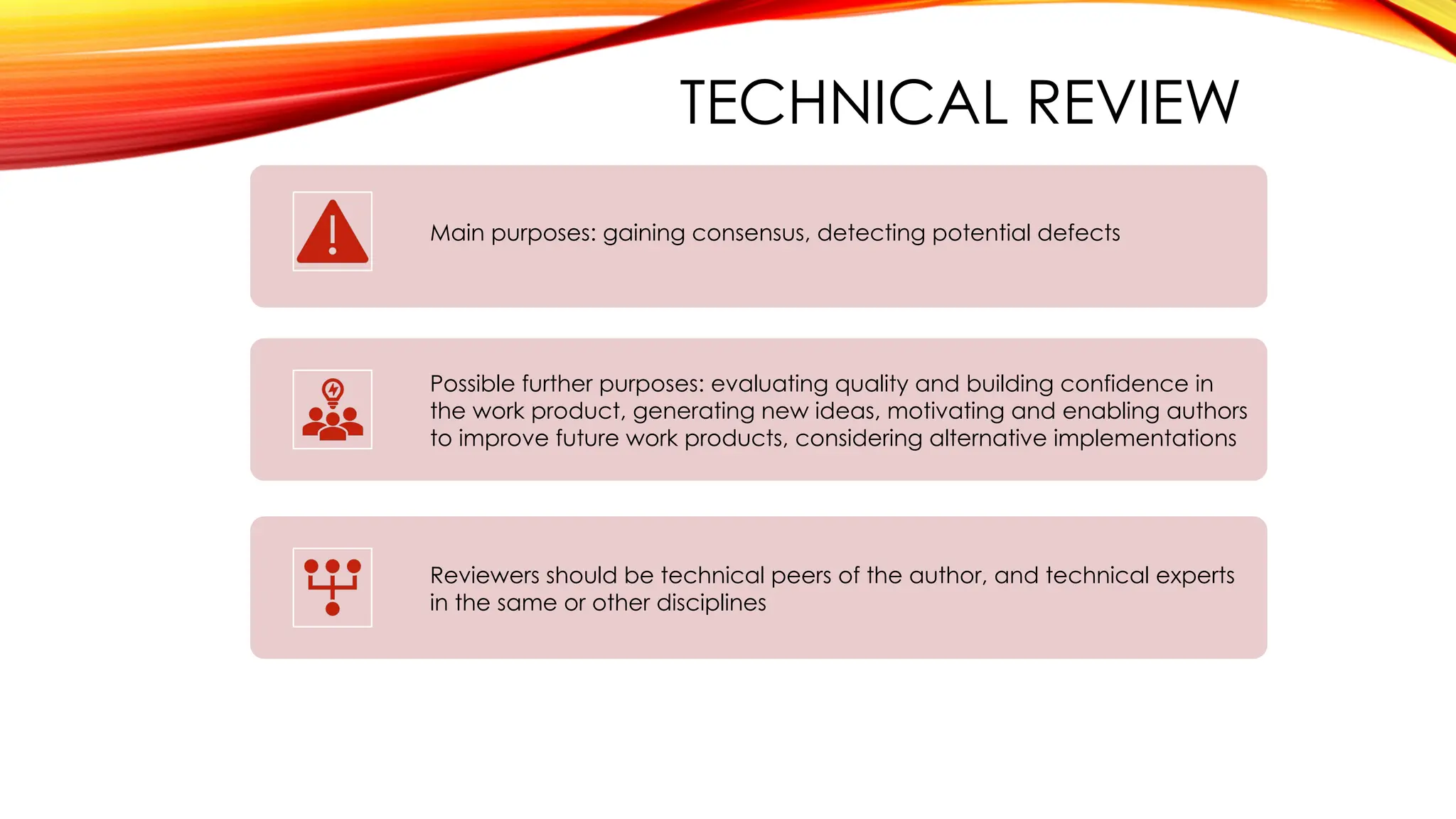
Main purposes: gaining consensus, detecting potential defects
Possible further purposes: evaluating quality and building confidence in
the work product, generating new ideas, motivating and enabling authors
to improve future work products, considering alternative implementations
Reviewers should be technical peers of the author, and technical experts
in the same or other disciplines
TECHNICAL
REVIEW
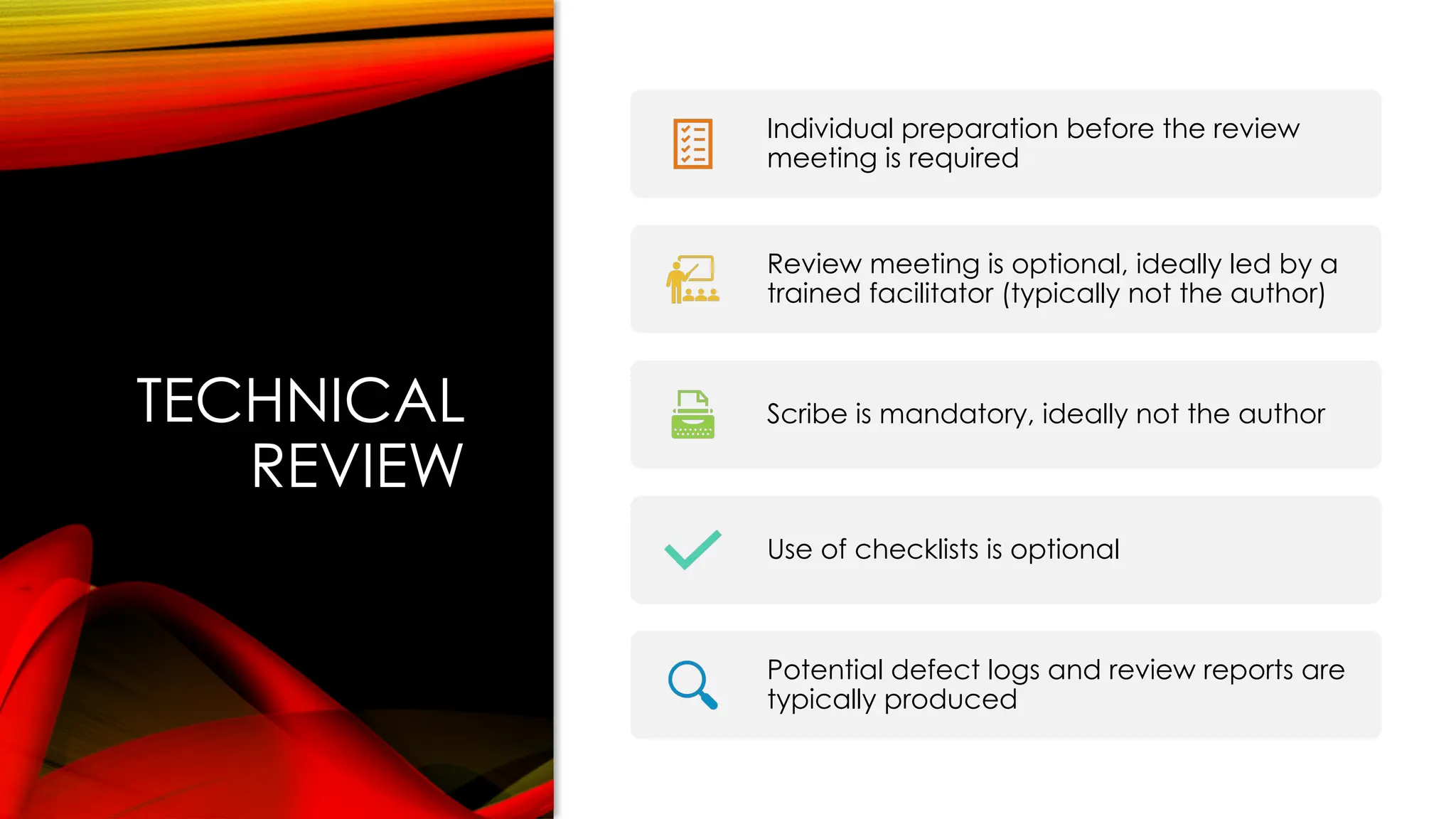
Individual preparation before the review
meeting is required
Review meeting is optional, ideally led by a
trained facilitator (typically not the author)
Scribe is mandatory, ideally not the author
Use of checklists is optional
Potential defect logs and review reports are
typically produced
INSPECTION
Main purposes: detecting potential defects,
evaluating quality and building confidence
in the work product, preventing future similar
defects through author learning and root
cause analysis
Possible further purposes: motivating and
enabling authors to improve future work
products and the software development
process, achieving consensus
Follows a defined process with formal
documented outputs, based on rules and
checklists
INSPECTION
Uses clearly defined roles, such as those
specified in section 3.2.2 which are
mandatory, and may include a dedicated
reader (who reads the work product aloud
during the review meeting)
Individual preparation before the review
meeting is required
Reviewers are either peers of the author or
experts in other disciplines that are relevant
to the work product
INSPECTION
Specified entry and exit criteria are used
Scribe is mandatory
Review meeting is led by a trained facilitator (not the
author)
Author cannot act as the review leader, reader, or
scribe
Potential defect logs and review report are produced
Metrics are collected and used to improve the entire
software development process, including the
inspection process
3.2.4
APPLYING
REVIEW
TECHNIQUES
There are a number of
review techniques that
can be applied during
the individual review
• Ad hoc
• Checklist-based
• Scenarios and dry runs
• Role-based
• Perspective-based
3.2.5
SUCCESS
FACTORS
FOR
REVIEWS
There are a number of factors that will affect
the outcome of the review
Each review has clear objectives, defined
during review planning, and used as
measurable exit criteria
Review types are applied which are suitable to
achieve the objectives and are appropriate to
the type and level of software work products
and participants
Any review techniques used, such as checklist-
based or role-based reviewing, are suitable for
effective defect identification in the work
product to be reviewed
3.2.5
SUCCESS
FACTORS
FOR
REVIEWS
Any checklists used address the main risks and are up to
date
Large documents are written and reviewed in small
chunks, so that quality control is exercised by providing
authors early and frequent feedback on defects
Participants have adequate time to prepare
Reviews are scheduled with adequate notice
Management supports the review process (e.g., by
incorporating adequate time for review activities in
project schedules)
PEOPLE-
RELATED
SUCCESS
FACTORS
FOR
REVIEWS
The right people are involved to meet the review
objectives.
Testers are seen as valued reviewers who
contribute to the review and learn about the work
product, which enables them to prepare more
effective tests, and to prepare those tests earlier
Participants dedicate adequate time and
attention to detail
Reviews are conducted on small chunks, so that
reviewers do not lose concentration during
individual review and/or the review meeting (when
held)
PEOPLE-
RELATED
SUCCESS
FACTORS
FOR
REVIEWS
Defects found are acknowledged, appreciated, and
handled objectively
The meeting is well-managed, so that participants
consider it a valuable use of their time
The review is conducted in an atmosphere of trust; the
outcome will not be used for the evaluation of the
participants
Participants avoid body language and behaviors that
might indicate boredom, exasperation, or hostility to
other participants
Adequate training is provided, especially for more
formal review types such as inspections
A culture of learning and process improvement is
promoted
ISTQB FOUNDATION
LEVEL EXAM
PREPARATION
https://arshadqa.com/
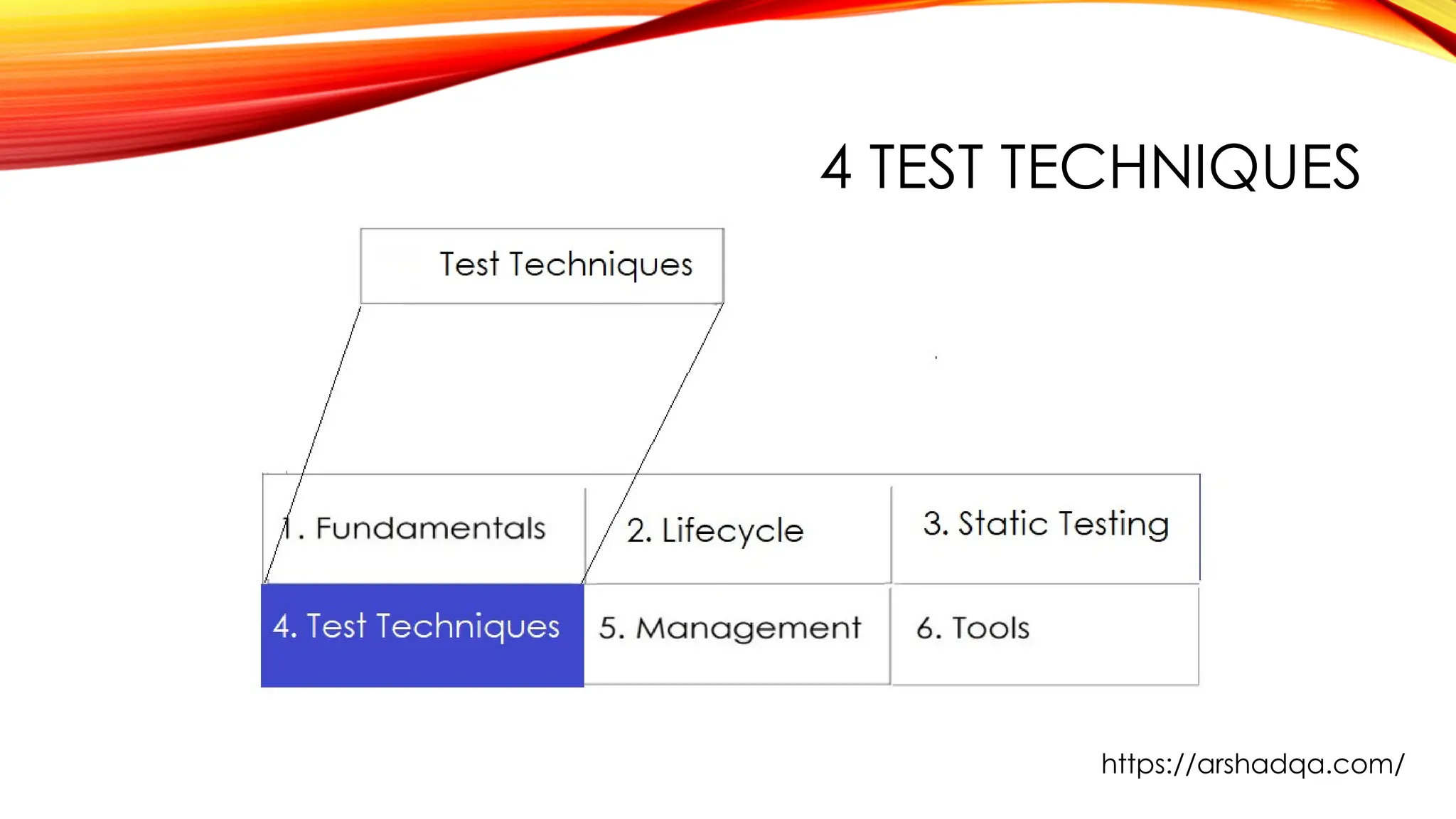
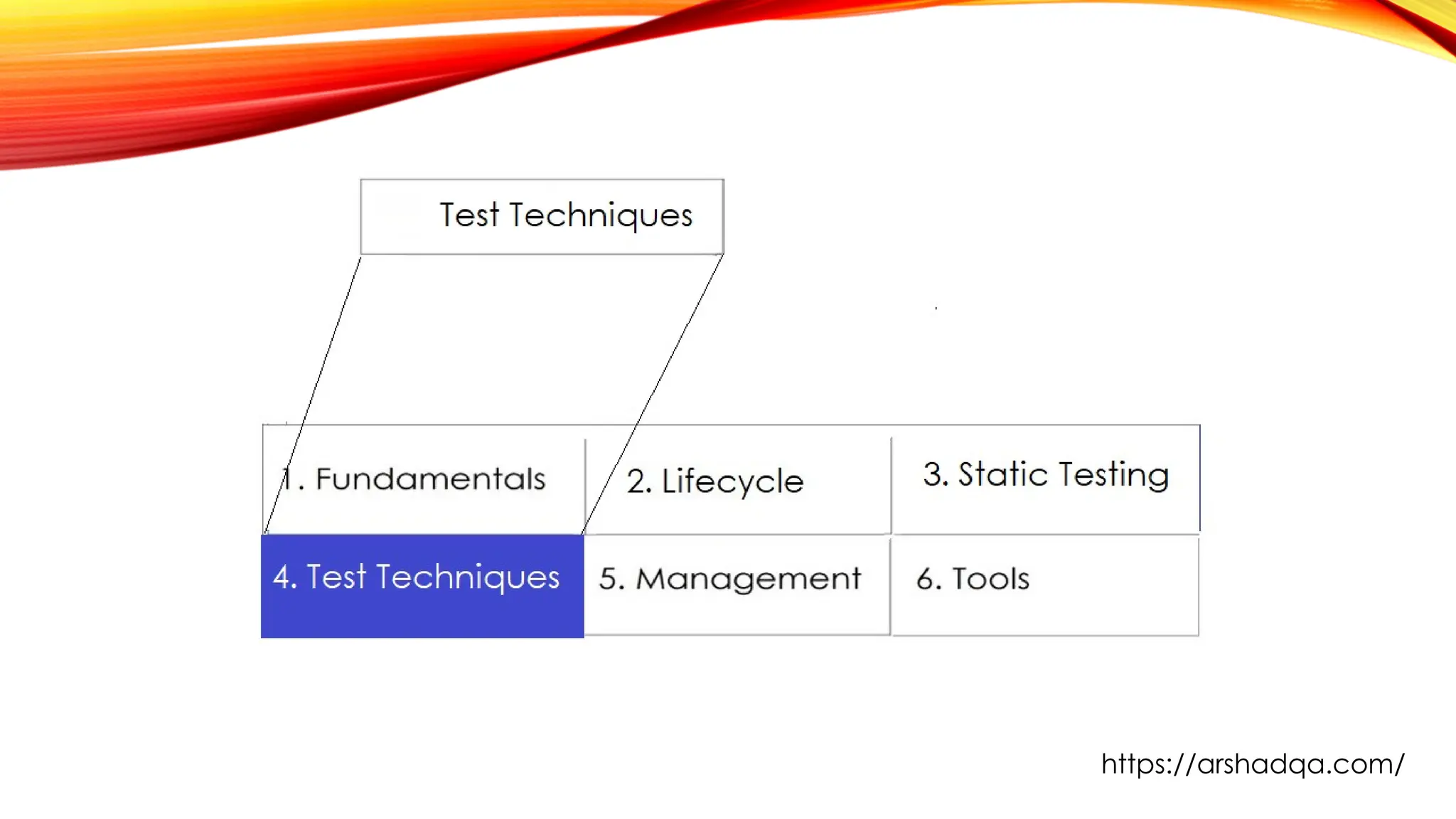
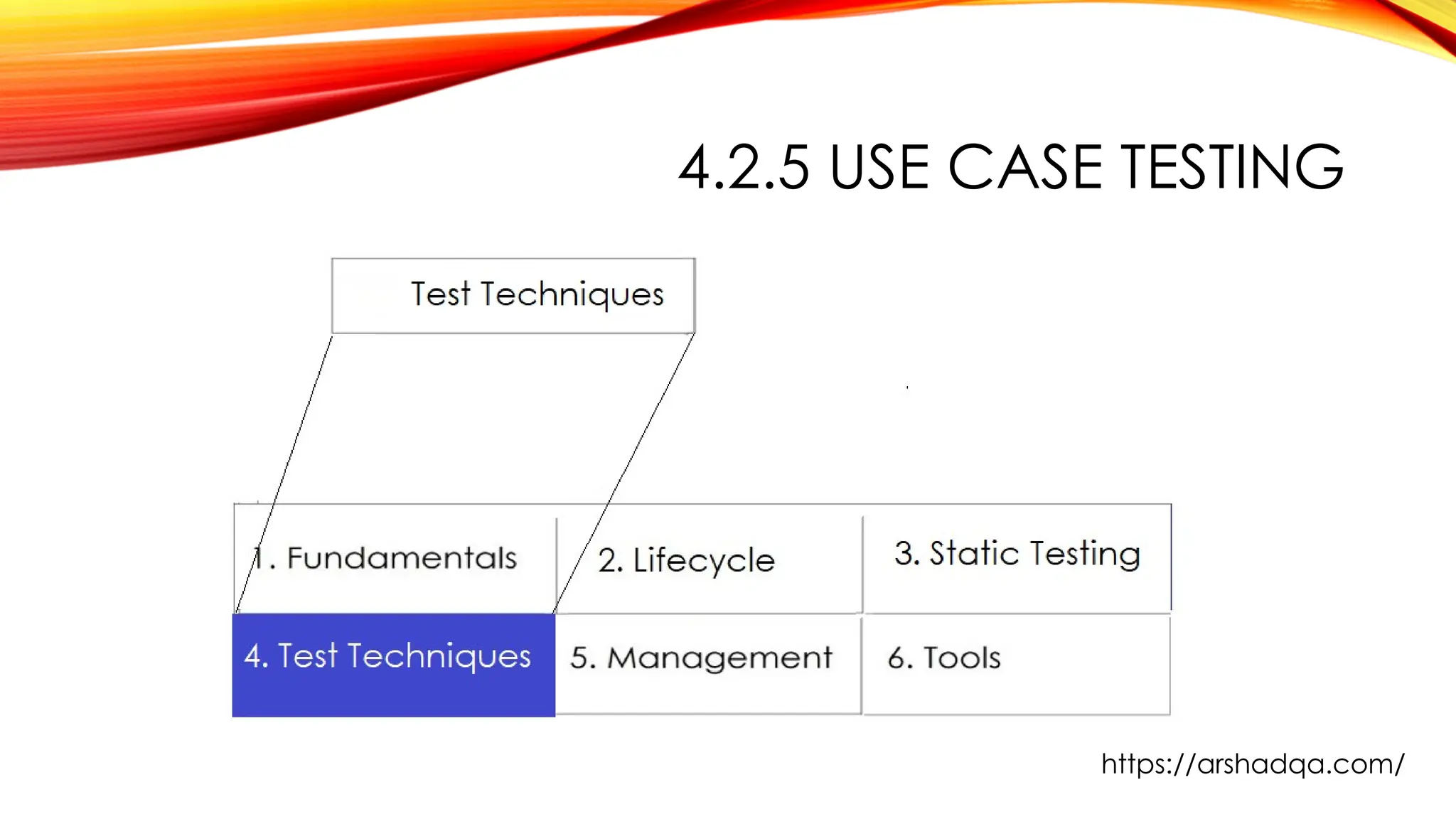
4 TEST TECHNIQUES
https://arshadqa.com/
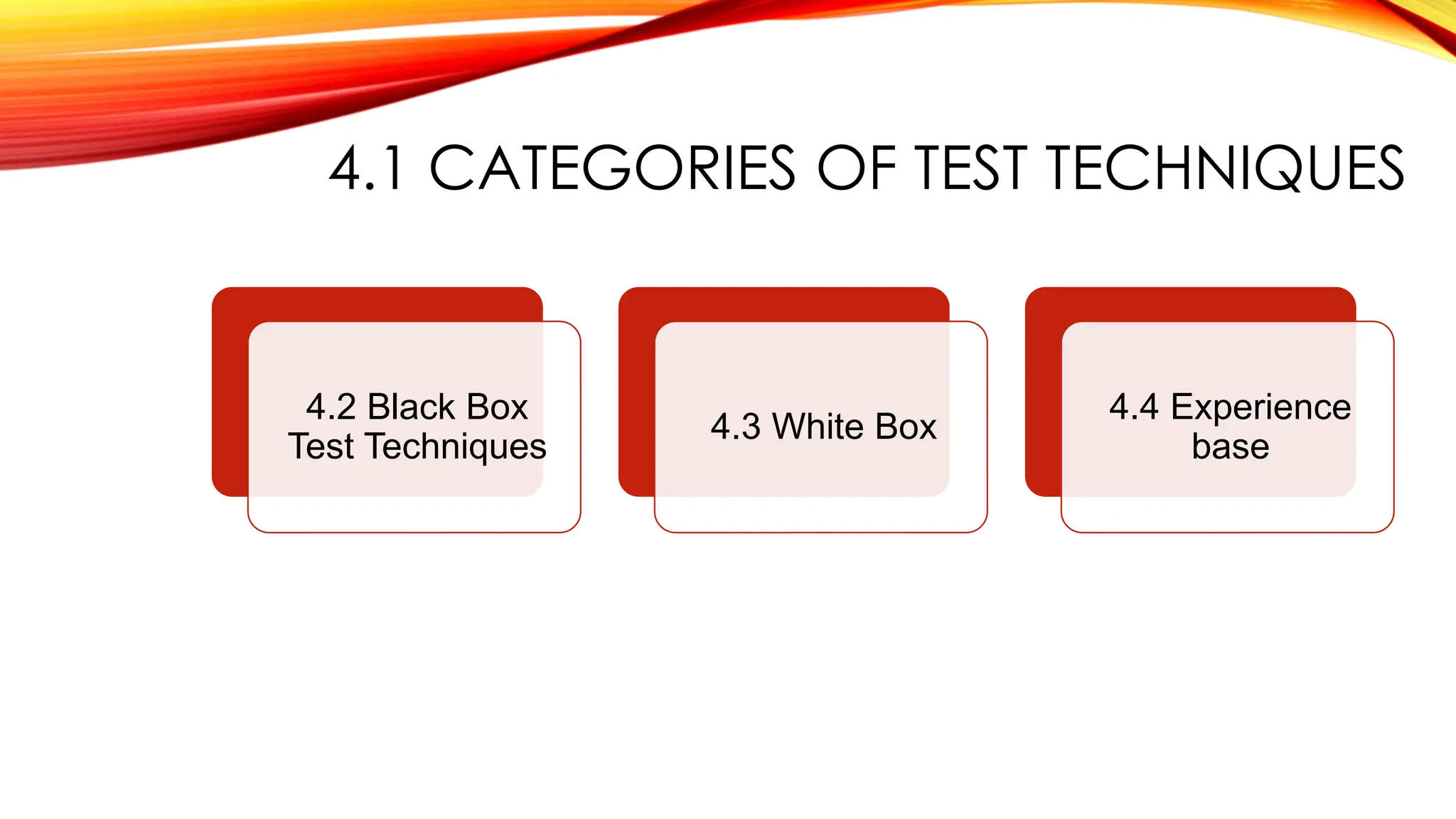
4.1 CATEGORIES OF TEST TECHNIQUES
4.2 Black Box
Test Techniques
4.3 White Box
4.4 Experience
base
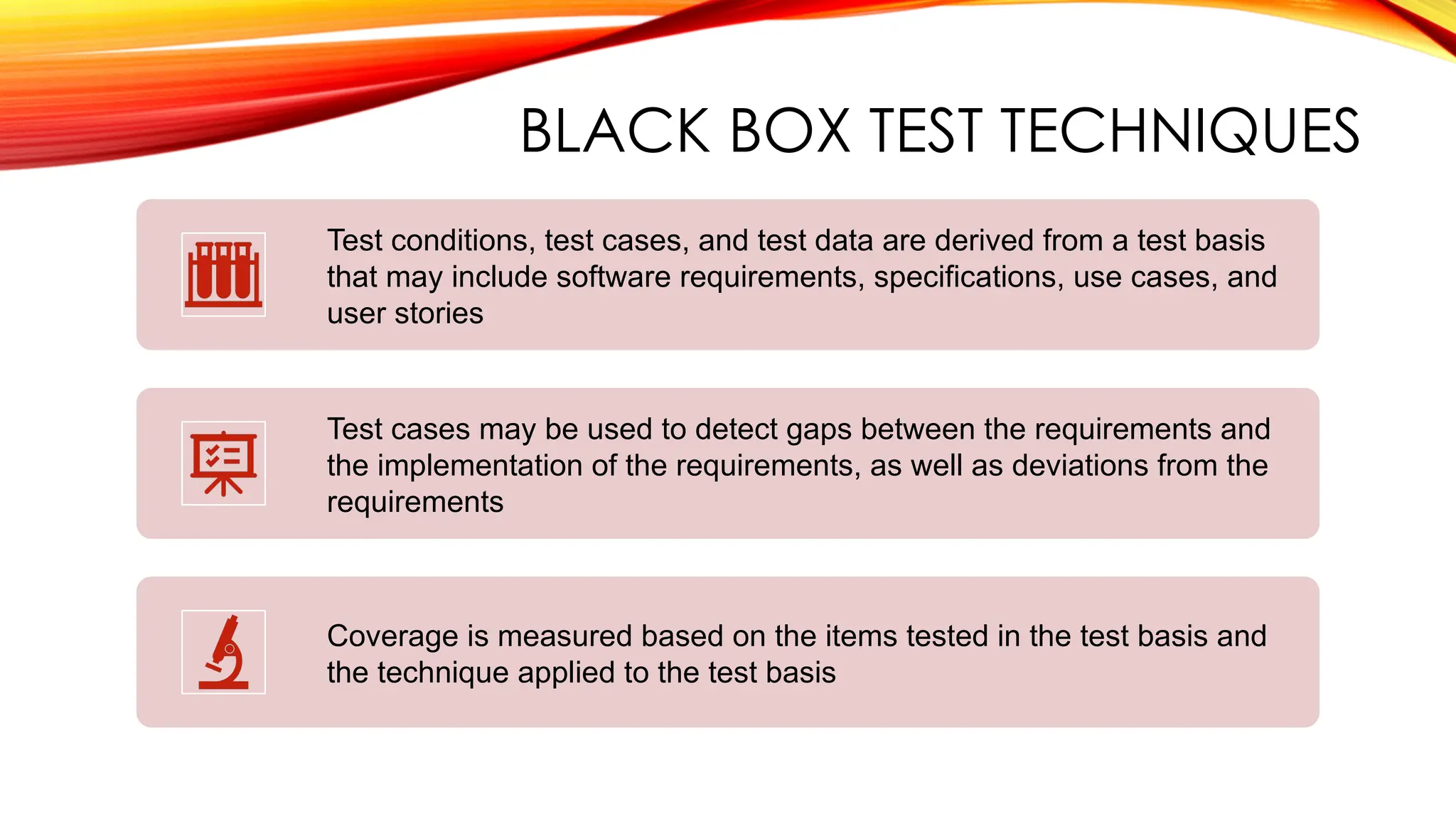
BLACK BOX TEST TECHNIQUES
Test conditions, test cases, and test data are derived from a test basis
that may include software requirements, specifications, use cases, and
user stories
Test cases may be used to detect gaps between the requirements and
the implementation of the requirements, as well as deviations from the
requirements
Coverage is measured based on the items tested in the test basis and
the technique applied to the test basis
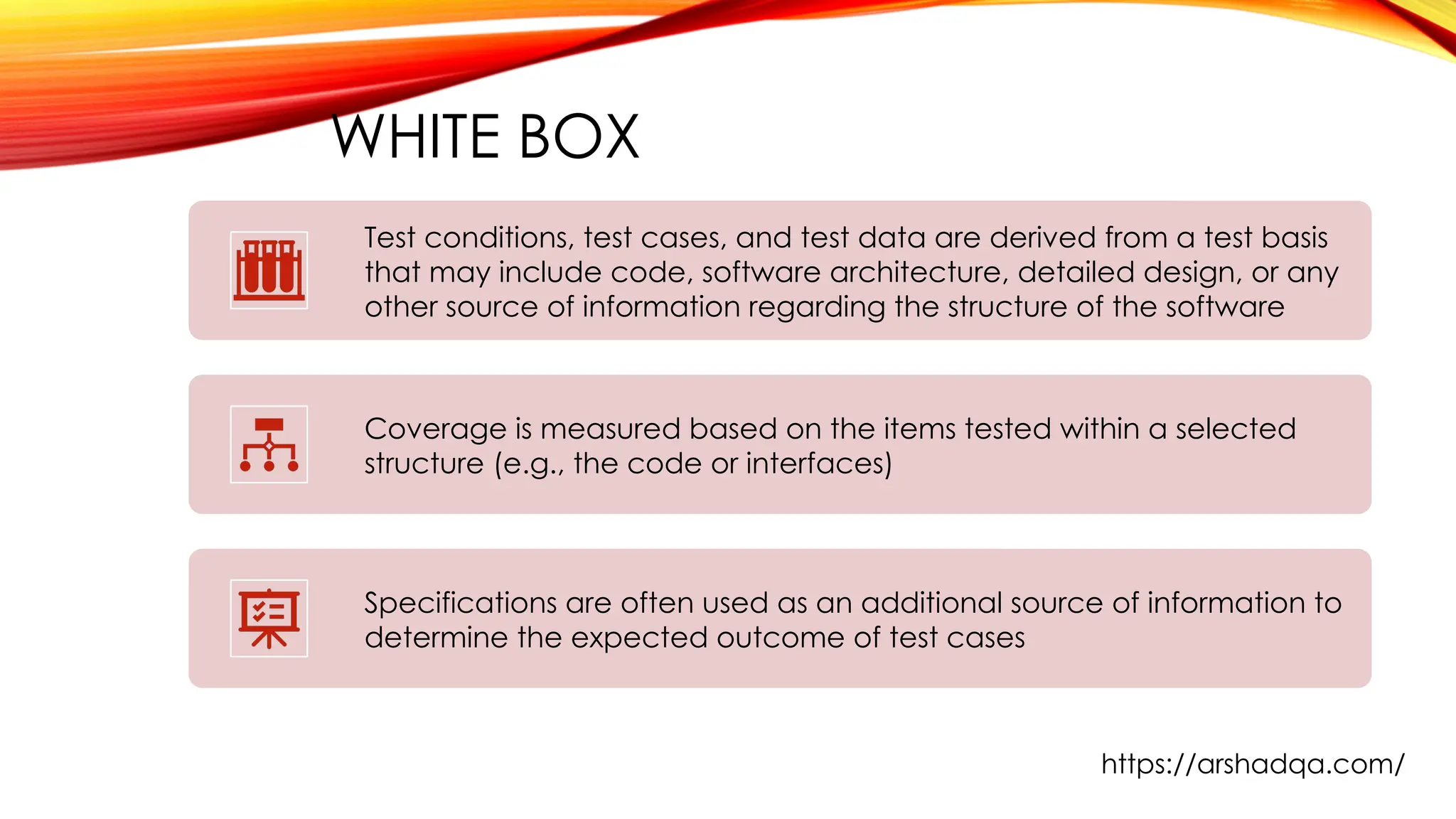
WHITE BOX
Test conditions, test cases, and test data are derived from a test basis
that may include code, software architecture, detailed design, or any
other source of information regarding the structure of the software
Coverage is measured based on the items tested within a selected
structure (e.g., the code or interfaces)
Specifications are often used as an additional source of information to
determine the expected outcome of test cases
https://arshadqa.com/
EXPERIENCE BASE
Common characteristics of experience-based test techniques include the following:
Test conditions, test cases, and test data are derived from a test basis that may
include knowledge and experience of testers, developers, users and other
stakeholders
This knowledge and experience includes expected use of the software, its
environment, likely defects, and the distribution of those defects
The international standard (ISO/IEC/IEEE 29119-4) contains descriptions of test
techniques and their corresponding coverage measures
4.1.1 CHOOSING TEST TECHNIQUES
When creating test cases, testers generally use a combination of test techniques to
achieve the best results from the test effort
Some techniques are more applicable to certain situations and test levels; others
are applicable to all test levels
The appropriate level of formality depends on the context of testing, including the
maturity of test and development processes, time constraints, safety or regulatory
requirements, the knowledge and skills of the people involved, and the software
development lifecycle model being followed.
4.1.1 CHOOSING TEST TECHNIQUES
The choice of which test techniques to use depends on a number of factors, including the following
Type of component or system
Component or system complexity
Regulatory standards
Customer or contractual requirements
Risk levels
Risk types
Test objectives
4.1.1 CHOOSING TEST TECHNIQUES
Available documentation
Tester knowledge and skills
Available tools
Time and budget
Software development lifecycle model
Expected use of the software
Previous experience with using the test techniques on the component or system to be tested
The types of defects expected in the component or system
ISTQB FOUNDATION
LEVEL EXAM
PREPARATION
https://arshadqa.com/
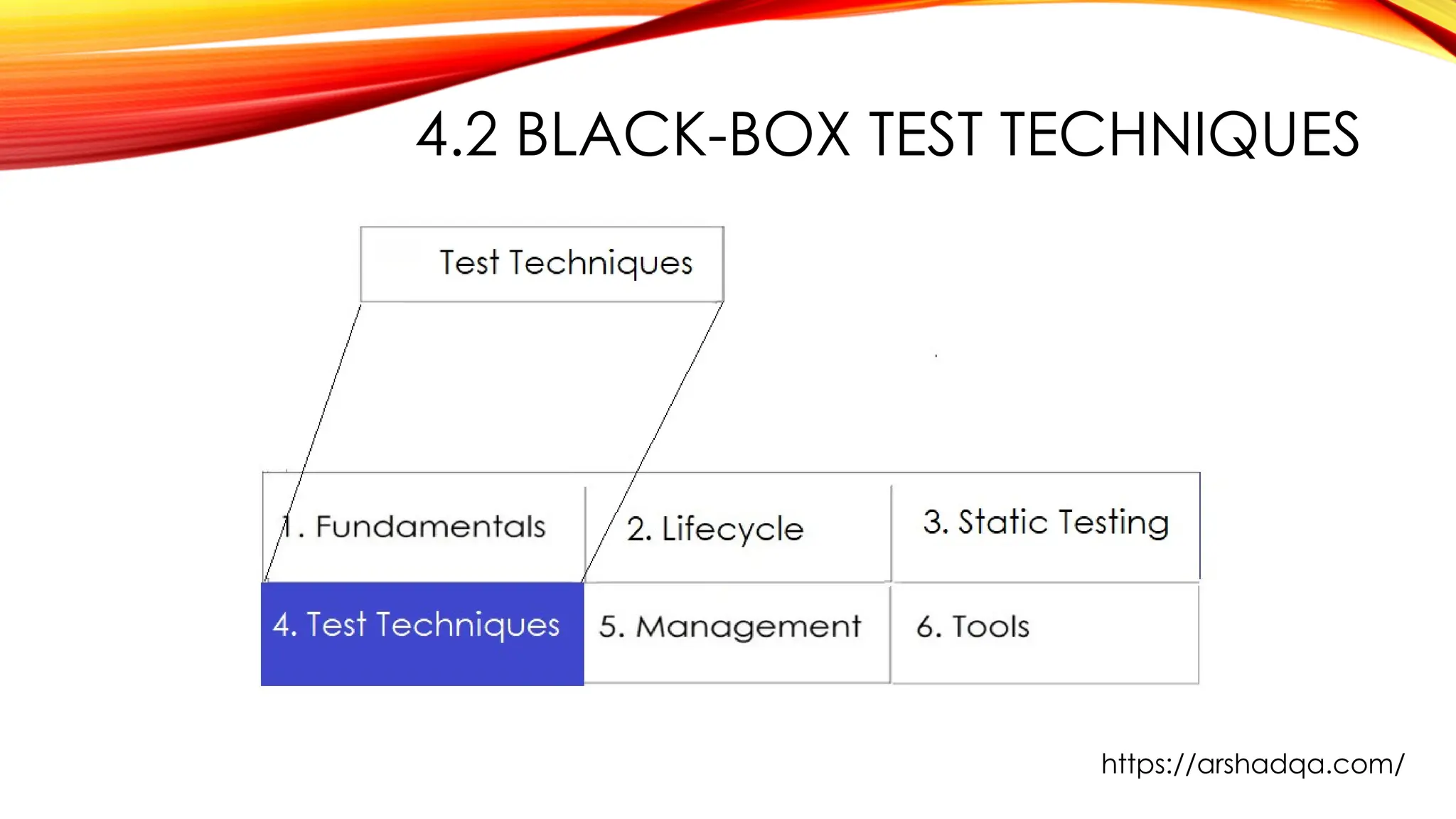
4.2 BLACK-BOX
TEST TECHNIQUES
4.2 BLACK-BOX TEST TECHNIQUES
https://arshadqa.com/
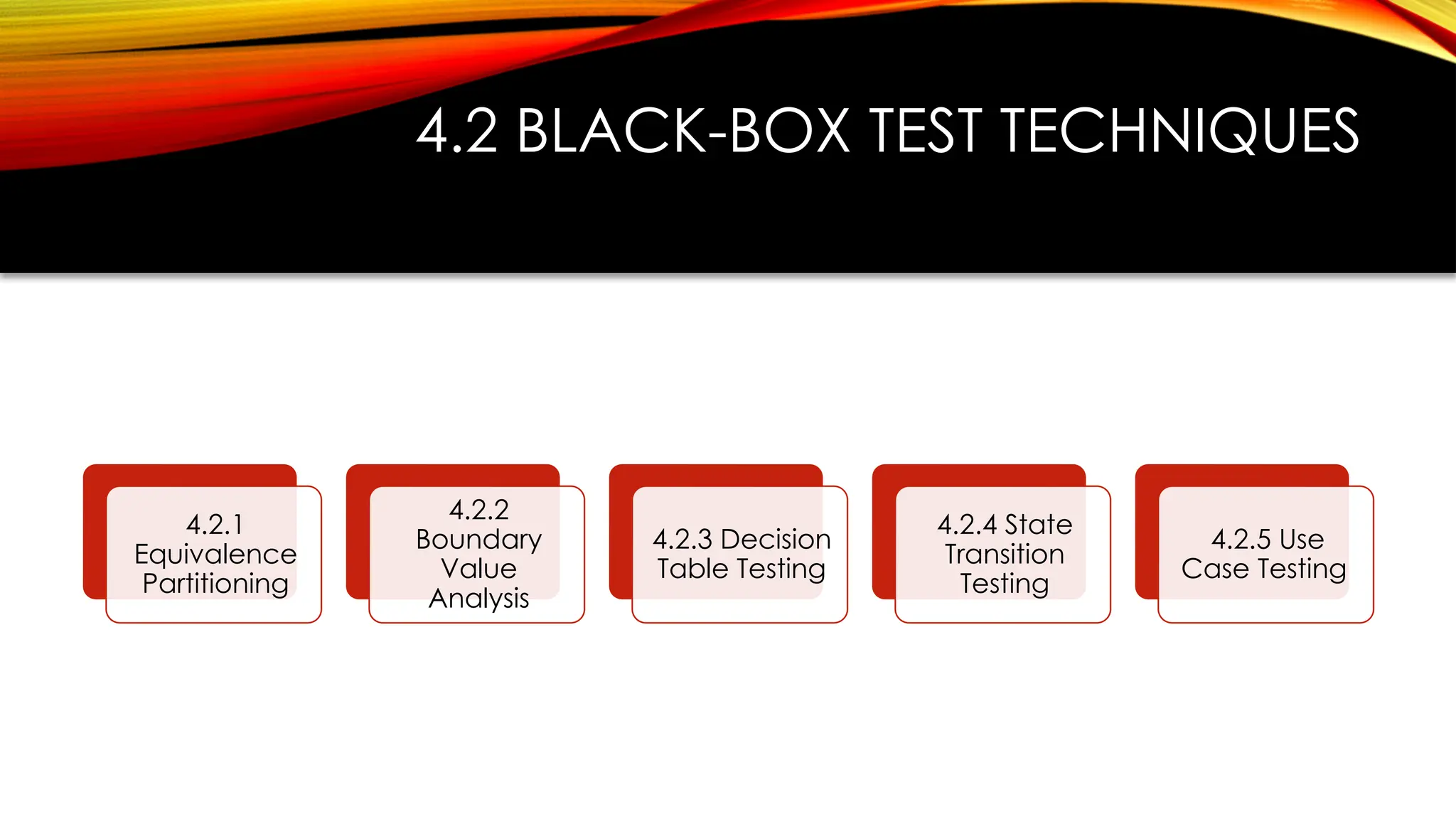
4.2 BLACK-BOX TEST TECHNIQUES
4.2.1
Equivalence
Partitioning
4.2.2
Boundary
Value
Analysis
4.2.3 Decision
Table Testing
4.2.4 State
Transition
Testing
4.2.5 Use
Case Testing
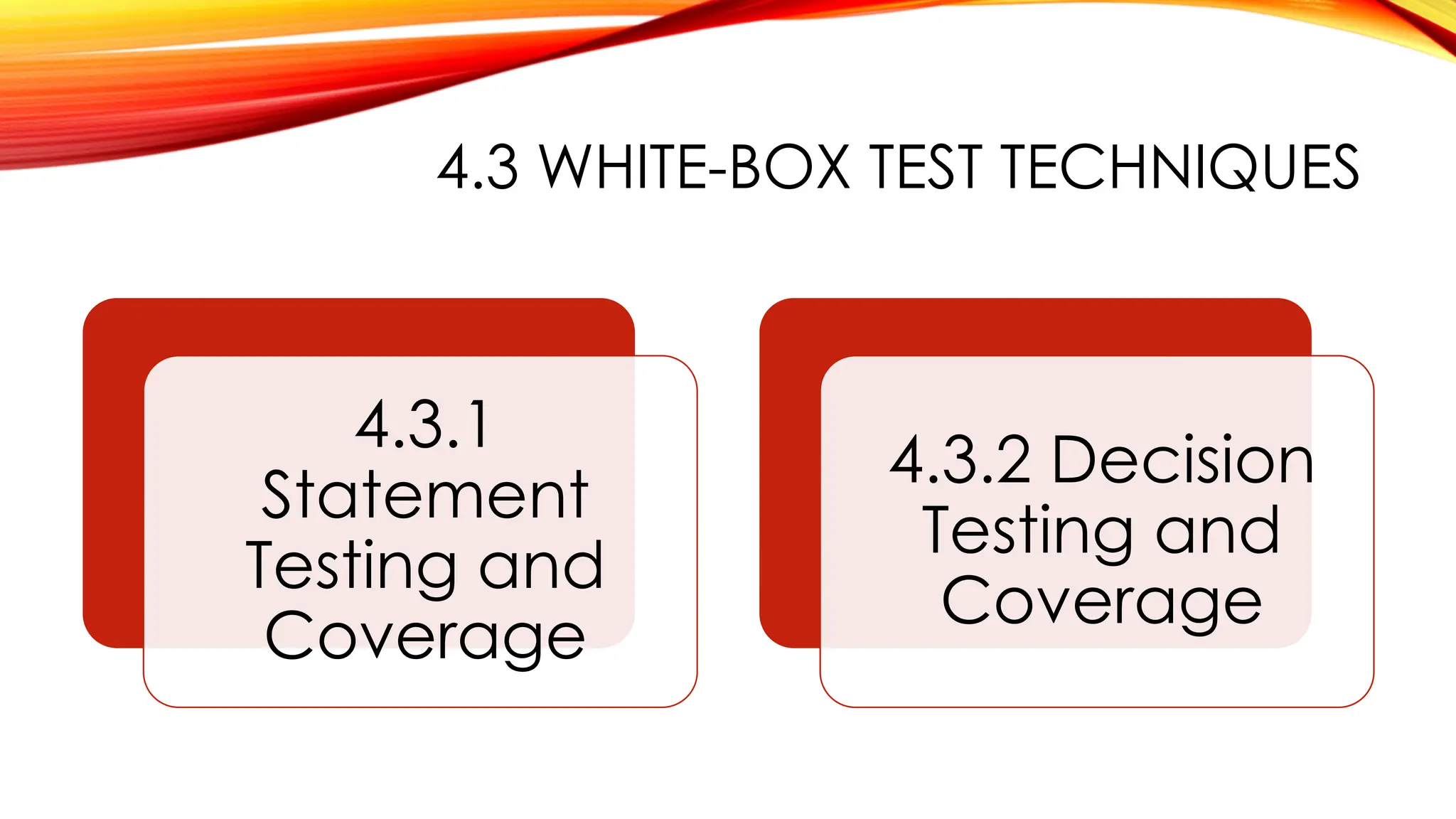
4.3 WHITE-BOX TEST TECHNIQUES
4.3.1
Statement
Testing and
Coverage
4.3.2 Decision
Testing and
Coverage
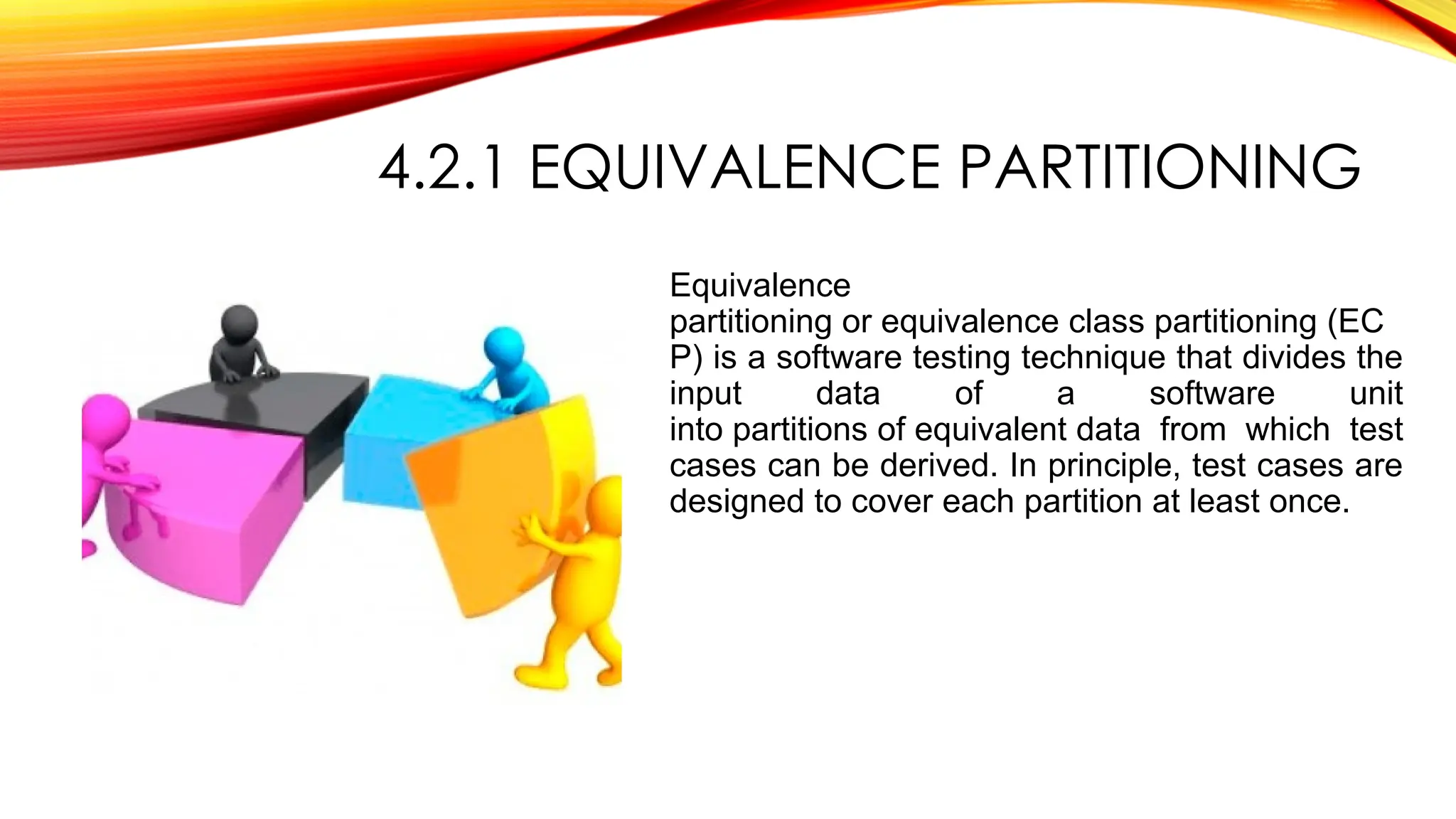
4.2.1 EQUIVALENCE PARTITIONING
Equivalence
partitioning or equivalence class partitioning (EC
P) is a software testing technique that divides the
input data of a software unit
into partitions of equivalent data from which test
cases can be derived. In principle, test cases are
designed to cover each partition at least once.
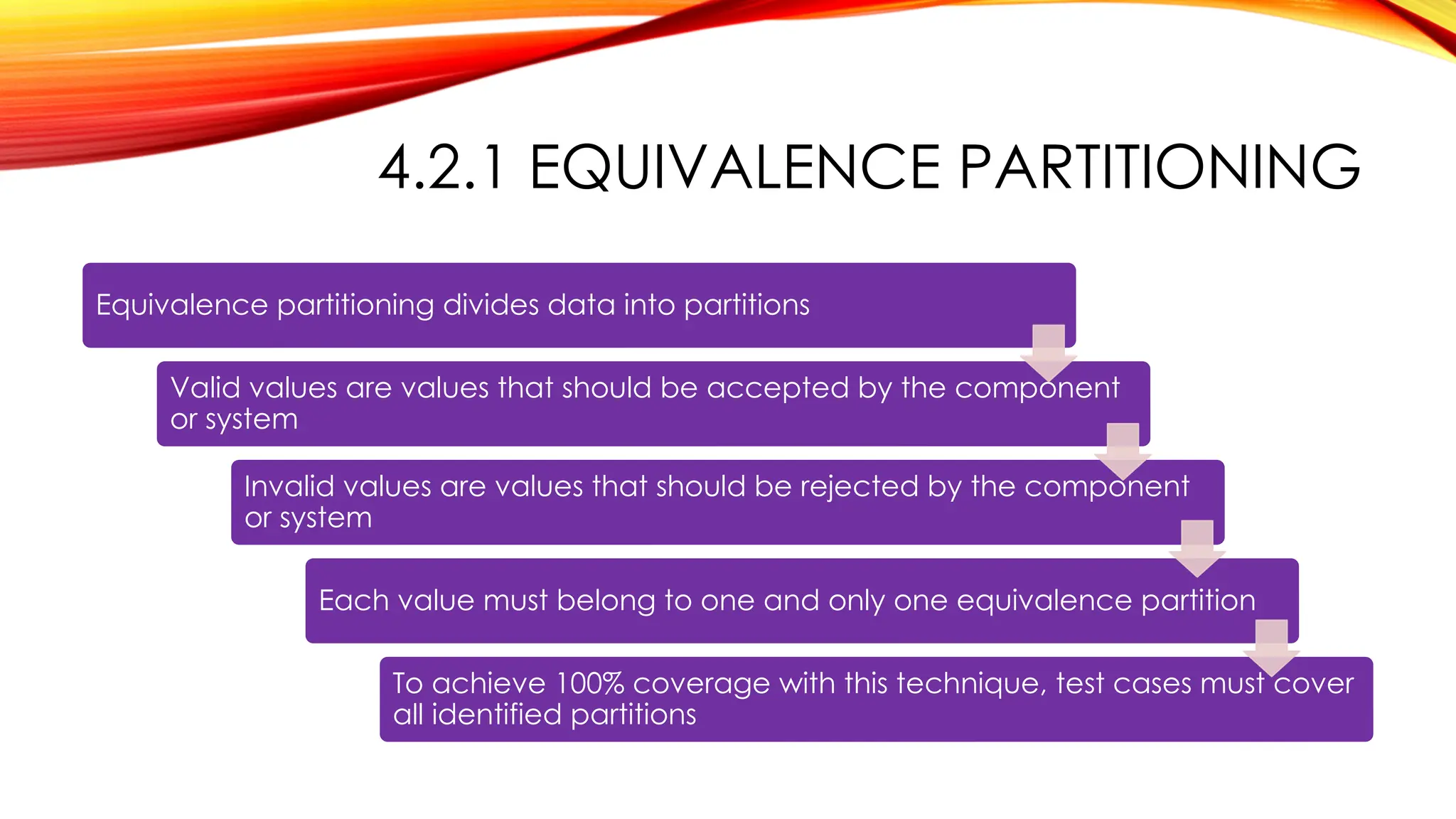
4.2.1 EQUIVALENCE PARTITIONING
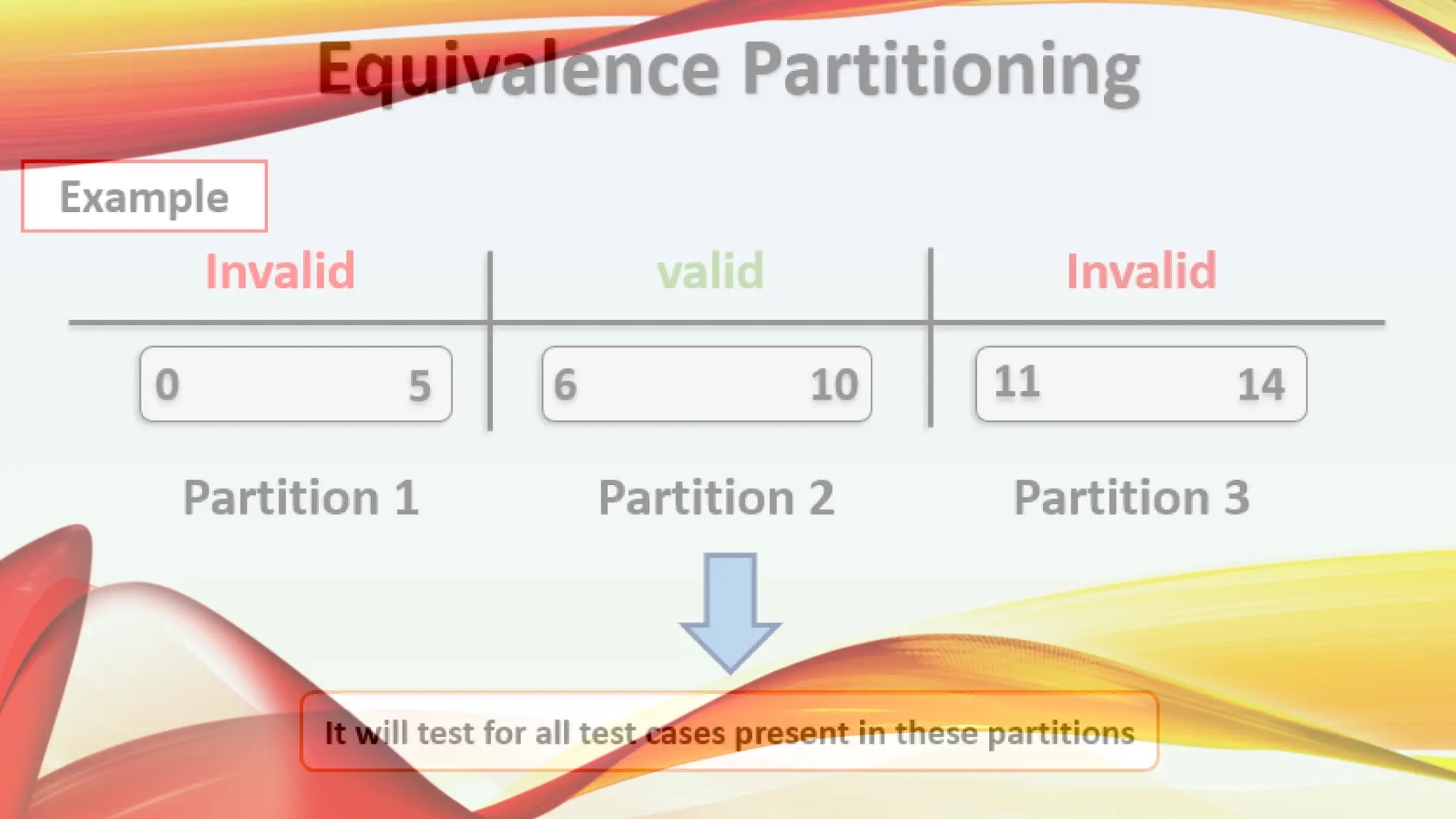
Equivalence partitioning divides data into partitions
Valid values are values that should be accepted by the component
or system
Invalid values are values that should be rejected by the component
or system
Each value must belong to one and only one equivalence partition
To achieve 100% coverage with this technique, test cases must cover
all identified partitions
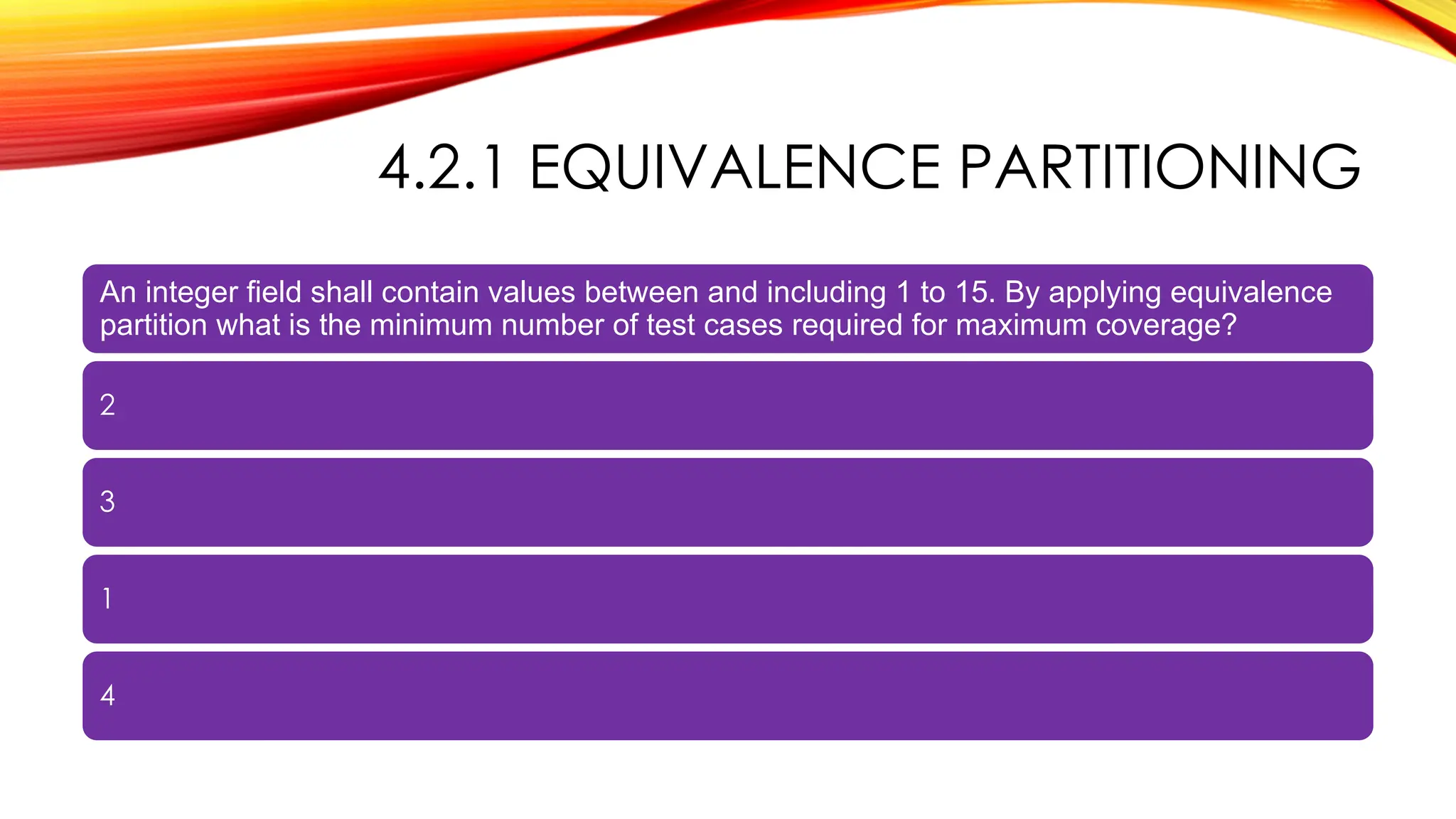
4.2.1 EQUIVALENCE PARTITIONING
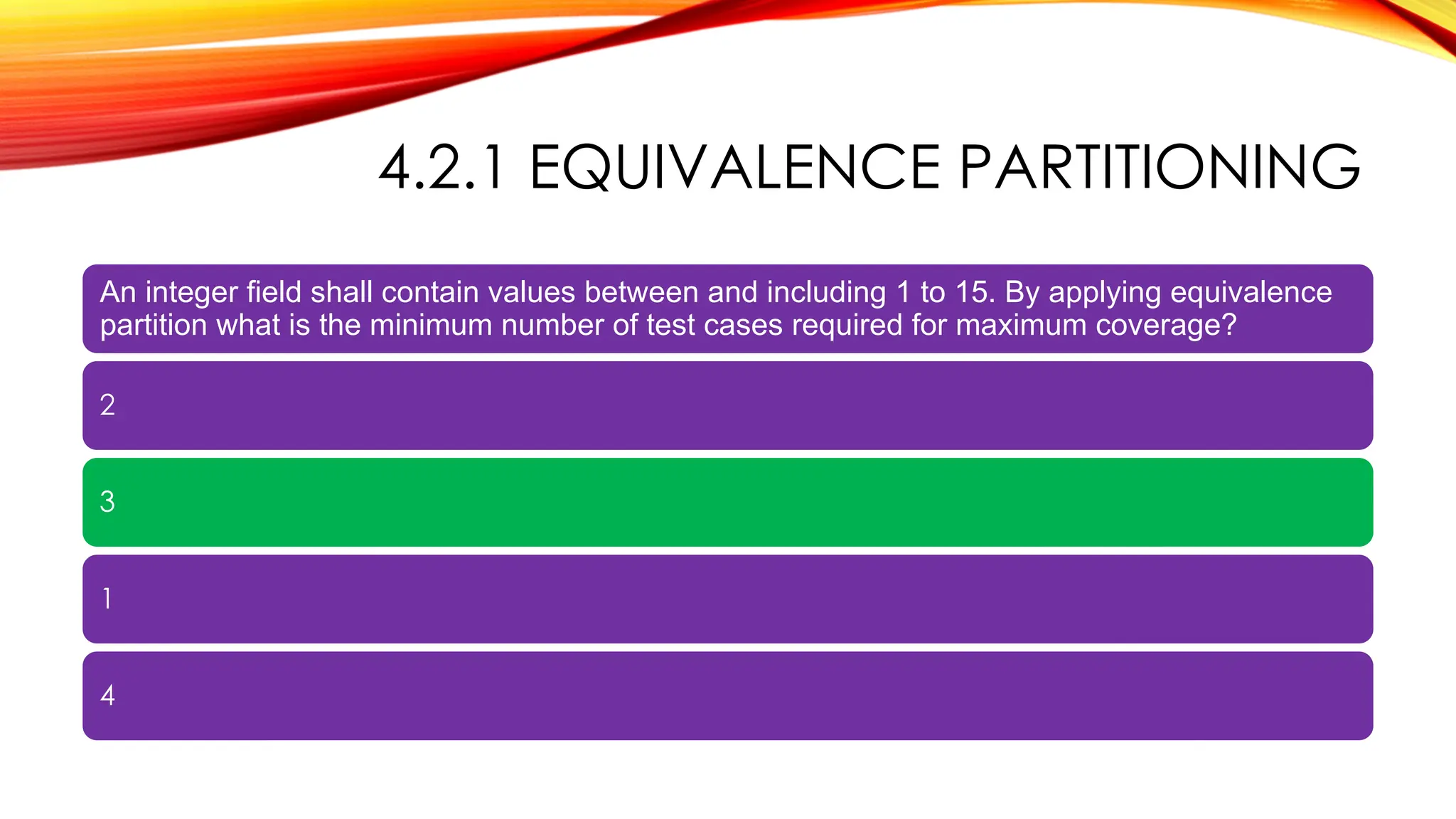
An integer field shall contain values between and including 1 to 15. By applying equivalence
partition what is the minimum number of test cases required for maximum coverage?
2
3
1
4
4.2.1 EQUIVALENCE PARTITIONING
An integer field shall contain values between and including 1 to 15. By applying equivalence
partition what is the minimum number of test cases required for maximum coverage?
2
3
1
4
4.2.1 EQUIVALENCE PARTITIONING
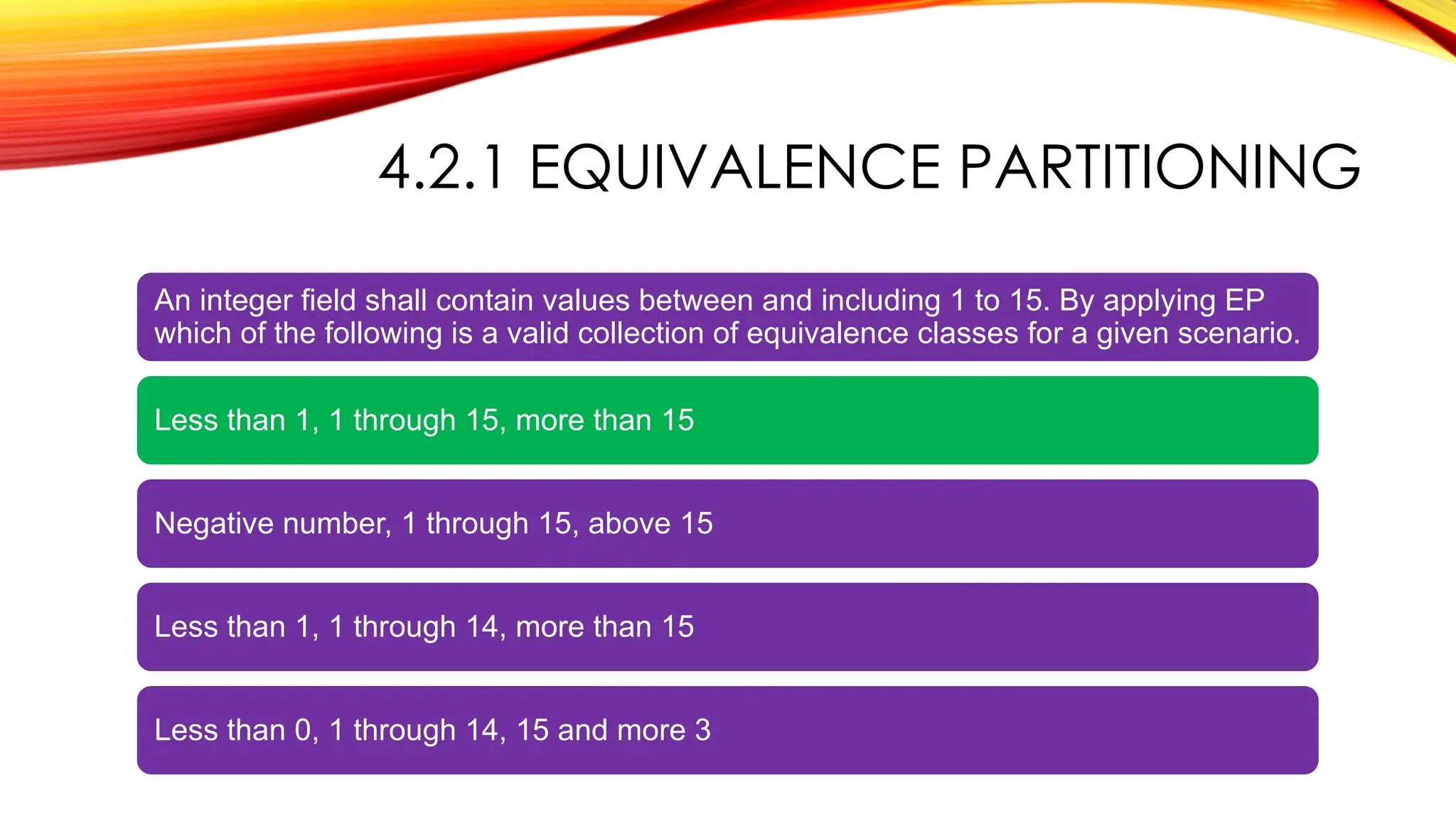
An integer field shall contain values between and including 1 to 15. By applying EP
which of the following is a valid collection of equivalence classes for a given scenario.
Less than 1, 1 through 15, more than 15
Negative number, 1 through 15, above 15
Less than 1, 1 through 14, more than 15
Less than 0, 1 through 14, 15 and more 3
ISTQB FOUNDATION LEVEL
EXAM PREPARATION
https://arshadqa.com/
4.2.2 BOUNDARY VALUE ANALYSIS
Boundary value analysis (BVA) is an extension of equivalence partitioning
Boundary value analysis can be applied at all test level
This technique is generally used to test requirements that call for a range of
numbers (including dates and times).
4.2.2 BOUNDARY VALUE ANALYSIS
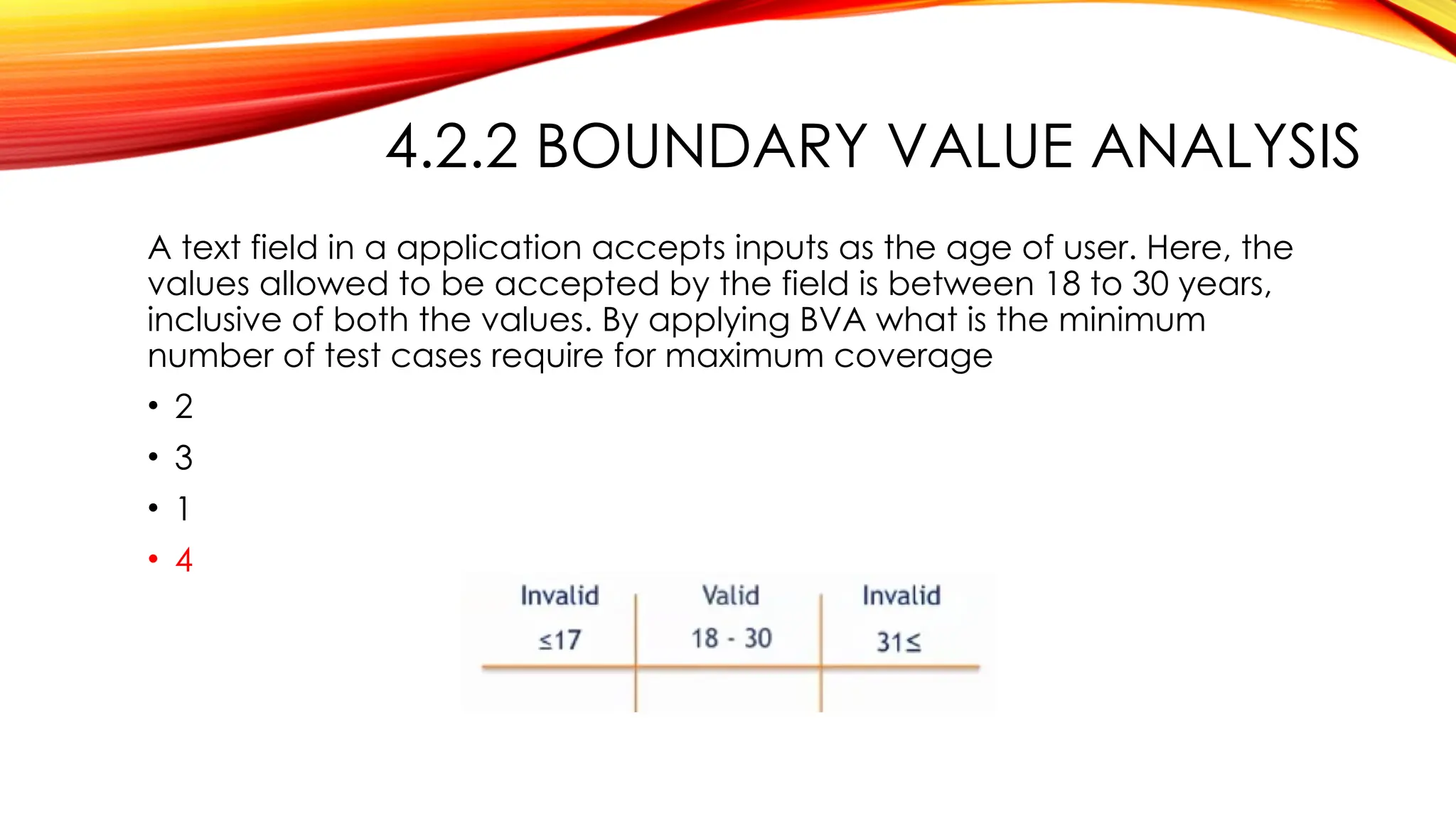
A text field in a application accepts inputs as the age of user. Here, the
values allowed to be accepted by the field is between 18 to 30 years,
inclusive of both the values. By applying BVA what is the minimum
number of test cases require for maximum coverage
• 2
• 3
• 1
• 4
4.2.2 BOUNDARY VALUE ANALYSIS
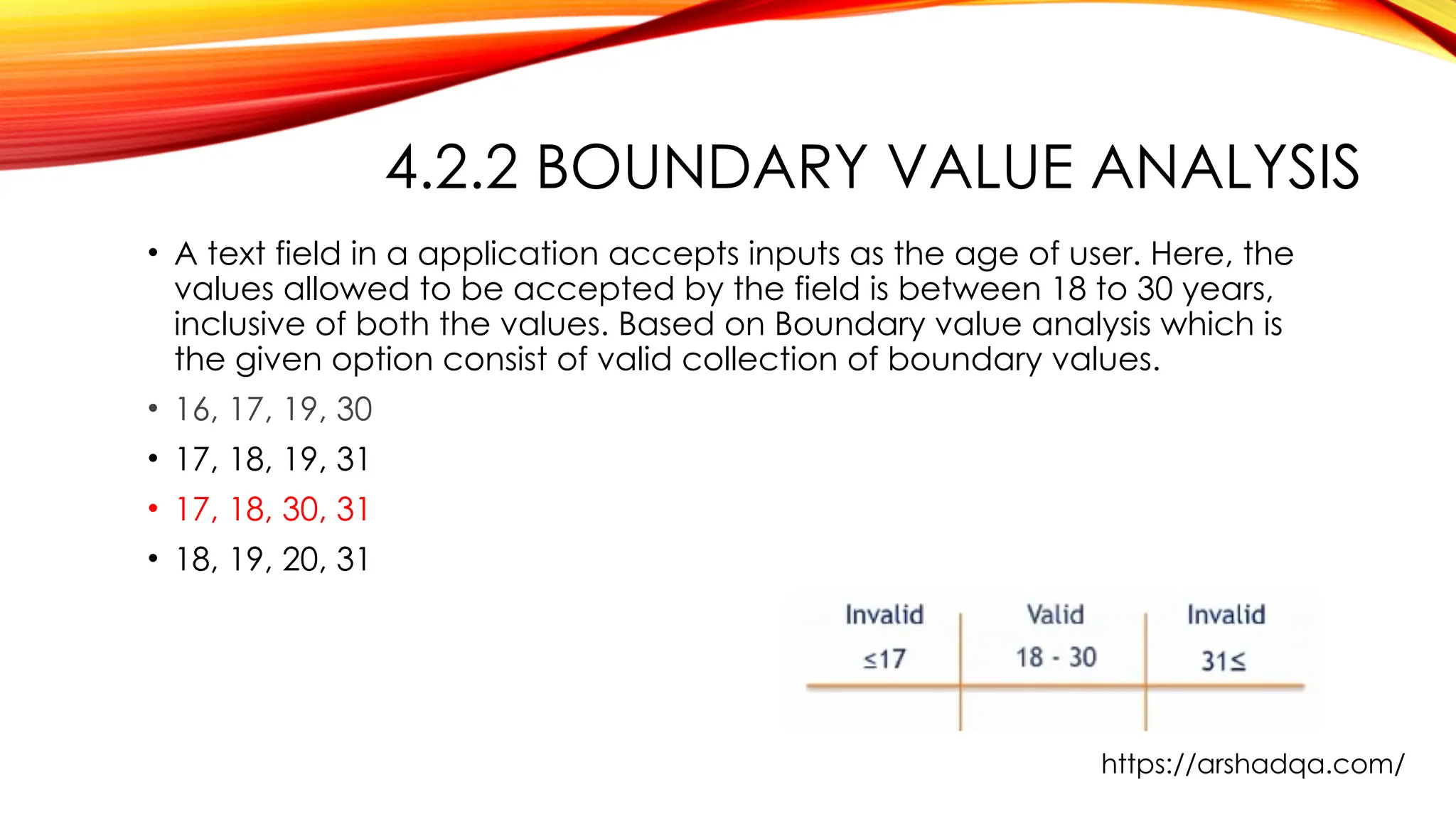
• A text field in a application accepts inputs as the age of user. Here, the
values allowed to be accepted by the field is between 18 to 30 years,
inclusive of both the values. Based on Boundary value analysis which is
the given option consist of valid collection of boundary values.
• 16, 17, 19, 30
• 17, 18, 19, 31
• 17, 18, 30, 31
• 18, 19, 20, 31
https://arshadqa.com/
4.2.2 BOUNDARY VALUE ANALYSIS
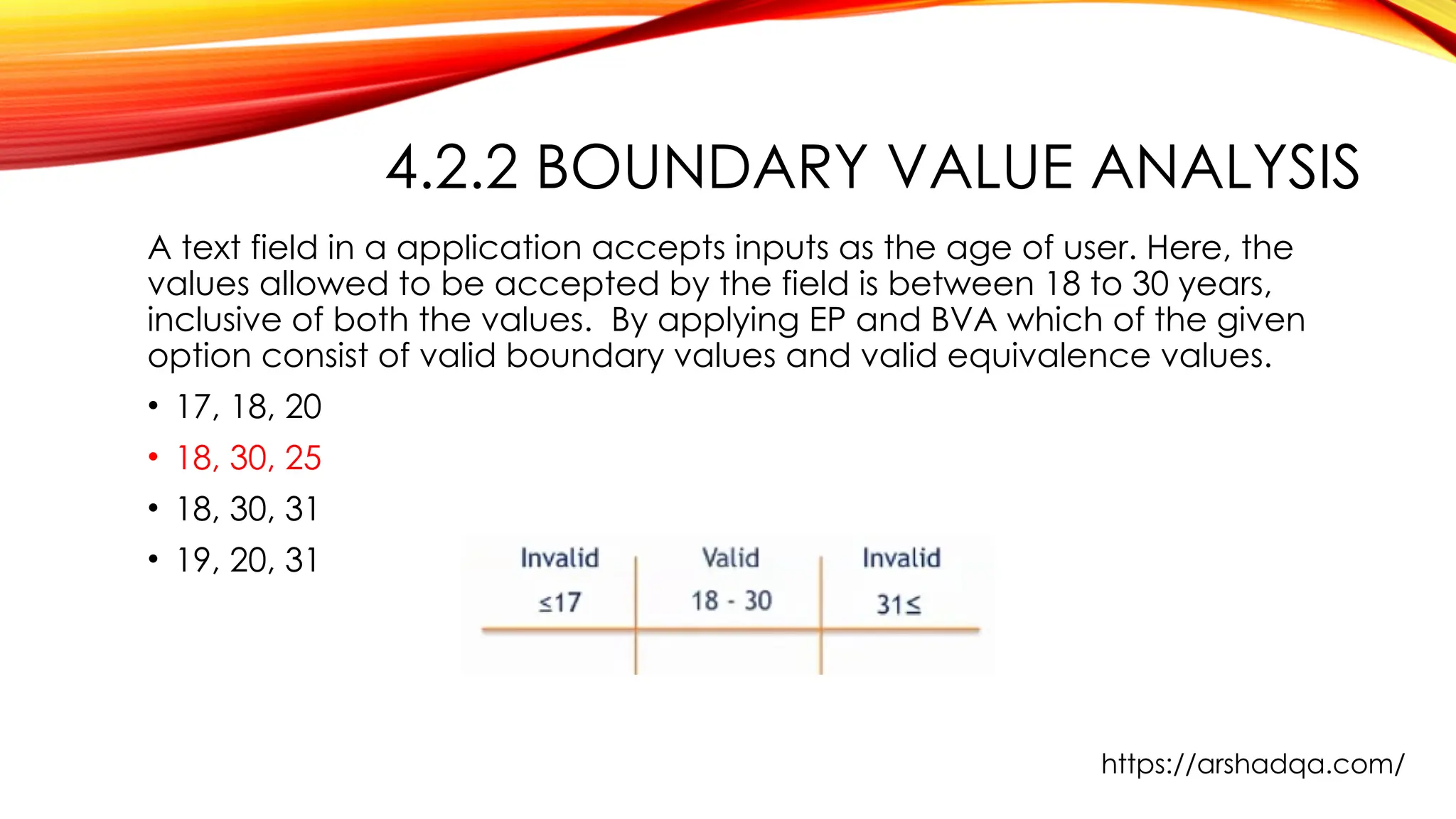
A text field in a application accepts inputs as the age of user. Here, the
values allowed to be accepted by the field is between 18 to 30 years,
inclusive of both the values. By applying EP and BVA which of the given
option consist of valid boundary values and valid equivalence values.
• 17, 18, 20
• 18, 30, 25
• 18, 30, 31
• 19, 20, 31
https://arshadqa.com/
ISTQB FOUNDATION LEVEL
EXAM PREPARATION
4.2.3 DECISION TABLE TESTING
4.2.3 DECISION
TABLE TESTING
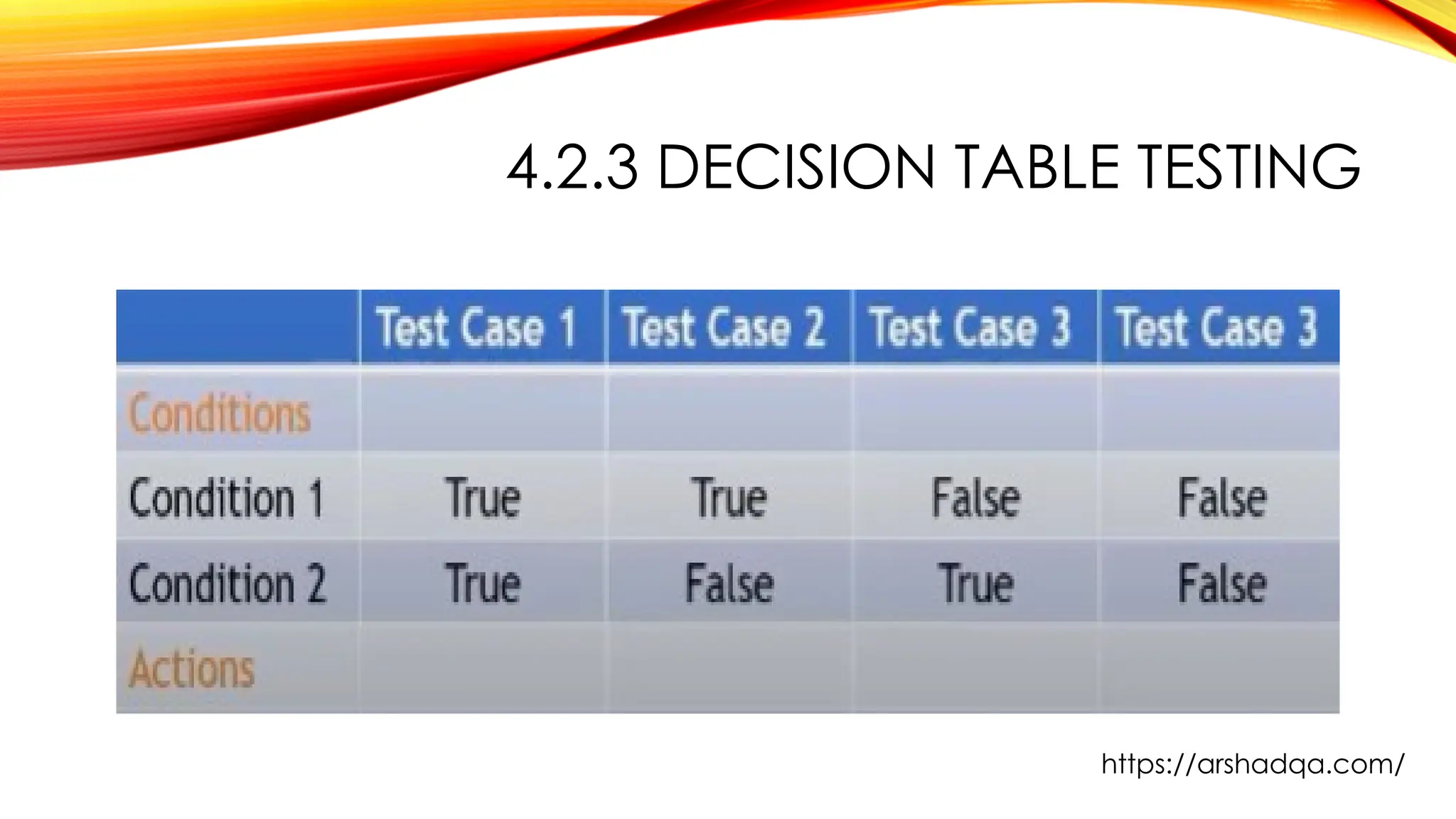
Decision tables are a good way to record complex
business rules that a system must implement
When creating decision tables, the tester identifies
conditions (often inputs) and the resulting actions (often
outputs) of the system
It may be applied to all situations in which the behavior
of the software depends on a combination of conditions,
at any test level.
It also helps in finding any gaps in the requirements
Decision table captures system requirements that
contain logical condition.
4.2.3 DECISION TABLE TESTING
https://arshadqa.com/
4.2.3 DECISION TABLE TESTING
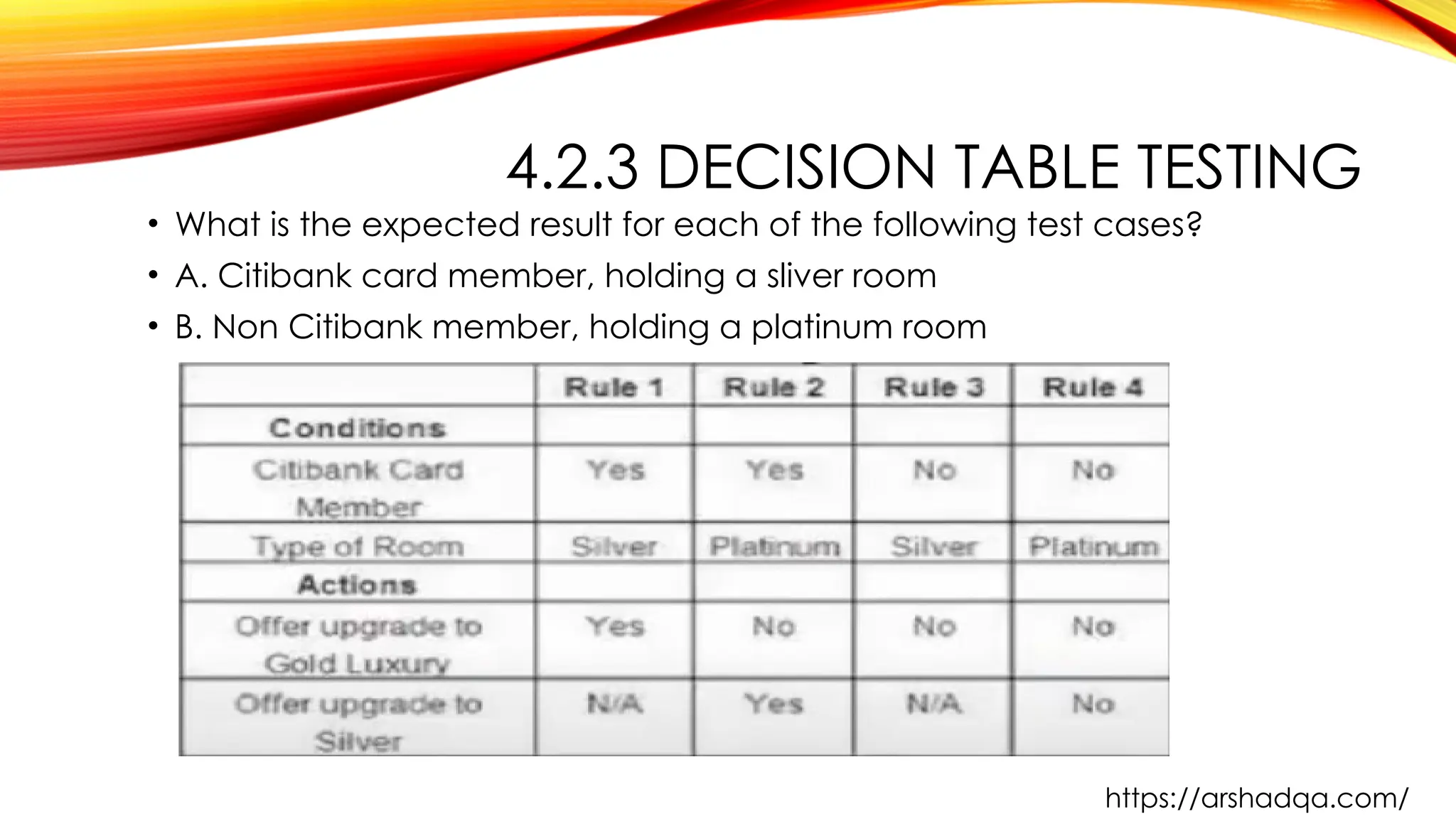
• What is the expected result for each of the following test cases?
• A. Citibank card member, holding a sliver room
• B. Non Citibank member, holding a platinum room
https://arshadqa.com/
4.2.3 DECISION TABLE TESTING
• A- Don’t offer any upgrade, B- Don’t offer any upgrade.
• A-Don’t offer any upgrade, B- Offer upgrade to Gold
• A-Offer upgrade to silver, B-Offer upgrade to silver
• A-Offer upgrade to Gold, B-Don’t offer any upgrade.
4.2.3 DECISION TABLE TESTING
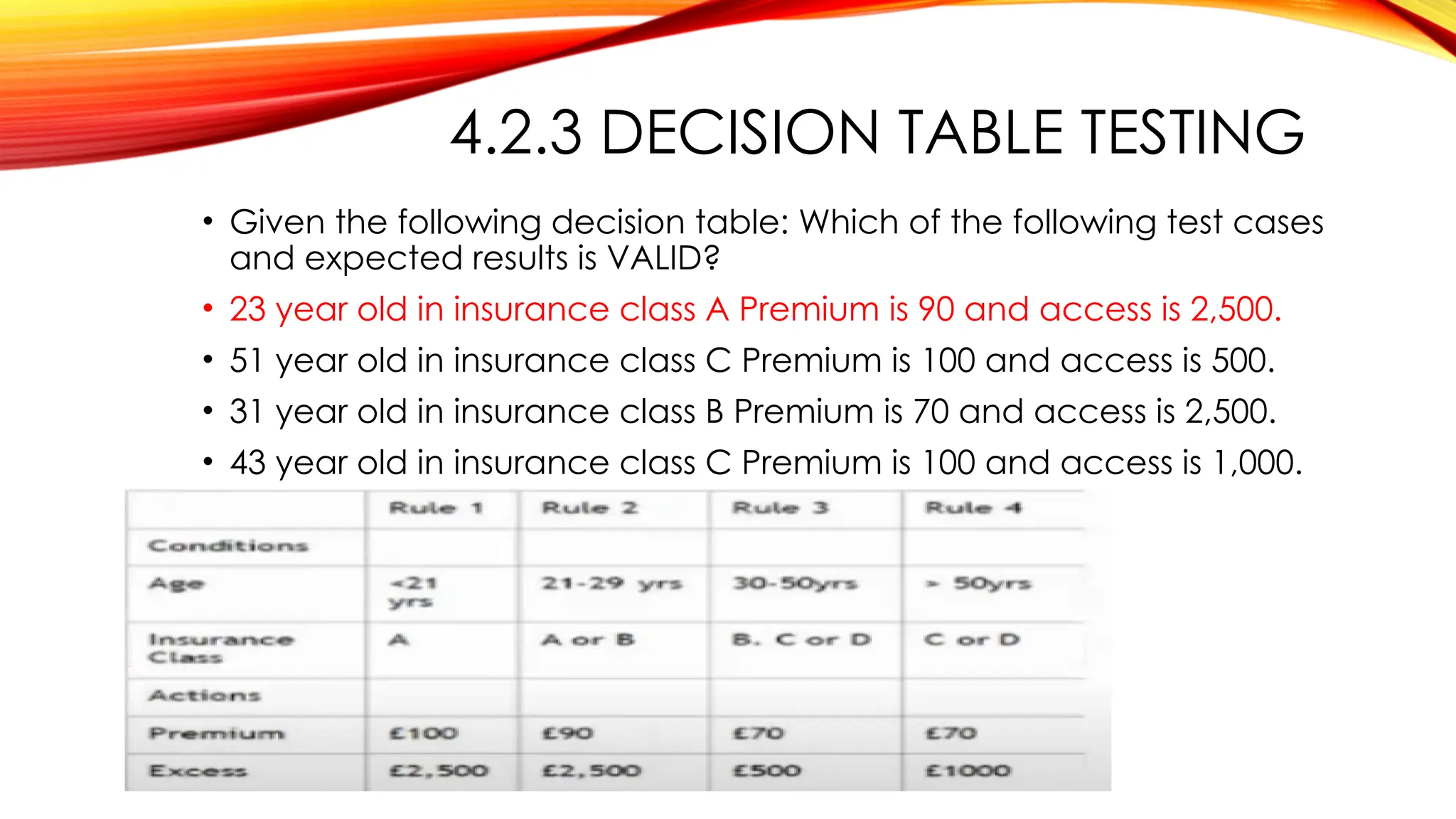
• Given the following decision table: Which of the following test cases
and expected results is VALID?
• 23 year old in insurance class A Premium is 90 and access is 2,500.
• 51 year old in insurance class C Premium is 100 and access is 500.
• 31 year old in insurance class B Premium is 70 and access is 2,500.
• 43 year old in insurance class C Premium is 100 and access is 1,000.
ISTQB FOUNDATION
LEVEL EXAM
PREPARATION
4.2.4 STATE TRANSITION TESTING
https://arshadqa.com/
4.2.4 STATE TRANSITION TESTING
State transition testing is used for menu-based applications and is widely
used within the embedded software industry.
The technique is also suitable for modeling a business scenario having
specific states or for testing screen navigation.
The concept of a state is abstract – it may represent a few lines of code
or an entire business process
GUARD CONDITION
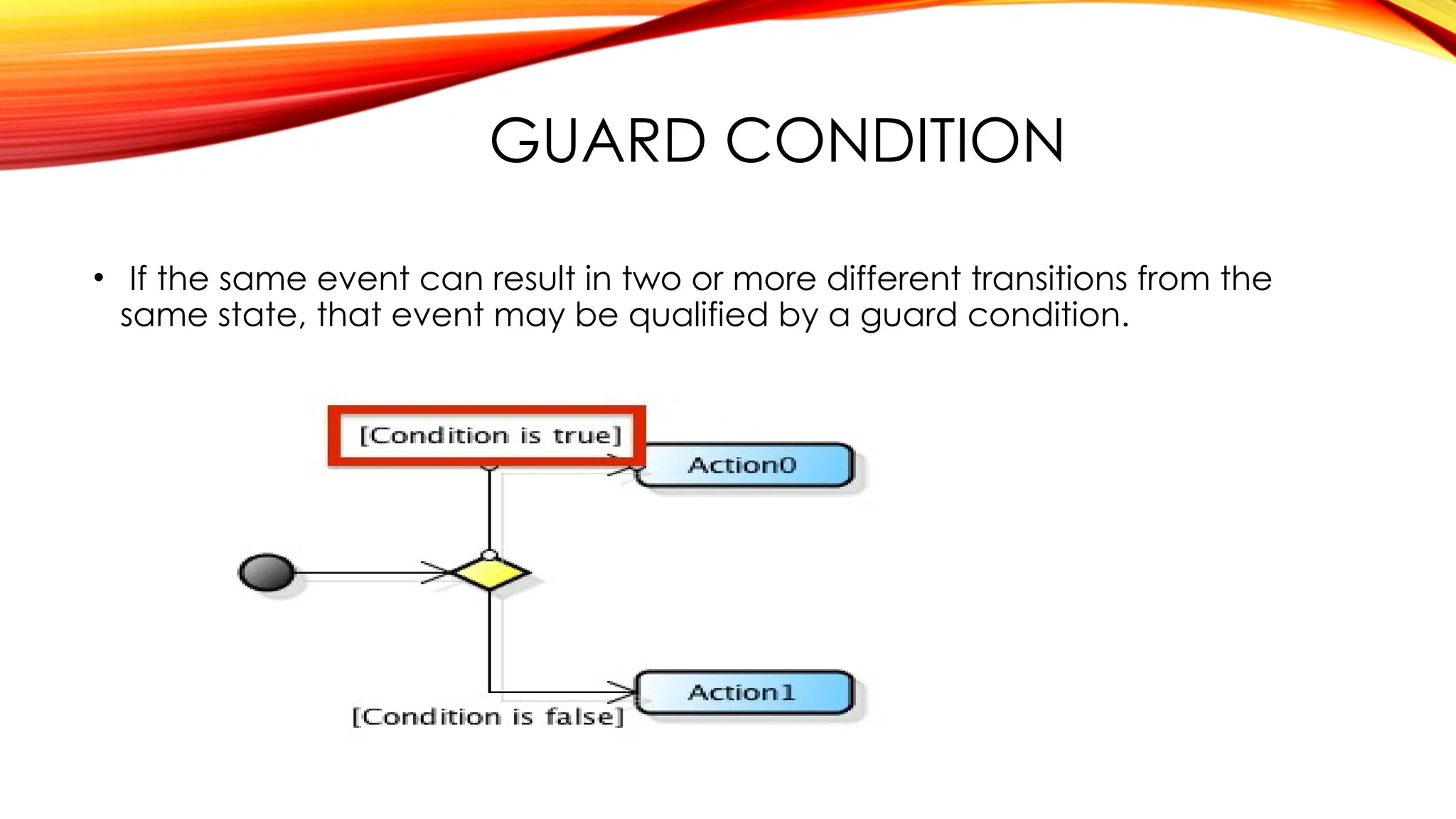
• If the same event can result in two or more different transitions from the
same state, that event may be qualified by a guard condition.
4.2.4 STATE TRANSITION TESTING
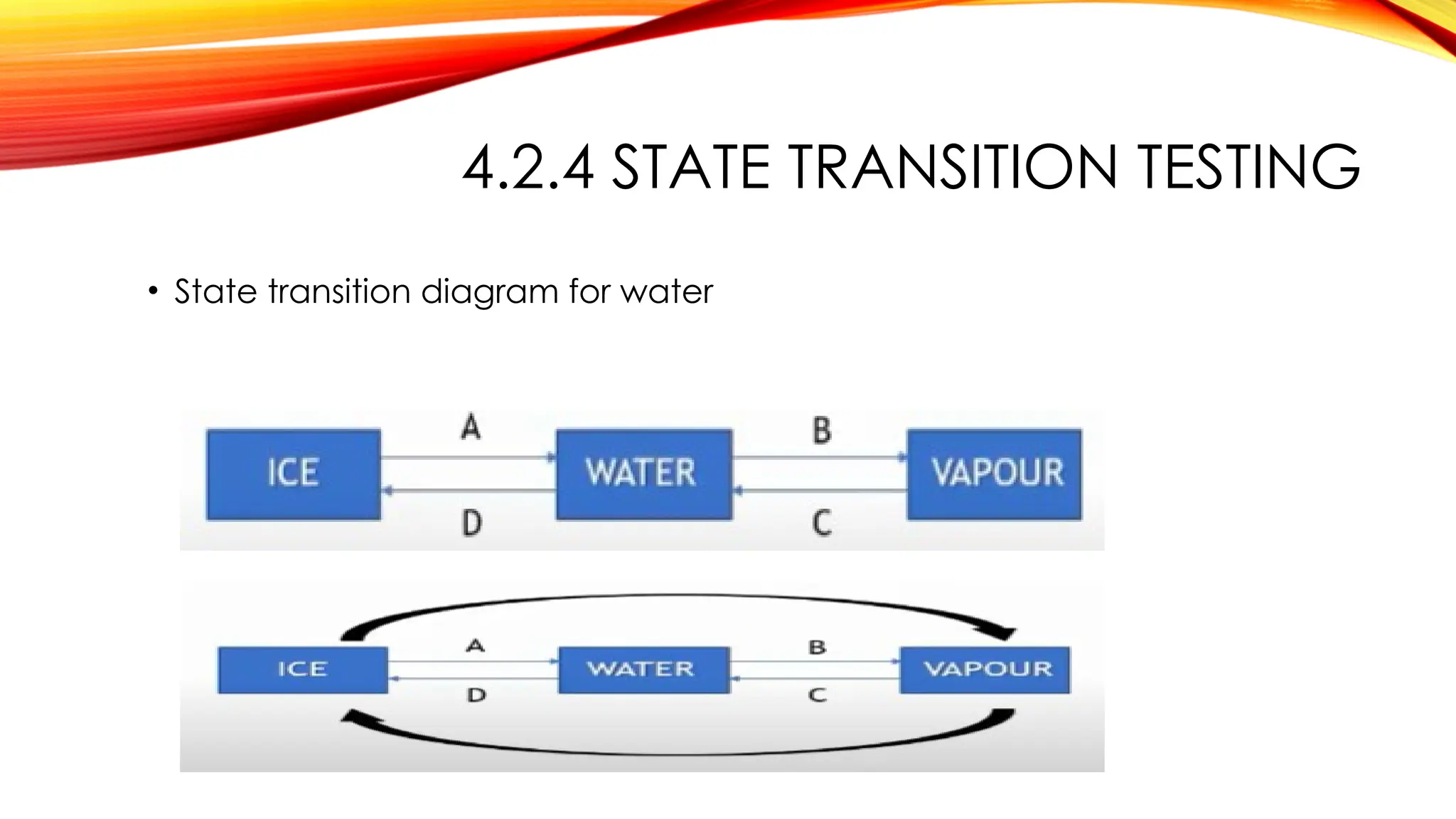
• State transition diagram for water
4.2.4 STATE TRANSITION TESTING
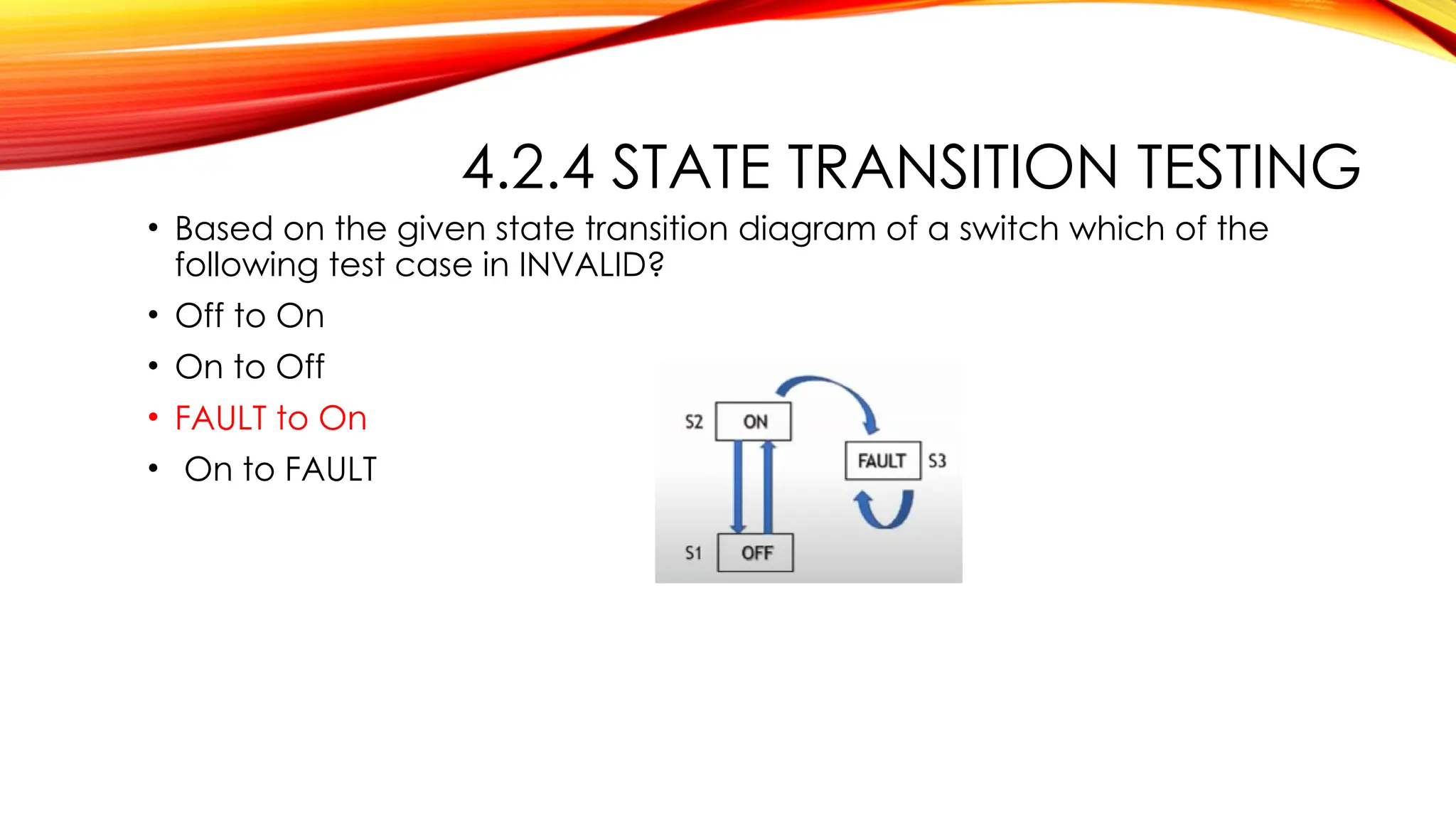
• Based on the given state transition diagram of a switch which of the
following test case in INVALID?
• Off to On
• On to Off
• FAULT to On
• On to FAULT
ISTQB FOUNDATION
LEVEL EXAM
PREPARATION
https://arshadqa.com/
4.2.5 USE CASE TESTING
https://arshadqa.com/
4.2.5 USE CASE TESTING
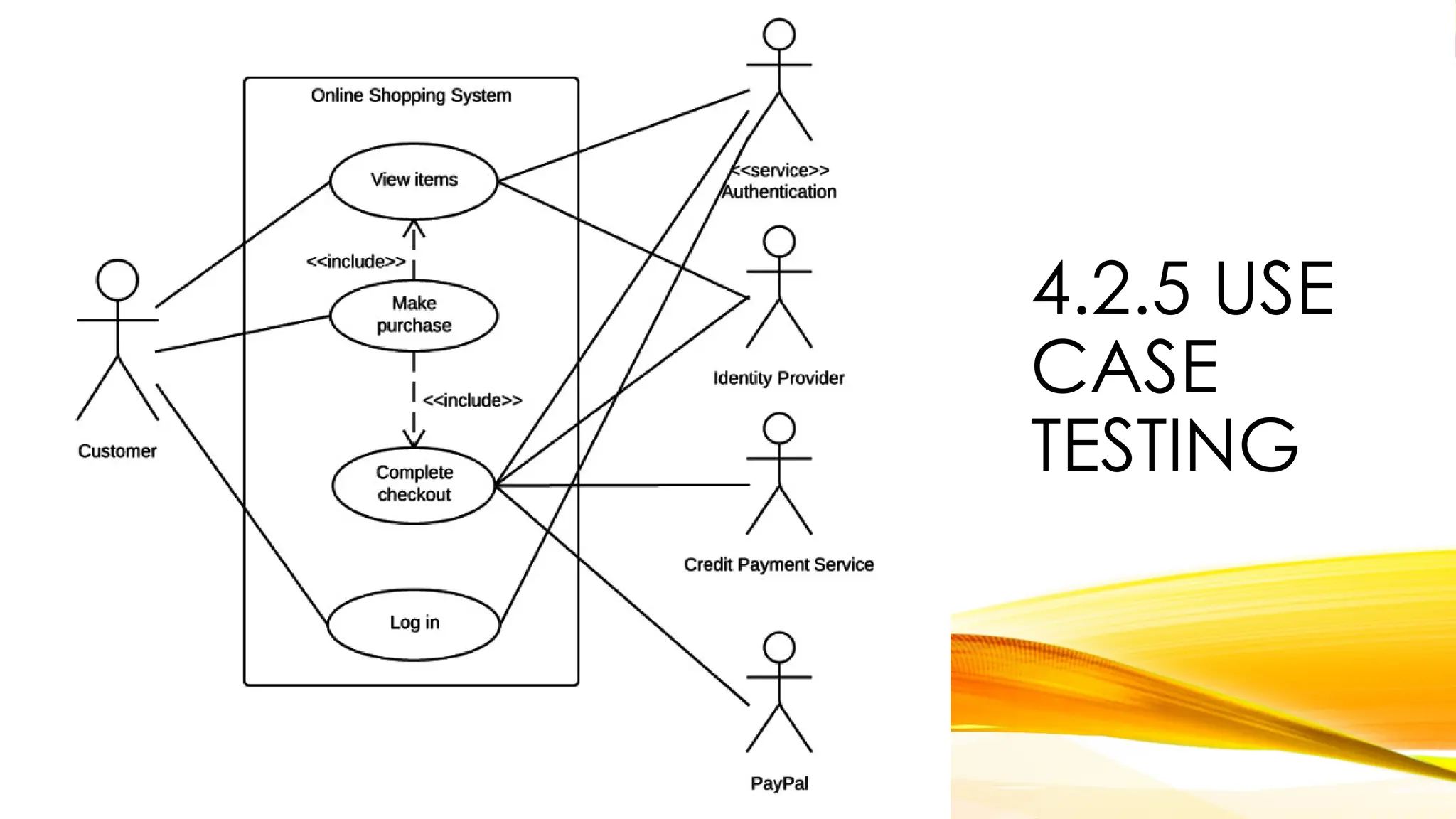
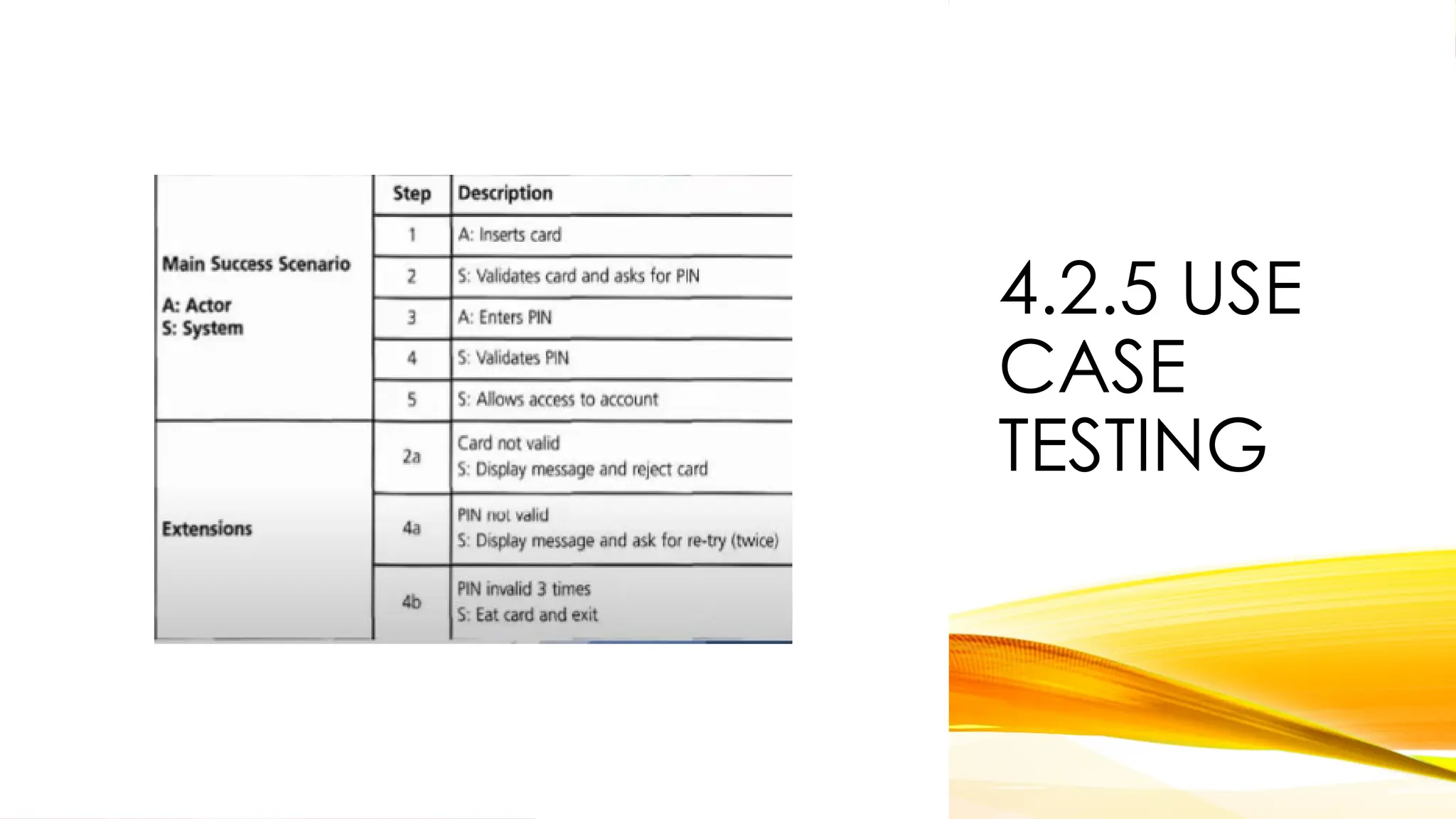
Each use case specifies some behavior that a subject can perform in
collaboration with one or more actors
Interactions may be represented graphically by work flows, activity diagrams,
or business process models.
Coverage can be measured by the percentage of use case behaviors tested
divided by the total number of use case behaviors, normally expressed as a
percentage
4.2.5 USE
CASE
TESTING
4.2.5 USE
CASE
TESTING
4.2.5 USE CASE TESTING
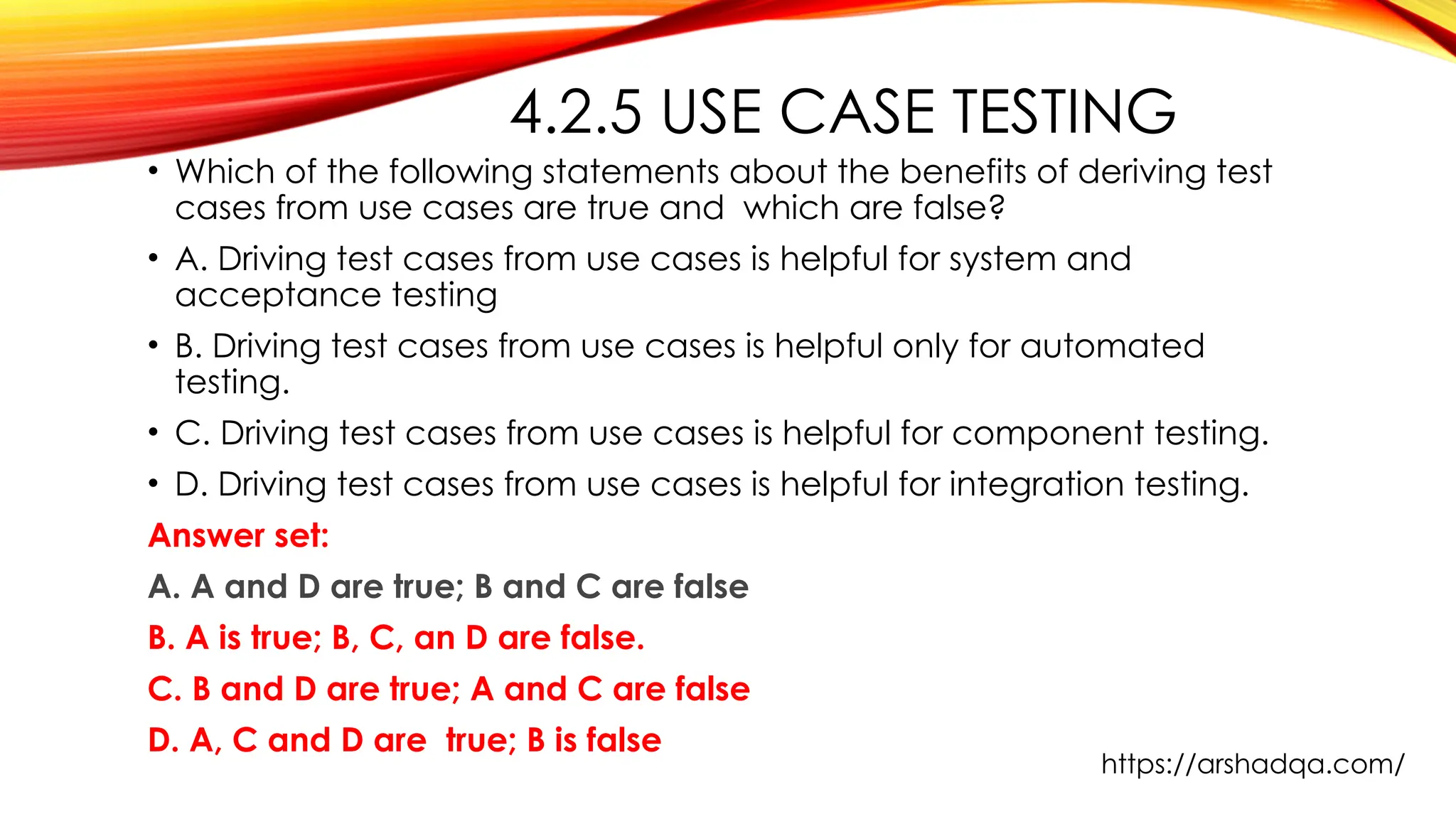
• Which of the following statements about the benefits of deriving test
cases from use cases are true and which are false?
• A. Driving test cases from use cases is helpful for system and
acceptance testing
• B. Driving test cases from use cases is helpful only for automated
testing.
• C. Driving test cases from use cases is helpful for component testing.
• D. Driving test cases from use cases is helpful for integration testing.
Answer set:
A. A and D are true; B and C are false
B. A is true; B, C, an D are false.
C. B and D are true; A and C are false
D. A, C and D are true; B is false
https://arshadqa.com/
ISTQB FOUNDATION
LEVEL EXAM
PREPARATION
https://arshadqa.com/
4.3 WHITE-BOX TEST TECHNIQUES
4.3.1 STATEMENT TESTING AND COVERAGE
https://arshadqa.com/
4.3 WHITE-BOX TEST
TECHNIQUES
4.3 WHITE-BOX TEST TECHNIQUES
4.3.1
Statement
Testing and
Coverage
4.3.2 Decision
Testing and
Coverage
4.3.1 STATEMENT
TESTING AND
COVERAGE
Statement testing exercises the
executable statements in the code.
Coverage is measured as the number of
statements executed by the tests divided
by the total number of executable
statements in the test object, normally
expressed as a percentage
4.3.1 STATEMENT
TESTING AND
COVERAGE
Statement Testing or statement coverage tests the
statement for a given fragment of code.
Whereas decision testing or decision coverage
tests the decisions made within a given fragment
of code.
Decision testing is also know as branch testing or
branch coverage.
Decision testing is stranger than statement testing.
100% decision coverage guarantee 100%
statement coverage but not vice versa.
4.3.1 STATEMENT TESTING AND COVERAGE
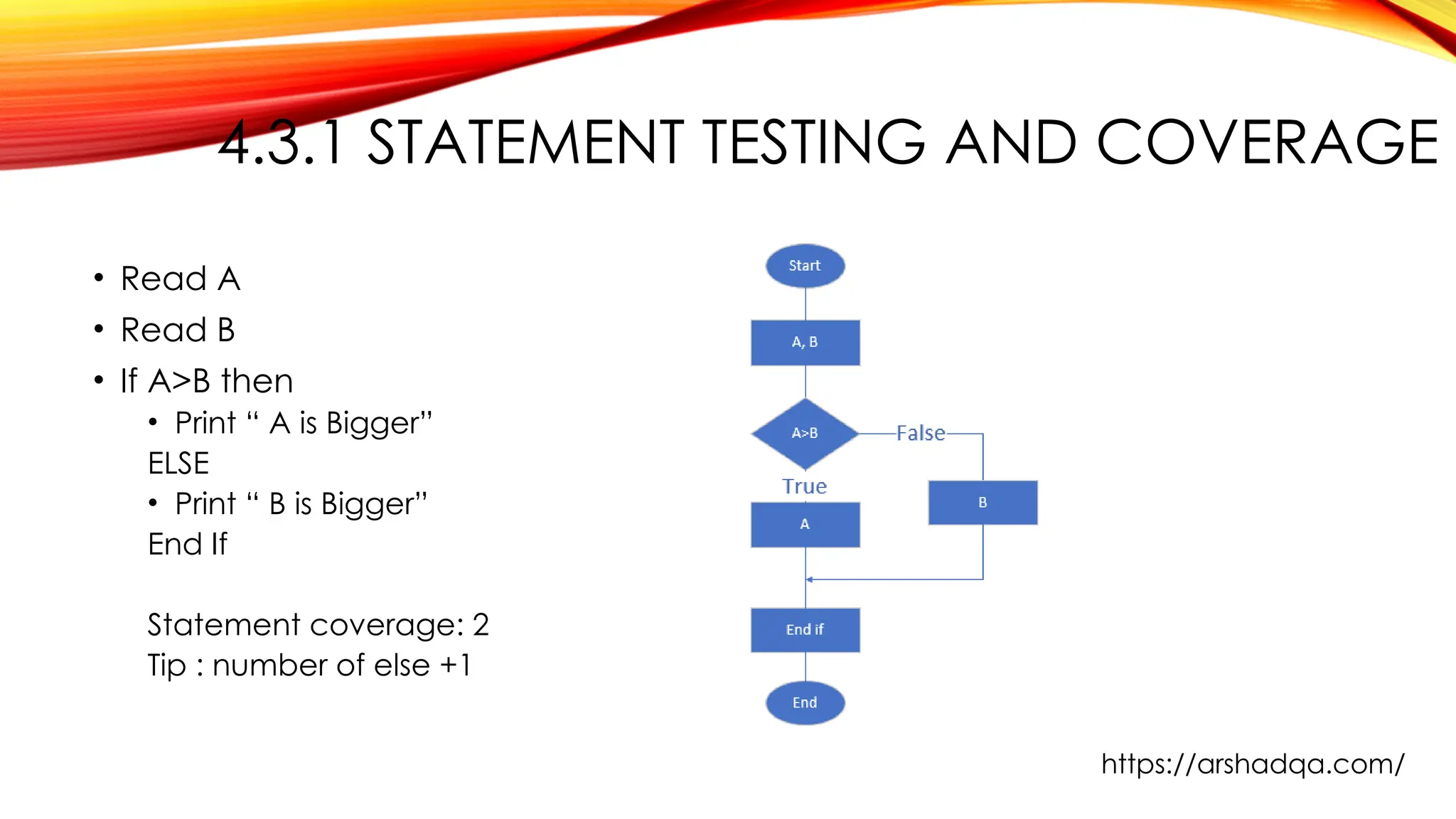
• Read A
• Read B
• If A>B then
• Print “ A is Bigger”
ELSE
• Print “ B is Bigger”
End If
Statement coverage: 2
Tip : number of else +1
https://arshadqa.com/
4.3.1 STATEMENT TESTING AND COVERAGE
• Read A
• Read B
• If A>B then
• Print “ A is Bigger”
ELSE
• Print “ B is Bigger”
End If
• What is the minimum number of test
cases require for 100% test coverage?
4.3.1 STATEMENT TESTING AND COVERAGE
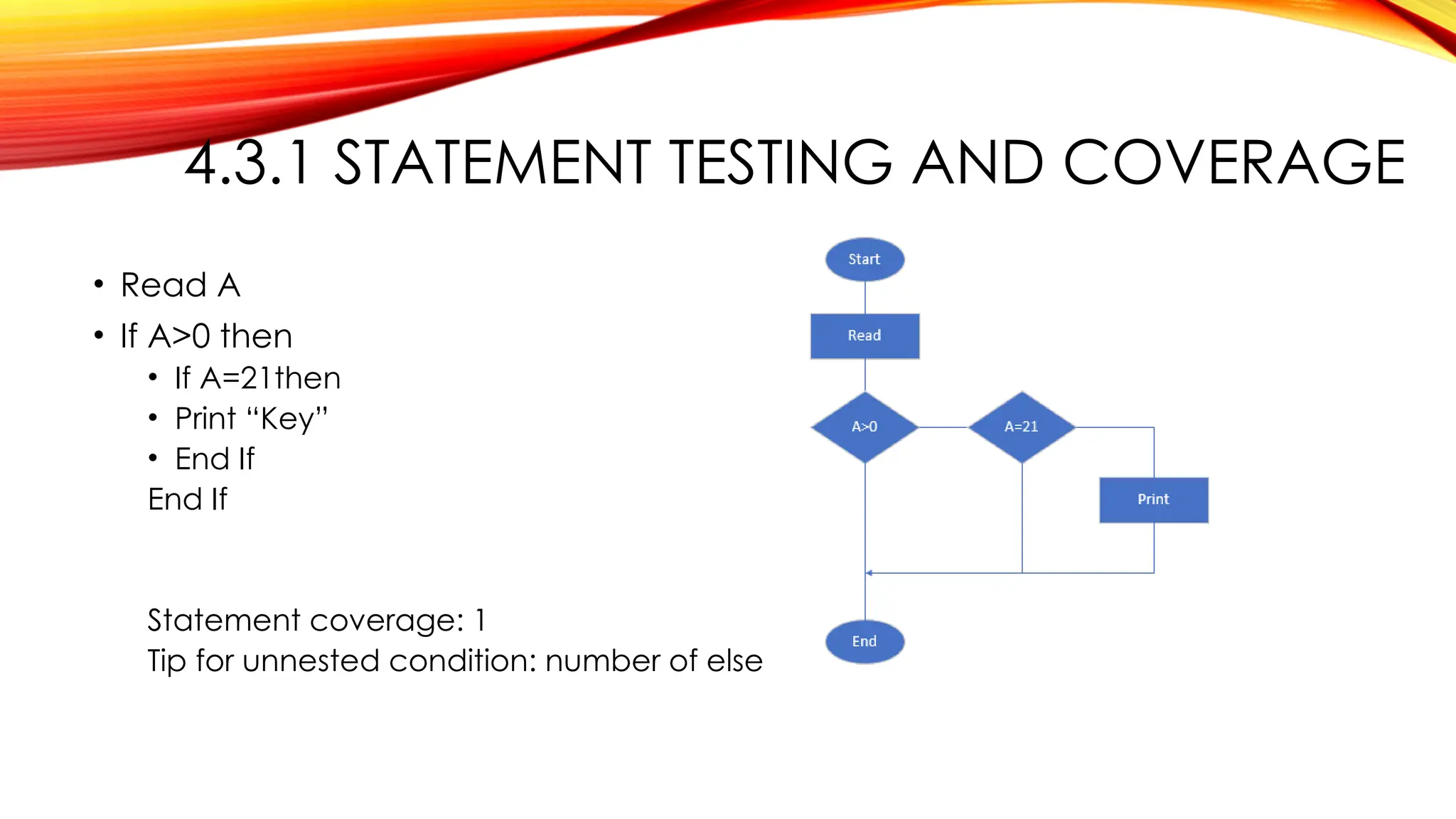
• Read A
• If A>0 then
• If A=21then
• Print “Key”
• End If
End If
Statement coverage: 1
Tip for unnested condition: number of else
4.3.1 STATEMENT TESTING AND COVERAGE
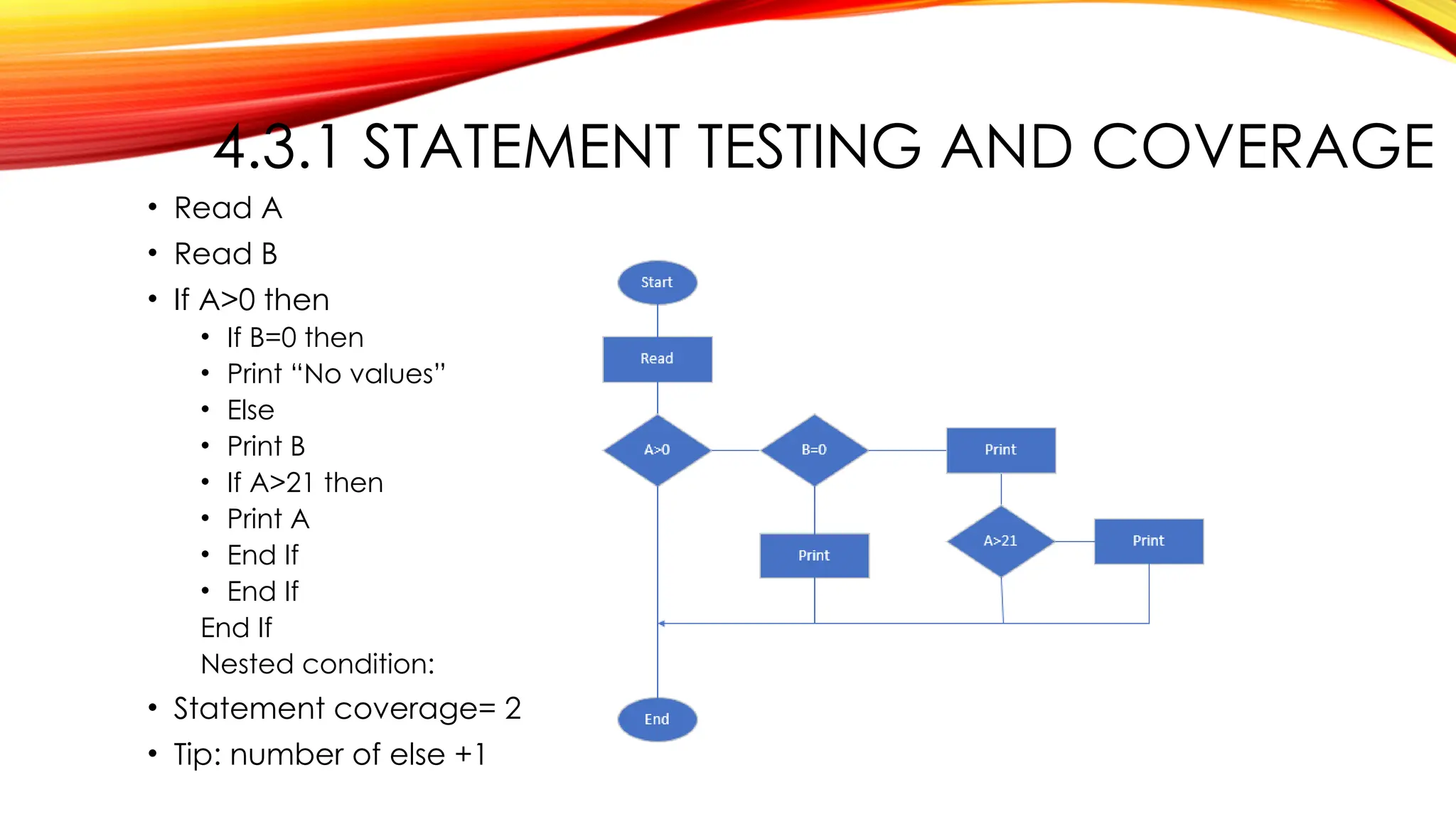
• Read A
• Read B
• If A>0 then
• If B=0 then
• Print “No values”
• Else
• Print B
• If A>21 then
• Print A
• End If
• End If
End If
Nested condition:
• Statement coverage= 2
• Tip: number of else +1
4.3.1 STATEMENT TESTING AND COVERAGE
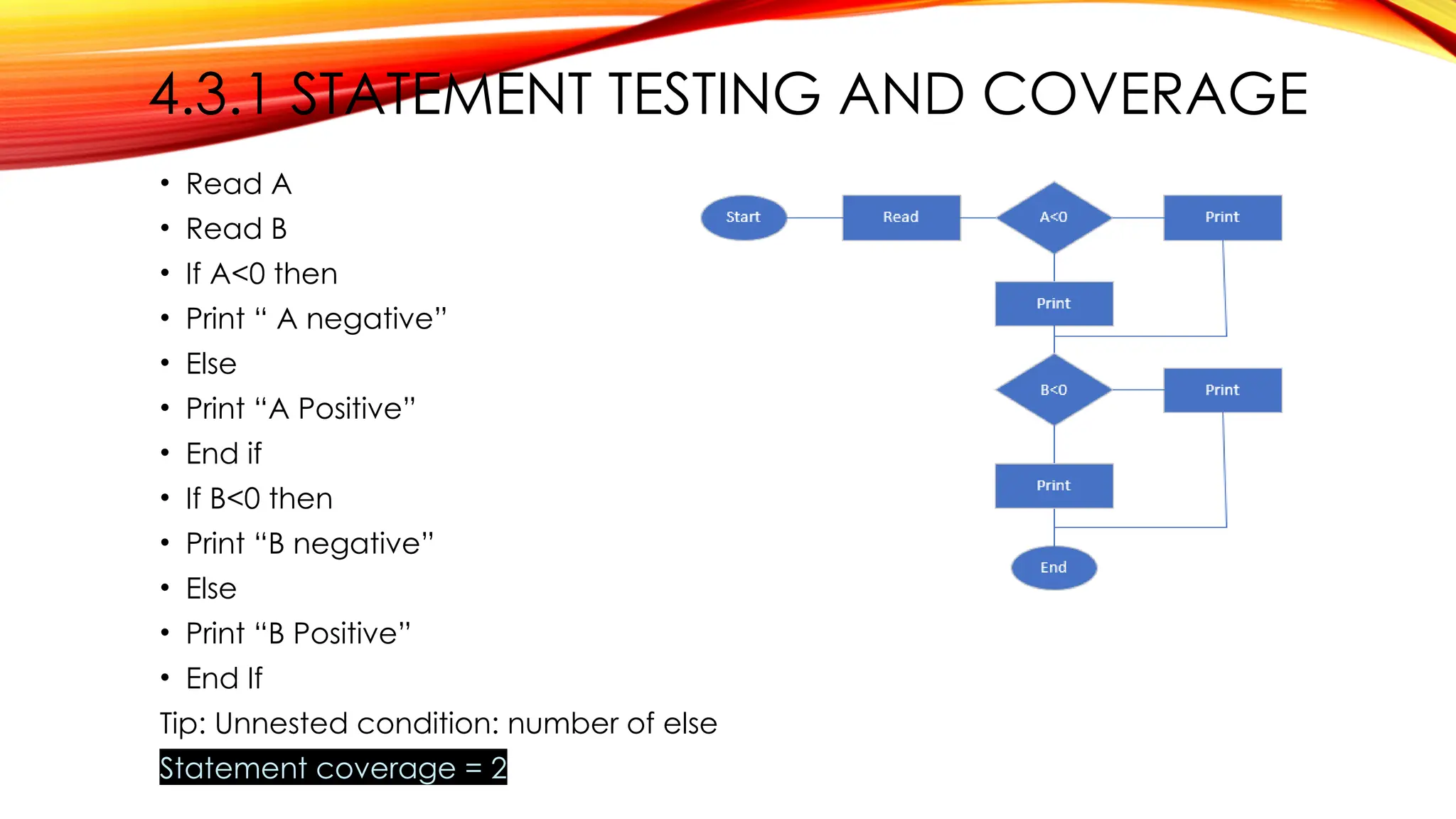
• Read A
• Read B
• If A<0 then
• Print “ A negative”
• Else
• Print “A Positive”
• End if
• If B<0 then
• Print “B negative”
• Else
• Print “B Positive”
• End If
Tip: Unnested condition: number of else
Statement coverage = 2
4.3.1 STATEMENT TESTING AND COVERAGE
• Tip for un-nested conditions
• Statement coverage = number of else
• Tip for nested conditions:
• Statement coverage = number of else
+1
4.3.1 STATEMENT TESTING AND COVERAGE
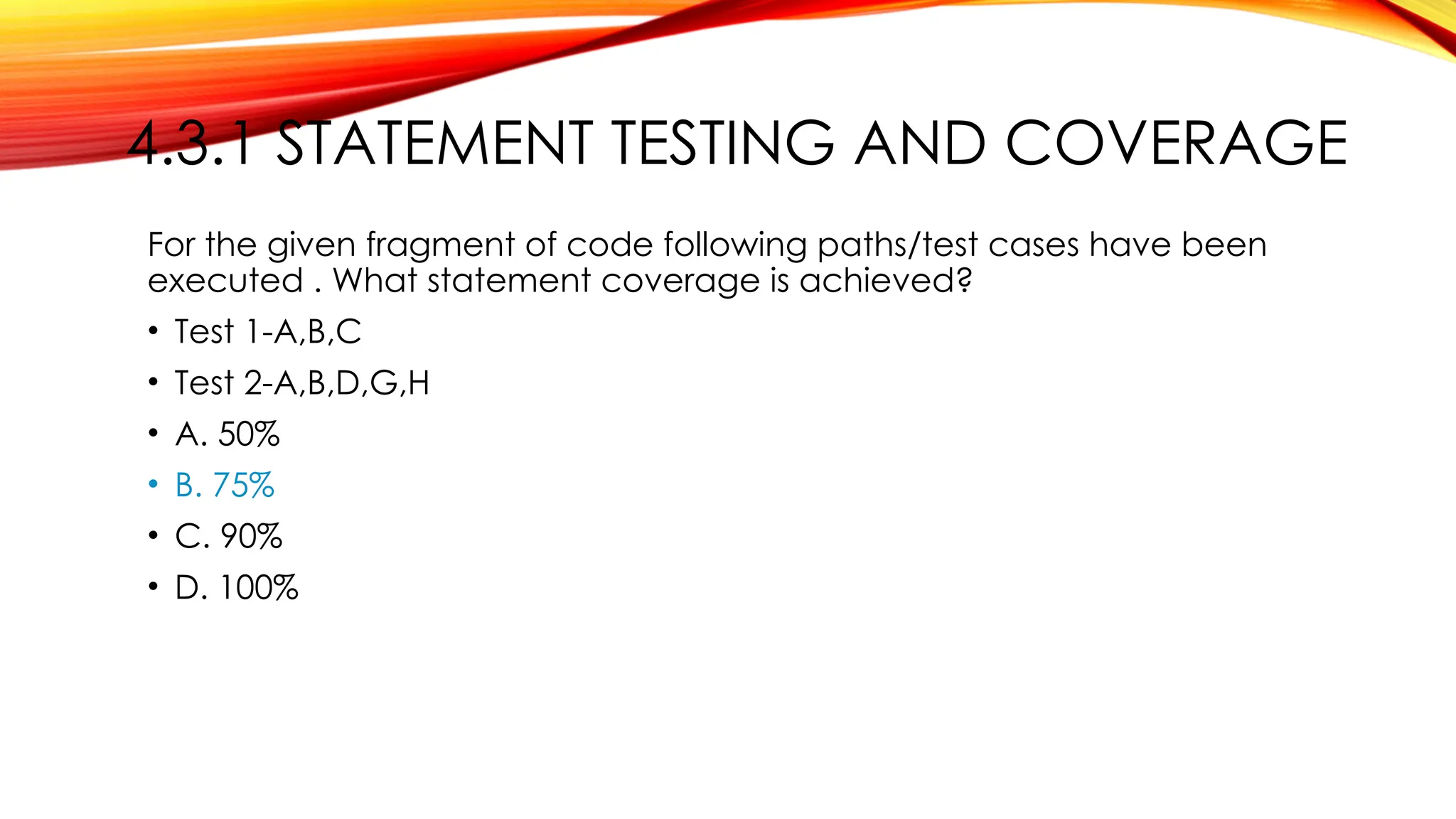
For the given fragment of code following paths/test cases have been
executed . What statement coverage is achieved?
• Test 1-A,B,C
• Test 2-A,B,D,G,H
• A. 50%
• B. 75%
• C. 90%
• D. 100%
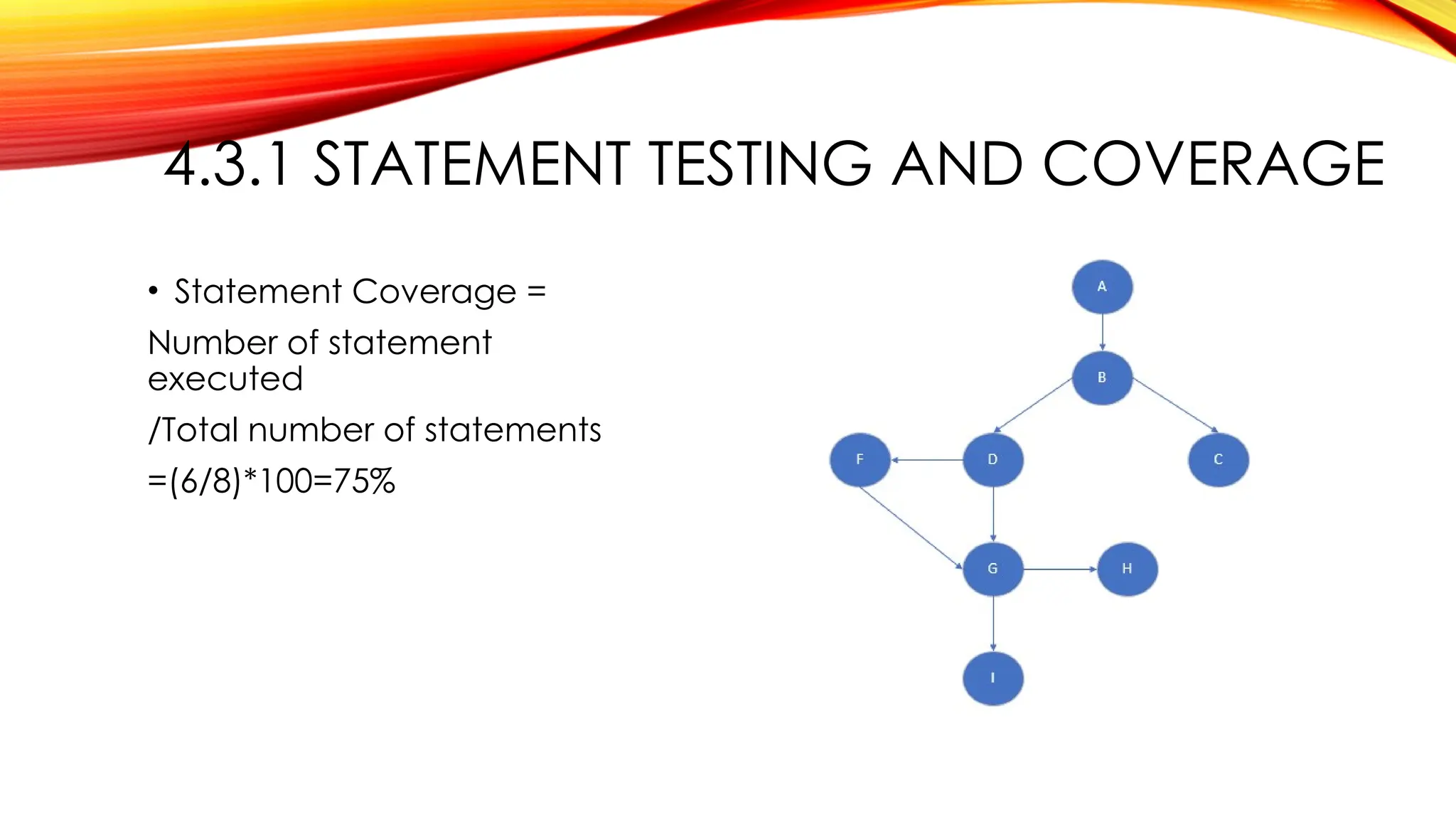
4.3.1 STATEMENT TESTING AND COVERAGE
• Statement Coverage =
Number of statement
executed
/Total number of statements
=(6/8)*100=75%
ISTQB FOUNDATION
LEVEL EXAM
PREPARATION
4.3 WHITE-BOX TEST TECHNIQUES
4.3.2 DECISION TESTING AND COVERAGE
https://arshadqa.com/
4.3.2 DECISION TESTING AND COVERAGE
Decision testing or decision coverage tests the decisions made within a given
fragment of code.
Decision testing is also know as branch testing or branch coverage.
Decision testing is stranger than statement testing.
100% decision coverage guarantee 100% statement coverage but not vice versa.
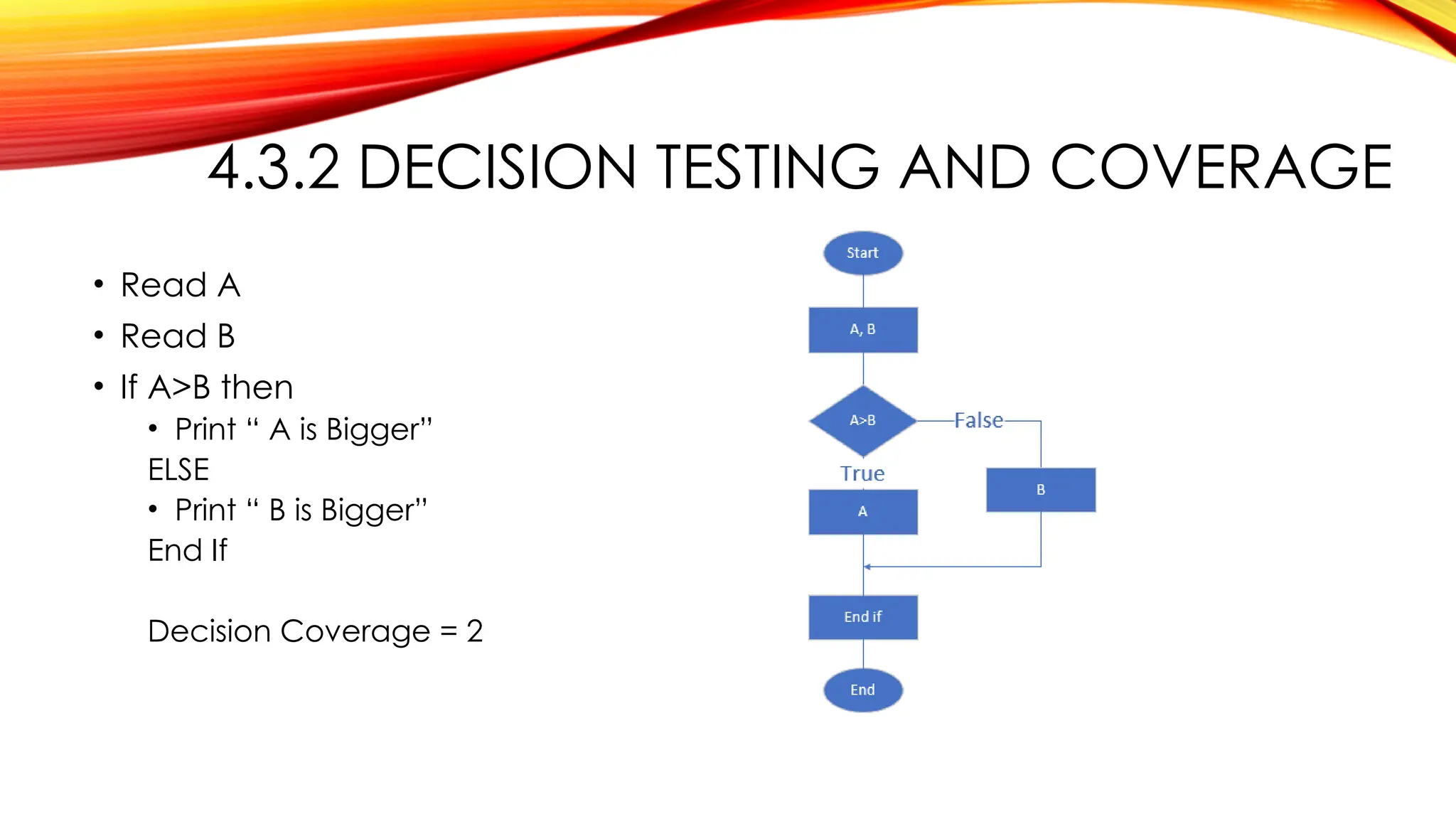
4.3.2 DECISION TESTING AND COVERAGE
• Read A
• Read B
• If A>B then
• Print “ A is Bigger”
ELSE
• Print “ B is Bigger”
End If
Decision Coverage = 2
4.3.2 DECISION TESTING AND COVERAGE
• Read A
• Read B
• If A>B then
• Print “ A is Bigger”
ELSE
• Print “ B is Bigger”
End If
• What is the minimum number of test cases require for 100% decision
coverage?
4.3.2 DECISION TESTING AND COVERAGE
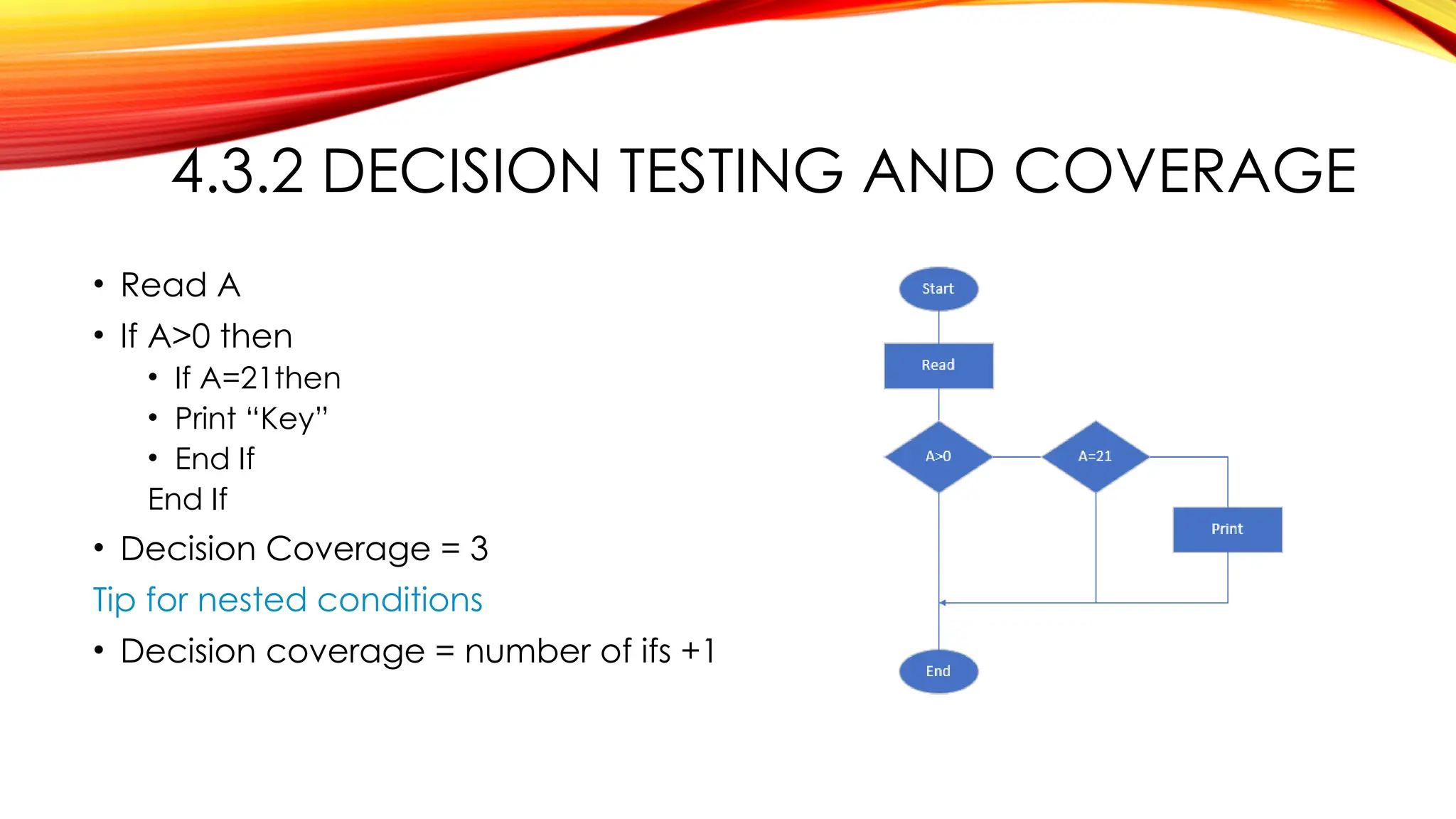
• Read A
• If A>0 then
• If A=21then
• Print “Key”
• End If
End If
• Decision Coverage = 3
Tip for nested conditions
• Decision coverage = number of ifs +1
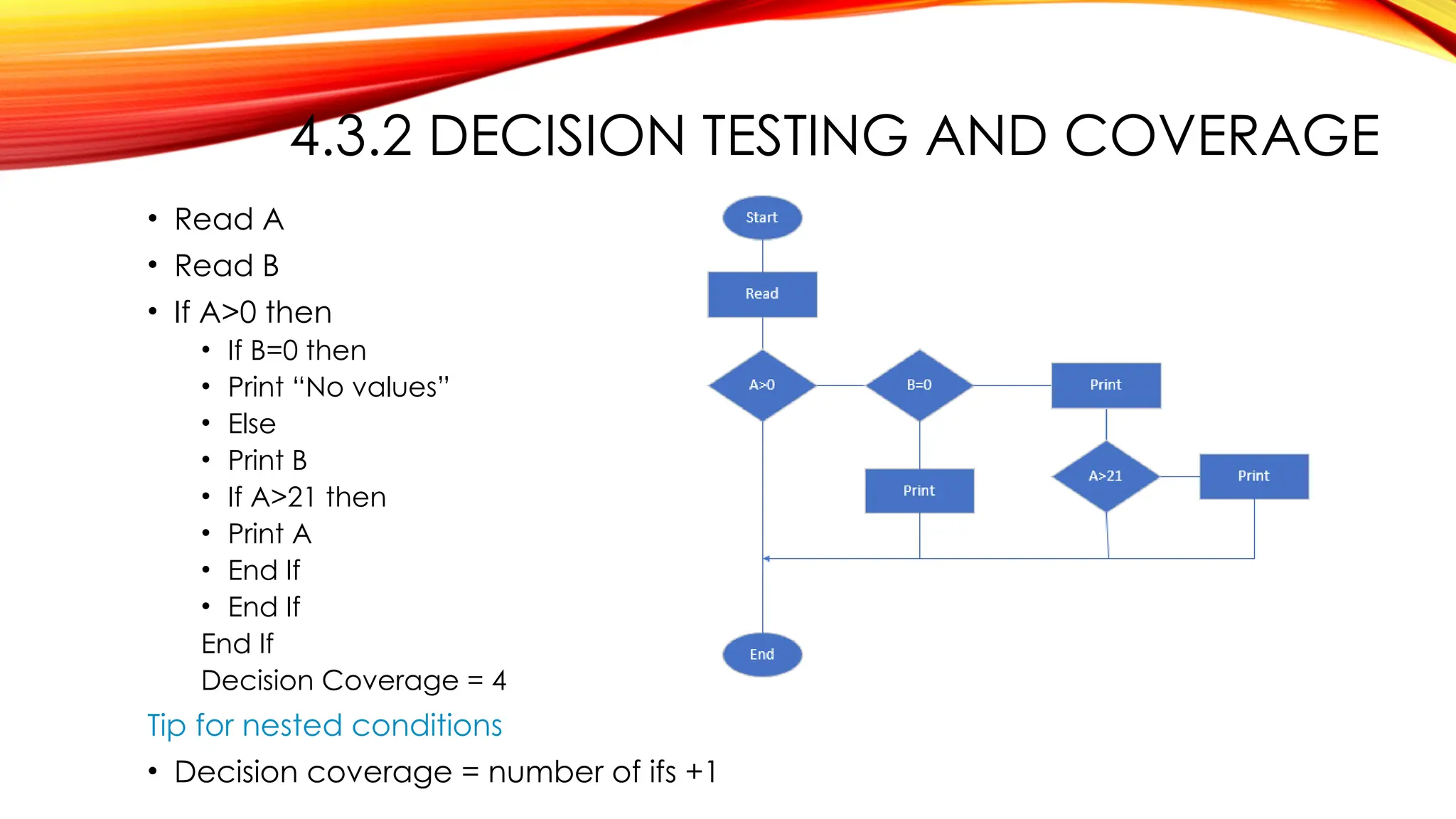
4.3.2 DECISION TESTING AND COVERAGE
• Read A
• Read B
• If A>0 then
• If B=0 then
• Print “No values”
• Else
• Print B
• If A>21 then
• Print A
• End If
• End If
End If
Decision Coverage = 4
Tip for nested conditions
• Decision coverage = number of ifs +1
4.3.2 DECISION TESTING AND COVERAGE
• Read A
• Read B
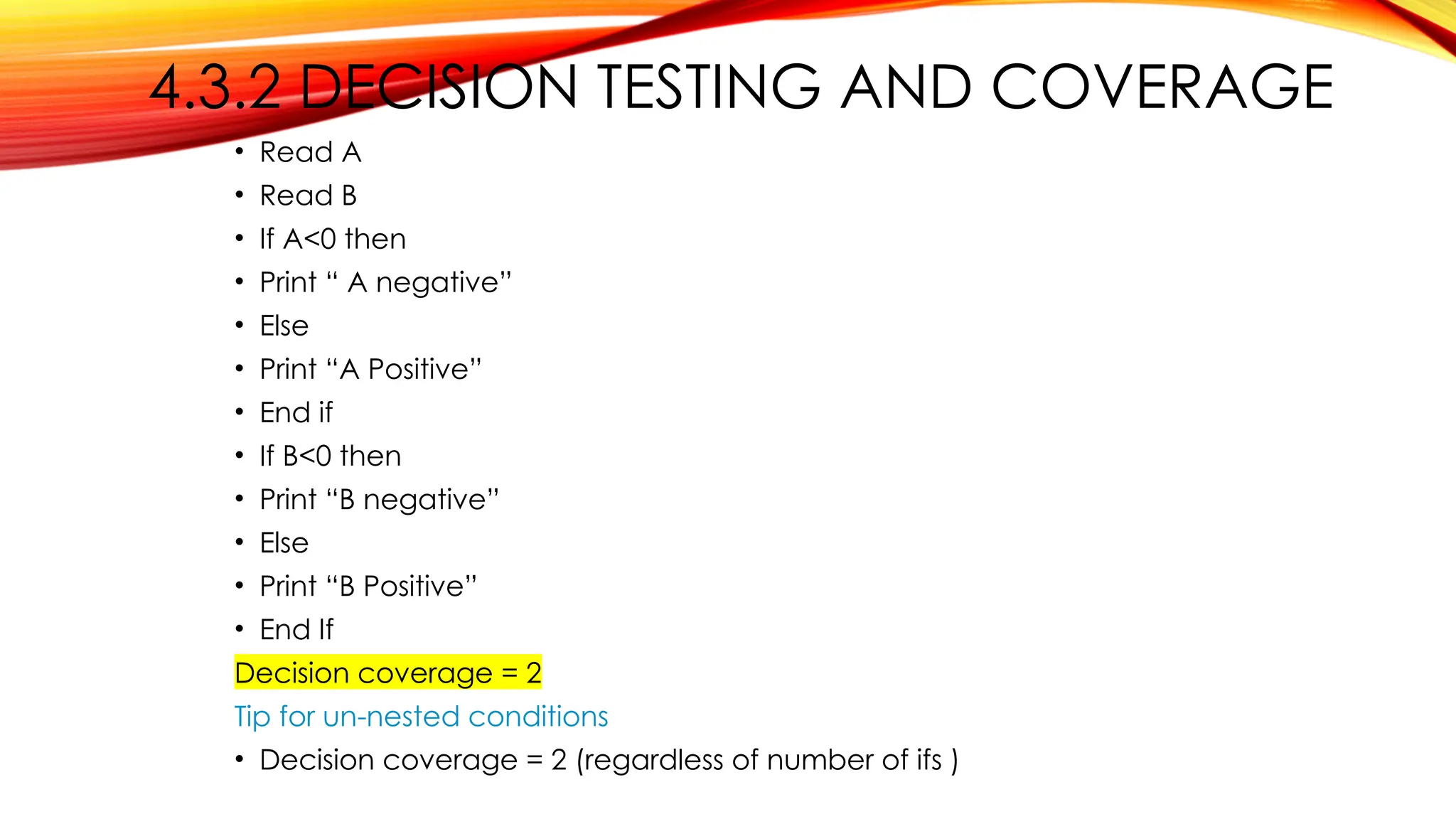
• If A<0 then
• Print “ A negative”
• Else
• Print “A Positive”
• End if
• If B<0 then
• Print “B negative”
• Else
• Print “B Positive”
• End If
Decision coverage = 2
Tip for un-nested conditions
• Decision coverage = 2 (regardless of number of ifs )
4.3.2 DECISION TESTING AND
COVERAGE
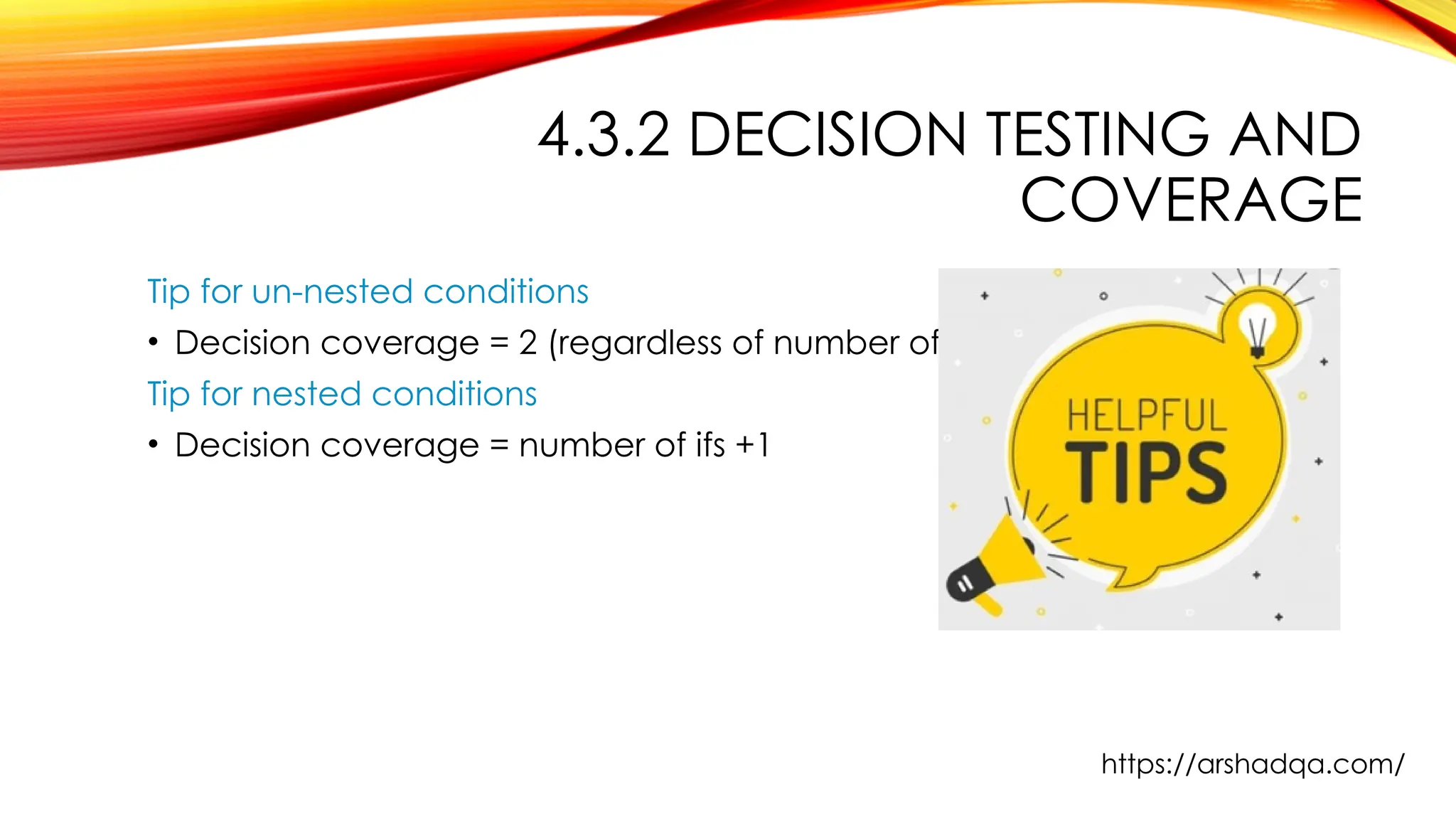
Tip for un-nested conditions
• Decision coverage = 2 (regardless of number of ifs )
Tip for nested conditions
• Decision coverage = number of ifs +1
https://arshadqa.com/
4.3.2 DECISION TESTING AND
COVERAGE
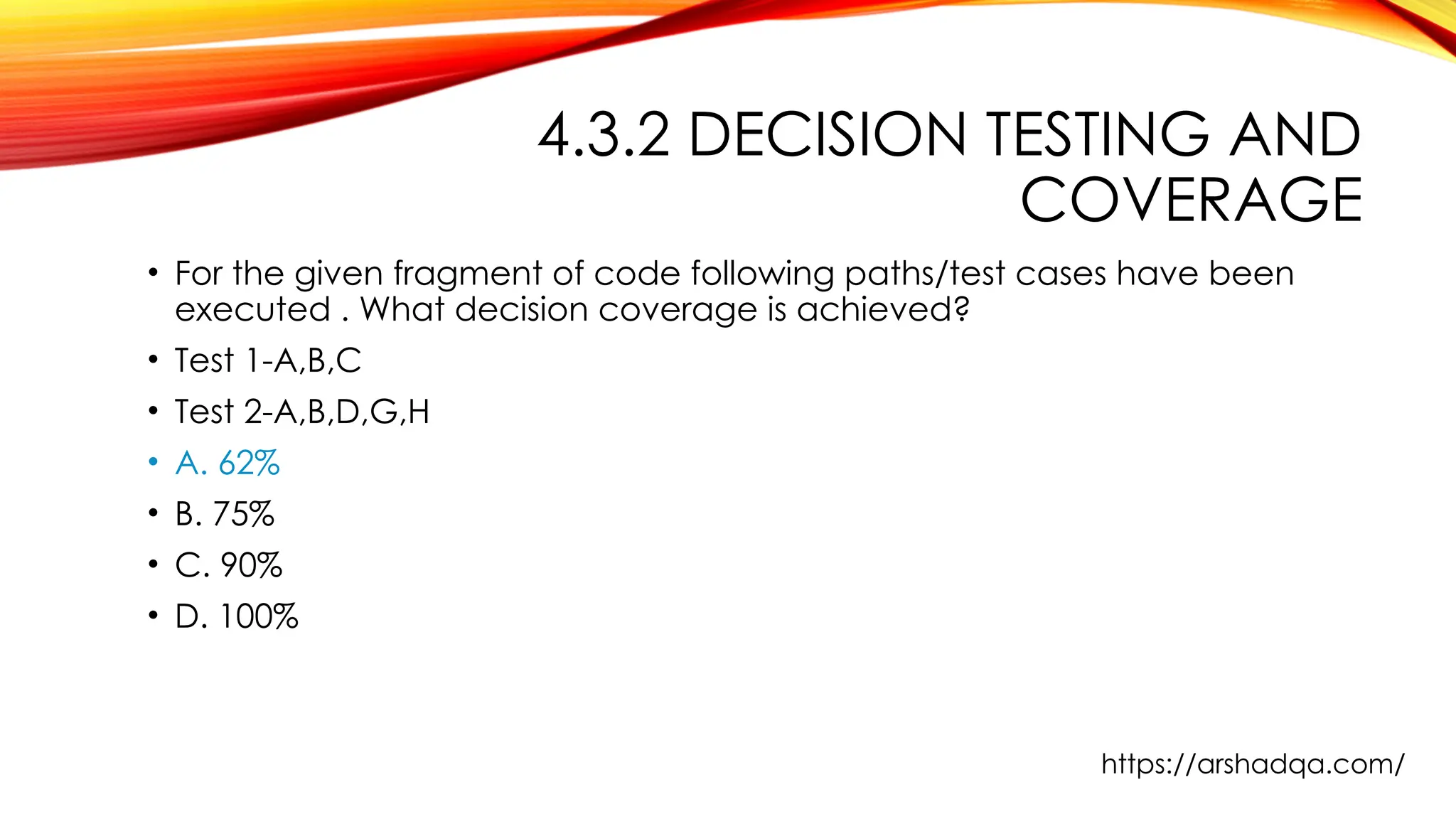
• For the given fragment of code following paths/test cases have been
executed . What decision coverage is achieved?
• Test 1-A,B,C
• Test 2-A,B,D,G,H
• A. 62%
• B. 75%
• C. 90%
• D. 100%
https://arshadqa.com/
4.3.2 DECISION TESTING AND
COVERAGE
• Decision Coverage =
Number of branch executed
/Total number of branches
=(5/8)*100=62%
https://arshadqa.com/
ISTQB FOUNDATION LEVEL EXAM
PREPARATION
https://arshadqa.com/
4.4 EXPERIENCE-BASED TEST TECHNIQUES
https://arshadqa.com/
4.4 EXPERIENCE-BASED
TEST TECHNIQUES
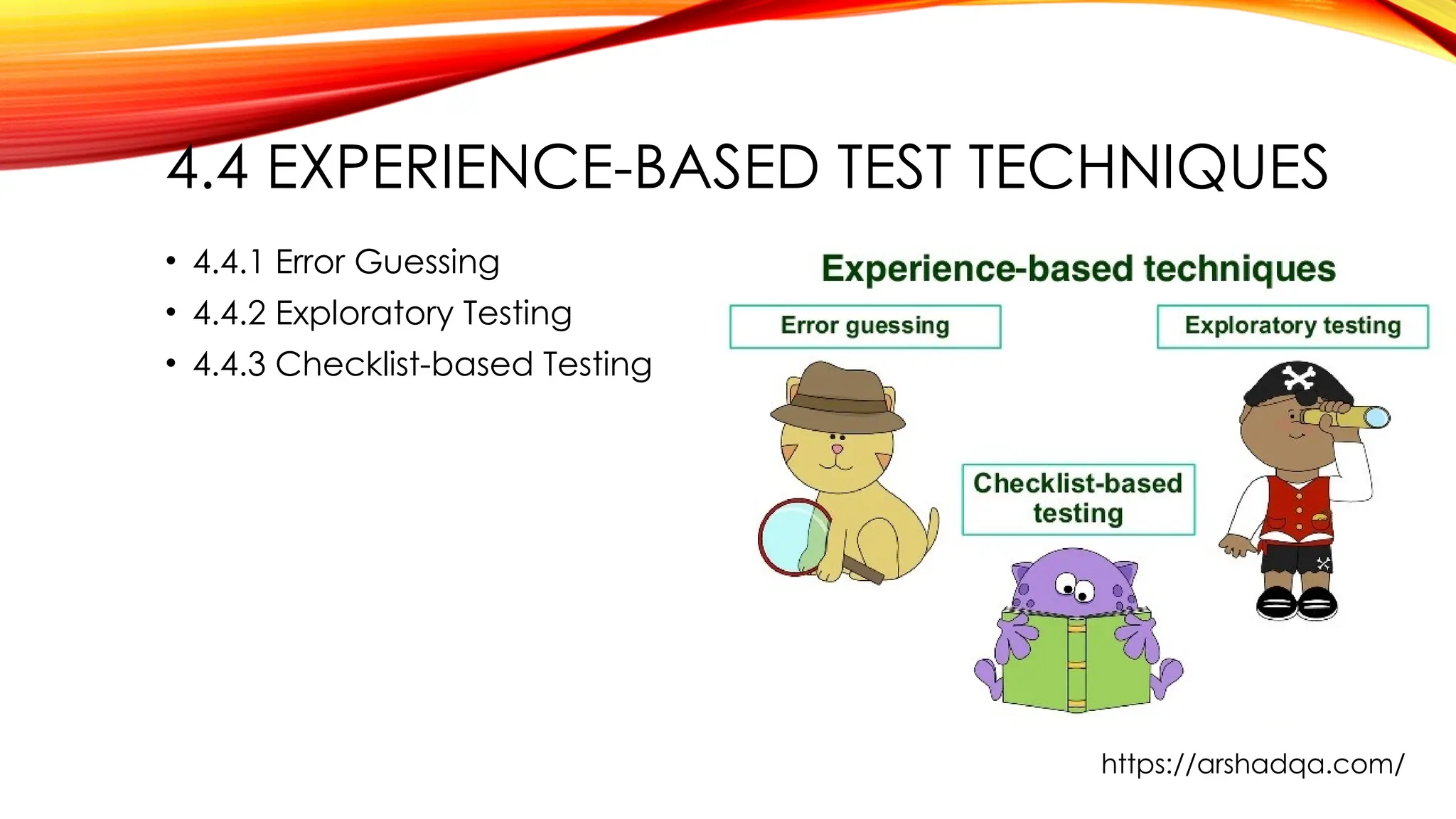
4.4 EXPERIENCE-BASED TEST TECHNIQUES
• 4.4.1 Error Guessing
• 4.4.2 Exploratory Testing
• 4.4.3 Checklist-based Testing
https://arshadqa.com/
4.4.1 ERROR
GUESSING
Error guessing is a technique used to anticipate the
occurrence of mistakes, defects, and failures, based on
the tester’s knowledge, including:
How the application has worked in the past
What types of mistakes the developers tend to make
Failures that have occurred in other applications
A methodical approach to the error guessing technique is
to create a list of possible mistakes, defects, and failures,
and design tests that will expose those failures and the
defects that caused them
4.4.2 EXPLORATORY TESTING
Exploratory testing is sometimes conducted using session-based
testing to structure the activity
Exploratory testing is most useful when there are few or
inadequate specifications or significant time pressure on testing.
Exploratory testing is also useful to complement other more
formal testing techniques.
https://arshadqa.com/
4.4.3 CHECKLIST-BASED TESTING
Such checklists can be built based on experience, knowledge
about what is important for the user, or an understanding of why
and how software fails.
Checklists can be created to support various test types, including
functional and non-functional testing
In checklist-based testing, testers design, implement, and execute
tests to cover test conditions found in a checklist
ISTQB FOUNDATION LEVEL EXAM
PREPARATION
https://arshadqa.com/
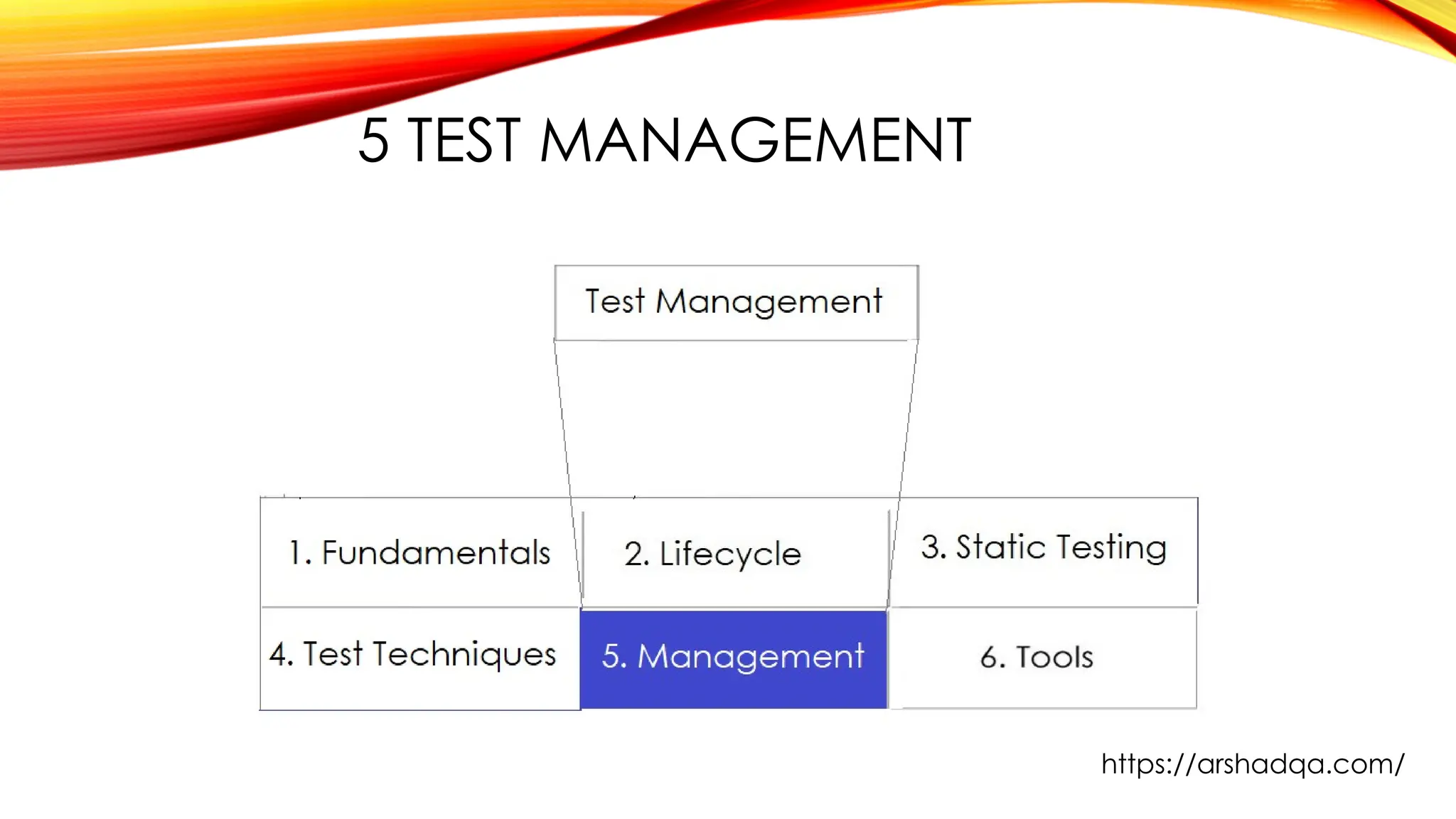
5 TEST MANAGEMENT
https://arshadqa.com/
5 TEST
MANAGEMENT
Test Management refers to the process of
organizing and controlling the testing activities
during the software development lifecycle. It
involves planning, execution, monitoring, and
reporting to ensure that the software product
meets the desired quality standards. Effective
test management ensures that all testing
activities are streamlined, documented, and
controlled to minimize risk and defects.
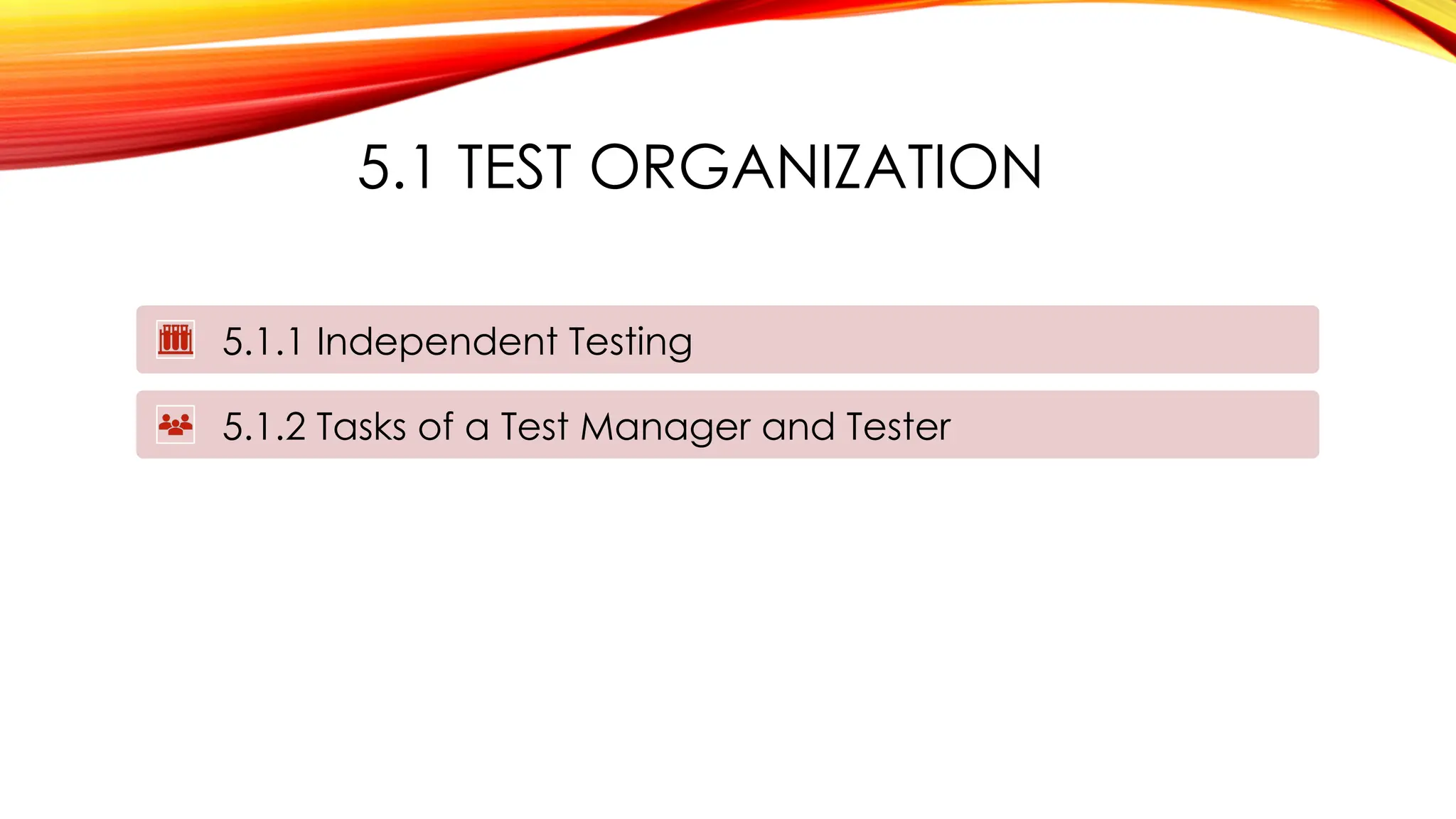
5.1 TEST ORGANIZATION
5.1.1 Independent Testing
5.1.2 Tasks of a Test Manager and Tester
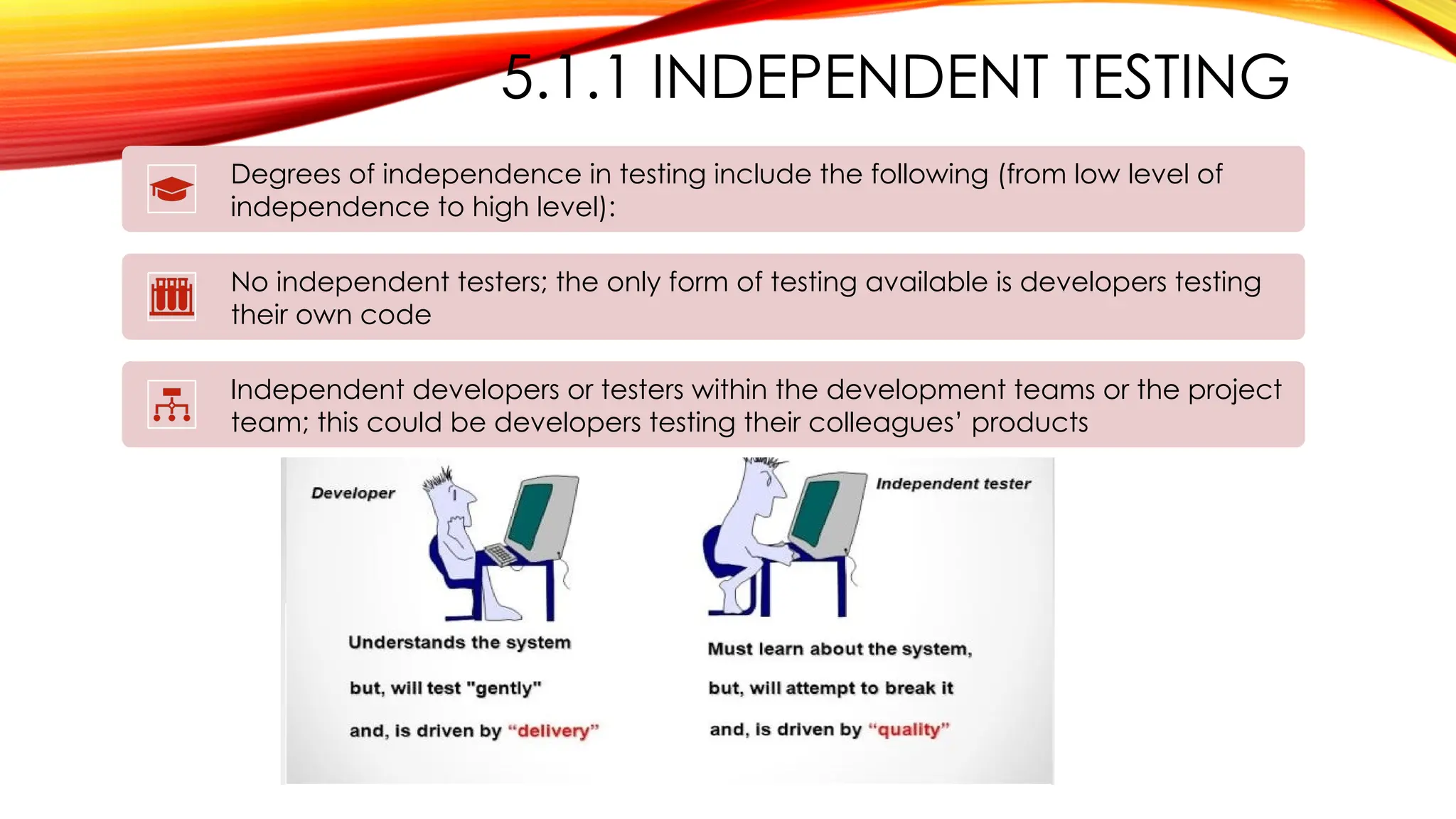
5.1.1 INDEPENDENT TESTING
Degrees of independence in testing include the following (from low level of
independence to high level):
No independent testers; the only form of testing available is developers testing
their own code
Independent developers or testers within the development teams or the project
team; this could be developers testing their colleagues’ products
5.1.1 INDEPENDENT TESTING
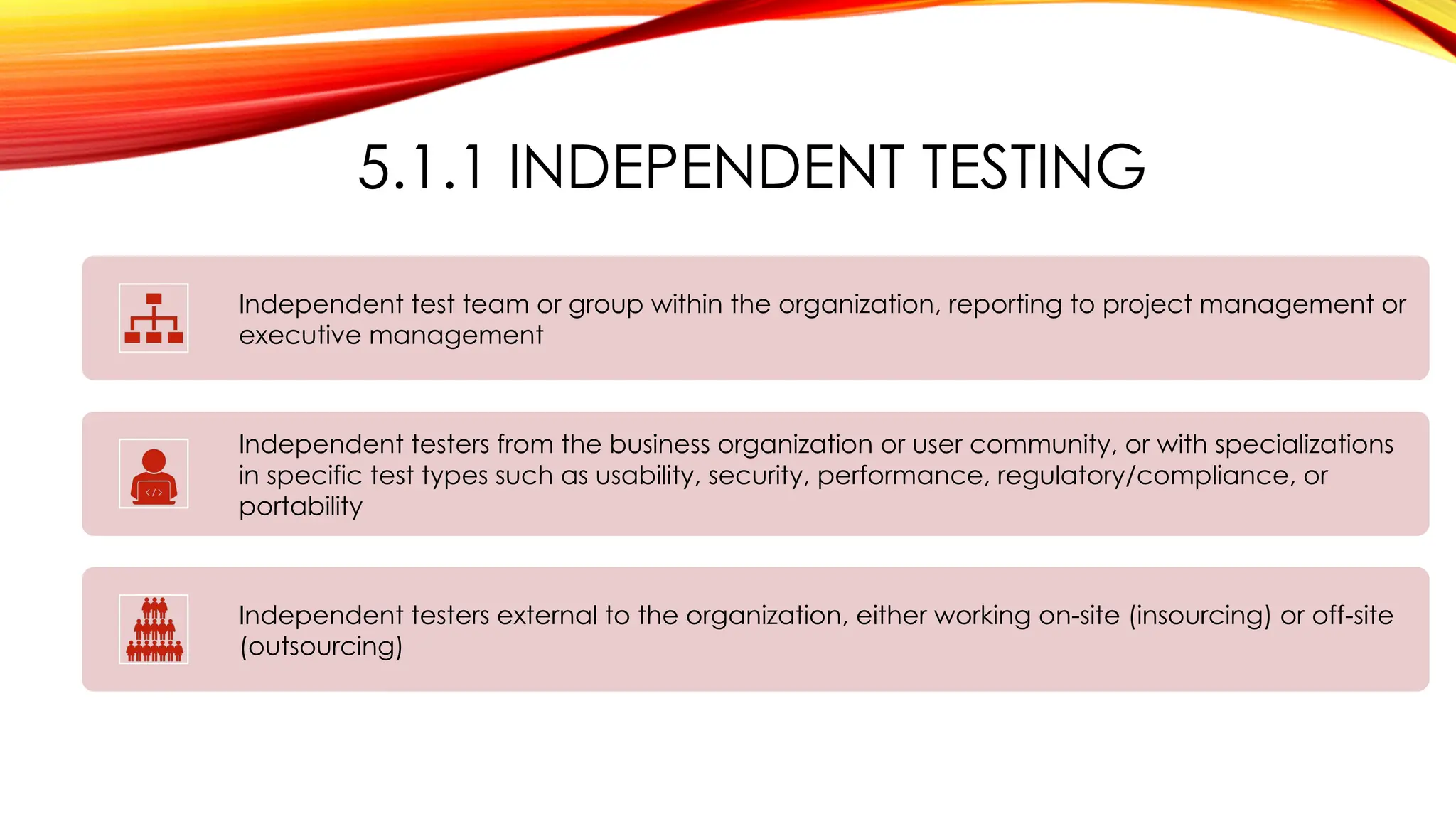
Independent test team or group within the organization, reporting to project management or
executive management
Independent testers from the business organization or user community, or with specializations
in specific test types such as usability, security, performance, regulatory/compliance, or
portability
Independent testers external to the organization, either working on-site (insourcing) or off-site
(outsourcing)
POTENTIAL BENEFITS OF TEST INDEPENDENCE
Independent testers are likely to recognize
different kinds of failures compared to
developers because of their different
backgrounds, technical perspectives, and
biases
An independent tester can verify,
challenge, or disprove assumptions made
by stakeholders during specification and
implementation of the system
POTENTIAL
DRAWBACKS OF TEST
INDEPENDENCE
Isolation from the development team, leading to a
lack of collaboration, delays in providing feedback to
the development team, or an adversarial relationship
with the development team
Developers may lose a sense of responsibility for
quality
Independent testers may be seen as a bottleneck or
blamed for delays in release
Independent testers may lack some important
information (e.g., about the test object)
5.1.2 TASKS OF A TEST
MANAGER AND TESTER
• In this syllabus, two test roles are covered, test managers
and testers. The activities and tasks performed by these
two roles depend on the project and product context,
the skills of the people in the roles, and the organization.
TEST MANAGER TASKS
Develop or review a test policy and test strategy for the organization
Plan the test activities by considering the context, and understanding the
test objectives and risks. This may include selecting test approaches,
estimating test time, effort and cost, acquiring resources, defining test
levels and test cycles, and planning defect management
Write and update the test plan(s)
Coordinate the test plan(s) with project managers, product owners, and
others
Share testing perspectives with other project activities, such as
integration planning
t
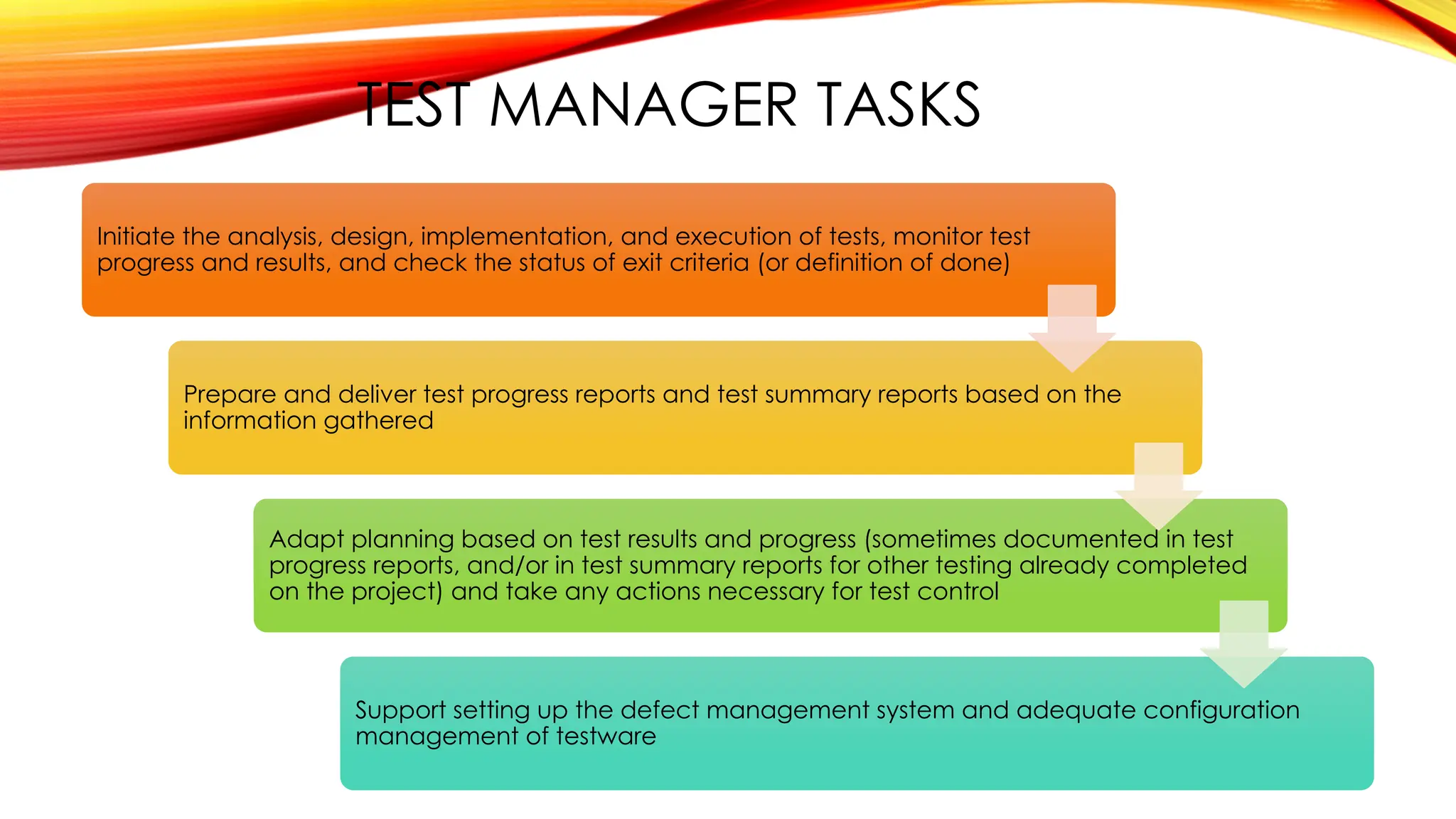
TEST MANAGER TASKS
Initiate the analysis, design, implementation, and execution of tests, monitor test
progress and results, and check the status of exit criteria (or definition of done)
Prepare and deliver test progress reports and test summary reports based on the
information gathered
Adapt planning based on test results and progress (sometimes documented in test
progress reports, and/or in test summary reports for other testing already completed
on the project) and take any actions necessary for test control
Support setting up the defect management system and adequate configuration
management of testware
TEST
MANAGER
TASKS
Introduce suitable metrics for measuring test
progress and evaluating the quality of the testing
and the product
Support the selection and implementation of tools to
support the test process, including recommending
the budget for tool selection (and possibly purchase
and/or support), allocating time and effort for pilot
projects, and providing continuing support in the use
of the tool(s)
Decide about the implementation of test
environment(s)
Promote and advocate the testers, the test team,
and the test profession within the organization
Develop the skills and careers of testers (e.g.,
through training plans, performance evaluations,
coaching, etc.)
TESTER TASKS
Review and
contribute to
test plans
Analyze, review, and assess
requirements, user stories and
acceptance criteria,
specifications, and models for
testability (i.e., the test basis)
Identify and document test conditions,
and capture traceability between test
cases, test conditions, and the test basis
TESTER TASKS
Design, set up, and verify test environment(s),
often coordinating with system administration
and network management
Design and implement test cases and test
procedures
Prepare and acquire test data
Create the detailed test execution schedule
TESTER TASKS
1
Execute tests, evaluate
the results, and
document deviations
from expected results
2
Use appropriate tools to
facilitate the test process
3
Automate tests as
needed (may be
supported by a
developer or a test
automation expert)
4
Evaluate non-functional
characteristics such as
performance efficiency,
reliability, usability, security,
compatibility, and portability
Review tests
developed by others
ISTQB
FOUNDATION
LEVEL EXAM
PREPARATION
5.2 TEST PLANNING AND
ESTIMATION
https://arshadqa.com/
TEST PLAN
Determining the scope, objectives, and risks of testing
Defining the overall approach of testing
Integrating and coordinating the test activities into the software lifecycle
activities
Making decisions about what to test, the people and other resources
required to perform the various test activities, and how test activities will be
carried out
TEST PLAN
Scheduling of test analysis, design, implementation, execution, and evaluation
activities, either on particular dates (e.g., in sequential development) or in the
context of each iteration (e.g., in iterative development)
Scheduling
Selecting metrics for test monitoring and control
Selecting
Budgeting for the test activities
Budgeting
Determining the level of detail and structure for test
documentation (e.g., by providing templates or example
documents)
Determining
TEST STRATEGY
• A test strategy provides a
generalized description of the test
process.
• Analytical:
• Model-Based
• Methodical
• Process-compliant
• Directed
• Regression-averse
• Reactive
https://arshadqa.com/
ENTRY
CRITERIA
Typical entry criteria include:
Availability of testable requirements, user stories, and/or
models (e.g., when following a model based testing
strategy)
Availability of test items that have met the exit criteria
for any prior test levels
Availability of test environment
Availability of necessary test tools
Availability of test data and other necessary resources
EXIT
CRITERIA
Typical exit criteria include:
Planned tests have been executed
A defined level of coverage (e.g., of requirements, user
stories, acceptance criteria, risks, code) has been
achieved
The number of unresolved defects is within an agreed
limit
The number of estimated remaining defects is
sufficiently low
The evaluated levels of reliability, performance
efficiency, usability, security, and other relevant quality
characteristics are sufficient
TEST EXECUTION SCHEDULE
The test suites can be
arranged in a test execution
schedule that defines the
order in which they are to
be run.
The test execution schedule
should take into account
such factors as prioritization,
dependencies, confirmation
tests, regression tests, and
the most efficient sequence
for executing the tests.
https://arshadqa.com/
FACTORS INFLUENCING THE TEST EFFORT
• Factors influencing the test effort may include
characteristics of the product, characteristics of the
development process, characteristics of the people, and
the test results.
PRODUCT
CHARACTERISTICS
The risks associated with the product
The quality of the test basis
The size of the product
The complexity of the product domain
The requirements for quality characteristics (e.g.,
security, reliability)
The required level of detail for test documentation
Requirements for legal and regulatory compliance
DEVELOPMENT
PROCESS
CHARACTERISTICS
The stability and maturity of the organization
The development model in use
The test approach
The tools used
The test process
Time pressure
PEOPLE
CHARACTERISTICS
The skills and experience of the
people involved, especially with
similar projects and products
(e.g., domain knowledge)
Team cohesion and leadership
TEST RESULTS
The number and severity
of defects found
The amount of rework
required
TEST ESTIMATION TECHNIQUES
There are a number of estimation techniques used
to determine the effort required for adequate
testing.
The metrics-based technique: estimating the test
effort based on metrics of former similar projects, or
based on typical values
The expert-based technique: estimating the test
effort based on the experience of the owners of the
testing tasks or by experts
https://arshadqa.com/
ISTQB FOUNDATION
LEVEL EXAM
PREPARATION
https://arshadqa.com/
5.3 TEST MONITORING AND
CONTROL
https://arshadqa.com/
5.3 TEST MONITORING AND CONTROL
The purpose of test monitoring is to gather information and provide
feedback and visibility about test activities
Information to be monitored may be collected manually or
automatically
Test control describes any guiding or corrective actions taken as a
result of information and metrics gathered and (possibly) reported
5.3 TEST MONITORING AND CONTROL
Examples of test control actions include:
Re-prioritizing tests when an identified risk occurs (e.g., software delivered late)
Changing the test schedule due to availability or unavailability of a test
environment or other resources
Re-evaluating whether a test item meets an entry or exit criterion due to rework
5.3.1 METRICS
USED IN TESTING
Metrics can be collected during and at
the end of test activities in order to assess:
Progress against the planned schedule
and budget
Current quality of the test object
Adequacy of the test approach
Effectiveness of the test activities with
respect to the objectives
COMMON TEST METRICS INCLUDE
Percentage of
planned work done in
test case preparation
(or percentage of
planned test cases
implemented)
Percentage of
planned work done in
test environment
preparation
Test case execution
(e.g., number of test
cases run/not run, test
cases passed/failed,
and/or test conditions
passed/failed)
COMMON TEST METRICS INCLUDE
Defect information (e.g., defect density, defects found and fixed, failure rate,
and confirmation test results)
Test coverage of requirements, user stories, acceptance criteria, risks, or code
Task completion, resource allocation and usage, and effort
Cost of testing, including the cost compared to the benefit of finding the next
defect or the cost compared to the benefit of running the next test
5.3.2 PURPOSES, CONTENTS, AND
AUDIENCES FOR TEST REPORTS
The purpose of test reporting is to
summarize and communicate test activity
information
During test monitoring and control, the test
manager regularly issues test progress
reports for stakeholders
TYPICAL TEST
PROGRESS
REPORTS
AND TEST
SUMMARY
REPORTS
MAY
INCLUDE
Summary of testing performed
Information on what occurred
during a test period
Deviations from plan, including
deviations in schedule, duration, or
effort of test activities
Status of testing and product quality
with respect to the exit criteria or
definition of done
TYPICAL TEST PROGRESS REPORTS AND
TEST SUMMARY REPORTS MAY INCLUDE
Factors that have
blocked or continue
to block progress
Metrics of defects,
test cases, test
coverage, activity
progress, and
resource
consumption.
Residual risks
Reusable test work
products produced
ISTQB
FOUNDATION
LEVEL EXAM
PREPARATION
https://arshadqa.com/
5.4 CONFIGURATION
MANAGEMENT
https://arshadqa.com/
5.4 CONFIGURATION
MANAGEMENT
The purpose of configuration
management is to establish and
maintain the integrity of the
component or system
During test planning, configuration
management procedures and
infrastructure (tools) should be
identified and implemented
CONFIGURATION
MANAGEMENT
MAY INVOLVE
ENSURING THE
FOLLOWING
All test items are uniquely
identified, version controlled,
tracked for changes, and
related to each other
All identified documents and
software items are
referenced unambiguously in
test documentation
ISTQB FOUNDATION
LEVEL EXAM
PREPARATION
5.5 RISKS AND TESTING
https://arshadqa.com/
5.5 RISKS AND
TESTING
Risk involves the possibility of
an event in the future which
has negative consequences.
The level of risk is determined
by the likelihood of the event
and the impact from that
event.
5.5.2 PRODUCT
AND PROJECT
RISKS
Product risk involves the possibility that
a work product (e.g., a specification,
component, system, or test) may fail
to satisfy the legitimate needs of its
users and/or stakeholders
Project risk involves situations that,
should they occur, may have a
negative effect on a project's ability
to achieve its objectives
PRODUCT RISKS
Software might not perform its intended
functions according to the specification
Software might not perform its intended
functions according to user, customer, and/or
stakeholder needs
A system architecture may not adequately
support some non-functional requirement(s)
A particular computation may be performed
incorrectly in some circumstances
A loop control structure may be coded
incorrectly
PRODUCT RISKS
Response-times may be inadequate for a high-
performance transaction processing system
User experience (UX) feedback might not meet product
expectations
PROJECT RISK
Delays may occur in delivery, task completion, or
satisfaction of exit criteria or definition of done
Inaccurate estimates, reallocation of funds to higher
priority projects
Late changes may result in substantial re-work
Skills, training, and staff may not be sufficient
Personnel issues may cause conflict and problems
Users, business staff, or subject matter experts may
not be available due to conflicting business priorities
PROJECT RISK
Testers may not communicate their
needs and/or the test results
adequately
Developers and/or testers may fail to
follow up on information found in
testing and reviews
There may be an improper attitude
toward, or expectations of, testing
(e.g., not appreciating the value of
finding defects during testing)
PROJECT RISK
Requirements may not be defined well enough
The requirements may not be met, given existing constraints
The test environment may not be ready on time
Data conversion, migration planning, and their tool support may be late
Weaknesses in the development process may impact the consistency or quality of project
work products
Poor defect management and similar problems may result in accumulated defects and
other technical debt
5.5.3 RISK-BASED TESTING AND PRODUCT QUALITY
A risk-based approach to testing provides proactive opportunities
to reduce the levels of product risk
Risk-based testing draws on the collective knowledge and insight
of the project stakeholders to carry out product risk analysis
To ensure that the likelihood of a product failure is minimized, risk
management activities provide a disciplined approach to
5.5.3 RISK-BASED TESTING AND PRODUCT QUALITY
Analyze
Analyze (and re-
evaluate on a
regular basis) what
can go wrong
(risks)
Determine
Determine which
risks are important
to deal with
Implement
Implement actions
to mitigate those
risks
Make
Make contingency
plans to deal with
the risks should
they become
actual events
ISTQB FOUNDATION
LEVEL EXAM
PREPARATION
5.6 DEFECT MANAGEMENT
https://arshadqa.com/
5.6 DEFECT
MANAGEMENT
Since one of the objectives of testing is
to find defects, defects found during
testing should be logged
Any defects identified should be
investigated and should be tracked
from discovery and classification to
their resolution
In order to manage all defects to
resolution, an organization should
establish a defect management
process which includes a workflow and
rules for classification
5.6 DEFECT
MANAGEMENT
Defects may be reported during
coding, static analysis, reviews,
dynamic testing, or use of a software
product
In order to have an effective and
efficient defect management
process, organizations may define
standards for the attributes,
classification, and workflow of defects.
5.6 DEFECT
MANAGEMENT
Typical defect reports have the
following objectives:
Provide developers and other parties
with information about any adverse
event that occurred.
Provide test managers a means of
tracking the quality of the work product
and the impact on the testing
Provide ideas for development and test
process improvement
ISTQB FOUNDATION
LEVEL EXAM
PREPARATION
https://arshadqa.com/
CHAPTER 6
6 Tool Support for Testing
6.1 TEST TOOL CONSIDERATIONS
https://arshadqa.com/
6.1 TEST TOOL CONSIDERATIONS
Test tools can be used to support one or more testing activities. Such tools include:
Tools that are directly used in testing, such as test execution tools and test data
preparation tools
Tools that help to manage requirements, test cases, test procedures, automated test
scripts, test results, test data, and defects, and for reporting and monitoring test execution
Tools that are used for investigation and evaluation
Any tool that assists in testing (a spreadsheet is also a test tool in this meaning)
6.1.1 TEST TOOL CLASSIFICATION
Test tools can have one or more of the following purposes depending on the context:
Have
Improve the efficiency of test activities by automating repetitive tasks or tasks that require
significant resources when done manually (e.g., test execution, regression testing)
Improve
Improve the quality of test activities by allowing for more consistent testing and a higher level of
defect reproducibility
Improve
Automate activities that cannot be executed manually (e.g., large scale performance testing)
Automate
Increase reliability of testing (e.g., by automating large data comparisons or simulating
behavior)
Increase
TOOL SUPPORT FOR MANAGEMENT
Test management tools and application lifecycle management
tools (ALM)
Requirements management tools (e.g., traceability to test
objects)
Defect management tools
Configuration management tools
Continuous integration tools (D)
TOOL SUPPORT FOR STATIC TESTING
TOOLS THAT SUPPORT
REVIEWS
STATIC ANALYSIS TOOLS
(D)
TOOL SUPPORT FOR TEST DESIGN
AND IMPLEMENTATION
Test design tools
Model-Based testing tools
Test data preparation tools
Acceptance test driven development (ATDD) and behavior driven
development (BDD) tools
Test driven development (TDD) tools (D)
TOOL SUPPORT FOR TEST EXECUTION AND LOGGING
Test execution
tools (e.g., to run
regression tests)
Coverage tools
(e.g., requirements
coverage, code
coverage (D))
Test harnesses (D)
Unit test framework
tools (D)
TOOL SUPPORT FOR PERFORMANCE
MEASUREMENT AND DYNAMIC ANALYSIS
Performanc
e testing
tools
Monitoring
tools
Dynamic
analysis tools
(D)
TOOL SUPPORT FOR SPECIALIZED
TESTING NEEDS
Data quality
assessment
Data conversion
and migration
Usability testing Accessibility testing
Localization testing Security testing
Portability testing
(e.g., testing
software across
multiple supported
platforms)
6.1.2 BENEFITS AND RISKS OF TEST
AUTOMATION
Simply acquiring a tool does not
guarantee success.
Each new tool introduced into an
organization will require effort to achieve
real and lasting benefits
POTENTIAL BENEFITS OF USING TOOLS TO SUPPORT
TEST EXECUTION INCLUDE
Reduction in repetitive manual work (e.g., running regression tests,
environment set up/tear down tasks, re-entering the same test data, and
checking against coding standards), thus saving time
Greater consistency and repeatability
More objective assessment (e.g., static measures, coverage)
Easier access to information about testing (e.g., statistics and graphs about
test progress, defect rates and performance)
POTENTIAL RISKS OF USING TOOLS
TO SUPPORT TESTING INCLUDE
Expectations for the tool may be unrealistic (including functionality and
ease of use)
The time, cost and effort for the initial introduction of a tool may be
under-estimated (including training and external expertise)
The time and effort needed to achieve significant and continuing
benefits from the tool may be under-estimated
POTENTIAL RISKS OF USING TOOLS
TO SUPPORT TESTING INCLUDE
• The effort required to maintain the test
assets generated by the tool may be
under-estimated
• The tool may be relied on too much
• Version control of test assets may be
neglected
POTENTIAL RISKS OF USING TOOLS
TO SUPPORT TESTING INCLUDE
The tool vendor may go out of business, retire the tool, or sell the
tool to a different vendor
The vendor may provide a poor response for support, upgrades,
and defect fixes
An open source project may be suspended
A new platform or technology may not be supported by the tool
There may be no clear ownership of the tool (e.g., for mentoring,
updates, etc.)
ISTQB FOUNDATION LEVEL
EXAM PREPARATION
6.2 EFFECTIVE USE OF TOOLS
https://arshadqa.com/
6.2.1 MAIN PRINCIPLES FOR TOOL
SELECTION
Assessment of the maturity of
the organization, its strengths
and weaknesses
Identification of opportunities
for an improved test process
supported by tools
Understanding of the
technologies used by the test
object(s), in order to select a
tool that is compatible with
that technology
The build and continuous
integration tools already in use
within the organization, in
order to ensure tool
compatibility and integration
6.2.1 MAIN PRINCIPLES FOR TOOL SELECTION
Evaluation of the tool against clear requirements and objective
criteria
Consideration of whether or not the tool is available for a free trial
period (and for how long)
Evaluation of the vendor (including training, support and commercial
aspects) or support for noncommercial (e.g., open source) tools
Identification of internal requirements for coaching and mentoring in
the use of the tool
6.2.1 MAIN PRINCIPLES FOR TOOL SELECTION
Evaluation of training needs, considering the testing (and test
automation) skills of those who will be working directly with the
tool(s)
Consideration of pros and cons of various licensing models (e.g.,
commercial or open source)
Estimation of a cost-benefit ratio based on a concrete business
case (if required)
6.2.2 PILOT
PROJECTS
Gaining in-depth knowledge about the tool,
understanding both its strengths and weaknesses
Evaluating how the tool fits with existing processes
and practices, and determining what would need
to change
Deciding on standard ways of using, managing,
storing, and maintaining the tool
Assessing whether the benefits will be achieved at
reasonable cost
Understanding the metrics that you wish the tool to
collect and report
6.2.3 SUCCESS
FACTORS FOR
TOOLS
Success factors for evaluation,
implementation, deployment,
and on-going support of tools
within an organization include:
Rolling out the tool to the rest of
the organization incrementally
Adapting and improving
processes to fit with the use of
the tool
6.2.3 SUCCESS
FACTORS FOR
TOOLS
Providing training, coaching, and mentoring
for tool users
Defining guidelines for the use of the tool
(e.g., internal standards for automation)
Implementing a way to gather usage
information from the actual use of the tool
Monitoring tool use and benefits
Providing support to the users of a given tool
Gathering lessons learned from all users
QUESTION DISTRIBUTION CHAPTER WISE
https://arshadqa.com/
THANKS
https://arshadqa.com/

International Software Testing Qualification Board

  • 1.
    WELCOME TO: ISTQB FOUNDATIONLEVEL EXAM PREPARATION COURSE https://arshadqa.com/
  • 2.
    COURSE OBJECTIVES Any personwho is interested in QA or wanted to learn about testing can enroll in this course. 100% success guarantee 16 sample ISTQB exam papers for practice By taking this course you can pass the ISTQB-FL exam in 1st attempt https://arshadqa.com/
  • 3.
  • 4.
    WHAT IS QUALITY? Synonyms of QualityExcellence Superiority Class Eminence Value Worth
  • 5.
  • 6.
    SOFTWARE QUALITY: DEFINITION 1 Lowlevels of defects when deployed, ideally approaching zero
  • 7.
    SOFTWARE QUALITY: DEFINITION 2 Amajority of clients with high user-satisfaction when surveyed
  • 8.
    SOFTWARE QUALITY: DEFINITION 3 A structurethat can minimize ―bad fixes or insertion of new ‖ defects during repairs
  • 9.
    SOFTWARE QUALITY: DEFINITION 4 Effectivecustomer support when problems do occur
  • 10.
    SOFTWARE QUALITY: DEFINITION 5 Rapidrepairs for defects, especially for high-severity defects
  • 11.
    BEYOND ABSENCE OFDEFECTS Sense of beauty • Sense of fitness for purpose • Sense of elegance that goes beyond the simple absence of overt flaws • Has well-formed requirements • Robust
  • 12.
  • 13.
    SOFTWARE QUALITY ASSURANCE ? Sothe term software quality assurance would mean that the software guarantees high quality
  • 14.
    ISTQB FOUNDATION LEVEL EXAMPREPARATION https://arshadqa.com/
  • 15.
  • 16.
  • 17.
    INTRODUCTION TO ISTQB International SoftwareTesting Qualification Board About ISTQB Certifications Local body conducting exam Who can appear? What is the cost? Validity
  • 19.
    INTRODUCTION TO ISTQB About Examination: Prerequisite Examtype – Objective Number of Questions Duration Schedule Location/Venue Passing Score Additional Info
  • 20.
    ISTQB FOUNDATION SYLLABUS Chapter 1: Fundamentalsof Testing Chapter 2: Testing Throughout the Software Development Life Cycle Chapter 3: Static Testing Chapter 4: Test Techniques Chapter 5: Test Management Chapter 6: Tool Support for testing
  • 21.
    ISTQB FOUNDATION LEVEL EXAMPREPARATION https://arshadqa.com/
  • 22.
    1.1 WHAT ISTESTING?
  • 23.
    FUNDAMENTALS OF TESTING Contents: 1.1 Whatis testing? 1.2 Why is testing necessary? 1.3 Seven testing principles 1.4 Test process 1.5 The psychology of testing
  • 24.
    WHAT IS TESTING?(K2) Common perception is testing is limited to execution Test activities exist before and after test execution as well Other activities throughout the development Lifecyle Contributing to reviews https://arshadqa.com/
  • 25.
  • 26.
    OBJECTIVES OF TESTING Testingis all about Finding defects Gaining confidence about quality Providing information Preventing defects To evaluate work products To verify if all the requirements have been met To reduce the level of risk To comply which contractual, legal or regulatory requirements and standards https://arshadqa.com/
  • 27.
    WHAT IS TESTING? (CLASSIFICATIONOF TESTING) https://arshadqa.com/
  • 28.
    WHAT IS TESTING? (CLASSIFICATIONOF TESTING) Types of reviews are informal reviews, walkthrough, technical review, inspection Level of testing are unit, integration, system, UAT and Non-functional testing
  • 29.
    WHAT IS TESTING?(DEBUGGING AND TESTING) Testing Testing deal with finding the defects by conducting failure on application or product. This activity is performed by testers. Debugging Debugging is a development activity which deals with analyzing these defects, finding the root cause and removes the cause of defects. This activity is commonly performed by developers.
  • 30.
  • 31.
    1.2 WHY TESTINGIS NECESSARY?
  • 32.
    1.2 WHY IS TESTING NECESSARY? Havingtesters involved in requirements reviews or user story refinement could detect defects in these work products. Having testers work closely with system designers while the system is being designed can increase each party’s understanding of the design and how to test it.
  • 33.
    WHY IS TESTINGNECESSARY? Having testers work closely with developers while the code is under development can increase each party’s understanding of the code and how to test it. Having testers verify and validate the software prior to release can detect failures that might otherwise have been missed,and support the process of removing the defect that cause the failures (I.e., debugging).
  • 34.
    QUALITY ASSURANCE &QUALITY CONTROL While people often use the phrase quality assurance (or Just QA) to refer to testing, quality assurance and testing are not the same, but they are related. Quality assurance is typically focused on adherence to proper processes, in order to provide confidence that the appropriate levels of quality will be achieved. When processes are generally of high quality, which contributes to defect prevention. Quality control involves various activities, including test activities, that support the achievement of appropriate levels of quality. Test activities are part of the overall software development or maintenance process.
  • 35.
    ERROR, DEFECT & FAILURE Error(Mistake) •A human action that produces an incorrect result Fault(Defect, Bug) • A manifestation of an error in software • Also know as a defect or bug • If executed, a fault may cause a failure Failure: Deviation of the software from its expected delivery or service
  • 36.
    CAUSES OF SOFTWARE DEFECTS Errors mayoccur for many reasons, such as: Time presser Human is error prone Inexperienced or insufficiently skilled project participants Miscommunication between project participants, including miscommunication about requirements and design Complexity of the code, design, architecture, the underlying problem to be solved, and/or the technologies used Misunderstandings about intra-system and inter-system interfaces, especially when such intrasystem and inter-system interactions are large in number New, unfamiliar technologies
  • 37.
  • 38.
    FUNDAMENTALS OF TESTING Contents: 1.1 Whatis testing? 1.2 Why Testing Necessary? 1.3 Seven Testing Principles 1.4 Fundamental Test Process 1.5 The Psychology of Testing
  • 39.
    1.3 PRINCIPLES OF TESTING Seven TestingPrinciples: Principle 1: Testing shows presence of defects Principle 2: Exhaustive testing is impossible Principle 3: Earlier Testing Principle 4: Defect clustering Principle 5: Pesticide paradox Principle 6: Testing is context dependent Principle 7: Absence-of-error fallacy
  • 40.
    PRINCIPLE 1: TESTIGN SHOWS PRESENCEOF DEFECTS Testing shows presence of defects, not there absence Testing can show that defects are present in a system software, but no matter whatever count of defects we find, at any point of time we can’t say there no more defects. Also to add to it, in case no defects are found, it’s not a proof of correctness.
  • 41.
    PRINCIPLE 2: EXHAUSTIVE TESTING IS IMPOSSIBLE Testingeverything, which mean all possible combination of inputs and preconditions is generally not feasible to be conducted. As an alternative to exhaustive testing, risk analysis and priorities should be used to focus on testing efforts Example: One screen has 15 input fields each have 5 possible values, then to test all the valid input value combinations, you would need 5^15 = 30517578125 tests
  • 42.
    PRINCIPLE 3: EARLYTESTING: IT SAVES TIME AND MONEY To find defects earlier or to prevents defects being introduced, testers must be involved as early as possible in developments life cycle. Testing activities must be coordinated with corresponding development activities. Testers are good contributor in reviews and must participate. This helps them understand the requirements earlier and prepare test cases earlier in life cycle.
  • 44.
    PRINCIPLE 4: DEFECTCLUSTERING Defects cluster together: It is possible that the more defects are clustered in smaller modules compared to being distributed among bigger and other modules. In this regards, a tester must consider and prepare proportional test cases to test such system. https://arshadqa.com/
  • 45.
    PRINCIPLE 5: PESTICIDEPARADOX If the same tests are prepared over and over again, eventually the same set of test cases will no longer help find new defects. To overcome this “Pesticide Paradox” test cases need to be regularly reviewed and revised https://arshadqa.com/
  • 46.
    PRINCIPLE 6: TESTING IS CONTEXT DEPENDENT Testingis done differently in different context Two different software are testing with different strategy.
  • 47.
    PRINCIPLE 7: ABSENCE-OF-ERRORFALLACY • Meeting the requirement is equally important. Finding and fixing defect doesn’t help if the system built doesn’t fulfill the users’ need and expectations.
  • 48.
    TESTING PRINCIPLES These principlesprovide a foundation for making informed decisions during the testing process. By applying these principles, testers can focus on high-risk areas, avoid common pitfalls, and ensure that their testing is both efficient and effective.
  • 49.
  • 50.
    1.4 TEST PROCESS– PART 1 https://arshadqa.com/
  • 51.
    1.4 TEST PROCESS – PART1 Contextual factors that influence the test process for an organizatio n, include but are not limited to: Software development lifecycle model and project methodologies being used. Test levels and test types being considered Product and project risks Business domain Operational constraints, (Budgets and resources, Timescales, complexity, contractual and regulatory requirements) Organizational policies and practices Required internal and external standards
  • 52.
    1.4 TEST PROCESS Ina QA (Quality Assurance) role, it’s crucial to remember the key aspects of the test process to ensure thorough and effective testing.
  • 53.
    TEST PROCESS: Test processconsists of following main activities: Test planning Test monitoring and control Test analysis Test design Test implementation Test execution Test completion
  • 54.
    TEST PLANNING Test planning consistsof following main activities: Determining the scope and risks and identifying the objective of testing Defining the overall approach of testing Scheduling test activities, assigning resources for the activities Defining the amount, detail, template for documentation Selecting metrics for monitoring and controlling Defining entry and exit criteria Deciding about automation.
  • 56.
    TEST MONITORING AND CONTROL TestMonitoring: It is process of measuring the progress on project Test Metrics: These contain set of formulae which calculates any dimensions(test, defects, coverage, etc.) of testing. Test Execution Rate: (No of test cases executed/No of test cases planned for execution)*100 Test control: Test control involves taking actions necessary to meet the objectives of the test.
  • 57.
    TEST PROCESS Test process consistsof following main activities: Test planning Test monitoring and control Test analysis Test design Test implementation Test execution Test completion
  • 58.
    TEST ANALYSIS Test analysis includesfollowing major activities: Analyzing the information needed in order to start the test analysis and create our Test Cases Evaluating the test basis and test items to identify defects of various types, such as ambiguities, omissions, inconsistencies, inaccuracies, etc. Identifying features and sets of features to be tested. Defining and prioritizing test conditions for each feature based on analysis of the test basis. Considering functional, non-functional, and structural characteristics, other business and technical factors, and level of risks.
  • 59.
    TEST DESIGN Test designincludes the following major activities: • Designing and prioritizing test cases • Identifying necessary test data to support the test conditions and test cases. • Designing the test environment and identifying required infrastructure and tools. • Creating bi-directional traceability between test basis and test cases
  • 60.
    TEST PROCESS Test processconsists of following main activities: Test planning Test monitoring and control Test analysis Test design Test implementation Test execution Test completion
  • 61.
    TEST IMPLEMENTATION Test implementationincludes the following activities Developing and prioritizing test procedures and potentially, creating automated test scripts Creating test suites from the test procedures and (if any) automated test scripts Arranging the test suites within a test execution schedule in a way that results in efficient test execution Building the test environment (including, potentially, test harness, service virtualization, simulators, and other infrastructure items) and verifying the everything needed has been set up correctly. Preparing test data and ensuring it is properly loaded in the test environment. Verifying and updating bi-directional traceability between the test basis, test conditions, test cases, test procedures and test suits.
  • 62.
    TEST EXECUTION Test executionincludes the following major activities • Recording the IDs and versions of the test item(s) or test object, test tool(s) and testware. • Executing tests either manually or by using test execution tools • Comparing actual results with expected results • Analyzing anomalies to establish their likely causes (e.g., failures my occur due to defects in code, but false positives also may occur. • Reporting defects based on the failures observed • Logging the outcome of test execution (e.g., pass, fail, blocked) • Repeating test activities either as a result of action taken for an anomaly, or as part of the planned testing(e.g., execution of a corrected test, confirmation testing and /or regression testing)
  • 63.
    TEST COMPLETION Test completionincludes following major activities : Checking whether all defects reports are closed, entering change requests or product backlog items for any defects that remain unresolved at the end of test execution. Creating test summary report to be communicated to stakeholders Finalizing and archiving the test environment, the test data, the test infrastructure and other testware for later reuse. Handing over the testware to the maintenance teams, other project teams, and /or other stakeholders who could benefit from it’s use. Analyzing lessons learned from the completed test activities to determine changes needed for future iterations, releases and projects. Using the information gathered to improve test process maturity.
  • 64.
  • 65.
    1.4 TEST PROCESS– PART 2 https://arshadqa.com/
  • 66.
    TEST WORK PRODUCTS Test planning work products: Test planningwork products typically include one or more test plans. The test plan includes information about the test basis, to which the other test work products will be related via traceability information.
  • 67.
    TEST WORK PRODUCTS: Test Monitoringand control work products: Test Test monitoring and control work products typically include various types of test reports, including test progress reports and test summary. Test Test monitoring and control work products should also address project management concerns, such as task completion, resource allocation and usage and effort. Test
  • 68.
    TEST WORK PRODUCTS: Test analysiswork products Test Test analysis work products include defined and prioritized test conditions, each of which is ideally bi- directional traceability to the specific element(s) of the test basis it covers. Test For exploratory testing, test analysis may involve the creation of test charters. Test
  • 69.
    TEST WORK PRODUCTS: Test DesignWork Products: • Test design results in test cases and sets of test cases to exercise the test conditions defined in test analysis. • Test design also results in the design and/or identification of the necessary test data, the design of the test environment, and the identification of infrastructure and tools, though the extent to which these results are documented varies significantly.
  • 70.
    TEST WORK PRODUCTS: Test implementationwork product include: • Test procedures and the sequencing of those test procedures • Test suites • A test execution schedule • Test implementation also may result in the creation and verification of test data and the test environment.
  • 71.
    TEST WORK PRODUCTS: Test executionwork products include: • Documentation of the status of individual test cases or test procedures(e.g., ready to run, pass, fail, blocked, deliberately skipped etc. • Defect reports • Documentation about which test item(s), test object(s), test tool, and testware were involved in the testing.
  • 72.
    TEST WORK PRODUCTS: Test completionwork products: • Test completion work products include test summary reports, action items for improvement of subsequent projects or iterations(e.g., following a project agile retrospective), change requests product backlog items, and finalized testware.
  • 73.
    TRACEABILITY BETWEEN THE TEST BASISAND TEST WORK PRODUCTS In addition to the evaluation of test coverage, good traceability supports: Analyzing the impact of changes Making testing auditable Meeting IT governance criteria Improving the understanding of test progress reports and test summary reports to include the status of elements of the test basis(e.g., requirements that passed their tests, requirements that failed their tests, and requirements that have pending tests) Relating the technical aspects of testing to stakeholders in terms that they can understand. Proving information to assess product quality, process capability, and project progress against business goals.
  • 74.
  • 75.
    1.5 PSYCHOLOGY OFTESTING https://arshadqa.com/
  • 76.
    HUMAN PSYCHOLOGY AND TESTING Identifying defectsduring a static test such as a requirements review or user story refinement session, or identifying failures during dynamic test execution, may be perceived as criticism of the product and of its author. Since developers expect their code to be correct, they have a confirmation bias that makes it difficult to accept that the code is incorrect Information produced by testing often contains bad news. it is a common human trait to blame the bearer of bad news
  • 77.
    HUMAN PSYCHOLOGY AND TESTING As aresult of these psychological factors, some people may perceive testing as a destructive activity, even though it contributes greatly to project progress and product quality. Information about defects and failures should be communicated in a constructive way This way, tensions between the testers and the analysts, product owners, designers, and developers can be reduced.
  • 78.
    HUMAN PSYCHOLOGY AND TESTING Testers andtest managers need to have good interpersonal skills to be able to communicate effectively and to build positive relationships with colleagues. Ways to communicate well include the following examples, let’s discuss few of them one by one
  • 79.
    WAYS TO COMMUNICATE WELL Start withcollaboration rather than battles. Remind everyone of the common goal of better quality systems. Emphasize the benefits of testing. Communicate test results and other findings in a neutral, fact-focused way without criticizing the person who created the defective item. Write objective and factual defect reports and review findings. Try to understand how the other person feels and the reasons they may react negatively to the information. Confirm that the other person has understood what has been said and vice versa.
  • 80.
    1.5.2 TESTER’S ANDDEVELOPER’S MINDSETS Developers and testers often think differently. A mindset reflects an individual’s assumptions and preferred methods for decision making and problem solving. A tester’s mindset should include curiosity, professional pessimism, a critical eye, attention to detail, and a motivation for good and positive communications and relationships A tester’s mindset tends to grow and mature as the tester gains experience.
  • 82.
    A DEVELOPER’S MINDSET A developer’smindset may include some of the elements of a tester’s mindset. Successful developers are often more interested in designing and building solutions than in contemplating what might be wrong with those solutions. Confirmation bias makes it difficult to find mistakes in their own work. With the right mindset, developers are able to test their own cod
  • 83.
    INDEPENDENT TESTING Having some ofthe test activities done by independent testers increases defect detection effectiveness. Independent testers bring a perspective which is different than that of the work product authors. Independent tasters or third party testers have different cognitive biases from the authors.
  • 84.
    LEVELS OF INDEPENDENTTESTERS Tests designed by the person who wrote the software under test 01 Tests designed by another person 02 Tests designed by a person from a different organizational group or test specialists. 03 Tests designed by a person from a different organization or company. 04
  • 85.
  • 86.
    CHAPTER: 02 TESTING THROUGHOUTTHE SOFTWARE LIFE CYCLE https://arshadqa.com/
  • 87.
    2. TESTING THROUGHOUTTHE SOFTWARE LIFE CYCLE
  • 88.
    TESTING THROUGHOUT THE SOFTWARELIFE CYCLE Contents: 2.1 Software development models 2.2 Test levels 2.3 Test Types 2.4 Maintenance Testing
  • 89.
    2.1 SOFTWARE DEVELOPMENTMODELS • V-Model (Sequential Development Model)
  • 90.
    TESTING WITHIN ALIFE CYCLE MODEL In any software development lifecycle model, there are several characteristics of good testing: For every development activity, there is a corresponding test activity Each test level has test objectives specific to that level Test analysis and design for a given test level begin during the corresponding development activity Testers participate in discussions to define and refine requirements and design, and are involved in reviewing work products
  • 91.
    SOFTWARE DEVELOPMENT MODEL A sequential developmentmodel describes the software development process as a linear, sequential flow of activities Incremental development involves establishing requirements, designing, building, and testing a system in pieces, which means that the software’s features grow incrementally Iterative development occurs when groups of features are specified, designed, built, and tested together in a series of cycles, often of a fixed duration
  • 92.
    ITERATIVE DEVELOPMENT MODEL EXAMPLES Rational Unified Process:Each iteration tends to be relatively long (e.g., two to three months). Scrum: Each iteration tends to be relatively short (e.g., hours, days, or a few weeks), and the feature increments are correspondingly small, such as a few enhancements and/or two or three new features Kanban: Implemented with or without fixed-length iterations. Spiral (or prototyping): Involves creating experimental increments
  • 94.
    SOFTWARE DEVELOPMENT LIFECYCLE MODELS IN CONTEXT Software developmentlifecycle models must be selected and adapted to the context of project and product characteristics Software development lifecycle models themselves may be combined Internet of Things (IoT) systems, which consist of many different objects, such as devices, products, and services, typically apply separate software development lifecycle models for each object. This presents a particular challenge for the development of Internet of Things system versions
  • 95.
  • 96.
  • 97.
    2.2 TEST LEVELS Testlevels are groups of test activities that are organized and managed together The test levels used in this syllabus are: Component testing Integration testing System testing Acceptance testing
  • 98.
    2.2 TEST LEVELS Testlevels are characterized by the following attributes: Specific objectives Test basis, referenced to derive test cases Test object (i.e., what is being tested) Typical defects and failures Specific approaches and responsibilities
  • 99.
    2.2.1 COMPONENT TESTING Componenttesting (also known as unit or module testing) focuses on components that are separately testable Objectives of component testing include Reducing risk Verifying whether the functional and non- functional behaviors of the component are as designed and specified Building confidence in the component’s quality Finding defects in the component Preventing defects from escaping to higher test levels
  • 100.
    2.2.1 COMPONENT TESTING •Test basis Examples of work products that can be used as a test basis for component testing include: • Detailed design • Code • Data model • Test objects Typical test objects for component testing include: • Components, units or modules • Code and data structures • Classes • Database modules https://arshadqa.com/
  • 101.
    2.2.2 INTEGRATION TESTING •Integration testing focuses on interactions between components or systems. Objectives of integration testing include: • Reducing risk • Verifying whether the functional and non-functional behaviors of the interfaces are as designed and specified • Building confidence in the quality of the interfaces • Finding defects (which may be in the interfaces themselves or within the components or systems) • Preventing defects from escaping to higher test levels https://arshadqa.com/
  • 102.
    TEST BASIS Test basis Examples ofwork products that can be used as a test basis for integration testing include: Software and system design Sequence diagrams Interface and communication protocol specifications Use cases Architecture at component or system level Workflows External interface definitions
  • 103.
  • 104.
    2.2.3 SYSTEM TESTING Systemtesting focuses on the behavior and capabilities of a whole system or product System testing often produces information that is used by stakeholders to make release decisions. System testing may also satisfy legal or regulatory requirements or standards. Independent testers typically carry out system testing https://arshadqa.com/
  • 105.
    TEST BASIS Examples of work products thatcan be used as a test basis for system testing include: System and software requirement specifications (functional and non-functional) Risk analysis reports Use cases Epics and user stories Models of system behavior State diagrams System and user manuals
  • 106.
  • 107.
    2.2.4 ACCEPTANCE TESTING Acceptance testing,like system testing, typically focuses on the behavior and capabilities of a whole system or product. Objectives of acceptance testing include: Establishing confidence in the quality of the system as a whole Validating that the system is complete and will work as expected Verifying that functional and non-functional behaviors of the system are as specified
  • 108.
    2.2.4 ACCEPTANCE TESTING Common formsof acceptance testing include the following: User acceptance testing Operational acceptance testing Contractual and regulatory acceptance testing Alpha and beta testing
  • 109.
    SPECIFIC APPROACHES AND RESPONSIBILITIES Acceptance testing isoften the responsibility of the customers, business users, product owners, or operators of a system, and other stakeholders may be involved as well Acceptance testing of a COTS software product may occur when it is installed or integrated Acceptance testing of a new functional enhancement may occur before system testing
  • 110.
    TEST BASIS Examples of work products thatcan be used as a test basis for any form of acceptance testing include: Business processes User or business requirements Regulations, legal contracts and standards Use cases System requirements System or user documentation Installation procedures Risk analysis reports
  • 111.
    TEST OBJECTS Typical test objects for anyform of acceptance testing include: System under test System configuration and configuration data Business processes for a fully integrated system Recovery systems and hot sites (for business continuity and disaster recovery testing) Operational and maintenance processes Forms Reports Existing and converted production data
  • 112.
  • 113.
  • 114.
    2.3 TEST TYPES Atest type is a group of test activities aimed at testing specific characteristics of a software system. Objectives Evaluating functional quality characteristics, such as completeness, correctness, and appropriateness Evaluating non-functional quality characteristics, such as reliability, performance efficiency, security, compatibility, and usability
  • 115.
  • 116.
    TEST TYPES OBJECTIVES Evaluating whetherthe structure or architecture of the component or system is correct, complete, and as specified Evaluating the effects of changes, such as confirming that defects have been fixed (confirmation testing) and looking for unintended changes in behavior resulting from software or environment changes (regression testing)
  • 117.
    2.3.1 FUNCTIONAL TESTING Functionaltesting of a system involves tests that evaluate functions that the system should perform The functions are “what” the system should do. Functional tests should be performed at all test levels Functional test design and execution may involve special skills or knowledge
  • 118.
    2.3.2 NON-FUNCTIONAL TESTING •Non-functional testing of a system evaluates characteristics of systems and software such as usability, performance efficiency or security • Non-functional testing can and often should be performed at all test levels, and done as early as possible • Non-functional test design and execution may involve special skills or knowledge, such as knowledge of the inherent weaknesses of a design or technology
  • 119.
    2.3.3 WHITE-BOX TESTING •White-box testing derives tests based on the system’s internal structure or implementation • White-box test design and execution may involve special skills or knowledge, such as the way the code is built
  • 120.
    2.3.4 CHANGE- RELATED TESTING Whenchanges are made to a system, either to correct a defect or because of new or changing functionality, testing should be done Confirmation testing: After a defect is fixed Regression testing: It is possible that a change made in one part of the code, whether a fix or another type of change, may accidentally affect the behavior of other parts of the code
  • 121.
    2.3.5 TEST TYPESAND TEST LEVELS • It is possible to perform any of the test types mentioned above at any test level • Functional, non-functional, white-box, and change-related tests will be given across all test levels which is • Component testing • Integration testing • System testing • Acceptance testing
  • 122.
  • 123.
  • 124.
    2.4 MAINTENANCE TESTING Once deployedto production environments, software and systems need to be maintained When any changes are made as part of maintenance, maintenance testing should be performed A maintenance release may require maintenance testing at multiple test levels using various test types, based on its scope
  • 125.
    THE SCOPE OFMAINTENANCE TESTING The degree of risk of the change, for example, the degree to which the changed area of software communicates with other components or systems The size of the existing system The size of the change
  • 126.
    2.4.1 TRIGGERS FOR MAINTENANCE There areseveral reasons why software maintenance, and thus maintenance testing, takes place, both for planned and unplanned changes. Modification, such as planned and unplanned enhancements Migration, such as from one platform to another being maintained Retirement, such as when an application reaches the end of its life
  • 127.
    2.4.1 TRIGGERS FORMAINTENANCE For Internet of Things systems, maintenance testing may be triggered by the introduction of completely new or modified things, such as hardware devices and software services, into the overall system. The maintenance testing for such systems places particular emphasis on integration testing at different levels (e.g., network level, application level) and on security aspects, in particular those relating to personal data.
  • 128.
    2.4.2 IMPACT ANALYSIS FOR MAINTENANCE Impactanalysis evaluates the changes that were made for a maintenance release to identify the intended consequences as well as expected and possible side effects of a change The side effects and affected areas in the system need to be tested for regressions Impact analysis may be done before a change is made
  • 129.
    2.4.2 IMPACT ANALYSIS FOR MAINTENANCE Impactanalysis can be difficult if: Specifications (e.g., business requirements, user stories, architecture) are out of date or missing Test cases are not documented or are out of date Bi-directional traceability between tests and the test basis has not been maintained Tool support is weak or non-existent The people involved do not have domain and/or system knowledge Insufficient attention has been paid to the software's maintainability during development
  • 130.
  • 131.
  • 132.
    3.1 STATIC TESTINGBASICS In contrast to dynamic testing, which requires the execution of the software being tested Static analysis is important for safety-critical computer systems (e.g., aviation, medical, or nuclear software) Static analysis is also often incorporated into automated build and delivery systems, for example in Agile development, continuous delivery, and continuous deployment
  • 133.
    3.1.1 WORK PRODUCTS THAT CAN BE EXAMINED BYSTATIC TESTING Almost any work product can be examined using static testing (reviews and/or static analysis), for example: Specifications, including business requirements, functional requirements, and security requirements Epics, user stories, and acceptance criteria Architecture and design specifications Code Testware, including test plans, test cases, test procedures, and automated test scripts
  • 134.
    3.1.1 WORK PRODUCTS THAT CANBE EXAMINED BY STATIC TESTING User guides Web pages Contracts, project plans, schedules, and budgets Models, such as activity diagrams
  • 135.
    3.1.2 BENEFITS OF STATIC TESTING Static testingtechniques provide a variety of benefits When applied early in the software development lifecycle, static testing enables the early detection of defects before dynamic testing is performed Using static testing techniques to find defects and then fixing those defects promptly is almost always much cheaper for the organization than using dynamic testing
  • 136.
    3.1.2 BENEFITS OF STATICTESTING Detecting and correcting defects more efficiently, and prior to dynamic test execution Detecting and correcting Identifying defects which are not easily found by dynamic testing Identifying Preventing defects Preventing Increasing development productivity (e.g., due to improved design, more maintainable code) Increasing Reducing development cost and time Reducing Reducing testing cost and time Reducing Reducing total cost of quality over the software’s lifetime, due to fewer failures later in the lifecycle or after delivery into operation Reducing Improving communication between team members in the course of participating in reviews Improving
  • 137.
    3.1.3 DIFFERENCES BETWEEN STATICAND DYNAMIC TESTING Static and dynamic testing complement each other by finding different types of defects. One main distinction is that static testing finds defects in work products directly rather than identifying failures caused by defects when the software is run Another distinction is that static testing can be used to improve the consistency and internal quality of work products Dynamic testing typically focuses on externally visible behaviors.
  • 138.
    TYPICAL DEFECTS Requirement defects (e.g.,inconsistencies, ambiguities, contradictions, omissions, inaccuracies, and redundancies) Design defects Coding defects Deviations from standards Incorrect interface specifications (e.g., different units of measurement used by the calling system than by the called system) Security vulnerabilities (e.g., susceptibility to buffer overflows) Gaps or inaccuracies in test basis traceability or coverage (e.g., missing tests for an acceptance criterion)
  • 139.
  • 140.
  • 141.
    3.2 REVIEW PROCESS Reviewsvary from informal to formal Informal reviews are characterized by not following a defined process and not having formal documented output The focus of a review depends on the agreed objectives of the review (e.g., finding defects, gaining understanding, educating participants such as testers and new team members, or discussing and deciding by consensus). ISO standard (ISO/IEC 20246) contains more in-depth descriptions of the review process for work products, including roles and review techniques
  • 142.
    3.2.1 WORK PRODUCT REVIEW PROCESS The reviewprocess comprises the following main activities Planning Initiate review Individual review (i.e., individual preparation) Issue communication and analysis Fixing and reporting
  • 143.
    REVIEW PLANNING Defining Defining the scope,which includes the purpose of the review, what documents or parts of documents to review, and the quality characteristic s to be evaluated Estimating Estimating effort and timeframe Identifying Identifying review characteristics such as the review type with roles, activities, and checklists Selecting Selecting the people to participate in the review and allocating roles Defining Defining the entry and exit criteria for more formal review types (e.g., inspections) Checking Checking that entry criteria are met (for more formal review types)
  • 144.
    INITIATE REVIEW Distributing the workproduct (physically or by electronic means) and other material, such as issue log forms, checklists, and related work products Explaining the scope, objectives, process, roles, and work products to the participants Answering any questions that participants may have about the review
  • 145.
    INDIVIDUAL REVIEW Reviewing all orpart of the work product Noting potential defects, recommendations, and question
  • 146.
    ISSUE COMMUNICATION ANDANALYSIS Communicating identified potential defects (e.g., in a review meeting) Analyzing potential defects, assigning ownership and status to them Evaluating and documenting quality characteristics Evaluating the review findings against the exit criteria to make a review decision (reject; major changes needed; accept, possibly with minor changes)
  • 147.
    FIXING AND REPORTING •Creating defect reports for those findings that require changes • Fixing defects found (typically done by the author) in the work product reviewed • Communicating defects to the appropriate person or team (when found in a work product related to the work product reviewed) • Recording updated status of defects (in formal reviews), potentially including the agreement of the comment originator • Gathering metrics (for more formal review types) • Checking that exit criteria are met (for more formal review types) • Accepting the work product when the exit criteria are reached
  • 148.
    3.2.2 ROLES ANDRESPONSIBILITIES IN A FORMAL REVIEW
  • 149.
    AUTHOR • Creates thework product under review • Fixes defects in the work product under review (if necessary)
  • 150.
    MANAGEMENT Is responsible forreview planning Decides on the execution of reviews Assigns staff, budget, and time Monitors ongoing cost-effectiveness Executes control decisions in the event of inadequate outcomes
  • 151.
    MODERATOR • Ensures effectiverunning of review meetings (when held) • Mediates, if necessary, between the various points of view • Is often the person upon whom the success of the review depends
  • 152.
    REVIEW LEADER • Takesoverall responsibility for the review • Decides who will be involved and organizes when and where it will take place
  • 153.
    REVIEWERS May be subjectmatter experts, persons working on the project, stakeholders with an interest in the work product, and/or individuals with specific technical or business backgrounds Identify potential defects in the work product under review May represent different perspectives (e.g., tester, programmer, user, operator, business analyst, usability expert, etc.)
  • 154.
    SCRIBE (OR RECORDER) •Collates potential defects found during the individual review activity • Records new potential defects, open points, and decisions from the review meeting (when held)
  • 155.
    3.2.3 REVIEW TYPES Oneof the main objective of review is to uncover defects
  • 156.
    INFORMAL REVIEW Main purpose:detecting potential defects Possible additional purposes: generating new ideas or solutions, quickly solving minor problems Not based on a formal (documented) process May not involve a review meeting
  • 157.
    INFORMAL REVIEW May beperformed by a colleague of the author (buddy check) or by more people Results may be documented Varies in usefulness depending on the reviewers Use of checklists is optional Very commonly used in Agile development
  • 158.
    WALKTHROUGH Main purposes: finddefects, improve the software product, consider alternative implementations, evaluate conformance to standards and specifications Possible additional purposes: exchanging ideas about techniques or style variations, training of participants, achieving consensus Individual preparation before the review meeting is optional Review meeting is typically led by the author of the work product
  • 159.
    WALKTHROUGH Scribe is mandatory Useof checklists is optional May take the form of scenarios, dry runs, or simulations Potential defect logs and review reports may be produced May vary in practice from quite informal to very formal
  • 160.
    TECHNICAL REVIEW Main purposes:gaining consensus, detecting potential defects Possible further purposes: evaluating quality and building confidence in the work product, generating new ideas, motivating and enabling authors to improve future work products, considering alternative implementations Reviewers should be technical peers of the author, and technical experts in the same or other disciplines
  • 161.
    TECHNICAL REVIEW Individual preparation beforethe review meeting is required Review meeting is optional, ideally led by a trained facilitator (typically not the author) Scribe is mandatory, ideally not the author Use of checklists is optional Potential defect logs and review reports are typically produced
  • 162.
    INSPECTION Main purposes: detectingpotential defects, evaluating quality and building confidence in the work product, preventing future similar defects through author learning and root cause analysis Possible further purposes: motivating and enabling authors to improve future work products and the software development process, achieving consensus Follows a defined process with formal documented outputs, based on rules and checklists
  • 163.
    INSPECTION Uses clearly definedroles, such as those specified in section 3.2.2 which are mandatory, and may include a dedicated reader (who reads the work product aloud during the review meeting) Individual preparation before the review meeting is required Reviewers are either peers of the author or experts in other disciplines that are relevant to the work product
  • 164.
    INSPECTION Specified entry andexit criteria are used Scribe is mandatory Review meeting is led by a trained facilitator (not the author) Author cannot act as the review leader, reader, or scribe Potential defect logs and review report are produced Metrics are collected and used to improve the entire software development process, including the inspection process
  • 165.
    3.2.4 APPLYING REVIEW TECHNIQUES There are anumber of review techniques that can be applied during the individual review • Ad hoc • Checklist-based • Scenarios and dry runs • Role-based • Perspective-based
  • 166.
    3.2.5 SUCCESS FACTORS FOR REVIEWS There are anumber of factors that will affect the outcome of the review Each review has clear objectives, defined during review planning, and used as measurable exit criteria Review types are applied which are suitable to achieve the objectives and are appropriate to the type and level of software work products and participants Any review techniques used, such as checklist- based or role-based reviewing, are suitable for effective defect identification in the work product to be reviewed
  • 167.
    3.2.5 SUCCESS FACTORS FOR REVIEWS Any checklists usedaddress the main risks and are up to date Large documents are written and reviewed in small chunks, so that quality control is exercised by providing authors early and frequent feedback on defects Participants have adequate time to prepare Reviews are scheduled with adequate notice Management supports the review process (e.g., by incorporating adequate time for review activities in project schedules)
  • 168.
    PEOPLE- RELATED SUCCESS FACTORS FOR REVIEWS The right peopleare involved to meet the review objectives. Testers are seen as valued reviewers who contribute to the review and learn about the work product, which enables them to prepare more effective tests, and to prepare those tests earlier Participants dedicate adequate time and attention to detail Reviews are conducted on small chunks, so that reviewers do not lose concentration during individual review and/or the review meeting (when held)
  • 169.
    PEOPLE- RELATED SUCCESS FACTORS FOR REVIEWS Defects found areacknowledged, appreciated, and handled objectively The meeting is well-managed, so that participants consider it a valuable use of their time The review is conducted in an atmosphere of trust; the outcome will not be used for the evaluation of the participants Participants avoid body language and behaviors that might indicate boredom, exasperation, or hostility to other participants Adequate training is provided, especially for more formal review types such as inspections A culture of learning and process improvement is promoted
  • 170.
  • 171.
  • 172.
    4.1 CATEGORIES OFTEST TECHNIQUES 4.2 Black Box Test Techniques 4.3 White Box 4.4 Experience base
  • 173.
    BLACK BOX TESTTECHNIQUES Test conditions, test cases, and test data are derived from a test basis that may include software requirements, specifications, use cases, and user stories Test cases may be used to detect gaps between the requirements and the implementation of the requirements, as well as deviations from the requirements Coverage is measured based on the items tested in the test basis and the technique applied to the test basis
  • 174.
    WHITE BOX Test conditions,test cases, and test data are derived from a test basis that may include code, software architecture, detailed design, or any other source of information regarding the structure of the software Coverage is measured based on the items tested within a selected structure (e.g., the code or interfaces) Specifications are often used as an additional source of information to determine the expected outcome of test cases https://arshadqa.com/
  • 175.
    EXPERIENCE BASE Common characteristicsof experience-based test techniques include the following: Test conditions, test cases, and test data are derived from a test basis that may include knowledge and experience of testers, developers, users and other stakeholders This knowledge and experience includes expected use of the software, its environment, likely defects, and the distribution of those defects The international standard (ISO/IEC/IEEE 29119-4) contains descriptions of test techniques and their corresponding coverage measures
  • 176.
    4.1.1 CHOOSING TESTTECHNIQUES When creating test cases, testers generally use a combination of test techniques to achieve the best results from the test effort Some techniques are more applicable to certain situations and test levels; others are applicable to all test levels The appropriate level of formality depends on the context of testing, including the maturity of test and development processes, time constraints, safety or regulatory requirements, the knowledge and skills of the people involved, and the software development lifecycle model being followed.
  • 177.
    4.1.1 CHOOSING TESTTECHNIQUES The choice of which test techniques to use depends on a number of factors, including the following Type of component or system Component or system complexity Regulatory standards Customer or contractual requirements Risk levels Risk types Test objectives
  • 178.
    4.1.1 CHOOSING TESTTECHNIQUES Available documentation Tester knowledge and skills Available tools Time and budget Software development lifecycle model Expected use of the software Previous experience with using the test techniques on the component or system to be tested The types of defects expected in the component or system
  • 179.
  • 180.
  • 181.
    4.2 BLACK-BOX TESTTECHNIQUES https://arshadqa.com/
  • 182.
    4.2 BLACK-BOX TESTTECHNIQUES 4.2.1 Equivalence Partitioning 4.2.2 Boundary Value Analysis 4.2.3 Decision Table Testing 4.2.4 State Transition Testing 4.2.5 Use Case Testing
  • 183.
    4.3 WHITE-BOX TESTTECHNIQUES 4.3.1 Statement Testing and Coverage 4.3.2 Decision Testing and Coverage
  • 184.
    4.2.1 EQUIVALENCE PARTITIONING Equivalence partitioningor equivalence class partitioning (EC P) is a software testing technique that divides the input data of a software unit into partitions of equivalent data from which test cases can be derived. In principle, test cases are designed to cover each partition at least once.
  • 185.
    4.2.1 EQUIVALENCE PARTITIONING Equivalencepartitioning divides data into partitions Valid values are values that should be accepted by the component or system Invalid values are values that should be rejected by the component or system Each value must belong to one and only one equivalence partition To achieve 100% coverage with this technique, test cases must cover all identified partitions
  • 187.
    4.2.1 EQUIVALENCE PARTITIONING Aninteger field shall contain values between and including 1 to 15. By applying equivalence partition what is the minimum number of test cases required for maximum coverage? 2 3 1 4
  • 188.
  • 189.
    4.2.1 EQUIVALENCE PARTITIONING Aninteger field shall contain values between and including 1 to 15. By applying equivalence partition what is the minimum number of test cases required for maximum coverage? 2 3 1 4
  • 190.
    4.2.1 EQUIVALENCE PARTITIONING Aninteger field shall contain values between and including 1 to 15. By applying EP which of the following is a valid collection of equivalence classes for a given scenario. Less than 1, 1 through 15, more than 15 Negative number, 1 through 15, above 15 Less than 1, 1 through 14, more than 15 Less than 0, 1 through 14, 15 and more 3
  • 191.
  • 192.
  • 193.
    4.2.2 BOUNDARY VALUEANALYSIS Boundary value analysis (BVA) is an extension of equivalence partitioning Boundary value analysis can be applied at all test level This technique is generally used to test requirements that call for a range of numbers (including dates and times).
  • 194.
  • 195.
    4.2.2 BOUNDARY VALUEANALYSIS A text field in a application accepts inputs as the age of user. Here, the values allowed to be accepted by the field is between 18 to 30 years, inclusive of both the values. By applying BVA what is the minimum number of test cases require for maximum coverage • 2 • 3 • 1 • 4
  • 196.
    4.2.2 BOUNDARY VALUEANALYSIS • A text field in a application accepts inputs as the age of user. Here, the values allowed to be accepted by the field is between 18 to 30 years, inclusive of both the values. Based on Boundary value analysis which is the given option consist of valid collection of boundary values. • 16, 17, 19, 30 • 17, 18, 19, 31 • 17, 18, 30, 31 • 18, 19, 20, 31 https://arshadqa.com/
  • 197.
    4.2.2 BOUNDARY VALUEANALYSIS A text field in a application accepts inputs as the age of user. Here, the values allowed to be accepted by the field is between 18 to 30 years, inclusive of both the values. By applying EP and BVA which of the given option consist of valid boundary values and valid equivalence values. • 17, 18, 20 • 18, 30, 25 • 18, 30, 31 • 19, 20, 31 https://arshadqa.com/
  • 198.
  • 199.
  • 200.
    4.2.3 DECISION TABLE TESTING Decisiontables are a good way to record complex business rules that a system must implement When creating decision tables, the tester identifies conditions (often inputs) and the resulting actions (often outputs) of the system It may be applied to all situations in which the behavior of the software depends on a combination of conditions, at any test level. It also helps in finding any gaps in the requirements Decision table captures system requirements that contain logical condition.
  • 201.
    4.2.3 DECISION TABLETESTING https://arshadqa.com/
  • 202.
    4.2.3 DECISION TABLETESTING • What is the expected result for each of the following test cases? • A. Citibank card member, holding a sliver room • B. Non Citibank member, holding a platinum room https://arshadqa.com/
  • 203.
    4.2.3 DECISION TABLETESTING • A- Don’t offer any upgrade, B- Don’t offer any upgrade. • A-Don’t offer any upgrade, B- Offer upgrade to Gold • A-Offer upgrade to silver, B-Offer upgrade to silver • A-Offer upgrade to Gold, B-Don’t offer any upgrade.
  • 204.
    4.2.3 DECISION TABLETESTING • Given the following decision table: Which of the following test cases and expected results is VALID? • 23 year old in insurance class A Premium is 90 and access is 2,500. • 51 year old in insurance class C Premium is 100 and access is 500. • 31 year old in insurance class B Premium is 70 and access is 2,500. • 43 year old in insurance class C Premium is 100 and access is 1,000.
  • 205.
  • 206.
    4.2.4 STATE TRANSITIONTESTING https://arshadqa.com/
  • 207.
    4.2.4 STATE TRANSITIONTESTING State transition testing is used for menu-based applications and is widely used within the embedded software industry. The technique is also suitable for modeling a business scenario having specific states or for testing screen navigation. The concept of a state is abstract – it may represent a few lines of code or an entire business process
  • 208.
    GUARD CONDITION • Ifthe same event can result in two or more different transitions from the same state, that event may be qualified by a guard condition.
  • 209.
    4.2.4 STATE TRANSITIONTESTING • State transition diagram for water
  • 210.
    4.2.4 STATE TRANSITIONTESTING • Based on the given state transition diagram of a switch which of the following test case in INVALID? • Off to On • On to Off • FAULT to On • On to FAULT
  • 211.
  • 212.
    4.2.5 USE CASETESTING https://arshadqa.com/
  • 213.
    4.2.5 USE CASETESTING Each use case specifies some behavior that a subject can perform in collaboration with one or more actors Interactions may be represented graphically by work flows, activity diagrams, or business process models. Coverage can be measured by the percentage of use case behaviors tested divided by the total number of use case behaviors, normally expressed as a percentage
  • 214.
  • 215.
  • 216.
    4.2.5 USE CASETESTING • Which of the following statements about the benefits of deriving test cases from use cases are true and which are false? • A. Driving test cases from use cases is helpful for system and acceptance testing • B. Driving test cases from use cases is helpful only for automated testing. • C. Driving test cases from use cases is helpful for component testing. • D. Driving test cases from use cases is helpful for integration testing. Answer set: A. A and D are true; B and C are false B. A is true; B, C, an D are false. C. B and D are true; A and C are false D. A, C and D are true; B is false https://arshadqa.com/
  • 217.
  • 218.
    4.3 WHITE-BOX TESTTECHNIQUES 4.3.1 STATEMENT TESTING AND COVERAGE https://arshadqa.com/
  • 219.
  • 220.
    4.3 WHITE-BOX TESTTECHNIQUES 4.3.1 Statement Testing and Coverage 4.3.2 Decision Testing and Coverage
  • 221.
    4.3.1 STATEMENT TESTING AND COVERAGE Statementtesting exercises the executable statements in the code. Coverage is measured as the number of statements executed by the tests divided by the total number of executable statements in the test object, normally expressed as a percentage
  • 222.
    4.3.1 STATEMENT TESTING AND COVERAGE StatementTesting or statement coverage tests the statement for a given fragment of code. Whereas decision testing or decision coverage tests the decisions made within a given fragment of code. Decision testing is also know as branch testing or branch coverage. Decision testing is stranger than statement testing. 100% decision coverage guarantee 100% statement coverage but not vice versa.
  • 223.
    4.3.1 STATEMENT TESTINGAND COVERAGE • Read A • Read B • If A>B then • Print “ A is Bigger” ELSE • Print “ B is Bigger” End If Statement coverage: 2 Tip : number of else +1 https://arshadqa.com/
  • 224.
    4.3.1 STATEMENT TESTINGAND COVERAGE • Read A • Read B • If A>B then • Print “ A is Bigger” ELSE • Print “ B is Bigger” End If • What is the minimum number of test cases require for 100% test coverage?
  • 225.
    4.3.1 STATEMENT TESTINGAND COVERAGE • Read A • If A>0 then • If A=21then • Print “Key” • End If End If Statement coverage: 1 Tip for unnested condition: number of else
  • 226.
    4.3.1 STATEMENT TESTINGAND COVERAGE • Read A • Read B • If A>0 then • If B=0 then • Print “No values” • Else • Print B • If A>21 then • Print A • End If • End If End If Nested condition: • Statement coverage= 2 • Tip: number of else +1
  • 227.
    4.3.1 STATEMENT TESTINGAND COVERAGE • Read A • Read B • If A<0 then • Print “ A negative” • Else • Print “A Positive” • End if • If B<0 then • Print “B negative” • Else • Print “B Positive” • End If Tip: Unnested condition: number of else Statement coverage = 2
  • 228.
    4.3.1 STATEMENT TESTINGAND COVERAGE • Tip for un-nested conditions • Statement coverage = number of else • Tip for nested conditions: • Statement coverage = number of else +1
  • 229.
    4.3.1 STATEMENT TESTINGAND COVERAGE For the given fragment of code following paths/test cases have been executed . What statement coverage is achieved? • Test 1-A,B,C • Test 2-A,B,D,G,H • A. 50% • B. 75% • C. 90% • D. 100%
  • 230.
    4.3.1 STATEMENT TESTINGAND COVERAGE • Statement Coverage = Number of statement executed /Total number of statements =(6/8)*100=75%
  • 231.
  • 232.
    4.3 WHITE-BOX TESTTECHNIQUES 4.3.2 DECISION TESTING AND COVERAGE https://arshadqa.com/
  • 233.
    4.3.2 DECISION TESTINGAND COVERAGE Decision testing or decision coverage tests the decisions made within a given fragment of code. Decision testing is also know as branch testing or branch coverage. Decision testing is stranger than statement testing. 100% decision coverage guarantee 100% statement coverage but not vice versa.
  • 234.
    4.3.2 DECISION TESTINGAND COVERAGE • Read A • Read B • If A>B then • Print “ A is Bigger” ELSE • Print “ B is Bigger” End If Decision Coverage = 2
  • 235.
    4.3.2 DECISION TESTINGAND COVERAGE • Read A • Read B • If A>B then • Print “ A is Bigger” ELSE • Print “ B is Bigger” End If • What is the minimum number of test cases require for 100% decision coverage?
  • 236.
    4.3.2 DECISION TESTINGAND COVERAGE • Read A • If A>0 then • If A=21then • Print “Key” • End If End If • Decision Coverage = 3 Tip for nested conditions • Decision coverage = number of ifs +1
  • 237.
    4.3.2 DECISION TESTINGAND COVERAGE • Read A • Read B • If A>0 then • If B=0 then • Print “No values” • Else • Print B • If A>21 then • Print A • End If • End If End If Decision Coverage = 4 Tip for nested conditions • Decision coverage = number of ifs +1
  • 238.
    4.3.2 DECISION TESTINGAND COVERAGE • Read A • Read B • If A<0 then • Print “ A negative” • Else • Print “A Positive” • End if • If B<0 then • Print “B negative” • Else • Print “B Positive” • End If Decision coverage = 2 Tip for un-nested conditions • Decision coverage = 2 (regardless of number of ifs )
  • 239.
    4.3.2 DECISION TESTINGAND COVERAGE Tip for un-nested conditions • Decision coverage = 2 (regardless of number of ifs ) Tip for nested conditions • Decision coverage = number of ifs +1 https://arshadqa.com/
  • 240.
    4.3.2 DECISION TESTINGAND COVERAGE • For the given fragment of code following paths/test cases have been executed . What decision coverage is achieved? • Test 1-A,B,C • Test 2-A,B,D,G,H • A. 62% • B. 75% • C. 90% • D. 100% https://arshadqa.com/
  • 241.
    4.3.2 DECISION TESTINGAND COVERAGE • Decision Coverage = Number of branch executed /Total number of branches =(5/8)*100=62% https://arshadqa.com/
  • 242.
    ISTQB FOUNDATION LEVELEXAM PREPARATION https://arshadqa.com/
  • 243.
    4.4 EXPERIENCE-BASED TESTTECHNIQUES https://arshadqa.com/
  • 244.
  • 245.
    4.4 EXPERIENCE-BASED TESTTECHNIQUES • 4.4.1 Error Guessing • 4.4.2 Exploratory Testing • 4.4.3 Checklist-based Testing https://arshadqa.com/
  • 246.
    4.4.1 ERROR GUESSING Error guessingis a technique used to anticipate the occurrence of mistakes, defects, and failures, based on the tester’s knowledge, including: How the application has worked in the past What types of mistakes the developers tend to make Failures that have occurred in other applications A methodical approach to the error guessing technique is to create a list of possible mistakes, defects, and failures, and design tests that will expose those failures and the defects that caused them
  • 247.
    4.4.2 EXPLORATORY TESTING Exploratorytesting is sometimes conducted using session-based testing to structure the activity Exploratory testing is most useful when there are few or inadequate specifications or significant time pressure on testing. Exploratory testing is also useful to complement other more formal testing techniques. https://arshadqa.com/
  • 248.
    4.4.3 CHECKLIST-BASED TESTING Suchchecklists can be built based on experience, knowledge about what is important for the user, or an understanding of why and how software fails. Checklists can be created to support various test types, including functional and non-functional testing In checklist-based testing, testers design, implement, and execute tests to cover test conditions found in a checklist
  • 249.
    ISTQB FOUNDATION LEVELEXAM PREPARATION https://arshadqa.com/
  • 250.
  • 251.
    5 TEST MANAGEMENT Test Managementrefers to the process of organizing and controlling the testing activities during the software development lifecycle. It involves planning, execution, monitoring, and reporting to ensure that the software product meets the desired quality standards. Effective test management ensures that all testing activities are streamlined, documented, and controlled to minimize risk and defects.
  • 252.
    5.1 TEST ORGANIZATION 5.1.1Independent Testing 5.1.2 Tasks of a Test Manager and Tester
  • 253.
    5.1.1 INDEPENDENT TESTING Degreesof independence in testing include the following (from low level of independence to high level): No independent testers; the only form of testing available is developers testing their own code Independent developers or testers within the development teams or the project team; this could be developers testing their colleagues’ products
  • 254.
    5.1.1 INDEPENDENT TESTING Independenttest team or group within the organization, reporting to project management or executive management Independent testers from the business organization or user community, or with specializations in specific test types such as usability, security, performance, regulatory/compliance, or portability Independent testers external to the organization, either working on-site (insourcing) or off-site (outsourcing)
  • 255.
    POTENTIAL BENEFITS OFTEST INDEPENDENCE Independent testers are likely to recognize different kinds of failures compared to developers because of their different backgrounds, technical perspectives, and biases An independent tester can verify, challenge, or disprove assumptions made by stakeholders during specification and implementation of the system
  • 256.
    POTENTIAL DRAWBACKS OF TEST INDEPENDENCE Isolationfrom the development team, leading to a lack of collaboration, delays in providing feedback to the development team, or an adversarial relationship with the development team Developers may lose a sense of responsibility for quality Independent testers may be seen as a bottleneck or blamed for delays in release Independent testers may lack some important information (e.g., about the test object)
  • 257.
    5.1.2 TASKS OFA TEST MANAGER AND TESTER • In this syllabus, two test roles are covered, test managers and testers. The activities and tasks performed by these two roles depend on the project and product context, the skills of the people in the roles, and the organization.
  • 258.
    TEST MANAGER TASKS Developor review a test policy and test strategy for the organization Plan the test activities by considering the context, and understanding the test objectives and risks. This may include selecting test approaches, estimating test time, effort and cost, acquiring resources, defining test levels and test cycles, and planning defect management Write and update the test plan(s) Coordinate the test plan(s) with project managers, product owners, and others Share testing perspectives with other project activities, such as integration planning t
  • 259.
    TEST MANAGER TASKS Initiatethe analysis, design, implementation, and execution of tests, monitor test progress and results, and check the status of exit criteria (or definition of done) Prepare and deliver test progress reports and test summary reports based on the information gathered Adapt planning based on test results and progress (sometimes documented in test progress reports, and/or in test summary reports for other testing already completed on the project) and take any actions necessary for test control Support setting up the defect management system and adequate configuration management of testware
  • 260.
    TEST MANAGER TASKS Introduce suitable metricsfor measuring test progress and evaluating the quality of the testing and the product Support the selection and implementation of tools to support the test process, including recommending the budget for tool selection (and possibly purchase and/or support), allocating time and effort for pilot projects, and providing continuing support in the use of the tool(s) Decide about the implementation of test environment(s) Promote and advocate the testers, the test team, and the test profession within the organization Develop the skills and careers of testers (e.g., through training plans, performance evaluations, coaching, etc.)
  • 261.
    TESTER TASKS Review and contributeto test plans Analyze, review, and assess requirements, user stories and acceptance criteria, specifications, and models for testability (i.e., the test basis) Identify and document test conditions, and capture traceability between test cases, test conditions, and the test basis
  • 262.
    TESTER TASKS Design, setup, and verify test environment(s), often coordinating with system administration and network management Design and implement test cases and test procedures Prepare and acquire test data Create the detailed test execution schedule
  • 263.
    TESTER TASKS 1 Execute tests,evaluate the results, and document deviations from expected results 2 Use appropriate tools to facilitate the test process 3 Automate tests as needed (may be supported by a developer or a test automation expert) 4 Evaluate non-functional characteristics such as performance efficiency, reliability, usability, security, compatibility, and portability Review tests developed by others
  • 264.
  • 265.
    5.2 TEST PLANNINGAND ESTIMATION https://arshadqa.com/
  • 266.
    TEST PLAN Determining thescope, objectives, and risks of testing Defining the overall approach of testing Integrating and coordinating the test activities into the software lifecycle activities Making decisions about what to test, the people and other resources required to perform the various test activities, and how test activities will be carried out
  • 267.
    TEST PLAN Scheduling oftest analysis, design, implementation, execution, and evaluation activities, either on particular dates (e.g., in sequential development) or in the context of each iteration (e.g., in iterative development) Scheduling Selecting metrics for test monitoring and control Selecting Budgeting for the test activities Budgeting Determining the level of detail and structure for test documentation (e.g., by providing templates or example documents) Determining
  • 268.
    TEST STRATEGY • Atest strategy provides a generalized description of the test process. • Analytical: • Model-Based • Methodical • Process-compliant • Directed • Regression-averse • Reactive https://arshadqa.com/
  • 269.
    ENTRY CRITERIA Typical entry criteriainclude: Availability of testable requirements, user stories, and/or models (e.g., when following a model based testing strategy) Availability of test items that have met the exit criteria for any prior test levels Availability of test environment Availability of necessary test tools Availability of test data and other necessary resources
  • 270.
    EXIT CRITERIA Typical exit criteriainclude: Planned tests have been executed A defined level of coverage (e.g., of requirements, user stories, acceptance criteria, risks, code) has been achieved The number of unresolved defects is within an agreed limit The number of estimated remaining defects is sufficiently low The evaluated levels of reliability, performance efficiency, usability, security, and other relevant quality characteristics are sufficient
  • 271.
    TEST EXECUTION SCHEDULE Thetest suites can be arranged in a test execution schedule that defines the order in which they are to be run. The test execution schedule should take into account such factors as prioritization, dependencies, confirmation tests, regression tests, and the most efficient sequence for executing the tests. https://arshadqa.com/
  • 272.
    FACTORS INFLUENCING THETEST EFFORT • Factors influencing the test effort may include characteristics of the product, characteristics of the development process, characteristics of the people, and the test results.
  • 273.
    PRODUCT CHARACTERISTICS The risks associatedwith the product The quality of the test basis The size of the product The complexity of the product domain The requirements for quality characteristics (e.g., security, reliability) The required level of detail for test documentation Requirements for legal and regulatory compliance
  • 274.
    DEVELOPMENT PROCESS CHARACTERISTICS The stability andmaturity of the organization The development model in use The test approach The tools used The test process Time pressure
  • 275.
    PEOPLE CHARACTERISTICS The skills andexperience of the people involved, especially with similar projects and products (e.g., domain knowledge) Team cohesion and leadership
  • 276.
    TEST RESULTS The numberand severity of defects found The amount of rework required
  • 277.
    TEST ESTIMATION TECHNIQUES Thereare a number of estimation techniques used to determine the effort required for adequate testing. The metrics-based technique: estimating the test effort based on metrics of former similar projects, or based on typical values The expert-based technique: estimating the test effort based on the experience of the owners of the testing tasks or by experts https://arshadqa.com/
  • 278.
  • 279.
    5.3 TEST MONITORINGAND CONTROL https://arshadqa.com/
  • 280.
    5.3 TEST MONITORINGAND CONTROL The purpose of test monitoring is to gather information and provide feedback and visibility about test activities Information to be monitored may be collected manually or automatically Test control describes any guiding or corrective actions taken as a result of information and metrics gathered and (possibly) reported
  • 281.
    5.3 TEST MONITORINGAND CONTROL Examples of test control actions include: Re-prioritizing tests when an identified risk occurs (e.g., software delivered late) Changing the test schedule due to availability or unavailability of a test environment or other resources Re-evaluating whether a test item meets an entry or exit criterion due to rework
  • 282.
    5.3.1 METRICS USED INTESTING Metrics can be collected during and at the end of test activities in order to assess: Progress against the planned schedule and budget Current quality of the test object Adequacy of the test approach Effectiveness of the test activities with respect to the objectives
  • 283.
    COMMON TEST METRICSINCLUDE Percentage of planned work done in test case preparation (or percentage of planned test cases implemented) Percentage of planned work done in test environment preparation Test case execution (e.g., number of test cases run/not run, test cases passed/failed, and/or test conditions passed/failed)
  • 284.
    COMMON TEST METRICSINCLUDE Defect information (e.g., defect density, defects found and fixed, failure rate, and confirmation test results) Test coverage of requirements, user stories, acceptance criteria, risks, or code Task completion, resource allocation and usage, and effort Cost of testing, including the cost compared to the benefit of finding the next defect or the cost compared to the benefit of running the next test
  • 285.
    5.3.2 PURPOSES, CONTENTS,AND AUDIENCES FOR TEST REPORTS The purpose of test reporting is to summarize and communicate test activity information During test monitoring and control, the test manager regularly issues test progress reports for stakeholders
  • 286.
    TYPICAL TEST PROGRESS REPORTS AND TEST SUMMARY REPORTS MAY INCLUDE Summaryof testing performed Information on what occurred during a test period Deviations from plan, including deviations in schedule, duration, or effort of test activities Status of testing and product quality with respect to the exit criteria or definition of done
  • 287.
    TYPICAL TEST PROGRESSREPORTS AND TEST SUMMARY REPORTS MAY INCLUDE Factors that have blocked or continue to block progress Metrics of defects, test cases, test coverage, activity progress, and resource consumption. Residual risks Reusable test work products produced
  • 288.
  • 289.
  • 290.
    5.4 CONFIGURATION MANAGEMENT The purposeof configuration management is to establish and maintain the integrity of the component or system During test planning, configuration management procedures and infrastructure (tools) should be identified and implemented
  • 291.
    CONFIGURATION MANAGEMENT MAY INVOLVE ENSURING THE FOLLOWING Alltest items are uniquely identified, version controlled, tracked for changes, and related to each other All identified documents and software items are referenced unambiguously in test documentation
  • 292.
  • 293.
    5.5 RISKS ANDTESTING https://arshadqa.com/
  • 294.
    5.5 RISKS AND TESTING Riskinvolves the possibility of an event in the future which has negative consequences. The level of risk is determined by the likelihood of the event and the impact from that event.
  • 295.
    5.5.2 PRODUCT AND PROJECT RISKS Productrisk involves the possibility that a work product (e.g., a specification, component, system, or test) may fail to satisfy the legitimate needs of its users and/or stakeholders Project risk involves situations that, should they occur, may have a negative effect on a project's ability to achieve its objectives
  • 296.
    PRODUCT RISKS Software mightnot perform its intended functions according to the specification Software might not perform its intended functions according to user, customer, and/or stakeholder needs A system architecture may not adequately support some non-functional requirement(s) A particular computation may be performed incorrectly in some circumstances A loop control structure may be coded incorrectly
  • 297.
    PRODUCT RISKS Response-times maybe inadequate for a high- performance transaction processing system User experience (UX) feedback might not meet product expectations
  • 298.
    PROJECT RISK Delays mayoccur in delivery, task completion, or satisfaction of exit criteria or definition of done Inaccurate estimates, reallocation of funds to higher priority projects Late changes may result in substantial re-work Skills, training, and staff may not be sufficient Personnel issues may cause conflict and problems Users, business staff, or subject matter experts may not be available due to conflicting business priorities
  • 299.
    PROJECT RISK Testers maynot communicate their needs and/or the test results adequately Developers and/or testers may fail to follow up on information found in testing and reviews There may be an improper attitude toward, or expectations of, testing (e.g., not appreciating the value of finding defects during testing)
  • 300.
    PROJECT RISK Requirements maynot be defined well enough The requirements may not be met, given existing constraints The test environment may not be ready on time Data conversion, migration planning, and their tool support may be late Weaknesses in the development process may impact the consistency or quality of project work products Poor defect management and similar problems may result in accumulated defects and other technical debt
  • 301.
    5.5.3 RISK-BASED TESTINGAND PRODUCT QUALITY A risk-based approach to testing provides proactive opportunities to reduce the levels of product risk Risk-based testing draws on the collective knowledge and insight of the project stakeholders to carry out product risk analysis To ensure that the likelihood of a product failure is minimized, risk management activities provide a disciplined approach to
  • 302.
    5.5.3 RISK-BASED TESTINGAND PRODUCT QUALITY Analyze Analyze (and re- evaluate on a regular basis) what can go wrong (risks) Determine Determine which risks are important to deal with Implement Implement actions to mitigate those risks Make Make contingency plans to deal with the risks should they become actual events
  • 303.
  • 304.
  • 305.
    5.6 DEFECT MANAGEMENT Since oneof the objectives of testing is to find defects, defects found during testing should be logged Any defects identified should be investigated and should be tracked from discovery and classification to their resolution In order to manage all defects to resolution, an organization should establish a defect management process which includes a workflow and rules for classification
  • 306.
    5.6 DEFECT MANAGEMENT Defects maybe reported during coding, static analysis, reviews, dynamic testing, or use of a software product In order to have an effective and efficient defect management process, organizations may define standards for the attributes, classification, and workflow of defects.
  • 307.
    5.6 DEFECT MANAGEMENT Typical defectreports have the following objectives: Provide developers and other parties with information about any adverse event that occurred. Provide test managers a means of tracking the quality of the work product and the impact on the testing Provide ideas for development and test process improvement
  • 308.
  • 309.
    CHAPTER 6 6 ToolSupport for Testing
  • 310.
    6.1 TEST TOOLCONSIDERATIONS https://arshadqa.com/
  • 311.
    6.1 TEST TOOLCONSIDERATIONS Test tools can be used to support one or more testing activities. Such tools include: Tools that are directly used in testing, such as test execution tools and test data preparation tools Tools that help to manage requirements, test cases, test procedures, automated test scripts, test results, test data, and defects, and for reporting and monitoring test execution Tools that are used for investigation and evaluation Any tool that assists in testing (a spreadsheet is also a test tool in this meaning)
  • 312.
    6.1.1 TEST TOOLCLASSIFICATION Test tools can have one or more of the following purposes depending on the context: Have Improve the efficiency of test activities by automating repetitive tasks or tasks that require significant resources when done manually (e.g., test execution, regression testing) Improve Improve the quality of test activities by allowing for more consistent testing and a higher level of defect reproducibility Improve Automate activities that cannot be executed manually (e.g., large scale performance testing) Automate Increase reliability of testing (e.g., by automating large data comparisons or simulating behavior) Increase
  • 313.
    TOOL SUPPORT FORMANAGEMENT Test management tools and application lifecycle management tools (ALM) Requirements management tools (e.g., traceability to test objects) Defect management tools Configuration management tools Continuous integration tools (D)
  • 314.
    TOOL SUPPORT FORSTATIC TESTING TOOLS THAT SUPPORT REVIEWS STATIC ANALYSIS TOOLS (D)
  • 315.
    TOOL SUPPORT FORTEST DESIGN AND IMPLEMENTATION Test design tools Model-Based testing tools Test data preparation tools Acceptance test driven development (ATDD) and behavior driven development (BDD) tools Test driven development (TDD) tools (D)
  • 316.
    TOOL SUPPORT FORTEST EXECUTION AND LOGGING Test execution tools (e.g., to run regression tests) Coverage tools (e.g., requirements coverage, code coverage (D)) Test harnesses (D) Unit test framework tools (D)
  • 317.
    TOOL SUPPORT FORPERFORMANCE MEASUREMENT AND DYNAMIC ANALYSIS Performanc e testing tools Monitoring tools Dynamic analysis tools (D)
  • 318.
    TOOL SUPPORT FORSPECIALIZED TESTING NEEDS Data quality assessment Data conversion and migration Usability testing Accessibility testing Localization testing Security testing Portability testing (e.g., testing software across multiple supported platforms)
  • 319.
    6.1.2 BENEFITS ANDRISKS OF TEST AUTOMATION Simply acquiring a tool does not guarantee success. Each new tool introduced into an organization will require effort to achieve real and lasting benefits
  • 320.
    POTENTIAL BENEFITS OFUSING TOOLS TO SUPPORT TEST EXECUTION INCLUDE Reduction in repetitive manual work (e.g., running regression tests, environment set up/tear down tasks, re-entering the same test data, and checking against coding standards), thus saving time Greater consistency and repeatability More objective assessment (e.g., static measures, coverage) Easier access to information about testing (e.g., statistics and graphs about test progress, defect rates and performance)
  • 321.
    POTENTIAL RISKS OFUSING TOOLS TO SUPPORT TESTING INCLUDE Expectations for the tool may be unrealistic (including functionality and ease of use) The time, cost and effort for the initial introduction of a tool may be under-estimated (including training and external expertise) The time and effort needed to achieve significant and continuing benefits from the tool may be under-estimated
  • 322.
    POTENTIAL RISKS OFUSING TOOLS TO SUPPORT TESTING INCLUDE • The effort required to maintain the test assets generated by the tool may be under-estimated • The tool may be relied on too much • Version control of test assets may be neglected
  • 323.
    POTENTIAL RISKS OFUSING TOOLS TO SUPPORT TESTING INCLUDE The tool vendor may go out of business, retire the tool, or sell the tool to a different vendor The vendor may provide a poor response for support, upgrades, and defect fixes An open source project may be suspended A new platform or technology may not be supported by the tool There may be no clear ownership of the tool (e.g., for mentoring, updates, etc.)
  • 324.
  • 325.
    6.2 EFFECTIVE USEOF TOOLS https://arshadqa.com/
  • 326.
    6.2.1 MAIN PRINCIPLESFOR TOOL SELECTION Assessment of the maturity of the organization, its strengths and weaknesses Identification of opportunities for an improved test process supported by tools Understanding of the technologies used by the test object(s), in order to select a tool that is compatible with that technology The build and continuous integration tools already in use within the organization, in order to ensure tool compatibility and integration
  • 327.
    6.2.1 MAIN PRINCIPLESFOR TOOL SELECTION Evaluation of the tool against clear requirements and objective criteria Consideration of whether or not the tool is available for a free trial period (and for how long) Evaluation of the vendor (including training, support and commercial aspects) or support for noncommercial (e.g., open source) tools Identification of internal requirements for coaching and mentoring in the use of the tool
  • 328.
    6.2.1 MAIN PRINCIPLESFOR TOOL SELECTION Evaluation of training needs, considering the testing (and test automation) skills of those who will be working directly with the tool(s) Consideration of pros and cons of various licensing models (e.g., commercial or open source) Estimation of a cost-benefit ratio based on a concrete business case (if required)
  • 329.
    6.2.2 PILOT PROJECTS Gaining in-depthknowledge about the tool, understanding both its strengths and weaknesses Evaluating how the tool fits with existing processes and practices, and determining what would need to change Deciding on standard ways of using, managing, storing, and maintaining the tool Assessing whether the benefits will be achieved at reasonable cost Understanding the metrics that you wish the tool to collect and report
  • 330.
    6.2.3 SUCCESS FACTORS FOR TOOLS Successfactors for evaluation, implementation, deployment, and on-going support of tools within an organization include: Rolling out the tool to the rest of the organization incrementally Adapting and improving processes to fit with the use of the tool
  • 331.
    6.2.3 SUCCESS FACTORS FOR TOOLS Providingtraining, coaching, and mentoring for tool users Defining guidelines for the use of the tool (e.g., internal standards for automation) Implementing a way to gather usage information from the actual use of the tool Monitoring tool use and benefits Providing support to the users of a given tool Gathering lessons learned from all users
  • 332.
    QUESTION DISTRIBUTION CHAPTERWISE https://arshadqa.com/
  • 333.