International Research Journal of Engineering and Technology (IRJET) e-ISSN: 2395-0056
Volume: 05 Issue: 01 | Jan-2018 www.irjet.net p-ISSN: 2395-0072
© 2018, IRJET | Impact Factor value: 6.171 | ISO 9001:2008 Certified Journal | Page 1470
Canteen Automation System
Monik Shah 1, Shalin Shah 2, Mohd Danish Shaikh3, Kaustubh Tiwari4
1,2,3,4 Computer Department, Thakur Polytechnic, Maharashtra, India
---------------------------------------------------------------------***---------------------------------------------------------------------
Abstract: Nowadays people don’t have much time to spend
in canteen by just there and waiting for the waiter to take
their order. Many customer visits the canteen in their lunch
break and recess so they have limited time to eat and returnto
their respective office and colleges. So thissoftwarehelpsthem
to save time and order food whenever they want without
calling the waiter again and again.
Manual system involves paper work in theformofmaintaining
various files and manuals. Maintaining critical informationin
the files and manuals is full of risk and a tedious process.
Including a framework showing how to apply Internet
technology progressively as skills and confidence grow, the
project demonstrates the route from adapting materials to
developing an online environment.
This Canteen Automation System enables the end users to
register online, read and select the food from e-menu cardand
order food online by just selecting the food that the user want
to have using android application. The results after selecting
the food from the E-menu card will directly appear in the
screen near the Chef who is going to cook the food for you. The
system is the combination of Android as well as Web
Application.
Key Words: Canteen Automation, POS, Food ordering.
1.Introduction:
Computers have become part of the life for accessing almost
any kind of information. Life in the 21st century is full of
technological advancement and in this technological ageitis
very difficult for any organization to survive without
utilizing technology. The World Wide Web contributes
greatly to the creation of an ever-increasing global
information database. It could also be used as a mechanism
to share information within an enterprise.
In today’s age of fast food and take-out, many canteen have
chosen to focus on quick preparation and speedy delivery of
orders rather than offering a rich dining experience. Until
very recently, all of these delivery orders were placed to the
waiters or over the phone, but there are manydisadvantages
to this system, including the inconvenience of the customer
needing to have a physical copy of the menu, lack of a visual
confirmation that the order was placed correctly, and the
necessity for the canteen to have an employeeansweringthe
phone and taking orders. What, we propose is a Canteen
Automation System, which is a technique of ordering foods
online applicable in any food delivery industry. The main
advantage of this system is that it greatly simplifies the
ordering process for both the customer and the canteen.
When the customer visits the ordering webpage, they are
presented with an interactive and up-to-date menu,
complete with all available options and dynamically
adjusting pricesbased on the selected options. After making
a selection, the item is then added to their order, which the
customer can review the details of at any time before
checking out.
This provides instant visual confirmation of what was
selected and ensures that itemsin the order are, infact,what
was intended.
This system also greatly lightens the load on the canteen’s
end, as the entire process of taking orders is automated.
Once an order is placed on the webpage, it isenteredintothe
database and then retrieved, in pretty much real-time, by a
desktop application on the canteen’s end. Within this
application, all items in the order are displayed, along with
their corresponding options and delivery details,inaconcise
and easy to read manner. This allows canteen employees to
quickly go through the orders as they are placed and
produce the necessary items with minimal delay and
confusion.
2. The Objectives of this project is:
I. To order food rapidly
II. To make it convenient for people who have limited
time
III. Cost reduction
IV. Reduced paper work
V. Computerized Oder and billing system
3. Types of Users:
1. Admin Login
 Take Order
 Bill Print
 Add/ Remove Food Items
 Add Offers
International Research Journal of Engineering and Technology (IRJET) e-ISSN: 2395-0056
Volume: 05 Issue: 01 | Jan-2018 www.irjet.net p-ISSN: 2395-0072
© 2018, IRJET | Impact Factor value: 6.171 | ISO 9001:2008 Certified Journal | Page 1471
 Update Inventory
 Order Forecasting (Predict Items Most Frequently
During Specific Hours)
 Sales for each day and month
 Sales of individual item for the day
 Total Earnings
2. Staff Login
 Order placed by Customer
 Offer
 Order Forecasting
3. User Login
 Menu Items
 Place an Order
 Combo Box Selection
 Bill Payment
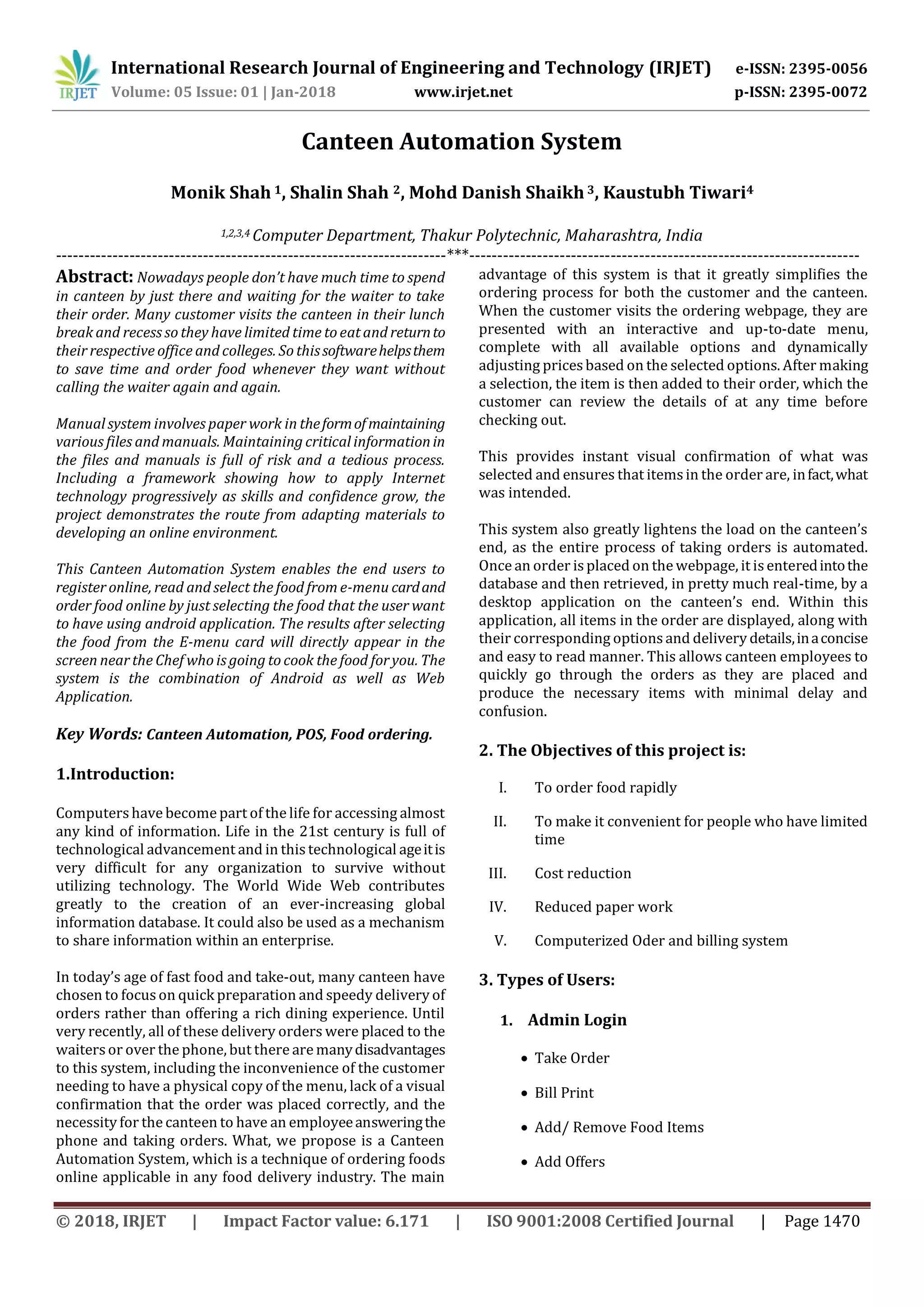
4.E-R Diagram of system:
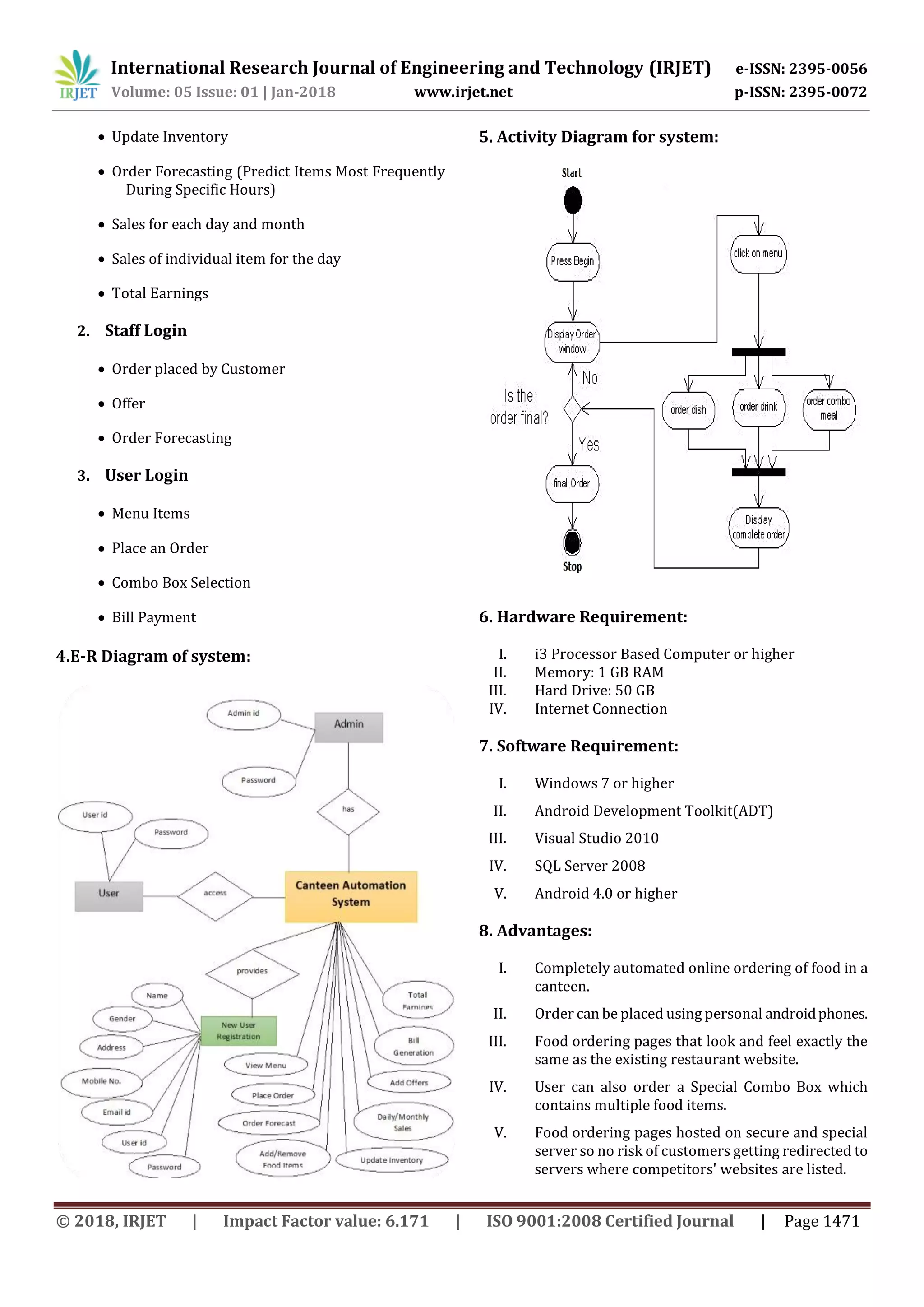
5. Activity Diagram for system:
6. Hardware Requirement:
I. i3 Processor Based Computer or higher
II. Memory: 1 GB RAM
III. Hard Drive: 50 GB
IV. Internet Connection
7. Software Requirement:
I. Windows 7 or higher
II. Android Development Toolkit(ADT)
III. Visual Studio 2010
IV. SQL Server 2008
V. Android 4.0 or higher
8. Advantages:
I. Completely automated online ordering of food in a
canteen.
II. Order can be placed using personal androidphones.
III. Food ordering pages that look and feel exactly the
same as the existing restaurant website.
IV. User can also order a Special Combo Box which
contains multiple food items.
V. Food ordering pages hosted on secure and special
server so no risk of customers getting redirected to
servers where competitors' websites are listed.
International Research Journal of Engineering and Technology (IRJET) e-ISSN: 2395-0056
Volume: 05 Issue: 01 | Jan-2018 www.irjet.net p-ISSN: 2395-0072
© 2018, IRJET | Impact Factor value: 6.171 | ISO 9001:2008 Certified Journal | Page 1472
VI. Developed using the latest website programming
protocols for minimum server loads and ultra-fast
loading and processing.
VII. Simple user-interface Admin Panel for creation and
configuration of menu groups, menu items, etc.
VIII. Built-in facility to set modifiers on different menu
items
IX. Facility to create modifier groups, individual
modifier items and assign modifier items into
different groups
X. Single and individual Admin Panel and login for
each Canteen
XI. Detailed summary of orders placed with option to
search orders, update order status, printorders,etc.
XII. Various reports to view total sales, details of
registered members with facility to print report.
9. Disadvantages:
I. Requires an active internet connection.
II. Requires Android phone if user is ordering.
10.Applications:
This system can also be used in Restaurants, Cafeteria, Etc.
11.Features:
11.1 Load Balancing:
Since the system will be available only the admin logs in the
amount of load on server will be limited to time period of
admin access.
11.2 Easy Accessibility:
Records can be easily accessed and store and other
information respectively.
11.3 User Friendly:
The web application will be giving a very user friendly
approach for all user.
11.4 Efficient and reliable:
Maintaining the all secured and database on the server
which will be accessible according the user requirement
without any maintenance cost will be a very efficient as
compared to storing all the customer data on the
spreadsheet or in physically in the record books.
11.5 Easy maintenance:
Canteen Automation System is design as easy way. So
maintenance is also easy.
12. Conclusion:
The development of Canteen Automation system involved
many phases. The approach used is a top-down one
concentrating on what first, then how and moving to
successive levels of details.
The first phase started with a detailed study of the problems
and prospects of ordering in Foods. In the course of this
study, many problemswere discovered to havehinderedthe
effectivenessof the existing manual system.Theseproblems,
information needsand activitieswere documentedandlater
used as the basis for system design, which immediately
followed the first phase. The design phase was concerned
primarily with the specification of the system elements in
manner that best met the organization’s business needs.
During this phase, strict adherence was made on proven
software engineering principlesandpractices.Toimplement
this design, a computer program wasthenwrittenandtested
in Visual Studio .Net environment.
It is hoped that effective implementation of this software
product would eliminate many problemsdiscovered during
systems investigation.
References:
[1] en.wikipedia.org
[2] Microsoft Developer Network (MSDN):
http://msdn2.microsoft.com/en-us/default.aspx:
This is a valuable online resource, and is a must for
any developer using Microsoft tools.
[3] http://www.asp.net/: This is the official Microsoft
ASP.NET web site. It has a lot of: tutorials, training
videos, and sample projects.
[4] http://www.isr.umd.edu/Courses/BARAS-
ENSE623/secured/Class%20Handouts/Trade-Off-
1.pdf

Canteen Automation System

  • 1.
    International Research Journalof Engineering and Technology (IRJET) e-ISSN: 2395-0056 Volume: 05 Issue: 01 | Jan-2018 www.irjet.net p-ISSN: 2395-0072 © 2018, IRJET | Impact Factor value: 6.171 | ISO 9001:2008 Certified Journal | Page 1470 Canteen Automation System Monik Shah 1, Shalin Shah 2, Mohd Danish Shaikh3, Kaustubh Tiwari4 1,2,3,4 Computer Department, Thakur Polytechnic, Maharashtra, India ---------------------------------------------------------------------***--------------------------------------------------------------------- Abstract: Nowadays people don’t have much time to spend in canteen by just there and waiting for the waiter to take their order. Many customer visits the canteen in their lunch break and recess so they have limited time to eat and returnto their respective office and colleges. So thissoftwarehelpsthem to save time and order food whenever they want without calling the waiter again and again. Manual system involves paper work in theformofmaintaining various files and manuals. Maintaining critical informationin the files and manuals is full of risk and a tedious process. Including a framework showing how to apply Internet technology progressively as skills and confidence grow, the project demonstrates the route from adapting materials to developing an online environment. This Canteen Automation System enables the end users to register online, read and select the food from e-menu cardand order food online by just selecting the food that the user want to have using android application. The results after selecting the food from the E-menu card will directly appear in the screen near the Chef who is going to cook the food for you. The system is the combination of Android as well as Web Application. Key Words: Canteen Automation, POS, Food ordering. 1.Introduction: Computers have become part of the life for accessing almost any kind of information. Life in the 21st century is full of technological advancement and in this technological ageitis very difficult for any organization to survive without utilizing technology. The World Wide Web contributes greatly to the creation of an ever-increasing global information database. It could also be used as a mechanism to share information within an enterprise. In today’s age of fast food and take-out, many canteen have chosen to focus on quick preparation and speedy delivery of orders rather than offering a rich dining experience. Until very recently, all of these delivery orders were placed to the waiters or over the phone, but there are manydisadvantages to this system, including the inconvenience of the customer needing to have a physical copy of the menu, lack of a visual confirmation that the order was placed correctly, and the necessity for the canteen to have an employeeansweringthe phone and taking orders. What, we propose is a Canteen Automation System, which is a technique of ordering foods online applicable in any food delivery industry. The main advantage of this system is that it greatly simplifies the ordering process for both the customer and the canteen. When the customer visits the ordering webpage, they are presented with an interactive and up-to-date menu, complete with all available options and dynamically adjusting pricesbased on the selected options. After making a selection, the item is then added to their order, which the customer can review the details of at any time before checking out. This provides instant visual confirmation of what was selected and ensures that itemsin the order are, infact,what was intended. This system also greatly lightens the load on the canteen’s end, as the entire process of taking orders is automated. Once an order is placed on the webpage, it isenteredintothe database and then retrieved, in pretty much real-time, by a desktop application on the canteen’s end. Within this application, all items in the order are displayed, along with their corresponding options and delivery details,inaconcise and easy to read manner. This allows canteen employees to quickly go through the orders as they are placed and produce the necessary items with minimal delay and confusion. 2. The Objectives of this project is: I. To order food rapidly II. To make it convenient for people who have limited time III. Cost reduction IV. Reduced paper work V. Computerized Oder and billing system 3. Types of Users: 1. Admin Login  Take Order  Bill Print  Add/ Remove Food Items  Add Offers
  • 2.
    International Research Journalof Engineering and Technology (IRJET) e-ISSN: 2395-0056 Volume: 05 Issue: 01 | Jan-2018 www.irjet.net p-ISSN: 2395-0072 © 2018, IRJET | Impact Factor value: 6.171 | ISO 9001:2008 Certified Journal | Page 1471  Update Inventory  Order Forecasting (Predict Items Most Frequently During Specific Hours)  Sales for each day and month  Sales of individual item for the day  Total Earnings 2. Staff Login  Order placed by Customer  Offer  Order Forecasting 3. User Login  Menu Items  Place an Order  Combo Box Selection  Bill Payment 4.E-R Diagram of system: 5. Activity Diagram for system: 6. Hardware Requirement: I. i3 Processor Based Computer or higher II. Memory: 1 GB RAM III. Hard Drive: 50 GB IV. Internet Connection 7. Software Requirement: I. Windows 7 or higher II. Android Development Toolkit(ADT) III. Visual Studio 2010 IV. SQL Server 2008 V. Android 4.0 or higher 8. Advantages: I. Completely automated online ordering of food in a canteen. II. Order can be placed using personal androidphones. III. Food ordering pages that look and feel exactly the same as the existing restaurant website. IV. User can also order a Special Combo Box which contains multiple food items. V. Food ordering pages hosted on secure and special server so no risk of customers getting redirected to servers where competitors' websites are listed.
  • 3.
    International Research Journalof Engineering and Technology (IRJET) e-ISSN: 2395-0056 Volume: 05 Issue: 01 | Jan-2018 www.irjet.net p-ISSN: 2395-0072 © 2018, IRJET | Impact Factor value: 6.171 | ISO 9001:2008 Certified Journal | Page 1472 VI. Developed using the latest website programming protocols for minimum server loads and ultra-fast loading and processing. VII. Simple user-interface Admin Panel for creation and configuration of menu groups, menu items, etc. VIII. Built-in facility to set modifiers on different menu items IX. Facility to create modifier groups, individual modifier items and assign modifier items into different groups X. Single and individual Admin Panel and login for each Canteen XI. Detailed summary of orders placed with option to search orders, update order status, printorders,etc. XII. Various reports to view total sales, details of registered members with facility to print report. 9. Disadvantages: I. Requires an active internet connection. II. Requires Android phone if user is ordering. 10.Applications: This system can also be used in Restaurants, Cafeteria, Etc. 11.Features: 11.1 Load Balancing: Since the system will be available only the admin logs in the amount of load on server will be limited to time period of admin access. 11.2 Easy Accessibility: Records can be easily accessed and store and other information respectively. 11.3 User Friendly: The web application will be giving a very user friendly approach for all user. 11.4 Efficient and reliable: Maintaining the all secured and database on the server which will be accessible according the user requirement without any maintenance cost will be a very efficient as compared to storing all the customer data on the spreadsheet or in physically in the record books. 11.5 Easy maintenance: Canteen Automation System is design as easy way. So maintenance is also easy. 12. Conclusion: The development of Canteen Automation system involved many phases. The approach used is a top-down one concentrating on what first, then how and moving to successive levels of details. The first phase started with a detailed study of the problems and prospects of ordering in Foods. In the course of this study, many problemswere discovered to havehinderedthe effectivenessof the existing manual system.Theseproblems, information needsand activitieswere documentedandlater used as the basis for system design, which immediately followed the first phase. The design phase was concerned primarily with the specification of the system elements in manner that best met the organization’s business needs. During this phase, strict adherence was made on proven software engineering principlesandpractices.Toimplement this design, a computer program wasthenwrittenandtested in Visual Studio .Net environment. It is hoped that effective implementation of this software product would eliminate many problemsdiscovered during systems investigation. References: [1] en.wikipedia.org [2] Microsoft Developer Network (MSDN): http://msdn2.microsoft.com/en-us/default.aspx: This is a valuable online resource, and is a must for any developer using Microsoft tools. [3] http://www.asp.net/: This is the official Microsoft ASP.NET web site. It has a lot of: tutorials, training videos, and sample projects. [4] http://www.isr.umd.edu/Courses/BARAS- ENSE623/secured/Class%20Handouts/Trade-Off- 1.pdf