COMMUNICATIONS SYSTEMS and
INTEROPERABILITY
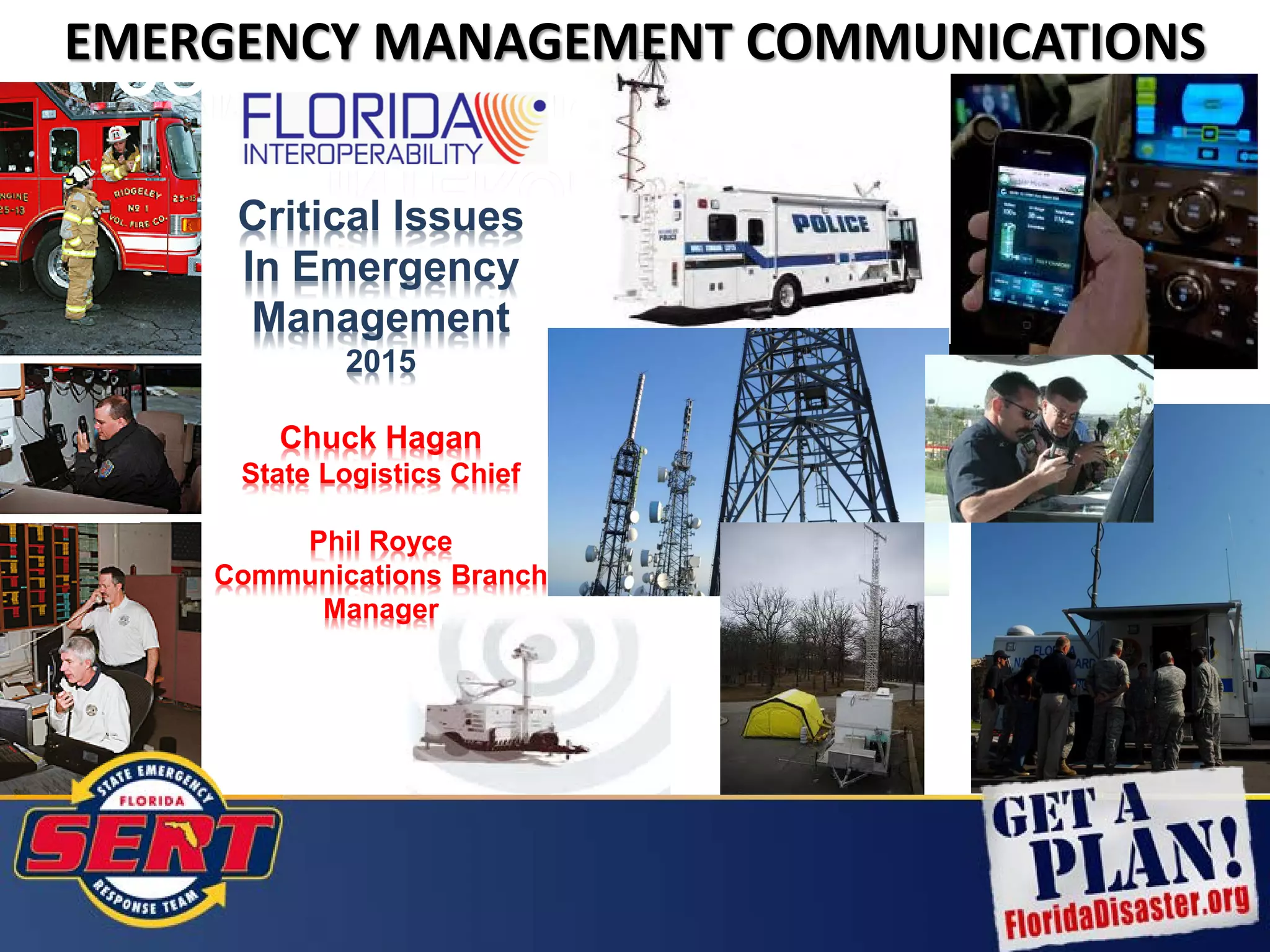
EMERGENCY MANAGEMENT COMMUNICATIONS
Critical Issues
In Emergency
Management
2015
Chuck Hagan
State Logistics Chief
Phil Royce
Communications Branch
Manager
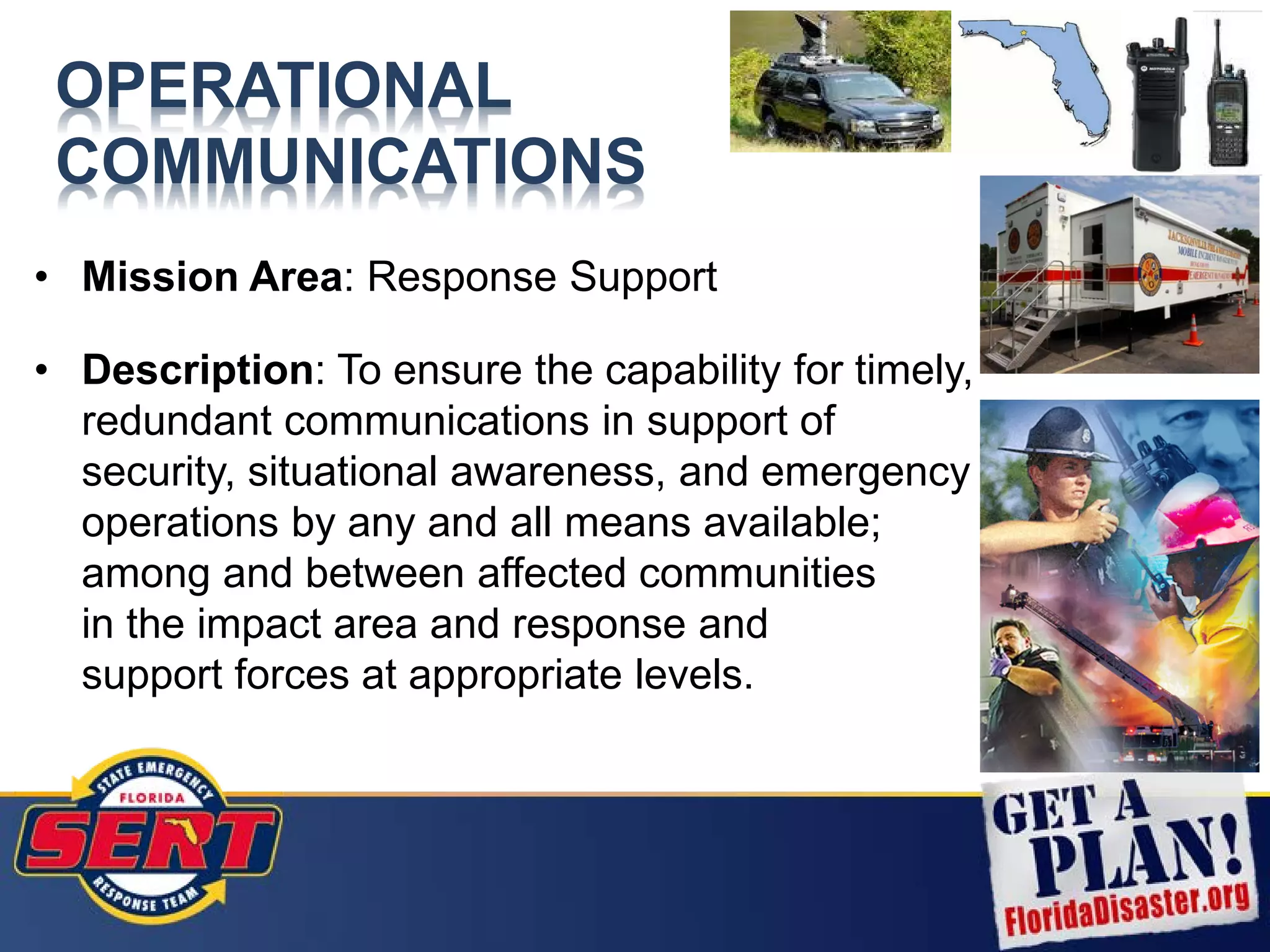
OPERATIONAL
COMMUNICATIONS
• Mission Area: Response Support
• Description: To ensure the capability for timely,
redundant communications in support of
security, situational awareness, and emergency
operations by any and all means available;
among and between affected communities
in the impact area and response and
support forces at appropriate levels.
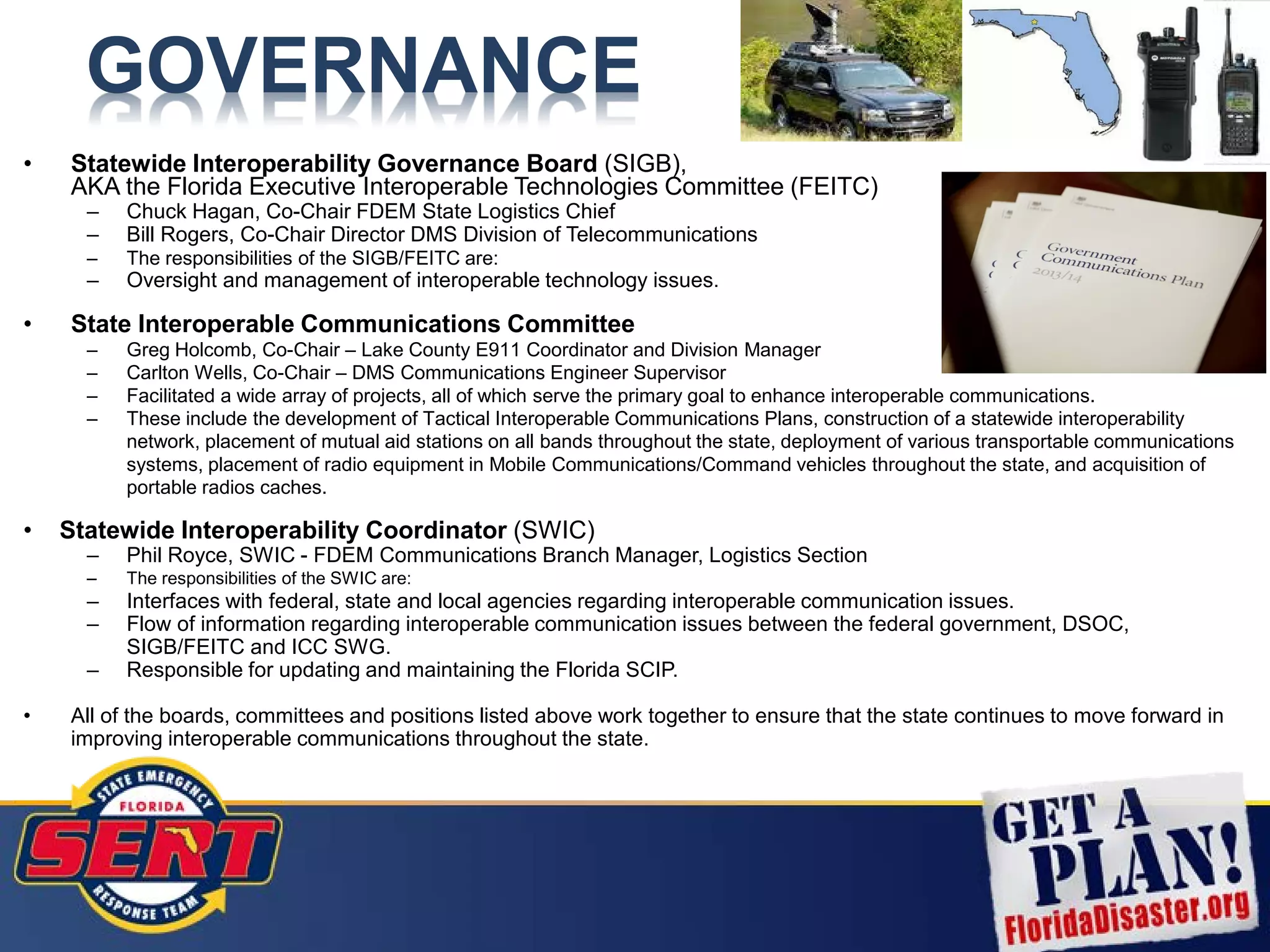
GOVERNANCE
• Statewide Interoperability Governance Board (SIGB),
AKA the Florida Executive Interoperable Technologies Committee (FEITC)
– Chuck Hagan, Co-Chair FDEM State Logistics Chief
– Bill Rogers, Co-Chair Director DMS Division of Telecommunications
– The responsibilities of the SIGB/FEITC are:
– Oversight and management of interoperable technology issues.
• State Interoperable Communications Committee
– Greg Holcomb, Co-Chair – Lake County E911 Coordinator and Division Manager
– Carlton Wells, Co-Chair – DMS Communications Engineer Supervisor
– Facilitated a wide array of projects, all of which serve the primary goal to enhance interoperable communications.
– These include the development of Tactical Interoperable Communications Plans, construction of a statewide interoperability
network, placement of mutual aid stations on all bands throughout the state, deployment of various transportable communications
systems, placement of radio equipment in Mobile Communications/Command vehicles throughout the state, and acquisition of
portable radios caches.
• Statewide Interoperability Coordinator (SWIC)
– Phil Royce, SWIC - FDEM Communications Branch Manager, Logistics Section
– The responsibilities of the SWIC are:
– Interfaces with federal, state and local agencies regarding interoperable communication issues.
– Flow of information regarding interoperable communication issues between the federal government, DSOC,
SIGB/FEITC and ICC SWG.
– Responsible for updating and maintaining the Florida SCIP.
• All of the boards, committees and positions listed above work together to ensure that the state continues to move forward in
improving interoperable communications throughout the state.
Interoperable vs. Non Interoperable
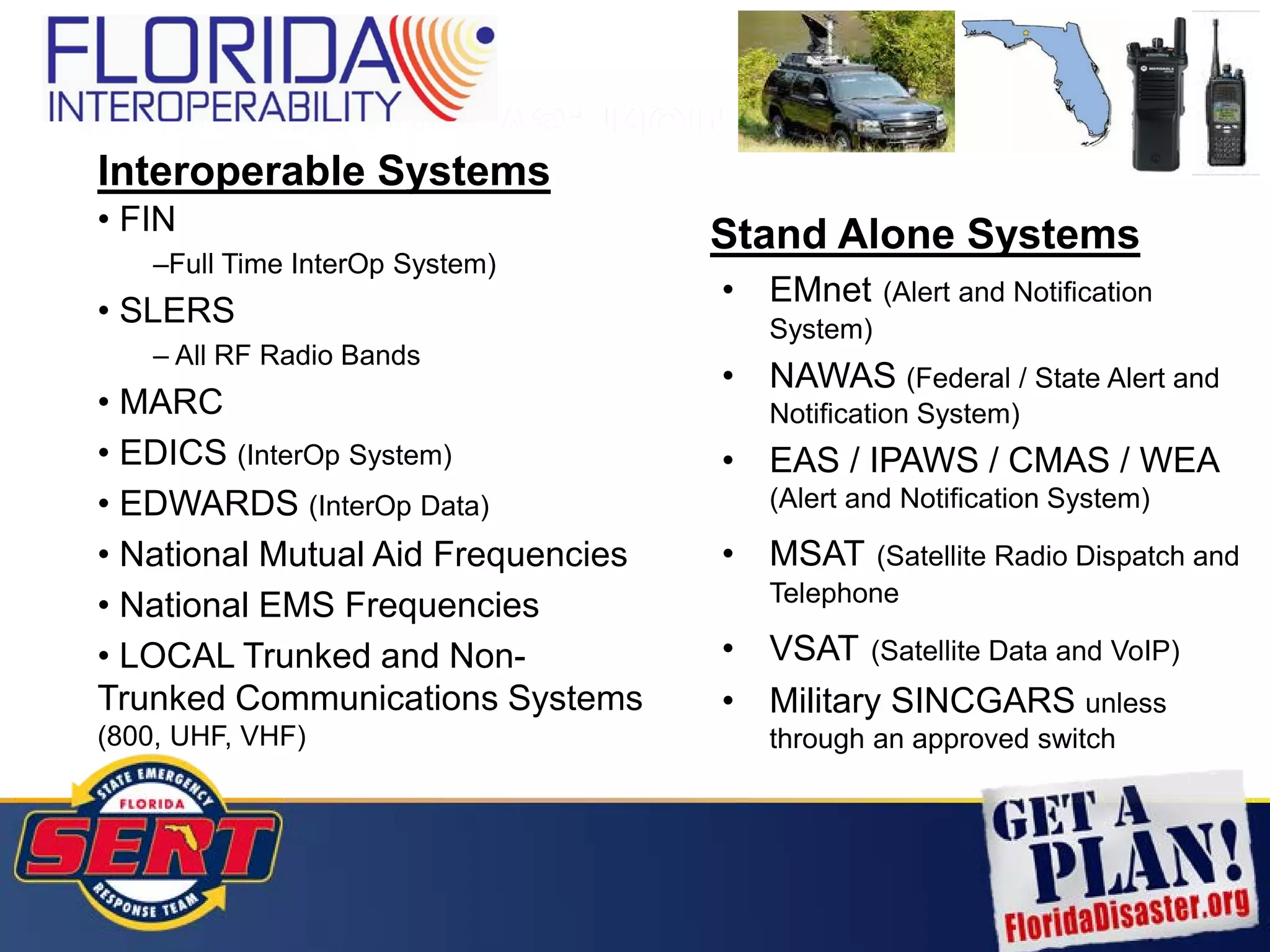
Interoperable Systems
• FIN
–Full Time InterOp System)
• SLERS
– All RF Radio Bands
• MARC
• EDICS (InterOp System)
• EDWARDS (InterOp Data)
• National Mutual Aid Frequencies
• National EMS Frequencies
• LOCAL Trunked and Non-
Trunked Communications Systems
(800, UHF, VHF)
Stand Alone Systems
• EMnet (Alert and Notification
System)
• NAWAS (Federal / State Alert and
Notification System)
• EAS / IPAWS / CMAS / WEA
(Alert and Notification System)
• MSAT (Satellite Radio Dispatch and
Telephone
• VSAT (Satellite Data and VoIP)
• Military SINCGARS unless
through an approved switch
Interoperable
Communications Exercises
and Training
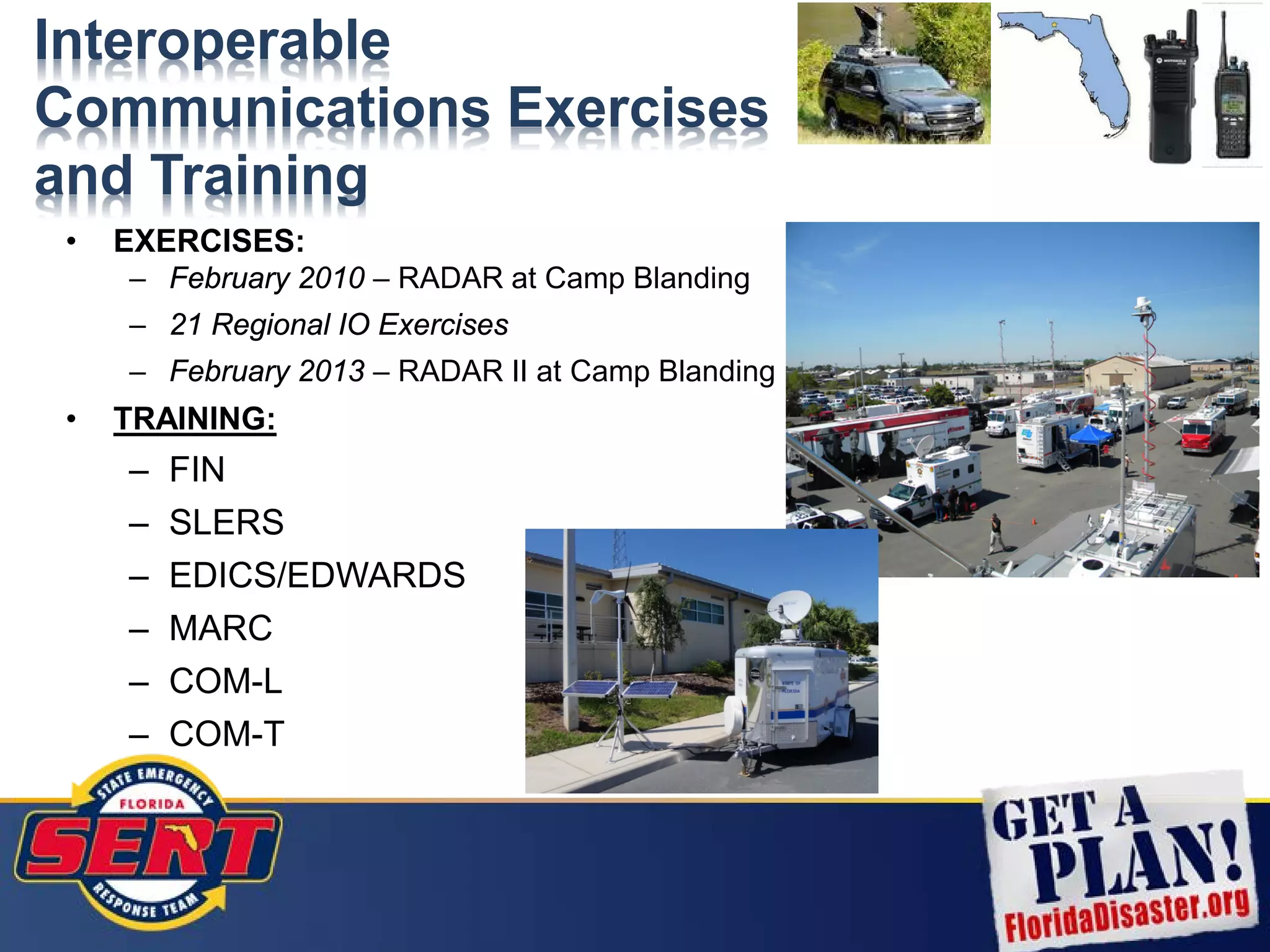
• EXERCISES:
– February 2010 – RADAR at Camp Blanding
– 21 Regional IO Exercises
– February 2013 – RADAR II at Camp Blanding
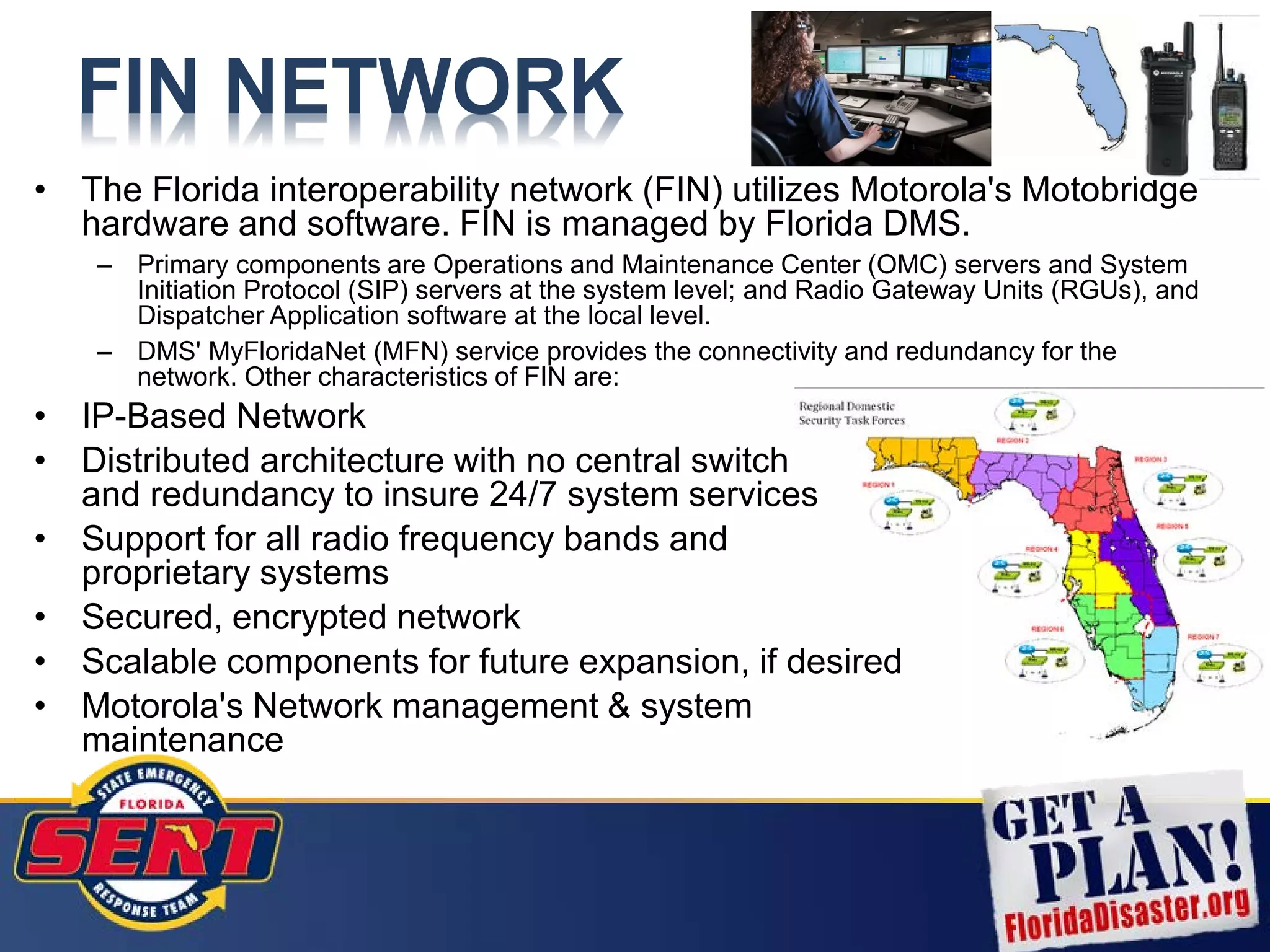
• TRAINING:
– FIN
– SLERS
– EDICS/EDWARDS
– MARC
– COM-L
– COM-T
FIN NETWORK
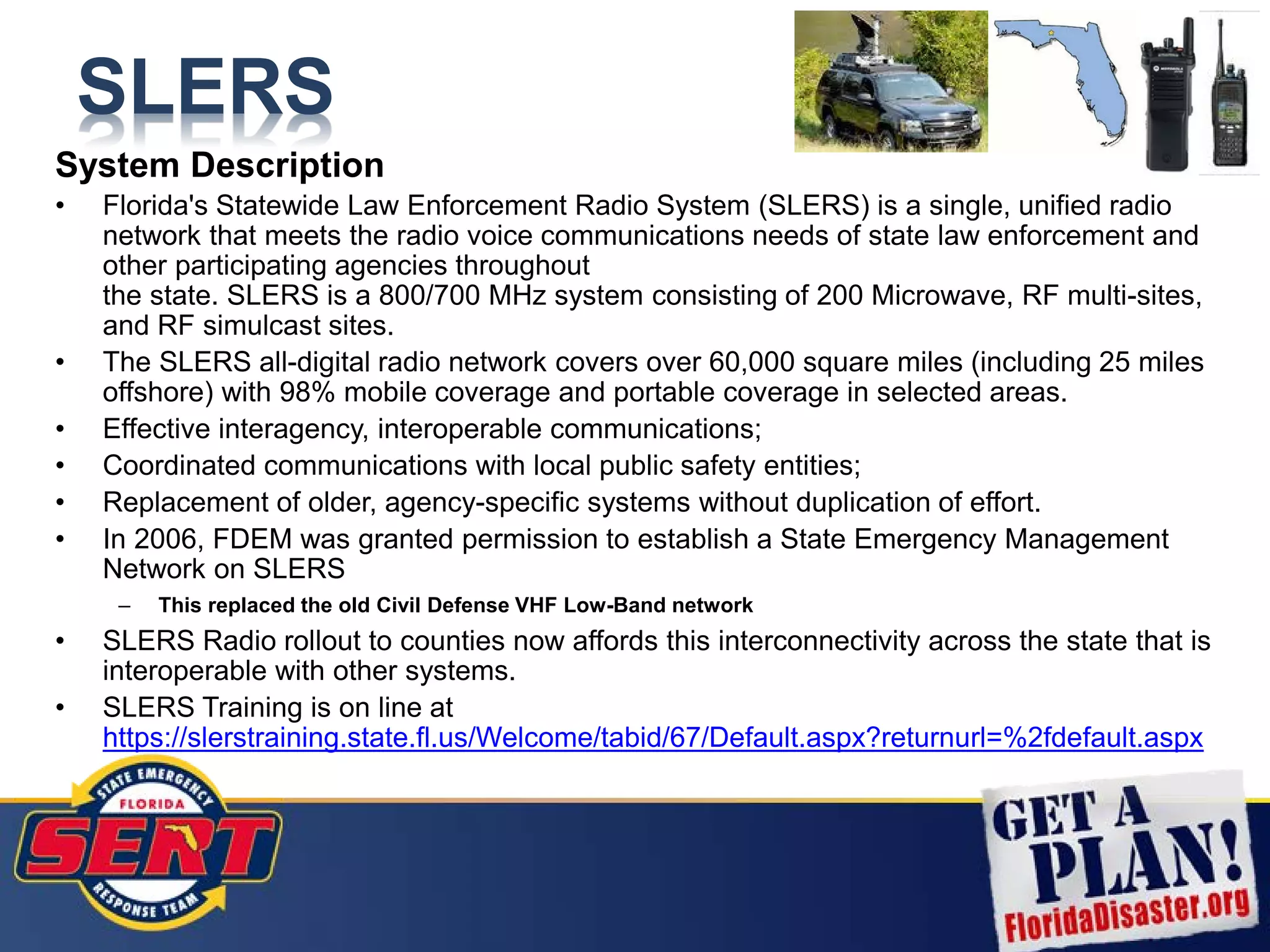
• The Florida interoperability network (FIN) utilizes Motorola's Motobridge
hardware and software. FIN is managed by Florida DMS.
– Primary components are Operations and Maintenance Center (OMC) servers and System
Initiation Protocol (SIP) servers at the system level; and Radio Gateway Units (RGUs), and
Dispatcher Application software at the local level.
– DMS' MyFloridaNet (MFN) service provides the connectivity and redundancy for the
network. Other characteristics of FIN are:
• IP-Based Network
• Distributed architecture with no central switch
and redundancy to insure 24/7 system services
• Support for all radio frequency bands and
proprietary systems
• Secured, encrypted network
• Scalable components for future expansion, if desired
• Motorola's Network management & system
maintenance
SLERS
System Description
• Florida's Statewide Law Enforcement Radio System (SLERS) is a single, unified radio
network that meets the radio voice communications needs of state law enforcement and
other participating agencies throughout
the state. SLERS is a 800/700 MHz system consisting of 200 Microwave, RF multi-sites,
and RF simulcast sites.
• The SLERS all-digital radio network covers over 60,000 square miles (including 25 miles
offshore) with 98% mobile coverage and portable coverage in selected areas.
• Effective interagency, interoperable communications;
• Coordinated communications with local public safety entities;
• Replacement of older, agency-specific systems without duplication of effort.
• In 2006, FDEM was granted permission to establish a State Emergency Management
Network on SLERS
– This replaced the old Civil Defense VHF Low-Band network
• SLERS Radio rollout to counties now affords this interconnectivity across the state that is
interoperable with other systems.
• SLERS Training is on line at
https://slerstraining.state.fl.us/Welcome/tabid/67/Default.aspx?returnurl=%2fdefault.aspx
EDICS / EDWARDS
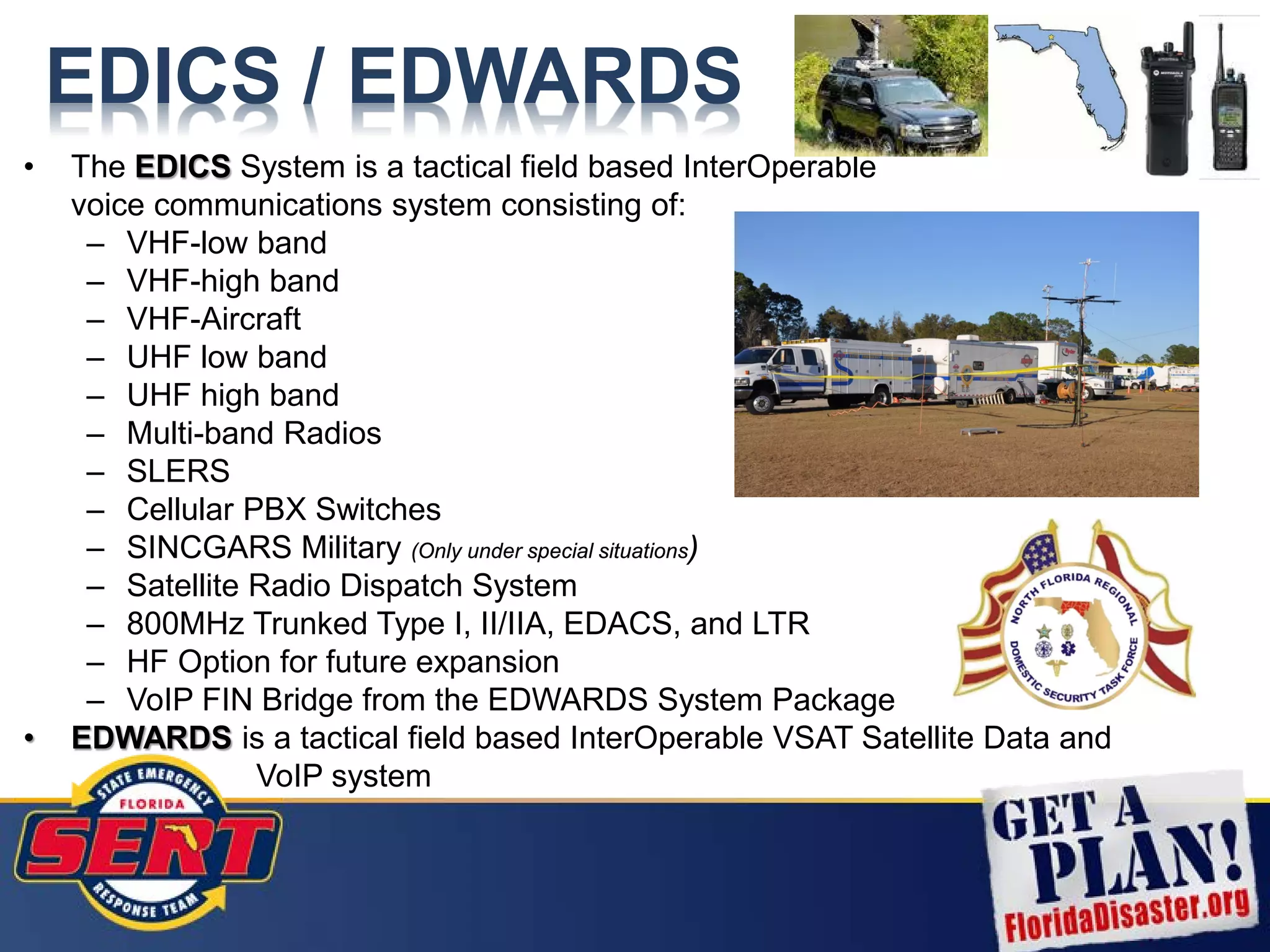
• The EDICS System is a tactical field based InterOperable
voice communications system consisting of:
– VHF-low band
– VHF-high band
– VHF-Aircraft
– UHF low band
– UHF high band
– Multi-band Radios
– SLERS
– Cellular PBX Switches
– SINCGARS Military (Only under special situations)
– Satellite Radio Dispatch System
– 800MHz Trunked Type I, II/IIA, EDACS, and LTR
– HF Option for future expansion
– VoIP FIN Bridge from the EDWARDS System Package
• EDWARDS is a tactical field based InterOperable VSAT Satellite Data and
VoIP system
NAWAS
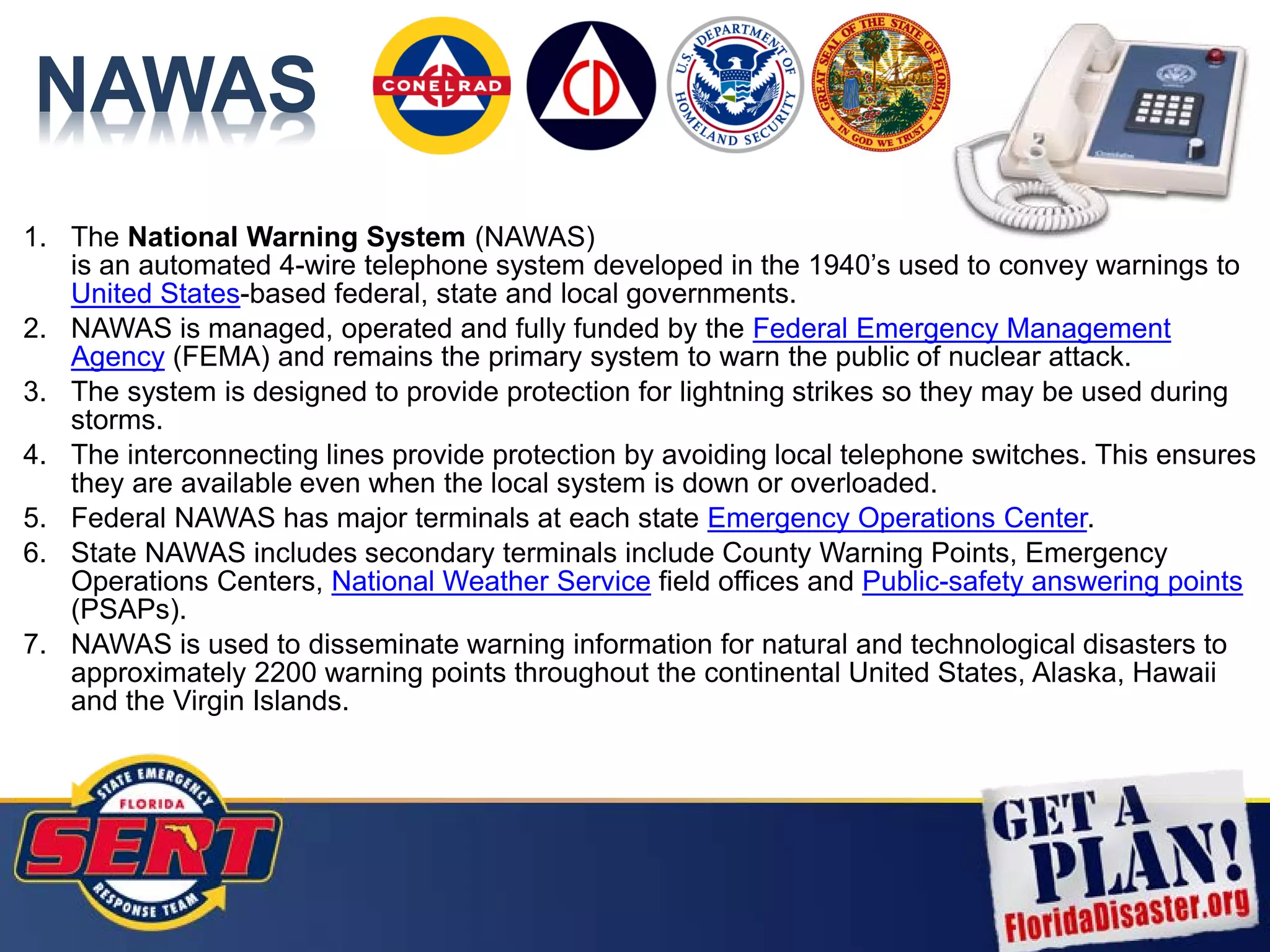
1. The National Warning System (NAWAS)
is an automated 4-wire telephone system developed in the 1940’s used to convey warnings to
United States-based federal, state and local governments.
2. NAWAS is managed, operated and fully funded by the Federal Emergency Management
Agency (FEMA) and remains the primary system to warn the public of nuclear attack.
3. The system is designed to provide protection for lightning strikes so they may be used during
storms.
4. The interconnecting lines provide protection by avoiding local telephone switches. This ensures
they are available even when the local system is down or overloaded.
5. Federal NAWAS has major terminals at each state Emergency Operations Center.
6. State NAWAS includes secondary terminals include County Warning Points, Emergency
Operations Centers, National Weather Service field offices and Public-safety answering points
(PSAPs).
7. NAWAS is used to disseminate warning information for natural and technological disasters to
approximately 2200 warning points throughout the continental United States, Alaska, Hawaii
and the Virgin Islands.
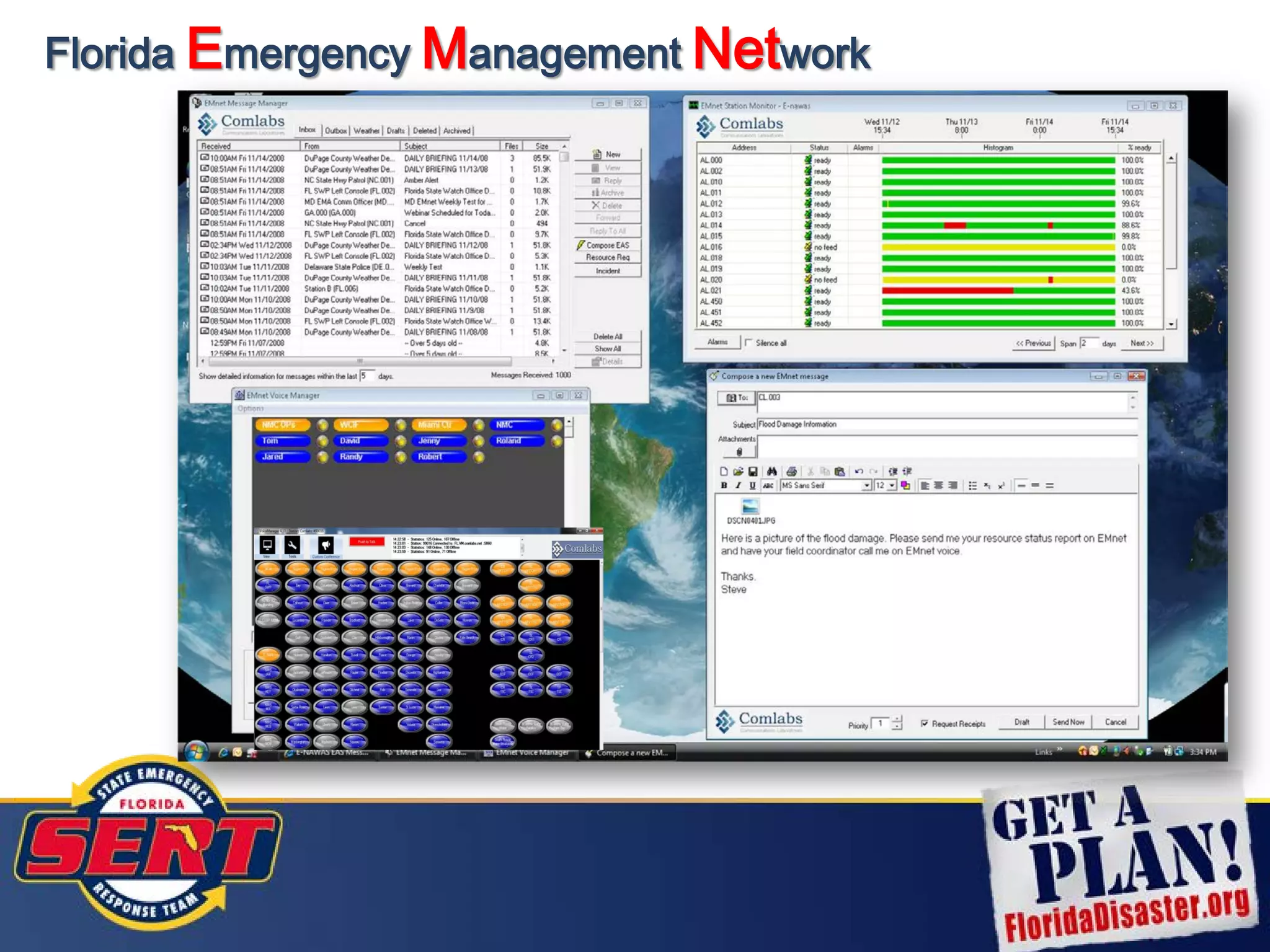
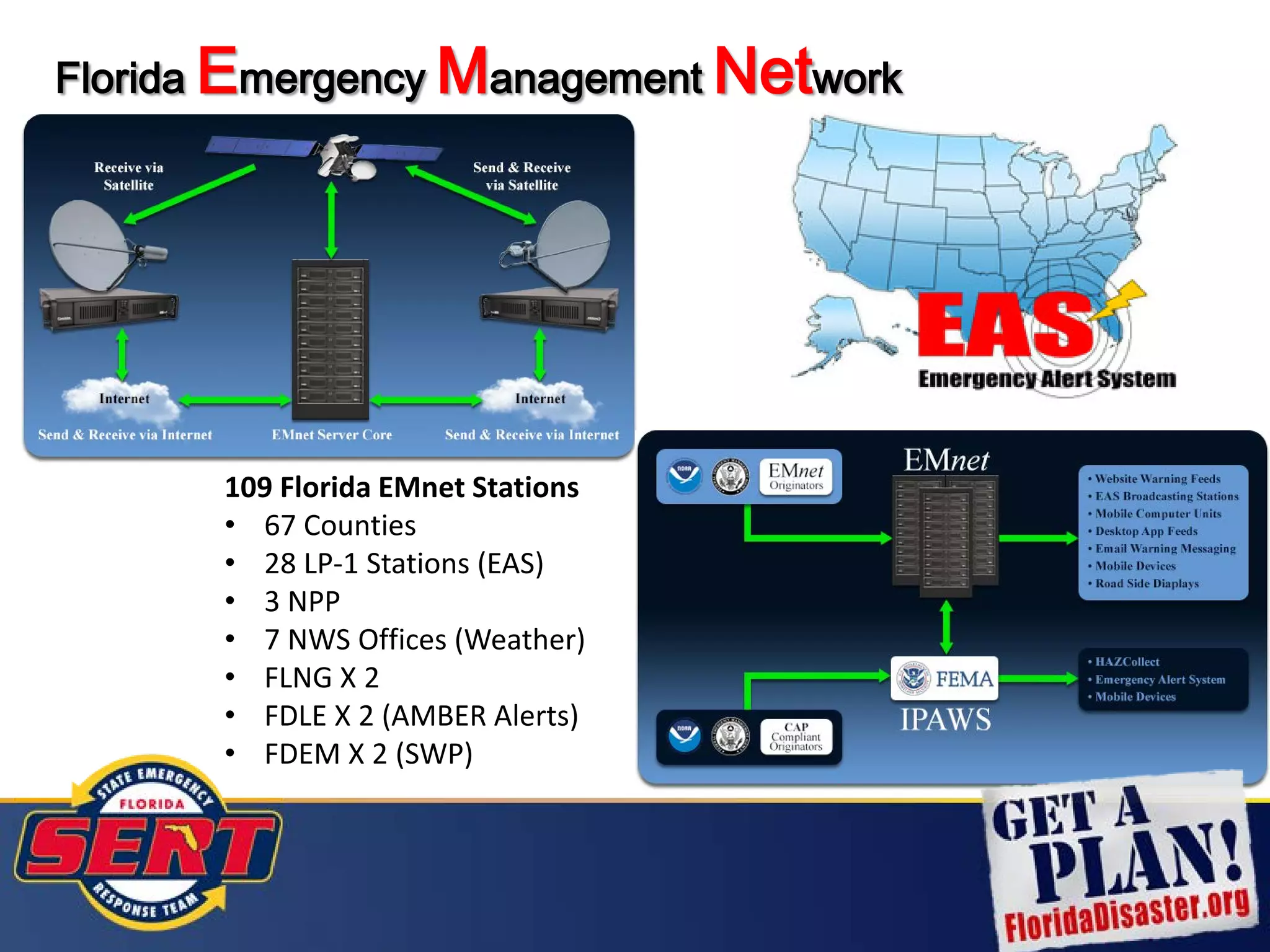
Florida Emergency Management Network
109 Florida EMnet Stations
• 67 Counties
• 28 LP-1 Stations (EAS)
• 3 NPP
• 7 NWS Offices (Weather)
• FLNG X 2
• FDLE X 2 (AMBER Alerts)
• FDEM X 2 (SWP)
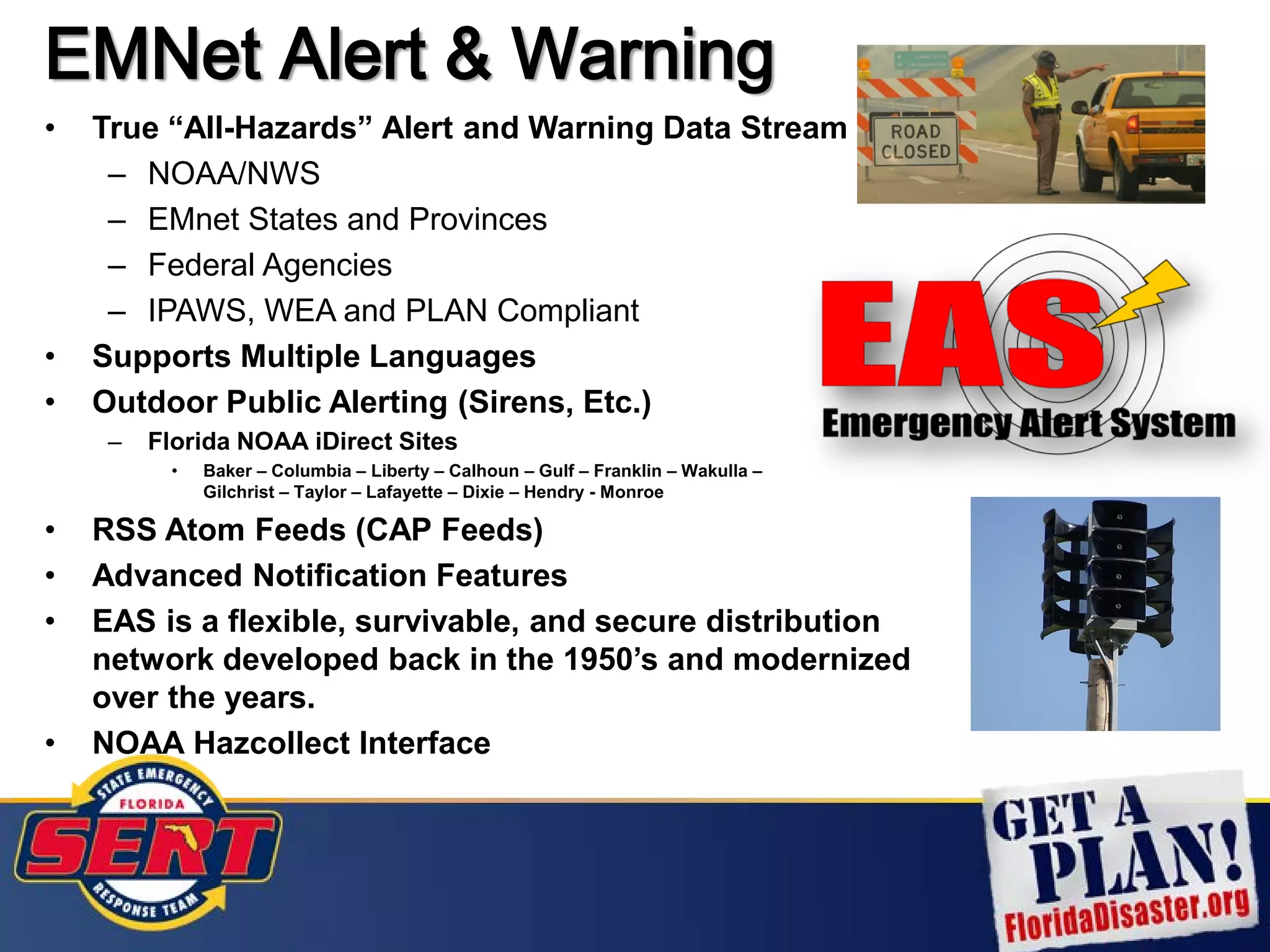
• True “All-Hazards” Alert and Warning Data Stream
– NOAA/NWS
– EMnet States and Provinces
– Federal Agencies
– IPAWS, WEA and PLAN Compliant
• Supports Multiple Languages
• Outdoor Public Alerting (Sirens, Etc.)
– Florida NOAA iDirect Sites
• Baker – Columbia – Liberty – Calhoun – Gulf – Franklin – Wakulla –
Gilchrist – Taylor – Lafayette – Dixie – Hendry - Monroe
• RSS Atom Feeds (CAP Feeds)
• Advanced Notification Features
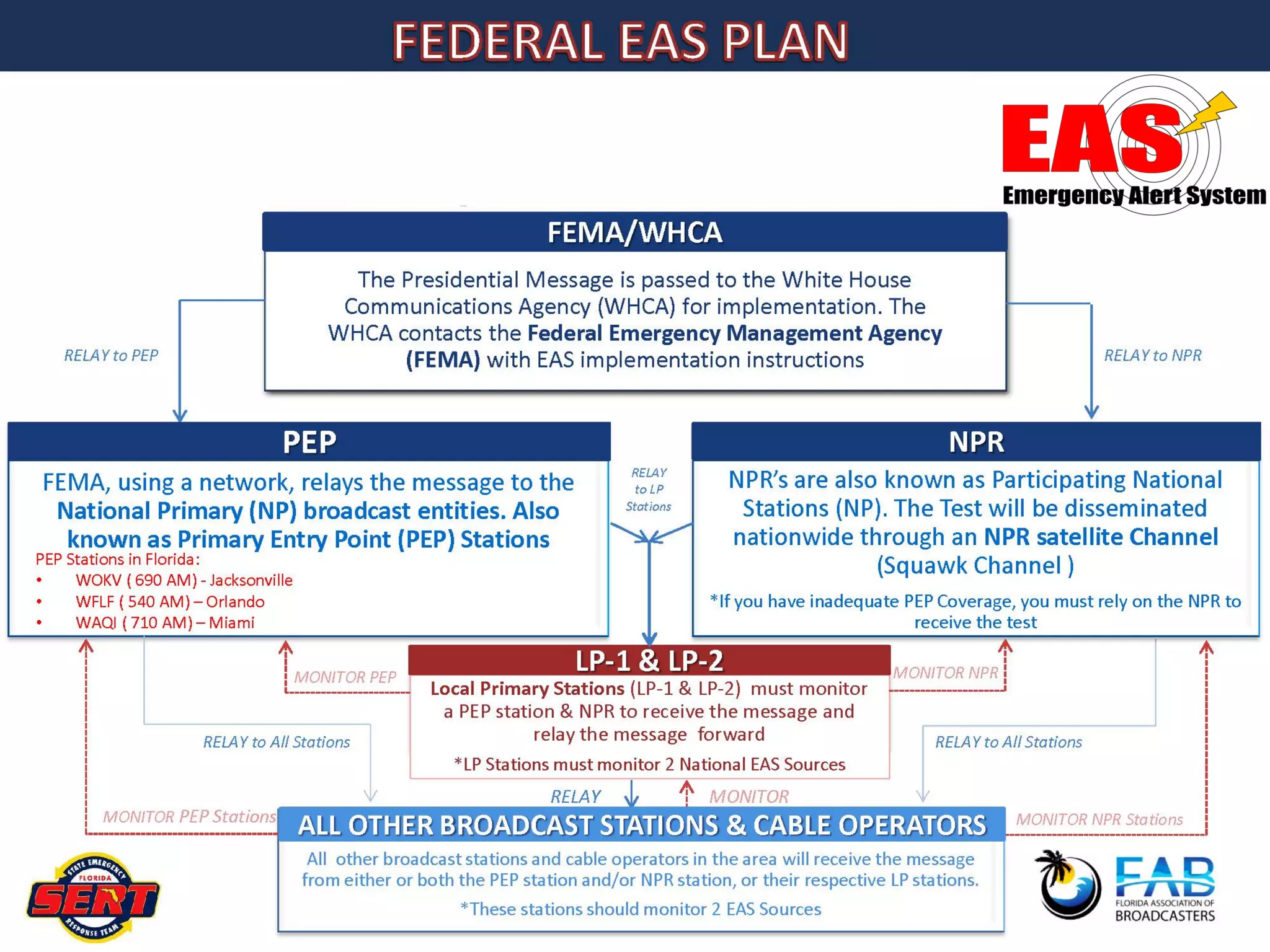
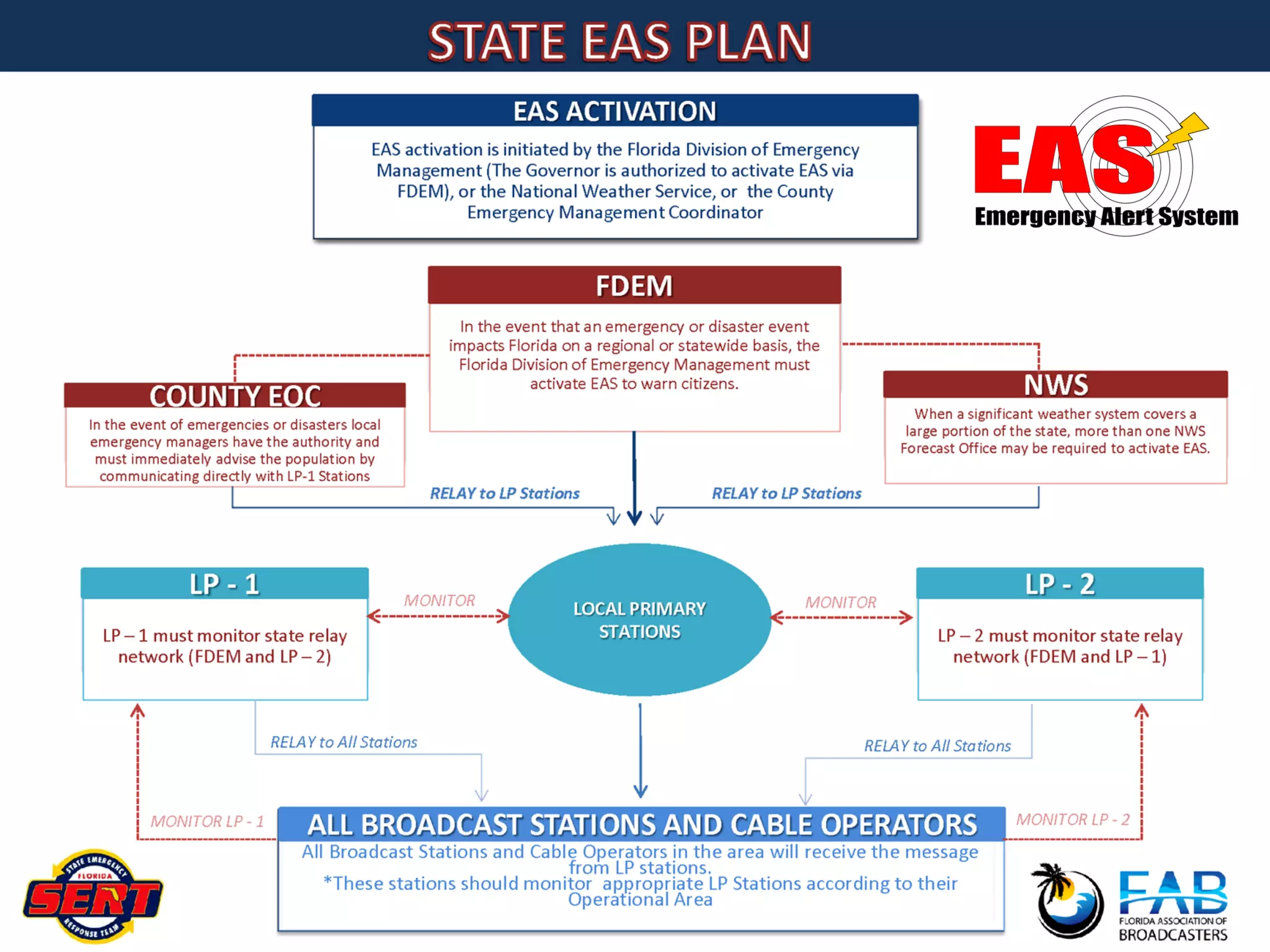
• EAS is a flexible, survivable, and secure distribution
network developed back in the 1950’s and modernized
over the years.
• NOAA Hazcollect Interface
EMNet Alert & Warning
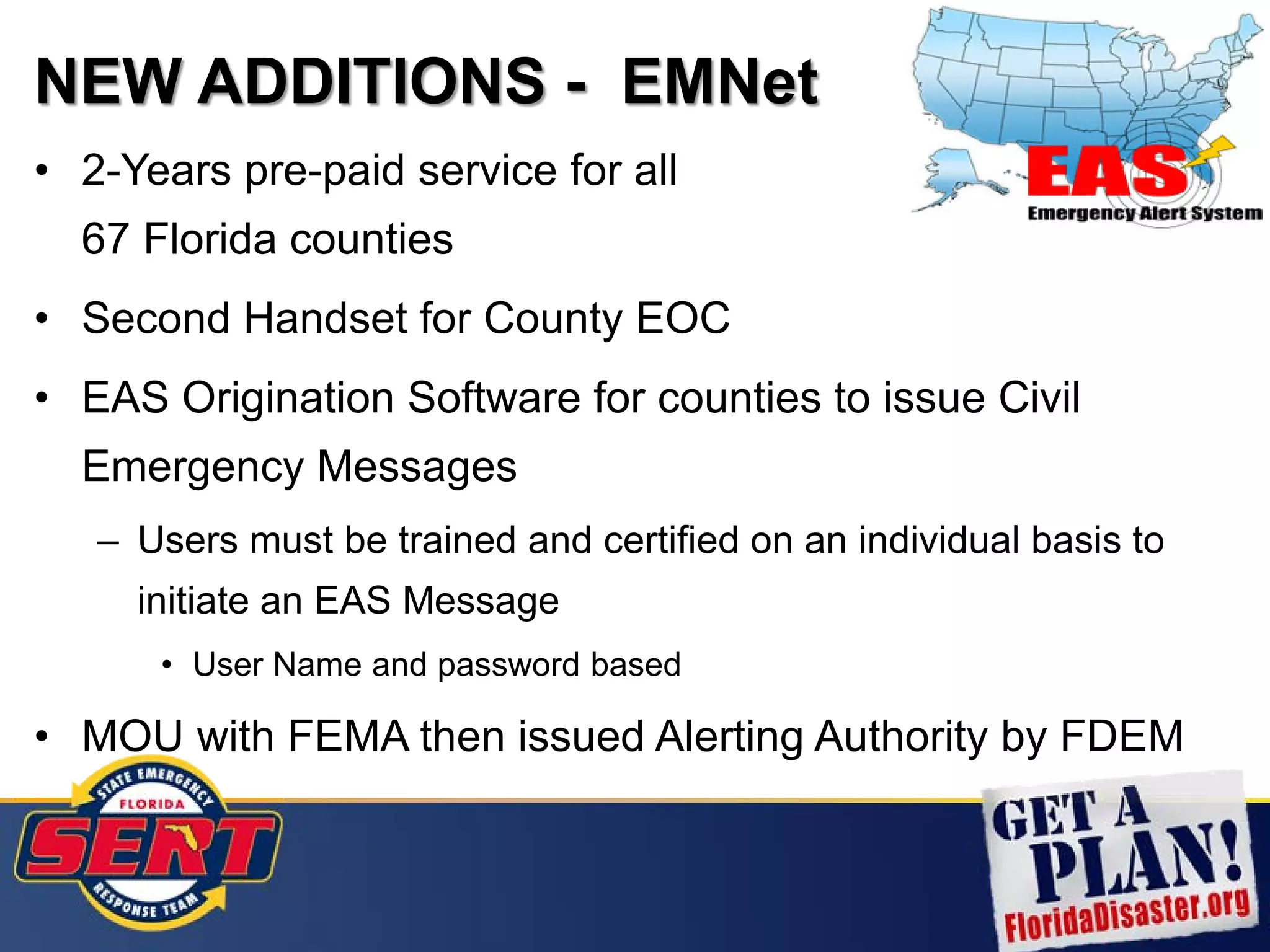
NEW ADDITIONS - EMNet
• 2-Years pre-paid service for all
67 Florida counties
• Second Handset for County EOC
• EAS Origination Software for counties to issue Civil
Emergency Messages
– Users must be trained and certified on an individual basis to
initiate an EAS Message
• User Name and password based
• MOU with FEMA then issued Alerting Authority by FDEM
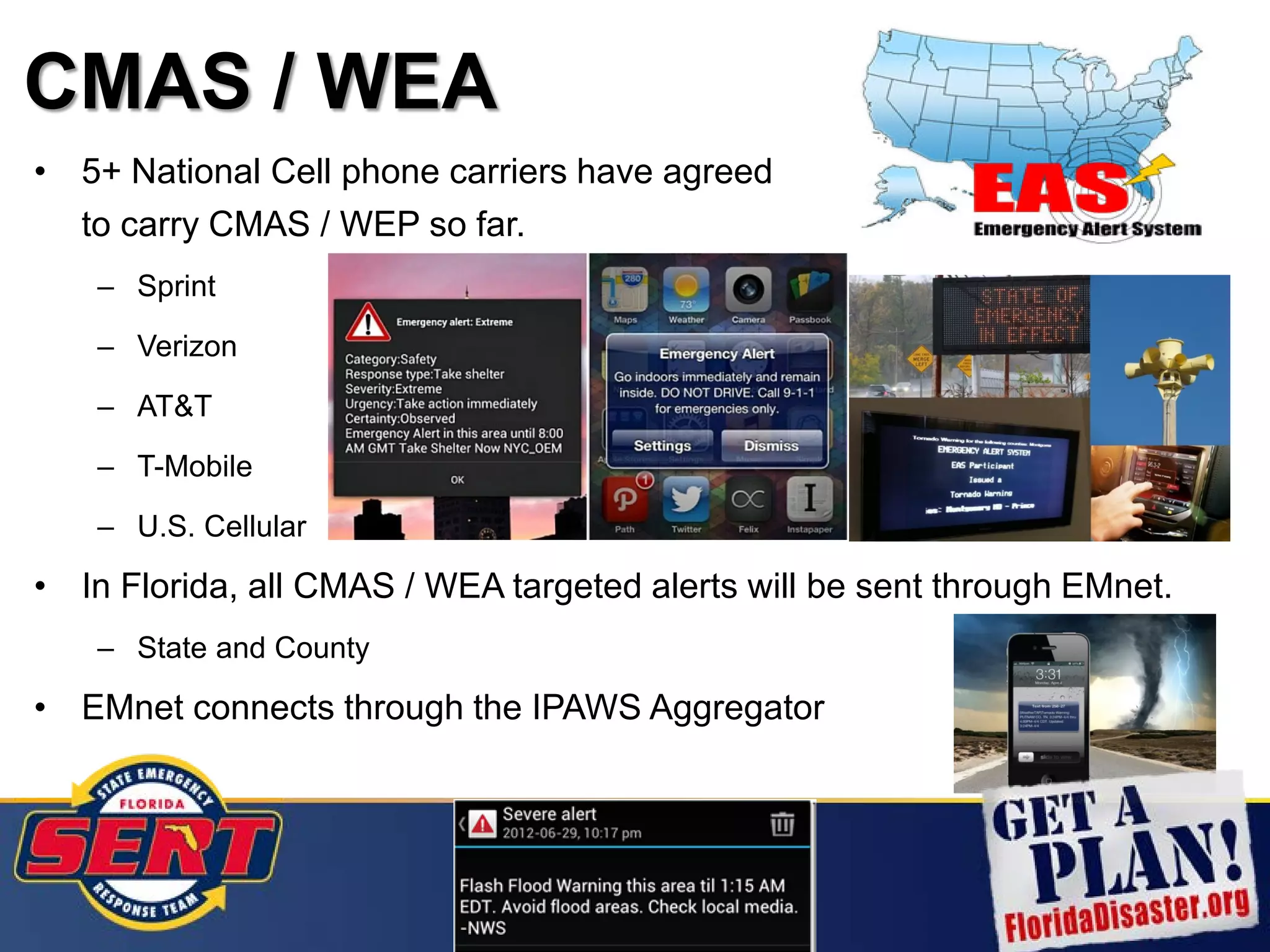
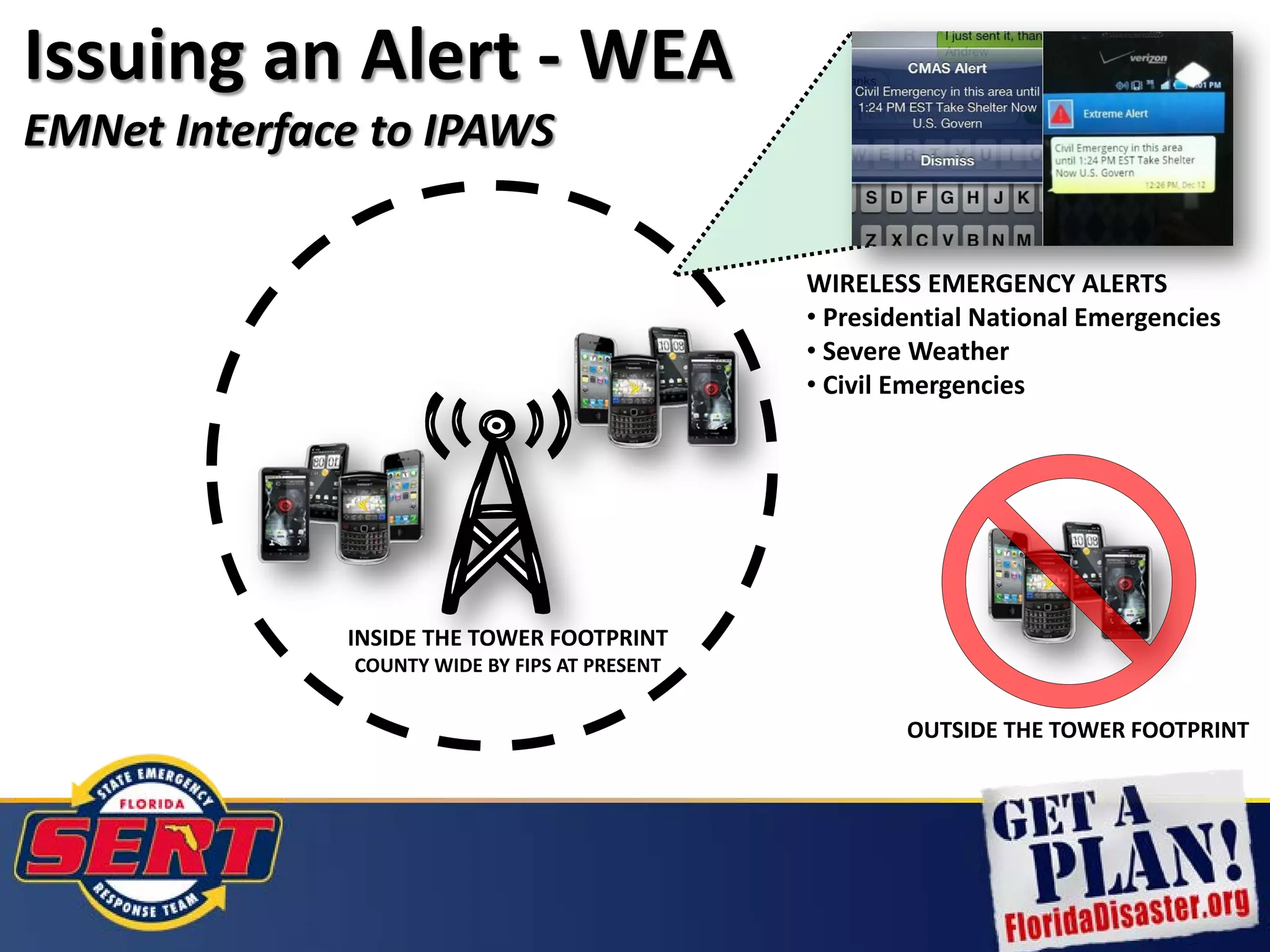
CMAS / WEA
• 5+ National Cell phone carriers have agreed
to carry CMAS / WEP so far.
– Sprint
– Verizon
– AT&T
– T-Mobile
– U.S. Cellular
• In Florida, all CMAS / WEA targeted alerts will be sent through EMnet.
– State and County
• EMnet connects through the IPAWS Aggregator
WIRELESS EMERGENCY ALERTS
• Presidential National Emergencies
• Severe Weather
• Civil Emergencies
INSIDE THE TOWER FOOTPRINT
COUNTY WIDE BY FIPS AT PRESENT
OUTSIDE THE TOWER FOOTPRINT
Issuing an Alert - WEA
EMNet Interface to IPAWS
FloridaNet Project
Status Update
DEM
October 2015
FirstNet Project Status Update
• The First Responder Network (FirstNet) Authority
was created on February 22, 2012, under the Middle
Class Tax Relief and Job Creation Act.
• FirstNet is an independent authority within the U.S. Department of
Commerce's National Telecommunications and Information
Administration.
• FloridaNet is a multi-year program designed to provide a
framework for Florida First Responders to work with the First
Responder Network Authority (FirstNet) in the design efforts for
the nations first Public Safety Broadband Network.
• The goal of this program is to work with FirstNet to create a
network design that can meet the requirements of the public
safety mission in Florida.
FloridaNet Project Status Update
• State and Local Implementation Grant (SLIGP)
awarded to Florida Department of Emergency
Management in 2013
• Agencies benefitting from this program include:
Law Enforcement • Emergency Management • Emergency
Medical Services • Tribal Public Safety Agencies • Health
Services • Public Works • Fire Services
• Florida Department of Highway Safety is sub recipient of SLIGP and
provides the full time staffing for the FloridaNet project
• On April 27, 2015, FirstNet issued the First Responder Network
Authority's Special Notice draft RFP which explains the proposed
design and operation of the Nationwide Public Safety Broadband
Network (NPSBN).
• The final RFP will be issued before the end of the calendar year, yet
it could take another 12-to-18 months before an award is made.
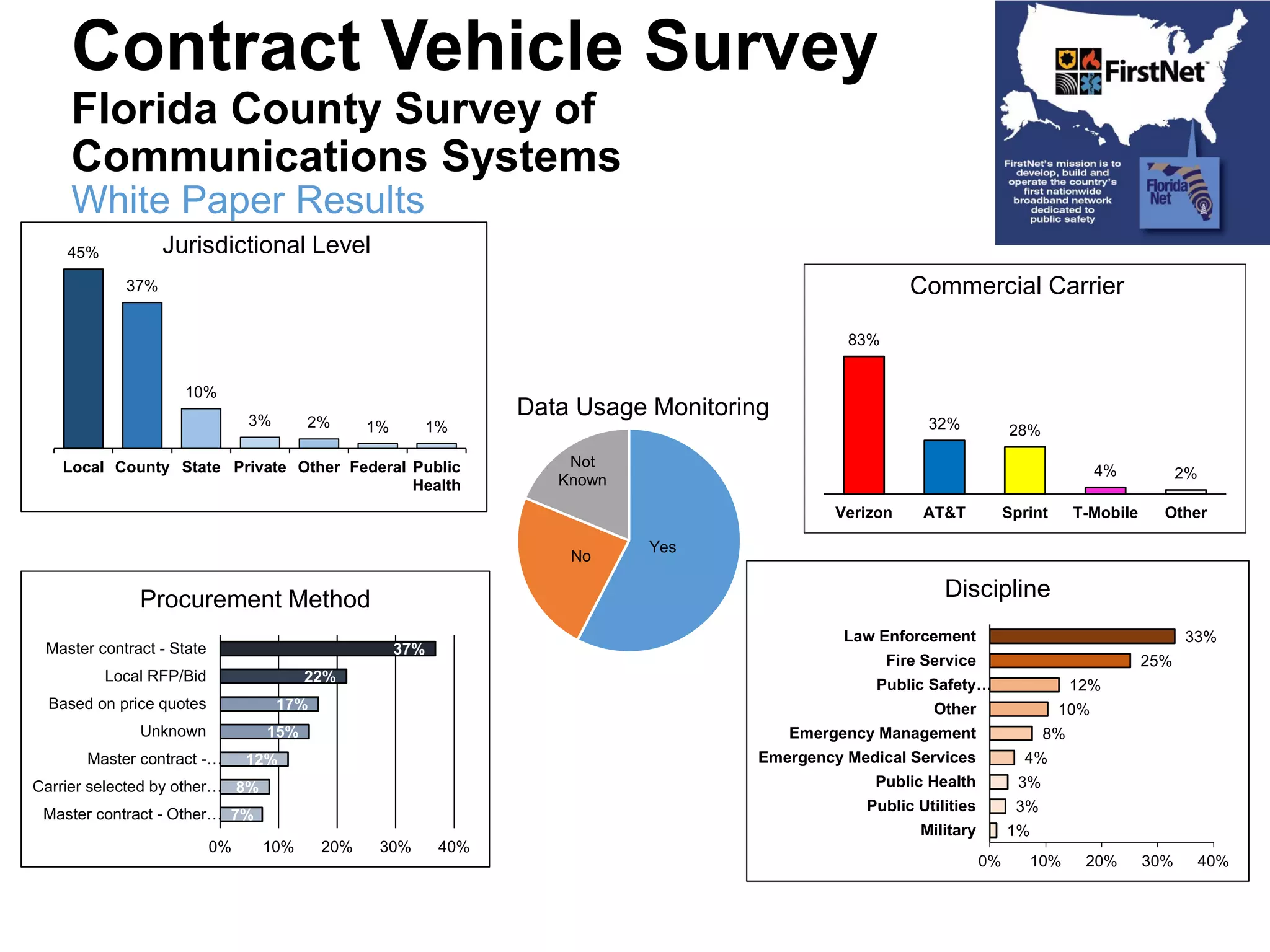
Contract Vehicle Survey
Florida County Survey of
Communications Systems
White Paper Results
45%
37%
10%
3% 2% 1% 1%
Local County State Private Other Federal Public
Health
Jurisdictional Level
1%
3%
3%
4%
8%
10%
12%
25%
33%
0% 10% 20% 30% 40%
Military
Public Utilities
Public Health
Emergency Medical Services
Emergency Management
Other
Public Safety…
Fire Service
Law Enforcement
Discipline
Yes
No
Not
Known
Data Usage Monitoring
7%
8%
12%
15%
17%
22%
37%
0% 10% 20% 30% 40%
Master contract - Other…
Carrier selected by other…
Master contract -…
Unknown
Based on price quotes
Local RFP/Bid
Master contract - State
Procurement Method
83%
32% 28%
4% 2%
Verizon AT&T Sprint T-Mobile Other
Commercial Carrier
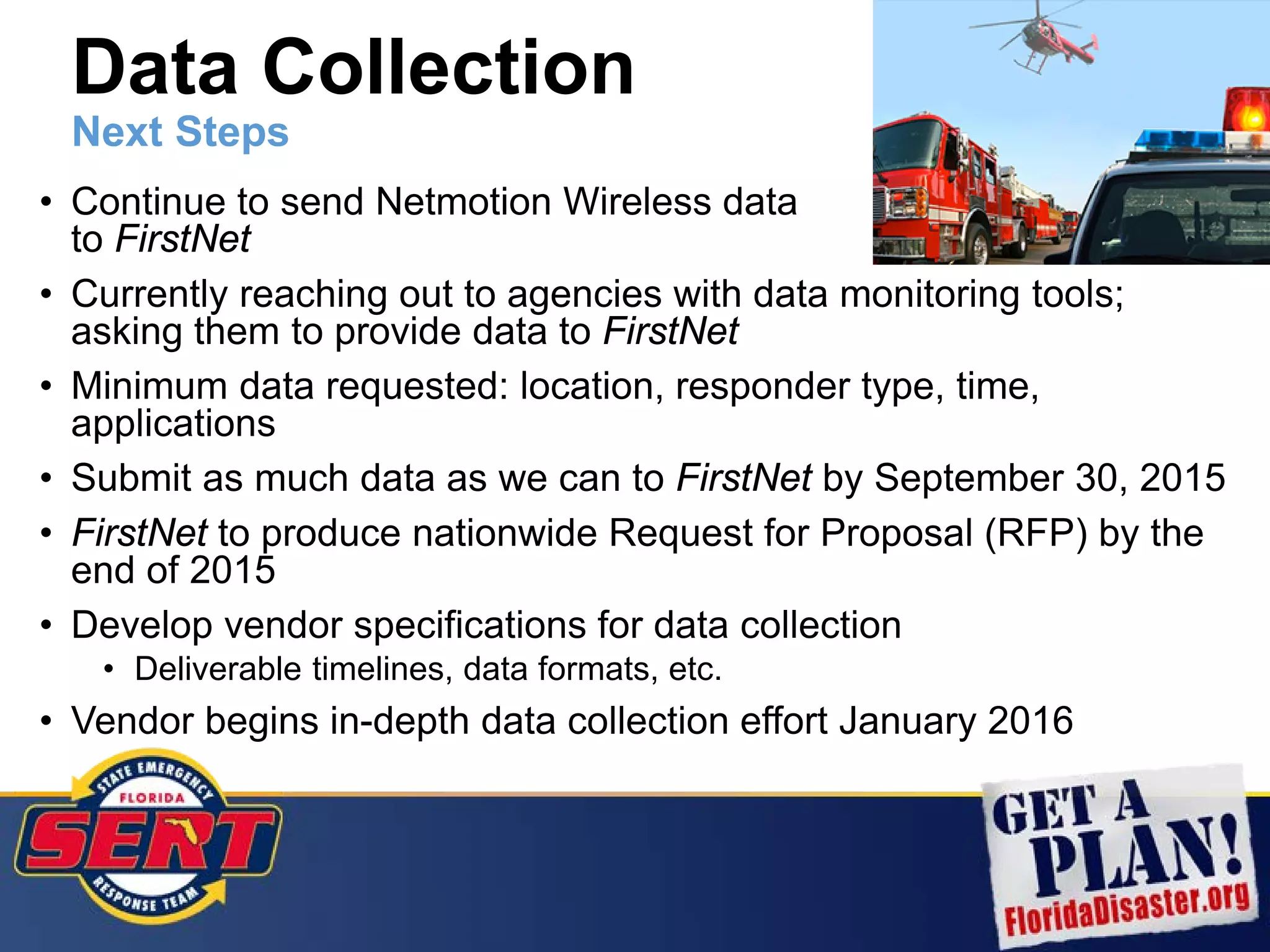
• Continue to send Netmotion Wireless data
to FirstNet
• Currently reaching out to agencies with data monitoring tools;
asking them to provide data to FirstNet
• Minimum data requested: location, responder type, time,
applications
• Submit as much data as we can to FirstNet by September 30, 2015
• FirstNet to produce nationwide Request for Proposal (RFP) by the
end of 2015
• Develop vendor specifications for data collection
• Deliverable timelines, data formats, etc.
• Vendor begins in-depth data collection effort January 2016
Data Collection
Next Steps
Questions
Florida Executive Interoperable Technology Committee Co-Chairs
Bill Rogers Chuck Hagan
Director, Division of Telecommunications State Logistics Chief
DMS Florida DEM
Bill.Rogers@dms.myflorida.com charles.hagan@em.myflorida.com
State Working Group – Interoperable Communications Committee Co-Chairs
Carlton Wells Greg Holcomb
State of Florida, DMS Lake County
Comm Engineer Supervisor Division Manager/E911 Coordinator
carlton.wells@dms.myflorida.com GHolcomb@lakecountyfl.gov
850-922-7426 352-343-9491
Florida Statewide Interoperability Coordinator (SWIC)
Phil Royce , Communications Branch Director
Logistics Section
Florida DEM
Phil.royce@em.myflorida.com

14a-Interoperable Communications CIEM 2015 VERSION 2

  • 1.
    COMMUNICATIONS SYSTEMS and INTEROPERABILITY EMERGENCYMANAGEMENT COMMUNICATIONS Critical Issues In Emergency Management 2015 Chuck Hagan State Logistics Chief Phil Royce Communications Branch Manager
  • 2.
    OPERATIONAL COMMUNICATIONS • Mission Area:Response Support • Description: To ensure the capability for timely, redundant communications in support of security, situational awareness, and emergency operations by any and all means available; among and between affected communities in the impact area and response and support forces at appropriate levels.
  • 3.
    GOVERNANCE • Statewide InteroperabilityGovernance Board (SIGB), AKA the Florida Executive Interoperable Technologies Committee (FEITC) – Chuck Hagan, Co-Chair FDEM State Logistics Chief – Bill Rogers, Co-Chair Director DMS Division of Telecommunications – The responsibilities of the SIGB/FEITC are: – Oversight and management of interoperable technology issues. • State Interoperable Communications Committee – Greg Holcomb, Co-Chair – Lake County E911 Coordinator and Division Manager – Carlton Wells, Co-Chair – DMS Communications Engineer Supervisor – Facilitated a wide array of projects, all of which serve the primary goal to enhance interoperable communications. – These include the development of Tactical Interoperable Communications Plans, construction of a statewide interoperability network, placement of mutual aid stations on all bands throughout the state, deployment of various transportable communications systems, placement of radio equipment in Mobile Communications/Command vehicles throughout the state, and acquisition of portable radios caches. • Statewide Interoperability Coordinator (SWIC) – Phil Royce, SWIC - FDEM Communications Branch Manager, Logistics Section – The responsibilities of the SWIC are: – Interfaces with federal, state and local agencies regarding interoperable communication issues. – Flow of information regarding interoperable communication issues between the federal government, DSOC, SIGB/FEITC and ICC SWG. – Responsible for updating and maintaining the Florida SCIP. • All of the boards, committees and positions listed above work together to ensure that the state continues to move forward in improving interoperable communications throughout the state.
  • 4.
    Interoperable vs. NonInteroperable Interoperable Systems • FIN –Full Time InterOp System) • SLERS – All RF Radio Bands • MARC • EDICS (InterOp System) • EDWARDS (InterOp Data) • National Mutual Aid Frequencies • National EMS Frequencies • LOCAL Trunked and Non- Trunked Communications Systems (800, UHF, VHF) Stand Alone Systems • EMnet (Alert and Notification System) • NAWAS (Federal / State Alert and Notification System) • EAS / IPAWS / CMAS / WEA (Alert and Notification System) • MSAT (Satellite Radio Dispatch and Telephone • VSAT (Satellite Data and VoIP) • Military SINCGARS unless through an approved switch
  • 5.
    Interoperable Communications Exercises and Training •EXERCISES: – February 2010 – RADAR at Camp Blanding – 21 Regional IO Exercises – February 2013 – RADAR II at Camp Blanding • TRAINING: – FIN – SLERS – EDICS/EDWARDS – MARC – COM-L – COM-T
  • 6.
    FIN NETWORK • TheFlorida interoperability network (FIN) utilizes Motorola's Motobridge hardware and software. FIN is managed by Florida DMS. – Primary components are Operations and Maintenance Center (OMC) servers and System Initiation Protocol (SIP) servers at the system level; and Radio Gateway Units (RGUs), and Dispatcher Application software at the local level. – DMS' MyFloridaNet (MFN) service provides the connectivity and redundancy for the network. Other characteristics of FIN are: • IP-Based Network • Distributed architecture with no central switch and redundancy to insure 24/7 system services • Support for all radio frequency bands and proprietary systems • Secured, encrypted network • Scalable components for future expansion, if desired • Motorola's Network management & system maintenance
  • 7.
    SLERS System Description • Florida'sStatewide Law Enforcement Radio System (SLERS) is a single, unified radio network that meets the radio voice communications needs of state law enforcement and other participating agencies throughout the state. SLERS is a 800/700 MHz system consisting of 200 Microwave, RF multi-sites, and RF simulcast sites. • The SLERS all-digital radio network covers over 60,000 square miles (including 25 miles offshore) with 98% mobile coverage and portable coverage in selected areas. • Effective interagency, interoperable communications; • Coordinated communications with local public safety entities; • Replacement of older, agency-specific systems without duplication of effort. • In 2006, FDEM was granted permission to establish a State Emergency Management Network on SLERS – This replaced the old Civil Defense VHF Low-Band network • SLERS Radio rollout to counties now affords this interconnectivity across the state that is interoperable with other systems. • SLERS Training is on line at https://slerstraining.state.fl.us/Welcome/tabid/67/Default.aspx?returnurl=%2fdefault.aspx
  • 8.
    EDICS / EDWARDS •The EDICS System is a tactical field based InterOperable voice communications system consisting of: – VHF-low band – VHF-high band – VHF-Aircraft – UHF low band – UHF high band – Multi-band Radios – SLERS – Cellular PBX Switches – SINCGARS Military (Only under special situations) – Satellite Radio Dispatch System – 800MHz Trunked Type I, II/IIA, EDACS, and LTR – HF Option for future expansion – VoIP FIN Bridge from the EDWARDS System Package • EDWARDS is a tactical field based InterOperable VSAT Satellite Data and VoIP system
  • 9.
    NAWAS 1. The NationalWarning System (NAWAS) is an automated 4-wire telephone system developed in the 1940’s used to convey warnings to United States-based federal, state and local governments. 2. NAWAS is managed, operated and fully funded by the Federal Emergency Management Agency (FEMA) and remains the primary system to warn the public of nuclear attack. 3. The system is designed to provide protection for lightning strikes so they may be used during storms. 4. The interconnecting lines provide protection by avoiding local telephone switches. This ensures they are available even when the local system is down or overloaded. 5. Federal NAWAS has major terminals at each state Emergency Operations Center. 6. State NAWAS includes secondary terminals include County Warning Points, Emergency Operations Centers, National Weather Service field offices and Public-safety answering points (PSAPs). 7. NAWAS is used to disseminate warning information for natural and technological disasters to approximately 2200 warning points throughout the continental United States, Alaska, Hawaii and the Virgin Islands.
  • 10.
  • 11.
    Florida Emergency ManagementNetwork 109 Florida EMnet Stations • 67 Counties • 28 LP-1 Stations (EAS) • 3 NPP • 7 NWS Offices (Weather) • FLNG X 2 • FDLE X 2 (AMBER Alerts) • FDEM X 2 (SWP)
  • 12.
    • True “All-Hazards”Alert and Warning Data Stream – NOAA/NWS – EMnet States and Provinces – Federal Agencies – IPAWS, WEA and PLAN Compliant • Supports Multiple Languages • Outdoor Public Alerting (Sirens, Etc.) – Florida NOAA iDirect Sites • Baker – Columbia – Liberty – Calhoun – Gulf – Franklin – Wakulla – Gilchrist – Taylor – Lafayette – Dixie – Hendry - Monroe • RSS Atom Feeds (CAP Feeds) • Advanced Notification Features • EAS is a flexible, survivable, and secure distribution network developed back in the 1950’s and modernized over the years. • NOAA Hazcollect Interface EMNet Alert & Warning
  • 15.
    NEW ADDITIONS -EMNet • 2-Years pre-paid service for all 67 Florida counties • Second Handset for County EOC • EAS Origination Software for counties to issue Civil Emergency Messages – Users must be trained and certified on an individual basis to initiate an EAS Message • User Name and password based • MOU with FEMA then issued Alerting Authority by FDEM
  • 16.
    CMAS / WEA •5+ National Cell phone carriers have agreed to carry CMAS / WEP so far. – Sprint – Verizon – AT&T – T-Mobile – U.S. Cellular • In Florida, all CMAS / WEA targeted alerts will be sent through EMnet. – State and County • EMnet connects through the IPAWS Aggregator
  • 17.
    WIRELESS EMERGENCY ALERTS •Presidential National Emergencies • Severe Weather • Civil Emergencies INSIDE THE TOWER FOOTPRINT COUNTY WIDE BY FIPS AT PRESENT OUTSIDE THE TOWER FOOTPRINT Issuing an Alert - WEA EMNet Interface to IPAWS
  • 18.
  • 19.
    FirstNet Project StatusUpdate • The First Responder Network (FirstNet) Authority was created on February 22, 2012, under the Middle Class Tax Relief and Job Creation Act. • FirstNet is an independent authority within the U.S. Department of Commerce's National Telecommunications and Information Administration. • FloridaNet is a multi-year program designed to provide a framework for Florida First Responders to work with the First Responder Network Authority (FirstNet) in the design efforts for the nations first Public Safety Broadband Network. • The goal of this program is to work with FirstNet to create a network design that can meet the requirements of the public safety mission in Florida.
  • 20.
    FloridaNet Project StatusUpdate • State and Local Implementation Grant (SLIGP) awarded to Florida Department of Emergency Management in 2013 • Agencies benefitting from this program include: Law Enforcement • Emergency Management • Emergency Medical Services • Tribal Public Safety Agencies • Health Services • Public Works • Fire Services • Florida Department of Highway Safety is sub recipient of SLIGP and provides the full time staffing for the FloridaNet project • On April 27, 2015, FirstNet issued the First Responder Network Authority's Special Notice draft RFP which explains the proposed design and operation of the Nationwide Public Safety Broadband Network (NPSBN). • The final RFP will be issued before the end of the calendar year, yet it could take another 12-to-18 months before an award is made.
  • 21.
    Contract Vehicle Survey FloridaCounty Survey of Communications Systems White Paper Results 45% 37% 10% 3% 2% 1% 1% Local County State Private Other Federal Public Health Jurisdictional Level 1% 3% 3% 4% 8% 10% 12% 25% 33% 0% 10% 20% 30% 40% Military Public Utilities Public Health Emergency Medical Services Emergency Management Other Public Safety… Fire Service Law Enforcement Discipline Yes No Not Known Data Usage Monitoring 7% 8% 12% 15% 17% 22% 37% 0% 10% 20% 30% 40% Master contract - Other… Carrier selected by other… Master contract -… Unknown Based on price quotes Local RFP/Bid Master contract - State Procurement Method 83% 32% 28% 4% 2% Verizon AT&T Sprint T-Mobile Other Commercial Carrier
  • 22.
    • Continue tosend Netmotion Wireless data to FirstNet • Currently reaching out to agencies with data monitoring tools; asking them to provide data to FirstNet • Minimum data requested: location, responder type, time, applications • Submit as much data as we can to FirstNet by September 30, 2015 • FirstNet to produce nationwide Request for Proposal (RFP) by the end of 2015 • Develop vendor specifications for data collection • Deliverable timelines, data formats, etc. • Vendor begins in-depth data collection effort January 2016 Data Collection Next Steps
  • 23.
    Questions Florida Executive InteroperableTechnology Committee Co-Chairs Bill Rogers Chuck Hagan Director, Division of Telecommunications State Logistics Chief DMS Florida DEM Bill.Rogers@dms.myflorida.com charles.hagan@em.myflorida.com State Working Group – Interoperable Communications Committee Co-Chairs Carlton Wells Greg Holcomb State of Florida, DMS Lake County Comm Engineer Supervisor Division Manager/E911 Coordinator carlton.wells@dms.myflorida.com GHolcomb@lakecountyfl.gov 850-922-7426 352-343-9491 Florida Statewide Interoperability Coordinator (SWIC) Phil Royce , Communications Branch Director Logistics Section Florida DEM Phil.royce@em.myflorida.com