Can the Post maintain its legacy?Meg. Dave. Tom. Arianna. Hsin-hsin
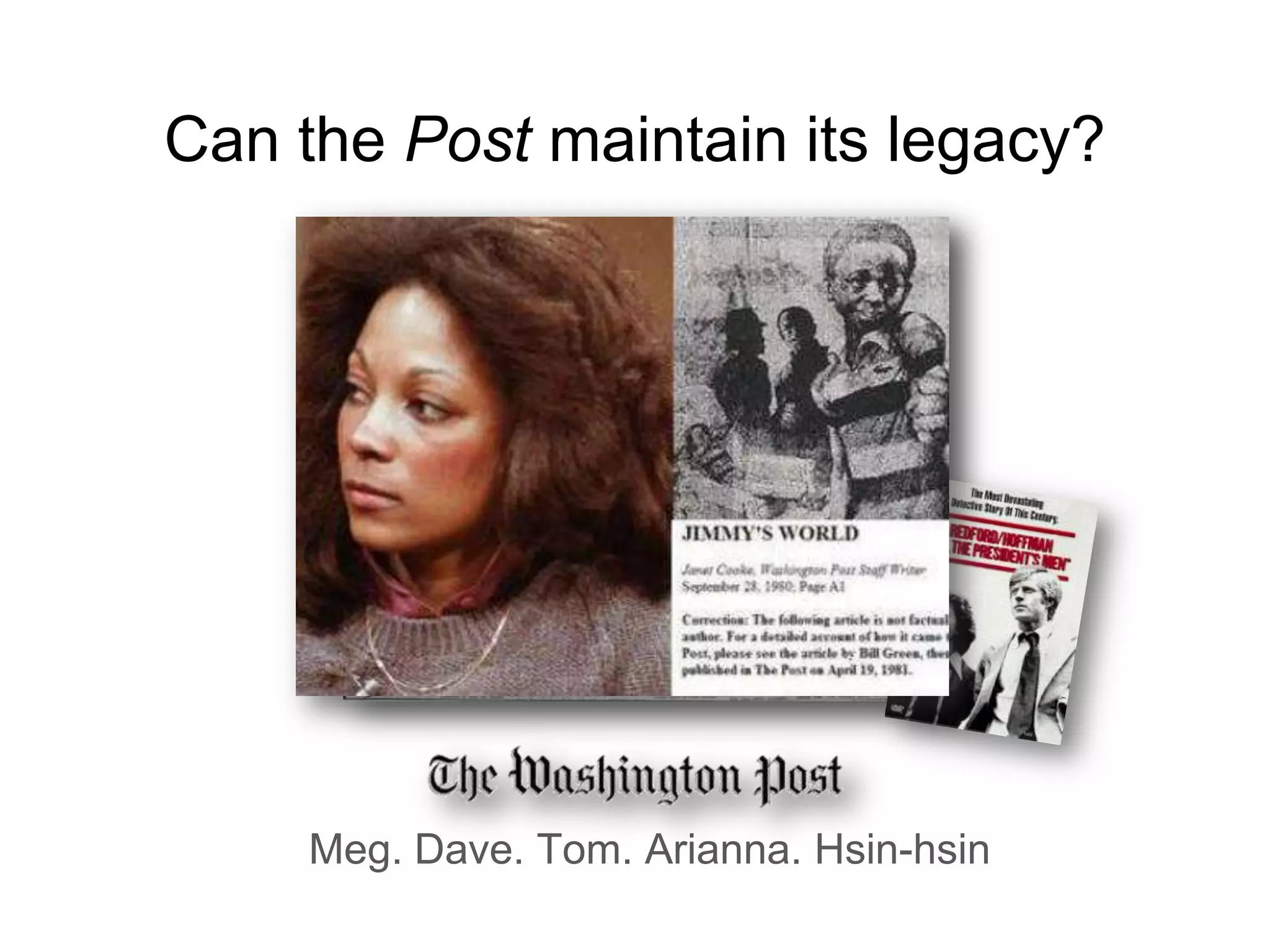
Legacy of the Washington PostAs we’ve explored in class, the Washington Post’s investigative journalism during the Watergate scandal spoke truth to power and is regarded as a striking example of proactive journalism.Does the Post continue to live up to this high journalistic standard in times of crisis?
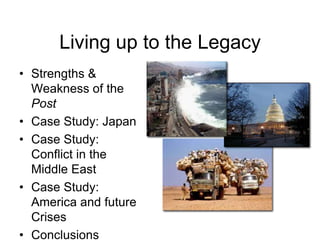
Living up to the LegacyStrengths & Weakness of the PostCase Study: JapanCase Study: Conflict in the Middle EastCase Study: America and future Crises Conclusions
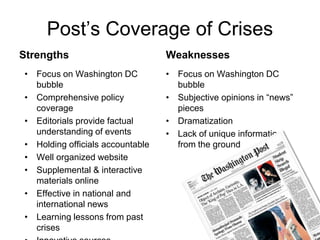
Post’s Coverage of CrisesStrengthsWeaknessesFocus on Washington DC bubbleComprehensive policy coverageEditorials provide factual understanding of eventsHolding officials accountableWell organized websiteSupplemental & interactive materials onlineEffective in national and international newsLearning lessons from past crisesInnovative sourcesFocus on Washington DC bubbleSubjective opinions in “news” piecesDramatizationLack of unique information from the ground
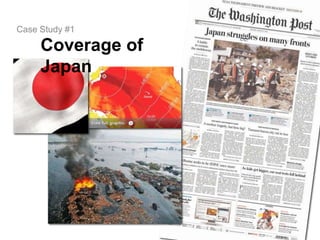
Case Study #1Coverage of Japan
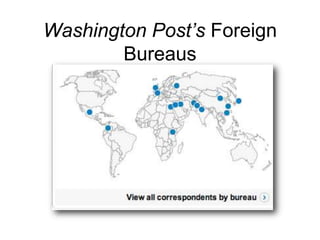
Washington Post’s Foreign Bureaus
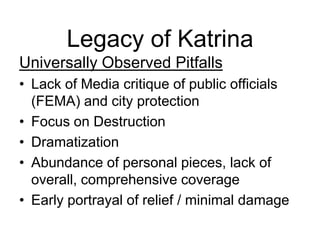
Hurricane Katrina v. Japan Earthquake/ Tsunami
Legacy of KatrinaUniversally Observed PitfallsLack of Media critique of public officials (FEMA) and city protectionFocus on DestructionDramatizationAbundance of personal pieces, lack of overall, comprehensive coverageEarly portrayal of relief / minimal damage
Successful Journalism in Japan“No one should underestimate the potential effects of such a catastrophe - human, political, economic.”Efficiently delivered the core factsAddressed official responses and the nation’s preparednessCaptured severity of situationCoverage progressed  from focus on incident, to overarching consequences“Scientists said the event has reinforced a growing sense that the field of seismology needs to ditch some of its presumptions.”
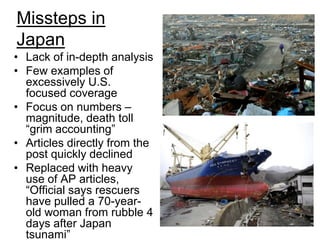
Missteps in JapanLack of in-depth analysis Few examples of excessively U.S. focused coverageFocus on numbers – magnitude, death toll “grim accounting” Articles directly from the post quickly declinedReplaced with heavy use of AP articles, “Official says rescuers have pulled a 70-year-old woman from rubble 4 days after Japan tsunami”
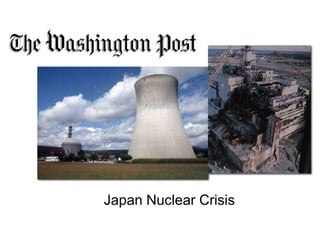
Japan Nuclear Crisis
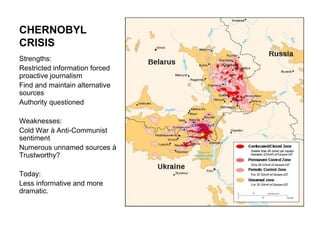
CHERNOBYL CRISISStrengths:Restricted information forced proactive journalismFind and maintain alternative sourcesAuthority questionedWeaknesses: Cold War à Anti-Communist sentimentNumerous unnamed sources à Trustworthy?Today:Less informative and more dramatic.
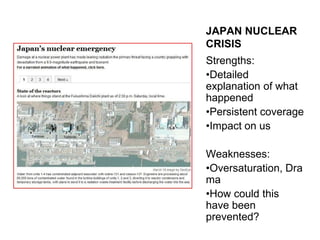
JAPAN NUCLEAR CRISISStrengths:Detailed explanation of what happenedPersistent coverageImpact on usWeaknesses:Oversaturation, DramaHow could this have been prevented?
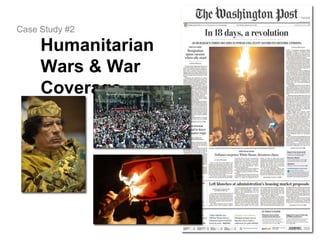
Case Study #2Humanitarian Wars & War Coverage
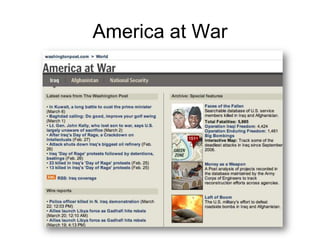
America at War
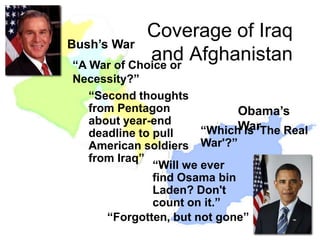
Coverage of Iraq and AfghanistanBush’s War“A War of Choice or Necessity?”“Second thoughts from Pentagon about year-end deadline to pull American soldiers from Iraq” Obama’s War“Which Is 'The Real War'?”“Will we ever find Osama bin Laden? Don't count on it.” “Forgotten, but not gone”
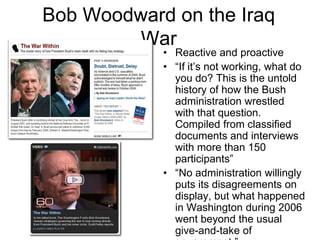
Bob Woodward on the Iraq WarReactive and proactive“If it’s not working, what do you do? This is the untold history of how the Bush administration wrestled with that question. Compiled from classified documents and interviews with more than 150 participants”“No administration willingly puts its disagreements on display, but what happened in Washington during 2006 went beyond the usual give-and-take of government.”
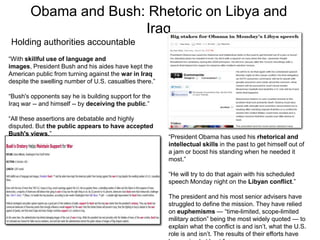
Obama and Bush: Rhetoric on Libya and IraqHolding authorities accountable“With skillful use of language and images, President Bush and his aides have kept the American public from turning against the war in Iraq despite the swelling number of U.S. casualties there.”“Bush's opponents say he is building support for the Iraq war -- and himself -- by deceiving the public.”“All these assertions are debatable and highly disputed. But the public appears to have accepted Bush's views.”“President Obama has used his rhetorical and intellectual skills in the past to get himself out of a jam or boost his standing when he needed it most.”“He will try to do that again with his scheduled speech Monday night on the Libyan conflict.”The president and his most senior advisers have struggled to define the mission. They have relied on euphemisms — “time-limited, scope-limited military action” being the most widely quoted — to explain what the conflict is and isn’t, what the U.S. role is and isn’t. The results of their efforts have been mixed at best.”
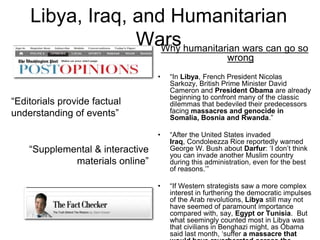
Libya, Iraq, and Humanitarian WarsWhy humanitarian wars can go so wrong“In Libya, French President Nicolas Sarkozy, British Prime Minister David Cameron and President Obama are already beginning to confront many of the classic dilemmas that bedeviled their predecessors facing massacres and genocide in Somalia, Bosnia and Rwanda.”“After the United States invaded Iraq, Condoleezza Rice reportedly warned George W. Bush about Darfur: ‘I don’t think you can invade another Muslim country during this administration, even for the best of reasons.’”“If Western strategists saw a more complex interest in furthering the democratic impulses of the Arab revolutions, Libya still may not have seemed of paramount importance compared with, say, Egypt or Tunisia.  But what seemingly counted most in Libya was that civilians in Benghazi might, as Obama said last month, ‘suffer a massacre that would have reverberated across the region and stained the conscience of the world.’”“Editorials provide factual understanding of events”“Supplemental & interactive materials online”
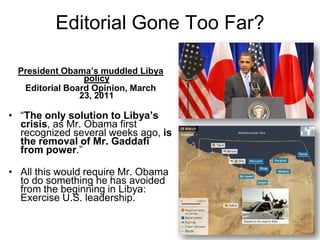
Editorial Gone Too Far?President Obama’s muddled Libya policyEditorial Board Opinion, March 23, 2011“The only solution to Libya’s crisis, as Mr. Obama first recognized several weeks ago, is the removal of Mr. Gaddafi from power.”All this would require Mr. Obama to do something he has avoided from the beginning in Libya: Exercise U.S. leadership.
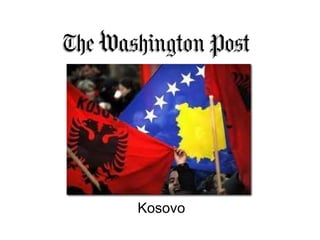
Kosovo
Conflict in KosovoFirst War: Early 1998 until 1999 between the army and police of Yugosalvia and the Kosovo Liberation Army [KLA]Second War: March 24, 1999 to June 11, 1999 between ethnic Albanian militants and Yugoslav forces NATO supported ethnic Albanian militants [KLA]
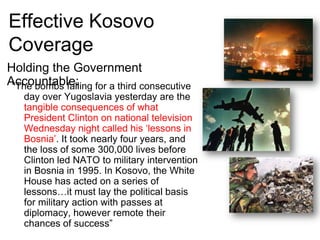
Effective Kosovo CoverageHolding the Government Accountable:“The bombs falling for a third consecutive day over Yugoslavia yesterday are the tangible consequences of what President Clinton on national television Wednesday night called his ‘lessons in Bosnia’. It took nearly four years, and the loss of some 300,000 lives before Clinton led NATO to military intervention in Bosnia in 1995. In Kosovo, the White House has acted on a series of lessons…it must lay the political basis for military action with passes at diplomacy, however remote their chances of success”
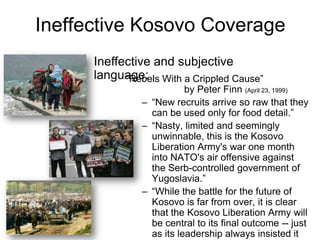
Ineffective Kosovo CoverageIneffective and subjective language: “Rebels With a Crippled Cause”                  by Peter Finn (April 23, 1999)“New recruits arrive so raw that they can be used only for food detail.”“Nasty, limited and seemingly unwinnable, this is the Kosovo Liberation Army's war one month into NATO's air offensive against the Serb-controlled government of Yugoslavia.” “While the battle for the future of Kosovo is far from over, it is clear that the Kosovo Liberation Army will be central to its final outcome -- just as its leadership always insisted it would be.”
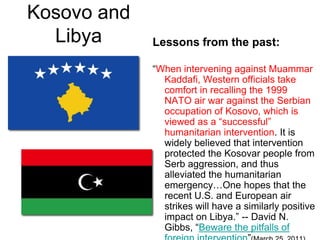
Kosovo and LibyaLessons from the past:“When intervening against Muammar Kaddafi, Western officials take comfort in recalling the 1999 NATO air war against the Serbian occupation of Kosovo, which is viewed as a “successful” humanitarian intervention. It is widely believed that intervention protected the Kosovar people from Serb aggression, and thus alleviated the humanitarian emergency…One hopes that the recent U.S. and European air strikes will have a similarly positive impact on Libya.” -- David N. Gibbs, “Beware the pitfalls of foreign intervention”(March 25, 2011)
Kosovo and the DC bubble“The Senate plans a daylong debate on the issue Monday. At a late afternoon meeting, its Republican leaders decided to seek a vote Tuesday on whether to block funds for the operation unless Congress authorizes it, according to an aide to Majority Leader Trent Lott (R-Miss.). But the vote will occur under rules requiring 60 votes for approval, which Republicans acknowledged would be difficult to get. They hold 55 of the Senate's 100 seats.” 		-- “Serb Aggression” by Charles Babington (March 20, 1999)
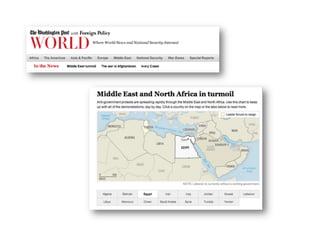
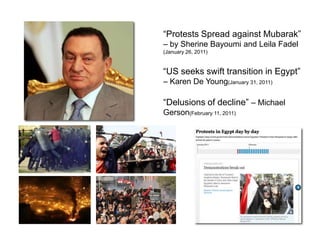
“Protests Spread against Mubarak” – by Sherine Bayoumi and Leila Fadel(January 26, 2011)“US seeks swift transition in Egypt” – Karen De Young(January 31, 2011)“Delusions of decline” – Michael Gerson(February 11, 2011)
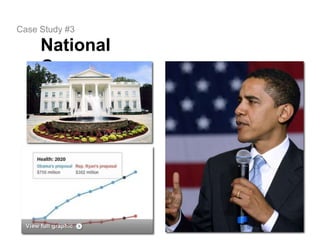
Case Study #3National Coverage
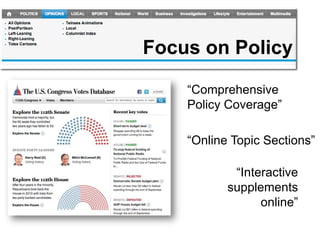
Focus on Policy“Comprehensive Policy Coverage”“Online Topic Sections”“Interactive supplements online”
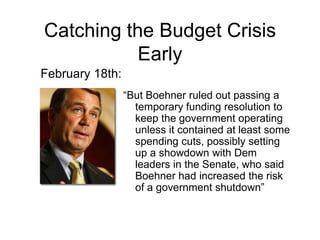
Catching the Budget Crisis EarlyFebruary 18th:“But Boehner ruled out passing a temporary funding resolution to keep the government operating unless it contained at least some spending cuts, possibly setting up a showdown with Dem leaders in the Senate, who said Boehner had increased the risk of a government shutdown”
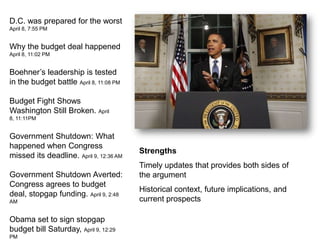
D.C. was prepared for the worst  April 8, 7:55 PMWhy the budget deal happened April 8, 11:02 PMBoehner’s leadership is tested in the budget battle April 8, 11:08 PMBudget Fight Shows Washington Still Broken. April 8, 11:11PMGovernment Shutdown: What happened when Congress missed its deadline. April 9, 12:36 AMGovernment Shutdown Averted: Congress agrees to budget deal, stopgap funding. April 9, 2:48 AMObama set to sign stopgap budget bill Saturday, April 9, 12:29 PMStrengthsTimely updates that provides both sides of the argumentHistorical context, future implications, and current prospects
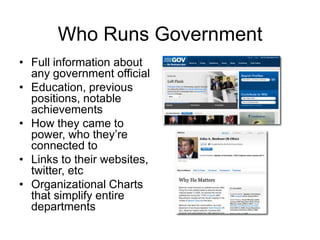
Who Runs GovernmentFull information about any government official
Education, previous positions, notable achievements
How they came to power, who they’re connected to
Links to their websites, twitter, etc
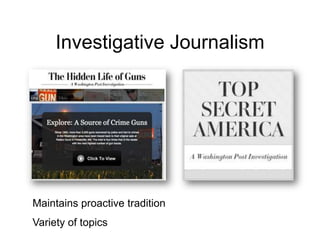
Organizational Charts that simplify entire departmentsInvestigative JournalismMaintains proactive traditionVariety of topics
Conclusion

Can the post maintain its legacy

  • 1.
    Can the Postmaintain its legacy?Meg. Dave. Tom. Arianna. Hsin-hsin
  • 2.
    Legacy of theWashington PostAs we’ve explored in class, the Washington Post’s investigative journalism during the Watergate scandal spoke truth to power and is regarded as a striking example of proactive journalism.Does the Post continue to live up to this high journalistic standard in times of crisis?
  • 3.
    Living up tothe LegacyStrengths & Weakness of the PostCase Study: JapanCase Study: Conflict in the Middle EastCase Study: America and future Crises Conclusions
  • 4.
    Post’s Coverage ofCrisesStrengthsWeaknessesFocus on Washington DC bubbleComprehensive policy coverageEditorials provide factual understanding of eventsHolding officials accountableWell organized websiteSupplemental & interactive materials onlineEffective in national and international newsLearning lessons from past crisesInnovative sourcesFocus on Washington DC bubbleSubjective opinions in “news” piecesDramatizationLack of unique information from the ground
  • 6.
  • 7.
  • 8.
    Hurricane Katrina v.Japan Earthquake/ Tsunami
  • 9.
    Legacy of KatrinaUniversallyObserved PitfallsLack of Media critique of public officials (FEMA) and city protectionFocus on DestructionDramatizationAbundance of personal pieces, lack of overall, comprehensive coverageEarly portrayal of relief / minimal damage
  • 10.
    Successful Journalism inJapan“No one should underestimate the potential effects of such a catastrophe - human, political, economic.”Efficiently delivered the core factsAddressed official responses and the nation’s preparednessCaptured severity of situationCoverage progressed from focus on incident, to overarching consequences“Scientists said the event has reinforced a growing sense that the field of seismology needs to ditch some of its presumptions.”
  • 11.
    Missteps in JapanLackof in-depth analysis Few examples of excessively U.S. focused coverageFocus on numbers – magnitude, death toll “grim accounting” Articles directly from the post quickly declinedReplaced with heavy use of AP articles, “Official says rescuers have pulled a 70-year-old woman from rubble 4 days after Japan tsunami”
  • 12.
  • 13.
    CHERNOBYL CRISISStrengths:Restricted informationforced proactive journalismFind and maintain alternative sourcesAuthority questionedWeaknesses: Cold War à Anti-Communist sentimentNumerous unnamed sources à Trustworthy?Today:Less informative and more dramatic.
  • 14.
    JAPAN NUCLEAR CRISISStrengths:Detailedexplanation of what happenedPersistent coverageImpact on usWeaknesses:Oversaturation, DramaHow could this have been prevented?
  • 15.
    Case Study #2HumanitarianWars & War Coverage
  • 16.
  • 17.
    Coverage of Iraqand AfghanistanBush’s War“A War of Choice or Necessity?”“Second thoughts from Pentagon about year-end deadline to pull American soldiers from Iraq” Obama’s War“Which Is 'The Real War'?”“Will we ever find Osama bin Laden? Don't count on it.” “Forgotten, but not gone”
  • 18.
    Bob Woodward onthe Iraq WarReactive and proactive“If it’s not working, what do you do? This is the untold history of how the Bush administration wrestled with that question. Compiled from classified documents and interviews with more than 150 participants”“No administration willingly puts its disagreements on display, but what happened in Washington during 2006 went beyond the usual give-and-take of government.”
  • 19.
    Obama and Bush:Rhetoric on Libya and IraqHolding authorities accountable“With skillful use of language and images, President Bush and his aides have kept the American public from turning against the war in Iraq despite the swelling number of U.S. casualties there.”“Bush's opponents say he is building support for the Iraq war -- and himself -- by deceiving the public.”“All these assertions are debatable and highly disputed. But the public appears to have accepted Bush's views.”“President Obama has used his rhetorical and intellectual skills in the past to get himself out of a jam or boost his standing when he needed it most.”“He will try to do that again with his scheduled speech Monday night on the Libyan conflict.”The president and his most senior advisers have struggled to define the mission. They have relied on euphemisms — “time-limited, scope-limited military action” being the most widely quoted — to explain what the conflict is and isn’t, what the U.S. role is and isn’t. The results of their efforts have been mixed at best.”
  • 20.
    Libya, Iraq, andHumanitarian WarsWhy humanitarian wars can go so wrong“In Libya, French President Nicolas Sarkozy, British Prime Minister David Cameron and President Obama are already beginning to confront many of the classic dilemmas that bedeviled their predecessors facing massacres and genocide in Somalia, Bosnia and Rwanda.”“After the United States invaded Iraq, Condoleezza Rice reportedly warned George W. Bush about Darfur: ‘I don’t think you can invade another Muslim country during this administration, even for the best of reasons.’”“If Western strategists saw a more complex interest in furthering the democratic impulses of the Arab revolutions, Libya still may not have seemed of paramount importance compared with, say, Egypt or Tunisia. But what seemingly counted most in Libya was that civilians in Benghazi might, as Obama said last month, ‘suffer a massacre that would have reverberated across the region and stained the conscience of the world.’”“Editorials provide factual understanding of events”“Supplemental & interactive materials online”
  • 21.
    Editorial Gone TooFar?President Obama’s muddled Libya policyEditorial Board Opinion, March 23, 2011“The only solution to Libya’s crisis, as Mr. Obama first recognized several weeks ago, is the removal of Mr. Gaddafi from power.”All this would require Mr. Obama to do something he has avoided from the beginning in Libya: Exercise U.S. leadership.
  • 22.
  • 23.
    Conflict in KosovoFirstWar: Early 1998 until 1999 between the army and police of Yugosalvia and the Kosovo Liberation Army [KLA]Second War: March 24, 1999 to June 11, 1999 between ethnic Albanian militants and Yugoslav forces NATO supported ethnic Albanian militants [KLA]
  • 24.
    Effective Kosovo CoverageHoldingthe Government Accountable:“The bombs falling for a third consecutive day over Yugoslavia yesterday are the tangible consequences of what President Clinton on national television Wednesday night called his ‘lessons in Bosnia’. It took nearly four years, and the loss of some 300,000 lives before Clinton led NATO to military intervention in Bosnia in 1995. In Kosovo, the White House has acted on a series of lessons…it must lay the political basis for military action with passes at diplomacy, however remote their chances of success”
  • 25.
    Ineffective Kosovo CoverageIneffectiveand subjective language: “Rebels With a Crippled Cause” by Peter Finn (April 23, 1999)“New recruits arrive so raw that they can be used only for food detail.”“Nasty, limited and seemingly unwinnable, this is the Kosovo Liberation Army's war one month into NATO's air offensive against the Serb-controlled government of Yugoslavia.” “While the battle for the future of Kosovo is far from over, it is clear that the Kosovo Liberation Army will be central to its final outcome -- just as its leadership always insisted it would be.”
  • 26.
    Kosovo and LibyaLessonsfrom the past:“When intervening against Muammar Kaddafi, Western officials take comfort in recalling the 1999 NATO air war against the Serbian occupation of Kosovo, which is viewed as a “successful” humanitarian intervention. It is widely believed that intervention protected the Kosovar people from Serb aggression, and thus alleviated the humanitarian emergency…One hopes that the recent U.S. and European air strikes will have a similarly positive impact on Libya.” -- David N. Gibbs, “Beware the pitfalls of foreign intervention”(March 25, 2011)
  • 27.
    Kosovo and theDC bubble“The Senate plans a daylong debate on the issue Monday. At a late afternoon meeting, its Republican leaders decided to seek a vote Tuesday on whether to block funds for the operation unless Congress authorizes it, according to an aide to Majority Leader Trent Lott (R-Miss.). But the vote will occur under rules requiring 60 votes for approval, which Republicans acknowledged would be difficult to get. They hold 55 of the Senate's 100 seats.” -- “Serb Aggression” by Charles Babington (March 20, 1999)
  • 29.
    “Protests Spread againstMubarak” – by Sherine Bayoumi and Leila Fadel(January 26, 2011)“US seeks swift transition in Egypt” – Karen De Young(January 31, 2011)“Delusions of decline” – Michael Gerson(February 11, 2011)
  • 30.
  • 31.
    Focus on Policy“ComprehensivePolicy Coverage”“Online Topic Sections”“Interactive supplements online”
  • 32.
    Catching the BudgetCrisis EarlyFebruary 18th:“But Boehner ruled out passing a temporary funding resolution to keep the government operating unless it contained at least some spending cuts, possibly setting up a showdown with Dem leaders in the Senate, who said Boehner had increased the risk of a government shutdown”
  • 33.
    D.C. was preparedfor the worst April 8, 7:55 PMWhy the budget deal happened April 8, 11:02 PMBoehner’s leadership is tested in the budget battle April 8, 11:08 PMBudget Fight Shows Washington Still Broken. April 8, 11:11PMGovernment Shutdown: What happened when Congress missed its deadline. April 9, 12:36 AMGovernment Shutdown Averted: Congress agrees to budget deal, stopgap funding. April 9, 2:48 AMObama set to sign stopgap budget bill Saturday, April 9, 12:29 PMStrengthsTimely updates that provides both sides of the argumentHistorical context, future implications, and current prospects
  • 34.
    Who Runs GovernmentFullinformation about any government official
  • 35.
    Education, previous positions,notable achievements
  • 36.
    How they cameto power, who they’re connected to
  • 37.
    Links to theirwebsites, twitter, etc
  • 38.
    Organizational Charts thatsimplify entire departmentsInvestigative JournalismMaintains proactive traditionVariety of topics
  • 39.

Editor's Notes

  • #25 Holding the government accountable for their past actionsRelating past wars to the current warsObjective coveragePositive tone
  • #26 This is an example of ineffective journalism due to the subjective and overly illustrative language. The language is strong, as it is in the Egypt and Libya coverage, but instead of including a balanced account of humanitarian crises, the journalists seem to overly embellish the details. The article does not provide any background information for the reader regarding the two players, even though this crisis began March 24, 1999.
  • #27 David N. Gibbs is a guest blogger on the Washington Post’s Political Bookworm blog.
  • #28 Demonstrates the prevalence of the Washington bubble and the importance of policy to the Washington Post due to the amount of space in the article devoted to the discussion of Senate policy
  • #34 Example on one of the strengths of the post:Constant Updates on current situationLaid out arguments for those who supported vs. those who didn’t—then divided those into Republicans and Democrats—then outlined what they are disagreeing over (abortion) and eventually a comment from Planned Parenthood.References to 2012 BudgetWhat it meant if the government really shuts down (affects on jobs, Washington D.C. district..etc.)Used Editorials to provide analysis on why each side compromised—compared Congress to college student facing term paperReferences Past Cases (Bill Clinton vs. Newt Gingrich 1995 budget showdown)Did not really talk about what this means for people OUTSIDE of washington DC