Can
museums
save the
world?
Steve Connor
- What will museums be like in 20, 30 or 40
  years time if they are truly sustainable?
- Embedded in communities, treading lightly
  on the planet and financially thriving?
A TINY CHALLENGE FOR YOU.


See the future.
A TINY CHALLENGE FOR YOU.


Save the world.
A TINY CHALLENGE FOR YOU.


Embrace change.
and smile
See the future.
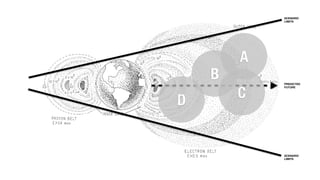
SCENARIO
            LIMITS


        A
    B       PREDICTED


        C
            FUTURE


D


            SCENARIO
            LIMITS
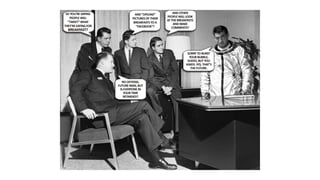
WHAT FUTURE?
ONE EXAMPLE
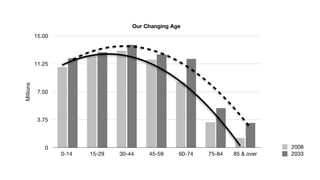
WE’RE GETTING ON A BIT.
2008
2033
Our Changing Age
           15.00


           11.25
Millions


            7.50


            3.75


              0                                                                  2008
                   0-14   15-29   30-44    45-59     60-74   75-84   85 & over   2033
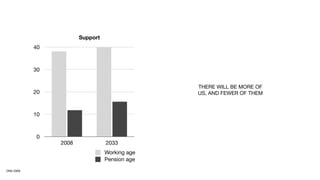
Support
           40


           30


                                               THERE WILL BE MORE OF
           20                                  US, AND FEWER OF THEM


           10


           0
                2008             2033
                                 Working age
                                 Pension age
ONS 2009
WE MIGHT NEED TO MAKE OUR
   LABELS A BIT BIGGER.
TRENDWATCHING
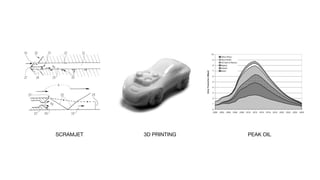
SCRAMJET   3D PRINTING   PEAK OIL
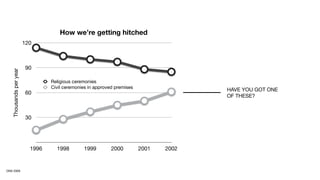
How we’re getting hitched
                        120


                         90
   Thousands per year


                                 Religious ceremonies
                                 Civil ceremonies in approved premises
                                                                                       HAVE YOU GOT ONE
                         60
                                                                                       OF THESE?


                         30


                          1996     1998        1999         2000         2001   2002


ONS 2009
TOMORROW
                           IN THE
                           GOLDEN STATE
                            MUSEUMS AND THE FUTURE OF CALIFORNIA


A GUIDE FOR FORECASTING AND PLANNING
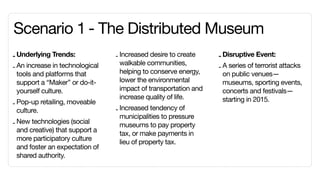
Scenario 1	- The Distributed Museum
- Underlying Trends:             - Increased desire to create     - Disruptive Event:
                                   walkable communities,
- An increase in technological                                    - A series of terrorist attacks
  tools and platforms that         helping to conserve energy,      on public venues—
  support a “Maker” or do-it-      lower the environmental          museums, sporting events,
  yourself culture.                impact of transportation and     concerts and festivals—
                                   increase quality of life.        starting in 2015.
- Pop-up retailing, moveable
  culture.                       - Increased tendency of
                                   municipalities to pressure
- New technologies (social         museums to pay property
  and creative) that support a     tax, or make payments in
  more participatory culture       lieu of property tax.
  and foster an expectation of
  shared authority.
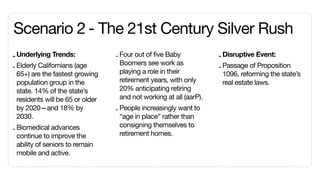
Scenario 2	- The 21st Century Silver Rush
- Underlying Trends:              - Four out of five Baby            - Disruptive Event:
                                    Boomers see work as
- Elderly Californians (age                                          - Passage of Proposition
  65+) are the fastest growing      playing a role in their            1096, reforming the state’s
  population group in the           retirement years, with only        real estate laws.
  state. 14% of the state’s         20% anticipating retiring
  residents will be 65 or older     and not working at all (aarP).
  by 2020—and 18% by              - People increasingly want to
  2030.                             “age in place” rather than
                                    consigning themselves to
- Biomedical advances
  continue to improve the           retirement homes.
  ability of seniors to remain
  mobile and active.
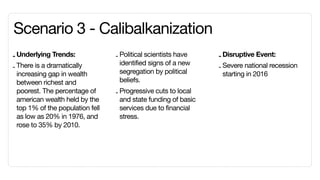
Scenario 3 - Calibalkanization
- Underlying Trends:              - Political scientists have    - Disruptive Event:
                                    identified signs of a new
- There is a dramatically                                        - Severe national recession
  increasing gap in wealth          segregation by political       starting in 2016
  between richest and               beliefs.
  poorest. The percentage of      - Progressive cuts to local
  american wealth held by the       and state funding of basic
  top 1% of the population fell     services due to financial
  as low as 20% in 1976, and        stress.
  rose to 35% by 2010.
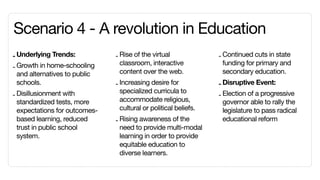
Scenario 4 -	A revolution in Education
- Underlying Trends:           - Rise of the virtual              - Continued cuts in state
                                 classroom, interactive             funding for primary and
- Growth in home-schooling
  and alternatives to public     content over the web.              secondary education.
  schools.                     - Increasing desire for            - Disruptive Event:
                                 specialized curricula to
- Disillusionment with                                            - Election of a progressive
  standardized tests, more       accommodate religious,             governor able to rally the
  expectations for outcomes-     cultural or political beliefs.     legislature to pass radical
  based learning, reduced      - Rising awareness of the            educational reform
  trust in public school         need to provide multi-modal
  system.                        learning in order to provide
                                 equitable education to
                                 diverse learners.
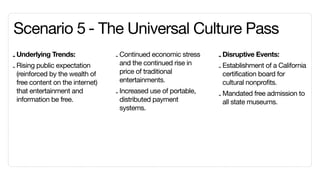
Scenario 5	- The Universal Culture Pass
- Underlying Trends:              - Continued economic stress    - Disruptive Events:
                                    and the continued rise in
- Rising public expectation                                      - Establishment of a California
  (reinforced by the wealth of      price of traditional           certification board for
  free content on the internet)     entertainments.                cultural nonprofits.
  that entertainment and          - Increased use of portable,   - Mandated free admission to
  information be free.              distributed payment            all state museums.
                                    systems.
Save the world.
In the last quarter century...


Redefining Prosperity: UK Sustainable Development Commission 2009
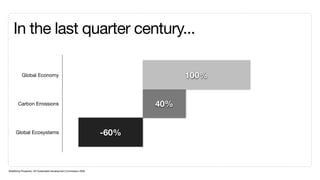
In the last quarter century...

           Global Economy                                                        100%


        Carbon Emissions                                                   40%


      Global Ecosystems                                             -60%


Redefining Prosperity: UK Sustainable Development Commission 2009
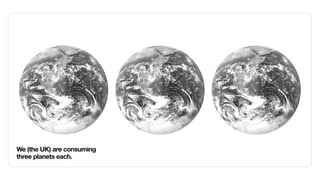
We (the UK) are consuming
three planets each.
What makes us happy?


Redefining Prosperity: UK Sustainable Development Commission 2009
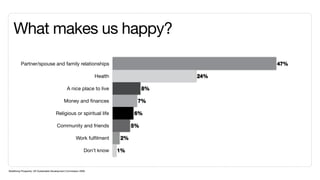
What makes us happy?
          Partner/spouse and family relationships                                                 47%

                                                                    Health                  24%

                                                 A nice place to live                  8%

                                               Money and finances                  7%

                                        Religious or spiritual life               6%

                                         Community and friends                    5%

                                                         Work fulfilment     2%

                                                                Don’t know   1%


Redefining Prosperity: UK Sustainable Development Commission 2009
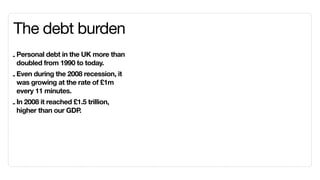
The debt burden
- Personal debt in the UK more than
  doubled from 1990 to today.
- Even during the 2008 recession, it
  was growing at the rate of £1m
  every 11 minutes.
- In 2008 it reached £1.5 trillion,
  higher than our GDP  .
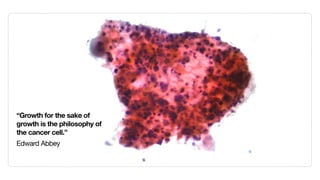
“Growth for the sake of
growth is the philosophy of
the cancer cell.”
Edward Abbey
My pitch
- Happiness and wealth fell   - Non-materialist forms of     - Reaching people, and
  out with each other more      social capital and             fighting for headspace, is
  than half a century ago.      experience are part of the     a core strength of the
                                solution.                      cultural sector.
- We need to ‘reboot’
  economics and find a way    - Culture and the
  to achieve prosperity         experience economy can
  without growth.               win us back from
                                materialism.
My pitch
- Culture creates the places   - Innovation must no longer   - Culture can (help to) save
  and spaces that people         be the preserve of            the world.
  want to be in, fostering a     consumerist ‘novelty’ and
  more compelling and            desire but has to become
  competitive identity.          part of how we craft our
                                 collective future.
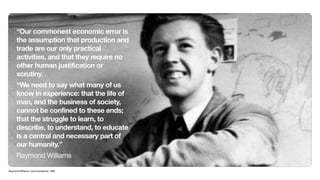
“Our commonest economic error is
      the assumption that production and
      trade are our only practical
      activities, and that they require no
      other human justification or
      scrutiny.
      “We need to say what many of us
      know in experience: that the life of
      man, and the business of society,
      cannot be confined to these ends;
      that the struggle to learn, to
      describe, to understand, to educate
      is a central and necessary part of
      our humanity.”
      Raymond Williams

Raymond Williams, Communications, 1962
Embrace change.
WHO
ATE ALL THE
QUANGOS?
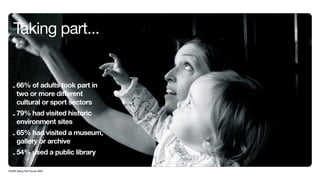
Taking part...


   - 66% of adults took part in
     two or more different
     cultural or sport sectors
   - 79% had visited historic
     environment sites
   - 65% had visited a museum,
     gallery or archive
   - 54% used a public library

DCMS Taking Part Survey 2009
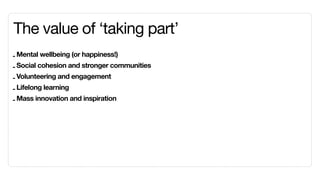
The value of ‘taking part’
- Mental wellbeing (or happiness!)
- Social cohesion and stronger communities
- Volunteering and engagement
- Lifelong learning
- Mass innovation and inspiration
Provocati
                                                     on 01: No
                                                              vember 2
                                                                      006


                                            The Ten H
                                           Mass Inno abits of
                                           By Charle
                                                         vation

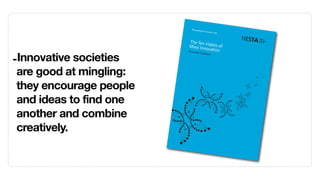
-Innovative societies
                                                    s Leadbeater


 are good at mingling:
 they encourage people
 and ideas to find one
 another and combine
 creatively.
                         !"##!$%&
                                  ''((()
Cultural solutions:
- Building social capital
- An ‘alternative hedonism’
- Changing values and shifting behaviours
- Reducing our carbon footprint
- Stronger places and competitive identity
- Genuine innovation
- A happier world
Can
museums
save the
world?
Steve Connor
Can Museums Save the World?

Can Museums Save the World?

  • 1.
  • 2.
    - What willmuseums be like in 20, 30 or 40 years time if they are truly sustainable? - Embedded in communities, treading lightly on the planet and financially thriving?
  • 3.
    A TINY CHALLENGEFOR YOU. See the future.
  • 4.
    A TINY CHALLENGEFOR YOU. Save the world.
  • 5.
    A TINY CHALLENGEFOR YOU. Embrace change.
  • 6.
  • 7.
  • 11.
    SCENARIO LIMITS A B PREDICTED C FUTURE D SCENARIO LIMITS
  • 12.
  • 13.
  • 14.
  • 15.
  • 16.
    Our Changing Age 15.00 11.25 Millions 7.50 3.75 0 2008 0-14 15-29 30-44 45-59 60-74 75-84 85 & over 2033
  • 17.
    Support 40 30 THERE WILL BE MORE OF 20 US, AND FEWER OF THEM 10 0 2008 2033 Working age Pension age ONS 2009
  • 18.
    WE MIGHT NEEDTO MAKE OUR LABELS A BIT BIGGER.
  • 20.
  • 21.
    SCRAMJET 3D PRINTING PEAK OIL
  • 23.
    How we’re gettinghitched 120 90 Thousands per year Religious ceremonies Civil ceremonies in approved premises HAVE YOU GOT ONE 60 OF THESE? 30 1996 1998 1999 2000 2001 2002 ONS 2009
  • 24.
    TOMORROW IN THE GOLDEN STATE MUSEUMS AND THE FUTURE OF CALIFORNIA A GUIDE FOR FORECASTING AND PLANNING
  • 25.
    Scenario 1 - TheDistributed Museum - Underlying Trends: - Increased desire to create - Disruptive Event: walkable communities, - An increase in technological - A series of terrorist attacks tools and platforms that helping to conserve energy, on public venues— support a “Maker” or do-it- lower the environmental museums, sporting events, yourself culture. impact of transportation and concerts and festivals— increase quality of life. starting in 2015. - Pop-up retailing, moveable culture. - Increased tendency of municipalities to pressure - New technologies (social museums to pay property and creative) that support a tax, or make payments in more participatory culture lieu of property tax. and foster an expectation of shared authority.
  • 26.
    Scenario 2 - The21st Century Silver Rush - Underlying Trends: - Four out of five Baby - Disruptive Event: Boomers see work as - Elderly Californians (age - Passage of Proposition 65+) are the fastest growing playing a role in their 1096, reforming the state’s population group in the retirement years, with only real estate laws. state. 14% of the state’s 20% anticipating retiring residents will be 65 or older and not working at all (aarP). by 2020—and 18% by - People increasingly want to 2030. “age in place” rather than consigning themselves to - Biomedical advances continue to improve the retirement homes. ability of seniors to remain mobile and active.
  • 27.
    Scenario 3 -Calibalkanization - Underlying Trends: - Political scientists have - Disruptive Event: identified signs of a new - There is a dramatically - Severe national recession increasing gap in wealth segregation by political starting in 2016 between richest and beliefs. poorest. The percentage of - Progressive cuts to local american wealth held by the and state funding of basic top 1% of the population fell services due to financial as low as 20% in 1976, and stress. rose to 35% by 2010.
  • 28.
    Scenario 4 - Arevolution in Education - Underlying Trends: - Rise of the virtual - Continued cuts in state classroom, interactive funding for primary and - Growth in home-schooling and alternatives to public content over the web. secondary education. schools. - Increasing desire for - Disruptive Event: specialized curricula to - Disillusionment with - Election of a progressive standardized tests, more accommodate religious, governor able to rally the expectations for outcomes- cultural or political beliefs. legislature to pass radical based learning, reduced - Rising awareness of the educational reform trust in public school need to provide multi-modal system. learning in order to provide equitable education to diverse learners.
  • 29.
    Scenario 5 - TheUniversal Culture Pass - Underlying Trends: - Continued economic stress - Disruptive Events: and the continued rise in - Rising public expectation - Establishment of a California (reinforced by the wealth of price of traditional certification board for free content on the internet) entertainments. cultural nonprofits. that entertainment and - Increased use of portable, - Mandated free admission to information be free. distributed payment all state museums. systems.
  • 31.
  • 32.
    In the lastquarter century... Redefining Prosperity: UK Sustainable Development Commission 2009
  • 33.
    In the lastquarter century... Global Economy 100% Carbon Emissions 40% Global Ecosystems -60% Redefining Prosperity: UK Sustainable Development Commission 2009
  • 34.
    We (the UK)are consuming three planets each.
  • 35.
    What makes ushappy? Redefining Prosperity: UK Sustainable Development Commission 2009
  • 36.
    What makes ushappy? Partner/spouse and family relationships 47% Health 24% A nice place to live 8% Money and finances 7% Religious or spiritual life 6% Community and friends 5% Work fulfilment 2% Don’t know 1% Redefining Prosperity: UK Sustainable Development Commission 2009
  • 37.
    The debt burden -Personal debt in the UK more than doubled from 1990 to today. - Even during the 2008 recession, it was growing at the rate of £1m every 11 minutes. - In 2008 it reached £1.5 trillion, higher than our GDP .
  • 39.
    “Growth for thesake of growth is the philosophy of the cancer cell.” Edward Abbey
  • 40.
    My pitch - Happinessand wealth fell - Non-materialist forms of - Reaching people, and out with each other more social capital and fighting for headspace, is than half a century ago. experience are part of the a core strength of the solution. cultural sector. - We need to ‘reboot’ economics and find a way - Culture and the to achieve prosperity experience economy can without growth. win us back from materialism.
  • 41.
    My pitch - Culturecreates the places - Innovation must no longer - Culture can (help to) save and spaces that people be the preserve of the world. want to be in, fostering a consumerist ‘novelty’ and more compelling and desire but has to become competitive identity. part of how we craft our collective future.
  • 43.
    “Our commonest economicerror is the assumption that production and trade are our only practical activities, and that they require no other human justification or scrutiny. “We need to say what many of us know in experience: that the life of man, and the business of society, cannot be confined to these ends; that the struggle to learn, to describe, to understand, to educate is a central and necessary part of our humanity.” Raymond Williams Raymond Williams, Communications, 1962
  • 44.
  • 45.
  • 46.
    Taking part... - 66% of adults took part in two or more different cultural or sport sectors - 79% had visited historic environment sites - 65% had visited a museum, gallery or archive - 54% used a public library DCMS Taking Part Survey 2009
  • 47.
    The value of‘taking part’ - Mental wellbeing (or happiness!) - Social cohesion and stronger communities - Volunteering and engagement - Lifelong learning - Mass innovation and inspiration
  • 48.
    Provocati on 01: No vember 2 006 The Ten H Mass Inno abits of By Charle vation -Innovative societies s Leadbeater are good at mingling: they encourage people and ideas to find one another and combine creatively. !"##!$%& ''((()
  • 49.
    Cultural solutions: - Buildingsocial capital - An ‘alternative hedonism’ - Changing values and shifting behaviours - Reducing our carbon footprint - Stronger places and competitive identity - Genuine innovation - A happier world
  • 50.

Editor's Notes

  • #43 By the time we reached our deadline more than 12,000 individuals across Greater Manchester had taken our pledge, we had endorsements from Tony Blair, Gordon Brown, Christopher Ecclestone, Fred Talbot and a host of other MPs, celebrities and sportspeople. We reached a media audience of almost 5 million and had 245,000 page views on our website. To date a further 4,000 people have pledged taking our running total to almost 16,000.