Neles® Metal Seated Ball
Valves
General Ball Valve
Information
© Metso
3
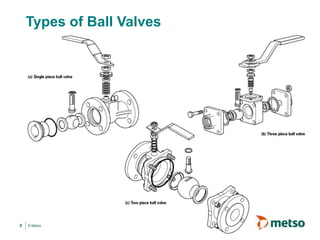
Types of Ball Valves
© Metso
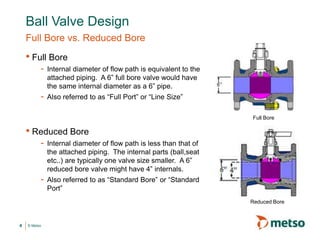
Ball Valve Design
Full Bore vs. Reduced Bore
• Full Bore
- Internal diameter of flow path is equivalent to the
attached piping. A 6” full bore valve would have
the same internal diameter as a 6” pipe.
- Also referred to as “Full Port” or “Line Size”
• Reduced Bore
- Internal diameter of flow path is less than that of
the attached piping. The internal parts (ball,seat
etc..) are typically one valve size smaller. A 6”
reduced bore valve might have 4” internals.
- Also referred to as “Standard Bore” or “Standard
Port”
4
Reduced Bore
Full Bore
© Metso
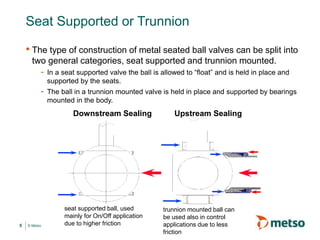
Seat Supported or Trunnion
• The type of construction of metal seated ball valves can be split into
two general categories, seat supported and trunnion mounted.
- In a seat supported valve the ball is allowed to “float” and is held in place and
supported by the seats.
- The ball in a trunnion mounted valve is held in place and supported by bearings
mounted in the body.
5
seat supported ball, used
mainly for On/Off application
due to higher friction
trunnion mounted ball can
be used also in control
applications due to less
friction
Downstream Sealing Upstream Sealing
© Metso Date
6
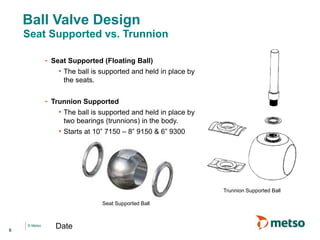
- Seat Supported (Floating Ball)
• The ball is supported and held in place by
the seats.
- Trunnion Supported
• The ball is supported and held in place by
two bearings (trunnions) in the body.
• Starts at 10” 7150 – 8” 9150 & 6” 9300
Seat Supported Ball
Trunnion Supported Ball
Ball Valve Design
Seat Supported vs. Trunnion
© Metso
Seat Supported or Trunnion
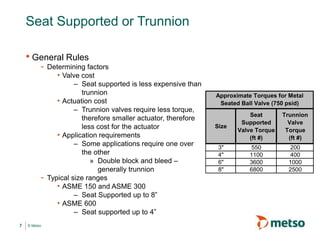
• General Rules
- Determining factors
• Valve cost
– Seat supported is less expensive than
trunnion
• Actuation cost
– Trunnion valves require less torque,
therefore smaller actuator, therefore
less cost for the actuator
• Application requirements
– Some applications require one over
the other
» Double block and bleed –
generally trunnion
- Typical size ranges
• ASME 150 and ASME 300
– Seat Supported up to 8”
• ASME 600
– Seat supported up to 4”
7
Size
Seat
Supported
Valve Torque
(ft #)
Trunnion
Valve
Torque
(ft #)
3" 550 200
4" 1100 400
6" 3600 1000
8" 6800 2500
Approximate Torques for Metal
Seated Ball Valve (750 psid)
© Metso
Torque Safety Factors for Severe Service
Applications
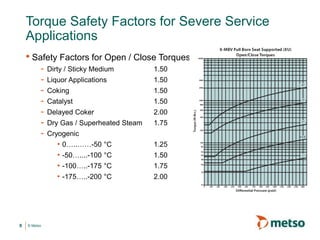
• Safety Factors for Open / Close Torques
- Dirty / Sticky Medium 1.50
- Liquor Applications 1.50
- Coking 1.50
- Catalyst 1.50
- Delayed Coker 2.00
- Dry Gas / Superheated Steam 1.75
- Cryogenic
• 0…..……-50 °C 1.25
• -50…....-100 °C 1.50
• -100…..-175 °C 1.75
• -175…..-200 °C 2.00
8
© Metso
Ball Valve Design
Soft Seats vs Metal Seats
9
General Rules of Thumb for Various Process
Conditions
Soft Seat Metal Seat
Low Pressure High Pressure
Low Temp (<500°F) High Temp (>500°F)
Clean Media Abrasive Media
Bubble Tight Not Bubble Tight
Low Velocity High Velocity
On/Off Control
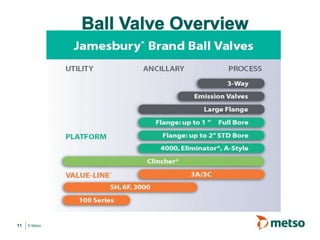
Jamesbury® Soft Seated Ball
Valves
© Metso
11
© Metso
12
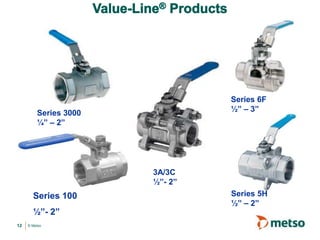
Series 5H
½” – 2”
3A/3C
½”- 2”
Series 6F
½” – 3”
Series 100
½”- 2”
Series 3000
¼” – 2”
© Metso
13
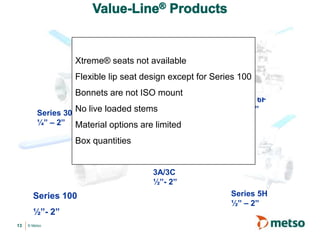
Series 5H
½” – 2”
3A/3C
½”- 2”
Series 6F
½” – 3”
Series 100
½”- 2”
Series 3000
¼” – 2”
Xtreme® seats not available
Flexible lip seat design except for Series 100
Bonnets are not ISO mount
No live loaded stems
Material options are limited
Box quantities
© Metso
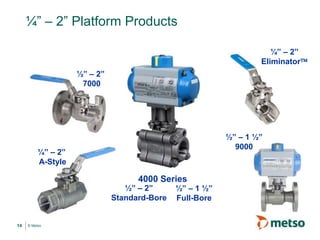
¼” – 2” Platform Products
14
½” – 2”
7000
½” – 1 ½”
9000
¼” – 2”
Eliminator
¼” – 2”
A-Style
½” – 2”
Standard-Bore
½” – 1 ½”
Full-Bore
4000 Series
© Metso
Platform Products
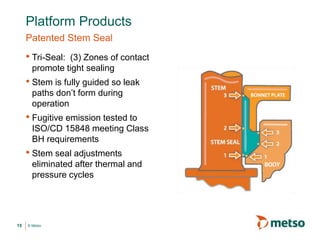
Patented Stem Seal
• Tri-Seal: (3) Zones of contact
promote tight sealing
• Stem is fully guided so leak
paths don’t form during
operation
• Fugitive emission tested to
ISO/CD 15848 meeting Class
BH requirements
• Stem seal adjustments
eliminated after thermal and
pressure cycles
15
© Metso
Platform Products
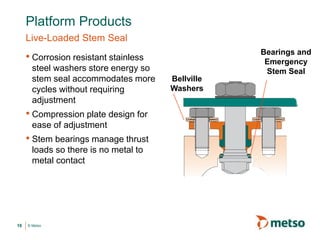
Live-Loaded Stem Seal
• Corrosion resistant stainless
steel washers store energy so
stem seal accommodates more
cycles without requiring
adjustment
• Compression plate design for
ease of adjustment
• Stem bearings manage thrust
loads so there is no metal to
metal contact
16
Bearings and
Emergency
Stem Seal
Bellville
Washers
© Metso
17
Platform Products
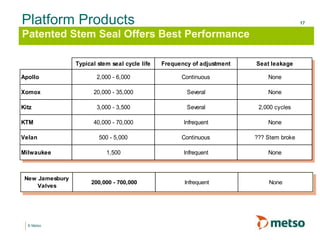
Patented Stem Seal Offers Best Performance
Typical stem seal cycle life Frequency of adjustment Seat leakage
Apollo 2,000 - 6,000 Continuous None
Xomox 20,000 - 35,000 Several None
Kitz 3,000 - 3,500 Several 2,000 cycles
KTM 40,000 - 70,000 Infrequent None
Velan 500 - 5,000 Continuous ??? Stem broke
Milwaukee 1,500 Infrequent None
New Jamesbury
Valves
200,000 - 700,000 Infrequent None
© Metso
Platform Products
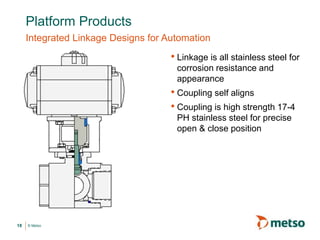
Integrated Linkage Designs for Automation
• Linkage is all stainless steel for
corrosion resistance and
appearance
• Coupling self aligns
• Coupling is high strength 17-4
PH stainless steel for precise
open & close position
18
© Metso
Performance Benefits of XTREME®
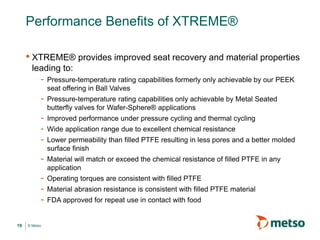
• XTREME® provides improved seat recovery and material properties
leading to:
- Pressure-temperature rating capabilities formerly only achievable by our PEEK
seat offering in Ball Valves
- Pressure-temperature rating capabilities only achievable by Metal Seated
butterfly valves for Wafer-Sphere® applications
- Improved performance under pressure cycling and thermal cycling
- Wide application range due to excellent chemical resistance
- Lower permeability than filled PTFE resulting in less pores and a better molded
surface finish
- Material will match or exceed the chemical resistance of filled PTFE in any
application
- Operating torques are consistent with filled PTFE
- Material abrasion resistance is consistent with filled PTFE material
- FDA approved for repeat use in contact with food
19
© Metso
XTREME® Achievement
Seat Recovery Affects Sealing
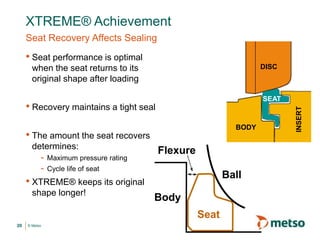
• Seat performance is optimal
when the seat returns to its
original shape after loading
• Recovery maintains a tight seal
• The amount the seat recovers
determines:
- Maximum pressure rating
- Cycle life of seat
• XTREME® keeps its original
shape longer!
20
DISC
SEAT
BODY
INSERT
Seat
Body
Ball
Flexure
© Metso
XTREME® Achievement
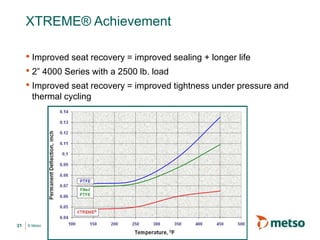
• Improved seat recovery = improved sealing + longer life
• 2” 4000 Series with a 2500 lb. load
• Improved seat recovery = improved tightness under pressure and
thermal cycling
21
© Metso
XTREME® Achievement
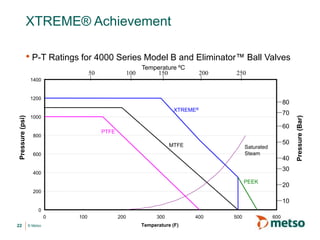
• P-T Ratings for 4000 Series Model B and Eliminator™ Ball Valves
22 Temperature (F)
0
200
400
600
800
1000
1200
1400
0 100 200 300 400 500 600
Pressure
(psi)
PTFE
MTFE
XTREME®
PEEK
Pressure
(Bar)
30
20
10
50 100 150 200 250
Temperature ºC
Saturated
Steam
80
70
60
50
40
Neles® Metal Seated Ball
Valves
© Metso
Neles® Ball Valve Offering
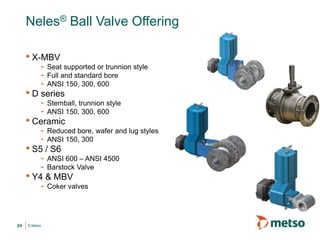
• X-MBV
- Seat supported or trunnion style
- Full and standard bore
- ANSI 150, 300, 600
• D series
- Stemball, trunnion style
- ANSI 150, 300, 600
• Ceramic
- Reduced bore, wafer and lug styles
- ANSI 150, 300
• S5 / S6
- ANSI 600 – ANSI 4500
- Barstock Valve
• Y4 & MBV
- Coker valves
24
X-MBV Ball Valves
© Metso
X-MBV Ball Valves - Product Offering
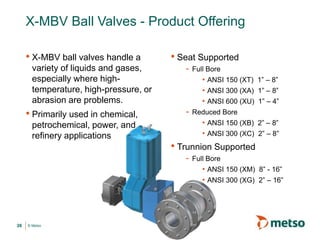
• X-MBV ball valves handle a
variety of liquids and gases,
especially where high-
temperature, high-pressure, or
abrasion are problems.
• Primarily used in chemical,
petrochemical, power, and
refinery applications
• Seat Supported
- Full Bore
• ANSI 150 (XT) 1” – 8”
• ANSI 300 (XA) 1” – 8”
• ANSI 600 (XU) 1” – 4”
- Reduced Bore
• ANSI 150 (XB) 2” – 8”
• ANSI 300 (XC) 2” – 8”
• Trunnion Supported
- Full Bore
• ANSI 150 (XM) 8” - 16”
• ANSI 300 (XG) 2” – 16”
26
© Metso
X-MBV – Product Features
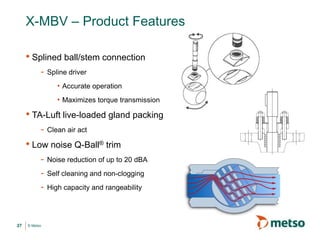
• Splined ball/stem connection
- Spline driver
• Accurate operation
• Maximizes torque transmission
• TA-Luft live-loaded gland packing
- Clean air act
• Low noise Q-Ball® trim
- Noise reduction of up to 20 dBA
- Self cleaning and non-clogging
- High capacity and rangeability
27
© Metso
X-MBV Seat Supported
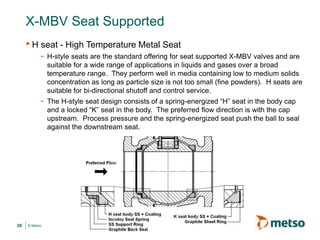
• H seat - High Temperature Metal Seat
- H-style seats are the standard offering for seat supported X-MBV valves and are
suitable for a wide range of applications in liquids and gases over a broad
temperature range. They perform well in media containing low to medium solids
concentration as long as particle size is not too small (fine powders). H seats are
suitable for bi-directional shutoff and control service.
- The H-style seat design consists of a spring-energized “H” seat in the body cap
and a locked “K” seat in the body. The preferred flow direction is with the cap
upstream. Process pressure and the spring-energized seat push the ball to seal
against the downstream seat.
28
© Metso
X-MBV Seat Supported
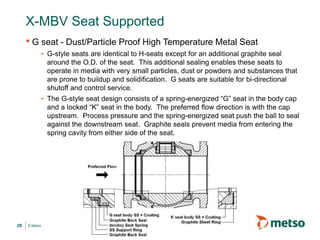
• G seat - Dust/Particle Proof High Temperature Metal Seat
- G-style seats are identical to H-seats except for an additional graphite seal
around the O.D. of the seat. This additional sealing enables these seats to
operate in media with very small particles, dust or powders and substances that
are prone to buildup and solidification. G seats are suitable for bi-directional
shutoff and control service.
- The G-style seat design consists of a spring-energized “G” seat in the body cap
and a locked “K” seat in the body. The preferred flow direction is with the cap
upstream. Process pressure and the spring-energized seat push the ball to seal
against the downstream seat. Graphite seals prevent media from entering the
spring cavity from either side of the seat.
29
© Metso
X-MBV Seat Supported
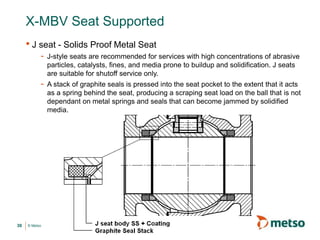
• J seat - Solids Proof Metal Seat
- J-style seats are recommended for services with high concentrations of abrasive
particles, catalysts, fines, and media prone to buildup and solidification. J seats
are suitable for shutoff service only.
- A stack of graphite seals is pressed into the seat pocket to the extent that it acts
as a spring behind the seat, producing a scraping seat load on the ball that is not
dependant on metal springs and seals that can become jammed by solidified
media.
30
© Metso
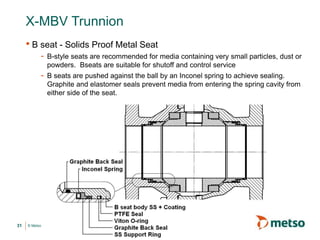
X-MBV Trunnion
• B seat - Solids Proof Metal Seat
- B-style seats are recommended for media containing very small particles, dust or
powders. Bseats are suitable for shutoff and control service
- B seats are pushed against the ball by an Inconel spring to achieve sealing.
Graphite and elastomer seals prevent media from entering the spring cavity from
either side of the seat.
31
Applications
© Metso
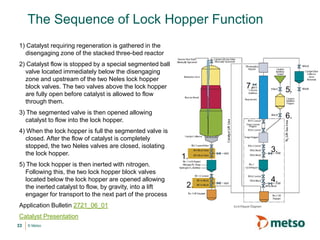
The Sequence of Lock Hopper Function
1) Catalyst requiring regeneration is gathered in the
disengaging zone of the stacked three-bed reactor
2) Catalyst flow is stopped by a special segmented ball
valve located immediately below the disengaging
zone and upstream of the two Neles lock hopper
block valves. The two valves above the lock hopper
are fully open before catalyst is allowed to flow
through them.
3) The segmented valve is then opened allowing
catalyst to flow into the lock hopper.
4) When the lock hopper is full the segmented valve is
closed. After the flow of catalyst is completely
stopped, the two Neles valves are closed, isolating
the lock hopper.
5) The lock hopper is then inerted with nitrogen.
Following this, the two lock hopper block valves
located below the lock hopper are opened allowing
the inerted catalyst to flow, by gravity, into a lift
engager for transport to the next part of the process
Application Bulletin 2721_06_01
Catalyst Presentation
1.
2.
3.
4.
5.
6.
7.
33
© Metso
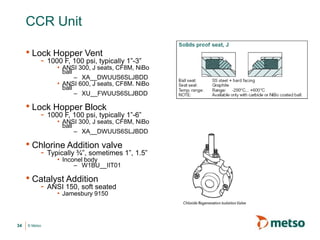
CCR Unit
• Lock Hopper Vent
- 1000 F, 100 psi, typically 1”-3”
• ANSI 300, J seats, CF8M, NiBo
ball
– XA__DWUUS6SLJBDD
• ANSI 600, J seats, CF8M. NiBo
ball
– XU__FWUUS6SLJBDD
• Lock Hopper Block
- 1000 F, 100 psi, typically 1”-6”
• ANSI 300, J seats, CF8M, NiBo
ball
– XA__DWUUS6SLJBDD
• Chlorine Addition valve
- Typically ¾”, sometimes 1”, 1.5”
• Inconel body
– W1BU__IIT01
• Catalyst Addition
- ANSI 150, soft seated
• Jamesbury 9150
34
© Metso
FCC Catalyst Addition
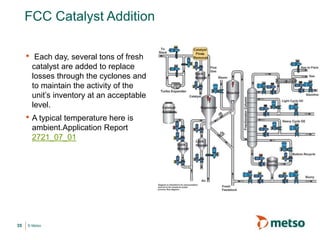
• Each day, several tons of fresh
catalyst are added to replace
losses through the cyclones and
to maintain the activity of the
unit’s inventory at an acceptable
level.
• A typical temperature here is
ambient.Application Report
2721_07_01
35
© Metso
Polymerization valve challenges
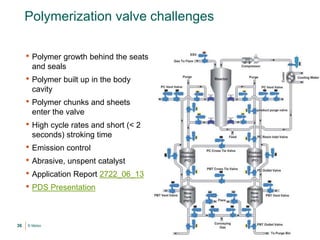
• Polymer growth behind the seats
and seals
• Polymer built up in the body
cavity
• Polymer chunks and sheets
enter the valve
• High cycle rates and short (< 2
seconds) stroking time
• Emission control
• Abrasive, unspent catalyst
• Application Report 2722_06_13
• PDS Presentation
36
© Metso
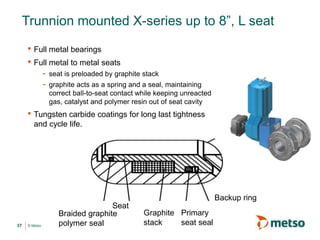
Trunnion mounted X-series up to 8”, L seat
• Full metal bearings
• Full metal to metal seats
- seat is preloaded by graphite stack
- graphite acts as a spring and a seal, maintaining
correct ball-to-seat contact while keeping unreacted
gas, catalyst and polymer resin out of seat cavity
• Tungsten carbide coatings for long last tightness
and cycle life.
Braided graphite
polymer seal
Seat
Graphite
stack
Primary
seat seal
Backup ring
37
© Metso
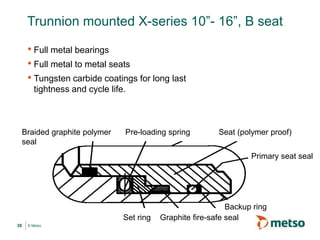
Trunnion mounted X-series 10”- 16”, B seat
• Full metal bearings
• Full metal to metal seats
• Tungsten carbide coatings for long last
tightness and cycle life.
Braided graphite polymer
seal
Pre-loading spring Seat (polymer proof)
Set ring Graphite fire-safe seal
Primary seat seal
Backup ring
38
D Series Ball Valves
D series valves are a flanged, full port,
trunnion style stemball valve that are used in
applications for shutoff and throttling service
with high pressure differentials
© Metso
D Series Ball Valves – Design Features
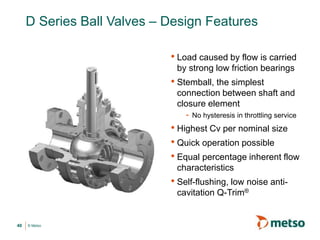
• Load caused by flow is carried
by strong low friction bearings
• Stemball, the simplest
connection between shaft and
closure element
- No hysteresis in throttling service
• Highest Cv per nominal size
• Quick operation possible
• Equal percentage inherent flow
characteristics
• Self-flushing, low noise anti-
cavitation Q-Trim®
40
© Metso
D Series Ball Valves – Standard Options
• Various ball / seat coatings
- 316 / NiBo
- 316 / chrome carbide
- 316 / tungsten carbide
- 316 / stellite
• 150# - 600# class
- 2”- 36” size
• TA-Luft live loaded gland
packing
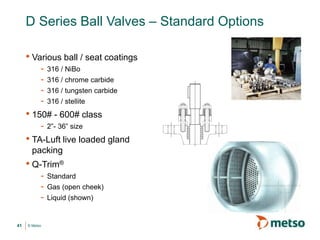
• Q-Trim®
- Standard
- Gas (open cheek)
- Liquid (shown)
41
© Metso
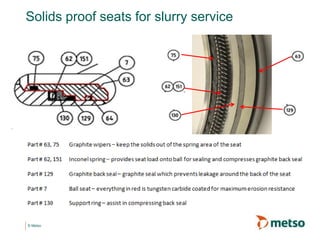
Solids proof seats for slurry service
© Metso
Solids proof seats for slurry service
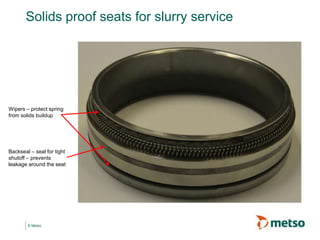
Wipers – protect spring
from solids buildup
Backseal – seal for tight
shutoff – prevents
leakage around the seat
© Metso
Solids proof seats for slurry service
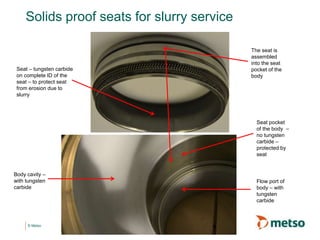
Body cavity –
with tungsten
carbide
Seat – tungsten carbide
on complete ID of the
seat – to protect seat
from erosion due to
slurry
Seat pocket
of the body –
no tungsten
carbide –
protected by
seat
Flow port of
body – with
tungsten
carbide
The seat is
assembled
into the seat
pocket of the
body
E Series
Ceramic Ball Valves
E series ceramic ball valves are one of the
most erosion resistant control valves on the
market today
© Metso
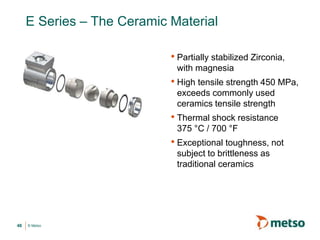
E Series – The Ceramic Material
• Partially stabilized Zirconia,
with magnesia
• High tensile strength 450 MPa,
exceeds commonly used
ceramics tensile strength
• Thermal shock resistance
375 °C / 700 °F
• Exceptional toughness, not
subject to brittleness as
traditional ceramics
46
© Metso
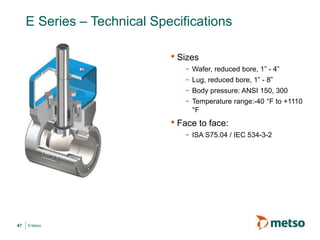
E Series – Technical Specifications
• Sizes
- Wafer, reduced bore, 1” - 4”
- Lug, reduced bore, 1” - 8”
- Body pressure: ANSI 150, 300
- Temperature range:-40 °F to +1110
°F
• Face to face:
- ISA S75.04 / IEC 534-3-2
47
Applications
© Metso
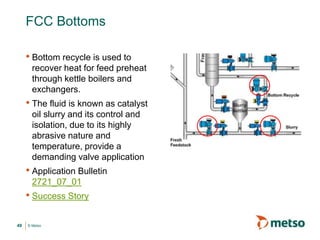
FCC Bottoms
• Bottom recycle is used to
recover heat for feed preheat
through kettle boilers and
exchangers.
• The fluid is known as catalyst
oil slurry and its control and
isolation, due to its highly
abrasive nature and
temperature, provide a
demanding valve application
• Application Bulletin
2721_07_01
• Success Story
49

Valvulas 8 Metso Ball Valves.pptx

  • 1.
  • 2.
  • 3.
  • 4.
    © Metso Ball ValveDesign Full Bore vs. Reduced Bore • Full Bore - Internal diameter of flow path is equivalent to the attached piping. A 6” full bore valve would have the same internal diameter as a 6” pipe. - Also referred to as “Full Port” or “Line Size” • Reduced Bore - Internal diameter of flow path is less than that of the attached piping. The internal parts (ball,seat etc..) are typically one valve size smaller. A 6” reduced bore valve might have 4” internals. - Also referred to as “Standard Bore” or “Standard Port” 4 Reduced Bore Full Bore
  • 5.
    © Metso Seat Supportedor Trunnion • The type of construction of metal seated ball valves can be split into two general categories, seat supported and trunnion mounted. - In a seat supported valve the ball is allowed to “float” and is held in place and supported by the seats. - The ball in a trunnion mounted valve is held in place and supported by bearings mounted in the body. 5 seat supported ball, used mainly for On/Off application due to higher friction trunnion mounted ball can be used also in control applications due to less friction Downstream Sealing Upstream Sealing
  • 6.
    © Metso Date 6 -Seat Supported (Floating Ball) • The ball is supported and held in place by the seats. - Trunnion Supported • The ball is supported and held in place by two bearings (trunnions) in the body. • Starts at 10” 7150 – 8” 9150 & 6” 9300 Seat Supported Ball Trunnion Supported Ball Ball Valve Design Seat Supported vs. Trunnion
  • 7.
    © Metso Seat Supportedor Trunnion • General Rules - Determining factors • Valve cost – Seat supported is less expensive than trunnion • Actuation cost – Trunnion valves require less torque, therefore smaller actuator, therefore less cost for the actuator • Application requirements – Some applications require one over the other » Double block and bleed – generally trunnion - Typical size ranges • ASME 150 and ASME 300 – Seat Supported up to 8” • ASME 600 – Seat supported up to 4” 7 Size Seat Supported Valve Torque (ft #) Trunnion Valve Torque (ft #) 3" 550 200 4" 1100 400 6" 3600 1000 8" 6800 2500 Approximate Torques for Metal Seated Ball Valve (750 psid)
  • 8.
    © Metso Torque SafetyFactors for Severe Service Applications • Safety Factors for Open / Close Torques - Dirty / Sticky Medium 1.50 - Liquor Applications 1.50 - Coking 1.50 - Catalyst 1.50 - Delayed Coker 2.00 - Dry Gas / Superheated Steam 1.75 - Cryogenic • 0…..……-50 °C 1.25 • -50…....-100 °C 1.50 • -100…..-175 °C 1.75 • -175…..-200 °C 2.00 8
  • 9.
    © Metso Ball ValveDesign Soft Seats vs Metal Seats 9 General Rules of Thumb for Various Process Conditions Soft Seat Metal Seat Low Pressure High Pressure Low Temp (<500°F) High Temp (>500°F) Clean Media Abrasive Media Bubble Tight Not Bubble Tight Low Velocity High Velocity On/Off Control
  • 10.
  • 11.
  • 12.
    © Metso 12 Series 5H ½”– 2” 3A/3C ½”- 2” Series 6F ½” – 3” Series 100 ½”- 2” Series 3000 ¼” – 2”
  • 13.
    © Metso 13 Series 5H ½”– 2” 3A/3C ½”- 2” Series 6F ½” – 3” Series 100 ½”- 2” Series 3000 ¼” – 2” Xtreme® seats not available Flexible lip seat design except for Series 100 Bonnets are not ISO mount No live loaded stems Material options are limited Box quantities
  • 14.
    © Metso ¼” –2” Platform Products 14 ½” – 2” 7000 ½” – 1 ½” 9000 ¼” – 2” Eliminator ¼” – 2” A-Style ½” – 2” Standard-Bore ½” – 1 ½” Full-Bore 4000 Series
  • 15.
    © Metso Platform Products PatentedStem Seal • Tri-Seal: (3) Zones of contact promote tight sealing • Stem is fully guided so leak paths don’t form during operation • Fugitive emission tested to ISO/CD 15848 meeting Class BH requirements • Stem seal adjustments eliminated after thermal and pressure cycles 15
  • 16.
    © Metso Platform Products Live-LoadedStem Seal • Corrosion resistant stainless steel washers store energy so stem seal accommodates more cycles without requiring adjustment • Compression plate design for ease of adjustment • Stem bearings manage thrust loads so there is no metal to metal contact 16 Bearings and Emergency Stem Seal Bellville Washers
  • 17.
    © Metso 17 Platform Products PatentedStem Seal Offers Best Performance Typical stem seal cycle life Frequency of adjustment Seat leakage Apollo 2,000 - 6,000 Continuous None Xomox 20,000 - 35,000 Several None Kitz 3,000 - 3,500 Several 2,000 cycles KTM 40,000 - 70,000 Infrequent None Velan 500 - 5,000 Continuous ??? Stem broke Milwaukee 1,500 Infrequent None New Jamesbury Valves 200,000 - 700,000 Infrequent None
  • 18.
    © Metso Platform Products IntegratedLinkage Designs for Automation • Linkage is all stainless steel for corrosion resistance and appearance • Coupling self aligns • Coupling is high strength 17-4 PH stainless steel for precise open & close position 18
  • 19.
    © Metso Performance Benefitsof XTREME® • XTREME® provides improved seat recovery and material properties leading to: - Pressure-temperature rating capabilities formerly only achievable by our PEEK seat offering in Ball Valves - Pressure-temperature rating capabilities only achievable by Metal Seated butterfly valves for Wafer-Sphere® applications - Improved performance under pressure cycling and thermal cycling - Wide application range due to excellent chemical resistance - Lower permeability than filled PTFE resulting in less pores and a better molded surface finish - Material will match or exceed the chemical resistance of filled PTFE in any application - Operating torques are consistent with filled PTFE - Material abrasion resistance is consistent with filled PTFE material - FDA approved for repeat use in contact with food 19
  • 20.
    © Metso XTREME® Achievement SeatRecovery Affects Sealing • Seat performance is optimal when the seat returns to its original shape after loading • Recovery maintains a tight seal • The amount the seat recovers determines: - Maximum pressure rating - Cycle life of seat • XTREME® keeps its original shape longer! 20 DISC SEAT BODY INSERT Seat Body Ball Flexure
  • 21.
    © Metso XTREME® Achievement •Improved seat recovery = improved sealing + longer life • 2” 4000 Series with a 2500 lb. load • Improved seat recovery = improved tightness under pressure and thermal cycling 21
  • 22.
    © Metso XTREME® Achievement •P-T Ratings for 4000 Series Model B and Eliminator™ Ball Valves 22 Temperature (F) 0 200 400 600 800 1000 1200 1400 0 100 200 300 400 500 600 Pressure (psi) PTFE MTFE XTREME® PEEK Pressure (Bar) 30 20 10 50 100 150 200 250 Temperature ºC Saturated Steam 80 70 60 50 40
  • 23.
  • 24.
    © Metso Neles® BallValve Offering • X-MBV - Seat supported or trunnion style - Full and standard bore - ANSI 150, 300, 600 • D series - Stemball, trunnion style - ANSI 150, 300, 600 • Ceramic - Reduced bore, wafer and lug styles - ANSI 150, 300 • S5 / S6 - ANSI 600 – ANSI 4500 - Barstock Valve • Y4 & MBV - Coker valves 24
  • 25.
  • 26.
    © Metso X-MBV BallValves - Product Offering • X-MBV ball valves handle a variety of liquids and gases, especially where high- temperature, high-pressure, or abrasion are problems. • Primarily used in chemical, petrochemical, power, and refinery applications • Seat Supported - Full Bore • ANSI 150 (XT) 1” – 8” • ANSI 300 (XA) 1” – 8” • ANSI 600 (XU) 1” – 4” - Reduced Bore • ANSI 150 (XB) 2” – 8” • ANSI 300 (XC) 2” – 8” • Trunnion Supported - Full Bore • ANSI 150 (XM) 8” - 16” • ANSI 300 (XG) 2” – 16” 26
  • 27.
    © Metso X-MBV –Product Features • Splined ball/stem connection - Spline driver • Accurate operation • Maximizes torque transmission • TA-Luft live-loaded gland packing - Clean air act • Low noise Q-Ball® trim - Noise reduction of up to 20 dBA - Self cleaning and non-clogging - High capacity and rangeability 27
  • 28.
    © Metso X-MBV SeatSupported • H seat - High Temperature Metal Seat - H-style seats are the standard offering for seat supported X-MBV valves and are suitable for a wide range of applications in liquids and gases over a broad temperature range. They perform well in media containing low to medium solids concentration as long as particle size is not too small (fine powders). H seats are suitable for bi-directional shutoff and control service. - The H-style seat design consists of a spring-energized “H” seat in the body cap and a locked “K” seat in the body. The preferred flow direction is with the cap upstream. Process pressure and the spring-energized seat push the ball to seal against the downstream seat. 28
  • 29.
    © Metso X-MBV SeatSupported • G seat - Dust/Particle Proof High Temperature Metal Seat - G-style seats are identical to H-seats except for an additional graphite seal around the O.D. of the seat. This additional sealing enables these seats to operate in media with very small particles, dust or powders and substances that are prone to buildup and solidification. G seats are suitable for bi-directional shutoff and control service. - The G-style seat design consists of a spring-energized “G” seat in the body cap and a locked “K” seat in the body. The preferred flow direction is with the cap upstream. Process pressure and the spring-energized seat push the ball to seal against the downstream seat. Graphite seals prevent media from entering the spring cavity from either side of the seat. 29
  • 30.
    © Metso X-MBV SeatSupported • J seat - Solids Proof Metal Seat - J-style seats are recommended for services with high concentrations of abrasive particles, catalysts, fines, and media prone to buildup and solidification. J seats are suitable for shutoff service only. - A stack of graphite seals is pressed into the seat pocket to the extent that it acts as a spring behind the seat, producing a scraping seat load on the ball that is not dependant on metal springs and seals that can become jammed by solidified media. 30
  • 31.
    © Metso X-MBV Trunnion •B seat - Solids Proof Metal Seat - B-style seats are recommended for media containing very small particles, dust or powders. Bseats are suitable for shutoff and control service - B seats are pushed against the ball by an Inconel spring to achieve sealing. Graphite and elastomer seals prevent media from entering the spring cavity from either side of the seat. 31
  • 32.
  • 33.
    © Metso The Sequenceof Lock Hopper Function 1) Catalyst requiring regeneration is gathered in the disengaging zone of the stacked three-bed reactor 2) Catalyst flow is stopped by a special segmented ball valve located immediately below the disengaging zone and upstream of the two Neles lock hopper block valves. The two valves above the lock hopper are fully open before catalyst is allowed to flow through them. 3) The segmented valve is then opened allowing catalyst to flow into the lock hopper. 4) When the lock hopper is full the segmented valve is closed. After the flow of catalyst is completely stopped, the two Neles valves are closed, isolating the lock hopper. 5) The lock hopper is then inerted with nitrogen. Following this, the two lock hopper block valves located below the lock hopper are opened allowing the inerted catalyst to flow, by gravity, into a lift engager for transport to the next part of the process Application Bulletin 2721_06_01 Catalyst Presentation 1. 2. 3. 4. 5. 6. 7. 33
  • 34.
    © Metso CCR Unit •Lock Hopper Vent - 1000 F, 100 psi, typically 1”-3” • ANSI 300, J seats, CF8M, NiBo ball – XA__DWUUS6SLJBDD • ANSI 600, J seats, CF8M. NiBo ball – XU__FWUUS6SLJBDD • Lock Hopper Block - 1000 F, 100 psi, typically 1”-6” • ANSI 300, J seats, CF8M, NiBo ball – XA__DWUUS6SLJBDD • Chlorine Addition valve - Typically ¾”, sometimes 1”, 1.5” • Inconel body – W1BU__IIT01 • Catalyst Addition - ANSI 150, soft seated • Jamesbury 9150 34
  • 35.
    © Metso FCC CatalystAddition • Each day, several tons of fresh catalyst are added to replace losses through the cyclones and to maintain the activity of the unit’s inventory at an acceptable level. • A typical temperature here is ambient.Application Report 2721_07_01 35
  • 36.
    © Metso Polymerization valvechallenges • Polymer growth behind the seats and seals • Polymer built up in the body cavity • Polymer chunks and sheets enter the valve • High cycle rates and short (< 2 seconds) stroking time • Emission control • Abrasive, unspent catalyst • Application Report 2722_06_13 • PDS Presentation 36
  • 37.
    © Metso Trunnion mountedX-series up to 8”, L seat • Full metal bearings • Full metal to metal seats - seat is preloaded by graphite stack - graphite acts as a spring and a seal, maintaining correct ball-to-seat contact while keeping unreacted gas, catalyst and polymer resin out of seat cavity • Tungsten carbide coatings for long last tightness and cycle life. Braided graphite polymer seal Seat Graphite stack Primary seat seal Backup ring 37
  • 38.
    © Metso Trunnion mountedX-series 10”- 16”, B seat • Full metal bearings • Full metal to metal seats • Tungsten carbide coatings for long last tightness and cycle life. Braided graphite polymer seal Pre-loading spring Seat (polymer proof) Set ring Graphite fire-safe seal Primary seat seal Backup ring 38
  • 39.
    D Series BallValves D series valves are a flanged, full port, trunnion style stemball valve that are used in applications for shutoff and throttling service with high pressure differentials
  • 40.
    © Metso D SeriesBall Valves – Design Features • Load caused by flow is carried by strong low friction bearings • Stemball, the simplest connection between shaft and closure element - No hysteresis in throttling service • Highest Cv per nominal size • Quick operation possible • Equal percentage inherent flow characteristics • Self-flushing, low noise anti- cavitation Q-Trim® 40
  • 41.
    © Metso D SeriesBall Valves – Standard Options • Various ball / seat coatings - 316 / NiBo - 316 / chrome carbide - 316 / tungsten carbide - 316 / stellite • 150# - 600# class - 2”- 36” size • TA-Luft live loaded gland packing • Q-Trim® - Standard - Gas (open cheek) - Liquid (shown) 41
  • 42.
    © Metso Solids proofseats for slurry service
  • 43.
    © Metso Solids proofseats for slurry service Wipers – protect spring from solids buildup Backseal – seal for tight shutoff – prevents leakage around the seat
  • 44.
    © Metso Solids proofseats for slurry service Body cavity – with tungsten carbide Seat – tungsten carbide on complete ID of the seat – to protect seat from erosion due to slurry Seat pocket of the body – no tungsten carbide – protected by seat Flow port of body – with tungsten carbide The seat is assembled into the seat pocket of the body
  • 45.
    E Series Ceramic BallValves E series ceramic ball valves are one of the most erosion resistant control valves on the market today
  • 46.
    © Metso E Series– The Ceramic Material • Partially stabilized Zirconia, with magnesia • High tensile strength 450 MPa, exceeds commonly used ceramics tensile strength • Thermal shock resistance 375 °C / 700 °F • Exceptional toughness, not subject to brittleness as traditional ceramics 46
  • 47.
    © Metso E Series– Technical Specifications • Sizes - Wafer, reduced bore, 1” - 4” - Lug, reduced bore, 1” - 8” - Body pressure: ANSI 150, 300 - Temperature range:-40 °F to +1110 °F • Face to face: - ISA S75.04 / IEC 534-3-2 47
  • 48.
  • 49.
    © Metso FCC Bottoms •Bottom recycle is used to recover heat for feed preheat through kettle boilers and exchangers. • The fluid is known as catalyst oil slurry and its control and isolation, due to its highly abrasive nature and temperature, provide a demanding valve application • Application Bulletin 2721_07_01 • Success Story 49

Editor's Notes

  • #18 In the process of redesigning the products, we also took the opportunity to improve ourselves against the competition. The competition had caught-up to us. The number one cause of customer complaints was leaking stem seals. We came-up with a new design that has multiple sealing zones, and applied for a patent. It came as a surprise to us how well our platform series works. The operational life blows-away anything else available in the market, and it costs us less to manufacture them.
  • #20 No notes required.
  • #59 The top coking facilities are continually optimizing operations to increase flexibility for processing a variety of feedstocks, while maximizing higher-valued liquid and gas products. Equally critical in daily operations is the emphasis on maintaining a safe and reliable processing unit. The heater is designed to raise residual stock temperatures above coking point without significant coke formation in the heaters. This required high velocities in the heaters. The coking happens in the surge drums. The most common feedstock is vacuum resid. Other feed streams can also be used, like visbroke tar, atmospheric residue, slurry oil, hydrotreated resid, tar sand, SDA or ROSE unit pitches. Feedstock composition has significant impact on the quality of coke produced. All the heavy metals are incorporated as contaminants in the coke. The quality of petroleum coke is classified into three categories: fuel grade, anode, and premium coke (needle coke).
  • #62 The entire coking process is typically grouped into three general sections – furnace and fractionation, coke drum and coke handling, and the closed blowdown areas. The exact configuration will vary depending on refinery’s specific design strategy and existing processing capabilities.