B Y - D R . R A N A C H I K H A L E
CALCIUM
METABOLISM
CONTENT
1. Introduction
2. History
3. Distribution in body
4. Daily requirement
5. Sources
6. Absorption – active , passive
7. Factors promoting absorption
8. Factors inhibiting absorption
9. Excretion
10. Effect of Excess/ Low Calcium Level
11. Functions
12. Homeostasis of plasma calcium-calcium balance
Parathormone
Vit D3
Calcitonin
13. Role in orthodontic tooth movement
INTRODUCTION
 Calcium is among the seven principal elements
(macroelements).
 Of which calcium is the most abundant.
 Calcium is an important component of a healthy diet
and a mineral necessary for life.
 It has role in Orthodontic tooth movement
HISTORY
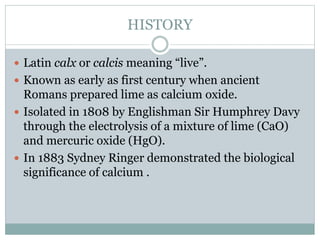
 Latin calx or calcis meaning “live”.
 Known as early as first century when ancient
Romans prepared lime as calcium oxide.
 Isolated in 1808 by Englishman Sir Humphrey Davy
through the electrolysis of a mixture of lime (CaO)
and mercuric oxide (HgO).
 In 1883 Sydney Ringer demonstrated the biological
significance of calcium .
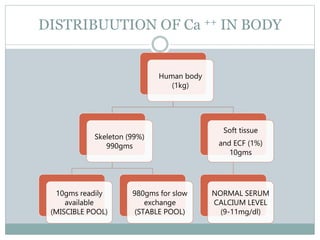
DISTRIBUUTION OF Ca ++ IN BODY
Human body
(1kg)
Skeleton (99%)
990gms
10gms readily
available
(MISCIBLE POOL)
980gms for slow
exchange
(STABLE POOL)
Soft tissue
and ECF (1%)
10gms
NORMAL SERUM
CALCIUM LEVEL
(9-11mg/dl)
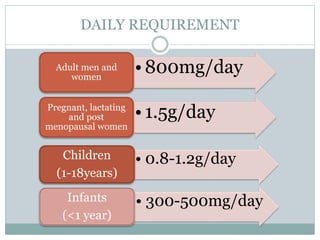
DAILY REQUIREMENT
•800mg/day
Adult men and
women
•1.5g/day
Pregnant, lactating
and post
menopausal women
• 0.8-1.2g/day
Children
(1-18years)
• 300-500mg/day
Infants
(<1 year)
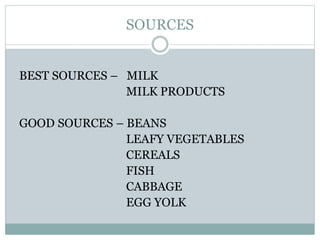
SOURCES
BEST SOURCES – MILK
MILK PRODUCTS
GOOD SOURCES – BEANS
LEAFY VEGETABLES
CEREALS
FISH
CABBAGE
EGG YOLK
ABSORPTION OF CALCIUM
Calcium absorption occurs across the intestinal wall in
the blood by 2 major mechanics:
1. Active transport (transcellularly)
2. Passive transport ( paracellularly)
Active transport of calcium is
dependent on the action of calcitriol and the
intestinal vitamin D receptor (VDR).
 Absorption of calcium at low and moderate intake
levels.
 Mostly in duodenum.
Passive diffusion or paracellular uptake
involves the movement of calcium between mucosal
cells and is dependent on luminal: serosal
electrochemical gradients.
 Occurs more readily during higher calcium intakes.
 Occurs throughout the length of the intestine.
 Mean Calcium Absorption (“fractional calcium
absorption,” which is the percentage of a given dose
of calcium that is absorbed) in men and non-
pregnant women—across a wide age range— has
been demonstrated to be approximately 25% of
calcium intake (Hunt and Johnson, 2007).
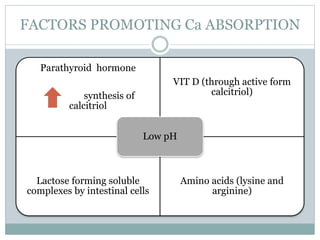
FACTORS PROMOTING Ca ABSORPTION
Parathyroid hormone
synthesis of
calcitriol
VIT D (through active form
calcitriol)
Lactose forming soluble
complexes by intestinal cells
Amino acids (lysine and
arginine)
Low pH
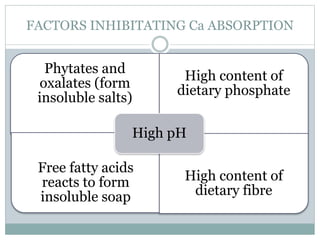
FACTORS INHIBITATING Ca ABSORPTION
Phytates and
oxalates (form
insoluble salts)
High content of
dietary phosphate
Free fatty acids
reacts to form
insoluble soap
High content of
dietary fibre
High pH
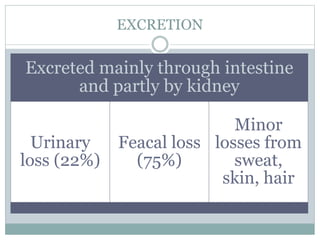
EXCRETION
Excreted mainly through intestine
and partly by kidney
Urinary
loss (22%)
Feacal loss
(75%)
Minor
losses from
sweat,
skin, hair
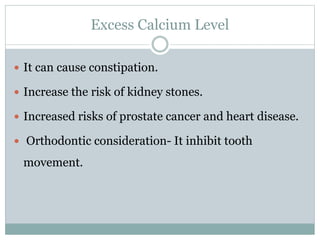
Excess Calcium Level
 It can cause constipation.
 Increase the risk of kidney stones.
 Increased risks of prostate cancer and heart disease.
 Orthodontic consideration- It inhibit tooth
movement.
Low Calcium Level
 Bone breakdown occurs as the body uses its
stored calcium to maintain normal biological
functions.
 Hypocalcemia.
 Osteoporosis.
 It can also cause rickets.
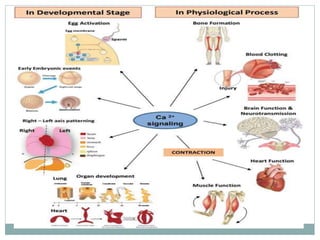
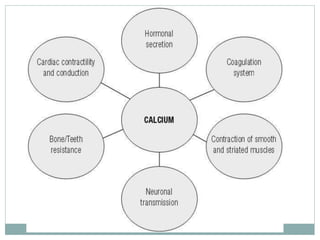
FUNCTIONS
BONE
 Mineralisation of Bones and teeth.
 Bone is a mineralized connective tissue.
 It contains organic (collagen – protein) and
inorganic (mineral) component, HYDROXY
APATITE, Ca10(Po4)6 (OH)2.
MUSCLE CONTRACTION
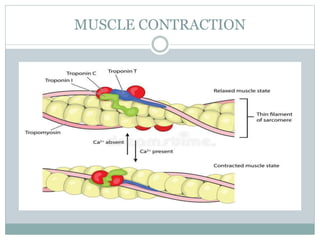
 controlled by tropomyosin binding to actin filaments and
three types of troponin (troponin I, C, and T).
 Troponin C is a calcium-binding protein.
 In the normal state, the Ca2+ concentration in the cytoplasm
is maintained at low levels. As Ca2+ will not bind to troponin C
in this state, the myosin binding site present in actin will be
covered by regulatory proteins. For this reason, the myosin
head is unable to bind to the actin filament, which means that
muscle contraction cannot occur.
 However, when the Ca2+ concentration in the cytoplasm rises,
Ca2+ binds to troponin C and changes its structure. As a result,
the myosin-binding site is exposed, allowing actin and myosin
to bind, thus causing muscle contraction
BLOOD COAGULATION
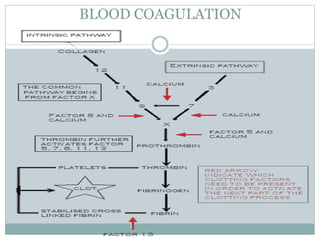
 Calcium is known as factor IV in blood coagulation
cascade.
 Prothrombin contains gamma carboxyl glutamate
residue which are chelated by calcium during the
thrombin formation.
NEURAL TRANSMISSION
necessary for transmission of nerve impulses from pre-synaptic to post –
synaptic region.
 When the action potential conducting along the
nerve reaches the synapse adhered to muscle cells,
the voltage-dependent Ca2+ channel distributed in
the synaptic membrane open, allowing Ca2+ to flow
into the synapse.
 This Ca2+ then activates the fusion of synaptic
vesicles, which triggers the secretion of
neurotransmitters.
AS A COFACTOR
 act as a cofactor or activator of certain enzymes.
 A protein namely calmodulin is present within
cytoplasm of cells which can bind calcium.
HOMEOSTASIS OF PLASMA
CALCIUM
 Mechanism by which body maintains blood
calcium level
 CALCIUM BALANCE
The amount of calcium either stored or lost by the
body over a specific period of time.
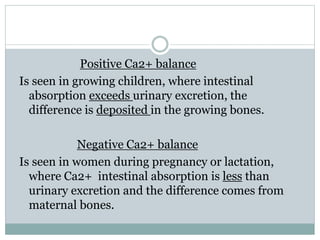
Positive Ca2+ balance
Is seen in growing children, where intestinal
absorption exceeds urinary excretion, the
difference is deposited in the growing bones.
Negative Ca2+ balance
Is seen in women during pregnancy or lactation,
where Ca2+ intestinal absorption is less than
urinary excretion and the difference comes from
maternal bones.
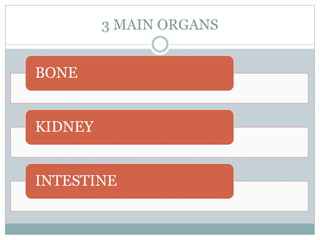
3 MAIN ORGANS
BONE
KIDNEY
INTESTINE
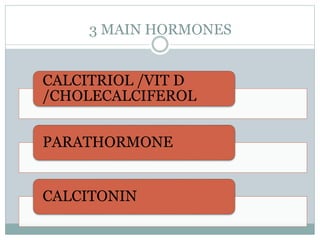
3 MAIN HORMONES
CALCITRIOL /VIT D
/CHOLECALCIFEROL
PARATHORMONE
CALCITONIN
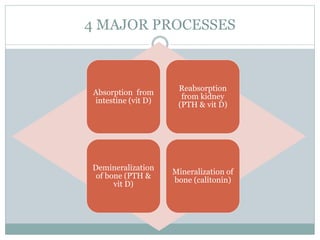
4 MAJOR PROCESSES
Absorption from
intestine (vit D)
Reabsorption
from kidney
(PTH & vit D)
Demineralization
of bone (PTH &
vit D)
Mineralization of
bone (calitonin)
Role of Parathyroid hormone
 Secreted by the chief cells of parathyroid glands.
 It is protein in nature.
 Action of Parathormone :- primary function is to
maintain the blood calcium level.
 Regulated by the Calcium ion concentration in the
blood.
 Parathormone acts through cyclic AMP, which acts
as second messenger.
EFFECT ON BONE
 Responsible for resorption of bone or calcium.
 Rapid flux of calcium from the bone fluid (occurs in
seconds).
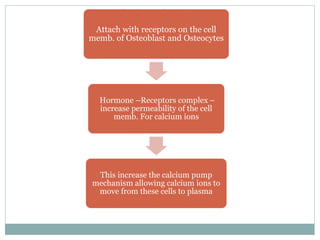
Attach with receptors on the cell
memb. of Osteoblast and Osteocytes
Hormone –Receptors complex –
increase permeability of the cell
memb. For calcium ions
This increase the calcium pump
mechanism allowing calcium ions to
move from these cells to plasma
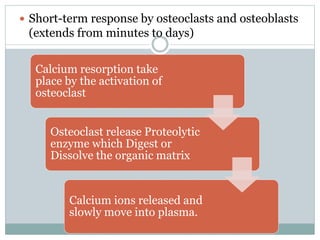
 Short-term response by osteoclasts and osteoblasts
(extends from minutes to days)
Calcium resorption take
place by the activation of
osteoclast
Osteoclast release Proteolytic
enzyme which Digest or
Dissolve the organic matrix
Calcium ions released and
slowly move into plasma.
EFFECT ON KIDNEY
 Increase the Reabsorption of Calcium from renal
tubules along with magnesium ions and hydrogen
ions.
 At the same time it also increases the excretion of
Phosphates from renal tubules.
EFFECT ON GI TRACT
 By the formation of 1,25 dihydroxy cholecalciferol
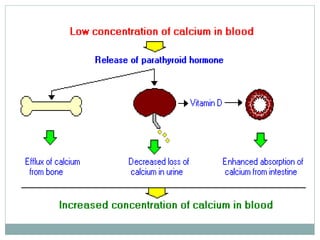
from vit-D it increase the Absorption of Calcium.
 Vit- D is essential for Ortho consideration. It
increases the tooth movement and consequently
influence orthodontic treatment.
VIT D3
 Vit. D3 with parathyroid and calcitonin hormone
regulates the amount of Ca and phosphorous in
human body.
 Parathyroid hormone convert the vit-D in its active
metabolite which is known as 1,25 Dihydroxy
cholecalciferol.
ACTION OF 1,25- DIHYDROXY
CHOLECALCIFEROL
1. absorption of calcium from the intestine.
2. synthesis of calcium induced ATP in
the intestinal epithelium.
3. synthesis of alkaline phophatase in the
intestinal epithelium.
4.interstitial Ca and phosphorous absorption’
5.bone mass and thus reduces fractures
and osteoporosis.
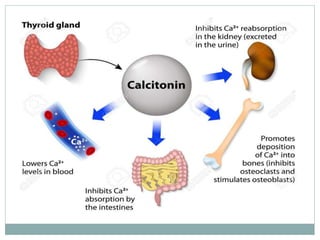
CALCITONIN
 Peptide hormone.
 secreted by intra follicular or C- cells in the thyroid
gland.
 also called Thyrocalcitonin.
ACTIONS
EFFECT ON BONE
 deposition of calcium on bones activity of
osteoclasts.
 development of new osteoclasts.
 Blood Calcium level , thereby counteracts the
action of Paratharmone. It flows in bloodstream
and attracts Ca to bone, thus reducing Serum
calcium .It reduces bone resorption by reducing the
no. of osteoclasts.
 It is used in the treatment of Hypercalcemia and
Osteoporosis
Effect on kidney
 It increase the excretion of calcium through urine,
by inhibiting the reabsorption of calcium from the
renal tubules.
Effect on intestine
 It prevent the absorption of Calcium from intestine
into the Blood.
 Orthodontic consideration- It inhibit tooth
movement and consequently delays orthodontic
treatment.
ROLE OF CALCIUM IN ORTHODONTIC
TOOTH MOVEMENT
 Orthodontic tooth movement is a unique process
where a solid object(tooth)is made to move through
a solid medium (bone) .
 When force is applied on a tooth to bring about
orthodontic movement, it result in formation of
 Area of pressure in the direction of the tooth movement.
 Area of tension form in the opposite direction.
Journal of Bone and Mineral Metabolism, 2004 Masayoshi Kawakami
and Teruko Takano-Yamamoto
 Local application of 1,25(OH)2D3 enhances the
reestablishment of supporting tissue, especially
alveolar bone of teeth, after orthodontic treatment.
Source: AJO-DO on CD-ROM, Volume 1984 May (424 - 430):
Root resorption and tooth movement in orthodontically treated, calcium-deficient, and lactating rats
- Goldie and King
 Increased tooth movement was found to correlate
directly with increased bone turnover and
decreased bone density.
 The data suggest that short-term parathyroid
hormone injection might be a potential method for
accelerating orthodontic tooth movement by
increasing the alveolar bone turnover rate.
Am J Orthod Dentofacial Orthop. 2013 Oct;144(4):523-32Effect of
parathyroid hormone on experimental tooth movement in rats.
Li F, Li G, Hu H, Liu R, Chen J, Zou S.
Quintessence Int. 2001 May;32 Tyrovola JB, Spyropoulos MN Effects of drugs and systemic
factors on orthodontic treatment
Remodeling activity are dependent on systemic
factors such as nutritional factors, metabolic bone
diseases, age, and use of drugs. Systemic hormones
such as estrogen, androgen, and calcitonin are
associated with an increase in bone mineral
content, bone mass, and a decrease in the rate of
bone resorption. Consequently, they could delay
orthodontic tooth movement.
 On the contrary, thyroid hormones and
corticosteroids might be involved in a more rapid
orthodontic tooth movement during orthodontic
therapy and have a less stable orthodontic result.
Drugs such as bisphosphonates, vitamin D
metabolites, and fluorides can probably cause a
reduction of tooth movement after the orthodontic
force is applied.
 Administration of Calcitonin reduces the root
resorption area and may therefore be effective as a
novel adjunctive orthodontic approach to diminish
undesired tooth movement via enhancing anchorage
or preventing relapse after OTM.
Effects of calcitonin on orthodontic tooth movement and associated root resorption
in rats.
Guan L, Lin S, Yan W, Chen L, Wang XActa Odontol Scand. 2017 Nov;75(8):595-602
THANK YOU !

CALCIUM METABOLISM file.pptx

  • 1.
    B Y -D R . R A N A C H I K H A L E CALCIUM METABOLISM
  • 2.
    CONTENT 1. Introduction 2. History 3.Distribution in body 4. Daily requirement 5. Sources 6. Absorption – active , passive 7. Factors promoting absorption 8. Factors inhibiting absorption
  • 3.
    9. Excretion 10. Effectof Excess/ Low Calcium Level 11. Functions 12. Homeostasis of plasma calcium-calcium balance Parathormone Vit D3 Calcitonin 13. Role in orthodontic tooth movement
  • 4.
    INTRODUCTION  Calcium isamong the seven principal elements (macroelements).  Of which calcium is the most abundant.  Calcium is an important component of a healthy diet and a mineral necessary for life.  It has role in Orthodontic tooth movement
  • 5.
    HISTORY  Latin calxor calcis meaning “live”.  Known as early as first century when ancient Romans prepared lime as calcium oxide.  Isolated in 1808 by Englishman Sir Humphrey Davy through the electrolysis of a mixture of lime (CaO) and mercuric oxide (HgO).  In 1883 Sydney Ringer demonstrated the biological significance of calcium .
  • 6.
    DISTRIBUUTION OF Ca++ IN BODY Human body (1kg) Skeleton (99%) 990gms 10gms readily available (MISCIBLE POOL) 980gms for slow exchange (STABLE POOL) Soft tissue and ECF (1%) 10gms NORMAL SERUM CALCIUM LEVEL (9-11mg/dl)
  • 7.
    DAILY REQUIREMENT •800mg/day Adult menand women •1.5g/day Pregnant, lactating and post menopausal women • 0.8-1.2g/day Children (1-18years) • 300-500mg/day Infants (<1 year)
  • 8.
    SOURCES BEST SOURCES –MILK MILK PRODUCTS GOOD SOURCES – BEANS LEAFY VEGETABLES CEREALS FISH CABBAGE EGG YOLK
  • 9.
    ABSORPTION OF CALCIUM Calciumabsorption occurs across the intestinal wall in the blood by 2 major mechanics: 1. Active transport (transcellularly) 2. Passive transport ( paracellularly)
  • 10.
    Active transport ofcalcium is dependent on the action of calcitriol and the intestinal vitamin D receptor (VDR).  Absorption of calcium at low and moderate intake levels.  Mostly in duodenum.
  • 11.
    Passive diffusion orparacellular uptake involves the movement of calcium between mucosal cells and is dependent on luminal: serosal electrochemical gradients.  Occurs more readily during higher calcium intakes.  Occurs throughout the length of the intestine.
  • 12.
     Mean CalciumAbsorption (“fractional calcium absorption,” which is the percentage of a given dose of calcium that is absorbed) in men and non- pregnant women—across a wide age range— has been demonstrated to be approximately 25% of calcium intake (Hunt and Johnson, 2007).
  • 13.
    FACTORS PROMOTING CaABSORPTION Parathyroid hormone synthesis of calcitriol VIT D (through active form calcitriol) Lactose forming soluble complexes by intestinal cells Amino acids (lysine and arginine) Low pH
  • 14.
    FACTORS INHIBITATING CaABSORPTION Phytates and oxalates (form insoluble salts) High content of dietary phosphate Free fatty acids reacts to form insoluble soap High content of dietary fibre High pH
  • 15.
    EXCRETION Excreted mainly throughintestine and partly by kidney Urinary loss (22%) Feacal loss (75%) Minor losses from sweat, skin, hair
  • 16.
    Excess Calcium Level It can cause constipation.  Increase the risk of kidney stones.  Increased risks of prostate cancer and heart disease.  Orthodontic consideration- It inhibit tooth movement.
  • 17.
    Low Calcium Level Bone breakdown occurs as the body uses its stored calcium to maintain normal biological functions.  Hypocalcemia.  Osteoporosis.  It can also cause rickets.
  • 18.
  • 21.
    BONE  Mineralisation ofBones and teeth.  Bone is a mineralized connective tissue.  It contains organic (collagen – protein) and inorganic (mineral) component, HYDROXY APATITE, Ca10(Po4)6 (OH)2.
  • 22.
  • 23.
     controlled bytropomyosin binding to actin filaments and three types of troponin (troponin I, C, and T).  Troponin C is a calcium-binding protein.  In the normal state, the Ca2+ concentration in the cytoplasm is maintained at low levels. As Ca2+ will not bind to troponin C in this state, the myosin binding site present in actin will be covered by regulatory proteins. For this reason, the myosin head is unable to bind to the actin filament, which means that muscle contraction cannot occur.  However, when the Ca2+ concentration in the cytoplasm rises, Ca2+ binds to troponin C and changes its structure. As a result, the myosin-binding site is exposed, allowing actin and myosin to bind, thus causing muscle contraction
  • 24.
  • 25.
     Calcium isknown as factor IV in blood coagulation cascade.  Prothrombin contains gamma carboxyl glutamate residue which are chelated by calcium during the thrombin formation.
  • 26.
    NEURAL TRANSMISSION necessary fortransmission of nerve impulses from pre-synaptic to post – synaptic region.
  • 27.
     When theaction potential conducting along the nerve reaches the synapse adhered to muscle cells, the voltage-dependent Ca2+ channel distributed in the synaptic membrane open, allowing Ca2+ to flow into the synapse.  This Ca2+ then activates the fusion of synaptic vesicles, which triggers the secretion of neurotransmitters.
  • 28.
    AS A COFACTOR act as a cofactor or activator of certain enzymes.  A protein namely calmodulin is present within cytoplasm of cells which can bind calcium.
  • 29.
  • 30.
     Mechanism bywhich body maintains blood calcium level  CALCIUM BALANCE The amount of calcium either stored or lost by the body over a specific period of time.
  • 31.
    Positive Ca2+ balance Isseen in growing children, where intestinal absorption exceeds urinary excretion, the difference is deposited in the growing bones. Negative Ca2+ balance Is seen in women during pregnancy or lactation, where Ca2+ intestinal absorption is less than urinary excretion and the difference comes from maternal bones.
  • 32.
  • 33.
    3 MAIN HORMONES CALCITRIOL/VIT D /CHOLECALCIFEROL PARATHORMONE CALCITONIN
  • 34.
    4 MAJOR PROCESSES Absorptionfrom intestine (vit D) Reabsorption from kidney (PTH & vit D) Demineralization of bone (PTH & vit D) Mineralization of bone (calitonin)
  • 35.
    Role of Parathyroidhormone  Secreted by the chief cells of parathyroid glands.  It is protein in nature.  Action of Parathormone :- primary function is to maintain the blood calcium level.  Regulated by the Calcium ion concentration in the blood.  Parathormone acts through cyclic AMP, which acts as second messenger.
  • 36.
    EFFECT ON BONE Responsible for resorption of bone or calcium.  Rapid flux of calcium from the bone fluid (occurs in seconds).
  • 37.
    Attach with receptorson the cell memb. of Osteoblast and Osteocytes Hormone –Receptors complex – increase permeability of the cell memb. For calcium ions This increase the calcium pump mechanism allowing calcium ions to move from these cells to plasma
  • 38.
     Short-term responseby osteoclasts and osteoblasts (extends from minutes to days) Calcium resorption take place by the activation of osteoclast Osteoclast release Proteolytic enzyme which Digest or Dissolve the organic matrix Calcium ions released and slowly move into plasma.
  • 39.
    EFFECT ON KIDNEY Increase the Reabsorption of Calcium from renal tubules along with magnesium ions and hydrogen ions.  At the same time it also increases the excretion of Phosphates from renal tubules.
  • 40.
    EFFECT ON GITRACT  By the formation of 1,25 dihydroxy cholecalciferol from vit-D it increase the Absorption of Calcium.  Vit- D is essential for Ortho consideration. It increases the tooth movement and consequently influence orthodontic treatment.
  • 42.
    VIT D3  Vit.D3 with parathyroid and calcitonin hormone regulates the amount of Ca and phosphorous in human body.  Parathyroid hormone convert the vit-D in its active metabolite which is known as 1,25 Dihydroxy cholecalciferol.
  • 43.
    ACTION OF 1,25-DIHYDROXY CHOLECALCIFEROL 1. absorption of calcium from the intestine. 2. synthesis of calcium induced ATP in the intestinal epithelium. 3. synthesis of alkaline phophatase in the intestinal epithelium. 4.interstitial Ca and phosphorous absorption’ 5.bone mass and thus reduces fractures and osteoporosis.
  • 44.
    CALCITONIN  Peptide hormone. secreted by intra follicular or C- cells in the thyroid gland.  also called Thyrocalcitonin.
  • 45.
    ACTIONS EFFECT ON BONE deposition of calcium on bones activity of osteoclasts.  development of new osteoclasts.  Blood Calcium level , thereby counteracts the action of Paratharmone. It flows in bloodstream and attracts Ca to bone, thus reducing Serum calcium .It reduces bone resorption by reducing the no. of osteoclasts.  It is used in the treatment of Hypercalcemia and Osteoporosis
  • 46.
    Effect on kidney It increase the excretion of calcium through urine, by inhibiting the reabsorption of calcium from the renal tubules.
  • 47.
    Effect on intestine It prevent the absorption of Calcium from intestine into the Blood.  Orthodontic consideration- It inhibit tooth movement and consequently delays orthodontic treatment.
  • 49.
    ROLE OF CALCIUMIN ORTHODONTIC TOOTH MOVEMENT  Orthodontic tooth movement is a unique process where a solid object(tooth)is made to move through a solid medium (bone) .  When force is applied on a tooth to bring about orthodontic movement, it result in formation of  Area of pressure in the direction of the tooth movement.  Area of tension form in the opposite direction.
  • 50.
    Journal of Boneand Mineral Metabolism, 2004 Masayoshi Kawakami and Teruko Takano-Yamamoto  Local application of 1,25(OH)2D3 enhances the reestablishment of supporting tissue, especially alveolar bone of teeth, after orthodontic treatment.
  • 51.
    Source: AJO-DO onCD-ROM, Volume 1984 May (424 - 430): Root resorption and tooth movement in orthodontically treated, calcium-deficient, and lactating rats - Goldie and King  Increased tooth movement was found to correlate directly with increased bone turnover and decreased bone density.
  • 52.
     The datasuggest that short-term parathyroid hormone injection might be a potential method for accelerating orthodontic tooth movement by increasing the alveolar bone turnover rate. Am J Orthod Dentofacial Orthop. 2013 Oct;144(4):523-32Effect of parathyroid hormone on experimental tooth movement in rats. Li F, Li G, Hu H, Liu R, Chen J, Zou S.
  • 53.
    Quintessence Int. 2001May;32 Tyrovola JB, Spyropoulos MN Effects of drugs and systemic factors on orthodontic treatment Remodeling activity are dependent on systemic factors such as nutritional factors, metabolic bone diseases, age, and use of drugs. Systemic hormones such as estrogen, androgen, and calcitonin are associated with an increase in bone mineral content, bone mass, and a decrease in the rate of bone resorption. Consequently, they could delay orthodontic tooth movement.
  • 54.
     On thecontrary, thyroid hormones and corticosteroids might be involved in a more rapid orthodontic tooth movement during orthodontic therapy and have a less stable orthodontic result. Drugs such as bisphosphonates, vitamin D metabolites, and fluorides can probably cause a reduction of tooth movement after the orthodontic force is applied.
  • 55.
     Administration ofCalcitonin reduces the root resorption area and may therefore be effective as a novel adjunctive orthodontic approach to diminish undesired tooth movement via enhancing anchorage or preventing relapse after OTM. Effects of calcitonin on orthodontic tooth movement and associated root resorption in rats. Guan L, Lin S, Yan W, Chen L, Wang XActa Odontol Scand. 2017 Nov;75(8):595-602
  • 56.

Editor's Notes

  • #5 Na, K, Ca, Mg, Cl, Phosphorus (P), Sulfer (S)
  • #6 Role of calcium in contraction od heart, Sydney Ringer.
  • #7 It makes up to 1.9kg of body weight
  • #9 Cows milk 100mg/100ml
  • #10 At low calcium intakes calcium is mainly absorbed transcellularly, but at higher intakes an increasing proportion of calcium is absorbed by simple diffusion.
  • #15 Oxylates and phylate naturaly occring molecules in plants which binds with calcium. Can form kidney stone. Helps plants to get rid of excess calcium.
  • #18  though it is more commonly associated with vitamin D deficiency
  • #24 Low level: below 1 × 10⁻⁷ M, Ca2+ concentration in the cytoplasm rises to around 1 × 10⁻⁵ M Ca2+ flows out from the sarcoplasmic reticulum and
  • #29 Cal-modul-in Calcium Modulated Protine.
  • #34 Calcitriol- helping body to use more of the calcium found in food or supplements. Paratharmone- it is directly involved in bone, kidnet and small intestine. It stimulates release of calcium in indirect process which leads to resorbtion of bone. Calcitonin- regulates level of calcium and p in blood. Opposing the action of parathyroid Harmone
  • #36 AMP Adinosine monophosphate
  • #51 Dihydoxy colecalciferol